1 Corinthians 16:2

Greek (Tischendorf 8th ed.) 1 Corinthians 16:2 appears in the Greek New Testament. The text above is from the Tischendorf 8th edition. Each word links to its Strong’s number and a concise gloss. Click any word for its full Thayer’s Greek Lexicon entry.
Download image
Cite this verse

1 Corinthians 16:2 (World English Bible). Public Domain. Lemma interlinear Bible study tool, https://lemma.gebible.app/v/1-corinthians/16/2.

Show BibTeX & RIS
BibTeX
RIS
English Translation
On the first day of the week, let each one of you save, as he may prosper, that no collections be made when I come.
World English Bible · Public Domain
Download a study sheet

One document with this verse’s original text, its word-by-word gloss line, the meaning frame, cross-references with their text, attributed commentary, and full source and license credits — printable, and it pastes into notes with its structure intact.

This verse Autodidact and up

Study sheet (.html) Plain text (.txt)

A passage Seminary Student

Up to 50 verses in one chapter. A passage sheet keeps up to 6 commentary sources and 12 cross-references per verse, in the order this page ranks them, and says so on the sheet whenever that leaves anything out. Ask for a single verse and you get the Autodidact verse sheet above.

Everything on this page stays free to read, with no account — the sheet is a download of what is already on screen, not access to it.

Want to remove ads? Support Godless Engineer
Compare translations 3

The same verse in 3 English versions, stacked beneath the original-language interlinear above. Click any original word for its lexicon entry.

Each is an independent rendering of the whole verse — the interlinear is not word-aligned to these translations.

Highlighted words mark where these versions differ — a whole-verse word diff, not a word-by-word alignment.

  • World English Bible Public Domain
    On the first day of the week, let each one of you save, as he may prosper, that no collections be made when I come.
  • King James Version Public Domain
    Upon the first day of the week let every one of you lay by him in store, as God hath prospered him, that there be no gatherings when I come.
  • unfoldingWord Literal Text CC BY-SA 4.0
    Every first of the week, let each of you put aside, storing up from whatever he might have prospered, so that when I come, there will not be collections then.

unfoldingWord Literal Text — © unfoldingWord, licensed CC BY-SA 4.0. Word-aligned USFM3 via Door43 (git.door43.org/unfoldingWord/en_ult).

Versions to compare (up to 4)

3 of 4 selected

Show all 19 translations

Every available English version of this verse, each an independent rendering of the whole verse.

  • World English Bible Public Domain
    On the first day of the week, let each one of you save, as he may prosper, that no collections be made when I come.
  • Berean Standard Bible Public Domain
    On the first day of every week, each of you should set aside a portion of his income, saving it up, so that when I come no collections will be needed.
  • Majority Standard Bible Public Domain
    On the first day of every week, each of you should set aside a portion of his income, saving it up, so that when I come no collections will be needed.
  • King James Version Public Domain
    Upon the first day of the week let every one of you lay by him in store, as God hath prospered him, that there be no gatherings when I come.
  • American Standard Version (1901) Public Domain
    Upon the first day of the week let each one of you lay by him in store, as he may prosper, that no collections be made when I come.
  • Revised Version (1885) Public Domain
    Upon the first day of the week let each one of you lay by him in store, as he may prosper, that no collections be made when I come.
  • Geneva Bible (1599) Public Domain
    Euery first day of the weeke, let euery one of you put aside by himselfe, and lay vp as God hath prospered him, that then there be no gatherings when I come.
  • Douay-Rheims (1899) Public Domain
    On the first day of the week let every one of you put apart with himself, laying up what it shall well please him; that when I come, the collections be not then to be made.
  • Young's Literal Translation Public Domain
    on every first `day' of the week, let each one of you lay by him, treasuring up whatever he may have prospered, that when I may come then collections may not be made;
  • Literal Standard Version CC BY-SA 4.0
    on every first [day] of the week, let each one of you lay by him, treasuring up whatever he may have prospered, that when I may come then collections may not be made;
  • Unlocked Literal Bible CC BY-SA 4.0
    On the first day of the week, each of you is to put something aside and store it up as you are able. Do this so that there will be no collections when I come.
  • unfoldingWord Literal Text CC BY-SA 4.0
    Every first of the week, let each of you put aside, storing up from whatever he might have prospered, so that when I come, there will not be collections then.
  • Darby Bible Public Domain
    On [the] first of [the] week let each of you put by at home, laying up [in] whatever [degree] he may have prospered, that there may be no collections when I come.
  • World Messianic Bible Public Domain
    On the first day of every week, let each one of you save as he may prosper, that no collections are made when I come.
  • Webster's Bible Public Domain
    Upon the first day of the week, let every one of you lay by him in store, as God hath prospered him, that there be no collections when I come.
  • Free Bible Version CC BY-SA 4.0
    On the first day of the week everybody should set aside some money you've earned. I don't want there to be any collections to have to be made when I'm with you.
  • Bible in Basic English Public Domain
    On the first day of the week, let every one of you put by him in store, in measure as he has done well in business, so that it may not be necessary to get money together when I come.
  • Text-Critical English NT CC BY 4.0
    On the first day of every week, each one of you should set something aside, storing up whatever he may be prospered with, so that collections will not need to be taken when I come.
  • Tyndale New Testament (1534) Public Domain
    Vpon some sondaye let every one of you put a syde at home and laye vp what soever he thinketh mete that ther be no gaderinges when I come.

Literal Standard Version (2020), Covenant Press — licensed CC BY-SA 4.0. Text via the HelloAO Bible API (eBible.org). Unlocked Literal Bible (unfoldingWord) — licensed CC BY-SA 4.0. Text via the HelloAO Bible API (eBible.org). unfoldingWord Literal Text — © unfoldingWord, licensed CC BY-SA 4.0. Word-aligned USFM3 via Door43 (git.door43.org/unfoldingWord/en_ult). Free Bible Version, Dr. Jonathan Gallagher — licensed CC BY-SA 4.0. Text via the HelloAO Bible API (eBible.org).

Word by word

More ways to search: Search by grammar → Find every occurrence → Compare this word →

Practice this passage: Drill this verse → Learn its vocabulary →

λογίαι
logía
G3048
“collection”
Noun, Nominative, Plural, Feminine
Part of Speech
Noun
Case
Nominative
Number
Plural
Gender
Feminine
Full Thayer's Definition

Origin: from G3056 (in the commercial sense)

TDNT: 4:282,*

1. a collection a. of money gathered for the relief of the poor
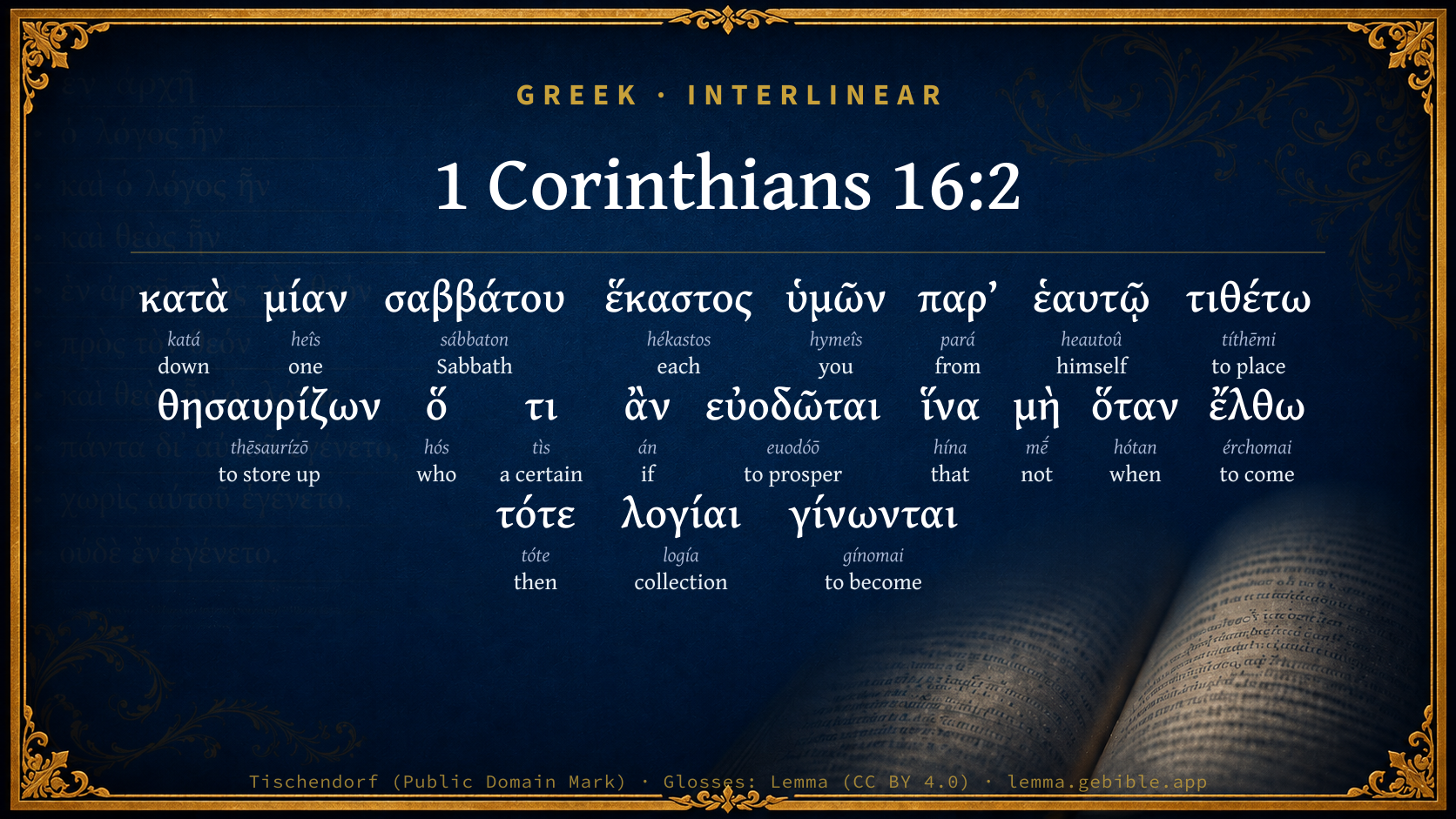
  1. κατὰ katá G2596 “down” Preposition
  2. μίαν heîs G1520 “one” Adjective, Accusative, Singular, Feminine
  3. σαββάτου sábbaton G4521 “Sabbath” Noun, Genitive, Singular, Neuter
  4. ἕκαστος hékastos G1538 “each” Adjective, Nominative, Singular, Masculine
  5. ὑμῶν hymeîs G5210 “you” Personal pronoun, 2nd person, Genitive, Plural
  6. παρ’ pará G3844 “from” Preposition
  7. ἑαυτῷ heautoû G1438 “himself” Reflexive pronoun, 3rd person, Dative, Singular, Masculine
  8. τιθέτω títhēmi G5087 “to place” Verb, Present, Active, Imperative, 3rd person, Singular
  9. θησαυρίζων thēsaurízō G2343 “to store up” Verb, Present, Active, Participle, Nominative, Singular, Masculine
  10. ὅ hós G3739 “who” Relative pronoun, Accusative, Singular, Neuter
  11. τι tìs G5100 “a certain” Indefinite pronoun, Accusative, Singular, Neuter
  12. ἂν án G302 “if” Particle
  13. εὐοδῶται euodóō G2137 “to prosper” Verb, Present, Passive, Subjunctive, 3rd person, Singular
  14. ἵνα hína G2443 “that” Conjunction
  15. μὴ mḗ G3361 “not” Particle, Negative
  16. ὅταν hótan G3752 “when” Conjunction
  17. ἔλθω érchomai G2064 “to come” Verb, Aorist, Active, Subjunctive, 1st person, Singular
  18. τότε tóte G5119 “then” Adverb
  19. γίνωνται gínomai G1096 “to become” Verb, Present, Middle or Passive deponent, Subjunctive, 3rd person, Plural

About this verse

These counts appear in no published source. They are computed here, from the morphology-tagged text and Lemma’s own curated glosses. What Lemma adds →

20
words
20
distinct lemmas
Pauline Epistles
section

Notable vocabulary

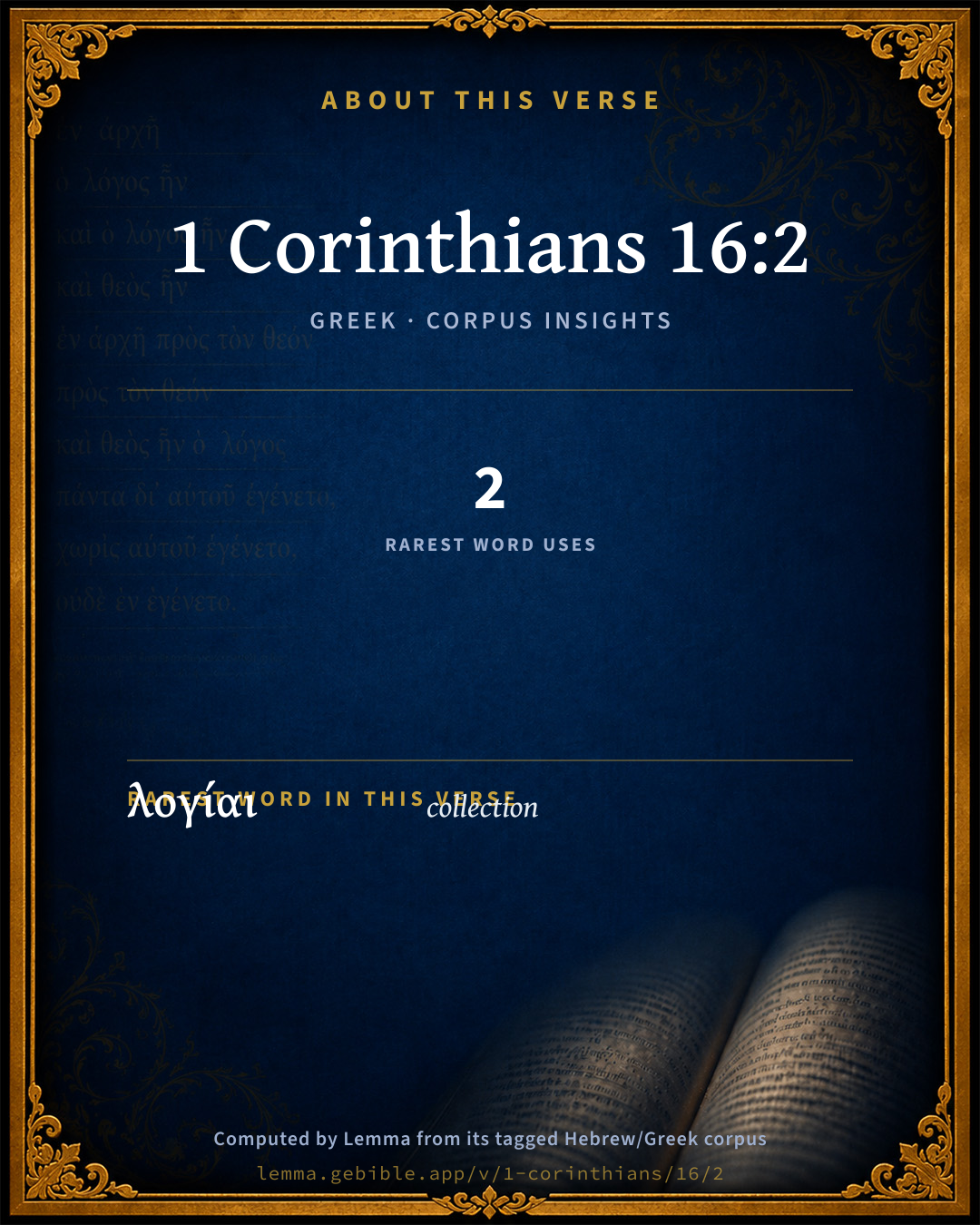
The rarest word here is λογίαι collection G3048 — appearing just 2 times in the whole Greek New Testament.

Shared distinctive vocabulary

λογίαι collection G3048 occurs in 2 verses of the Greek New Testament. Also found in:

Cross-references

20

Topical passages linked to 1 Corinthians 16:2 in the Treasury of Scripture Knowledge — connected by theme and wording, ordered by reader-vote popularity; previews shown in the World English Bible.

  • Malachi 3:9–10 You are cursed with the curse; for you rob me, even this whole nation.
  • Luke 16:10 He who is faithful in a very little is faithful also in much. He who is dishonest in a very little is also dishonest in much.
  • Acts 20:7 On the first day of the week, when the disciples were gathered together to break bread, Paul talked with them, intending to depart on the next day, and continued his speech until midnight.
  • Deuteronomy 8:18 But you shall remember Yahweh your God, for it is he who gives you power to get wealth; that he may establish his covenant which he swore to your fathers, as at this day.
  • Deuteronomy 15:11–14 For the poor will never cease out of the land: therefore I command you, saying, You shall surely open your hand to your brother, to your needy, and to your poor, in your land.
  • 2 Corinthians 9:3–5 But I have sent the brothers that our boasting on your behalf may not be in vain in this respect, that, just as I said, you may be prepared,
  • 2 Corinthians 8:1–3 Moreover, brothers, we make known to you the grace of God which has been given in the assemblies of Macedonia;
  • 2 Corinthians 8:11–15 But now complete the doing also, that as there was the readiness to be willing, so there may be the completion also out of your ability.
  • Revelation 1:10 I was in the Spirit on the Lord's day, and I heard behind me a loud voice, like a trumpet
  • Mark 12:41–44 Jesus sat down opposite the treasury, and saw how the multitude cast money into the treasury. Many who were rich cast in much.
  • Luke 24:1 But on the first day of the week, at early dawn, they and some others came to the tomb, bringing the spices which they had prepared.
  • John 20:19 When therefore it was evening, on that day, the first day of the week, and when the doors were locked where the disciples were assembled, for fear of the Jews, Jesus came and stood in the midst, and said to them, "Peace be to you."
  • Genesis 26:12 Isaac sowed in that land, and reaped in the same year one hundred times what he planted. Yahweh blessed him.
  • 2 Chronicles 31:10 Azariah the chief priest, of the house of Zadok, answered him and said, Since [the people] began to bring the offerings into the house of Yahweh, we have eaten and had enough, and have left plenty: for Yahweh has blessed his people; and that which is left is this great store.
  • Haggai 2:16–19 Through all that time, when one came to a heap of twenty measures, there were only ten. When one came to the wine vat to draw out fifty, there were only twenty.
  • Genesis 30:30 For it was little which you had before I came, and it has increased to a multitude. Yahweh has blessed you wherever I turned. Now when will I provide for my own house also?"
  • Genesis 32:10 I am not worthy of the least of all the loving kindnesses, and of all the truth, which you have shown to your servant; for with just my staff I passed over this Jordan; and now I have become two companies.
  • Genesis 33:11 Please take the gift that I brought to you; because God has dealt graciously with me, and because I have enough." He urged him, and he took it.
  • Mark 14:8 She has done what she could. She has anointed my body beforehand for the burying.
  • John 20:26 After eight days again his disciples were inside, and Thomas was with them. Jesus came, the doors being locked, and stood in the midst, and said, "Peace be to you."

Cross-references courtesy of OpenBible.info (CC BY 4.0).

Commentary

Notes on 1 Corinthians 16:2 from classic Christian and Jewish commentators (each source and its license shown beneath its notes). The classic Christian expositions comment on the surrounding passage and are grouped to its opening verse, so a note may address several verses; the Jewish commentaries on the Tanakh (Rashi and others) are per-verse, so they appear only where the commentator wrote on this verse.

Lemma curates 59 commentaries, every one of them public domain or Creative Commons licensed, each selected and text-cleaned for this edition rather than reprinted as found. About our sources →

Joseph Benson's Commentary

1Co 16:2-4. Upon the first day of the week — So κατα μιαν σαββατων

here signifies, the Hebrews using the numeral for the ordinal numbers, as Gen 1:5, The evening and the morning were one day; that is, the first day; and also using the word sabbath to denote the week, as Luk 18:12. I fast twice, του σαββατου, in the week. So Mar 16:2, πρωι της μιας σαββατων, early the first day of the week. Let every one of you lay by him in store, &c. — Not the rich only: let him also that hath little gladly give of that little, as God hath prospered him — Increasing his alms as God increases his substance. According to this lowest rule of Christian prudence, if a man, when he has or gains one pound, give a tenth to God, when he has or gains ten pounds, he will give a tenth to God; when he has or gains a hundred, he will give the tenth of this also. “And yet,” says Mr. Wesley, “I show unto you a more excellent way. He that hath ears to hear let him hear: Stint yourself to no proportion at all; but lend to God all you can.” That there be no gatherings — No necessity of making any particular collections; when I come — From these last words it is inferred that θησαυριζων, here rendered laying by him in store, signifies to put his charity into a common box; because, if they had kept it at home, there would have been need of gathering it when the apostle came. But the words εκαστος παρ’ εαυτω τιθετω, let every one place it with himself, admit not of this sense; nor, when each of them had done this, could there be any necessity of making collections; or, as that expression imports, soliciting the charities of others, but only of receiving the contributions thus laid by for the use of the saints. We may observe here, that from the beginning, the Christians were wont to assemble on the first day of the week, called by them the Lord’s day, to perform their religious worship. “This day being the Lord’s day,” saith Dionysius, bishop of Corinth, “we keep it holy.” “On Sunday,” saith Justin, “all Christians in the city or country meet together, because that is the day of our Lord’s resurrection; and then we read the writings of the prophets and apostles. This being done, the president makes an oration to the assembly, to exhort them to imitate and do the things they heard: then we all join in prayer, and after that we celebrate the Lord’s supper.” — See Whitby. And when 1 come — When I am arrived at Corinth; whomsoever ye shall approve by letters — Signed by the members of your church, or their representatives; them will I send to bring your liberality — Greek, την χαριν υμων; literally, your grace; that is, the fruit of your grace, or, your free gift, to Jerusalem, to be there distributed among the poor Christians. And if it be meet — If it be thought proper; that I also should go — Thither on this occasion; they shall go with me — That they may witness for me that no part of the money received has been withheld, but that the whole of it has been delivered with the greatest fidelity, to be employed solely for the purposes for which it was contributed.

Joseph Benson's Commentary on the Old and New Testaments (1811–1818) — public domain. Text from a community e-Sword module.

Scofield Reference Notes

C. I. Scofield

as God

1Co 16:1; 1Co 16:2 (See Scofield "2Co 8:1").

The Scofield Reference Bible (1917 edition), notes by C. I. Scofield — public domain. Text from a community e-Sword module.

Tyndale Open Study Notes

Tyndale Open Resources

16:2 Christians met on the first day of each week (see Acts 20:7) rather than the last day of the week, as in the Old Testament (Exod 20:8; 34:21; Isa 58:13-14). The first day was the “Lord’s Day,” the day of the Lord’s resurrection (Mark 16:9; Luke 24:13-15; John 20:19; Rev 1:10). • The portion of the money you have earned is not specified; Paul later encouraged them to give as generously as they could (2 Cor 8:1-4; 9:6-13; cp. Luke 12:33-34; 21:1-4; 1 Tim 6:18-19).

Tyndale Open Study Notes — © Tyndale Open Resources, licensed CC BY-SA 4.0. Text via the HelloAO Bible API.

Bengel's Gnomon

Johann Albrecht Bengel

1Co 16:2. Κατὰ μίαν, on the first day) The Lord’s day even already at that time was peculiarly observed. On the Sabbath the Jews and Christians met together; next day the latter engaged in the duties peculiar to themselves. The Sabbath is used by Synecdoche [end.] for the week; usually the form of expression is ἡ μία σαββάτων, the one, i.e., the first day of the week; but here the article is not used, in order that κατὰ may retain its distributive meaning. The advice is easily put in practice. When men give once for all, not so much is given. If [when] a man every Lord’s day has laid by something, more has been collected, than one would have given at once.—ἕκαστος, every one) even those not very rich.—παρʼ ἑαυτῷ, by himself) apart, that it may appear, what he himself lays by; whether others lay by more sparingly or more liberally than he does. The Corinthians had not yet a common treasury in the Church.—τιθέτω, let him lay by) at the public meeting.—θησαυρίζων, in store) plentifully, a pleasant word, 1Ti 6:19.—εὐοδῶται, it may be convenient)[154] according as one’s mind is willing and one’s means are easy. It is a matter of Christian prudence to put in practice, according as your circumstances enable you, what is inculcated at Ecc 9:10; 1Sa 10:7.—ἵνα μὴ, that not) This is by way of anticipation [occupatio[155]], that they may not think it necessary to have a collection also at that time, and in like manner there is boldness of speech, as much as to say, I will certainly not pass you over.—ὅταν ἔλθω, when I come) It would neither be pleasant for Paul nor for the Corinthians to do this in his presence. Now, says he, you will act the more generously; then, we shall attend to other matters.—λογίαι, gatherings, collections) This term, a less agreeable one, advises them not to delay.

[154] So Vulg. “Quod ei placuerit.” But Engl. Ver. “As God hath prospered him.”

[155] See App.

Bengel's Gnomon of the New Testament — English translation (T&T Clark, Edinburgh, 1860) — public domain. Text from a community e-Sword module.

Meyer's Critical & Exegetical Commentary

Heinrich August Wilhelm Meyer

1Co_16:2. Κατὰ μίαν σαββάτου] on each first day of the week. A Hebraism very common in the New Testament, in accordance with the Jewish custom of designating the days of the week by אחר בשבת, שּׁני בשבת, etc. Lightfoot, Hor. ad Mat_28:1. The singular of σαββ. also means week, as in Mar_16:9; Luk_18:12.

It does not, indeed, follow from this passage in itself that the Sunday was already observed at that time by assemblies for the worship of God, although this is to be assumed from other indications (see regarding this on Act_20:7); for παρʼ ἑαυτῷ τιθέτω cannot refer to the laying down of money in the assembly (Estius, Bengel, Mosheim, al.); but no doubt it does show that to the Christian consciousness it was a holy day in whose consecration the appropriateness of such works of love was felt, τὰ γὰρ ἀπόῤῥητα ἀγαθὰ καὶ ἡ ῥίζα καὶ ἡ ἀρχὴ τῆς ζωῆς ἡμετέρας ἐν ταύτη γέγονεν, Chrysosto.

παρʼ ἑαυτῷ τιθέτω κ.τ.λ.] let him lay up in store at home whatever (quodcunque) he succeeds in, i.e. if he has success in anything, let him lay it up (i.e. what has been gained thereby), comp. expressions such as in Joh_12:5; Mat_19:21, etc. Comp. Herod. vi. 73: Κλεομένεϊ εὐωδώθη τὸ πρῆγμα. Sir_11:16; Sir_38:14; Sir_41:1; Tob_4:19; 3Jn_1:2. To supply θησαυρίζειν after εὐοδ. (Hofmann) is superfluous. Explanations such as quod ei placuerit (Vulgate,[103] Erasmus, Paraphr., Luther, al.), and that of Billroth and Rückert, following older interpreters: what is possible for him without burdening himself, are not in accordance with the literal sense of εὐοδόω (see on Rom_1:10). ΠΑΡʼ ἙΑΥΤῷ: at home, chez lui, see on Luk_24:12. Loesner, Obss. p. 297. θησαυρίζων: paulatim cumulum aliquem faciens, Grotiu.

ἽΝΑ ΜῊ Κ.Τ.Λ.] in order that gatherings be not made, when I shall have come. The collection was to be then so far already made, that every one would only have to produce what he had already gathered together week by week out of his profits in trade. By this whole injunction Paul doubtless had in view both the enlargement and the acceleration in due season of the collection.

[103] The Vulgate, perhaps, may have read εὐδοκῇ. Comp. the Gothic: thatei vili (what he will).

Meyer — Critical and Exegetical Commentary on the New Testament — English translation by Peter Christie, edited by Frederick Crombie (T&T Clark, 1880) — public domain. Text from a community e-Sword module.

Expositor's Greek Testament

ed. W. Robertson Nicoll

1Co 16:2 rehearses the rule previously laid down for Galatia: “On every first (day) of the week let each of you by himself (= at home) lay up, making a store (of it), whatever he may be prospered in”. μίαν σαββάτου ’ echäd shabbath or bashshabbâth according to Hebrew idiom (see parls.) for the days of the week, the term κυριακὴ ἡμέρα (Rev 1:10 ) not being yet current, while the heathen name ( dies solis ) is avoided. The earliest mention of this Christian day, going to show that the First Day, not the Sabbath, was already the Sacred Day of the Church ( cf. Act 20:7 ), appropriate therefore for deeds of charity ( cf. Mat 12:12 ). παρʼ ἑαυτῷ , apud se, chez lui (see parls). θησαυρίζων , “making a treasure,” describes each householder “paulatim cumulum aliquem faciens” (Gr [2608] ), till at the end the accumulated store should be paid over. εὐοδῶται (from εὖ and ὁδός , to send well on one’s way ) is pr [2609] sbj [2610] , with ἂν of contingency and ὅ , τι in acc [2611] of specification: any little superfluity that Providence might throw in a Cor [2612] Christian’s way, he could put into this sacred hoard (cf. 2Co 8:12 ). Many in this Church were slaves, without wages or stated income. The Vg [2613] renders, “quod si bene placuerit,” as though reading ὅ , τι ἐὰν εὐδοκῃ ; and Bg [2614] wrongly, “quod commodum sit”. ἵνα μή , ὅταν ἔλθω , τότε κ . τ . λ .: “that there may not be, when I come, collections going on then”. P. would avoid the unseemliness and the difficulty of raising the money suddenly, at the last moment; and he wishes when he comes to be free to devote himself to higher matters ( cf. Act 6:2 ) “tunc alia agens” (Bg [2615] ).

[2608] Greek, or Grotius’ Annotationes in N.T.

[2609] present tense.

[2610] subjunctive mood.

[2611] accusative case.

[2612] Corinth, Corinthian or Corinthians.

[2613] Latin Vulgate Translation.

[2614] Bengel’s Gnomon Novi Testamenti.

[2615] Bengel’s Gnomon Novi Testamenti.

The Expositor's Greek Testament, edited by W. Robertson Nicoll (1897–1910) — public domain. Text from a community e-Sword module.

International Critical Commentary

2. κατὰ μίαν σαββάτου. ‘On every first day of the week.’ The expression is Hebraistic; Mar 16:2; Luk 24:1; Joh 20:1, Joh 20:19; Act 20:7. For the sing. σάββατον = ‘week,’ Luk 18:12; [Mar 16:9]. This is our earliest evidence respecting the early consecration of the first day of the week by the Apostolic Church. Apparently, the name ‘Lord’s Day’ was not yet in use, and the first day of the week is never called ‘the sabbath’ in Scripture. If it was right to do good on the Jewish sabbath (Mat 12:12; Mar 3:4), how much more on the Lord’s Day? καὶ γὰρ ἡ ἡμέρα ἱκανὴ ἦν ἀγαγεῖν εἰς ἐλεημοσύνην, for it reminded them of the untold blessings which they had received (Chrys.). Hastings, DB. 3. p. 140; D. Chr. Ant. 2. p. 2031; Knowling, Test. of St Paul to Christ, pp. 281 f.

ἕκαστος ὑμῶν. It is assumed that every one, however poor, will give something; but the giving is to be neither compulsory nor oppressive. Some of them would be slaves.

παρʼ ἑαυτῷ τιθέτω θησαυρίζων. This cannot mean, ‘Let him assign a certain sum as he is disposed, and put it into the Church treasury.’ It is improbable that at that time there was any Church treasury, and not until much later was money collected during public worship. Each is to lay by something weekly ‘in his own house, forming a little hoard, which will become a heavenly treasure’ (Mat 6:19-21; Luk 12:21). Chrysostom says that the accumulation was to be made in private, because the additions might be so small that the donor would be ashamed to make them in the congregation. The Apostle virtually says, ‘Become a guardian of holy possessions, a self-elected steward of the poor’—γενοῦ φύλαξ χρημάτων ἱερῶν, αὐτοχειροτόνητος οἰκονόμος πενήτων.*

ὅ τι ἂν εὐοδῶται. ‘Whatsoever he may prosper in,’ ‘whatever success he may have,’ ‘whereinsoever he is prospered by God’; quod pro Dei benignitate licuerit (Beza). The idea of a prosperous journey (ὁδός) has dropped out of the word. The verb is frequent in this more general sense in LXX, especially in Chronicles, Daniel, and Tobit: comp. the Testaments, Judah 1:6; Gad. 7:1. It is not certain what tense εὐοδωται is. WH. (ii. App. p. 172) decide for the perfect; either εὐόδωται, perf. indic., or εὐοδῶται, a very rare perf. mid. subjunctive. J. H. Moulton (Gr. 1. p. 54) follows Blass and Findlay in deciding for the pres. subj., which seems to be more probable. In any case, the meaning is that the amount is to be fixed by the giver in proportion to his weekly gains; and there is no dictation as to the right proportion, whether a tenth, or more, or less. A tenth is little for some, impossible for others; but week by week each would see how much or how little he had got, and would act accordingly.

ἵνα μὴ ὅταν ἔλθω τότε λογίαι γίνωνται. ‘So that, whenever I come, collections may not be going on then.’† Each will have his contribution ready, instead of having to decide at the last moment how much he ought to give, and how the money is to be found. St Paul does not wish to go round begging, when he comes; he will have other things to do. Moreover, he does not wish to put pressure upon them by asking in person (2Co 9:7): he desires to leave them quite free. The τότε is emphatic; ‘then’ would be the worst possible time.

σαββάτων (K L M) is an obvious correction of the less usual σαββάτου (A B C D E F G L P): א* has σαββατω. For ἄν, B I2 M have ἐάν. εὐοδῶται (א* B D E F G L P) is to be preferred to εὐοδωθῇ (A C I2 K M). Vulg. has quod ei bene placuerit, which seems to imply a reading ὅ τι ἐὰν εὐδοκῇ, and Latin translations of Chrus. have quod sibi videatur or videbitur. ὅταν εὐοδῶται is pure conjecture.

International Critical Commentary — older volumes (1896–1929), various authors — public domain. Text from a community e-Sword module.

Hodge's Commentary on Romans, Ephesians & First Corinthians

Charles Hodge

1Co_16:2

Upon the first (day) of the week let every one of you lay by him in store, as (God) hath prospered him, that there be no gatherings when I come.

The collection was to be made every Lords day; every one was to contribute; and the contributions were to be in proportion to the means of the giver. These are the three principles which the apostle had established among the churches of Galatia, and which he urged the Corinthians to adopt. Upon the first day of the week, literally, upon one of the Sabbath, according to the Jewish method of designating the days of the week. The Hebrew word, sabbath (rest), is used not only in the singular, but also in the plural form, both for the seventh day, and for the whole week, Luk_18:12. That the first day of the week was, by divine appointment, made the sacred day for Christians, may be inferred.

1. From the distinction put upon that day by our Lord himself, Joh_20:19, Joh_20:26.

2. From the greatness of the event which its observance was intended to commemorate. The sanctification of the seventh day of the week was intended to keep in mind the great truth of the creation of the world, on which the whole system of revealed religion was founded; and as Christianity is founded on the resurrection of Christ, the day on which Christ rose became for that reason the Christian Sabbath.

3. From its being called by the apostle John the Lords day, i.e. the day set apart for the service of the Lord, Rev_1:10.

4. From the evidence that it was from the beginning the day on which Christians assembled for worship, Act_20:7.

5. From the uniform practice of the whole church, which practice, having the clear evidence of apostolic sanction, is authoritative.

Let every one of you. It was an important feature of these apostolic arrangements, that the contributions were not to be confined to any one class of the people. The same amount might perhaps have been raised from the rich few. But this would not have answered one important end which the apostle had in view. It was the religious effect which these gifts were to produce in promoting Christian fellowship, in evincing the truth and power of the gospel, and in calling forth gratitude and praise to God, even more than the relief of the temporal necessities of the poor, that Paul desired to see accomplished, 2Co_9:12-14. Every one was to lay by himself, i.e. most modern commentators say, at home, παρ ̓ ἑαυτῷ. Compare πρὸς ἑαυτόν, in Luk_24:12; see also Joh_20:10. The direction then is that every one should, on the first day of the week, lay aside at home whatever he was able to give, thus treasuring up his contribution. To this interpretation it may be objected that the whole expression is thus obscure and awkward. Let every one at home place, treasuring up what he has to give. The words do not mean to lay by at home, but to lay by himself. The direction is nothing more definite than, let him place by himself, i.e. let him take to himself what he means to give. What he was to do with it, or where he was to deposit it, is not expressed. The word Θησαυρίζων means putting into the treasury, or hoarding up, and is perfectly consistent with the assumption that the place of deposit was some common treasury, and not every mans own house.

2. If Paul directed this money to be laid up at home, why was the first day of the week selected? It is evident that the first day must have offered some special facility for doing what is here enjoined. The only reason that can be assigned for requiring the thing to be done on the first day of the week, is, that on that day the Christians were accustomed to meet, and what each one had laid aside from his weekly gains could be treasured up, i.e. put into the common treasury of the church.

3. The end which the apostle desired to accomplish could not otherwise have been effected. He wished that there might be no collections when he came. But if every man had his money laid by at home, the collection would be still to be made. The probability is, therefore, Paul intended to direct the Corinthians to make a collection every Lords day for the poor, when they met for worship. As God hath prospered him; literally, whatever has gone well with him. He was to lay aside what by his success in business he was able to give. This is another principle which the apostle would have Christians to act upon. Their contribution should be in proportion to their means.

Charles Hodge — Commentary on Romans (1835), First Corinthians (1857), and Ephesians (1856) — public domain. Text from a community e-Sword module.

Geneva Bible (1599)

Geneva Bible translators

Which in times past was called Sunday, but now is called the Lord’s day.

That every man bestow, according to the ability that God hath blessed him with.

Geneva Bible (1599) marginal notes — public domain. Text via Bolls.life.

Jamieson, Fausset & Brown

Robert Jamieson, A. R. Fausset & David Brown

first day of . . . week--already kept sacred by Christians as the day of the Lord's resurrection, the beginning day both of the physical and of the new spiritual creations: it gradually superseded the Jewish sabbath on the seventh day (Psa 118:22-24; Joh 20:19, Joh 20:26; Act 20:7; Rev 1:10). So the beginning of the year was changed from autumn to spring when Israel was brought out of Egypt. Three annual feasts, all typical of Christian truths, were directed to be kept on the first day of the week: the feast of the wave offering of the first sheaf, answering to the Lord's resurrection; Pentecost, or the feast of weeks, typical of the fruits of the resurrection in the Christian Church (Lev 23:11, Lev 23:15-16, Lev 23:36); the feast of tabernacles at harvest, typical of the ingathering of the full number of the elect from one end of heaven to the other. Easter was directed to be kept as a holy sabbath (Exo 12:16). The Christian Sabbath commemorates the respective works of the Three Persons of the Triune God--creation, redemption (the resurrection), and sanctification (on Pentecost the Holy Ghost being poured out). Jesus came to fulfil the Spirit of the Law, not to cancel it, or to lower its standard. The primary object of the sabbath is holiness, not merely rest: "Remember that thou keep holy the sabbath day." Compare Gen 2:3, "God blessed and sanctified it, because . . . in it He had rested," &c. The word "Remember" implies that it was in existence before the giving of the law from Sinai, and refers to its institution in Paradise (compare Exo 16:22-23, Exo 16:26, Exo 16:30). "Six days shalt thou labor": the spirit of the command is fulfilled whether the six days' labor be on the last six days or on the first. A perpetual sabbath would doubtless be the highest Christian ideal; but living in a world of business where the Christian ideal is not yet realized, if a law of definite times was necessary in Paradise, it is still more so now.

every one of yon--even those in limited circumstances.

lay by him--though there be not a weekly public collection, each is privately to set apart a definite proportion of his weekly income for the Lord's cause and charity.

in store--abundantly: the earnest of a better store laid up for the giver (Ti1 6:19).

as God hath prospered him--literally, "whatsoever he may be prospered in," or "may by prosperity have acquired" [ALFORD], (Mat 25:15-29; Co2 8:12).

that there be no gatherings when I come--that they may not then have to be made, when your and my time ought to be employed m more directly spiritual things. When men give once for all, not so much is given. But when each lays by something every Lord's day, more is collected than one would have given at once [BENGEL].

Jamieson, Fausset & Brown — Commentary Critical and Explanatory on the Whole Bible (1871) — public domain (CC PDM 1.0). Text via the HelloAO Bible API.

Adam Clarke's Commentary

Verse 2. Upon the first day of the week] The apostle prescribes the most convenient and proper method of making this contribution.

1. Every man was to feel it his duty to succour his brethren in distress.

2. He was to do this according to the ability which God gave him.

3. He was to do this at the conclusion of the week, when he had cast up his weekly earnings, and had seen how much God had prospered his labour.

4. He was then to bring it on the first day of the week, as is most likely, to the church or assembly, that it might be put in the common treasury.

5. We learn from this that the weekly contribution could not be always the same, as each man was to lay by as God had prospered him: now, some weeks he would gain more; others, less.

6. It appears from the whole that the first day of the week, which is the Christian Sabbath, was the day on which their principal religious meetings were held in Corinth and the Churches of Galatia; and, consequently, in all other places where Christianity had prevailed. This is a strong argument for the keeping of the Christian Sabbath.

7. We may observe that the apostle follows here the rule of the synagogue; it was a regular custom among the Jews to make their collections for the poor on the Sabbath day, that they might not be without the necessaries of life, and might not be prevented from coming to the synagogue.

8. For the purpose of making this provision, they had a purse, which was called ארנקי של צדקה Arneki shel tsedakah, "The purse of the alms," or what we would term, the poor's box. This is what the apostle seems to mean when he says, Let him lay by him in store-let him put it in the alms' purse, or in the poor's box.

9. It was a maxim also with them that, if they found any money, they were not to put it in their private purse, but in that which belonged to the poor.

10. The pious Jews believed that as salt seasoned food, so did alms, riches; and that he who did not give alms of what he had, his riches should be dispersed. The moth would corrupt the bags, and the canker corrode the money, unless the mass was sanctified by giving a part to the poor.

Adam Clarke's Commentary on the Bible (1810–1826) — public domain. Text from a community e-Sword/MySword module.

Ellicott's Commentary for English Readers

(2) Upon the first day of the week.—The Greek phrase (as given in the best MSS.) is literally, on one of the Sabbaths—that being, after a Hebrew idiom, equivalent to “the day next after the Sabbath.” Already the day of the week on which Christ had risen had become noted as a suitable day for distinctively Christian work and Christian worship. It does not yet seem to have been designated by the phrase by which it became subsequently universally known in Christendom—“the Lord’s Day;” that name occurs first in Rev_1:10. This would be a convenient as well as a suitable day for each one to set aside, as he had proposed, something, storing it up until the Apostle’s arrival; for this was already the usual day for Christians assembling themselves together (Act_20:7). I cannot think with Stanley and others that the Apostle means that each was to lay by “in his own house,” and not in some general treasury. The object of this direction is expressly stated to be that the money should all be ready in bulk-sum when the Apostle came, so that his time and that of the Christian community during his visit might not be occupied with this, but with more profitable matters, which result would not have been accomplished if the offering had then to be gathered from each Christian home.

As God hath prospered him.—Better, whatsoever he may be prospered in. These words do not imply that only in cases of exceptional prosperity was a man to contribute, but every man was to give out of whatever fruits he had from his labour.

A Bible Commentary for English Readers, edited by Charles John Ellicott (1878–1897) — public domain. Text from a community e-Sword module.

The Cambridge Bible for Schools and Colleges

gen. ed. J. J. S. Perowne

2. Upon the first day of the week] Some Greek copies read the word translated ‘week’ in the plural. Hence Tyndale renders, in some saboth daye, and Calvin, more literally, on one of the sabbaths. Wiclif connects these words with the preceding verse. So also do ghe on oo dai of the woke. This verse, Act_20:7, and Rev_1:10, are the only passages in Scripture which notice the practice instituted from the very first among Christians of observing the day of the Lord’s Resurrection with especial reverence. But though it is clear enough, from the universal consent of Christians, that they were accustomed to meet together for worship on the Lord’s Day, we cannot infer it from this passage. See next note.

lay by him] i.e. at home (Tyndale, apud se, Vulg.), not in the assembly, as is generally supposed. “He does not say ‘bring it at once,’ lest the giver should be ashamed of the smallness of his contribution; but first lay it up by thyself, and when it is worthy of collecting, then bring it.”—Chrysostom. He speaks of a custom in his time of placing a small box by the bed-side into which an offering was to be put whenever prayer was made.

in store] Literally, treasuring up. The words that follow are governed by this participle, treasuring up whatsoever he hath been prospered with. So Vulg. Keeping that that plesith to him. Wiclif.

as God hath prospered him] The word God is not in the original. Literally, whatsoever he may be prospered in. The word originally signifies to have a good journey, and is so translated in Rom_1:10 (where, however, it has the same meaning as here). See also 3Jn_1:2. This common feeling between men of different nationalities, and widely separated by distance, was altogether the creation of the gospel, and is being increasingly recognized in our own age. See Robertson.

that there be no gatherings when I come] The word here translated gatherings is translated collection in 1Co_16:1. Wiclif and Tyndale have gathering in both places. The rendering in the text is Tyndale’s. In the original the language is more emphatic, that when I come, the gatherings may not take place then. So Vulg.

The Cambridge Bible for Schools and Colleges (gen. ed. J. J. S. Perowne; Cambridge University Press, 1878–1918) — public domain. Text from a community e-Sword module.

John Gill's Exposition

Upon the first day of the week,.... In an ancient copy of Beza's, and in some others, it is added, "the Lord's day". Upon some one first day of the week, or more, if there was a necessity for it, until the collection was finished; though the Syriac and Arabic versions render it, "every first day": but this is not the apostle's intention, that a collection should be made every first day, but only on some one day, or as long as it was necessary: for at the close of the verse he gives this reason for it, "that there be no gatherings when I come": whereas, if this collection was to have been every first day, and to have been always continued, it must have been when he was present, as well as when absent; but this was only designed for a certain time, and on a certain account: the reason of his fixing upon the first day of the week was, because on this day the disciples of Christ, and the primitive churches, met together for divine worship, to hear the word, and observe the ordinances of Christ; see Joh 20:19 and was a very fit reason for such a work, when their hearts were warmed with the presence of God and Christ, with the grace of the Spirit, and the doctrines of the Gospel, and their affections were knit to one another, and to all the saints: and so we find from the accounts of Justin Martyr (w), and of Tertullian (x), that it was usual for the primitive churches in the age following that of the apostles, after the worship of God was over, to collect money for widows and orphans, and for saints in distress, such as were banished into distant parts, or condemned to the mines; and this practice was very agreeable to the customs of the apostle's countrymen, the Jews, from whence he might take this, who used to collect for, and distribute to the poor on their sabbath (y).

"The alms dish was every day, but the alms chest from evening of the sabbath to the evening of the sabbath,''

It was collected and distributed then, as their commentators say (z).

Let everyone of you lay by him in store, as God hath prospered him. The persons who are to contribute are everyone, of every sex, age, state, and condition, male and female, young and old, servants and masters, the meaner as well as the richer sort; the poor widow threw in her mite into the treasury as well as the rich men: the act of communication or distribution is signified by laying by him in store; for this is not to be understood of separating a part of his substance from the rest, and laying it up "in his own house", as the Syriac version renders it, or the putting it in his pocket in order to give it; though both these acts may be necessary, as preparatory to the work: but it intends the very act itself: for communicating to the poor is laying up in store a good foundation for the time to come; it is a laying up treasure in heaven, and riches there, which will never corrupt: the manner in which this is to be done, and the measure of it, "as God hath prospered him"; according to the success he has in his worldly business, and the increase of his worldly substance, and which is the way to have it enlarged. The Jews have a saying (a),

"if a man observes his provisions to be straitened, let him do alms of them, how much more if they are large.''

The Vulgate Latin version renders, it, "laying up what pleases him well"; and the Arabic version, "what through liberality he pleases, and shall be convenient for him"; for this ought to be a freewill offering, as a matter of bounty and generosity, and not of covetousness, or of force and necessity, but as a man, of himself has purposed in his own heart, and which he does with cheerfulness and freedom.

That there be no gatherings when I come; who had other work, and greater service to do among them; besides, he was desirous of having this collection over and ready when he came, that he might directly send it away to Jerusalem, knowing the pressing necessities of the saints there.

(w) Apolog. 2. p. 98, 99. (x) Apolog. c. 39. (y) T. Bab. Bava Bathra, fol. 8. 2. Maimon, Hilch. Mattanot Anayim, c. 9. sect. 6. (z) Maimon. R. Samson & Bartenora in Misn. Peah, c. 8. sect. 7. (a) T. Bab. Gittim, fol. 7. 1.

John Gill's Exposition of the Whole Bible (1746–1763) — public domain (CC PDM 1.0). Text via the HelloAO Bible API.

Trapp's Complete Commentary

John Trapp

2 Upon the first day of the week let every one of you lay by him in store, as God hath prospered him, that there be no gatherings when I come.

Ver. 2. Upon the first day] The Christian sabbath, the Lord’s day, as the Greek scholiast well renders it; which to sanctify was in the primitive times a badge of Christianity. When the question was propounded, Servasti Dominicum? Hast thou kept the Lord’s day? The answer was returned, Christianus sum; intermittere non possum, I am a Christian, I can do no less than keep the Lord’s day. But the world is now grown perfectly profane (saith Dr King, on Jonah, Lect. 7), and can play on the Lord’s day without book; the sabbath of the Lord, the sanctified day of his rest, is shamelessly troubled and disquieted.

Lay by him in store] Gr. as a treasure, 1Ti 6:18. Manus pauperum gazophylacium Christi, The poor man’s box is Christ’s treasury.

As God hath prospered him] Gr. ευοδωται, Given him a good arrival at the end of his voyage, and enabled him; for we may not stretch beyond the staple, and so spoil all.

John Trapp, A Commentary or Exposition upon All the Books of the Old and New Testament (1647–1656) — public domain. Text from a community e-Sword module.

Albert Barnes' Notes on the Bible

Upon the first day of the week - Greek, “On one of the Sabbaths.” The Jews, however, used the word Sabbath to denote the week; the period of seven days; Mat 28:1; Mar 16:9; Luk 18:12; Luk 24:1; Joh 20:1, Joh 20:19; compare Lev 23:15; Deu 16:9. It is universally agreed that this here denotes the first day of the week, or the Lord’s Day.

Let every one of you - Let the collection be universal. Let each one esteem it his duty and his privilege to give to this object. It was not to be confined to the rich only, but was the common duty of all. The poor, as well as the rich, were expected to contribute according to their ability.

Lay by him in store - (παρ ̓ ἑαυτῷ τιθέτω θησαυρίζων par' heautō tithetō thēsaurizōn). Let him lay up at home, treasuring up as he has been prospered. The Greek phrase, “by himself,” means, probably, the same as at home. Let him set it apart; let him designate a certain portion; let him do this by himself, when he is at home, when he can calmly look at the evidence of his prosperity. Let him do it not under the influence of pathetic appeals, or for the sake of display when he is with others; but let him do it as a matter of principle, and when he is by himself. The phrase in Greek, “treasuring up,” may mean that each one was to put the part which he had designated into the common treasury. This interpretation seems to be demanded by the latter part of the verse. They were to lay it by, and to put it into the common treasury, that there might be no trouble of collecting when he should come. Or it may, perhaps, mean that they were individually to treasure it up, having designated in their own mind the sum which they could give, and have it in readiness when he should come. This was evidently to be done not on one Sunday only, but was to be done on each Lord’s Day until he should come.

As God hath prospered him - The word “God” is not in the original, but it is evidently understood, and necessary to the sense. The word rendered “hath prospered” (εὐοδῶται euodōtai) means, properly, to set forward on one’s way; to prosper one’s journey; and then to prosper, or be prospered. This is the rule which Paul lays down here to guide the Christians at Corinth in giving alms, a rule that is as applicable now, and as valuable now, as it was then.

That there be no gatherings when I come - No collections λογίαι logiai, 1Co 16:1). The apostle means that there should be no trouble in collecting the small sums; that it should all be prepared; that each one might have laid by what he could give; and that all might be ready to be handed over to him, or to whomsoever they might choose to send with it to Jerusalem; 1Co 16:3 - In view of this important verse, we may remark:

(1) That there is here clear proof that the first day of the week was observed by the church at Corinth as holy time. If it was not, there can have been no propriety in selecting that day in preference to any other in which to make the collection. It was the day which was set apart to the duties of religion, and therefore an appropriate day for the exercise of charity and the bestowment of alms. There can have been no reason why this day should have been designated except that it was a day set apart to religion, and therefore deemed a proper day for the exercise of benevolence toward others.

(2) This order extended also to the churches in Galatia, proving also that the first day of the week was observed by them, and was regarded as a day proper for the exercise of charity toward the poor and the afflicted. And if the first day of the week was observed, by apostolic authority, in those churches, it is morally certain that it was observed by others. This consideration, therefore, demonstrates that it was the custom to observe this day, and that it was observed by the authority of the early founders of Christianity.

(3) Paul intended that they should be systematic in their giving, and that they should give from principle, and not merely under the impulse of feeling.

(4) Paul designed that the habit of doing good with their money should be constant. He, therefore, directed that it should be on the return of each Lord’s Day, and that the subject should be constantly before their minds.

(5) It was evident that Paul in this way would obtain more for his object than he would if he waited that they should give all at once. He therefore directed them honestly to lay by each week what they could then give, and to regard it as a sacred treasure. How much would the amount of charities in the Christian churches be swelled if this were the practice now, and if all Christians would lay by in store each week what they could then devote to sacred purposes.

(6) The true rule of giving is, “as the Lord hath prospered us.” If he has prospered us, we owe it to him as a debt of gratitude. And according to our prosperity and success, we should honestly devote our property to God.

(7) It is right and proper to lay by of our wealth for the purposes of benevolence on Sunday. It is right to do good then Mat 12:12; and one of the appropriate exercises of religion is to look at the evidence of our prosperity with a view to know what we may be permitted to give to advance the kingdom of the Lord Jesus.

(8) If every Christian would honestly do this every week, it would do much to keep down the spirit of worldliness that now prevails everywhere in the Christian church; and if every Christian would conscientiously follow the direction of Paul here, there would be no lack of funds for any well-directed plan for the conversion of the world.

Albert Barnes' Notes on the Bible (1834–1885) — public domain. Text from a community e-Sword/MySword module.

Haydock's Catholic Bible Commentary

On the [1] first day of the week, which is Sunday, and our sabbath, not the Jewish sabbath, as St. John Chrysostom observes, so that before this time, the apostles had appointed the first day of the week for the worship of God. (Witham)

===============================

[BIBLIOGRAPHY]

Per unam, that is primam Sabbati, Greek: eis mian sabbaton. St. John Chrysostom, Greek: om. m., toutesti kuriaken, p. 530.

George Leo Haydock (1774–1849), Haydock's Catholic Family Bible and Commentary, 1859 edition — public domain. Excludes Psalms (Douay-Rheims chapter numbering differs from Protestant) and Deuterocanonical books (Catholic canon only).

Matthew Poole's English Annotations

From hence both divers of the ancients, and very many late divines, argue for the change of the sabbath from the seventh day of the week to the first. It is plain from hence, that the gospel churches were wont to assemble upon that day; nor do we read in Scripture of any assembly of Christians for religious worship on any other day. On this day the apostle orders collections for the poor saints to be made, accordingly as God had prospered any in their employments; he directeth that they should every one lay by him something, not doing what he did with any ostentation, but having it ready when it should be called for: this he calls a treasuring (so it is in the Greek); monies laid by for charitable uses are treasures, both with respect to those for whom they are laid up, and also for ourselves; for he that giveth to the poor, layeth up for himself treasures in heaven. He would have no gatherings when he came, either to avoid the scandal of his being chargeable to them, or that he would have no delay, but when he came it might be in a readiness to be presently sent away.

Matthew Poole's English Annotations on the Holy Bible (1683–1685) — public domain. Text from a community e-Sword/MySword module.

Whedon's Commentary on the Bible

Daniel D. Whedon

2. The first day of the week—Greek, μιαν σαββατων, where the numerical one is for an ordinal first, agreeing with ημερα, day, understood. The other word, in either singular or plural, had come to signify week. This direction, which would for the same reason be extended to all the Pauline Churches, indicates the early adoption by Gentile Christians of a seven-day division of time, peculiar heretofore to the Jews. It was the earliest establishment of the Christian week, with “the Lord’s day” at its head. St. Paul’s objection in his Epistle to the Galatians, that they “observe days,” stands not in the way of his enjoining upon these very Galatians to “observe” this day. St. John (Rev_1:10) inspiredly recognises this day as a Christian institution, and the question, Dominicum servasti?—Hast thou kept the Lord’s day?—was a test of Christian profession and a qualification for martyrdom. Justin Martyr, whose life covers the forty years of the formation of the New Testament canon, says, “Upon the so-called sun’s day there are meetings of all dwelling in both cities and country.” See note on Act_20:7. The decalogue requires the keeping one day in seven publicly, organically, religiously; but it does not prescribe which day shall be the observed “seventh.” The Jewish Church held that to be its seventh and sabbath which its sacred tradition was in possession of; the Christian Church, by clear apostolic sanction, first elevated the Lord’s resurrection day to the head of its week, and then gradually disused the Jewish sabbath. If, as may be clearly proved, the decalogue is of perpetual obligation, then Sunday is the Christian decalogue sabbath.

Every one—Do not expect the rich or the liberal alone to contribute. A mite from each is a mass from the whole. It is wonderful how much may be done by a Church where every one gives his something.

Lay by him—So keeping a little savings bank at home, and bringing the whole to the church when the apostle arrives.

Prospered him—The poor giving a little, the richer more in proportion.

No gatherings—If the whole are made at once they will be scanty, and the apostle’s time will be occupied with moneys which he would rather expend on souls.

Daniel D. Whedon (gen. ed.), Commentary on the Old and New Testaments (1874–1909) — public domain. Text from a community e-Sword module.

The Pulpit Commentary

Upon the first day of the week. This verse can hardly be said to imply any religious observance of the Sunday, which rests rather on Act_20:7; Rev_1:10; Joh_20:19, Joh_20:26. Lay by him in store. The Greek phrase implies that the laying up was done at home, but when the money was accumulated, it was doubtless brought to the assembly and handed over to the presbyters. As God hath prospered him; rather, whatsoever he has been prospered in; i.e. all that his prosperity may permit. That there be no gatherings when I come; rather, that, when I come, there may then be no collections. When he came he did not wish his attention to be absorbed in serving tables.

The Pulpit Commentary (1880–1919), ed. H.D.M. Spence-Jones & Joseph S. Exell — public domain. Text from a community e-Sword module.

John Wesley's Explanatory Notes

Let every one - Not the rich only: let him also that hath little, gladly give of that little. According as he hath been prospered - Increasing his alms as God increases his substance. According to this lowest rule of Christian prudence, if a man when he has or gains one pound give a tenth to God, when he has or gains an hundred he will give the tenth of this also. And yet I show unto you a more excellent way. He that hath ears to hear, let him hear. Stint yourself to no proportion at all. But lend to God all you can.

John Wesley, Explanatory Notes Upon the Whole Bible (1754–1765) — public domain. Text via the GEBible commentary corpus.

Godbey's Commentary on the New Testament

William B. Godbey

THE FIRST DAY OF THE WEEK KEPT BY THE APOSTLES

2. “Let each one of you, treasuring up as to whatsoever he may be prospered, deposit with himself on the first day of the week, in order that when I may come there may be no collections.” The very fact of their making their weekly contributions to the poor saints on the first day of the week is a recognition of their regular weekly worship on that day. The Christian Church began all Jews, gradually absorbing the Gentile element and eliminating the Jewish till it underwent a radical revolution in about one century, ultimating a Gentile body. In the beginning, of course, they all kept the old Jewish Sabbath, as well as the Lord’s Day commemorative of His resurrection on the first day of the week. Justin Martyr, a disciple of Polycarp, who was a disciple of the Apostle John, has left, in his own writing, his personal testimony that they held their weekly meetings on Sunday. In vain do the Seventh-day Adventists claim that the Pope made the change, when we have it in the New Testament, and continuously on in the writings of the Christian Fathers and in the Roman histories of the early centuries, whereas there never was a pope till the seventh century, when Procas, the king of Italy, crowned Boniface, the third bishop of Rome, spiritual autocrat of all the churches. Suetonius, Pliny, Sallust, and other Roman historians in the early centuries, give accounts of Christianity among the current events of the times. Those were the memorable martyr ages inaugurated by the Emperor Nero, A. D. 58, when he beheaded Paul and turned loose the demons of blood indiscriminately to exterminate the Christians. When a student in college, reading the Latin course, I remember well the statements of the historians in reference to the efforts of the emperors to subjugate the Christians and make them loyal to the Roman gods. They describe the trial of a Christian preparatory to martyrdom, when the magistrate propounded the question: “Dominicum servasti?” — Have you kept the Lord’s Day? The answer followed: “Christianus sum” — I am a Christian; “intermittere non possum” — I can not omit it. This is a positive proof that they did rigidly keep the first day of the week during those primitive ages when the bloody fire of persecution tried men’s souls.

If they had kept the Jewish Sabbath instead of Sunday, i. e., the Lord’s Day, the question would have been asked: “Sabbaticum servasti?” — Have you kept the Sabbath Day? The very fact that this question was never asked is demonstrative proof that it was not the day they kept, as the term “Lord’s Day” never was applied to the old Jewish Sabbath, but to the first day of the week from the resurrection of our Lord. While such are matters of fact and indisputable, we have no controversy with any one who feels it to be a duty to keep the Jewish Sabbath. Let them satisfy their consciences. But while you keep the Jewish Sabbath for the sake of your own conscience, remember that God requires you to keep the Christian Sabbath for the sake of the conscience of Christendom — ch. 1Co 8:12: “When you thus sin against the brethren, wounding their weak conscience, you sin against Christ.” You can not ignore our Sunday without sinning against the conscience of millions. In so doing, you sin against God. Hence the safe side is to satisfy your own conscience, and that of Christendom, too, whether it requires you to keep one day or two.

William B. Godbey, Commentary on the New Testament (1896–1900) — public domain. Text from a community e-Sword module.

McGarvey & Pendleton's Commentaries

J. W. McGarvey

Upon the first day of the week let each one of you lay by him in store, as he may prosper, that no collections be made when I come . [The word "thesaurizoon," translated "in store," means, literally, "put into the treasury;" and the phrase "par' heauto," translated "by him," may be taken as the neuter reflexive pronoun, and may be rendered with equal correctness "by itself." Macknight thus renders these two words, and this rendering is to be preferred. If each man had laid by in his own house, all these scattered collections would have had to be gathered after Paul's arrival, which was the very thing that he forbade. Again, had the collection been of such a private nature, it would have been gathered normally at the end instead of at the beginning of the week. But the first day of the week was evidently set apart for public worship ( Joh_20:19-26 ; Act_20:7 ; Rev_1:10 ), and this offering was part of the service. It was put in the public treasury of the church, but kept by itself as a separate fund. The translation of the Revised Version is unfortunate, as it obscures the idea of the weekly service of the church. According to Paul's method of collecting, each rendered a weekly account of his stewardship, and gave more and felt it less than if he had attempted to donate it all at one time. Paul had promised to take such offerings ( Gal_2:10 ). As a Christian he tries to relieve that distress which, as a persecutor, he had aided to inflict ( Act_26:6-10 ). He wished each one, rich or poor, to contribute to the offering, and he wanted the whole matter disposed of and out of the way when he came, that he might turn attention to more important matters.]

J. W. McGarvey (with Philip Y. Pendleton), Commentaries on the New Testament (The Fourfold Gospel, 1914; Acts; and the epistles) — public domain. Text from a community e-Sword/MySword module.

The People's New Testament

B. W. Johnson

2. Upon the first day of the week. This shows that the first day of the week was set apart and regarded by the church. Acts 20:7, shows that the church assembled to break bread on that day. Let every one of you lay by him in store. The usual view is that every one was directed to set aside something on the Lord's day and keep it until Paul came. This view is sanctioned by the translations and most of the commentators. Macknight renders: “On the first day of the week, let each one of you lay somewhat by itself, putting it into the treasury.” I believe Macknight is right; for (1) there were to be no collections when Paul came. That implies that the money was to be placed in the treasury. Otherwise, it would have to be collected. (2) Thesaurizoon, rendered in the Common Version “in store,” is a present participle, meaning literally, “putting into the thesaurus,” or “treasury.” (3) All church history testifies that the early church took up weekly collections on the first day of the week. See Pliny's Letter to the Emperor Trajan. (4) We know, from Acts 21:7, and from all early church history, that the church met on the first day of the week. It only remains to add that par' heauto, rendered by the translators “by him,” is rendered with equal correctness, “by itself.” Its form is that of the neuter reflexive pronoun. As God hath prospered him. Each week every one is to give according to his ability.

B. W. Johnson's The People's New Testament with Notes (1889–1891) — public domain. Electronic text from the Christian Classics Ethereal Library (CCEL) ThML edition.

Cambridge Greek Testament for Schools and Colleges

2. σαββάτου ABCDEFG Vetus Lat. Vulg. Peshito. Rec. σαββάτων.

2. κατὰ μίαν σαββάτου. This verse, Act 20:7, and Rev 1:10, are the only passages in Scripture which notice the practice, universal among Christians, of observing the day of the Lord’s Resurrection. But though it is clear enough, from other evidence, that the Christian Church was from the first accustomed to meet for worship on the first day of the week, it cannot (see note on next verse) be inferred from this passage. The rec. σαββάτων has given rise to Tyndale’s rendering in some saboth daye, and Calvin’s on one of the sabbaths.

παρ’ ἑαυτῷ. At home. Apud se, Vulg. Not, as is generally supposed, in the assembly. ‘He does not say “bring it at once,” lest the giver should be ashamed of the smallness of his contribution, but first lay it up by thyself, and when it is worthy of collection, then bring it.’ Chrysostom. This Father mentions a custom prevalent in his time of placing a small box by the bed-side into which an offering was to be put whenever prayer was made.

θησαυρίζων, treasuring up.

ὅ τι ἂν εὐοδῶται. Literally, in whatsoever he may be prospered, not, as A.V., as God hath prospered him. εὐοδῶμαι means literally to have an easy journey. See Rom 1:10; 3Jn 1:2. Hence it comes to mean generally to prosper. The feeling of brotherhood between men of different nationalities, and widely separated from one another, which this precept was calculated to strengthen, was altogether the creation of the Gospel. This age has seen a vast extension of it.

ἵνα μή. The Greek is somewhat stronger than the A.V. in the emphasis it gives to the undesirableness of delaying the collection until St Paul’s arrival.

Cambridge Greek Testament for Schools and Colleges (Cambridge University Press, 1896; 21 vols, various authors incl. Carr, Maclear, Plummer, Farrar, Lumby, Moule, M. R. James, Simcox) — public domain. Text from a community e-Sword module.

Alford’s Greek Testament

Henry Alford

2.] μίαν σαββ.] For this Hebraism, and σαβ. in the singular, signifying week, see reff.

On the observance of the first day of the week, see notes, Act 20:7, and Rom 14:5. Here there is no mention of their assembling, which we have in Act 20:7, but a plain indication that the day was already considered as a special one, and one more than others fitting for the performance of a religious duty.

παρʼ ἑαυτῷ τιθ.] let each of you lay up at home (reff.) in store whatsoever he may by prosperity have acquired (lit. ‘whatsoever he may be prospered in:’ i.e. the pecuniary result of any prosperous adventure, or dispensation of Providence): not, as Bengel, al.: ‘quod commodum sit,’—a meaning which the word will not bear.

ἵνα μή, …] that there may not, when I come, then be collections to be made. His time would be better employed in imparting to them a spiritual benefit, than in urging them to and superintending this duty.

Henry Alford, The Greek Testament (1849–1861) — public domain. Text from a community e-Sword module.

Vincent's Word Studies in the New Testament

Marvin R. Vincent

Upon the first day of the week [κατα μιαν σαββατου] . Kata has a distributive force, every first day. For week, lit., Sabbath, see on Act 20:7.

Lay by him in store [παρ εαυτω τιθετω θησαυριζων] . Lit., put by himself treasuring. Put by at home. 137 As God hath prospered [ο τι αν ευοδωται] . Lit., whatsoever he may prosper in. See on Rom 1:10; 3Jo 1:2; and on Act 11:29 for the verb eujporew in the similar sense of making a prosperous journey.

No gatherings, etc. Rev., collections. The amount would be greater through systematic weekly saving than through collections made once for all on his arrival.

When I am come [οταν ελθω τοτε] . Lit., then whenever I may have come. The indefinite whenever and the emphatic then indicate his unwillingness to rely upon a special contribution called forth by his arrival at any uncertain time. Christian beneficence is to be the outcome of a settled principle, not of an occasional impulse.

Marvin R. Vincent, Word Studies in the New Testament (1887–1900) — public domain. Text from a community e-Sword/MySword module.

Lesson kit

Teaching starters — assembled from the data on this page, not authored interpretation. Every prompt links to the verse data it draws on. Edit before teaching.

1 Corinthians, in the Pauline Epistles, opens this verse with 20 words (20 distinct Greek lemmas). Its most distinctive word is logía (“collection”). A historical commentator’s framing appears above. Read the whole chapter for the surrounding context.

Discussion questions

  1. What does “collection” (logía) contribute to the verse as a whole?
  2. 1 Corinthians 16:1 shares the word «collection» with this verse. How do the two illuminate each other?
  3. The translations on this page render this verse differently — a whole-verse word diff, not a word-by-word alignment. What might account for the different wordings?
  4. Reading how Joseph Benson's Commentary and Scofield Reference Notes read this verse, where do the two commentators agree and where do they part?

Things to notice

Reading settings

Reading text

Shown beneath each verse's original-language words.

Old Testament
Old Testament edition

Read the OT as the Masoretic Hebrew (MT) or the Greek Septuagint (LXX).

English shown for the Greek Septuagint (in the Hebrew ↔ Greek comparison).

Comparing translations? Open the Compare panel on any verse page to stack up to four side by side.