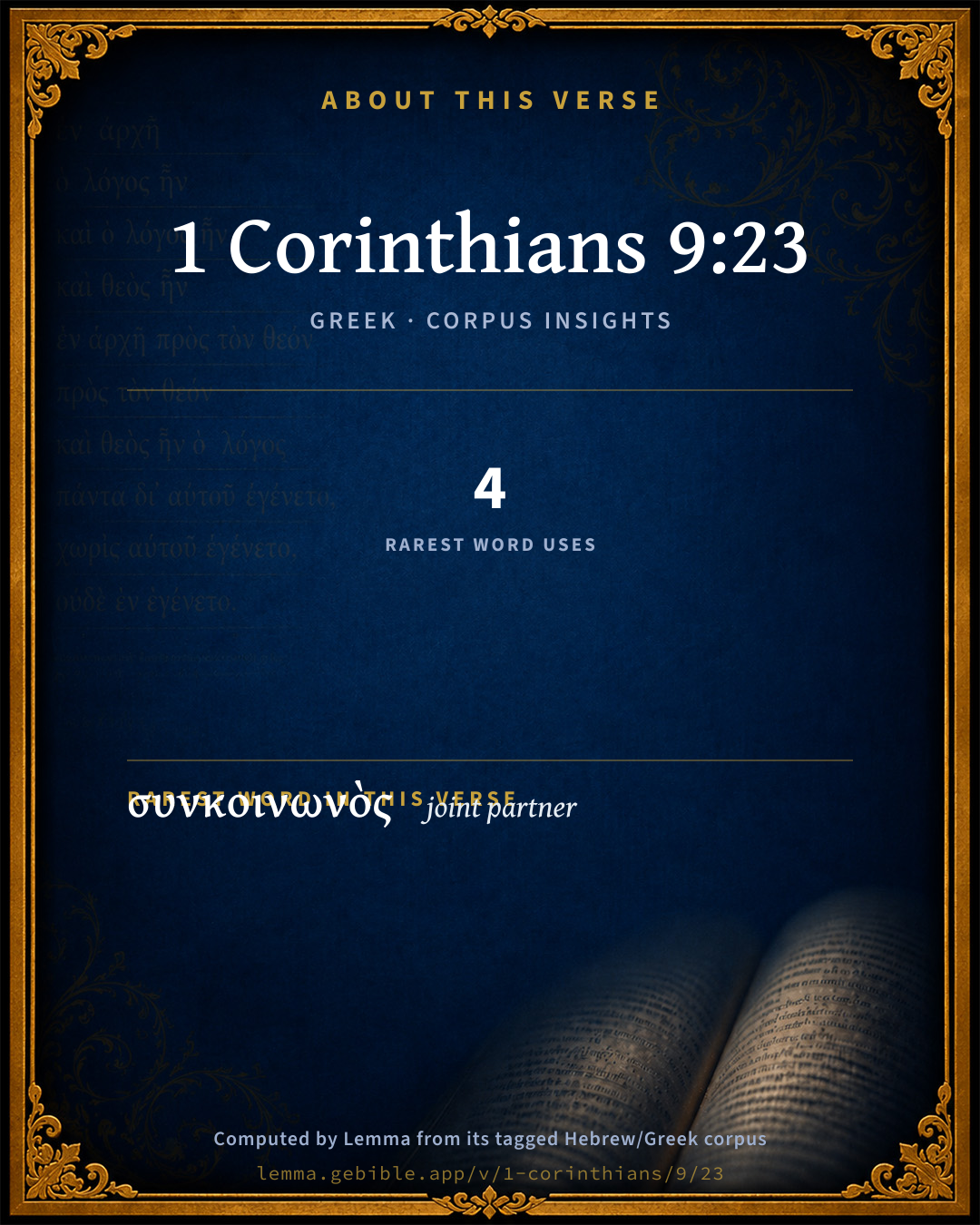
1 Corinthians 9:23

Greek (Tischendorf 8th ed.) 1 Corinthians 9:23 appears in the Greek New Testament. The text above is from the Tischendorf 8th edition. Each word links to its Strong’s number and a concise gloss. Click any word for its full Thayer’s Greek Lexicon entry.
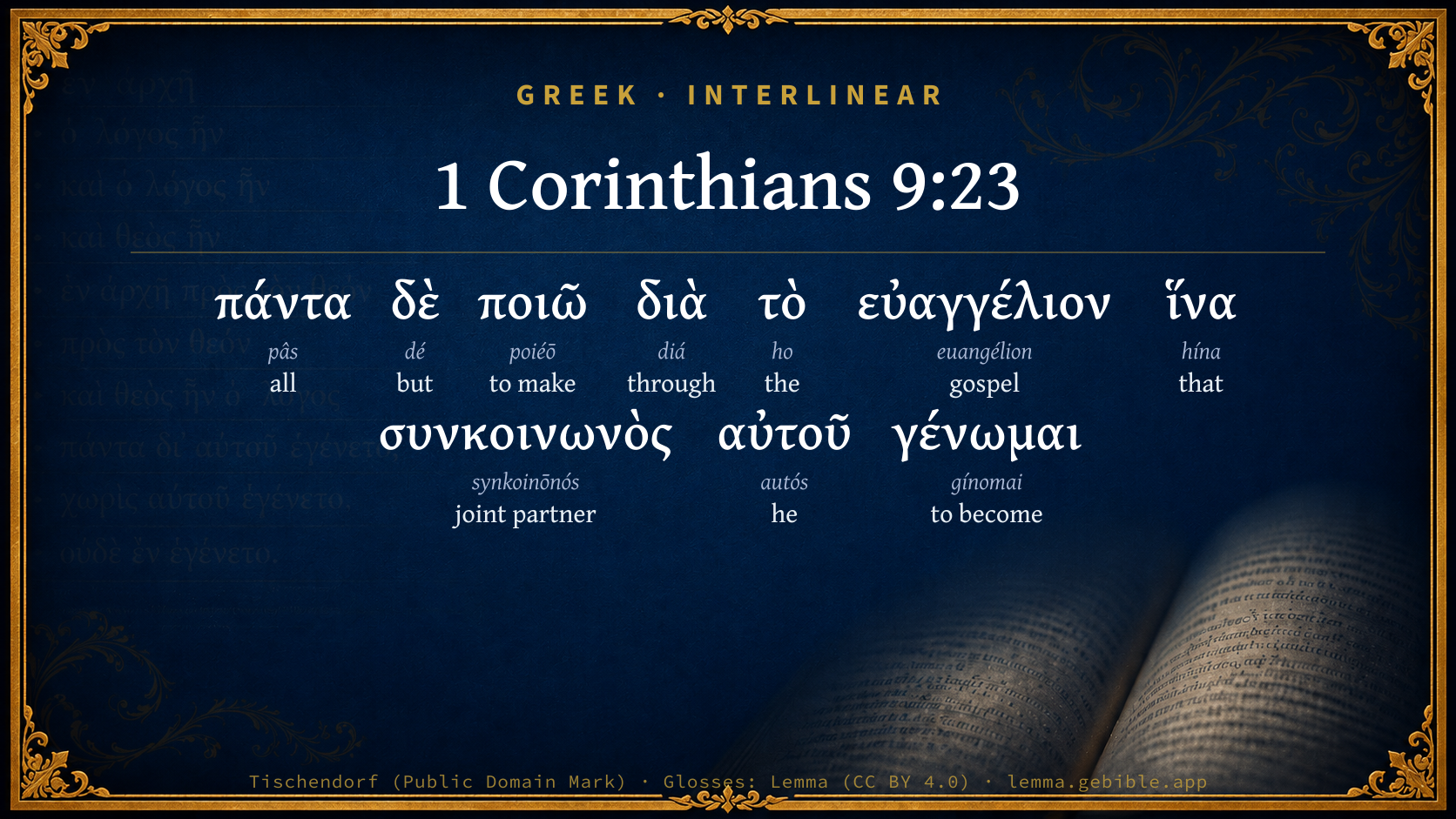
Download image
Cite this verse

1 Corinthians 9:23 (World English Bible). Public Domain. Lemma interlinear Bible study tool, https://lemma.gebible.app/v/1-corinthians/9/23.

Show BibTeX & RIS
BibTeX
RIS
English Translation
Now I do this for the Gospel's sake, that I may be a joint partaker of it.
World English Bible · Public Domain
Download a study sheet

One document with this verse’s original text, its word-by-word gloss line, the meaning frame, cross-references with their text, attributed commentary, and full source and license credits — printable, and it pastes into notes with its structure intact.

This verse Autodidact and up

Study sheet (.html) Plain text (.txt)

A passage Seminary Student

Up to 50 verses in one chapter. A passage sheet keeps up to 6 commentary sources and 12 cross-references per verse, in the order this page ranks them, and says so on the sheet whenever that leaves anything out. Ask for a single verse and you get the Autodidact verse sheet above.

Everything on this page stays free to read, with no account — the sheet is a download of what is already on screen, not access to it.

Want to remove ads? Support Godless Engineer
Compare translations 3

The same verse in 3 English versions, stacked beneath the original-language interlinear above. Click any original word for its lexicon entry.

Each is an independent rendering of the whole verse — the interlinear is not word-aligned to these translations.

Highlighted words mark where these versions differ — a whole-verse word diff, not a word-by-word alignment.

  • World English Bible Public Domain
    Now I do this for the Gospel's sake, that I may be a joint partaker of it.
  • King James Version Public Domain
    And this I do for the gospel's sake, that I might be partaker thereof with you.
  • unfoldingWord Literal Text CC BY-SA 4.0
    But I do all things for the sake of the gospel so that I might become a partaker of it.

unfoldingWord Literal Text — © unfoldingWord, licensed CC BY-SA 4.0. Word-aligned USFM3 via Door43 (git.door43.org/unfoldingWord/en_ult).

Versions to compare (up to 4)

3 of 4 selected

Show all 19 translations

Every available English version of this verse, each an independent rendering of the whole verse.

  • World English Bible Public Domain
    Now I do this for the Gospel's sake, that I may be a joint partaker of it.
  • Berean Standard Bible Public Domain
    I do all this for the sake of the gospel, so that I may share in its blessings.
  • Majority Standard Bible Public Domain
    I do this for the sake of the gospel, so that I may share in its blessings.
  • King James Version Public Domain
    And this I do for the gospel's sake, that I might be partaker thereof with you.
  • American Standard Version (1901) Public Domain
    And I do all things for the gospel's sake, that I may be a joint partaker thereof.
  • Revised Version (1885) Public Domain
    And I do all things for the gospel’s sake, that I may be a joint partaker thereof.
  • Geneva Bible (1599) Public Domain
    And this I doe for the Gospels sake, that I might be partaker thereof with you.
  • Douay-Rheims (1899) Public Domain
    And I do all things for the gospel's sake: that I may be made partaker thereof.
  • Young's Literal Translation Public Domain
    And this I do because of the good news, that a fellow-partaker of it I may become;
  • Literal Standard Version CC BY-SA 4.0
    And I do this because of the good news, that I may become a fellow-partaker of it;
  • Unlocked Literal Bible CC BY-SA 4.0
    I do all things for the gospel's sake, so that I may participate in its blessings.
  • unfoldingWord Literal Text CC BY-SA 4.0
    But I do all things for the sake of the gospel so that I might become a partaker of it.
  • Darby Bible Public Domain
    And I do all things for the sake of the glad tidings, that I may be fellow-partaker with them.
  • World Messianic Bible Public Domain
    Now I do this for the sake of the Good News, that I may be a joint partaker of it.
  • Webster's Bible Public Domain
    And this I do for the gospel's sake, that I may be partaker of it with you.
  • Free Bible Version CC BY-SA 4.0
    I do all this for the sake of the good news so that I too may share in its blessings!
  • Bible in Basic English Public Domain
    And I do all things for the cause of the good news, so that I may have a part in it.
  • Text-Critical English NT CC BY 4.0
    I do this for the sake of the gospel, so that I may share in its blessings.
  • Tyndale New Testament (1534) Public Domain
    And this I do for the gospels sake that I might have my parte therof.

Literal Standard Version (2020), Covenant Press — licensed CC BY-SA 4.0. Text via the HelloAO Bible API (eBible.org). Unlocked Literal Bible (unfoldingWord) — licensed CC BY-SA 4.0. Text via the HelloAO Bible API (eBible.org). unfoldingWord Literal Text — © unfoldingWord, licensed CC BY-SA 4.0. Word-aligned USFM3 via Door43 (git.door43.org/unfoldingWord/en_ult). Free Bible Version, Dr. Jonathan Gallagher — licensed CC BY-SA 4.0. Text via the HelloAO Bible API (eBible.org).

Word by word

More ways to search: Search by grammar → Find every occurrence → Compare this word →

Practice this passage: Drill this verse → Learn its vocabulary →

About this verse

These counts appear in no published source. They are computed here, from the morphology-tagged text and Lemma’s own curated glosses. What Lemma adds →

10
words
10
distinct lemmas
Pauline Epistles
section

Notable vocabulary

The rarest word here is συνκοινωνὸς joint partner G4791 — appearing just 4 times in the whole Greek New Testament.

Shared distinctive vocabulary

συνκοινωνὸς joint partner G4791 occurs in 4 verses of the Greek New Testament. Also found in:

Cross-references

11

Topical passages linked to 1 Corinthians 9:23 in the Treasury of Scripture Knowledge — connected by theme and wording, ordered by reader-vote popularity; previews shown in the World English Bible.

  • 2 Timothy 2:10 Therefore I endure all things for the chosen ones' sake, that they also may obtain the salvation which is in Christ Jesus with eternal glory.
  • Mark 8:35 For whoever wants to save his life will lose it; and whoever will lose his life for my sake and the Gospel's will save it.
  • 1 Corinthians 9:25–27 Every man who strives in the games exercises self-control in all things. Now they do it to receive a corruptible crown, but we an incorruptible.
  • Galatians 2:5 to whom we gave no place in the way of subjection, not for an hour, that the truth of the Gospel might continue with you.
  • Hebrews 3:14 For we have become partakers of Christ, if we hold fast the beginning of our confidence firm to the end:
  • 1 John 1:3 that which we have seen and heard we declare to you, that you also may have fellowship with us. Yes, and our fellowship is with the Father, and with his Son, Jesus Christ.
  • 2 Corinthians 2:4 For out of much affliction and anguish of heart I wrote to you with many tears, not that you should be made sorry, but that you might know the love that I have so abundantly for you.
  • 1 Corinthians 9:12 If others partake of this right over you, don't we yet more? Nevertheless we did not use this right, but we bear all things, that we may cause no hindrance to the Gospel of Christ.
  • 2 Timothy 2:6 The farmers who labor must be the first to get a share of the crops.
  • Hebrews 3:1 Therefore, holy brothers, partakers of a heavenly calling, consider the Apostle and High Priest of our confession, Jesus;
  • 1 Peter 5:1 I exhort the elders among you, as a fellow elder, and a witness of the sufferings of Christ, and who will also share in the glory that will be revealed.

Cross-references courtesy of OpenBible.info (CC BY 4.0).

Where the printed editions differ

1 variant

Places in this verse where the major printed Greek editions disagree on the wording in a way that affects the translation — a comparison of editions, not a manuscript-by-manuscript collation. The editions are the modern critical texts (Nestlé-Aland 28/27, SBL, Westcott-Hort, Tregelles, Tyndale House) and the traditional texts behind the KJV (the Textus Receptus and the Byzantine/Majority text). It is not a claim about which reading is original.

  1. Different wording
    πάντα

    “All [things]”

    In NA28NA27TynSBLWHTreg Not in TRByz

    Τοῦτο (Touto) 'This' occurs in traditional manuscripts (TR+Byz) instead of πάντα (panta) 'All [things]' in older manuscripts (NA28+NA27+Tyn+SBL+WH+Treg)

Textual data: Translators Amalgamated Greek New Testament (STEPBible TAGNT) · CC BY 4.0.

Commentary

Notes on 1 Corinthians 9:23 from classic Christian and Jewish commentators (each source and its license shown beneath its notes). The classic Christian expositions comment on the surrounding passage and are grouped to its opening verse, so a note may address several verses; the Jewish commentaries on the Tanakh (Rashi and others) are per-verse, so they appear only where the commentator wrote on this verse.

Lemma curates 59 commentaries, every one of them public domain or Creative Commons licensed, each selected and text-cleaned for this edition rather than reprinted as found. About our sources →

Whedon's Commentary on the Bible

Daniel D. Whedon

4. These various self-denials are undergone for an eternal future prize, 1Co_9:23-27.

23. Partaker thereof—Partaker, that is, of the gospel, embracing therein all the blessings, temporal or eternal, in the included gospel. Note on 1Co_9:18. This gospel includes the prize of 1Co_9:24, the incorruptible crown of 1Co_9:25.

You—In italics; it is not in the Greek. Literal rendering, be a fellow-partaker of it; that is, a sharer with, not only you, but all the glorified, of the blessed results wrapped up in the gospel. So a blissful eternity is ever present to the faith of Paul, being included in the very gospel he preaches.

Daniel D. Whedon (gen. ed.), Commentary on the Old and New Testaments (1874–1909) — public domain. Text from a community e-Sword module.

The Preacher's Complete Homiletical Commentary

Joseph S. Exell (gen. ed.)

CRITICAL NOTES

1Co_9:24.—His own salvation is at stake as well as that of his hearers. He must do all these things, not only as expedients which for his hearers’ sakes may make him a successful soul-winner, but because to do everything he can to ensure success is to discharge faithfully his “stewardship” (1Co_9:17), and is thus one condition of his final acceptance when he comes to the goal. The comma after “run” in the A. V., and, still more, the “even so run” in the R.V., makes it clear that the reading should not be carelessly taken to be, “Run so that ye may,” nor, “So run as that ye may.” “So” looks not forward to “that ye may obtain,” but backward, to the way racers run who know that they are competitors, the success of one of whom means the failure of all the others. This is not a maxim standing alone and meaning, “Do you run your Christian course in such a manner as to ensure that you will win the prize.” It is a picture gathering up the scene on which Paul and his hearers are gazing. “See the sustained straining, and the concentration of energy; see how nothing diverts attention from the Prize; see the fierce eagerness of competition; remember the long, self-denying training for that moment of supreme effort. That is the way to win your Crown. Run your course like that—so—thus—if you mean to attain.”

1Co_9:25.—Racing, boxing, wrestling, all kinds of athletic contests “for the mastery.” See the rendering. The Olympic games were in Paul’s time still celebrated, and survived the Isthmian, which, however, were more familiar to the Corinthians, and at the time were more important. Nero contended in them, with “an agony to succeed” (Stanley). Ten months’ preliminary training—dieting, etc.—was obligatory on every competitor. [The metaphor of the foot race is found not only in Php_3:12; Php_3:14; 2Ti_4:7-8 (Heb_12:1); but in briefer phrases—Act_12:25; Act_20:24; Gal_2:2; Php_2:16; Gal_5:2; 2Th_3:1; perhaps Rom_9:15-16. (See Dean Howson, Metaphors of St. Paul.)] A corruptible crown.—At the Isthmus this was of Grecian pine leaves; because these were so valueless intrinsically, the more to be admired was the eagerness of the competitors.

1Co_9:26. Uncertainly.—With no definite goal, keeping to no particular track. Beating the air.—As if fighting a shadow, or merely “lunging about” for practice to the muscles. “It is no ‘practice,’ but the serious contest, I am engaged in.”

1Co_9:27.—See Homiletic Suggestions. Buffet for “keep under.” Lit., by derivation, “Give it a blow that bruises it under the eye—to keep it in its place, as servant, not master.

HOMILETIC ANALYSIS.—1Co_9:23-27

The Minister’s Care for his Own Salvation.—We see him:

I. In Conflict. Then

II. Crowned. Or

III. Castaway.

I. In conflict.—

1. 1Co_9:23 is transitional. A new thought is introduced, out of which this paragraph grows. The preacher of the Gospel hopes to be, needs to be, a “partaker of the Gospel along with” those to whom he preaches it. He is himself vitally interested in its truth and its success. He may be an apostle; but he is first a sinner, lost and in bondage, and himself needing to hear the “joyful sound” of release and recovery. The trumpet of Jubilee which he is set to sound, proclaims an “acceptable year of the Lord,” in whose happy issues he too hopes to share. He has heard the Gospel, and is rejoicing in its salvation; but if he is to retain his status, he must be faithful to his duty as a preacher, set to “save as many souls as he can.” If he fail personally, he will be a failure officially; no man will succeed in the ministry who does not keep his personal life right. Conversely, if he fail officially, through neglect or unfaithfulness, he will fail personally, His unfaithfulness is sin. (See this and some after points expounded in Separate Homily, “An Apostle’s Peril,” 1Co_9:27.)

2. A racer, putting all his energies into the race; making no play of his ministry, but most serious and arduous and even exhausting labour. A boxer, matched with a busy, active, dangerous antagonist in his very “body”; finding here again that it is no play to deal with himself. His nature every moment waits to render him secure, and then in his security to gain an advantage over him. Indolence, love of ease and comfort, and even natural weariness, need to be watched, lest they deal deadly blows at his life. He must be ready to return rebuke for suggestion, blow for blow. [“Get thee behind Me, Satan!” said Christ to Peter, who had revolted against the idea of the shame and the bodily suffering of the cross. “Do not think of such a thing, Lord! That be far from Thee! Be propitious to Thyself (lit. Greek); be kinder to Thyself than that!” Had the Master just passed through conflict in anticipatory presence of the cross? And now, with mistaken kindness, His friend, Peter, makes the very suggestion, which, quite innocently, His own holy body may have been making. “Shun the pain!” (Mat_16:22).] There are dangers of the couch, the arm-chair, the hospitable table, the glass, the pipe, the cycle, many (literal) body-dangers besetting, buffeting, the Christian “boxer.” [Make the very body come obediently “to heel.”] [As there are also dangers in the study,—of dilettante reading and work, known to, condemned by, nobody outside; dangers of success; dangers in days of what seems “failure”; dangers of the infection of the “secular” temper—for the minister may do his work in as thoroughly “secular” a spirit as any business man in the market or the shop.]

3. He is in constant training for his running. He must never suffer himself to get “out of condition.” Things allowable if he were not running a race, or if he were not in the ministry, and bound to “fulfil it” [Col_4:17; cf. the R.V. in Rev_3:2 : “No works of thine fulfilled before God; many things purposed, begun, half done, nearly finished, but “not fulfilled”], are not permissible to him. He must keep himself free, pure, not entangled nor self-ensnared, in the best order of body, mind, heart, to do his work and accomplish his “course.” [“Temperate in all things.” See Separate Homily.]

II. Crowned.—[Rev_3:11 is a warning to an official life that its official “crown” may be given over to, passed on to, worn by, some other who has done more faithfully and effectually work which was allotted to the uncrowned man. Rev_2:10 is the personal reward of the personal life. And notice] the “crown” of a successful, faithful life is “Life.” “Uncorruptness” in teaching (Tit_2:7, where notice the displaced reading, which was significant in its reiteration of idea), and in that love (Eph_6:24) which is the very element of the Christian walk, thus leads up to “life and incorruption” (2Ti_1:10). The purifying of the nature from all that belongs to “death” at last made complete; the life which sprang here from “incorruptible seed” at last developed into eternal, indefectible perfection of all its features and capacities; whatever of added happiness “Heaven” may include,—happiness ab extra, dependent upon surroundings, companionships, appointed employments; all this in perfection, with nothing of transitoriness to dim, even as a possibility, the enjoyment of the present; with no remotest possibility of an end, to cloud over as with the gradual closing in of an eternal Night, the Divine glory of the eternal Day of that world’s life;—this “Life” is Paul’s “crown.” The spiritual life here was all the work of Christ in the soul; and to His heart also that after-life which is the expansion, the fulness, the sequel as well as the successor of this, is the crown of this. Finis coronat opus Christi, et Pauli. [What crown is there of all for which men in the “natural” realm “strive for the mastery,” which is incorruptible? E.g. how much of the knowledge acquired by a lifetime of study and self-denying, enslaving labour is merely relative! It is modified, supplemented, made obsolete, almost before the man who won it and wore it is cold in his grave. Or, how distance of time dwindles and “corrupts” away the mere crown of fame and honour given by contemporaries, and not unworthily, to the majority of the famous people of any one century or nation! How unsatisfying the best reward of mere secular labours! How many a hot-browed athlete has found his crown begin to wither and perish almost as soon as it has been placed upon his head!] Or, unhappy alternative:

III. Castaway.—(See, again, below.) Of all the “lost,” is the rejection of any man more pathetically painful to imagine than that of the preacher, who has set others to run, who has directed their training and their running, who has enheartened them in their days of faintness or discouragement, who has seen them take the one last step which bears them in death over the line that marks the goal attained; and then himself presents himself to the Judge for “approval” and for crowning, only to be thrust away “reprobate” “castaway”?

SEPARATE HOMILIES

1Co_9:24-27. “Temperate in all things.”—(May be made the basis of a Temperance Sermon.)

I. Christian religion honours the body.—Only one that really does. Such religion as Corinthians knew took no account of it; bodily sins and lusts were reckoned things indifferent.

1. Some to-day make almost a religion of bodily exercise. Athletics the god which gets their best devotion. Read nothing else in the paper; can talk on no other topics. That an exaggeration. [Body not everything. Some giants very poor creatures in mind. Dwarfs have done great things. Two most wonderful figures in Europe at end of seventeenth century were two commanders of large armies: William III., an “asthmatic skeleton”; Luxembourg, “the princely hunchback” (Macaulay).] 2 As real an exaggeration to make teetotalism the only devotion, the only religion, the only remedy for human ill. [Easy to understand the “intemperance of temperance people”; not difficult to excuse, or even justify, it. Man who sees most of the wide extent, and dire results, of intemperance; lives in midst of its woe and wreck; finds all efforts, hopes, prayers, defeated by it; finds the thick moral induration of the drunkard-habit turn edge of keenest sword, or most pointed arrow; finds the work of years of painful recovery blighted by outburst of old, mad passion again; may be excused if he feel or speak with “undue” strength. May be forgiven his “madness” when he sees wife, child, friend, minister, dragged down to the slough of the sin and shame of drunkard-life. No doubt, too, if we could make drunken England into part of sober England, we should cut tap-root of nine-tenths of English ills, and solve many a social and economic problem. No doubt total abstinence the only remedy for large percentage of misery and sin; the most practical remedy, as things are to-day. Yet it is exaggeration.] It is not all. Some appeals to the intemperate are only less liable to become mischievous than drink itself. E.g. appeal too strongly to the saving of money effected; may cast out devil of drink by putting in covetousness. Appeal too exclusively to self-respect or strength of will; may make reclaimed drunkard a Pharisee in pride of self. May sometimes only have cured physical mischief by inoculating with moral poison—Be temperate even in your remedy fôr intemperance. True way of regarding question is to make it part of the Christian honour of the body, as an instrument through which Christ is to be served. Highest purpose of education is to make mind a fit instrument for serving Christ. And so too the body is His; He bought it; bought all of the man—body and soul. It is to be kept in best possible order for Him, and His use. Therefore, in mind and body,—temperate in all things.

II. What is temperance?—

1. See driver of ancient chariot, or modern four-in-hand; his strong bit; still more, his firm, skilled hand. That perfect control of his team is temperance. Man, boy, drives team of three bodily appetites; mettlesome horses, powerful, sometimes turbulent, in their strength; but they have their work to do. Temperance is having the team well in hand, making them do their work, but no more; do it, at the man’s will; or leave it alone, at his will. Horses must not be allowed to run away with chariot, with man. “Be temperate, lest team carry you over the precipice of ruin here and hereafter.”

2. See chorus on the orchestra, how built up of four classes, masses, of voice. Conductor makes each do its part, but no more. Too much bass, too much treble, equally spoil the music. If tenors (or even one voice) over-assert themselves, they spoil balance and harmony. Conductor makes each do its part, loud, soft, everything, as he will. Mind, body, pleasure, work, intellect, heart, will,—in the perfect harmony of Life, all take their part; no more, no less; nothing dwarfed or stunted; nothing exaggerated or over-grown. Be the conductor in full authority over your choir of gifts, powers, passions; make all temper to a happy balance and wholeness. Drunkard lets one voice out-shout the rest and ruin the music of the life.

3. Intemperance means not having oneself perfectly in hand, having something a man cannot say “no” to. [“Never so let yourself go that you cannot ‘pull up’ at will. Find cannot say ‘no’ easily? Then put foot down, say ‘no’ absolutely. Body wants to be master? Give it a buffet under the eye—that is Paul’s word—to keep it under. Make it know you will be master, the grace of God helping you. Body and mind are partners in business of life; neither is a sleeping partner; but not equal partners; body has some stake in concern, but must not have the management, especially in drinking. Mind—you—must be master. That is temperance.”] “In all things.” Rule for ancient athletes, and for Christians now, for everybody who wants even to win the prizes of life. Nothing really worthy in being a teetotaler, and yet an impure man; a hard worker, yet intemperate in relaxation after hard work. Not too much reading, music, sleep, anything. Every single thing in measure, all in balance.

III. In many things—not drinking only—this may mean total abstinence. As to drinking:

1. For every drunkard, or man or woman in danger, a necessity. Such must abstain, or they cannot be Christ’s.

2. For Christians it may become expedient (see Homily on 1Co_8:9-13). In England, in last century, may not have been. May not be on Continent to-day. Are things, however, coming, or are they come, to such a pass in England, that Christian people must stand clear of what is cursing England as never before?

3. For young people, safety. No guarantee “worth a rush” except conversion; even that sometimes overborne No strength but God’s in them absolutely to be trusted; but total abstinence a safeguard.

IV. If not, will not win the prize.—Happily public opinion is beginning to say intemperate people (in every sense) shall not. Also inevitable working of “natural law” forbids. Boys and men handicap themselves physically by any exaggerated or sinful excess. Success even in business means clear head, sober hand, healthy body. Highest work demands body and mind at their best. So Christ’s work demands it. Also if some intemperate men seem to “win,” they lose themselves and are cast away (cf. Luk_9:25; 1Co_9:27). [Our forefathers bore with intemperate Pitt, and too-convivial Scott, and the sinner Nelson. But, a little later, they would not give Byron his place in Westminster Abbey. To-day not all the witchery of their Shelley or our Swinburne must permit them to take first rank in our national devotion. Day coming when Christianised society will refuse, and say that neither an intemperate man nor an impure man shall lead the national life: “We won’t have it!”]

1Co_9:26. Christian Progress.—Compare the progress suggested by (a) Running with that suggested by (b) Growth. Four Contrasts.

I. (a) Progress, in the outward aspects of it: the life of action and of conflict, of speech, of work.—Every detail of life a step forward towards the goal or backward towards the starting-point, or out of the prescribed course altogether. (b) Progress in the inner life; in strength of character and of principle, greater simplicity and directness of motive; greater abundance in the fruits of grace, in loveliness and Christ-likeness. “Every detail a step.” Then how important every smallest detail. There is nothing which “does not matter.” Everything “matters.” And, further, why fear dying? It is but one more step, to be taken in the same strength as that next preceding and all preceding; the one step which carries the runner over the line which marks the goal attained; but, except for that, perhaps not intrinsically so difficult or so important as many another preceding. Let every detail of life have its right direction, and carry us forward.

II. (a) Progress in a definitely marked-out course.—The runner is kept right by rules and bounds imposed from without. (b) The thing that grows is kept right in its progressive development from within, according to the “law” of its very life. The plant or the body obeys the ideal of its kind or order. The oak, the moss, unfold themselves and assimilate and dispose into their structure new material, in obedience to the life within them. No need to watch or take pains that in pattern or kind the leaves shall grow those of the moss or the oak. So the new life in the soul has its ideal and its laws. It will naturally show a developing progress, the features characteristic of the Christ-life appearing of themselves. But the Racer is only kept right as he keeps within bounds prescribed; he may go wrong at any point. On this side stand God’s “Thou shalts”; on the other His “Thou shalt nots.” Within these lies the one, only path to the goal and the prize. If in his advance the racer has not submitted to the direction or the restraint of these, he runs “unlawfully” and “uncertainly.” He may not be surprised if he find himself, after all, “cast away” as the result of the Judge’s verdict. If all other indications of the course fail, the steps of Christ are the supreme summary of all direction. What He did, and, above all, the principles of His words and acts—these are His “steps.” They show the path in which alone progress can be made.

III. The progress of growth is solitary; that of running is in company.—The one palm will grow as well solitary in an oasis as in a grove of palms. No tree helps the next to grow. The children in a family grow hearty or weakly independently of each other. As there is a spiritual life which must be lived, and progress which must be made, alone. A man might be, if need were, a great saint in a great solitude. It would be one-sided sainthood. No Christian fellowship or united worship can do the work of the closet and the searched Word. But the progress of Running is progress in company; all the helpfulness of companionship and sympathy is brought into use. The runners in training for athletic contests will secure a friend to run by their side during the last “lap” of the course; by the fresh and unexhausted vigour of the friend to help themselves over the strain of the last portion of their path. The sloth or eagerness of one Christian’s progress will affect the pace of a fellow-runner. His steady pursuit of the prize may decide some feebler, wavering soul just feeling the first strain after the eagerness of the start is over, and beginning to wonder whether, after all, the prize is worth such an effort to win.

IV. Growth speaks of a steady, quiet progress; not to be measured from moment to moment, but palpable enough in accumulated results. We see that the plant has grown, or the body, but not the actual growing. Racing puts forward the continuous, eager, straining effort, and the concentration of it upon the one thing—the crown. Our life is no “walk-over” the course; no lounging parade towards the goal; but “racing,” with all the eagerness of competition, where the racers are companions, but not competitors. There is no turning aside to examine the beautiful sculptures and altars by the side of the course; no stopping to exchange greetings with the friends amongst the spectators. [“This one thing I do” (Php_3:13) is well illustrated by the last words shouted by the “coach” to the men in the trial eights on the river: “Now then, keep your eyes in the boat; look at the shoulder of the man in front of you; don’t think of anything but the time and the stroke.”] The racer’s progress is possessed by one idea: “The prize,” “the crown.” He sees nothing but that. From head to foot, from the finger-tip of his outstretched hand to the extremity of the foot, which barely touches the ground from one step to another as he strains along, and flies rather than runs—every inch of him, ever muscle in his frame, says, “The Crown!” Everything is made to bend to that; everything in life which will not help progress is discounted or dismissed; all must help to win the goal and the Judge’s award. The Christian man knows what he wants, and makes that the serious, ruling business of his life. [In Heb_12:1 are the added ideas of training away all superfluous “weight” every ounce which is not bone or muscle, which will help in running, and of stripping off all encumbering, “clinging” (= “easily besetting”) garments.] Look at the runners. So run, as they do, that ye may obtain. It is not never-ending progress leading to no definite issue; an endless seeking and never finding; an unending effort which attains to no prize. [Edward Irving exclaims, “Probation does not lead to probation, but to issues!” (Divine Judgments, vii.); to “crowning” or “cast away.”] “A great deal of trouble to make Christian progress!” Certainly. But see Pro_14:4 : “Where no oxen are, the crib is clean; but,” etc. Nothing is easier than have a clean stable, and to escape the “trouble” of cleansing it; but the indolent man must be content to forego the “increase which is by the strength of the ox.”

1Co_9:27. An Apostle’s Peril.—Both words, that for “preach” and that for “castaway,” are, themselves or their cognates, so common in St. Paul that we need not overpress the derivational meaning of even the former, or necessarily regard them as saturated with suggestion springing from the imagery of a racer. The herald who has called others and induced them to enter for the prize, who has announced the conditions of the competition and even seemed to be joining in the race himself, comes to the judge’s seat for the crown. “No crown for you; you have not yourself submitted to the rules, have not contended ‘lawfully’ ” (2Ti_2:5). And he turns away from the judge’s seat filled with the beginnings of the disappointment of an eternal failure. Probable; suitable to the context; true; but not certainly to be got out of the words.

I. An official application of the words.—Pauls peril is from his body.—He “keeps his body under.” Must take this precisely for what he says: not the “flesh,” but the “body,”—a narrower and very definite source of danger. Sin in Gentile life ran most frequently into physical excess. All heathenism, all natural human life, gravitates sooner or later into indulgence of the three physical appetites. Mere human wisdom and morals have no sure reason why these should not be indulged; the tendency is always to treat bodily sins as venial, or even indifferent actions. Strangely enough, also, the same temperament which makes some men, some ministers, seem highly receptive of the Spirit’s enduement of power, appears to expose them to the assault of physical temptation. From high spiritual exaltation to bodily excess is not an uncommon fall. Paul seems to have been by temperament and by special grace in little peril in one particular direction. [1Co_7:7, as usually interpreted, but the inference is by no means so certain as is generally assumed]. And he may be in some degree identifying himself with his readers, and the “I” not be entirely personal, but rather representative. A real danger to a minister arises from the frequent association with women in the work of his life, whether as grateful and attached hearers, or busy helpers, or the objects of his labours. There are dangers at the hospitable tables of his congregation. Dangers of indolence fostered by the sedentary nature of his work in the study. Nowadays ministerial athletics may become a peril. Paul is in danger from his body; and, further, in two particulars in this very chapter does he give the body a check. “Paul’s refusal of maintenance, and the bodily toil resulting thereupon, and his refusal to eat meat which might injure a weak brother, were blows against the spiritual power of his own body, and tended to make the body more and more a servant of the spirit within” [Beet, in loco. We may add also]: All the physical dangers and suffering which he not only submitted to, but accepted and gloried in (2Co_4:10; 2Co_6:5; 2Co_11:23-27), as the accompaniments of his work for his Master, became, through his persistent, voluntary pursuit of a career which made him run the gauntlet of so many blows upon his body, really in effect his own buffetings of his body. All the exhausting physical toil of the modern ministry; long walks, wearying pastorising; the contact, so repugnant to all the training and instincts of a gentleman, with physical squalor, dirt, disorder, and disease in the fulfilment of his labours; unwelcome exposure to all weathers;—all may be sanctified into blows which “keep the body under.” Asceticism, ingeniously, gratuitously, inventively prescribed, is uncalled for. In the direct application of the possible figure (above), official defect, and condemnation of his official life and work, are most prominent. But not apart from personal unfaithfulness and failure, and a personal rejection. [He regards it as quite possible for a teacher to lose his life’s superstructure and building, whilst himself being saved because on the one foundation (1Co_3:14-15).] Personal unfaithfulness is by far the commonest cause of ministerial and official failure. Not the apostle only, but the man, has to take account of the liability to be at the last a “castaway.” So then:

II. An application of the principle to the personal life.—

1. Every Chris-tion may become a “castaway,” and miss the crown. [The thought, but not the same (original Greek) word, in Luk_9:25.] All safety is of God’s grace, with which the man must co-operate; [and the co-operation is in the strength of grace also]. The grace must go all the way, for the peril goes all the way. [To the last the Christian soldier is not on the parade-ground, but on the battle-field. He must hold himself ready for fighting or sudden attack at any moment. No “standing at ease”! Danger never far away.]

2. No man is exempt because of high honour, long service, or great success in the work of God; Paul had all these. Nor because of great gifts or grace at one time enjoyed; Paul had these. Through these, indeed, fatal temptation may reach the soul; e.g. if a man thus honoured and endowed become proud, self-satisfied, self-reliant to the exclusion of dependence upon God’s grace.

3. Each man should know his own liability, his own vulnerable point. Perhaps, safe everywhere else, he may, like Achilles, be in danger at the heel; the lowest part of his nature, that wherein he touches the earthly most nearly, may be the point of attack, rather than the heart or the exalted intellect.

4. Each man should “exercise” himself [Act_24:16; the physical training of the combatant in the games]. Keeping himself well in hand; taking care that the spiritual is always the dominant element in his life. Yet the self-distrust, the watchfulness over oneself, the fear of the sad possibility of after all missing the prize, must not be so dwelt upon as to become a morbid dread, or a haunting terror, overshadowing with gloomy clouds the “joy of the Lord.” The case of a “castaway” is by God’s grace a very rare one, though a possible one. Moreover, dwell also upon the grace for the faithful, patient, successful running of the course until we say, “I have finished my course” (2Ti_4:7). [There is yet a Greater Runner than Paul Who is proposed for our contemplation (Heb_12:1-2): “Looking at (as well as unto) Jesus,” who has won His prize. Did He, may we not say, “keep under His” very “body”?] Leading up to the temple of Neptune at Corinth, close by the Isthmian race-ground, Pausanias the traveller saw two hundred statues of victors in the games, ranged in honourable array on either side of the path. What an inspiration to after-competitors! We, too, have our array of victors. Amongst the most distinguished stands the figure of Paul. No “castaway” after all! And the grace which kept him and crowned him may keep and crown any of us!

HOMILETIC SUGGESTIONS

1Co_9:24. Six Earnest Counsels on the Race of Life. (A Sermon to the Young.)

I. Trifle not; the business is earnest.

[“Each word we speak hath infinite effect;

Each soul we pass must go to heaven or hell;

And this our one chance through eternity;—

To drop and die like dead leaves on the brake,

Or like the meteor-stone …

Kindle the dry moors into a fruitful blaze.

Be earnest, earnest, earnest,—mad, if thou wilt!

Do what thou dost as if the stake were heaven

And that thy last deed ere the judgment day.” (Kingsley, Saint’s Tragedy.)]

II. Delay not; the opportunity is short.

III. Err not; the path is narrow. [“Narrow!” Yes; as the railway lines make a “narrow” track for the engine and its train. But the “narrow” grip of the rails upon the wheels is safety for the travellers. “Liberty” from their compulsion to keep the track is danger, disaster, ruin. Plenty of liberty to run forward, in the only safe direction, with all prudent speed.]

IV. Divide not your attention; the work is difficult. [“The children of this world are, in (for the aims and purposes of) their generation, wiser than the children of light.” The “Jack-of-all-trades” danger of some characters.]

V. Relax not your efforts; he only that endureth to the end shall be saved.

VI. Faint not; the prize is glorious.—[J. L., in part.]

The Preacher's Complete Homiletical Commentary (gen. ed. Joseph S. Exell; Funk & Wagnalls, c. 1892) — public domain (pre-1929). A full-Bible homiletical/sermon-outline anthology covering 65 of 66 books (2 John is absent from the source module). Text from a community e-Sword module.

Bengel's Gnomon

Johann Albrecht Bengel

1Co 9:23. Ἴνα συγκοινωνὸς ἀυτοῦ γένωμαι) The Σὺν and γίνομαι show great modesty. Those things which follow, are referred to this verse, as to the proposition [the theme to be handled].—ἀυτοῦ, of it) of the Gospel and salvation; comp. the words, I might save, 1Co 9:22.

Bengel's Gnomon of the New Testament — English translation (T&T Clark, Edinburgh, 1860) — public domain. Text from a community e-Sword module.

Meyer's Critical & Exegetical Commentary

Heinrich August Wilhelm Meyer

1Co_9:23. Πάντα δὲ ποιῶ] quite general; now all that I do is done for the gospels sake.

ἵνα συγκοιν. αὐτοῦ γεν.] Epexegesis of διὰ τὸ εὐαγγ.: in order that I may become a fellow-partaker therein. Comp on ΣΥΓΚΟΙΝ., Rom_11:17. Whoever is included as belonging to those in whom the salvation proclaimed in the gospel shall be fulfilled (at the day of judgment), enters along with them when this fulfilment is accomplished into the participation of the gospel, to wit, through sharing in the common fruition of that which forms the real contents of the message of salvation. Hence the meaning in substance is: in order to become one of those in whom the gospel will realize itself, through their attaining the Messianic salvation. Note the humility of the expression; he who laboured more than all others, has yet in view no higher reward for himself than just the salvation common to all believers. Flatt and Billroth make it: in order to take part in the spreading of the gospel. But the aim here stated corresponds to the βραβεῖον in 1Co_9:24. The inward salvation of the moral life again (Semler and Pott) is only the ethical path of development, whereby men ultimately reach the συγκοινωνία here intended. Comp Php_3:10 ff.

Meyer — Critical and Exegetical Commentary on the New Testament — English translation by Peter Christie, edited by Frederick Crombie (T&T Clark, 1880) — public domain. Text from a community e-Sword module.

Expositor's Greek Testament

ed. W. Robertson Nicoll

1Co 9:23 . Paul’s course in its chameleon-like changes is governed by a simple practical aim: “But all things I do for the gospel’s sake”. His one purpose is to fulfil his Gospel stewardship (1Co 9:17 , 1Co 4:1 ff., etc., Act 20:24 ); Phi 3:7-14 presents the inner side of the “one thing” he pursues. The intensity with which this end is sought accounts for the variety of means; the most resolute, in a complicated situation, becomes the most versatile of men. διὰ τὸ εὐαγγέλιον , “on the gospel’s account”, with a view to spread the good news most widely and carry it into effect most completely: for διὰ of the end as a ground of action, cf. 1Co 4:17 , 1Co 8:11 , Rom 4:25 . For himself Paul’s sole ambition is “that I may be joint-partaker in it (with those I save)” that he may win its salvation along with many others, the fruit of his ministry ( cf. 1Th 2:19 f.; also Joh 14:3 ; Joh 17:24 ).

The Expositor's Greek Testament, edited by W. Robertson Nicoll (1897–1910) — public domain. Text from a community e-Sword module.

Godet's Commentaries

Frédéric Louis Godet

Vv. 23. “Now then I do all things for the gospel’s sake, that I might be partaker thereof also.”

The δέ, then, is progressive; it marks the transition from interest taken in the salvation of our brethren to care for our own. To understand this verse, we need not construe it in the way in which it is usually done, as if the verb I do had two regimens; the first, for the gospel, and the second, that I might..., the latter being regarded as explaining the former. The explanation would not square sufficiently with the term to be explained. There is, it seems to me, only one motive, that which is indicated by the that, the salvation of Paul himself. This will appear if we paraphrase as follows: “If I act thus for the gospel, it is that I myself might be partaker thereof.” Those sacrifices which he makes for the preaching of the gospel (διὰ τὸ εὐαγγ.), he makes that he may himself share in the salvation which he preaches; comp. 1Co 9:27, which is the key of all that precedes. This life of self-denial, then, is the only condition on which Paul founds the hope that he may one day be welcomed by the Judge and receive the crown from His hand.

If we read τοῦτο, this, with T. R., the reference is to the general principle of conduct expounded above. If, with the Alex. and the Greco-Lats., we read πάντα, all things, the word refers to the various applications of the principle which have been enumerated. The last reading seems preferable. — The Greek expression literally means: fellow-partaker of the gospel. The apostle means: partaking with all other believers in the blessings which it confers, and in those which it promises. Paul would not at any price be deprived of the salvation and glory made sure to other preachers by the freedom with which they perform their task. These words should open the eyes of the Corinthians, who will deny themselves nothing, to the danger to which they thus expose themselves. Edwards explains Paul’s phrase in the sense: “to be a partaker of the spirit of the gospel.” Certainly Paul does not think that the reward promised to the faithful can be separated from the possession of the evangelical spirit. But 1Co 9:27 constrains us to think specially of salvation, and of the salvation, present or final, which the gospel promises. 1Co 9:19 expresses in a positive form the same idea as 1Co 9:27 does negatively.

To illustrate this terrible thought, the apostle borrows a figure from the most exciting spectacle which Greek life presented. Every two years there were celebrated near Corinth the Isthmian games, which, like the other public games of Greece, such as the Olympic and Nemaean games, included the five exercises of leaping, throwing the discus, racing, boxing, and wrestling. All Greece witnessed these competitions with the warmest interest, and the athlete who was proclaimed the victor received the admiration and homage of the whole nation; see the description given by Beet, p. 157 seq. It is quite probable, as the same author says, that, during the two years Paul had passed at Corinth, he had himself witnessed the Isthmian games, at least once.

Paul makes use here only of the two exercises of racing and boxing.

II. The Question considered from the Viewpoint of the Salvation of the Strong Themselves. 9:23-10:22.

As Paul concluded the preceding development by giving his own example, he introduces the following in the same way. In 1Co 9:23-27 he shows the danger which he himself ran, if he ventured to deviate from the austere path of voluntary renunciation. Then, in chap. 1Co 10:1-11, he presents a second example to the Corinthians, that of the people of Israel when they had come out of Egypt, whose numerous chastisements in the wilderness were called forth by their loose abandonment to their lusts. Finally, 1Co 9:12-22, he applies these examples to the present situation of the Corinthians.

Frédéric Louis Godet — Commentaries on Luke, John, Romans, and 1 Corinthians — English translation (T&T Clark, Edinburgh, 1870s–1890s) — public domain. Text from a community e-Sword module.

Hodge's Commentary on Romans, Ephesians & First Corinthians

Charles Hodge

1Co_9:23

And this I do for the gospels sake, that I might be partaker thereof with (you).

This I do; or, according to the reading now generally adopted (πάντα instead of τοῦτο), I do all things, my whole course of action, not merely in thus accommodating myself to the prejudices of others, but in every thing else, is regulated for the promotion of the gospel. This gives a better sense; for to say, This I do, would be only to repeat what is included in the preceding verse. Paul lived for the gospel. He did all things for it. That I may be a joint-partaker thereof, i.e. a partaker with others; not, with you, as there is nothing to confine the statement to the Corinthians. To be a partaker of the gospel, means, of course, to be a partaker of its benefits; the subject of the redemption which it announces. It is necessary to live for the gospel, in order to be a partaker of the gospel.

Charles Hodge — Commentary on Romans (1835), First Corinthians (1857), and Ephesians (1856) — public domain. Text from a community e-Sword module.

Geneva Bible (1599)

Geneva Bible translators

That both I and they to whom I preach the Gospel, may receive fruit by the Gospel.

Geneva Bible (1599) marginal notes — public domain. Text via Bolls.life.

Jamieson, Fausset & Brown

Robert Jamieson, A. R. Fausset & David Brown

partaker thereof--Greek, "fellow partaker": of the Gospel blessings promised at Christ's coming: "with" (not as English Version, "you": but) them, namely, with those thus "gained" by me to the Gospel.

Jamieson, Fausset & Brown — Commentary Critical and Explanatory on the Whole Bible (1871) — public domain (CC PDM 1.0). Text via the HelloAO Bible API.

Adam Clarke's Commentary

Verse 23. And this I do for the Gospel's sake] Instead of τουτο, this, παντα, all things, (I do all things for the Gospel's sake,) is the reading of ABCDEFG, several others, the Coptic, AEthiopic, Vulgate, Itala, Armenian, and Sahidic; the two latter reading ταυτα παντα, all these things.

Several of the fathers have the same reading, and there is much reason to believe it to be genuine.

That I might be partaker thereof with you.] That I might attain to the reward of eternal life which it sets before me; and this is in all probability the meaning of το ευαγγελιον, which we translate the Gospel, and which should be rendered here prize or reward; this is a frequent meaning of the original word, as may be seen in my preface to St. Matthew: I do all this for the sake of the prize, that I may partake of it with you.

Adam Clarke's Commentary on the Bible (1810–1826) — public domain. Text from a community e-Sword/MySword module.

John Calvin's Commentaries

23. That I may become a partaker of it. As the Corinthians might think with themselves, that this was a peculiarity in Paul’s case on the ground of his office, he argues, from the very design of it, that this is common to all Christians. For when he declares, that his aim had been, that he might become a partaker of the gospel, he indirectly intimates, that all who do not act the same part with him are unworthy of the fellowship of the gospel. To become a partaker of the gospel is to receive the fruit of it.

John Calvin's Commentaries (1540-1563) — public domain. Text from the Calvin Translation Society English edition (1840s-50s) via the Christian Classics Ethereal Library (ccel.org). Calvin's coverage is partial (roughly two-thirds of the Bible); uncommented books and verses are honest gaps, never fabricated. The 19th-century editor's footnotes and remarks are omitted so the notes are faithfully Calvin's own voice.

Ellicott's Commentary for English Readers

(23) And this I do . . .—Better, And all things I do for the gospel’s sake: such being the reading of the best MSS. Here a new thought is introduced. From them for whom he labours, the Apostle turns for a moment to himself. After all, the highest reward even an Apostle can have is to be a sharer in that common salvation which has been brought to light by the gospel. With argument and illustration, St. Paul had vigorously and unflinchingly maintained the dignity and rights of his office. The pathetic words with which he now concludes show that in defending the dignity of his Apostolate he had not been forgetful of that personal humility which every Christian minister feels more and more deeply in proportion as he realises the greatness of his office.

A Bible Commentary for English Readers, edited by Charles John Ellicott (1878–1897) — public domain. Text from a community e-Sword module.

John Gill's Exposition

Know ye not that they which run in a race,.... The allusion in this and the following verses is to the Grecian games, which consisted, among other things, of running of races, and of wrestling, combating, and fighting; and which are in this and the context particularly mentioned: and the apostle the rather makes use of these terms, and refers to these things, because they were well known to the Corinthians, and refers to them as well known; for the Isthmian games were performed in their neighbourhood, and doubtless had been seen by many of them, for the Corinthians were presidents of them. The race, or stadium in which they ran, was the space or interval between the place they set out from, and that which they ran unto, and consisted of 125 paces, or 625 feet; it was the space of a furlong, and about the eighth part of a mile: in this they

run all; as many as would, that came around from all parts, striving who should be foremost and get the crown;

but one receives the prize; which was held by the president of the game, or judge of the race, and received by the winner, who was judged to be so by him; and was no other in the Isthmian games, which are most likely to be referred to here, than a crown made of pine tree branches, or leaves, and sometimes of dried parsley (s):

so run that ye may obtain. The apostle accommodates or applies the above account to the Christian's course of life, and exhorts to run in it in like manner as racers do in a race. The "stadium", or "race" plot in the which the believer runs, is this world, or this present life; he is only a runner now and here, for no sooner is the time of his departure come, but his course or race is finished; and, as his forerunner Christ, sits down in full rest from all his labours as at a table, with Abraham, Isaac, and Jacob, and on a throne with Christ: the course he runs includes the exercise of every grace, particularly faith, which is expressed not only by going to Christ, walking in him, but by fleeing and running to him; and the discharge of every duty, signified by a running in the way of God's commandments; and, in a word, the whole of a Christian profession, and the holding of it fast, and holding on in it unto the end. The act of "running" is a motion forward, a following on to know the Lord, a going from strength to strength, from one degree of grace to another, a pressing forward toward the mark for the prize; and requires spiritual strength from Christ, and a daily renewal of it; is to be performed with readiness, swiftness, and cheerfulness, in opposition to a slowness of heart to believe, and a slothfulness and sluggishness in the business and service of Christ. The manner of running, "so", that is, as the Grecians ran in their races; they ran "all", so should all believers run, ministers and churches, churches and the several members thereof, old and young professors; so the church determines for herself, her members, and the daughters of Jerusalem, "we will run after thee", Sol 1:4 and they have this encouragement which the others had not, for only one received the prize with the Grecians, but here all, that run well, obtain: again, they ran and strove to be foremost, who should get to the goal first and receive the prize, so should believers be emulous to outdo each other, to go before one another, in faith and holiness; striving in the strength of Christ, who should do most service for him, and bring most glory to him: moreover, as they ran in the way that was marked out for them, not turning to the right hand or the left, so should believers run in the way of salvation, which is Christ; in the way of holiness, faith, and truth; and in the path of duty and ordinances, which are all clearly pointed out unto them: once more, as they while running kept their eye upon the mark, so should believers, while running the race set before them, be continually looking to Jesus, the author and finisher of faith: to say no more, as they kept running till they came to the end of their race, so should the saints; there is no time for stopping or looking back; remember Lot's wife. The end of running is to obtain the prize, the incorruptible crown of eternal life; not that this is to be procured in a way of merit by running; for the best services of the saints have no merit in them, they are previously due to God, nor can they be profitable to him; and besides, are done by the assistance of his own grace and strength; nor is there any proportion between the best works of men, and this crown of glory, life, and righteousness; yea, salvation, or eternal life, is expressly denied to be of him that willeth, or of him that runneth, and is always represented as this crown is, to be a free gift: the meaning of the expression is, that believers are to run on in their Christian race, that they may, and when they are come to the end of it they shall, as he that came foremost in the race did, stretch forth their hand, lay hold on, and receive the crown which the righteous Judge will give them; and is the true import of the word made use of here, and the sense the same with Ti1 6:12. "Fight the good fight of faith, lay hold on eternal life", and denotes that the persevering saint shall enjoy the crown.

(s) Schmid. Prolegam. in Isthm. Pindar, p. 5, 6. & Not. in Olymp. p. 312. Paschalius de Coronis, l. 6. c. 27. p. 441.

John Gill's Exposition of the Whole Bible (1746–1763) — public domain (CC PDM 1.0). Text via the HelloAO Bible API.

Trapp's Complete Commentary

John Trapp

23 And this I do for the gospel’s sake, that I might be partaker thereof with you.

Ver. 23. That I might be partaker] i.e. That I might be saved together with you. For the bell may call men to the Church, though itself never enter. The field may be well sowed with a dirty hand; the well yield excellent water, though it have much mud. Noah’s builders were drowned: and the sign that telleth the passenger there is wholesome diet or warm lodging within, may itself remain in the storms without. See 1Ti 4:16. Nihil turpius est Peripatetico claudo. Oh how many heavenly doctrines are in some people’s ears, that never were in the preacher’s heart. So true is that of Hilary, Sanctiores sunt aures plebis, quam corda sacerdotum. More consecrated are the ears of the common people than the hearts of the priests.

John Trapp, A Commentary or Exposition upon All the Books of the Old and New Testament (1647–1656) — public domain. Text from a community e-Sword module.

Albert Barnes' Notes on the Bible

For the gospel’s sake - That it may be advanced, and may be successful.

That I might be partaker thereof with you - You hope to be saved. You regard yourselves as Christians; and I wish to give evidence also that “I” am a Christian, and that I shall be admitted to heaven to partake of the happiness of the redeemed. This he did, by so denying himself as to give evidence that he was truly actuated by Christian principles.

Albert Barnes' Notes on the Bible (1834–1885) — public domain. Text from a community e-Sword/MySword module.

Haydock's Catholic Bible Commentary

How convincing it this and many similar texts against those who deny the merit of good works, and who would not have men to act with a view to any recompense, though rewards and recompenses are very frequently mentioned in holy writ. (Haydock)

George Leo Haydock (1774–1849), Haydock's Catholic Family Bible and Commentary, 1859 edition — public domain. Excludes Psalms (Douay-Rheims chapter numbering differs from Protestant) and Deuterocanonical books (Catholic canon only).

Matthew Poole's English Annotations

Paul had two great ends which he aimed at in this denial of himself in these points of liberty; the one was the doing good to the souls both of Jews and Gentiles, this he had before instanced in; the other was the glory of God, which is that which he here meaneth by this phrase,

for the gospel’s sake, which he before expounded, 1Co 9:12, lest we should hinder the gospel of Christ. By Paul’s tenacious adhering to one part in a thing wherein he had liberty, the gospel, that is, the progress or success of the gospel, might have been hindered, both by the reproaches of enemies, and also by the alienation and estrangement of the hearts of weaker Christians, or laying stumblingblocks before them, at which they might fall, being imboldened by the examples of their guides, to do what, though lawful in itself, yet they judged unlawful.

That I might be partaker thereof with you; I did it, saith he, that I might bring you into the fellowship of the gospel: I had rather so interpret it, than of the reward of the gospel, as it pleaseth some. The humility of the great apostle is very remarkable; he disdaineth not to be συγκοινωνος, a partaker in the gospel with the meanest members of the church; he is not ashamed to call those brethren whom his Lord and Master is not ashamed so to call.

Matthew Poole's English Annotations on the Holy Bible (1683–1685) — public domain. Text from a community e-Sword/MySword module.

The Pulpit Commentary

And this I do. The better reading is, and I do all things. For the gospel"s sake. This is a wider feeling than even "for the elect"s sakes" 2Ti_2:10. With you. The "you" is not expressed in the original, where we only have "a fellow partaker sugkoinwnov, (Rom_11:17) of it." But the word illustrates the deep humility of the apostle.

The Pulpit Commentary (1880–1919), ed. H.D.M. Spence-Jones & Joseph S. Exell — public domain. Text from a community e-Sword module.

Godbey's Commentary on the New Testament

William B. Godbey

23. “I do all things for the sake of the gospel, in order that I may be its fellow-partaker.” Paul defines the gospel (Rom 1:16)

“the dynamite of God unto salvation to every one that believeth.”

This is our only theme, Christ, the Holy Ghost, the dynamite which blows all sin and devils out of soul, mind, body, life, and influence. The reason why Christendom is divided up into six thousand sects is because they preach their sectarian differentia, which is really humanism, and as inappropriate and effete as the Jewish rites and ceremonies in Paul’s day. While Paul winked at them for Christ’s sake, that he might win the Jews, he never preached them. If all the preachers, like Paul, would preach nothing but the gospel, and at the same time be all things to all men, eliminating in this way all the barriers which intervene between the sects of Christendom, these partition walls would soon dilapidate and tumble down.

William B. Godbey, Commentary on the New Testament (1896–1900) — public domain. Text from a community e-Sword module.

McGarvey & Pendleton's Commentaries

J. W. McGarvey

And I do all things for the gospel's sake, that I may be a joint partaker thereof . [He made every sacrifice for the success of the gospel, that he might share with other successful apostles and evangelists in its triumphs and blessings ( Joh_4:36 ). He recommends to others a like spirit of abstinence and sacrifice, and to illustrate the necessity and utility of such a course he draws some comparisons between those who run the Christian race, and the athletes who competed for the prizes in the Grecian games. The Corinthians were familiar with the ways and customs of these athletes, for one of the great race-courses lay in the immediate vicinity of Corinth, and at this time it was the most noted in Greece, having even surpassed the Olympic in its popularity. It was held triennially. Parts of its stadium are still seen as one goes from Corinth to Athens.]

J. W. McGarvey (with Philip Y. Pendleton), Commentaries on the New Testament (The Fourfold Gospel, 1914; Acts; and the epistles) — public domain. Text from a community e-Sword/MySword module.

The People's New Testament

B. W. Johnson

23. And I do all things. All this self denial had in view a single object—the promotion of the gospel. Would that all Christians, from the same motive, would adapt themselves to all classes, in order to reach them.

B. W. Johnson's The People's New Testament with Notes (1889–1891) — public domain. Electronic text from the Christian Classics Ethereal Library (CCEL) ThML edition.

Cambridge Greek Testament for Schools and Colleges

23. πάντα אABCDEFG Vetus Lat. Vulg. τοῦτο rec. with Peshito.

23. πάντα δὲ ποιῶ. This gives a better sense than the rec. τοῦτο. ‘And I do everything for the Gospel’s sake.’

Cambridge Greek Testament for Schools and Colleges (Cambridge University Press, 1896; 21 vols, various authors incl. Carr, Maclear, Plummer, Farrar, Lumby, Moule, M. R. James, Simcox) — public domain. Text from a community e-Sword module.

Alford’s Greek Testament

Henry Alford

23.] But (q. d. ‘not only this of which I have spoken, but all’) all things I do on account of the gospel, that I may be a fellow-partaker (with others) of it (of the blessings promised in the gospel to be brought by the Lord at His coming).

24 ff.] ‘This is my aim in all I do: but inasmuch as many run in a race, many reach the goal, but one only receives the prize,—I as an Apostle run my course, and you must so run yours, as each to labour not to be rejected at last, but to gain the glorious and incorruptible prize.’ This, as compared with the former context, seems to be the sense and connexion of the passage. He was anxious, as an Apostle, to labour more abundantly, more effectually than they all: and hence his condescension (συγκατάβασις) to all men, and self-denial: accompanied with which was a humble self-distrust as to the great matter itself of his personal salvation, and an eager anxiety to secure it. These he proposes for their example likewise.

Henry Alford, The Greek Testament (1849–1861) — public domain. Text from a community e-Sword module.

International Critical Commentary

23. πάντα δὲ ποιῶ διὰ τὸ εὐαγγέλιον. ‘Yet all that I do, I do because of the Gospel.’* Not, ‘for the Gospel’s sake’, in order to help its progress, but because the Gospel is so precious to himself. He has just been stating how much he does for the salvation of others; he now adds that he is also careful of his own salvation, and thus anticipates the conclusion of v. 27. What follows shows that this is the meaning; he must secure his share in that eternal life which the Gospel offers.

ἵνα συνκοινωνὸς αὐτοῦ γένωμαι. ‘In order that I may prove to be a fellow-partaker thereof,’ i.e. not lose his share in the salvation which he tries to bring to others.† Even in speaking of his own salvation he does not regard it as the main thing, or as something apart by itself. Salvation is offered by the Gospel to all; and he must strive to be one of those who receive it. The prize is not yet won: σύν et γίγνομαι magnam habent modestiam (Beng.).

International Critical Commentary — older volumes (1896–1929), various authors — public domain. Text from a community e-Sword module.

Lesson kit

Teaching starters — assembled from the data on this page, not authored interpretation. Every prompt links to the verse data it draws on. Edit before teaching.

1 Corinthians, in the Pauline Epistles, opens this verse with 10 words (10 distinct Greek lemmas). Its most distinctive word is synkoinōnós (“joint partner”). A historical commentator’s framing appears above. Read the whole chapter for the surrounding context.

Discussion questions

  1. The word synkoinōnós carries the sense “joint partner.” How does it shape the verse?
  2. How does Romans 11:17, which shares the word «joint partner», read alongside this verse?
  3. These translations render this verse differently. What is at stake in choosing one wording over another?
  4. Compare how Whedon's Commentary on the Bible and The Preacher's Complete Homiletical Commentary read this verse. Where do they agree or differ?

Things to notice

Reading settings

Reading text

Shown beneath each verse's original-language words.

Old Testament
Old Testament edition

Read the OT as the Masoretic Hebrew (MT) or the Greek Septuagint (LXX).

English shown for the Greek Septuagint (in the Hebrew ↔ Greek comparison).

Comparing translations? Open the Compare panel on any verse page to stack up to four side by side.