
Mark 4:10

Greek (Tischendorf 8th ed.) Mark 4:10 appears in the Greek New Testament. The text above is from the Tischendorf 8th edition. Each word links to its Strong’s number and a concise gloss. Click any word for its full Thayer’s Greek Lexicon entry.
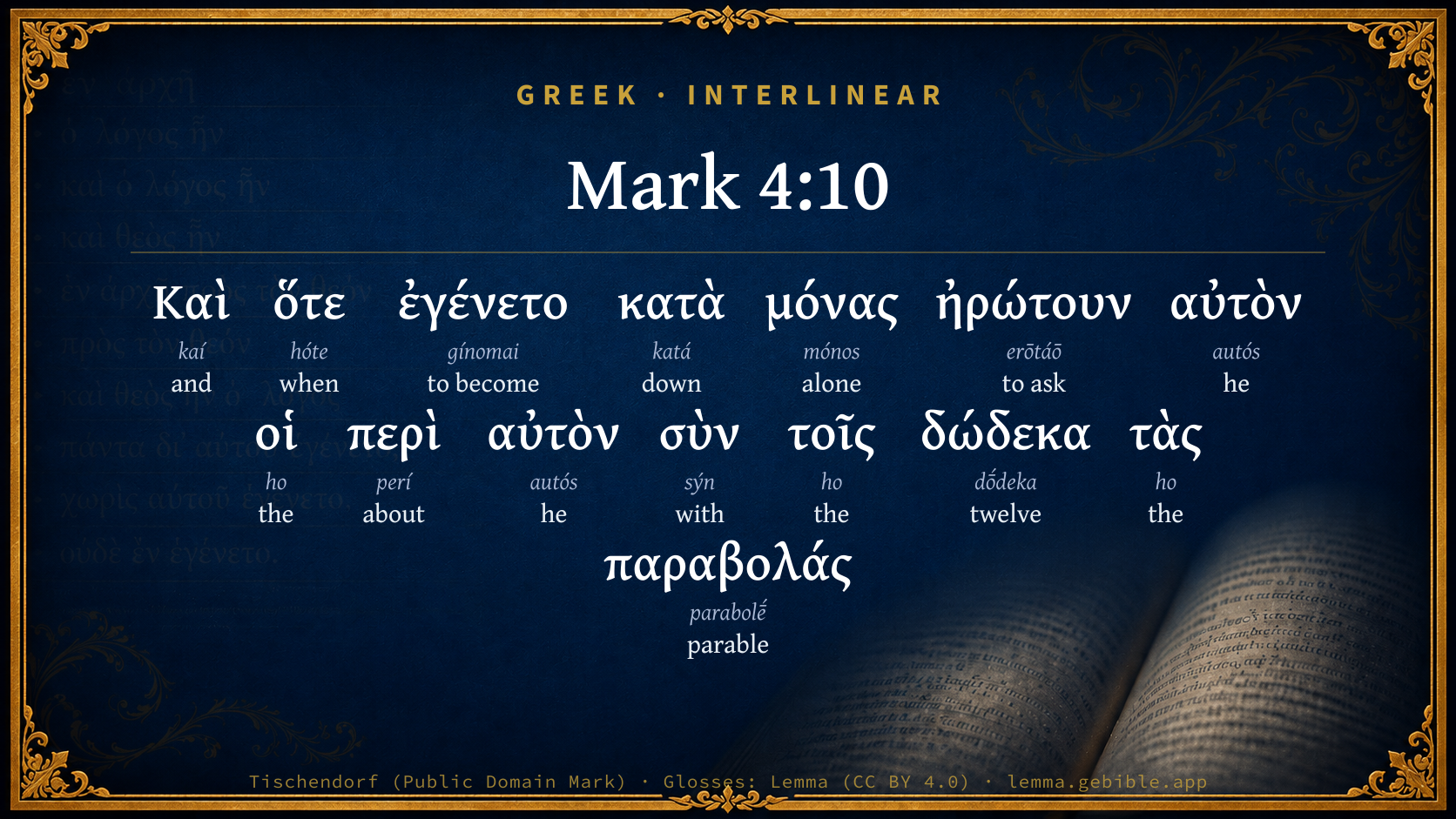
Download image
Cite this verse

Mark 4:10 (World English Bible). Public Domain. Lemma interlinear Bible study tool, https://lemma.gebible.app/v/mark/4/10.

Show BibTeX & RIS
BibTeX
RIS
English Translation
When he was alone, those who were around him with the twelve asked him about the parables.
World English Bible · Public Domain
Download a study sheet

One document with this verse’s original text, its word-by-word gloss line, the meaning frame, cross-references with their text, attributed commentary, and full source and license credits — printable, and it pastes into notes with its structure intact.

This verse Autodidact and up

Study sheet (.html) Plain text (.txt)

A passage Seminary Student

Up to 50 verses in one chapter. A passage sheet keeps up to 6 commentary sources and 12 cross-references per verse, in the order this page ranks them, and says so on the sheet whenever that leaves anything out. Ask for a single verse and you get the Autodidact verse sheet above.

Everything on this page stays free to read, with no account — the sheet is a download of what is already on screen, not access to it.

Want to remove ads? Support Godless Engineer
Compare translations 3

The same verse in 3 English versions, stacked beneath the original-language interlinear above. Click any original word for its lexicon entry.

Each is an independent rendering of the whole verse — the interlinear is not word-aligned to these translations.

Highlighted words mark where these versions differ — a whole-verse word diff, not a word-by-word alignment.

  • World English Bible Public Domain
    When he was alone, those who were around him with the twelve asked him about the parables.
  • King James Version Public Domain
    And when he was alone, they that were about him with the twelve asked of him the parable.
  • unfoldingWord Literal Text CC BY-SA 4.0
    And when he was alone, the ones around him with the Twelve were asking him about the parables.

unfoldingWord Literal Text — © unfoldingWord, licensed CC BY-SA 4.0. Word-aligned USFM3 via Door43 (git.door43.org/unfoldingWord/en_ult).

Versions to compare (up to 4)

3 of 4 selected

Show all 19 translations

Every available English version of this verse, each an independent rendering of the whole verse.

  • World English Bible Public Domain
    When he was alone, those who were around him with the twelve asked him about the parables.
  • Berean Standard Bible Public Domain
    As soon as Jesus was alone with the Twelve and those around Him, they asked Him about the parable.
  • Majority Standard Bible Public Domain
    As soon as Jesus was alone with the Twelve and those around Him, they asked Him about the parable.
  • King James Version Public Domain
    And when he was alone, they that were about him with the twelve asked of him the parable.
  • American Standard Version (1901) Public Domain
    And when he was alone, they that were about him with the twelve asked of him the parables.
  • Revised Version (1885) Public Domain
    And when he was alone, they that were about him with the twelve asked of him the parables.
  • Geneva Bible (1599) Public Domain
    And whe he was alone, they that were about him with the twelue, asked him of ye parable.
  • Douay-Rheims (1899) Public Domain
    And when he was alone, the twelve that were with him asked him the parable.
  • Young's Literal Translation Public Domain
    And when he was alone, those about him, with the twelve, did ask him of the simile,
  • Literal Standard Version CC BY-SA 4.0
    And when He was alone, those around Him, with the Twelve, asked Him of the allegory,
  • Unlocked Literal Bible CC BY-SA 4.0
    When Jesus was alone, those who were close to him and with the twelve asked him about the parables.
  • unfoldingWord Literal Text CC BY-SA 4.0
    And when he was alone, the ones around him with the Twelve were asking him about the parables.
  • Darby Bible Public Domain
    And when he was alone, those about him with the twelve asked him [as to] the parables.
  • World Messianic Bible Public Domain
    When he was alone, those who were around him with the twelve asked him about the parables.
  • Webster's Bible Public Domain
    And when he was alone, they that were about him, with the twelve, asked of him the parable.
  • Free Bible Version CC BY-SA 4.0
    When he was by himself, his twelve disciples and the others who were with him asked him what the illustrations meant.
  • Bible in Basic English Public Domain
    And when he was by himself, those who were round him with the twelve put questions to him about the purpose of the stories.
  • Text-Critical English NT CC BY 4.0
    When he was alone with the twelve and the others who were around him, they asked him about the parable.
  • Tyndale New Testament (1534) Public Domain
    And when he was alone they that were aboute him with the.xii. axed him of the similitude.

Literal Standard Version (2020), Covenant Press — licensed CC BY-SA 4.0. Text via the HelloAO Bible API (eBible.org). Unlocked Literal Bible (unfoldingWord) — licensed CC BY-SA 4.0. Text via the HelloAO Bible API (eBible.org). unfoldingWord Literal Text — © unfoldingWord, licensed CC BY-SA 4.0. Word-aligned USFM3 via Door43 (git.door43.org/unfoldingWord/en_ult). Free Bible Version, Dr. Jonathan Gallagher — licensed CC BY-SA 4.0. Text via the HelloAO Bible API (eBible.org).

Word by word

More ways to search: Search by grammar → Find every occurrence → Compare this word →

Practice this passage: Drill this verse → Learn its vocabulary →

μόνας
mónos
G3441
“alone”
Adjective, Accusative, Plural, Feminine
Part of Speech
Adjective
Case
Accusative
Number
Plural
Gender
Feminine
Full Thayer's Definition

Origin: probably from G3306

TDNT: None

1. alone (without a companion), forsaken, destitute of help, alone, only, merely
  1. Καὶ kaí G2532 “and” Conjunction
  2. ὅτε hóte G3753 “when” Adverb
  3. ἐγένετο gínomai G1096 “to become” Verb, Aorist, Middle deponent, Indicative, 3rd person, Singular
  4. κατὰ katá G2596 “down” Preposition
  5. ἠρώτουν erōtáō G2065 “to ask” Verb, Imperfect, Active, Indicative, 3rd person, Plural
  6. αὐτὸν autós G846 “he” Personal pronoun, Accusative, Singular, Masculine
  7. οἱ ho G3588 “the” Article, Nominative, Plural, Masculine
  8. περὶ perí G4012 “about” Preposition
  9. αὐτὸν autós G846 “he” Personal pronoun, Accusative, Singular, Masculine
  10. σὺν sýn G4862 “with” Preposition
  11. τοῖς ho G3588 “the” Article, Dative, Plural, Masculine
  12. δώδεκα dṓdeka G1427 “twelve” Adjective, Numeral (indeclinable)
  13. τὰς ho G3588 “the” Article, Accusative, Plural, Feminine
  14. παραβολάς parabolḗ G3850 “parable” Noun, Accusative, Plural, Feminine

About this verse

These counts appear in no published source. They are computed here, from the morphology-tagged text and Lemma’s own curated glosses. What Lemma adds →

15
words
12
distinct lemmas
Gospels
section

Shared distinctive vocabulary

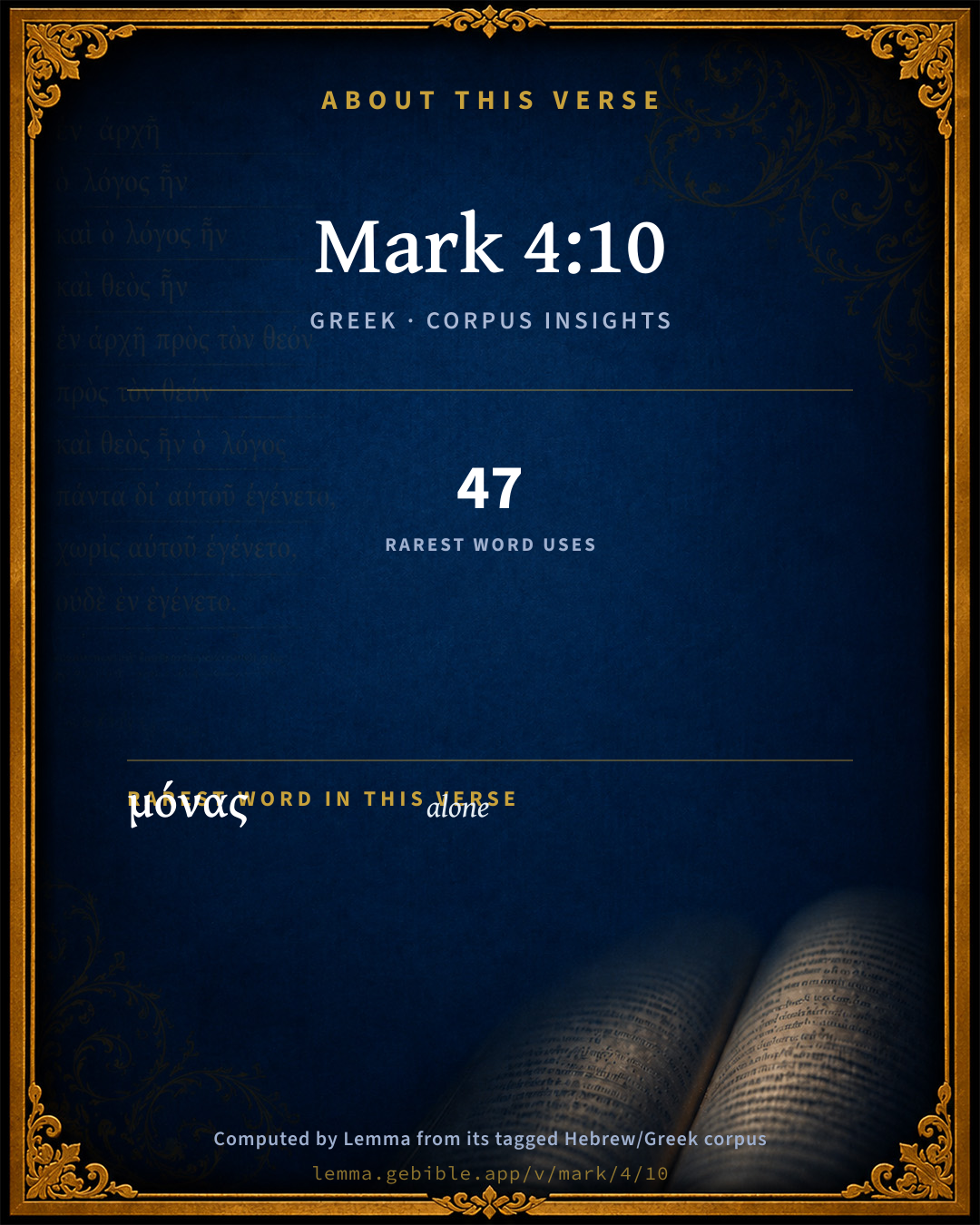
μόνας alone G3441 occurs in 46 verses of the Greek New Testament. Also found in:
Repetition

Words recur within this verse:

  • οἱ the G3588 ×3
  • αὐτὸν he G846 ×2

Cross-references

6

Topical passages linked to Mark 4:10 in the Treasury of Scripture Knowledge — connected by theme and wording, ordered by reader-vote popularity; previews shown in the World English Bible.

  • Matthew 13:10–17 The disciples came, and said to him, "Why do you speak to them in parables?"
  • Matthew 13:36 Then Jesus sent the multitudes away, and went into the house. His disciples came to him, saying, "Explain to us the parable of the darnel of the field."
  • Mark 4:34 Without a parable he didn't speak to them; but privately to his own disciples he explained all things.
  • Mark 7:17 When he had entered into a house away from the multitude, his disciples asked him about the parable.
  • Luke 8:9–15 Then his disciples asked him, "What does this parable mean?"
  • Proverbs 13:20 One who walks with wise men grows wise, But a companion of fools suffers harm.

Cross-references courtesy of OpenBible.info (CC BY 4.0).

Where the printed editions differ

2 variants

Places in this verse where the major printed Greek editions disagree on the wording in a way that affects the translation — a comparison of editions, not a manuscript-by-manuscript collation. The editions are the modern critical texts (Nestlé-Aland 28/27, SBL, Westcott-Hort, Tregelles, Tyndale House) and the traditional texts behind the KJV (the Textus Receptus and the Byzantine/Majority text). It is not a claim about which reading is original.

  1. Editions differ
    κατὰ

    “utterly”

    In NA28NA27TynSBLWHTregTR»1Byz Not in TR
  2. Different wording
    παραβολάς.

    “parables.”

    In NA28NA27TynSBLWHTreg Not in TRByz

    παραβολήν (parabolēn) 'parable' occurs in traditional manuscripts (TR+Byz) instead of παραβολάς. (parabolas) 'parables.' in older manuscripts (NA28+NA27+Tyn+SBL+WH+Treg)

Textual data: Translators Amalgamated Greek New Testament (STEPBible TAGNT) · CC BY 4.0.

Commentary

Notes on Mark 4:10 from classic Christian and Jewish commentators (each source and its license shown beneath its notes). The classic Christian expositions comment on the surrounding passage and are grouped to its opening verse, so a note may address several verses; the Jewish commentaries on the Tanakh (Rashi and others) are per-verse, so they appear only where the commentator wrote on this verse.

Lemma curates 59 commentaries, every one of them public domain or Creative Commons licensed, each selected and text-cleaned for this edition rather than reprinted as found. About our sources →

Joseph Benson's Commentary

Mar 4:10-12. When he was alone — That is, retired apart from the multitude. Unto them that are without — So the Jews termed the heathen: so our Lord terms all obstinate unbelievers; for they shall not enter into the kingdom; they shall abide in outer darkness. So that seeing they may see, and not perceive — They would not see before; now they could not, God having given them up to the blindness which they had chosen.

Joseph Benson's Commentary on the Old and New Testaments (1811–1818) — public domain. Text from a community e-Sword module.

MacLaren's Expositions of Holy Scripture

Alexander MacLaren

Mark

FOUR SOILS FOR ONE SEED

Mar 4:10 - Mar 4:20.

Dean Stanley and others have pointed out how the natural features of the land round the lake of Gennesaret are reflected in the parable of the sower. But we must go deeper than that to find its occasion. It was not because Jesus may have seen a sower in a field which had these three varieties of soil that He spoke, but because He saw the frivolous crowd gathered to hear His words. The sad, grave description of the threefold kinds of vainly-sown ground is the transcript of His clear and sorrowful insight into the real worth of the enthusiasm of the eager listeners on the beach. He was under no illusions about it; and, in this parable, He seeks to warn His disciples against expecting much from it, and to bring its subjects to a soberer estimate of what His word required of them. The full force and pathos of the parable is felt only when it is regarded as the expression of our Lord’s keen consciousness of His wasted words. This passage falls into two parts-Christ’s explanation of the reasons for His use of parables, and His interpretation of the parable itself.

I. Christ was the centre of three circles:

The outermost consisting of the fluctuating masses of merely curious hearers; the second, of true but somewhat loosely attached disciples, whom Mark here calls ‘they that were about Him’; and the innermost, the twelve. The two latter appear, in our first verse, as asking further instruction as to ‘the parable,’ a phrase which includes both parts of Christ’s answer. The statement of His reason for the use of parables is startling. It sounds as if those who needed light most were to get least of it, and as if the parabolic form was deliberately adopted for the express purpose of hiding the truth. No wonder that men have shrunk from such a thought, and tried to soften down the terrible words. Inasmuch as a parable is the presentation of some spiritual truth under the guise of an incident belonging to the material sphere, it follows, from its very nature, that it may either reveal or hide the truth, and that it will do the former to susceptible, and the latter to unsusceptible, souls. The eye may either dwell upon the coloured glass or on the light that streams through it; and, as is the case with all revelations of spiritual realities through sensuous mediums, gross and earthly hearts will not rise above the medium, which to them, by their own fault, becomes a medium of obscuration, not of revelation. This double aspect belongs to all revelation, which is both a ‘savour of life unto life and of death unto death.’ It is most conspicuous in the parable, which careless listeners may take for a mere story, and which those who feel and see more deeply will apprehend in its depth. These twofold effects are certain, and must therefore be embraced in Christ’s purpose; for we cannot suppose that issues of His teaching escaped His foresight; and all must be regarded as part of His design. But may we not draw a distinction between design and desire? The primary purpose of all revelation is to reveal. If the only intention were to hide, silence would secure that, and the parable were needless. But if the twofold operation is intended, we can understand how mercy and righteous retribution both preside over the use of parables; how the thin veil hides that it may reveal, and how the very obscurity may draw some grosser souls to a longer gaze, and so may lead to a perception of the truth, which, in its purer form, they are neither worthy nor capable of receiving. No doubt, our Lord here announces a very solemn law, which runs through all the divine dealings, ‘To him that hath shall be given; and from him that hath not, shall be taken away even that which he hath.’

II. We turn to the exposition of the parable of the sower, or rather of the fourfold soils in which he sows the seed.

A sentence at the beginning disposes of the personality of the sower, which in Mark’s version does not refer exclusively to Christ, but includes all who carry the word to men. The likening of ‘the word’ to seed needs no explanation. The tiny, living nucleus of force, which is thrown broadcast, and must sink underground in order to grow, which does grow, and comes to light again in a form which fills the whole field where it is sown, and nourishes life as well as supplies material for another sowing, is the truest symbol of the truth in its working on the spirit. The threefold causes of failure are arranged in progressive order. At every stage of growth there are enemies. The first sowing never gets into the ground at all; the second grows a little, but its greenness soon withers; the third has a longer life, and a yet sadder failure, because a nearer approach to fertility. The types of character represented are unreceptive carelessness, emotional facility of acceptance, and earthly-mindedness, scotched, but not killed, by the word. The dangers which assault, but too successfully, the seed are the personal activity of Satan, opposition from without, and conflicting desires within. On all the soils the seed has been sown by hand; for drills are modern inventions; and sowing broadcast is the only right husbandry in Christ’s field with Christ’s seed. He is a poor workman, and an unfaithful one, who wants to pick his ground. Sow everywhere; ‘Thou canst not tell which shall prosper, whether this or that.’ The character of the soil is not irrevocably fixed; but the trodden path may be broken up to softness, and the stony heart changed, and the soul filled with cares and lusts be cleared, and any soil may become good ground. So the seed is to be flung out broadcast; and prayer for seed and soil will often turn the weeping sower into the joyous reaper.

The seed sown on the trodden footpath running across the field never sinks below the surface. It lies there, and has no real contact, nor any chance of growth. It must be in, not on, the ground, if its mysterious power is to be put forth. A pebble is as likely to grow as a seed, if both lie side by side, on the surface. Is not this the description of a mournfully large proportion of hearers of God’s truth? It never gets deeper than their ears, or, at the most, effects a shallow lodgment on the surface of their minds. So many feet pass along the path, and beat it into hardness, that the truth has no chance to take root. Habitual indifference to the gospel, masked by an utterly unmeaning and unreal acceptance of it, and by equally habitual decorous attendance on its preaching, is the condition of a dreadfully large proportion of church-goers. Their very familiarity with the truth robs it of all penetrating power. They know all about it, as they suppose; and so they listen to it as they would to the clank of a mill-wheel to which they were accustomed, missing its noise if it stops, and liking to be sent to sleep by its hum. Familiar truth often lies ‘bedridden in the dormitory of the soul, beside exploded errors.’

And what comes of this idle hearing, without acceptance or obedience? Truth which is common, and which a man supposes himself to believe, without having ever reflected on it, or let it influence conduct, is sure to die out. If we do not turn our beliefs into practice they will not long be our beliefs. Neglected impressions fade; the seed is only safe when it is buried. There are flocks of hungry, sharp-eyed, quick-flying thieves ready to pounce down on every exposed grain. So Mark uses here again his favourite ‘straightway’ to express the swift disappearance of the seed. As soon as the preacher’s voice is silent, or the book closed, the words are forgotten. The impression of a gliding keel on a smooth lake is not more evanescent.

The distinct reference to Satan as the agent in removing the seed is not to be passed by lightly. Christ’s words about demons have been emptied of meaning by the allegation that He was only accommodating Himself to the superstition of the times, but no explanation of that sort will do in this case. He surely commits Himself here to the assertion of the existence and agency of Satan; and surely those who profess to receive His words as the truth ought not to make light of them, in reference to so solemn and awe-inspiring a revelation.

The seed gets rather farther on the road to fruit in the second case. A thin surface of mould above a shelf of rock is like a forcing-house in hot countries. The stone keeps the heat and stimulates growth. The very thing that prevents deep rooting facilitates rapid shooting. The green spikelets will be above ground there long before they show in deeper soil. There would be many such hearers in the ‘very great multitude’ on the shore, who were attracted, they scarcely knew why, and were the more enthusiastic the less they understood the real scope of Christ’s teaching. The disciple who pressed forward with his excited and unasked ‘Master, I will follow Thee whithersoever Thou goest!’ was one of such-well-meaning, perfectly sincere, warmly affected, and completely unreliable. Lightly come is lightly go. When such people forsake their fervent purposes, and turn their backs on what they have been so eagerly pursuing, they are quite consistent; for they are obeying the uppermost impulse in both cases, and, as they were easily drawn to follow without consideration, they are easily driven back with as little. The first taste of supposed good secured their giddy-pated adhesion; the first taste of trouble ensures their desertion. They are the same men acting in the same fashion at both times. Two things are marked by our Lord as suspicious in such easily won discipleship-its suddenness and its joyfulness. Feelings which are so easily stirred are superficial. A puff of wind sets a shallow pond in wavelets. Quick maturity means brief life and swift decay, as every ‘revival’ shows. The more earnestly we believe in the possibility of sudden conversions, the more we should remember this warning, and make sure that, if they are sudden, they shall be thorough, which they may be. The swiftness is not so suspicious if it be not accompanied with the other doubtful characteristic-namely, immediate joy. Joy is the result of true acceptance of the gospel; but not the first result. Without consciousness of sin and apprehension of judgment there is no conversion. We lay down no rules as to depth or duration of the ‘godly sorrow’ which precedes all well-grounded ‘joy in the Lord’; but the Christianity which has taken a flying leap over the valley of humiliation will scarcely reach a firm standing on the rock. He who ‘straightway with joy’ receives the word, will straightway, with equal precipitation, cast it away when the difficulties and oppositions which meet all true discipleship begin to develop themselves. Fair-weather crews will desert when storms begin to blow.

The third sort of soil brings things still farther on before failure comes. The seed is not only covered and germinating, but has actually begun to be fruitful. The thorns are supposed to have been cut down, but their roots have been left, and they grow faster than the wheat. They take the ‘goodness’ out of the ground, and block out sun and air; and so the stalks, which promised well, begin to get pale and droop, and the half-formed ear comes to nothing, or, as the other version of the parable has it, brings ‘forth no fruit to perfection.’ There are two crops fighting for the upper hand on the one ground, and the earlier possessor wins. The ‘struggle for existence’ ends with the ‘survival of the fittest’; that is, of the worst, to which the natural bent of the desires and inclinations of the unrenewed man is more congenial. The ‘cares of this world’ and the ‘deceitfulness of riches’ are but two sides of one thing. The poor man has cares; the rich man has the illusions of his wealth. Both men agree in thinking that this world’s good is most desirable. The one is anxious because he has not enough of it, or fears to lose what he has; the other man is full of foolish confidence because he has much. Eager desires after creatural good are common to both; and, what with the anxiety lest they lose, and the self-satisfaction because they have, and the mouths watering for the world’s good, there is no force of will, nor warmth of love, nor clearness of vision, left for better things. That is the history of the fall of many a professing Christian, who never apostatises, and keeps up a reputable appearance of godliness to the end; but the old worldliness, which was cut down for a while, has sprung again in his heart, and, by slow degrees, the word is ‘choked’-a most expressive picture of the silent, gradual dying-out of its power for want of sun and air-and ‘he’ or ‘it’ ‘becometh unfruitful,’ relapsing from a previous condition of fruit-bearing into sterility. No heart can mature two crops. We must choose between God and Mammon-between the word and the world.

There is nothing fixed or necessary in the faults of these three classes, and they are not so much the characteristics of separate types of men as evils common to all hearers, against which all have to guard. They depend upon the will and affections much more than on anything in temperament fixed and not to be got rid of. So there is no reason why any one of the three should not become ‘good soil’: and it is to be noted that the characteristic of that soil is simply that it receives and grows the seed. Any heart that will, can do that; and that is all that is needed. But to do it, there will have to be diligent care, lest we fall into any of the evils pointed at in the preceding parts of the parable, which are ever waiting to entrap us. The true ‘accepting’ of the word requires that we shall not let it lie on the surface of our minds, as in the case of the first; nor be satisfied with its penetrating a little deeper and striking root in our emotions, like the second, of whom it is said with such profound truth, that they ‘have no root in themselves,’ their roots being only in the superficial part of their being, and never going down to the true central self; nor let competing desires grow up unchecked, like the third; but cherish the ‘word of the truth of the gospel’ in our deepest hearts, guard it against foes, let it rule there, and mould all our conduct in conformity with its blessed principles. The true Christian is he who can truly say, ‘Thy word have I hid in mine heart.’ If we do, we shall be fruitful, because it will bear fruit in us. No man is obliged, by temperament or circumstances, to be ‘wayside,’ or ‘stony,’ or ‘thorny’ ground. Wherever a heart opens to receive the gospel, and keeps it fast, there the increase will be realised-not in equal measure in all, but in each according to faithfulness and diligence. Mark arranges the various yields in ascending scale, as if to teach our hopes and aims a growing largeness, while Matthew orders them in the opposite fashion, as if to teach that, while the hundredfold, which is possible for all, is best, the smaller yield is accepted by the great Lord of the harvest, who Himself not only sows the seed, but gives it its vitality, blesses its springing, and rejoices to gather the wheat into His barn.

Alexander MacLaren, Expositions of Holy Scripture (1904–1910) — public domain. Text from a community e-Sword module.

Tyndale Open Study Notes

Tyndale Open Resources

4:10 The scene changes from Jesus’ teaching a very large crowd from a boat to his being alone with the twelve disciples and . . . others. Their question concerns all the parables (4:33-34), not just this one.

Tyndale Open Study Notes — © Tyndale Open Resources, licensed CC BY-SA 4.0. Text via the HelloAO Bible API.

Bengel's Gnomon

Johann Albrecht Bengel

Mar 4:10. Οἱ περὶ αὐτὸν, they that were about Him) Who enjoyed the privilege of the first admission to His presence: ch. Mar 3:34.

Bengel's Gnomon of the New Testament — English translation (T&T Clark, Edinburgh, 1860) — public domain. Text from a community e-Sword module.

Meyer's Critical & Exegetical Commentary

Heinrich August Wilhelm Meyer

Mar_4:10-20. See on Mat_13:10-23. Comp. Luk_8:9-15.

καταμόνας] therefore, according to Mark, no longer in the ship, Mar_4:1.

οἱ περὶ αὐτόν] they who besides and next after the Twelve were the more confidential disciples of Jesus. A more precise definition than in Matthew and Luke. Of the Seventy (Euthymius Zigabenus) Mark has no mention. We may add that Matthew could not have better made use of the expression οἱ περὶ αὐτὸν σὺν τοῖς δώδεκα. (Holtzmann, who therefore pronounces it not to belong to the primitive-Mark), nor could he not use it at all (Weiss in the Zeitschr. f. D. Theol. 1864, p. 86 f.). He has only changed the detailed description of Mark into the usual expression, and he goes to work in general less accurately in delineating the situation.

τὰς παραβ.] see Mar_4:2.

Mar_4:11. δέδοται] of the spiritual giving brought about by making them capable of knowing; hence γνῶναι, (which here is spurious) in Matthew and Luke.

τοῖς ἔξω] that is, to those who are outside of our circle, to the people. The sense of οἱ ἔξω is always determined by the contrast to it. In the Epistles it is the non-Christians (1Co_5:12 f.; Col_4:5; 1Th_4:12; 1Ti_3:7). We are the less entitled to discover here, with de Wette, an unsuitable ὕστερον πρότερον of expression, seeing that the expression in itself so relative does not even in the Talmud denote always the non-Jews (Schoettgen, ad 1Co_5:12 f.), but also those who do not profess the doctrine of the הכמיםthe היצונים; see Lightfoot, p. 609.

ἐν παραβ. τὰ πάντα γίνεται] ἐν παραβ. has the emphasis: in parables the whole is imparted to them, so that there is not communicated to them in addition the abstract doctrine itself. All that is delivered to them of the mystery of the Messiahs kingdomthat is, of the divine counsel concerning it, which was first unveiled in the gospelis conveyed to them under a veil of parable, and not otherwise. On γίνεται, comp. Herod. ix. 46: ἡμῖν οἱ λόγοι γεγόνασι, Thucyd. v. 111, al.

Mar_4:12. ἵνα] not: ita ut, as Wolf, Bengel, Rosenmüller, Kuinoel, and others would have it, but, as it always is (comp. on Mat_1:22), a pure particle of design. The unbelieving people are, by the very fact that the communications of the mystery of the Messiahs kingdom are made to them in parables and not otherwise, intended not to attain to insight into this mystery, and thereby to conversion and forgiveness. This idea of the divine Nemesis is expressed under a remembrance of Isa_6:9-10, which prophetic passage appears in Matthew (less originally) as a formal citation by Jesus, and in an altered significance of bearing attended by a weakening of its teleological point. Baur, indeed, finds the aim expressed in Mark (for it is in nowise to be explained away) absolutely inconceivable; but it is to be conceived of as a mediate, not as a final, aima judicium divinum (Bengel), which has a paedagogic purpose.

Mar_4:13. After Jesus, Mar_4:11-12, has expressed the right of His disciples to learn, not merely, like the unbelieving multitude, the parables themselves, but also their meaningthe μυστήριον contained in themand has thus acknowledged their question in Mar_4:10 as justified, He addresses Himself now, with a new commencement of His discourse (καὶ λέγει αὐτοῖς, comp. Mar_4:21; Mar_4:24; Mar_4:26; Mar_4:30; Mar_4:35), to the purpose of answering that question, and that with reference to the particular concrete parable, Mar_4:3 ff. To this parable, which is conceived as having suggested the general question of Mar_4:10 (hence τ. παραβολὴν ταύτην), He confines Himself, and introduces the exposition to be given with the words: Know ye not this parable, and how shall ye (in general) understand all parables? These words are merely intended to lead back in a lively manner, after the digression of Mar_4:11-12, to the point of the question at Mar_4:10, the reply to which then begins at Mar_4:14 with respect to that special parable. A reproach is by some found in the words (since unto you it is given, etc., Mar_4:11, it surprises me, that ye know not, etc.). See Fritzsche and de Wette, the latter accusing Mark of placing quite inappropriately in the mouth of Jesus an unseasonable reproach. But Mark himself pronounces decisively against the entire supposition of this connection by his καὶ λέγει αὐτοῖς, whereby he separates the discourse of Mar_4:13 from what has gone before. If the assumed connection were correct, Mark must have omitted this introduction of a new portion of discourse, and instead of οὐκ οἴδατε must have used perhaps καὶ ὑμεῖς οὐκ οἴδατε, or some similar link of connection with what precedes. Moreover, Mar_4:13 is to be read as one question (comp. Lachmann and Tischendorf), and in such a way that καὶ πῶς κ.τ.λ. still depends on οὐκ οἴδατε (comp. Ewald); not, as Fritzsche would have it, in such a way that καί indicates the consequence, and there would result the meaning: Ye understand not this parable, and are ye to understand all parables? But this would rather result in the meaning: Ye understand not this parable; how is it, consequently, possible that ye shall understand all parables? And this would be a strange and unmeaning, because altogether self-evident consequence. Usually Mar_4:13 is divided into two questions (so, too, de Wette), and πάσας is taken as equivalent to: all the rest; but this is done quite without warrant, since the idea of λοιπάς would be precisely the point in virtue of the contrast which is assumed.

γνώσεσθε] future, because the disciples were not aware how they should attain to the understanding of the whole of the parables partly delivered already (Mar_4:2), partly still to be delivered in time to come.

The following interpretation of the parable, Mar_4:14-20, is so vivid, rich, and peculiar, that there is good reason for finding in it words of Christ Himself, Ewald.

Mar_4:15. Observe the difference between the local ὅπον and the temporal ὅταν, in connection with which καί is not adversative (Kuinoel, de Wette), but the simple conjunctive and: The following are those (who are sown) by the way-side: then, when the teaching is sown and they shall have heard, cometh straightway Satan, etc.

Mar_4:16. ὁμοίως] in like manner, after an analogous figurative reference, in symmetrical further interpretation of the parable. Translate: And the following are in like manner those who are sown on the stony ground: (namely) those who, when they shall have heard the word, immediately receive it with joy; and they have not root in themselves, etc. It is more in keeping with the simplicity and vividness of the discourse not to take the καὶ οὐκ ἔχουσι along with οἵ.

Mar_4:18 f. And there are others, who are sown among the thorns; these are they who, etc. If ἀκούοντες be read,which, however, would arise more easily from the similar parallel of Matthew than ἀκούσαντες (B C D L Δ א, Tisch.) from the dissimilar one of Luke,the course of events is set forth from the outset, whereas ἀκούσαντες sets it forth from the standpoint of the result (they have heard, and, etc.).

τὰ λοιπά] besides riches: sensual pleasure, honour, etc.

εἰσπορ.] namely, into that place whither the word that is heard has penetrated, into the heart. The expression does not quite fit into the parable itself; but this does not point to less of originality (Weiss). De Wette wrongly observes that εἰσπορ. is probably an erroneous explanation of the πορευόμενοι in Luke.

Mar_4:20. ἐν (not ἕν; see the critical remarks on Mar_4:8) τριάκοντα κ.τ.λ. is, it is true, so far out of keeping, that by retaining the numbers the discourse falls back from the interpretation into the figure; but the very repetition of the striking closing words of the parable, in which only the preposition is here accidentally changed, betokens the set purpose of solemn emphasis.

Meyer — Critical and Exegetical Commentary on the New Testament — English translation by Peter Christie, edited by Frederick Crombie (T&T Clark, 1880) — public domain. Text from a community e-Sword module.

Expositor's Greek Testament

ed. W. Robertson Nicoll

Mar 4:10-12 . Disciples ask an explanation of the parable (Mat 13:10-17 , Luk 8:9-10 ). Mar 4:10 . κατὰ μόνας ( ὁδούς or χώρας understood), alone οἱ περὶ αὐτὸν , those about Him, not = οἱ παρʼ αὐτοῦ (Mar 3:21 ), nor = the Twelve, who are separately mentioned ( σὺν τ . δωδ .); an outer circle of disciples from which the Twelve were chosen. τὰς παραβολάς , the parables , spoken that day. They asked Him about them, as to their meaning. The plural, well attested, implies that the parables of the day had a common drift. To explain one was to explain all. They were a complaint of the comparative fruitlessness of past efforts.

The Expositor's Greek Testament, edited by W. Robertson Nicoll (1897–1910) — public domain. Text from a community e-Sword module.

Geneva Bible (1599)

Geneva Bible translators

Word for word, solitary.

They that followed him at the heels.

Geneva Bible (1599) marginal notes — public domain. Text via Bolls.life.

Adam Clarke's Commentary

Verse 10. They that were about him] None of the other evangelists intimate that there were any besides the twelve with him: but it appears there were several others present; and though they were not styled disciples, yet they appear to have seriously attended to his public and private instructions.

Adam Clarke's Commentary on the Bible (1810–1826) — public domain. Text from a community e-Sword/MySword module.

Ellicott's Commentary for English Readers

(10) They that were about him.—In St. Matthew, simply, “the disciples.” Here the presence of others besides the Twelve is directly asserted.

A Bible Commentary for English Readers, edited by Charles John Ellicott (1878–1897) — public domain. Text from a community e-Sword module.

The Cambridge Bible for Schools and Colleges

gen. ed. J. J. S. Perowne

10–25. The Explanation of the Parable

10. And when he was alone] St Mark here anticipates what took place after the Saviour had “sent the multitudes away” and “gone into the house” (Mat_13:36).

The Cambridge Bible for Schools and Colleges (gen. ed. J. J. S. Perowne; Cambridge University Press, 1878–1918) — public domain. Text from a community e-Sword module.

John Gill's Exposition

And he said unto them,.... His disciples;

unto you it is given to know the mystery of the kingdom of God; or the mysteries of the kingdom of heaven, the secrets of the Gospel dispensation, the mysterious doctrines of grace; See Gill on Mat 13:11,

but unto them that are without; "to strangers", as the Syriac and Arabic versions render it, who were not the disciples of Christ, nor admitted to any intimacy with him; who came only to amuse themselves with the sight of his person and miracles:

all these things are done in parables; are wrapped up in dark sayings, and figurative expressions, the sound of which they heard, and might be pleased with the pretty similes made use of, but understood not the spiritual meaning of them.

John Gill's Exposition of the Whole Bible (1746–1763) — public domain (CC PDM 1.0). Text via the HelloAO Bible API.

Trapp's Complete Commentary

John Trapp

10 And when he was alone, they that were about him with the twelve asked of him the parable.

Ver. 10. And when he was alone] Or solitary. A well chosen season is a very great advantage.

John Trapp, A Commentary or Exposition upon All the Books of the Old and New Testament (1647–1656) — public domain. Text from a community e-Sword module.

Albert Barnes' Notes on the Bible

See the notes at Mat 13:10-17. On Mar 4:12, see the notes at Joh 12:39-40.

When he was alone - That is, separate from the multitude. When he withdrew from the multitude a few followed him for the purpose of more instruction.

Mar 4:13

Know ye not this parable? - This which is so plain and obvious.

How then will ye know all parables? - Those which are more difficult and obscure. As they were themselves to be “teachers,” it was important that they should be acquainted with the whole system of religion - of much more importance for them at that time than for the mass of the people.

Albert Barnes' Notes on the Bible (1834–1885) — public domain. Text from a community e-Sword/MySword module.

Haydock's Catholic Bible Commentary

When he was alone: in Greek Ote egeneto Katamonas; i.e. when he was retired and alone, either in the house, out of the city, or at a distance from the multitude. (Tirinus)

George Leo Haydock (1774–1849), Haydock's Catholic Family Bible and Commentary, 1859 edition — public domain. Excludes Psalms (Douay-Rheims chapter numbering differs from Protestant) and Deuterocanonical books (Catholic canon only).

The Pulpit Commentary

When he was alone. These words do not appear in St. Matthew"s account. He simply says that "the disciples came and said unto him." This must have been upon some other occasion. It could not have been when be was preaching from the boat; for St. Mark says, they that were about him with the twelve. He is the only evangelist who notices this. We must not forget that, besides the twelve, there were seventy other disciples. They asked of him the parables (tav ), according to the best reading. The inquiry was a general one, although St. Mark here gives the explanation of one only.

Vers. 10-13, 21-25. The lamp of parabolic teaching.

Probably the opposition, malignity, and misrepresentation of the scribes and Pharisees were the occasion of the commencement by our Lord of a new style of public teaching. He did not wish at present to excite so much turmoil and violence as should lead to the interruption of his ministry. His design was to introduce into men"s minds new ideas of the spiritual reign of God ideas altogether in contradiction to their own carnal notions and hopes. He knew, however, the importance of considering the character and the mental position of the learner, in order that the mature might be thoroughly enlightened and instructed, in order that the immature might be encouraged to inquiry and to thought, in order that, for a season, the doctrine might remain concealed from the unspiritual and the unsympathetic.

I THE LAMP OF DIVINE TEACHING IS INTENDED TO GIVE LIGHT. The Galilean cottage had its lampstand, its bed, its corn-measure; and every peasant could see the absurdity of first kindling the lamp and then hiding it under the meal-box or the couch. Let it be put upon the lofty stand, and it will give light to all. So when Christ came, the great Teacher, the great Saviour, he came a light into the world, to be the light, of men. His words, his character, his deeds, his whole life, were an illumination from heaven. When he taught he taught for all humanity and for all time.

II THE PARABOLIC FORM OF TEACHING WAS NO EXCEPTION. The parable hid the truth, made a secret of it, enclosed it like a jewel in a casket. But it was never intended that the truth should remain concealed; the intention was that it should be manifested, that it should come to light (ver. 22). And, as a matter of fact, the figurative and pictorial form has served to display and illumine rather than to hide the great truths of Christianity. To how many simple, childlike minds have the parables of our Lord Jesus brought home lessons of wisdom, grace, hope, and consolation! And what materials for reflection, what profound spiritual help and illumination, have they afforded to the thoughtful student of the Word! And what themes for the teacher, the preacher, the expositor, have these parables ever been found! They are "a mystery;" but a mystery is a truth once hidden but now made clear and published abroad.

III IN FACT, PARABOLIC TEACHING IS DARKNESS TO THE UNSPIRITUAL AND LIGHT TO THE SPIRITUAL. Like all good things, it may be used and it may be abused. When Christ speaks, there are those who do not perceive, who do not understand. Is this the fault of the Word? No, it is the fault of their own inattentive, unreceptive, unsympathizing nature. It is they, the hearers, who are to blame; not the truth which they will not appreciate (ver. 12). Yet are there those "who have ears to hear;" and these hear. To them the Word is as music, satisfying their souls, bringing to them the thoughts of the Divine mind, the love of the Divine heart, the secret of the Divine purposes. To them it is said, "Happy are your ears, for they hear!

IV CHRISTIANS LEARN THE MYSTERY THAT THEY MAY PUBLISH IT. Speaking especially to his apostles, but through them to all who receive the gospel, our Lord bids those who welcome and value the truth to proclaim it far and wide. It is light intended for the world"s illumination; let it be set up on high, that all in this great dark house of humanity may see their way to God. It is meal for the hungering multitude; let it be dealt forth to every applicant with no sparing hand, no grudging heart. There is light enough for all who are in darkness; bread enough for all who are in danger of starving. It is the office of the members of Christ"s Church to hold forth the light of life, to take of the food and, as it multiplies in their hands, to give to the vast multitude in the barren wilderness.

V WE ARE ACCOUNTABLE BOTH FOR THE WAY IN WHICH WE RECEIVE AND FOR THE WAY IN WHICH WE IMPART DIVINE TRUTH.

1. "Take heed what and how ye hear." It is unprofitable and wrong to offer a willing ear to every teacher, to all tidings. On the other hand, it is folly and sin to turn away from him who speaketh from heaven, or to listen to him with inattention, with unconcern, with unsympathizing, unbelieving hearts.

2. "With what measure ye mete it shall be measured unto you." Be faithful, be diligent, fulfill your trust with zeal and wisdom, display benevolence towards the untaught and the unblessed, and you shall receive more more of truth and more of spiritual enrichment and joy. On the other hand, the selfish, the unpitying, the unfaithful, shall gain nothing by spiritual niggardliness; from them shall be taken away even that which they have.

The Pulpit Commentary (1880–1919), ed. H.D.M. Spence-Jones & Joseph S. Exell — public domain. Text from a community e-Sword module.

John Wesley's Explanatory Notes

When he was alone - That is, retired apart from the multitude.

John Wesley, Explanatory Notes Upon the Whole Bible (1754–1765) — public domain. Text via the GEBible commentary corpus.

Kretzmann's Popular Commentary

Paul E. Kretzmann

The disciples ask for an explanation:

v. 10. And when He was alone, they that were about Him with the Twelve asked of Him the parable.

v. 11. And He said unto them, Unto you it is given to know the mystery of the kingdom of God; but unto them that are without, all these things are done in parables:

v. 12. that seeing they may see, and not perceive; and hearing they may hear, and not understand; lest at any time they should be converted, and their sins should be forgiven them.

v. 13. And He said unto them, Know ye not this parable? and how, then, will ye know all parables?

The disciples of the Lord, the Twelve as well as the others that believed on Him and were with Him as much as possible, were still very dense in spiritual understanding. So they took the opportunity, when they were alone with the Lord, to ask Him about the meaning of this parable. He said to them: To you the mystery of the kingdom of God is given. The word "mystery" here, according to New Testament usage, does not mean something hidden and obscure, but something that is and should be revealed. "We usually think of a mystery as something hidden; but in the New Testament it means something revealed. It had been ’kept secret’ and was still hidden to the world in general; but this mystery of God’s nature and God’s will had now been ’made known’ (Eph 3:3; Eph 6:1-24:. " The disciples, the members of His Church, should fully understand the meaning of the kingdom of God, how Christ, in and with the working of the Holy Ghost through the Gospel, engenders faith in the hearts of men, so that they might know their Savior Jesus Christ, perform truly good works by His power, and finally obtain the everlasting possession of heaven. Of those without, Christ says that He speaks everything to them in parables, and then quotes the prophecy of Isaiah, chapter 6:9, in which it is said of the unbelieving Jews that they see indeed, that they use their eyes, and yet get no picture of that which they see, that they use their ears and yet understand not, that therefore there would not be an opportunity for them to repent and receive remission of their sins. It is one of the severe passages directed against self-hardening. This word of the prophet found its application in the days of Jesus. The judgment of God against His former people, which had begun in the days of Isaiah, was now being fully accomplished. It became more and more evident that the majority of the people that crowded to Jesus had no thought of seeking salvation in their hearts; they were merely inquisitive, they wanted to see and hear this new Prophet, about whom they had been told so many wonderful things. And so God finally condemns them to remain in their perverse, hardened mind. The Gospel of Christ, preached by Christ Himself, served the terrible purpose of hardening their hearts, it was to them a savor of death unto death. But the disciples also needed an earnest admonition. Their spiritual dullness was a great danger, theirs was the condition of so many Christians that are satisfied with just a little and do not have their senses exercised to discern both good and evil, Heb 5:14. The Word of God is like a mountain full of treasures. The treasures on the outside have been picked over so often that their beauties have been brought down to the plane of mere platitudes with many people; but the searcher after the pure gold will dig and delve and search, and will find ever new veins and occasionally such a rich nugget of purest gold that he stands overawed in the presence of such sublimity.

Paul E. Kretzmann, Popular Commentary of the Bible (1921–1924) — public domain. Text from a community e-Sword module.

Burkitt's Expository Notes on the New Testament

William Burkitt

Observe here, The disciples’ question, and our Saviour’s reply. Their question is about the sense and meaning of the parable. They own their ignorance, and desire better information. It is no shame, for the best of ministers, yea, the best of men, to acknowledge their own ignorance in the mysteries of religion, and to attend upon the means of instruction, in order to their further information. In our Saviour’s answer, To you it is given to know the mysteries of the kingdom of God, &c.

Observe, 1. That the doctrines of the gospel are great mysteries.

2. That it is a matchless and invaluable privilege practically to understand gospel-mysteries.

3. That this privilege all are not sharers in, and partakers of, but only those to whom it is given.

4. That it is a righteous thing with God, to give such persons over to farther blindness and ignorance in spiritual things, who wilfully reject the truth, and shut their eyes against the light and evidence of it.

The Pharisees had all along shut their eyes, and said they would not see: and now Christ closes their eyes judicially, and says they shall not see. Seeing ye shall see, and not perceive; and hearing ye shall hear, and not understand.

William Burkitt's Expository Notes on the New Testament (1700–1703) — public domain. Text from a community e-Sword module.

unfoldingWord translationNotes

Door43 World Missions Community

When Jesus was alone

This does not mean that Jesus was completely alone; rather, that the crowds were gone and Jesus was only with the twelve and some of his other close followers.

To you is given

This can be stated in active form. "God has given you" or "I have given you" (See: Active or Passive)

to those outside

"but to those who are not among you." This refers to all the other people who were not among the twelve or Jesus' other close followers.

everything is in parables

It can be stated that Jesus gives the parables to the people. AT: "I have spoken everything in parables" (See: Ellipsis)

when they look ... when they hear

It is assumed that Jesus is speaking about the people looking at what he shows them and hearing what he tells them. AT: "when they look at what I am doing ... when they hear what I am saying" (See: Assumed Knowledge and Implicit Information)

they look, but do not see

Jesus speaks of people understanding what they see as actually seeing. AT: "they look and do not understand" (See: Metaphor)

they would turn

"turn to God." Here "turn" is a metaphor for "repent." AT: "they would repent" (See: Metaphor)

translationWords

Jesus

the twelve

parable

mystery

kingdom of God

God

understand

turn

forgive

unfoldingWord translationNotes — © Distant Shores Media and the Door43 World Missions Community, licensed CC BY-SA 4.0. Source: git.door43.org/Door43/en_tn.

Cambridge Greek Testament for Schools and Colleges

10. καὶ ὅτε rather than ὅτε δέ. See on Mar 4:5. ἠρώτων ([702][703][704][705][706][707]) rather than ἠρώτησαν ([708]). τὰς παραβολάς ([709][710][711][712][713]) rather than τὴν παραβολἠν ([714][715]).

[702] Codex Sinaiticus. 4th cent. Discovered by Tischendorf in 1859 at the Monastery of St Katharine on Mount Sinai. Now at St Petersburg. The whole Gospel, ending at Mar 16:8. Photographic facsimile, 1911.

[703] Codex Alexandrinus. 5th cent. Brought by Cyril Lucar, Patriarch of Constantinople, from Alexandria, and afterwards presented by him to King Charles I. in 1628. In the British Museum. The whole Gospel. Photographic facsimile, 1879.

[704] Codex Vaticanus. 4th cent., but perhaps a little later than א. In the Vatican Library almost since its foundation by Pope Nicolas V., and one of its greatest treasures. The whole Gospel, ending at Mar 16:8. Photographic facsimile, 1889.

[705] Codex Ephraemi. 5th cent. A palimpsest: the original writing has been partially rubbed out, and the works of Ephraem the Syrian have been written over it; but a great deal of the original writing has been recovered; of Mark we have Mar 1:17 to Mar 6:31, Mar 8:5 to Mar 12:29, Mar 13:19 to Mar 16:20. In the National Library at Paris.

[706] Codex Regius. 8th cent. An important witness. At Paris. Contains Mar 1:1 to Mar 10:15; Mar 10:30 to Mar 15:1; Mar 15:20 to Mar 16:20, but the shorter ending is inserted between Mar 16:8 and Mar 16:9, showing that the scribe preferred it to the longer one.

[707] Codex Sangallensis. 9th or 10th cent. Contains the Gospels nearly complete, with an interlinear Latin translation. The text of Mark is specially good, agreeing often with CL. At St Gall.

[708] Codex Petropolitanus. 9th cent. Gospels almost complete. Mar 16:18-20 is in a later hand.

[709] Codex Sinaiticus. 4th cent. Discovered by Tischendorf in 1859 at the Monastery of St Katharine on Mount Sinai. Now at St Petersburg. The whole Gospel, ending at Mar 16:8. Photographic facsimile, 1911.

[710] Codex Vaticanus. 4th cent., but perhaps a little later than א. In the Vatican Library almost since its foundation by Pope Nicolas V., and one of its greatest treasures. The whole Gospel, ending at Mar 16:8. Photographic facsimile, 1889.

[711] Codex Ephraemi. 5th cent. A palimpsest: the original writing has been partially rubbed out, and the works of Ephraem the Syrian have been written over it; but a great deal of the original writing has been recovered; of Mark we have Mar 1:17 to Mar 6:31, Mar 8:5 to Mar 12:29, Mar 13:19 to Mar 16:20. In the National Library at Paris.

[712] Codex Regius. 8th cent. An important witness. At Paris. Contains Mar 1:1 to Mar 10:15; Mar 10:30 to Mar 15:1; Mar 15:20 to Mar 16:20, but the shorter ending is inserted between Mar 16:8 and Mar 16:9, showing that the scribe preferred it to the longer one.

[713] Codex Sangallensis. 9th or 10th cent. Contains the Gospels nearly complete, with an interlinear Latin translation. The text of Mark is specially good, agreeing often with CL. At St Gall.

[714] Codex Alexandrinus. 5th cent. Brought by Cyril Lucar, Patriarch of Constantinople, from Alexandria, and afterwards presented by him to King Charles I. in 1628. In the British Museum. The whole Gospel. Photographic facsimile, 1879.

[715] Codex Petropolitanus. 9th cent. Gospels almost complete. Mar 16:18-20 is in a later hand.

10. κατὰ μόνας. The expression is freq. in LXX., but in N.T. only here and Luk 9:18; perhaps χώρας was originally understood. Cf. Thuc. i. 32, 37. When they came to be by themselves, after other parables had been spoken, is the meaning. That there had been other parables is shown by what follows.

ἠρώτων τὰς παραβολάς. See crit. note. Mk always uses the imperf. of ἐρωτάω, never the aor. (Mar 7:26, Mar 8:5). He regards conversation as a process; see on Mar 5:9. Mt., as often, substitutes an aor., εἶπαν. Usually ἐρωτάω = “I question” is followed by περί or ὑπέρ. The reading, τὴν παραβολήν, was substituted because only one parable has been recorded.

Cambridge Greek Testament for Schools and Colleges (Cambridge University Press, 1896; 21 vols, various authors incl. Carr, Maclear, Plummer, Farrar, Lumby, Moule, M. R. James, Simcox) — public domain. Text from a community e-Sword module.

Alford’s Greek Testament

Henry Alford

10-12.] Reason for speaking in parables. Mat 13:10-17. Luk 8:9, Luk 8:10.

10.] οἱ π. αὐτ. σὺν τ. δώδ. = οἱ μαθ. αὐτοῦ Luke.

Henry Alford, The Greek Testament (1849–1861) — public domain. Text from a community e-Sword module.

International Critical Commentary

10-25. Explanation of the parable.

10. καὶ ὅτε ἐγένετο κατὰ μόνας1—And when he came to be alone, i.e. after the departure of the crowd, which, however, followed probably the telling of the other parables. This is certainly so, if we adopt the reading τὰς παραβολάς at the end of the verse.

οἱ περὶ αὐτὸν—The disciples generally, as distinguished from the multitude on the one hand, and the twelve on the other. Disciples, because he separates them from those outside, as those to whom the mystery of the kingdom is entrusted. τὰς παραβολάς—the parables uttered by him on this occasion, including those following the explanation of the Parable of the Sower.

Καὶ ὅτε, instead of Ὅτε δὲ, Tisch. Treg. WH. RV. א BCDL Δ Latt. Memph. etc. ἠρώτων, instead of ἠρώτησαν, Treg. WH. RV. ABL Δ 33. ἠρώτουν, Tisch. א C τὰς παραβολάς, instead of Sing., Tisch. Treg. WH. RV. א BCL Δ one ms. of Lat. Vet. mss. of Vulg. Memph. some edd.

International Critical Commentary — older volumes (1896–1929), various authors — public domain. Text from a community e-Sword module.

Vincent's Word Studies in the New Testament

Marvin R. Vincent

When he was alone. Mark only.

They that were about him with the twelve. Mark only. Matthew and Luke, the disciples.

Marvin R. Vincent, Word Studies in the New Testament (1887–1900) — public domain. Text from a community e-Sword/MySword module.

Lesson kit

Teaching starters — assembled from the data on this page, not authored interpretation. Every prompt links to the verse data it draws on. Edit before teaching.

Mark, in the Gospels, opens this verse with 15 words (12 distinct Greek lemmas). Its most distinctive word is mónos (“alone”). A historical commentator’s framing appears above. Read the whole chapter for the surrounding context.

Discussion questions

  1. The word mónos carries the sense “alone.” How does it shape the verse?
  2. Matthew 4:4 shares the word «alone» with this verse. How do the two illuminate each other?
  3. “the” occurs 3× in this one verse. What is the effect of the repetition?
  4. The translations on this page render this verse differently — a whole-verse word diff, not a word-by-word alignment. What might account for the different wordings?
  5. Reading how Joseph Benson's Commentary and MacLaren's Expositions of Holy Scripture read this verse, where do the two commentators agree and where do they part?

Things to notice

Reading settings

Reading text

Shown beneath each verse's original-language words.

Old Testament
Old Testament edition

Read the OT as the Masoretic Hebrew (MT) or the Greek Septuagint (LXX).

English shown for the Greek Septuagint (in the Hebrew ↔ Greek comparison).

Comparing translations? Open the Compare panel on any verse page to stack up to four side by side.