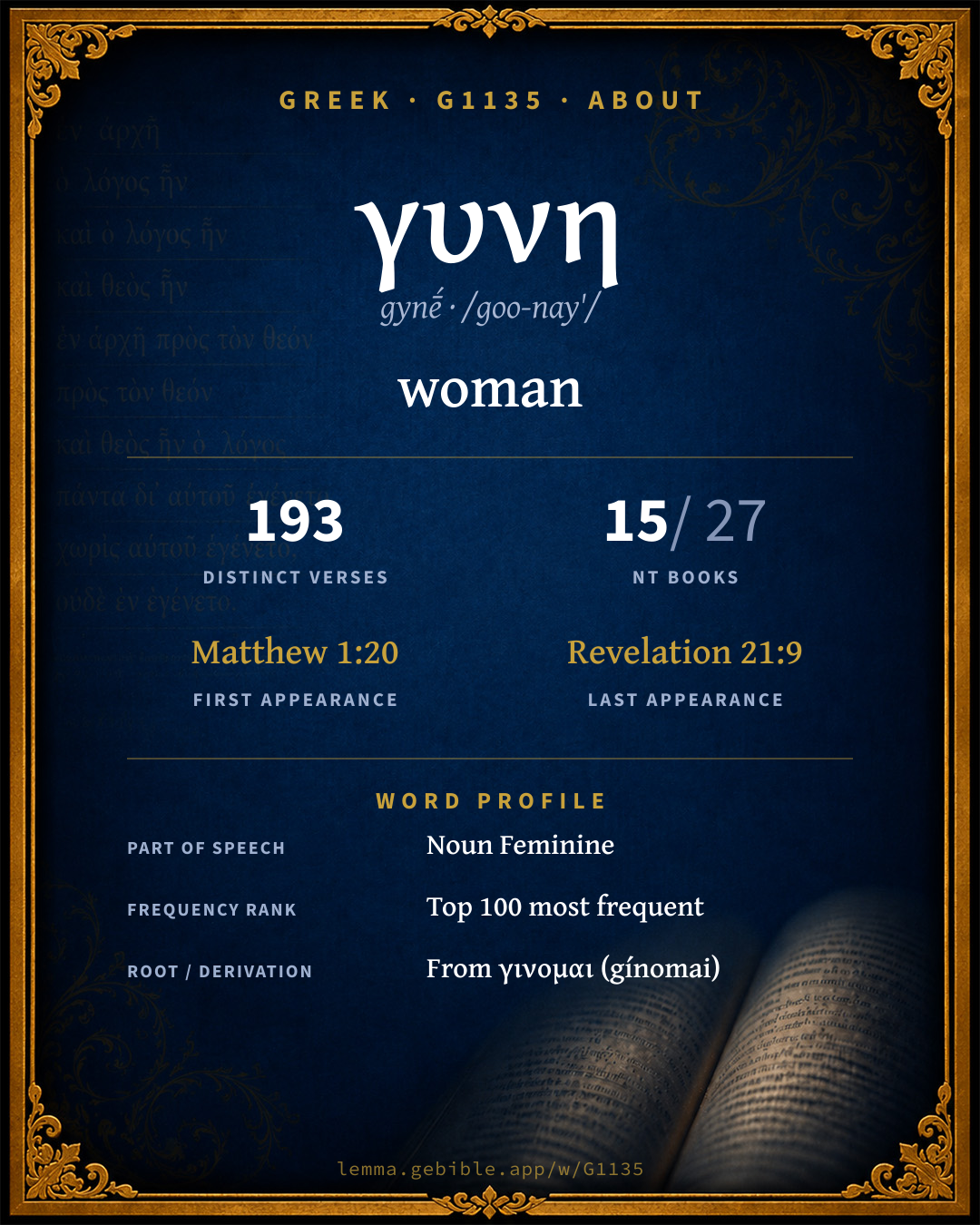
γυνή
woman
‘woman’ is one of 2 main senses fuller range ↓
Full lexicon entry — Thayer's Greek Lexicon
From Thayer's Greek Lexicon
Where this word appears
See every Nominative-case word in the Greek New Testament →
Grammar key — what these labels mean
Part of speech
- Noun
- A naming word — a person, place, thing, or idea.
Case
- Nominative
- The case of the subject (and the predicate nominative).
- Accusative
- The case of the direct object and of extent.
- Genitive
- The case of source, possession, or “of” — answers “whose / from what.”
- Dative
- The case of the indirect object, means, or location — “to / for / with / in.”
- Vocative
- The case of direct address (“O Lord”).
Gender
- Feminine
- Grammatically feminine.
Number
- Singular
- One.
- Plural
- More than one.
Grammatical forms 9 distinct
- Noun, Nominative, Singular, Feminine 73 times (34%)
- Noun, Accusative, Singular, Feminine 50 times (23%)
- Noun, Genitive, Singular, Feminine 23 times (11%)
- Noun, Dative, Singular, Feminine 17 times (8%)
- Noun, Nominative, Plural, Feminine 15 times (7%)
- Noun, Accusative, Plural, Feminine 11 times (5%)
- Noun, Genitive, Plural, Feminine 11 times (5%)
- Noun, Vocative, Singular, Feminine 9 times (4%)
+1 more form (6 occurrences)
Parsed forms decoded from the imported morphology (Robinson–Tischendorf, public domain), counted across 215 parsed occurrences — not distinct verses.
Every verse where G1135 appears — 193 distinct verses across 15 books. Click any verse to open its interlinear word-by-word view. Verse text shown in the World English Bible for context — . Each verse’s Greek form is shown with its reference; the English is not keyword-highlighted, since the data carries no word-level English alignment. Use “Compare translations” on any verse to read it across multiple English versions. This concordance covers the Greek New Testament; Septuagint (Greek Old Testament) occurrences of this word are not indexed here.
Matthew 29 verses
- Matthew 1:20 γυναῖκά n acc sg fem But when he thought about these things, behold, an angel of the Lord appeared to him in a dream, saying, "Joseph, son of David, don't be afraid to take to yourself Mary, your wife, for that which is conceived in her is of the Holy Spirit.
- Matthew 1:24 γυναῖκα n acc sg fem Joseph arose from his sleep, and did as the angel of the Lord commanded him, and took his wife to himself;
- Matthew 5:28 γυναῖκα n acc sg fem but I tell you that everyone who gazes at a woman to lust after her has committed adultery with her already in his heart.
- Matthew 5:31 γυναῖκα n acc sg fem "It was also said, 'Whoever shall put away his wife, let him give her a writing of divorce,'
- Matthew 5:32 γυναῖκα n acc sg fem but I tell you that whoever puts away his wife, except for the cause of sexual immorality, makes her an adulteress; and whoever marries her when she is put away commits adultery.
- Matthew 9:20 γυνὴ n nom sg fem Behold, a woman who had an issue of blood for twelve years came behind him, and touched the tassels of his garment;
- Matthew 9:22 γυνὴ n nom sg fem But Jesus, turning around and seeing her, said, "Daughter, cheer up! Your faith has made you well." And the woman was made well from that hour.
- Matthew 11:11 γυναικῶν n gen pl fem Most assuredly I tell you, among those who are born of women there has not arisen anyone greater than John the Baptizer; yet he who is least in the Kingdom of Heaven is greater than he.
- Matthew 13:33 γυνὴ n nom sg fem He spoke another parable to them. "The Kingdom of Heaven is like yeast, which a woman took, and hid in three measures of meal, until it was all leavened."
- Matthew 14:3 γυναῖκα n acc sg fem For Herod had laid hold of John, and bound him, and put him in prison for the sake of Herodias, his brother Philip's wife.
- Matthew 14:21 γυναικῶν n gen pl fem Those who ate were about five thousand men, besides women and children.
- Matthew 15:22 γυνὴ n nom sg fem Behold, a Canaanite woman came out from those borders, and cried, saying, "Have mercy on me, Lord, you son of David! My daughter is severely demonized!"
- Matthew 15:28 γύναι n voc sg fem Then Jesus answered her, "Woman, great is your faith! Be it done to you even as you desire." And her daughter was healed from that hour.
- Matthew 15:38 γυναικῶν n gen pl fem Those who ate were four thousand men, besides women and children.
- Matthew 18:25 γυναῖκα n acc sg fem But because he couldn't pay, his lord commanded him to be sold, with his wife, his children, and all that he had, and payment to be made.
- Matthew 19:3 γυναῖκα n acc sg fem Pharisees came to him, testing him, and saying, "Is it lawful for a man to divorce his wife for any reason?"
- Matthew 19:5 γυναικὶ n dat sg fem and said, 'For this cause a man shall leave his father and mother, and shall join to his wife; and the two shall become one flesh?'
- Matthew 19:8 γυναῖκας n acc pl fem He said to them, "Moses, because of the hardness of your hearts, allowed you to divorce your wives, but from the beginning it has not been so.
- Matthew 19:9 γυναῖκα n acc sg fem I tell you that whoever divorces his wife, except for sexual immorality, and marries another, commits adultery; and he who marries her when she is divorced commits adultery."
- Matthew 19:10 γυναικός n gen sg fem His disciples said to him, "If this is the case of the man with his wife, it is not expedient to marry."
- Matthew 22:24 γυναῖκα n acc sg fem saying, "Teacher, Moses said, 'If a man dies, having no children, his brother shall marry his wife, and raise up seed for his brother.'
- Matthew 22:25 γυναῖκα n acc sg fem Now there were with us seven brothers. The first married and died, and having no seed left his wife to his brother.
- Matthew 22:27 γυνή n nom sg fem After them all, the woman died.
- Matthew 22:28 γυνή n nom sg fem In the resurrection therefore, whose wife will she be of the seven? For they all had her."
- Matthew 26:7 γυνὴ n nom sg fem a woman came to him having an alabaster jar of very expensive ointment, and she poured it on his head as he sat at the table.
- Matthew 26:10 γυναικί n dat sg fem But Jesus, knowing this, said to them, "Why do you trouble the woman? Because she has done a good work for me.
- Matthew 27:19 γυνὴ n nom sg fem While he was sitting on the judgment seat, his wife sent to him, saying, "Have nothing to do with that righteous man, for I have suffered many things this day in a dream because of him."
- Matthew 27:55 γυναῖκες n nom pl fem Many women were there watching from afar, who had followed Jesus from Galilee, serving him.
- Matthew 28:5 γυναιξίν n dat pl fem The angel answered the women, "Don't be afraid, for I know that you seek Jesus, who has been crucified.
Mark 14 verses
- Mark 5:25 γυνὴ n nom sg fem A certain woman, who had an issue of blood for twelve years,
- Mark 5:33 γυνὴ n nom sg fem But the woman, fearing and trembling, knowing what had been done to her, came and fell down before him, and told him all the truth.
- Mark 6:17 γυναῖκα n acc sg fem For Herod himself had sent out and arrested John, and bound him in prison for the sake of Herodias, his brother Philip's wife, for he had married her.
- Mark 6:18 γυναῖκα n acc sg fem For John said to Herod, "It is not lawful for you to have your brother's wife."
- Mark 7:25 γυνὴ n nom sg fem For a woman, whose little daughter had an unclean spirit, having heard of him, came and fell down at his feet.
- Mark 7:26 γυνὴ n nom sg fem Now the woman was a Greek, a Syrophoenician by race. She begged him that he would cast the demon out of her daughter.
- Mark 10:2 γυναῖκα n acc sg fem Pharisees came to him testing him, and asked him, "Is it lawful for a man to divorce his wife?"
- Mark 10:11 γυναῖκα n acc sg fem He said to them, "Whoever divorces his wife, and marries another, commits adultery against her.
- Mark 12:19 γυναῖκα γυναῖκα n acc sg fem n acc sg fem "Teacher, Moses wrote to us, 'If a man's brother dies, and leaves a wife behind him, and leaves no children, that his brother should take his wife, and raise up offspring for his brother.'
- Mark 12:20 γυναῖκα n acc sg fem There were seven brothers. The first took a wife, and dying left no offspring.
- Mark 12:22 γυνὴ n nom sg fem and the seven took her and left no children. Last of all the woman also died.
- Mark 12:23 γυνή γυναῖκα n nom sg fem n acc sg fem In the resurrection, when they rise, whose wife will she be of them? For the seven had her as a wife."
- Mark 14:3 γυνὴ n nom sg fem While he was at Bethany, in the house of Simon the leper, as he sat at the table, a woman came having an alabaster jar of ointment of pure nard-- very costly. She broke the jar, and poured it over his head.
- Mark 15:40 γυναῖκες n nom pl fem There were also women watching from afar, among whom were both Mary Magdalene, and Mary the mother of James the less and of Joses, and Salome;
Luke 37 verses
- Luke 1:5 γυνὴ n nom sg fem There was in the days of Herod, the king of Judea, a certain priest named Zacharias, of the priestly division of Abijah. He had a wife of the daughters of Aaron, and her name was Elizabeth.
- Luke 1:13 γυνή n nom sg fem But the angel said to him, "Don't be afraid, Zacharias, because your request has been heard, and your wife, Elizabeth, will bear you a son, and you shall call his name John.
- Luke 1:18 γυνή n nom sg fem Zacharias said to the angel, "How can I be sure of this? For I am an old man, and my wife is well advanced in years."
- Luke 1:24 γυνὴ n nom sg fem After these days Elizabeth, his wife, conceived, and she hid herself five months, saying,
- Luke 1:42 γυναιξίν n dat pl fem She called out with a loud voice, and said, "Blessed are you among women, and blessed is the fruit of your womb!
- Luke 3:19 γυναικὸς n gen sg fem but Herod the tetrarch, being reproved by him for Herodias, his brother's wife, and for all the evil things which Herod had done,
- Luke 4:26 γυναῖκα n acc sg fem Elijah was sent to none of them, except to Zarephath, in the land of Sidon, to a woman who was a widow.
- Luke 7:28 γυναικῶν n gen pl fem "For I tell you, among those who are born of women there is not a greater prophet than John the Baptizer, yet he who is least in the Kingdom of God is greater than he."
- Luke 7:37 γυνὴ n nom sg fem Behold, a woman in the city who was a sinner, when she knew that he was reclining in the Pharisee's house, she brought an alabaster jar of ointment.
- Luke 7:39 γυνὴ n nom sg fem Now when the Pharisee who had invited him saw it, he said to himself, "This man, if he were a prophet, would have perceived who and what kind of woman this is who touches him, that she is a sinner."
- Luke 7:44 γυναῖκα γυναῖκα n acc sg fem n acc sg fem Turning to the woman, he said to Simon, "Do you see this woman? I entered into your house, and you gave me no water for my feet, but she has wet my feet with her tears, and wiped them with the hair of her head.
- Luke 7:50 γυναῖκα n acc sg fem He said to the woman, "Your faith has saved you. Go in peace."
- Luke 8:2 γυναῖκές n nom pl fem and certain women who had been healed of evil spirits and infirmities: Mary who was called Magdalene, from whom seven demons had gone out;
- Luke 8:3 γυνὴ n nom sg fem and Joanna, the wife of Chuzas, Herod's steward; Susanna; and many others; who ministered to them from their possessions.
- Luke 8:43 γυνὴ n nom sg fem A woman who had a flow of blood for twelve years, who had spent all her living on physicians, and could not be healed by any,
- Luke 8:47 γυνὴ n nom sg fem When the woman saw that she was not hidden, she came trembling, and falling down before him declared to him in the presence of all the people the reason why she had touched him, and how she was healed immediately.
- Luke 10:38 γυνὴ n nom sg fem It happened as they went on their way, he entered into a certain village, and a certain woman named Martha received him into her house.
- Luke 11:27 γυνὴ n nom sg fem It came to pass, as he said these things, a certain woman out of the multitude lifted up her voice, and said to him, "Blessed is the womb that bore you, and the breasts which nursed you!"
- Luke 13:11 γυνὴ n nom sg fem Behold, there was a woman who had a spirit of infirmity eighteen years, and she was bent over, and could in no way straighten herself up.
- Luke 13:12 γύναι n voc sg fem When Jesus saw her, he called her, and said to her, "Woman, you are freed from your infirmity."
- Luke 13:21 γυνὴ n nom sg fem It is like yeast, which a woman took and hid in three measures of flour, until it was all leavened."
- Luke 14:20 γυναῖκα n acc sg fem "Another said, 'I have married a wife, and therefore I can't come.'
- Luke 14:26 γυναῖκα n acc sg fem "If anyone comes to me, and doesn't hate his own father, mother, wife, children, brothers, and sisters, yes, and his own life also, he can't be my disciple.
- Luke 15:8 γυνὴ n nom sg fem Or what woman, if she had ten drachma coins, if she lost one drachma coin, wouldn't light a lamp, sweep the house, and seek diligently until she found it?
- Luke 16:18 γυναῖκα n acc sg fem Everyone who divorces his wife, and marries another, commits adultery. He who marries one who is divorced from a husband commits adultery.
- Luke 17:32 γυναικὸς n gen sg fem Remember Lot's wife!
- Luke 18:29 γυναῖκα n acc sg fem He said to them, "Most assuredly I tell you, there is no one who has left house, or wife, or brothers, or parents, or children, for the Kingdom of God's sake,
- Luke 20:28 γυναῖκα γυναῖκα n acc sg fem n acc sg fem They asked him, "Teacher, Moses wrote to us that if a man's brother dies having a wife, and he is childless, his brother should take the wife, and raise up children for his brother.
- Luke 20:29 γυναῖκα n acc sg fem There were therefore seven brothers. The first took a wife, and died childless.
- Luke 20:32 γυνὴ n nom sg fem Afterward the woman also died.
- Luke 20:33 γυνὴ γυνή γυναῖκα n nom sg fem n nom sg fem n acc sg fem Therefore in the resurrection whose wife of them will she be? For the seven had her as a wife."
- Luke 22:57 γύναι n voc sg fem He denied Jesus, saying, "Woman, I don't know him."
- Luke 23:27 γυναικῶν n gen pl fem A great multitude of the people followed him, including women who also mourned and lamented him.
- Luke 23:49 γυναῖκες n nom pl fem All his acquaintances, and the women who followed with him from Galilee, stood at a distance, watching these things.
- Luke 23:55 γυναῖκες n nom pl fem The women, who had come with him out of Galilee, followed after, and saw the tomb, and how his body was laid.
- Luke 24:22 γυναῖκές n nom pl fem Also, certain women of our company amazed us, having arrived early at the tomb;
- Luke 24:24 γυναῖκες n nom pl fem Some of us went to the tomb, and found it just like the women had said, but they didn't see him."
John 21 verses
- John 2:4 γύναι n voc sg fem Jesus said to her, "Woman, what does that have to do with you and me? My hour has not yet come."
- John 4:7 γυνὴ n nom sg fem A woman of Samaria came to draw water. Jesus said to her, "Give me a drink."
- John 4:9 γυνὴ γυναικὸς n nom sg fem n gen sg fem The Samaritan woman therefore said to him, "How is it that you, being a Jew, ask for a drink from me, a Samaritan woman?" (For Jews have no dealings with Samaritans.)
- John 4:11 γυνή n nom sg fem The woman said to him, "Sir, you have nothing to draw with, and the well is deep. From where then have you that living water?
- John 4:15 γυνή n nom sg fem The woman said to him, "Sir, give me this water, so that I don't get thirsty, neither come all the way here to draw."
- John 4:17 γυνὴ n nom sg fem The woman answered, "I have no husband." Jesus said to her, "You said well, 'I have no husband,'
- John 4:19 γυνή n nom sg fem The woman said to him, "Sir, I perceive that you are a prophet.
- John 4:21 γύναι n voc sg fem Jesus said to her, "Woman, believe me, the hour comes, when neither in this mountain, nor in Jerusalem, will you worship the Father.
- John 4:25 γυνή n nom sg fem The woman said to him, "I know that Messiah comes," (he who is called Christ). "When he has come, he will declare to us all things."
- John 4:27 γυναικὸς n gen sg fem At this, his disciples came. They marveled that he was speaking with a woman; yet no one said, "What are you looking for?" or, "Why do you speak with her?"
- John 4:28 γυνὴ n nom sg fem So the woman left her water pot, and went away into the city, and said to the people,
- John 4:39 γυναικὸς n gen sg fem From that city many of the Samaritans believed in him because of the word of the woman, who testified, "He told me everything that I did."
- John 4:42 γυναικὶ n dat sg fem They said to the woman, "Now we believe, not because of your speaking; for we have heard for ourselves, and know that this is indeed the Christ, the Savior of the world."
- John 8:3 γυναῖκα n acc sg fem The scribes and the Pharisees brought a woman taken in adultery. Having set her in the midst,
- John 8:4 γυνὴ n nom sg fem they told him, "Teacher, we found this woman in adultery, in the very act.
- John 8:9 γυνὴ n nom sg fem They, when they heard it, being convicted by their conscience, went out one by one, beginning from the oldest, even to the last. Jesus was left alone with the woman where she was, in the middle.
- John 8:10 γυναικός γυνή n gen sg fem n dat sg fem Jesus, standing up, saw her and said, "Woman, where are your accusers? Did no one condemn you?"
- John 16:21 γυνὴ n nom sg fem A woman, when she gives birth, has sorrow, because her time has come. But when she has delivered the child, she doesn't remember the anguish any more, for the joy that a human being is born into the world.
- John 19:26 γύναι n voc sg fem Therefore when Jesus saw his mother, and the disciple whom he loved standing there, he said to his mother, "Woman, behold your son!"
- John 20:13 γύναι n voc sg fem They told her, "Woman, why are you weeping?" She said to them, "Because they have taken away my Lord, and I don't know where they have laid him."
- John 20:15 γύναι n voc sg fem Jesus said to her, "Woman, why are you weeping? Who are you looking for?" She, supposing him to be the gardener, said to him, "Sir, if you have carried him away, tell me where you have laid him, and I will take him away."
Acts 19 verses
- Acts 1:14 γυναιξὶν n dat pl fem All these with one accord continued steadfastly in prayer and supplication, along with the women, and Mary the mother of Jesus, and with his brothers.
- Acts 5:1 γυναικὶ n dat sg fem But a certain man named Ananias, with Sapphira, his wife, sold a possession,
- Acts 5:2 γυναικός n gen sg fem and kept back part of the price, his wife also being aware of it, and brought a certain part, and laid it at the apostles' feet.
- Acts 5:7 γυνὴ n nom sg fem About three hours later, his wife, not knowing what had happened, came in.
- Acts 5:14 γυναικῶν n gen pl fem More believers were added to the Lord, multitudes of both men and women.
- Acts 8:3 γυναῖκας n acc pl fem But Saul ravaged the assembly, entering into every house, and dragged both men and women off to prison.
- Acts 8:12 γυναῖκες n nom pl fem But when they believed Philip preaching good news concerning the Kingdom of God and the name of Jesus Christ, they were baptized, both men and women.
- Acts 9:2 γυναῖκας n acc pl fem and asked for letters from him to the synagogues of Damascus, that if he found any who were of the Way, whether men or women, he might bring them bound to Jerusalem.
- Acts 13:50 γυναῖκας n acc pl fem But the Jews stirred up the devout and prominent women and the chief men of the city, and stirred up a persecution against Paul and Barnabas, and threw them out of their borders.
- Acts 16:1 γυναικὸς n gen sg fem He came to Derbe and Lystra: and behold, a certain disciple was there, named Timothy, the son of a Jewess who believed; but his father was a Greek.
- Acts 16:13 γυναιξίν n dat pl fem On the Sabbath day we went forth outside of the city by a riverside, where we supposed there was a place of prayer, and we sat down, and spoke to the women who had come together.
- Acts 16:14 γυνὴ n nom sg fem A certain woman named Lydia, a seller of purple, of the city of Thyatira, one who worshiped God, heard us; whose heart the Lord opened to listen to the things which were spoken by Paul.
- Acts 17:4 γυναικῶν n gen pl fem Some of them were persuaded, and joined Paul and Silas, of the devout Greeks a great multitude, and not a few of the chief women.
- Acts 17:12 γυναικῶν n gen pl fem Many of them therefore believed; also of the prominent Greek women, and not a few men.
- Acts 17:34 γυνὴ n nom sg fem But certain men joined with him, and believed, among whom also was Dionysius the Areopagite, and a woman named Damaris, and others with them.
- Acts 18:2 γυναῖκα n acc sg fem He found a certain Jew named Aquila, a man of Pontus by race, who had recently come from Italy, with his wife Priscilla, because Claudius had commanded all the Jews to depart from Rome. He came to them,
- Acts 21:5 γυναιξὶ n dat pl fem When it happened that we had accomplished the days, we departed and went on our journey. They all, with wives and children, brought us on our way until we were out of the city. Kneeling down on the beach, we prayed.
- Acts 22:4 γυναῖκας n acc pl fem I persecuted this Way to the death, binding and delivering into prisons both men and women.
- Acts 24:24 γυναικὶ n dat sg fem But after some days, Felix came with Drusilla, his wife, who was a Jewess, and sent for Paul, and heard him concerning the faith in Christ Jesus.
Romans 1 verse
1 Corinthians 30 verses
- 1 Corinthians 5:1 γυναῖκά n acc sg fem It is actually reported that there is sexual immorality among you, and such sexual immorality as is not even named among the Gentiles, that one has his father's wife.
- 1 Corinthians 7:1 γυναικὸς n gen sg fem Now concerning the things about which you wrote to me: it is good for a man not to touch a woman.
- 1 Corinthians 7:2 γυναῖκα n acc sg fem But, because of sexual immoralities, let each man have his own wife, and let each woman have her own husband.
- 1 Corinthians 7:3 γυναικὶ γυνὴ n dat sg fem n nom sg fem Let the husband render to his wife the affection owed her, and likewise also the wife to her husband.
- 1 Corinthians 7:4 γυνὴ γυνή n nom sg fem n nom sg fem The wife doesn't have authority over her own body, but the husband. Likewise also the husband doesn't have authority over his own body, but the wife.
- 1 Corinthians 7:10 γυναῖκα n acc sg fem But to the married I command--not I, but the Lord--that the wife not leave her husband
- 1 Corinthians 7:11 γυναῖκα n acc sg fem (but if she departs, let her remain unmarried, or else be reconciled to her husband), and that the husband not leave his wife.
- 1 Corinthians 7:12 γυναῖκα n acc sg fem But to the rest I--not the Lord--say, if any brother has an unbelieving wife, and she is content to live with him, let him not leave her.
- 1 Corinthians 7:13 γυνὴ n nom sg fem The woman who has an unbelieving husband, and he is content to live with her, let her not leave her husband.
- 1 Corinthians 7:14 γυναικί γυνὴ n dat sg fem n nom sg fem For the unbelieving husband is sanctified in the wife, and the unbelieving wife is sanctified in the husband. Otherwise your children would be unclean, but now are they holy.
- 1 Corinthians 7:16 γύναι γυναῖκα n voc sg fem n acc sg fem For how do you know, wife, whether you will save your husband? Or how do you know, husband, whether you will save your wife?
- 1 Corinthians 7:27 γυναικί γυναικός γυναῖκα n dat sg fem n gen sg fem n acc sg fem Are you bound to a wife? Don't seek to be freed. Are you free from a wife? Don't seek a wife.
- 1 Corinthians 7:29 γυναῖκας n acc pl fem But I say this, brothers: the time is short, that from now on, both those who have wives may be as though they had none;
- 1 Corinthians 7:33 γυναικί n dat sg fem but he who is married is concerned about the things of the world, how he may please his wife.
- 1 Corinthians 7:34 γυνὴ n nom sg fem There is also a difference between a wife and a virgin. The unmarried woman cares about the things of the Lord, that she may be holy both in body and in spirit. But she who is married cares about the things of the world--how she may please her husband.
- 1 Corinthians 7:39 γυνὴ n nom sg fem A wife is bound by law for as long as her husband lives; but if the husband is dead, she is free to be married to whoever she desires, only in the Lord.
- 1 Corinthians 9:5 γυναῖκα n acc sg fem Have we no right to take along a wife who is a believer, even as the rest of the apostles, and the brothers of the Lord, and Cephas?
- 1 Corinthians 11:3 γυναικὸς n gen sg fem But I would have you know that the head of every man is Christ, and the head of the woman is the man, and the head of Christ is God.
- 1 Corinthians 11:5 γυνὴ n nom sg fem But every woman praying or prophesying with her head unveiled dishonors her head. For it is one and the same thing as if she were shaved.
- 1 Corinthians 11:6 γυνή γυναικὶ n nom sg fem n dat sg fem For if a woman is not covered, let her also be shorn. But if it is shameful for a woman to be shorn or shaved, let her be covered.
- 1 Corinthians 11:7 γυνὴ n nom sg fem For a man indeed ought not to have his head covered, because he is the image and glory of God, but the woman is the glory of the man.
- 1 Corinthians 11:8 γυναικός γυνὴ n gen sg fem n nom sg fem For man is not from woman, but woman from man;
- 1 Corinthians 11:9 γυναῖκα γυνὴ n acc sg fem n nom sg fem for neither was man created for the woman, but woman for the man.
- 1 Corinthians 11:10 γυνὴ n nom sg fem For this cause the woman ought to have authority on her head, because of the angels.
- 1 Corinthians 11:11 γυνὴ γυναικὸς n nom sg fem n gen sg fem Nevertheless, neither is the woman independent of the man, nor the man independent of the woman, in the Lord.
- 1 Corinthians 11:12 γυνὴ γυναικός n nom sg fem n gen sg fem For as woman came from man, so a man also comes through a woman; but all things are from God.
- 1 Corinthians 11:13 γυναῖκα n acc sg fem Judge for yourselves. Is it appropriate that a woman pray to God unveiled?
- 1 Corinthians 11:15 γυνὴ n nom sg fem But if a woman has long hair, it is a glory to her, for her hair is given to her for a covering.
- 1 Corinthians 14:34 γυναῖκες n nom pl fem let your wives keep silent in the assemblies, for it has not been permitted for them to speak; but let them be in subjection, as the law also says.
- 1 Corinthians 14:35 γυναικὶ n dat sg fem If they desire to learn anything, let them ask their own husbands at home, for it is shameful for a woman to chatter in the assembly.
Galatians 1 verse
Ephesians 7 verses
- Ephesians 5:22 γυναῖκες n nom pl fem Wives, be subject to your own husbands, as to the Lord.
- Ephesians 5:23 γυναικὸς n gen sg fem For the husband is the head of the wife, and Christ also is the head of the assembly, being himself the savior of the body.
- Ephesians 5:24 γυναῖκες n nom pl fem But as the assembly is subject to Christ, so let the wives also be to their own husbands in everything.
- Ephesians 5:25 γυναῖκας n acc pl fem Husbands, love your wives, even as Christ also loved the assembly, and gave himself up for it;
- Ephesians 5:28 γυναῖκας γυναῖκα n acc pl fem n acc sg fem Even so ought husbands also to love their own wives as their own bodies. He who loves his own wife loves himself.
- Ephesians 5:31 γυναικί n dat sg fem "For this cause a man will leave his father and mother, and will be joined to his wife. The two will become one flesh."
- Ephesians 5:33 γυναῖκα γυνὴ n acc sg fem n nom sg fem Nevertheless each of you must also love his own wife even as himself; and let the wife see that she respects her husband.
Colossians 2 verses
1 Timothy 9 verses
- 1 Timothy 2:9 γυναῖκας n acc pl fem In the same way, that women also adorn themselves in decent clothing, with modesty and propriety; not just with braided hair, gold, pearls, or expensive clothing;
- 1 Timothy 2:10 γυναιξὶν n dat pl fem but (which becomes women professing godliness) with good works.
- 1 Timothy 2:11 Γυνὴ n nom sg fem Let a woman learn in quietness with all subjection.
- 1 Timothy 2:12 γυναικὶ n dat sg fem But I don't permit a woman to teach, nor to exercise authority over a man, but to be in quietness.
- 1 Timothy 2:14 γυνὴ n nom sg fem Adam wasn't deceived, but the woman, being deceived, has fallen into disobedience;
- 1 Timothy 3:2 γυναικὸς n gen sg fem The overseer therefore must be without reproach, the husband of one wife, temperate, sensible, modest, hospitable, good at teaching;
- 1 Timothy 3:11 γυναῖκας n acc pl fem Their wives in the same way must be reverent, not slanderers, temperate, faithful in all things.
- 1 Timothy 3:12 γυναικὸς n gen sg fem Let deacons be husbands of one wife, ruling their children and their own houses well.
- 1 Timothy 5:9 γυνή n nom sg fem Let no one be enrolled as a widow under sixty years old, having been the wife of one man,
Titus 1 verse
Hebrews 1 verse
1 Peter 2 verses
- 1 Peter 3:1 γυναῖκες γυναικῶν n nom pl fem n gen pl fem In like manner, wives, be in subjection to your own husbands; so that, even if any don't obey the Word, they may be won by the behavior of their wives without a word;
- 1 Peter 3:5 γυναῖκες n nom pl fem For this is how the holy women before, who hoped in God, also adorned themselves, being in subjection to their own husbands:
Revelation 19 verses
- Revelation 2:20 γυναῖκα n acc sg fem But I have this against you, that you tolerate your woman, Jezebel, who calls herself a prophetess. She teaches and seduces my servants to commit sexual immorality, and to eat things sacrificed to idols.
- Revelation 9:8 γυναικῶν n gen pl fem They had hair like women's hair, and their teeth were like those of lions.
- Revelation 12:1 γυνὴ n nom sg fem A great sign was seen in heaven: a woman clothed with the sun, and the moon under her feet, and on her head a crown of twelve stars.
- Revelation 12:4 γυναικὸς n gen sg fem His tail drew one third of the stars of the sky, and threw them to the earth. The dragon stood before the woman who was about to give birth, so that when she gave birth he might devour her child.
- Revelation 12:6 γυνὴ n nom sg fem The woman fled into the wilderness, where she has a place prepared by God, that there they may nourish her one thousand two hundred sixty days.
- Revelation 12:13 γυναῖκα n acc sg fem When the dragon saw that he was thrown down to the earth, he persecuted the woman who gave birth to the male child.
- Revelation 12:14 γυναικὶ n dat sg fem Two wings of the great eagle were given to the woman, that she might fly into the wilderness to her place, so that she might be nourished for a time, and times, and half a time, from the face of the serpent.
- Revelation 12:15 γυναικὸς n gen sg fem The serpent spewed water out of his mouth after the woman like a river, that he might cause her to be carried away by the stream.
- Revelation 12:16 γυναικί n dat sg fem The earth helped the woman, and the earth opened its mouth and swallowed up the river which the dragon spewed out of his mouth.
- Revelation 12:17 γυναικί n dat sg fem The dragon grew angry with the woman, and went away to make war with the rest of her seed, who keep God's commandments and hold Jesus' testimony.
- Revelation 14:4 γυναικῶν n gen pl fem These are those who were not defiled with women, for they are virgins. These are those who follow the Lamb wherever he goes. These were redeemed by Jesus from among men, the first fruits to God and to the Lamb.
- Revelation 17:3 γυναῖκα n acc sg fem He carried me away in the Spirit into a wilderness. I saw a woman sitting on a scarlet-colored animal, full of blasphemous names, having seven heads and ten horns.
- Revelation 17:4 γυνὴ n nom sg fem The woman was dressed in purple and scarlet, and decked with gold and precious stones and pearls, having in her hand a golden cup full of abominations and the impurities of the sexual immorality of the earth.
- Revelation 17:6 γυναῖκα n acc sg fem I saw the woman drunken with the blood of the saints, and with the blood of the martyrs of Jesus. When I saw her, I wondered with great amazement.
- Revelation 17:7 γυναικὸς n gen sg fem The angel said to me, "Why do you wonder? I will tell you the mystery of the woman, and of the beast that carries her, which has the seven heads and the ten horns.
- Revelation 17:9 γυνὴ n nom sg fem Here is the mind that has wisdom. The seven heads are seven mountains, on which the woman sits.
- Revelation 17:18 γυνὴ n nom sg fem The woman whom you saw is the great city, which reigns over the kings of the earth."
- Revelation 19:7 γυνὴ n nom sg fem Let us rejoice and be exceedingly glad, and let us give the glory to him. For the marriage of the Lamb has come, and his wife has made herself ready."
- Revelation 21:9 γυναῖκα n acc sg fem One of the seven angels who had the seven bowls, who were loaded with the seven last plagues came, and he spoke with me, saying, "Come here. I will show you the wife, the Lamb's bride."
About this entry
At a glance — auto-summarized from this page’s data, not written by a person. Every figure links to its source below. This summary describes the numbers; it doesn’t interpret them.
γυνη (gynḗ) is a Greek noun most often rendered “woman.” It first appears in Matthew 1:20. It turns up in 193 verses across 15 books, a common footprint. Its lexical range runs to 2 senses. From the same root come γινομαι, γενος and γονευς. The sections below give every sense, occurrence, and version rendering.
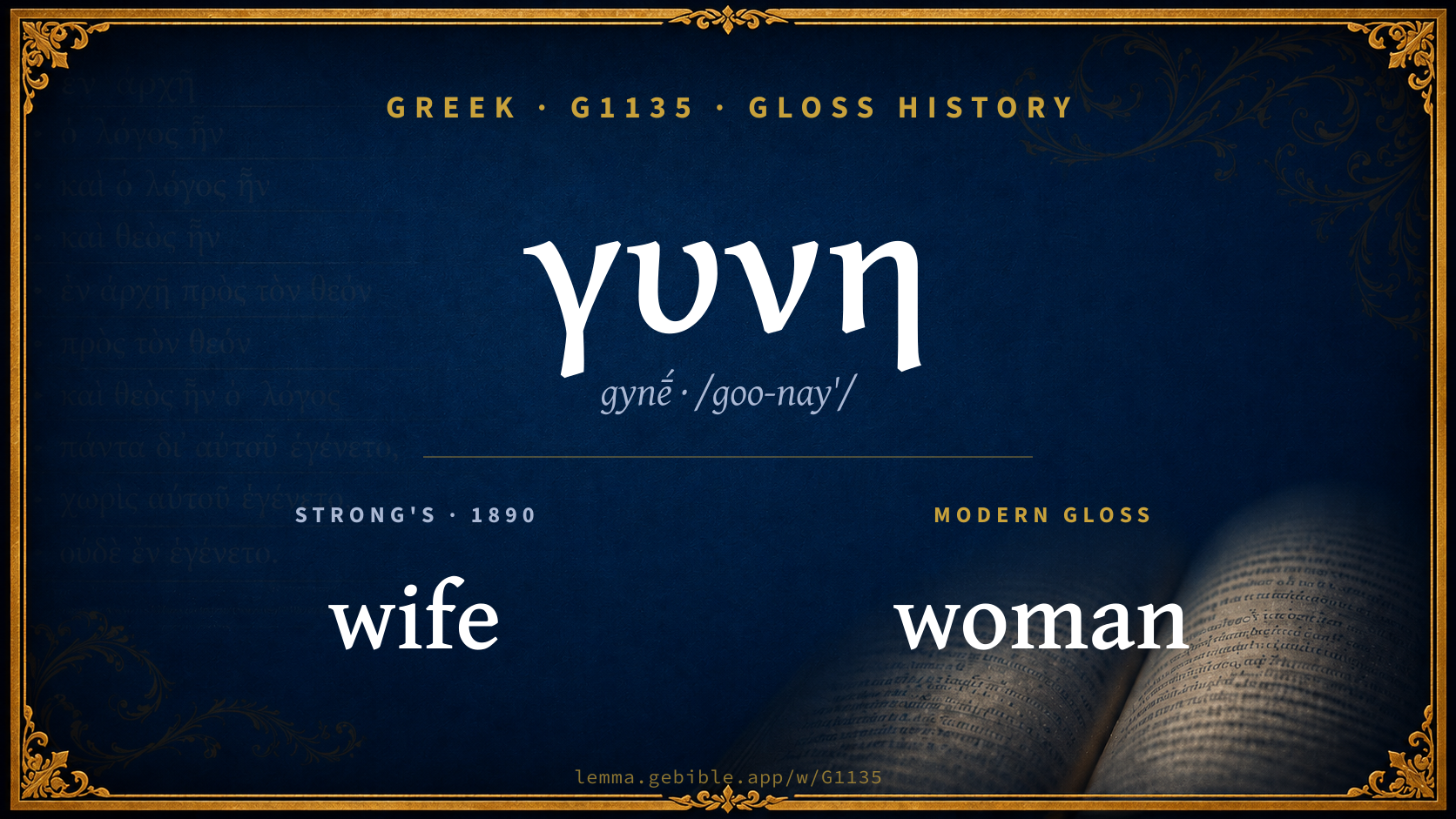
Gloss history
Strong's 1890 vs modern scholarship
About this word
Strong's G1135 catalogs a Greek word from the Greek New Testament.
These counts are not copied from any lexicon or concordance. They are computed here, from the morphology-tagged Greek New Testament. What Lemma adds →
- 193
- distinct verses
- The word appears in 193 distinct verses.
- 15 / 27
- NT books
- The word appears in 15 of 27 New Testament books.
- #76
- by frequency
- Top 100 most frequent Greek words (rank 76 of 5,347 Greek words by occurrence).
View all 193 occurrences in the concordance →
Most concentrated in
- Luke 37 verses 19%
- 1 Corinthians 30 verses 16%
- Matthew 29 verses 15%
By section of the New Testament
By traditional corpus
Conventional, traditional groupings — biblical authorship is debated, so this is a traditional corpus grouping, not an authorship claim. Some books belong to more than one corpus (Luke is in both the Gospels and the Lukan corpus, and so on), so these shares overlap and need not total 100%. Each figure is a share of the word’s 193 distinct verses.
- Gospels 101 verses · 52%
- Lukan (Luke–Acts) 56 verses · 29%
- Pauline corpus 51 verses · 26%
- Johannine 40 verses · 21%
- Revelation 19 verses · 10%
- General (Catholic) Epistles 2 verses · 1%
- Hebrews 1 verse · 1%
How translations render this word
Counts come from each version’s own published word-to-Strong’s tagging or interlinear alignment — an approximate guide to how each version renders this word, not a word-level alignment the data otherwise carries. Because each total is that version’s own tagged count, the per-version totals vary from one another and need not match the appearance or distinct-verse counts above. These counts may also differ from a printed concordance because Lemma counts each distinctly tagged rendering and does not collapse phrase taggings into a single head-word total. This is a fixed set of word-tagged versions (KJV, ASV, BSB, ULT) and does not change with the reading translation you choose elsewhere. Each version’s license is shown beside its name below (and on Sources).
- King James Version: Woman 95×, Wife 80×, Women 33×
- American Standard Version: Woman 90×, Wife 65×, Women 32×
- Berean Standard Bible: Woman 93×, Wife 66×, Women 32×
- unfoldingWord Literal Text: Woman 97×, Wife 73×, Women 32×
King James Version Public Domain
Renders G1135 across 221 tagged occurrences — most commonly:
Plus 4 renderings that appear only once — usually multi-word phrases or single function words the recovered tagging swept in, not distinct renderings.
American Standard Version Public Domain
Renders G1135 across 216 tagged occurrences — most commonly:
Plus 13 renderings that appear only once — usually multi-word phrases or single function words the recovered tagging swept in, not distinct renderings.
Berean Standard Bible Public Domain
Renders G1135 across 210 tagged occurrences — most commonly:
Plus 6 renderings that appear only once — usually multi-word phrases or single function words the recovered tagging swept in, not distinct renderings. Not rendered by a distinct English word in 5 further occurrences.
unfoldingWord Literal Text CC BY-SA 4.0
Renders G1135 across 233 tagged occurrences — most commonly:
Plus 6 renderings that appear only once — usually multi-word phrases or single function words the recovered tagging swept in, not distinct renderings.
Senses in Thayer's
The 2 senses Thayer's distinguishes for this word, in lexicon order (not ranked by frequency or importance). The full entry — with sub-senses — is in the Lexicon Entry tab.
- a woman of any age, whether a virgin, or married, or a widow
- of a betrothed woman
Word origin
Derived from γινομαι (gínomai) (G1096) — to become.
Probably from the base of G1096 ; a woman ; specifically a wife : - wife woman.
— Strong’s Exhaustive Concordance (1890), public domain.
Forms in the corpus
The 17 distinct written forms G1135 takes in the Greek New Testament, most frequent first — each parse links to that case’s occurrences in the concordance.
Same root — word family
Other Thayer's entries built from the same root as G1135, grouped by Strong’s listed origin. These share a root / origin per the lexicon — not necessarily a shared meaning. Each links to that word’s own entry.
Derives from
Shares the same root
Derived from this word
Compare all same-root words → Showing 4 of 6 — not the complete family. They share a root, not necessarily a meaning.
Septuagint usage
The same Greek word γυνη appears 771 times in the Greek Old Testament (Septuagint), across 671 verses in 31 books.
- 771
- LXX occurrences
- Tagged occurrences of this Greek word in the Septuagint.
- 671
- verses
- Distinct Septuagint verses containing this word.
- 31 / 39
- OT books
- The word appears in 31 of the 39 Old Testament books.
Sample Septuagint occurrences
- Genesis 2:22 γυνή
- Exodus 1:19 γυνή
- Leviticus 12:2 γυνή
- Numbers 5:6 γυνή
- Deuteronomy 2:34 γυνή
- Joshua 1:14 γυνή
- Judges 1:12 γυνή
- Ruth 1:1 γυνή
- 1 Samuel 1:2 γυνή
- 2 Samuel 1:26 γυνή
- 1 Kings 2:17 γυνή
- 2 Kings 4:1 γυνή
Septuagint occurrences (same lexeme)
Every verse where the same Strong’s number (G1135) appears in the Greek Septuagint — showing the first 50 of 671. Verse text shown in the World English Bible for context; the Greek form is the matched word — the English is not keyword-highlighted.
- Genesis 2:22 γυνή He made the rib, which Yahweh God had taken from the man, into a woman, and brought her to the man.
- Genesis 2:23 γυνή The man said, "This is now bone of my bones, and flesh of my flesh. She will be called Woman, because she was taken out of Man."
- Genesis 2:24 γυνή Therefore a man will leave his father and his mother, and will join with his wife, and they will be one flesh.
- Genesis 2:25 γυνή They were both naked, the man and his wife, and were not ashamed.
- Genesis 3:1 γυνή Now the serpent was more subtle than any animal of the field which Yahweh God had made. He said to the woman, "Yes, has God said, 'You shall not eat of any tree of the garden?'"
- Genesis 3:2 γυνή The woman said to the serpent, "Of the fruit of the trees of the garden we may eat,
- Genesis 3:4 γυνή The serpent said to the woman, "You won't surely die,
- Genesis 3:6 γυνή When the woman saw that the tree was good for food, and that it was a delight to the eyes, and that the tree was to be desired to make one wise, she took of the fruit of it, and ate; and she gave some to her husband with her, and he ate.
- Genesis 3:8 γυνή They heard the voice of Yahweh God walking in the garden in the cool of the day, and the man and his wife hid themselves from the presence of Yahweh God among the trees of the garden.
- Genesis 3:12 γυνή The man said, "The woman whom you gave to be with me, she gave me of the tree, and I ate."
- Genesis 3:13 γυνή Yahweh God said to the woman, "What is this you have done?" The woman said, "The serpent deceived me, and I ate."
- Genesis 3:15 γυνή I will put enmity between you and the woman, and between your offspring and her offspring. He will bruise your head, and you will bruise his heel."
- Genesis 3:16 γυνή To the woman he said, "I will greatly multiply your pain in childbirth. In pain you will bring forth children. Your desire will be for your husband, and he will rule over you."
- Genesis 3:17 γυνή To Adam he said, "Because you have listened to your wife's voice, and have eaten of the tree, of which I commanded you, saying, 'You shall not eat of it,' cursed is the ground for your sake. In toil you will eat of it all the days of your life.
- Genesis 3:20 γυνή The man called his wife Eve, because she was the mother of all living.
- Genesis 3:21 γυνή Yahweh God made coats of skins for Adam and for his wife, and clothed them.
- Genesis 4:1 γυνή The man knew Eve his wife. She conceived, and gave birth to Cain, and said, "I have gotten a man with Yahweh's help."
- Genesis 4:17 γυνή Cain knew his wife. She conceived, and gave birth to Enoch. He built a city, and called the name of the city, after the name of his son, Enoch.
- Genesis 4:19 γυνή Lamech took two wives: the name of the one was Adah, and the name of the other Zillah.
- Genesis 4:23 γυνή Lamech said to his wives, "Adah and Zillah, Hear my voice, You wives of Lamech, listen to my speech, For I have slain a man for wounding me, A young man for bruising me.
- Genesis 4:25 γυνή Adam knew his wife again. She gave birth to a son, and named him Seth. For, she said, "God has appointed me another child instead of Abel, for Cain killed him."
- Genesis 6:2 γυνή that God's sons saw that men's daughters were beautiful, and they took for themselves wives of all that they chose.
- Genesis 6:18 γυνή But I will establish my covenant with you. You shall come into the ark, you, your sons, your wife, and your sons' wives with you.
- Genesis 7:7 γυνή Noah went into the ark with his sons, his wife, and his sons' wives, because of the waters of the flood.
- Genesis 7:13 γυνή In the same day Noah, and Shem, Ham, and Japheth, the sons of Noah, and Noah's wife, and the three wives of his sons with them, entered into the ark;
- Genesis 8:16 γυνή "Go forth from the ark, you, and your wife, and your sons, and your sons' wives with you.
- Genesis 8:18 γυνή Noah went forth, with his sons, his wife, and his sons' wives with him.
- Genesis 11:29 γυνή Abram and Nahor took wives. The name of Abram's wife was Sarai, and the name of Nahor's wife, Milcah, the daughter of Haran who was also the father of Iscah.
- Genesis 11:31 γυνή Terah took Abram his son, Lot the son of Haran, his son's son, and Sarai his daughter-in-law, his son Abram's wife. They went forth from Ur of the Chaldees, to go into the land of Canaan. They came to Haran, and lived there.
- Genesis 12:5 γυνή Abram took Sarai his wife, Lot his brother's son, all their substance that they had gathered, and the souls who they had gotten in Haran; and they went forth to go into the land of Canaan. Into the land of Canaan they came.
- Genesis 12:11 γυνή It happened, when he was come near to enter into Egypt, that he said to Sarai his wife, "See now, I know that you are a beautiful woman to look on.
- Genesis 12:12 γυνή It will happen, when the Egyptians will see you, that they will say, 'This is his wife.' They will kill me, but they will save you alive.
- Genesis 12:14 γυνή It happened that when Abram had come into Egypt, the Egyptians saw that the woman was very beautiful.
- Genesis 12:17 γυνή Yahweh plagued Pharaoh and his house with great plagues because of Sarai, Abram's wife.
- Genesis 12:18 γυνή Pharaoh called Abram, and said, "What is this that you have done to me? Why didn't you tell me that she was your wife?
- Genesis 12:19 γυνή Why did you say, 'She is my sister,' so that I took her to be my wife? Now therefore, see your wife, take her, and go your way."
- Genesis 12:20 γυνή Pharaoh gave men charge concerning him: and they brought him on the way, and his wife, and all that he had.
- Genesis 13:1 γυνή Abram went up out of Egypt: he, his wife, all that he had, and Lot with him, into the South.
- Genesis 14:16 γυνή He brought back all the goods, and also brought back his relative, Lot, and his goods, and the women also, and the people.
- Genesis 16:1 γυνή Now Sarai, Abram's wife, bore him no children. She had a handmaid, an Egyptian, whose name was Hagar.
- Genesis 16:3 γυνή Sarai, Abram's wife, took Hagar the Egyptian, her handmaid, after Abram had lived ten years in the land of Canaan, and gave her to Abram her husband to be his wife.
- Genesis 17:15 γυνή God said to Abraham, "As for Sarai your wife, you shall not call her name Sarai, but her name will be Sarah.
- Genesis 17:19 γυνή God said, "No, but Sarah, your wife, will bear you a son. You shall call his name Isaac. I will establish my covenant with him for an everlasting covenant for his seed after him.
- Genesis 18:9 γυνή They said to him, "Where is Sarah, your wife? He said, "See, in the tent."
- Genesis 18:10 γυνή He said, "I will certainly return to you when the season comes round. Behold, Sarah your wife will have a son." Sarah heard in the tent door, which was behind him.
- Genesis 19:15 γυνή When the morning arose, then the angels hurried Lot, saying, "Arise, take your wife, and your two daughters who are here, lest you be consumed in the iniquity of the city."
- Genesis 19:16 γυνή But he lingered; and the men laid hold on his hand, and on the hand of his wife, and on the hand of his two daughters, Yahweh being merciful to him; and they took him out, and set him outside of the city.
- Genesis 19:26 γυνή But his wife looked back from behind him, and she became a pillar of salt.
- Genesis 20:2 γυνή Abraham said about Sarah his wife, "She is my sister." Abimelech king of Gerar sent, and took Sarah.
- Genesis 20:3 γυνή But God came to Abimelech in a dream of the night, and said to him, "Behold, you are a dead man, because of the woman whom you have taken. For she is a man's wife."
These are occurrences of the same Greek lexeme (G1135) in the Septuagint — not a translation of any one Hebrew word. The store carries no word-level Hebrew↔Greek alignment, so no Hebrew original is asserted here. Counts come from the recovered LXX Strong's tagging — high-frequency vocabulary is well covered, while rare or late forms may be untagged — so they reflect tagged occurrences and may slightly undercount.