

Mark 4:19
Greek (Tischendorf 8th ed.) Mark 4:19 appears in the Greek New Testament. The text above is from the Tischendorf 8th edition. Each word links to its Strong’s number and a concise gloss. Click any word for its full Thayer’s Greek Lexicon entry.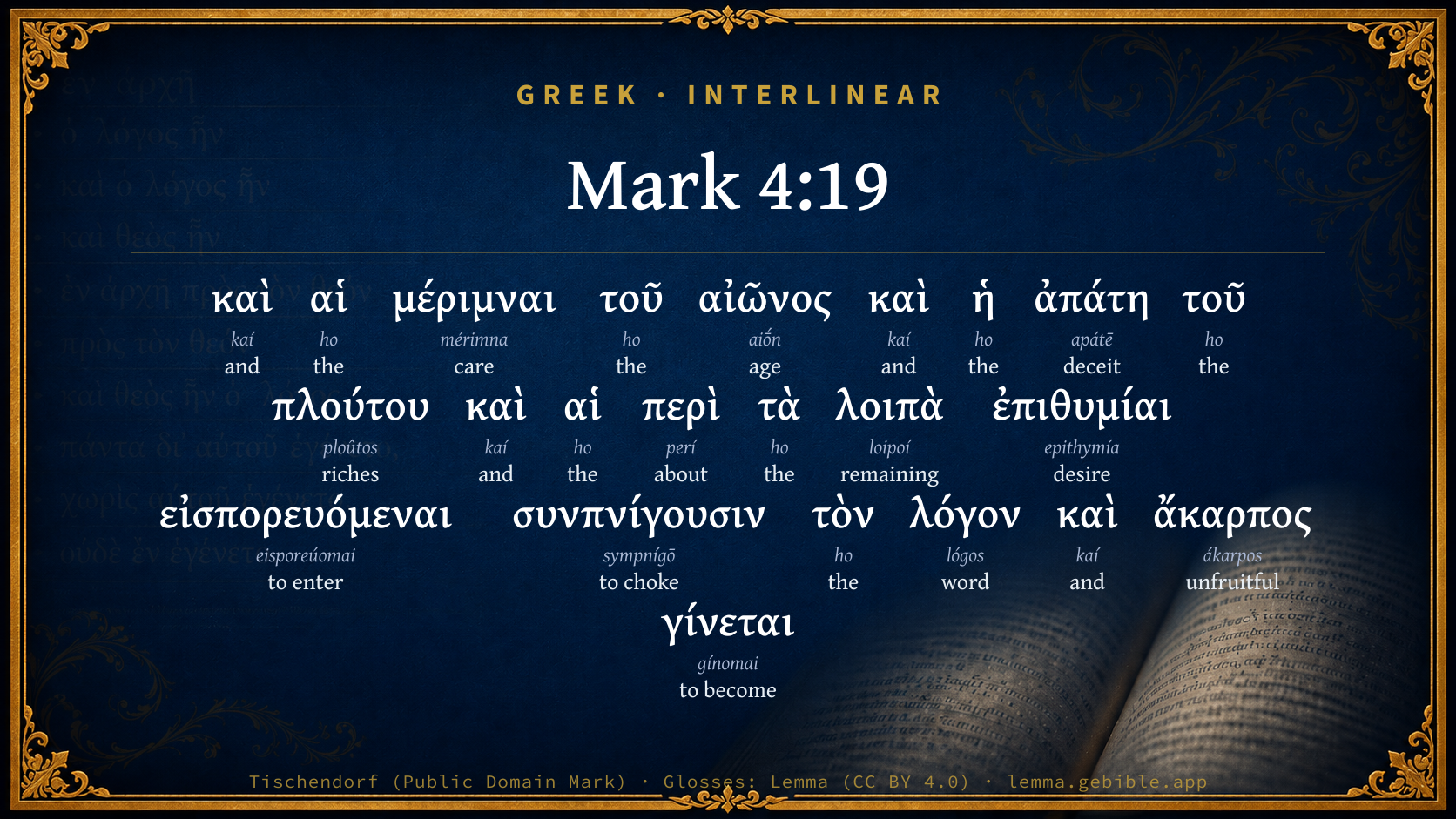
and the cares of this age, and the deceitfulness of riches, and the lusts of other things entering in choke the word, and it becomes unfruitful.
Download a study sheet
One document with this verse’s original text, its word-by-word gloss line, the meaning frame, cross-references with their text, attributed commentary, and full source and license credits — printable, and it pastes into notes with its structure intact.
This verse Autodidact and up
A passage Seminary Student
Up to 50 verses in one chapter. A passage sheet keeps up to 6 commentary sources and 12 cross-references per verse, in the order this page ranks them, and says so on the sheet whenever that leaves anything out. Ask for a single verse and you get the Autodidact verse sheet above.
Everything on this page stays free to read, with no account — the sheet is a download of what is already on screen, not access to it.
Compare translations 3
The same verse in 3 English versions, stacked beneath the original-language interlinear above. Click any original word for its lexicon entry.
Each is an independent rendering of the whole verse — the interlinear is not word-aligned to these translations.
Highlighted words mark where these versions differ — a whole-verse word diff, not a word-by-word alignment.
-
World English Bible Public Domain
and the cares of this age, and the deceitfulness of riches, and the lusts of other things entering in choke the word, and it becomes unfruitful.
-
King James Version Public Domain
And the cares of this world, and the deceitfulness of riches, and the lusts of other things entering in, choke the word, and it becometh unfruitful.
-
unfoldingWord Literal Text CC BY-SA 4.0
and the worries of the age and the deceitfulness of riches and the desires concerning other things, entering in, choke the word, and it becomes unfruitful.
unfoldingWord Literal Text — © unfoldingWord, licensed CC BY-SA 4.0. Word-aligned USFM3 via Door43 (git.door43.org/unfoldingWord/en_ult).
Show all 19 translations
Every available English version of this verse, each an independent rendering of the whole verse.
-
World English Bible Public Domain
and the cares of this age, and the deceitfulness of riches, and the lusts of other things entering in choke the word, and it becomes unfruitful.
-
Berean Standard Bible Public Domain
but the worries of this life, the deceitfulness of wealth, and the desire for other things come in and choke the word, and it becomes unfruitful.
-
Majority Standard Bible Public Domain
but the worries of this life, the deceitfulness of wealth, and the desire for other things come in and choke the word, and it becomes unfruitful.
-
King James Version Public Domain
And the cares of this world, and the deceitfulness of riches, and the lusts of other things entering in, choke the word, and it becometh unfruitful.
-
American Standard Version (1901) Public Domain
and the cares of the world, and the deceitfulness of riches, and the lusts of other things entering in, choke the word, and it becometh unfruitful.
-
Revised Version (1885) Public Domain
and the cares of the world, and the deceitfulness of riches, and the lusts of other things entering in, choke the word, and it becometh unfruitful.
-
Geneva Bible (1599) Public Domain
But the cares of this world, and the deceitfulnes of riches, and the lustes of other things enter in, and choke the word, and it is vnfruitfull.
-
Douay-Rheims (1899) Public Domain
And the cares of the world, and the deceitfulness of riches, and the lusts after other things entering in choke the word, and it is made fruitless.
-
Young's Literal Translation Public Domain
and the anxieties of this age, and the deceitfulness of the riches, and the desires concerning the other things, entering in, choke the word, and it becometh unfruitful.
-
Literal Standard Version CC BY-SA 4.0
and the anxieties of this age, and the deceitfulness of the riches, and the desires concerning the other things, entering in, choke the word, and it becomes unfruitful.
-
Unlocked Literal Bible CC BY-SA 4.0
but the cares of the world, the deceitfulness of riches, and the desires of other things enter in and choke the word, and it does not produce a crop.
-
unfoldingWord Literal Text CC BY-SA 4.0
and the worries of the age and the deceitfulness of riches and the desires concerning other things, entering in, choke the word, and it becomes unfruitful.
-
Darby Bible Public Domain
and the cares of life, and the deceitfulness of riches, and the lusts of other things, entering in, choke the word, and it becomes unfruitful.
-
World Messianic Bible Public Domain
and the cares of this age, and the deceitfulness of riches, and the lusts of other things entering in choke the word, and it becomes unfruitful.
-
Webster's Bible Public Domain
And the cares of this world, and the deceitfulness of riches, and the lusts of other things entering in, choke the word, and it becometh unfruitful.
-
Free Bible Version CC BY-SA 4.0
but worries of this world, the temptation of wealth, and other distractions choke the growth of the word, and it becomes unproductive.
-
Bible in Basic English Public Domain
And the cares of this life, and the deceits of wealth, and the desire for other things coming in, put a stop to the growth of the word, and it gives no fruit.
-
Text-Critical English NT CC BY 4.0
but the cares of this world, the deceitfulness of riches, and the desire for other things enter in and choke the word, and it becomes unfruitful.
-
Tyndale New Testament (1534) Public Domain
and the care of this worlde and the disseytfulnes of ryches and the lustes of other thinges entre in and choocke the worde and it is made vnfrutfull.
Literal Standard Version (2020), Covenant Press — licensed CC BY-SA 4.0. Text via the HelloAO Bible API (eBible.org). Unlocked Literal Bible (unfoldingWord) — licensed CC BY-SA 4.0. Text via the HelloAO Bible API (eBible.org). unfoldingWord Literal Text — © unfoldingWord, licensed CC BY-SA 4.0. Word-aligned USFM3 via Door43 (git.door43.org/unfoldingWord/en_ult). Free Bible Version, Dr. Jonathan Gallagher — licensed CC BY-SA 4.0. Text via the HelloAO Bible API (eBible.org).
Word by word
More ways to search: Search by grammar → Find every occurrence → Compare this word →
Practice this passage: Drill this verse → Learn its vocabulary →
- Appears 5× in the Greek New Testament
- First appears at Matthew 13:22
- Part of Speech
- Verb
- Tense
- Present
- Voice
- Active
- Mood
- Indicative
- Person
- 3rd person
- Number
- Plural
Full Thayer's Definition
- καὶ kaí G2532 “and” Conjunction
- αἱ ho G3588 “the” Article, Nominative, Plural, Feminine
- μέριμναι mérimna G3308 “care” Noun, Nominative, Plural, Feminine
- τοῦ ho G3588 “the” Article, Genitive, Singular, Masculine
- αἰῶνος aiṓn G165 “age” Noun, Genitive, Singular, Masculine
- καὶ kaí G2532 “and” Conjunction
- ἡ ho G3588 “the” Article, Nominative, Singular, Feminine
- ἀπάτη apátē G539 “deceit” Noun, Nominative, Singular, Feminine
- τοῦ ho G3588 “the” Article, Genitive, Singular, Masculine
- πλούτου ploûtos G4149 “riches” Noun, Genitive, Singular, Masculine
- καὶ kaí G2532 “and” Conjunction
- αἱ ho G3588 “the” Article, Nominative, Plural, Feminine
- περὶ perí G4012 “about” Preposition
- τὰ ho G3588 “the” Article, Accusative, Plural, Neuter
- λοιπὰ loipoí G3062 “remaining” Adjective, Accusative, Plural, Neuter
- ἐπιθυμίαι epithymía G1939 “desire” Noun, Nominative, Plural, Feminine
- εἰσπορευόμεναι eisporeúomai G1531 “to enter” Verb, Present, Middle or Passive deponent, Participle, Nominative, Plural, Feminine
- συνπνίγουσιν sympnígō G4846 “to choke” Verb, Present, Active, Indicative, 3rd person, Plural
- τὸν ho G3588 “the” Article, Accusative, Singular, Masculine
- λόγον lógos G3056 “word” Noun, Accusative, Singular, Masculine
- καὶ kaí G2532 “and” Conjunction
- ἄκαρπος ákarpos G175 “unfruitful” Adjective, Nominative, Singular, Masculine
- γίνεται gínomai G1096 “to become” Verb, Present, Middle or Passive deponent, Indicative, 3rd person, Singular
About this verse
These counts appear in no published source. They are computed here, from the morphology-tagged text and Lemma’s own curated glosses. What Lemma adds →
- 23
- words
- 14
- distinct lemmas
- Gospels
- section
Notable vocabulary
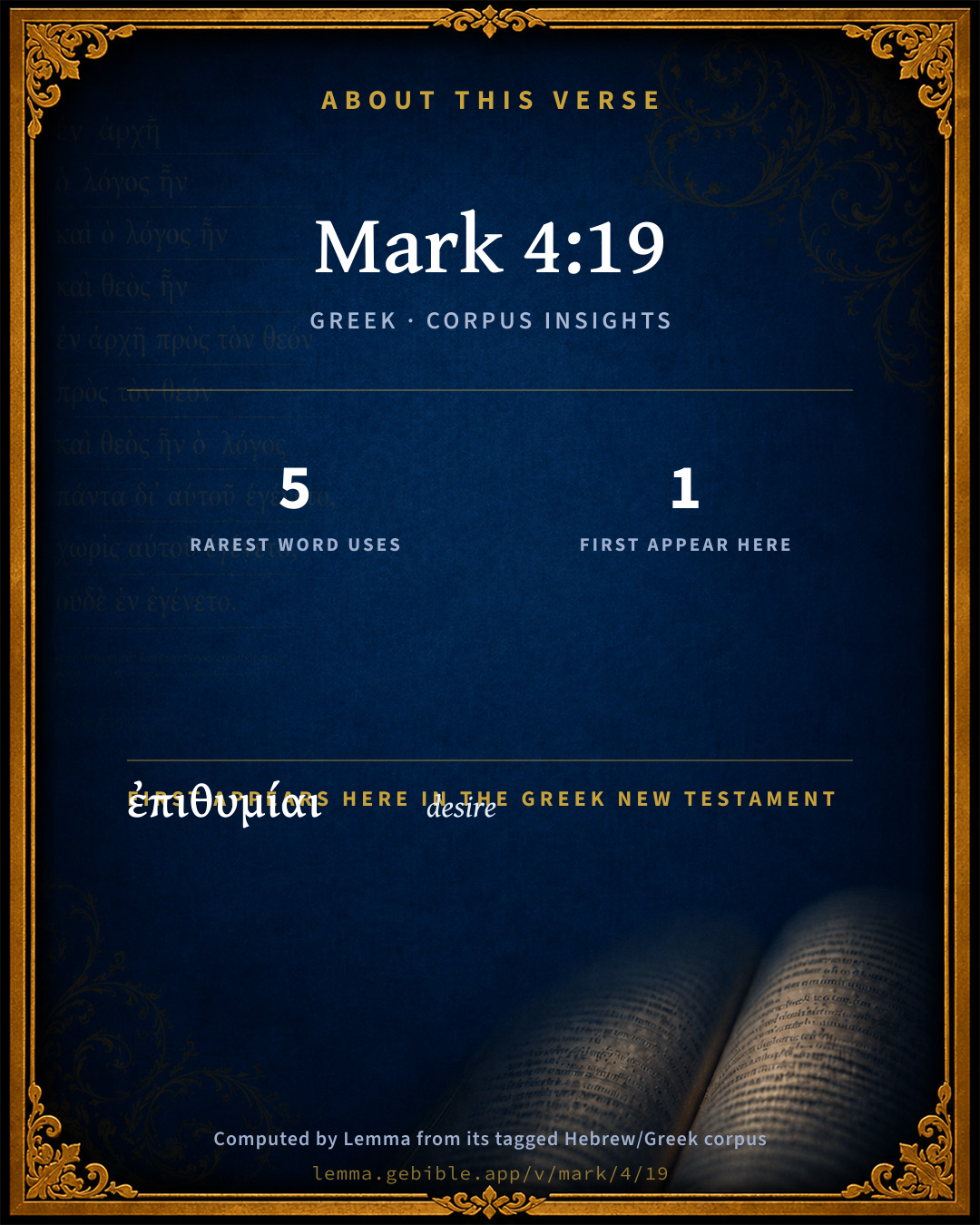
The rarest word here is συνπνίγουσιν to choke G4846 — appearing just 5 times in the whole Greek New Testament.
First appearance in Scripture
This word makes its first canonical appearance in the Greek New Testament here:
- ἐπιθυμίαι desire G1939
Shared distinctive vocabulary
συνπνίγουσιν to choke G4846 occurs in 5 verses of the Greek New Testament. Also found in:
Cross-references
22Topical passages linked to Mark 4:19 in the Treasury of Scripture Knowledge — connected by theme and wording, ordered by reader-vote popularity; previews shown in the World English Bible.
- 1 John 2:15–17 Don't love the world, neither the things that are in the world. If anyone loves the world, the Father's love isn't in him.
- 1 Timothy 6:9–10 But those who are determined to be rich fall into a temptation and a snare and many foolish and harmful lusts, such as drown men in ruin and destruction.
- 1 Timothy 6:17 Charge those who are rich in this present world that they not be haughty, nor have their hope set on the uncertainty of riches, but on the living God, who richly provides us with everything to enjoy;
- Matthew 19:23 Jesus said to his disciples, "Most assuredly I say to you, a rich man will enter into the Kingdom of Heaven with difficulty.
- Philippians 4:6 In nothing be anxious, but in everything, by prayer and petition with thanksgiving, let your requests be made known to God.
- 1 Peter 4:2–3 that you no longer should live the rest of your time in the flesh for the lusts of men, but for the will of God.
- Luke 12:29–30 Don't seek what you will eat or what you will drink; neither be anxious.
- John 15:2 Every branch in me that doesn't bear fruit, he takes away. Every branch that bears fruit, he prunes, that it may bear more fruit.
- Luke 10:41 Jesus answered her, "Martha, Martha, you are anxious and troubled about many things,
- Luke 21:34 "So be careful, or your hearts will be loaded down with carousing, drunkenness, and cares of this life, and that day will come on you suddenly.
- Ecclesiastes 5:10–16 He who loves silver shall not be satisfied with silver; nor he who loves abundance, with increase: this also is vanity.
- Isaiah 5:2 He dug it up, Gathered out its stones, Planted it with the choicest vine, Built a tower in its midst, And also cut out a winepress therein. He looked for it to yield grapes, But it yielded wild grapes.
- Isaiah 5:4 What could have been done more to my vineyard, that I have not done in it? Why, when I looked for it to yield grapes, did it yield wild grapes?
- Ecclesiastes 4:8 There is one who is alone, and he has neither son nor brother. There is no end to all of his labor, neither are his eyes satisfied with wealth. For whom then, do I labor, and deprive my soul of enjoyment? This also is vanity, yes, it is a miserable business.
- Luke 12:17–21 He reasoned within himself, saying, 'What will I do, because I don't have room to store my crops?'
- Luke 14:18–20 They all as one began to make excuses. "The first said to him, 'I have bought a field, and I must go and see it. Please have me excused.'
- Hebrews 6:7–8 For the land which has drunk the rain that comes often on it, and brings forth a crop suitable for them for whose sake it is also tilled, receives blessing from God;
- 2 Peter 1:8 For if these things are yours and abound, they make you to be not idle nor unfruitful to the knowledge of our Lord Jesus Christ.
- 2 Timothy 4:10 for Demas left me, having loved this present world, and went to Thessalonica; Crescens to Galatia, and Titus to Dalmatia.
- Proverbs 23:5 Why do you set your eyes on that which is not? For it certainly sprouts wings like an eagle and flies in the sky.
- Jude 1:12 These are hidden rocky reefs in your love feasts when they feast with you, shepherds who without fear feed themselves; clouds without water, carried along by winds; autumn leaves without fruit, twice dead, plucked up by the roots;
- Matthew 3:10 "Even now the axe lies at the root of the trees. Therefore, every tree that doesn't bring forth good fruit is cut down, and cast into the fire.
Cross-references courtesy of OpenBible.info (CC BY 4.0).
Where the printed editions differ
1 variantPlaces in this verse where the major printed Greek editions disagree on the wording in a way that affects the translation — a comparison of editions, not a manuscript-by-manuscript collation. The editions are the modern critical texts (Nestlé-Aland 28/27, SBL, Westcott-Hort, Tregelles, Tyndale House) and the traditional texts behind the KJV (the Textus Receptus and the Byzantine/Majority text). It is not a claim about which reading is original.
-
Different wording
αἰῶνος
“age”
In NA28NA27TynSBLWHTregTRByzβίου (biou) 'of life' occurs in a few manuscripts (NIV+05+032) instead of αἰῶνος (aiōnos) 'age' in older manuscripts (NA28+NA27+Tyn+SBL+WH+Treg+TR+Byz)
Textual data: Translators Amalgamated Greek New Testament (STEPBible TAGNT) · CC BY 4.0.
Lesson kit
Teaching starters — assembled from the data on this page, not authored interpretation. Every prompt links to the verse data it draws on. Edit before teaching.
Mark, in the Gospels, opens this verse with 23 words (14 distinct Greek lemmas). Its most distinctive word is sympnígō (“to choke”). A historical commentator’s framing appears above. Read the whole chapter for the surrounding context.
Discussion questions
- What does “to choke” (sympnígō) contribute to the verse as a whole?
- This is the first place “desire” appears in Scripture (first appears here). What does its debut here establish?
- How does Matthew 13:22, which shares the word «to choke», read alongside this verse?
- What does the repetition of “the” (7× in this one verse) do in this verse?
- These translations render this verse differently. What is at stake in choosing one wording over another?
- Compare how Bengel's Gnomon and Expositor's Greek Testament read this verse. Where do they agree or differ?
Things to notice
- 1 word makes its first canonical appearance in Scripture here.
- These translations choose different wording for 9 words in this verse.
- “the” occurs 7× in this single verse.
- 14 distinct Greek lemmas span 23 words in this verse.
Commentary
Notes on Mark 4:19 from classic Christian and Jewish commentators (each source and its license shown beneath its notes). The classic Christian expositions comment on the surrounding passage and are grouped to its opening verse, so a note may address several verses; the Jewish commentaries on the Tanakh (Rashi and others) are per-verse, so they appear only where the commentator wrote on this verse.
Lemma curates 59 commentaries, every one of them public domain or Creative Commons licensed, each selected and text-cleaned for this edition rather than reprinted as found. About our sources →
Bengel's Gnomon
Johann Albrecht Bengel
Bengel's Gnomon of the New Testament — English translation (T&T Clark, Edinburgh, 1860) — public domain. Text from a community e-Sword module.
Expositor's Greek Testament
ed. W. Robertson Nicoll
The Expositor's Greek Testament, edited by W. Robertson Nicoll (1897–1910) — public domain. Text from a community e-Sword module.
Geneva Bible (1599)
Geneva Bible translators
Geneva Bible (1599) marginal notes — public domain. Text via Bolls.life.
Adam Clarke's Commentary
Adam Clarke's Commentary on the Bible (1810–1826) — public domain. Text from a community e-Sword/MySword module.
The Cambridge Bible for Schools and Colleges
gen. ed. J. J. S. Perowne
The Cambridge Bible for Schools and Colleges (gen. ed. J. J. S. Perowne; Cambridge University Press, 1878–1918) — public domain. Text from a community e-Sword module.
John Gill's Exposition
John Gill's Exposition of the Whole Bible (1746–1763) — public domain (CC PDM 1.0). Text via the HelloAO Bible API.
The Pulpit Commentary
The Pulpit Commentary (1880–1919), ed. H.D.M. Spence-Jones & Joseph S. Exell — public domain. Text from a community e-Sword module.
John Wesley's Explanatory Notes
John Wesley, Explanatory Notes Upon the Whole Bible (1754–1765) — public domain. Text via the GEBible commentary corpus.
Cambridge Greek Testament for Schools and Colleges
Cambridge Greek Testament for Schools and Colleges (Cambridge University Press, 1896; 21 vols, various authors incl. Carr, Maclear, Plummer, Farrar, Lumby, Moule, M. R. James, Simcox) — public domain. Text from a community e-Sword module.
International Critical Commentary
International Critical Commentary — older volumes (1896–1929), various authors — public domain. Text from a community e-Sword module.
Vincent's Word Studies in the New Testament
Marvin R. Vincent
Marvin R. Vincent, Word Studies in the New Testament (1887–1900) — public domain. Text from a community e-Sword/MySword module.