
Matthew 9:29

Greek (Tischendorf 8th ed.) Matthew 9:29 appears in the Greek New Testament. The text above is from the Tischendorf 8th edition. Each word links to its Strong’s number and a concise gloss. Click any word for its full Thayer’s Greek Lexicon entry.
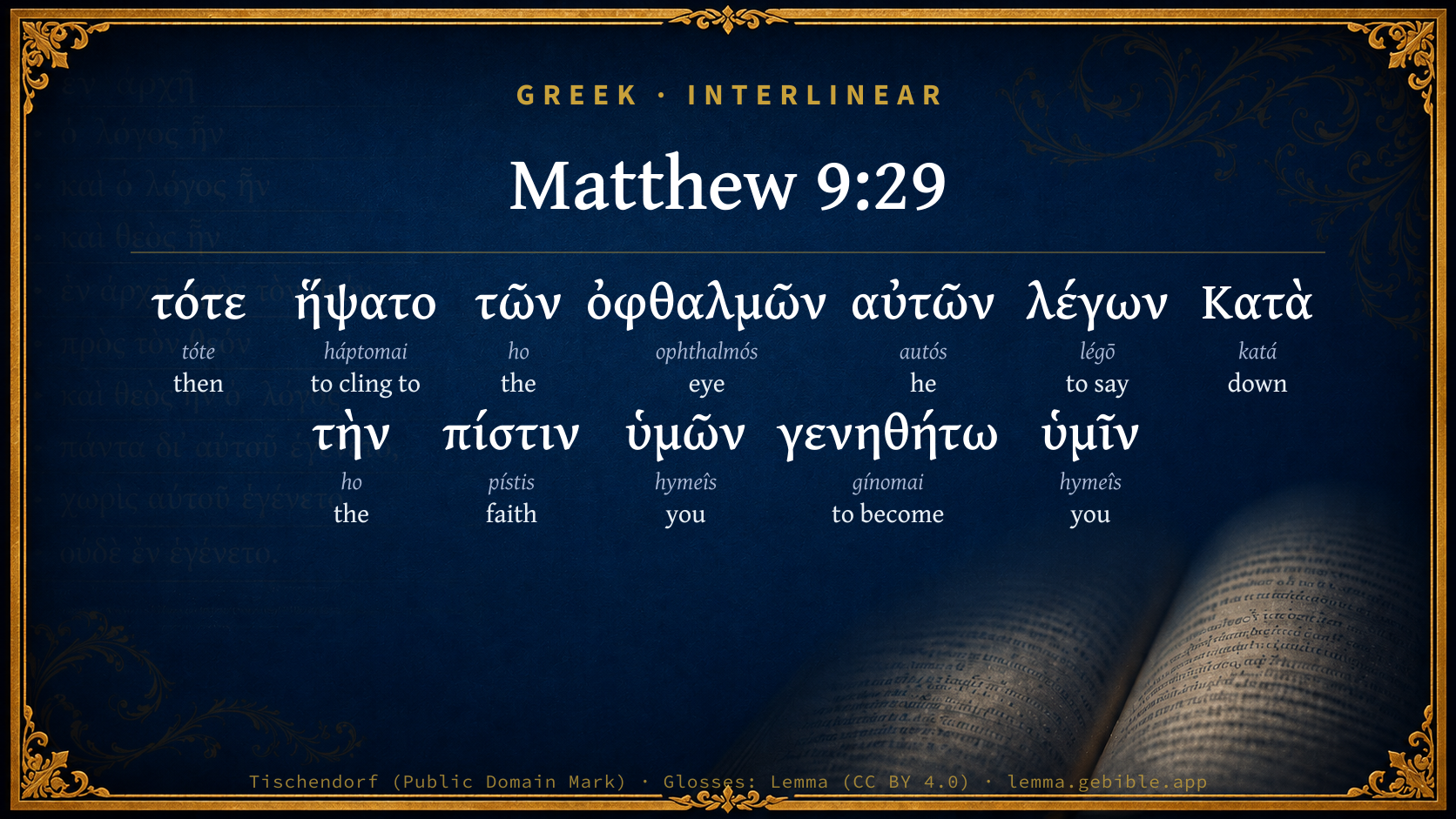
Download image
Cite this verse

Matthew 9:29 (World English Bible). Public Domain. Lemma interlinear Bible study tool, https://lemma.gebible.app/v/matthew/9/29.

Show BibTeX & RIS
BibTeX
RIS
English Translation
Then he touched their eyes, saying, "According to your faith be it done to you."
World English Bible · Public Domain
Download a study sheet

One document with this verse’s original text, its word-by-word gloss line, the meaning frame, cross-references with their text, attributed commentary, and full source and license credits — printable, and it pastes into notes with its structure intact.

This verse Autodidact and up

Study sheet (.html) Plain text (.txt)

A passage Seminary Student

Up to 50 verses in one chapter. A passage sheet keeps up to 6 commentary sources and 12 cross-references per verse, in the order this page ranks them, and says so on the sheet whenever that leaves anything out. Ask for a single verse and you get the Autodidact verse sheet above.

Everything on this page stays free to read, with no account — the sheet is a download of what is already on screen, not access to it.

Want to remove ads? Support Godless Engineer
Compare translations 3

The same verse in 3 English versions, stacked beneath the original-language interlinear above. Click any original word for its lexicon entry.

Each is an independent rendering of the whole verse — the interlinear is not word-aligned to these translations.

Highlighted words mark where these versions differ — a whole-verse word diff, not a word-by-word alignment.

  • World English Bible Public Domain
    Then he touched their eyes, saying, "According to your faith be it done to you."
  • King James Version Public Domain
    Then touched he their eyes, saying, According to your faith be it unto you.
  • unfoldingWord Literal Text CC BY-SA 4.0
    Then he touched their eyes, saying, “Let it be done to you according to your faith.”

unfoldingWord Literal Text — © unfoldingWord, licensed CC BY-SA 4.0. Word-aligned USFM3 via Door43 (git.door43.org/unfoldingWord/en_ult).

Versions to compare (up to 4)

3 of 4 selected

Show all 19 translations

Every available English version of this verse, each an independent rendering of the whole verse.

  • World English Bible Public Domain
    Then he touched their eyes, saying, "According to your faith be it done to you."
  • Berean Standard Bible Public Domain
    Then He touched their eyes and said, “According to your faith will it be done to you.”
  • Majority Standard Bible Public Domain
    Then He touched their eyes and said, “According to your faith will it be done to you.”
  • King James Version Public Domain
    Then touched he their eyes, saying, According to your faith be it unto you.
  • American Standard Version (1901) Public Domain
    Then touched he their eyes, saying, According to your faith be it done unto you.
  • Revised Version (1885) Public Domain
    Then touched he their eyes, saying, According to your faith be it done unto you.
  • Geneva Bible (1599) Public Domain
    Then touched he their eyes, saying, According to your faith be it vnto you.
  • Douay-Rheims (1899) Public Domain
    Then he touched their eyes, saying, According to your faith, be it done unto you.
  • Young's Literal Translation Public Domain
    Then touched he their eyes, saying, `According to your faith let it be to you,'
  • Literal Standard Version CC BY-SA 4.0
    Then He touched their eyes, saying, “According to your faith let it be to you,”
  • Unlocked Literal Bible CC BY-SA 4.0
    Then Jesus touched their eyes and said, “Let it be done to you according to your faith,”
  • unfoldingWord Literal Text CC BY-SA 4.0
    Then he touched their eyes, saying, “Let it be done to you according to your faith.”
  • Darby Bible Public Domain
    Then he touched their eyes, saying, According to your faith, be it unto you.
  • World Messianic Bible Public Domain
    Then he touched their eyes, saying, “According to your faith be it done to you.”
  • Webster's Bible Public Domain
    Then he touched their eyes, saying, According to your faith, be it to you.
  • Free Bible Version CC BY-SA 4.0
    Then Jesus touched their eyes, and said, “Because of your trust in me it will happen!”
  • Bible in Basic English Public Domain
    Then he put his hand on their eyes, saying, As your faith is, let it be done to you.
  • Text-Critical English NT CC BY 4.0
    Then he touched their eyes, saying, “Let it be done for yoʋ according to your faith.”
  • Tyndale New Testament (1534) Public Domain
    Then touched he their eyes saying: acordynge to youre faythe be it vnto you.

Literal Standard Version (2020), Covenant Press — licensed CC BY-SA 4.0. Text via the HelloAO Bible API (eBible.org). Unlocked Literal Bible (unfoldingWord) — licensed CC BY-SA 4.0. Text via the HelloAO Bible API (eBible.org). unfoldingWord Literal Text — © unfoldingWord, licensed CC BY-SA 4.0. Word-aligned USFM3 via Door43 (git.door43.org/unfoldingWord/en_ult). Free Bible Version, Dr. Jonathan Gallagher — licensed CC BY-SA 4.0. Text via the HelloAO Bible API (eBible.org).

Word by word

More ways to search: Search by grammar → Find every occurrence → Compare this word →

Practice this passage: Drill this verse → Learn its vocabulary →

ἥψατο
háptomai
G680
“to cling to”
Verb, Aorist, Middle deponent, Indicative, 3rd person, Singular
Part of Speech
Verb
Tense
Aorist
Voice
Middle deponent
Mood
Indicative
Person
3rd person
Number
Singular
Full Thayer's Definition

Origin: reflexive of G681

TDNT: None

1. to fasten one's self to, adhere to, cling to a. to touch b. of carnal intercourse with a women or cohabitation c. of levitical practice of having no fellowship with heathen practices. Things not to be touched appear to be both women and certain kinds of food, so celibacy and abstinence of certain kinds of food and drink are recommended. d. to touch, assail anyone
  1. τότε tóte G5119 “then” Adverb
  2. τῶν ho G3588 “the” Article, Genitive, Plural, Masculine
  3. ὀφθαλμῶν ophthalmós G3788 “eye” Noun, Genitive, Plural, Masculine
  4. αὐτῶν autós G846 “he” Personal pronoun, Genitive, Plural, Masculine
  5. λέγων légō G3004 “to say” Verb, Present, Active, Participle, Nominative, Singular, Masculine
  6. Κατὰ katá G2596 “down” Preposition
  7. τὴν ho G3588 “the” Article, Accusative, Singular, Feminine
  8. πίστιν pístis G4102 “faith” Noun, Accusative, Singular, Feminine
  9. ὑμῶν hymeîs G5210 “you” Personal pronoun, 2nd person, Genitive, Plural
  10. γενηθήτω gínomai G1096 “to become” Verb, Aorist, Passive deponent, Imperative, 3rd person, Singular
  11. ὑμῖν hymeîs G5210 “you” Personal pronoun, 2nd person, Dative, Plural

About this verse

These counts appear in no published source. They are computed here, from the morphology-tagged text and Lemma’s own curated glosses. What Lemma adds →

12
words
10
distinct lemmas
Gospels
section

Shared distinctive vocabulary

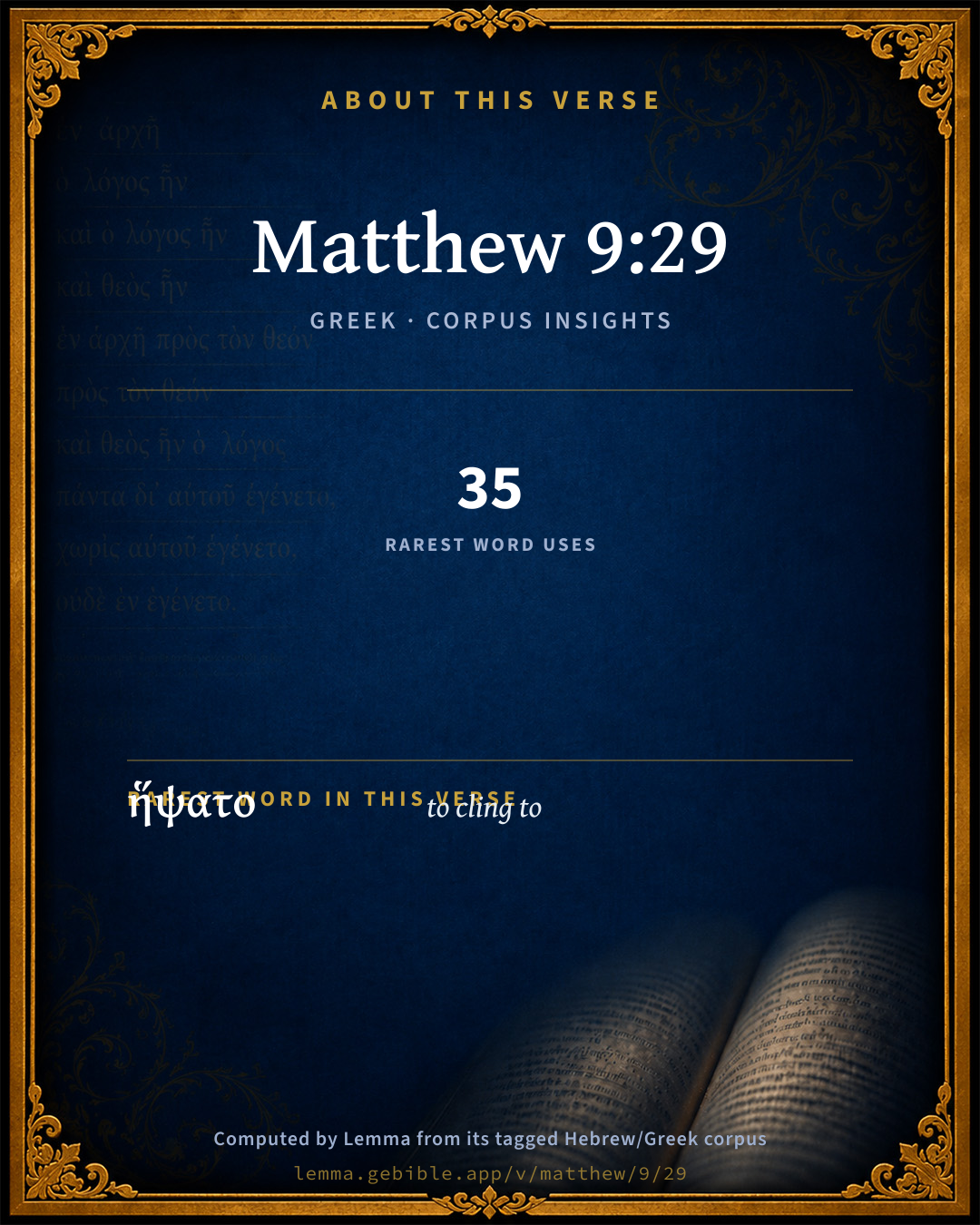
ἥψατο to cling to G680 occurs in 33 verses of the Greek New Testament. Also found in:
Repetition

Words recur within this verse:

Cross-references

7

Topical passages linked to Matthew 9:29 in the Treasury of Scripture Knowledge — connected by theme and wording, ordered by reader-vote popularity; previews shown in the World English Bible.

  • Matthew 15:28 Then Jesus answered her, "Woman, great is your faith! Be it done to you even as you desire." And her daughter was healed from that hour.
  • Mark 10:52 Jesus said to him, "Go your way. Your faith has made you well." Immediately he received his sight, and followed Jesus in the way.
  • Matthew 9:22 But Jesus, turning around and seeing her, said, "Daughter, cheer up! Your faith has made you well." And the woman was made well from that hour.
  • Matthew 8:13 Jesus said to the centurion, "Go your way. Let it be done for you as you have believed." His servant was healed in that hour.
  • Matthew 20:34 Jesus, being moved with compassion, touched their eyes; and immediately their eyes received their sight, and they followed him.
  • Matthew 8:6–7 and saying, "Lord, my servant lies in the house paralyzed, grievously tormented."
  • John 9:6–7 When he had said this, he spat on the ground, made mud with the saliva, anointed the blind man's eyes with the mud,

Cross-references courtesy of OpenBible.info (CC BY 4.0).

Commentary

Notes on Matthew 9:29 from classic Christian and Jewish commentators (each source and its license shown beneath its notes). The classic Christian expositions comment on the surrounding passage and are grouped to its opening verse, so a note may address several verses; the Jewish commentaries on the Tanakh (Rashi and others) are per-verse, so they appear only where the commentator wrote on this verse.

Lemma curates 59 commentaries, every one of them public domain or Creative Commons licensed, each selected and text-cleaned for this edition rather than reprinted as found. About our sources →

The Biblical Illustrator

Joseph S. Exell

Mat_9:29

Then touched He their eyes.

The opened eye

The power, glory, rewards of faith form the theme of this chapter.

I. The faith described in the text was the first outgrowth and expression of a deep and lively sense of wretchedness and darkness. Faith often springs out of such convictions; it Also amounts to a conviction that light is possible.

II. The faith in this instance was intelligent. They had settled it in their minds that Jesus was the Son of David, that He had come to open the eyes of the blind. Their faith conceived the grandeur of His mission. Faith is not merely an emotion; it is a conviction of the understanding.

III. This faith of the blind men was eager and importunate. They followed Jesus. It was not crushed by having to wait for mercy.

IV. The faith of these individuals was A personal experience.

V. The faith here referred to appreciated Christs power to save.

VI. The faith here mentioned appropriates and applies the Divine Power to its own case. (H. R. Reynolds, B. A.)

The blind men restored to sight

1. A simple prayer. Their prayer was

(1) united. Union is strength.

(2) Earnest.

(3) Persevering.

II. An important inquiry. Believe, ye, etc.

1. What it involves. The dignity of Christ.

2. On account of the principle it sets forth. He required no personal worthiness in those He cured; faith only.

3. Because of its spiritual application. Faith stands in same relation to healing of the soul.

III. A gracious act.

1. When He did so-as soon as they professed faith.

2. The words with which the act was accompanied.

3. The result that ensued.

IV. An express injunction. See that no man know it. The reasons:-

1. The malice of His enemies.

2. The misguided zeal of the multitude.

3. The manner in which it was regarded. (Expository Outlines.)

The measure of the faith, the measure of the gift

1. The broad law of the gospel is that God gives all He gives to faith.

2. That the measure of faith is the measure of His gift.

3. The chief ways to multiply faith are

(1) to live much on the promise;

(2) to love and cherish in the heart the inward voices of the Holy Spirit;

(3) to act out whatever grace God has already given. (J. Vaughan, M. A.)

The ways of Eastern poor folk

Most of the poor make their wants known to the public by begging. Paralytics are laid down at the doors of the rich, or of the church or mosque, with the idea that men are most inclined to be charitable when they come from the house of feasting or of prayer. The blind lift up their voices as they grope their way from door to door along the streets. (Van Lennep.)

Our Lords question to the blind men

I. The seekers.

the two blind men.

1. They were in downright earnest.

2. They were thoroughly persevering.

3. They had a definite object in their prayers.

4. They honoured Christ in their prayers.

5. They confessed their unworthiness.

II. The question which was put to them.

1. It concerned their faith.

2. It concerned their faith in Jesus-Believe ye that I am able to do this?

3. Believe ye that I am able to do this? Some think their hearts too hard.

III. That question was a very reasonable one. Else why do you pray?

IV. The answer.

1. It was distinct.

2. It was immediate.

V. Our Lords response to their answer. (C. H. Spurgeon)

Faith receptive of blessing

Why is faith so essential It is because of its receptive power. A purse will not make a man rich, and yet without some place for his money how could a man acquire wealth. Faith of itself could not contribute a penny to salvation, but it is the purse which hold: a precious Christ within itself, yea, it holds all the treasures of Divine love. If a man is thirsty a rope and a bucket are not in themselves of much use to him, but yet, sirs, if there is a well near at hand the very thing that is wanted is a bucket and a rope, by means of which the water can be lifted. Faith is the bucket by means of which a man may draw water out of the wells of salvation, and drink to his hearts content. You may sometimes have stopped a moment at a street fountain, and have desired to drink, but you found you could not, for the drinking-cup was gone. The water flowed, but you could not get at it. It was tantalizing to be at the fountain-head and yet to be thirsty still for want of a little cup. Now faith is that little cup, which we hold up to the flowing stream of Christs grace: we fill it, and then we drink and are refreshed. Hence the importance of faith. It would have seemed to our forefathers an idle thing to lay down a cable under the sea from England to America and it would be idle now if it were not that science has taught us how to speak by lightning: yet the cable itself is now of the utmost importance, for the best inventions of telegraphy would be of no use for purposes of transatlantic communication if there were not the connecting wire between the two continents, Faith is just that; it is the connecting link between our souls and God, and the living message flashes along it to our souls. Faith is sometimes weak and comparable only to a very slender thread; but it is a very precious thing for all that, for it is the beginning of great things. Years ago they were wanting to throw a suspension bridge across a mighty chasm, through which flowed, far down, a navigable river, From crag to crag it was proposed to hang an iron bridge aloft in the air, but how was it to be commenced? They shot an arrow from one side to the other, and it carried across the gulf a tiny thread. That invisible thread was enough to begin with. The connection was established; by-and-by the thread drew a piece of twine, the twine carried after it a small rope, the rope soon carried a cable across, and all in good time came the iron chains and all else that was needed for the permanent way. Now, faith is often ver) weak, but even in that ease it is still of the utmost value, for it forms a communication between the soul and the Lord Jesus Christ. (C. H. Spurgeon.)

Blind people swarm in Oriental cities

In our own streets we meet here and there with a blind beggar, gut they swarm in Eastern cities. Ophthalmia is the scourge of Egypt and Syria, and Volney declares that in Cairo, out of a hundred persons whom he met, twenty were quite blind, ten wanted one eye, and twenty others were more or less afflicted in that organ. At the present day every one is struck with the immense number of the blind in Oriental lands, and things were probably worse in our Saviours time. (C. H. Spurgeon.)

The Biblical Illustrator, edited by Joseph S. Exell (c. 1880s–1900s) — public domain. Text from a community e-Sword module.

Bengel's Gnomon

Johann Albrecht Bengel

Mat 9:29. Κατὰ, according to) He says this by way of affirmation, not of limitation.—γενηθήτω, let it be done, or let it become) corresponding with the Hebrew יהי.[430]

[430] Used in the celebrated passage, Gen 1:3, “And GOD said, ‘Let there be Light:’—and there was Light.”—(I. B.)

Bengel's Gnomon of the New Testament — English translation (T&T Clark, Edinburgh, 1860) — public domain. Text from a community e-Sword module.

Jamieson, Fausset & Brown

Robert Jamieson, A. R. Fausset & David Brown

Then touched he their eyes, saying, According to your faith be it unto you--not, Receive a cure proportioned to your faith, but, Receive this cure as granted to your faith. Thus would they carry about with them, in their restored vision, a gracious seal of the faith which drew it from their compassionate Lord.

Jamieson, Fausset & Brown — Commentary Critical and Explanatory on the Whole Bible (1871) — public domain (CC PDM 1.0). Text via the HelloAO Bible API.

Adam Clarke's Commentary

Verse 29. According to your faith] See Clarke on Mt 8:13.

Adam Clarke's Commentary on the Bible (1810–1826) — public domain. Text from a community e-Sword/MySword module.

Ellicott's Commentary for English Readers

(29) Then touched he their eyes.—This is the first recorded instance of the method which our Lord seems always to have adopted in the case of the blind, and, in part also, in that of the deaf. Others might have their faith strengthened by the look of sympathy and conscious power which they saw in the face of the Healer. From that influence they were shut out, and for them therefore its absence was supplied by acts which they would naturally connect with the purpose to heal them. (Comp. the later instances in Mat_20:34; ‘Joh_9:6.)

A Bible Commentary for English Readers, edited by Charles John Ellicott (1878–1897) — public domain. Text from a community e-Sword module.

John Gill's Exposition

But they, when they were departed,.... That is, out of the house where they received their cure, and out of the city; for it appears, by what follows, they went into other parts, where it is probable they might originally belong; they

spread abroad his fame in all that country. This they did, not in contempt of Christ and his orders; but rather out of gratitude to their benefactor, and through an honest zeal to spread his honour and glory: though they are not to be commended for disregarding the command of Christ; for, not our affection, but Christ's will, is to be the rule of our actions.

John Gill's Exposition of the Whole Bible (1746–1763) — public domain (CC PDM 1.0). Text via the HelloAO Bible API.

Trapp's Complete Commentary

John Trapp

29 Then touched he their eyes, saying, According to your faith be it unto you.

Ver. 29. According to your faith] Questionless (saith a famous divine) justifying faith is not beneath miraculous, in the sphere of its own activity, and where it hath warrant of God’s word,

John Trapp, A Commentary or Exposition upon All the Books of the Old and New Testament (1647–1656) — public domain. Text from a community e-Sword module.

Albert Barnes' Notes on the Bible

Then touched he their eyes - Simply to indicate that the power proceeded from him. Compare Mat 8:3.

According to your faith ... - That is, you have “believed” that you could be healed, be healed accordingly. Your faith covered the whole extent of the work respecting my power and the absolute restoration to sight, and that power is exerted accordingly, and your sight is restored. So with the sinner. If he has faith in the Son of God; if he believes that he is able and willing to save him: and if he earnestly desires to be saved, the power of Jesus will be put forth to the full extent of his faith.

Albert Barnes' Notes on the Bible (1834–1885) — public domain. Text from a community e-Sword/MySword module.

Whedon's Commentary on the Bible

Daniel D. Whedon

29. Touched their eyes — As if his finger were the conductor of the power. But the act served to show that the cure was no accidental coincidence. It visibly manifested that the work was his. According to your faith — So that the measure of faith which you have shall be exactly justified, sustained, and rewarded. Thus faith is a readiness to receive of God. Though it has no merit to deserve a reward, yet it is the right state of soul to receive God’s truth and mercy.

Daniel D. Whedon (gen. ed.), Commentary on the Old and New Testaments (1874–1909) — public domain. Text from a community e-Sword module.

The Pulpit Commentary

Then touched he their eyes. So also Mat_20:34, showing his sympathy and helping their faith; (Mat_8:3) cf. also Joh_9:6, and supra, ver. 18, note. Saying, According to your faith (Mat_8:13, note) be it (done, Revised Version; genhyhtw) unto you.

According to faith.

This expression was connected with a miracle of healing. Not all Christ"s gracious deeds are recorded in our Gospels. Some are fully detailed. Some are briefly sketched. Some are merely summarized. The reason for the difference of treatment may be found in the degree in which any miracle afforded illustration of truth. This is not one of the fully developed cases, but it yields one point. Blindness is a common affliction in the East. Christ had just wrought a miracle. Its proper result was reached, for others were led to believe in Christ. These two blind men heard what Jesus had done, so they sought his help for themselves. He tests their faith, and gives accordingly. Why did Christ always require, and work for, faith? Because he healed diseases for the sake of healing souls. Calling out faith was healing the soul"s sickness. The word "faith" often bewilders; better call it "trust." That is a simpler word, and helps us to connect religious faith with everyday faith. The spirit of trust is the spirit that puts us ready to receive God"s best blessings. But the text must not be read as if it meant that the conditions of blessing are all rearranged by Christ, and that we can have anything we like from God, if only we believe enough.

I HELPED TO TRUST, THAT IS THE BEGINNING OF CHRISTIAN LIFE. Take the familiar command, "Believe on the Lord Jesus Christ," and put "trust" for "believe," then it means, "Give the whole matter of your soul"s salvation into his hands." That is the beginning.

II LEARNING TO TRUST; THAT IS THE GREAT WORK OF CHRISTIAN LIFE, There is a constant tendency to fall back on self-confidence, which needs to be watched and resisted. There is a constant demand for the culturing of weak trust into strength. All Christian discipline means development of trust.

III ACCORDING TO TRUST; THAT IS THE LAW OF DIVINE BLESSINGS IN THE CHRISTIAN LIFE. Because that is the guarantee that gifts will be well used. If we were utterly self-willed, we should fling back the gift. Just in the measure of our self-will we are likely to use unworthily the gift. So far as we can trust, we are likely to use it rightly. Open souls welcome spiritual blessings. R.T.

The Pulpit Commentary (1880–1919), ed. H.D.M. Spence-Jones & Joseph S. Exell — public domain. Text from a community e-Sword module.

The People's New Testament

B. W. Johnson

29. According to your faith be it unto you. Faith is the hand which takes what God offers, the spiritual organ of appropriation.

B. W. Johnson's The People's New Testament with Notes (1889–1891) — public domain. Electronic text from the Christian Classics Ethereal Library (CCEL) ThML edition.

unfoldingWord translationNotes

Door43 World Missions Community

touched their eyes and said

It is not clear whether he touched both men's eyes at the same time or used only his right hand to touch one then the other. As the left hand was customarily used for unclean purposes, it is most likely that he used only his right hand. It is also not clear whether he spoke as he was touching them or touched them first and then spoke to them.

Let it be done to you according to your faith

This can be stated in active form. AT: "I will do as you have believed" or "Because you believe, I will heal you" (See: Active or Passive)

their eyes were opened

This means they were able to see. This can be stated in active form. AT: "God healed their eyes" or "the two blind men were able to see" (See: Idiom and Active or Passive)

See that no one knows about this

Here "See" means "be sure." AT: "Be sure no one finds out about this" or "Do not tell anyone that I healed you" (See: Idiom)

But the two men

"The two men did not do what Jesus told them to do. They"

spread the news

"told many people what had happened to them"

translationWords

Jesus

faith

command

unfoldingWord translationNotes — © Distant Shores Media and the Door43 World Missions Community, licensed CC BY-SA 4.0. Source: git.door43.org/Door43/en_tn.

Alford’s Greek Testament

Henry Alford

29.] In this miracle however we have this peculiar feature, that no direct word of power passes from our Lord, but a relative concession, making that which was done a measure of the faith of the blind men: and from the result the degree of their faith appears. Stier remarks (Reden Jesu, i. 383), “We may already notice, in the history of this first period of our Lord’s ministry, that from having at first yielded immediately to the request for healing, He begins, by degrees, to prove and exercise the faith of the applicants.”

Henry Alford, The Greek Testament (1849–1861) — public domain. Text from a community e-Sword module.

International Critical Commentary

(E) 29. Then He touched their eyes, saying, According to your faith be it to you.]—ἥψατο] cf. 8:15 of the hand, 20:34 of the eyes, Mar 7:33 the tongue.—κατὰ τὴν πίστιν ὑμῶν] cf. Mar 10:52 ἡ πίστις σου σέσωκεν σε.—πίστις] as in 8:10, 9:2, 22.

International Critical Commentary — older volumes (1896–1929), various authors — public domain. Text from a community e-Sword module.

Lesson kit

Teaching starters — assembled from the data on this page, not authored interpretation. Every prompt links to the verse data it draws on. Edit before teaching.

Matthew, in the Gospels, opens this verse with 12 words (10 distinct Greek lemmas). Its most distinctive word is háptomai (“to cling to”). A historical commentator’s framing appears above. Read the whole chapter for the surrounding context.

Discussion questions

  1. The word háptomai carries the sense “to cling to.” How does it shape the verse?
  2. Matthew 8:3 shares the word «to cling to» with this verse. How do the two illuminate each other?
  3. “the” occurs 2× in this one verse. What is the effect of the repetition?
  4. These translations render this verse differently; the difference is in the English rendering, not the original. What questions does that raise?
  5. Reading how The Biblical Illustrator and Bengel's Gnomon read this verse, where do the two commentators agree and where do they part?

Things to notice

Reading settings

Reading text

Shown beneath each verse's original-language words.

Old Testament
Old Testament edition

Read the OT as the Masoretic Hebrew (MT) or the Greek Septuagint (LXX).

English shown for the Greek Septuagint (in the Hebrew ↔ Greek comparison).

Comparing translations? Open the Compare panel on any verse page to stack up to four side by side.