

Mark 9:50
Greek (Tischendorf 8th ed.) Mark 9:50 appears in the Greek New Testament. The text above is from the Tischendorf 8th edition. Each word links to its Strong’s number and a concise gloss. Click any word for its full Thayer’s Greek Lexicon entry.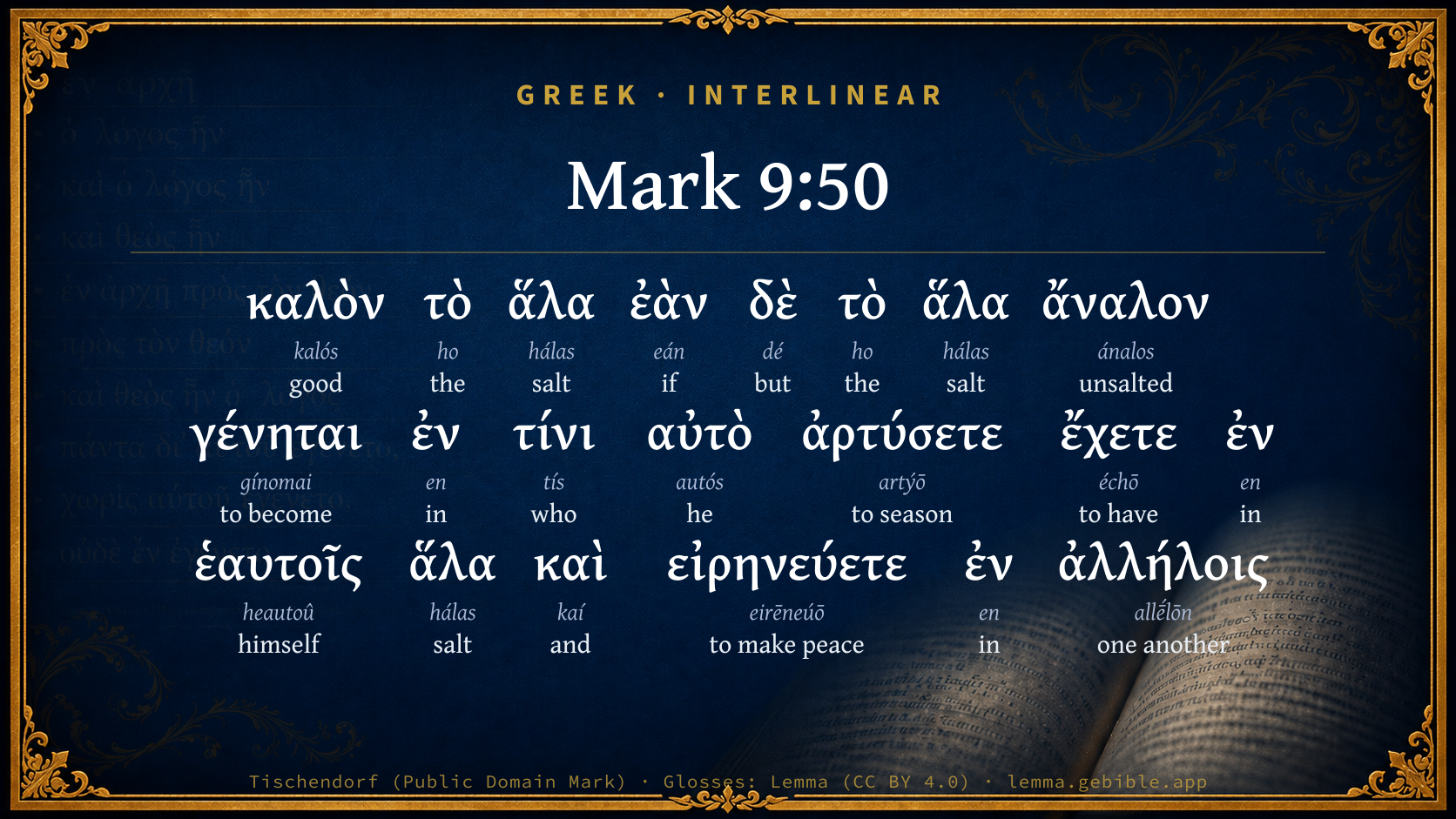
Salt is good, but if the salt has lost its saltiness, with what will you season it? Have salt in yourselves, and be at peace with one another."
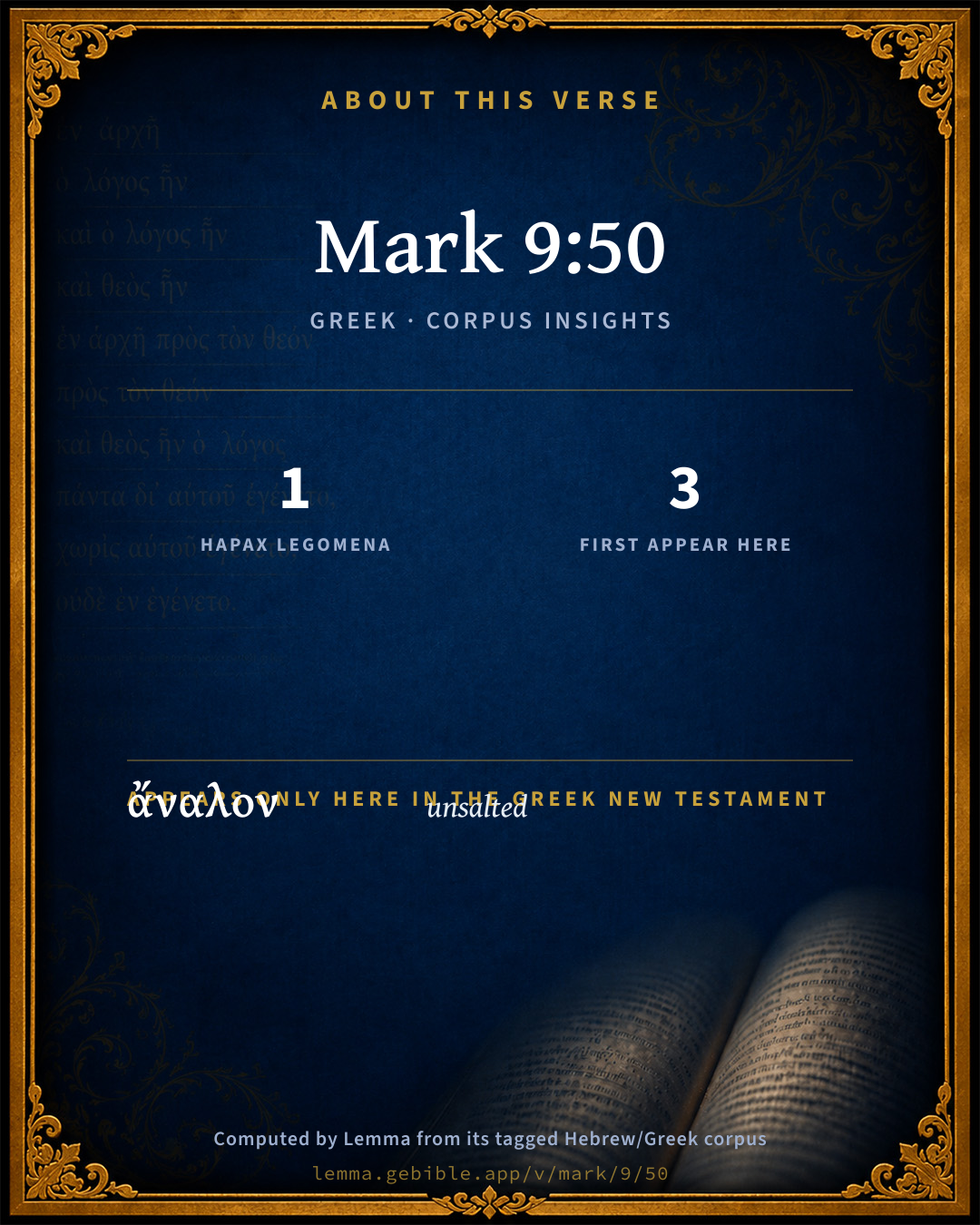
- 1 hapax legomenon — only here in the Greek New Testament
- 3 first appearances in the Greek New Testament
Download a study sheet
One document with this verse’s original text, its word-by-word gloss line, the meaning frame, cross-references with their text, attributed commentary, and full source and license credits — printable, and it pastes into notes with its structure intact.
This verse Autodidact and up
A passage Seminary Student
Up to 50 verses in one chapter. A passage sheet keeps up to 6 commentary sources and 12 cross-references per verse, in the order this page ranks them, and says so on the sheet whenever that leaves anything out. Ask for a single verse and you get the Autodidact verse sheet above.
Everything on this page stays free to read, with no account — the sheet is a download of what is already on screen, not access to it.
Compare translations 3
The same verse in 3 English versions, stacked beneath the original-language interlinear above. Click any original word for its lexicon entry.
Each is an independent rendering of the whole verse — the interlinear is not word-aligned to these translations.
Highlighted words mark where these versions differ — a whole-verse word diff, not a word-by-word alignment.
-
World English Bible Public Domain
Salt is good, but if the salt has lost its saltiness, with what will you season it? Have salt in yourselves, and be at peace with one another."
-
King James Version Public Domain
Salt is good: but if the salt have lost his saltness, wherewith will ye season it? Have salt in yourselves, and have peace one with another.
-
unfoldingWord Literal Text CC BY-SA 4.0
Salt is good, but if the salt becomes unsalty, with what will you season it? Have salt in yourselves, and be at peace with one another.”
unfoldingWord Literal Text — © unfoldingWord, licensed CC BY-SA 4.0. Word-aligned USFM3 via Door43 (git.door43.org/unfoldingWord/en_ult).
Show all 18 translations
Every available English version of this verse, each an independent rendering of the whole verse.
-
World English Bible Public Domain
Salt is good, but if the salt has lost its saltiness, with what will you season it? Have salt in yourselves, and be at peace with one another."
-
Berean Standard Bible Public Domain
Salt is good, but if the salt loses its saltiness, with what will you season it? Have salt among yourselves, and be at peace with one another.”
-
Majority Standard Bible Public Domain
Salt is good, but if the salt loses its saltiness, with what will you season it? Have salt among yourselves, and be at peace with one another.”
-
King James Version Public Domain
Salt is good: but if the salt have lost his saltness, wherewith will ye season it? Have salt in yourselves, and have peace one with another.
-
American Standard Version (1901) Public Domain
Salt is good: but if the salt have lost its saltness, wherewith will ye season it? Have salt in yourselves, and be at peace one with another.
-
Revised Version (1885) Public Domain
Salt is good: but if the salt have lost its saltness, wherewith will ye season it? Have salt in yourselves, and be at peace one with another.
-
Geneva Bible (1599) Public Domain
Salt is good: but if the salt be vnsauerie, wherewith shall it be seasoned? haue salt in your selues, and haue peace one with another.
-
Young's Literal Translation Public Domain
The salt `is' good, but if the salt may become saltless, in what will ye season `it'? Have in yourselves salt, and have peace in one another.'
-
Literal Standard Version CC BY-SA 4.0
The salt [is] good, but if the salt may become saltless, in what will you season [it]? Have in yourselves salt, and have peace in one another.”
-
Unlocked Literal Bible CC BY-SA 4.0
Salt is good, but if the salt has lost its saltiness, how can you make it salty again? Have salt among yourselves, and be at peace with one another.”
-
unfoldingWord Literal Text CC BY-SA 4.0
Salt is good, but if the salt becomes unsalty, with what will you season it? Have salt in yourselves, and be at peace with one another.”
-
Darby Bible Public Domain
Salt [is] good, but if the salt is become saltless, wherewith will ye season it? Have salt in yourselves, and be at peace with one another.
-
World Messianic Bible Public Domain
Salt is good, but if the salt has lost its saltiness, with what will you season it? Have salt in yourselves, and be at peace with one another.”
-
Webster's Bible Public Domain
Salt is good: but if the salt hath lost its saltness, with what will ye season it? Have salt in yourselves, and have peace one with another.
-
Free Bible Version CC BY-SA 4.0
Salt is good, but if it loses its taste, how could you make it salty again? You need to be like salt, and live in peace with one another.”
-
Bible in Basic English Public Domain
Salt is good; but if the taste goes from it, how will you make it salt again? Have salt in yourselves, and be at peace one with another.
-
Text-Critical English NT CC BY 4.0
Salt is good, but if it becomes unsalty, with what shall you season it? Have salt in yourselves, and be at peace with one another.”
-
Tyndale New Testament (1534) Public Domain
Salt is good. But yf the salt be vnsavery: what shall the salte therwith? Se that ye have salt in youre selves: and have peace amonge youre selves one with another.
Literal Standard Version (2020), Covenant Press — licensed CC BY-SA 4.0. Text via the HelloAO Bible API (eBible.org). Unlocked Literal Bible (unfoldingWord) — licensed CC BY-SA 4.0. Text via the HelloAO Bible API (eBible.org). unfoldingWord Literal Text — © unfoldingWord, licensed CC BY-SA 4.0. Word-aligned USFM3 via Door43 (git.door43.org/unfoldingWord/en_ult). Free Bible Version, Dr. Jonathan Gallagher — licensed CC BY-SA 4.0. Text via the HelloAO Bible API (eBible.org).
Word by word
More ways to search: Search by grammar → Find every occurrence → Compare this word →
Practice this passage: Drill this verse → Learn its vocabulary →
- Appears 1× in the Greek New Testament
- First appears here
- Part of Speech
- Adjective
- Case
- Nominative
- Number
- Singular
- Gender
- Neuter
Full Thayer's Definition
- καλὸν kalós G2570 “good” Adjective, Nominative, Singular, Neuter
- τὸ ho G3588 “the” Article, Nominative, Singular, Neuter
- ἅλα hálas G217 “salt” Noun, Nominative, Singular, Neuter
- ἐὰν eán G1437 “if” Conditional
- δὲ dé G1161 “but” Conjunction
- τὸ ho G3588 “the” Article, Nominative, Singular, Neuter
- ἅλα hálas G217 “salt” Noun, Nominative, Singular, Neuter
- ἄναλον ánalos G358 “unsalted” Adjective, Nominative, Singular, Neuter
- γένηται gínomai G1096 “to become” Verb, Aorist, Middle deponent, Subjunctive, 3rd person, Singular
- ἐν en G1722 “in” Preposition
- τίνι tís G5101 “who” Interrogative pronoun, Dative, Singular, Neuter
- αὐτὸ autós G846 “he” Personal pronoun, Accusative, Singular, Neuter
- ἀρτύσετε artýō G741 “to season” Verb, Future, Active, Indicative, 2nd person, Plural
- ἔχετε échō G2192 “to have” Verb, Present, Active, Imperative, 2nd person, Plural
- ἐν en G1722 “in” Preposition
- ἑαυτοῖς heautoû G1438 “himself” Reflexive pronoun, 2nd person, Dative, Plural, Masculine
- ἅλα hálas G217 “salt” Noun, Accusative, Singular, Neuter
- καὶ kaí G2532 “and” Conjunction
- εἰρηνεύετε eirēneúō G1514 “to make peace” Verb, Present, Active, Imperative, 2nd person, Plural
- ἐν en G1722 “in” Preposition
- ἀλλήλοις allḗlōn G240 “one another” Reciprocal pronoun, Dative, Plural, Masculine
About this verse
These counts appear in no published source. They are computed here, from the morphology-tagged text and Lemma’s own curated glosses. What Lemma adds →
- 21
- words
- 16
- distinct lemmas
- Gospels
- section
Notable vocabulary
1 hapax legomenon — a word that appears only here in the entire Greek New Testament:
- ἄναλον unsalted G358
First appearance in Scripture
These words make their first canonical appearance in the Greek New Testament here:
Shared distinctive vocabulary
ἀρτύσετε to season G741 occurs in 3 verses of the Greek New Testament. Also found in:
Cross-references
25Topical passages linked to Mark 9:50 in the Treasury of Scripture Knowledge — connected by theme and wording, ordered by reader-vote popularity; previews shown in the World English Bible.
- Colossians 4:6 Let your speech always be with grace, seasoned with salt, that you may know how you ought to answer each one.
- Matthew 5:13 "You are the salt of the earth, but if the salt has lost its flavor, with what will it be salted? It is then good for nothing, but to be cast out and trodden under the feet of men.
- Romans 12:18 If it is possible, as much as it is up to you, be at peace with all men.
- 2 Corinthians 13:11 Finally, brothers, rejoice. Be perfected, be comforted, be of the same mind, live in peace, and the God of love and peace will be with you.
- Hebrews 12:14 Follow after peace with all men, and the sanctification without which no man will see the Lord,
- Philippians 1:27 Only let your manner of life be worthy of the Gospel of Christ, that, whether I come and see you or am absent, I may hear of your state, that you stand firm in one spirit, with one soul striving for the faith of the Gospel;
- Job 6:6 Can that which has no flavor be eaten without salt? Or is there any taste in the white of an egg?
- Luke 14:34–35 Salt is good, but if the salt becomes flat and tasteless, with what do you season it?
- Ephesians 4:29 Let no corrupt speech proceed out of your mouth, but such as is good for building up as the need may be, that it may give grace to those who hear.
- Ephesians 4:31–32 Let all bitterness, wrath, anger, outcry, and slander, be put away from you, with all malice.
- 1 Thessalonians 5:13 and to respect and honor them in love for their work's sake. Be at peace among yourselves.
- Psalms 34:14 Depart from evil, and do good. Seek peace, and pursue it.
- John 13:34–35 A new commandment I give to you, that you love one another, just like I have loved you; that you also love one another.
- Galatians 5:22 But the fruit of the Spirit is love, joy, peace, patience, kindness, goodness, faithfulness,
- Ephesians 4:2–6 with all lowliness and humility, with patience, bearing with one another in love;
- Philippians 2:1–3 If there is therefore any exhortation in Christ, if any consolation of love, if any fellowship of the Spirit, if any tender mercies and compassion,
- Colossians 3:12 Put on therefore, as God's chosen ones, holy and beloved, a heart of compassion, kindness, lowliness, humility, and perseverance;
- 2 Timothy 2:22 Flee from youthful lusts; but pursue righteousness, faith, love, and peace with those who call on the Lord out of a pure heart.
- James 1:20 for the anger of man doesn't produce the righteousness of God.
- James 3:14–18 But if you have bitter jealousy and selfish ambition in your heart, don't boast and don't lie against the truth.
- 1 Peter 3:8 Finally, be all like-minded, compassionate, loving as brothers, tenderhearted, courteous,
- Mark 9:34 But they were silent, for they had disputed one with another on the way about who was the greatest.
- John 15:17–18 "I command these things to you, that you may love one another.
- Psalms 133:1 See how good and how pleasant it is For brothers to live together in unity!
- Galatians 5:14–15 For the whole law is fulfilled in one word, in this: "You shall love your neighbor as yourself."
Cross-references courtesy of OpenBible.info (CC BY 4.0).
Lesson kit
Teaching starters — assembled from the data on this page, not authored interpretation. Every prompt links to the verse data it draws on. Edit before teaching.
Mark, in the Gospels, opens this verse with 21 words (16 distinct Greek lemmas). Its most distinctive word is ánalos (“unsalted”). A historical commentator’s framing appears above. Read the whole chapter for the surrounding context.
Discussion questions
- How does “unsalted” (ánalos) shape what this verse is saying?
- 1 word here appears nowhere else in the Greek New Testament. Why might the author reach for such rare wording?
- 3 words make their first appearance in Scripture here. What does this debut establish?
- How does Luke 14:34, which shares the word «to season», read alongside this verse?
- What does the repetition of “salt” (3× in this one verse) do in this verse?
- The translations on this page render this verse differently — a whole-verse word diff, not a word-by-word alignment. What might account for the different wordings?
- Compare how The Biblical Illustrator and MacLaren's Expositions of Holy Scripture read this verse. Where do they agree or differ?
Things to notice
- 1 word in this verse appears nowhere else in the Greek New Testament.
- 3 words make their first canonical appearance in Scripture here.
- These translations choose different wording for 9 words in this verse.
- “salt” occurs 3× in this single verse.
- 16 distinct Greek lemmas span 21 words in this verse.
Commentary
Notes on Mark 9:50 from classic Christian and Jewish commentators (each source and its license shown beneath its notes). The classic Christian expositions comment on the surrounding passage and are grouped to its opening verse, so a note may address several verses; the Jewish commentaries on the Tanakh (Rashi and others) are per-verse, so they appear only where the commentator wrote on this verse.
Lemma curates 59 commentaries, every one of them public domain or Creative Commons licensed, each selected and text-cleaned for this edition rather than reprinted as found. About our sources →
The Biblical Illustrator
Joseph S. Exell
The Biblical Illustrator, edited by Joseph S. Exell (c. 1880s–1900s) — public domain. Text from a community e-Sword module.
MacLaren's Expositions of Holy Scripture
Alexander MacLaren
Alexander MacLaren, Expositions of Holy Scripture (1904–1910) — public domain. Text from a community e-Sword module.
Bengel's Gnomon
Johann Albrecht Bengel
Bengel's Gnomon of the New Testament — English translation (T&T Clark, Edinburgh, 1860) — public domain. Text from a community e-Sword module.
Meyer's Critical & Exegetical Commentary
Heinrich August Wilhelm Meyer
Meyer — Critical and Exegetical Commentary on the New Testament — English translation by Peter Christie, edited by Frederick Crombie (T&T Clark, 1880) — public domain. Text from a community e-Sword module.
Expositor's Greek Testament
ed. W. Robertson Nicoll
The Expositor's Greek Testament, edited by W. Robertson Nicoll (1897–1910) — public domain. Text from a community e-Sword module.
Adam Clarke's Commentary
Adam Clarke's Commentary on the Bible (1810–1826) — public domain. Text from a community e-Sword/MySword module.
Ellicott's Commentary for English Readers
A Bible Commentary for English Readers, edited by Charles John Ellicott (1878–1897) — public domain. Text from a community e-Sword module.
The Cambridge Bible for Schools and Colleges
gen. ed. J. J. S. Perowne
The Cambridge Bible for Schools and Colleges (gen. ed. J. J. S. Perowne; Cambridge University Press, 1878–1918) — public domain. Text from a community e-Sword module.
Trapp's Complete Commentary
John Trapp
John Trapp, A Commentary or Exposition upon All the Books of the Old and New Testament (1647–1656) — public domain. Text from a community e-Sword module.
Matthew Poole's English Annotations
Matthew Poole's English Annotations on the Holy Bible (1683–1685) — public domain. Text from a community e-Sword/MySword module.
Whedon's Commentary on the Bible
Daniel D. Whedon
Daniel D. Whedon (gen. ed.), Commentary on the Old and New Testaments (1874–1909) — public domain. Text from a community e-Sword module.
The Pulpit Commentary
The Pulpit Commentary (1880–1919), ed. H.D.M. Spence-Jones & Joseph S. Exell — public domain. Text from a community e-Sword module.
John Wesley's Explanatory Notes
John Wesley, Explanatory Notes Upon the Whole Bible (1754–1765) — public domain. Text via the GEBible commentary corpus.
Burkitt's Expository Notes on the New Testament
William Burkitt
William Burkitt's Expository Notes on the New Testament (1700–1703) — public domain. Text from a community e-Sword module.
The People's New Testament
B. W. Johnson
B. W. Johnson's The People's New Testament with Notes (1889–1891) — public domain. Electronic text from the Christian Classics Ethereal Library (CCEL) ThML edition.
Cambridge Greek Testament for Schools and Colleges
Cambridge Greek Testament for Schools and Colleges (Cambridge University Press, 1896; 21 vols, various authors incl. Carr, Maclear, Plummer, Farrar, Lumby, Moule, M. R. James, Simcox) — public domain. Text from a community e-Sword module.
Alford’s Greek Testament
Henry Alford
Henry Alford, The Greek Testament (1849–1861) — public domain. Text from a community e-Sword module.
Vincent's Word Studies in the New Testament
Marvin R. Vincent
Marvin R. Vincent, Word Studies in the New Testament (1887–1900) — public domain. Text from a community e-Sword/MySword module.