
Romans 9:29

Greek (Tischendorf 8th ed.) Romans 9:29 appears in the Greek New Testament. The text above is from the Tischendorf 8th edition. Each word links to its Strong’s number and a concise gloss. Click any word for its full Thayer’s Greek Lexicon entry.
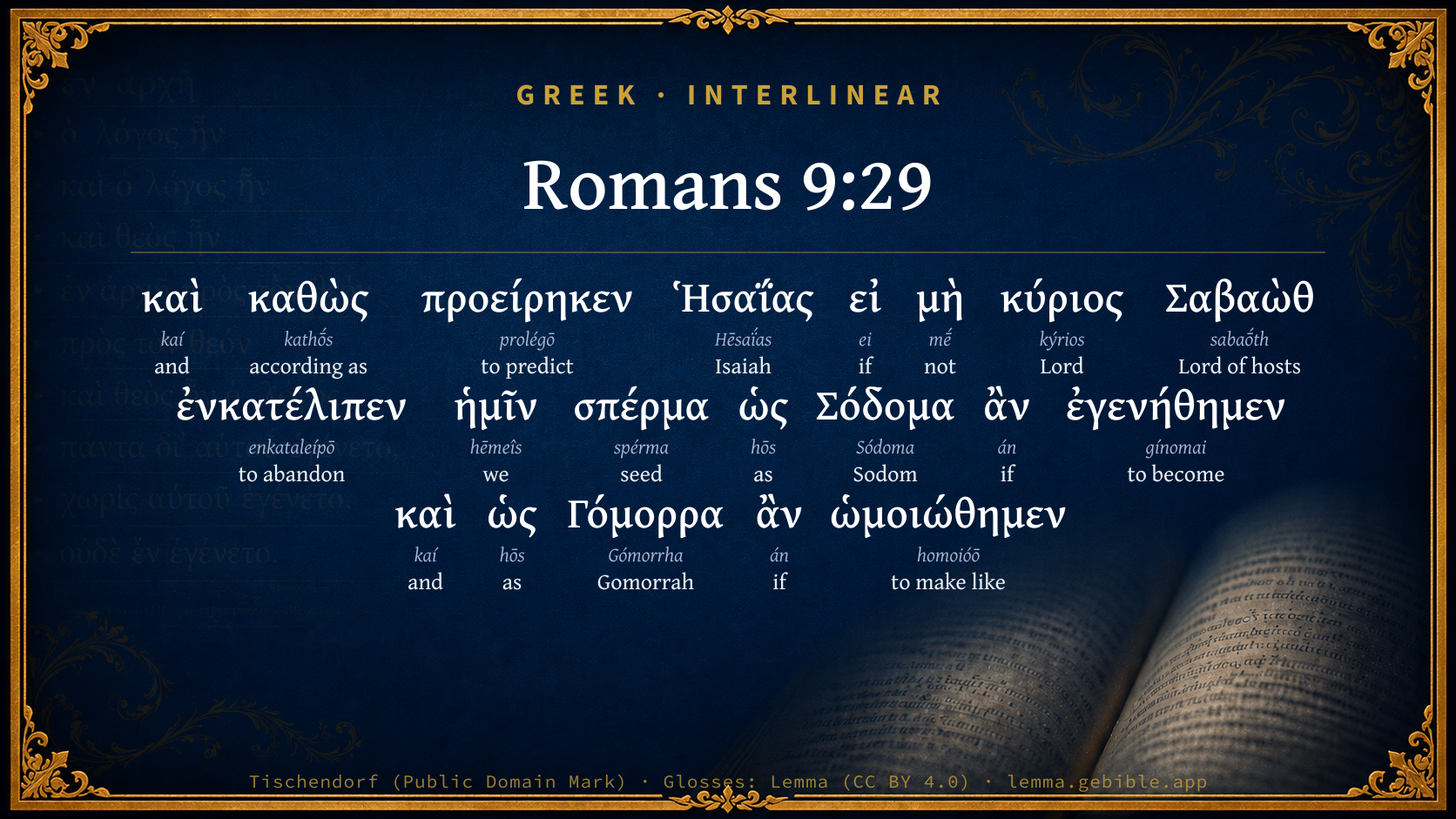
Download image
Cite this verse

Romans 9:29 (World English Bible). Public Domain. Lemma interlinear Bible study tool, https://lemma.gebible.app/v/romans/9/29.

Show BibTeX & RIS
BibTeX
RIS
English Translation
As Isaiah has said before, "Unless the Lord of Hosts had left us a seed, We would have become like Sodom, And would have been made like Gomorrah."
World English Bible · Public Domain
Highlights
  • 1 first appearance in the Greek New Testament
Full analysis ↓
Download a study sheet

One document with this verse’s original text, its word-by-word gloss line, the meaning frame, cross-references with their text, attributed commentary, and full source and license credits — printable, and it pastes into notes with its structure intact.

This verse Autodidact and up

Study sheet (.html) Plain text (.txt)

A passage Seminary Student

Up to 50 verses in one chapter. A passage sheet keeps up to 6 commentary sources and 12 cross-references per verse, in the order this page ranks them, and says so on the sheet whenever that leaves anything out. Ask for a single verse and you get the Autodidact verse sheet above.

Everything on this page stays free to read, with no account — the sheet is a download of what is already on screen, not access to it.

Want to remove ads? Support Godless Engineer
Compare translations 3

The same verse in 3 English versions, stacked beneath the original-language interlinear above. Click any original word for its lexicon entry.

Each is an independent rendering of the whole verse — the interlinear is not word-aligned to these translations.

Highlighted words mark where these versions differ — a whole-verse word diff, not a word-by-word alignment.

  • World English Bible Public Domain
    As Isaiah has said before, "Unless the Lord of Hosts had left us a seed, We would have become like Sodom, And would have been made like Gomorrah."
  • King James Version Public Domain
    And as Esaias said before, Except the Lord of Sabaoth had left us a seed, we had been as Sodoma, and been made like unto Gomorrha.
  • unfoldingWord Literal Text CC BY-SA 4.0
    And just as Isaiah has said beforehand, “If the Lord of hosts did not leave us a seed, we would have become like Sodom, and we would have been made like Gomorrah.” ts\*

unfoldingWord Literal Text — © unfoldingWord, licensed CC BY-SA 4.0. Word-aligned USFM3 via Door43 (git.door43.org/unfoldingWord/en_ult).

Versions to compare (up to 4)

3 of 4 selected

Show all 19 translations

Every available English version of this verse, each an independent rendering of the whole verse.

  • World English Bible Public Domain
    As Isaiah has said before, "Unless the Lord of Hosts had left us a seed, We would have become like Sodom, And would have been made like Gomorrah."
  • Berean Standard Bible Public Domain
    It is just as Isaiah foretold: “Unless the Lord of Hosts had left us descendants, we would have become like Sodom, we would have resembled Gomorrah.”
  • Majority Standard Bible Public Domain
    It is just as Isaiah foretold: “Unless the Lord of Hosts had left us descendants, we would have become like Sodom, we would have resembled Gomorrah.”
  • King James Version Public Domain
    And as Esaias said before, Except the Lord of Sabaoth had left us a seed, we had been as Sodoma, and been made like unto Gomorrha.
  • American Standard Version (1901) Public Domain
    And, as Isaiah hath said before, Except the Lord of Sabaoth had left us a seed, We had become as Sodom, and had been made like unto Gomorrah.
  • Revised Version (1885) Public Domain
    And, as Isaiah hath said before, Except the Lord of Sabaoth had left us a seed, We had become as Sodom, and had been made like unto Gomorrah.
  • Geneva Bible (1599) Public Domain
    And as Esaias sayde before, Except the Lord of hostes had left vs a seede, we had bene made as Sodom, and had bene like to Gomorrha.
  • Douay-Rheims (1899) Public Domain
    And as Isaias foretold: Unless the Lord of Sabaoth had left us a seed, we had been made as Sodom, and we had been like unto Gomorrha.
  • Young's Literal Translation Public Domain
    and according as Isaiah saith before, `Except the Lord of Sabaoth did leave to us a seed, as Sodom we had become, and as Gomorrah we had been made like.'
  • Literal Standard Version CC BY-SA 4.0
    And according as Isaiah says before, “Except the LORD of Hosts left to us a seed, we had become as Sodom, and we had been made like Gomorrah.”
  • Unlocked Literal Bible CC BY-SA 4.0
    As Isaiah had said previously, “If the Lord of hosts had not left us descendants, we would be like Sodom, and we would have become like Gomorrah.”
  • unfoldingWord Literal Text CC BY-SA 4.0
    And just as Isaiah has said beforehand, “If the Lord of hosts did not leave us a seed, we would have become like Sodom, and we would have been made like Gomorrah.” ts\*
  • Darby Bible Public Domain
    And according as Esaias said before, Unless [the] Lord of hosts had left us a seed, we had been as Sodom, and made like even as Gomorrha.
  • World Messianic Bible Public Domain
    As Isaiah has said before, “Unless the Lord of Hosts had left us a seed, we would have become like Sodom, and would have been made like Gomorrah.”
  • Webster's Bible Public Domain
    And as Isaiah said before, Except the Lord of Sabaoth had left us a seed, we had been as Sodom, and been made like Gomorrah.
  • Free Bible Version CC BY-SA 4.0
    As Isaiah previously said, “If the Lord Almighty had not left us some descendants, we would have become just like Sodom and Gomorrah.”
  • Bible in Basic English Public Domain
    And, as Isaiah had said before, If the Lord of armies had not given us a seed, we would have been like Sodom and Gomorrah.
  • Text-Critical English NT CC BY 4.0
    And just as Isaiah foretold, “If the Lord of hosts had not left us any descendants, we would have been like Sodom and become like Gomorrah.”
  • Tyndale New Testament (1534) Public Domain
    And as Esaias sayd before: Except the Lorde of sabaoth had left us seede we had bene made as Zodoma and had bene lykened to Gomorra.

Literal Standard Version (2020), Covenant Press — licensed CC BY-SA 4.0. Text via the HelloAO Bible API (eBible.org). Unlocked Literal Bible (unfoldingWord) — licensed CC BY-SA 4.0. Text via the HelloAO Bible API (eBible.org). unfoldingWord Literal Text — © unfoldingWord, licensed CC BY-SA 4.0. Word-aligned USFM3 via Door43 (git.door43.org/unfoldingWord/en_ult). Free Bible Version, Dr. Jonathan Gallagher — licensed CC BY-SA 4.0. Text via the HelloAO Bible API (eBible.org).

Word by word

More ways to search: Search by grammar → Find every occurrence → Compare this word →

Practice this passage: Drill this verse → Learn its vocabulary →

Σαβαὼθ
sabaṓth
G4519
“Lord of hosts”
Hebrew transliteration
Part of Speech
Hebrew transliteration
Full Thayer's Definition

Origin: of hebrew origin H6635 in feminine plural

TDNT: None

1. "Lord of Sabaoth" a. Lord of the armies of Israel, as those who are under the leadership and protection of Jehovah maintain his cause in war
  1. καὶ kaí G2532 “and” Conjunction
  2. καθὼς kathṓs G2531 “according as” Adverb
  3. προείρηκεν prolégō G4302 “to predict” Verb, Perfect, Active, Indicative, 3rd person, Singular
  4. Ἡσαΐας Hēsaḯas G2268 “Isaiah” Noun, Nominative, Singular, Masculine
  5. εἰ ei G1487 “if” Conditional
  6. μὴ mḗ G3361 “not” Particle, Negative
  7. κύριος kýrios G2962 “Lord” Noun, Nominative, Singular, Masculine
  8. ἐνκατέλιπεν enkataleípō G1459 “to abandon” Verb, Aorist, Active, Indicative, 3rd person, Singular
  9. ἡμῖν hēmeîs G2249 “we” Personal pronoun, 1st person, Dative, Plural
  10. σπέρμα spérma G4690 “seed” Noun, Accusative, Singular, Neuter
  11. ὡς hōs G5613 “as” Adverb
  12. Σόδομα Sódoma G4670 “Sodom” Noun, Nominative, Plural, Neuter
  13. ἂν án G302 “if” Particle
  14. ἐγενήθημεν gínomai G1096 “to become” Verb, Aorist, Passive deponent, Indicative, 1st person, Plural
  15. καὶ kaí G2532 “and” Conjunction
  16. ὡς hōs G5613 “as” Adverb
  17. Γόμορρα Gómorrha G1116 “Gomorrah” Noun, Nominative, Singular, Feminine
  18. ἂν án G302 “if” Particle
  19. ὡμοιώθημεν homoióō G3666 “to make like” Verb, Aorist, Passive, Indicative, 1st person, Plural

About this verse

These counts appear in no published source. They are computed here, from the morphology-tagged text and Lemma’s own curated glosses. What Lemma adds →

20
words
17
distinct lemmas
Pauline Epistles
section

Notable vocabulary

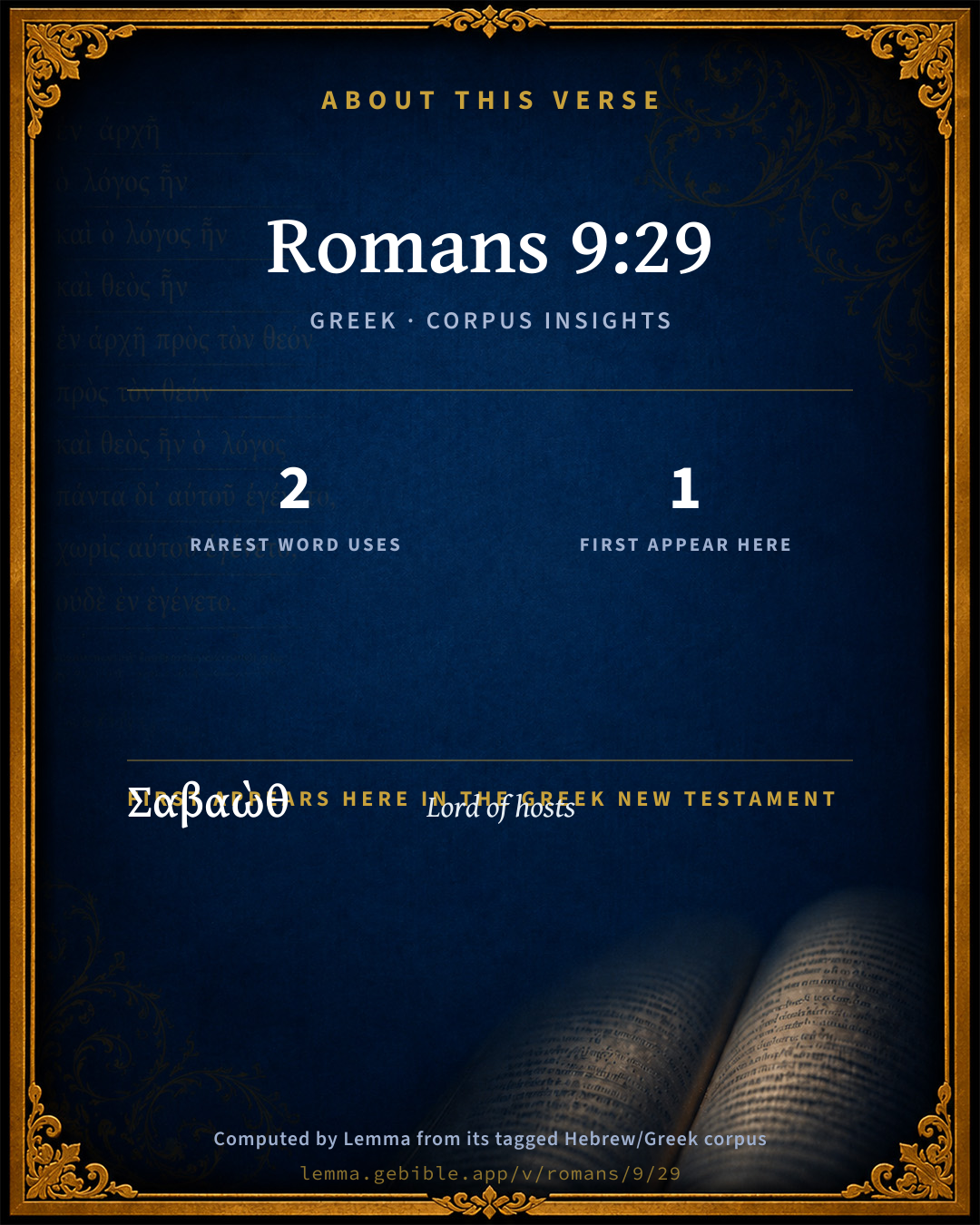
The rarest word here is Σαβαὼθ Lord of hosts G4519 — appearing just 2 times in the whole Greek New Testament.

First appearance in Scripture

This word makes its first canonical appearance in the Greek New Testament here:

  • Σαβαὼθ Lord of hosts G4519

Shared distinctive vocabulary

Σαβαὼθ Lord of hosts G4519 occurs in 2 verses of the Greek New Testament. Also found in:
Repetition

Words recur within this verse:

Cross-references

14

Topical passages linked to Romans 9:29 in the Treasury of Scripture Knowledge — connected by theme and wording, ordered by reader-vote popularity; previews shown in the World English Bible.

  • Isaiah 1:9 Unless Yahweh of hosts had left to us a very small remnant, We would have been as Sodom; We would have been like Gomorrah.
  • Isaiah 13:19 Babylon, the glory of kingdoms, the beauty of the Chaldeans' pride, shall be as when God overthrew Sodom and Gomorrah.
  • Amos 4:11 "I have overthrown some of you, As when God overthrew Sodom and Gomorrah, And you were like a burning stick plucked out of the fire; Yet you haven't returned to me," says Yahweh.
  • James 5:4 Behold, the wages of the laborers who mowed your fields, which you have kept back by fraud, cry out, and the cries of those who reaped have entered into the ears of the Lord of Hosts.
  • Jeremiah 49:18 As in the overthrow of Sodom and Gomorrah and the neighbor cities of it, says Yahweh, no man shall dwell there, neither shall any son of man sojourn therein.
  • Jeremiah 50:40 As when God overthrew Sodom and Gomorrah and the neighbor cities of it, says Yahweh, so shall no man dwell there, neither shall any son of man sojourn therein.
  • Genesis 19:24–25 Then Yahweh rained on Sodom and on Gomorrah sulfur and fire from Yahweh out of the sky.
  • Deuteronomy 29:23 [and that] the whole land of it is sulfur, and salt, [and] a burning, [that] it is not sown, nor bears, nor any grass grows therein, like the overthrow of Sodom and Gomorrah, Admah and Zeboiim, which Yahweh overthrew in his anger, and in his wrath:
  • 2 Peter 2:6 and turning the cities of Sodom and Gomorrah into ashes, condemned them to destruction, having made them an example to those who would live ungodly;
  • Jude 1:7 Even as Sodom and Gomorrah, and the cities around them, having, in the same way as these, given themselves over to sexual immorality and gone after strange flesh, are set forth as an example, suffering the punishment of eternal fire.
  • Isaiah 6:13 If there are yet a tenth in it, It also shall in turn be eaten up: As a terebinth, and as an oak, whose stock remains, when they are felled; So the holy seed is its stock."
  • Lamentations 3:22 [It is of] Yahweh's loving kindnesses that we are not consumed, because his compassion doesn't fail.
  • Lamentations 4:6 For the iniquity of the daughter of my people is greater than the sin of Sodom, That was overthrown as in a moment, and no hands were laid on her.
  • Zephaniah 2:6 The sea coast will be pastures, with cottages for shepherds and folds for flocks.

Cross-references courtesy of OpenBible.info (CC BY 4.0).

Commentary

Notes on Romans 9:29 from classic Christian and Jewish commentators (each source and its license shown beneath its notes). The classic Christian expositions comment on the surrounding passage and are grouped to its opening verse, so a note may address several verses; the Jewish commentaries on the Tanakh (Rashi and others) are per-verse, so they appear only where the commentator wrote on this verse.

Lemma curates 59 commentaries, every one of them public domain or Creative Commons licensed, each selected and text-cleaned for this edition rather than reprinted as found. About our sources →

Tyndale Open Study Notes

Tyndale Open Resources

9:29 The destruction of the cities of Sodom and Gomorrah (Gen 19) is a poignant illustration of the reality and severity of God’s judgment.

Tyndale Open Study Notes — © Tyndale Open Resources, licensed CC BY-SA 4.0. Text via the HelloAO Bible API.

Bengel's Gnomon

Johann Albrecht Bengel

Rom 9:29. Εἰ μὴ—ὡμοιώθημεν) Isa 1:9, LXX., καὶ εἰ μὴ ὡμοιώθημεν.—προείρηκεν, said before) Before the event, or before the prophecy quoted at Rom 9:28.—σαβαὼθ) In 1 Samuel and in Isaiah, σαβαὼθ is put for the Heb. word צבאת; in all the other books it is translated παντοκράτωρ, Ruler over all. From this circumstance there is strong ground for conjecturing, that one or perhaps several persons were employed to translate those two books, and that different persons translated the rest. And in the same first book of Sam. Scripture beings to give this title to God, although others had been formerly used as it were in its place.—Exo 34:23.—σπέρμα, a seed) There is denoted 1) a small number at the present time, 2) the propagation of a multitude after deliverance from captivity.—ὡς Σόδομα, as Sodom) where not a single citizen escaped; no seed was left.

Bengel's Gnomon of the New Testament — English translation (T&T Clark, Edinburgh, 1860) — public domain. Text from a community e-Sword module.

Meyer's Critical & Exegetical Commentary

Heinrich August Wilhelm Meyer

Rom_9:29. Since the preceding prophecy was not introduced by καθώς or ὡς, we must here punctuate καὶ, καθὼς προείρηκεν Ἡσαΐας, εἰ μὴ κ.τ.λ., so that Paul adopts as his own the words of Isa_1:9 (closely following the LXX.): And, as Isaiah has prophesied, if the Lord of Zebaoth had not left behind to us a seed (in the sense of the apostle, this is that very ὑπόλειμμα of Rom_9:27, which, like seed out of which new fruit grows, preserves and continues the true people of God), we should have become as Sodom, and like to Gomorrha; the whole nation (by exclusion from Messianic salvation) would have without exception perished (fallen unto ἀπώλεια).

ΠΡΟΕΊΡ] Not to be understood, with Baumgarten-Crusius and van Hengel, following Erasmus, Beza, Calvin, Grotius, Michaelis, and others: has said at an earlier place, for local specifications of this kind are quite unusual in quotations with Paul, and here such reference would be without significance. It is used in the prophetic sense; the prophet has said of the fate of the people in his time, with a forecast of its corresponding fate in the present time, what holds good of Israels present; the mass of its people is hardened by divine judgment, and forfeits salvation, and only a holy σπέρμα is left to it. Comp. on ΠΡΟΕΊΡ., Act_1:16; Plato, Rep. p. 619 C; Lucian, Jov. Frag. 30; Polyb. vi. 3. 2.

ὡς Γόμ.] Two modes of conception are intermixed: become like, and become as, LXX., Hos_4:6; Eze_32:2; Fritzsche, ad Marc. p. 140 f. Compare the classical connection of ὅμοιος and ὉΜΟΊΩς with Ὡς and ὭΣΠΕΡ.

Meyer — Critical and Exegetical Commentary on the New Testament — English translation by Peter Christie, edited by Frederick Crombie (T&T Clark, 1880) — public domain. Text from a community e-Sword module.

Expositor's Greek Testament

ed. W. Robertson Nicoll

Rom 9:29 . But his last quotation is in verbal agreement with the LXX Isa 1:9 , and transparently clear. The σπέρμα or seed which God leaves is the same as the ὑπόλειμμα . The figure is not to be pressed. The remnant is not the germ of a new people; Paul expects Israel as a whole to be restored.

With this the theodicy proper closes. The unbelief of the Jews was a great problem to the Apostolic age, and one which easily led to scepticism concerning the Gospel. The chosen people without a part in the kingdom of God impossible. This chapter is Paul’s attempt to explain this situation as one not involving any unrighteousness or breach of faith on the part of God. It is not necessary to resume the various stages of the argument as they have been elucidated in the notes. The point of greatest difficulty is no doubt that presented by Rom 9:22-23 . Many good scholars, Meyer and Lipsius for example, hold that Paul in these verses is not withdrawing from, but carrying through, the argument from God’s absoluteness stated so emphatically in Rom 9:21 . They hold that the σκεύη ὀργῆς κατηρτισμένα εἰς ἀπώλειαν would not be σκεύη ὀργῆς at all, if their repentance and amendment were conceivable; and although God bears long with them that is, defers their destruction it is only in order that He may have time and opportunity to manifest the riches of His glory on the vessels of mercy. But the answer to this is plain. It assumes that human life, in its relation to God, can be interpreted by the analogy of clay in its relation to the potter; in other words, that moral and spiritual experiences can be construed and made intelligible through what are merely physical categories. But this is not the case. And if it be said that justice is not done, by the interpretation given in this commentary, to the expression σκεύη ὀργῆς , it may also be said that justice is not done, by the interpretation of Meyer and Lipsius, to the expression ἐν πολλῇ μακροθυμίᾳ . Each of these allegations may be said to neutralise the other that is, neither is Iecisive for the interpretation of the passage; and the Apostle’s meaning remains to be determined by the general movement of his thought. In spite of the great difficulties of the section as a whole, I cannot hesitate to read it as above.

The Expositor's Greek Testament, edited by W. Robertson Nicoll (1897–1910) — public domain. Text from a community e-Sword module.

Hodge's Commentary on Romans, Ephesians & First Corinthians

Charles Hodge

Rom_9:29

The second passage quoted by the apostle is from Isa_1:9, Except the Lord of hosts had left as a seed, we had been as Sodom, been made like unto Gomorrah. The object of this quotation is the same as that of the preceding, viz., to show that being Israelites was not enough to secure either exemption from divine judgments or the enjoyment of Gods favor. The passage is perfectly in point, for although the prophet is speaking of the national judgments which the people had brought upon themselves by their sins, and by which they were well nigh cut off entirely, yet it was necessarily involved in the destruction of the people for their idolatry and other crimes, that they perished from the kingdom of God. Of course the passage strictly proves what Paul designed to establish, viz., that the Jews, as Jews, were as much exposed to Gods judgments as others, and consequently could lay no special claim to admission into the kingdom of heaven.

Paul here again follows the Septuagint. The only difference, however, is, that the Greek version has (σπέρμα) a seed, instead of a remnant, as it is in the Hebrew. The sense is precisely the same. The Hebrew word means that which remains; and seed, as used in this passage, means the seed reserved for sowing. The figure, therefore, is striking and beautiful. Lord of Hosts is a frequent designation for the Supreme God in the Old Testament. As the word host is used in reference to any multitude arranged in order, as of men in an army, of angels, of the stars, or of all the heavenly bodies, including the sun and moon, so the expression Lord of hosts, may mean, Lord of armies, Lord of angels, or Lord of heaven, or of the universe as a marshaled host; see 1Ki_22:19, I saw the Lord sitting on his throne, and all the host of heaven standing by him; 2Ch_18:18; Psa_103:21; Psa_148:2, Praise ye him, all his angels, praise ye him, all his hosts. In other passages, the reference is, with equal distinctness, to the stars, Jer_23:22; Deu_4:19, and frequently. It is most probable, therefore, that God is called Lord of hosts in reference to his Lordship over the whole heavens, and all that they contain, Lord of hosts being equivalent to Lord of the universe.

Charles Hodge — Commentary on Romans (1835), First Corinthians (1857), and Ephesians (1856) — public domain. Text from a community e-Sword module.

Geneva Bible (1599)

Geneva Bible translators

Even a very few.

Armies, by which word the chiefest power that is, is given to God.

Geneva Bible (1599) marginal notes — public domain. Text via Bolls.life.

Jamieson, Fausset & Brown

Robert Jamieson, A. R. Fausset & David Brown

And as Esaias said--"hath said"

before--that is, probably in an earlier part of his book, namely, Isa 1:9.

Except the Lord of Sabaoth--that is, "The Lord of Hosts": the word is Hebrew, but occurs so in the Epistle of James (Jam 5:4), and has thence become naturalized in our Christian phraseology.

had left us a seed--meaning a "remnant"; small at first, but in due time to be a seed of plenty (compare Psa 22:30-31; Isa 6:12-13).

we had been--"become"

as Sodom, &c.--But for this precious seed, the chosen people would have resembled the cities of the plain, both in degeneracy of character and in merited doom.

Jamieson, Fausset & Brown — Commentary Critical and Explanatory on the Whole Bible (1871) — public domain (CC PDM 1.0). Text via the HelloAO Bible API.

Adam Clarke's Commentary

Verse 29. And as Esaias said before] What God designs to do with the Jews at present, because of their obstinacy and rebellion, is similar to what he has done before, to which the same prophet refers, Isa 1:9: Except the Lord of hosts had left unto us a very small remnant, we should have been as Sodom, and we should have been like unto Gomorrah: i.e. had not God, who commands and overrules all the powers in heaven and earth, in mercy preserved a very small remnant, to keep up the name and being of the nation, it had been quite cut off and extinct, as Sodom and Gomorrah were. Thus we learn that it is no new thing with God to abandon the greatest part of the Jewish nation, when corrupt, and to confine his favour and blessing to a righteous, believing few.

Instead of remnant, שריד sarid, both the Septuagint and the apostle have σπερμα, a seed, intimating that there were left just enough of the righteous to be a seed for a future harvest of true believers. So the godly were not destroyed from the land; some remained, and the harvest was in the days of the apostles.

Adam Clarke's Commentary on the Bible (1810–1826) — public domain. Text from a community e-Sword/MySword module.

John Calvin's Commentaries

29. And as Isaiah had before said, etc. He brings another testimony from the first chapter, where the Prophet deplores the devastation of Israel in his time: and as this had happened once, it was no new thing. The people of Israel had indeed no pre-eminence, except what they had derived from their ancestors; who had yet been in such a manner treated, that the Prophet complained that they had been so afflicted, that they were not far from having been destroyed, as Sodom and Gomorrah had been. There was, however, this difference, that a few were preserved for a seed, to raise up the name, that they might not wholly perish, and be consigned to eternal oblivion. For it behoved God to be ever mindful of his promise, so as to manifest his mercy in the midst of the severest judgments.

John Calvin's Commentaries (1540-1563) — public domain. Text from the Calvin Translation Society English edition (1840s-50s) via the Christian Classics Ethereal Library (ccel.org). Calvin's coverage is partial (roughly two-thirds of the Bible); uncommented books and verses are honest gaps, never fabricated. The 19th-century editor's footnotes and remarks are omitted so the notes are faithfully Calvin's own voice.

Ellicott's Commentary for English Readers

(29) Said before—i.e., in an earlier part of his book. The Book of Isaiah was at this time collected in the form in which we have it. In Act_13:33, we find an express reference to the present numbering of the Psalms—“It is also written in the second psalm, Thou art my Son, this day have I begotten thee.” (Some authorities read “first,” the two psalms being arranged as one, but “second” is probably the true reading.)

A seed.—Equivalent to the “remnant” of Rom_9:27. The point of the quotation is, that but for this remnant the rejection of Israel would have been utter and complete.

A Bible Commentary for English Readers, edited by Charles John Ellicott (1878–1897) — public domain. Text from a community e-Sword module.

The Cambridge Bible for Schools and Colleges

gen. ed. J. J. S. Perowne

29. And] Q. d., “And again, the small number of Jewish believers fulfils another prediction.”

said before] Lit., and better, hath said before; i.e. “as we have it in his book.”—“Before” refers not to the quotation of an earlier chapter, but to the words as a prediction. The quotation is from Isa_1:9, and exactly with LXX., which gives “a seed” where the Heb. gives the equivalent, “a small remnant.” St Paul instructs us that this passage not only describes a state of distress contemporary with the Prophets, but also predicts, through this as a type, the spiritual future.—“Sabaoth”:—the Gr. transliteration of Ts’vâôth, the Heb. word meaning Hosts, Armies.

The Cambridge Bible for Schools and Colleges (gen. ed. J. J. S. Perowne; Cambridge University Press, 1878–1918) — public domain. Text from a community e-Sword module.

John Gill's Exposition

What shall we say then?.... To God's calling of a large number of the Gentiles, and only a very few of the Jews, according to his eternal purposes and decrees; what can be objected to it? is he chargeable with any unrighteousness? must it not be referred to his sovereign will and pleasure? is it not an instance of his grace and goodness, that he calls and saves some, when they were all so wicked, that he might in justice have destroyed every individual of them? or what is further to be said, concerning both Jews and Gentiles? or what can be objected to what may be further observed concerning them? as

that the Gentiles which followed not after righteousness; the very same persons among them, who are, called by grace, and are vessels of mercy, before their calling were without a righteousness, stout hearted, and far from one; being without Christ, and destitute of his Spirit; they were ignorant of righteousness, of the righteousness of God, and of his law, and consequently of what true righteousness is; they were unconcerned about it, and did not labour after it, as the Jews did. They did not pursue and improve the light of nature, about God and things of a moral kind, as they might have done; but held the light and truth they had in unrighteousness, and indeed were filled with nothing else: and yet these persons

have attained to righteousness, even the righteousness which is of faith. The righteousness they attained unto, was not a righteousness of their own, not the righteousness of works, or a righteousness by the deeds of the law, to which the righteousness which is of faith is always opposed; nor faith itself, which is distinguished from it; but the righteousness of Christ, so called, not because that faith is the cause or condition of it, but because the discovery of it is made to faith; that receives it, lays hold on it, and exercises itself on it; by it the soul renounces its own righteousness, looks to, and depends on Christ's, and rejoices in it. These Gentiles being called by grace, "attained", "comprehended", or "apprehended" this righteousness; not by the light of nature, which makes no discovery, nor gives the least hint of it; but by the light of faith they apprehended it, as revealed in the Gospel; which faith they had not of themselves, but of God; so that the whole of this account is a wonderful instance of the grace of God, and abundantly confirms the observation made before by the apostle, that "it is not of him that willeth, nor of him that runneth, but of God that shows mercy", Rom 9:16; since these persons had nothing in them, disposing and qualifying them for a justifying righteousness, and yet attained one; and the grace appears to be the more distinguishing, by what follows.

John Gill's Exposition of the Whole Bible (1746–1763) — public domain (CC PDM 1.0). Text via the HelloAO Bible API.

Trapp's Complete Commentary

John Trapp

29 And as Esaias said before, Except the Lord of Sabaoth had left us a seed, we had been as Sodoma, and been made like unto Gomorrha.

Ver. 29. Except the Lord of Sabaoth] That is, of hosts. God is commander-in-chief of all creatures. The Rabbis well observe that he hath Magnleh Cheloth, and Matteh Cheloth, two general troops, as his horse and foot, the upper and lower troops ready pressed. (Kimchi.)

John Trapp, A Commentary or Exposition upon All the Books of the Old and New Testament (1647–1656) — public domain. Text from a community e-Sword module.

Albert Barnes' Notes on the Bible

And as Esaias said - Isa 1:9.

Before - The apostle had just cited one prediction from the tenth chapter of Isaiah. He now says that Isaiah had affirmed the same thing in a previous part of his prophecy.

Except the Lord of Sabaoth - In Isaiah, the Lord of Hosts. The word “Sabaoth” is the Hebrew word rendered “hosts” (armies). It properly denotes armies or military hosts organized for war. Hence, it denotes the “hosts of heaven,” and means:

(1) “The angels” who are represented as marshalled or arranged into military orders; Eph 1:21; Eph 3:10; Eph 6:12; Col 1:16; Col 2:15; Jud 1:6; 1Ki 22:19, “I saw the Lord sitting on his throne, and all the host of heaven standing by him;” Psa 103:21; Psa 148:2.

(2) The stars; Jer 33:22, “As the host of heaven cannot be numbered, etc.” Isa 40:26; Deu 4:19, etc. God is called the Lord of hosts, as being at the head of all these armies; their King and their Commander. It is a phrase properly expressive of his majesty and power, and is appropriately introduced here, as the “act of saving” “the seed” was a signal “act of power” in the midst of great surrounding wickedness.

Had left - Had preserved, or kept from destruction. Here their preservation is ascribed to God, and it is affirmed that if God had not interposed, “the whole nation” would have been cut off. This fully establishes the doctrine of the apostle, that God might cast off the Jews, and extend the blessings to the Gentiles.

A seed - The Hebrew in Isaiah means “one surviving or escaping,” corresponding with the word “remnant.” The word “seed” commonly means in the Scriptures “descendants, posterity.” In this place it means “a part, a small portion; a remnant,” like the small portion of the harvest which is reserved for sowing.

We had been as Sodoma - The nation was so wicked, that unless God had preserved a small number who were pious from the general corruption of the people, they would have been swept off by judgment, like Sodom and Gomorrah. We are told that ten righteous men would have saved Sodom; Gen 18:32. Among the Israelites, in a time of great general depravity, a small number of holy men were found who preserved the nation. The design of the apostle here was the same as in the previous verses - to show that it was settled in the Jewish history that God might cast off the people, and reject them from enjoying the special privileges of his friends. It is true that in Isaiah he has reference to the temporal punishments of the Jews. But it settles “a great principle,” for which Paul was contending, that God might cast off the nation consistently with his promises and his plans. We may learn here,

That the existence of religion among a people is owing to the love of God. “Except the Lord “had left us, etc.”

(2)It is owing to his mercy that “any men” are kept from sin, and any nation from destruction.

(3)We see the value of religion and of pious people in a nation. Ten such would have saved Sodom; and a few such saved Judea; compare Mat 5:13-14.

God has aright to withdraw his mercies from any other people, however exalted their privileges, and leave them to ruin; and we should not be high-minded, but fear; Rom, Mat 10:20.

Albert Barnes' Notes on the Bible (1834–1885) — public domain. Text from a community e-Sword/MySword module.

Matthew Poole's English Annotations

As Esaias said before; in Isa 1:9.

The Lord of sabaoth; or, of hosts: the mighty God, whose hosts all creatures are, which execute his will, as soldiers the will of their commander.

Had left us a seed: he means by a seed, the same that he meant before by a remnant, a small number. These were left as a little seed, out of a great heap of corn: that which is chosen, and left for seed, is little in comparison of the whole crop.

We had been as Sodoma, and been made like unto Gomorrha; i.e. utterly wasted and destroyed as they were, Jer 50:40.

Matthew Poole's English Annotations on the Holy Bible (1683–1685) — public domain. Text from a community e-Sword/MySword module.

Whedon's Commentary on the Bible

Daniel D. Whedon

29. Esaias said before—That is, he said this (Isa_1:9) before, or earlier in time than (Rom_10:20-21) the above quoted. The present passage corroborates the doctrine of the former, that the fewness of faithful Jews accords with divine foresight.

Daniel D. Whedon (gen. ed.), Commentary on the Old and New Testaments (1874–1909) — public domain. Text from a community e-Sword module.

The Pulpit Commentary

And as Esaias hath said before (i.e. in an earlier chapter), Except the Lord of sabaoth had left us a seed, we should have been as Sodom, and been made like unto Gomorrah. This quotation is from Isa_1:9, etc. and, though it seems to have no obvious reference to the Messianic age, it expresses the same idea as the other, of a remnant only being saved; and it is quoted suitably, occurring as it does at the beginning of the Book of Isaiah, and being a sort of key-note of the prevailing purport of his prophecies. The force of all the above quotations is much enhanced, if we remember that they are not mere isolated texts, but suggestive specimens of many prophetic utterances to the same effect. All familiar with the prophetic writings are aware that main ideas constantly recurring are: First, judgments to come upon the chosen people, painted often in many consecutive verses without relief; but secondly, after such denunciations, a dawn of hope and comfort appearing, and culminating in unutterable blessing under the Messiah"s kingdom; and thirdly, this dawn of hope being for a remnant only of the race, compared in one place to a gleaning of the grapes when the vintage is done; (Isa_24:13) and fourthly, the association with this remnant, not only of the "outcasts of Israel" gathered from all lands, but also of a multitude of Gentiles, who should be gathered into the Messiah"s kingdom. (cf. Zep_3:12 Zec_13:9 Amo_9:9 Joe_2:32 Isa_6:13 Isa_56:6 Isa 60)

The Pulpit Commentary (1880–1919), ed. H.D.M. Spence-Jones & Joseph S. Exell — public domain. Text from a community e-Sword module.

John Wesley's Explanatory Notes

As Isaiah had said before - Namely, Isaiah i, 9, concerning those who were besieged in Jerusalem by Rezin and Pekah. Unless the Lord had left us a seed - Which denotes,

1. The present paucity:

2. The future abundance. We had been as Sodom - So that it is no unexampled thing for the main body of the Jewish nation to revolt from God, and perish in their sin.

John Wesley, Explanatory Notes Upon the Whole Bible (1754–1765) — public domain. Text via the GEBible commentary corpus.

Scofield Reference Notes

C. I. Scofield

Lord of

LORD of hosts. Isa 1:9.

The Scofield Reference Bible (1917 edition), notes by C. I. Scofield — public domain. Text from a community e-Sword module.

Godbey's Commentary on the New Testament

William B. Godbey

29. “And as Isaiah before said: Unless the Lord of hosts left unto us a seed, we were as Sodom and we become like unto Gomorra.” Hence you see that the Jews were neither exterminated nor utterly cast away, God’s merciful eye following the faithful remnant in all their peregrinations upon the face of the whole earth, keeping the covenant which He made with Abraham, Isaac, Jacob and Moses, and finally gathering them back to the land of their holy patrimony.

William B. Godbey, Commentary on the New Testament (1896–1900) — public domain. Text from a community e-Sword module.

McGarvey & Pendleton's Commentaries

J. W. McGarvey

And, as Isaiah hath said before [This may mean, Isaiah has said this before me, so that I need not prophesy myself, but may appropriate his word, or, as earlier expositors (Erasmus, Calvin, Grotius, etc.) render it, Isaiah spoke the words which I am about to quote earlier than those which I have already quoted, the latter being Isa_10:22-23 ; and the former being at Isa_1:9 . Since the apostle is proving his case by the Scripture and not resting it upon his own authority, the former reading seems out of place. It would be somewhat trite in Paul to state that Isaiah wrote before him! It is objected that the latter rendering states an unimportant fact. What difference can it make which saying came first or last? But it is not so much the order as the repetition of the saving that the apostle has in mind. Isaiah did not see some moment of national disaster in a single vision, and so cry out. He saw this destruction of all save a remnant in the very first vision of his book, and it is the oft-repeated burden and refrain of a large portion of his prophecies], Except the Lord of Sabaoth [Hebrew for "hosts"] had left us a seed [for replanting], We had become as Sodom, and had been made like unto Gomorrah . [Like "cities of which now," as Chalmers observes, "no vestige is found, and of whose people the descendants are altogether lost in the history or our species." (Comp. Jer_50:40 ) In contrast with these, the Jews, though few in number, have ever been found in the kingdom of God. Since the section just finished is the stronghold of Calvinism, we should not leave it without noting that Simon Peter warns us not to put false construction upon it. He says: "Wherefore, beloved, seeing that ye look for these things" (a new heaven and a new earth), "give diligence that ye may be found in peace, without spot and blameless in his [God's] sight, and account that the longsuffering of our Lord is salvation; even as our beloved brother Paul also, according to the wisdom given to him, wrote unto you; as also in all his epistles, speaking in them of these things; wherein are some things hard to be understood, which the ignorant and unstedfast wrest, as they do also the other scriptures, unto their own destruction. Ye therefore, beloved, knowing these things beforehand, beware lest, being carried away with the error of the wicked, ye fall from you" own stedfastness" ( 2Pe_3:14-17 ). Now, Paul uses the word "longsuffering" ten times. Seven times he speaks of the longsuffering of men. Once he speaks of the longsuffering of Christ extended to him personally and individually as chief of sinners. Twice ( Rom_2:4-11 ; Rom_9:19-29 ) he fills the measure of Peter's statement, and writes that men should "account that the longsuffering of our Lord is salvation." As the first of these passages ( Rom_2:4-11 ) has never been in dispute, it follows either that all have wrested it, or that none have wrested it, so that in either case its history does not comply with Peter's description. The passage before us, then, is the one which the ignorant and unsteadfast have wrested, and that so seriously that it has compassed their destruction. In further support of this identification, note (1) that this passage was, as we have seen, addressed to the Jews, and it therefore answers to the "wrote unto you" of Peter's letter, which was also addressed to Jews; (2) while "the longsuffering of God," etc., is not prominent in all Paul's Epistles, as we have just shown, the doctrine of election, which is the stumbling-block here, is a common topic with the apostle. Since, then, Peter warns us against wresting this section, let us see who wrests it. According to Peter, it is those who get a soul-destroying doctrine out of it, and such is Calvinism. It is those who derive from it a doctrine which palsies their effort, so that, believing themselves impelled by inexorable will and sovereign, immutable decree, they hold they can do nothing either to please or displease God, and therefore cease to "give diligence that they may be found in peace, without spot and blameless in his sight," and cease to "account that the longsuffering of our Lord is salvation," and thus, "being carried away with the error of the wicked" that human effort is of no avail, they cease to make any, and so "fall from their own stedfastness." Surely with so plain a warning from so trustworthy a source we are foolish indeed if we wrest this Scripture so as to make it contradict the doctrines of human free will and responsibility so plainly taught in other Scriptures.]

J. W. McGarvey (with Philip Y. Pendleton), Commentaries on the New Testament (The Fourfold Gospel, 1914; Acts; and the epistles) — public domain. Text from a community e-Sword/MySword module.

The People's New Testament

B. W. Johnson

29. As Esaias said before. Isaiah spoke this before he wrote what is quoted in verses 27 and 28. This is found in Isaiah 1:9. This passage, like the other, shows that only “a remnant of Israel shall be saved.” We had been as Sodom. Sodom and Gomorrah had perished on account of their sins. Had it not been for God's mercy, Israel would have been blotted out for the same cause.

B. W. Johnson's The People's New Testament with Notes (1889–1891) — public domain. Electronic text from the Christian Classics Ethereal Library (CCEL) ThML edition.

Cambridge Greek Testament for Schools and Colleges

29. Isa 1:9 = LX[196].

[196] LXX the Septuagint Version of the Old Testament

Cambridge Greek Testament for Schools and Colleges (Cambridge University Press, 1896; 21 vols, various authors incl. Carr, Maclear, Plummer, Farrar, Lumby, Moule, M. R. James, Simcox) — public domain. Text from a community e-Sword module.

Alford’s Greek Testament

Henry Alford

29.] Another proof of a remnant to be saved, from a preceding part of the same prophecy. (Such seems to be the sense of προείρ. here,—and so Beza, Calv., Grot., al.; De W., Thol., al., prefer ‘prophesied;’ but surely there is no necessity for affixing an unusual sense to the word, where the ordinary one (see all the reff.) suits much better.)

“ὁμοιοῦσθαι ὡς is a construction in which two ideas, ‘to become as,’ and ‘to become like to,’ are mingled, as in Heb. נִמְשַׁל כְּ, Psa 49:13, 21; compare Mar 4:30.” Tholuck. On ‘Jehovah Sabaoth,’ Bengel remarks, “Pro Hebraico צְבָאֹת in libro 1 Sam. et Jesaia σαβαώθ ponitur; in reliquis libris omnibus παντοκράτωρ.” (This is not strictly the case: δυνάμεων is found in several places: and σαβαώθ occurs in Zec 13:2 Bא.)

The citation is verbatim from the LXX, who have put σπέρμα for the Heb. שָׂרִיד, ‘residuum,’—implying a remnant for a fresh planting.

Henry Alford, The Greek Testament (1849–1861) — public domain. Text from a community e-Sword module.

International Critical Commentary

29. προείρηκεν ‘has foretold.’ A second passage is quoted in corroboration of the preceding.

εἰ μὴ Κύριος κ.τ.λ., quoted from the LXX of Isa 1:9, which again seems adequately to represent the Hebrew. ‘Even in the O. T., that book from which you draw your hopes, it is stated that Israel would be completely annihilated and forgotten but for a small remnant which would preserve their seed and name.’

The Power and Rights of God as Creator

St. Paul in this section (vv. 19-29) expands and strengthens the previous argument. He had proved in vv. 14-18 the absolute character of the Divine sovereignty from the O. T.; he now proves the same from the fundamental relations of God to man implied in that fact which all his antagonists must admit—that God had created man. This he applies in an image which was common in the O. T. and the Apocryphal writings, that of the potter and the clay. God has created man, and, as far as the question of ‘right’ and ‘justice’ goes, man cannot complain of his lot. He would not exist but for the will of God, and whether his lot be honourable or dishonourable, whether he be destined for eternal glory or eternal destruction, he has no ground for speaking of injustice. The application to the case in point is very clear. If the Jews are to be deprived of the Messianic salvation, they have, looking at the question on purely abstract grounds, no right or ground of complaint. Whether or no God be arbitrary in His dealings with them does not matter: they must submit, and that without murmuring.

This is clearly the argument. We cannot on the one hand minimize the force of the words by limiting them to a purely earthly destination: as Beyschlag, ‘out of the material of the human race which is at His disposal as it continues to come into existence to stamp individuals with this or that historical destination,’ implying that St. Paul is making no reference either to the original creation of man or to his final destination, in both points erroneously. St. Paul’s argument cannot be thus limited. It is entirely based on the assumption that God has created man, and the use of the words εἰς δόξαν, εἰς ἀπώλειαν prove conclusively that he is looking as much as he ever does to the final end and destination of man. To limit them thus entirely deprives the passage of any adequate meaning.

But on the other side it is equally necessary to see exactly how much St. Paul does say, and how much he does not. He never says, he carefully avoids saying, that God has created men for reprobation. What his argument would bear is that, supposing we isolate this point, the ‘rights’ of man against God or of God against man, then, even if God had created man for reprobation, man could have no grounds for complaint.

We must in fact remember—and it is quite impossible to understand St. Paul if we do not—that the three chapters 9-11 form one very closely reasoned whole. Here more than anywhere else in his writings, more clearly even than in 1:16-3:26, does St. Paul show signs of a definite method. He raises each point separately, argues it and then sets it aside. He deliberately isolates for a time the aspect under discussion. So Mr. Gore (op. cit. p. 37): ‘His method may be called abstract or ideal: that is to say, he makes abstraction of the particular aspect of a subject with which he is immediately dealing, and—apparently indifferent to being misunderstood—treats it in isolation; giving, perhaps, another aspect of the same subject in equal abstraction in a different place.’ He isolates one side of his argument in one place, one in another, and just for that very reason we must never use isolated texts. We must not make deductions from one passage in his writings separated from its contexts and without modifying it by other passages presenting other aspects of the same questions. The doctrinal deductions must be made at the end of chap. 11 and not of chap. 9.

St. Paul is gradually working out a sustained argument. He has laid down the principle that God may choose and reject whom He wills, that He may make men for one purpose or another just as He wills, and if He will in quite an arbitrary manner. But it is already pointed out that this is not His method. He has shown long-suffering and forbearance. Some there were whom He had created, that had become fitted for destruction—as will be shown eventually, by their own act. These He has borne with—both for their own sakes, to give them room for repentance, and because they have been the means of exhibiting His mercy on those whom He has prepared for His glory. The Apostle lays down the lines of the argument he will follow in chap. 11.

The section concludes with a number of quotations from the O. T., introduced somewhat irregularly so far as method and arrangement go, to recall the fact that this Divine plan, which we shall find eventually worked out more fully, had been foretold by the O. T. Prophets.

(The argument of Rom. 9-11 is put for English readers in the most accessible and clearest form by Mr. Gore in the paper often quoted above in Studia Biblica, iii. 37, ‘The argument of Romans 9-11.’)

The Relation of St. Paul’s Argument in chap. 9 to the Book of Wisdom

In a note at the end of the first chapter of the Romans the very marked resemblance that exists between St. Paul’s language there and certain passages in the Book of Wisdom has been pointed out. Again in the ninth chapter the same resemblance meets us, and demands some slight treatment in this place. The passages referred to occur mostly in Wisdom 11, 12.

There is first of all similarity of subject. Wisdom 10-19 form like Rom. 9-11 a sort of Philosophy of History. The writer devotes himself to exhibiting Wisdom as a power in the world, and throughout (influenced perhaps by associations connected with the place of his residence contrasts the fortunes of the Israelites and Egyptians, just as St. Paul makes Moses and Pharaoh his two typical instances.

And this resemblance is continued in details.

The impossibility of resisting the Divine power is more than once dwelt on, and in language which has a very close resemblance with passages in the Romans.

Rom 9:19, Rom 9:20 ἐρεῖς μοι οὖν, Τί ἔτι μέμφεται; τῷ γὰρ βουλήματι αὐτοῦ τίς ἀνθέστηκε; … μὴ ἐρεῖ τὸ πλάσμα τῷ πλάσαντι, Τί με ἐποίησας οὕτως; Wisd. 11:21 καὶ κράτει βραχίονός σου τίς ἀντιστήσεται;

12:12 τίς γὰρ ἐρεῖ, Τί ἐποίησασ; ἤ τίς ἀντιστήσεται τῷ κρίματί σου; τίς δὲ ἐγκαλέσει σοι κατὰ ἐθνῶν ἀπολωλότων, ἅ σὺ ἐποίησασ; ἢ τίς εἰς κατάστασίν σοι ἐλεύσεται ἔκο͂ικος κατὰ ἀδίκων ἀνθρώπων;

Both writers again lay great stress on the forbearance of God.

Rom 9:22, Rom 9:23 εἰ δὲ θέλων ὁ Θεὸς ἐνδείξασθαι τὴν ὀργὴν καὶ γνωρίσαι τὸ δυνατὸν αὐτοῦ ἤνεγκεν ἐν πολλῇ μακροθυμίᾳ σκεύη ὀργῆς κατηρτισμένα εἰς ἀπώλειαν, καὶ ἵνα γνωρίσῃ τὸν πλοῦτον τῆς δόξης αὐτοῦ ἐπὶ σκεύη ἐλέους κ.τ.λ. Wisd. 12:10 κρίνων δὲ κατὰ βραχυ ἐδίδους τόπον μετανοίας.

12:20 εἰ γὰρ ἐχθροὺς παίδων σου καὶ ὀφειλομένους θανάτῳ μετὰ τοσαύτης ἐτιμώρησας προσοχῆς καὶ δεήσεως, δοὺς χρόνους καὶ τόπον διʼ ὧν ἀπαλλαγῶσι τῆς κακίας, μετὰ πόσης ἀκριβείας ἔκρινας τοὺς υἱούς σου;

So again we have the image

of the potter used by both, although neither the context nor the purpose is quite similar.

Rom 9:21 ἢ οὐκ ἔχει ἐξουσίαν ὁ κεραμεὺς τοῦ πηλοῦ, ἐκ τοῦ αὐτοῦ φυράματος ποιῆσαι ὃ μὲν εἰς τιμὴν σκεῦος, ὃ δὲ εἰς ἀτιμίαν; Wisd. 15:7 καὶ γὰρ κεραμεὺς ἁπαλὴν γῆν θλίβων ἐπίμοχθον πλάσσει πρὸς ὑπηρεσίαν ἡμῶν ἕκαστον· ἀλλʼ ἐκ τοῦ αὐτοῦ πηλοῦ ἀνεπλάσατο τά τε τῶν καθαρῶν ἔργων δοῦλα σκεύη, τά τε ἐναντία, πάνθʼ ὁμοίως· τούτων δὲ ἑτέρου τίς ἑκάστου ἐστὶν ἡ χρῆσις, κριτὴς ὁ πηλουργός.

The particular resemblance of special passages and of the general drift of the argument combined with similar evidence from other parts of the Epistle seems to suggest some definite literary obligation. But here the indebtedness ceases. The contrast is equally instructive. The writer of the Book of Wisdom uses broad principles without understanding their meaning, is often self-contradictory, and combines with ideas drawn from his Hellenic culture crude and inconsistent views. The problem is the distinction between the positions of Jews and Gentiles in the Divine economy. Occasionally we find wide universalist sentiments, but he always comes back to a strong nationalism. At one time he says (11:23-26): ‘But Thou hast mercy upon all … Thou lovest all the things that are, and abhorrest nothing which Thou hast made … Thou sparest all: for they are Thine, O Lord, Thou Lover of souls.’ But shortly after we read (12:10): ‘Thou gavest them place for repentance, not being ignorant that their cogitation would never be changed.’ We soon find in fact that the philosophy of the Book of Wisdom is strictly limited by the nationalist sympathies of the writer. The Gentiles are to be punished by God for being enemies of His people and for their idolatry. Any forbearance has been only for a time and that largely for the moral instruction thus indirectly to be given to the Jews. The Jews have been punished,—but only slightly, and with the purpose of teaching them: the Gentiles for their idolatry deserve ‘extreme damnation.’

If St. Paul learnt from the Book of Wisdom some expressions illustrating the Divine power, and a general aspect of the question: he obtained nothing further. His broad views and deep insight are his own. And it is interesting to contrast a Jew who has learnt many maxims which conflict with his nationalism but yet retains all his narrow sympathies, with the Christian Apostle full of broad sympathy and deep insight, who sees in human affairs a purpose of God for the benefit of the whole world being worked out.

A History of the Interpretation of Rom 9:6-29

The difficulties of the ninth chapter of the Romans are so great that few will ever be satisfied that they have really understood it: at any rate an acquaintance with the history of exegesis upon it will make us hesitate to be too dogmatic about our own conclusions. A survey of some of the more typical lines of comment (nothing more can be attempted) will be a fitting supplement to the general discussion given above on its meaning.

Gnostics.

The earliest theologians who attempted to construct a system out of St. Paul’s writings were the Gnostics. They found the Epistle to the Romans, or to speak more correctly certain texts and ideas selected from the Epistle (such as Rom 5:14 and 8:19; cf. Hip. Ref. vii. 25) and generally misinterpreted, very congenial. And, as might naturally be expected, the doctrine of election rigidly interpreted harmonized with their own exclusive religious pretensions, and with the key-word of their system φύσις. We are not surprised therefore to learn that Rom_9, especially ver. 14 sq., was one of their strongholds, nor do we require to be told how they interpreted it (see Origen De Princ. III. ii. 8, vol. xxi. p. 267, ed. Lomm. = Philoc. xxi. vol. xxv. p. 170; Comm. in Rom. Praef. vol. vi. p. 1; and Tert. Adv. Marcion. ii. 14).

Origen.

The interest of the Gnostic system of interpretation is that it determined the direction and purpose of Origen, who discusses the passage not only in his Commentary, written after 244 (vii. 15-18, vol. vii. pp. 160-180), but also in the third book of the De Principiis, written before 231 (De Prin. III. ii. 7-22, vol. xxi. pp. 265-303 = Philoc. xxi. vol. xxv. pp. 164-190), besides some few other passages. His exegesis is throughout a strenuous defence of freewill. Exegetically the most marked feature is that he puts vv. 14-19 into the mouth of an opponent of St. Paul, an interpretation which influenced subsequent patristic commentators. Throughout he states that God calls men because they are worthy, not that they are worthy because they are called; and that they are worthy because they have made themselves so. Cf. ad Rom 7:17 (Lomm. vii. 175) Ut enim Iacob esset vas ad honorem sanctificatum, et utile Domino, ad omne opus bonum paratum, anima eius emendaverat semet ipsam: et videns Deus puritatem eius, et potestatem habens ex eadem massa facere aliud vas ad honorem, aliud ad contumeliam, Iacob quidem, qui ut diximus emundaverat semet ipsum, fecit vas as honorem, Esau vero, cuius animam non ita puram nec ita simplicem vidit, ex eadem massa fecit vas ad contumeliam. To the question that may be asked, how or when did they make themselves such, the answer is, ‘In a state of pre-existence.’ De Princ. II. ix. 7, Lomm. xxi. 225 igitur sicut de Esau et Iacob diligentius perscrutatis scripturis invenitur, quia non est iniustitia apud Deum … si ex praecedentis videlicet vitae meritis digne eum electum esse sentiamus a Deo, ita ut fratri praeponi mereretur. See also III. i. 21. Lomm. xxi. 300. The hardening of Pharaoh’s heart he explains by the simile of rain. The rain is the same for all, but under its influence well-cultivated fields send forth good crops, ill-cultivated fields thistles, &c. (cf. Heb 6:7, Heb 6:8). So it is a man’s own soul which hardens itself by refusing to yield to the Divine grace. The simile of the potter he explains by comparing 2Ti 2:20, 2Ti 2:21. ‘A soul which has not cleansed itself nor purged itself of its sins by penitence, becomes thereby a vessel for dishonour.’ And God knowing the character of the souls He has to deal with, although He does not foreknow their future, makes use of them—as for example Pharaoh—to fulfil that part in history which is necessary for His purpose.

Influence of Origen.

Origen’s interpretation of this passage, with the exception of his doctrine of pre-existence, had a very wide influence both in the East and West. In the West his interpretation is followed in the main by Jerome (Epist. 120 ad Hedibiam de quaestionibus 12, cap. 10, Migne xxii. 997), by Pelagius (Migne xxx. 687-691), and Sedulius Scotus (Migne ciii. 83-93). In the East, alter its influence had prevailed for a century and a half, it became the starting-point of the Antiochene exegesis. Of this school Diodore is unfortunately represented to us only in isolated fragments; Theodore is strongly influenced by Origen; Chrysostom therefore may be taken as its best and most distinguished representative. His comment is contained in the XVIth homily on the Romans, written probably before his departure from Antioch, that is before the year 398.

Chrysostom.

Chrysostom is like Origen a strong defender of Freewill. As might be expected in a member of the Antiochene school, he interprets the passage in accordance with the purpose of St. Paul, i.e. to explain how it was the Jews had been rejected. He refers ver. 9 to those who have become true sons of God by Baptism. ‘You see then that it is not the children of the flesh that are the children of God, but that even in nature itself the generation by means of Baptism from above was sketched out beforehand. And if you tell me of the womb, I have in return to tell you of the water.’ On ver. 16 he explains that Jacob was called because he was worthy, and was known to be such by the Divine foreknowledge: ἡ κατʼ ἐκλογὴν πρόθεσις τοῦ Θεοῦ is explained as ἡ ἐκλογὴ ἡ κατὰ πρόθεσιν καὶ πρόγνωσιν γενομένη. On vv. 14-20 Chrysostom does not follow Origen, nor yet does he interpret the verses as expressing St. Paul’s own mind; but he represents him in answer to the objection that in this case God would be unjust, as putting a number of hard cases and texts which his antagonist cannot answer and thus proving that man has no right to object to God’s action, or accuse Him of injustice, since he cannot understand or follow Him. ‘What the blessed Paul aimed at was to show by all that he said that only God knoweth who are worthy.’ Verses 20, 21 are not introduced to take away Freewill, but to show up to what point we ought to obey God. For if he were here speaking of the will, God would be Himself the creator of good or evil, and men would be free from all responsibility in these matters, and St. Paul would be inconsistent with himself. What he does teach is that ‘man should not contravene God, but yield to His incomprehensible wisdom.’ On vv. 22-24 he says that Pharaoh has been fitted for destruction by his own act; that God has left undone nothing which should save him, while he himself had left undone nothing which would lead to his own destruction. Yet God had borne with him with great long-suffering, wishing to lead him to repentance. ‘Whence comes it then that some are vessels of wrath, and some of mercy? Of their own free choice. God however being very good shows the same kindness to both.’

The commentaries of Chrysostom became supreme in the East, and very largely influenced all later Greek commentators, Theodoret (sec. v), Photius (sec. ix), Oecumenius (see. x), Theophylact (sec. xi), Euthymius Zigabenus (sec. xii), &c.

Russian commentaries.

The tradition of the Greek commentators is preserved in the Russian Church. Modern Sclavonic theology presents an interesting subject for study, as it is derived directly from Chrysostom and John of Damascus, and has hardly been illuminated or obscured by the strong, although often one-sided, influence of Augustine and Western Scholasticism. In the Commentary of Bishop Theophanes* on the Romans (he died in 1894) published at Moscow in 1890, we find these characteristics very clearly. Just as in Chrysostom we find the passage interpreted in accordance not with à priori theories as to Grace and Predestination, but with what was clearly St. Paul’s purpose, the problem of the ‘Unbelief of the Jews in the presence of Christianity.’ And also as in Chrysostom we find vv. 11, 12 explained on the grounds of Fore-knowledge, and Pharaoh’s destruction ascribed to his own act. On ver. 18: ‘The word “he hardeneth” must not be understood to mean that God by His power effected a hardening in the heart of the disobedient like Pharaoh, but that the disobedient in character, under the working of God’s mercies, themselves, according to their evil character do not soften themselves, but more and more harden themselves in their obstinacy and disobedience.’ So again on vv. 22, 23: ‘God prepared the one to be vessels of mercy, the others fashioned themselves into vessels of wrath.’ And the commentary on these verses concludes thus: ‘Do not be troubled and do not admit of the thought that there is any injustice, or that the promise has failed; but on the contrary believe, that God in all his works is good and right, and rest yourselves in evotion to His wise and for us unsearchable destinations and divisions.’ There is, in fact, a clear conception of the drift and purpose of St. Paul’s argument, but a fear of one-sided predestination teaching makes a complete grasp of the whole of the Apostle’s meaning impossible.

Augustine.

The commentary generally quoted under the name of Ambrosiaster has an interest as containing probably the earliest correct exposition of vv. 14-19. But it is more convenient to pass at once to St. Augustine. His exposition of this passage was to all appearance quite independent of that of any of his predecessors.

The most complete exposition of the ninth chapter of Romans is found in the treatise Ad Simplicianum, i. qu. 2, written about the year 397, and all the leading points in this exposition are repeated in his last work, the Opus imperfectum contra Iulianum, i. 141. The main characteristics of the commentary are that (1) he ascribes vv. 14-19 to St. Paul himself, and considers that they represent his own opinions, thus correcting the false exegesis of Origen and Chrysostom, and (2) that he takes a view of the passage exactly opposite to that of the latter. The purpose of St. Paul is to prove that works do not precede grace but follow it, and that Election is not based on foreknowledge, for if it were based on foreknowledge then it would imply merit. Ad Simplic. i. qu. 2, § 2 Ut scilicet non se quisque arbitretur ideo percepisse gratiam, quia bene operatus est; sed bene operari non posse, nisi per fidem perceperit gratiam … § 3 Prima est igitur gratia, secunda opera bona. The instance of Jacob and Esau proves that the gift of the Divine grace is quite gratuitous and independent of human merit—that grace in fact precedes faith. § 7 Nemo enim credit qui non vocatur … Ergo ante omne meritum est gratia. Even the will to be saved must come from God. Nisi eius vocatione non volumus. And again: § 10 Noluit ergo Esau et non cucurrit: sed et si voluisset et cucurrisset, Dei adiutorio pervenisset, qui ei etiam velle et currere vocando praestaret, nisi vocationis contemptu reprobus fieret. It is then shown that God can call whom He will, if He only wills to make His grace congruous. Why then does He not do so? The answer lies in the incomprehensibility of the Divine justice. The question whom He will pity and whom He will not depends upon the hidden justice of God which no human standard can measure. § 16 Sit igitur hoc fixum atque immobile in mente sobria pietate atque stabile in fide, quod nulla est iniquitas apud Deum: atque ita tenacissime firmissimeque credatur, id ipsum quod Deus cuius vult miseretur et quem vult obdurat, hoc est, cuius vult miseretur, et cuius non vult non miseretur, esse alicuius occultae atque ab humano modulo investigabilis aequitatis: and so again, aequitate occultissima et ab humanis sensibus remotissima iudicat. God is always just. His mercy cannot be understood. Those whom He calls, He calls out of pity; those whom He does not, He refuses to call out of justice. It is not merit or necessity or fortune, but the depths of the wisdom and knowledge of God which distinguishes vessels of wrath from vessels of mercy. And so it is for the sake of the vessels of mercy that He postpones the punishment of the vessels of anger. They are the instruments of the safety of others whom God pities.

Enough has been said to show the lines of St. Augustine’s interpretation. Although from time to time there might be controversies about his views on Grace, and there might be a tendency to modify some of the harder sides of his system, yet his exegesis of this passage, as compared with that of Origen or Chrysostom, became supreme in the West. It influenced first the exegesis and doctrine of the Schoolmen, and then that of the Reformation and of Calvin.

For the middle ages it may be sufficient to take Abelard (1079-1142) and Thomas Aquinas (1227-1274). Both were largely influenced by Augustine; but whereas in the case of Abelard the influence was only indirect, in Aquinas we have the clearest and most perfect example of the Augustinian exposition.

Abelard.

Abelard (Migne clxxviii. 911) makes a somewhat strange division of the Epistle, attaching the exposition of 9:1-5 to the end of chap. 8. He begins his fourth book with 9:6. In vv. 6-13 he sees a vindication of the freedom of the Divine will in conferring grace, but only in relation to Jacob. ‘That the election of Jacob,’ he says, ‘that is the predestination, may remain unmoved.’ The choice depends solely on the Divine grace. Verses 14-19 he explains as the objection of an opponent, to which St. Paul gives an answer, ver. 20, ‘Who art thou?’ The answer is a rebuke to the man who would accuse God of iniquity. God may do what He will with those whom He has created: imo multo potius Deo licere quocunque modo voluerit creaturam suam tractare atque disponere, qui obnoxius nullo tenetur debito, antequam quidquam illa promereatur. Men have no more right to complain than the animals of their position. There is no injustice with God. He does more for mankind by the impiety of Judas than by the piety of Peter. Quis enim fidelium nesciat, quam optime usus sit summa illa impietate Iudae, cuius exsecrabili perditione totius humani generis redemptionem est operatus. Then he argues at some length the question why man should not complain, if he is not called as others are called to glory; and somewhat inconsistently he finds the solution in perseverance. God calls all, He gives grace to all, but some have the energy to follow the calling, while others are slothful and negligent. Sic et Deo nobis quotidie regnum coelorum offerente, alius regni ipsius desiderio accensus in bonis perseverat operibus, alius in sua torpescit ignavia. On vv. 22, 23 he says God bore with the wickedness of Pharaoh both to give him an opportunity to repent, and that He might use his crimes for the common good of mankind.

Aquinas.

In contrast with the somewhat hesitating and inconsistent character of Abelard’s exposition, Aquinas stands out as one of the best and clearest commentaries written from the Augustinian standpoint. The modern reader must learn to accustom himself to the thoroughness with which each point is discussed, and the minuteness of the sub-divisions, but from few exponents will he gain so much insight into the philosophical questions discussed, or the logical difficulties the solution of which is attempted.

The purpose of the section is, he says, to discuss the origin of Grace, to do which the Apostle makes use of the opportunity afforded by the difficulties implied in the rejection of the Jews. Apostolus supra necessitatem et virtutem gratiae demonstravit: hic incipit agere de origine gratiae, utrum ex sola Dei electione detur, aut detur ex meritis praecedentium operum, occasione accepta ex eo, quod Iudaei qui videbantur divinis obsequiis mancipati, exciderant a gratia. In vv. 6-13 the errors of the Jews, of the Manichaeans (who believed that human actions were controlled by the stars which appeared at the time of their birth), of the Pelagians, of Origen (the pre-existence of souls) are condemned, and it is shown that God chose men, not because they were holy, but that they might be holy: unum alteri praeeligit, non quia sanctus erat, sed ut sanctus esset. In vv. 14-18 St. Paul shows from Scripture that there is no injustice either in Predestination or in Reprobation. God has predestined the just to life for merits which He has Himself conferred on them, the wicked to destruction for sins which come from themselves. Deus proposuit se puniturum malos propter peccata, quae a se ipsis habent non a Deo. Iustos autem proposuit se praemiaturum propter merita quae a se ipsis non habent. All lies in the will of God; we notice indeed that among other erroneous opinions one, that of merita consequentia gratiam,—the view apparently of Abelard—is refuted. There is no injustice. ‘Distributive justice has a place in cases of debt, but not in cases of pity.’ If a man relieves one beggar, but not another, he is not unjust; he is kind-hearted towards one. Similarly if a man forgives only one of two offenders, he is not unjust; he is merciful towards one, just towards the other.

In the instance of Pharaoh two readings are discussed, servavi and excitavi. If the first be taken it shows that, as the wicked are worthy of immediate destruction, if they are saved it is owing to the clemency of God; if the second, God does not cause wickedness, except by permitting it; He allows the wicked by His good judgement to fall into sin on account of the iniquity they have committed. Quod quidem non est intelligendum hoc modo quod Deus in homine causat malitiam, sed est intelligendum permissive, quia scilicet in iusto suo iudicio permittit aliquos ruere in peccatum propter praecedentes iniquitates. Deus malitiam ordinat non causat. In vv. 19-24 he says there are two questions. (1) Why, speaking generally, should He choose some men and not choose others? (2) Why should He choose this or that man and not someone else? The second of these is treated in vv. 19-21; to it there is no answer but the righteous will of God. No man can complain of being unjustly treated, for all are deserving of punishment. The answer to the first is contained in vv. 22-24. In order to exhibit both His justice and His mercy, there must be some towards whom He shows His justice, some towards whom He can show His mercy. The former are those who are naturally fitted for eternal damnation: God has done nothing but allow them to do what they wish. Vasa apta in interitum he defines as in se habentia aptitudinem ad aeternam damnationem; and adds Hoc autem solus Deus circa eos agit, quod eos permittit agere quae concupiscunt. He has in fact borne with them both for their own sakes, and for the sake of those whom He uses to exhibit the abundance of His goodness—a goodness which could not be apparent unless it could be contrasted with the fate of the condemned. Signanter autem dicit [ut ostenderet divitias gloriae suae] quia ipsa condemnatio et reprobatio malorum quae est secundum Dei iustitiam, manifestat et commendat sanctorum gloriam qui ab ipsa tali miseria liberantur.

The antithesis which was represented among patristic commentators by Augustine and Chrysostom was exaggerated at the Reformation by Calvin and Arminius. Each saw only his own side. Calvin followed Augustine, and exaggerated his harshest teaching: Arminius showed a subtle power of finding Freewill even in the most unlikely places.

Calvin.

The object of St. Paul, according to Calvin, is to maintain the freedom of the Divine election. This is absolutely gratuitous on God’s part, and quite independent of man. In the salvation of the just there is nothing above God’s goodness, in the punishment of the wicked there is nothing above His severity: the one He predestinates to salvation, the other to eternal damnation. This determination is quite independent of foreknowledge, for there can be nothing in man’s fallen nature which can make God show kindness to him. The predestination of Pharaoh to destruction is dependent on a just but secret counsel of God: the word ‘to harden’ must be taken not only permissive, but as signifying the action of the Divine wrath. The ruin of the wicked is described not as foreseen, but as ordained by His will and counsel. It was not merely foreknown, but, as Solomon says, the wicked were created that they might perish. There is no means of telling the principle by which one is taken and another rejected; it lies in the secret counsels of God. None deserve to be accepted. The wrath of God against Pharaoh was postponed that others might be terrified by the horrible judgement, that God’s power might be displayed, and His mercy towards the elect made more clear. As God is especially said to prepare the vessels of glory for glory, it follows that the preparation of the vessels of wrath equally comes from Him; otherwise the Apostle would have said that they had prepared themselves for destruction. Before they were created their fate was assigned to them. They were created for destruction.

Arminius.

Arminius represents absolute antagonism on every point to these views. The purpose of the chapter is, he says, the same as that of the Epistle, looked at from a special point of view. While the aim of the Epistle is to prove ‘Justification by Faith,’ in this chapter St. Paul defends his argument against Jews who had urged: ‘It overthrows the promises of God, therefore it is not true.’ By the words addressed to Rebecca He signified that He had from eternity resolved not to admit to His privileges all the children of Abraham, but those only whom He should select in accordance with the plan He had laid down. This plan was to extend His mercy to those who had faith in Him when He called and who believed on Christ, not to those who sought salvation by works. The passage that follows (ver. 14 ff.) shows that God has decided to give His mercy in His own way and on His own plan, that is to give it not to him who runs, to him that is who strives after it by works, but to him who seeks it in the way that He has appointed. And this is perfectly just, because He has Himself announced this as His method. Then the image of the potter and the clay is introduced to prove, not the absolute sovereignty of God, but His right to do what He will, that is to name His own conditions. He has created man to become something better than he was made. God has made man a vessel: man it is who makes himself a bad vessel. God decrees on certain conditions to make men vessels of glory or vessels of wrath according as they do or do not fulfil these conditions. The condition is Justification by Faith.

Fritzsche.

The systems of Arminius and Calvin were for the most part supreme during the seventeenth and eighteenth centuries in the exegesis of this chapter, although there were from time to time signs of historical methods of interpretation. Hammond for example, the English divine of the seventeenth century, in his paraphrase adopts methods very much beyond those of his time. But gradually at the beginning of the present century the defects or inadequacy of both views became apparent. It was quite clear that as against Arminius Calvin’s interpretation of chap. 9 was correct, that St. Paul’s object in it was not to prove or defend justification by faith, but to discuss the question behind it, why it was that some had obtained justification by faith and others had not. But equally clear was it that Calvin’s interpretation, or rather much of what he had read into his interpretation, was inconsistent with chap. 10, and the language which St. Paul habitually uses elsewhere. This apparent inconsistency then must be recognized. How must it be treated? Various answers have been given. Fritzsche asserts that St. Paul is carried away by his argument and unconsciously contradicts himself. ‘It is evident that what St. Paul writes is not only inconsistent with itself but absolutely contradictory.’ If the Jews, it is asserted in chap. 9, were first chosen and then rejected, it was the malignity of God and not their own perversity which caused their fall. If God had decreed their fall for a time (chap. 11), they could not be blamed if they had fallen; and yet in chap. 10 they are blamed. Multis saepe accidit ut amicum fortunae fulmine percussum erecturi studio consolandi argumentis cupide uterentur neque ab omni parte firmis et quorum unum cum altero parum consisteret. Et melius sibi Paulus consensisset, si Aristotelis non Gamalielis alumnus fuisset.

Meyer.

Meyer admits the discrepancy but explains it differently. ‘As often as we treat only one of the two truths, God is absolutely free and all-sufficient, and man has moral freedom and is in virtue of his proper self-determination and responsibility a liberum agens, the author of his salvation or perdition, and carry it out in a consistent theory and therefore in a one-sided method, we are compelled to speak in such a manner that the other truth appears to be annulled.’ … ‘The Apostle has here wholly taken his position on the absolute standpoint of the theory of our dependence upon God, and that with all the boldness of clear consistency.’ … ‘He allows the claims of both modes of consideration to stand side by side, just as they exist side by side within the limits of human thought.’ According to Meyer in fact the two points of view are irreconcileable in thought, and St. Paul recognizing this does not attempt to reconcile them.

Beyschlag.

It would be impossible to enumerate all the different varieties of opinion in the views of modern scholars. One more specimen will be sufficient. The solution offered by Beyschlag. He maintains that all interpretations are wrong which consider that St. Paul is concerned with anything either before or after this life. It is no eternal decree of God, nor is it the future destiny of mankind that he is dealing with. It is merely their position in history and in the world. Why has he chosen one race (the Jews) for one purpose, another race (the Egyptians) for another? He is dealing with nations not individuals, with temporal not spiritual privileges.

The above sketch will present the main lines of interpretation of these verses, and will serve as a supplement to the explanation which has been given above. We must express our obligations in compiling it to Weber (Dr. Valentin), Kritische Geschichte der Exegese des 9. Kapitels resp. der Verse 14-23 des Römerbriefes, bis auf Chrysostomus und Augustinus einschiesslich, and to Beyschlag (Dr. Willibald), Die paulinische Theodicee, Römer IX-XI, who have materially lightened the labour incurred.

ISRAEL ITSELF TO BLAME FOR ITS REJECTION

9:30-10:13. The reason that God has rejected Israel is that, though they sought righteousness, they sought it in their own way by means of works, not in God’s way through faith. Hence when the Messiah came they stumbled as had been foretold (vv. 30-33). They refused to give up their own method, that of Law, although Law had come to an end in Christ (10:1-4), and this in spite of the fact that the old system was difficult if not impossible (ver. 5), while the new system was easy and within the reach of all (vv. 6-10), indeed universal in its scope (vv. 11-13).

IX. 30 What then is the position of the argument so far? One fact is clear. A number of Gentiles who did not profess to be in pursuit of righteousness have unexpectedly come upon it; a righteousness however of which the characteristic is that it is not earned by their own efforts but is the product of faith in a power outside them. 31 Israel on the other hand, the chosen people of God, although making strenuous efforts after a rule of moral and religious life that would win for them righteousness, have not succeeded in attaining to the accomplishment of such a rule. 32 How has this come about? Because they sought it in their own way, not in God’s way. They did not seek it by faith, but their aim was to pursue it by a rigid performance of works. 33 And hence that happened to them which the Prophet Isaiah foretold. He spoke (28:16) of a rock which the Lord would lay in Zion and foretold that if a man put his trust in it, he would never have cause to be ashamed. But elsewhere (8:14) he calls it ‘a stone of stumbling and a rock of offence,’ implying that those who have not this faith will consider it a stumbling-block in their way. This rock is, as you have always been told, the Messiah. The Messiah has come; and the Jews through want of faith have regarded as a cause of offence that which is the corner stone of the whole building.

X. 1 Let me pause for a moment, brethren. It is a serious accusation that I am bringing against my fellow-countrymen. But I repeat that I do it from no feeling of resentment. How great is my heart’s good will for them! How earnest my prayer to God for their salvation! 2 For indeed as a fellow-countryman, as one who was once as they are, I can testify that they are full of zeal for God. That is not the point in which they have failed; it is that they have not guided their zeal by that true knowledge which is the result of genuine spiritual insight. 3 Righteousness they strove after, but there were two ways of attaining to it. The one was God’s method: of that they remained ignorant. The other was their own method: to this they clung blindly and wilfully. They refused to submit to God’s plan of salvation.

4Their own method was based on a rigid performance of legal enactments. But that has been ended in Christ. Now there is a new and a better way, one which has two characteristics; it is based on the principle of faith, and it is universal and for all men alike. 5(1) It is based on the principle of faith. Hence it is that while the old method was difficult, if not impossible, the new is easy and open to all. The old method righteousness by law, that is by the exact performance of legal rules, is aptly described by Moses when he says (Lev 18:5), ‘the man who does these things shall live,’ i. e. Life in all its fulness here and hereafter was to be gained by undeviating strictness of conduct; and that condition we have seen (1:18-3:20) was impossible of fulfilment. 6But listen to the proclamation which righteousness by faith makes to mankind. It speaks in well-known words which have become through it more real. ‘There is no need for you to say, Who will go up into heaven? Heaven has come to you; Christ has come down and lived among men. 7There is no need to search the hidden places of the deep. Christ has risen. There is no need therefore to seek the living among the dead. You are offered something which does not require hard striving or painful labour. 8The word of God is very nigh thee, in thy heart and in thy mouth.’ And that word of God is the message of faith, the Gospel which proclaims ‘believe and thou shalt be saved’; and this Gospel we preach throughout the world. 9All it says to you is: ‘With thy mouth thou must confess Jesus as sovereign Lord, with thy heart thou must believe that God raised Him from the dead.’ 10For that change of heart which we call faith, brings righteousness, and the path of salvation is entered by the confession of belief in Christ which a man makes at his baptism.

11(2) This is corroborated by what the Prophet Isaiah said (28:16) in words quoted above (9:33), the full meaning of which we now understand: ‘Everyone that believeth in Him (i. e. the Messiah) shall not be ashamed.’ Moreover this word of his, ‘everyone,’ introduces the second characteristic of the new method. It is universal. 12And that means that it applies equally to Jew and to Greek. We have shown that the new covenant is open for Greeks as well as Jews; it is also true to say that the conditions demanded are the same for Jew as for Greek. The Jew cannot keep to his old methods; he must accept the new. And this must be so, because there is for all men alike one Redeemer, who gives the wealth of His salvation to all those whoever they may be who call on His name. 13And so the prophet Joel, foretelling the times of the foundation of the Messianic kingdom, says (2:32) ‘Everyone that shall call on the name of the Lord (i. e. of the Messiah) shall be saved.’ When the last days come, in the times of storm and anguish, it is the worshippers of the Messiah, those who are enrolled as His servants and call on His Name, who will find a strong salvation.

9:30-10:21. St. Paul now passes to another aspect of the subject he is discussing. He has considered the rejection of Israel from the point of view of the Divine justice and power, he is now to approach it from the side of human responsibility. The concluding verses of the ninth chapter and the whole of the tenth are devoted to proving the guilt of Israel. It is first sketched out in 9:30-33. Israel have sought righteousness in the wrong way, in that they have rejected the Messiah. Then St. Paul, overwhelmed with the sadness of the subject, pauses for a moment (10:1, 2) to emphasize his grief. He returns to the discussion by pointing out that they have adhered to their own method instead of accepting God’s method (vv. 2, 3). And this in spite of several circumstances; (1) that the old method has been done away with in Christ (ver. 4); (2) that while the old method was hard and difficult the new is easy and within the reach of all (vv. 5-10); (3) that the new method is clearly universal and intended for all alike (vv. 11-13). At ver. 14 he passes to another aspect of the question: it might still be asked: Had they full opportunities of knowing? In vv. 14-21 it is shown that both through the full and universal preaching of the Gospel, and through their own Prophets, they have had every opportunity given them.

International Critical Commentary — older volumes (1896–1929), various authors — public domain. Text from a community e-Sword module.

Vincent's Word Studies in the New Testament

Marvin R. Vincent

Said before [προειρηκεν] . Not in a previous passage, but by way of prediction.

Seed. Following the Septuagint, which thus renders the Hebrew remnant. See ver. 27. Like the remnant of corn which the farmer leaves for seed.

Marvin R. Vincent, Word Studies in the New Testament (1887–1900) — public domain. Text from a community e-Sword/MySword module.

Lesson kit

Teaching starters — assembled from the data on this page, not authored interpretation. Every prompt links to the verse data it draws on. Edit before teaching.

Romans, in the Pauline Epistles, opens this verse with 20 words (17 distinct Greek lemmas). Its most distinctive word is sabaṓth (“Lord of hosts”). A historical commentator’s framing appears above. Read the whole chapter for the surrounding context.

Discussion questions

  1. The word sabaṓth carries the sense “Lord of hosts.” How does it shape the verse?
  2. The word “Lord of hosts” first appears here in Scripture. What is being introduced at this debut?
  3. James 5:4 shares the word «Lord of hosts» with this verse. How do the two illuminate each other?
  4. “and” occurs 2× in this one verse. What is the effect of the repetition?
  5. These translations render this verse differently. What is at stake in choosing one wording over another?
  6. Reading how Tyndale Open Study Notes and Bengel's Gnomon read this verse, where do the two commentators agree and where do they part?

Things to notice

  • 1 word makes its first canonical appearance in Scripture here.
  • These translations choose different wording for 22 words in this verse.
  • “and” occurs 2× in this single verse.
  • 17 distinct Greek lemmas span 20 words in this verse.

Reading settings

Reading text

Shown beneath each verse's original-language words.

Old Testament
Old Testament edition

Read the OT as the Masoretic Hebrew (MT) or the Greek Septuagint (LXX).

English shown for the Greek Septuagint (in the Hebrew ↔ Greek comparison).

Comparing translations? Open the Compare panel on any verse page to stack up to four side by side.