
Mark 4:37

Greek (Tischendorf 8th ed.) Mark 4:37 appears in the Greek New Testament. The text above is from the Tischendorf 8th edition. Each word links to its Strong’s number and a concise gloss. Click any word for its full Thayer’s Greek Lexicon entry.
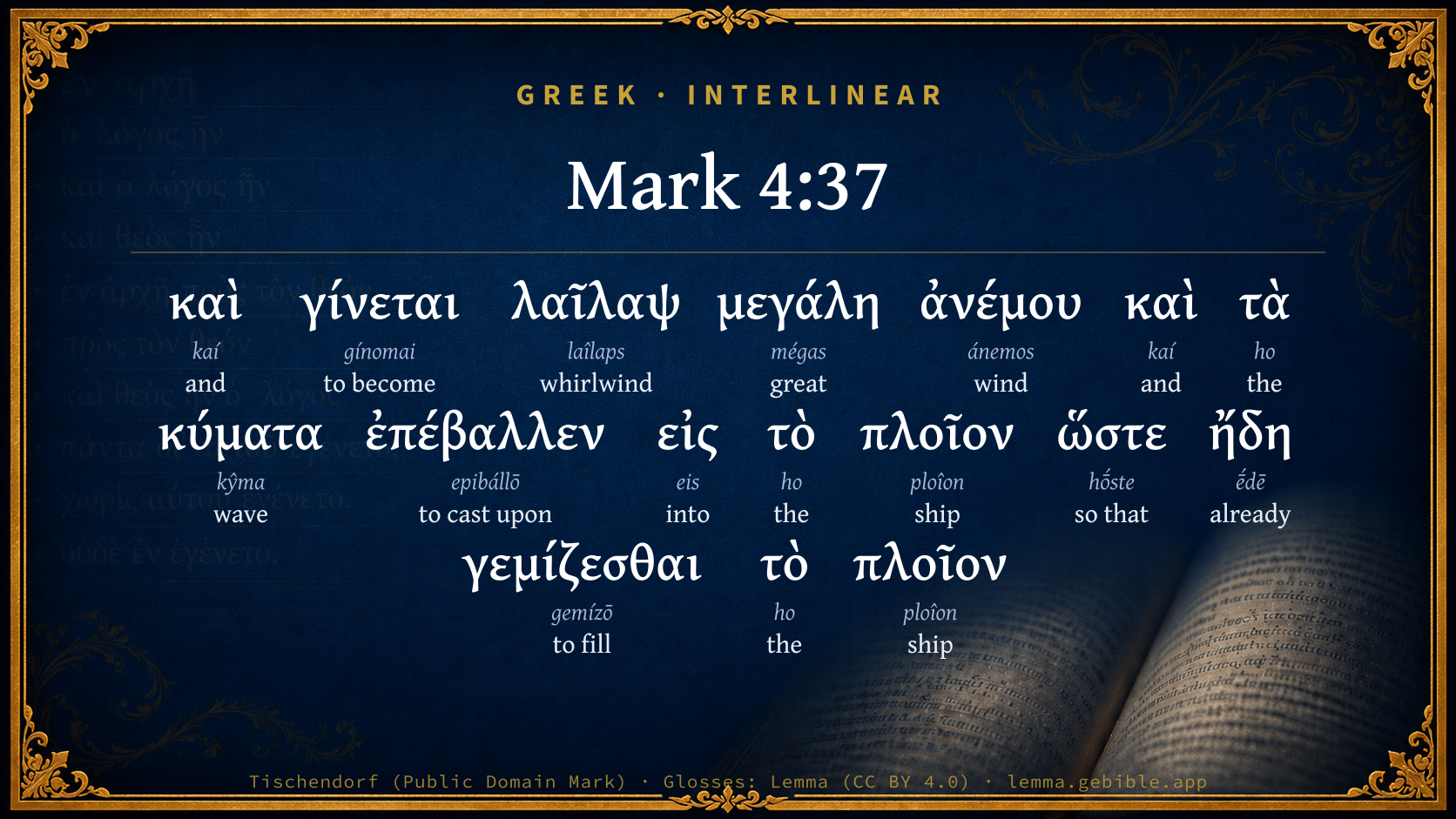
Download image
Cite this verse

Mark 4:37 (World English Bible). Public Domain. Lemma interlinear Bible study tool, https://lemma.gebible.app/v/mark/4/37.

Show BibTeX & RIS
BibTeX
RIS
English Translation
There arose a great wind storm, and the waves beat into the boat, so much that the boat was already filled.
World English Bible · Public Domain
Highlights
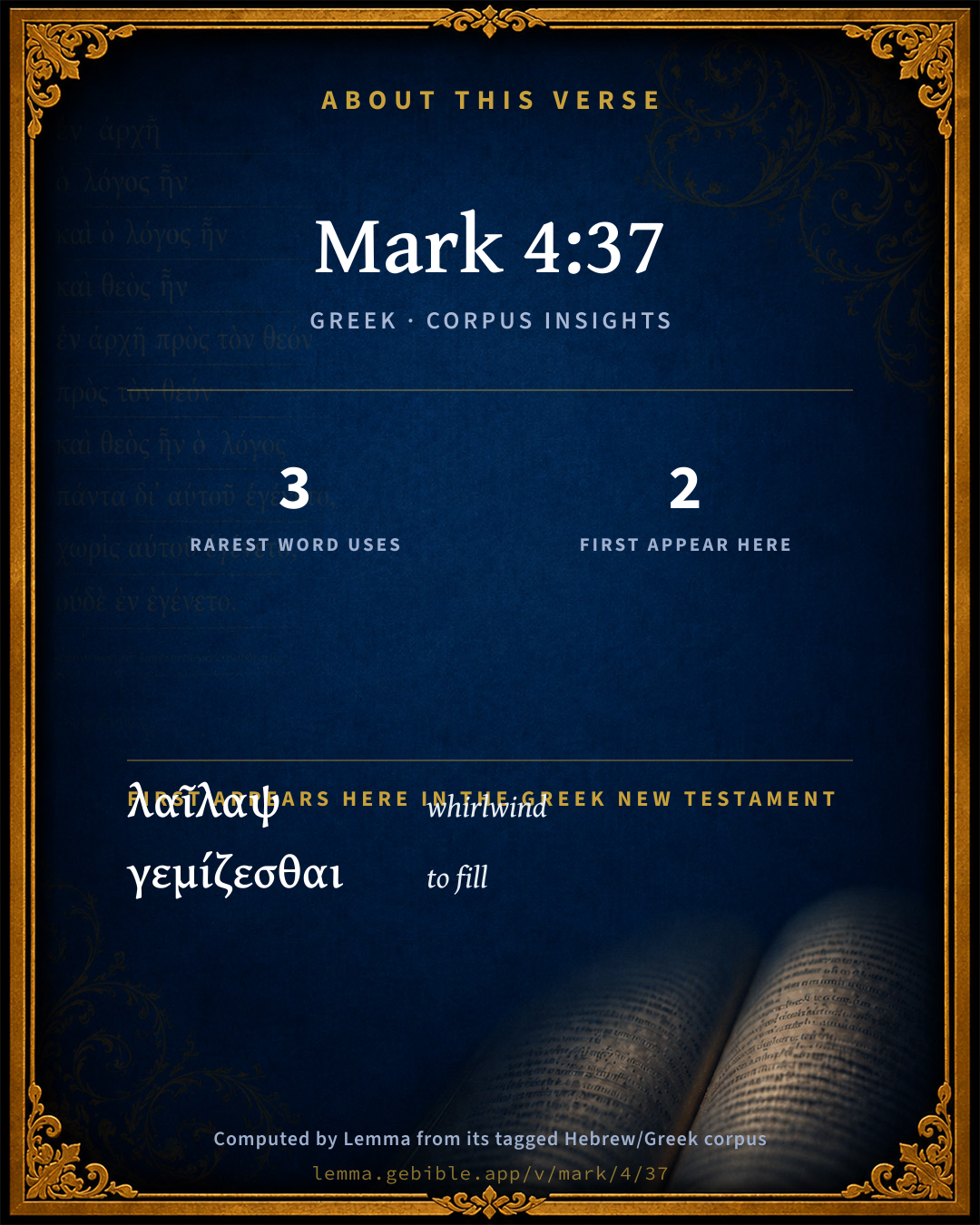
  • 2 first appearances in the Greek New Testament
Full analysis ↓
Download a study sheet

One document with this verse’s original text, its word-by-word gloss line, the meaning frame, cross-references with their text, attributed commentary, and full source and license credits — printable, and it pastes into notes with its structure intact.

This verse Autodidact and up

Study sheet (.html) Plain text (.txt)

A passage Seminary Student

Up to 50 verses in one chapter. A passage sheet keeps up to 6 commentary sources and 12 cross-references per verse, in the order this page ranks them, and says so on the sheet whenever that leaves anything out. Ask for a single verse and you get the Autodidact verse sheet above.

Everything on this page stays free to read, with no account — the sheet is a download of what is already on screen, not access to it.

Want to remove ads? Support Godless Engineer
Compare translations 3

The same verse in 3 English versions, stacked beneath the original-language interlinear above. Click any original word for its lexicon entry.

Each is an independent rendering of the whole verse — the interlinear is not word-aligned to these translations.

Highlighted words mark where these versions differ — a whole-verse word diff, not a word-by-word alignment.

  • World English Bible Public Domain
    There arose a great wind storm, and the waves beat into the boat, so much that the boat was already filled.
  • King James Version Public Domain
    And there arose a great storm of wind, and the waves beat into the ship, so that it was now full.
  • unfoldingWord Literal Text CC BY-SA 4.0
    And a great storm of wind happens, and the waves were breaking into the boat, so that the boat was already filled.

unfoldingWord Literal Text — © unfoldingWord, licensed CC BY-SA 4.0. Word-aligned USFM3 via Door43 (git.door43.org/unfoldingWord/en_ult).

Versions to compare (up to 4)

3 of 4 selected

Show all 19 translations

Every available English version of this verse, each an independent rendering of the whole verse.

  • World English Bible Public Domain
    There arose a great wind storm, and the waves beat into the boat, so much that the boat was already filled.
  • Berean Standard Bible Public Domain
    Soon a violent windstorm came up, and the waves were breaking over the boat, so that it was being swamped.
  • Majority Standard Bible Public Domain
    Soon a violent windstorm came up, and the waves were breaking over the boat, so that it was being swamped.
  • King James Version Public Domain
    And there arose a great storm of wind, and the waves beat into the ship, so that it was now full.
  • American Standard Version (1901) Public Domain
    And there ariseth a great storm of wind, and the waves beat into the boat, insomuch that the boat was now filling.
  • Revised Version (1885) Public Domain
    And there ariseth a great storm of wind, and the waves beat into the boat, insomuch that the boat was now filling.
  • Geneva Bible (1599) Public Domain
    And there arose a great storme of winde, and the waues dashed into the shippe, so that it was now full.
  • Douay-Rheims (1899) Public Domain
    And there arose a great storm of wind, and the waves beat into the ship, so that the ship was filled.
  • Young's Literal Translation Public Domain
    And there cometh a great storm of wind, and the waves were beating on the boat, so that it is now being filled,
  • Literal Standard Version CC BY-SA 4.0
    And there comes a great storm of wind, and the waves were beating on the boat, so that it is now being filled,
  • Unlocked Literal Bible CC BY-SA 4.0
    Just then a violent windstorm arose and the waves were breaking into the boat so that the boat was almost full of water.
  • unfoldingWord Literal Text CC BY-SA 4.0
    And a great storm of wind happens, and the waves were breaking into the boat, so that the boat was already filled.
  • Darby Bible Public Domain
    And there comes a violent gust of wind, and the waves beat into the ship, so that it already filled.
  • World Messianic Bible Public Domain
    A big wind storm arose, and the waves beat into the boat, so much that the boat was already filled.
  • Webster's Bible Public Domain
    And there arose a great storm of wind, and the waves beat into the boat, so that it was now full.
  • Free Bible Version CC BY-SA 4.0
    Soon a terrible storm started blowing, and waves crashed against the boat, filling it with water.
  • Bible in Basic English Public Domain
    And a great storm of wind came up, and the waves came into the boat, so that the boat was now becoming full.
  • Text-Critical English NT CC BY 4.0
    Now a great windstorm arose, and the waves were beating against the boat, so that it was nearly swamped.
  • Tyndale New Testament (1534) Public Domain
    And ther arose a great storme of wynde and dasshed the waves into the ship so that it was full.

Literal Standard Version (2020), Covenant Press — licensed CC BY-SA 4.0. Text via the HelloAO Bible API (eBible.org). Unlocked Literal Bible (unfoldingWord) — licensed CC BY-SA 4.0. Text via the HelloAO Bible API (eBible.org). unfoldingWord Literal Text — © unfoldingWord, licensed CC BY-SA 4.0. Word-aligned USFM3 via Door43 (git.door43.org/unfoldingWord/en_ult). Free Bible Version, Dr. Jonathan Gallagher — licensed CC BY-SA 4.0. Text via the HelloAO Bible API (eBible.org).

Word by word

More ways to search: Search by grammar → Find every occurrence → Compare this word →

Practice this passage: Drill this verse → Learn its vocabulary →

λαῖλαψ
laîlaps
G2978
“whirlwind”
Noun, Nominative, Singular, Feminine
Part of Speech
Noun
Case
Nominative
Number
Singular
Gender
Feminine
Full Thayer's Definition

Origin: of uncertain derivation

TDNT: None

1. a whirlwind, a tempestuous wind 2. a violent attack of wind, a squall a. never a single gust nor a steady blowing wind, however violent, but a storm breaking forth from black thunder clouds in furious gusts, with floods of rain, and throwing everything topsy-turvy
  1. καὶ kaí G2532 “and” Conjunction
  2. γίνεται gínomai G1096 “to become” Verb, Present, Middle or Passive deponent, Indicative, 3rd person, Singular
  3. μεγάλη mégas G3173 “great” Adjective, Nominative, Singular, Feminine
  4. ἀνέμου ánemos G417 “wind” Noun, Genitive, Singular, Masculine
  5. καὶ kaí G2532 “and” Conjunction
  6. τὰ ho G3588 “the” Article, Nominative, Plural, Neuter
  7. κύματα kŷma G2949 “wave” Noun, Nominative, Plural, Neuter
  8. ἐπέβαλλεν epibállō G1911 “to cast upon” Verb, Imperfect, Active, Indicative, 3rd person, Singular
  9. εἰς eis G1519 “into” Preposition
  10. τὸ ho G3588 “the” Article, Accusative, Singular, Neuter
  11. πλοῖον ploîon G4143 “ship” Noun, Accusative, Singular, Neuter
  12. ὥστε hṓste G5620 “so that” Conjunction
  13. ἤδη ḗdē G2235 “already” Adverb
  14. γεμίζεσθαι gemízō G1072 “to fill” Verb, Present, Passive, Infinitive
  15. τὸ ho G3588 “the” Article, Accusative, Singular, Neuter
  16. πλοῖον ploîon G4143 “ship” Noun, Accusative, Singular, Neuter

About this verse

These counts appear in no published source. They are computed here, from the morphology-tagged text and Lemma’s own curated glosses. What Lemma adds →

17
words
13
distinct lemmas
Gospels
section

Notable vocabulary

The rarest word here is λαῖλαψ whirlwind G2978 — appearing just 3 times in the whole Greek New Testament.

First appearance in Scripture

These words make their first canonical appearance in the Greek New Testament here:

  • λαῖλαψ whirlwind G2978
  • γεμίζεσθαι to fill G1072

Shared distinctive vocabulary

λαῖλαψ whirlwind G2978 occurs in 3 verses of the Greek New Testament. Also found in:
Repetition

Words recur within this verse:

Cross-references

7

Topical passages linked to Mark 4:37 in the Treasury of Scripture Knowledge — connected by theme and wording, ordered by reader-vote popularity; previews shown in the World English Bible.

  • Matthew 8:23–24 When he got into a boat, his disciples followed him.
  • Job 1:19 and, behold, there came a great wind from the wilderness, and struck the four corners of the house, and it fell on the young men, and they are dead. I alone have escaped to tell you."
  • Luke 8:22–23 Now it happened on one of those days, that he entered into a boat, himself and his disciples, and he said to them, "Let's go over to the other side of the lake." So they launched out.
  • Psalms 107:23–31 Those who go down to the sea in ships, Who do business in great waters;
  • Jonah 1:4 But Yahweh sent out a great wind on the sea, and there was a mighty tempest on the sea, so that the ship was likely to break up.
  • Job 1:12 Yahweh said to Satan, "Behold, all that he has is in your power. Only on himself don't put forth your hand." So Satan went forth from the presence of Yahweh.
  • Acts 27:14–20 But before long, a tempestuous wind beat down from shore, which is called Euroclydon.

Cross-references courtesy of OpenBible.info (CC BY 4.0).

Where the printed editions differ

1 variant

Places in this verse where the major printed Greek editions disagree on the wording in a way that affects the translation — a comparison of editions, not a manuscript-by-manuscript collation. The editions are the modern critical texts (Nestlé-Aland 28/27, SBL, Westcott-Hort, Tregelles, Tyndale House) and the traditional texts behind the KJV (the Textus Receptus and the Byzantine/Majority text). It is not a claim about which reading is original.

  1. Different wording
    πλοῖον.

    “boat.”

    In NA28NA27TynSBLWHTreg Not in TRByz

    αὐτὸ (auto) 'it' occurs in traditional manuscripts (TR+Byz) instead of πλοῖον. (ploion) 'boat.' in older manuscripts (NA28+NA27+Tyn+SBL+WH+Treg)

Textual data: Translators Amalgamated Greek New Testament (STEPBible TAGNT) · CC BY 4.0.

Commentary

Notes on Mark 4:37 from classic Christian and Jewish commentators (each source and its license shown beneath its notes). The classic Christian expositions comment on the surrounding passage and are grouped to its opening verse, so a note may address several verses; the Jewish commentaries on the Tanakh (Rashi and others) are per-verse, so they appear only where the commentator wrote on this verse.

Lemma curates 59 commentaries, every one of them public domain or Creative Commons licensed, each selected and text-cleaned for this edition rather than reprinted as found. About our sources →

Bengel's Gnomon

Johann Albrecht Bengel

Mar 4:37. Ααῖλαψ) i.e. κίνησις νεφῶν καὶ ταραχὴ μετὰ εὐδίαν, κ.τ.λ., An agitation and commotion of the clouds after a calm [fair weather].—Eustathius.—ἐπέβαλεν, dashed into) viz. dashed themselves into.

Bengel's Gnomon of the New Testament — English translation (T&T Clark, Edinburgh, 1860) — public domain. Text from a community e-Sword module.

Expositor's Greek Testament

ed. W. Robertson Nicoll

Mar 4:37 . γίνεται λαῖλαψ : cf. Jon 1:4 , ἐγένετο κλύδων μέγας . ἐπέβαλλεν , were dashing (intransitive) against and into ( εἰς ) the ship. γεμίζεσθαι , so that already ( ἤδη ) the ship was getting full .

The Expositor's Greek Testament, edited by W. Robertson Nicoll (1897–1910) — public domain. Text from a community e-Sword module.

Geneva Bible (1599)

Geneva Bible translators

They that sail with Christ, although he seems to sleep never so soundly when they are in danger, yet they are preserved of him in time convenient, being awakened.

Geneva Bible (1599) marginal notes — public domain. Text via Bolls.life.

Adam Clarke's Commentary

Verse 37. A great storm of wind] See Clarke on Mt 8:24.

Adam Clarke's Commentary on the Bible (1810–1826) — public domain. Text from a community e-Sword/MySword module.

Ellicott's Commentary for English Readers

(37) Beat into the ship, so that it was now full.—Better, were beating upon the ship, so that it was filling. Both verbs describe continuous action.

A Bible Commentary for English Readers, edited by Charles John Ellicott (1878–1897) — public domain. Text from a community e-Sword module.

The Cambridge Bible for Schools and Colleges

gen. ed. J. J. S. Perowne

37. a great storm] The word here used is found in Luk_8:23. The word employed in Mat_8:24 generally means an earthquake. It was one of those sudden and violent squalls to which the Lake of Gennesaret was notoriously exposed, lying as it does 600 feet lower than the sea and surrounded by mountain gorges, which act “like gigantic funnels to draw down the cold winds from the mountains.” These winds are not only violent, but they come down suddenly, and often when the sky is perfectly clear. See Thomson’s Land and the Book, p. 374; Tristram’s Land of Israel, p. 430.

beat] Rather, kept beating. Comp. Mat_8:24.

was now full] Rather, was already filling, or beginning to fill.

The Cambridge Bible for Schools and Colleges (gen. ed. J. J. S. Perowne; Cambridge University Press, 1878–1918) — public domain. Text from a community e-Sword module.

Trapp's Complete Commentary

John Trapp

37 And there arose a great storm of wind, and the waves beat into the ship, so that it was now full.

Ver. 37. {See Trapp on "Mat 8:24"} {See Trapp on "Mat 8:25"}

John Trapp, A Commentary or Exposition upon All the Books of the Old and New Testament (1647–1656) — public domain. Text from a community e-Sword module.

The Pulpit Commentary

And there arose a great storm of wind; literally, there ariseth (ginetai lailaq). St. Mark often uses the historical present, which gives vigor and point to his narrative. And the waves beat into the boat, insomuch that the boat was now filling (hdh gemizesyai). St. Matthew says, (Mat_8:24) "the boat was covered with the waves." St. Luke, (Luk_8:23) "they were filling with water, and were in jeopardy." Bede and ethers have thought that the boat in which Christ was the only boat that was tossed by this storm; in order that Christ might show his power in limiting the area of the tempest. But it is far more probable that the ether boats were subject to it; for they were very near to the boat in which Christ was. There must have been some reason for the allusion to these boats; and the wider the reach of the tempest, the greater would appear the Divine power of Christ in stilling it, and the greater the amount of testimony to the reality of the miracle. The miracle was wrought to show his power over all creation, the sea as well as the dry land; and that they, his disciples, and all who were with him might believe in him as the Omnipotent God. But further, this tempest on the sea of Galilee was a type and symbol of the trials and temptations which should come on the Church. For the Church of God is as a ship in a storm, ever tossed upon "the waves of this troublesome world." And then, moreover, as the rude storm urges the ship onwards, so that it more quickly reaches the desired haven, so afflictions and temptations quicken Christ"s disciples to the greater desire of holiness, by which they are borne onwards more speedily to "the haven where they would be.

Vers. 37-39. The Christian"s extremity Christ"s opportunity.

I THE CHRISTIAN FREQUENTLY SUFFERED TO ENTER INTO APPARENT PERIL.

1. Outward losses troubles Persecution in its various phases and degrees. The major calamities of life. Everything seems against him, and he is continually disappointed; yet the objects sought are reasonable and proper.

2. Inward griefs and fears. Self-questionings as to being in a state of grace; as to whether or not God"s favor has been turned away doubts; prevailing sins.

II IN THESE CIRCUMSTANCES ORDINARY MEANS OF DELIVERANCE ARE OF SO AVAIL. The ordinances of the Church fail to comfort or strengthen. Work for Christ becomes distasteful and mechanical. Prayer itself appears to be unanswered, etc.

III THE REASONS FOR THIS.

1. To correct and strengthen character. Besetting weakness is discovered; defective principles of belief are exposed; the backward graces of the Spirit are stimulated; the whole nature is roused to keener sensitiveness, and awakened to the solemn responsibility and greatness of the Divine life.

2. A more signal and immediate manifestation of God is vouchsafed.

(1) To create a closer and higher communion, and a more vivid sense of the supernatural, and to deepen and correct the creed of the believer. A conscious dependence upon his heavenly Father takes the place of the former distance and semi-legalism. Self and self-dependence are subdued, and practical faith made the daily experience. One such great and signal providence may do more than anything else to elevate and confirm the spiritual life.

(2) To be a sign to them that are without. For a "means of grace," or simply as a warning and an undeniable demonstration, which may make them, with the devils, "believe and tremble" even in their rebellion. M.

The Pulpit Commentary (1880–1919), ed. H.D.M. Spence-Jones & Joseph S. Exell — public domain. Text from a community e-Sword module.

MacLaren's Expositions of Holy Scripture

Alexander MacLaren

Mark

THE STORM STILLED

Mar 4:35.

Mark seldom dates his incidents, but he takes pains to tell us that this run across the lake closed a day of labour, Jesus was wearied, and felt the need of rest, He had been pressed on all day by ‘a very great multitude,’ and felt the need of solitude. He could not land from the boat which had been His pulpit, for that would have plunged Him into the thick of the crowd, and so the only way to get away from the throng was to cross the lake. But even there He was followed; ‘other boats were with Him.’

I. The first point to note is the wearied sleeper.

The disciples ‘take Him, . . . even as He was,’ without preparation or delay, the object being simply to get away as quickly as might be, so great was His fatigue and longing for quiet. We almost see the hurried starting and the intrusive followers scrambling into the little skiffs on the beach and making after Him. The ‘multitude’ delights to push itself into the private hours of its heroes, and is devoured with rude curiosity. There was a leather, or perhaps wooden, movable seat in the stern for the steersman, on which a wearied-out man might lay his head, while his body was stretched in the bottom of the boat. A hard ‘pillow’ indeed, which only exhaustion could make comfortable! But it was soft enough for the worn-out Christ, who had apparently flung Himself down in sheer tiredness as soon as they set sail. How real such a small detail makes the transcendent mystery of the Incarnation! Jesus is our pattern in small common things as in great ones, and among the sublimities of character set forth in Him as our example, let us not forget that the homely virtue of hard work is also included. Jonah slept in a storm the sleep of a skulking sluggard, Jesus slept the sleep of a wearied labourer.

II. The next point is the terrified disciples.

The evening was coming on, and, as often on a lake set among hills, the wind rose as the sun sank behind the high land on the western shore astern. The fishermen disciples were used to such squalls, and, at first, would probably let their sail down, and pull so as to keep the boat’s head to the wind. But things grew worse, and when the crazy, undecked craft began to fill and get water-logged, they grew alarmed. The squall was fiercer than usual, and must have been pretty bad to have frightened such seasoned hands. They awoke Jesus, and there is a touch of petulant rebuke in their appeal, and of a sailor’s impatience at a landsman lying sound asleep while the sweat is running down their faces with their hard pulling. It is to Mark that we owe our knowledge of that accent of complaint in their words, for he alone gives their ‘Carest Thou not?’

But it is not for us to fling stones at them, seeing that we also often may catch ourselves thinking that Jesus has gone to sleep when storms come on the Church or on ourselves, and that He is ignorant of, or indifferent to, our plight. But though the disciples were wrong in their fright, and not altogether right in the tone of their appeal to Jesus, they were supremely right in that they did appeal to Him. Fear which drives us to Jesus is not all wrong. The cry to Him, even though it is the cry of unnecessary terror, brings Him to His feet for our help.

III. The next point is the word of power.

Again we have to thank Mark for the very words, so strangely, calmly authoritative. May we take ‘Peace!’ as spoken to the howling wind, bidding it to silence; and ‘Be still!’ as addressed to the tossing waves, smoothing them to a calm plain? At all events, the two things to lay to heart are that Jesus here exercises the divine prerogative of controlling matter by the bare expression of His will, and that this divine attribute was exercised by the wearied man, who, a moment before, had been sleeping the sleep of human exhaustion. The marvellous combination of apparent opposites, weakness, and divine omnipotence, which yet do not clash, nor produce an incredible monster of a being, but coalesce in perfect harmony, is a feat beyond the reach of the loftiest creative imagination. If the Evangelists are not simple biographers, telling what eyes have seen and hands have handled, they have beaten the greatest poets and dramatists at their own weapons, and have accomplished ‘things unattempted yet in prose or rhyme.’

A word of loving rebuke and encouragement follows. Matthew puts it before the stilling of the storm, but Mark’s order seems the more exact. How often we too are taught the folly of our fears by experiencing some swift, easy deliverance! Blessed be God! He does not rebuke us first and help us afterwards, but rebukes by helping. What could the disciples say, as they sat there in the great calm, in answer to Christ’s question, ‘Why are ye fearful?’ Fear can give no reasonable account of itself, if Christ is in the boat. If our faith unites us to Jesus, there is nothing that need shake our courage. If He is ‘our fear and our dread,’ we shall not need to ‘fear their fear,’ who have not the all-conquering Christ to fight for them.

‘Well roars the storm to them who hear

A deeper voice across the storm.’

Jesus wondered at the slowness of the disciples to learn their lesson, and the wonder was reflected in the sad question, ‘Have ye not yet faith?’-not yet, after so many miracles, and living beside Me for so long? How much more keen the edge of that question is when addressed to us, who know Him so much better, and have centuries of His working for His servants to look back on. When, in the tempests that sweep over our own lives, we sometimes pass into a great calm as suddenly as if we had entered the centre of a typhoon, we wonder unbelievingly instead of saying, out of a faith nourished by experience, ‘It is just like Him.’

Alexander MacLaren, Expositions of Holy Scripture (1904–1910) — public domain. Text from a community e-Sword module.

The People's New Testament

B. W. Johnson

37. There arose a great storm. See notes on Matt. 8:23–27. Compare Luke 8:22–25. The Sea of Galilee lies 600 feet below the level of the Mediterranean, and has a tropical climate. Only a short distance north are the high mountains of Lebanon. The heated air about the sea invites the rush of cold waves from the mountains.

B. W. Johnson's The People's New Testament with Notes (1889–1891) — public domain. Electronic text from the Christian Classics Ethereal Library (CCEL) ThML edition.

Cambridge Greek Testament for Schools and Colleges

37. ὥστε ἤδη γεμίζεσθαι τὸ πλοῖον ([845][846][847][848][849]) rather than ὥστε αὐτὸ ἤδη γεμ. ([850][851]).

[845] Codex Vaticanus. 4th cent., but perhaps a little later than א. In the Vatican Library almost since its foundation by Pope Nicolas V., and one of its greatest treasures. The whole Gospel, ending at Mar 16:8. Photographic facsimile, 1889.

[846] Codex Ephraemi. 5th cent. A palimpsest: the original writing has been partially rubbed out, and the works of Ephraem the Syrian have been written over it; but a great deal of the original writing has been recovered; of Mark we have Mar 1:17 to Mar 6:31, Mar 8:5 to Mar 12:29, Mar 13:19 to Mar 16:20. In the National Library at Paris.

[847] Codex Bezae. 6th cent. Has a Latin translation (d) side by side with the Greek text, and the two do not quite always agree. Presented by Beza to the University Library of Cambridge in 1581. Remarkable for its frequent divergences from other texts. Contains Mark, except Mar 16:15-20, which has been added by a later hand. Photographic facsimile, 1899.

[848] Codex Regius. 8th cent. An important witness. At Paris. Contains Mar 1:1 to Mar 10:15; Mar 10:30 to Mar 15:1; Mar 15:20 to Mar 16:20, but the shorter ending is inserted between Mar 16:8 and Mar 16:9, showing that the scribe preferred it to the longer one.

[849] Codex Sangallensis. 9th or 10th cent. Contains the Gospels nearly complete, with an interlinear Latin translation. The text of Mark is specially good, agreeing often with CL. At St Gall.

[850] Codex Alexandrinus. 5th cent. Brought by Cyril Lucar, Patriarch of Constantinople, from Alexandria, and afterwards presented by him to King Charles I. in 1628. In the British Museum. The whole Gospel. Photographic facsimile, 1879.

[851] Codex Petropolitanus. 9th cent. Gospels almost complete. Mar 16:18-20 is in a later hand.

37. λαῖλαψ. The word is in all three. It perhaps expresses the swishing slap with which the wind struck; λα- is sometimes an intensive prefix; λαδρέω, λακατάρατος.

ἐπέβαλλεν. The waves continued to beat into the boat. The imperf. ([883][884][885] etc.) is better than the aor. ([886][887][888] etc.). The intrans. use of ἐπιβάλλω is found in the later books of LXX. and in Polybius. Vulg. makes it trans., with λαῖλαψ as nom., procella … fluctus mittebat in navem.

[883] Codex Alexandrinus. 5th cent. Brought by Cyril Lucar, Patriarch of Constantinople, from Alexandria, and afterwards presented by him to King Charles I. in 1628. In the British Museum. The whole Gospel. Photographic facsimile, 1879.

[884] Codex Vaticanus. 4th cent., but perhaps a little later than א. In the Vatican Library almost since its foundation by Pope Nicolas V., and one of its greatest treasures. The whole Gospel, ending at Mar 16:8. Photographic facsimile, 1889.

[885] Codex Ephraemi. 5th cent. A palimpsest: the original writing has been partially rubbed out, and the works of Ephraem the Syrian have been written over it; but a great deal of the original writing has been recovered; of Mark we have Mar 1:17 to Mar 6:31, Mar 8:5 to Mar 12:29, Mar 13:19 to Mar 16:20. In the National Library at Paris.

[886] Codex Sinaiticus. 4th cent. Discovered by Tischendorf in 1859 at the Monastery of St Katharine on Mount Sinai. Now at St Petersburg. The whole Gospel, ending at Mar 16:8. Photographic facsimile, 1911.

[887] Codex Bezae. 6th cent. Has a Latin translation (d) side by side with the Greek text, and the two do not quite always agree. Presented by Beza to the University Library of Cambridge in 1581. Remarkable for its frequent divergences from other texts. Contains Mark, except Mar 16:15-20, which has been added by a later hand. Photographic facsimile, 1899.

[888] Codex Basiliensis. 8th cent. At Basle.

ἤδη γμίζεσθαι. Was now filling (R.V.). The needless repetition of τὸ πλοῖον is characteristic. Cf. τὸν ἄνθρωπον in Mar 7:15.

Cambridge Greek Testament for Schools and Colleges (Cambridge University Press, 1896; 21 vols, various authors incl. Carr, Maclear, Plummer, Farrar, Lumby, Moule, M. R. James, Simcox) — public domain. Text from a community e-Sword module.

International Critical Commentary

37. λαῖλαψ—a storm marked by frequent great gusts of wind. Mt. uses σεισμός, which means properly earthquake, but denoting here the turbulence of the storm.

καὶ τὰ κύματα ἐπέβαλλεν1—and the waves were beating into the boat. εἰς—into, not against. ὥστε ἤδη γεμίζεσθαι τ. πλοῖον—so that already the boat was filling. Not full, AV. The verb is present, and denotes the act in its progress, not its completion.

ἤδη γεμίζεσθαι τὸ πλοῖον, instead of αὐτὸ ἤδη γεμίζεσθαι, Tisch. Treg. WH. RV. אa BCDL Δ most mss. Lat. Vet. Vulg. Memph. Harcl. marg.

This repetition of the noun, instead of the pronoun, is quite in Mk.’s style.

International Critical Commentary — older volumes (1896–1929), various authors — public domain. Text from a community e-Sword module.

Vincent's Word Studies in the New Testament

Marvin R. Vincent

Storm [λαιλαψ] . So Luke. Distinctively furious storm or hurricane. Compare Septuagint, Job 38:1, of the whirlwind out of which God answered Job. See, also, Job 21:18. Matthew uses seismov, a shaking. See on Mt 8:24. Mr. Macgregor (" Rob Roy on the Jordan ") says that "on the sea of Galilee the wind has a singular force and suddenness; and this is no doubt because that sea is so deep in the world that the sun rarefies the air in it enormously, and the wind, speeding swiftly above a long and level plateau, gathers much force as it sweeps through flat deserts, until suddenly it meets this huge gap in the way, and it tumbles down here irresistible."

Marvin R. Vincent, Word Studies in the New Testament (1887–1900) — public domain. Text from a community e-Sword/MySword module.

Lesson kit

Teaching starters — assembled from the data on this page, not authored interpretation. Every prompt links to the verse data it draws on. Edit before teaching.

Mark, in the Gospels, opens this verse with 17 words (13 distinct Greek lemmas). Its most distinctive word is laîlaps (“whirlwind”). A historical commentator’s framing appears above. Read the whole chapter for the surrounding context.

Discussion questions

  1. How does “whirlwind” (laîlaps) shape what this verse is saying?
  2. 2 words make their first appearance in Scripture here. What does this debut establish?
  3. How does Luke 8:23, which shares the word «whirlwind», read alongside this verse?
  4. What does the repetition of “ship” (2× in this one verse) do in this verse?
  5. The translations on this page render this verse differently — a whole-verse word diff, not a word-by-word alignment. What might account for the different wordings?
  6. Compare how Bengel's Gnomon and Expositor's Greek Testament read this verse. Where do they agree or differ?

Things to notice

  • 2 words make their first canonical appearance in Scripture here.
  • These translations choose different wording for 12 words in this verse.
  • “ship” occurs 2× in this single verse.
  • 13 distinct Greek lemmas span 17 words in this verse.

Reading settings

Reading text

Shown beneath each verse's original-language words.

Old Testament
Old Testament edition

Read the OT as the Masoretic Hebrew (MT) or the Greek Septuagint (LXX).

English shown for the Greek Septuagint (in the Hebrew ↔ Greek comparison).

Comparing translations? Open the Compare panel on any verse page to stack up to four side by side.