Luke 2:6

Greek (Tischendorf 8th ed.) Luke 2:6 appears in the Greek New Testament. The text above is from the Tischendorf 8th edition. Each word links to its Strong’s number and a concise gloss. Click any word for its full Thayer’s Greek Lexicon entry.
Download image
Cite this verse

Luke 2:6 (World English Bible). Public Domain. Lemma interlinear Bible study tool, https://lemma.gebible.app/v/luke/2/6.

Show BibTeX & RIS
BibTeX
RIS
English Translation
It happened, while they were there, that the day had come that she should give birth.
World English Bible · Public Domain
Download a study sheet

One document with this verse’s original text, its word-by-word gloss line, the meaning frame, cross-references with their text, attributed commentary, and full source and license credits — printable, and it pastes into notes with its structure intact.

This verse Autodidact and up

Study sheet (.html) Plain text (.txt)

A passage Seminary Student

Up to 50 verses in one chapter. A passage sheet keeps up to 6 commentary sources and 12 cross-references per verse, in the order this page ranks them, and says so on the sheet whenever that leaves anything out. Ask for a single verse and you get the Autodidact verse sheet above.

Everything on this page stays free to read, with no account — the sheet is a download of what is already on screen, not access to it.

Want to remove ads? Support Godless Engineer
Compare translations 3

The same verse in 3 English versions, stacked beneath the original-language interlinear above. Click any original word for its lexicon entry.

Each is an independent rendering of the whole verse — the interlinear is not word-aligned to these translations.

Highlighted words mark where these versions differ — a whole-verse word diff, not a word-by-word alignment.

  • World English Bible Public Domain
    It happened, while they were there, that the day had come that she should give birth.
  • King James Version Public Domain
    And so it was, that, while they were there, the days were accomplished that she should be delivered.
  • unfoldingWord Literal Text CC BY-SA 4.0
    And it happened that, while they were there, the days were fulfilled for her to deliver.

unfoldingWord Literal Text — © unfoldingWord, licensed CC BY-SA 4.0. Word-aligned USFM3 via Door43 (git.door43.org/unfoldingWord/en_ult).

Versions to compare (up to 4)

3 of 4 selected

Show all 19 translations

Every available English version of this verse, each an independent rendering of the whole verse.

  • World English Bible Public Domain
    It happened, while they were there, that the day had come that she should give birth.
  • Berean Standard Bible Public Domain
    While they were there, the time came for her Child to be born.
  • Majority Standard Bible Public Domain
    While they were there, the time came for her Child to be born.
  • King James Version Public Domain
    And so it was, that, while they were there, the days were accomplished that she should be delivered.
  • American Standard Version (1901) Public Domain
    And it came to pass, while they were there, the days were fulfilled that she should be delivered.
  • Revised Version (1885) Public Domain
    And it came to pass, while they were there, the days were fulfilled that she should be delivered.
  • Geneva Bible (1599) Public Domain
    And so it was, that while they were there, the daies were accomplished that shee shoulde be deliuered,
  • Douay-Rheims (1899) Public Domain
    And it came to pass, that when they were there, her days were accomplished, that she should be delivered.
  • Young's Literal Translation Public Domain
    And it came to pass, in their being there, the days were fulfilled for her bringing forth,
  • Literal Standard Version CC BY-SA 4.0
    And it came to pass, in their being there, the days were fulfilled for her bringing forth,
  • Unlocked Literal Bible CC BY-SA 4.0
    Now it came about that while they were there, the time came for her to deliver her baby.
  • unfoldingWord Literal Text CC BY-SA 4.0
    And it happened that, while they were there, the days were fulfilled for her to deliver.
  • Darby Bible Public Domain
    And it came to pass, while they were there, the days of her giving birth [to her child] were fulfilled,
  • World Messianic Bible Public Domain
    While they were there, the day had come for her to give birth.
  • Webster's Bible Public Domain
    And so it was, that while they were there, the days were accomplished that she should be delivered.
  • Free Bible Version CC BY-SA 4.0
    While they were there, the time came for her to have her baby.
  • Bible in Basic English Public Domain
    And while they were there, the time came for her to give birth.
  • Text-Critical English NT CC BY 4.0
    While they were there, the days were fulfilled for her to give birth,
  • Tyndale New Testament (1534) Public Domain
    And it fortuned whyll they were there her tyme was come that she shuld be delyvered.

Literal Standard Version (2020), Covenant Press — licensed CC BY-SA 4.0. Text via the HelloAO Bible API (eBible.org). Unlocked Literal Bible (unfoldingWord) — licensed CC BY-SA 4.0. Text via the HelloAO Bible API (eBible.org). unfoldingWord Literal Text — © unfoldingWord, licensed CC BY-SA 4.0. Word-aligned USFM3 via Door43 (git.door43.org/unfoldingWord/en_ult). Free Bible Version, Dr. Jonathan Gallagher — licensed CC BY-SA 4.0. Text via the HelloAO Bible API (eBible.org).

Word by word

More ways to search: Search by grammar → Find every occurrence → Compare this word →

Practice this passage: Drill this verse → Learn its vocabulary →

τεκεῖν
tíktō
G5088
“to produce”
Verb, Aorist, Active, Infinitive
Part of Speech
Verb
Tense
Aorist
Voice
Active
Mood
Infinitive
Full Thayer's Definition

Origin: a strengthened form of a primary teko tek'-o (which is used only as alternate in certain tenses)

TDNT: None

1. to bring forth, bear, produce (fruit from the seed) a. of a woman giving birth b. of the earth bringing forth its fruits c. metaph. to bear, bring forth
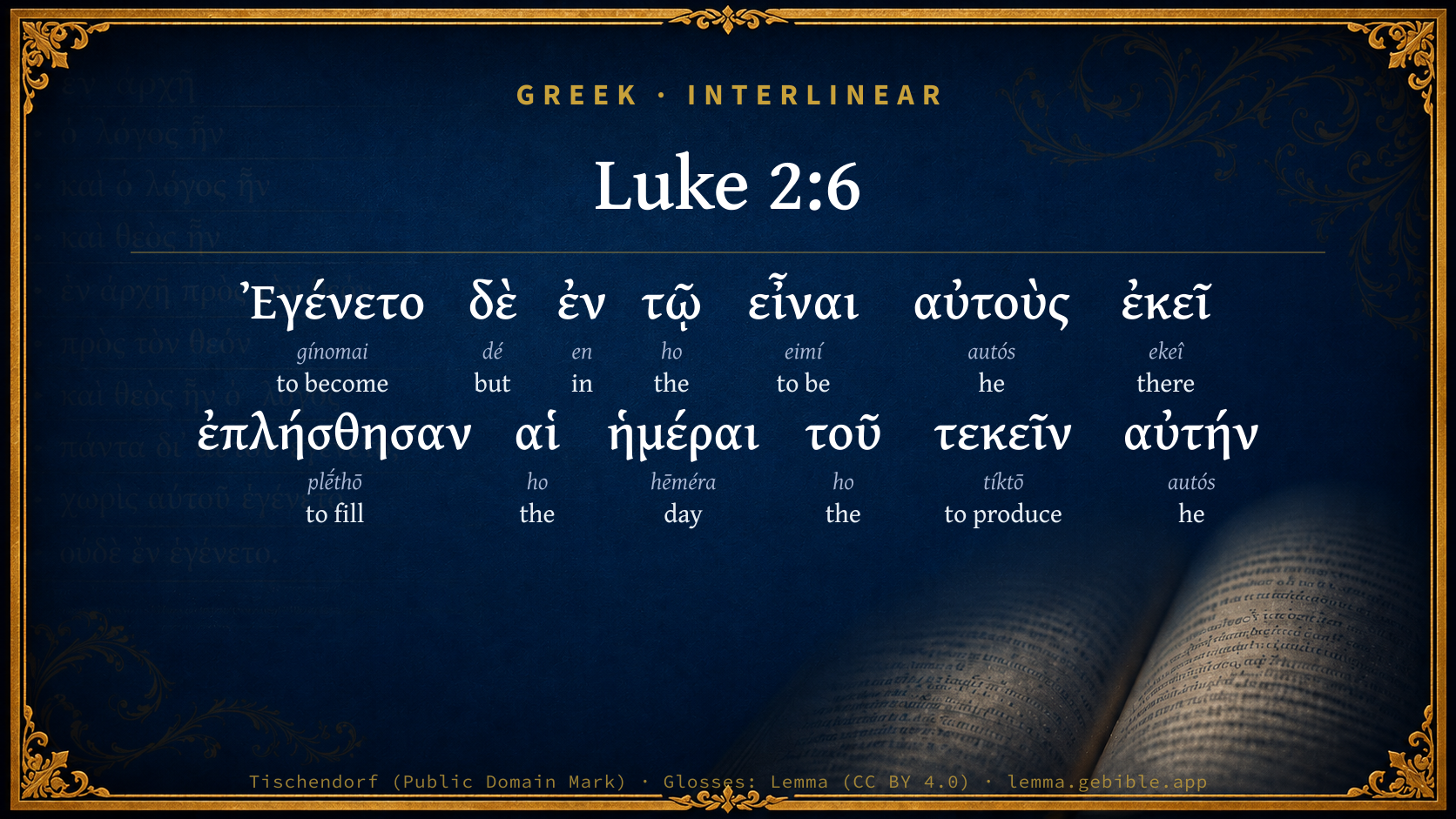
  1. Ἐγένετο gínomai G1096 “to become” Verb, Aorist, Middle deponent, Indicative, 3rd person, Singular
  2. δὲ dé G1161 “but” Conjunction
  3. ἐν en G1722 “in” Preposition
  4. τῷ ho G3588 “the” Article, Dative, Singular, Neuter
  5. εἶναι eimí G1510 “to be” Verb, Present, Active, Infinitive
  6. αὐτοὺς autós G846 “he” Personal pronoun, Accusative, Plural, Masculine
  7. ἐκεῖ ekeî G1563 “there” Adverb
  8. ἐπλήσθησαν plḗthō G4130 “to fill” Verb, Aorist, Passive, Indicative, 3rd person, Plural
  9. αἱ ho G3588 “the” Article, Nominative, Plural, Feminine
  10. ἡμέραι hēméra G2250 “day” Noun, Nominative, Plural, Feminine
  11. τοῦ ho G3588 “the” Article, Genitive, Singular, Neuter
  12. αὐτήν autós G846 “he” Personal pronoun, Accusative, Singular, Feminine

About this verse

These counts appear in no published source. They are computed here, from the morphology-tagged text and Lemma’s own curated glosses. What Lemma adds →

13
words
10
distinct lemmas
Gospels
section

Notable vocabulary

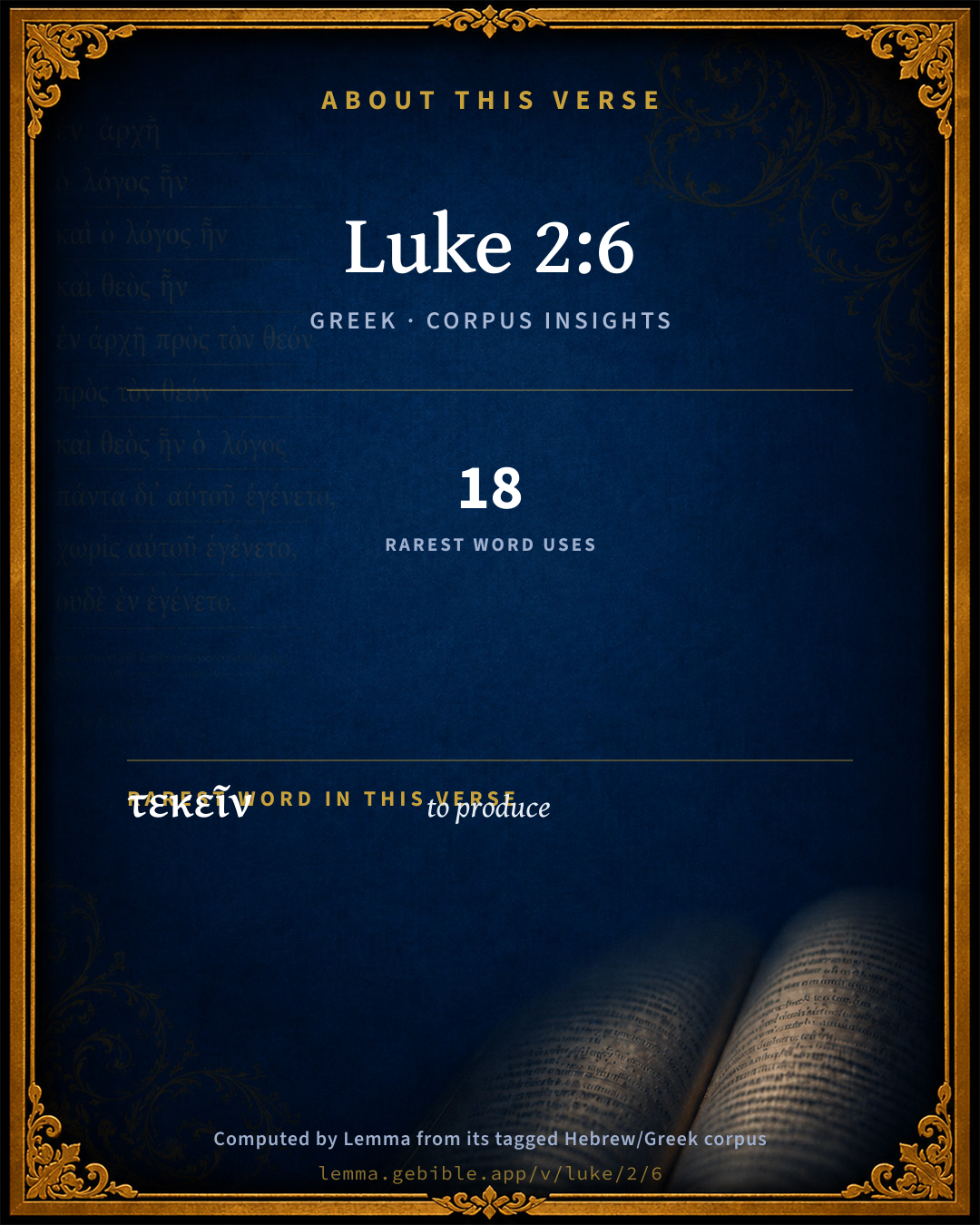
The rarest word here is τεκεῖν to produce G5088 — appearing just 18 times in the whole Greek New Testament.

Shared distinctive vocabulary

τεκεῖν to produce G5088 occurs in 17 verses of the Greek New Testament. Also found in:

Repetition

Words recur within this verse:

  • τῷ the G3588 ×3
  • αὐτοὺς he G846 ×2

Cross-references

5

Topical passages linked to Luke 2:6 in the Treasury of Scripture Knowledge — connected by theme and wording, ordered by reader-vote popularity; previews shown in the World English Bible.

  • Psalms 33:11 The counsel of Yahweh stands fast forever, The thoughts of his heart to all generations.
  • Micah 5:2 But you, Bethlehem Ephrathah, Being small among the clans of Judah, Out of you one will come forth to me that is to be ruler in Israel; Whose goings forth are from of old, from everlasting.
  • Revelation 12:1–5 A great sign was seen in heaven: a woman clothed with the sun, and the moon under her feet, and on her head a crown of twelve stars.
  • Proverbs 19:21 There are many plans in a man's heart, But Yahweh's counsel will prevail.
  • Luke 1:57 Now the time that Elizabeth should give birth was fulfilled, and she brought forth a son.

Cross-references courtesy of OpenBible.info (CC BY 4.0).

Commentary

Notes on Luke 2:6 from classic Christian and Jewish commentators (each source and its license shown beneath its notes). The classic Christian expositions comment on the surrounding passage and are grouped to its opening verse, so a note may address several verses; the Jewish commentaries on the Tanakh (Rashi and others) are per-verse, so they appear only where the commentator wrote on this verse.

Lemma curates 59 commentaries, every one of them public domain or Creative Commons licensed, each selected and text-cleaned for this edition rather than reprinted as found. About our sources →

The Biblical Illustrator

Joseph S. Exell

Luk_2:6

The days were accomplished

The birth of Christ

The whole of the worlds history led up to this night.

It is the hinge on which the history of man turns. The whole of mankind from Adam waited for this night. All the prophets, from righteous Enoch to John the preacher of repentance, laboured to prepare the way for Him who came on this night. The Word was made flesh to sanctity human nature. God descended to man, to raise man to God. Christmas is the feast of salvation for all mankind. The heathen were at this time celebrating their Saturnalia, in remembrance of the Golden Age, which indeed had never been since sin was in the world, an age when, they said, all the world was full of light, and joy, and innocence. But these were times for ever gone by, times from which every century was removing them further morally, as well as actually. Yet, see! how Christmas comes to turn the vain and wistful backward look into a look forwards. The evening and the morning form the day according to the Divine reckoning, not the morning and the evening. First comes darkness, and then light; first sadness, then joy; first desire, then fulfilment. Christ came to bid the old heathens turn away from contemplation of the past, and through Him look to the coming of the true Golden Age, the age when, from the new heavens and the new earth, sin and sighing shall have fled; when He, who is the Wonderful, the Counsellor, the Everlasting Father, the Prince of Peace, shall reign in righteousness, and of His kingdom there shall be no end. Christ has not, indeed, founded on earth the Golden Age such as the Gentiles lusted after, any more than He came to be the Messiah such as the Jews longed for; He did not come to give peace to the world itself, but an inner peace, a peace that is hid with Christ in God--not such as the world giveth--a peace which cannot be broken and taken away, a peace to be won through conflict and storm and anguish. He came not to give earthly riches and prosperity, but the true riches, which are spiritual: The Incarnation has made that possible which before was impossible. The heathen looked back to the reign of Peace and Innocence and Plenty as something past and unattainable. Christ shows it as future, and opens the kingdom of the Golden Age to all. Earth and heaven are united. Man is made a citizen of Heaven, a member of the Golden Kingdom that is preparing and awaiting its manifestation. On earth man is subject to temptation, with the world ever striving to stamp out and destroy the spiritual kingdom, as Herod, its type, sought to destroy the infant Messiah; on earth, but not of it, man waits and prepares himself, and prays, Thy kingdom come, knowing that the manifestation of the sons of God in the coming Golden Age cannot be till Gods will is done by His subjects on earth as it is done by the denizens of heaven. At the heathen Saturnalia all distinction between slave and master was done away, to return into full force when the feast was over. Christmas shows us Him who is very God made the servant of all, taking on Him the form of a servant, made in the likeness of flesh, that He might redeem men from slavery, and set them free in the glorious liberty of childhood to God. And as on this day the birth of the visible sun was kept, because the days have been shortening, and now appear to lengthen again, Christ calls the Gentiles to look away from the sun that rules the day to Himself, who is the true Light of the world, the Sun of Righteousness, rising with healing on His wings, who comes with promise of a day eternal, in which there will be no created sun or moon, or humanly-made candle, but the Lord God will be the light, and there shall be no night more. (S. Baring-Gould, M. A.)

The joy of Christmas

Christmas Day is characteristically different from other festivals, such as Easter or Whitsunday. It has a softer, tenderer, more domestic interest about it. It falls in with other feelings, and blends with some of the closest and dearest associations of family life. A first-born child in common life--born, it may be, after a season of gloom and distress; an heir, it may be, of a throne, or born in the humblest life, what is a first-born child but the sweet and happy embodiment of hope and promise, of happy days, of daily developing delight, of good and noble manhood? So it is in our common everyday life; and those who do not know it of their own, know it well for their friends, how deeply, thankfully sinks into the heart of man the delight of a newborn, a first-born child. So, I say, of common life and ordinary families. But this day saw the birth, not of the first-born of ordinary human parents, but of the Child of heaven and earth, the Child of God and man, the Child for whom both heaven and earth were waiting in anxious expectation of redemption and restitution, the Child of hopes unspeakable-hopes that could not be frustrated to those who would hold them fast; the Heir of heaven, the Heir of earth, the Heir in whose inheritance all men might regain the inheritance of their Fathers kingdom … Then let us keep this holy day with peaceful, happy, Christian thankfulness. Let it be a day of sober joy, of outpouring charity, of mutual Christian love, of deepminded peace. It is a day of family concord; a day for special parental love, and special filial duty and obedience; a day on which the internal affection of families should be warmest and brightest; a day that should know of no bickerings or irritations between those of the same household, brothers and sisters, fellow-servants, and all others. It is a day for neighbourly kindness, mutual forgiveness, interchange of all friendly offices. It is a day which, opening our hearts in grateful love to God, should open them also in brotherly kindness to one another, and help us all on towards that blessed goal which we all hope to reach, and which none will reach so surely as those who are doing their best to enable others to reach it also. (Bishop Moberly.)

The greatest event on the smallest of scales

And in speaking of the greatness of the event of Christmas Day, let us observe further one peculiarity of its outward circumstances that conveys to us a special lesson concerning greatness of all kinds. This decisive world-historical birthday took place in a small inn of a small village of a small province of a small nation. It was the greatest of events on the smallest of scales. There are some who think that all events and characters are to be measured by the magnitude of the stage on which they appear; there are some who are perplexed by the thought that this globe, on which the history of man is enacted, is now known to be a mere speck in the universe: there are some who are startled on learning for the first time that the heathen world far outnumbers the Christian, and that the famous Indian teacher, Buddha, counts myriads more worshippers than Christ. But the moment we go below the surface we find that the truth conveyed to us by the birth of the worlds Redeemer in the little village of Bethlehem is the likeness of a principle which ramifies far and wide. It was once said to me by a distinguished American, The truth which needs especially to be impressed upon us Americans is that bigness is not greatness. It was a truth which a well-known English philosopher had already impressed upon his American audience with a courage which they were honest enough to appreciate. The fact is that the great nations of the world have almost always been amongst the smallest in size. Europe is diminutive compared with any of the other continents, and yet Europe is certainly the seat and centre of the worlds history. Athens in its greatest days was as nothing compared with Babylon and Nineveh, and yet Athens was the eye of the worlds civilization. Palestine was not nearly half the size even of our own little island, and yet Palestine is the cradle of the worlds religion. (Dean Stanley.)

On the most striking circumstances that distinguished the birth of the Redeemer

I. HIS IMMACULATE AND MYSTERIOUS CONCEPTION. Ancient mythology teems with instances of a fictitious correspondence between Divine and human kind. In that credulous age, whoever had the good fortune to excel his competitors in wisdom, arts, or arms, boasted an alliance with heaven. Even the best among them did not scruple to blast maternal honour for the sake of this imaginary distinction. But, fantastical as it was in them, it is an evidence to us, that the idea was then sufficiently popular to warrant and protect the fact from implicit reprobation when it happened. Indeed the various impostures of this kind, which mark the annals of paganism, most probably resulted from some of the earliest predictions of the Messiahs birth, which might be propagated among the heathen by tradition, as it was preserved among the Jews by Scripture.

II. The era of Christs nativity, interesting as it was to the children of men, was NOT ANNOUNCED BY ANY OF THOSE FULSOME FORMS OF OSTENTATIOUS SPLENDOUR WHICH MARK THE BIRTH OF THE GREAT. His kingdom was not of this world, and He deigned not to borrow its rites. But His insignia are stamped in the heavens (Mat_2:2). Angels announced His advent with strains of highest rapture.

III. THE WORLD WAS LITTLE AFFECTED by this event so essential to its welfare. This, perhaps, is the most extraordinary circumstance of all, that dignified and distinguished that occasion. Those already specified were evidently adapted by Providence to assert the importance, and attest the truth of His character. But what shall we say of the meanness, the ignominy, the contempt to which the Son of God condescended in taking upon Him the form of a man? The gospel accounts sufficiently for this. It is intended to suppress the arrogant, and elevate all the milder sensibilities of the heart. Christ came to inculcate the principles of virtue and religious wisdom; not to swell the passions, or stimulate the wishes of ambition, but to refine fallen and degraded human nature; not to pamper the appetites of men, but to wean them from the sensual and temporary enjoyments of this life, by those of a rational, spiritual, and immortal kind. It was, indeed, one capital object of this Divine embassy, to set the insignificance of those things which dazzle our senses, and mislead our hearts, in the strongest and most affecting point of view. And how could He do it more effectually than by the poverty and abjection in which He made His appearance and progress through life? The most likely means of detaching His disciples from the world, was giving them in this manner an example of living above it. They cannot consistently be covetous of distinctions, which are so uniformly despised by their Master. CONCLUSION: Do not imagine that this festival requires no preparation of you. Let one and all prepare the way of the Lord, and make straight His paths. Come, ye miserable sinners, laden with the insupportable burden of your sins; come, ye troubled consciences, uneasy at the remembrance of your many idle words, many criminal thoughts, many abominable actions; come, ye poor mortals, condemned first to bear the infirmities of nature, the caprices of society, the vicissitudes of age, the turns of fortune, and then the horrors of death, and the frightful night of the tomb; come, behold the Wonderful, the Counsellor, the Mighty God, the Everlasting Father, the Prince of Peace; take Him into your arms, learn to desire nothing more when you possess Him. (B. Murphy.)

The Biblical Illustrator, edited by Joseph S. Exell (c. 1880s–1900s) — public domain. Text from a community e-Sword module.

Joseph Benson's Commentary

Luk 2:6-7. And while they were there, the days were accomplished, &c. — Whatever views Mary might have in going up to Bethlehem, her going there was doubtless by the direction of Divine Providence, in order that the Messiah might be born in that city, agreeably to the prophecy of Mic 5:2. And she brought forth her firstborn son — Τον υιον αυτης τον πρωτοτοκον, her son, the firstborn; that excellent and glorious person, who was the firstborn of every creature, and the heir of all things. See note on Mat 1:25. And wrapped him in swaddling-clothes — By her doing this herself, it is thought her labour was without the usual pangs of childbearing. And laid him in a manger — Though the word φατνη, here used, sometimes signifies a stall, yet it is certain it more frequently signifies a manger, and certainly the manger was the most proper part of the stall in which the infant could be laid. As to the notion of Bishop Pearce, that not a manger is here meant, but a bag of coarse cloth, like those out of which the horses of our troopers are fed when encamped; and that this bag was fastened to the wall, or some other part, not of a stable, but of the guest- chamber, or room for the reception of strangers, where Joseph and Mary were lodged; this odd notion is amply confuted by Dr. Campbell in a very long note on this passage. Tradition informs us that the stable, in which the holy family was lodged, was, according to the custom of the country, hollowed out of a rock, and consequently the coldness of it, at least by night, must have greatly added to its other inconveniences. Because there was no room for them in the inn — The concourse of people at Bethlehem being very great on this occasion. It seems there was but one principal inn at Bethlehem, now but a small village, and that when Joseph came thither it was full, so that he and Mary were obliged to lodge in a stable, fitted up as a receptacle for poor travellers, in which they, and the animals that brought them, were meanly accommodated under the same roof. Now also there is seldom room for Christ in an inn. It will not be improper to observe, on this humiliating circumstance of our Lord’s birth in a stable, how, “through the whole course of his life, he despised the things most esteemed by men. For though he was the Son of God, when he became man he chose to be born of parents in the meanest condition of life. Though he was heir of all things, he chose to be born in an inn, nay, in the stable of an inn, where, instead of a cradle, he was laid in a manger. The angels reported the good news of his birth, not to the rabbis and great men, but to shepherds, who, being plain honest people, were unquestionably good witnesses of what they heard and saw. When he grew up he wrought with his father as a carpenter. And afterward, while he executed the duties of his ministry, he was so poor that he had not a place where to lay his head, but lived on the bounty of his friends. Thus, by going before men in the thorny path of poverty and affliction, he has taught them to be contented with their lot in this life, however humble it may be.”

Joseph Benson's Commentary on the Old and New Testaments (1811–1818) — public domain. Text from a community e-Sword module.

Bengel's Gnomon

Johann Albrecht Bengel

Luk 2:6. Ἔκεῖ, there) Mary does not seem to have known that, according to the meaning of the prophecy, she must bring forth at Bethlehem: but a heavenly Providence guided all things, that it should be so brought to pass.

Bengel's Gnomon of the New Testament — English translation (T&T Clark, Edinburgh, 1860) — public domain. Text from a community e-Sword module.

Meyer's Critical & Exegetical Commentary

Heinrich August Wilhelm Meyer

Luk_2:6 f. Ἐπλήσθησαν αἱ ἡμέραι τοῦ τεκεῖν αὐτήν] comp. Luk_1:57. The supposition (see as early as Protevang. Jac. 17) that Mary was surprised by the pains of labour on the way, is set aside by the ἐν τῷ εἶναι αὐτοὺς ἐκεῖ. And probably she had hoped to be able to finish the journey before her delivery. Non videtur scisse, se vi prophetiae (Mic_5:2) debere Bethlehemi parere, sed providentia coelestis omnia gubernavit, ut ita fieret, Bengel.

That Mary was delivered without pain and injury is proved by Fathers and expositors, such as even Maldonatus and Estius, from the fact that she herself swaddled the child and laid it in the manger!

τὸν πρωτότοκον] See on Mat_1:25. The evasive suggestion resorted to, that this word is used without reference to later born children, appears the more groundless in view of the agreement of Matthew and Luke.

ἐσπαργάν.] She swaddled him; frequently used in Greek writers.

ἐν φάτνῃ] without the article (see the critical remarks): she deposited him in a manger. Many, including Paulus and Kuinoel, have, contrary to linguistic usage, made of it a stable.[48] See, on the other hand, Gersdorf, p. 221; Bornemann, Schol. p. 18.

ἐν τῷ καταλύματι] in the inn (Luk_10:34), where they lodgedprobably on account of the number of strangers who were present on the same occasion. If we should wish to understand it as: the house of a friendly host (for the signification of καταλύμα is generally a place of shelter, lodging, comp. Luk_22:11), it would remain improbable that a friendly host, even with ever so great restriction of room, should not have made a chamber in the house available for such an exigency. The text suggests nothing indicative of an inhospitable treatment (Calvin).

[48] That a stable (in opposition to Ebrard) was the place of the birth, follows from ἐν φάτνῃ, διότι κ.τ.λ. It is possible that the stable was a rock-cave, which an old legend (Justin, c. Tryph. 78; Orig. c. Cels. i. 51; Protevang. Jac. 18) designates as the place of the birth, not without suspicion, however, by reason of its appeal to Isa_33:16, LXX. Moreover, that tradition transfers the cave expressly only to the neighbourhood of the little town, and states withal of Joseph: οὐκ εἶχεν ἐν τῇ κώμῃ ἐκείνῃ ποῦ καταλῦσαι, Justin, l.c. Over this grotto designated by the legend Helena built the church Mariae de praesepio. Comp. also Robinson, Pal. 11. p. 284 ff.; Ritter, Erdk. XVI. p. 292 ff.

Meyer — Critical and Exegetical Commentary on the New Testament — English translation by Peter Christie, edited by Frederick Crombie (T&T Clark, 1880) — public domain. Text from a community e-Sword module.

Expositor's Greek Testament

ed. W. Robertson Nicoll

Luk 2:6-7 . The birth . ἐπλήσθησαν αἱ ἡ ., as in Luk 1:57 . In this case, as in that of John, the natural course was run. ἐσπαργάνωσεν (here and Luk 2:12 ), ἀνέκλινεν : the narrative runs as if Mary did these things herself, whence the patristic inference of painless birth. φάτνῃ , in a manger (in a stall, Grotius, et al. ). καταλύματι , in the inn, not probably a πανδοχεῖον (Luk 10:34 ), with a host, but simply a khan , an enclosure with open recesses. The meaning may be, not that there was absolutely no room for Joseph and Mary there, but that the place was too crowded for a birth , and that therefore they retired to a stall or cave, where there was room for the mother, and a crib for the babe ( vide ch. Luk 22:11 ).

The Expositor's Greek Testament, edited by W. Robertson Nicoll (1897–1910) — public domain. Text from a community e-Sword module.

Jamieson, Fausset & Brown

Robert Jamieson, A. R. Fausset & David Brown

while they were there, the days were accomplished that she should be delivered--Mary had up to this time been living at the wrong place for Messiah's birth. A little longer stay at Nazareth, and the prophecy would have failed. But lo! with no intention certainly on her part, much less of Cæsar Augustus, to fulfil the prophecy, she is brought from Nazareth to Bethlehem, and at that nick of time her period arrives, and her Babe is born (Psa 118:23). "Every creature walks blindfold; only He that dwells in light knows whether they go" [BISHOP HALL].

Jamieson, Fausset & Brown — Commentary Critical and Explanatory on the Whole Bible (1871) — public domain (CC PDM 1.0). Text via the HelloAO Bible API.

The Cambridge Bible for Schools and Colleges

gen. ed. J. J. S. Perowne

6. the days were accomplished] There is a reasonable certainty that our Lord was born b. c. 4 of our era, and it is probable that He was born (according to the unanimous tradition of the Christian Church) in winter. There is nothing to guide us as to the actual day of His birth. It was unknown to the ancient Christians (Clem. Alex. Strom. i. 21), Some thought that it took place on May 20 or April 20. There is no trace of the date Dec. 25 earlier than the fourth century, but it is accepted by Athanasius, Jerome, Ambrose, &c.

The Cambridge Bible for Schools and Colleges (gen. ed. J. J. S. Perowne; Cambridge University Press, 1878–1918) — public domain. Text from a community e-Sword module.

John Gill's Exposition

And so it was, that while they were there,.... At Bethlehem, waiting to be called and enrolled in their turn,

the days were accomplished that she should be delivered; her reckoning was up, the nine months of her going with child were ended, and her full time to bring forth was come.

John Gill's Exposition of the Whole Bible (1746–1763) — public domain (CC PDM 1.0). Text via the HelloAO Bible API.

Trapp's Complete Commentary

John Trapp

6 And so it was, that, while they were there, the days were accomplished that she should be delivered.

Ver. 6. The days were accomplished] Her delivery might well be hastened, or at least facilitated, by her long journey; for it was no less than four days’ journey from Nazareth to Bethlehem. Some say she was gravida, but not gravata; great-bellied, but not unwieldy: Lumen enim quod in se habebat, pondus habere non poterat, saith Augustine; but I am not bound to believe him.

John Trapp, A Commentary or Exposition upon All the Books of the Old and New Testament (1647–1656) — public domain. Text from a community e-Sword module.

Whedon's Commentary on the Bible

Daniel D. Whedon

6. They were there—In Bethlehem, where the royal David was born and had spent his boyhood, these two descendants of his regal lineage have now arrived. But though their family register attests their birth, they are too poor to obtain not merely a palace but an inn.

Daniel D. Whedon (gen. ed.), Commentary on the Old and New Testaments (1874–1909) — public domain. Text from a community e-Sword module.

The Pulpit Commentary

The days were accomplished that she should be delivered. The universal tradition of the Christian Church places the nativity in winter. The date "December 25" was generally received by the Fathers of the Greek and Latin from the fourth century downwards.

The Pulpit Commentary (1880–1919), ed. H.D.M. Spence-Jones & Joseph S. Exell — public domain. Text from a community e-Sword module.

John Wesley's Explanatory Notes

And while they were there, the days were fulfilled that she should be delivered - Mary seems not to have known that the child must have been born in Bethlehem, agreeably to the prophecy. But the providence of God took care for it.

John Wesley, Explanatory Notes Upon the Whole Bible (1754–1765) — public domain. Text via the GEBible commentary corpus.

Kretzmann's Popular Commentary

Paul E. Kretzmann

The birth of the Savior:

v. 6 And so it was that, while they were there, the days were accomplished that she should be delivered.

v. 7. And she brought forth her firstborn Son, and wrapped Himin swaddling-clothes, and laid Him in a manger, because there was no room for them in the inn.

The infinite simplicity of Luke’s account of the great miracle of the. incarnation is worthy of special notice, since it serves to sustain the fact of the inspiration of the story. If he had written as an ordinary human author would, he would probably have been carried away by the indescribable glory of the miracle and declaimed in exulting rhapsodies of the event; which stands in the center of the history of the world. It happened, it came about, Luke merely states. And yet, the entire Old Testament stands behind these words; it represented the grand fulfillment of the wish and desire of thousands of believers of the ancient world, not only in Judea, but wherever the prophecies of old had become known. While they were there in Bethlehem, to which town God had directed their steps in such a singular way, it came about that the days of Mary, according to the course of nature, were fulfilled. The Son that had been promised "by the angel was born. Mary herself took the Wonder-child and gave Him the first care. By reason of her poverty and on account of the absence from home she was not provided with the necessary clothing. So she wrapped Him in such scraps of clothing as were available and made a bed for Him in a manger, out in the stable, to which they had retired, since there was no room for them in the inn, in the great enclosure which was used as a place for lodging in Oriental towns. According to many commentators, the place where Christ was born was one of the caves or grottoes at Bethlehem, some of which are used for such purposes to the present time. "Some also dispute as to the manner of the birth, that Mary brought Him forth during a prayer, in great joy, before she was aware of it, without all pain. Whose devotion I do not reject, since it may have been invented for the sake of the simple Christians. But we should adhere to the gospel, which states that she bore Him, and to the article of our faith, where we confess: He was born of Mary, the virgin. There is no fraud here, but, as the words say, a true birth. When they came to Bethlehem, the evangelist shows how they were the. lowliest and the most despised; they were obliged to yield to everyone, until they, shown into a stable, had a common inn, a common table, a common room, and a common bed with the beasts. In the meantime many an evil person occupied the place of honor in the inn, and permitted himself to be honored as a lord. There no one perceives or knows what God performs in the stable. Oh, what a dark night was over Bethlehem then, that the city knew nothing of the Light! How strongly God indicates that He does not regard what the world is, has, and does; and again, the world proves how thoroughly she does not understand nor realize what God is, has, and does. " Note also: The God-man, who here lies before us as the firstborn Son of Mary, is at the same time the absolute miracle and the most inestimable benefit; God and man, the old and new covenants, heaven and earth, meet in a poor manger. He that, either secretly or openly, denies this truth can never understand the significance of the Christmas festival—perhaps never experience the true Christmas joy. Also: The lowly birth of the Savior of the world coincides exactly with the nature of His kingdom. The origin of the Kingdom was not of earth; one of its fundamental laws was to deny self and for love to serve others; its end, to become great through abasement, and to triumph by conflict: all this is here exhibited before our eyes.

Paul E. Kretzmann, Popular Commentary of the Bible (1921–1924) — public domain. Text from a community e-Sword module.

The People's New Testament

B. W. Johnson

6. And it came to pass. Mary and Joseph, when journeying to Bethlehem, were probably ignorant of the fact that they were helping to fulfill the prophecy that pointed to Bethlehem as the birthplace of Christ.

B. W. Johnson's The People's New Testament with Notes (1889–1891) — public domain. Electronic text from the Christian Classics Ethereal Library (CCEL) ThML edition.

unfoldingWord translationNotes

Door43 World Missions Community

Connecting Statement:

This tells of the birth of Jesus and the announcement by the angels to the shepherds.

General Information:

The UDB rearranges these verses into a verse bridge in order to keep together the details about the place they stayed. (See: Verse Bridges)

Now it came about

This phrase marks the beginning of the next event in the story. (See: Introduction of a New Event)

while they were there

"while Mary and Joseph were in Bethlehem"

the time came for her to deliver her baby

"it was time to give birth to her baby"

wrapped him in long strips of cloth

In some cultures mothers comfort their babies by wrapping them tightly in cloth or a blanket. AT: "wrapped cloths firmly around him" or "wrapped him tightly in a blanket" (See: Assumed Knowledge and Implicit Information)

laid him in a manger

This was some kind of box or frame that people put hay or other food in for animals to eat. It was most likely clean and may have had something soft and dry like hay in it as a cushion for the baby. Animals were often kept near the home to keep them secure and to feed them easily. Mary and Joseph stayed in a room that was used for animals.

there was no room for them in the inn

"there was no space for them to stay in the guest room." This was probably because so many people went to Bethlehem to register. Luke adds this as background information. (See: Background Information)

translationWords

firstborn

unfoldingWord translationNotes — © Distant Shores Media and the Door43 World Missions Community, licensed CC BY-SA 4.0. Source: git.door43.org/Door43/en_tn.

Cambridge Greek Testament for Schools and Colleges

6. ἐπλήσθησαν αἱ ἡμέραι. There is a reasonable certainty that our Lord was born B.C. 4 of our era, and it is probable that He was born (according to the unanimous tradition of the Christian Church) in winter. There is nothing to guide us as to the actual day of His birth. It was unknown to the ancient Christians (Clem. Alex. Strom. l. 21). Some thought that it took place on May 20 or April 20. There is no trace of the date Dec. 25 earlier than the fourth century, but it is accepted by Athanasius, Jerome, Ambrose, &c.

Cambridge Greek Testament for Schools and Colleges (Cambridge University Press, 1896; 21 vols, various authors incl. Carr, Maclear, Plummer, Farrar, Lumby, Moule, M. R. James, Simcox) — public domain. Text from a community e-Sword module.

International Critical Commentary

6, 7. The Birth of the Saviour at Bethlehem. The Gospel of Pseudo-Matthew (13.) represents the birth as taking place before Bethlehem is reached. So also apparently the Protevangelium of James (xvii.), which limits the decree of Augustus to those who lived at Bethlehem ! For ἐπλήσθησαν see on 1:15 and 57.

International Critical Commentary — older volumes (1896–1929), various authors — public domain. Text from a community e-Sword module.

Lesson kit

Teaching starters — assembled from the data on this page, not authored interpretation. Every prompt links to the verse data it draws on. Edit before teaching.

Luke, in the Gospels, opens this verse with 13 words (10 distinct Greek lemmas). Its most distinctive word is tíktō (“to produce”). A historical commentator’s framing appears above. Read the whole chapter for the surrounding context.

Discussion questions

  1. The word tíktō carries the sense “to produce.” How does it shape the verse?
  2. How does Matthew 1:21, which shares the word «to produce», read alongside this verse?
  3. What does the repetition of “the” (3× in this one verse) do in this verse?
  4. These translations render this verse differently; the difference is in the English rendering, not the original. What questions does that raise?
  5. Compare how The Biblical Illustrator and Joseph Benson's Commentary read this verse. Where do they agree or differ?

Things to notice

Reading settings

Reading text

Shown beneath each verse's original-language words.

Old Testament
Old Testament edition

Read the OT as the Masoretic Hebrew (MT) or the Greek Septuagint (LXX).

English shown for the Greek Septuagint (in the Hebrew ↔ Greek comparison).

Comparing translations? Open the Compare panel on any verse page to stack up to four side by side.