

Luke 5:12
Greek (Tischendorf 8th ed.) Luke 5:12 appears in the Greek New Testament. The text above is from the Tischendorf 8th edition. Each word links to its Strong’s number and a concise gloss. Click any word for its full Thayer’s Greek Lexicon entry.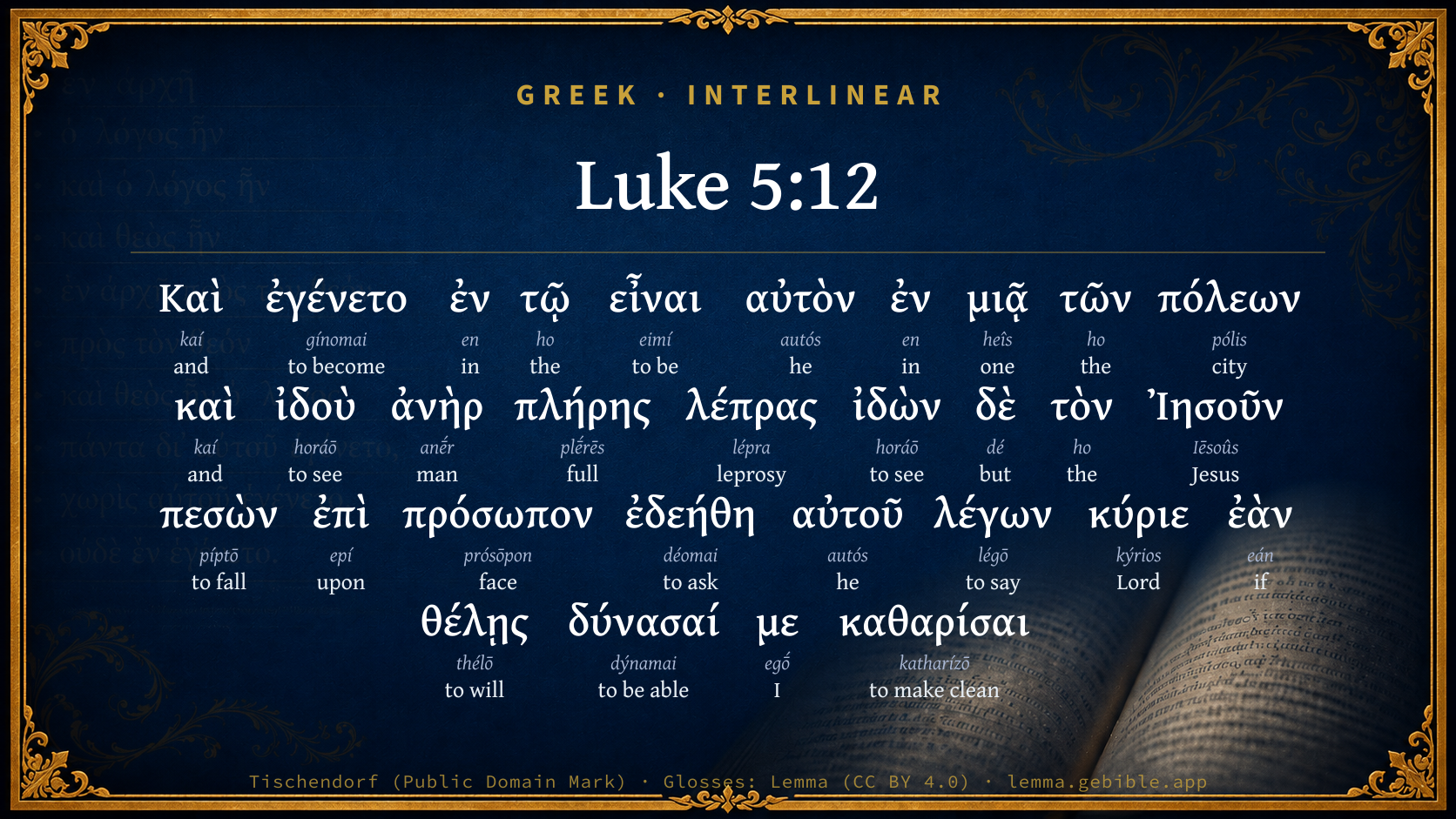
It happened, while he was in one of the cities, behold, there was a man full of leprosy. When he saw Jesus, he fell on his face, and begged him, saying, "Lord, if you want to, you can make me clean."
Download a study sheet
One document with this verse’s original text, its word-by-word gloss line, the meaning frame, cross-references with their text, attributed commentary, and full source and license credits — printable, and it pastes into notes with its structure intact.
This verse Autodidact and up
A passage Seminary Student
Up to 50 verses in one chapter. A passage sheet keeps up to 6 commentary sources and 12 cross-references per verse, in the order this page ranks them, and says so on the sheet whenever that leaves anything out. Ask for a single verse and you get the Autodidact verse sheet above.
Everything on this page stays free to read, with no account — the sheet is a download of what is already on screen, not access to it.
Compare translations 3
The same verse in 3 English versions, stacked beneath the original-language interlinear above. Click any original word for its lexicon entry.
Each is an independent rendering of the whole verse — the interlinear is not word-aligned to these translations.
Highlighted words mark where these versions differ — a whole-verse word diff, not a word-by-word alignment.
-
World English Bible Public Domain
It happened, while he was in one of the cities, behold, there was a man full of leprosy. When he saw Jesus, he fell on his face, and begged him, saying, "Lord, if you want to, you can make me clean."
-
King James Version Public Domain
And it came to pass, when he was in a certain city, behold a man full of leprosy: who seeing Jesus fell on his face, and besought him, saying, Lord, if thou wilt, thou canst make me clean.
-
unfoldingWord Literal Text CC BY-SA 4.0
And it happened that he was in one of the cities, and behold, a man full of leprosy. And seeing Jesus, he fell on his face begged him, saying, “Lord, if you are willing, you are able to make me clean.”
unfoldingWord Literal Text — © unfoldingWord, licensed CC BY-SA 4.0. Word-aligned USFM3 via Door43 (git.door43.org/unfoldingWord/en_ult).
Show all 19 translations
Every available English version of this verse, each an independent rendering of the whole verse.
-
World English Bible Public Domain
It happened, while he was in one of the cities, behold, there was a man full of leprosy. When he saw Jesus, he fell on his face, and begged him, saying, "Lord, if you want to, you can make me clean."
-
Berean Standard Bible Public Domain
While Jesus was in one of the towns, a man came along who was covered with leprosy. When he saw Jesus, he fell facedown and begged Him, “Lord, if You are willing, You can make me clean.”
-
Majority Standard Bible Public Domain
While Jesus was in one of the towns, a man came along who was covered with leprosy. When he saw Jesus, he fell facedown and begged Him, “Lord, if You are willing, You can make me clean.”
-
King James Version Public Domain
And it came to pass, when he was in a certain city, behold a man full of leprosy: who seeing Jesus fell on his face, and besought him, saying, Lord, if thou wilt, thou canst make me clean.
-
American Standard Version (1901) Public Domain
And it came to pass, while he was in one of the cities, behold, a man full of leprosy: and when he saw Jesus, he fell on his face, and besought him, saying, Lord, if thou wilt, thou canst make me clean.
-
Revised Version (1885) Public Domain
And it came to pass, while he was in one of the cities, behold, a man full of leprosy: and when he saw Jesus, he fell on his face, and besought him, saying, Lord, if thou wilt, thou canst make me clean.
-
Geneva Bible (1599) Public Domain
Nowe it came to passe, as he was in a certaine citie, beholde, there was a man full of leprosie, and when he sawe Iesus, he fell on his face, and besought him, saying, Lord, if thou wilt, thou canst make me cleane.
-
Douay-Rheims (1899) Public Domain
And it came to pass, when he was ina certain city, behold a man full of leprosy, who seeing Jesus, and falling on his face, besought him, saying: Lord, if thou wilt, thou canst make me clean.
-
Young's Literal Translation Public Domain
And it came to pass, in his being in one of the cities, that lo, a man full of leprosy, and having seen Jesus, having fallen on `his' face, he besought him, saying, `Sir, if thou mayest will, thou art able to cleanse me;'
-
Literal Standard Version CC BY-SA 4.0
And it came to pass, in His being in one of the cities, that behold, a man full of leprosy, and having seen Jesus, having fallen on [his] face, he implored Him, saying, “Lord, if You may will, You are able to cleanse me”;
-
Unlocked Literal Bible CC BY-SA 4.0
It came about that while he was in one of the cities, a man full of leprosy was there. When he saw Jesus, he fell on his face and begged him, saying, “Lord, if you are willing, you can make me clean.”
-
unfoldingWord Literal Text CC BY-SA 4.0
And it happened that he was in one of the cities, and behold, a man full of leprosy. And seeing Jesus, he fell on his face begged him, saying, “Lord, if you are willing, you are able to make me clean.”
-
Darby Bible Public Domain
And it came to pass as he was in one of the cities, that behold, there was a man full of leprosy, and seeing Jesus, falling upon his face, he besought him saying, Lord, if thou wilt, thou art able to cleanse me.
-
World Messianic Bible Public Domain
While he was in one of the cities, behold, there was a man full of leprosy. When he saw Yeshua, he fell on his face and begged him, saying, “Lord, if you want to, you can make me clean.”
-
Webster's Bible Public Domain
And it came to pass, when he was in a certain city, behold, a man full of leprosy: who seeing Jesus, fell on his face, and besought him, saying, Lord, if thou wilt, thou canst make me clean.
-
Free Bible Version CC BY-SA 4.0
Once when Jesus was visiting one of the towns, he met a man there who had a very bad case of leprosy. The man fell with his face to the ground and begged Jesus, “Please Lord, if you're willing, you can make me clean.”
-
Bible in Basic English Public Domain
And it came about that while he was in one of the towns, there was a leper there: and when he saw Jesus he went down on his face in prayer to him, saying, Lord, if it is your pleasure, you have power to make me clean.
-
Text-Critical English NT CC BY 4.0
While Jesus was in one of the towns, behold, there was a man full of leprosy. When the man saw Jesus, he fell on his face and begged him, “Lord, if yoʋ are willing, yoʋ can make me clean.”
-
Tyndale New Testament (1534) Public Domain
And it fortuned as he was in a certayne cite: beholde ther was a man full of leprosy: and when he had spied Iesus he fell on his face and besought him sayinge: Lorde yf thou wilt thou canst make me cleane.
Literal Standard Version (2020), Covenant Press — licensed CC BY-SA 4.0. Text via the HelloAO Bible API (eBible.org). Unlocked Literal Bible (unfoldingWord) — licensed CC BY-SA 4.0. Text via the HelloAO Bible API (eBible.org). unfoldingWord Literal Text — © unfoldingWord, licensed CC BY-SA 4.0. Word-aligned USFM3 via Door43 (git.door43.org/unfoldingWord/en_ult). Free Bible Version, Dr. Jonathan Gallagher — licensed CC BY-SA 4.0. Text via the HelloAO Bible API (eBible.org).
Word by word
More ways to search: Search by grammar → Find every occurrence → Compare this word →
Practice this passage: Drill this verse → Learn its vocabulary →
- Appears 4× in the Greek New Testament
- First appears at Matthew 8:3
- Part of Speech
- Noun
- Case
- Genitive
- Number
- Singular
- Gender
- Feminine
Full Thayer's Definition
- Καὶ kaí G2532 “and” Conjunction
- ἐγένετο gínomai G1096 “to become” Verb, Aorist, Middle deponent, Indicative, 3rd person, Singular
- ἐν en G1722 “in” Preposition
- τῷ ho G3588 “the” Article, Dative, Singular, Neuter
- εἶναι eimí G1510 “to be” Verb, Present, Active, Infinitive
- αὐτὸν autós G846 “he” Personal pronoun, Accusative, Singular, Masculine
- ἐν en G1722 “in” Preposition
- μιᾷ heîs G1520 “one” Adjective, Dative, Singular, Feminine
- τῶν ho G3588 “the” Article, Genitive, Plural, Feminine
- πόλεων pólis G4172 “city” Noun, Genitive, Plural, Feminine
- καὶ kaí G2532 “and” Conjunction
- ἰδοὺ horáō G3708 “to see” Verb, Aorist, Middle, Imperative, 2nd person, Singular
- ἀνὴρ anḗr G435 “man” Noun, Nominative, Singular, Masculine
- πλήρης plḗrēs G4134 “full” Adjective, Nominative, Singular, Masculine
- λέπρας lépra G3014 “leprosy” Noun, Genitive, Singular, Feminine
- ἰδὼν horáō G3708 “to see” Verb, Aorist, Active, Participle, Nominative, Singular, Masculine
- δὲ dé G1161 “but” Conjunction
- τὸν ho G3588 “the” Article, Accusative, Singular, Masculine
- Ἰησοῦν Iēsoûs G2424 “Jesus” Noun, Accusative, Singular, Masculine
- πεσὼν píptō G4098 “to fall” Verb, Aorist, Active, Participle, Nominative, Singular, Masculine
- ἐπὶ epí G1909 “upon” Preposition
- πρόσωπον prósōpon G4383 “face” Noun, Accusative, Singular, Neuter
- ἐδεήθη déomai G1189 “to ask” Verb, Aorist, Passive, Indicative, 3rd person, Singular
- αὐτοῦ autós G846 “he” Personal pronoun, Genitive, Singular, Masculine
- λέγων légō G3004 “to say” Verb, Present, Active, Participle, Nominative, Singular, Masculine
- κύριε kýrios G2962 “Lord” Noun, Vocative, Singular, Masculine
- ἐὰν eán G1437 “if” Conditional
- θέλῃς thélō G2309 “to will” Verb, Present, Active, Subjunctive, 2nd person, Singular
- δύνασαί dýnamai G1410 “to be able” Verb, Present, Middle or Passive deponent, Indicative, 2nd person, Singular
- με egṓ G1473 “I” Personal pronoun, 1st person, Accusative, Singular
- καθαρίσαι katharízō G2511 “to make clean” Verb, Aorist, Active, Infinitive
About this verse
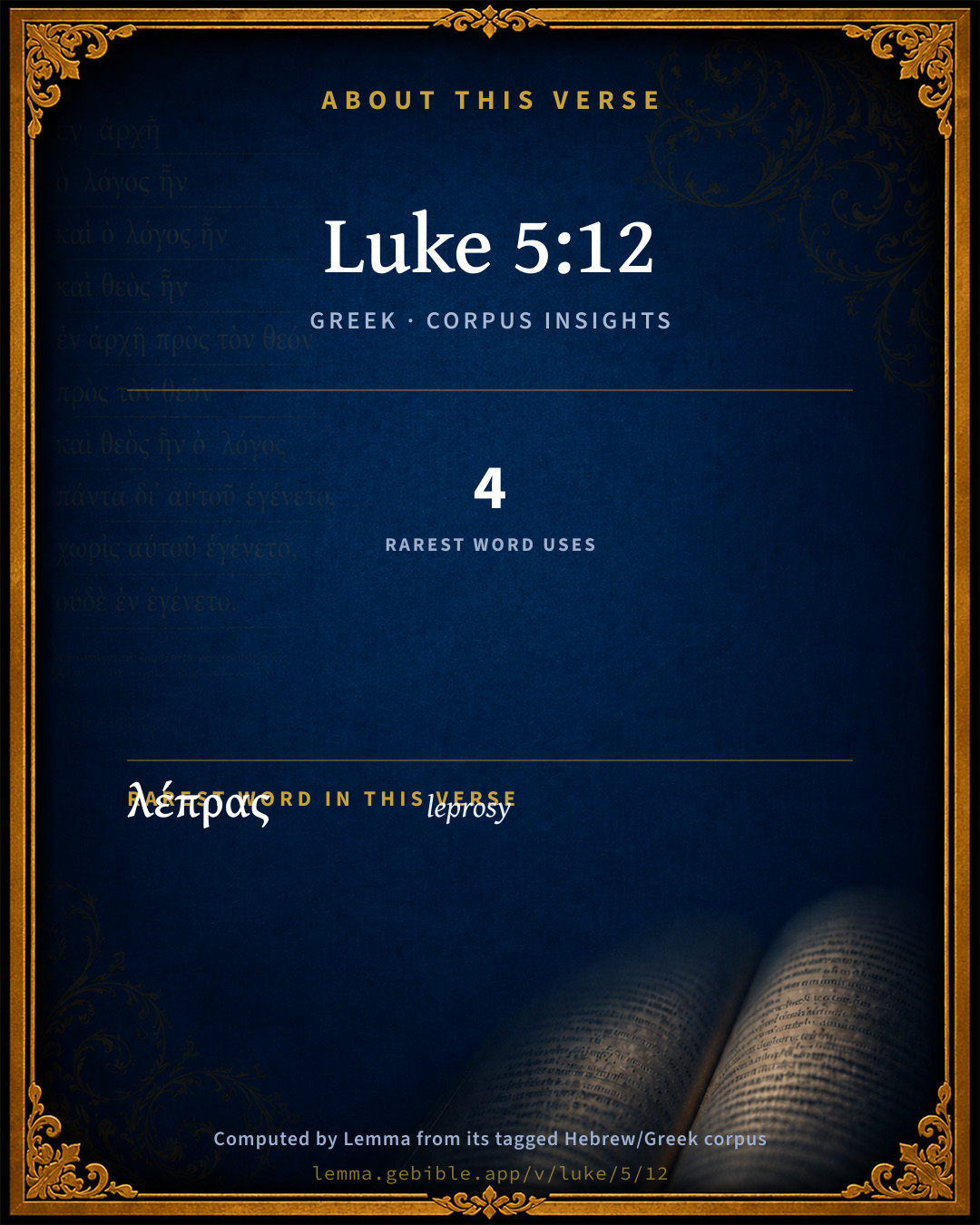
These counts appear in no published source. They are computed here, from the morphology-tagged text and Lemma’s own curated glosses. What Lemma adds →
- 31
- words
- 25
- distinct lemmas
- Gospels
- section
Cross-references
24Topical passages linked to Luke 5:12 in the Treasury of Scripture Knowledge — connected by theme and wording, ordered by reader-vote popularity; previews shown in the World English Bible.
- Psalms 50:15 Call on me in the day of trouble. I will deliver you, and you will honor me."
- Matthew 8:2–4 Behold, a leper came to him and worshiped him, saying, "Lord, if you want to, you can make me clean."
- Luke 17:16 He fell on his face at Jesus' feet, giving him thanks; and he was a Samaritan.
- Luke 17:12–13 As he entered into a certain village, ten men who were lepers met him, who stood at a distance.
- Matthew 9:28 When he had come into the house, the blind men came to him. Jesus said to them, "Do you believe that I am able to do this?" They told him, "Yes, Lord."
- Mark 1:40–45 There came to him a leper, begging him, kneeling down to him, and saying to him, "If you want to, you can make me clean."
- Genesis 18:14 Is anything too hard for Yahweh? At the set time I will return to you, when the season comes round, and Sarah will have a son."
- Psalms 91:15 He will call on me, and I will answer him. I will be with him in trouble. I will deliver him, and honor him.
- Matthew 8:8–9 The centurion answered, "Lord, I'm not worthy for you to come under my roof. Just say the word, and my servant will be healed.
- Hebrews 7:25 Therefore he is also able to save to the uttermost those who draw near to God through him, seeing he ever lives to make intercession for them.
- Exodus 4:6 Yahweh said furthermore to him, "Now put your hand inside your cloak." He put his hand inside his cloak, and when he took it out, behold, his hand was leprous, as white as snow.
- Matthew 26:6 Now when Jesus was in Bethany, in the house of Simon the leper,
- Mark 9:22–24 Often it has cast him both into the fire and into the water, to destroy him. But if you can do anything, have compassion on us, and help us."
- Leviticus 9:24 There came forth fire from before Yahweh, and consumed the burnt offering and the fat upon the altar: and when all the people saw it, they shouted, and fell on their faces.
- Numbers 12:10–12 The cloud removed from over the Tent; and, behold, Miriam was leprous, as [white as] snow: and Aaron looked at Miriam, and, behold, she was leprous.
- Deuteronomy 24:8 Take heed in the plague of leprosy, that you observe diligently, and do according to all that the priests the Levites shall teach you: as I commanded them, so you shall observe to do.
- Joshua 5:14 He said, No; but [as] prince of the host of Yahweh am I now come. Joshua fell on his face to the earth, and did worship, and said to him, What says my lord to his servant?
- 1 Kings 18:39 When all the people saw it, they fell on their faces: and they said, Yahweh, he is God; Yahweh, he is God.
- 2 Kings 5:1 Now Naaman, captain of the host of the king of Syria, was a great man with his master, and honorable, because by him Yahweh had given victory to Syria: he was also a mighty man of valor, [but he was] a leper.
- 1 Chronicles 21:16 David lifted up his eyes, and saw the angel of Yahweh standing between earth and the sky, having a drawn sword in his hand stretched out over Jerusalem. Then David and the elders, clothed in sackcloth, fell on their faces.
- Leviticus 13:1–14 Yahweh spoke to Moses and to Aaron, saying,
- 2 Kings 7:3 Now there were four leprous men at the entrance of the gate: and they said one to another, Why sit we here until we die?
- 2 Chronicles 26:19–20 Then Uzziah was angry; and he had a censer in his hand to burn incense; and while he was angry with the priests, the leprosy broke forth in his forehead before the priests in the house of Yahweh, beside the altar of incense.
- Mark 5:23 and begged him much, saying, "My little daughter is at the point of death. Please come and lay your hands on her, that she may be made healthy, and live."
Cross-references courtesy of OpenBible.info (CC BY 4.0).
Lesson kit
Teaching starters — assembled from the data on this page, not authored interpretation. Every prompt links to the verse data it draws on. Edit before teaching.
Luke, in the Gospels, opens this verse with 31 words (25 distinct Greek lemmas). Its most distinctive word is lépra (“leprosy”). A historical commentator’s framing appears above. Read the whole chapter for the surrounding context.
Discussion questions
- The word lépra carries the sense “leprosy.” How does it shape the verse?
- How does Matthew 8:3, which shares the word «leprosy», read alongside this verse?
- What does the repetition of “to see” (2× in this one verse) do in this verse?
- The translations on this page render this verse differently — a whole-verse word diff, not a word-by-word alignment. What might account for the different wordings?
- Compare how Matthew Henry's Commentary and The Biblical Illustrator read this verse. Where do they agree or differ?
Things to notice
- These translations choose different wording for 22 words in this verse.
- “to see” occurs 2× in this single verse.
- 25 distinct Greek lemmas span 31 words in this verse.
Commentary
Notes on Luke 5:12 from classic Christian and Jewish commentators (each source and its license shown beneath its notes). The classic Christian expositions comment on the surrounding passage and are grouped to its opening verse, so a note may address several verses; the Jewish commentaries on the Tanakh (Rashi and others) are per-verse, so they appear only where the commentator wrote on this verse.
Lemma curates 59 commentaries, every one of them public domain or Creative Commons licensed, each selected and text-cleaned for this edition rather than reprinted as found. About our sources →
Matthew Henry's Commentary
Matthew Henry's Commentary on the Whole Bible (1708–1710) — public domain (CC PDM 1.0). Text via the HelloAO Bible API.
The Biblical Illustrator
Joseph S. Exell
The Biblical Illustrator, edited by Joseph S. Exell (c. 1880s–1900s) — public domain. Text from a community e-Sword module.
Joseph Benson's Commentary
Joseph Benson's Commentary on the Old and New Testaments (1811–1818) — public domain. Text from a community e-Sword module.
Whedon's Commentary on the Bible
Daniel D. Whedon
Daniel D. Whedon (gen. ed.), Commentary on the Old and New Testaments (1874–1909) — public domain. Text from a community e-Sword module.
The Preacher's Complete Homiletical Commentary
Joseph S. Exell (gen. ed.)
The Preacher's Complete Homiletical Commentary (gen. ed. Joseph S. Exell; Funk & Wagnalls, c. 1892) — public domain (pre-1929). A full-Bible homiletical/sermon-outline anthology covering 65 of 66 books (2 John is absent from the source module). Text from a community e-Sword module.
Lange's Commentary on the Holy Scriptures
Lange's Commentary on the Holy Scriptures (Critical, Doctrinal, and Homiletical), ed. John Peter Lange, English translation edited by Philip Schaff (1864–1880) — public domain. Text from a community e-Sword module.
Kretzmann's Popular Commentary
Paul E. Kretzmann
Paul E. Kretzmann, Popular Commentary of the Bible (1921–1924) — public domain. Text from a community e-Sword module.
Godbey's Commentary on the New Testament
William B. Godbey
William B. Godbey, Commentary on the New Testament (1896–1900) — public domain. Text from a community e-Sword module.
Tyndale Open Study Notes
Tyndale Open Resources
Tyndale Open Study Notes — © Tyndale Open Resources, licensed CC BY-SA 4.0. Text via the HelloAO Bible API.
Bengel's Gnomon
Johann Albrecht Bengel
Bengel's Gnomon of the New Testament — English translation (T&T Clark, Edinburgh, 1860) — public domain. Text from a community e-Sword module.
Meyer's Critical & Exegetical Commentary
Heinrich August Wilhelm Meyer
Meyer — Critical and Exegetical Commentary on the New Testament — English translation by Peter Christie, edited by Frederick Crombie (T&T Clark, 1880) — public domain. Text from a community e-Sword module.
Expositor's Greek Testament
ed. W. Robertson Nicoll
The Expositor's Greek Testament, edited by W. Robertson Nicoll (1897–1910) — public domain. Text from a community e-Sword module.
Godet's Commentaries
Frédéric Louis Godet
Frédéric Louis Godet — Commentaries on Luke, John, Romans, and 1 Corinthians — English translation (T&T Clark, Edinburgh, 1870s–1890s) — public domain. Text from a community e-Sword module.
Geneva Bible (1599)
Geneva Bible translators
Geneva Bible (1599) marginal notes — public domain. Text via Bolls.life.
Adam Clarke's Commentary
Adam Clarke's Commentary on the Bible (1810–1826) — public domain. Text from a community e-Sword/MySword module.
Ellicott's Commentary for English Readers
A Bible Commentary for English Readers, edited by Charles John Ellicott (1878–1897) — public domain. Text from a community e-Sword module.
The Cambridge Bible for Schools and Colleges
gen. ed. J. J. S. Perowne
The Cambridge Bible for Schools and Colleges (gen. ed. J. J. S. Perowne; Cambridge University Press, 1878–1918) — public domain. Text from a community e-Sword module.
John Gill's Exposition
John Gill's Exposition of the Whole Bible (1746–1763) — public domain (CC PDM 1.0). Text via the HelloAO Bible API.
Trapp's Complete Commentary
John Trapp
John Trapp, A Commentary or Exposition upon All the Books of the Old and New Testament (1647–1656) — public domain. Text from a community e-Sword module.
Albert Barnes' Notes on the Bible
Albert Barnes' Notes on the Bible (1834–1885) — public domain. Text from a community e-Sword/MySword module.
Haydock's Catholic Bible Commentary
George Leo Haydock (1774–1849), Haydock's Catholic Family Bible and Commentary, 1859 edition — public domain. Excludes Psalms (Douay-Rheims chapter numbering differs from Protestant) and Deuterocanonical books (Catholic canon only).
Matthew Poole's English Annotations
Matthew Poole's English Annotations on the Holy Bible (1683–1685) — public domain. Text from a community e-Sword/MySword module.
The Pulpit Commentary
The Pulpit Commentary (1880–1919), ed. H.D.M. Spence-Jones & Joseph S. Exell — public domain. Text from a community e-Sword module.
John Wesley's Explanatory Notes
John Wesley, Explanatory Notes Upon the Whole Bible (1754–1765) — public domain. Text via the GEBible commentary corpus.
Scofield Reference Notes
C. I. Scofield
The Scofield Reference Bible (1917 edition), notes by C. I. Scofield — public domain. Text from a community e-Sword module.
Burkitt's Expository Notes on the New Testament
William Burkitt
William Burkitt's Expository Notes on the New Testament (1700–1703) — public domain. Text from a community e-Sword module.
McGarvey & Pendleton's Commentaries
J. W. McGarvey
J. W. McGarvey (with Philip Y. Pendleton), Commentaries on the New Testament (The Fourfold Gospel, 1914; Acts; and the epistles) — public domain. Text from a community e-Sword/MySword module.
The People's New Testament
B. W. Johnson
B. W. Johnson's The People's New Testament with Notes (1889–1891) — public domain. Electronic text from the Christian Classics Ethereal Library (CCEL) ThML edition.
unfoldingWord translationNotes
Door43 World Missions Community
unfoldingWord translationNotes — © Distant Shores Media and the Door43 World Missions Community, licensed CC BY-SA 4.0. Source: git.door43.org/Door43/en_tn.
Cambridge Greek Testament for Schools and Colleges
Cambridge Greek Testament for Schools and Colleges (Cambridge University Press, 1896; 21 vols, various authors incl. Carr, Maclear, Plummer, Farrar, Lumby, Moule, M. R. James, Simcox) — public domain. Text from a community e-Sword module.
Alford’s Greek Testament
Henry Alford
Henry Alford, The Greek Testament (1849–1861) — public domain. Text from a community e-Sword module.
International Critical Commentary
International Critical Commentary — older volumes (1896–1929), various authors — public domain. Text from a community e-Sword module.
Vincent's Word Studies in the New Testament
Marvin R. Vincent
Marvin R. Vincent, Word Studies in the New Testament (1887–1900) — public domain. Text from a community e-Sword/MySword module.