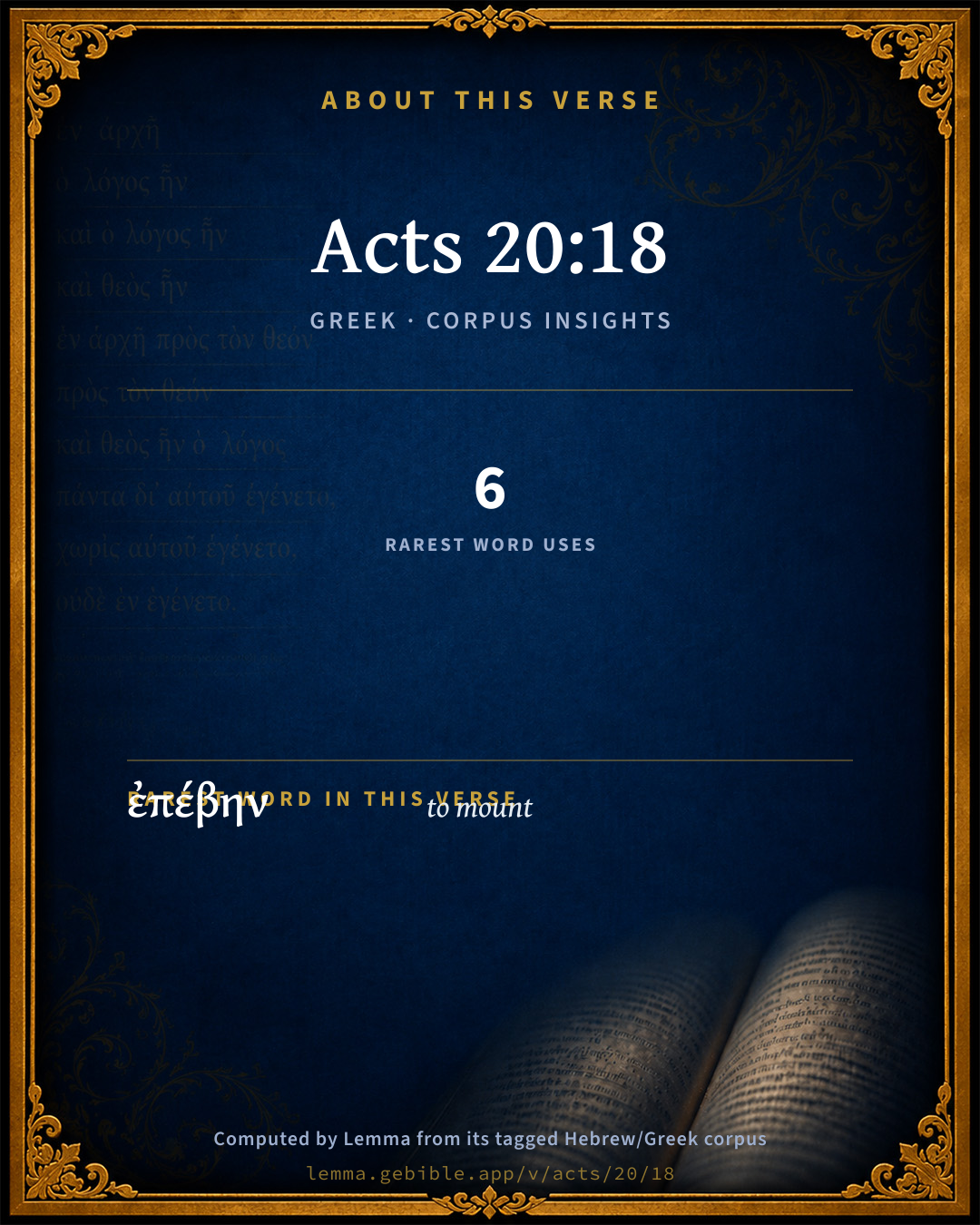
Acts 20:18

Greek (Tischendorf 8th ed.) Acts 20:18 appears in the Greek New Testament. The text above is from the Tischendorf 8th edition. Each word links to its Strong’s number and a concise gloss. Click any word for its full Thayer’s Greek Lexicon entry.
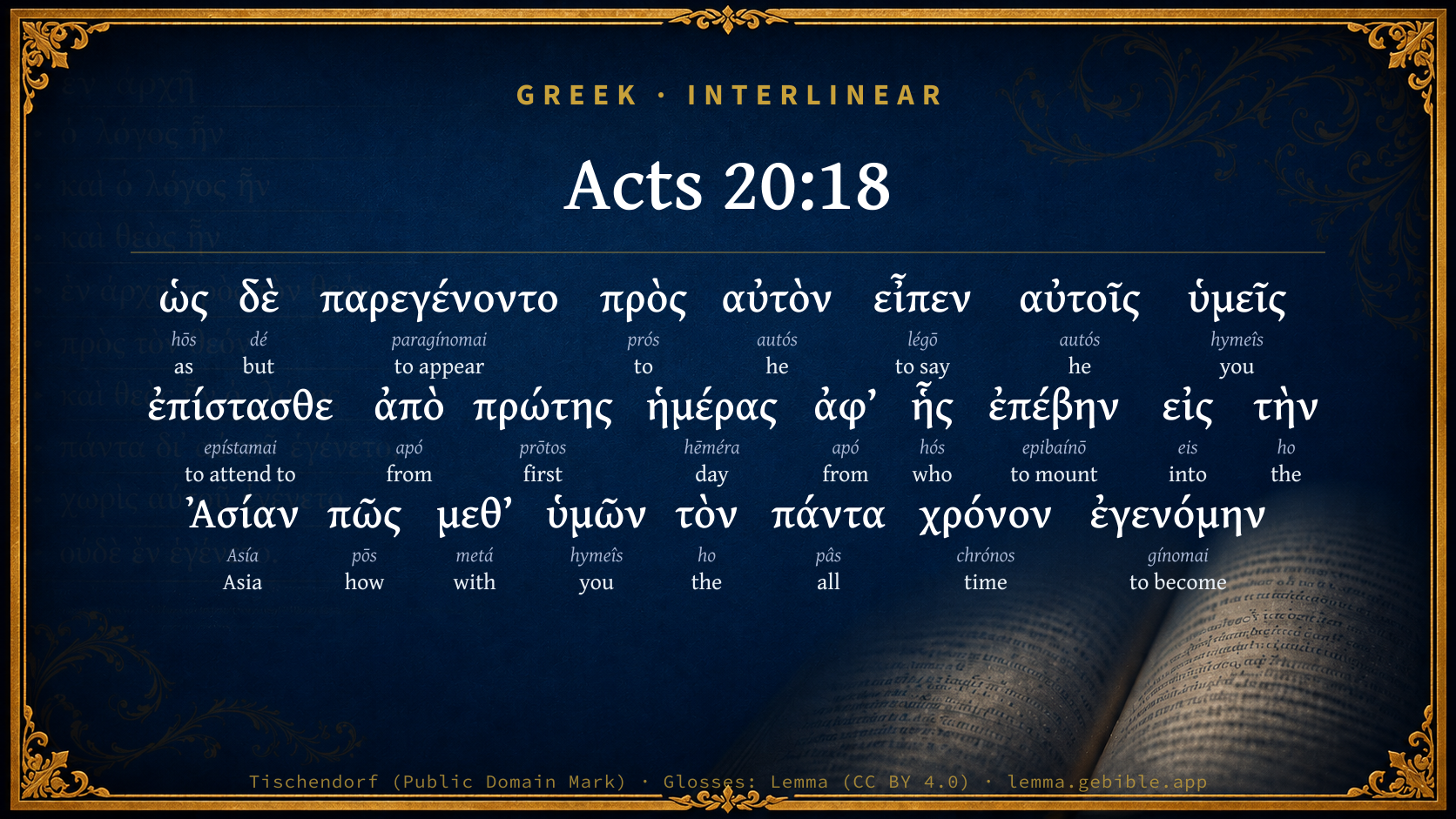
Download image
Cite this verse

Acts 20:18 (World English Bible). Public Domain. Lemma interlinear Bible study tool, https://lemma.gebible.app/v/acts/20/18.

Show BibTeX & RIS
BibTeX
RIS
English Translation
When they had come to him, he said to them, "You yourselves know, from the first day that I set foot in Asia, how I was with you all the time,
World English Bible · Public Domain
Download a study sheet

One document with this verse’s original text, its word-by-word gloss line, the meaning frame, cross-references with their text, attributed commentary, and full source and license credits — printable, and it pastes into notes with its structure intact.

This verse Autodidact and up

Study sheet (.html) Plain text (.txt)

A passage Seminary Student

Up to 50 verses in one chapter. A passage sheet keeps up to 6 commentary sources and 12 cross-references per verse, in the order this page ranks them, and says so on the sheet whenever that leaves anything out. Ask for a single verse and you get the Autodidact verse sheet above.

Everything on this page stays free to read, with no account — the sheet is a download of what is already on screen, not access to it.

Want to remove ads? Support Godless Engineer
Compare translations 3

The same verse in 3 English versions, stacked beneath the original-language interlinear above. Click any original word for its lexicon entry.

Each is an independent rendering of the whole verse — the interlinear is not word-aligned to these translations.

Highlighted words mark where these versions differ — a whole-verse word diff, not a word-by-word alignment.

  • World English Bible Public Domain
    When they had come to him, he said to them, "You yourselves know, from the first day that I set foot in Asia, how I was with you all the time,
  • King James Version Public Domain
    And when they were come to him, he said unto them, Ye know, from the first day that I came into Asia, after what manner I have been with you at all seasons,
  • unfoldingWord Literal Text CC BY-SA 4.0
    And when they came to him, he said to them, “You know, from the first day from which I set foot in Asia, how I was with you the whole time,

unfoldingWord Literal Text — © unfoldingWord, licensed CC BY-SA 4.0. Word-aligned USFM3 via Door43 (git.door43.org/unfoldingWord/en_ult).

Versions to compare (up to 4)

3 of 4 selected

Show all 19 translations

Every available English version of this verse, each an independent rendering of the whole verse.

  • World English Bible Public Domain
    When they had come to him, he said to them, "You yourselves know, from the first day that I set foot in Asia, how I was with you all the time,
  • Berean Standard Bible Public Domain
    When they came to him, he said, “You know how I lived the whole time I was with you, from the first day I arrived in the province of Asia.
  • Majority Standard Bible Public Domain
    When they came to him, he said, “You know how I lived the whole time I was with you, from the first day I arrived in the province of Asia.
  • King James Version Public Domain
    And when they were come to him, he said unto them, Ye know, from the first day that I came into Asia, after what manner I have been with you at all seasons,
  • American Standard Version (1901) Public Domain
    And when they were come to him, he said unto them, Ye yourselves know, from the first day that I set foot in Asia, after what manner I was with you all the time,
  • Revised Version (1885) Public Domain
    And when they were come to him, he said unto them, Ye yourselves know, from the first day that I set foot in Asia, after what manner I was with you all the time,
  • Geneva Bible (1599) Public Domain
    Who when they were come to him, hee said vnto them, Ye know from the first day that I came into Asia, after what maner I haue bene with you at all seasons,
  • Douay-Rheims (1899) Public Domain
    And when they were come to him, and were together, he said to them: You know from the first day that I came into Asia, in what manner I have been with you, for all the time,
  • Young's Literal Translation Public Domain
    and when they were come unto him, he said to them, `Ye -- ye know from the first day in which I came to Asia, how, with you at all times I was;
  • Literal Standard Version CC BY-SA 4.0
    and when they were come to him, he said to them, “You know from the first day in which I came to Asia, how I was with you at all times;
  • Unlocked Literal Bible CC BY-SA 4.0
    When they had come to him, he said to them, “You yourselves know, from the first day that I set foot in Asia, how I always spent my time with you.
  • unfoldingWord Literal Text CC BY-SA 4.0
    And when they came to him, he said to them, “You know, from the first day from which I set foot in Asia, how I was with you the whole time,
  • Darby Bible Public Domain
    And when they were come to him, he said to them, *Ye* know how I was with you all the time from the first day that I arrived in Asia,
  • World Messianic Bible Public Domain
    When they had come to him, he said to them, “You yourselves know, from the first day that I set foot in Asia, how I was with you all the time,
  • Webster's Bible Public Domain
    And when they had come to him, he said to them, Ye know, from the first day that I came into Asia, after what manner I have been with you at all seasons,
  • Free Bible Version CC BY-SA 4.0
    When they arrived, he told them, “You know how I always behaved while I was with you from the first day I arrived in the province of Asia.
  • Bible in Basic English Public Domain
    And when they had come, he said to them, You yourselves have seen what my life has been like all the time from the day when I first came into Asia,
  • Text-Critical English NT CC BY 4.0
    When they came to him, he said to them, “You yourselves know how I lived the whole time I was with you, from the day I first set foot in Asia,
  • Tyndale New Testament (1534) Public Domain
    And when they were come to him he sayde vnto the: Ye knowe from the fyrst daye that I came vnto Asia after what maner I have bene with you at all ceasons

Literal Standard Version (2020), Covenant Press — licensed CC BY-SA 4.0. Text via the HelloAO Bible API (eBible.org). Unlocked Literal Bible (unfoldingWord) — licensed CC BY-SA 4.0. Text via the HelloAO Bible API (eBible.org). unfoldingWord Literal Text — © unfoldingWord, licensed CC BY-SA 4.0. Word-aligned USFM3 via Door43 (git.door43.org/unfoldingWord/en_ult). Free Bible Version, Dr. Jonathan Gallagher — licensed CC BY-SA 4.0. Text via the HelloAO Bible API (eBible.org).

Word by word

More ways to search: Search by grammar → Find every occurrence → Compare this word →

Practice this passage: Drill this verse → Learn its vocabulary →

ἐπέβην
epibaínō
G1910
“to mount”
Verb, Aorist, Active, Indicative, 1st person, Singular
Part of Speech
Verb
Tense
Aorist
Voice
Active
Mood
Indicative
Person
1st person
Number
Singular
Full Thayer's Definition

Origin: from G1909 and the base of G939

TDNT: None

1. to get upon, mount a. to embark in b. to go aboard (a ship) 2. to set foot in, enter
  1. ὡς hōs G5613 “as” Adverb
  2. δὲ dé G1161 “but” Conjunction
  3. παρεγένοντο paragínomai G3854 “to appear” Verb, Aorist, Middle deponent, Indicative, 3rd person, Plural
  4. πρὸς prós G4314 “to” Preposition
  5. αὐτὸν autós G846 “he” Personal pronoun, Accusative, Singular, Masculine
  6. εἶπεν légō G3004 “to say” Verb, Aorist, Active, Indicative, 3rd person, Singular
  7. αὐτοῖς autós G846 “he” Personal pronoun, Dative, Plural, Masculine
  8. ὑμεῖς hymeîs G5210 “you” Personal pronoun, 2nd person, Nominative, Plural
  9. ἐπίστασθε epístamai G1987 “to attend to” Verb, Present, Middle or Passive deponent, Indicative, 2nd person, Plural
  10. ἀπὸ apó G575 “from” Preposition
  11. πρώτης prōtos G4413 “first” Adjective, Genitive, Singular, Feminine, Superlative
  12. ἡμέρας hēméra G2250 “day” Noun, Genitive, Singular, Feminine
  13. ἀφ’ apó G575 “from” Preposition
  14. ἧς hós G3739 “who” Relative pronoun, Genitive, Singular, Feminine
  15. εἰς eis G1519 “into” Preposition
  16. τὴν ho G3588 “the” Article, Accusative, Singular, Feminine
  17. Ἀσίαν Asía G773 “Asia” Noun, Accusative, Singular, Feminine
  18. πῶς pōs G4459 “how” Adverb
  19. μεθ’ metá G3326 “with” Preposition
  20. ὑμῶν hymeîs G5210 “you” Personal pronoun, 2nd person, Genitive, Plural
  21. τὸν ho G3588 “the” Article, Accusative, Singular, Masculine
  22. πάντα pâs G3956 “all” Adjective, Accusative, Singular, Masculine
  23. χρόνον chrónos G5550 “time” Noun, Accusative, Singular, Masculine
  24. ἐγενόμην gínomai G1096 “to become” Verb, Aorist, Middle deponent, Indicative, 1st person, Singular

About this verse

These counts appear in no published source. They are computed here, from the morphology-tagged text and Lemma’s own curated glosses. What Lemma adds →

25
words
21
distinct lemmas
Acts
section

Notable vocabulary

The rarest word here is ἐπέβην to mount G1910 — appearing just 6 times in the whole Greek New Testament.

Shared distinctive vocabulary

ἐπέβην to mount G1910 occurs in 6 verses of the Greek New Testament. Also found in:

Repetition

Words recur within this verse:

  • αὐτὸν he G846 ×2
  • ὑμεῖς you G5210 ×2
  • ἀπὸ from G575 ×2
  • τὴν the G3588 ×2

Cross-references

9

Topical passages linked to Acts 20:18 in the Treasury of Scripture Knowledge — connected by theme and wording, ordered by reader-vote popularity; previews shown in the World English Bible.

  • 1 Thessalonians 1:5–6 and that our Gospel came to you not in word only, but also in power, and in the Holy Spirit, and with much assurance. You know what kind of men we showed ourselves to be among you for your sake.
  • Acts 18:19 He came to Ephesus, and he left them there; but he himself entered into the synagogue, and reasoned with the Jews.
  • Acts 19:1 It happened that, while Apollos was at Corinth, Paul, having passed through the upper country, came to Ephesus, and found certain disciples.
  • Acts 19:10 This continued for two years, so that all those who lived in Asia heard the word of the Lord Jesus, both Jews and Greeks.
  • 2 Thessalonians 3:7–9 For you know how you ought to imitate us. For we didn't behave ourselves rebelliously among you,
  • 2 Corinthians 1:12 For our boasting is this: the testimony of our conscience, that in holiness and sincerity of God, not in fleshly wisdom but in the grace of God we behaved ourselves in the world, and more abundantly toward you.
  • 2 Corinthians 6:3–11 We give no occasion of stumbling in anything, that our service may not be blamed,
  • 1 Thessalonians 2:1–10 For you yourselves know, brothers, our visit to you wasn't in vain,
  • 2 Timothy 3:10 But you did follow my teaching, conduct, purpose, faith, patience, love, steadfastness,

Cross-references courtesy of OpenBible.info (CC BY 4.0).

Commentary

Notes on Acts 20:18 from classic Christian and Jewish commentators (each source and its license shown beneath its notes). The classic Christian expositions comment on the surrounding passage and are grouped to its opening verse, so a note may address several verses; the Jewish commentaries on the Tanakh (Rashi and others) are per-verse, so they appear only where the commentator wrote on this verse.

Lemma curates 59 commentaries, every one of them public domain or Creative Commons licensed, each selected and text-cleaned for this edition rather than reprinted as found. About our sources →

The Biblical Illustrator

Joseph S. Exell

Act_20:18-19

Ye know … after what manner I have been with you.

Example better than precept

Words are cannonballs. Example is the powder that gives the words their force. Many men may be able to say, Heed what I tell you, but not many could so confidently say, Follow my example. Yet this was what Paul said to the Ephesian elders, and what he wrote to the disciples at Philippi (Php_4:9). Example is always better than precept, because talk is cheap, but deeds are dear. To preach the gospel can be done in a moment, but to practise the gospel is a very different thing. If we can have only one of these things, we prefer practice to preaching. Much of our profession goes for nothing, because we profess one thing with our lips and then deny our profession by our deeds. But since actions speak louder than words, our actions drown our speech. A man who walks to church one day in the week, and to queer places six days in the week, must not be surprised if people call him a hypocrite. (A. F. Schauffler.)

Serving the Lord with all humility of mind.--

Humility

I. Its nature. All Christian graces are products of truth. So humility is the state of mind which the truth concerning our character and relations ought to produce. It includes--

1. A sense of insignificance, because we are both absolutely and relatively insignificant. We are as nothing before God, in the universe, in the hierarchy of intelligences, in the millions of mankind. We are insignificant in capacity, learning, influence, and power, compared to thousands of our predecessors and contemporaries. Humility is not only the consciousness of this insignificance, but the recognition and acknowledgment of it, and acquiescence in it. Pride is the denial of or forgetfulness of this fact, the assertion of our own importance.

2. A sense of weakness. Humility stands opposed to pride as including self-confidence, and especially pride of intellect, either as consisting in Rationalism, or the refusal to submit to the teaching of God; or in a sense of superiority to others. No man can be a Christian without becoming as a little child.

3. A sense of guilt. Humility stands opposed to self-righteousness. When we consider the number and aggravations of our sins we are lost in wonder that men can be so infatuated as to arrogate merit to themselves. The parable of the Pharisee and the publican shows that a moral man propped up with a sense of his good desert is more offensive to God than an immoral man bowed down with a sense of guilt.

II. Its importance appears from--

1. Its nature, as the want of it implies ignorance or disbelief of the truth concerning our true character.

2. The frequent declarations of Scripture; that God resisteth the proud but showeth grace to the humble; that those who exalt themselves shall be abased, etc.

3. Its connection with the whole economy of redemption, which is intended to humble man. Men must stoop to enter heaven.

4. Its influence on our fellow men. As nothing is so offensive as pride, so nothing is so conciliating as humility.

5. Its influence on ourselves. The humble only are peaceful.

III. Its cultivation.

1. Bring your mind under the operation of truth.

2. Especially live in the presence of God.

3. Never act from the impulse of pride.

4. Humble yourselves by not seeking great things.

5. Seek the indwelling of the Spirit, and the aid of Christ. (C. Hodge, D. D.)

Humility

I. Its comprehensiveness. Serving the Lord not only with humility, but with all humility.

1. There are many sorts of pride, and you will be able, by looking at the contrast, to see that there must be also many kinds of humility. There is the pride of--

(1) The heretic, who will utter false doctrines, because he thinks his own judgment to be better than the Word of God; he is a disputant but not a disciple. Now Paul never had this. So willing was he to sit at the feet of Jesus that he counted all the learning which he had received at the feet of Gamaliel to be of no value in itself, but became a fool that he might be wise.

(2) The Papist, who attaches merit to his own works, and hopes to win heaven by them. From this Paul was totally free. He learnt to count his righteousness as filthy rags.

(3) The curious. He would if he could climb to the Eternal Throne, and break the seven seals of the book of destiny. Paul was never curious; he was perfectly content to take his doctrine from his Masters spirit, and leave endless genealogies and questionings to those who had no better guests to entertain.

(4) The persecutor. The pride which suggests that I am infallible, and that if any man should differ from me, the stake and the rack would be the due deserts of so great a sin. But Paul had the humility of a man of generous spirit.

(5) The impenitent man who will not yield to God. Not so our apostle. He was ever filled with a sense of his own unworthiness.

2. To give you a clearer view of this comprehensiveness I will put it in another shape. There is humility--

(1) Before serving God. When a man lacks this he proposes to himself his own honour and esteem in serving God. How little too many Christians have of that humility. They will pick that position in the Church which will give them most honour. But it never was so with the apostle. I think I see him now, working long past midnight making his tents. Then I see that tent maker going into the pulpit with his hands all blistered with his hard work. You would say of him at once, That man never proposes to himself the praises of his hearers.

(2) During the act. That is a splendid psalm which begins, Not unto us. David thought it needful to say it twice. Then he deals the death blow with the other sentence, But unto Thy Name be all the glory. To sing that song when you are reaping the great harvest, when you are going on from strength to strength, will prove a healthy state of heart.

(3) After the service is done. In looking back upon success achieved, upon heights attained, it is so easy to say, My right hand and my mighty arm hath gotten me the victory. Christian workers, see to it that never when your work is done you speak of yourselves or of your work.

II. Its trials, or the dangers through which it has to pass.

1. The possession of great ability. When a man hath seven talents he must recollect that he hath seven burdens of responsibility; and therefore he should be bowed down. Let a man feel that he possesses more power than another, more learning, and he is so apt to say, I am somebody in the Church. It is so ridiculous; for the more we have the more we owe, and how can there be any ground for boasting there? Great talents make it hard for a man to maintain humility. Yet little talents have precisely the same effect. There, says one, I have but a trifle in the world, I must make a flare with it. I have but one ring, and I will always put the finger that wears that outwards so that it may be seen. If you have little talents, do not swell and burst with envy. The frog was never contemptible as a frog, but when he tried to blow himself out to the size of the ox then he was contemptible indeed. It is just as easy for a man to be proud in his rags as my Lord Mayor in his gold chain. There is many a costermonger riding in his little cart, quite as vain as my lord who rides in a gilded coach. You may be a king and yet be humble; you may be a beggar and yet be proud.

2. Success. Great success is like a full cup it is hard to hold it with a steady hand. It is swimming in deep waters, and there is always a fear of being drowned there. But want of success has just the same tendency. Have you not seen the man who could not get a good congregation, and who insisted upon it, that it was because he was a better preacher than the man who did?

3. Long enjoyment of the Masters presence. To walk all day in the sunlight brings us in danger of a sunstroke. If we have nothing but full assurance, we may come to be presumptuous. When you have long-continued joys, fear and tremble for all the goodness of God. But long-continued doubts also will breed pride. When a man has long been doubting his God, and mistrusting His promise, what is that but pride? He wants to be somebody and something. He is not willing to believe his God in the dark; he thinks he always ought to have joy and satisfaction, and so it comes to pass that his doubts and fears are as ready parents of pride as assurance could have been. There is not a position in the world where a man cannot be humble if he have grace; there is not a station under heaven where a man will not be proud if left to himself.

III. The arguments by which we ought to be provoked to it.

1. From ourselves. What am I that I should be proud? I am a man. An angel--how much he surpasseth me, and yet the Lord charged His angels with folly. How much less, then, should the son of man exalt himself? Verily, man at his best estate is altogether vanity. But there is a yet stronger argument. What are you but depraved creatures? When the child of God is at his best he is no better than a sinner at his worst, except so far as God has made him to differ. There goes John Bradford--but for the grace of God. A sinner saved by grace and yet proud! Out on such impudence!

2. In Christ. Our Master was never exalted above measure. He condescended to men of low estate, but in such a way that there was not the appearance of stooping. And shall the servant be above his Master, or the disciple above his Lord? Ye that are purse proud, or talent proud, or beauty proud, I beseech you, think how unlike you are to the Master. He made Himself of no reputation, etc. Look at that strange sight, and never be proud again.

3. In Gods goodness towards us. What was there in you that Christ should buy you with His precious blood? What in you that you should be made the temple of the Holy Ghost? What is there in you that you should be brought to heaven? (C. H. Spurgeon.)

The energy of humility

The little and the lowly may be found in combination with wondrous energy. The coralline (Corrallina officinalis), which only be found most abundantly on any of our coasts, growing in greatest perfection near low watermark, is a small plant seldom exceeding five or six inches in height, and not even reaching that size. However, it compensates refits low stature by its luxuriant growth, being usually found in dense masses wherever it can find a convenient shelter. If the vital force of this plant had shot upwards, pushing out numerous and majestic branches in the air, and covering itself with abundant leafage and blossom, it would have attracted more attention and admiration, but it would not have gained force, or perhaps usefulness, thereby. Thus with human minds. Those whose powers shoot upward by some splendid feat of genius in literature or battle, arrest public attention and win public plaudits. Whereas possibly they neither gain more strength nor achieve more usefulness than those less showy men who work modestly for the common good in the obscurer regions of human life, and who, like the coralline plant, are always accessible to those who seek them at the low watermark of lifes affairs. (Scientific Illustrations.)

Humility leads to usefulness

See yon evening star, how bright it shines! how pure, how gentle are its rays! But, look, it is lower in the heavens than those that sparkle with a restless twinkling in the highest regions of the sky. God keeps you low that you may shine bright. Where do the rivers run that fertilise our soil? Is it in the barren top of yonder hill? No; in the vales beneath. If you would have the river, whose streams make glad the city of our God, to run through your hearts, and enrich them to His glory, you must abide in the vale of humility. (Rowland Hill.)

Humility of the truly great servants of Christ

Canon Auriol was invited on one occasion to preach an ordination sermon, at Carlisle, by the late Bishop Waldegrave. On the Sunday morning, as a large party, consisting of the Bishops family, the chaplains, and the candidates for holy orders, were sitting round the breakfast table at the Bishops residence, the Bishop repeated a text of Scripture suited to the occasion, and then called on each of those present do the same. This being a well-known weekly custom at Rose Castle, everyone was prepared, and as each text was repeated it was most interesting to remark what was the uppermost feeling in the minds of the several young men about to be ordained, some expressing bright hope as to their future, such as I can do all things through Christ which strengtheneth me, some rather breathing a prayer for grace and guidance, such as Hold up my goings in Thy paths that my footsteps slip not. But when it came to Mr. Auriols turn there was a pause of a moment or two; and then it was seen that the old veteran was overcome by emotion. At last he began Unto me who am less than the least of all saints, here his voice faltered and his eyes moistened, but recovering himself, he went on, his voice gaining strength as he proceeded, is this grace given that I should preach among the Gentiles the unsearchable riches of Christ. The effect was most impressive. It was felt that if such are the feelings of one who has spent so many years in the Masters service, and who has been so highly honoured of Him as His minister in holy things, what ought to be the humility and the casting away of high-mindedness on the part of younger men. His words produced a hush of reverential awe.

Humility aided by sorrow

About the ruins of an ancient castle, abbey, or cathedral, green moss and incidental flowerets break out from the rifts and rents as if they would beautify the ruin. So it is amid the wrecks of a broken heart that the sweet flowerets of humility, and lowliness, and love, and peace begin to germinate and grow, refreshed by Gods sun and watered by His dews, and adorning the character that His grace has created, and making it the admiration of others and acceptable to Himself. (J. Cumming.)

The Biblical Illustrator, edited by Joseph S. Exell (c. 1880s–1900s) — public domain. Text from a community e-Sword module.

Joseph Benson's Commentary

Act 20:18-19. And he said, Ye know, &c. — Happy is that minister who can thus appeal to the consciences of his hearers; from the first day that I came into Asia — From the first time of my appearing among you; after what manner I have been with you — How I have conducted myself toward God, toward you, and toward all men; at all seasons — Τον παντα χρονον, the whole time; every day and hour, in private and public; serving the Lord — Not only instructing men in the principles of divine truth, but in the whole tenor of my conduct serving the Lord Jesus Christ; seeking, not my own honour, interest, or pleasure, but his honour, the interest of his kingdom, and the pleasing of him; making his will my rule, and his glory my end, in all my actions; with all humility of mind — In all instances of condescension, modesty, and self-abasement; conscious that I am unworthy to be permitted to serve him, that he does me a great and undeserved honour to employ me in his service, and that my best services are utterly unworthy of his acceptance; and with many tears — Of tender affection and deep concern for your present and eternal salvation; and in sympathy with you under your trials and troubles. Though Paul’s acquaintance with them was of late standing, yet, so near did they lie to his heart, that he wept with them that wept, and mingled his tears with theirs upon every occasion; and temptations — Πειρασμων, trials; namely, of his faith, patience, and courage; such trials as, perhaps, were sometimes temptations to him, if not to desist from, yet to abate of his zeal and diligence in the work of the Lord; which befell me by the lying in wait of the Jews — Who were still plotting some mischief or other against him. These three things, humility, tears, and trials, are the concomitants of the true and faithful service of Christ in the ministry of the gospel. The service itself is described more particularly in the two following verses. The humility here spoken of, he recommends to the Ephesians themselves, Eph 4:2. His tears are mentioned again, Act 20:31; as also, 2Co 2:4, and Php 3:18. These passages laid together supply us with the genuine character of Paul. Holy tears, from those who seldom weep on account of natural occurrences, are no mean specimen of the efficacy, and proof of the truth of Christianity; yet joy is well consistent therewith, (Act 20:24,) for the same person may be sorrowful, yet always rejoicing.

Joseph Benson's Commentary on the Old and New Testaments (1811–1818) — public domain. Text from a community e-Sword module.

Whedon's Commentary on the Bible

Daniel D. Whedon

18. Said unto them—This speech, in its difference from the style of Luke, and likeness both to the style and thought of Paul, furnishes strong proof of being a genuine and very accurate report. It abounds with passages breathing the spirit of the finest strains of his epistles. Compare Paul’s description of his pastoral faithfulness, Act_20:18-21, with 1Th_2:10, and 2Co_6:3-4; his appeals to his own example in this speech with 2Co_1:12; 1Co_11:1; and Php_3:15; his tears in Act_20:31 with 2Co_2:4; the private teaching of Act_20:20 with 1Th_2:11, and 2Ti_4:2; the anticipation of persecution in Jerusalem, Act_20:22, with Rom_15:31; his self-maintenance in Act_20:33 with 1Th_2:9; 2Th_3:7-9; 1Co_4:12 and 1Co_9:12.

Daniel D. Whedon (gen. ed.), Commentary on the Old and New Testaments (1874–1909) — public domain. Text from a community e-Sword module.

Tyndale Open Study Notes

Tyndale Open Resources

20:18-38 Paul’s address to the elders of the church of Ephesus is a testimony regarding his life and ministry in Ephesus, calling for similar dedication from the leaders who would carry on the ministry. The sermon highlights Paul’s integrity and pastoral care (20:18-21, 26, 31), speaks about the future (20:22-23, 25, 29-30), warns against false teachers (20:29-30), and exhorts the elders to be watchful and faithful (20:28, 31). Paul modeled sacrificial, conscientious, servant leadership.

Tyndale Open Study Notes — © Tyndale Open Resources, licensed CC BY-SA 4.0. Text via the HelloAO Bible API.

Bengel's Gnomon

Johann Albrecht Bengel

Act 20:18. Ὑμεῖς ἐπίστασθε, ye know) Happy the minister who can thus begin his address, appealing to the conscience of his hearers as attesting what he says.—ἐπέβην, I entered) This denotes more than I came to; for it signifies, I set foot on.—πῶς) There follows ὡς, Act 20:20, which is equivalent to an Anaphora (the repetition of the same word in beginnings, thereby marking them).—τὸν) Relative [the whole time that I was with you].

Bengel's Gnomon of the New Testament — English translation (T&T Clark, Edinburgh, 1860) — public domain. Text from a community e-Sword module.

Meyer's Critical & Exegetical Commentary

Heinrich August Wilhelm Meyer

Act_20:18-19. In hac concione[111] praecipue huc insistit Paulus, ut, quos Ephesi creaverat pastores, suo exemplo hortetur ad munus suum fideliter peragendum, Calvin. It is a clear and true pastoral mirror.

Only the Ephesian (τῆς ἐκκλησ., Act_20:17) presbyters were assembled; not, as Iren. iii. 14. 2 relates, those also of the neighbouring churches,an error which arose, perhaps, on account of Act_20:28, from the later episcopal dignity.

ἈΠῸ ΠΡΏΤΗς … ʼΑΣΊΑΝ] belongs to the following Πῶς … ἘΓΕΝΌΜΗΝ, to which it is emphatically prefixed (comp. on 1Co_15:2; Winer, p. 522 [E. T. 702]), not to ἘΠΊΣΤΑΣΘΕ; for the point was not the continuity of the knowledge of those addressed, but that of the apostolic conduct. Tholuck, with justice, here calls attention to the frequency and force of the self-witness, which we meet with in Paul (1Co_4:16; 1Co_11:1; 2Co_1:12; Php_3:17, al.; comp. Trip, p. 214 ff.). The reason thereof lies in his own special consciousness, 1Co_4:4; 1Co_15:10; and it is wrong to find in the self-witness of this speech the apologetic fabrication of a later adorer (see particularly, Zeller, p. 273).

The first day; see Act_28:19. On μεθʼ ὑμ. ἐγενόμ., comp. Act_7:38.

Τῷ ΚΥΡΊῼ] to Christ, as His apostles.

μετὰ πάσ. ταπεινοφρ.] with all possible humility, πολλὰ γὰρ εἴδη τῆς ταπεινοφροσύνης, Oecumenius. See also Theile, ad Ep. Jac. p. 6 ff.

δακρύων] See on Act_20:31.

[111] On the Pauline character of this speech (in opposition to Baur, üb. d. Pastoralbr. p. 93), see Tholuck in the Stud. u. Krit. 1839, p. 305 ff.; Neander, p. 473 ff. According to Baur and Zeller, the whole speech (according to Schneckenburger, only part of it) is an apologetic fiction. Ewald correctly remarks: to doubt its historical character in general, is folly itself.Precisely this speech, and that to the Athenians, chap. 17, bear most decidedly and most directly the impress of vivid originality. See also Klostermann, Vindiciae Luc. p. 40 ff.; Trip, Paulus, p. 206 ff.

Meyer — Critical and Exegetical Commentary on the New Testament — English translation by Peter Christie, edited by Frederick Crombie (T&T Clark, 1880) — public domain. Text from a community e-Sword module.

Expositor's Greek Testament

ed. W. Robertson Nicoll

Act 20:18 . ὑμεῖς : “ye yourselves,” R.V., ipsi , emphatic, cf. Act 10:37 , Act 15:7 . ἀπὸ π . ἡ .: to be connected with what follows, although it is quite possible that the word may hold a middle place (Alford), connected partly with ἐπίσ . and partly with ἐγεν . ἐπέβην : “set foot in Asia,” R.V., only in Acts, except Mat 21:5 , also with the dative of place, Act 25:1 , but the local meaning is doubtful (LXX, Jos 14:9 ). Rendall renders “I took ship for Asia,” but although the expression elsewhere refers to a voyage, cf. Act 21:2 ; Act 21:4 ; Act 21:6 , Act 27:2 , it is not always so used, e.g. , Act 25:1 . πῶς μεθʼ ὑ .… ἐγεν ., cf. Act 7:38 ( versor cum ), Act 9:19 , Mar 16:10 . Bethge points out that the phrase is always used of intimate association and contrasts the less intimate significance of σύν . See also critical note and reading in .

The Expositor's Greek Testament, edited by W. Robertson Nicoll (1897–1910) — public domain. Text from a community e-Sword module.

Geneva Bible (1599)

Geneva Bible translators

A lively image of a true pastor.

Geneva Bible (1599) marginal notes — public domain. Text via Bolls.life.

Jamieson, Fausset & Brown

Robert Jamieson, A. R. Fausset & David Brown

Ye know . . . after what manner I have been with you at all seasons--For the Christian integrity and fidelity of his whole official intercourse with them he appeals to themselves.

Jamieson, Fausset & Brown — Commentary Critical and Explanatory on the Whole Bible (1871) — public domain (CC PDM 1.0). Text via the HelloAO Bible API.

Adam Clarke's Commentary

Verse 18. After what manner I have been with you] The Codex Bezae adds here, for three years, and even more, which reading might have been borrowed from Ac 20:31, though the time assigned by it is too long.

Adam Clarke's Commentary on the Bible (1810–1826) — public domain. Text from a community e-Sword/MySword module.

John Calvin's Commentaries

18. Ye know. Paul, in this sermon, standeth principally upon this, that he may exhort those pastors of Ephesus, by his own example, to do their duty faithfully. For that is the true kind of censure, and by this means is authority purchased to doctrine, when the teacher prescribeth nothing which he himself hath not done indeed before. And it was no unseemly thing for Paul to speak of his virtues. There is nothing less tolerable in the servants of Christ than ambition and vanity; but forasmuch as all men knew full well what modesty and humility was in the holy man, he needed not to fear lest he should incur the suspicion of vain boasting; especially, seeing that benign information by necessity, he did declare his faithfulness and diligence, that others might take example thereby. He doth, indeed, greatly extol his labors, patience, fortitude, and other virtues, but to what end? Surely not that he may purchase commendation at the hands of his auditory, but that his holy exhortation may pierce more deeply, and may stick fast in their minds. He did also shoot at another mark, that his integrity and uprightness in dealing might serve afterward to commend his doctrine. And he citeth eye-witnesses, lest he seem to speak of things unknown. I call those witnesses who did not only know all things, but had also a judgment which was pure, and corrupt with no affections.

John Calvin's Commentaries (1540-1563) — public domain. Text from the Calvin Translation Society English edition (1840s-50s) via the Christian Classics Ethereal Library (ccel.org). Calvin's coverage is partial (roughly two-thirds of the Bible); uncommented books and verses are honest gaps, never fabricated. The 19th-century editor's footnotes and remarks are omitted so the notes are faithfully Calvin's own voice.

Ellicott's Commentary for English Readers

(18) Ye know, from the first day that I came into Asia . . .—No discourse recorded in the Acts is so full of living personal interest. St. Luke would naturally be present at the meeting, and able to take notes of the address, and reproduce it almost, if not altogether, word for word. It bears upon the face of it internal marks of genuineness. No writer of a history adorned with fictitious speeches could have written a discourse so essentially Pauline in all its turns and touches of thought and phraseology, in its tenderness and sympathy, its tremulous anxieties, its frank assertions of the fulness of his teaching and the self-denying labours of his life, its sense of the infinite responsibility of the ministerial office for himself and others, its apprehension of coming dangers from without and from within the Church. The words present a striking parallel to the appeal of. Samuel to the people in 1Sa_12:3.

A Bible Commentary for English Readers, edited by Charles John Ellicott (1878–1897) — public domain. Text from a community e-Sword module.

The Cambridge Bible for Schools and Colleges

gen. ed. J. J. S. Perowne

18. And … he said unto them] This is the only speech recorded in the Acts of the Apostles which we can be sure that the writer heard St Paul make. This is probably the reason why we have it somewhat in detail, and why it is so marked, as we shall see it is, with expressions that are to be found in the Apostle’s letters. While giving other speeches in abstract St Luke employs his own diction or that of some who were his authorities.

Ye know] The pronoun is emphatically expressed, and for this reason the Rev. Ver. says, “Ye yourselves know.” Had St Luke been giving the speech in substance, his Greek training would have made him commence, as he so often does, “Men and brethren.” That he has not done so in the speech which he gathered from St Paul’s own lips is an evidence of a faithful reporter.

from the first day that I came into Asia] The Rev. Ver. brings out the force of the Greek verb “I set foot in.” The Apostle is appealing not only to what he had done in Ephesus itself, but to what they had heard of his labours elsewhere in Asia. Ephesus was no doubt the greatest centre of Christian life in Proconsular Asia, and all that was done elsewhere would be reported there, and the lesser churches would seek for intercommunion with a church in which they could learn so much of what St Paul had taught.

after what manner I have been with you at all seasons] The A.V. neither represents duly the last noun, which is singular, nor the tense of the verb. Read (with Rev. Ver.) I was with you all the time. The Apostle is appealing to his behaviour from first to last during his residence in Asia. It is not that he had been with them at all seasons which he desires to note, but how he had borne himself while he was among them.

The Cambridge Bible for Schools and Colleges (gen. ed. J. J. S. Perowne; Cambridge University Press, 1878–1918) — public domain. Text from a community e-Sword module.

John Gill's Exposition

Serving the Lord with all humility of mind,.... Meaning, in the ministration of the Gospel, being conscious to himself of his own weakness and insufficiency in himself for such service; no ways elated with those excellent and extraordinary gifts bestowed upon him; ascribing all his success to the power, grace, and Spirit of God; treating no man with contempt and disdain; nor lording it over God's heritage, or claiming a dominion over the faith of men; nor seeking honour nor riches for himself, nor even what he had a just right unto, a maintenance from the people; but laboured with his own hands, and to his own and the necessities of others:

and with many tears; at the obstinacy and unbelief of some, and at the distresses and afflictions of others, both corporeal and spiritual; as well as on account of the unbecoming walk of some professors:

and temptations which befell me by the lying in wait of the Jews: who were hardened against his ministrations, and believed not the Gospel preached by him, but spoke evil of it, and lay in wait to take away his life; by reason of which, his afflictions, which he calls temptations, because they were trials of his faith and patience, were very great.

John Gill's Exposition of the Whole Bible (1746–1763) — public domain (CC PDM 1.0). Text via the HelloAO Bible API.

Trapp's Complete Commentary

John Trapp

18 And when they were come to him, he said unto them, Ye know, from the first day that I came into Asia, after what manner I have been with you at all seasons,

Ver. 18. Ye know] This the apostle speaketh, not out of vain glory or desire of popular applause, but partly for their imitation (all things in a minister should be eximious and exemplary), and partly to procure credit to his doctrine by setting forth the holiness of his life; since quod iussit, et gessit, as Bernard, nec verbis solum praedicavit, sed et exemplis, as Eusebius saith of Origen, he did what he taught; and his life was nothing else but a transcript of his sermons. This would be a real apology for him against the false apostles.

John Trapp, A Commentary or Exposition upon All the Books of the Old and New Testament (1647–1656) — public domain. Text from a community e-Sword module.

Albert Barnes' Notes on the Bible

And when they were come to him - The discourse which follows is one of the most tender, affectionate, and eloquent which is anywhere to be found. It is strikingly descriptive of the apostle’s manner of life while with them; evinces his deep concern for their welfare; is full of tender and kind admonition; expresses the firm purpose of his soul to live to the glory of God, and his expectation to be persecuted still; and is a most affectionate and solemn farewell. No man can read it without being convinced that it came from a heart full of love and kindness; and that it evinces a great and noble purpose to be entirely employed in one great aim and object - the promotion of the glory of God, in the face of danger and of death.

Ye know - From your own observation. He had been with them three years, and could make this solemn appeal to themselves that he had led a faithful and devoted life. How happy is it when a minister can thus appeal to those with whom he has labored in proof of his own sincerity and fidelity! How comforting to himself, and how full of demonstration to a surrounding world, of the truth and power of the gospel which is preached! We may further remark that this appeal furnishes strong proof of the purity and holiness of Paul’s life. The elders at Ephesus must have had abundant opportunity to know him. They had seen him, and heard him publicly, and in their private dwellings. A man does not make such an appeal unless he has a consciousness of integrity, nor unless there is conclusive proof of his integrity. It is strong evidence of the holiness of the character of the apostles, and proof that they were not impostors, that they could thus appeal with the utmost assurance to those who had every opportunity of knowing them.

From the first day - He was with them three years, Act 20:31.

Into Asia - Asia Minor. They would probably know not only how he had demeaned himself while with them, but also how he had conducted in other places near them.

After what manner I have been with you - How I have lived and acted. What has been my manner of life. What had been his mode of life he specifies in the following verses.

At all seasons - At all times.

Albert Barnes' Notes on the Bible (1834–1885) — public domain. Text from a community e-Sword/MySword module.

Matthew Poole's English Annotations

Asia; strictly and properly so called; or that part of the Lesser Asia whose metropolis was Ephesus.

After what manner I have been with you at all seasons; a singular form for a good man to use, if he must of necessity leave his charge or flock, when his conscience does not accuse him. St. Paul spake not this as boasting of what he had done, or how he had been amongst them; but setting his example before them and others, to be imitated, and calling them for to witness the truth of it.

Matthew Poole's English Annotations on the Holy Bible (1683–1685) — public domain. Text from a community e-Sword/MySword module.

The Pulpit Commentary

Ye yourselves for ye, A.V.; set foot in for came into, A.V.; was for have been, A.V.; all the time for at all seasons, A.V.

The Pulpit Commentary (1880–1919), ed. H.D.M. Spence-Jones & Joseph S. Exell — public domain. Text from a community e-Sword module.

John Wesley's Explanatory Notes

Ye know - Happy is he who can thus appeal to the conscience of his hearers.

John Wesley, Explanatory Notes Upon the Whole Bible (1754–1765) — public domain. Text via the GEBible commentary corpus.

McGarvey & Pendleton's Commentaries

J. W. McGarvey

18-21. The interview with these elders may be regarded as a type of all the meetings and partings which took place on this journey, and was, probably, described with minuteness on this account. (18) " And when they had come to him, he said to them, You well know from the day in which I first came into Asia, after what manner I was with you all the time, (19) serving the Lord with all humility and many tears and trials which befell me by the plots of the Jews; (20) that I have kept back nothing that was profitable, but have declared it to you, and taught you both publicly and from house to house, (21) testifying to both Jews and Greeks repentance toward God, and faith in our Lord Jesus Christ. " The order in which the terms repentance and faith occur in this last sentence, and in some other passages, has been urged as proof that repentance occurs before faith in the order of mental operations. But this is a most fallacious source of reasoning. From it we might argue that sanctification precedes faith, because Paul addresses the Thessalonians as having been chosen to salvation "through sanctification of spirit and the belief of the truth;" or that the confession precedes faith, because Paul says: "If thou shalt confess with thy mouth the Lord Jesus, and believe in thy heart that God has raised him from the dead, thou shalt be saved." The order of the words describing two actions proves nothing in reference to the order of their occurrence, except when it is mad evident that it was the writer's intention to indicate the order of occurrence. No such intention is manifest here.

The purpose of the sentence in question is to state the two leading topics on which he had testified among the Ephesians, and the order in which they are mentioned was suggested by the nature of the case. All the Jews in Ephesus and all the Gentiles who attended the synagogue worship already believed in God, before Paul preached to them concerning Jesus. It was also necessary that all the heathen should learn to believe in God, before hearing the gospel of the Son of God. Moreover, they might be induced to repent toward God, as they had all been taught that they must do, before they believed that Jesus was the Son of God. Repentance toward God, bringing men to an honest and candid state of mind, was a most excellent preparation for faith in Jesus Christ. This was the design of John's ministry. He prepared them for the reception of Jesus Christ, by calling them to repentance before God. Paul also attempted to make known the true God to the Athenians, and told them that God had "commanded all men everywhere to repent," before he introduced to them the name of Jesus. This, however, is far from being proof of repentance before faith in the ordinary sense of the expression, which requires not repentance toward God before faith in Christ, but repentance toward God before faith in God.

That a man can repent toward a God in whose existence he does not believe, is not assumed by any party; but all grant that some degree or species of faith must precede repentance, while the prevailing Protestant parties that saving faith, as it is styled, must follow repentance. The mistake which they commit arises from a misconception of the nature of both faith and repentance. Regarding repentance as simply sorrow for sin, and faith as a yielding up of the will to Christ, they very readily reach the conclusion that the former must precede the latter. But in this conception the sorrow for sin which produces repentance is mistaken for repentance itself; while the yielding up of the will to Christ, which is really repentance, is mistaken for faith. Repentance, therefore, really covers all the ground usually assigned to both repentance and saving faith, leaving no room for faith to arise after it.

A correct definition of faith is equally inconsistent with this conception. It is "confidence as to things hoped for, conviction as to things not seen." It can exist, in this its fullest sense, only when its object is both unseen and a subject of hope. When the object is not a subject of hope, as in the faith that the worlds were framed by the word of God, the faith is merely a conviction as to something not seen. But Jesus the Christ, the prime object of the Christian's faith, is both unseen, and the being upon whom all our hopes depend. Faith in him, therefore, is both "confidence as to things hoped for, and conviction as to things not seen." But it is impossible for me to repent of the sins which I have committed against Christ before I am convinced in reference to his Messiahship, and have confidence in reference to the things which he has promised. It is, therefore, impossible for repentance to precede faith, in reference to him. On the contrary, faith, or conviction that he is the Christ, and confidence in reference to what he has promised, is the chief means of leading men to repentance; although it is still true, that deists, such as modern Jews, and some others who believe in God but reject Christ, might be induced to repent toward God before they believe in Christ.

We may further remark, that, in the scriptural distribution of our conception of the divine nature, God is the proper object of repentance, and Jesus Christ of faith. To believe that Jesus is the Christ is the faith; but repentance is not thus limited; it has reference to God, independent of the distinction between Father and Son. It is this thought which suggested the connection of the term repentance with the name of God, and faith with that of Christ.

J. W. McGarvey (with Philip Y. Pendleton), Commentaries on the New Testament (The Fourfold Gospel, 1914; Acts; and the epistles) — public domain. Text from a community e-Sword/MySword module.

Cambridge Greek Testament for Schools and Colleges

18. εἶπεν αὐτοῖς, he said to them. This is the only speech recorded in the Acts of the Apostles which we can be sure that the writer heard St Paul make. This is probably the reason why we have it somewhat in detail, and why it is so marked, as we shall see it is, with expressions that are to be found in the Apostle’s letters. While giving other speeches in abstract St Luke employs his own diction or that of some who were his authorities.

ὑμεῖς ἐπίστασθε, ye yourselves know. The pronoun is expressed emphatically, and should be represented. Had St Luke been giving the speech in substance, his Greek training would have made him commence, as he so often does, Ἄνδρες ἀδελφοί. That he has not done so in the speech which he gathered from St Paul’s own lips is an evidence of a faithful reporter.

ἀπὸ πρώτης ἡμέρας ἀφ’ ἧς, from the first day that. The repetition of the preposition in the relative clause is not common. The more usual form is either to omit the second preposition or to write ἀφ’ ἧς ἡμέρας, but when πρώτης was to be used this was not very practicable. We must understand ἡμέρας with the relative to make the grammar complete.

ἐπέβην εἰς τὴν Ἀσίαν, I set foot in Asia. The Apostle is appealing not only to what he had done in Ephesus itself, but to what they had heard of his labours elsewhere in Asia. Ephesus was no doubt the greatest centre of Christian life in Proconsular Asia, and all that was done elsewhere would be reported there, and the lesser Churches would seek for intercommunion with a Church in which they could learn so much of what St Paul had taught.

πῶς μεθ’ ὑμῶν τὸν πάντα χρόνον ἐγενόμην, after what manner I was with you all the time, i.e. all the time which I spent with you. The Apostle calls to their remembrance how he had borne himself during all the period of his ministry in Asia.

Cambridge Greek Testament for Schools and Colleges (Cambridge University Press, 1896; 21 vols, various authors incl. Carr, Maclear, Plummer, Farrar, Lumby, Moule, M. R. James, Simcox) — public domain. Text from a community e-Sword module.

Alford’s Greek Testament

Henry Alford

18.] The evidence furnished by this speech as to the literal report in the Acts of the words spoken by Paul, is most important. It is a treasure-house of words, idioms, and sentiments, peculiarly belonging to the Apostle himself. Many of these appear in the reff., but many more lie beneath the surface, and can only be discovered by a continuous and verbal study of his Epistles. I shall point out such instances of parallelism as I have observed, in the notes.

The contents of the speech may be thus given: He reminds the elders of his conduct among them (vv. 18-21): announces to them his final separation from them (vv. 22-25): and commends earnestly to them the flock committed to their charge, for which he himself had by word and work disinterestedly laboured (vv. 26-35).

ἀπὸ πρ. ἡμ.] These words hold a middle place, partly with ἐπίστασθε, partly with ἐγενόμην. The knowledge on their part was coextensive with his whole stay among them: so that we may take the words with ἐπίστασθε, at the same time carrying on their sense to what follows.

μεθʼ ὑμ. ἐγεν.] So 1Th 1:5, οἴδατε οἷοι ἐγενήθημεν ἐν ὑμῖν,—2:10, ὑμ. μάρτυρες … ὡς ὁσίως … ὑμῖν τοῖς πιστεύουσιν ἐγενήθημεν. See 1Co 9:20, 1Co 9:22.

Henry Alford, The Greek Testament (1849–1861) — public domain. Text from a community e-Sword module.

Lesson kit

Teaching starters — assembled from the data on this page, not authored interpretation. Every prompt links to the verse data it draws on. Edit before teaching.

Acts, in the Acts, opens this verse with 25 words (21 distinct Greek lemmas). Its most distinctive word is epibaínō (“to mount”). A historical commentator’s framing appears above. Read the whole chapter for the surrounding context.

Discussion questions

  1. How does “to mount” (epibaínō) shape what this verse is saying?
  2. Matthew 21:5 shares the word «to mount» with this verse. How do the two illuminate each other?
  3. “he” occurs 2× in this one verse. What is the effect of the repetition?
  4. These translations render this verse differently; the difference is in the English rendering, not the original. What questions does that raise?
  5. Reading how The Biblical Illustrator and Joseph Benson's Commentary read this verse, where do the two commentators agree and where do they part?

Things to notice

Reading settings

Reading text

Shown beneath each verse's original-language words.

Old Testament
Old Testament edition

Read the OT as the Masoretic Hebrew (MT) or the Greek Septuagint (LXX).

English shown for the Greek Septuagint (in the Hebrew ↔ Greek comparison).

Comparing translations? Open the Compare panel on any verse page to stack up to four side by side.