1 Kings 1:7

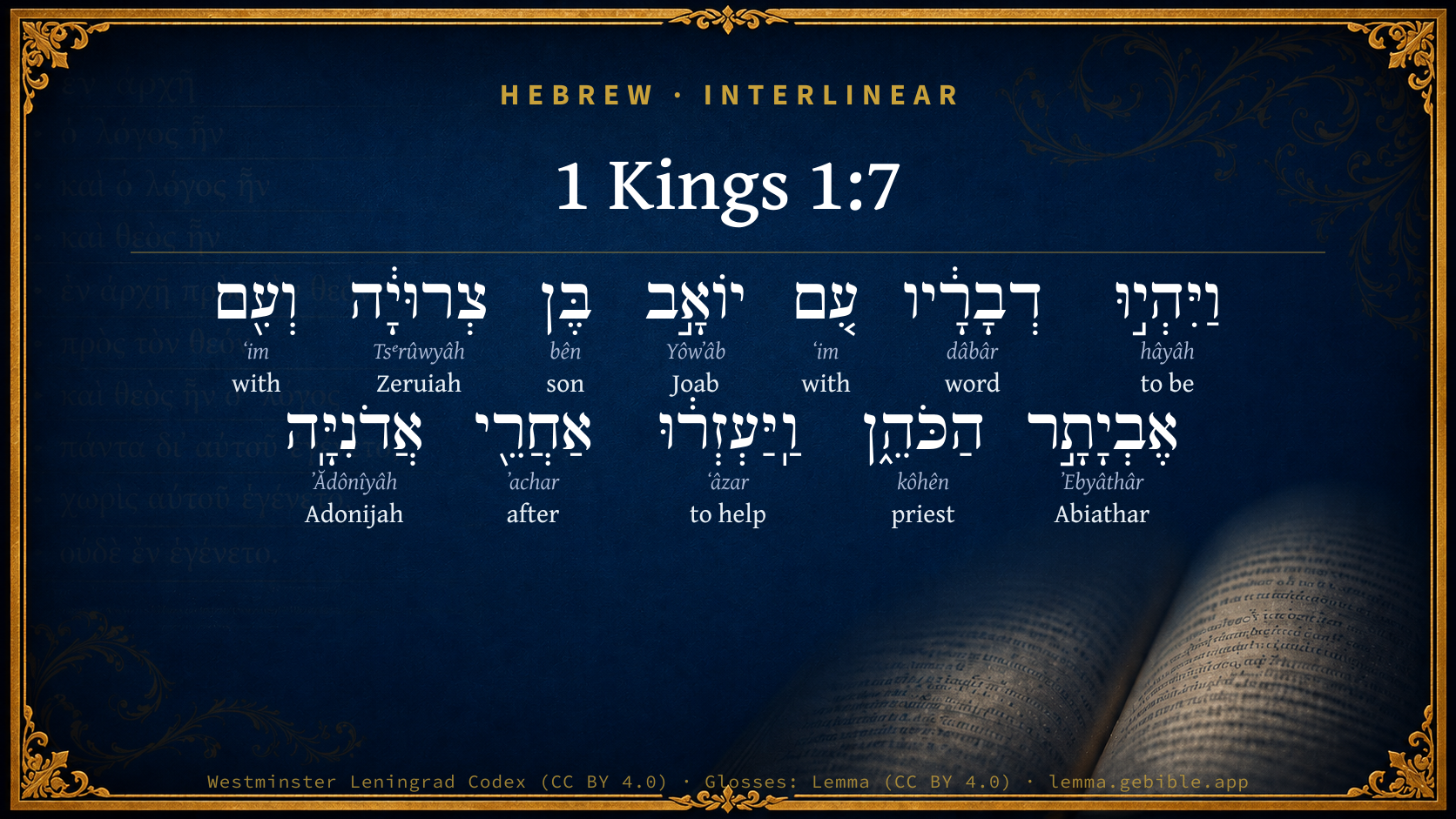
Hebrew (Westminster Leningrad Codex) 1 Kings 1:7 appears in the Hebrew Old Testament. The text above is from the Westminster Leningrad Codex. Each word links to its Strong’s number, a concise gloss, and parsing drawn from the Open Scriptures Hebrew Bible morphology. Click any word for its full Brown-Driver-Briggs (BDB) entry.
Download image
Cite this verse

1 Kings 1:7 (World English Bible). Public Domain. Lemma interlinear Bible study tool, https://lemma.gebible.app/v/1-kings/1/7.

Show BibTeX & RIS
BibTeX
RIS
English Translation
He conferred with Joab the son of Zeruiah, and with Abiathar the priest: and they following Adonijah helped him.
World English Bible · Public Domain
Download a study sheet

One document with this verse’s original text, its word-by-word gloss line, the meaning frame, cross-references with their text, attributed commentary, and full source and license credits — printable, and it pastes into notes with its structure intact.

This verse Autodidact and up

Study sheet (.html) Plain text (.txt)

A passage Seminary Student

Up to 50 verses in one chapter. A passage sheet keeps up to 6 commentary sources and 12 cross-references per verse, in the order this page ranks them, and says so on the sheet whenever that leaves anything out. Ask for a single verse and you get the Autodidact verse sheet above.

Everything on this page stays free to read, with no account — the sheet is a download of what is already on screen, not access to it.

Want to remove ads? Support Godless Engineer
Compare translations 3

The same verse in 3 English versions, stacked beneath the original-language interlinear above. Click any original word for its lexicon entry.

Each is an independent rendering of the whole verse — the interlinear is not word-aligned to these translations.

Highlighted words mark where these versions differ — a whole-verse word diff, not a word-by-word alignment.

  • World English Bible Public Domain
    He conferred with Joab the son of Zeruiah, and with Abiathar the priest: and they following Adonijah helped him.
  • King James Version Public Domain
    And he conferred with Joab the son of Zeruiah, and with Abiathar the priest: and they following Adonijah helped him.
  • unfoldingWord Literal Text CC BY-SA 4.0
    And his words were with Joab, the son of Zeruiah, and with Abiathar the priest. And they helped after Adonijah.

unfoldingWord Literal Text — © unfoldingWord, licensed CC BY-SA 4.0. Word-aligned USFM3 via Door43 (git.door43.org/unfoldingWord/en_ult).

Versions to compare (up to 4)

3 of 4 selected

Show all 18 translations

Every available English version of this verse, each an independent rendering of the whole verse.

  • World English Bible Public Domain
    He conferred with Joab the son of Zeruiah, and with Abiathar the priest: and they following Adonijah helped him.
  • Berean Standard Bible Public Domain
    So Adonijah conferred with Joab son of Zeruiah and with Abiathar the priest, who supported him.
  • Majority Standard Bible Public Domain
    So Adonijah conferred with Joab son of Zeruiah and with Abiathar the priest, who supported him.
  • King James Version Public Domain
    And he conferred with Joab the son of Zeruiah, and with Abiathar the priest: and they following Adonijah helped him.
  • American Standard Version (1901) Public Domain
    And he conferred with Joab the son of Zeruiah, and with Abiathar the priest: and they following Adonijah helped him.
  • Revised Version (1885) Public Domain
    And he conferred with Joab the son of Zeruiah, and with Abiathar the priest: and they following Adonijah helped him.
  • Geneva Bible (1599) Public Domain
    And he tooke counsel of Ioab the sonne of Zeruiah, and of Abiathar the Priest: and they helped forward Adoniiah.
  • Douay-Rheims (1899) Public Domain
    And he conferred with Joab the son of Sarvia, and with Abiathar the priest, who furthered Adonias's side.
  • Young's Literal Translation Public Domain
    And his words are with Joab son of Zeruiah, and with Abiathar the priest, and they help after Adonijah;
  • Literal Standard Version CC BY-SA 4.0
    And his words are with Joab son of Zeruiah, and with Abiathar the priest, and they help after Adonijah;
  • Unlocked Literal Bible CC BY-SA 4.0
    He conferred with Joab son of Zeruiah and with Abiathar the priest. They followed Adonijah and helped him.
  • unfoldingWord Literal Text CC BY-SA 4.0
    And his words were with Joab, the son of Zeruiah, and with Abiathar the priest. And they helped after Adonijah.
  • Darby Bible Public Domain
    And he conferred with Joab the son of Zeruiah, and with Abiathar the priest; and they helped Adonijah and followed [him].
  • World Messianic Bible Public Domain
    He conferred with Joab the son of Zeruiah and with Abiathar the priest; and they followed Adonijah and helped him.
  • Webster's Bible Public Domain
    And he conferred with Joab the son of Zeruiah, and with Abiathar the priest: and they following Adonijah, helped him.
  • Free Bible Version CC BY-SA 4.0
    Adonijah discussed his plan with Joab, son of Zeruiah, and with Abiathar the priest, who agreed to support him.
  • Bible in Basic English Public Domain
    And he had talk with Joab, the son of Zeruiah, and with Abiathar the priest; and they were on his side and gave him their support.
  • JPS Tanakh (1917) Public Domain
    And he conferred with Joab the son of Zeruiah, and with Abiathar the priest; and they following Adonijah helped him.

Literal Standard Version (2020), Covenant Press — licensed CC BY-SA 4.0. Text via the HelloAO Bible API (eBible.org). Unlocked Literal Bible (unfoldingWord) — licensed CC BY-SA 4.0. Text via the HelloAO Bible API (eBible.org). unfoldingWord Literal Text — © unfoldingWord, licensed CC BY-SA 4.0. Word-aligned USFM3 via Door43 (git.door43.org/unfoldingWord/en_ult). Free Bible Version, Dr. Jonathan Gallagher — licensed CC BY-SA 4.0. Text via the HelloAO Bible API (eBible.org).

Word by word

More ways to search: Search by grammar → Find every occurrence → Compare this word →

Practice this passage: Drill this verse → Learn its vocabulary →

צְרוּיָ֔ה
Tsᵉrûwyâh
H6870
“Zeruiah”
Noun, Proper
Part of Speech
Noun
Type
Proper
Full BDB Definition

Origin: pass part from the same as H6875

TWOT: None

Zeruiah = "balsam" - sister of David and mother of the 3 leading heroes of David's army - Abishai, Joab, and Asahel
  1. וַיִּהְי֣וּ hâyâh H1961 “and · to be” Conjunction + Verb, Qal, Sequential Imperfect, 3rd Person, Masculine, Plural
  2. דְבָרָ֔יו dâbâr H1697 “words · his” Noun, Common, Masculine, Plural, Construct + Suffix, Personal, 3rd Person, Masculine, Singular
  3. עִ֚ם ʻim H5973 “with” Preposition
  4. יוֹאָ֣ב Yôwʼâb H3097 “Joab” Noun, Proper
  5. בֶּן bên H1121 “son of” Noun, Common, Masculine, Singular, Construct
  6. וְעִ֖ם ʻim H5973 “and · with” Conjunction + Preposition
  7. אֶבְיָתָ֣ר ʼEbyâthâr H54 “Abiathar” Noun, Proper
  8. הַכֹּהֵ֑ן kôhên H3548 “the · priest” Particle, Definite Article + Noun, Common, Masculine, Singular, Absolute
  9. וַֽיַּעְזְר֔וּ ʻâzar H5826 “and · to help” Conjunction + Verb, Qal, Sequential Imperfect, 3rd Person, Masculine, Plural
  10. אַחֲרֵ֖י ʼachar H310 “after” Preposition
  11. אֲדֹנִיָּֽה ʼĂdônîyâh H138 “Adonijah” Noun, Proper

About this verse

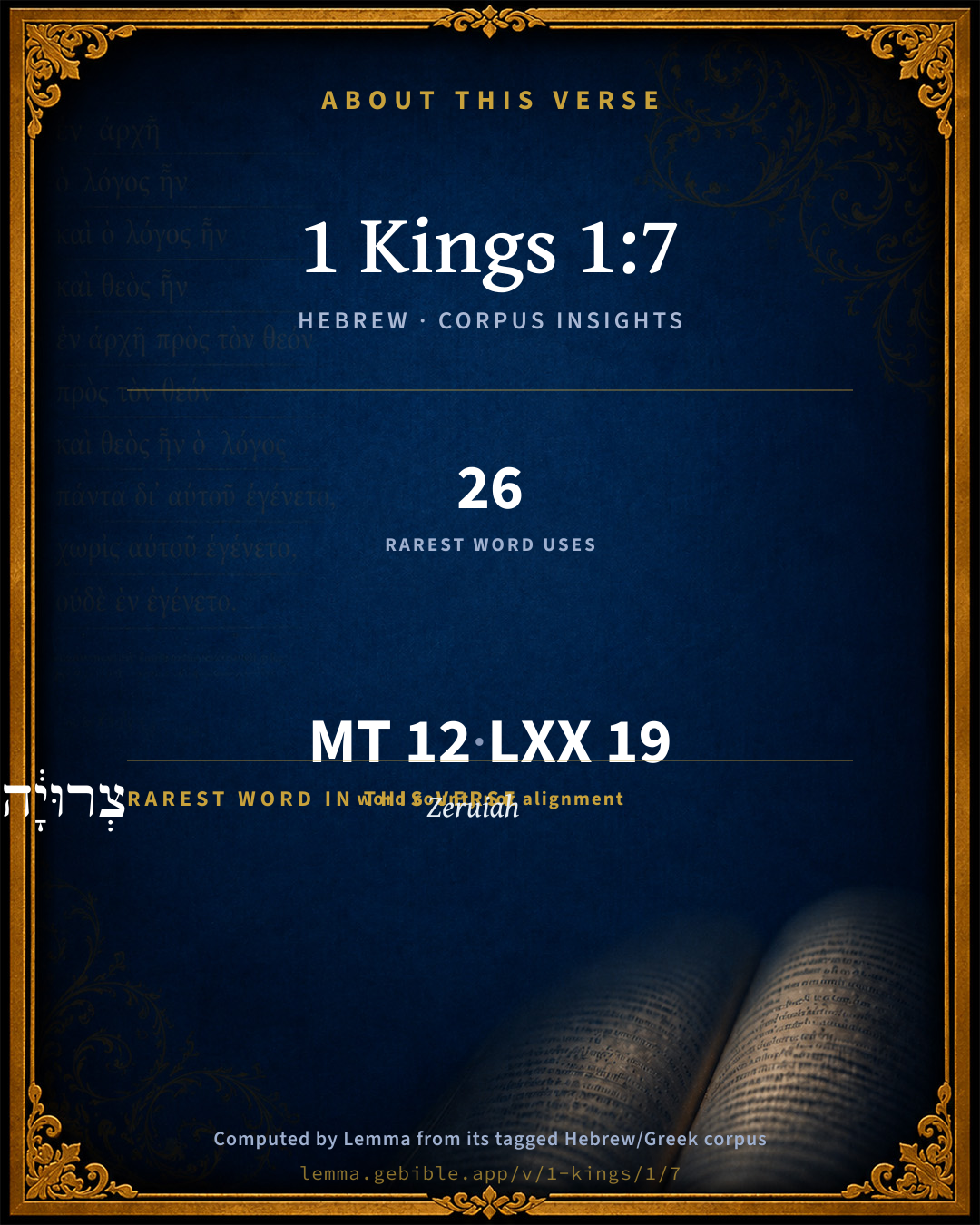
These counts appear in no published source. They are computed here, from the morphology-tagged text and Lemma’s own curated glosses. What Lemma adds →

12
words
11
distinct lemmas
Historical
section

Shared distinctive vocabulary

צְרוּיָ֔ה Zeruiah H6870 occurs in 25 verses of the Hebrew Bible. Also found in:

Grammatical profile

  • 2 verbs
  • 7 nouns
  • 3 prepositions

Verb forms

  • וַיִּהְי֣וּ Qal · Sequential Imperfect
  • וַֽיַּעְזְר֔וּ Qal · Sequential Imperfect

Repetition

A word recurs within this verse — often emphatic in Hebrew:

  • עִ֚ם with H5973 ×2

Hebrew & Septuagint length

In English translation the verse runs 19 words from the Hebrew and 19 from the Septuagint (LXX English) — the same length.

A rough comparison of the two English renderings, which tokenize alike — not a word-level alignment.

Word counts can differ between the Hebrew and the Greek without any difference in meaning — e.g. the Hebrew direct-object marker אֵת has no separate Greek word, and Greek often adds the article ὁ.

In the original languages it is 12 Hebrew tokens and 19 Greek tokens — but the two are counted differently (Hebrew bundles its prefixes and suffixes into one token; the Greek is in lemma form), so that isn’t a like-for-like length.

Cross-references

11

Topical passages linked to 1 Kings 1:7 in the Treasury of Scripture Knowledge — connected by theme and wording, ordered by reader-vote popularity; previews shown in the World English Bible.

  • 2 Samuel 20:25 and Sheva was scribe; and Zadok and Abiathar were priests;
  • 1 Kings 2:22 King Solomon answered his mother, Why do you ask Abishag the Shunammite for Adonijah? ask for him the kingdom also; for he is my elder brother; even for him, and for Abiathar the priest, and for Joab the son of Zeruiah.
  • 1 Samuel 22:20–23 One of the sons of Ahimelech, the son of Ahitub, named Abiathar, escaped, and fled after David.
  • 2 Samuel 8:16 Joab the son of Zeruiah was over the host; and Jehoshaphat the son of Ahilud was recorder;
  • 2 Samuel 15:12 Absalom sent for Ahithophel the Gilonite, David's counselor, from his city, even from Giloh, while he was offering the sacrifices. The conspiracy was strong; for the people increased continually with Absalom.
  • 2 Samuel 15:24–29 Behold, Zadok also [came], and all the Levites with him, bearing the ark of the covenant of God; and they set down the ark of God; and Abiathar went up, until all the people had done passing out of the city.
  • 2 Samuel 15:35 Don't you have Zadok and Abiathar the priests there with you? therefore it shall be, that whatever thing you shall hear out of the king's house, you shall tell it to Zadok and Abiathar the priests.
  • 2 Samuel 20:23 Now Joab was over all the host of Israel; and Benaiah the son of Jehoiada was over the Cherethites and over the Pelethites;
  • 1 Kings 2:26–35 To Abiathar the priest said the king, Get you to Anathoth, to your own fields; for you are worthy of death: but I will not at this time put you to death, because you bear the ark of the Lord Yahweh before David my father, and because you were afflicted in all in which my father was afflicted.
  • 1 Chronicles 11:6 David said, Whoever strikes the Jebusites first shall be chief and captain. Joab the son of Zeruiah went up first, and was made chief.
  • Psalms 2:2 The kings of the earth take a stand, And the rulers take counsel together, Against Yahweh, and against his anointed, saying,

Cross-references courtesy of OpenBible.info (CC BY 4.0).

Hebrew and Greek witnesses Masoretic Hebrew ↔ Greek Septuagint

The same verse in the two great witnesses to the Old Testament, shown verse-for-verse.

These are two independent witnesses, not word-aligned to each other, and the Septuagint is shown in lemma (dictionary) form.

Hebrew 1 Kings 1:7 Masoretic · Westminster Leningrad Codex

וַיִּהְי֣וּ דְבָרָ֔יו עִ֚ם יוֹאָ֣ב בֶּן צְרוּיָ֔ה וְעִ֖ם אֶבְיָתָ֣ר הַכֹּהֵ֑ן וַֽיַּעְזְר֔וּ אַחֲרֵ֖י אֲדֹנִיָּֽה

He conferred with Joab the son of Zeruiah, and with Abiathar the priest: and they following Adonijah helped him.

World English Bible · Public Domain

Greek LXX 1 Kings 1:7 Septuagint · lemma form

καί γίγνομαι ὁ λόγος αὐτός μετά ιωαβ ὁ υἱός σαρουια καί μετά αβιαθαρ ὁ ἱερεύς καί βοηθέω ὀπίσω αδωνίας

And he conferred with Joab the son of Saruia, and with Abiathar the priest, and they followed after Adonias.

LXX2012 (modern English Septuagint) · Public Domain

Hebrew: Westminster Leningrad Codex (CC BY 4.0). Greek: Septuagint (public domain); English from LXX2012 (modern English Septuagint) (Public Domain). How the Septuagint differs from the Hebrew →

Targum (Aramaic paraphrase)

1

The Targum is the ancient Jewish Aramaic paraphrase of the Hebrew Scriptures — an interpretive translation, not the Hebrew text itself. Onkelos (literal) and Pseudo-Jonathan (expansive) render the Torah, and Jonathan the Prophets. Coverage is partial: where no permissively-licensed English translation exists for a verse, only the Aramaic is shown. This is verse-level text, not a word-by-word alignment to the Hebrew.

  1. Targum Jonathan Prophets (Joshua–Malachi)
    וַהֲווֹ פִּתְגָמוֹהִי בְּעֵצָה עִם יוֹאָב בַּר צְרוּיָה וְעִם אֶבְיָתָר כַּהֲנָא וְסַעְדִין בָּתַר אֲדוֹנִיָה:

    (no public-domain English translation for this verse)

    Targum Jonathan — Aramaic: “Mikraot Gedolot” (public domain). English: “Sefaria Community Translation” (CC0 1.0 (public-domain dedication)); “London "Chaldee Paraphrase," 1871” (public domain). Text via Sefaria.

Commentary

Notes on 1 Kings 1:7 from classic Christian and Jewish commentators (each source and its license shown beneath its notes). The classic Christian expositions comment on the surrounding passage and are grouped to its opening verse, so a note may address several verses; the Jewish commentaries on the Tanakh (Rashi and others) are per-verse, so they appear only where the commentator wrote on this verse.

Lemma curates 59 commentaries, every one of them public domain or Creative Commons licensed, each selected and text-cleaned for this edition rather than reprinted as found. About our sources →

Trapp's Complete Commentary

John Trapp

1Ki 1:7 And he conferred with Joab the son of Zeruiah, and with Abiathar the priest: and they following Adonijah helped [him].

Ver. 7. And he conferred with Joab, &c.] Seeking to draw these grandees to his party, whom he knew to be discontented, and therefore more easily wrought upon. Joab was conscious to himself of the treacherous murdering of Abner and Amasa; for which and the death of Absalom, David bare him still an aching tooth: and if he stayed till David appointed a successor in the kingdom, who knew what might follow? Abiathar haply was displeased that Zadok was so much favoured: and might fear the fulfilling of that prophecy concerning the overthrow of Eli’s house, of which he was. But what saith an ancient? Divinum consilium dum devitatur, impletur; humana sapientia, dum reluctatur, comprehenditur. {a} There are "many devices in a man’s heart: nevertheless the counsel of the Lord, that shall stand." {Pro 19:21}

{a} Greg.

John Trapp, A Commentary or Exposition upon All the Books of the Old and New Testament (1647–1656) — public domain. Text from a community e-Sword module.

Tyndale Open Study Notes

Tyndale Open Resources

1:7 Joab, David’s military commander, and Abiathar, the high priest, gave Adonijah powerful military and religious backing in his pursuit of the throne.

Tyndale Open Study Notes — © Tyndale Open Resources, licensed CC BY-SA 4.0. Text via the HelloAO Bible API.

Geneva Bible (1599)

Geneva Bible translators

Hebrew, his words were with Joab.

They took his part and followed him.

Geneva Bible (1599) marginal notes — public domain. Text via Bolls.life.

Jamieson, Fausset & Brown

Robert Jamieson, A. R. Fausset & David Brown

he conferred with Joab--The anxiety of Adonijah to secure the influence of a leader so bold, enterprising, and popular with the army was natural, and the accession of the hoary commander is easily accounted for from his recent grudge at the king (see on Sa2 19:13).

and with Abiathar the priest--His influence was as great over the priests and Levites--a powerful body in the kingdom--as that of Joab over the troops. It might be that both of them thought the crown belonged to Adonijah by right of primogeniture, from his mature age and the general expectations of the people (Kg1 2:15).

Jamieson, Fausset & Brown — Commentary Critical and Explanatory on the Whole Bible (1871) — public domain (CC PDM 1.0). Text via the HelloAO Bible API.

Adam Clarke's Commentary

Verse 7. And he conferred with Joab] Joab well knew, if he made the new king, he would necessarily be continued in the command of the army, and so govern him.

Adam Clarke's Commentary on the Bible (1810–1826) — public domain. Text from a community e-Sword/MySword module.

Ellicott's Commentary for English Readers

(7) Joab.—The books of Samuel have brought out clearly the career and character of Joab, as being (in some degree like Abner) a professed soldier, raised to a formidable and half-independent power by the incessant wars of Saul and David. He stands out in consistent portraiture throughout, as a bold, hard, and unscrupulous man; in his relations to the king often imperious and disobedient; but nevertheless an absolutely loyal servant, to whom, in great degree, the establishment of David’s throne was due, and who, moreover (as is shown by his remonstrance against the numbering of the people, recorded in 2Sa_24:3; 1Ch_21:3; 1Ch_21:6), was not without some right instincts of policy and of duty to God.

Abiathar the priest.—Of Abiathar we also know that he had been the companion of all David’s adversity, and of his reign at Hebron (1Sa_22:20; 1Sa_23:6; 1Sa_23:9; 1Sa_30:7; 2Sa_2:1-4); that he was in-installed (with Zadok) as high priest at Jerusalem, and remained faithful to David in the rebellion of Absalom (2Sa_8:17; 2Sa_15:24-29).

The adhesion of these two faithful servants of David, as also of “the king’s sons,” and “the men of Judah, the king’s servants,” to the rash usurpation of Adonijah, seems strange at first sight. Probably Joab had never recovered his position in the king’s favour since the death of Absalom; and it is possible that the evident growth of despotic power and state in David’s latter years may have alienated from him the trusty friends of earlier and simpler days. But the true explanation would seem to be, that the attempt of Adonijah was not viewed as an actual rebellion. Solomon was young; David’s designation of him for the succession might be represented as the favouritism of dotage; and the assumption of the crown by the eldest son, a man in the prime of life and of popular qualities, might seem not only justifiable, but even right and expedient.

A Bible Commentary for English Readers, edited by Charles John Ellicott (1878–1897) — public domain. Text from a community e-Sword module.

The Cambridge Bible for Schools and Colleges

gen. ed. J. J. S. Perowne

7. Joab the son of Zeruiah] Zeruiah was David’s sister, and Joab the eldest of her three sons, and a man of much authority and influence during David’s reign. He became captain of the host (as we should say, commander in chief) after the conquest of Jebus (1Ch_11:6), and served David faithfully in the main until this time. But he held David’s secret in the matter of Uriah, and accordingly defied him, when it suited his purpose. His greatest offence against the king was the slaughter of Absalom, whom he killed in defiance of David’s order. (2Sa_18:14.)

Abiathar the priest] This was the son of that Ahimelech who, with all his family except Abiathar, was put to death by Saul, when Doeg the Edomite informed him that the shewbread from the tabernacle at Nob had been given to David (1 Samuel 21, 22.). Abiathar then escaped to David and had remained with him through all his troubles until this time, when, it may be through jealousy of Zadok, he sided with Adonijah against Solomon.

they following Adonijah helped him] Lit. ‘They helped after Adonijah.’ Joab had his own thoughts about the orders which David might leave at his death, and Abiathar his jealousy, and both no doubt felt that by their conduct, if it were successful, they were making Adonijah for evermore their debtor.

The Cambridge Bible for Schools and Colleges (gen. ed. J. J. S. Perowne; Cambridge University Press, 1878–1918) — public domain. Text from a community e-Sword module.

John Gill's Exposition

And he conferred with Joab the son of Zeruiah, and with Abiathar the priest,.... About getting the kingdom into his hands: and they were very proper persons to consult with, who, if gained to his interest, might be of great service, the one being the general of the army, and so had a great interest in the soldiery, with whom he could make way for him, and defend him, and the other was the high priest, who might be thought to have a great share in the affections of the people, and whose office it was to anoint the king; and he might the rather apply to them, knowing them to be, on some accounts, discontented persons:

and they following Adonijah, helped him; they took on his side; Joab knowing David's hatred of him on account of his murder of Abner and Amasa, and especially for his slaying his son Absalom, and his insolent behaviour towards him, and perhaps he might fear, or had an him of what he had charged Solomon with concerning him; and Abiathar, who saw plainly that the priesthood in Eli's family was declining, and that Zadok was the favourite priest with David, and in all probability would be with Solomon; all which might influence these two persons to join Adonijah, and who, by so doing, greatly encouraged him, and many others to flock to him, which much helped and served his cause.

John Gill's Exposition of the Whole Bible (1746–1763) — public domain (CC PDM 1.0). Text via the HelloAO Bible API.

Albert Barnes' Notes on the Bible

Joab’s defection on this occasion, after his faithful adherence to David during the troubles caused by Absalom 2 Sam. 18:2-17, may be accounted for by his fear that Solomon would be a “man of rest” 1Ch 22:9 and by his preference for the character of Adonijah. He may also have thought that Adonijah, as the eldest son 1Ki 1:5, had almost a right to succeed.

Abiathar’s defection is still more surprising than Joab’s. For his history, see 1Sa 22:20 note. Hereto, David and he had been the firmest of friends. It has been conjectured that he had grown jealous of Zadok, and feared being supplanted by him.

Albert Barnes' Notes on the Bible (1834–1885) — public domain. Text from a community e-Sword/MySword module.

Haydock's Catholic Bible Commentary

Side. For their own interest, and because they supposed that the throne belonged of course to him. (Menochius) --- This was the natural privilege, when no other disposition was made by God, or by the kings who succeeded David. They did not esteem themselves bound to leave the crown to their eldest sons. Hitherto God had made choice himself, as he had required, Deuteronomy xvii. 15. In favour of David, he pleased to grant sovereignty to his descendants. But the king expected to declare which he preferred, in case he chose to deviate from the natural order, ver. 20.

George Leo Haydock (1774–1849), Haydock's Catholic Family Bible and Commentary, 1859 edition — public domain. Excludes Psalms (Douay-Rheims chapter numbering differs from Protestant) and Deuterocanonical books (Catholic canon only).

Matthew Poole's English Annotations

Either because they thought the right of the crown was his; or rather, from secret grudges, because they perceived themselves neglected by David, and possibly by Solomon too; and from carnal policy, that they might secure and advance their own interest, which they saw to be in manifest danger.

Matthew Poole's English Annotations on the Holy Bible (1683–1685) — public domain. Text from a community e-Sword/MySword module.

Whedon's Commentary on the Bible

Daniel D. Whedon

7. He conferred with Joab — Joab doubtless felt that he had lost the favour of David, (compare 2Sa_19:13,) but hoped to continue captain of the host if his help raised Adonijah to the throne, and therefore readily entered into the conspiracy.

And with Abiathar — To many it has seemed strange that this priest, the friend of David in his wanderings, should have countenanced such conspiracy. His action probably grew out of jealousy towards Zadok, his associate in office, who received so much favour from David.

Daniel D. Whedon (gen. ed.), Commentary on the Old and New Testaments (1874–1909) — public domain. Text from a community e-Sword module.

The Pulpit Commentary

And he conferred Hebrews his words were" 2Sa_3:17, Hebrews with Joab Joab"s share in this conspiracy, despite his hitherto unwavering fidelity to David, is easily accounted for. He must have known that he was under David"s displeasure, and he must have feared, too, that he would be an object of dislike and distrust to a successor trained, as Solomon had been, under David"s and Nathan"s immediate influence. He could hardly be unconscious that under a new reign his position unless he took measures to assure it would be a precarious one. He resolved, therefore, to secure himself by helping Adonijah to his throne. It is also highly probable that Adonijah"s ambitious character was much more to his liking than that of the pious and pacific Solomon. Adonijah"s physical qualities, again, would no doubt commend him to this rough soldier, who may also have sympathised with him as the eldest son. And there may have been other circumstances (such, e.g., as close personal friendship), of which we know nothing the son of Zeruiah, and with Abiathar in 2Sa_8:17, we read that "Ahimelech son of Abiathar" was priest. Similarly, 1Ch_24:6. An obvious transposition the priest. "Abiathar"s defection is still more surprising" than Joab"s (Rawlinson). It is certainly remarkable, when we consider the close ties which subsisted between Abiathar and David, ties which were cemented by the blood of eighty-five persons, (1Sa_22:18) and strengthened by the many afflictions which they had shared in common (ibid. ver. 23 to 28; 2Sa_15:24-29) that he should have joined in a plot to defeat David"s cherished hopes and plans plans, too, which he must surely have known, had the sanction of religion, (1Ch_28:5) and there must have been some powerful motive to account for this. May we not find one in jealousy of Zadok, who had for some time been associated with him in the priesthood, who is generally mentioned first (2Sa_8:17 2Sa_15:29, 2Sa_15:35, 36 20:25) as if he were the more important and influential, and whose advancement, after the prophecy of: 1Sa_2:33-36, Abiathar could not contemplate without suspicion and dread. Is it not highly probable that among the "words" Adonijah had with him was a promise to restore the priesthood to his family exclusively, as the reward of his allegiance and they following Adonijah helped him (lit., as marg., "helped after Adonijah." It is a pregnant construction, "they aided having followed the side of Adonijah" (Gesenius). And now, O Lord my Cod, thou hast made thy servant king instead of David my father; and I am but Heb. and I a little child: These words are generally understood as indicating Solomon"s humility rather than his age. No doubt, there is some exaggeration in the expression, which manifestly is not to be taken au pied de la lettre; at the same time it is questionable whether such words would be used of himself by a young man of twenty, which Solomon is commonly supposed to have been. See 1Ki_2:2, and 12:8 I know not how to go out or come in. The same phrase is found in the Pentateuch, Deu_28:6 Deu_31:2. Also 1Sa_18:13; 2Sa_3:25; Psa_121:8. It is the formula for expressing behaviour, conduct, the outward life of man.

The Pulpit Commentary (1880–1919), ed. H.D.M. Spence-Jones & Joseph S. Exell — public domain. Text from a community e-Sword module.

John Wesley's Explanatory Notes

They helped - Either because they thought the right of the crown was his: or to secure and advance their own interest. It seems God left them to themselves, to correct them for former miscarriages, with a rod of their own making.

John Wesley, Explanatory Notes Upon the Whole Bible (1754–1765) — public domain. Text via the GEBible commentary corpus.

unfoldingWord translationNotes

Door43 World Missions Community

He conferred with Joab

"Adonijah discussed his plans with Joab"

Joab ... Zeruiah ... Abiathar ... Adonijah ... Zadok ... Benaiah ... Jehoiada ... Nathan ... Shimei ... Rei

These are men's names. (See: How to Translate Names)

followed Adonijah and helped him

"supported and helped Adonijah" or "promised to support and help Adonijah"

translationWords

Joab

Abiathar

priest

Zadok

Benaiah

Nathan

prophet

Shimei

unfoldingWord translationNotes — © Distant Shores Media and the Door43 World Missions Community, licensed CC BY-SA 4.0. Source: git.door43.org/Door43/en_tn.

Rashi

Rabbi Shlomo Yitzchaki (Rashi)

With Yoav ben Tseruyah. Because he knew that Dovid bore a grudge against him for having killed Avner, Amasa, and Avsholom; and that he would eventually charge his son, who would reign in his place, to deal with him. He [Yoav] therefore wanted that this one [Adoniyahu] should reign through his assistance so that he would favor him.

And with Evyosor the kohein. He was dismissed from the priesthood at the time when Dovid escaped from Yerusholayim on account of Avsholom, when he [Evyosor] consulted the Urim and Tumim and was unsuccessful as it is stated, “And Evyosor went up.” He [Evyosor] was a descendant of Eili. And he knew that he would not serve in the days of Shlomo, for it was stated to Eili, “And I will appoint for Myself a faithful kohein... and he will serve before My anointed one...” He [Evyosor] wanted that this one [Adoniyah become king] through his assistance.

Rashi on the Tanakh — English translations: “The Judaica Press complete Tanach with Rashi, translated by A. J. Rosenberg” (CC BY 4.0); “Pentateuch with Rashi's commentary by M. Rosenbaum and A.M. Silbermann, 1929-1934” (public domain); “The Metsudah Tanach series, Lakewood, N.J” (CC BY 4.0); and “The Book of Joshua, Metsudah Publications, 1997” (CC BY 4.0). Text via Sefaria.

Lesson kit

Teaching starters — assembled from the data on this page, not authored interpretation. Every prompt links to the verse data it draws on. Edit before teaching.

1 Kings, in the Historical, opens this verse with 12 words (11 distinct Hebrew lemmas). Its most distinctive word is Tsᵉrûwyâh (“Zeruiah”). A historical commentator’s framing appears above. Read the whole chapter for the surrounding context.

Discussion questions

  1. How does “Zeruiah” (Tsᵉrûwyâh) shape what this verse is saying?
  2. How does 1 Samuel 26:6, which shares the word «Zeruiah», read alongside this verse?
  3. What does the repetition of “with” (2× in this one verse) do in this verse?
  4. The translations on this page render this verse differently — a whole-verse word diff, not a word-by-word alignment. What might account for the different wordings?
  5. «וַיִּהְי֣וּ» is a Qal Sequential Imperfect verb. How does that grammatical form shape the action described?
  6. Compare how Trapp's Complete Commentary and Tyndale Open Study Notes read this verse. Where do they agree or differ?

Things to notice

Reading settings

Reading text

Shown beneath each verse's original-language words.

Old Testament
Old Testament edition

Read the OT as the Masoretic Hebrew (MT) or the Greek Septuagint (LXX).

English shown for the Greek Septuagint (in the Hebrew ↔ Greek comparison).

Comparing translations? Open the Compare panel on any verse page to stack up to four side by side.