Galatians 5:26

Greek (Tischendorf 8th ed.) Galatians 5:26 appears in the Greek New Testament. The text above is from the Tischendorf 8th edition. Each word links to its Strong’s number and a concise gloss. Click any word for its full Thayer’s Greek Lexicon entry.
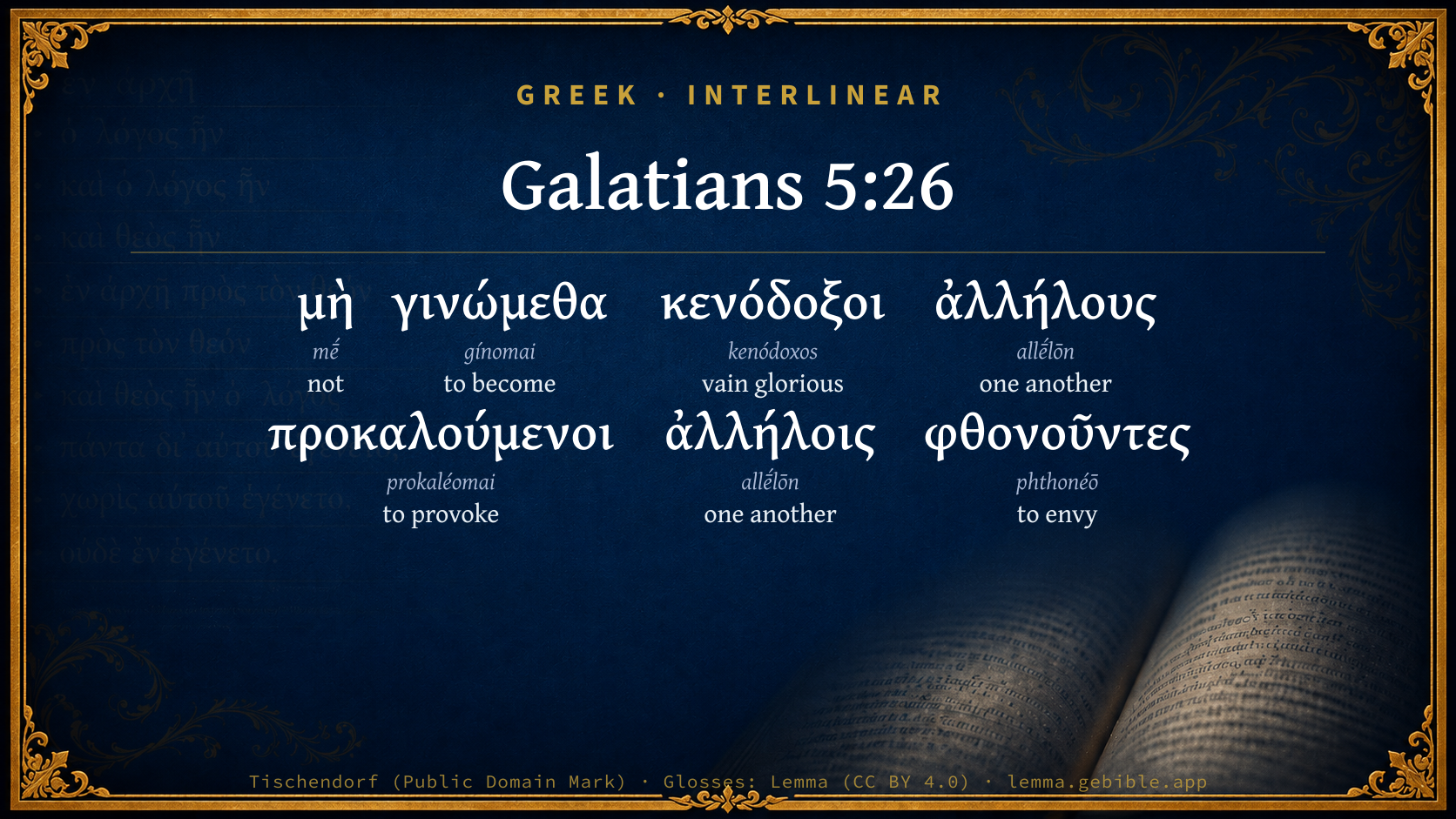
Download image
Cite this verse

Galatians 5:26 (World English Bible). Public Domain. Lemma interlinear Bible study tool, https://lemma.gebible.app/v/galatians/5/26.

Show BibTeX & RIS
BibTeX
RIS
English Translation
Let's not become conceited, provoking one another, and envying one another.
World English Bible · Public Domain
Highlights
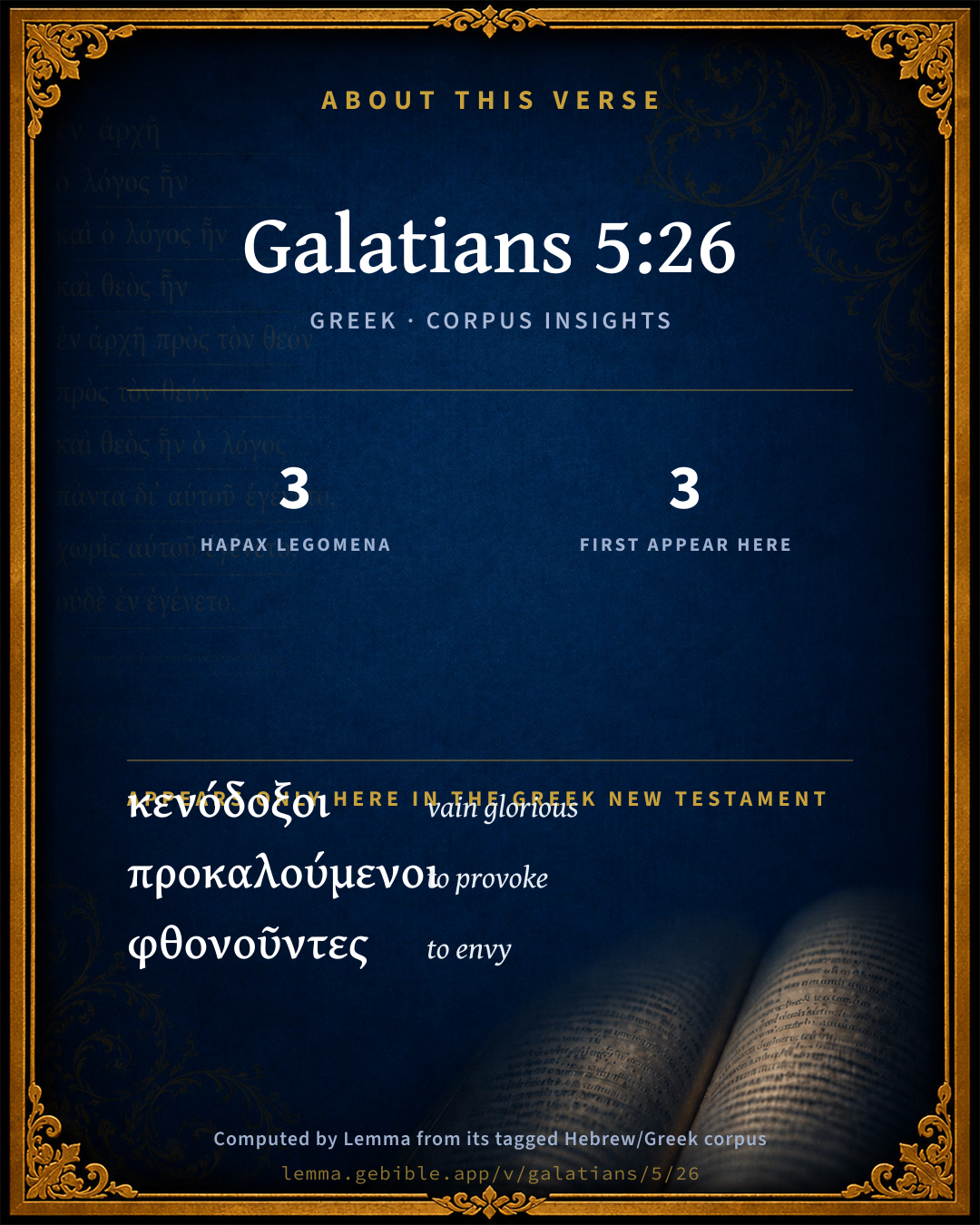
  • 3 hapax legomena — only here in the Greek New Testament
  • 3 first appearances in the Greek New Testament
Full analysis ↓
Download a study sheet

One document with this verse’s original text, its word-by-word gloss line, the meaning frame, cross-references with their text, attributed commentary, and full source and license credits — printable, and it pastes into notes with its structure intact.

This verse Autodidact and up

Study sheet (.html) Plain text (.txt)

A passage Seminary Student

Up to 50 verses in one chapter. A passage sheet keeps up to 6 commentary sources and 12 cross-references per verse, in the order this page ranks them, and says so on the sheet whenever that leaves anything out. Ask for a single verse and you get the Autodidact verse sheet above.

Everything on this page stays free to read, with no account — the sheet is a download of what is already on screen, not access to it.

Want to remove ads? Support Godless Engineer
Compare translations 3

The same verse in 3 English versions, stacked beneath the original-language interlinear above. Click any original word for its lexicon entry.

Each is an independent rendering of the whole verse — the interlinear is not word-aligned to these translations.

Highlighted words mark where these versions differ — a whole-verse word diff, not a word-by-word alignment.

  • World English Bible Public Domain
    Let's not become conceited, provoking one another, and envying one another.
  • King James Version Public Domain
    Let us not be desirous of vain glory, provoking one another, envying one another.
  • unfoldingWord Literal Text CC BY-SA 4.0
    Let us not become boastful, provoking one another, envying one another.

unfoldingWord Literal Text — © unfoldingWord, licensed CC BY-SA 4.0. Word-aligned USFM3 via Door43 (git.door43.org/unfoldingWord/en_ult).

Versions to compare (up to 4)

3 of 4 selected

Show all 19 translations

Every available English version of this verse, each an independent rendering of the whole verse.

  • World English Bible Public Domain
    Let's not become conceited, provoking one another, and envying one another.
  • Berean Standard Bible Public Domain
    Let us not become conceited, provoking and envying one another.
  • Majority Standard Bible Public Domain
    Let us not become conceited, provoking and envying one another.
  • King James Version Public Domain
    Let us not be desirous of vain glory, provoking one another, envying one another.
  • American Standard Version (1901) Public Domain
    Let us not become vainglorious, provoking one another, envying one another.
  • Revised Version (1885) Public Domain
    Let us not be vainglorious, provoking one another, envying one another.
  • Geneva Bible (1599) Public Domain
    Let vs not be desirous of vaine glorie, prouoking one another, enuying one another.
  • Douay-Rheims (1899) Public Domain
    Let us not be made desirous of vain glory, provoking one another, envying on another.
  • Young's Literal Translation Public Domain
    let us not become vain-glorious -- one another provoking, one another envying!
  • Literal Standard Version CC BY-SA 4.0
    let us not become vainglorious—provoking one another, envying one another!
  • Unlocked Literal Bible CC BY-SA 4.0
    Let us not become conceited, provoking one another, envying one another.
  • unfoldingWord Literal Text CC BY-SA 4.0
    Let us not become boastful, provoking one another, envying one another.
  • Darby Bible Public Domain
    Let us not become vain-glorious, provoking one another, envying one another.
  • World Messianic Bible Public Domain
    Let’s not become conceited, provoking one another, and envying one another.
  • Webster's Bible Public Domain
    Let us not be desirous of vain-glory, provoking one another, envying one another.
  • Free Bible Version CC BY-SA 4.0
    Let's not become boastful, or irritate and envy one another.
  • Bible in Basic English Public Domain
    Let us not be full of self-glory, making one another angry, having envy of one another.
  • Text-Critical English NT CC BY 4.0
    Let us not become conceited, provoking one another and envying one another.
  • Tyndale New Testament (1534) Public Domain
    Let vs not be vayne glorious provokinge one another and envyinge one another.

Literal Standard Version (2020), Covenant Press — licensed CC BY-SA 4.0. Text via the HelloAO Bible API (eBible.org). Unlocked Literal Bible (unfoldingWord) — licensed CC BY-SA 4.0. Text via the HelloAO Bible API (eBible.org). unfoldingWord Literal Text — © unfoldingWord, licensed CC BY-SA 4.0. Word-aligned USFM3 via Door43 (git.door43.org/unfoldingWord/en_ult). Free Bible Version, Dr. Jonathan Gallagher — licensed CC BY-SA 4.0. Text via the HelloAO Bible API (eBible.org).

Word by word

More ways to search: Search by grammar → Find every occurrence → Compare this word →

Practice this passage: Drill this verse → Learn its vocabulary →

About this verse

These counts appear in no published source. They are computed here, from the morphology-tagged text and Lemma’s own curated glosses. What Lemma adds →

7
words
6
distinct lemmas
Pauline Epistles
section

Notable vocabulary

3 hapax legomena — words that appear only here in the entire Greek New Testament:

  • κενόδοξοι vain glorious G2755
  • προκαλούμενοι to provoke G4292
  • φθονοῦντες to envy G5354

First appearance in Scripture

These words make their first canonical appearance in the Greek New Testament here:

  • κενόδοξοι vain glorious G2755
  • προκαλούμενοι to provoke G4292
  • φθονοῦντες to envy G5354

Repetition

A word recurs within this verse:

  • ἀλλήλους one another G240 ×2

Cross-references

7

Topical passages linked to Galatians 5:26 in the Treasury of Scripture Knowledge — connected by theme and wording, ordered by reader-vote popularity; previews shown in the World English Bible.

  • James 3:14–16 But if you have bitter jealousy and selfish ambition in your heart, don't boast and don't lie against the truth.
  • Philippians 2:1–3 If there is therefore any exhortation in Christ, if any consolation of love, if any fellowship of the Spirit, if any tender mercies and compassion,
  • James 4:16 But now you glory in your boasting. All such boasting is evil.
  • 1 Corinthians 3:7 So then neither he who plants is anything, nor he who waters, but God who gives the increase.
  • Luke 14:10 But when you are invited, go and sit in the lowest place, so that when he who invited you comes, he may tell you, 'Friend, move up higher.' Then you will be honored in the presence of all who sit at the table with you.
  • Galatians 5:15 But if you bite and devour one another, be careful that you don't consume one another.
  • 1 Peter 5:5 Likewise, you younger ones, be subject to the elder. Yes, all of you gird yourselves with humility, to subject yourselves to one another; for "God resists the proud, but gives grace to the humble."

Cross-references courtesy of OpenBible.info (CC BY 4.0).

Commentary

Notes on Galatians 5:26 from classic Christian and Jewish commentators (each source and its license shown beneath its notes). The classic Christian expositions comment on the surrounding passage and are grouped to its opening verse, so a note may address several verses; the Jewish commentaries on the Tanakh (Rashi and others) are per-verse, so they appear only where the commentator wrote on this verse.

Lemma curates 59 commentaries, every one of them public domain or Creative Commons licensed, each selected and text-cleaned for this edition rather than reprinted as found. About our sources →

The Biblical Illustrator

Joseph S. Exell

Gal_5:26

Let us not be desirous of vainglory, provoking one another, envying one another.

I. Disunion may exist in a Christian community.

II. Entire sympathy with Christ will heighten mans appreciation of man without selfseeking.

III. Christianity is the only humanizing and fraternizing religion. Iv. Self-seeking is in utter antagonism to the spirit of Christ.

V. Christianity never encourages a degrading view of human nature.

1. Pauls appeal is for unanimity.

2. Want of unanimity is a reflection on the uniting force. (J. Parker, D. D.)

Vainglory

I. What it is. A branch of pride which makes men refer all they have or can do to show their own private glory and advancement.

II. Why the Galatians were admonished of it? They Were adorned with many excellences, and those who are so favoured are frequently the most vainglorious (2Co_12:7; Mat_6:5). Other vices feed on evil; this on good. For a man will be proud sometimes, even because he is not proud.

III. Where is it to be found?

1. In a Church where men make a great show of piety to be praised of men, but not at home to be praised of God.

2. In the world, for honour and renown.

IV. What is the remedy?

1. Meditation on these facts.

(1) God resisteth the proud, etc. (1Pe_5:5).

(2) It is the work of the devil to puff up that he may pull down; but God abases that He may exalt.

(3) Vainglory is a sure mark of impiety (Joh_5:44).

2. Practice.

(1) Acknowledge Gods majesty and our own vileness.

(2) Gods grace and our own indebtedness.

(3) Approve ourselves to God first.

(4) When reviled, be content; when praised, take heed. (W. Perkins.)

Vainglory

I. Manifests itself in--

1. Display.

2. Boasting.

3. Presumption.

4. Insolence.

5. Depreciation of others.

II. Springs from--

1. Conceit.

2. Ignorance.

3. Contempt of man.

4. Forgetfulness of God.

III. Leads to--

1. Extravagance.

2. Dishonesty.

3. Humiliation,

4. Ruin. (J. W. Burns.)

Unworthy boasts

It would be consolatory could we think this exhortation, though necessary in the apostles time, had become unnecessary in ours. But, alas, how different is the truth! How much vainglorying is there among the professors of the name of Christ, even among those of whom charity obliges us to hope that their profession is genuine! How do they glory in their distinctions! One boasts of his connection with a rich and powerful, ancient and venerable establishment; another glories in his being a Dissenter. One boasts of the imposing splendour, and another glories in the primitive simplicity, of their respective modes of worship. Even far less discernible marks of distinction become grounds of glorification, and this provokes to angry controversy, and this again produces strife, jealousy, enmity, malignity. Were we more spiritual it would be otherwise. We should glory chiefly in the grand principles of Christian truth, in which all really good men are agreed; and our attachment to these would produce attachments to all who really believe them. While every man sought after, and endeavoured to communicate to his brother those views of truth and duty which he conceived he had obtained from his Bible--speaking the truth in love--there would be no provoking one another, except to love and good works; and instead of envying and hating one another, there would be general edification of the body in love. (John Brown, D. D.)

Love of vainglory

Love of vainglory is a common vice the whole world through, in all conditions. No village so small but there be one or two peasants therein, that will fain be taken for wiser and better than the rest. It is so pleasant to be pointed at with the finger and hear it said: See, there is a man that is fit for anything! This vice is common, yet nowhere does it such harm as to those who fulfil a spiritual function and service in the Church. (Luther.)

Vainglory

I recollect a little town where there was a chapel, the people connected with which thought that if they could only buy a chandelier that was on sale, they would cut out all the other chapels entirely, and everybody would feel that they were made weighty and respectable people, and that the place would be filled with people to see the chandelier. I believe for a time it was, but its light grew dim, and they found that was not the way in which the light of the kingdom of God was to be spread. (C. H. Spurgeon.)

The Biblical Illustrator, edited by Joseph S. Exell (c. 1880s–1900s) — public domain. Text from a community e-Sword module.

Tyndale Open Study Notes

Tyndale Open Resources

5:26 The Galatian church was apparently having trouble with factions (see also study note on 5:20; cp. 1 Cor 3) instead of following the Spirit’s leading.

Tyndale Open Study Notes — © Tyndale Open Resources, licensed CC BY-SA 4.0. Text via the HelloAO Bible API.

Bengel's Gnomon

Johann Albrecht Bengel

Gal 5:26. Μὴ γινώμεθα, let us not become [Engl. Vers., not so well, be]) Those who do not carefully walk in the Spirit, fall in the next place into the desire of vain-glory, of which two effects are here mentioned.—κενόδοξοι) See Chrys. de Sacerd.[58] § 587.—προκαλούμενοι, provoking) to envy. The relative exists on the part of [has reference to] the stronger.—φθονοῦντες, envying) The correlative exists on the part of [has reference to] the weaker.

[58] What then, says he, is the food of those wild beasts? (he means the affections of the soul): the food of vain-glory (κενοδοξίας) is honour and praise; and of folly (ἀπονοίας), the greatness of power and authority; and of envy (βασκανίας), the celebrity of our neighbours; of avarice, the ambition of those who supply the occasions; of licentiousness, luxury, and the perpetual intercourse with women—and the one is the food of the other.—E. B.

—————

Bengel's Gnomon of the New Testament — English translation (T&T Clark, Edinburgh, 1860) — public domain. Text from a community e-Sword module.

Meyer's Critical & Exegetical Commentary

Heinrich August Wilhelm Meyer

Gal_5:26. Special exhortations now begin, flowing from the general obligation mentioned above (Gal_5:16; Gal_5:25); first negative (Gal_5:26), and then positive (Gal_6:1 ff.). Hence Gal_5:26 ought to begin a new chapter. The address, αδελφοί (Gal_6:1), and the transition to the second person, which Rückert, Schott, Wieseler, make use of to defend the division of the chapters, and the consideration added by de Wette, that the vices mentioned in Gal_5:26 belong to the works of the flesh in Gal_5:20, and to the dissension in Gal_5:15 (this would also admit of application to Gal_6:1 ff.), cannot outweigh the connection which binds the special exhortations together.

κενόδόξοι] vanam gloriam captantes. Php_2:3; Polyb. xxvii. 6. 12, xxxix. 1. 1. Comp. κενοδοξεῖν, 4Ma_5:9, and κενοδοξία, Lucian. V. H. 4, M. D. 8. See Servius, ad Virg. Aen. xi. 854. In these warnings, Paul refers neither merely to those who had remained faithful to him (Olshausen), nor merely to those of Judaistic sentiments (Theophylact and many others), for these partial references are not grounded on the context; but to the circumstances of the Galatians generally at that time, when boasting and strife (comp. Gal_5:15) were practised on both sides.

Both the γινώμεθα in itself,[246] and the use of the first person, imply a forbearing mildness of expression.

ἀλλήλους προκαλ., ἀλλήλοις φθονοῦντες] contains the modus of the κενοδοξία. challenging one another (to the conflict, in order to triumph over the challenged), envying one another (namely, those superior, with whom they do not venture to stand a contest). On προκαλεῖσθαι, to provoke, see Hom. Il. iii. 432, vii. 50. 218. 285; Od. viii. 142; Polyb. i. 46. 11; Bast. ep. crit. p. 56, and the passages in Wetstein.

φθονεῖν governs only the dative of the person (Kühner, II. p. 247), or the accusative with the infinitive (Hom. Od. i. 346, xviii. 16, xi. 381; Herod. viii. 109), not the mere accusative (not even in Soph. O. R. 310); hence the reading adopted by Lachmann, ἀλλήλους φθον. (following B G*, and several min., Chrysostom, Theodoret, ms., Oecumenius), must be considered as an error of transcription, caused by the mechanical repetition of the foregoing ἀλλήλους.

The fact that ἀλλήλ. in both cases precedes the verb, makes the contrariety to fellowship more apparent, Gal_5:13.

[246] Fiamus. The matter is conceived as already in course of taking place; hence the present, and not the aorist, as is read in G*, min., γενώμεθα. The Vulgate and Erasmus also correctly render it efficiamur. On the other hand, Castalio, Beza, Calvin, and most expositors, incorrectly give simus. Against efficiamur Beza brings forward the irrelevant dogmatic objection atqui natura ipsa tales nos genuit, which does not hold good, because Christians are regenerate (ver. 24). Hofmann dogmatically affirms that forbearing mildness is out of the question. It is, in fact, implied in the very expression. Comp. Rom_12:16; 2Co_6:14; Eph_5:17. And passages such as Gal_4:12 are in no way opposed to this view, for they are without negation; comp. Eph_5:1, Php_3:17.

Meyer — Critical and Exegetical Commentary on the New Testament — English translation by Peter Christie, edited by Frederick Crombie (T&T Clark, 1880) — public domain. Text from a community e-Sword module.

Expositor's Greek Testament

ed. W. Robertson Nicoll

Gal 5:26 . The English version provoking introduces an idea of wanton provocation which does not belong to the Latin provocantes , nor to the Greek προκαλούμενοι , for this denotes challenges to combat, and so describes the spirit of defiance which animated rival parties amid the heated atmosphere of religious controversy. The verse denounces the vainglorious temper of party leaders which found vent in mutual defiance and ill-will.

The Expositor's Greek Testament, edited by W. Robertson Nicoll (1897–1910) — public domain. Text from a community e-Sword module.

Geneva Bible (1599)

Geneva Bible translators

He addeth peculiar exhortations according as he knew the Galatians subject to divers vices: and first of all he warneth them to take heed of ambition, which vice hath two fellows, backbiting and envy, out of which two it cannot be but many contentions must needs arise.

Geneva Bible (1599) marginal notes — public domain. Text via Bolls.life.

Jamieson, Fausset & Brown

Robert Jamieson, A. R. Fausset & David Brown

Greek, "Let us not BECOME." While not asserting that the Galatians are "vainglorious" now, he says they are liable to become so.

provoking one another--an effect of "vaingloriousness" on the stronger: as "envying" is its effect on the weaker. A danger common both to the orthodox and Judaizing Galatians.

Next: Galatians Chapter 6

Jamieson, Fausset & Brown — Commentary Critical and Explanatory on the Whole Bible (1871) — public domain (CC PDM 1.0). Text via the HelloAO Bible API.

Adam Clarke's Commentary

Verse 26. Let us not be desirous of vain glory] κενοδοξοι. Let us not be vain glorious-boasting of our attainments; vaunting ourselves to be superior to others; or seeking honour from those things which do not possess moral good; in birth, riches, eloquence, c., c.

Provoking one another] What this may refer to we cannot tell whether to the Judaizing teachers, endeavouring to set themselves up beyond the apostle, and their attempts to lessen him in the people's eyes, that they might secure to themselves the public confidence, and thus destroy St. Paul's influence in the Galatian Churches or whether to some other matter in the internal economy of the Church, we know not. But the exhortation is necessary for every Christian, and for every Christian Church. He who professes to seek the honour that comes from God, should not be desirous of vain glory. He who desires to keep the unity of the Spirit in the bond of peace, should not provoke another. He who knows that he never deserved any gift or blessing from God should not envy another those blessings which the Divine goodness may have thought proper to bestow upon him. May not God do what he will with his own? If Christians in general would be content with the honour that comes from God, if they would take heed to give no provocations to their fellow Christians, if they would cease from envying those on whom either God or man bestows honours or advantages, we should soon have a happier and more perfect state of the Christian Church than we now see. Christianity requires us to esteem each other better than ourselves, or in honour to prefer one another. Had not such a disposition been necessary to the Christian character, and to the peace and perfection of the Church of Christ, it would not have been so strongly recommended. But who lays this to heart, or even thinks that this is indispensably necessary to his salvation? Where this disposition lives not, there are both the seed and fruit of the flesh. Evil tempers are the bane of religion and totally contrary to Christianity.

Adam Clarke's Commentary on the Bible (1810–1826) — public domain. Text from a community e-Sword/MySword module.

John Calvin's Commentaries

26. Let us not be desirous of vain-glory, The special exhortations which were addressed to the Galatians were not more necessary for them than they are adapted to our own time. Of many evils existing in society at large, and particularly in the church, ambition is the mother. Paul therefore directs us to guard against it, for the vain-glory (κενοδοξία) of which he speaks is nothing else than ambition, (filimia,) or the desire of honor, by which every one desires to excel all others. The heathen philosophers do not condemn every desire of glory; but among Christians, whoever is desirous of glory departs from true glory, and therefore is justly charged with idle and foolish ambition. It is not lawful for us to glow but in God alone. Every other kind of glorying is pure vanity. Mutual provocations and envyings are the daughters of ambition. He who aspires to the highest rank must of necessity envy all others, and disrespectful, biting, stinging language is the unavoidable consequence.

John Calvin's Commentaries (1540-1563) — public domain. Text from the Calvin Translation Society English edition (1840s-50s) via the Christian Classics Ethereal Library (ccel.org). Calvin's coverage is partial (roughly two-thirds of the Bible); uncommented books and verses are honest gaps, never fabricated. The 19th-century editor's footnotes and remarks are omitted so the notes are faithfully Calvin's own voice.

Ellicott's Commentary for English Readers

(26) Let us not be.—Strictly, Let us not become. When he left the Galatian Church St. Paul was satisfied with their condition, but he fears that they will change. The warning that he addresses to them exactly hits the weak points in the national character—fickleness, vanity, and a quarrelsome disposition.

A Bible Commentary for English Readers, edited by Charles John Ellicott (1878–1897) — public domain. Text from a community e-Sword module.

The Cambridge Bible for Schools and Colleges

gen. ed. J. J. S. Perowne

26. To soften the rebuke, St Paul uses the 1st pers. plur., including himself with those by whom the warning is needed. A walk directed by the Spirit of God will not lead to the display of strife and vain-glory or the indulgence of envy, all which are works of the flesh. Compare Eph_4:1-2, ‘I beseech you that ye walk worthy of the vocation wherewith ye were called, with all lowliness and meekness, &c.’

Let us not be] Rather, ‘let us not become, or appear.’

vain-glory] The true Christian ought to regard all glory as vain and empty save that which cometh from Him who alone is God. Joh_4:44.

provoking … envying …] To provoke or challenge is the act of the stronger party. Where this is impossible, the heart-sin of envy may be indulged by those who lack power or opportunity of active aggression.

The Cambridge Bible for Schools and Colleges (gen. ed. J. J. S. Perowne; Cambridge University Press, 1878–1918) — public domain. Text from a community e-Sword module.

Trapp's Complete Commentary

John Trapp

26 Let us not be desirous of vain glory, provoking one another, envying one another.

Ver. 26. Let us not be desirous of vain glory] Ingens dulcedo gloriae (saith Aeneas Sylvius) facilius contemnenda dicitur, quam contemnitur. It was this vice that raised so much trouble in Germany between Luther and Carolostadius, and that bred the sacramentary war that is not yet ended. It was a saying of Luther, From a vain glorious doctor, from a contentious pastor, and from unprofitable questions, the good Lord deliver his Church.

Provoking one another, envying one another] And so discovering your weakness, as the vainglorious peacock doth his filthy parts behind, while he delighteth to be seen and to behold his own tail.

John Trapp, A Commentary or Exposition upon All the Books of the Old and New Testament (1647–1656) — public domain. Text from a community e-Sword module.

Albert Barnes' Notes on the Bible

Let us not be desirous of vainglory - The word used here (κενόδοξοι kenodoxoi) means “proud” or “vain” of empty advantages, as of birth, property, eloquence, or learning. The reference here is probably to the paltry competitions which arose on account of these supposed advantages. It is possible that this might have been one cause of the difficulties existing in the churches of Galatia, and the apostle is anxious wholly to check and remove it. The Jews prided themselves on their birth, and people are everywhere prone to overvalue the supposed advantages of birth and blood. The doctrines of Paul are, that on great and most vital respects people are on a level; that these things contribute nothing to salvation (notes, Gal 3:28); and that Christians should esteem them of little importance, and that they should not be suffered to interfere with their fellowship, or to mar their harmony and peace.

Provoking one another - The sense is, that they who are desirous of vainglory, do provoke one another. They provoke those whom they regard as inferiors by a haughty carriage and a contemptuous manner toward them. They look upon them often with contempt; pass them by with disdain; treat them as beneath their notice; and this provokes on the other hand hard feeling, and hatred. and a disposition to take revenge. When people regard themselves as equal in their great and vital interests; when they feel that they are fellow-heirs of the grace of life; when they feel that they belong to one great family, and are in their great interests on a level; deriving no advantage from birth and blood; on a level as descendants of the same apostate father; as being themselves sinners; on a level at the foot of the cross, at the communion table, on beds of sickness, in the grave, and at the bar of God; when they feel this, then the consequences here referred to will be avoided. There will be no haughty carriage such as to provoke opposition; and on the other hand there will be no envy on account of the superior rank of others.

Envying one another - On account of their superior wealth, rank, talent, learning. The true way to cure envy is to make people feel that in their great and important interests they are on a level. Their great interests are beyond the grave. The distinctions of this life are temporary, and are comparative trifles. Soon all will be on a level in the grave, and at the bar of God and in heaven. Wealth, and honor, and rank do not avail there. The poorest man will wear as bright a crown as the rich; the man of most humble birth will be admitted as near the throne as he who can boast the longest line of illustrious ancestors. Why should a man who is soon to wear a “crown incorruptible and undefiled and that fadeth not away,” envy him who has a ducal coronet here, or a royal diadem - baubles that are soon to be laid aside forever? Why should he, though poor here, who is soon to inherit the treasures of heaven where “moth and rust do not corrupt,” envy him who can walk over a few acres as his own, or who has accumulated a glittering pile of dust, soon to be left forever?

Why should he who is soon to wear the robes of salvation, made “white in the blood of the Lamb,” envy him who is “clothed in purple and fine linen,” or who can adorn himself and his family in the most gorgeous attire which art and skill can make, soon to give place to the winding-sheet; soon to be succeeded by the simple garb which the most humble wears in the grave? If men feel that their great interests are beyond the tomb: that in the important matter of salvation they are on a level; that soon they are to be undistinguished beneath the clods of the valley, how unimportant comparatively would it seem to adorn their bodies, to advance their name and rank and to improve their estates! The rich and the great would cease to look down with contempt on those of more humble rank, and the poor would cease to envy those above them, for they are soon to be their equals in the grave; their equals, perhaps their superiors in heaven!

Albert Barnes' Notes on the Bible (1834–1885) — public domain. Text from a community e-Sword/MySword module.

Matthew Poole's English Annotations

Let us not be desirous of vain-glory: ambition or vain-glory is a natural corruption, disposing us to boast and commend ourselves, and to seek the honour and applause of men.

Provoking one another; this is an effect of the former, disposing us, out of hope of victory, to challenge others to a contest with us. Or it may be understood of provoking others by injuries and wrongs done them; which is contrary to the duty of love.

Envying one another; not repining at the good of others; either desiring their portion, or being troubled that they fare so well. Possibly this verse might more properly have been made the first of the next chapter, (as Luther maketh it), where the apostle goeth on, pressing further spiritual duties common to all Christians.

Matthew Poole's English Annotations on the Holy Bible (1683–1685) — public domain. Text from a community e-Sword/MySword module.

Whedon's Commentary on the Bible

Daniel D. Whedon

26. Vainglory, provoking… envying—Pointed allusions again to these traits in the Galatians, which were ruining their Christianity.

Daniel D. Whedon (gen. ed.), Commentary on the Old and New Testaments (1874–1909) — public domain. Text from a community e-Sword module.

The Pulpit Commentary

Let us not be desirous of vain glory (mhmeqa kenodoxoi); let us not be vain-glorious. The communicative form of exhortation in which the speaker conjoins himself with those whom he addresses in order to soften the tone of superiority implied in exhorting them, connects this verse closely with the preceding one, in which also it is employed. Indeed, as in outward term of expression this verse coheres with ver. 25, so also in substance it coheres strictly with the whole passage beginning with ver. 13; for this is throughout levelled against a spirit of contentiousness then rife in the Galatian Churches. One cause to which the apostle thinks this ill state of things to be especially due was the spirit of vainglory or self-vaunting a weakness to which the Celtic race has ever been markedly prone (see Lightfoot"s "Introduction," p. 14). The softened form of exhortation visible in the use of the first person plural has been traced also by many critics in the use of the verb ginwmeqa as if the writer meant to imply that they were not as yet really vainglorious, but were in danger of becoming so. This, however, is not so clear. This verb is often used when there is no reference at all intended to passing out of a former state into a new one, but simply as meaning" show one"s self," "be in act, so and so." Thusneto Rom_16:2, "she hath been (ejge a succourer of many;"menov) Php_3:6, "found (geno blameless;"nhqhmen);" 1Th_1:5, "what manner of men we showed ourselves ejge ibid., 2:7; Jam_1:25. Very often is this verb so used in exhortations, and especially in the present tense; as Rom_12:16, "Be not (mhnesqe wise in your own conceits;" nesqe) 1Co_4:16, "Be (gi) imitators of me;" so ibid., 11:1; skopoi Php_3:17) 1Co_10:32, "Be giving no occasion for stumbling (ajpro ginesqe);" 14:20, "Be (ginesqe) not babes in understanding, but in understanding be (ginesqe) full-grown men;" and so often. In many of such cases there can be no reference to preceding conduct, whether in the way of approval or disapproval, but simply an exhortation to be or not to be so and so. The Authorized Version, therefore, is quite right in here rendering, "Let us not be," etc. The adjective kenodoxov occurs only here in the New Testament, as the substantive kenodoxia is only found in Php_2:3. The do from which it is derived may be either "notion," "opinion," or "glory." Accordingly in RAPC Wis 14:14, and Ignatius, "Ad Magnes," 11, kenodoxia appears to mean the following of vain, idle notions with which we may compare the words ojrqodoxov eJterodoxov. But here kenodoxoi is considered by most critics to mean "affecting, desirous of, empty glory;" so the Authorized Version, "desirous of vain glory," where "vain glory" are two words, not one. Such empty glory would mean glory founded on distinctive qualities, which either are merely imaginary, not existing at all, or which, if there, give no real title to honour. Perhaps, however, the doxa of this compound is always "notion," "opinion," only varying so far in meaning as sometimes to denote opinions respecting ourselves; as Suidas says, "kenodoxia, a vain thinking respecting one"s self;" at other times, notions about ether matters. The best interpretation of the word as here used is suggested by the apostle"s own words in the next chapter (ver. 3), "if a man thinketh himself to be something when he is nothing, he deceiveth himself." As again in Php_2:3," Doing nothing through faction or through vain glory;" the sense of the second noun is illustrated by the converse, "But in lowliness of mind each counting other better than himself," suggesting its meaning to be the disposition to claim a superiority over others which we are not entitled to. "Wise in our own conceits" (Rom_12:16) is one form of this vicious quality; but there are others, all, however, fundamentally and intensely inimical to a spirit of loving sympathy with other men. Provoking one another, envying one another (ajllhlouv prokaloumenoi ajllhloiv fqonountev); challenging one another, envying one another. Here again are two Greek words found nowhere else in the New Testament prokaloumai and fqonw. The rendering of the first in the Authorized Version, "provoking," is perhaps not meant in the sense in which this English verb is now commonly used, and in which it also frequently occurs in our English Bible, of "making angry," but in the proper sense of the Latin verb prorocantes, "challenging," e.g., to legal controversy, or to battle, or to mutual comparative estimation in any way. Any superiority, real or imaginary, in gifts spiritual (as eharisms) or natural, in eloquence, in theological acquirements, in qualification for office, in public estimation, even in moral consistency (for what follows in Gal_6:1 seems to point in this last direction) might be among the Galatians either an occasion for self-vaunting or a subject of envy on the part of those who felt themselves cast in the shade. What it was in actual facts which gave the apostle Occasion for administering this implied reproof, it is impossible to conjecture Therein an evident correlation between the "challenging: on the part of those who felt themselves strong, and the "envying" on the part of those who found themselves weak; both faults being, however, traceable to one and the same root the excessive wish to be thought much of.

No departure allowed from the spiritual standard.

If the Spirit is our Guide and Upholder, there ought to be no room for the indulgence of a proud or contentious or envious disposition.

I VAIN-GLORY. "Let us not become vain-glorious." A mild and suggestive warning against an evil only in its incipiency. It is vain because it rests on no basis of reality; because, like a bubble, it bursts in a moment and is seen no more; because it leads to strife and envy.

II "PROVOKING ONE ANOTHER." This applies to the habit of challenging others to combat, as if Galatian Christianity had not been already sufficiently spoiled by controversies.

III" ENVYING ONE ANOTHER." The challenges of the strong might excite the envy of the weak. How beautifully the gospel calls the saints to peace, not to doubtful disputations!

The Pulpit Commentary (1880–1919), ed. H.D.M. Spence-Jones & Joseph S. Exell — public domain. Text from a community e-Sword module.

John Wesley's Explanatory Notes

Be not desirous of vain glory - Of the praise or esteem of men. They who do not carefully and closely follow the Spirit, easily slide into this: the natural effects of which are, provoking to envy them that are beneath us, and envying them that are above us.

John Wesley, Explanatory Notes Upon the Whole Bible (1754–1765) — public domain. Text via the GEBible commentary corpus.

Luther on Galatians

Martin Luther

VERSE 26. Let us not be desirous of vain glory.

To desire vainglory is to desire lies, because when one person praises another he tells lies. What is there in anybody to praise? But it is different when the ministry is praised. We should not only desire people to praise the ministry of the Gospel but also do our utmost to make the ministry worthy of praise because this will make the ministry more effective. Paul warns the Romans not to bring Christianity into disrepute. "Let not then your good be evil spoken of." (Rom 14:16.) He also begged the Corinthians to "give no offense in anything, that the ministry be not blamed." (1Co 6:3.) When people praise our ministry they are not praising our persons, but God.

VERSE 26. Provoking one another, envying one another.

Such is the ill effect of vainglory. Those who teach errors provoke others. When others disapprove and reject the doctrine the teachers of errors get angry in turn, and then you have strife and trouble. The sectarians hate us furiously because we will not approve their errors. We did not attack them directly. We merely called attention to certain abuses in the Church. They did not like it and became sore at us, because it hurt their pride. They wish to be the lone rulers of the church.

Martin Luther — Commentary on the Epistle to the Galatians (1535), English translation by Theodore Graebner (Zondervan, 1939) — public domain (U.S. copyright not renewed). Text from a community e-Sword module.

Burkitt's Expository Notes on the New Testament

William Burkitt

Our apostle closes this excellent chapter with an exhortation to the Galatians to avoid all pride and ambition, all vain-glorious boastings and ostentation, not provoking one another by their contentions, not envying either the gifts or graces of God bestowed on others.

Learn hence, 1. That there is and may be in all men, a desire of applause and just commendation. All men pretend to a share in reputation, and do not love to see it monopolized and engrossed by any person.

Learn, 2. That a vain-glorious desire of applause and reputation is sinful, when we seek for what we do not deserve, or for more than we deserve, or seek more to be applauded by men than to be approved by God.

Learn, 3. That ambition is usually attended with envy and contention; no sin goes single, but has a train of followers; Let us not be desirous of vain-glory, provoking one another, envying one another.

William Burkitt's Expository Notes on the New Testament (1700–1703) — public domain. Text from a community e-Sword module.

McGarvey & Pendleton's Commentaries

J. W. McGarvey

Let us not become vainglorious, provoking one another, envying one another.

J. W. McGarvey (with Philip Y. Pendleton), Commentaries on the New Testament (The Fourfold Gospel, 1914; Acts; and the epistles) — public domain. Text from a community e-Sword/MySword module.

The People's New Testament

B. W. Johnson

26. Let us not be desirous of vain glory. This was probably a well-known fault of the Galatians.

B. W. Johnson's The People's New Testament with Notes (1889–1891) — public domain. Electronic text from the Christian Classics Ethereal Library (CCEL) ThML edition.

Cambridge Greek Testament for Schools and Colleges

26. ἀλλήλοις אACD. ἀλλήλους is read by W.H. margin with BG*.

26. μὴ γινώμεθα, in contrast to the preceding suggestion of harmony. Observe the humility and tact whereby St Paul writes as though he himself was exposed to this temptation. Perhaps he was; certainly they were, by the very fact of their disputes. Controversy easily engenders self-conceit.

κενόδοξοι[154]. Cf. κενοδοξία, Php 2:3[155], which is coupled in 4Ma 2:15 with φιλαρχία, ἀλαζονία, μεγαλαυχία and βασκανία. For the thought cf. Gal 6:3.

[154] Is affixed it means that all the passages are mentioned where the word occurs in the Greek Bible.

[155] Is affixed to a word it means that all the passages are mentioned where that word occurs in the New Testament.

ἀλλήλους προκαλούμενοι, 2Ma 8:11[156]. “Ex parte potentiorum” as φθονοῦντες “ex parte infirmiorum” (Bengel).

[156] Is affixed it means that all the passages are mentioned where the word occurs in the Greek Bible.

ἀλλήλοις φθονοῦντες, Tob 4:7; Tob 4:16 (17)[157], cf. Gal 5:21. See notes on Textual Criticism.

[157] Is affixed it means that all the passages are mentioned where the word occurs in the Greek Bible.

Cambridge Greek Testament for Schools and Colleges (Cambridge University Press, 1896; 21 vols, various authors incl. Carr, Maclear, Plummer, Farrar, Lumby, Moule, M. R. James, Simcox) — public domain. Text from a community e-Sword module.

Alford’s Greek Testament

Henry Alford

26.] connected with στοιχῶμεν above, by the first person,—and with ch. 6:1, by the sense; and so forming a transition to the admonitions which follow.

μὴ γινώμ., let us not become—efficiamur, vulg., Erasm.,—a mild, and at the same time a solemn method of warning. For while it seems to concede that they were not this as yet, it assumes that the process was going on which would speedily make them so. ‘Let us not be,’ of the E. V., misses this.

κενόδοξοι would include, as De W. observes, all worldly honour, as not an object for the Christian to seek, 1Co 1:31; 2Co 10:17.

ἀλλήλ. προκαλ.] εἰς φιλονεικίας κ. ἔρεις, Chrys. So ἐς δίκας προκαλουμένων τῶν Ἀθηναίων, Thuc. vii. 18: εἰς μάχην προὐκαλεῖτο, Xen. (Wetst.) “φθονεῖν is the correlative act on the part of the weak, to the προκαλεῖσθαι on the part of the strong. The strong vauntingly challenged their weaker brethren they could only reply with envy.” Ellicott.

These words are addressed to all the Galatians:—the danger was common to both parties, the obedient and disobedient, the orthodox and the Judaizers.

Henry Alford, The Greek Testament (1849–1861) — public domain. Text from a community e-Sword module.

International Critical Commentary

26. μὴ γινώμεθα κενόδοξοι, ἀλλήλους προκαλούμενοι, ἀλληλοις φθονοῦντες. “Let us not become vain-minded, provoking one another, envying one another.” This sentence, following the preceding without connective, expresses negatively one element or consequence of that which is positively expressed in πνεύματι στοιχῶμεν. Walking by the Spirit, let us not put false estimates on things, and thus, on the one side, provoke or challenge our fellows to do things they hesitate to do, or, on the other, envy our fellows who dare to do what we do not venture to do. The two parts of the exhortation doubtless have reference to two classes in the churches of the Galatians. Those who fancied that they had attained unto freedom and were in danger of converting their freedom into an occasion to the flesh (v. 13), whose κενοδοξία took the form of pride in their fancied possession of liberty to act without restraint, would be tempted to challenge (προκαλεῖσθαι) their more timid or more scrupulous brethren, saying, e. g., “We dare do these things that the law forbids; are you afraid to do them?” On the other hand, the more scrupulous would, while not quite daring to follow in the footsteps of these, yet be tempted to regard this spurious liberty of their fellow-Christians as a thing to be desired, and to look at them with envy, wishing that they felt the same freedom. Cf. the similar, though not quite identical, situation more fully reflected in 1 Cor., chap. 8, where the apostle addresses especially those who with conceit of knowledge act regardless of the well-being of their more timid or more scrupulous brethren; and that set forth in Rom., chap. 14, where, however, the relation of the two parties is not as here, that one challenges and the other envies, but that one despises and the other judges. As in those cases the apostle prescribes Christian love as the corrective of the divisive evils, so here he prescribes walking by the Spirit, the fruit of which is love, joy, peace, etc.

The relation of this verse to what precedes and to what follows is similar to that of v. 1 to its context; it is the conclusion of what precedes and the introduction to what follows. Yet it is the former connection that is closest, and the greater paragraph division should be made, not as in WH., Stage, Zahn, between vv. 24 and 25, or as in Mey. Weizs. Stapfer. between vv. 25 and 26, but at the end of the chapter, as in AV. Tdf. Ell. Ltft. Segond, Sief. ERV ARV make a paragraph both here and at the beginning of v. 24.

The dative ἀλλήλοις before φθονοῦντες is attested by אACDFG2KL al. pler. Clem. Euthal. Thdrt. Dam. On the other hand, BG*P al. 25 Clem. Chr. Thdrt. cod. Oec. read ἀλλήλους. The latter, despite its strong support, is so contrary to known usage that it must be supposed to be a corruption under the influence of the preceding ἀλλήλους.

Κενόδοξος (like its cognates κενοδοξία and κενοδοξέω) is a word of later Greek, appearing first in Polyb. 3. 1:1; 27. 6:12, where it is associated with ἀλαζών, then in this passage, the only N. T. instance, and in Did. 3:5, where to be φιλάργυρος or κενόδοξος is said to lead to theft: τέκνον μου, μὴ γίνου ψεύστης, ἐπειδὴ ὁδηγεῖ τὸ ψεῦσμα εἰς τὴν κλοπήν, μηδὲ φιλάργυρος μηδὲ κενόδοξος· ἐκ γὰρ τούτων ἁπάντων κλοπαὶ γεννῶνται. κενοδοξία is more frequent, occurring in Polyb. 3. 81:9; Wisd. 14:14; 4 Mal 2:15, Mal 2:8:19, 24; Philo, Mut. nom. 96 (15); Leg. ad Gaium, 114 (16); Php 2:3; Clem. Rom. 35:5; Ign. Philad. 1:1; Magn. 11:1; Herm. Mand. 8:5; Sim. 8. 9:3; Galen, Tuend. valetud. 6 (quoted by Zahn, following Wetstein), φιλοτιμίας ἣν ὀνομάζουσιν οἱ νῦν Ἕλληνες κενοδοξίαν.

In several of these passages κενοδοξία is associated with ἀλαζονἰα, “boastfulness.” Suidas defines it as μάταιά τις περὶ ἑαυτοῦ οἴησις. But usage shows that this definition is not quite comprehensive enough. The noun and the adjective are evidently closely related in meaning, and κενόδοξος means “glorying in vain things,” “setting value on things not really valuable,” whether possessed, or supposed to be possessed, or desired. It is the almost exact antithesis of σώφρων and σωφροῶν, which mean “seeing things as they are, estimating them at their true value” (cf. Rom 12:3). The English word “vain” expresses the meaning of κενόδοξος approximately, but as commonly used refers more especially to pride in petty possessions and less distinctly suggests the desire for vain things not yet possessed. “Vain-minded,” if we might coin an English word, would translate κενόδοξος exactly.*

Προκαλέω, though not found in the Lxx, Ps. Sol. or Patr. Ap., in the Apocr. only in a variant reading in 2 Mac. 8:11, and here only in N. T., occurs in classical writers from Homer down. It is evidently used here in the meaning common in Greek writers, “to call forth,” “to challenge.”

Φθονέω, likewise not found in the Lxx, and in the Apocr. in Tob. 4:7, 16 only, not in Ps. Sol., in Patr. Rev_2 Clem. 15:5 only, here only in N. T., is like προκαλ. a common classical word from Homer down. Cf. on φθόνος, v. 21.

אԠא. Codex Sinaiticus. Fourth century. In Imperial Library, Petrograd. Edited by Tischendorf, 1862; photographic reproduction by H. and K. Lake, Oxford, 1911.

A A. Codex Alexandrinus. Fifth century. In British Museum, London. Edited by Woide, 1786; N. T. portion by Cowper, 1860; Hansell, 1864; in photographic facsimile, by E. Maunde Thompson, 1879; and again in photographic simile by F. G. Kenyon in 1909.

B B. Codex Vaticanus. Fourth century. In Vatican Library, Rome. Photographic facsimile by Cozza-Luzi, 1889; and a second issued by the Hoepli publishing house, 1904.

C C. Codex Ephrœmi Rescriptus. Fifth century. In National Library, Paris. As its name implies, it is a palimpsest, the text of the Syrian Father Ephrem being written over the original biblical text. New Testament portion edited by Tischendorf, 1843. Contains Gal 1:21, ἔπειτα to the end, except that certain leaves are damaged on the edge, causing the loss of a few words. So e. g. ξῆλος or ξῆλοι, Gal 5:20.

D D. Codex Claromontanus. Sixth century. In National Library, Paris. Greek-Latin. Edited by Tischendorf, 1852.

H H. Sixth century. The fragments of this ms. are scattered in six European libraries. The portion at Athos contains Gal 1:1-4 2:Gal 1:14-17; that in the Imperial Library at Petrograd Gal 1:4-10 2:Gal 1:9-14; that in the National Library in Paris Gal 4:30-5. The portions known at that time were published by Tischendorf in Mon. Sac. Ined. Bd. VIII; Duchesne published the Athos and Paris fragments in Archives des Missons sc. et lit. Ser. III, vol. 3, pp. 420-429, Paris, 1876; and H. Omont published the entire ms. as then known (forty-one leaves) in Notice sur un très ancien manuscrit grec en onciales des èpîtres de Saint Paul, conservé à la Bibliothèque Nationale, Paris, 1889; which is republished in Notices et Extraits des manuscrits de la Bibliothèque Nationale, vol. 33, pp. 145-192, Paris, 1890. From the offset on opposite leaves J. A. Robinson published sixteen pages of the ms., including Gal 4:27-30 5:Gal 4:6-10, in Texts and Studies, vol. III, No. 3, Cambridge, 1895. Kirsopp Lake reproduced the Athos fragments in facsimile and a transcribed text in Facsimiles of the Athos Fragment of Codex H of the Pauline Epistles, Oxford, 1905. The citations of the text in this commentary are made from the publications of Omont, Robinson, and Lake.

P P. Codex Porphyrianus. Ninth century. In Imperial Library, Petrograd. Published by Tischendorf in Mon. Sac. Ined. Bd. V, 1865.

31 31 (Tischendorf, Constantin, Novum Testamentum Grœce. 37) the so-called Leicester Codex. Fifteenth century. At Leicester, England. Described by J. Rendel Harris in The Origin of the Leicester Codex of the New Testament, London, 1887.

33 33 (Tischendorf, Constantin, Novum Testamentum Grœce. 17). Ninth or tenth century. In National Library, Paris. Called by Eichhorn “the queen of the cursives.” Cited by Tischendorf in Galatians more frequently than any other cursive. Contains the Prophets as well as Gospels, Acts, Cath. Epp. and Paul.

442 442 (Tischendorf, Constantin, Novum Testamentum Grœce. 73). Thirteenth century. In Upsala.

Euthal. Euthalius. 459. See Lightfoot, Joseph Barber, Saint Paul’s Epistle to the Galatians. London, 1865. 2d ed., revised, 1866. Various later editions., p. 230, and Dictionary of Christian Biography, Literature, Sects, and Doctrines. Edited by Wm. Smith and Henry Wace. 4 vols. London 1877-87.

Dam. Joannes Damascenus. † ca. 756. See Sanday, Wm., and Headlam, A. C.. A Critical and Exegetical Commentary on the Epistle to the Romans. Edinburgh and New York, 1895. , p. c.; Dictionary of Christian Biography, Literature, Sects, and Doctrines. Edited by Wm. Smith and Henry Wace. 4 vols. London 1877-87.

K K. Codex Mosquensis. Ninth century. In Moscow.

L G. Codex Bærnerianus. Ninth century. In Royal Library, Dresden. Greek-Latin. Edited by Matthæi, 1791; photographic reproduction issued by the Hiersemann publishing house, Leipzig, 1909.

Cyr. Cyril of Alexandria. † 444. See Dictionary of Christian Biography, Literature, Sects, and Doctrines. Edited by Wm. Smith and Henry Wace. 4 vols. London 1877-87.

Thdrt. Theodoretus. † ca. 458. See Lightfoot, Joseph Barber, Saint Paul’s Epistle to the Galatians. London, 1865. 2d ed., revised, 1866. Various later editions., p. 230; Dictionary of Christian Biography, Literature, Sects, and Doctrines. Edited by Wm. Smith and Henry Wace. 4 vols. London 1877-87.

Thphyl. Theophylactus. Ca. 1077.

F F. Codex Augiensis. Ninth century. In Trinity College, Cambridge. Greek-Latin. Edited by Scrivener, 1859. Closely related to Codex Bærnerianus. See Gregory, Textkritik des Neuen Testaments, vol. II, Leipzig, 1902, pp. 113 f.

Vg. Vulgate, text of the Latin Bible.

Tert. Tertullian. † ca. 223. See Dictionary of Christian Biography, Literature, Sects, and Doctrines. Edited by Wm. Smith and Henry Wace. 4 vols. London 1877-87.

Victorin. C. Marius Victorinus. Ca. 360 a.d. See Lightfoot, Joseph Barber, Saint Paul’s Epistle to the Galatians. London, 1865. 2d ed., revised, 1866. Various later editions., p. 231; Dictionary of Christian Biography, Literature, Sects, and Doctrines. Edited by Wm. Smith and Henry Wace. 4 vols. London 1877-87.;

Hier. Eusebius Hieronymus (Jerome). † 420. See Lightfoot, Joseph Barber, Saint Paul’s Epistle to the Galatians. London, 1865. 2d ed., revised, 1866. Various later editions., p. 232, and Dictionary of Christian Biography, Literature, Sects, and Doctrines. Edited by Wm. Smith and Henry Wace. 4 vols. London 1877-87.

Ambrst. Ambrosiaster. Ca. 305 a.d. See Lightfoot, Joseph Barber, Saint Paul’s Epistle to the Galatians. London, 1865. 2d ed., revised, 1866. Various later editions., p. 232; Dictionary of Christian Biography, Literature, Sects, and Doctrines. Edited by Wm. Smith and Henry Wace. 4 vols. London 1877-87.

Aug. Aurelius Augustinus. Ca. 394. See Lightfoot, Joseph Barber, Saint Paul’s Epistle to the Galatians. London, 1865. 2d ed., revised, 1866. Various later editions., p. 232; Dictionary of Christian Biography, Literature, Sects, and Doctrines. Edited by Wm. Smith and Henry Wace. 4 vols. London 1877-87.

Ltft. Lightfoot, Joseph Barber, Saint Paul’s Epistle to the Galatians. London, 1865. 2d ed., revised, 1866. Various later editions.

424 424 (Tischendorf, Constantin, Novum Testamentum Grœce. Paul 67). Eleventh century. In Vienna. It is in the corrections of the second hand (424:2) that the pre-Syrian element especially appears. See Westcott and Hort, [Westcott, B. F., and Hort, F. J. A., The New Testament in the original Greek. London, 1881. Vol. I, Text; vol. II, Introduction and Appendix.] Introd. § 212, p. 155.

Ln. Lachmann, C., Novum Testamentum Grœce et Latine. (Ed. major) 2 vols. Berlin, 1842, 1850.

Tdf. Tischendorf, Constantin, Novum Testamentum Grœce. Editio octava crit. maj. Leipzig, 1869-72.

WH. Westcott, B. F., and Hort, F. J. A., The New Testament in the original Greek. London, 1881. Vol. I, Text; vol. II, Introduction and Appendix.

Sief. Sieffert, F. Galatien und seine ersten Christengemeinden, in Zeitschrift für nistorische Theologie., vol. XLI, 1871.

Ell. Ellicott, Charles John, A Critical and Grammatical Commentary on St. Paul’s Epistle to the Galatians. London, 1854. Various subsequent editions.

Cf. Confer, compare.

B Burton, Ernest De Witt, Syntax of the Moods and Tenses in New Testament Greek. Third edition. Chicago, 1898.

Schm. Schmiedel, P. W.

Chrys. Joannes Chrysostomus. † 407. See Lightfoot, Joseph Barber, Saint Paul’s Epistle to the Galatians. London, 1865. 2d ed., revised, 1866. Various later editions., p. 228.

Just. Mart. Justin Martyr. Ca. 150.

Iren. Irenæus. † 190. See Dictionary of Christian Biography, Literature, Sects, and Doctrines. Edited by Wm. Smith and Henry Wace. 4 vols. London 1877-87.

Th. Thayer, Joseph Henry, A Greek English Lexicon of the New Testament. New York, 1886. Rev. edition, 1889.

Butt. Buttmann, A., A Grammar of the New Testament Greek. E. T. by J. H. Thayer. Andover, 1873.

Lxx The Old Testament in Greek according to the Septuagint. Quotations are from the edition of H. B. Swete. 3 vols. Cambridge, 1887-94.

* Cf. the words of Chrysostom quoted by Alford ad loc.: “For even the cross which was a stumbling-block to the Jews was not so much so as the failure to require obedience to the ancestral laws. For when they attacked Stephen they said not that he was worshipping the Crucified but that he was speaking against the law and the holy place.”

M. and M. Moulton, J. H., and Milligan, G., Vocabulary of the Greek New Testament. 1914-.

W. Winer, G. B., Grammatik des neutestamentlichen Sprachidioms. Various editions and translations.

Weizs. Weizsäcker, C., Das apostolische Zeitalter. Zweite Aufl. Freiburg, i. B. 1892. Das Neue Testament, übersetzt von C. Weizsäcker.

GMT Gildersleeve, Basil L., Syntax of the Moods and Tenses of the Greek Verb. Revised and enlarged. Boston, 1889.

Sd. Soden, Hermann Freiherr von, Die Schriften des Neuen Testaments. Göttingen, 1902-13. Handausgabe (Griechisches Neues Testament), 1913.

Mey. Meyer, Heinrich August Wilhelm, Kritisch-exegetisches Handbuch über den Brief an die Galater. Göttingen, 1841, in Kritisch-exegetischer Kommentar über das Neue Testament, 1832-59. E. T., with bibliography, by Venables and Dickson. Edinburgh, 1873-85. Various later editions. See also under Sieffert, F. Galatien und seine ersten Christengemeinden, in Zeitschrift für nistorische Theologie., vol. XLI, 1871.

Pap. Oxyr. The Oxyrhynchus Papyri. Vols. I-VI, X-XIII, edited by B. P. Grenfell and A. S. Hunt; vols. VII-IX by A. S. Hunt. London 1898-1919.

* The apparent Lxx use of θυμός in the sense of poison (Deu 32:24, Deu 32:33, Psa_57 (58):5, Job 20:16, Amo 6:12) almost certainly arises from infelicitous translation of the Hebrew rather than from a usage of the Greek word in that sense.

E. T. English translation.

Mcion. Marcion. See Dictionary of Christian Biography, Literature, Sects, and Doctrines. Edited by Wm. Smith and Henry Wace. 4 vols. London 1877-87.

Kühner-Gerth Kühner, Raphael, Ausführliche Grammatik der griechischen Sprache. Dritte Auflage in neuer Bearbeitung, besorgt von Bernhard Gerth. 2 vols. Leipzig, 1898, 1904.

Patr. Ap. Apostolic Fathers.

Cremer Cremer, H., Biblisch-theologisches Wörterbuch der neutestamentlichen Gräcität. Zehnte völlig durchgearbeitete Auflage herausgegeben von Julius Kögel. Gotha, 1911-15.

BDB. Brown, Driver, and Briggs, Hebrew and English Lexicon. Boston, 1906.

H Dictionary of the Bible. Edited by James Hastings. 5 vols Edinburgh and New York, 1898-1905.

Encyc. Bib. Encyclopedia Biblica. Edited by T. K. Cheyne and J. S. Black. 4 vols. London, 1899-1903.

Cf. Confer, compare.

Kühner-Gerth Kühner, Raphael, Ausführliche Grammatik der griechischen Sprache. Dritte Auflage in neuer Bearbeitung, besorgt von Bernhard Gerth. 2 vols. Leipzig, 1898, 1904.

Butt. Buttmann, A., A Grammar of the New Testament Greek. E. T. by J. H. Thayer. Andover, 1873.

Cremer Cremer, H., Biblisch-theologisches Wörterbuch der neutestamentlichen Gräcität. Zehnte völlig durchgearbeitete Auflage herausgegeben von Julius Kögel. Gotha, 1911-15.

Lxx The Old Testament in Greek according to the Septuagint. Quotations are from the edition of H. B. Swete. 3 vols. Cambridge, 1887-94.

Patr. Ap. Apostolic Fathers.

Ell. Ellicott, Charles John, A Critical and Grammatical Commentary on St. Paul’s Epistle to the Galatians. London, 1854. Various subsequent editions.

Ltft. Lightfoot, Joseph Barber, Saint Paul’s Epistle to the Galatians. London, 1865. 2d ed., revised, 1866. Various later editions.

Sief. Sieffert, F. Galatien und seine ersten Christengemeinden, in Zeitschrift für nistorische Theologie., vol. XLI, 1871.

WH. Westcott, B. F., and Hort, F. J. A., The New Testament in the original Greek. London, 1881. Vol. I, Text; vol. II, Introduction and Appendix.

Mey. Meyer, Heinrich August Wilhelm, Kritisch-exegetisches Handbuch über den Brief an die Galater. Göttingen, 1841, in Kritisch-exegetischer Kommentar über das Neue Testament, 1832-59. E. T., with bibliography, by Venables and Dickson. Edinburgh, 1873-85. Various later editions. See also under Sieffert, F. Galatien und seine ersten Christengemeinden, in Zeitschrift für nistorische Theologie., vol. XLI, 1871.

Weizs. Weizsäcker, C., Das apostolische Zeitalter. Zweite Aufl. Freiburg, i. B. 1892. Das Neue Testament, übersetzt von C. Weizsäcker.

AV. The Holy Bible. Authorised Version of 1611.

Tdf. Tischendorf, Constantin, Novum Testamentum Grœce. Editio octava crit. maj. Leipzig, 1869-72.

אԠא. Codex Sinaiticus. Fourth century. In Imperial Library, Petrograd. Edited by Tischendorf, 1862; photographic reproduction by H. and K. Lake, Oxford, 1911.

A A. Codex Alexandrinus. Fifth century. In British Museum, London. Edited by Woide, 1786; N. T. portion by Cowper, 1860; Hansell, 1864; in photographic facsimile, by E. Maunde Thompson, 1879; and again in photographic simile by F. G. Kenyon in 1909.

C C. Codex Ephrœmi Rescriptus. Fifth century. In National Library, Paris. As its name implies, it is a palimpsest, the text of the Syrian Father Ephrem being written over the original biblical text. New Testament portion edited by Tischendorf, 1843. Contains Gal 1:21, ἔπειτα to the end, except that certain leaves are damaged on the edge, causing the loss of a few words. So e. g. ξῆλος or ξῆλοι, Gal 5:20.

D D. Codex Claromontanus. Sixth century. In National Library, Paris. Greek-Latin. Edited by Tischendorf, 1852.

F F. Codex Augiensis. Ninth century. In Trinity College, Cambridge. Greek-Latin. Edited by Scrivener, 1859. Closely related to Codex Bærnerianus. See Gregory, Textkritik des Neuen Testaments, vol. II, Leipzig, 1902, pp. 113 f.

G G. Codex Bærnerianus. Ninth century. In Royal Library, Dresden. Greek-Latin. Edited by Matthæi, 1791; photographic reproduction issued by the Hiersemann publishing house, Leipzig, 1909.

K K. Codex Mosquensis. Ninth century. In Moscow.

Euthal. Euthalius. 459. See Lightfoot, Joseph Barber, Saint Paul’s Epistle to the Galatians. London, 1865. 2d ed., revised, 1866. Various later editions., p. 230, and Dictionary of Christian Biography, Literature, Sects, and Doctrines. Edited by Wm. Smith and Henry Wace. 4 vols. London 1877-87.

Thdrt. Theodoretus. † ca. 458. See Lightfoot, Joseph Barber, Saint Paul’s Epistle to the Galatians. London, 1865. 2d ed., revised, 1866. Various later editions., p. 230; Dictionary of Christian Biography, Literature, Sects, and Doctrines. Edited by Wm. Smith and Henry Wace. 4 vols. London 1877-87.

Dam. Joannes Damascenus. † ca. 756. See Sanday, Wm., and Headlam, A. C.. A Critical and Exegetical Commentary on the Epistle to the Romans. Edinburgh and New York, 1895. , p. c.; Dictionary of Christian Biography, Literature, Sects, and Doctrines. Edited by Wm. Smith and Henry Wace. 4 vols. London 1877-87.

B B. Codex Vaticanus. Fourth century. In Vatican Library, Rome. Photographic facsimile by Cozza-Luzi, 1889; and a second issued by the Hoepli publishing house, 1904.

P P. Codex Porphyrianus. Ninth century. In Imperial Library, Petrograd. Published by Tischendorf in Mon. Sac. Ined. Bd. V, 1865.

Did. Διδαχὴ τῶν δώδεκα Ἀποστόλων. Various editions.

* The verb κενοδοξέω seems to have taken on a somewhat more general meaning than the noun or the adjective, signifying to hold a baseless opinion (of any kind). See 4 Mac. 5:9, 8:24; Mar. Pol. 10:1.

International Critical Commentary — older volumes (1896–1929), various authors — public domain. Text from a community e-Sword module.

Vincent's Word Studies in the New Testament

Marvin R. Vincent

Desirous of vainglory [κενοδοξοι] . N. T. o. Better, vainglorious. The noun kenodoxia vainglory only Phi 2:3. In LXX see Wisd. 14 14; 4 Macc. 2 15; 8 18. Originally, vain opinion, error. Ignatius, Magn. 11, speaks of falling into agkistra thv kenodoxiav the hooks or clutches of error. Doxa has not the sense of opinion in N. T., but that of reputation, glory. This compound means having a vain conceit of possessing a rightful claim to honor. Suidas defines any vain thinking about one's self. It implies a contrast with the state of mind which seeks the glory of God. The modes in which vainglory may show itself are pointed out in the two following participles, provoking and envying.

Provoking [προκαλουμενοι] . N. T. o. LXX, only 2 Macc. 8 11. Lit. calling forth, challenging, and so stirring up strife. Very common in Class.

Marvin R. Vincent, Word Studies in the New Testament (1887–1900) — public domain. Text from a community e-Sword/MySword module.

Lesson kit

Teaching starters — assembled from the data on this page, not authored interpretation. Every prompt links to the verse data it draws on. Edit before teaching.

Galatians, in the Pauline Epistles, opens this verse with 7 words (6 distinct Greek lemmas). Its most distinctive word is kenódoxos (“vain glorious”). A historical commentator’s framing appears above. Read the whole chapter for the surrounding context.

Discussion questions

  1. The word kenódoxos carries the sense “vain glorious.” How does it shape the verse?
  2. 3 words here appear nowhere else in the Greek New Testament. Why might the author reach for such rare wording?
  3. 3 words make their first appearance in Scripture here. What does this debut establish?
  4. How does James 3:14–16, which shares this passage’s theme, read alongside this verse?
  5. What does the repetition of “one another” (2× in this one verse) do in this verse?
  6. These translations render this verse differently; the difference is in the English rendering, not the original. What questions does that raise?
  7. Compare how The Biblical Illustrator and Tyndale Open Study Notes read this verse. Where do they agree or differ?

Things to notice

  • 3 words in this verse appear nowhere else in the Greek New Testament.
  • 3 words make their first canonical appearance in Scripture here.
  • These translations choose different wording for 9 words in this verse.
  • “one another” occurs 2× in this single verse.
  • 6 distinct Greek lemmas span 7 words in this verse.

Reading settings

Reading text

Shown beneath each verse's original-language words.

Old Testament
Old Testament edition

Read the OT as the Masoretic Hebrew (MT) or the Greek Septuagint (LXX).

English shown for the Greek Septuagint (in the Hebrew ↔ Greek comparison).

Comparing translations? Open the Compare panel on any verse page to stack up to four side by side.