
Hebrews 7:20

Greek (Tischendorf 8th ed.) Hebrews 7:20 appears in the Greek New Testament. The text above is from the Tischendorf 8th edition. Each word links to its Strong’s number and a concise gloss. Click any word for its full Thayer’s Greek Lexicon entry.
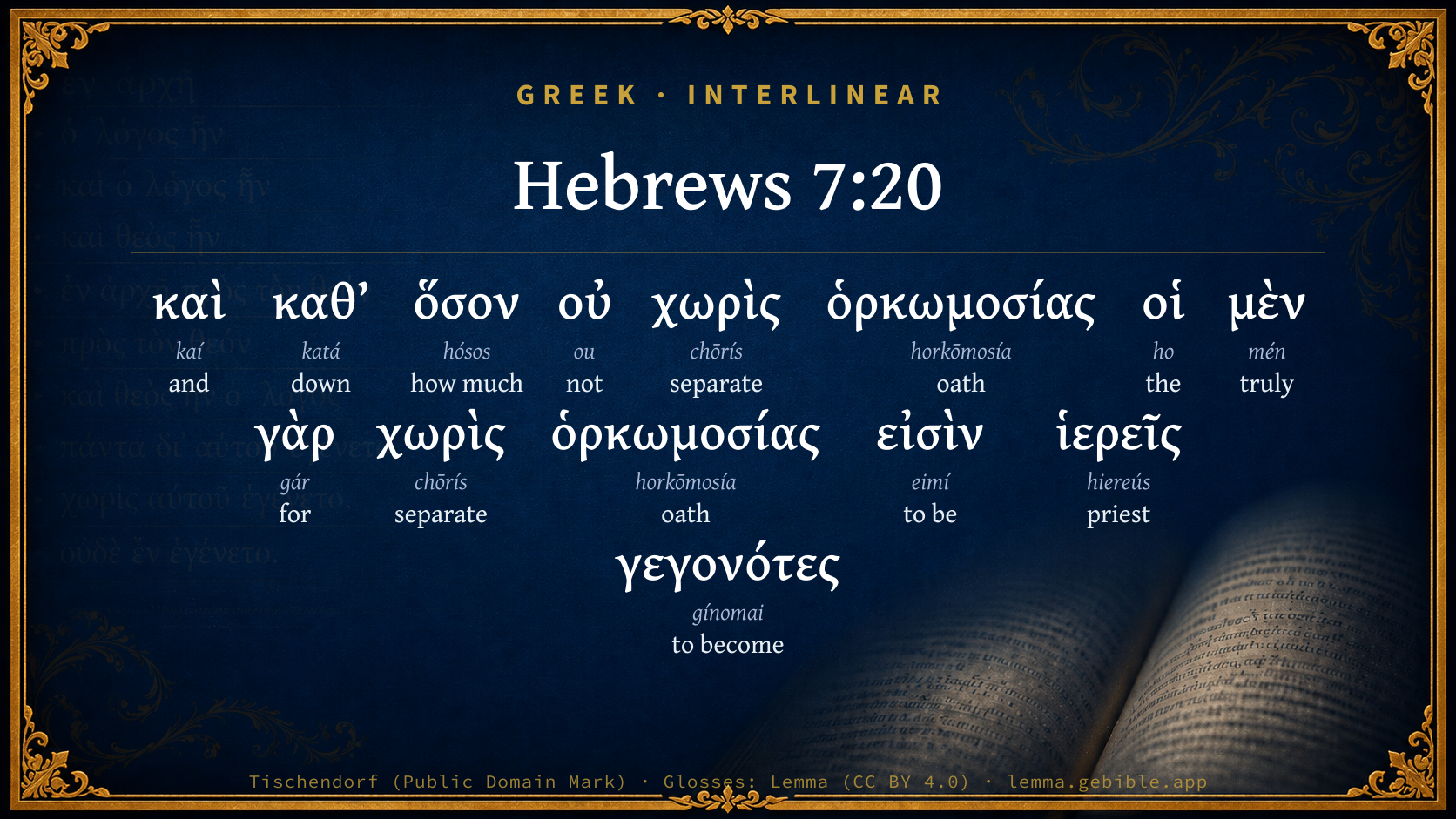
Download image
Cite this verse

Hebrews 7:20 (World English Bible). Public Domain. Lemma interlinear Bible study tool, https://lemma.gebible.app/v/hebrews/7/20.

Show BibTeX & RIS
BibTeX
RIS
English Translation
Inasmuch as he was not made priest without the taking of an oath
World English Bible · Public Domain
Highlights
  • 1 first appearance in the Greek New Testament
Full analysis ↓
Download a study sheet

One document with this verse’s original text, its word-by-word gloss line, the meaning frame, cross-references with their text, attributed commentary, and full source and license credits — printable, and it pastes into notes with its structure intact.

This verse Autodidact and up

Study sheet (.html) Plain text (.txt)

A passage Seminary Student

Up to 50 verses in one chapter. A passage sheet keeps up to 6 commentary sources and 12 cross-references per verse, in the order this page ranks them, and says so on the sheet whenever that leaves anything out. Ask for a single verse and you get the Autodidact verse sheet above.

Everything on this page stays free to read, with no account — the sheet is a download of what is already on screen, not access to it.

Want to remove ads? Support Godless Engineer
Compare translations 3

The same verse in 3 English versions, stacked beneath the original-language interlinear above. Click any original word for its lexicon entry.

Each is an independent rendering of the whole verse — the interlinear is not word-aligned to these translations.

Highlighted words mark where these versions differ — a whole-verse word diff, not a word-by-word alignment.

  • World English Bible Public Domain
    Inasmuch as he was not made priest without the taking of an oath
  • King James Version Public Domain
    And inasmuch as not without an oath he was made priest:
  • unfoldingWord Literal Text CC BY-SA 4.0
    And by as much as not without swearing an oath,—for indeed they without swearing an oath are become priests,

unfoldingWord Literal Text — © unfoldingWord, licensed CC BY-SA 4.0. Word-aligned USFM3 via Door43 (git.door43.org/unfoldingWord/en_ult).

Versions to compare (up to 4)

3 of 4 selected

Show all 19 translations

Every available English version of this verse, each an independent rendering of the whole verse.

  • World English Bible Public Domain
    Inasmuch as he was not made priest without the taking of an oath
  • Berean Standard Bible Public Domain
    And none of this happened without an oath. For others became priests without an oath,
  • Majority Standard Bible Public Domain
    And none of this happened without an oath. For others became priests without an oath,
  • King James Version Public Domain
    And inasmuch as not without an oath he was made priest:
  • American Standard Version (1901) Public Domain
    And inasmuch as `it is' not without the taking of an oath
  • Revised Version (1885) Public Domain
    And inasmuch as it is not without the taking of an oath
  • Geneva Bible (1599) Public Domain
    And for as much as it is not without an othe (for these are made Priestes without an othe:
  • Douay-Rheims (1899) Public Domain
    And inasmuch as it is not without an oath, (for the others indeed were made priests without an oath;
  • Young's Literal Translation Public Domain
    And inasmuch as `it is' not apart from oath, (for those indeed apart from oath are become priests,
  • Literal Standard Version CC BY-SA 4.0
    And inasmuch as [it is] not apart from oath
  • Unlocked Literal Bible CC BY-SA 4.0
    And it was not without an oath! Others became priests without any oath,
  • unfoldingWord Literal Text CC BY-SA 4.0
    And by as much as not without swearing an oath,—for indeed they without swearing an oath are become priests,
  • Darby Bible Public Domain
    And by how much [it was] not without the swearing of an oath;
  • World Messianic Bible Public Domain
    Inasmuch as he was not made priest without the taking of an oath
  • Webster's Bible Public Domain
    And inasmuch as not without an oath he was made priest:
  • Free Bible Version CC BY-SA 4.0
    This was not without an oath, even though those who become priests do so without an oath.
  • Bible in Basic English Public Domain
    And as this is not without the taking of an oath
  • Text-Critical English NT CC BY 4.0
    And none of this happened without an oath. Aaron's descendants become priests without an oath,
  • Tyndale New Testament (1534) Public Domain
    And for this cause it is a better hope that it was not promysed with out an othe.

Literal Standard Version (2020), Covenant Press — licensed CC BY-SA 4.0. Text via the HelloAO Bible API (eBible.org). Unlocked Literal Bible (unfoldingWord) — licensed CC BY-SA 4.0. Text via the HelloAO Bible API (eBible.org). unfoldingWord Literal Text — © unfoldingWord, licensed CC BY-SA 4.0. Word-aligned USFM3 via Door43 (git.door43.org/unfoldingWord/en_ult). Free Bible Version, Dr. Jonathan Gallagher — licensed CC BY-SA 4.0. Text via the HelloAO Bible API (eBible.org).

Word by word

More ways to search: Search by grammar → Find every occurrence → Compare this word →

Practice this passage: Drill this verse → Learn its vocabulary →

About this verse

These counts appear in no published source. They are computed here, from the morphology-tagged text and Lemma’s own curated glosses. What Lemma adds →

14
words
12
distinct lemmas
General Epistles
section

Notable vocabulary

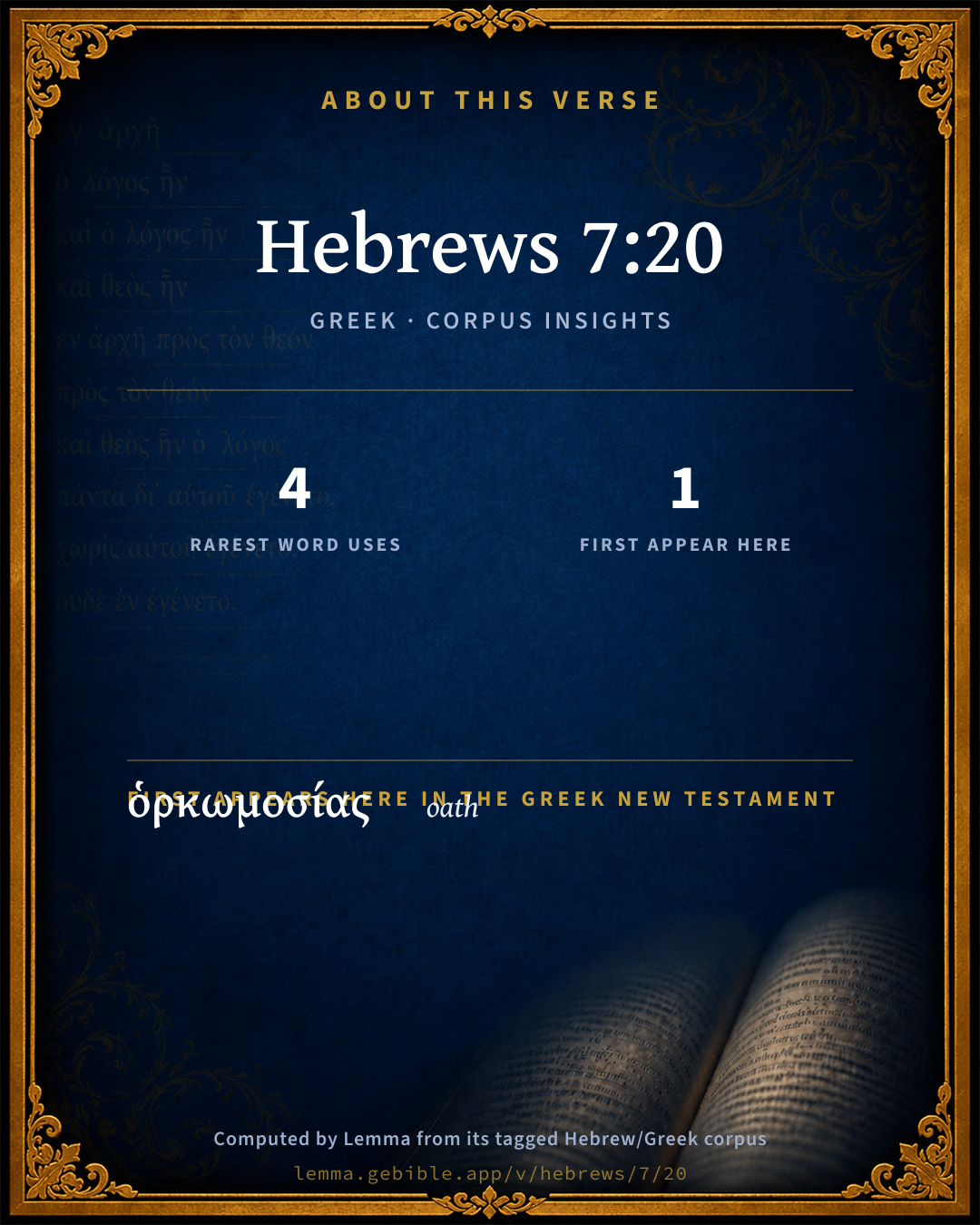
The rarest word here is ὁρκωμοσίας oath G3728 — appearing just 4 times in the whole Greek New Testament.

First appearance in Scripture

This word makes its first canonical appearance in the Greek New Testament here:

  • ὁρκωμοσίας oath G3728

Shared distinctive vocabulary

ὁρκωμοσίας oath G3728 occurs in 3 verses of the Greek New Testament. Also found in:
Repetition

Words recur within this verse:

  • χωρὶς separate G5565 ×2
  • ὁρκωμοσίας oath G3728 ×2

Cross-references

3

Topical passages linked to Hebrews 7:20 in the Treasury of Scripture Knowledge — connected by theme and wording, ordered by reader-vote popularity; previews shown in the World English Bible.

  • Numbers 18:7 You and your sons with you shall keep your priesthood for everything of the altar, and for that within the veil; and you shall serve: I give you the priesthood as a service of gift: and the stranger who comes near shall be put to death.
  • Hebrews 5:6 As he says also in another place, "You are a priest forever, After the order of Melchizedek."
  • Psalms 110:4 Yahweh has sworn, and will not change his mind: "You are a priest forever in the order of Melchizedek."

Cross-references courtesy of OpenBible.info (CC BY 4.0).

Commentary

Notes on Hebrews 7:20 from classic Christian and Jewish commentators (each source and its license shown beneath its notes). The classic Christian expositions comment on the surrounding passage and are grouped to its opening verse, so a note may address several verses; the Jewish commentaries on the Tanakh (Rashi and others) are per-verse, so they appear only where the commentator wrote on this verse.

Lemma curates 59 commentaries, every one of them public domain or Creative Commons licensed, each selected and text-cleaned for this edition rather than reprinted as found. About our sources →

Joseph Benson's Commentary

Heb 7:20-22. And inasmuch as, &c. — Here is another argument from the words of the psalmist, to prove the appointment of a new priesthood, the removal of the old, and the superior excellence of the new to the old; not without an oath — Which argues the weightiness of the matter, and the eternal continuance of Christ’s priesthood. “The apostle’s reasoning here is founded on this, that God never interposed his oath except to show the certainty and immutability of the thing sworn. Thus he sware to Abraham, that in his seed all the nations of the earth should be blessed, Gen 22:16-18; and to the rebellious Israelites, that they should not enter into his rest, Deu 1:34-35; and to Moses, that he should not go into Canaan, Deu 4:21; and to David, that his seed should endure for ever, and his throne unto all generations, Psa 89:4. Wherefore, since Christ was made a priest not without an oath, that he should be a priest for ever, &c., that circumstance showed God’s immutable resolution never to change or abolish his priesthood, or the covenant established thereon. Whereas the Levitical priesthood and the law of Moses being established without an oath were thereby declared to be changeable at God’s pleasure.” — Macknight. The Lord sware and will not repent — Hence also it appears that his priesthood is unchangeable. God not only sware that he would make him a priest for ever, but sware also that he would never repent of doing it. By so much, &c. — By how much the priesthood of Christ was better than the former, by so much the testament, or rather covenant, of which he was to be surety, was better also. The word covenant frequently occurs in the remaining part of this epistle. The original word means either a covenant, or a last will and testament. St. Paul takes it sometimes in the former, sometimes in the latter sense; sometimes he includes both. The word surety or sponsor, may here mean one who has undertaken, on our behalf, to satisfy divine justice for our sins, making atonement for them; and to give to all that sincerely, earnestly, and perseveringly ask it, grace sufficient to enable them to perform the conditions of the covenant, and thereupon to receive its blessings. But it is proper to observe, that the Greek commentators explain the word εγγυος, here rendered a surety, by μεσιτης, a mediator, which is its etymological meaning. “For it comes from εγγυς, near, and signifies one who draws near, or who causes another to draw near. Now, as in this passage a comparison is stated between Jesus, as a High-Priest, and the Levitical high-priests; and as these were justly considered by the apostle as the mediators of the Sinai covenant, because through their mediation the Israelites worshipped God with sacrifices, and received from him, as their king, a political pardon, in consequence of the sacrifices offered by the high-priest on the day of atonement, it is evident that the apostle, in this passage, calls Jesus the High-Priest, or Mediator, of the better covenant, because through his mediation believers receive all the blessings of the better covenant. And, as the apostle had said, (Heb 7:19,) that, by the introduction of a better hope, εγγιζομεν, we draw near to God, he, in this verse, very properly called Jesus εγγυος, rather than μεσιτης, to denote the effect of his mediation. See Heb 7:25. Our translators, indeed, following the Vulgate and Beza, have rendered the word surety, a sense which it hath, Sir 29:16, and which naturally enough follows from its etymological meaning. For the person who becomes surety for the good behaviour of another, or for his performing something stipulated, brings that other near to the party to whom he gives the security; he reconciles the two. But in this sense, the word εγγυος, is not applicable to the Jewish high-priests. For to be a proper surety, one must either have power to compel the party to perform that for which he hath become his surety, or, in case of his not performing it, he must be able to perform it himself. As little is the appellation, surety of the new covenant, applicable to Jesus. For since the new covenant doth not require perfect obedience, but only the obedience of faith; if the obedience of faith is not given by men themselves, it cannot be given by another in their room, unless we suppose that men can be saved without personal faith; I therefore infer, that they who speak of Jesus as the surety of the new covenant, must hold that it requires perfect obedience, which not being in the power of believers to give, Jesus hath performed it for them. But is not this to make the covenant of grace a covenant of works, contrary to the whole tenor of Scripture? For these reasons, I think the Greek commentators have given the true meaning of the word εγγυος in this passage, when they explain it by μεσιτης, Mediator.” — Macknight.

Joseph Benson's Commentary on the Old and New Testaments (1811–1818) — public domain. Text from a community e-Sword module.

Lange's Commentary on the Holy Scriptures

III

The New Covenant is by so much the more excellent as Jesus Himself is its personal guarantee

Heb_7:20-22

20And inasmuch as not without an oath [the swearing of an oath, ὁρχωμοσία] was he made priest: 21(For those priests were made [for they indeed have become priests] without an oath; but this [he] with an oath by him that said unto him, The Lord sware and will not repent, Thou art a priest for ever after the order of Melchisedek:)11 22By so much12 [also] was Jesus made [hath Jesus also become] a surety of a better testament [covenant].

[Heb_7:20.—ὁρκωμοσία, the swearing of an oath: so the fuller form (like μισθαποδοσία, Heb_2:2) had better be rendered (with Alf.), than by the simple oath (ὃρκος, as Heb_6:17).

Heb_7:21.—οἰ μὲν γὰρ χωρὶς ὃρκωμ. εἰσὶν ἰερ. γεγ, for they indeed=for while they, without the swearing, etc., have become priests. It is difficult to reproduce in English the force of the periphrastic είσὶν γεγονότες, are having become, bringing out more fully the two-fold idea of becoming and continuance. We cannot, perhaps, render better than simply have become as if it were γέγονατε.

Heb_7:22.—καὶ κρείττονος διαθ. γεγ. ἔγγυος Ἰης., also of a better covenant (not testament), hath Jesus become (not, been made) surety.—K.].

EXEGETICAL AND CRITICAL

Heb_7:20. And inasmuch as, etc.—Luther translates erroneously, “and besides, what is much,” from a misconception of the Vulgate et quantum est. He connects also, like Chrys., Theodoret, Erasm., Calv., etc., these words with the preceding. True, the text in fact emphasizes the idea that this hope was not introduced without the swearing of an oath, but in form a protasis precedes to which the κατὰ τοσοῦτο corresponds, and in which we are not to supply ἱερεὺς γέγονεν (Œc., Beng., Böhme, Lün.), still less ἔγγυος γέγονεν, but, γίνεται τοῦτο (Bleek, De W., Thol., Hofm., Del.).

Heb_7:22. Surety of a better covenant.—Luther erroneously understands here διαθήκη as testament, and translates without authority ἔγγυος, ausrichter=executor. In classic Greek διαθήκη always denotes an arrangement, in general, a disposition or settlement, of which will or testament is a special form. The Sept., however, employs the word regularly instead of συνθήκη, as a translation of בְּרִית, so that it is also to be regarded in the New Testament as a terminus dogmaticus = covenant, from which signification we are to depart, only when compelled by the connection. The justification of this view of the word on the part of the LXX., and of the New Testament writers, lies in the fact that the covenant of God with men is not a compact concluded between two equally authorized and independent parties; but is essentially a Divine arrangement and disposition against sin and for human salvation, into which those who are called enter under a religious obligation, and to which God binds Himself in His truth and faithfulness. The Hebrew expression appears, on the contrary, to spring from this latter view, since for the word בָּרָה the signification “determine, constitute, establish,” assumed by Hofm., cannot be proved, but only either the signification “separate, choose out,” is admissible, 1Sa_17:8, or the signification “cut,” with reference to the original mode of ratifying a covenant, to which Jehovah (Genesis 15.), as matter of convenience condescends.—Ἔγγυος is not to be explained by μεσίτης, mediator, although this word (not found elsewhere in the New Testament) may have been selected with allusion to the preceding ἐγγίζειν. Moreover the strictly juristic conception of the term fidejussor, and a reference to Christ’s vicarious satisfaction (Thom. Aquin., Calov, etc.), as well as any supposed reference to Christ’s sufferings in general, as sealing the covenant (Bl., De W., Lün.) is against the context, which in Christ, the Everlasting One, exalted at the right hand of God, recognizes the voucher and guaranty for the eternal maintenance and validity of the covenant which He mediates.

DOCTRINAL AND ETHICAL

1. The Levitical priests entered the priestly office by a simple command; Christ entered it by an arrangement confirmed with a Divine oath. In this lies an undoubted pledge: 1. for the fulfilment under the conduct of the Messiah, of the Divine promise; 2. for the exaltation of the New Covenant above the earlier one; 3. for its everlasting duration.

2. Jesus is the promised eternal priestly king, whose personal character, position and dignity, give to the covenant which He mediates a closely allied and corresponding preëminence.

3. In the very nature of a royal command in regard to an arrangement and institution whose perpetuity is not specially indicated, still less promised and pledged, lies already the possibility of the reversing of the command, of the annulling of the institution, of a change of the arrangement by the Ruler Himself, without His thereby of necessity becoming untruthful, unrighteous and untrustworthy, falling into contradiction with Himself, or throwing back into confusion the products of His own creative power.

HOMILETICAL AND PRACTICAL

Jesus Christ, the mediator of the New Covenant, is at the same time the pledge: a. of its everlasting continuance; b. of its divinely approved character; and c. of the perpetual accomplishment of its promises.—How the preëminence of the New Covenant over the Old is assured a. by the promise and oath of its author; b. by the person of its priestly mediator.—From the Old Testament itself we might infer the exaltation of the Priest of the Promise above the priests of the law, and above their service.—The Promise connects with one another Law and Gospel, and at the same time leads over from time into eternity.

Starke:—As it was conceived and determined in the counsels of the adored Trinity, so in Christ Jesus has all been carried out that in Him all should become blessed, and whatever will may become blessed.

Rieger—From the swearing of the oath the Apostle justly infers the great earnestness, the weighty interest and the extraordinary pleasure with which God has entered into and sealed this His arrangement.—Elsewhere he swears who undertakes an office in order that persons may entrust to him their interests; but here He swears who confers the office in testimony of His high purposes, and of His unchangeable will.

Footnotes:

[11]Heb_7:21.—The words κατὰ τὴν τάξιν Μελχ., are wanting in Cod. Sin., B. C., 17, 80. In the Sin. are wanting also the preceding words εἰς τὸν αἰῶνα.

[12]Heb_7:22.—Instead of the Rec. τοσοῦτον, we are to read τοσοῦτο according to the Sin. A. B. C. D*. In the Sin. the ν has been added by a later hand, as also previously the words εἰς τὸν αἰῶνα as far as Μελχ.

Lange's Commentary on the Holy Scriptures (Critical, Doctrinal, and Homiletical), ed. John Peter Lange, English translation edited by Philip Schaff (1864–1880) — public domain. Text from a community e-Sword module.

Tyndale Open Study Notes

Tyndale Open Resources

7:20-21 This new system refers to God’s way of appointing a priest. • God’s solemn oath is expressed in the quote from Ps 110:4.

Tyndale Open Study Notes — © Tyndale Open Resources, licensed CC BY-SA 4.0. Text via the HelloAO Bible API.

Bengel's Gnomon

Johann Albrecht Bengel

Heb 7:20. Καθʼ ὅσον, inasmuch as) Supply from what follows, He was made a priest. The Apodosis is in Heb 7:22, κατὰ τοσοῦτον, by so much.—ὁρκωμοσίας) A magnificent compound.

Bengel's Gnomon of the New Testament — English translation (T&T Clark, Edinburgh, 1860) — public domain. Text from a community e-Sword module.

Meyer's Critical & Exegetical Commentary

Heinrich August Wilhelm Meyer

Heb_7:20-22. As one element in the superiority of the everlasting priesthood after the manner of Melchisedec, assigned to Christ, over the Levitical priesthood has been already implicitly brought forward, Heb_7:18-19, namely, that the goal, for the attainment of which the strength was lacking to the Levitical priesthood, is really attained by the everlasting priesthood. A second point of superiority in the new order of things over the old follows in Heb_7:20-22. Of less moment than the everlasting priesthood of Jesus must the Levitical priesthood be; for the former was constituted by God by virtue of a declaration upon oath, the latter without a declaration upon oath. Heb_7:20-22 form again a single period, the protasis being contained in καὶ καθ ̓ ὅσον οὐ χωρὶς ὁρκωμοσίας, to which then καὶ τοσοῦτο κ.τ.λ., Heb_7:22, corresponds as the apodosis, while all that intervenes (οἱ μὲν γάρ, to the end of Heb_7:21) is a parenthesis. Wrongly do Chrysostom, Theodoret, Erasmus, Calvin (in the translation), Er. Schmid, and others join καὶ καθ ̓ ὅσον οὐ χωρὶς ὁρκωμοσίας, too, to the closing words of Heb_7:19 : and, indeed, a hope which is better, inasmuch as it is not brought in without an oath. So also Luther: and moreover, which is a great thing, not without oath; while, with not less violence, Lud. Cappellus, who, in enclosing Heb_7:18-19 within a parenthesis, and taking καὶ καθ ̓ ὅσον οὐ χωρὶς ὁρκωμοσίας with Heb_7:17, gives as the sense: Deus constituit Christum sacerdotem secundum ordinem Melchisedec, et quidem non sine jurejurando.

καί] coupling on a farther link in the chain of enumeration, as Heb_7:8-9; Heb_7:23.

καὶ καθ ̓ ὅσον οὐ χωρὶς ὁρκωμοσίας] sc. ἱερεύς ἐστιν γεγονώς; and inasmuch (Heb_9:27) as He has become priest not without a declaration upon oath, i.e. He has not become so without God having sanctioned His appointment to be a priest by a declaration upon oath (namely, by virtue of the oath, with which the declaration, Psa_110:4, is introduced). Only this mode of supplementing is warranted by the connection, as is shown partly by the οἱ μὲν γὰρ χωρὶς ὁρκωμοσίας εἰσὶν ἱερεῖς γεγονότες immediately following, partly by the circumstance that the author is still engaged in the exposition of the Scripture statement, Heb_7:17, this statement thus containing for him the gist of the matter; as, accordingly, this declaration of Scripture is repeated anew, Heb_7:21, and then likewise the εἰσὶν ἱερεῖς γεγονότες recurs in the further member of the thought, Heb_7:23 f. The explanation therefore of Seb. Schmidt, Wolf, Heinrichs, Böhme, Kuinoel, Ebrard, Alford, Kurtz, and others is to be rejected, when to καθ ̓ ὅσον οὐ χωρὶς ὁρκωμοσίας they supplement from the apodosis διαθήκης ἔγγυος γέγονεν; as also that of Storr, Schulz, Bleek, de Wette, Tholuck, Bisping, Delitzsch, Moll, and Hofmann, when they supply τοῦτο (sc. ἐπεισαγωγὴ κρείττονος ἐλπίδος) γίνεται (γέγονεν).

οἱ μὲν γάρ] namely, the Levitical priests.

χωρὶς ὁρκωμοσίας] since nothing is related in Scripture of an oath of God, when He destined Aaron and his posterity to be priests.

εἰσὶν γεγονότες] forms one idea: have become. Wrongly, Paulus and Klee: are priests who have become so without an oath. Böhme (and so also Hofmann): sunt sacerdotes, sed sine juramento (illi quidem singuli deinceps) factiwhich must have been expressed by εἰσὶν ἱερεῖς χωρὶς ὁρκωμοσίας γεγονότες. Still more widely mistaken the view of Michaelis ad Peirc.: fuerunt, i.e. esse desierunt,which is grammatically as well as logically impossible. The tempus periphrasticum εἰσὶν γεγονότες marks the fact already belonging to the past as still extending onwards into the present.

ὁ δέ] namely, Christ.

μεθ ̓ ὁρκωμοσίας] sc. ἱερεύς ἐστιν γεγονώς.

διὰ τοῦ λέγοντος πρὸς αὐτόν] i.e. in the sense of the author: by God, not: by the psalmist (Rambach, Heinrichs), although certainly the statement, Psa_110:4, that God hath sworn and will not repent of this oath, forms not a constituent part of the words of God Himself, but a remark of the psalmist, with which he introduces the words of God. Yet, when in the psalm it is said that God has sworn, and of this oath He will not repent, and then there is adduced as the subject-matter of this oath the declaration: σὺ ἱερεὺς κ.τ.λ., this is tantamount to saying that God has declared by virtue of an irreversible oath: σὺ ἱερεὺς κ.τ.λ. As, accordingly, the psalmist is relating the words of God, so does he also relate the oath which preceded them.

Meyer — Critical and Exegetical Commentary on the New Testament — English translation by Peter Christie, edited by Frederick Crombie (T&T Clark, 1880) — public domain. Text from a community e-Sword module.

Expositor's Greek Testament

ed. W. Robertson Nicoll

Heb 7:20-22 . Another element in the superiority of the covenant established upon the priesthood of Jesus is that in the very manner of the institution of His priesthood it was declared to be permanent. The long parenthesis of Heb 7:21 being held aside the statement of 20 22 reads thus: “And [introducing a fresh consideration] in proportion as not without an oath [was He made priest] … in that proportion better is the covenant of which Jesus has become the surety”. The parenthesis of Heb 7:21 is inserted to confirm by an appeal to Scripture [Psa 110:4 ] the fact that by the swearing of an oath the Melchizedek priest was appointed, and to indicate the significance of this mode of appointment, viz .: that repentance or change of plan is excluded. That is to say, this priesthood is final, eternal. And the superiority of the priesthood involves the superiority of the covenant based upon it. The oath signifies therefore the transition from a provisional and temporary covenant to that which is eternal. καθʼ ὅσον . This form of argument is frequent in Philo, see Quis. Rev. Div. H. , 17, etc. οὐ χωρὶς ὁρκωμοσίας , “not without oath-swearing”; the clause may be completed from that which follows, “has he been made priest,” as in A.V., although Weiss maintains that this is “sprachwidrig” and that the broken clause “kann natürlich nur aus dem Vorigen ergänzt werden”. But it is most natural and grammatical to complete it from the sentence in which it stands: “As not without an oath, so of a better covenant has Jesus become surety ”. The parenthesis thus furnishes the needed ground of this statement. He became surety by becoming priest, and as priest he was constituted with an oath. οἱ μὲν γὰρ “For the one [that is, the Levitical priests] εἰσὶν ἱερεῖς γεγονότες “have been made priests” Vaughan renders “are having become priests are priests having become so”. So Delitzsch, Weiss and von Soden. Westcott says: “The periphrasis marks the possession as well as the impartment of the office;” and on the “periphrastic conjugation” see Blass, sec. 62; Stephanus Thesaurus s.v . εἰμί , and cf. Act 21:29 , ἦσαν γὰρ προεωρακότες .]. ὁ δὲ μετὰ ὁρκ . “but the other [the new priest] with an oath,” μετὰ of course not being instrumental, but “interposito jurejurando”; where and how this oath is to be found is next explained, it is διὰ f1τοῦ λέγοντος … “through Him that saith to him. The Lord sware and will not repent, Thou art,” etc. There is no call to translate πρὸς αὐτόν “in reference to Him”; neither is there any difficulty in referring the words ὤμοσε … μεταμελ . to God. “Though the words are not directly spoken by the Lord, they are His by implication. The oath is His” (Westcott). On the distinction between μετανοέω and μεταμέλομαι see Trench, Synonyms , 241. “He who has changed his mind about the past is in the way to change everything; he who has an after care may have little or nothing more than a selfish dread of the consequences of what he has done.” This, however, does not apply to the LXX (from which the quotation of this verse is taken) where both words are used to translate נָחַם . Cf. 1Ki 15:29 ; 1Ki 15:34 . κατὰ τοσοῦτο “by so much,” that is, the superiority of the new covenant to the old is in the ratio of eternity to time, of what is permanent and adequate to what is transitory and provisional. κρείττονος διαθήκης “of a better covenant” [“id est, non infirmae et inutilis. Frequens in hac epistola epitheton, κρείττων , item αἰώνιος , ἀληθινὸς , δεύτερος , διαφορώτερος , ἔτερος , ζῶν , καινὸς , μέλλων , νέος , πρόσφατος , τέλειος ” (Bengel)], here first mentioned in the Epistle, but whose character and contents and relation to the “foregoing” covenant are fully explained in the following chapter. Here already its “betterness” is recognisable in this, that it supersedes the older, and is itself permanent because perfectly accomplishing the purposes of a covenant.

The Expositor's Greek Testament, edited by W. Robertson Nicoll (1897–1910) — public domain. Text from a community e-Sword module.

Geneva Bible (1599)

Geneva Bible translators

Another argument whereby he proveth that the Priesthood of Christ is better than the Priesthood of Levi, because his was established with an oath, but theirs was not so.

Geneva Bible (1599) marginal notes — public domain. Text via Bolls.life.

Jamieson, Fausset & Brown

Robert Jamieson, A. R. Fausset & David Brown

Another proof of the superiority of Christ's Melchisedec-like priesthood; the oath of God gave a solemn weight to it which was not in the law-priesthood, which was not so confirmed.

he was made priest--rather supply from Heb 7:22, which completes the sentence begun in this verse, Heb 7:21 being a parenthesis, "inasmuch as not without an oath He was made surety of the testament (for, &c.), of so much better a testament hath Jesus been made the surety."

Jamieson, Fausset & Brown — Commentary Critical and Explanatory on the Whole Bible (1871) — public domain (CC PDM 1.0). Text via the HelloAO Bible API.

Adam Clarke's Commentary

Verse 20. Not without an oath] "The apostle's reasoning here is founded on this, that God never interposed his oath, except to show the certainty and immutability of the thing sworn. Thus he sware to Abraham, Ge 22:16-18, that in his seed all the nations of the earth should be blessed; and to the rebellious Israelites, De 1:34; De 1:35, that they should not enter into his rest; and to Moses, De 4:21, that he should not go into Canaan; and to David, Ps 89:4, that his seed should endure for ever, and his throne unto all generations. Wherefore, since Christ was made a priest, not without an oath that he should be a priest for ever, after the similitude of Melchisedec, that circumstance showed God's immutable resolution never to change or abolish his priesthood, nor to change or abolish the covenant which was established on his priesthood; whereas the Levitical priesthood and the law of Moses, being established without an oath, were thereby declared to be changeable at God's pleasure." This judicious note is from Dr. Macknight.

Adam Clarke's Commentary on the Bible (1810–1826) — public domain. Text from a community e-Sword/MySword module.

John Calvin's Commentaries

20. And inasmuch as not without an oath, etc. Here is another argument, why the Law ought to give place to the Gospel; for God has set Christ’s priesthood above that of Aaron, since in honor to the former he was pleased to make an oath. For when he appointed the ancient priests, he introduced no oath; but it is said of Christ, the Lord swore; which was doubtless done for the sake of honoring him. We see the end for which he again quotes the Psalmist, even that we may know, that more honor through God’s oath was given to Christ than to any others. But we must bear in mind this truth, that a priest is made that he may be the surety of a covenant. The Apostle hence concludes, that the covenant which God has made by Christ with us, is far more excellent than the old covenant of which Moses was the interpreter.

John Calvin's Commentaries (1540-1563) — public domain. Text from the Calvin Translation Society English edition (1840s-50s) via the Christian Classics Ethereal Library (ccel.org). Calvin's coverage is partial (roughly two-thirds of the Bible); uncommented books and verses are honest gaps, never fabricated. The 19th-century editor's footnotes and remarks are omitted so the notes are faithfully Calvin's own voice.

Ellicott's Commentary for English Readers

(20) This and the next two verses constitute one sentence, the third verse answering to the first, and Heb_7:21 being parenthetical. Hitherto no reference has been made to the remarkable opening of Psa_110:4, so often quoted: these three verses are occupied with the thought of the oath—or rather (for a very uncommon word is used, one that answers well to the importance of the thought) the “swearing of an oath.” This is a further illustration of the words of Heb_7:15, “a different priest.”

He was made priest.—Some supplement is needed to give clearness to the English sentence; but one of general meaning, such as “all this was done,” will best answer the purpose.

A Bible Commentary for English Readers, edited by Charles John Ellicott (1878–1897) — public domain. Text from a community e-Sword module.

The Cambridge Bible for Schools and Colleges

gen. ed. J. J. S. Perowne

20. inasmuch as not without an oath] This is the sixth point of superiority. He has lingered at much greater length over the fifth than over the others, from the extreme importance of the argument which it incidentally involved. The oath on which the Melchisedek Priesthood was founded is that of Psa_110:4. The word used for “oath” is not the common word horkos (as in Heb_6:17), but the more sonorous horkomosia.

The Cambridge Bible for Schools and Colleges (gen. ed. J. J. S. Perowne; Cambridge University Press, 1878–1918) — public domain. Text from a community e-Sword module.

John Gill's Exposition

For these priests were made without an oath,.... The priests of the tribe of Levi, and of the order of Aaron, were installed into their office, and invested with it, without an oath; no mention is made of any when Aaron and his sons were put into it in Moses's time; nor was any used afterwards, neither by God, nor by the priests, nor by the people; it is true indeed that after the sect of the Sadducees arose, the high priest on the day of atonement, was obliged to take an oath that he would not change any of the customs of the day (t); but then this regarded not his investiture, but the execution of his office; and was an oath of his and not of the Lord's, which is here designed:

but this with an oath; that is, Christ was made an high priest with an oath, even with an oath of God; which gives his priesthood the preference to the Levitical priesthood, which was without one: and this oath was made,

by him that said unto him: the Syriac version reads, "as he said to him by David"; that is, in Psa 110:4. David being the penman of that psalm, in which stand the following words of the Father to Christ:

the Lord sware and will not repent, thou art a priest for ever after the order of Melchisedec; which proves that Jehovah swore that Christ should be a priest, and continue so: swearing, when ascribed to God, is after the manner of men, and is always by himself, and never upon any trivial account; but either to confirm his love to his people, or his covenant with them, or the mission of his Son to be the Redeemer, or, as here, his priestly office: and this oath was made not so much on Christ's account, as on account of the heirs of promise, for their consolation; and shows the dignity, validity, importance, and singularity of Christ's priesthood, as well as the durableness of it; and of this oath God will never repent: repentance cannot properly fall upon God, on any account; for it is contrary to his holiness and righteousness, and to his happiness, to his unchangeableness, omniscience, and omnipotence; it is indeed sometimes ascribed to him improperly, and after the manner of men; and only regards a change of his outward conduct according to his immutable will; and the change that is made is in the creature, and not in God himself: but God will not repent in any sense of the priesthood of Christ, nor of his oath, that it should continue for ever according to the order of Melchizedek; for he was every way qualified for it, and has faithfully performed it, not his investiture, but the execution of his office; and was an oath of his and not of the Lord's, which is here designed:

but this with an oath; that is, Christ was made an high priest with an oath, even with an oath of God; which gives his priesthood the preference to the Levitical priesthood, which was without one: and this oath was made,

by him that said unto him: the Syriac version reads, "as he said to him by David"; that is, in Psa 110:4. David being the penman of that psalm, in which stand the following words of the Father to Christ:

the Lord sware and will not repent, thou art a priest for ever after the order of Melchisedec; which proves that Jehovah swore that Christ should be a priest, and continue so: swearing, when ascribed to God, is after the manner of men, and is always by himself, and never upon any trivial account; but either to confirm his love to his people, or his covenant with them, or the mission of his Son to be the Redeemer, or, as here, his priestly office: and this oath was made not so much on Christ's account, as on account of the heirs of promise, for their consolation; and shows the dignity, validity, importance, and singularity of Christ's priesthood, as well as the durableness of it; and of this oath God will never repent: repentance cannot properly fall upon God, on any account; for it is contrary to his holiness and righteousness, and to his happiness, to his unchangeableness, omniscience, and omnipotence; it is indeed sometimes ascribed to him improperly, and after the manner of men; and only regards a change of his outward conduct according to his immutable will; and the change that is made is in the creature, and not in God himself: but God will not repent in any sense of the priesthood of Christ, nor of his oath, that it should continue for ever according to the order of Melchizedek; for he was every way qualified for it, and has faithfully performed it.

(t) Misn. Yoma, c. 1. sect. 5.

John Gill's Exposition of the Whole Bible (1746–1763) — public domain (CC PDM 1.0). Text via the HelloAO Bible API.

Trapp's Complete Commentary

John Trapp

20 And inasmuch as not without an oath he was made priest:

Ver. 20. Not without an oath] A singular confirmation: what a monstrous sin then is unbelief!

John Trapp, A Commentary or Exposition upon All the Books of the Old and New Testament (1647–1656) — public domain. Text from a community e-Sword module.

Albert Barnes' Notes on the Bible

And inasmuch as not without an oath - In addition to every other consideration showing the superiority of Christ as a priest, there was the solemnity of the oath by which he was set apart to the office. The appointment of one to the office of priest by an oath, such as occurred in the case of Jesus, was much more solemn and important than where the office was received merely by descent.

Albert Barnes' Notes on the Bible (1834–1885) — public domain. Text from a community e-Sword/MySword module.

Haydock's Catholic Bible Commentary

The old law was good in itself, being established by God, who does noting in vain; but it was weak and imperfect, and the shadow and figure of that which was to come. It was preparatory to a more perfect dispensation under Jesus Christ, who, as our new high priest, was to finish by the gospel what Moses began by the law.

George Leo Haydock (1774–1849), Haydock's Catholic Family Bible and Commentary, 1859 edition — public domain. Excludes Psalms (Douay-Rheims chapter numbering differs from Protestant) and Deuterocanonical books (Catholic canon only).

Matthew Poole's English Annotations

This is a further proof of the excellency of Christ’s priesthood above Aaron’s, taken from his constitution in it by oath. He who is made a priest by oath, is a better and a greater priest than any made so without it; but so is Christ. Καθ οσον is a comparative, answered Heb 7:22, insinuating by how much the cause constituting or confirming an office of priesthood is more excellent, by so much the effect and office must excel, receiving greater power for some more excellent end. This ορκωμοσια is as much as a double oath, απο του ομνυειν ορκον. By the swearing of an oath by God the Father was the gospel High Priest constituted an eternal one after Melchisedec’s order; and it addeth so much the more strength and glory to the sanction. This is testified by David, Psa 110:4. The Levitical priests were made by a Divine designation, and with external rites were consecrated; but Christ was constituted a Priest by oath, as our translators well supply it out of the following verse.

Matthew Poole's English Annotations on the Holy Bible (1683–1685) — public domain. Text from a community e-Sword/MySword module.

Whedon's Commentary on the Bible

Daniel D. Whedon

20-22. Point fifth. The high priesthood forever was inaugurated by an oath, the Levitical not.

20. Not without an oath—Christ’s high priesthood, as the highest and surest inauguration, the oath of God. Note on Heb_6:13.

Daniel D. Whedon (gen. ed.), Commentary on the Old and New Testaments (1874–1909) — public domain. Text from a community e-Sword module.

The Pulpit Commentary

Vers. 20-22. And inasmuch as not without an oath properly, swearing of an oath, orkwmosiav he was made priest: (for they indeed have been made priests without an oath; but he with an oath by him that saith unto him, Thou art a Priest for ever); by so much of a better covenant hath Jesus become surety. The significance of the Divine oath, in connection with the promise to Abraham, has been dwelt on above: the oath of Psalm 110. is here similarly referred to, as imitating a priesthood that rests on no mere temporary ordinance, but on the immutable Divine counsels. (Observe the first occurrence here of the word diaykh , introducing in the way of hint (as is usual in the Epistle) an idea to be afterwards expanded, as it is in Hebrews 8 and Heb 9. The meaning of the word will be considered below.)

Separated from sinners. This verse exhibits in a strong clear light the moral purity of our High Priest, and its becomingness in relation to the necessities of his people.

I THE HOLINESS OF CHRIST. He was born without; entail of birth-sin. His boyhood and youth were stainless. His manhood was one of sinless perfection. His friends regarded him as faultless. His enemies testified to his purity (Pilate, Judas, the devils whom he east out). Jesus himself claimed to be holy; (Joh_8:46 Joh_14:30) and he never confessed sin, or begged forgiveness. The voice of his Father from heaven attested him, once and again, to be the Holy One of God. (Mat_3:17 Mat_17:5) Notice:

1. The elements of his holiness. Three adjectives are used, referring to three different departments of moral character.

(1) "Holy," i.e. pious in relation to God. Jesus lived the life of ideal godliness. He perfectly obeyed "the great and first commandment the four "words" of the first table of the Law.

(2) "Guileless," i.e. just and kind towards his fellow-men. Jesus perfectly observed the six precepts cf. the second table. He injured no one. He "went about doing good.

(3) "Undefiled," i.e. personally pure; uncontaminated by his constant contact with sinful men; holy in the midst of sin, temptation, and suffering.

2. The singularity of his holiness. "Separated from sinners." This phrase sustains a relation of contrast to the three adjectives. It indicates the unique character and the matchless harmony of the Savior"s moral life. It expresses his solitariness in his holiness. If the human race be divided into two classes the sinners and the holy all the rest of mankind must take rank as sinners, while Jesus stands by himself as the one human being who was holy.

3. The reward of his holiness. "Made higher than the heavens." His supreme exaltation has set him more visibly apart from other men than before. It was conferred upon him as the reward of his pure, unworldly, self-sacrificing life. His mediatorial throne has been erected in the new heavens of the new covenant, and these are higher than any heavens formerly known to mankind.

II THE NECESSITY OF CHRIST"S HOLINESS IN RELATION TO OUR SALVATION. "Such a High Priest became us." In Heb_2:10 we read of what in this connection "became" God; here, of what "became" man. The purity of the Redeemer was admirably adapted to the necessities of our condition.

1. That he might be a true manifestation of God. A priest is a mediator or middle-man between God and men; and it is indispensable that he should be in perfect sympathy with the purity of the Eternal. Holiness is the crown and flower of the Divine perfections; and it was needful that our priest should reflect that holiness in his own character.

2. That his sacrifice might be an adequate atonement for sin. He must be on the very best of terms with the God whom we have offended. His expiation must be satisfactory to Divine justice. It is impossible that Jesus could have atoned for us had he been himself morally infirm, like the Jewish high priest, tie could only purchase our reconciliation by offering himself as a Victim, without spot or blemish, upon the altar.

3. That he might leave us a perfect example. The Christian life consists in the imitation of Christ. Believers follow him in the three great departments of moral excellence in which he was so absolutely pure. We ought to copy him also in his separatedness from the world. Indeed, his people should already be in spirit, through their oneness of character with their risen Lord, "made higher than the heavens?

The Pulpit Commentary (1880–1919), ed. H.D.M. Spence-Jones & Joseph S. Exell — public domain. Text from a community e-Sword module.

John Wesley's Explanatory Notes

And - The greater solemnity wherewith he was made priest, farther proves the superior excellency of his priesthood.

John Wesley, Explanatory Notes Upon the Whole Bible (1754–1765) — public domain. Text via the GEBible commentary corpus.

Kretzmann's Popular Commentary

Paul E. Kretzmann

The oath of God a guarantee of the superiority of Christ’s priesthood:

v. 20. And inasmuch as not without an oath he was made priest,

v. 21. (for those priests were made without an oath; but this with an oath by Him that said unto Him, The Lord swore and will not repent, Thou art a priest forever after the order of Melchizedek,)

v. 22. by so much was Jesus made a surety of a better testament.

This is another important consideration in the proof of Christ’s greater excellence: And in proportion as not without the swearing of an oath (was He made priest), in that proportion Jesus also became surety for a better covenant. Jesus became our High Priest in consequence of, and for the sake of fulfilling, a solemn oath made by His heavenly Father. This oath is one of the evidences which we have of the earnest intention and purpose which God has with regard to the salvation of all mankind. Christ was the only one in whose case such an extraordinary exception was made. By that token, therefore, He is the surety, the sponsor, the guarantee of a better, superior, more excellent covenant. This fact is brought out still more strongly by the clause which the author inserts for the sake of explanation: For the one indeed are priests, having become so without the swearing of an oath, but the other with an oath by Him that said to Him, Thou art a Priest forever after the order of Melchizedek. The members of the Levitical priesthood were installed into office and discharged the functions of their ministry without a special objuration of the ordinand or oath on their own part. Their work was clearly defined by the Mosaic Law, and they discharged it in the knowledge that all their sacrifices were but types of the Messiah’s work. But in the case of Christ, the true High Priest, God swore an oath and had it recorded through His prophet, Psa 110:4, designating His Son, the Messiah of the world, as the eternal High Priest. The incarnation of Christ, therefore, signified that the Levitical priesthood was no longer needed for the purpose of mediating between God and men, and the oath of God, in addition, set the priesthood of Christ just that much higher, God Himself indicating the superior excellence of Christ’s office.

Paul E. Kretzmann, Popular Commentary of the Bible (1921–1924) — public domain. Text from a community e-Sword module.

Burkitt's Expository Notes on the New Testament

William Burkitt

Our apostle has not yet done with his several arguments to prove the transcendent excellency of Christ’s priesthood above that of Aaron’s: His argument in the verses now before us lies thus: he that is made an unchangeable priest by the oath of God, is a better, greater, and more excellent priest, than any made so without it. But whereas the Levitical priests were made without an oath, by the law changeable at the will of the lawgiver; Jesus Christ was made a Priest by the unchangeable oath of God. The Lord swore and will not repent, Thou art a priest for ever.

Learn hence, That nothing was wanting on the part of God, that might either give eminency and glory, or stability and efficacy to the priesthood of Christ: This was both due to the glory of his person, and also needful to encourage and secure the faith of the church.

Learn, 2. That Jesus Christ, our great High Priest, being initiated into his office by the oath of God, his priesthood is liable to no alteration, succession, or substitution; but the church may continually draw nigh to God, in full assurance of his meritorious satisfaction and prevailing intercession, and receive from thence a solid foundation of peace and consolation; By so much was Jesus made a surety of a better testament.

Observe here, 1. The title given to the gospel-covenant, it is here called a better testament: Better not for substance, but for clearness; for substance, the old covenant dispensation and the new are the same: but the latter is made more clear, more free, more full, more surely ratified, by the death of Christ, and accompanied with a more mighty operation of the Spirit of God.

Observe, 2. The title here given to Christ, he is the surety of a better testament. Our surety, because our sacrifice. The Socinians own Christ to be the surety of the covenant in respect of his holy life, and exemplary death, sealing it as a testimony by his blood, but deny him to be a surety in respect of his satisfaction, merit, and intercession. But alas! as our sinful condition requires a mediator of redemption so our changeable condition requires a mediator of intercession; and, blessed be God, he has appointed one for both, even his own and only Son, who is the surety of a better testament.

Learn thence, that the Lord Jesus was not only made a surety on God’s part to us, to assure us, that the promise of the covenant on his part, should be performed, but was also a surety on our part, to furnish us with that grace and assistance which shall enable us to do, answer, and perform all that is required on our part, that we may enjoy the benefit of the covenant, first, to satisfy for sin, by offering himself a propitiatory sacrifice: and next to furnish forth sufficincy of grace to enable for the fulfilling the conditions of the gospel-covenant. Thus was Jesus the surety of this better covenant.

William Burkitt's Expository Notes on the New Testament (1700–1703) — public domain. Text from a community e-Sword module.

The People's New Testament

B. W. Johnson

20. Not without an oath. God never interposed an oath except to show certainty and immutability. Thus he swore to Abraham (Gen. 22:16–18); to the rebellious Israelites (Deut. 1:34); to David, that his seed should endure forever (Ps. 89:4). Since the same solemn assurance is given concerning the priesthood of Christ, the meaning is that it is immutable.

B. W. Johnson's The People's New Testament with Notes (1889–1891) — public domain. Electronic text from the Christian Classics Ethereal Library (CCEL) ThML edition.

unfoldingWord translationNotes

Door43 World Missions Community

General Information:

This quote comes from the same psalm of David as verse 17. (See: Hebrews 7:17)

And it was not without an oath!

The word "it" refers to Jesus becoming the eternal priest. It can be stated clearly who made the oath. AT: "And God did not choose this new priest without swearing an oath!" or "And it was because God swore an oath that the Lord became the new priest!" (See: Assumed Knowledge and Implicit Information and Double Negatives)

translationWords

oath

priest

lord

mind

eternity

unfoldingWord translationNotes — © Distant Shores Media and the Door43 World Missions Community, licensed CC BY-SA 4.0. Source: git.door43.org/Door43/en_tn.

Cambridge Greek Testament for Schools and Colleges

20–22. BECAUSE IT WAS FOUNDED ON THE SWEARING OF AN OATH

20. καθʼ ὅσον οὐ χωρὶς ὁρκωμοσίας. This is the SIXTH point of superiority. He has lingered at much greater length over the FIFTH than over the others, from the extreme importance of the argument which it incidentally involved. The oath on which the Melchisedek Priesthood was founded is that of Psa 110:4. For the common word ὅρκος (as in Heb 6:17), he prefers the more sonorous ὁρκωμοσία which means the same thing, but sounds more emphatic.

Cambridge Greek Testament for Schools and Colleges (Cambridge University Press, 1896; 21 vols, various authors incl. Carr, Maclear, Plummer, Farrar, Lumby, Moule, M. R. James, Simcox) — public domain. Text from a community e-Sword module.

Alford’s Greek Testament

Henry Alford

20-22.] See summary at ver. 11. Further proof of the superiority of the Melchisedek-priesthood of Christ—in that he was constituted in it by an oath, thus giving it a solemnity and weight which that other priesthood had not. And inasmuch as (it was) not without an oath (Thdrt. and some of the older Commentators (hardly Chrys.) join this clause with the former verse, and understand it to apply to the certainty of the κρείττων ἐλπίς. αὕτη ἡμᾶς προσοικειοῖ τῷ θεῷ· ὅρκος δὲ ἡμῖν βεβαιοῖ τοῦ θεοῦ τὴν ὑπόσχεσιν. Thdrt. And so Calvin, “Nihil enim lex perfecit, sed accessit introductio ad spem potiorem per quam appropinquamus Deo: atque hoc potiorem, quod non absque jurejurando res acta sit.” So Luther. The vulg., “et quantum est, non sine jurejurando,” is apparently meant as an exclamation, as indeed Primas. and Justiniani take it. But there can be little doubt that the right connexion is to take καθʼ ὅσον as the protasis, the following, οἱ μέν to αἰῶνα, as a parenthesis, and κατὰ τοσοῦτο κ.τ.λ. as the apodosis. So, distinctly, Thl. (having before said on καθʼ ὅσον κ.τ.λ.,—ἰδοὺ ἄλλη διαφορὰ τοῦ τε νέου ἱερέως πρὸς τοὺς παλαιοὺς κ.τ.λ., he explains κατὰ τοσοῦτο, τουτέστι, καθόσον ὤμοσεν ἀεὶ αὐτὸν ἔσεσθαι ἱερέα). And so I believe Chrys. meant, though ordinarily quoted on the other side. He is by no means clear: and indeed the notes of his lectures on parts of this Epistle are evidently very imperfect. So almost all the modern Commentators, including Delitzsch. As regards the ellipsis here, it is variously supplied. Some fill it up out of the apodosis, διαθήκης ἔγγυος γέγονε. And this seems on the whole more natural, and more agreeable to the style of our Epistle, than to put in, as E. V. after Œc., and Bengel, Lünem., al., γέγονεν ἀρχιερεύς, or as Bleek, al., τοῦτο (viz. ἐπεισαγωγὴ κρείττονος ἐλπίδος) γέγονεν (or γίνεται). ἡ ὁρκωμοσία, the swearing of an oath, is not found in classical Greek, but τὰ ὁρκωμόσια, in Plato, Phædr. p. 241 a, and Crito, p. 120 b, θύματα or ἱερεῖα being understood. Still, as Wolf remarks, ἡ ἀπωμοσία, ἡ διωμοσία, and many similar forms, are actually found),—for they, as we know (on μὲν γάρ, see above, ver. 18), without swearing of an oath are made priests (εἰσὶν γεγονότες, not only for the sake of rhythm, but as more strongly marking the existence of these priests at the time of writing. The quasi-aoristic use of γεγόνασιν is so common, that it would not convey to the reader here the meaning intended. Paulus and Klee render, “are without an oath made priests:” Böhme, “sunt sacerdotes, sed sine juramento (illi quidem singuli deinceps) facti:” which would require εἰσὶν ἱερεῖς χωρὶς ὁρκ. γεγονότες. Michaelis would render it “fuerunt, i. e. esse desierunt:” which is against both grammar and context), but He with swearing of an oath, by Him who saith (i. e. certainly not the Psalmist, as some (hardly Schlichting), who cannot be said to have spoken this πρὸς αὐτόν, unless indeed we take πρός in the mere secondary sense of ‘with reference to.’ In the following citation it is the words of address only to which this refers: the former part is the mere introduction to them. Not seeing this has led to the above mistake. It was God who addressed Him, God who made Him priest, God who sware unto Him) to Him, The Lord (κύριος, as commonly in LXX, for יְהֹוָה) sware, and will not repent (so ref. Jer. Heb., וְלֹא יִנָּחֵם: i. e. the decree stands fast, and shall undergo no change). Thou art a priest for ever (see var. readd.):—of so much (in that same proportion, viz. as the difference between the oath and no oath indicates) better a testament (the meanings of διαθήκη, 1. an appointment, without concurrence of a second party, of somewhat concerning that second party,—of which nature is a last will and testament; 2. a mutual agreement in which all parties concerned consent, = a covenant, in the proper sense,—being confessed, our business here is, not, as Ebrard absurdly maintains, to enquire what is the fixed theological acceptance of the word, and so to render it here, irrespective of any subsequent usage by our Writer himself; but to enquire, 1. how he uses it in this Epistle, 2. whether he is likely to have used it in more than one sense:—and to render accordingly. Now it cannot well be doubted, that in ch. 9:16, 17, he does use it in the sense of “testament.” And just as little can it be questioned, that he is speaking there of the same thing as here; that the καινὴ διαθήκη there answers to the κρείττων διαθήκη here, this first mention of it being in fact preparatory to that fuller treatment. I therefore keep here to the E. V., which Bleek also approves in spite of Ebrard’s strong but silly dictum, that every passage is to be interpreted as a reader would understand it who had never read any further) also hath Jesus become surety (ἔγγυος, see reff., occurs in the Apocrypha, and in the later classics, e. g. Xen. Vectig. iv. 20, τῷ δημοσίῳ ἐστὶ λαβεῖν ἐγγύους παρὰ τῶν μισθουμένων, and Polyb. in reff.: but the form ἐγγυντής is much more common. Bl. remarks that Moeris’s notice is wrong, ἔγγυον Ἀττικῶς, ἐγγυητὴν Ἑλληνικῶς. “Jesus is become the surety of the better covenant, i. e. in His person security and certainty is given to men, that a better covenant is made and sanctioned by God. For Christ, the Son of God, became man, to publish this covenant on earth,—has sealed it with His sufferings and death, and by His resurrection from the dead was declared with power to be sent by God as the Founder of such a Covenant.” Lünemann. This seems better, considering the context, in which our hope mainly, and not at present Christ’s satisfaction, is in question, than to bring in, as Calov., al., that satisfaction, or to regard His suretyship (Limborch, Baumgarten, al.) as meaning His mediatorship (see ch. 8:6, where He is described as κρείττονος διαθήκης μεσίτης) seen from both sides—that He is God’s surety for man and man’s surety for God. Ἰησοῦς is emphatically placed at the end: cf. Joh_19 ult.).

Henry Alford, The Greek Testament (1849–1861) — public domain. Text from a community e-Sword module.

Vincent's Word Studies in the New Testament

Marvin R. Vincent

Not without an oath [ου χωρις ορκωμοσιας] . The A. V. is, on the whole, better than Rev. by inserting he was made priest. JOrkwmosia only in Hebrews. In LXX see Eze 17:18; 1 Esdr. 9 93. For an oath rend. the taking of an oath.

Marvin R. Vincent, Word Studies in the New Testament (1887–1900) — public domain. Text from a community e-Sword/MySword module.

Westcott on Hebrews & the Epistles of John

Brooke Foss Westcott

20. ov χωρὶς dpx.] not without the taking of an oath hath He received His office. This addition is suggested by v. 22, and by μετὰ dpx. which follows. The words however may be taken generally: ‘the whole transaction doth not take place without the taking of an oath’,.

The ‘word ὁρκωμοσία, which occurs again in v. 28; Ezek. xvii. 18 ἢ 1 Kedr. viii. 90, expresses the whole action, and not simply the oath.

. οἱ μὲν ydp...6 δέ... εἰς τὸν αἰῶνα) for

while theu.. Ho.. Vulg. alii quidem «hic autem...This oluborato paronthesis is inserted to explain fully the contrast implied in χωρὶς ὄρκωpoolas.

‘For while the one class of priests (the Levitical priests) have become priests without any taking of an oath, He was made priest with it’ (μετά comp. Matt. xiv. 7). The stress laid upon the oath suggesta the contrast between ‘the promise’ and ‘the Law’ on which 8t Paul dwells (6.0. Gal. iii. 15 ff). The Law is an expression of the sovereign power of God Who requires specific obodionce: the oath implies a purpose of love not to be disturbed by man’s unworthiness.

εἰσὶν ἱερεῖς yeyor.] The periphrasis marks tho possession as well as the impartmont of the office: thoy have been made pricets and they act as priests.

Oomp. Ὁ. 27; iv. 2; x. 10 (ii 13). The construction is not uncommon throughout the N.T., and is never without force. Oompare MoultonWiner, p. 438.

Brooke Foss Westcott (1825–1901), The Epistle to the Hebrews (1889) and The Epistles of St John (1883) — public domain (pre-1929). Text recovered from Internet Archive / Google Books OCR scans. Westcott’s Gospel of John commentary is not included (its OCR lost the chapter running-heads required for reliable verse-keying). Some Greek quoted in the Hebrews volume is imperfectly rendered by the OCR.

Lesson kit

Teaching starters — assembled from the data on this page, not authored interpretation. Every prompt links to the verse data it draws on. Edit before teaching.

Hebrews, in the General Epistles, opens this verse with 14 words (12 distinct Greek lemmas). Its most distinctive word is horkōmosía (“oath”). A historical commentator’s framing appears above. Read the whole chapter for the surrounding context.

Discussion questions

  1. The word horkōmosía carries the sense “oath.” How does it shape the verse?
  2. This is the first place “oath” appears in Scripture (first appears here). What does its debut here establish?
  3. How does Hebrews 7:21, which shares the word «oath», read alongside this verse?
  4. What does the repetition of “separate” (2× in this one verse) do in this verse?
  5. These translations render this verse differently; the difference is in the English rendering, not the original. What questions does that raise?
  6. Compare how Joseph Benson's Commentary and Lange's Commentary on the Holy Scriptures read this verse. Where do they agree or differ?

Things to notice

  • 1 word makes its first canonical appearance in Scripture here.
  • These translations choose different wording for 10 words in this verse.
  • “separate” occurs 2× in this single verse.
  • 12 distinct Greek lemmas span 14 words in this verse.

Reading settings

Reading text

Shown beneath each verse's original-language words.

Old Testament
Old Testament edition

Read the OT as the Masoretic Hebrew (MT) or the Greek Septuagint (LXX).

English shown for the Greek Septuagint (in the Hebrew ↔ Greek comparison).

Comparing translations? Open the Compare panel on any verse page to stack up to four side by side.