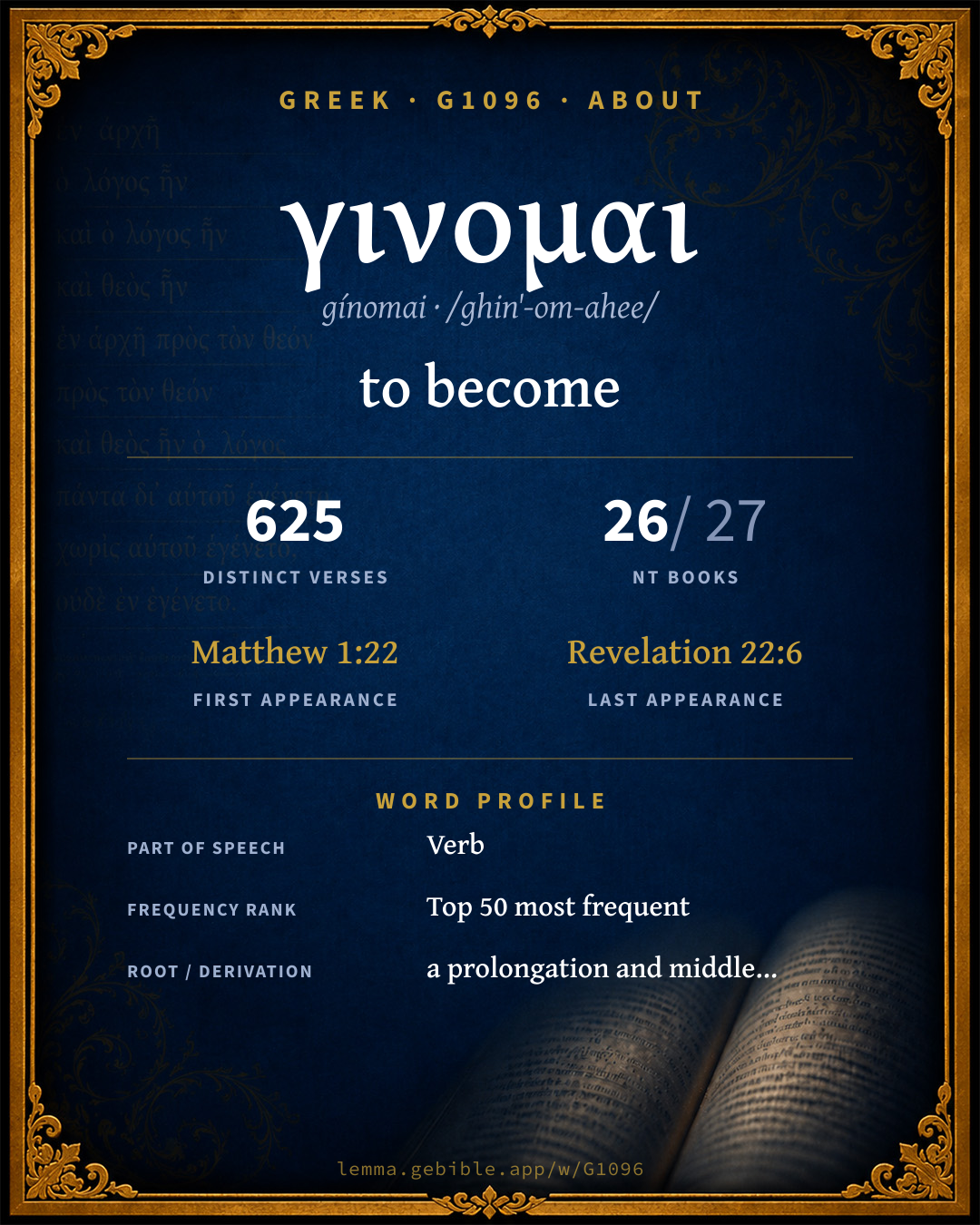
γίνομαι
to become
also: begin to be, receive being fuller range ↓
Full lexicon entry — Thayer's Greek Lexicon
From Thayer's Greek Lexicon
Where this word appears
See every Aorist-tense verb in the Greek New Testament →
Grammar key — what these labels mean
Part of speech
- Verb
- An action or state-of-being word.
Tense
- Aorist
- Action viewed as a simple whole, without regard to duration — often past (perfective aspect).
- Perfect
- A completed past action with continuing present results.
- Present
- Ongoing or general action in present time (imperfective aspect).
- Future
- Action expected in future time.
- Imperfect
- Continuous or repeated action in past time (“was writing”).
- Pluperfect
- A past action completed before another past point (“had written”).
Voice
- Middle deponent
- Middle in form but active in meaning.
- Active
- The subject performs the action.
- Middle or Passive deponent
- Middle/passive in form but active in meaning.
- Passive deponent
- Passive in form but active in meaning.
- Passive
- The subject receives the action.
Mood
- Indicative
- States a fact or asks a factual question (the mood of reality).
- Subjunctive
- Expresses probability, purpose, or possibility (the mood of contingency).
- Infinitive
- A verbal noun (“to write”), unmarked for person or number.
- Participle
- A verbal adjective (“writing,” “having written”).
- Imperative
- Expresses a command or request.
- Optative
- Expresses a wish or a remote possibility.
Case
- Genitive
- The case of source, possession, or “of” — answers “whose / from what.”
- Nominative
- The case of the subject (and the predicate nominative).
- Accusative
- The case of the direct object and of extent.
- Dative
- The case of the indirect object, means, or location — “to / for / with / in.”
Person
- 3rd person
- The one spoken about (“he / she / it / they”).
- 2nd person
- The one addressed (“you”).
- 1st person
- The speaker (“I / we”).
Gender
- Feminine
- Grammatically feminine.
- Masculine
- Grammatically masculine.
- Neuter
- Grammatically neuter.
Number
- Singular
- One.
- Plural
- More than one.
Every verse where G1096 appears in the Book of Acts — 118 distinct verses. Click any verse to open its interlinear word-by-word view. Verse text shown in the World English Bible for context — . Each verse’s Greek form is shown with its reference; the English is not keyword-highlighted, since the data carries no word-level English alignment. Use “Compare translations” on any verse to read it across multiple English versions. This concordance covers the Greek New Testament; Septuagint (Greek Old Testament) occurrences of this word are not indexed here.
Acts
- Acts 1:16 γενομένου aor mid.dep ptcp gen sg masc "Brothers, it was necessary that this Scripture should be fulfilled, which the Holy Spirit spoke before by the mouth of David concerning Judas, who was guide to those who took Jesus.
- Acts 1:18 γενόμενος aor mid.dep ptcp nom sg masc Now this man obtained a field with the reward for his wickedness, and falling headlong, his body burst open, and all his intestines gushed out.
- Acts 1:19 ἐγένετο aor mid.dep ind 3sg It became known to everyone who lived in Jerusalem that in their language that field was called 'Akeldama,' that is, 'The field of blood.'
- Acts 1:20 γενηθήτω aor pass.dep impv 3sg For it is written in the book of Psalms, 'Let his habitation be made desolate, Let no one dwell therein,' and, 'Let another take his office.'
- Acts 1:22 γενέσθαι aor mid.dep inf beginning from the baptism of John, to the day that he was received up from us, of these one must become a witness with us of his resurrection."
- Acts 2:2 ἐγένετο aor mid.dep ind 3sg Suddenly there came from the sky a sound like the rushing of a mighty wind, and it filled all the house where they were sitting.
- Acts 2:6 γενομένης aor mid.dep ptcp gen sg fem When this sound was heard, the multitude came together, and were bewildered, because everyone heard them speaking in his own language.
- Acts 2:43 Ἐγίνετο ἐγίνετο impf mid/pass.dep ind 3sg impf mid/pass.dep ind 3sg Fear came on every soul, and many wonders and signs were done through the apostles.
- Acts 4:4 ἐγενήθη aor pass.dep ind 3sg But many of those who heard the word believed, and the number of the men came to be about five thousand.
- Acts 4:5 Ἐγένετο aor mid.dep ind 3sg It happened in the morning, that their rulers, elders, and scribes were gathered together in Jerusalem.
- Acts 4:11 γενόμενος aor mid.dep ptcp nom sg masc He is 'the stone which was regarded as worthless by you, the builders, which has become the head of the corner.'
- Acts 4:16 γέγονεν perf act ind 3sg saying, "What shall we do to these men? Because indeed a notable miracle has been done through them, as can be plainly seen by all who dwell in Jerusalem, and we can't deny it.
- Acts 4:21 γεγονότι perf act ptcp dat sg neut When they had further threatened them, they let them go, finding no way to punish them, because of the people; for everyone glorified God for that which was done.
- Acts 4:22 γεγόνει plup act ind 3sg For the man on whom this miracle of healing was performed was more than forty years old.
- Acts 4:28 γενέσθαι aor mid.dep inf to do whatever your hand and your council foreordained to happen.
- Acts 4:30 γίνεσθαι pres mid/pass.dep inf while you stretch out your hand to heal; and that signs and wonders may be done through the name of your holy Servant Jesus."
- Acts 5:5 ἐγένετο aor mid.dep ind 3sg Ananias, hearing these words, fell down and died. Great fear came on all who heard these things.
- Acts 5:7 Ἐγένετο γεγονὸς aor mid.dep ind 3sg perf act ptcp acc sg neut About three hours later, his wife, not knowing what had happened, came in.
- Acts 5:11 ἐγένετο aor mid.dep ind 3sg Great fear came on the whole assembly, and on all who heard these things.
- Acts 5:12 ἐγίνετο impf mid/pass.dep ind 3sg By the hands of the apostles many signs and wonders were done among the people. They were all with one accord in Solomon's porch.
- Acts 5:24 γένοιτο aor mid.dep opt 3sg Now when the high priest, the captain of the temple, and the chief priests heard these words, they were very perplexed about them and what might become of this.
- Acts 5:36 ἐγένοντο aor mid.dep ind 3pl For before these days Theudas rose up, making himself out to be somebody; to whom a number of men, about four hundred, joined themselves: who was slain; and all, as many as obeyed him, were dispersed, and came to nothing.
- Acts 6:1 ἐγένετο aor mid.dep ind 3sg Now in those days, when the number of the disciples was multiplying, a complaint arose from the Grecian Jews against the Hebrews because their widows were neglected in the daily service.
- Acts 7:13 ἐγένετο aor mid.dep ind 3sg On the second time Joseph was made known to his brothers, and Joseph's race was revealed to Pharaoh.
- Acts 7:29 ἐγένετο aor mid.dep ind 3sg Moses fled at this saying, and became a stranger in the land of Midian, where he became the father of two sons.
- Acts 7:31 ἐγένετο aor mid.dep ind 3sg When Moses saw it, he wondered at the sight. As he came close to see, a voice of the Lord came to him,
- Acts 7:32 γενόμενος aor mid.dep ptcp nom sg masc 'I am the God of your fathers, the God of Abraham, the God of Isaac, and the God of Jacob.' Moses trembled, and dared not look.
- Acts 7:38 γενόμενος aor mid.dep ptcp nom sg masc This is he who was in the assembly in the wilderness with the angel that spoke to him on Mount Sinai, and with our fathers, who received living oracles to give to us,
- Acts 7:39 γενέσθαι aor mid.dep inf to whom our fathers wouldn't be obedient, but rejected him, and turned back in their hearts to Egypt,
- Acts 7:40 ἐγένετο aor mid.dep ind 3sg saying to Aaron, 'Make us gods that will go before us, for as for this Moses, who led us out of the land of Egypt, we don't know what has become of him.'
- Acts 7:52 ἐγένεσθε aor mid.dep ind 2pl Which of the prophets didn't your fathers persecute? They killed those who foretold the coming of the Righteous One, of whom you have now become betrayers and murderers.
- Acts 8:1 Ἐγένετο aor mid.dep ind 3sg Saul was consenting to his death. A great persecution arose against the assembly which was in Jerusalem in that day. They were all scattered abroad throughout the regions of Judea and Samaria, except for the apostles.
- Acts 8:8 ἐγένετο aor mid.dep ind 3sg There was great joy in that city.
- Acts 8:13 γινομένας pres mid/pass.dep ptcp acc pl fem Simon himself also believed. Being baptized, he continued with Philip. Seeing signs and great miracles occuring, he was amazed.
- Acts 9:3 ἐγένετο aor mid.dep ind 3sg As he traveled, it happened that he got close to Damascus, and suddenly a light from the sky shone around him.
- Acts 9:19 Ἐγένετο aor mid.dep ind 3sg He took food and was strengthened. Saul stayed several days with the disciples who were at Damascus.
- Acts 9:32 ἐγένετο aor mid.dep ind 3sg It happened, as Peter went throughout all those parts, he came down also to the saints who lived at Lydda.
- Acts 9:37 ἐγένετο aor mid.dep ind 3sg It happened in those days that she fell sick, and died. When they had washed her, they laid her in an upper chamber.
- Acts 9:42 ἐγένετο aor mid.dep ind 3sg And it became known throughout all Joppa, and many believed in the Lord.
- Acts 9:43 ἐγένετο aor mid.dep ind 3sg It happened, that he stayed many days in Joppa with one Simon, a tanner.
- Acts 10:4 γενόμενος aor mid.dep ptcp nom sg masc He, fastening his eyes on him, and being frightened, said, "What is it, Lord?" He said to him, "Your prayers and your gifts to the needy have gone up for a memorial before God.
- Acts 10:10 ἐγένετο ἐγένετο aor mid.dep ind 3sg aor mid.dep ind 3sg He became hungry and desired to eat, but while they were preparing, he fell into a trance.
- Acts 10:13 ἐγένετο aor mid.dep ind 3sg A voice came to him, "Rise, Peter, kill and eat!"
- Acts 10:16 ἐγένετο aor mid.dep ind 3sg This was done three times, and immediately the vessel was received up into heaven.
- Acts 10:25 ἐγένετο aor mid.dep ind 3sg When it happened that Peter entered, Cornelius met him, fell down at his feet, and worshiped him.
- Acts 10:37 γενόμενον aor mid.dep ptcp acc sg neut that spoken word you yourselves know, which was proclaimed throughout all Judea, beginning from Galilee, after the baptism which John preached;
- Acts 10:40 γενέσθαι aor mid.dep inf God raised him up the third day, and gave him to be revealed,
- Acts 11:10 ἐγένετο aor mid.dep ind 3sg This was done three times, and all were drawn up again into heaven.
- Acts 11:19 γενομένης aor mid.dep ptcp gen sg fem They therefore who were scattered abroad by the oppression that arose about Stephen traveled as far as Phoenicia, Cyprus, and Antioch, speaking the word to no one except to Jews only.
- Acts 11:26 ἐγένετο aor mid.dep ind 3sg When he had found him, he brought him to Antioch. It happened, that for a whole year they were gathered together with the assembly, and taught many people. The disciples were first called Christians in Antioch.
- Acts 11:28 ἐγένετο aor mid.dep ind 3sg One of them named Agabus stood up, and indicated by the Spirit that there should be a great famine all over the world, which also happened in the days of Claudius.
- Acts 12:5 γινομένη pres mid/pass.dep ptcp nom sg fem Peter therefore was kept in the prison, but constant prayer was made by the assembly to God for him.
- Acts 12:9 γινόμενον pres mid/pass.dep ptcp nom sg neut And he went out and followed him. He didn't know that what was being done by the angel was real, but thought he saw a vision.
- Acts 12:11 γενόμενος aor mid.dep ptcp nom sg masc When Peter had come to himself, he said, "Now I truly know that the Lord has sent out his angel and delivered me out of the hand of Herod, and from everything the Jewish people were expecting."
- Acts 12:18 γενομένης ἐγένετο aor mid.dep ptcp gen sg fem aor mid.dep ind 3sg Now as soon as it was day, there was no small stir among the soldiers about what had become of Peter.
- Acts 12:23 γενόμενος aor mid.dep ptcp nom sg masc Immediately an angel of the Lord struck him, because he didn't give God the glory, and he was eaten by worms and died.
- Acts 13:5 γενόμενοι aor mid.dep ptcp nom pl masc When they were at Salamis, they proclaimed the word of God in the synagogues of the Jews. They had also John as their attendant.
- Acts 13:12 γεγονὸς perf act ptcp acc sg neut Then the proconsul, when he saw what was done, believed, being astonished at the teaching of the Lord.
- Acts 13:32 γενομένην aor mid.dep ptcp acc sg fem We bring you good news of the promise made to the fathers,
- Acts 14:1 Ἐγένετο aor mid.dep ind 3sg It happened in Iconium that they entered together into the synagogue of the Jews, and so spoke that a great multitude both of Jews and of Greeks believed.
- Acts 14:3 γίνεσθαι pres mid/pass.dep inf Therefore they stayed there a long time, speaking boldly in the Lord, who testified to the word of his grace, granting signs and wonders to be done by their hands.
- Acts 14:5 ἐγένετο aor mid.dep ind 3sg When some of both the Gentiles and the Jews, with their rulers, made a violent attempt to mistreat and stone them,
- Acts 15:2 γενομένης aor mid.dep ptcp gen sg fem Therefore when Paul and Barnabas had no small discord and discussion with them, they appointed Paul and Barnabas, and some others of them, to go up to Jerusalem to the apostles and elders about this question.
- Acts 15:7 γενομένης aor mid.dep ptcp gen sg fem When there had been much discussion, Peter rose up and said to them, "Brothers, you know that a good while ago God made choice among you, that by my mouth the Gentiles should hear the word of the Gospel, and believe.
- Acts 15:25 γενομένοις aor mid.dep ptcp dat pl masc it seemed good to us, having come to one accord, to choose out men and send them to you with our beloved Barnabas and Paul,
- Acts 15:39 ἐγένετο aor mid.dep ind 3sg Then the contention grew so sharp that they separated from each other. Barnabas took Mark with him, and sailed away to Cyprus,
- Acts 16:16 Ἐγένετο aor mid.dep ind 3sg It happened, as we were going to prayer, that a certain girl having a spirit of divination met us, who brought her masters much gain by fortune telling.
- Acts 16:26 ἐγένετο aor mid.dep ind 3sg Suddenly there was a great earthquake, so that the foundations of the prison were shaken; and immediately all the doors were opened, and everyone's bonds were loosened.
- Acts 16:27 γενόμενος aor mid.dep ptcp nom sg masc The jailer, being roused out of sleep and seeing the prison doors open, drew his sword and was about to kill himself, supposing that the prisoners had escaped.
- Acts 16:29 γενόμενος aor mid.dep ptcp nom sg masc He called for lights and sprang in, and, fell down trembling before Paul and Silas,
- Acts 16:35 γενομένης aor mid.dep ptcp gen sg fem But when it was day, the magistrates sent the sergeants, saying, "Let those men go."
- Acts 19:1 Ἐγένετο aor mid.dep ind 3sg It happened that, while Apollos was at Corinth, Paul, having passed through the upper country, came to Ephesus, and found certain disciples.
- Acts 19:10 ἐγένετο aor mid.dep ind 3sg This continued for two years, so that all those who lived in Asia heard the word of the Lord Jesus, both Jews and Greeks.
- Acts 19:17 ἐγένετο aor mid.dep ind 3sg This became known to all, both Jews and Greeks, who lived at Ephesus. Fear fell on them all, and the name of the Lord Jesus was magnified.
- Acts 19:21 γενέσθαι aor mid.dep inf Now after these things had ended, Paul determined in the spirit, when he had passed through Macedonia and Achaia, to go to Jerusalem, saying, "After I have been there, I must also see Rome."
- Acts 19:23 Ἐγένετο aor mid.dep ind 3sg About that time there arose no small stir concerning the Way.
- Acts 19:26 γινόμενοι pres mid/pass.dep ptcp nom pl masc You see and hear, that not at Ephesus alone, but almost throughout all Asia, this Paul has persuaded and turned away many people, saying that they are no gods, that are made with hands.
- Acts 19:28 γενόμενοι aor mid.dep ptcp nom pl masc When they heard this they were filled with anger, and cried out, saying, "Great is Artemis of the Ephesians!"
- Acts 19:34 ἐγένετο aor mid.dep ind 3sg But when they perceived that he was a Jew, all with one voice for a time of about two hours cried out, "Great is Artemis of the Ephesians!"
- Acts 20:3 γενομένης ἐγένετο aor mid.dep ptcp gen sg fem aor mid.dep ind 3sg When he had spent three months there, and a plot was made against him by Jews as he was about to set sail for Syria, he determined to return through Macedonia.
- Acts 20:16 γένηται γενέσθαι aor mid.dep subj 3sg aor mid.dep inf For Paul had determined to sail past Ephesus, that he might not have to spend time in Asia; for he was hastening, if it were possible for him, to be in Jerusalem on the day of Pentecost.
- Acts 20:18 ἐγενόμην aor mid.dep ind 1sg When they had come to him, he said to them, "You yourselves know, from the first day that I set foot in Asia, how I was with you all the time,
- Acts 20:37 ἐγένετο aor mid.dep ind 3sg They all wept a lot, and fell on Paul's neck and kissed him,
- Acts 21:1 ἐγένετο aor mid.dep ind 3sg When it happened that we had parted from them and had set sail, we came with a straight course to Cos, and the next day to Rhodes, and from there to Patara.
- Acts 21:5 ἐγένετο aor mid.dep ind 3sg When it happened that we had accomplished the days, we departed and went on our journey. They all, with wives and children, brought us on our way until we were out of the city. Kneeling down on the beach, we prayed.
- Acts 21:14 γινέσθω pres mid/pass.dep impv 3sg When he would not be persuaded, we ceased, saying, "The Lord's will be done."
- Acts 21:17 Γενομένων aor mid.dep ptcp gen pl masc When we had come to Jerusalem, the brothers received us gladly.
- Acts 21:30 ἐγένετο aor mid.dep ind 3sg All the city was moved, and the people ran together. They seized Paul and dragged him out of the temple. Immediately the doors were shut.
- Acts 21:35 ἐγένετο aor mid.dep ind 3sg When he came to the stairs, it happened that he was carried by the soldiers because of the violence of the crowd;
- Acts 21:40 γενομένης aor mid.dep ptcp gen sg fem When he had given him permission, Paul, standing on the stairs, beckoned with his hand to the people. When there was a great silence, he spoke to them in the Hebrew language, saying,
- Acts 22:6 ἐγένετο aor mid.dep ind 3sg It happened that, as I made my journey, and came close to Damascus, about noon, suddenly there shone from the sky a great light around me.
- Acts 22:17 ἐγένετο γενέσθαι aor mid.dep ind 3sg aor mid.dep inf "It happened that, when I had returned to Jerusalem, and while I prayed in the temple, I fell into a trance,
- Acts 23:7 ἐγένετο aor mid.dep ind 3sg When he had said this, an argument arose between the Pharisees and Sadducees, and the assembly was divided.
- Acts 23:9 ἐγένετο aor mid.dep ind 3sg A great clamor arose, and some of the scribes of the Pharisees part stood up, and contended, saying, "We find no evil in this man. But if a spirit or angel has spoken to him, let's not fight against God!"
- Acts 23:10 γινομένης pres mid/pass.dep ptcp gen sg fem When a great argument arose, the commanding officer, fearing that Paul would be torn in pieces by them, commanded the soldiers to go down and take him by force from among them, and bring him into the barracks.
- Acts 23:12 Γενομένης aor mid.dep ptcp gen sg fem When it was day, some of the Jews banded together, and bound themselves under a curse, saying that they would neither eat nor drink until they had killed Paul.
- Acts 24:3 γινομένων pres mid/pass.dep ptcp gen pl neut we accept it in all ways and in all places, most excellent Felix, with all thankfulness.
- Acts 24:25 γενόμενος aor mid.dep ptcp nom sg masc As he reasoned about righteousness, self-control, and the judgment to come, Felix was terrified, and answered, "Go your way for this time, and when it is convenient for me, I will summon you."
- Acts 25:15 γενομένου aor mid.dep ptcp gen sg masc about whom, when I was at Jerusalem, the chief priests and the elders of the Jews informed me, asking for a sentence against him.
- Acts 25:26 γενομένης aor mid.dep ptcp gen sg fem Of whom I have no certain thing to write to my lord. Therefore I have brought him forth before you, and especially before you, King Agrippa, that, after examination, I may have something to write.
- Acts 26:4 γενομένην aor mid.dep ptcp acc sg fem "Indeed, all the Jews know my way of life from my youth up, which was from the beginning among my own nation and at Jerusalem;
- Acts 26:6 γενομένης aor mid.dep ptcp gen sg fem Now I stand here to be judged for the hope of the promise made by God to our fathers,
- Acts 26:19 ἐγενόμην aor mid.dep ind 1sg "Therefore, King Agrippa, I was not disobedient to the heavenly vision,
- Acts 26:22 γίνεσθαι pres mid/pass.dep inf Having therefore obtained the help that is from God, I stand to this day testifying both to small and great, saying nothing but what the prophets and Moses said would happen,
- Acts 26:29 γενέσθαι aor mid.dep inf Paul said, "I pray to God, that whether with little or with much, not only you, but also all that hear me this day, might become such as I am, except for these bonds."
- Acts 27:7 γενόμενοι aor mid.dep ptcp nom pl masc When we had sailed slowly many days, and had come with difficulty opposite Cnidus, the wind not allowing us further, we sailed under the lee of Crete, opposite Salmone.
- Acts 27:16 γενέσθαι aor mid.dep inf Running under the lee of a small island called Clauda, we were able, with difficulty, to secure the boat.
- Acts 27:27 ἐγένετο aor mid.dep ind 3sg But when the fourteenth night had come, as we were driven back and forth in the Adriatic Sea, about midnight the sailors surmised that they were drawing near to some land.
- Acts 27:29 γενέσθαι aor mid.dep inf Fearing that we would run aground on rocky ground, they let go four anchors from the stern, and wished for daylight.
- Acts 27:33 γίνεσθαι pres mid/pass.dep inf While the day was coming on, Paul begged them all to take some food, saying, "This day is the fourteenth day that you wait and continue fasting, having taken nothing.
- Acts 27:36 γενόμενοι aor mid.dep ptcp nom pl masc Then they all cheered up, and they also took food.
- Acts 27:39 ἐγένετο aor mid.dep ind 3sg When it was day, they didn't recognize the land, but they noticed a certain bay with a beach, and they decided to try to drive the ship onto it.
- Acts 27:42 ἐγένετο aor mid.dep ind 3sg The soldiers' counsel was to kill the prisoners, so that none of them would swim out and escape.
- Acts 27:44 ἐγένετο aor mid.dep ind 3sg and the rest should follow, some on planks, and some on other things from the ship. So it happened that they all escaped safely to the land.
- Acts 28:6 γινόμενον pres mid/pass.dep ptcp acc sg neut But they expected that he would have swollen or fallen down dead suddenly, but when they watched for a long time and saw nothing bad happen to him, they changed their minds, and said that he was a god.
- Acts 28:8 ἐγένετο aor mid.dep ind 3sg It happened that the father of Publius lay sick of fever and dysentery. Paul entered in to him, prayed, and laying his hands on him, healed him.
- Acts 28:9 γενομένου aor mid.dep ptcp gen sg neut Then when this was done, the rest also who had diseases in the island came, and were cured.
- Acts 28:17 ἐγένετο aor mid.dep ind 3sg It happened that after three days Paul called together those who were the leaders of the Jews. When they had come together, he said to them, "I, brothers, though I had done nothing against the people, or the customs of our fathers, still was delivered prisoner from Jerusalem into the hands of the Romans,
About this entry
At a glance — auto-summarized from this page’s data, not written by a person. Every figure links to its source below. This summary describes the numbers; it doesn’t interpret them.
The Greek verb γινομαι centers on the idea of “to become.” The King James Version usually renders it “was,” while modern versions prefer “happened” (unfoldingWord Literal Text) — see the renderings breakdown. Spanning 625 verses in 26 books, it ranks among the most common words of the Greek New Testament. Debuting at Matthew 1:22, it then recurs through the corpus. Thayer's distinguishes 5 senses; alongside “to become” it spans “begin to be” and “receive being”. For the data behind this summary, explore the sense tree and the renderings breakdown below.
Gloss history
Strong's 1890 vs modern scholarship

About this word
Strong's G1096 catalogs a Greek word from the Greek New Testament.
These counts are not copied from any lexicon or concordance. They are computed here, from the morphology-tagged Greek New Testament. What Lemma adds →
- 625
- distinct verses
- The word appears in 625 distinct verses.
- 26 / 27
- NT books
- The word appears in 26 of 27 New Testament books.
- #28
- by frequency
- Top 50 most frequent Greek words (rank 28 of 5,347 Greek words by occurrence).
View all 625 occurrences in the concordance →
By section of the New Testament
By traditional corpus
Conventional, traditional groupings — biblical authorship is debated, so this is a traditional corpus grouping, not an authorship claim. Some books belong to more than one corpus (Luke is in both the Gospels and the Lukan corpus, and so on), so these shares overlap and need not total 100%. Each figure is a share of the word’s 625 distinct verses.
- Gospels 294 verses · 47%
- Lukan (Luke–Acts) 246 verses · 39%
- Pauline corpus 130 verses · 21%
- Johannine 79 verses · 13%
- Revelation 31 verses · 5%
- Hebrews 28 verses · 4%
- General (Catholic) Epistles 24 verses · 4%
How translations render this word
Counts come from each version’s own published word-to-Strong’s tagging or interlinear alignment — an approximate guide to how each version renders this word, not a word-level alignment the data otherwise carries. Because each total is that version’s own tagged count, the per-version totals vary from one another and need not match the appearance or distinct-verse counts above. These counts may also differ from a printed concordance because Lemma counts each distinctly tagged rendering and does not collapse phrase taggings into a single head-word total. This is a fixed set of word-tagged versions (KJV, ASV, BSB, ULT) and does not change with the reading translation you choose elsewhere. Each version’s license is shown beside its name below (and on Sources).
- King James Version: Was 94×, Came to pass 65×, Be 38×
- American Standard Version: Came to pass 60×, Was 53×, Be 28×
- Berean Standard Bible: Was 39×, Came 35×, Be 26×
- unfoldingWord Literal Text: Happened 71×, Happened that 57×, Became 48×
King James Version Public Domain
Renders G1096 across 680 tagged occurrences — most commonly:
Plus other, less common renderings. Plus 112 renderings that appear only once — usually multi-word phrases or single function words the recovered tagging swept in, not distinct renderings. Not rendered by a distinct English word in 29 further occurrences.
American Standard Version Public Domain
Renders G1096 across 682 tagged occurrences — most commonly:
Plus other, less common renderings. Plus 122 renderings that appear only once — usually multi-word phrases or single function words the recovered tagging swept in, not distinct renderings. Not rendered by a distinct English word in 2 further occurrences.
Berean Standard Bible Public Domain
Renders G1096 across 544 tagged occurrences — most commonly:
Plus other, less common renderings. Plus 127 renderings that appear only once — usually multi-word phrases or single function words the recovered tagging swept in, not distinct renderings. Not rendered by a distinct English word in 85 further occurrences.
unfoldingWord Literal Text CC BY-SA 4.0
Renders G1096 across 755 tagged occurrences — most commonly:
Plus other, less common renderings. Plus 81 renderings that appear only once — usually multi-word phrases or single function words the recovered tagging swept in, not distinct renderings.
Senses in Thayer's
The 5 senses Thayer's distinguishes for this word, in lexicon order (not ranked by frequency or importance). The full entry — with sub-senses — is in the Lexicon Entry tab.
- to become, i.e. to come into existence, begin to be, receive being
- to become, i.e. to come to pass, happen
- to arise, appear in history, come upon the stage
- of miracles, to be performed, wrought
- to become, be made
Word origin
Origin: a prolongation and middle voice form of a primary verb
A prolonged and middle form of a primary verb; to cause to be (gen -erate) that is (reflexively) to become ( come into being ) used with great latitude (literally figuratively intensively etc.): - arise be assembled be (come -fall -have self) be brought (to pass) (be) come (to pass) continue be divided be done draw be ended fall be finished follow be found be fulfilled + God forbid grow happen have be kept be made be married be ordained to be partake pass be performed be published require seem be showed X soon as it was sound be taken be turned use wax will would be wrought.
— Strong’s Exhaustive Concordance (1890), public domain.
Forms in the corpus
The 85 distinct written forms G1096 takes in the Greek New Testament, most frequent first — each parse links to that tense’s occurrences in the concordance.
The 60 most common forms are shown; 25 rarer forms follow in the full concordance.
Same root — word family
Other Thayer's entries built from the same root as G1096, grouped by Strong’s listed origin. These share a root / origin per the lexicon — not necessarily a shared meaning. Each links to that word’s own entry.
Derived from this word
Compare all same-root words → They share a root, not necessarily a meaning.
Septuagint usage
The same Greek word γινομαι appears 1,711 times in the Greek Old Testament (Septuagint), across 1,567 verses in 37 books.
- 1,711
- LXX occurrences
- Tagged occurrences of this Greek word in the Septuagint.
- 1,567
- verses
- Distinct Septuagint verses containing this word.
- 37 / 39
- OT books
- The word appears in 37 of the 39 Old Testament books.
Sample Septuagint occurrences
- Genesis 1:3 γίγνομαι
- Exodus 1:7 γίγνομαι
- Leviticus 8:29 γίγνομαι
- Numbers 1:20 γίγνομαι
- Deuteronomy 1:3 γίγνομαι
- Joshua 1:1 γίγνομαι
- Judges 1:1 γίγνομαι
- Ruth 1:1 γίγνομαι
- 1 Samuel 1:4 γίγνομαι
- 2 Samuel 1:1 γίγνομαι
- 1 Kings 1:7 γίγνομαι
- 2 Kings 2:1 γίγνομαι
Septuagint occurrences (same lexeme)
Every verse where the same Strong’s number (G1096) appears in the Greek Septuagint — showing the first 50 of 1,567. Verse text shown in the World English Bible for context; the Greek form is the matched word — the English is not keyword-highlighted.
- Genesis 1:3 γίγνομαι God said, "Let there be light," and there was light.
- Genesis 1:5 γίγνομαι God called the light Day, and the darkness he called Night. There was evening and there was morning, one day.
- Genesis 1:6 γίγνομαι God said, "Let there be an expanse in the midst of the waters, and let it divide the waters from the waters."
- Genesis 1:8 γίγνομαι God called the expanse sky. There was evening and there was morning, a second day.
- Genesis 1:9 γίγνομαι God said, "Let the waters under the sky be gathered together to one place, and let the dry land appear," and it was so.
- Genesis 1:11 γίγνομαι God said, "Let the earth put forth grass, herbs yielding seed, and fruit trees bearing fruit after their kind, with its seed in it, on the earth," and it was so.
- Genesis 1:13 γίγνομαι There was evening and there was morning, a third day.
- Genesis 1:14 γίγνομαι God said, "Let there be lights in the expanse of sky to divide the day from the night; and let them be for signs, and for seasons, and for days and years;
- Genesis 1:15 γίγνομαι and let them be for lights in the expanse of sky to give light on the earth," and it was so.
- Genesis 1:19 γίγνομαι There was evening and there was morning, a fourth day.
- Genesis 1:20 γίγνομαι God said, "Let the waters swarm with swarms of living creatures, and let birds fly above the earth in the open expanse of sky."
- Genesis 1:23 γίγνομαι There was evening and there was morning, a fifth day.
- Genesis 1:24 γίγνομαι God said, "Let the earth bring forth living creatures after their kind, cattle, creeping things, and animals of the earth after their kind," and it was so.
- Genesis 1:30 γίγνομαι To every animal of the earth, and to every bird of the sky, and to everything that creeps on the earth, in which there is life, I have given every green herb for food." And it was so.
- Genesis 1:31 γίγνομαι God saw everything that he had made, and, behold, it was very good. There was evening and there was morning, the sixth day.
- Genesis 2:4 γίγνομαι This is the history of the generations of the heavens and of the earth when they were created, in the day that Yahweh God made earth and the heavens.
- Genesis 2:5 γίγνομαι No plant of the field was yet in the earth, and no herb of the field had yet sprung up; for Yahweh God had not caused it to rain on the earth. There was not a man to till the ground,
- Genesis 2:7 γίγνομαι Yahweh God formed man from the dust of the ground, and breathed into his nostrils the breath of life; and man became a living soul.
- Genesis 3:22 γίγνομαι Yahweh God said, "Behold, the man has become like one of us, knowing good and evil. Now, lest he put forth his hand, and also take of the tree of life, and eat, and live forever..."
- Genesis 4:2 γίγνομαι Again she gave birth, to Cain's brother Abel. Abel was a keeper of sheep, but Cain was a tiller of the ground.
- Genesis 4:3 γίγνομαι As time passed, it happened that Cain brought an offering to Yahweh from the fruit of the ground.
- Genesis 4:6 γίγνομαι Yahweh said to Cain, "Why are you angry? Why has the expression of your face fallen?
- Genesis 4:8 γίγνομαι Cain said to Abel, his brother, "Let's go into the field." It happened, when they were in the field, that Cain rose up against Abel, his brother, and killed him.
- Genesis 4:18 γίγνομαι To Enoch was born Irad. Irad became the father of Mehujael. Mehujael became the father of Methushael. Methushael became the father of Lamech.
- Genesis 4:26 γίγνομαι There was also born a son to Seth, and he named him Enosh. Then men began to call on Yahweh's name.
- Genesis 5:4 γίγνομαι The days of Adam after he became the father of Seth were eight hundred years, and he became the father of sons and daughters.
- Genesis 5:5 γίγνομαι All the days that Adam lived were nine hundred thirty years, then he died.
- Genesis 5:8 γίγνομαι All the days of Seth were nine hundred twelve years, then he died.
- Genesis 5:11 γίγνομαι All the days of Enosh were nine hundred five years, then he died.
- Genesis 5:14 γίγνομαι and all the days of Kenan were nine hundred ten years, then he died.
- Genesis 5:17 γίγνομαι All the days of Mahalalel were eight hundred ninety-five years, then he died.
- Genesis 5:20 γίγνομαι All the days of Jared were nine hundred sixty-two years, then he died.
- Genesis 5:23 γίγνομαι all the days of Enoch were three hundred sixty-five years.
- Genesis 5:27 γίγνομαι All the days of Methuselah were nine hundred sixty-nine years, then he died.
- Genesis 5:31 γίγνομαι All the days of Lamech were seven hundred seventy-seven years, then he died.
- Genesis 6:1 γίγνομαι It happened, when men began to multiply on the surface of the ground, and daughters were born to them,
- Genesis 7:6 γίγνομαι Noah was six hundred years old when the flood of waters came on the earth.
- Genesis 7:10 γίγνομαι It happened after the seven days, that the waters of the flood came on the earth.
- Genesis 7:12 γίγνομαι The rain was on the earth forty days and forty nights.
- Genesis 7:17 γίγνομαι The flood was forty days on the earth. The waters increased, and lifted up the ark, and it was lifted up above the earth.
- Genesis 8:6 γίγνομαι It happened at the end of forty days, that Noah opened the window of the ark which he had made,
- Genesis 8:13 γίγνομαι It happened in the six hundred first year, in the first month, the first day of the month, the waters were dried up from off the earth. Noah removed the covering of the ark, and looked. He saw that the surface of the ground was dried.
- Genesis 9:27 γίγνομαι God enlarge Japheth, Let him dwell in the tents of Shem; Let Canaan be his servant."
- Genesis 9:29 γίγνομαι All the days of Noah were nine hundred fifty years, then he died.
- Genesis 10:1 γίγνομαι Now this is the history of the generations of the sons of Noah and of Shem, Ham, and Japheth. Sons were born to them after the flood.
- Genesis 10:10 γίγνομαι The beginning of his kingdom was Babel, Erech, Accad, and Calneh, in the land of Shinar.
- Genesis 10:19 γίγνομαι The border of the Canaanites was from Sidon, as you go toward Gerar, to Gaza; as you go toward Sodom, Gomorrah, Admah, and Zeboiim, to Lasha.
- Genesis 10:21 γίγνομαι To Shem, the father of all the children of Eber, the elder brother of Japheth, to him also were children born.
- Genesis 10:25 γίγνομαι To Eber were born two sons. The name of the one was Peleg, for in his days was the earth divided. His brother's name was Joktan.
- Genesis 10:30 γίγνομαι Their dwelling was from Mesha, as you go toward Sephar, the mountain of the east.
These are occurrences of the same Greek lexeme (G1096) in the Septuagint — not a translation of any one Hebrew word. The store carries no word-level Hebrew↔Greek alignment, so no Hebrew original is asserted here. Counts come from the recovered LXX Strong's tagging — high-frequency vocabulary is well covered, while rare or late forms may be untagged — so they reflect tagged occurrences and may slightly undercount.