Mark 11:19

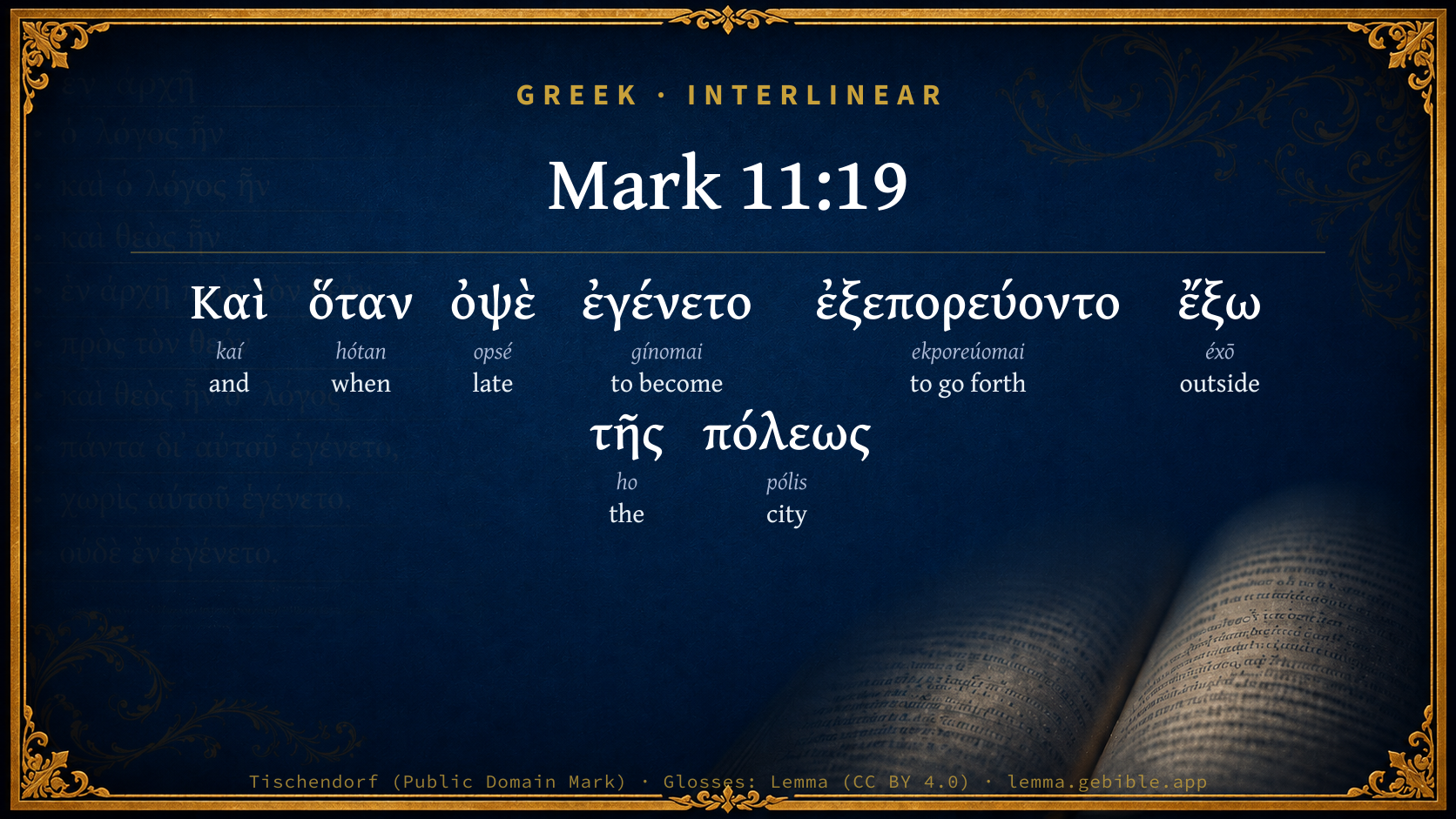
Greek (Tischendorf 8th ed.) Mark 11:19 appears in the Greek New Testament. The text above is from the Tischendorf 8th edition. Each word links to its Strong’s number and a concise gloss. Click any word for its full Thayer’s Greek Lexicon entry.
Download image
Cite this verse

Mark 11:19 (World English Bible). Public Domain. Lemma interlinear Bible study tool, https://lemma.gebible.app/v/mark/11/19.

Show BibTeX & RIS
BibTeX
RIS
English Translation
When evening came, he went out of the city.
World English Bible · Public Domain
Download a study sheet

One document with this verse’s original text, its word-by-word gloss line, the meaning frame, cross-references with their text, attributed commentary, and full source and license credits — printable, and it pastes into notes with its structure intact.

This verse Autodidact and up

Study sheet (.html) Plain text (.txt)

A passage Seminary Student

Up to 50 verses in one chapter. A passage sheet keeps up to 6 commentary sources and 12 cross-references per verse, in the order this page ranks them, and says so on the sheet whenever that leaves anything out. Ask for a single verse and you get the Autodidact verse sheet above.

Everything on this page stays free to read, with no account — the sheet is a download of what is already on screen, not access to it.

Want to remove ads? Support Godless Engineer
Compare translations 3

The same verse in 3 English versions, stacked beneath the original-language interlinear above. Click any original word for its lexicon entry.

Each is an independent rendering of the whole verse — the interlinear is not word-aligned to these translations.

Highlighted words mark where these versions differ — a whole-verse word diff, not a word-by-word alignment.

  • World English Bible Public Domain
    When evening came, he went out of the city.
  • King James Version Public Domain
    And when even was come, he went out of the city.
  • unfoldingWord Literal Text CC BY-SA 4.0
    And when evening came, they were going out outside the city.

unfoldingWord Literal Text — © unfoldingWord, licensed CC BY-SA 4.0. Word-aligned USFM3 via Door43 (git.door43.org/unfoldingWord/en_ult).

Versions to compare (up to 4)

3 of 4 selected

Show all 19 translations

Every available English version of this verse, each an independent rendering of the whole verse.

  • World English Bible Public Domain
    When evening came, he went out of the city.
  • Berean Standard Bible Public Domain
    And when evening came, Jesus and His disciples went out of the city.
  • Majority Standard Bible Public Domain
    And when evening came, Jesus went out of the city.
  • King James Version Public Domain
    And when even was come, he went out of the city.
  • American Standard Version (1901) Public Domain
    And every evening he went forth out of the city.
  • Revised Version (1885) Public Domain
    And every evening he went forth out of the city.
  • Geneva Bible (1599) Public Domain
    But when euen was come, Iesus went out of the citie.
  • Douay-Rheims (1899) Public Domain
    And when evening was come, he went forth out of the city.
  • Young's Literal Translation Public Domain
    and when evening came, he was going forth without the city.
  • Literal Standard Version CC BY-SA 4.0
    and when evening came, He was going forth outside the city.
  • Unlocked Literal Bible CC BY-SA 4.0
    When evening came, they left the city.
  • unfoldingWord Literal Text CC BY-SA 4.0
    And when evening came, they were going out outside the city.
  • Darby Bible Public Domain
    And when it was evening he went forth without the city.
  • World Messianic Bible Public Domain
    When evening came, he went out of the city.
  • Webster's Bible Public Domain
    And when evening had come, he went out of the city.
  • Free Bible Version CC BY-SA 4.0
    When evening came Jesus and his disciples left the city.
  • Bible in Basic English Public Domain
    And every evening he went out of the town.
  • Text-Critical English NT CC BY 4.0
    And when evening came, he went out of the city.
  • Tyndale New Testament (1534) Public Domain
    And when even was come he went out of the cite.

Literal Standard Version (2020), Covenant Press — licensed CC BY-SA 4.0. Text via the HelloAO Bible API (eBible.org). Unlocked Literal Bible (unfoldingWord) — licensed CC BY-SA 4.0. Text via the HelloAO Bible API (eBible.org). unfoldingWord Literal Text — © unfoldingWord, licensed CC BY-SA 4.0. Word-aligned USFM3 via Door43 (git.door43.org/unfoldingWord/en_ult). Free Bible Version, Dr. Jonathan Gallagher — licensed CC BY-SA 4.0. Text via the HelloAO Bible API (eBible.org).

Word by word

More ways to search: Search by grammar → Find every occurrence → Compare this word →

Practice this passage: Drill this verse → Learn its vocabulary →

About this verse

These counts appear in no published source. They are computed here, from the morphology-tagged text and Lemma’s own curated glosses. What Lemma adds →

8
words
8
distinct lemmas
Gospels
section

Notable vocabulary

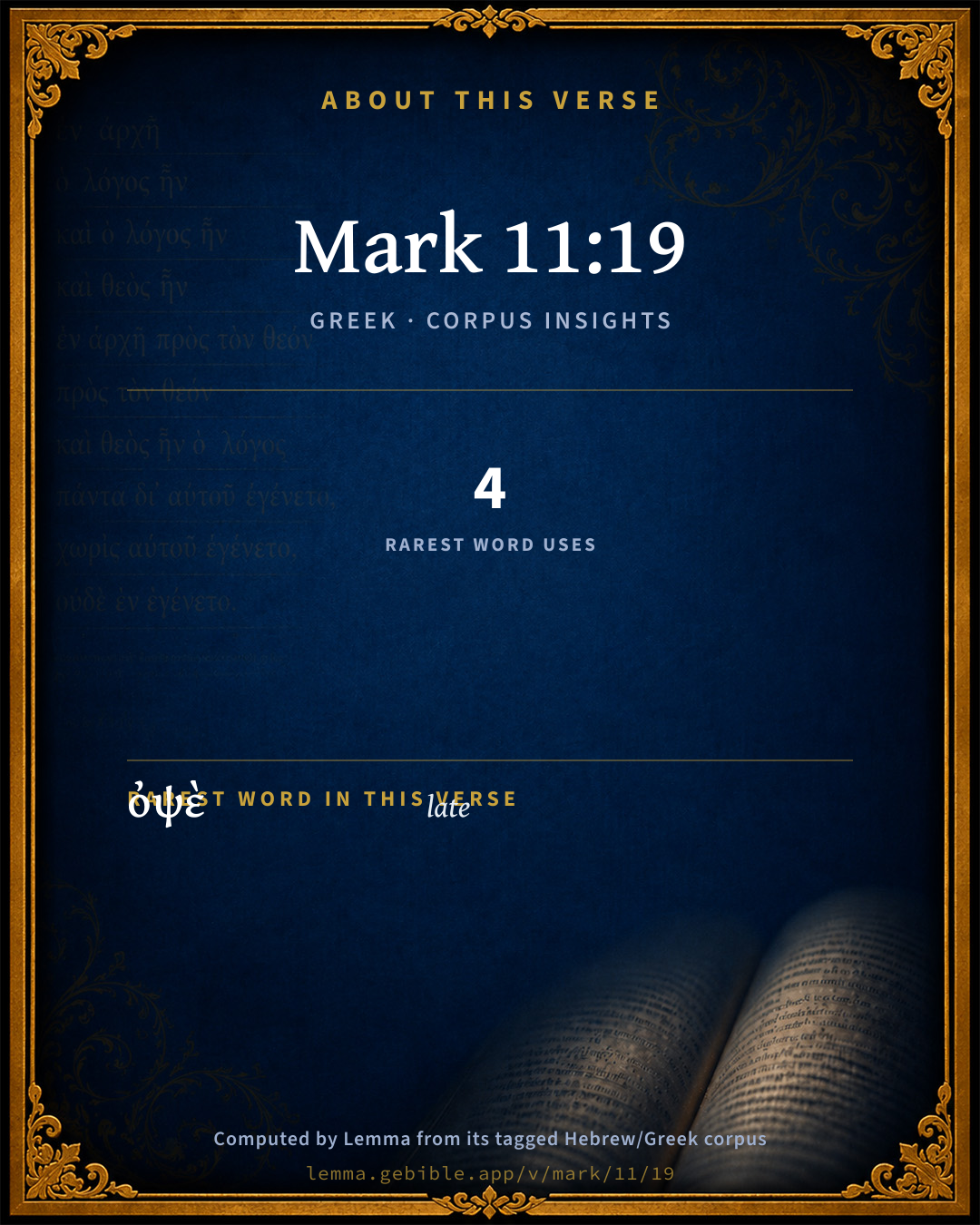
The rarest word here is ὀψὲ late G3796 — appearing just 4 times in the whole Greek New Testament.

Shared distinctive vocabulary

ὀψὲ late G3796 occurs in 4 verses of the Greek New Testament. Also found in:

Cross-references

3

Topical passages linked to Mark 11:19 in the Treasury of Scripture Knowledge — connected by theme and wording, ordered by reader-vote popularity; previews shown in the World English Bible.

  • Luke 21:37 Every day Jesus was teaching in the temple, and every night he would go out and spend the night on the mountain that is called Olivet.
  • Mark 11:11 Jesus entered into the temple in Jerusalem. When he had looked around at everything, it being now evening, he went out to Bethany with the twelve.
  • John 12:36 While you have the light, believe in the light, that you may become children of light." Jesus said these things, and he departed and hid himself from them.

Cross-references courtesy of OpenBible.info (CC BY 4.0).

Commentary

Notes on Mark 11:19 from classic Christian and Jewish commentators (each source and its license shown beneath its notes). The classic Christian expositions comment on the surrounding passage and are grouped to its opening verse, so a note may address several verses; the Jewish commentaries on the Tanakh (Rashi and others) are per-verse, so they appear only where the commentator wrote on this verse.

Lemma curates 59 commentaries, every one of them public domain or Creative Commons licensed, each selected and text-cleaned for this edition rather than reprinted as found. About our sources →

Tyndale Open Study Notes

Tyndale Open Resources

11:19 Jesus and the disciples left: They presumably returned to Bethany (11:11; 14:3).

Tyndale Open Study Notes — © Tyndale Open Resources, licensed CC BY-SA 4.0. Text via the HelloAO Bible API.

Expositor's Greek Testament

ed. W. Robertson Nicoll

Mar 11:19 . ὅταν ( ὅτε , T.R.) implies repetition of the action. We have here ἄν with the indicative instead of the optative without ἄν as in the classics. Field ( Ot. Nor. ) regards ὅταν ὀψὲ ἐγένετο as a solecism due probably to Mk. himself (as in Mar 3:11 , ὅταν ἐθεώρουν ), and holds that the connection in Mk.’s narrative is decidedly in favour of a single action instead of, as in Lk., a daily practice.

The Expositor's Greek Testament, edited by W. Robertson Nicoll (1897–1910) — public domain. Text from a community e-Sword module.

Adam Clarke's Commentary

Verse 19. He went out of the city.] To go to Bethany.

Adam Clarke's Commentary on the Bible (1810–1826) — public domain. Text from a community e-Sword/MySword module.

Ellicott's Commentary for English Readers

(19) And when even was come.—Another note of time peculiar to St. Mark.

A Bible Commentary for English Readers, edited by Charles John Ellicott (1878–1897) — public domain. Text from a community e-Sword module.

The Cambridge Bible for Schools and Colleges

gen. ed. J. J. S. Perowne

19. he went out] or rather, they went out, of the city, crossed the ridges of Olivet, and sought once more the retirement of Bethany.

The Cambridge Bible for Schools and Colleges (gen. ed. J. J. S. Perowne; Cambridge University Press, 1878–1918) — public domain. Text from a community e-Sword module.

John Gill's Exposition

And when even was come, he went out of the city. Of Jerusalem, as he did the evening before, and for the same reasons: probably he went to Bethany, where he had lodged the last night, with Lazarus, Martha, and Mary; or to the Mount of Olives, where he sometimes spent the night in prayer: the Syriac version renders it, "they went out"; for Christ took his disciples with him, as is evident from the following verse.

And when even was come, he went out of the city. Of Jerusalem, as he did the evening before, and for the same reasons: probably he went to Bethany, where he had lodged the last night, with Lazarus, Martha, and Mary; or to the Mount of Olives, where he sometimes spent the night in prayer: the Syriac version renders it, "they went out"; for Christ took his disciples with him, as is evident from the following verse.

Mark 11:20

mar 11:20

mar 11:20

mar 11:20And in the morning, as they passed by,.... The fig tree; when they returned the next morning from Bethany, or the Mount of Olives, or the place, wherever it was, they had been that night:

they saw the fig tree dried up from the roots; they did not see it immediately wither as it did, nor could they see it, as they went from Jerusalem to this place, because it was then in the evening; but in the morning, as they came along, they observed it; not only that the tender branches and boughs of it, but the trunk and body of the tree, and even the roots of it, were all dried up; so that it was entirely dead, and there was no room ever to expect it would revive, and bear any more fruit.

John Gill's Exposition of the Whole Bible (1746–1763) — public domain (CC PDM 1.0). Text via the HelloAO Bible API.

Trapp's Complete Commentary

John Trapp

19 And when even was come, he went out of the city.

Ver. 19. He went out of the city] Having first cried, and said, "He that believeth on me," &c., Joh 12:42, to the end of that chapter.

John Trapp, A Commentary or Exposition upon All the Books of the Old and New Testament (1647–1656) — public domain. Text from a community e-Sword module.

Whedon's Commentary on the Bible

Daniel D. Whedon

19. When even was come — The evening of Monday of the Passion Week.

Went out of the city — To his friends at Bethany.

Daniel D. Whedon (gen. ed.), Commentary on the Old and New Testaments (1874–1909) — public domain. Text from a community e-Sword module.

The Pulpit Commentary

And when even was come; literally, and whenever (otan) evening came; that is, every evening. During these last days before his crucifixion, he remained in Jerusalem during the day, and went back to Bethany at night. St. Matthew says, (Mat_21:17) speaking of one of these days, "And he left them, and went forth out of the city to Bethany, and lodged there." So true it was that "he came unto his own, and his own received him not." No one in that city, which he loved so well, offered to receive him. The end was drawing near. But the intercourse with Martha and Mary must have been soothing to him; and Bethany was less than two miles from Jerusalem.

The Pulpit Commentary (1880–1919), ed. H.D.M. Spence-Jones & Joseph S. Exell — public domain. Text from a community e-Sword module.

Scofield Reference Notes

C. I. Scofield

when even

whenever, i.e. every day when evening came.

The Scofield Reference Bible (1917 edition), notes by C. I. Scofield — public domain. Text from a community e-Sword module.

McGarvey & Pendleton's Commentaries

J. W. McGarvey

J. W. McGarvey's The Fourfold Gospel [CVII. Finding the Fig-Tree Withered].

CVII. FINDING THE FIG-TREE WITHERED. (Road from Bethany to Jerusalem, Tuesday, April 4, A. D. 30.) aMATT. XXI. 20-22; bMARK XI. 19-25; cLUKE XXI. 37, 38.

c37 And every day he was teaching in the temple [he was there Sunday, Monday and Tuesday, but he seems to have spent Wednesday and Thursday in Bethany]; and every night { bevening he went forth out out of the city. cand lodged in the mount that is called Olivet. [As Bethany was on the Mount of Olives, this statement leaves us free to suppose that he spent his nights there, but it is not likely that he retired to any one house or place continuously, for had he done so the rulers could easily have ascertained his whereabouts and arrested him.] 38 And all the people came early in the morning to him in the temple, to hear him. [The enthusiasm of the triumphal entry did not die out in a day: Jesus was still the center of observation.] b20 And as they passed by in the morning, they saw the fig tree withered away from the roots. [It was completely withered--dead root and branch. We have observed before, Jam_4:2, Jam_4:3), or which it is unwise for us to seek ( 2Co_12:7-9), nor must we selfishly run counter to the will of God ( Luk_22:42, 1Jo_5:14, 1Jo_5:15), nor must we expect that God shall perform a miracle for us, for miracles have ceased--in short, we [584] must pray to God in full remembrance of the relationship between us, we must consider that he is the Ruler and we his subjects, and are not to think for one moment that by faith we can alter this eternal, unchangeable relation. The disciples whom Jesus addressed were very soon to enter upon a task which would seem to them as difficult as the removal of mountains. The license and immorality of paganism, and the bigotry and prejudice of Judaism, would seem insurmountable obstacles in their pathway to success. They needed to be assured that the power of faith was superior to all these adverse forces, and that the judgments of God could accomplish in a moment changes which apparently could not be wrought out in the tedious course of years. As we to-day look back upon this promise of Christ we can see that the mountains then standing have, indeed, been removed; and that which seemed vigorous and flourishing has been blasted in a day.] b25 And whensoever ye stand [a customary attitude-- Luk_18:13] praying, forgive, if ye have aught against any one; that your Father also who is in heaven may forgive you your trespasses. [Forgiveness has already been enjoined (see pp. 253, 254). Here our Lord emphasizes the need of forgiveness because he had just performed a miracle of judgment, and he wished his disciples to understand that they must not exercise their miraculous gifts with a vengeful, unforgiving spirit. They must suffer evil and not retaliate with miracles of judgment.] [585]

[FFG 583-585]

J. W. McGarvey (with Philip Y. Pendleton), Commentaries on the New Testament (The Fourfold Gospel, 1914; Acts; and the epistles) — public domain. Text from a community e-Sword/MySword module.

Bengel's Gnomon

Johann Albrecht Bengel

[19. Ὅτε ὀψὲ ἐγένετο, when evening was come) Mark has given with peculiar and extraordinary distinctness, the description of these last walks of the Saviour.—Harm., p. 457.]

Bengel's Gnomon of the New Testament — English translation (T&T Clark, Edinburgh, 1860) — public domain. Text from a community e-Sword module.

Cambridge Greek Testament for Schools and Colleges

19. ὅταν ([2541][2542][2543][2544][2545][2546][2547]) rather than ὅτε ([2548][2549][2550][2551][2552]). ἐξεπορεύοντο ([2553][2554][2555][2556][2557][2558]) is probably to be preferred to ἐξεπορεύετο ([2559][2560][2561][2562][2563][2564]), but it may be a correction to harmonize with παραπορευόμενοι (Mar 11:20).

[2541] Codex Sinaiticus. 4th cent. Discovered by Tischendorf in 1859 at the Monastery of St Katharine on Mount Sinai. Now at St Petersburg. The whole Gospel, ending at Mar 16:8. Photographic facsimile, 1911.

[2542] Codex Vaticanus. 4th cent., but perhaps a little later than א. In the Vatican Library almost since its foundation by Pope Nicolas V., and one of its greatest treasures. The whole Gospel, ending at Mar 16:8. Photographic facsimile, 1889.

[2543] Codex Ephraemi. 5th cent. A palimpsest: the original writing has been partially rubbed out, and the works of Ephraem the Syrian have been written over it; but a great deal of the original writing has been recovered; of Mark we have Mar 1:17 to Mar 6:31, Mar 8:5 to Mar 12:29, Mar 13:19 to Mar 16:20. In the National Library at Paris.

[2544] Codex Cyprius. 9th cent. One of the seven uncials which have the Gospels complete, the others being אBMSUΩ. At Paris.

[2545] Codex Regius. 8th cent. An important witness. At Paris. Contains Mar 1:1 to Mar 10:15; Mar 10:30 to Mar 15:1; Mar 15:20 to Mar 16:20, but the shorter ending is inserted between Mar 16:8 and Mar 16:9, showing that the scribe preferred it to the longer one.

[2546] Codex Sangallensis. 9th or 10th cent. Contains the Gospels nearly complete, with an interlinear Latin translation. The text of Mark is specially good, agreeing often with CL. At St Gall.

[2547] Codex Athous Laurae. 8th cent. Like N and Σ, it is written in silver letters on purple vellum. Contains Mar 9:5 to Mar 16:20, and, as in L, the shorter ending is inserted between Mar 16:8 and Mar 16:9. As in Δ, the text of Mark is specially good.

[2548] Codex Alexandrinus. 5th cent. Brought by Cyril Lucar, Patriarch of Constantinople, from Alexandria, and afterwards presented by him to King Charles I. in 1628. In the British Museum. The whole Gospel. Photographic facsimile, 1879.

[2549] Codex Bezae. 6th cent. Has a Latin translation (d) side by side with the Greek text, and the two do not quite always agree. Presented by Beza to the University Library of Cambridge in 1581. Remarkable for its frequent divergences from other texts. Contains Mark, except Mar 16:15-20, which has been added by a later hand. Photographic facsimile, 1899.

[2550] Codex Purpureus. 6th cent. Full text in Texts and Studies v. No. 4, 1899. Contains Mar 5:20 to Mar 7:4; Mar 7:20 to Mar 8:32; Mar 9:1 to Mar 10:43; Mar 11:7 to Mar 12:19; Mar 14:25 to Mar 15:23; Mar 15:33-42. See below on Ψ.

[2551] Codex Monacensis. 10th cent. Contains Mar 6:47 to Mar 16:20. Many verses in 14, 15, 16 are defective.

[2552] Codex Oxoniensis. 9th cent. Contains Mark, except Mar 3:35 to Mar 6:20.

[2553] Codex Alexandrinus. 5th cent. Brought by Cyril Lucar, Patriarch of Constantinople, from Alexandria, and afterwards presented by him to King Charles I. in 1628. In the British Museum. The whole Gospel. Photographic facsimile, 1879.

[2554] Codex Vaticanus. 4th cent., but perhaps a little later than א. In the Vatican Library almost since its foundation by Pope Nicolas V., and one of its greatest treasures. The whole Gospel, ending at Mar 16:8. Photographic facsimile, 1889.

[2555] Codex Cyprius. 9th cent. One of the seven uncials which have the Gospels complete, the others being אBMSUΩ. At Paris.

[2556] Codex Sangallensis. 9th or 10th cent. Contains the Gospels nearly complete, with an interlinear Latin translation. The text of Mark is specially good, agreeing often with CL. At St Gall.

[2557] Codex Petropolitanus. 9th cent. Gospels almost complete. Mar 16:18-20 is in a later hand.

[2558] Codex Athous Laurae. 8th cent. Like N and Σ, it is written in silver letters on purple vellum. Contains Mar 9:5 to Mar 16:20, and, as in L, the shorter ending is inserted between Mar 16:8 and Mar 16:9. As in Δ, the text of Mark is specially good.

[2559] Codex Sinaiticus. 4th cent. Discovered by Tischendorf in 1859 at the Monastery of St Katharine on Mount Sinai. Now at St Petersburg. The whole Gospel, ending at Mar 16:8. Photographic facsimile, 1911.

[2560] Codex Ephraemi. 5th cent. A palimpsest: the original writing has been partially rubbed out, and the works of Ephraem the Syrian have been written over it; but a great deal of the original writing has been recovered; of Mark we have Mar 1:17 to Mar 6:31, Mar 8:5 to Mar 12:29, Mar 13:19 to Mar 16:20. In the National Library at Paris.

[2561] Codex Bezae. 6th cent. Has a Latin translation (d) side by side with the Greek text, and the two do not quite always agree. Presented by Beza to the University Library of Cambridge in 1581. Remarkable for its frequent divergences from other texts. Contains Mark, except Mar 16:15-20, which has been added by a later hand. Photographic facsimile, 1899.

[2562] Codex Purpureus. 6th cent. Full text in Texts and Studies v. No. 4, 1899. Contains Mar 5:20 to Mar 7:4; Mar 7:20 to Mar 8:32; Mar 9:1 to Mar 10:43; Mar 11:7 to Mar 12:19; Mar 14:25 to Mar 15:23; Mar 15:33-42. See below on Ψ.

[2563] Codex Monacensis. 10th cent. Contains Mar 6:47 to Mar 16:20. Many verses in 14, 15, 16 are defective.

[2564] Codex Oxoniensis. 9th cent. Contains Mark, except Mar 3:35 to Mar 6:20.

19. καὶ ὅταν ὀψὲ ἐγένετο. See crit. note. Not ὅτε, but ὅταν: And every evening they went forth out of the city; lit. “whenever it became late.” Cf. Mar 3:11, Mar 6:56. Blass § 63. 7; J. H. Moulton, p. 168. See on Mar 11:11. Lk. says the same in very different words.

It is impossible to be certain whether Christ cleansed the Temple twice or only once. There is no improbability in His having done so both at the beginning and at the end of His Ministry (Salmon, Human Element, p. 433). If He cleansed it at the beginning, the evil would revive, for the authorities would delight in showing public contempt for His teaching and in resuming their profits. In that case He would deal with it more severely the second time; and His condemnation of it in the Synoptics is more severe than in Jn. See on Joh 2:17. Mk contains facts which imply an earlier Ministry in Jerusalem. When did Joseph of Arimathaea become a disciple? When did the household at Bethany become friendly, or the owners of the colt, or the owner of the upper room? But at the present time the hypothesis that He cleansed the Temple only once finds more favour. Then which is the true date? Here there is much difference of opinion, for the probabilities are rather equally divided. But in one respect all four Gospels agree about the date; they make it “the first public act in the Ministry in Jerusalem” (J. A. Robinson, Hist. Char. of St John’s Gospel, p. 21,—an admirable little book). The Synoptists omit the early work in Jerusalem, but they place this significant action at the opening of what they do record of Christ’s work there; and in each case His protest against the licensed desecration of “the Mountain of the House” provokes a question as to His own authority (Mar 11:28; Joh 2:18).

Cambridge Greek Testament for Schools and Colleges (Cambridge University Press, 1896; 21 vols, various authors incl. Carr, Maclear, Plummer, Farrar, Lumby, Moule, M. R. James, Simcox) — public domain. Text from a community e-Sword module.

Alford’s Greek Testament

Henry Alford

19.] See note on Matt. ver. 17. On the Sunday and Monday evenings, our Lord appears to have gone to Bethany.

Henry Alford, The Greek Testament (1849–1861) — public domain. Text from a community e-Sword module.

International Critical Commentary

19-26. The morning of the third day, as they are passing by, they see the fig tree which Jesus had cursed, withered. Jesus commends faith to them, as able to remove not only trees, but mountains. Mk. introduces here the irrelevant matter of forgiveness as the condition of answer to prayer.

19. Κ. ὅταν ὀψὲ ἐγένετο—And whenever it came to be evening. This may be taken in two ways, either of which involves an irregularity. (1) It may be, And whenever evening came (RV.), every evening; involving the irregularity of the aor. for the impf. Or (2) it may be, And when it came to be evening, referring to a single evening, involving the irregularity of ὅταν for ὅτε. The latter use is found in Byzantine writers. See Win. 425. But in judging an irregular style like this, the anomalous use of the aor. seems more easily accountable than that of the more striking ὅταν. Moreover, the translation whenever is more accordant with the impf. in the principal clause.

ὅταν, instead of ὅτε, when, Tisch. Treg. WH. RV. אBCKL ΔΠ* 28, 33. ἐξεπορεύοντο, they would go, instead of ἐξεπορεύετο, he would go, Treg. WH. RV.marg. ABKM* ΔΠ 124, two mss. Lat. Vet. Pesh. Harcl. marg.

International Critical Commentary — older volumes (1896–1929), various authors — public domain. Text from a community e-Sword module.

Vincent's Word Studies in the New Testament

Marvin R. Vincent

When evening was come [οταν] . Lit., whenever evening came on; not on the evening of the purging of the temple merely, but each day at evening.

20 - 24. All the details are peculiar to Mark. Compare Mt 21:20 - 22.

Marvin R. Vincent, Word Studies in the New Testament (1887–1900) — public domain. Text from a community e-Sword/MySword module.

Lesson kit

Teaching starters — assembled from the data on this page, not authored interpretation. Every prompt links to the verse data it draws on. Edit before teaching.

Mark, in the Gospels, opens this verse with 8 words (8 distinct Greek lemmas). Its most distinctive word is opsé (“late”). A historical commentator’s framing appears above. Read the whole chapter for the surrounding context.

Discussion questions

  1. The word opsé carries the sense “late.” How does it shape the verse?
  2. How does Matthew 28:1, which shares the word «late», read alongside this verse?
  3. These translations render this verse differently; the difference is in the English rendering, not the original. What questions does that raise?
  4. Compare how Tyndale Open Study Notes and Expositor's Greek Testament read this verse. Where do they agree or differ?

Things to notice

Reading settings

Reading text

Shown beneath each verse's original-language words.

Old Testament
Old Testament edition

Read the OT as the Masoretic Hebrew (MT) or the Greek Septuagint (LXX).

English shown for the Greek Septuagint (in the Hebrew ↔ Greek comparison).

Comparing translations? Open the Compare panel on any verse page to stack up to four side by side.