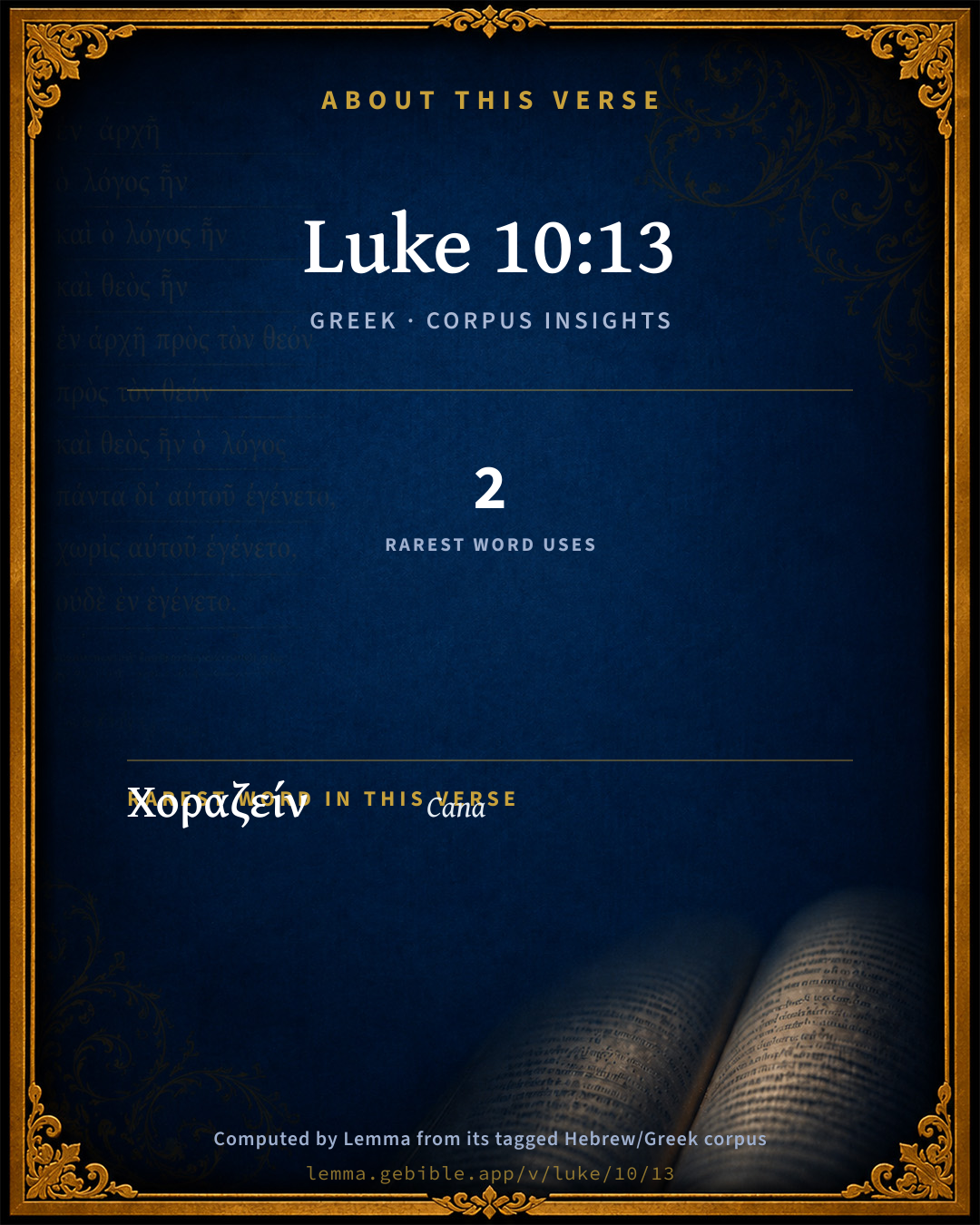
Luke 10:13

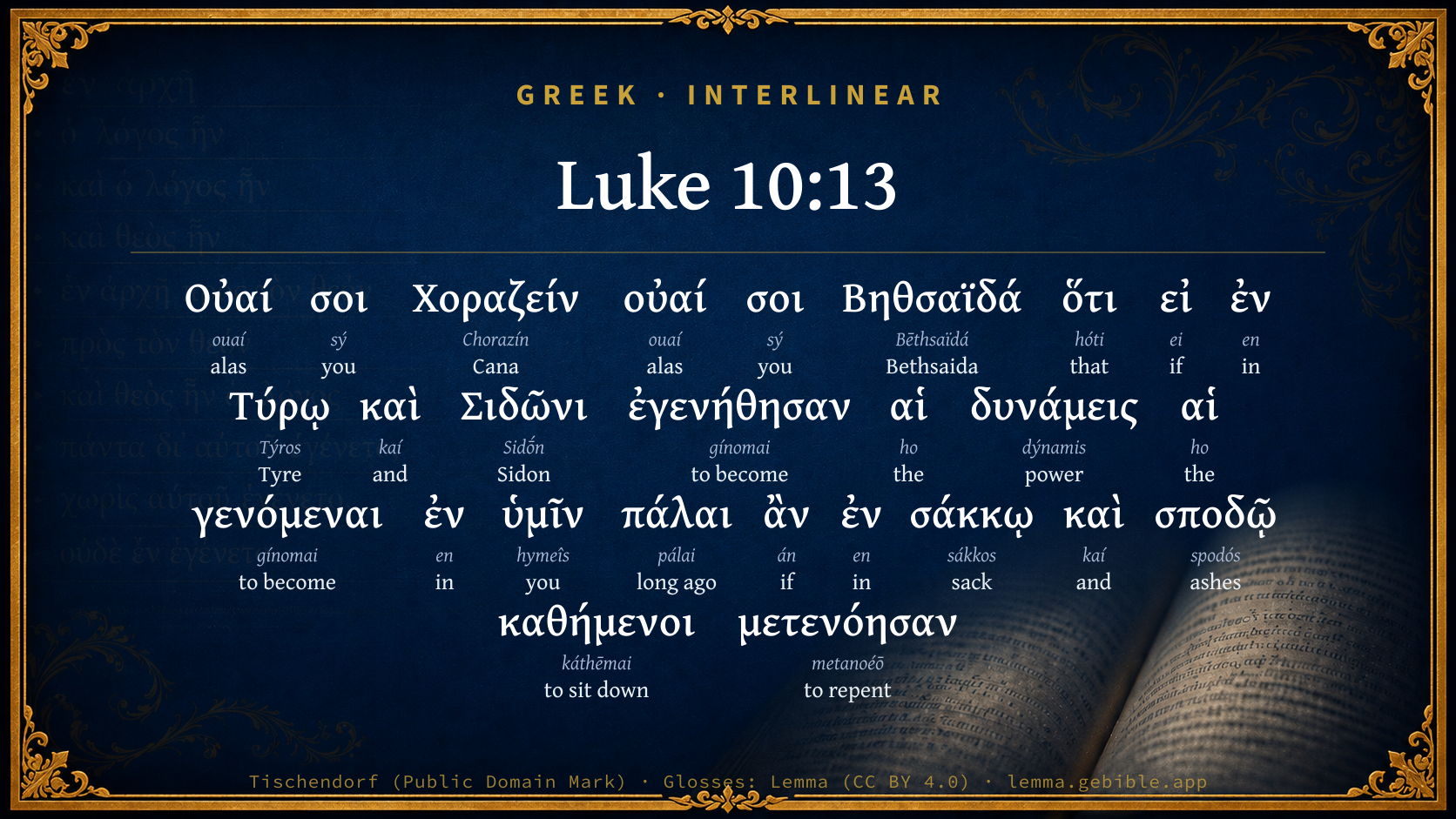
Greek (Tischendorf 8th ed.) Luke 10:13 appears in the Greek New Testament. The text above is from the Tischendorf 8th edition. Each word links to its Strong’s number and a concise gloss. Click any word for its full Thayer’s Greek Lexicon entry.
Download image
Cite this verse

Luke 10:13 (World English Bible). Public Domain. Lemma interlinear Bible study tool, https://lemma.gebible.app/v/luke/10/13.

Show BibTeX & RIS
BibTeX
RIS
English Translation
"Woe to you, Chorazin! Woe to you, Bethsaida! For if the mighty works had been done in Tyre and Sidon which were done in you, they would have repented long ago, sitting in sackcloth and ashes.
World English Bible · Public Domain
Download a study sheet

One document with this verse’s original text, its word-by-word gloss line, the meaning frame, cross-references with their text, attributed commentary, and full source and license credits — printable, and it pastes into notes with its structure intact.

This verse Autodidact and up

Study sheet (.html) Plain text (.txt)

A passage Seminary Student

Up to 50 verses in one chapter. A passage sheet keeps up to 6 commentary sources and 12 cross-references per verse, in the order this page ranks them, and says so on the sheet whenever that leaves anything out. Ask for a single verse and you get the Autodidact verse sheet above.

Everything on this page stays free to read, with no account — the sheet is a download of what is already on screen, not access to it.

Want to remove ads? Support Godless Engineer
Compare translations 3

The same verse in 3 English versions, stacked beneath the original-language interlinear above. Click any original word for its lexicon entry.

Each is an independent rendering of the whole verse — the interlinear is not word-aligned to these translations.

Highlighted words mark where these versions differ — a whole-verse word diff, not a word-by-word alignment.

  • World English Bible Public Domain
    "Woe to you, Chorazin! Woe to you, Bethsaida! For if the mighty works had been done in Tyre and Sidon which were done in you, they would have repented long ago, sitting in sackcloth and ashes.
  • King James Version Public Domain
    Woe unto thee, Chorazin! woe unto thee, Bethsaida! for if the mighty works had been done in Tyre and Sidon, which have been done in you, they had a great while ago repented, sitting in sackcloth and ashes.
  • unfoldingWord Literal Text CC BY-SA 4.0
    Woe to you, Chorazin! Woe to you, Bethsaida! For if the miracles had happened in Tyre and Sidon which happened in you, they would have repented long ago, sitting in sackcloth and ashes.

unfoldingWord Literal Text — © unfoldingWord, licensed CC BY-SA 4.0. Word-aligned USFM3 via Door43 (git.door43.org/unfoldingWord/en_ult).

Versions to compare (up to 4)

3 of 4 selected

Show all 19 translations

Every available English version of this verse, each an independent rendering of the whole verse.

  • World English Bible Public Domain
    "Woe to you, Chorazin! Woe to you, Bethsaida! For if the mighty works had been done in Tyre and Sidon which were done in you, they would have repented long ago, sitting in sackcloth and ashes.
  • Berean Standard Bible Public Domain
    Woe to you, Chorazin! Woe to you, Bethsaida! For if the miracles that were performed in you had been performed in Tyre and Sidon, they would have repented long ago, sitting in sackcloth and ashes.
  • Majority Standard Bible Public Domain
    Woe to you, Chorazin! Woe to you, Bethsaida! For if the miracles that were performed in you had been performed in Tyre and Sidon, they would have repented long ago, sitting in sackcloth and ashes.
  • King James Version Public Domain
    Woe unto thee, Chorazin! woe unto thee, Bethsaida! for if the mighty works had been done in Tyre and Sidon, which have been done in you, they had a great while ago repented, sitting in sackcloth and ashes.
  • American Standard Version (1901) Public Domain
    Woe unto thee, Chorazin! woe unto thee, Bethsaida! for if the mighty works had been done in Tyre and Sidon, which were done in you, they would have repented long ago, sitting in sackcloth and ashes.
  • Revised Version (1885) Public Domain
    Woe unto thee, Chorazin! woe unto thee, Bethsaida! for if the mighty works had been done in Tyre and Sidon, which were done in you, they would have repented long ago, sitting in sackcloth and ashes.
  • Geneva Bible (1599) Public Domain
    Woe be to thee, Chorazin: woe be to thee, Beth-saida: for if the miracles had bene done in Tyrus and Sidon, which haue bene done in you, they had a great while agone repented, sitting in sackecloth and ashes.
  • Douay-Rheims (1899) Public Domain
    Woe to thee, Corozain, woe to thee, Bethsaida. For if in Tyre and Sidon had been wrought the mighty works that have been wrought in you, they would have done penance long ago, sitting in sackcloth and ashes.
  • Young's Literal Translation Public Domain
    `Wo to thee, Chorazin; wo to thee, Bethsaida; for if in Tyre and Sidon had been done the mighty works that were done in you, long ago, sitting in sackcloth and ashes, they had reformed;
  • Literal Standard Version CC BY-SA 4.0
    Woe to you, Chorazin; woe to you, Bethsaida; for if the mighty works that were done in you had been done in Tyre and Sidon, they had converted long ago, sitting in sackcloth and ashes;
  • Unlocked Literal Bible CC BY-SA 4.0
    Woe to you, Chorazin! Woe to you, Bethsaida! If the mighty works which were done in you had been done in Tyre and Sidon, they would have repented long ago, sitting in sackcloth and ashes.
  • unfoldingWord Literal Text CC BY-SA 4.0
    Woe to you, Chorazin! Woe to you, Bethsaida! For if the miracles had happened in Tyre and Sidon which happened in you, they would have repented long ago, sitting in sackcloth and ashes.
  • Darby Bible Public Domain
    Woe to thee, Chorazin! woe to thee, Bethsaida! for if the works of power which have taken place in you had taken place in Tyre and Sidon, they had long ago repented, sitting in sackcloth and ashes.
  • World Messianic Bible Public Domain
    “Woe to you, Chorazin! Woe to you, Bethsaida! For if the mighty works had been done in Tyre and Sidon which were done in you, they would have repented long ago, sitting in sackcloth and ashes.
  • Webster's Bible Public Domain
    Woe to thee, Chorazin! woe to thee Bethsaida! for if the mighty works had been done in Tyre and Sidon, which have been done in you, they had a great while ago repented sitting in sackcloth and ashes.
  • Free Bible Version CC BY-SA 4.0
    Shame on you Korazin! Shame on you Bethsaida! For if the miracles you saw happen had happened in Tyre and Sidon they would have repented a long time ago, and they would be sitting in sackcloth and ashes.
  • Bible in Basic English Public Domain
    A curse is on you, Chorazin! A curse is on you, Beth-saida! For if such works of power had been done in Tyre and Sidon as have been done in you, they would have been turned from their sins, in days gone by, seated in the dust.
  • Text-Critical English NT CC BY 4.0
    “Woe to yoʋ, Chorazin! Woe to yoʋ, Bethsaida! For if the miracles that were done in you had been done in Tyre and Sidon, they would have repented long ago, sitting in sackcloth and ashes.
  • Tyndale New Testament (1534) Public Domain
    Wo be to the Chorazin: wo be to the Bethsaida. For yf the miracles had bene done in Tyre and Sidon which have bene done in you they had a greate whyle agone repeted sitting in heere and asshes.

Literal Standard Version (2020), Covenant Press — licensed CC BY-SA 4.0. Text via the HelloAO Bible API (eBible.org). Unlocked Literal Bible (unfoldingWord) — licensed CC BY-SA 4.0. Text via the HelloAO Bible API (eBible.org). unfoldingWord Literal Text — © unfoldingWord, licensed CC BY-SA 4.0. Word-aligned USFM3 via Door43 (git.door43.org/unfoldingWord/en_ult). Free Bible Version, Dr. Jonathan Gallagher — licensed CC BY-SA 4.0. Text via the HelloAO Bible API (eBible.org).

Word by word

More ways to search: Search by grammar → Find every occurrence → Compare this word →

Practice this passage: Drill this verse → Learn its vocabulary →

Χοραζείν
Chorazín
G5523
“Cana”
Noun, Proper, indeclinable
Part of Speech
Noun · Proper, indeclinable
Full Thayer's Definition

Origin: of uncertain derivation

TDNT: None

Chorazin = "a furnace of smoke" 1. a town in Galilee
  1. Οὐαί ouaí G3759 “alas” Interjection
  2. σοι sý G4771 “you” Personal pronoun, 2nd person, Dative, Singular
  3. οὐαί ouaí G3759 “alas” Interjection
  4. σοι sý G4771 “you” Personal pronoun, 2nd person, Dative, Singular
  5. Βηθσαϊδά Bēthsaïdá G966 “Bethsaida” Noun, Proper, indeclinable
  6. ὅτι hóti G3754 “that” Conjunction
  7. εἰ ei G1487 “if” Conditional
  8. ἐν en G1722 “in” Preposition
  9. Τύρῳ Týros G5184 “Tyre” Noun, Dative, Singular, Feminine
  10. καὶ kaí G2532 “and” Conjunction
  11. Σιδῶνι Sidṓn G4605 “Sidon” Noun, Dative, Singular, Feminine
  12. ἐγενήθησαν gínomai G1096 “to become” Verb, Aorist, Passive deponent, Indicative, 3rd person, Plural
  13. αἱ ho G3588 “the” Article, Nominative, Plural, Feminine
  14. δυνάμεις dýnamis G1411 “power” Noun, Nominative, Plural, Feminine
  15. αἱ ho G3588 “the” Article, Nominative, Plural, Feminine
  16. γενόμεναι gínomai G1096 “to become” Verb, Aorist, Middle deponent, Participle, Nominative, Plural, Feminine
  17. ἐν en G1722 “in” Preposition
  18. ὑμῖν hymeîs G5210 “you” Personal pronoun, 2nd person, Dative, Plural
  19. πάλαι pálai G3819 “long ago” Adverb
  20. ἂν án G302 “if” Particle
  21. ἐν en G1722 “in” Preposition
  22. σάκκῳ sákkos G4526 “sack” Noun, Dative, Singular, Masculine
  23. καὶ kaí G2532 “and” Conjunction
  24. σποδῷ spodós G4700 “ashes” Noun, Dative, Singular, Feminine
  25. καθήμενοι káthēmai G2521 “to sit down” Verb, Present, Middle or Passive deponent, Participle, Nominative, Plural, Masculine
  26. μετενόησαν metanoéō G3340 “to repent” Verb, Aorist, Active, Indicative, 3rd person, Plural

About this verse

These counts appear in no published source. They are computed here, from the morphology-tagged text and Lemma’s own curated glosses. What Lemma adds →

27
words
20
distinct lemmas
Gospels
section

Notable vocabulary

The rarest word here is Χοραζείν Cana G5523 — appearing just 2 times in the whole Greek New Testament.

Shared distinctive vocabulary

Χοραζείν Cana G5523 occurs in 2 verses of the Greek New Testament. Also found in:

Repetition

Words recur within this verse:

  • Οὐαί alas G3759 ×2
  • ἐγενήθησαν to become G1096 ×2
  • ἐν in G1722 ×3
  • σοι you G4771 ×2
  • καὶ and G2532 ×2
  • αἱ the G3588 ×2

Cross-references

15

Topical passages linked to Luke 10:13 in the Treasury of Scripture Knowledge — connected by theme and wording, ordered by reader-vote popularity; previews shown in the World English Bible.

  • Isaiah 23:1–18 The burden of Tyre. Howl, you ships of Tarshish; for it is laid waste, so that there is no house, no entering in: from the land of Kittim it is revealed to them.
  • Ezekiel 26:1–28:26 It happened in the eleventh year, in the first [day] of the month, that the word of Yahweh came to me, saying,
  • Joel 3:4–8 "Yes, and what are you to me, Tyre, and Sidon, And all the regions of Philistia? Will you repay me? And if you repay me, I will swiftly and speedily return your repayment on your own head.
  • Matthew 11:20–23 Then he began to denounce the cities in which most of his mighty works had been done, because they didn't repent.
  • Acts 28:25–28 When they didn't agree among themselves, they departed after Paul had spoken one word, "The Holy Spirit spoke rightly through Isaiah, the prophet, to our fathers,
  • Job 42:6 Therefore I abhor myself, And repent in dust and ashes."
  • Isaiah 61:3 to appoint to those who mourn in Zion, to give to them a garland for ashes, the oil of joy for mourning, the garment of praise for the spirit of heaviness; that they may be called trees of righteousness, the planting of Yahweh, that he may be glorified.
  • Ezekiel 3:6–7 not to many peoples of a strange speech and of a hard language, whose words you can not understand. Surely, if I sent you to them, they would listen to you.
  • Mark 8:22–26 He came to Bethsaida. They brought a blind man to him, and begged him to touch him.
  • Luke 9:10–17 The apostles, when they had returned, told him what things they had done. He took them, and withdrew apart to a deserted place of a city called Bethsaida.
  • John 3:5–6 Jesus answered, "Most assuredly I tell you, unless one is born of water and spirit, he can't enter into the Kingdom of God!
  • Romans 9:29–33 As Isaiah has said before, "Unless the Lord of Hosts had left us a seed, We would have become like Sodom, And would have been made like Gomorrah."
  • Romans 11:8–11 According as it is written, "God gave them a spirit of stupor, eyes that they should not see, and ears that they should not hear, to this very day."
  • 1 Timothy 4:2 through the hypocrisy of men who speak lies, branded in their own conscience as with a hot iron;
  • Revelation 11:3 I will give power to my two witnesses, and they will prophesy one thousand two hundred sixty days, clothed in sackcloth."

Cross-references courtesy of OpenBible.info (CC BY 4.0).

Commentary

Notes on Luke 10:13 from classic Christian and Jewish commentators (each source and its license shown beneath its notes). The classic Christian expositions comment on the surrounding passage and are grouped to its opening verse, so a note may address several verses; the Jewish commentaries on the Tanakh (Rashi and others) are per-verse, so they appear only where the commentator wrote on this verse.

Lemma curates 59 commentaries, every one of them public domain or Creative Commons licensed, each selected and text-cleaned for this edition rather than reprinted as found. About our sources →

The Biblical Illustrator

Joseph S. Exell

Luk_10:13-15

Woe unto thee

The sentence of Chorazin

We may conceive some inhabitant of these Jewish towns demanding with astonishment, How can these things be?

Shall we who are the children of Abraham be rejected, and the heathen be preferred in our stead? The Almighty Judge, we may hence collect, in the apportioning of rewards and punishments, regards not the actual amount of profligacy or virtue, but takes into consideration also the means of improvement enjoyed, the kind of information and light vouchsafed. He could estimate, in Tyre and Sidon, debased as they were by ignorance and idolatry, a disposition not indifferent to those proofs of Divine revelation, which to Bethsaida and Chorazin were exhibited in vain. He judges according to that hidden temper, according to that inward disposition; not by the acts committed, but by the circumstances also under which they are done. Nay, He judges of a degree of faith never actually called into existence.

I. The first conclusion to be drawn from the text thus explained relates to the future condition of those millions of mankind who depart this life in ignorance of a Saviours name. The sacrifice of Christ made atonement for the whole race of mankind. And though so many millions are ignorant of His name, yet in some of them is discerned a spirit which would enable them to have repented at His preaching. By that spirit it may be hereafter determined whether or no the merits of Jesus Christ are imparted for the salvation of their souls.

II. Secondly, we may learn, from this view of the text, the probability of our being greatly mistaken in our views of the future judgment.

III. And here, thirdly, it may be observed, that mankind are too ready to draw hasty conclusions, from anything which they can interpret as a manifest interference of Divine Providence for the punishment of sin.

IV. Such, too, let us in the last place remember, is the sentence recorded against every one of us ourselves, if we know these things and do them not; if we acknowledge these mighty works and yet repent not. Let us not then be deceived by the blessings of outward prosperity. They form part of our trial. (C. Girdlestone, M. A.)

The danger of impenitence where the gospel is preached

I. I observe from this discourse of our Saviour that miracles are of great force and efficacy to bring men to repentance.

II. I observe, likewise, from our Saviours discourse, that God is not always obliged to work miracles for the conversion of sinners.

III. I observe farther, from our Saviours discourse, that the external means of repentance which God affords to men, do suppose an inward grace of God accompanying them, sufficiently enabling me, to repent, if it be not their own fault; I say, a sufficient grace of God accompanying the outward means of repentance, till, by our wilful and obstinate neglect and resistance, and opposition of this grace, we provoke God to withdraw it from the means, or else to withdraw both the grace and the means from us: otherwise impenitence, after such external means afforded, would be no new and special fault.

IV. I observe from this discourse of our Saviours, that an irresistible degree of grace is not necessary to repentance, nor commonly afforded to those who do repent.

V. I observe from the main scope of our Saviours discourse, that the sins and impenitence of men receive their aggravation, and consequently shall have their punishment proportionable, to the opportunities and means of repentance which those persons have enjoyed and neglected. For what is here said of miracles, is by equality of reason likewise true of all other advantages and means of repentance and salvation.

VI. Sixth and last observation, and which naturally follows from the former, is this: that the case of those who are impenitent under the gospel is of all others the most dangerous, and their damnation shall be heaviest and most severe. (Archbishop Tillotson.)

Chorazin

It stands in the midst of such desolation as must be seen to be believed. Millions of boulders cover the ground everywhere as far as the eye can reach. The terrible volcanic energy in this district ceased long before the historic period--how long no one can tell--and hence the aspect of the landscape must have been the same in Christs day as at present. One very interesting feature of the ruins is that many of the dwelling-houses are still tolerably perfect, though in the days of St. Jerome (A.D. 331-420), Chorazin had long been deserted. They have stood tenantless for at least 1,500 years, and may well have been standing in the days when our Lord from time to time wandered among them, doing those mighty works which were yet, as at Bethsaida and Capernaum, ineffectual to bring the population to thoughtfulness and repentance. It helps one to realize better the daily life of our Saviour, to see in what poor barren spots He laboured; following the lost sheep of the house of Israel to such a forbidding wilderness. (C. Geikie, D. D.)

The guilt of a privileged people

Max Muller in the preface to his essays tells us of a Hindu who, having been converted in Benares, greatly wished to visit England. He had heard that it was a land of Bibles, a land of preaching, a land of churches and chapels, and he longed to see it. He expected to find the Christian land Christ-like. At length he arrived there. Max Muller adds that never shall he forget the deep dejection of the man when he discovered the Christianity of Europe to be so unlike that of the New Testament. In fact, nothing but keeping to the teachings of the Bible kept him from an utter relapse into idolatry.

The Biblical Illustrator, edited by Joseph S. Exell (c. 1880s–1900s) — public domain. Text from a community e-Sword module.

Joseph Benson's Commentary

Luk 10:13. Wo unto thee, Chorazin, &c. — “Having mentioned the punishment of those cities which should reject his ministers, it naturally brought to his mind the sad state and punishment of the cities where he himself had preached most frequently, namely, Chorazin, Bethsaida, and Capernaum. For, notwithstanding he had often resided in those cities, and performed many miracles before the inhabitants of them, they had continued impenitent. Wherefore, because he was never to preach to them any more, and because he knew how great their punishment would be, in the overflowing tenderness of his soul he affectionately lamented their obstinacy, which he foresaw would draw down on them the heaviest judgments. The same declaration Christ had made some time before. By repeating it now he warns the seventy not to lose time by going to those cities. At the same time, this part of his discourse was well calculated to comfort these disciples, now sent out, under the ill usage they might meet with; the preaching of Christ himself had often been unacceptable and unsuccessful, with respect to many of his hearers, and therefore it was not much to be wondered at if theirs should prove so likewise.” Considering the affectionate temper of our Lord, it is no wonder that he should renew his lamentation over those unhappy places where he had so intimately conversed; and that he should do it in such words as these, so well calculated to alarm and impress all that should hear or read them. O! that they might now have their due weight with those who might pass them over too slightly, when they occurred before in Mat 11:20-24. O! that every impenitent creature who reads them might know that the sentence of his own condemnation is now before his eyes! See Macknight and Doddridge, and the notes on Mat 11:20-24.

Joseph Benson's Commentary on the Old and New Testaments (1811–1818) — public domain. Text from a community e-Sword module.

Tyndale Open Study Notes

Tyndale Open Resources

10:13 Korazin and Bethsaida, two of the towns in which Jesus ministered, were located on the northern shore of the Sea of Galilee. • Tyre and Sidon were Gentile cities in Phoenicia, on the Mediterranean coast north of Galilee. The prophets had pronounced messages of judgment against their wickedness (Isa 23; Ezek 28).

Tyndale Open Study Notes — © Tyndale Open Resources, licensed CC BY-SA 4.0. Text via the HelloAO Bible API.

Bengel's Gnomon

Johann Albrecht Bengel

Luk 10:13. Χοραζὶν) So my editions write the word, although others in my name have edited Χωραζίν. Some have written Χωραζὶν from a slip of the pen, as I have observed in Appar., p. 473: and these in serious earnest have made out of Chorazin, which is mentioned in Mat 11:21 among the towns, the region of Zin (χώρα and ζιν): D. Rus, T. i. Harmon. Ev.; p. 1199, et seqq., mentions and refutes this notion.

Luk 10:13-15. Οὐαὶ, woe) A most weighty denunciation: with which comp. Mat 11:20, et seqq. It is now repeated by apostrophe [i.e. when the speech is suddenly directed to some other person, present or absent, differently from what the sentence had begun with. Append.], as a formula whereby the ungrateful cities are dismissed; and it is intimated that these Seventy ambassadors are to go to other cities rather than to these, and that others are to take warning from the example of these.

Bengel's Gnomon of the New Testament — English translation (T&T Clark, Edinburgh, 1860) — public domain. Text from a community e-Sword module.

Meyer's Critical & Exegetical Commentary

Heinrich August Wilhelm Meyer

Luk_10:13-15. See on Mat_11:21-24. Luke has not here any mistaken reminiscence (de Wette), but the disaster of these Galilaean cities lay sufficiently close to the heart of Jesus to force from Him the denunciation of woe more than once, and here, indeed, in very appropriate connection, since this woe brings into the light and confirms what has just been said at Luk_10:12 by the example of the cities which had rejected Jesus Himself.

καθήμενοι (see the critical remarks): the inhabitants, namely. See Buttmann, Neut. Gram. p. 114 [E. T. 130].

Meyer — Critical and Exegetical Commentary on the New Testament — English translation by Peter Christie, edited by Frederick Crombie (T&T Clark, 1880) — public domain. Text from a community e-Sword module.

Expositor's Greek Testament

ed. W. Robertson Nicoll

Luk 10:13-16 . Woe to thee, Chorasin (Mat 11:21-24 ). While the terms in which the woes on the cities of Galilee are reported are nearly identical in Mt. and Lk., the connections in which they are given are different. In Mt. the connection is very general. The woes simply find a place in a collection of moral criticisms by Jesus on His time: on John, on the Pharisees, and on the Galilean towns. Here they form part of Christ’s address to the Seventy, when sending them forth on their mission. Whether they properly come in here has been disputed. Wendt (L. J., p. 89) thinks they do, inasmuch as they indicate that the punishment for rejecting the disciples will be the same as that of the cities which were unreceptive to the ministry of the Master. J. Weiss (in Meyer), on the other hand, thinks the woes have been inserted here from a purely external point of view, noting in proof the close connection between Luk 10:12 and Luk 10:16 . It is impossible to be quite sure when the words were spoken, but also impossible to doubt that they were spoken by Jesus, probably towards or after the close of His Galilean ministry. καθήμενοι , after σποδῷ , is an addition of Lk.’s, explanatory or pictorial.

The Expositor's Greek Testament, edited by W. Robertson Nicoll (1897–1910) — public domain. Text from a community e-Sword module.

Adam Clarke's Commentary

Verse 13. Wo unto thee, Chorazin!] See on Mt 11:21-24.

Adam Clarke's Commentary on the Bible (1810–1826) — public domain. Text from a community e-Sword/MySword module.

Ellicott's Commentary for English Readers

(13-16) Woe unto thee, Chorazin!—See Notes on Mat_11:21, where the words appear as spoken at an earlier period. We have again to choose between the two alternative views, (1) that the words were spoken but once, and floated in men’s memories without any very definite note of time or place, and were wrongly placed by one, or, possibly, by both Evangelists; or (2) that they were repeated on different occasions. The latter seems, on the whole, by far the more probable.

A Bible Commentary for English Readers, edited by Charles John Ellicott (1878–1897) — public domain. Text from a community e-Sword module.

The Cambridge Bible for Schools and Colleges

gen. ed. J. J. S. Perowne

13. Woe unto thee, Chorazin] The mention of this town is very interesting because this is the only occasion (Mat_11:21) on which the name occurs, and we are thus furnished with a very striking proof of the fragmentariness of the Gospels. The very site of Chorazin was long unknown. It has now been discovered at Keraseh, the ruins of an old town on a wady, two miles inland from Tel Hum (Capernaum). At a little distance these ruins look like mere rude heaps of basaltic stones.

Bethsaida] See on Luk_9:10.

mighty works] Literally, “powers.”

they had a great while ago repented] like Nineveh (Jon_3:5-10), “Surely had I sent thee unto them they would have hearkened unto thee,” Eze_3:6; comp. Jas_4:17.

The Cambridge Bible for Schools and Colleges (gen. ed. J. J. S. Perowne; Cambridge University Press, 1878–1918) — public domain. Text from a community e-Sword module.

John Gill's Exposition

Woe unto thee Chorazin,.... See Gill on Mat 11:21.

Woe unto thee Bethsaida; a city of Galilee, a fishing town, from whence it has its name, and was the native place of those two fishermen, Peter and Andrew: very likely Chorazin was near it, since they are here, and in Matthew, mentioned together; and woe is pronounced upon them both for their impenitence and unbelief, which were attended with aggravating circumstances:

for if the mighty works had been done in Tyre and Sidon, which have been done in you; meaning both the ministry of the word by Christ, which was with power and authority, and the miracles of Christ, which were the works of almighty power, and showed him to be the mighty God: these were not done in Tyre and Sidon, cities in Phoenicia; for though our Lord was on the borders of those places, yet not in them, they being Gentile cities, to which he was not sent, and in which he did not preach, nor do miracles; but he did both in Bethsaida and Chorazin, and they repented not of their sins; nor did they embrace his doctrine, though confirmed by miracles; whereas, in all likelihood, humanly speaking, had the inhabitants of Tyre and Sidon had the like advantages,

they had a great while ago repented: they would have repented immediately, it would have been soon visible in them, of which they would have given proof, by

sitting in sackcloth and ashes; which was an outward token of repentance, used by penitent sinners, as by the Ninevites, and others. The same things are said at another time, and on another occasion, as here; See Gill on Mat 11:21, Mat 11:22, Mat 11:23, Mat 11:24

John Gill's Exposition of the Whole Bible (1746–1763) — public domain (CC PDM 1.0). Text via the HelloAO Bible API.

Trapp's Complete Commentary

John Trapp

13 Woe unto thee, Chorazin! woe unto thee, Bethsaida! for if the mighty works had been done in Tyre and Sidon, which have been done in you, they had a great while ago repented, sitting in sackcloth and ashes.

Ver. 13. See Mat 11:21.

John Trapp, A Commentary or Exposition upon All the Books of the Old and New Testament (1647–1656) — public domain. Text from a community e-Sword module.

Albert Barnes' Notes on the Bible

See the notes at Mat 11:21-24.

Albert Barnes' Notes on the Bible (1834–1885) — public domain. Text from a community e-Sword/MySword module.

Matthew Poole's English Annotations

See Poole on "Mat 11:21", and following verses to Mat 11:24.

Matthew Poole's English Annotations on the Holy Bible (1683–1685) — public domain. Text from a community e-Sword/MySword module.

Whedon's Commentary on the Bible

Daniel D. Whedon

13. Woe… Chorazin… Bethsaida—As Jesus has just left these cities, this is the last sad reference he makes to them. It expresses in language what the wiping the dust from the feet does in action. And this verse indicates that the sending forth of the seventy could have been on no later occasion.

Daniel D. Whedon (gen. ed.), Commentary on the Old and New Testaments (1874–1909) — public domain. Text from a community e-Sword module.

The Pulpit Commentary

Woe unto thee, Chorazin! woe unto thee, Bethsaida! for if the mighty works had been done in Tyre and Sidon, which have been done in you, they had a great while ago repented, sitting in sackcloth and ashes. In St. Matthew"s Gospel, (Mat_11:20) where the woe of the fair lake-cities is announced in similar language, the "woe" is introduced with the words," Then began he to upbraid the cities wherein most of his mighty works were done." Now, we have no record of any miracles having been worked at Chorazin, the first mentioned. But these cities were in the immediate vicinity of Capernaum, where for a length-cued period our Lord principally resided. He was, no doubt, during the Galilaean ministry, constantly in one or other of those bright, busy cities built on the shores of the Lake of Gennesaret. This bears out St. John"s statement (Joh_20:30) concerning the many unrecorded miracles of Christ, and gives us some notion of the numerous events in the life left without mention; much must have happened in Choraziu to have called forth this stern saying. Late research thinks it probable that the site of Chorazin has been discovered near Capernaum; the ruins, however, at a little distance, look but a mere rough heap of stones. A great theological truth is urged in this saying of the Master. Men will be judged not only for what they have done or failed to do, but their opportunities, their circumstances, their chances in life, will be, before they are judged, strictly taken into account.

The Pulpit Commentary (1880–1919), ed. H.D.M. Spence-Jones & Joseph S. Exell — public domain. Text from a community e-Sword module.

John Wesley's Explanatory Notes

Woe to thee, Chorazin - The same declaration Christ had made some time before. By repeating it now, he warns the seventy not to lose time by going to those cities. Matt. xi, 21.

John Wesley, Explanatory Notes Upon the Whole Bible (1754–1765) — public domain. Text via the GEBible commentary corpus.

Scofield Reference Notes

C. I. Scofield

Woe

See notes, Mat 11:20; Mar 8:23 (See Scofield "Mat 11:20") See Scofield "Mar 8:23"

The Scofield Reference Bible (1917 edition), notes by C. I. Scofield — public domain. Text from a community e-Sword module.

Kretzmann's Popular Commentary

Paul E. Kretzmann

Woes upon several cities of Galilee:

v. 13. Woe unto thee, Chorazin! Woe unto thee, Bethsaida! For if the mighty works had been done in Tyre and Sidon which have been done in you, they had a great while ago repented, sitting in sackcloth and ashes.

v. 14. But it shall be more tolerable for Tyre and Sidon at the Judgment than for you.

v. 15. And thou, Capernaum, which art exalted to heaven, shalt be thrust down to hell.

v. 16. He that heareth you heareth Me; and he that despiseth you despiseth Me; and he that despiseth Me despiseth Him that sent Me.

See Mat 11:21-23. The question of the guilt of those that reject the Gospel calls to the mind of Jesus the behavior of the cities of Galilee in whose neighborhood some of His greatest works had been done. He had come to them with the fullness of His love and mercy, and they had rejected Him. Chorazin and Bethsaida were on the shores of Lake Gennesaret, almost side by side. Great miracles had been done in their midst, and the people had been willing enough to be entertained, but the words of eternal love out of the mouth of Jesus had made no impression upon them. Under like circumstances Tyre and Sidon, the heathen cities whom the Jews despised for their idolatrous practices and beliefs, would long since have repented, clothed in a garment of sack-cloth, with ashes on the head. And therefore Tyre and Sidon, to whom His grace had not been revealed in this measure, would receive greater consideration on the Day of Judgment than these cities of Galilee. And Capernaum also, which had been lifted up to heaven by the fact that Jesus made this city His headquarters during His Galilean ministry, would receive the full measure of His wrath on the last day and be forcefully thrust down to hell. Note: There is a word of warning here for all Christians. They have Christ in their midst for years, decades, and generations, in the printed and in the spoken Word of the Gospel. But how often, is Jesus neglected and overlooked in the Christian homes! No reading of Scriptures alone or in family worship; no regular attendance at church;—there is danger of falling into the condemnation of the Galilean cities. And this applies also to the treatment accorded to the messengers of Christ. In hearing, -them we hear Christ, for they are His ambassadors and plenipotentiaries; but also, in despising them, in repudiating the Gospel of mercy, we repudiate Christ, of whose salvation it preaches; and in despising Christ, we despise His heavenly Father, partly because He is sent forth by the Father with full power, partly because He is one with the Father. Here is food for serious thought!

Paul E. Kretzmann, Popular Commentary of the Bible (1921–1924) — public domain. Text from a community e-Sword module.

Burkitt's Expository Notes on the New Testament

William Burkitt

These cities in Galilee, Chorazin, Bethsaida, and Capernaum, having been the place where Christ preached and wrought his miracles, they have a woe denounced here against them for their contempt of Christ, and the offers of his grace: Woe unto thee, Chorazin, etc. The higher a people rise under the means, the lower they fall if they miscarry. They that have been nearest to conversion, being not converted, shall have the greatest condemnation when they are judged. Capernaum’s sentence will exceed Sodom’s for severity, because she excelled Sodom in the enjoyment of means and mercy.

Observe here, 1. Capernaum’s privilege enjoyed; She was lifted up to heaven; that is, enjoyed privileges above other places, namely, the presence, preaching, and miracles of our Saviour.

Observe, 2. Capernaum’s doom denounced: Thou shalt be thrust down to hell; that is, thy condition shall be sadder than those that never heard of a Saviour; even Tyre and Sidon, Sodom and Gomorrah, those rude and barbarous nations, out of the pale of the church, shall be in an easier state and condition, than those that have enjoyed gospel ordinances and church privileges, but not improved them.

Learn hence,

1. That gospel ordinances enjoyed, are a mighty honor and advancement to the poorest persons and obscurest places: Thou, Capernaum, art exalted to heaven.

2. That gospel ordinances and church privileges enjoyed, but not improved, provoke Almighty God to inflict the sorest judgments upon a people: Thou that art exalted to heaven, shall be thrust down to hell.

William Burkitt's Expository Notes on the New Testament (1700–1703) — public domain. Text from a community e-Sword module.

The People's New Testament

B. W. Johnson

13–15. Woe unto thee, Chorazin! See notes on Matt. 11:21–24. It is thought that this is a repetition of the words used on a former occasion, in order to emphasize the sin of rejecting the messengers of the Lord.

B. W. Johnson's The People's New Testament with Notes (1889–1891) — public domain. Electronic text from the Christian Classics Ethereal Library (CCEL) ThML edition.

unfoldingWord translationNotes

Door43 World Missions Community

Woe to you, Chorazin! Woe to you, Bethsaida!

Jesus speaks as if the people of the cities of Chorazin and Bethsaida are there listening to him, but they are not. (See: Apostrophe and How to Translate Names and Metonymy)

If the mighty works which were done in you had been done in Tyre and Sidon

Jesus is describing a situation that could have happened in the past but did not. AT: "If someone had performed the miracles for the people of Tyre and Sidon that I performed for you" (See: Hypothetical Situations and Active or Passive)

they would have repented long ago, sitting

"the wicked people who lived there would have shown that they were sorry for their sins by sitting"

sitting in sackcloth and ashes

"wearing sackcloth and sitting in ashes"

But it will be more tolerable for Tyre and Sidon at the judgment than for you

It may be helpful to clearly state the reason for their judgment. AT: "But because you did not repent and believe in me even though you saw me do miracles, God will judge you more severely than he will judge the people of Tyre and Sidon" (See: Assumed Knowledge and Implicit Information and Metonymy)

at the judgment

"on that final day when God judges everyone"

You, Capernaum

Jesus now speaks to the people in the city of Capernaum as if they are listening to him, but they are not. (See: Apostrophe and Metonymy)

do you think you will be exalted to heaven?

Jesus uses a question to rebuke the people of Capernaum for their pride. AT: "you will certainly not go up to heaven!" or "God will not honor you!" (See: Rhetorical Question and Active or Passive)

exalted to heaven

This expression means "greatly exalted."

you will be brought down to Hades

This can be stated in active form. AT: "you will go down to Hades" or "God will send you to Hades" (See: Active or Passive)

translationWords

woe

might

works

Tyre

Sidon

repent

sackcloth

judge

Capernaum

exalt

heaven

Hades

unfoldingWord translationNotes — © Distant Shores Media and the Door43 World Missions Community, licensed CC BY-SA 4.0. Source: git.door43.org/Door43/en_tn.

Cambridge Greek Testament for Schools and Colleges

13. οὐαί σοι Χοραζείν. The mention of this town is very interesting because this is the only occasion (Mat 11:21) on which the name occurs, and we are thus furnished with a very striking proof of the fragmentariness of the Gospels. The very site of Chorazin was long unknown. It has now been discovered at Keraseh, the ruins of an old town on a wady, two miles inland from Tel Hum (Capernaum). At a little distance these ruins look like mere rude heaps of basaltic stones. Etiam periere ruinae.

Βηθσαϊδά. See on Luk 9:10.

αἱ δυνάμεις. Literally, ‘the powers.’

πάλαι ἂν … μετενόησαν. Like Nineveh (Jon 3:5-10), “Surely had I sent thee unto them they would have hearkened unto thee,” Eze 3:6; comp. Jas 4:17.

καθήμενοι. This is a constructio ad sensum. The participle does not agree with the fem. name of the towns but refers to their inhabitants.

Cambridge Greek Testament for Schools and Colleges (Cambridge University Press, 1896; 21 vols, various authors incl. Carr, Maclear, Plummer, Farrar, Lumby, Moule, M. R. James, Simcox) — public domain. Text from a community e-Sword module.

Alford’s Greek Testament

Henry Alford

13.] In these words, which our Lord had uttered before (Mat 11:21 ff.), He takes His solemn farewell of the cities where the greatest number of His miracles had been done, and discourses uttered: they being awful examples of the ἡ πόλις ἐκείνη just described. It is wonderful how De Wette can write of these four verses falsche Reminiscenz, s. z. Mat 11:20Mat 11:20—and this when he believes Luke to have had Matt. before him.

Henry Alford, The Greek Testament (1849–1861) — public domain. Text from a community e-Sword module.

International Critical Commentary

13-15. The Solemn Farewell to the Cities in which He had preached and manifested Himself in vain. The mention of the judgment which awaits the towns that shall reject His forerunners naturally leads to the mention of those places which have already rejected Him. It is plain from ver. 16 that this lamentation over the three cities is part of the address to the Seventy. The wording is almost the same as Mat 11:21-24, but there the comparison with Sodom is joined to the denunciation of Capernaum.

13. χοραζείν. Excepting here and the similar Woe in Mat 11:21, Chorazin is not mentioned in N.T. This shows us how much of Christ’s work is left unrecorded (Joh 21:25). The name does not occur in O.T. nor in Josephus. It may be identified with the ruins now called Kerâzeh, about two miles N.E. of Tell Hûm, which is supposed to be Capernaum; and Jerome tells us that Chorazin was two miles from Capernaum: est autem nunc desertum in secundo lapide a Capharnaum. Some identify Tell Hûm with Chorazin; but Conder, who does not believe that Tell Hûm is Capernaum, nevertheless regards Kerâzeh as certainly Chorazin (Handbook to the Bible, pp. 324-326); and this is now the prevailing view. D. B.2 s.v.; D.C.G.s.v.

ἐν σάκκῳ … καθήμενοι. Constructio ad sensum: comp. ver. 8. Χοραζείν and Βηθσαϊδά are feminine, and hence the reading καθήμεναι (D).

ἐν σάκκῳ. Our “sackcloth” gives a wrong idea of σάκκος, which was made of the hair of goats and other animals, and was used for clothing. But sacks were made of it (Gen 42:25; Jos 9:4) as well as garments. Comp. Jon 3:6. The πάλαι points to a ministry of considerable duration in these cities.

μετενόησαν. Like μετάνοια (see on 3:3), μετανοεῖν is much more frequent in Lk. (11:32, 13:3, 5, 15:7, etc.) than in Mt. and Mk. Neither is found in Jn. See on 5:32.

International Critical Commentary — older volumes (1896–1929), various authors — public domain. Text from a community e-Sword module.

Vincent's Word Studies in the New Testament

Marvin R. Vincent

Mighty works. See on Mt 11:20.

Sackcloth [σακκω] . From the Hebrew sak : what is knotted together; net - shaped; coarsely woven. It was made of goats ' or camels ' hair (Rev 6:12), and was a material similar to that upon which Paul wrought in tent - making. The same word in Hebrew is used to describe a grain - sack, and this coarse material of which it is made (Gen 42:25; Jos 9:4). So the Greek sagh means a pack or baggage. The same root, according to some etymologists, appears in saghnh, a drag - net (see Mt 13:47), and sagov, Latin sagum, a coarse, soldier 's cloak. It was employed for the rough garments for mourners (Est 4:1; 1Ki 21:27), in which latter passage the sackcloth is put next the flesh in token of extreme sorrow. Compare 2Ki 6:30; Job 16:15.

Ashes [σποδω] . As a sign of mourning. Defiling one's self with dead things, as ashes or dirt, as a sign of sorrow, was common among the Orientals and Greeks. Thus Homer describes Achilles on hearing of the death of Patroclus :

"Grasping in both hands The ashes of the hearth, he showered them o'er His head, and soiled with them his noble face."

Iliad, 18 28.

And Priam, mourning for Hector :

"In the midst the aged man Sat with a cloak wrapped round him, and much dust Strewn on his head and neck, which, when he rolled Upon the earth, he gathered with his hands."

Iliad, 24 162 - 5.

See 1Sa 4:12; 2Sa 1:2; 2Sa 13:19; Job 2:12; Eze 17:30; Rev 18:19. In Judith 4 14, 15, in the mourning over the ravages of the Assyrians, the priests minister at the altar, girded with sackcloth, and with ashes on their mitres. Sir Gardner Wilkinson, describing a funeral at Thebes, says : "Men, women, and children, with the body exposed above the waist, throw dust on their heads, or cover their faces with mud" (" Modern Egypt and Thebes "). Stifling with ashes was a Persian mode of punishment. Compare Apocrypha, 2 Macc. 13 5 - 7. Herodotus relates that Nitocris, an Egyptian queen, after having drowned the murderers of her brother, threw herself into an apartment full of ashes, in order to escape the vengeance of their friends.

Marvin R. Vincent, Word Studies in the New Testament (1887–1900) — public domain. Text from a community e-Sword/MySword module.

Godet's Commentaries

Frédéric Louis Godet

Vers. 13-16. “Woe unto thee, Chorazin! Woe unto thee, Bethsaida! for if the mighty works had been done in Tyre and Sidon which have been done in you, they had a great while ago repented, sitting in sackcloth and ashes. 14 But it shall be more tolerable for Tyre and Sidon at the judgment than for you. 15 And thou, Capernaum, which art exalted to heaven, shalt be thrust down to hell. 16 He that heareth you heareth me; and he that despiseth you despiseth me; and he that despiseth me despiseth Him that sent me.”

The name of Chorazin is not found either in the O. T. or in Josephus. But Jewish tradition mentions it frequently, either under the name of Chorazaïm, as producing a cheese of inferior quality, or under that of Choraschin, as situated in Naphtali.

According to Eusebius (Onomasticon), Chorazin was situated 12 miles (4 leagues)

Jerome says, certainly by mistake, in his translation, 2 miles—from Capernaum. This situation corresponds exactly with the ruins which still bear the name of Bir-Kirâzeh, a little to the north of Tel-Hum, if we place Capernaum in the plain of Gennesaret (vol. i. p. 242).

We do not know any of the numerous miracles which this declaration implies. Of those at Bethsaida we know only one. On the important consequences which this fact has for criticism, see vol. i. p. 339. The interpretation which M. Colani has attempted to give to the word δυνάμεις in this passage—works of holiness—will not bear discussion.

It is impossible to render well into English the image employed by Jesus. The two cities personified are represented as sitting clothed in sackcloth, and covered with ashes.

The πλήν, excepting, is related to an idea which is understood: “Tyre and Sidon shall also be found guilty; only, they shall be so in a less degree than you.”

The tone rises (Luk 10:15) as the mind of Jesus turns to the city which had shared most richly in that effusion of grace of which Galilee has just been the subject

Capernaum. It was there that Jesus had fixed His residence; He had made it the new Jerusalem, the cradle of the kingdom of God. It is difficult to understand how commentators could have referred the words, exalted to heaven, to the commercial prosperity of the city, and Stier to its alleged situation on a hill by the side of the lake! This whole discourse of Jesus moves in the most elevated sphere. The point in question is the privilege which Jesus bestowed on the city by making it His city (Mat 9:1). Notwithstanding the authority of Tischendorf, we unhesitatingly prefer the received reading ἡ ὑψωθεῖσα, “which art exalted,” to that of some Alex. μὴ ὑψωθήσῃ, “Wilt thou be exalted? No, thou wilt come down...” The meaning which this reading gives is tame and insipid. It has arisen simply from the fact that the final μ of Capernaum was by mistake joined to the following ἡ, which, thus become a μή, necessitated the change from ὑψωθεῖσα to ὑψωθήσῃ. This variation is also found in Matthew, where the MSS. show another besides, ἣ ὑψώθης, which gives the same meaning as the T. R.

As Heaven is here the emblem of the highest divine favours, Hades is that of the deepest abasement. In the O. T. it is the place of silence, where all earthly activity ceases, where all human grandeur returns to its nothingness (Ezekiel 31, 32).

Matthew places this declaration in the middle of the Galilean ministry, immediately after the embassy sent by John the Baptist. We can understand without difficulty the association of ideas which led the evangelist to connect the one of those pieces with the other. The impenitence of the people in respect of the forerunner was the prelude to their unbelief in respect of Jesus. But does not the historical situation indicated by Luke deserve the preference? Is such a denunciation not much more intelligible when the mission of Jesus to those cities was entirely finished? Luke adds a saying, Luk 10:16, which, by going back on the thought in the first part of the discourse, brings out its unity,—the position taken up with respect to the messengers of Jesus and their preaching, shall be equivalent to a position taken up with respect to Jesus, nay, with respect to God Himself. What a grandeur, then, belongs to the work which He confides to them!

Frédéric Louis Godet — Commentaries on Luke, John, Romans, and 1 Corinthians — English translation (T&T Clark, Edinburgh, 1870s–1890s) — public domain. Text from a community e-Sword module.

Lesson kit

Teaching starters — assembled from the data on this page, not authored interpretation. Every prompt links to the verse data it draws on. Edit before teaching.

Luke, in the Gospels, opens this verse with 27 words (20 distinct Greek lemmas). Its most distinctive word is Chorazín (“Cana”). A historical commentator’s framing appears above. Read the whole chapter for the surrounding context.

Discussion questions

  1. How does “Cana” (Chorazín) shape what this verse is saying?
  2. Matthew 11:21 shares the word «Cana» with this verse. How do the two illuminate each other?
  3. “alas” occurs 2× in this one verse. What is the effect of the repetition?
  4. These translations render this verse differently. What is at stake in choosing one wording over another?
  5. Reading how The Biblical Illustrator and Joseph Benson's Commentary read this verse, where do the two commentators agree and where do they part?

Things to notice

Reading settings

Reading text

Shown beneath each verse's original-language words.

Old Testament
Old Testament edition

Read the OT as the Masoretic Hebrew (MT) or the Greek Septuagint (LXX).

English shown for the Greek Septuagint (in the Hebrew ↔ Greek comparison).

Comparing translations? Open the Compare panel on any verse page to stack up to four side by side.