
Mark 4:39

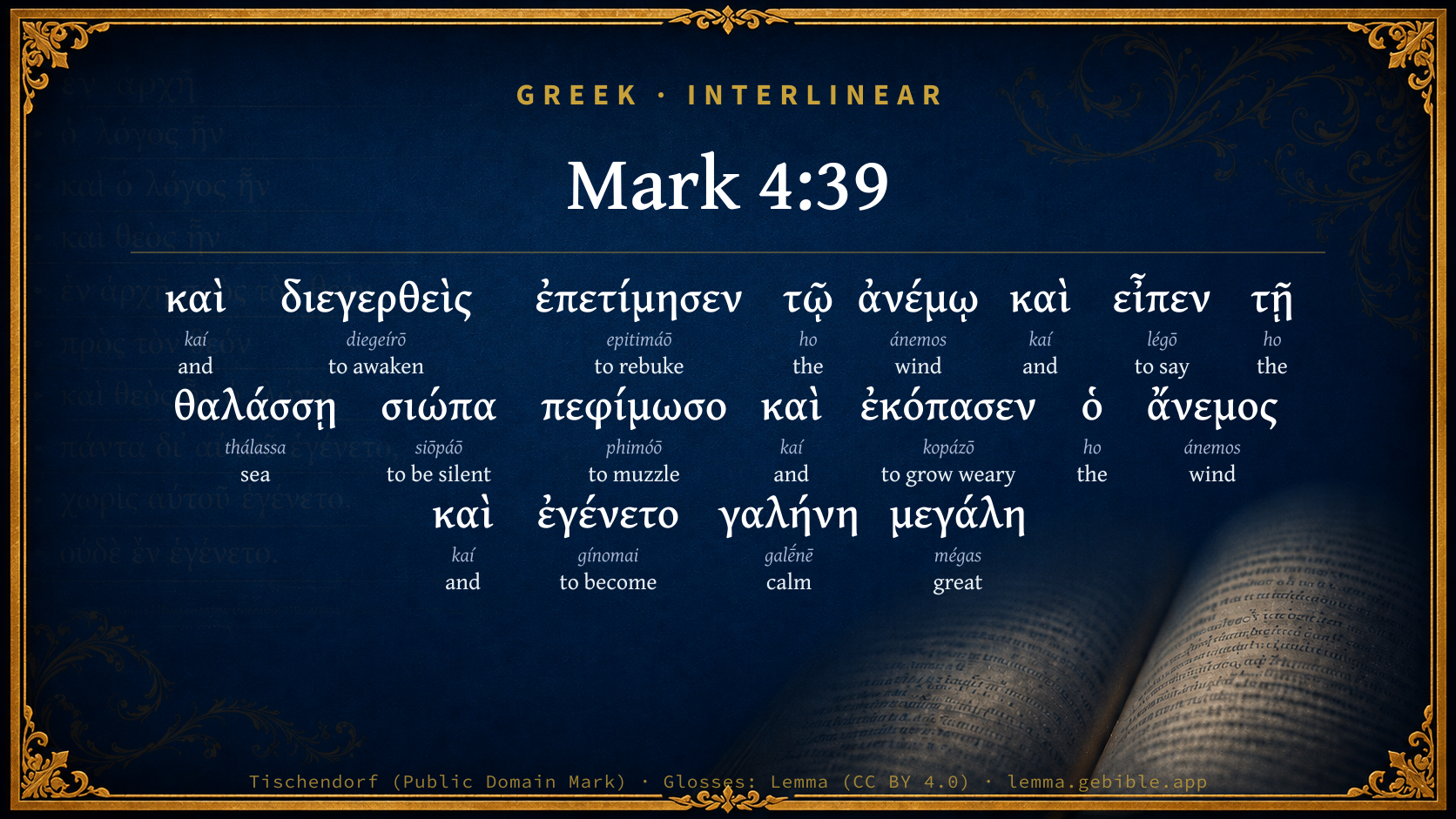
Greek (Tischendorf 8th ed.) Mark 4:39 appears in the Greek New Testament. The text above is from the Tischendorf 8th edition. Each word links to its Strong’s number and a concise gloss. Click any word for its full Thayer’s Greek Lexicon entry.
Download image
Cite this verse

Mark 4:39 (World English Bible). Public Domain. Lemma interlinear Bible study tool, https://lemma.gebible.app/v/mark/4/39.

Show BibTeX & RIS
BibTeX
RIS
English Translation
He awoke, and rebuked the wind, and said to the sea, "Peace! Be still!" The wind ceased, and there was a great calm.
World English Bible · Public Domain
Highlights
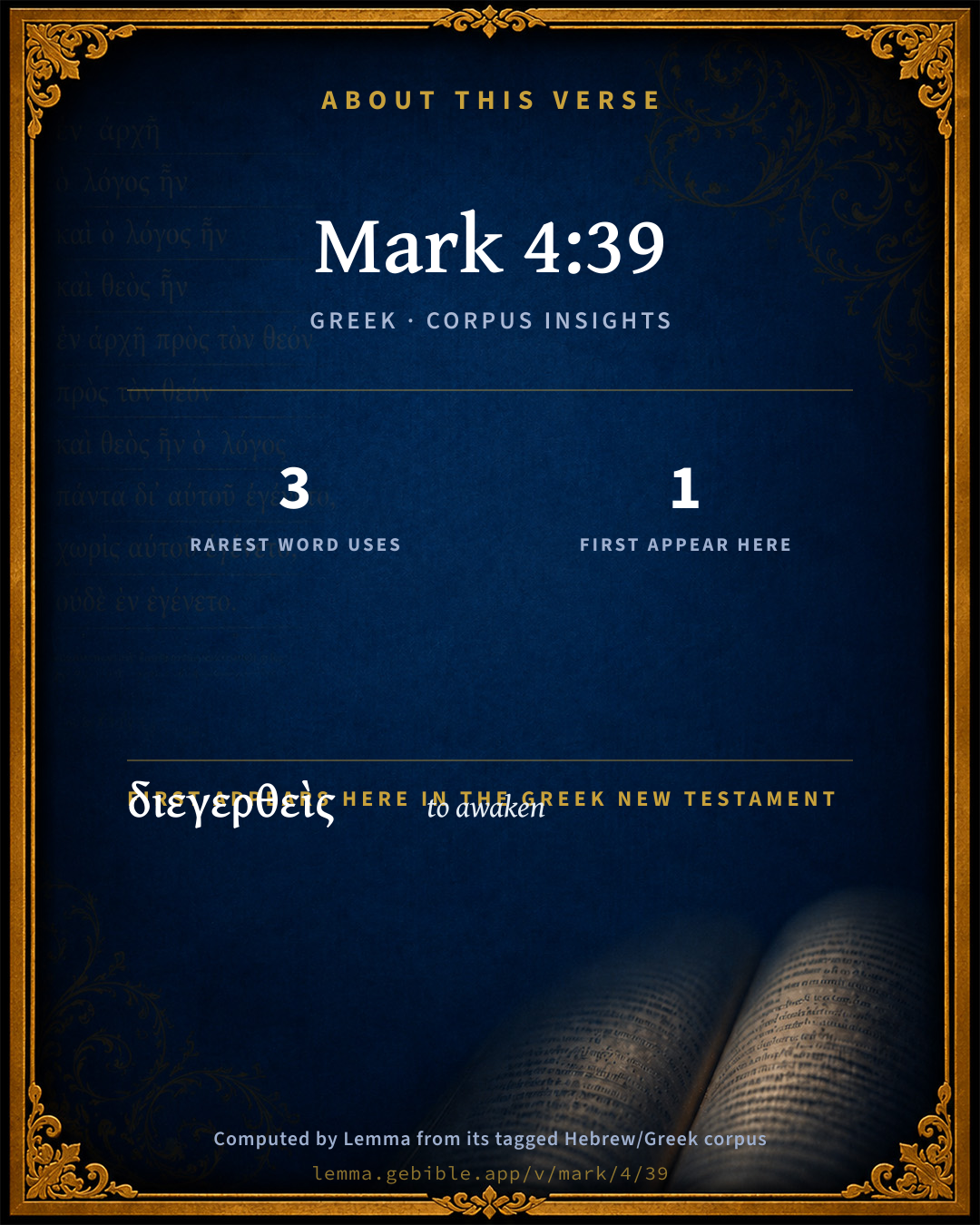
  • 1 first appearance in the Greek New Testament
Full analysis ↓
Download a study sheet

One document with this verse’s original text, its word-by-word gloss line, the meaning frame, cross-references with their text, attributed commentary, and full source and license credits — printable, and it pastes into notes with its structure intact.

This verse Autodidact and up

Study sheet (.html) Plain text (.txt)

A passage Seminary Student

Up to 50 verses in one chapter. A passage sheet keeps up to 6 commentary sources and 12 cross-references per verse, in the order this page ranks them, and says so on the sheet whenever that leaves anything out. Ask for a single verse and you get the Autodidact verse sheet above.

Everything on this page stays free to read, with no account — the sheet is a download of what is already on screen, not access to it.

Want to remove ads? Support Godless Engineer
Compare translations 3

The same verse in 3 English versions, stacked beneath the original-language interlinear above. Click any original word for its lexicon entry.

Each is an independent rendering of the whole verse — the interlinear is not word-aligned to these translations.

Highlighted words mark where these versions differ — a whole-verse word diff, not a word-by-word alignment.

  • World English Bible Public Domain
    He awoke, and rebuked the wind, and said to the sea, "Peace! Be still!" The wind ceased, and there was a great calm.
  • King James Version Public Domain
    And he arose, and rebuked the wind, and said unto the sea, Peace, be still. And the wind ceased, and there was a great calm.
  • unfoldingWord Literal Text CC BY-SA 4.0
    And awaking, he rebuked the wind, and said to the sea, “Be silent! Be still!” And the wind ceased, and there was a great calm.

unfoldingWord Literal Text — © unfoldingWord, licensed CC BY-SA 4.0. Word-aligned USFM3 via Door43 (git.door43.org/unfoldingWord/en_ult).

Versions to compare (up to 4)

3 of 4 selected

Show all 19 translations

Every available English version of this verse, each an independent rendering of the whole verse.

  • World English Bible Public Domain
    He awoke, and rebuked the wind, and said to the sea, "Peace! Be still!" The wind ceased, and there was a great calm.
  • Berean Standard Bible Public Domain
    Then Jesus got up and rebuked the wind and the sea. “Silence!” He commanded. “Be still!” And the wind died down, and it was perfectly calm.
  • Majority Standard Bible Public Domain
    Then Jesus got up and rebuked the wind and the sea. “Silence!” He commanded. “Be still!” And the wind died down, and it was perfectly calm.
  • King James Version Public Domain
    And he arose, and rebuked the wind, and said unto the sea, Peace, be still. And the wind ceased, and there was a great calm.
  • American Standard Version (1901) Public Domain
    And he awoke, and rebuked the wind, and said unto the sea, Peace, be still. And the wind ceased, and there was a great calm.
  • Revised Version (1885) Public Domain
    And he awoke, and rebuked the wind, and said unto the sea, Peace, be still. And the wind ceased, and there was a great calm.
  • Geneva Bible (1599) Public Domain
    And hee rose vp, and rebuked the winde, and saide vnto the sea, Peace, and be still. So the winde ceased, and it was a great calme.
  • Douay-Rheims (1899) Public Domain
    And rising up, he rebuked the wind, and said to the sea: Peace, be still. And the wind ceased: and there was made a great calm.
  • Young's Literal Translation Public Domain
    And having waked up, he rebuked the wind, and said to the sea, `Peace, be stilled;' and the wind did lull, and there was a great calm:
  • Literal Standard Version CC BY-SA 4.0
    And having awoken, He rebuked the wind and said to the sea, “Peace, be stilled”; and the wind stilled, and there was a great calm;
  • Unlocked Literal Bible CC BY-SA 4.0
    He got up, rebuked the wind, and said to the sea, “Peace! Be still!” Then the wind ceased, and there was a great calm.
  • unfoldingWord Literal Text CC BY-SA 4.0
    And awaking, he rebuked the wind, and said to the sea, “Be silent! Be still!” And the wind ceased, and there was a great calm.
  • Darby Bible Public Domain
    And awaking up he rebuked the wind, and said to the sea, Silence; be mute. And the wind fell, and there was a great calm.
  • World Messianic Bible Public Domain
    He awoke and rebuked the wind, and said to the sea, “Peace! Be still!” The wind ceased and there was a great calm.
  • Webster's Bible Public Domain
    And he arose, and rebuked the wind, and said to the sea, Peace, be still: and the wind ceased, and there was a great calm.
  • Free Bible Version CC BY-SA 4.0
    Jesus woke up. He told the wind to die down and told the waves, “Be quiet! Be still.” The wind stopped, and the water became completely calm.
  • Bible in Basic English Public Domain
    And he came out of his sleep, and gave strong orders to the wind, and said to the sea, Peace, be at rest. And the wind went down, and there was a great calm.
  • Text-Critical English NT CC BY 4.0
    Then he woke up and rebuked the wind and said to the sea, “Peace! Be still!” So the wind ceased, and there was a great calm.
  • Tyndale New Testament (1534) Public Domain
    And he rose vp and rebuked the wynde and sayde vnto the see: peace and be still. And the winde alayed and ther folowed a greate calme.

Literal Standard Version (2020), Covenant Press — licensed CC BY-SA 4.0. Text via the HelloAO Bible API (eBible.org). Unlocked Literal Bible (unfoldingWord) — licensed CC BY-SA 4.0. Text via the HelloAO Bible API (eBible.org). unfoldingWord Literal Text — © unfoldingWord, licensed CC BY-SA 4.0. Word-aligned USFM3 via Door43 (git.door43.org/unfoldingWord/en_ult). Free Bible Version, Dr. Jonathan Gallagher — licensed CC BY-SA 4.0. Text via the HelloAO Bible API (eBible.org).

Word by word

More ways to search: Search by grammar → Find every occurrence → Compare this word →

Practice this passage: Drill this verse → Learn its vocabulary →

ἐκόπασεν
kopázō
G2869
“to grow weary”
Verb, Aorist, Active, Indicative, 3rd person, Singular
Part of Speech
Verb
Tense
Aorist
Voice
Active
Mood
Indicative
Person
3rd person
Number
Singular
Full Thayer's Definition

Origin: from G2873

TDNT: None

1. to grow weary or tired 2. to cease from violence, cease raging
  1. καὶ kaí G2532 “and” Conjunction
  2. διεγερθεὶς diegeírō G1326 “to awaken” Verb, Aorist, Passive, Participle, Nominative, Singular, Masculine
  3. ἐπετίμησεν epitimáō G2008 “to rebuke” Verb, Aorist, Active, Indicative, 3rd person, Singular
  4. τῷ ho G3588 “the” Article, Dative, Singular, Masculine
  5. ἀνέμῳ ánemos G417 “wind” Noun, Dative, Singular, Masculine
  6. καὶ kaí G2532 “and” Conjunction
  7. εἶπεν légō G3004 “to say” Verb, Aorist, Active, Indicative, 3rd person, Singular
  8. τῇ ho G3588 “the” Article, Dative, Singular, Feminine
  9. θαλάσσῃ thálassa G2281 “sea” Noun, Dative, Singular, Feminine
  10. σιώπα siōpáō G4623 “to be silent” Verb, Present, Active, Imperative, 2nd person, Singular
  11. πεφίμωσο phimóō G5392 “to muzzle” Verb, Perfect, Passive, Imperative, 2nd person, Singular
  12. καὶ kaí G2532 “and” Conjunction
  13. ὁ ho G3588 “the” Article, Nominative, Singular, Masculine
  14. ἄνεμος ánemos G417 “wind” Noun, Nominative, Singular, Masculine
  15. καὶ kaí G2532 “and” Conjunction
  16. ἐγένετο gínomai G1096 “to become” Verb, Aorist, Middle deponent, Indicative, 3rd person, Singular
  17. γαλήνη galḗnē G1055 “calm” Noun, Nominative, Singular, Feminine
  18. μεγάλη mégas G3173 “great” Adjective, Nominative, Singular, Feminine

About this verse

These counts appear in no published source. They are computed here, from the morphology-tagged text and Lemma’s own curated glosses. What Lemma adds →

19
words
13
distinct lemmas
Gospels
section

Notable vocabulary

The rarest word here is ἐκόπασεν to grow weary G2869 — appearing just 3 times in the whole Greek New Testament.

First appearance in Scripture

This word makes its first canonical appearance in the Greek New Testament here:

  • διεγερθεὶς to awaken G1326

Shared distinctive vocabulary

ἐκόπασεν to grow weary G2869 occurs in 3 verses of the Greek New Testament. Also found in:
Repetition

Words recur within this verse:

  • ἀνέμῳ wind G417 ×2
  • καὶ and G2532 ×4
  • τῷ the G3588 ×3

Cross-references

17

Topical passages linked to Mark 4:39 in the Treasury of Scripture Knowledge — connected by theme and wording, ordered by reader-vote popularity; previews shown in the World English Bible.

  • Psalms 107:29 He makes the storm a calm, So that its waves are still.
  • Psalms 89:9 You rule the pride of the sea. When its waves rise up, you calm them.
  • Psalms 29:10 Yahweh sat enthroned at the Flood. Yes, Yahweh sits as King forever.
  • Psalms 65:7 Who stills the roaring of the seas, The roaring of their waves, And the turmoil of the nations.
  • Jeremiah 5:22 Don't you fear me? says Yahweh: won't you tremble at my presence, who have placed the sand for the bound of the sea, by a perpetual decree, that it can't pass it? and though the waves of it toss themselves, yet they can't prevail; though they roar, yet they can't pass over it.
  • Proverbs 8:29 When he gave to the sea its boundary, That the waters should not violate his commandment, When he marked out the foundations of the earth;
  • Job 38:11 And said, 'Here you may come, but no further; Here shall your proud waves be stayed?'
  • Exodus 14:22 The children of Israel went into the midst of the sea on the dry ground, and the waters were a wall to them on their right hand, and on their left.
  • Exodus 14:28–29 The waters returned, and covered the chariots and the horsemen, even all Pharaoh's army that went in after them into the sea. There remained not so much as one of them.
  • Psalms 93:3–4 The floods have lifted up, Yahweh, The floods have lifted up their voice. The floods lift up their waves.
  • Psalms 104:7–9 At your rebuke they fled. At the voice of your thunder they hurried away.
  • Psalms 148:8 Lightning and hail, snow and clouds; Stormy wind, fulfilling his word;
  • Exodus 14:16 Lift up your rod, and stretch out your hand over the sea, and divide it: and the children of Israel shall go into the midst of the sea on dry ground.
  • Mark 9:25 When Jesus saw that a multitude came running together, he rebuked the unclean spirit, saying to him, "You mute and deaf spirit, I command you, come out of him, and never enter him again!"
  • Lamentations 3:31 For the Lord will not cast off forever.
  • Nahum 1:4 He rebukes the sea, and makes it dry, and dries up all the rivers. Bashan languishes, and Carmel; and the flower of Lebanon languishes.
  • Luke 4:39 He stood over her, and rebuked the fever; and it left her. Immediately she rose up and served them.

Cross-references courtesy of OpenBible.info (CC BY 4.0).

Commentary

Notes on Mark 4:39 from classic Christian and Jewish commentators (each source and its license shown beneath its notes). The classic Christian expositions comment on the surrounding passage and are grouped to its opening verse, so a note may address several verses; the Jewish commentaries on the Tanakh (Rashi and others) are per-verse, so they appear only where the commentator wrote on this verse.

Lemma curates 59 commentaries, every one of them public domain or Creative Commons licensed, each selected and text-cleaned for this edition rather than reprinted as found. About our sources →

The Expositor's Bible

CHAPTER 4:39, 5:15, 5:31, 5:41 (Mar_4:39; Mar_5:15; Mar_5:31; Mar_5:41)

FOUR MIRACLES

"And there was a great calm." Mar_4:39 (R.V.)

"Behold, him that was possessed with devils, sitting, clothed and in his right mind, even him that had the legion." Mar_5:15 (R.V.)

"Who touched Me?" Mar_5:31 (R.V.)

"Talitha cumi." Mar_5:41 (R.V.)

THERE are two ways, equally useful, of studying Scripture, as there are of regarding the other book of God, the face of Nature. We may bend over a wild flower, or gaze across a landscape; and it will happen that a naturalist, pursuing a moth, loses sight of a mountain range. It is a well-known proverb, that one may fail to see the wood for the trees, losing in details the general effect. And so the careful student of isolated texts may never perceive the force and cohesion of a connected passage.

The reader of a Gospel narrative thinks, that by pondering it as a whole, he secures himself against any such misfortune. But a narrative dislocated, often loses as much as a detached verse. The actions of our Lord are often exquisitely grouped, as becometh Him Who hath made everything not beautiful only, but especially beautiful in its season. And we should not be content without combining the two ways of reading Scripture, the detailed and the rapid, -- lingering at times to apprehend the marvelous force of a solitary verse, and again sweeping over a broad expanse, like a surveyor, who, to map a country, stretches his triangle from mountain peak to peak.

We have reached a point at which St. Mark records a special outshining of miraculous power. Four striking works follow each other without a break, and it must not for a moment be supposed that the narrative is thus constructed, certain intermediate discourses and events being sacrificed for the purpose, without a deliberate and a truthful intention. That intention is to represent the effect, intense and exalting, produced by such a cycle of wonders on the minds of His disciples. They saw them come close upon each other: we should lose the impression as we read, if other incidents were allowed to interpose themselves. It is one more example of St. Mark's desire to throw light, above all things, upon the energy and power of the sacred life.

We have to observe therefore the bearing of these four miracles on each other, and upon what precedes, before studying them one by one.

It was a time of trial. The Pharisees had decided that He had a devil. His relatives had said He was beside Himself. His manner of teaching had changed, because the people should see without perceiving, and hear without understanding. They who understood His parables heard much of seed that failed, of success a great way off, of a kingdom which would indeed be great at last, but for the present weak and small. And it is certain that there must have been heavy hearts among those who left, with Him, the populous side of the lake, to cross over into remote and semi-pagan retirement. To encourage them, and as if in protest against His rejection by the authorities, Jesus enters upon this great cycle of miracles.

They find themselves, as the Church has often since been placed, and as every human soul has had to feel itself, far from shore, and tempest-beaten. The rage of human foes is not so deaf, so implacable, as that of wind and wave. It is the stress of adverse circumstances in the direst form. But Jesus proves Himself to be Master of the forces of nature which would overwhelm them.

Nay, they learn that His seeming indifference is no proof that they are neglected, by the rebuke He speaks to their over-importunate appeals, Why are ye so fearful? have ye not yet faith? And they, who might have been shaken by the infidelity of other men, fear exceedingly as they behold the obedience of the wind and the sea, and ask, Who then is this?

But in their mission as His disciples, a worse danger than the enmity of man or convulsions of nature awaits them. On landing, they are at once confronted by one whom an evil spirit has made exceeding fierce, so that no man could pass by that way. It is their way nevertheless, and they must tread it. And the demoniac adores, and the evil spirits themselves are abject in supplication, and at the word of Jesus are expelled. Even the inhabitants, who will not receive Him, are awe-struck and deprecatory, and if at their bidding Jesus turns away again, His followers may judge whether the habitual meekness of such a one is due to feebleness or to a noble self-command.

Landing once more, they are soon accosted by a ruler of the synagogue, whom sorrow has purified from the prejudices of his class. And Jesus is about to heal the daughter of Jairus, when another form of need is brought to light. A slow and secret decline, wasting the vital powers, a silent woe, speechless, stealthily approaching the Healer--over this grief also He is Lord. And it is seen that neither the visible actions of Jesus nor the audible praises of His petitioners can measure the power that goes out of Him, the physical benefits which encompass the Teacher as a halo envelopes flame.

Circumstances, and the fiends of the pit, and the woes that waste the lives of men, over these He has been seen to triumph. But behind all that we strive with here, there lurks the last enemy, and he also shall be subdued. And now first an example is recorded of what we know to have already taken place, the conquest of death by his predicted Spoiler. Youth and gentle maidenhood, high hope and prosperous circumstances have been wasted, but the call of Jesus is heard by the ear that was stopped with dust, and the spirit obeys Him in the far off realm of the departed, and they who have just seen such other marvels, are nevertheless amazed with a great amazement.

No cycle of miracles could be more rounded, symmetrical and exhaustive; none could better vindicate to His disciples his impugned authority, or brace their endangered faith, or fit them for what almost immediately followed, their own commission, and the first journey upon which they too cast out many devils, and anointed with oil many that were sick, and healed them.

William Robertson Nicoll, ed., The Expositor's Bible (London: Hodder & Stoughton, 1887–1910) — public domain. 65 of 66 books (1 Corinthians is not separately keyed, as that volume carries no machine-parseable verse references); section-level commentary keyed to the opening verse. Introductory and overview sections not keyed to a specific passage are excluded.

Tyndale Open Study Notes

Tyndale Open Resources

4:39-40 The disciples still lacked faith in Jesus (4:41), despite their numerous opportunities to experience his power and authority (1:21-34, 40-45; 2:1-12; 3:1-5).

Tyndale Open Study Notes — © Tyndale Open Resources, licensed CC BY-SA 4.0. Text via the HelloAO Bible API.

Bengel's Gnomon

Johann Albrecht Bengel

Mar 4:39. Σιώπα, be silent) cease from roaring.—πεφίμωσο, be still) cease from violence [i.e., the σιώπα refers to the noise; πεφίμωσο, to the furious violence of the waves].—γαλήνη, a calm) of the sea; which, under other circumstances, would have continued in a troubled state even after the wind had lulled.

Bengel's Gnomon of the New Testament — English translation (T&T Clark, Edinburgh, 1860) — public domain. Text from a community e-Sword module.

Expositor's Greek Testament

ed. W. Robertson Nicoll

Mar 4:39 . Observe the poetic parallelism in this verse: wind and sea separately addressed, and the corresponding effects separately specified: lulled wind, calmed sea. The evangelist realises the dramatic character of the situation. σιώπα , πεφίμωσο , silence! hush! laconic, majestic, probably the very words. ἐκόπασεν , ceased, as if tired blowing, from κόπος ( vide at Mat 14:32 ).

The Expositor's Greek Testament, edited by W. Robertson Nicoll (1897–1910) — public domain. Text from a community e-Sword module.

Adam Clarke's Commentary

Verse 39. Peace, be still.] Be silent! Be still! There is uncommon majesty and authority in these words. Who but God could act thus? Perhaps this salvation of his disciples in the boat might be designed to show forth that protection and deliverance which Christ will give to his followers, however violently they may be persecuted by earth or hell. At least, this is a legitimate use which may be made of this transaction.

Adam Clarke's Commentary on the Bible (1810–1826) — public domain. Text from a community e-Sword/MySword module.

Ellicott's Commentary for English Readers

(39) Peace, be still.—Literally, be still, be silenced, The latter word is the same as that used of the man who had not on a wedding garment, and was “speechless” (Mat_22:12). Note the vividness with which St. Mark gives the very words addressed to the raging sea, as though it were a hostile power rising in rebellion against its true Lord.

The wind ceased.—Better, lulled.

A Bible Commentary for English Readers, edited by Charles John Ellicott (1878–1897) — public domain. Text from a community e-Sword module.

The Cambridge Bible for Schools and Colleges

gen. ed. J. J. S. Perowne

39. rebuked the wind] All three Evangelists record that He rebuked the wind (comp. Psa_106:9), St Mark alone adds His distinct address to the furious elements. On be still see above, Mar_1:25. Comp. Mat_8:26; Luk_8:24, and note. The perfect imperative of the original implies the command that the result should be instantaneous.

the wind ceased] Lit. grew tired. We have the same word in Mat_14:32, and again in Mar_6:51. As a rule, after a storm the waves continue to heave and swell for hours, but here at the word of the Lord of Nature there was a “great calm.”

The Cambridge Bible for Schools and Colleges (gen. ed. J. J. S. Perowne; Cambridge University Press, 1878–1918) — public domain. Text from a community e-Sword module.

Trapp's Complete Commentary

John Trapp

39 And he arose, and rebuked the wind, and said unto the sea, Peace, be still. And the wind ceased, and there was a great calm.

Ver. 39. Peace, be still] That is, have done quickly: so much the ingemination imports, Gen 41:32.

John Trapp, A Commentary or Exposition upon All the Books of the Old and New Testament (1647–1656) — public domain. Text from a community e-Sword module.

The Pulpit Commentary

And he arose literally, he awoke (diegeryeiv)and rebuked the wind, and said unto the sea, Peace, be still (Siwpa pefimwso); literally, Be silent! be muzzled! The Greek perfect implies that before the word was uttered, the thing was done by the simple fiat of his will preceding the word. The combined descriptions of the synoptists show that the storm was very violent, such as no human power could have composed or stilled. So that these words indicate the supreme authority of Christ as God, ruling the sea with his mighty power. Thus Christ shows himself to be God. In like manner, Christ is able to overrule and control the persecutions of the Church and the temptations of the soul. St. Augustine says that "when we allow temptations to overcome us, Christ sleeps in us. We forget Christ at such times. Let us, then, remember him. Let us awake him. He will speak. He will rebuke the tempest in the soul, and there will be a great calm." There was a great calm. For all creation perceives its Creator. He never speaks in vain. It is observable that, as in his miracles of healing, the subjects of them usually passed at once to perfect soundness, so here, there was no gradual subsiding of the storm, as in the ordinary operations of nature, but almost before the word had escaped his lips there was a perfect calm.

The Pulpit Commentary (1880–1919), ed. H.D.M. Spence-Jones & Joseph S. Exell — public domain. Text from a community e-Sword module.

John Wesley's Explanatory Notes

Peace - Cease thy tossing: Be still - Cease thy roaring; literally, Be thou gagged.

John Wesley, Explanatory Notes Upon the Whole Bible (1754–1765) — public domain. Text via the GEBible commentary corpus.

MacLaren's Expositions of Holy Scripture

Alexander MacLaren

Mark

THE STORM STILLED

Mar 4:35.

Mark seldom dates his incidents, but he takes pains to tell us that this run across the lake closed a day of labour, Jesus was wearied, and felt the need of rest, He had been pressed on all day by ‘a very great multitude,’ and felt the need of solitude. He could not land from the boat which had been His pulpit, for that would have plunged Him into the thick of the crowd, and so the only way to get away from the throng was to cross the lake. But even there He was followed; ‘other boats were with Him.’

I. The first point to note is the wearied sleeper.

The disciples ‘take Him, . . . even as He was,’ without preparation or delay, the object being simply to get away as quickly as might be, so great was His fatigue and longing for quiet. We almost see the hurried starting and the intrusive followers scrambling into the little skiffs on the beach and making after Him. The ‘multitude’ delights to push itself into the private hours of its heroes, and is devoured with rude curiosity. There was a leather, or perhaps wooden, movable seat in the stern for the steersman, on which a wearied-out man might lay his head, while his body was stretched in the bottom of the boat. A hard ‘pillow’ indeed, which only exhaustion could make comfortable! But it was soft enough for the worn-out Christ, who had apparently flung Himself down in sheer tiredness as soon as they set sail. How real such a small detail makes the transcendent mystery of the Incarnation! Jesus is our pattern in small common things as in great ones, and among the sublimities of character set forth in Him as our example, let us not forget that the homely virtue of hard work is also included. Jonah slept in a storm the sleep of a skulking sluggard, Jesus slept the sleep of a wearied labourer.

II. The next point is the terrified disciples.

The evening was coming on, and, as often on a lake set among hills, the wind rose as the sun sank behind the high land on the western shore astern. The fishermen disciples were used to such squalls, and, at first, would probably let their sail down, and pull so as to keep the boat’s head to the wind. But things grew worse, and when the crazy, undecked craft began to fill and get water-logged, they grew alarmed. The squall was fiercer than usual, and must have been pretty bad to have frightened such seasoned hands. They awoke Jesus, and there is a touch of petulant rebuke in their appeal, and of a sailor’s impatience at a landsman lying sound asleep while the sweat is running down their faces with their hard pulling. It is to Mark that we owe our knowledge of that accent of complaint in their words, for he alone gives their ‘Carest Thou not?’

But it is not for us to fling stones at them, seeing that we also often may catch ourselves thinking that Jesus has gone to sleep when storms come on the Church or on ourselves, and that He is ignorant of, or indifferent to, our plight. But though the disciples were wrong in their fright, and not altogether right in the tone of their appeal to Jesus, they were supremely right in that they did appeal to Him. Fear which drives us to Jesus is not all wrong. The cry to Him, even though it is the cry of unnecessary terror, brings Him to His feet for our help.

III. The next point is the word of power.

Again we have to thank Mark for the very words, so strangely, calmly authoritative. May we take ‘Peace!’ as spoken to the howling wind, bidding it to silence; and ‘Be still!’ as addressed to the tossing waves, smoothing them to a calm plain? At all events, the two things to lay to heart are that Jesus here exercises the divine prerogative of controlling matter by the bare expression of His will, and that this divine attribute was exercised by the wearied man, who, a moment before, had been sleeping the sleep of human exhaustion. The marvellous combination of apparent opposites, weakness, and divine omnipotence, which yet do not clash, nor produce an incredible monster of a being, but coalesce in perfect harmony, is a feat beyond the reach of the loftiest creative imagination. If the Evangelists are not simple biographers, telling what eyes have seen and hands have handled, they have beaten the greatest poets and dramatists at their own weapons, and have accomplished ‘things unattempted yet in prose or rhyme.’

A word of loving rebuke and encouragement follows. Matthew puts it before the stilling of the storm, but Mark’s order seems the more exact. How often we too are taught the folly of our fears by experiencing some swift, easy deliverance! Blessed be God! He does not rebuke us first and help us afterwards, but rebukes by helping. What could the disciples say, as they sat there in the great calm, in answer to Christ’s question, ‘Why are ye fearful?’ Fear can give no reasonable account of itself, if Christ is in the boat. If our faith unites us to Jesus, there is nothing that need shake our courage. If He is ‘our fear and our dread,’ we shall not need to ‘fear their fear,’ who have not the all-conquering Christ to fight for them.

‘Well roars the storm to them who hear

A deeper voice across the storm.’

Jesus wondered at the slowness of the disciples to learn their lesson, and the wonder was reflected in the sad question, ‘Have ye not yet faith?’-not yet, after so many miracles, and living beside Me for so long? How much more keen the edge of that question is when addressed to us, who know Him so much better, and have centuries of His working for His servants to look back on. When, in the tempests that sweep over our own lives, we sometimes pass into a great calm as suddenly as if we had entered the centre of a typhoon, we wonder unbelievingly instead of saying, out of a faith nourished by experience, ‘It is just like Him.’

Alexander MacLaren, Expositions of Holy Scripture (1904–1910) — public domain. Text from a community e-Sword module.

Cambridge Greek Testament for Schools and Colleges

39. διεγερθείς. Pointing back to ἐγείρουσιν (Mar 4:38); He awoke (R.V.); not “He arose” (A.V.).

Σιώπα, πεφίμωσο. Mk alone preserves these words. Cf. Mar 1:25 and the rebuke to the braggart fig-tree (Mar 11:14). The asyndeton is peremptory. The rare perf. imperat. indicates that what is commanded is to continue in its effects; be still and remain so. Cf. ἔρρωσθε, Act 15:29. For σιωπάω see on Mar 10:48.

ἐγένετο γαλήνη. In all three. This was more marvellous than the “sinking to rest” of the wind. Wind sometimes has dropped suddenly, and yet “the sea wrought and was tempestuous” long after the wind ceased. In Jon 1:11, κοπάζω is used of the sea sinking to rest. There are several points of similarity between the two narratives; but there are more and far stronger points of contrast.

Cambridge Greek Testament for Schools and Colleges (Cambridge University Press, 1896; 21 vols, various authors incl. Carr, Maclear, Plummer, Farrar, Lumby, Moule, M. R. James, Simcox) — public domain. Text from a community e-Sword module.

Alford’s Greek Testament

Henry Alford

39. σιώπα, πεφ.] These remarkable words are given only here. On the variations in the accounts, see on Matt. ver. 25.

Henry Alford, The Greek Testament (1849–1861) — public domain. Text from a community e-Sword module.

International Critical Commentary

39. ἐπετίμησε—he rebuked. The verb contains in itself not only the notion of chiding, but also of restraint by that means. Probably, all that Jesus said was Σιῶπα, πεφίμωσο, so that the chiding would be expressed in the tones of his voice. πεφίμωσο—be silent, be muzzled. Cf. 1Co 9:9, TR. The latter is not only a strong word in itself, but the perf. imp. strengthens the command, like our have done with it. It means not only be still, but stay so.2 ἐκόπασεν—ceased. This again is a descriptive word, denoting not only ceasing, but the ceasing of a tired person. γαλήνη μεγάλη—a great calm, contrasted with the great storm. Cf. v. 37.

International Critical Commentary — older volumes (1896–1929), various authors — public domain. Text from a community e-Sword module.

Vincent's Word Studies in the New Testament

Marvin R. Vincent

Peace, be still [σιωπα, πεφιμωσο] . Lit., be silent ! be muzzled ! Wyc., rather tamely, wax dumb ! How much more vivid than the narratives of either Matthew or Luke is this personification and rebuke of the sea as a raging monster.

Ceased [εκοπασεν] . From kopov, meaning, 1, beating; 2, toil; 3, weariness. A beautiful and picturesque word. The sea sank to rest as if exhausted by its own beating.

There was [εγενετο] . More strictly, there arose or ensued. The aorist tense indicates something immediate. Tynd. has followed.

Calm. Wyc., peaceableness.

Marvin R. Vincent, Word Studies in the New Testament (1887–1900) — public domain. Text from a community e-Sword/MySword module.

Lesson kit

Teaching starters — assembled from the data on this page, not authored interpretation. Every prompt links to the verse data it draws on. Edit before teaching.

Mark, in the Gospels, opens this verse with 19 words (13 distinct Greek lemmas). Its most distinctive word is kopázō (“to grow weary”). A historical commentator’s framing appears above. Read the whole chapter for the surrounding context.

Discussion questions

  1. How does “to grow weary” (kopázō) shape what this verse is saying?
  2. This is the first place “to awaken” appears in Scripture (first appears here). What does its debut here establish?
  3. How does Matthew 14:32, which shares the word «to grow weary», read alongside this verse?
  4. What does the repetition of “wind” (2× in this one verse) do in this verse?
  5. These translations render this verse differently; the difference is in the English rendering, not the original. What questions does that raise?
  6. Compare how The Expositor's Bible and Tyndale Open Study Notes read this verse. Where do they agree or differ?

Things to notice

  • 1 word makes its first canonical appearance in Scripture here.
  • These translations choose different wording for 5 words in this verse.
  • “wind” occurs 2× in this single verse.
  • 13 distinct Greek lemmas span 19 words in this verse.

Reading settings

Reading text

Shown beneath each verse's original-language words.

Old Testament
Old Testament edition

Read the OT as the Masoretic Hebrew (MT) or the Greek Septuagint (LXX).

English shown for the Greek Septuagint (in the Hebrew ↔ Greek comparison).

Comparing translations? Open the Compare panel on any verse page to stack up to four side by side.