
Luke 5:17

Greek (Tischendorf 8th ed.) Luke 5:17 appears in the Greek New Testament. The text above is from the Tischendorf 8th edition. Each word links to its Strong’s number and a concise gloss. Click any word for its full Thayer’s Greek Lexicon entry.
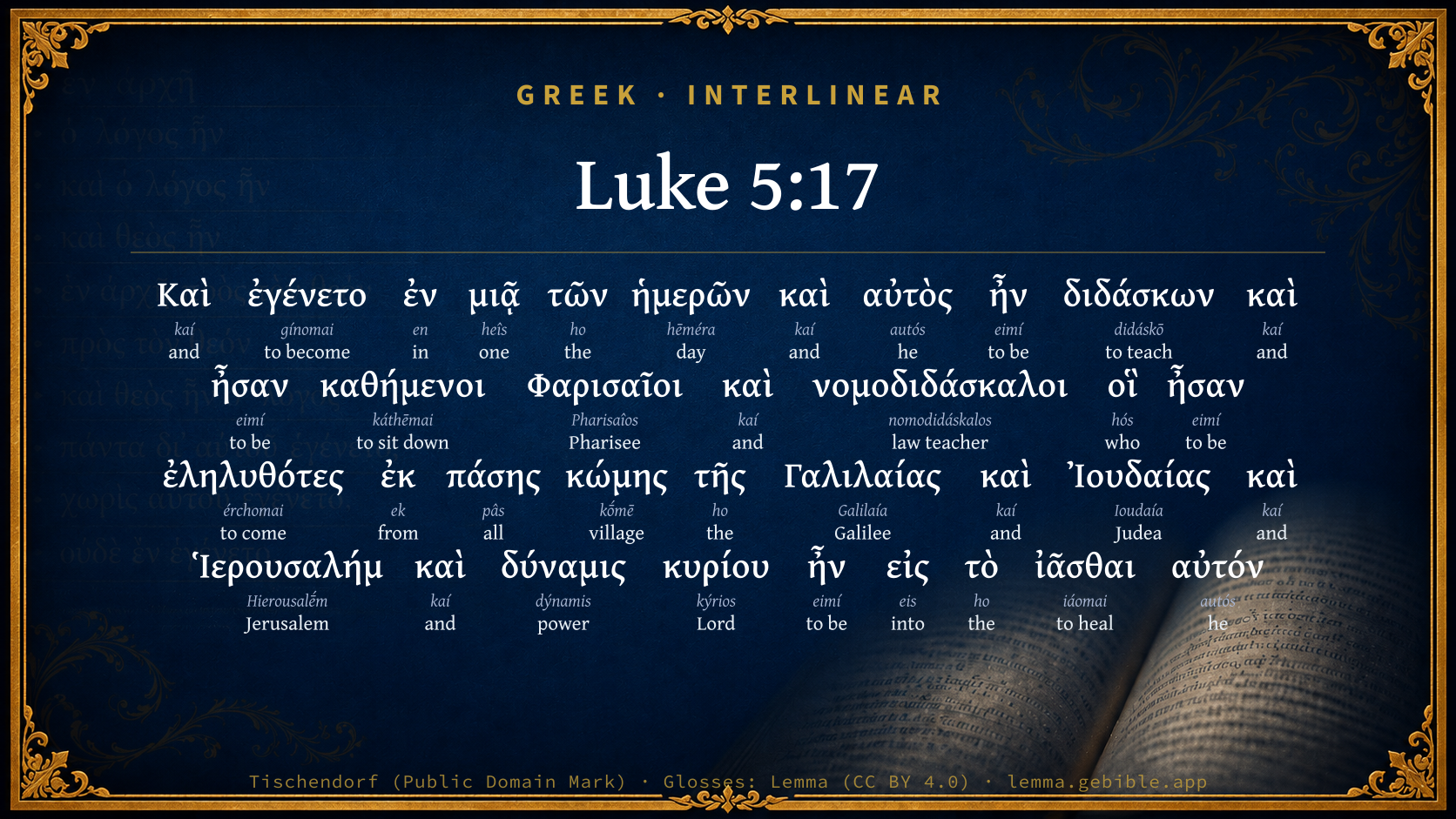
Download image
Cite this verse

Luke 5:17 (World English Bible). Public Domain. Lemma interlinear Bible study tool, https://lemma.gebible.app/v/luke/5/17.

Show BibTeX & RIS
BibTeX
RIS
English Translation
It happened on one of those days, that he was teaching; and there were Pharisees and teachers of the law sitting by, who had come out of every village of Galilee, Judea, and Jerusalem. The power of the Lord was with him to heal them.
World English Bible · Public Domain
Highlights
  • 1 first appearance in the Greek New Testament
Full analysis ↓
Download a study sheet

One document with this verse’s original text, its word-by-word gloss line, the meaning frame, cross-references with their text, attributed commentary, and full source and license credits — printable, and it pastes into notes with its structure intact.

This verse Autodidact and up

Study sheet (.html) Plain text (.txt)

A passage Seminary Student

Up to 50 verses in one chapter. A passage sheet keeps up to 6 commentary sources and 12 cross-references per verse, in the order this page ranks them, and says so on the sheet whenever that leaves anything out. Ask for a single verse and you get the Autodidact verse sheet above.

Everything on this page stays free to read, with no account — the sheet is a download of what is already on screen, not access to it.

Want to remove ads? Support Godless Engineer
Compare translations 3

The same verse in 3 English versions, stacked beneath the original-language interlinear above. Click any original word for its lexicon entry.

Each is an independent rendering of the whole verse — the interlinear is not word-aligned to these translations.

Highlighted words mark where these versions differ — a whole-verse word diff, not a word-by-word alignment.

  • World English Bible Public Domain
    It happened on one of those days, that he was teaching; and there were Pharisees and teachers of the law sitting by, who had come out of every village of Galilee, Judea, and Jerusalem. The power of the Lord was with him to heal them.
  • King James Version Public Domain
    And it came to pass on a certain day, as he was teaching, that there were Pharisees and doctors of the law sitting by, which were come out of every town of Galilee, and Judaea, and Jerusalem: and the power of the Lord was present to heal them.
  • unfoldingWord Literal Text CC BY-SA 4.0
    And it happened on one of those days that he was teaching, and there were Pharisees and law teachers sitting there who had come from every village of Galilee and Judea and from Jerusalem, and power of the Lord was upon him to heal.

unfoldingWord Literal Text — © unfoldingWord, licensed CC BY-SA 4.0. Word-aligned USFM3 via Door43 (git.door43.org/unfoldingWord/en_ult).

Versions to compare (up to 4)

3 of 4 selected

Show all 19 translations

Every available English version of this verse, each an independent rendering of the whole verse.

  • World English Bible Public Domain
    It happened on one of those days, that he was teaching; and there were Pharisees and teachers of the law sitting by, who had come out of every village of Galilee, Judea, and Jerusalem. The power of the Lord was with him to heal them.
  • Berean Standard Bible Public Domain
    One day Jesus was teaching, and the Pharisees and teachers of the law were sitting there. People had come from Jerusalem and from every village of Galilee and Judea, and the power of the Lord was present for Him to heal the sick.
  • Majority Standard Bible Public Domain
    One day Jesus was teaching, and the Pharisees and teachers of the law were sitting there. People had come from Jerusalem and from every village of Galilee and Judea, and the power of the Lord was present for Him to heal the sick.
  • King James Version Public Domain
    And it came to pass on a certain day, as he was teaching, that there were Pharisees and doctors of the law sitting by, which were come out of every town of Galilee, and Judaea, and Jerusalem: and the power of the Lord was present to heal them.
  • American Standard Version (1901) Public Domain
    And it came to pass on one of those days, that he was teaching; and there were Pharisees and doctors of the law sitting by, who were come out of every village of Galilee and Judaea and Jerusalem: and the power of the Lord was with him to heal.
  • Revised Version (1885) Public Domain
    And it came to pass on one of those days, that he was teaching; and there were Pharisees and doctors of the law sitting by, which were come out of every village of Galilee and Judaea and Jerusalem: and the power of the Lord was with him to heal.
  • Geneva Bible (1599) Public Domain
    And it came to passe, on a certaine day, as he was teaching, that the Pharises and doctours of the Law sate by, which were come out of euery towne of Galile, and Iudea, and Hierusalem, and the power of the Lord was in him to heale them.
  • Douay-Rheims (1899) Public Domain
    And it came to pass on a certain day, as he sat teaching, that there were also Pharisees and doctors of the law sitting by, that were come out of every town of Galilee, and Judea and Jerusalem: and the power of the Lord was to heal them.
  • Young's Literal Translation Public Domain
    And it came to pass, on one of the days, that he was teaching, and there were sitting by Pharisees and teachers of the Law, who were come out of every village of Galilee, and Judea, and Jerusalem, and the power of the Lord was -- to heal them.
  • Literal Standard Version CC BY-SA 4.0
    And it came to pass, on one of the days, that He was teaching, and there were sitting by Pharisees and teachers of the Law, who were come out of every village of Galilee, and Judea, and Jerusalem, and the power of the LORD was—to heal them.
  • Unlocked Literal Bible CC BY-SA 4.0
    It came about on one of those days that he was teaching, and there were Pharisees and teachers of the law sitting there who had come from many different villages in the regions of Galilee and Judea, and also from the town of Jerusalem. The power of the Lord was with him to heal.
  • unfoldingWord Literal Text CC BY-SA 4.0
    And it happened on one of those days that he was teaching, and there were Pharisees and law teachers sitting there who had come from every village of Galilee and Judea and from Jerusalem, and power of the Lord was upon him to heal.
  • Darby Bible Public Domain
    And it came to pass on one of the days, that *he* was teaching, and there were Pharisees and doctors of the law sitting by, who were come out of every village of Galilee and Judaea and [out of] Jerusalem; and [the] Lord's power was [there] to heal them.
  • World Messianic Bible Public Domain
    On one of those days, he was teaching; and there were Pharisees and teachers of the Torah sitting by who had come out of every village of Galilee, Judea, and Jerusalem. The power of the Lord was with him to heal them.
  • Webster's Bible Public Domain
    And it came to pass on a certain day, as he was teaching, that there were Pharisees and doctors of the law sitting by, who had come out of every town of Galilee, and Judea, and Jerusalem: and the power of the Lord was present to heal them.
  • Free Bible Version CC BY-SA 4.0
    One day when Jesus was teaching, the Pharisees and religious teachers who had come from all over Galilee, Judea, and Jerusalem were sitting there. The power of the Lord to heal was with him so he could heal.
  • Bible in Basic English Public Domain
    And it came about that on one of these days he was teaching; and some Pharisees and teachers of the law were seated there, who had come from every town of Galilee and Judaea and from Jerusalem; and the power of the Lord was with him, to make those who were ill free from their diseases.
  • Text-Critical English NT CC BY 4.0
    On one of those days, as he was teaching, some Pharisees and teachers of the law were sitting there. They had come from every village of Galilee, Judea, and Jerusalem, and the power of the Lord was present to heal the people.
  • Tyndale New Testament (1534) Public Domain
    And it happened on a certayne daye that he taught: and ther sate the pharises: and docturs of lawe which were come out of all the tounes of Galile Iurie and Hierusalem. And the power of the Lorde was to heale them.

Literal Standard Version (2020), Covenant Press — licensed CC BY-SA 4.0. Text via the HelloAO Bible API (eBible.org). Unlocked Literal Bible (unfoldingWord) — licensed CC BY-SA 4.0. Text via the HelloAO Bible API (eBible.org). unfoldingWord Literal Text — © unfoldingWord, licensed CC BY-SA 4.0. Word-aligned USFM3 via Door43 (git.door43.org/unfoldingWord/en_ult). Free Bible Version, Dr. Jonathan Gallagher — licensed CC BY-SA 4.0. Text via the HelloAO Bible API (eBible.org).

Word by word

More ways to search: Search by grammar → Find every occurrence → Compare this word →

Practice this passage: Drill this verse → Learn its vocabulary →

νομοδιδάσκαλοι
nomodidáskalos
G3547
“law teacher”
Noun, Nominative, Plural, Masculine
Part of Speech
Noun
Case
Nominative
Number
Plural
Gender
Masculine
Full Thayer's Definition

Origin: from G3551 and G1320

TDNT: 04:39,2

1. a teacher and interpreter of the law: among the Jews a. of those who among Christians went about as champions and interpreters of the Mosaic law
  1. Καὶ kaí G2532 “and” Conjunction
  2. ἐγένετο gínomai G1096 “to become” Verb, Aorist, Middle deponent, Indicative, 3rd person, Singular
  3. ἐν en G1722 “in” Preposition
  4. μιᾷ heîs G1520 “one” Adjective, Dative, Singular, Feminine
  5. τῶν ho G3588 “the” Article, Genitive, Plural, Feminine
  6. ἡμερῶν hēméra G2250 “day” Noun, Genitive, Plural, Feminine
  7. καὶ kaí G2532 “and” Conjunction
  8. αὐτὸς autós G846 “he” Personal pronoun, Nominative, Singular, Masculine
  9. ἦν eimí G1510 “to be” Verb, Imperfect, Active, Indicative, 3rd person, Singular
  10. διδάσκων didáskō G1321 “to teach” Verb, Present, Active, Participle, Nominative, Singular, Masculine
  11. καὶ kaí G2532 “and” Conjunction
  12. ἦσαν eimí G1510 “to be” Verb, Imperfect, Active, Indicative, 3rd person, Plural
  13. καθήμενοι káthēmai G2521 “to sit down” Verb, Present, Middle or Passive deponent, Participle, Nominative, Plural, Masculine
  14. Φαρισαῖοι Pharisaîos G5330 “Pharisee” Noun, Nominative, Plural, Masculine
  15. καὶ kaí G2532 “and” Conjunction
  16. οἳ hós G3739 “who” Relative pronoun, Nominative, Plural, Masculine
  17. ἦσαν eimí G1510 “to be” Verb, Imperfect, Active, Indicative, 3rd person, Plural
  18. ἐληλυθότες érchomai G2064 “to come” Verb, Perfect, Active, Participle, Nominative, Plural, Masculine
  19. ἐκ ek G1537 “from” Preposition
  20. πάσης pâs G3956 “all” Adjective, Genitive, Singular, Feminine
  21. κώμης kṓmē G2968 “village” Noun, Genitive, Singular, Feminine
  22. τῆς ho G3588 “the” Article, Genitive, Singular, Feminine
  23. Γαλιλαίας Galilaía G1056 “Galilee” Noun, Genitive, Singular, Feminine
  24. καὶ kaí G2532 “and” Conjunction
  25. Ἰουδαίας Ioudaía G2449 “Judea” Noun, Genitive, Singular, Feminine
  26. καὶ kaí G2532 “and” Conjunction
  27. Ἱερουσαλήμ Hierousalḗm G2419 “Jerusalem” Noun, Proper, indeclinable
  28. καὶ kaí G2532 “and” Conjunction
  29. δύναμις dýnamis G1411 “power” Noun, Nominative, Singular, Feminine
  30. κυρίου kýrios G2962 “Lord” Noun, Genitive, Singular, Masculine
  31. ἦν eimí G1510 “to be” Verb, Imperfect, Active, Indicative, 3rd person, Singular
  32. εἰς eis G1519 “into” Preposition
  33. τὸ ho G3588 “the” Article, Accusative, Singular, Neuter
  34. ἰᾶσθαι iáomai G2390 “to heal” Verb, Present, Middle or Passive deponent, Infinitive
  35. αὐτόν autós G846 “he” Personal pronoun, Accusative, Singular, Masculine

About this verse

These counts appear in no published source. They are computed here, from the morphology-tagged text and Lemma’s own curated glosses. What Lemma adds →

36
words
24
distinct lemmas
Gospels
section

Notable vocabulary

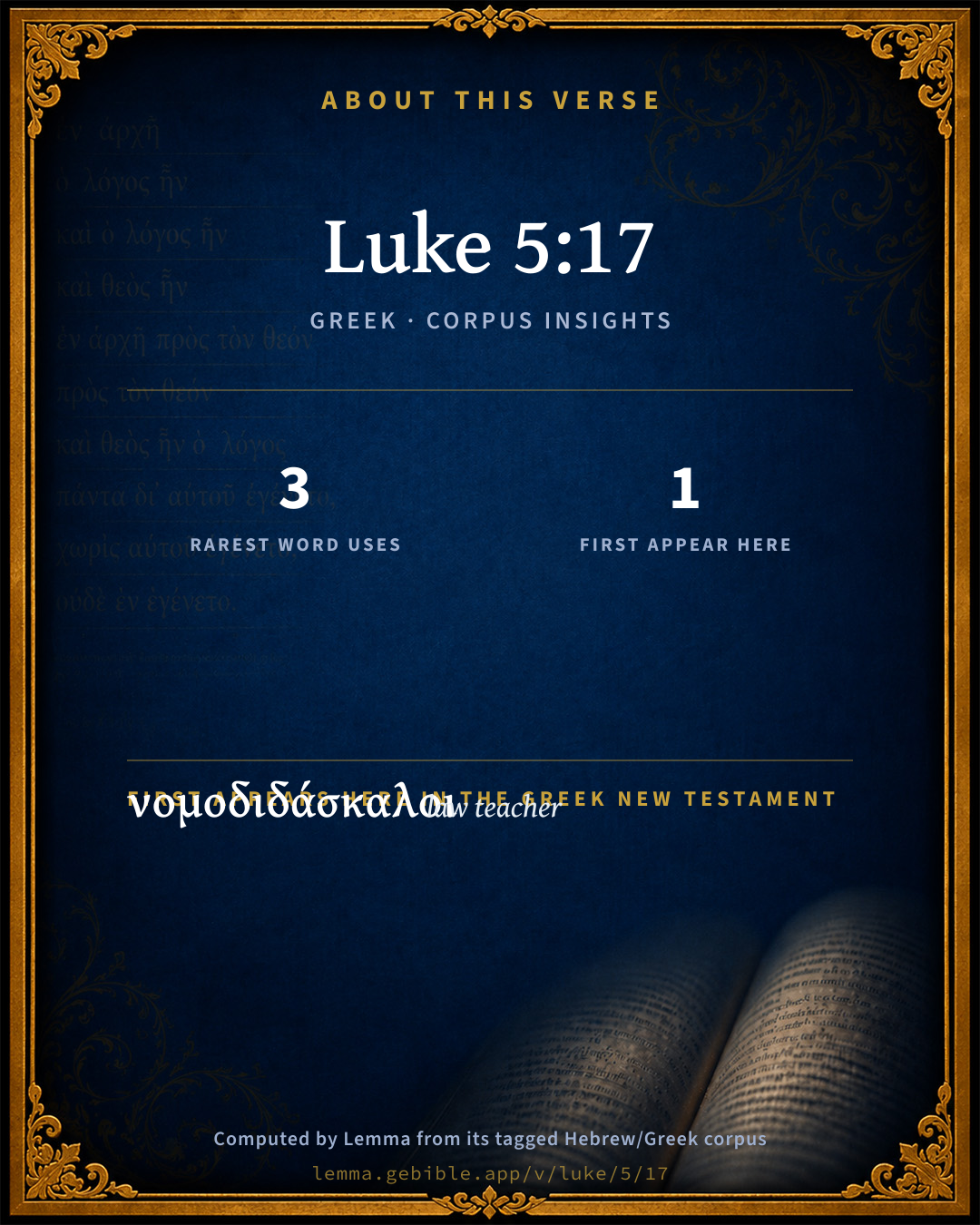
The rarest word here is νομοδιδάσκαλοι law teacher G3547 — appearing just 3 times in the whole Greek New Testament.

First appearance in Scripture

This word makes its first canonical appearance in the Greek New Testament here:

  • νομοδιδάσκαλοι law teacher G3547

Shared distinctive vocabulary

νομοδιδάσκαλοι law teacher G3547 occurs in 3 verses of the Greek New Testament. Also found in:
Repetition

Words recur within this verse:

Cross-references

17

Topical passages linked to Luke 5:17 in the Treasury of Scripture Knowledge — connected by theme and wording, ordered by reader-vote popularity; previews shown in the World English Bible.

  • Luke 6:19 All the multitude sought to touch him, for power came out from him and healed them all.
  • Luke 8:46 But Jesus said, "Someone did touch me, for I perceived that power has gone out of me."
  • Matthew 11:5 the blind receive their sight, the lame walk, the lepers are cleansed, the deaf hear, the dead are raised up, and the poor have good news preached to them.
  • Acts 19:11 God worked special miracles by the hands of Paul,
  • Matthew 15:1 Then Pharisees and scribes came to Jesus from Jerusalem, saying,
  • Mark 5:30 Immediately Jesus, perceiving in himself that the power had gone out from him, turned around in the crowd, and asked, "Who touched my clothes?"
  • Mark 7:1 Then the Pharisees, and some of the scribes gathered together to him, having come from Jerusalem.
  • Acts 4:30 while you stretch out your hand to heal; and that signs and wonders may be done through the name of your holy Servant Jesus."
  • Luke 2:46 It happened after three days they found him in the temple, sitting in the midst of the teachers, both listening to them, and asking them questions.
  • John 3:21 But he who does the truth comes to the light, that his works may be revealed, that they have been done in God."
  • Mark 16:18 they will take up serpents; and if they drink any deadly thing, it will in no way hurt them; they will lay hands on the sick, and they will recover."
  • Luke 5:21 The scribes and the Pharisees began to reason, saying, "Who is this that speaks blasphemies? Who can forgive sins, but God alone?"
  • Luke 5:30 Their scribes and the Pharisees murmured against his disciples, saying, "Why do you eat and drink with the tax collectors and sinners?"
  • Luke 7:30 But the Pharisees and the lawyers rejected the counsel of God, not being baptized by him themselves.
  • Luke 11:52–54 Woe to you lawyers! For you took away the key of knowledge. You didn't enter in yourselves, and those who were entering in, you hindered."
  • Luke 15:2 The Pharisees and the scribes murmured, saying, "This man welcomes sinners, and eats with them."
  • Mark 3:22 The scribes who came down from Jerusalem said, "He has Beelzebul," and, "By the prince of the demons he casts out the demons."

Cross-references courtesy of OpenBible.info (CC BY 4.0).

Where the printed editions differ

1 variant

Places in this verse where the major printed Greek editions disagree on the wording in a way that affects the translation — a comparison of editions, not a manuscript-by-manuscript collation. The editions are the modern critical texts (Nestlé-Aland 28/27, SBL, Westcott-Hort, Tregelles, Tyndale House) and the traditional texts behind the KJV (the Textus Receptus and the Byzantine/Majority text). It is not a claim about which reading is original.

  1. Different wording
    αὐτόν.

    “Him.”

    In NA28NA27TynSBLWH Not in TregTRByz

    αὐτούς (autous) 'them' occurs in traditional manuscripts (Treg+TR+Byz) instead of αὐτόν. (auton) 'Him.' in older manuscripts (NA28+NA27+Tyn+SBL+WH)

Textual data: Translators Amalgamated Greek New Testament (STEPBible TAGNT) · CC BY 4.0.

Commentary

Notes on Luke 5:17 from classic Christian and Jewish commentators (each source and its license shown beneath its notes). The classic Christian expositions comment on the surrounding passage and are grouped to its opening verse, so a note may address several verses; the Jewish commentaries on the Tanakh (Rashi and others) are per-verse, so they appear only where the commentator wrote on this verse.

Lemma curates 59 commentaries, every one of them public domain or Creative Commons licensed, each selected and text-cleaned for this edition rather than reprinted as found. About our sources →

Matthew Henry's Commentary

Here is, I. A general account of Christ's preaching and miracles, Luk 5:17. 1. He was teaching on a certain day, not on the sabbath day, then he would have said so, but on a week-day; six days shalt thou labour, not only for the world, but for the soul, and the welfare of that. Preaching and hearing the word of God are good works, if they be done well, any day in the week, as well as on sabbath days. It was not in the synagogue, but in a private house; for even there where we ordinarily converse with our friends it is not improper to give and receive good instruction. 2. There he taught, he healed (as before, Luk 5:15): And the power of the Lord was to heal them - ēn eis to iasthai autous. It was mighty to heal them; it was exerted and put forth to heal them, to heal those whom he taught (we may understand it so), to heal their souls, to cure them of their spiritual diseases, and to give them a new life, a new nature. Note, Those who receive the word of Christ in faith will find a divine power going along with that word, to heal them; for Christ came with his comforts to heal the broken-hearted, Luk 4:18. The power of the Lord is present with the word, present to those that pray for it and submit to it, present to heal them. Or it may be meant (and so it is generally taken) of the healing of those who were diseased in body, who came to him for cures. Whenever there was occasion, Christ had not to seek for his power, it was present to heal. 3. There were some grandees present in this assembly, and, as it should seem, more than usual: There were Pharisees, and doctors of the law, sitting by; not sitting at his feet, to learn of him; then I should have been willing to take the following clause as referring to those who are spoken of immediately before (the power of the Lord was present to heal them); and why might not the word of Christ reach their hearts? But, by what follows (Luk 4:21), it appears that they were not healed, but cavilled at Christ, which compels us to refer this to others, not to them; for they sat by as persons unconcerned, as if the word of Christ were nothing to them. They sat by as spectators, censors, and spies, to pick up something on which to ground a reproach or accusation. How many are there in the midst of our assemblies, where the gospel is preached, that do not sit under the word, but sit by! It is to them as a tale that is told them, not as a message that is sent them; they are willing that we should preach before them, not that we should preach to them. These Pharisees and scribes (or doctors of the law) came out of every town of Galilee, and Judea, and Jerusalem; they came from all parts of the nation. Probably, they appointed to meet at this time and place, to see what remarks they could make upon Christ and what he said and did. They were in a confederacy, as those that said, Come, and let us devise devices against Jeremiah, and agree to smite him with the tongue, Jer 18:18. Report, and we will report it, Jer 20:10. Observe, Christ went on with his work of preaching and healing, though he saw these Pharisees, and doctors of the Jewish church, sitting by, who, he knew, despised him, and watched to ensnare him.

II. A particular account of the cure of the man sick of the palsy, which was related much as it is here by both the foregoing evangelists: let us therefore only observe in short,

1. The doctrines that are taught us and confirmed to us by the story of this cure. (1.) That sin is the fountain of all sickness, and the forgiveness of sin is the only foundation upon which a recovery from sickness can comfortably be built. They presented the sick man to Christ, and he said, "Man, thy sins are forgiven thee (Luk 5:20), that is the blessing thou art most to prize and seek; for if thy sins be forgiven thee, though the sickness be continued, it is in mercy; if they be not, though the sickness be removed, it is in wrath." The cords of our iniquity are the bands of our affliction. (2.) That Jesus Christ has power on earth to forgive sins, and his healing diseases was an incontestable proof of it. This was the thing intended to be proved (Luk 5:24): That ye may know and believe that the Son of man, though now upon earth in his state of humiliation, hath power to forgive sins, and to release sinners, upon gospel terms, from the eternal punishment of sin, he saith to the sick of the palsy, Arise, and walk; and he is cured immediately. Christ claims one of the prerogatives of the King of kings when he undertakes to forgive sin, and it is justly expected that he should produce a good proof of it. "Well," saith he, "I will put it upon this issue: here is a man struck with a palsy, and for his sin; if I do not with a word's speaking cure his disease in an instant, which cannot be done by nature or art, but purely by the immediate power and efficacy of the God of nature, then say that I am not entitled to the prerogative of forgiving sin, am not the Messiah, am not the Son of God and King of Israel: but, if I do, you must own that I have power to forgive sins." Thus it was put upon a fair trial, and one word of Christ determined it. He did but say, Arise, take up thy couch, and that chronical disease had an instantaneous cure; immediately he arose before them. They must all own that there could be no cheat or fallacy in it. They that brought him could attest how perfectly lame he was before; they that saw him could attest how perfectly well he was now, insomuch that he had strength enough to take up and carry away the bed he lay upon. How well is it for us that this most comfortable doctrine of the gospel, that Jesus Christ, our Redeemer and Saviour, has power to forgive sin, has such a full attestation! (3.) That Jesus Christ is God. He appears to be so, [1.] By knowing the thoughts of the scribes and Pharisees (Luk 5:22), which it is God's prerogative to do, though these scribes and Pharisees knew as well how to conceal their thoughts, and keep their countenances, as most men, and probably were industrious to do it at this time, for they lay in wait secretly. [2.] By doing that which their thoughts owned none could do but God only (Luk 5:21): Who can forgive sins, say they, but only God? "I will prove," saith Christ, "that I can forgive sins;" and what follows then but that he is God? What horrid wickedness then were they guilty of who charged him with speaking the worst of blasphemies, even when he spoke the best of blessings, Thy sins are forgiven thee!

2. The duties that are taught us, and recommended to us, by this story. (1.) In our applications to Christ, we must be very pressing and urgent: that is an evidence of faith, and is very pleasing to Christ and prevailing with him. They that were the friends of this sick man sought means to bring him in before Christ (Luk 5:18); and, when they were baffled in their endeavour, they did not give up their cause; but when they could not get in by the door, it was so crowded, they untiled the house, and let the poor patient down through the roof, into the midst before Jesus, Luk 5:19. In this Jesus Christ saw their faith, Luk 5:20. Now here he has taught us (and it were well if we could learn the lesson) to put the best construction upon words and actions that they will bear. When the centurion and the woman of Canaan were in no care at all to bring the patients they interceded for into Christ's presence, but believed that he could cure them at a distance, he commended their faith. But though in these there seemed to be a different notion of the thing, and an apprehension that it was requisite the patient should be brought into his presence, yet he did not censure and condemn their weakness, did not ask them, "Why do you give this disturbance to the assembly? Are you under such a degree of infidelity as to think I could not have cured him, though he had been out of doors?" But he made the best of it, and even in this he saw their faith. It is a comfort to us that we serve a Master that is willing to make the best of us. (2.) When we are sick, we should be more in care to get our sins pardoned than to get our sickness removed. Christ, in what he said to this man, taught us, when we seek to God for health, to begin with seeking to him for pardon. (3.) The mercies which we have the comfort of God must have the praise of. The man departed to his own house, glorifying God, Luk 5:25. To him belong the escapes from death, and in them therefore he must be glorified. (4.) The miracles which Christ wrought were amazing to those that saw them, and we ought to glorify God in them, Luk 5:26. They said, "We have seen strange things today, such as we never saw before, nor our fathers before us; they are altogether new." But they glorified God, who had sent into their country such a benefactor to it; and were filled with fear, with a reverence of God, with a jealous persuasion that this was the Messiah and that he was not treated by their nation as he ought to be, which might prove in the end the ruin of their state; perhaps they were some such thoughts as these that filled them with fear, and a concern likewise for themselves.

Matthew Henry's Commentary on the Whole Bible (1708–1710) — public domain (CC PDM 1.0). Text via the HelloAO Bible API.

Jamieson, Fausset & Brown

Robert Jamieson, A. R. Fausset & David Brown

PARALYTIC HEALED. (Luk 5:17-26)

Pharisees and doctors . . . sitting by--the highest testimony yet borne to our Lord's growing influence, and the necessity increasingly felt by the ecclesiastics throughout the country of coming to some definite judgment regarding Him.

power of the Lord . . . present--with Jesus.

to heal them--the sick people.

Jamieson, Fausset & Brown — Commentary Critical and Explanatory on the Whole Bible (1871) — public domain (CC PDM 1.0). Text via the HelloAO Bible API.

Albert Barnes' Notes on the Bible

See this passage explained in the notes at Mat 9:1-7.

Luk 5:17

On a certain day - The time and place are not particularly mentioned here, but from Mat 9:1 it seems it was at Capernaum.

Luk 5:19

The tiling - See the notes at Mat 9:1-7.

Albert Barnes' Notes on the Bible (1834–1885) — public domain. Text from a community e-Sword/MySword module.

Joseph Benson's Commentary

Luk 5:17-25. And on a certain day, as he was teaching — Not on a sabbath day, as it appears, but on a week-day; and not in the synagogue, but in a private house. Preaching and hearing the word of God is good work, if it be performed properly, on any day in the week, as well as on the sabbath days; and in any convenient place, as well as in a place peculiarly set apart for divine worship: even there where we ordinarily converse with our friends, it is not improper to give and receive good instruction. There were Pharisees and doctors of the law sitting by — As being more honourable than the bulk of the congregation, who stood. These men of learning and influence had come from all quarters, on hearing the report of his miracles, to see his works, and scrutinize his pretensions of being a divinely-commissioned teacher. And the power of the Lord was present to heal — Namely, as many as then applied to him for the cure of their diseases. The sense is, that Christ not only preached such awakening sermons as might have converted them to righteousness, but his mighty and miraculous power was there to perform such cures as ought to have removed all their scruples with respect to his divine mission. Accordingly he embraced an opportunity, which now offered, of showing his power on a man afflicted with the palsy to such a degree that he could neither walk, nor stand, nor sit, nor move any member of his body, nor utter so much as a word importing the least desire of relief; but seemed a carcass rather than a man. This miserable object was carried in his bed, or couch, by four persons, who, when they could not bring him in at the door because of the crowd that was gathered to see how Jesus would behave before such learned judges, they bare him up, by some stairs on the outside, to the roof of the house, which, like other roofs in that country, was flat, with a battlement round it, and had a kind of trap-door, it seems, by which the members of the family could come out upon it to walk, and take the air, or perform their devotions. Through this they let him down with his couch, into the midst of the company assembled, before Jesus — Who, knowing the man to be a true penitent, and observing the faith of those who brought him, immediately gave him the consolation of knowing that his sins were all forgiven; and as a proof that he had authority to announce to him such glad tidings, he immediately so perfectly healed him of his disorder, as to enable him instantly to rise up before all that were present, take up his couch, and walk. For a more particular elucidation of the circumstances of this remarkable miracle, see notes on Mar 2:3-12. To what is there observed, it may not be improper to add here, that by our Lord’s manner of proceeding on this occasion we are taught two important lessons; 1st, That sin is the cause of all sickness, and the forgiveness of sin the only foundation on which the expectation of a recovery from sickness can be comfortably built. 2d, That when we are sick, we should be more concerned to get our sins pardoned than our sickness removed; Christ, in what he said to this man, directing us when we seek to God for health, to begin with seeking to him for pardon. And from the influence which the healing of this man’s soul and body had upon his mind, inducing him as he departed to his house, bearing his couch, to praise and glorify God, we may learn to give God the praise of those mercies of which we have the comfort, and to acknowledge his hand in all our recoveries from affliction and escapes from death, and to glorify him for them, by whose mercy and power alone they are wrought.

Joseph Benson's Commentary on the Old and New Testaments (1811–1818) — public domain. Text from a community e-Sword module.

Whedon's Commentary on the Bible

Daniel D. Whedon

§ 30. HEALING OF THE PARALYTIC, Luk_5:17-26.

Mat_9:2-8; Mar_2:1-12.

Daniel D. Whedon (gen. ed.), Commentary on the Old and New Testaments (1874–1909) — public domain. Text from a community e-Sword module.

The Preacher's Complete Homiletical Commentary

Joseph S. Exell (gen. ed.)

CRITICAL NOTES

Luk_5:17.—The scene of this miracle was a house in Capernaum, either in a house belonging to his family (Joh_2:12) or in St. Peter’s house. Pharisees and doctors of the law.—They had probably come to see and hear the prophet whose fame was now becoming widespread. There is no reason to ascribe to them any malignant purpose at this stage of their relations with Jesus. The power of the Lord.—I.e. not of the Lord Jesus, but of the Lord God working through Jesus. Present to heal them.—R.V. “the power of the Lord was with Him to heal.”

Luk_5:18. Men.—Four men (Mar_2:3).

Luk_5:19.—St. Mark says that the crowd was so great that they could not get near the door. By an outside stair they reached the flat roof of the house, and by removing some of the tiles were able to lower the mat or mattress on which the sick man lay into the presence of Jesus, who was evidently in the upper room of the house.

Luk_5:20.—Though Jesus repudiated the principle that suffering is in every case the proof of previous sin (Joh_9:3), He did at times draw attention to the fact that suffering often follows from sin, as in Joh_5:14, and apparently here.

Luk_5:21. Blasphemies.—“In classical Greek the word means abuse and injurious talk, but the Jews used it specially of curses against God, or claiming His attributes “(Mat_26:65; Joh_10:36)” (Farrar).

Luk_5:22. Their thoughts.—Rather, “their reasonings” (R.V.).

Luk_5:23. Whether is easier, etc.—“He does not ask, ‘Which is easier, to forgive sins or to raise a sick man?’ for it could not be affirmed that the act of forgiving was easier than that of healing; but, ‘Which is easier, to claim this power or to claim that?’—to say, ‘Thy sins be forgiven thee,’ or to say, ‘Arise and walk’? And He then proceeds, ‘That is easier, and I will now prove My right to say it by saying with effect, and with an outward consequence setting its seal to My truth, the harder word, Rise up and walk’ ” (Trench).

Luk_5:25. Took up that whereon he lay.—An indication of the reality of the cure. He had been carried by others to the presence of Jesus, but now is seen to depart carrying with him the mat or mattress on which he had lain.

Luk_5:26. Fear.—A feeling akin to that described in Luk_5:8.

MAIN HOMILETICS OF THE PARAGRAPH.—Luk_5:17-26

Christ’s Claim to forgive, and its Attestations.—The important part of this story is not the miracle, but the forgiveness preceding it, and the teaching as to the relation between the invisible and perpetual work of Christ on men’s consciences and His visible work on their outward condition.

1. The first thought suggested is—that our deepest need is forgiveness. Christ’s answer to the faith He discerned here seems irrelevant and beside the mark. “Man, thy sins are forgiven thee,” was far away from the wishes of the bearers; but it was the shortest road to their accomplishment, and goes straight to the heart of the case. Probably the sick man felt that, whatever his friends wanted for him, what he wanted most for himself was pardon. And forgiveness is our prime need. A man’s relation to God is the most important thing. If that is wrong, everything is wrong. The consciousness that we have sinned is the source of all sorrow; for the most of our misery comes either from our own or others’ wrong-doing, and the rest is needful because of sin, in order to discipline and purify. Hence the profound wisdom of Christ and of His gospel in not trifling with the surface, but going right to the centre. The wise physician pays little heed to secondary symptoms, but grapples with the disease. Christ makes the tree good, and trusts the good tree to make, as it will, good fruit. The first thing to do, in order to heal men’s misery, is to make them pure, and the first step towards that is to assure them of Divine forgiveness. All other attempts to deliver men will fail if this deepest wound be not dealt with first.

II. Forgiveness is an exclusively Divine act.—Those who now in their hearts accused Christ of blasphemy were quite right in believing that forgiveness is God’s prerogative. “Sin” has to do with God only; vice has to do with morality; crime has to do with human law; and the same act may be regarded in any one of these three aspects. When regarded as sin, only He against whom it has been committed can forgive it. Forgiveness is mainly that the love of the offended shall flow to the offender, notwithstanding the offence. It is love rising above the dam which we have flung across its course, and pouring into our hearts. The essence of forgiveness is not the suspension of penalty, but the unchecked and unembittered gift of God’s love to the sinner. This is what we need, and we need to have a definite Divine declaration of it. A vague trust in the possible mercy of a silent God is not enough: we need to hear with infallible certitude the assurance of forgiveness.

III. Jesus claims and exercises the Divine prerogative of forgiveness.—Had He been a mere man, His critics would have been justified in bringing the charge of blasphemy against Him. And he would have been bound, as a religious teacher and as a devout man, to disdain any intention of usurping the Divine prerogative. But He recognises their premises, and then asserts that He, the Son of man, has the power which they and He agree in acknowledging to belong to God only. “No man can forgive sins, but God only. I forgive sins. Whom think ye that I, the Son of man, am?” Surely we are here brought face to face with a very sharp alternative: either Jesus was an audacious blasphemer, or He was God manifest in the flesh. The whole context forbids us to take these words, “Thy sins are forgiven thee,” as anything less than Divine love wiping out the man’s transgressions; and if Jesus Christ said them, no hypothesis can save His character for the undiminished reverence of the world but that which sees in Him God revealed in manhood, the Son of man, who is the Son of God, the Judge of men, and their Pardoner.

IV. Jesus Christ brings visible facts to attest His invisible power.—The sentences, “Thy sins are forgiven thee,” and “Arise, and take up thy couch,” are equally easy to pronounce; the fulfilments of them are equally impossible for a man to bring about; but the difference between them is that the one can be checked, and the other cannot. He will do the visible impossibility, and leave them to judge whether He can do the invisible one or not. Of course the miracle was a witness to His right to assume the Divine prerogative, and to the efficacy of His announcement of forgiveness, only if He did it (as He assumed to give pardon) by virtue of His being in an altogether unique way the wielder of Divine power. If He did the one as a mere minister and recipient of that power, as a Moses or an Elijah, He must do the other in the same way, i.e. merely declare that God had forgiven the sinner. But the very stamp on all His miracles is that they are His in a fashion which is perfectly unique. True, “the Father that dwelleth in Me, He doeth the works”; but that dwelling of the Father in Him was unexampled, and pre-supposed His own divinity. Note, then, that our Lord here teaches us the power of His miracles as evidences of His Deity, and sets forth lucidly the relative importance of the miracle and of the inward forgiveness which it attests. The miracle is subordinate to the higher and the permanent work of bringing pardon and peace to sinners.

The subsidiary, visible effects of the gospel constitute very strong evidence of the reality of Christ’s claims to exercise the invisible power of pardon. Men reclaimed, passions tamed, homes made, instead of pandemoniums, houses of God, are proofs that the forgiveness which He gives is no mere delusion.—Maclaren.

SUGGESTIVE COMMENTS ON Luk_5:17-26

Luk_5:17-26. Christ forgiving Sin.

I. Sin and disease.—Christ forgave the sin first, showing that He regarded it as having come first, the disease being in some measure the result of sin. There is punishment for sin in this life. If not seen in the physical frame, it is seen in the deadened conscience, the hardened heart.

II. Faith and forgiveness.—The man knew that he needed healing, and believed that Christ could and would heal him. If he did not yet fully admit that sin was at the root of his ailment, Christ’s words settled that, and he confessed it in his heart. Sin injures not only man, but God. David said, “Against Thee only have I sinned,” though he had sinned against others, and against himself. This sin entails the burden of guilt. This burden can be cleared away. Sin’s worst effect can be, and at a great cost has been, removed. It is as easy to say, “Thy sins be forgiven thee,” as to say, “Rise up, and walk.” But the first is harder to accomplish. Nature never forgives—is merciless to those who get in her way. Man cannot forgive completely: only God can so forgive as to restore love and confidence. But it is not easy even for God to do so. Should we not value forgiveness all the more? It is a blessing greater and better than bodily healing.—Hastings.

Luk_5:17. “Pharisees and doctors of the law sitting by.”—I.e. occupying places of honour and pre-eminence; seated as critics to judge the teaching and actions of Jesus. Their want of sympathy with Him and their prejudices soon brought them into collision with Him. We can only truly learn of Christ and understand Him by abandoning the attitude of critics, and taking up that of humble, childlike faith. The power to heal was present with Christ, yet it was only faith that could give it free scope. Such faith was manifested in the incident that follows.

Luk_5:18. Bearing one another’s Burdens.

I. This is the kind of help we ought to render to each other.—There are many all around us needing such aid.

II. There are many ways of doing this neighbourly duty.

III. There was co-operation in this work.—One could not have done this work. It needed four. United, they had no difficulty. So it is in helping sinners to Christ. There is strength in the union of hearts and hands, when one alone cannot take his friend to the Saviour.—Miller.

Intercession for Others.—It is clear that the faith of those who carried him was helpful to the sick man and specially moved our Saviour. It is true that the wise virgins cannot lend their oil to those who have it not—that no one is saved through the faith and prayers of another, if he does not himself believe. But there is a place for intercession for others. A believing heart can by prayer and supplication prevail with God to give another a new heart and faith. The words of Ambrose to Monica, grieving over the sins of her son Augustine, beautifully express this truth: “It is impossible that so many tears from a believing heart should be in vain. You will see that God will melt the heart of the son of thy tears, and bring him to repentance and faith.” And it happened as the bishop had said.

Luk_5:19. “Let him down through the tiling.”—A fine illustration of the saying, “The kingdom of heaven suffereth violence, and the violent take it by force” (Mat_11:12).

Luk_5:20. Their Faith.—Which persisted in spite of obstacles until the sick man was brought into His presence. The holy boldness manifested could not but please Him. It is interesting to observe that the faith of the bearers is of a kind Christ approves and rewards: this fact should encourage us in making intercession for others. So far as appears the sufferer was entirely passive, and offered no petition for himself. In answer to the question, How far do men derive benefit from the faith of others, Calvin says, “It is certain that the faith of Abraham was of advantage for his posterity when he embraced the free covenant offered to him and to his seed. We must hold a similar belief with regard to all believers, that, by their faith, the grace of God is extended to their children and their children’s children, even before they are born. It is also beyond all question that earthly blessings are often, for the sake of the godly, bestowed on unbelievers.”

Faith seen in Works.—The efforts of the sick man’s friends told of—

I. A very strong faith.—The best evidence of faith is the effort we make to obtain faith’s prize. There is no need of words or protestations where acts of faith attest its existence.

II. Christ sees faith.—He sees it in the heart where it is exercised, before there has been any expression of it in word or act; but the emphasis here lies on the fact that He sees it in act, and is pleased when it is evidenced by works. He hears wordless prayers; but where possible prayer should embody itself in act. God wants to see our faith.—Miller.

“Thy sins are forgiven thee.”—It is evident that while the thoughts of his friends were bent upon the cure of his physical malady, the man himself was chiefly concerned about his spiritual state. He seems, too, to have been despondent, if not despairing, since Christ’s first words to him, as St. Matthew says (Luk_9:2), were, “Son, be of good cheer.” From the word “son,” (lit. “child), we understand that he was but young in years. Probably the reference to his sins before the cure is wrought is to be explained by the disease being the consequence of sinful courses.

A Declaration of Forgiveness.—The absolving words are not optative only, no mere desire that so it might be, but declaratory that so it was: the man’s sins were forgiven. Nor yet were they declaratory only of something which passed in the mind and intention of God; but, even as the words were spoken, there was shed abroad in his heart the sense of forgiveness and of reconciliation with God.—Trench.

Forgiveness of Sin and Remission of Penalty.—An interval took place, therefore, between the forgiveness of sin and the remission of the penalty which sin had brought. In this case it was but a short interval. In many other instances men have to bear for long, and perhaps while they live, the penal consequences of their sins, even though they have obtained forgiveness. But in their case there is this compensation, that the displeasure of God being removed, their sufferings are no longer punishments.

Luk_5:21. “Speaketh blasphemies.”—From their point of view, since they regarded Christ as a mere man, the objection raised by the scribes and Pharisees was perfectly justifiable. Their fault lay in the culpable spiritual blindness which hindered their recognition of His Divine glory.

Blasphemy.—Profane antiquity was unacquainted with the profound Biblical meaning of “blasphemy.” In the sense in which they viewed it, it only signifies, first, to speak evil of any one; and secondly, to utter words of evil foreboding. Monotheism alone leads to the true notion of blasphemy, which denotes not only imprecations, and injurious words against God, but more especially the assumption on the part of the creature of the honour belonging to the Creator (Joh_10:33).—Olshausen.

Of what this Sin consists.—Blasphemy is when

(1) unworthy things are ascribed to God,

(2) when the honour due to Him is withheld, and

(3) when that which is specially His is conferred upon those to whom it does not belong.—Bengel.

All Sins are against God.—They are against God only (Psa_51:4). They may be injuries and cruelties to others, but, as sins, they are relative to God only. And hence God only can forgive them.—Morison.

Absolution.—The belief in a human absolving power retains a pertinacious hold upon mankind. The savage believes that his priest can shield him from the consequenæes of sin. There was not a people in antiquity who had not dispensers of Divine favour. That same belief passed from Paganism into Romanism. It was exposed at the period of the Reformation: the whole idea of a human priesthood was proved baseless, human mediation was vehemently controverted, and men were referred back to God as the sole absolver. Yet still now again, three centuries after, the belief is as strong as ever. The question is not solved by merely denying the error. The heart craves human assurance of forgiveness, and can only be satisfied by positive truth.

I. The impotency of the negation.—“None can forgive sins, but God only.” The Pharisees denied the efficacy of human absolution: but what did they effect by such denial? They conferred no peace; they produced no holiness. They were startled at hearing a man freely announcing forgiveness. It appeared to them licence given to sin. If this new Teacher were to go about the land telling sinners to be at peace, to forget the past and to work onwards, bidding men’s consciences be at rest, and commanding them not to fear the God whom they had offended, but to trust in Him, what would become of morality and religion? What remained to restrain them from sin? For to dread God, and not to love and trust Him, was their conception of religion. Another class of men, the scribes, also denied human power of absolution. They were men of ponderous learning and accurate definitions. They could define the exact number of yards that might be travelled on the Sabbath day without infringement of the law; they could decide the respective importance of each duty, and tell which was the great commandment of the law. The scribe is the man who turns religion into etiquette; his idea of God is that of a monarch, transgression against whom is an offence against statute law; and he, the scribe, is there to explain the prescribed conditions upon which the offence may be expiated. And there are scribes in the present day, who have no idea of God but as an incensed judge, and prescribe certain methods of appeasing Him—certain prices—in consideration of which He is willing to sell forgiveness. What wonder is it that many should cry, “You have restricted God’s love and narrowed the path to heaven: you have terrified me with so many snares and pitfalls, on every side, that I dare not tread at all. Give me peace; give me human guidance: I want a human arm to lean on.”

II. The power of the positive truth.—What is forgiveness? It is God reconciled to us. What is absolution? It is the authoritative declaration that God is reconciled. Authoritative—that is, a real power of conveying a sense and feeling of forgiveness. It is the power of the Son of man on earth to forgive sins. It is man, God’s image, representing by his forgiveness on earth God’s forgiveness in heaven. Absolution is the conveyance to the conscience of the conviction of forgive ness; to absolve is to free—to comfort by strengthening—to afford repose from fear. The Saviour emancipated from sin by the freeness of absolution. The moment the sinner’s feelings changed towards God, He proclaimed that God was reconciled to him. Hence came His wondrous power with sinful, erring hearts; hence the life and fresh impulse which He imparted to the being and experience of those with whom He dealt. The absolving power is the central secret of the gospel. Salvation is unconditional: not an offer, but a gift; not clogged with conditions, but free as the air we breathe. And the power Christ exercised of declaring forgiveness He delegated to His Church: “Whosesoever sins ye remit, they are remitted.” An example of the use of this power is given in 2Co_2:10. The apostle absolves a man because the congregation absolved him; not as a plenipotentiary supernaturally gifted to convey a mysterious benefit, but as himself an organ and representative of the Church. The power of absolution, therefore, belonged to the Church, and to the apostle through the Church. It was a power belonging to all Christians: to the apostle, because he was a Christian, not because he was an apostle. A priestly power, no doubt, because Christ has made all Christians kings and priests. By every magnanimous act, by every free forgiveness with which a pure man forgives, or pleads for mercy, or assures the penitent, he proclaims this truth, that “the Son of man hath power on earth to forgive sins”—he exhibits the priestly power of humanity—he does absolve: let theology say what it will of absolution, he gives peace to the conscience—he is a type and assurance of what God is—he breaks the chains and lets the captive go free.—Robertson.

A Delayed Cure.—It seems hard that the “doctors of the law” should be permitted to interpose.

I. But it was good for them that the cure was delayed till they had fixed on a test by which they would try Jesus, until He had reduced their doubts to a single, definite issue, and then triumphantly encountered it. And—

II. And it was good for the paralytic himself.—It gave him time to reflect on the gracious words, “Thy sins are forgiven thee”—to feel their power, to lay their comfort to heart. God will often delay to grant our prayers, because He loves us, because He wishes to assure us that we are really His.—Cox.

The Inward certified by the Outward.—The Saviour, in the most felicitous manner imaginable, brings the case to the simplest of issues. There was no need for any long discussion. The whole matter could be settled with a few words. The inward could be certified by the outward, without any circumlocution; the upward could be reflected by the downward, immediately; the invisible could be manifested in the visible, just at once. And if, therefore, it would be more satisfactory to them, or would carry more of the evidence of Divine authority, He could speak a few words of fiat in reference to the visible, and downward, and outward; and He would do that just as easily as He had authoritatively said, Thy sins have been forgiven. They might call in question His authority to say, Thy sins have been forgiven, inasmuch as they could not actually see the dismissal of the sins. But if when He said, Arise, take up thy bed, and walk, they could see with their eyes that the fiat was fulfilled, then surely they would have no just reason for calling in question the fulness of the Divine authority that was behind all that He was saying and doing.—Morison.

Luk_5:22. “Perceived their thoughts.”—The supernatural insight of Christ is plainly indicated in this narrative. The secret thoughts of men lie open to Him.

(1) He recognises the penitence and faith of the sufferer, though He speaks no word, and

(2) He perceives and follows out the reasonings of the unbelieving scribes and Pharisees.

Luk_5:23. “Whether is easier,” etc.—That is to utter words which lead to no visible consequences, or to utter words which are meant to disturb the visible course of nature? Our Lord does not compare the acts themselves, but the safety of claiming the power to perform them.—Burgon.

Luk_5:24. “But that ye may know.”—The miracle was meant not only to reward the faith of those who had sought this benefit from Christ, but to convince the unbelieving spectators of His true power and claims. In it we may see His mercy toward even those who were hard of heart and who accused Him of blasphemy. He would give them a sign by which they might be enabled to overcome their unbelief.

Christ’s Consciousness of Divine Authority.—How thoroughly conscious the Saviour must have been of His Divine authority and power! His whole influence in the country and the world at large, in the age and for all ages, lay trembling as it were in the balance, and perilled so to speak on the result of His fiat. If failure had been the result, His humiliation would have been overwhelming and final. The supposed blasphemy of His assumption in reference to the forgiveness of sins would have been demonstrated. The triumph of His censors would have been complete and legitimate. This being obviously the case, He must have known, ere He spoke, that there was really no peril; otherwise, His fiat would have faltered on His tongue, and would, indeed, have been utterly irreconcilable with the lowest degree of prudence, not to speak of the highest degrees of good sense and sincerity.—Morison.

“Power on earth.”—In the words “power on earth” there lies a tacit opposition to “power in heaven.” This power is not exercised as you deem, only by God in heaven, but also by the Son of man upon earth. You rightly assert that it is only exercised by Him who dwelleth in the heavens; but He, who, in the person of the Son of man, has descended also upon earth, has brought down this power with Him here.—Trench.

Strength bestowed.—“I say unto thee, Arise!”

I. A strange command.—The man was paralysed. He was helpless as a corpse. Why did Jesus require of him such an impossibility?

II. As the will obeys power returns.

III. It is the same in spiritual life.

IV. Strength will not come until we try to obey.—Miller.

Luk_5:25. “Took up that whereon he lay.”—A mat or couch. “The bed had borne him; now he bears the bed” (Bengel). There is a touch of triumph in this description of the full strength imparted to the paralytic.

Luk_5:26. “They glorified God.”—Nothing is said as to the effect produced by this miracle upon the unbelieving scribes and Pharisees; but we are told that both the man himself and the multitude gave glory to God. This was, indeed, a fulfilment of the effect Jesus desired to accomplish.

“Strange things.”—I.e.

(1) the claim to be able to forgive sins, and

(2) the miracle wrought in support of this claim. The thought must have been excited in many minds that God would not have given the power to work this miracle to one who had really been guilty of blasphemy or infringed the Divine prerogative of mercy to sinners.

The Preacher's Complete Homiletical Commentary (gen. ed. Joseph S. Exell; Funk & Wagnalls, c. 1892) — public domain (pre-1929). A full-Bible homiletical/sermon-outline anthology covering 65 of 66 books (2 John is absent from the source module). Text from a community e-Sword module.

MacLaren's Expositions of Holy Scripture

Alexander MacLaren

Luke

BLASPHEMER, OR-WHO?

Luk 5:17 - Luk 5:26.

Luke describes the composition of the unfriendly observers in this crowd with more emphasis and minuteness than the other Evangelists do. They were Pharisees and doctors, and they were assembled from every part of Galilee, and even from Judea, and, what was most remarkable, from Jerusalem itself. Probably the conflict with the authorities in the capital recorded in Joh 5:1 - Joh 5:47 had taken place by this time, and if so, a deputation from the Sanhedrim would very naturally be despatched to Capernaum, and its members would as naturally summon the local lights to sit with them, and watch this revolutionary young teacher, who had no licence from them, and apparently not much reverence for them.

One can easily imagine that these heresy-hunters would be much too superior persons to mix with the crowd about the door of Peter’s house, and would, as Luke says, be ‘sitting by,’ near enough to see and hear, but far enough to show that they had no share in the vulgar enthusiasm of these provincial peasants. They were too holy to mingle with the mob, so they kept together by themselves, and waited hopefully for some heresy or breach of their multitudinous precepts. They got more than they expected.

We may note the contrast between their cynical watchfulness and the glorious manifestations for which they had no eyes. ‘The power of the Lord’-that is, of Christ-’was’ {operative} ‘in His healing,’ or, according to another reading, ‘to heal them.’ But the critics took no heed of that. There is a temper of mind which is sharp-eyed as a lynx for faults, and blind as a bat to evidences of divine power in the Gospel or its adherents. Some noses are keen to smell stenches, and dull to perceive fragrance. The race of such inquisitors is not extinct.

They contrast, too, with the earnestness of the four friends who brought the paralysed man. The former sat cool and critical, because they had no sense of need either for themselves or for others. The latter made all the effort they could to fight through the crowd, and then took to the roof by some outside stair, and hastily stripping off enough of the tiling, lowered their friend, bed and all, right down in front of the young Rabbi. The house would be low, and the roof slight, and Jesus was probably seated in an open inner court or verandah, At any rate, the description gives a piece of local colour, and presents no improbability.

Earnestness in striving to come oneself or to bring a dear one to Christ’s feet seems a supremely absurd waste of energy to a cynical critic, who feels no need of anything that Christ can give. It looks rather different to the paralytic on his couch, and to the friends who long for his healing.

The first lesson from this incident is that our deepest need is forgiveness. No doubt, something in the paralytic’s case determined Christ’s method with him. Perhaps his sickness had been brought on by dissipation, and possibly conscience was lashing him with a whip of scorpions, so that, while his friends sought for his healing, he himself was more anxious for pardon. It is very unlikely that Jesus would have offered forgiveness unless He had known that it was yearned for. But whether that is so or not, we may fairly generalise the order of givings in this miracle, and draw from it the lesson that what Jesus then gave first is His chief gift. In most of His other miracles He gave bodily healing first. First or second, it is always Christ’s chief gift in the beginning of discipleship. His miracles of bodily healing are parables of that higher miracle. This incident brings out what is always the order of relative importance, whether it is that of chronological sequence or not.

And we all need to lay that truth to heart for ourselves. No tinkering with superficial discomforts, or culture of intellect and taste, or success in worldly pursuits, will avail to stanch the deep wound through which our life-blood is ebbing out. We need something that goes deeper than all these styptics. Only a power which can deal with our sense of sin, and soothe that into blessed assurance of pardon, is strong enough to grapple with our true root of misery. It is useless to give a man dying of cancer medicine for pimples. That is what all attempts to make man happy and restful while sin remains unforgiven, are doing.

Social reformers need this lesson. Many voices proclaim many gospels to-day. Culture, economical or social reconstruction, is trumpeted as the panacea. But it matters comparatively little how society is organised. If its individual members retain their former natures, the former evils will come back, whatever its organisation. The only thorough cure for social evils is individual regeneration. Christ deals with men singly, and remoulds society by renewing the individual. The most elaborate machinery may be used for filtering the black waters. What will be the good of that if the fountain of blackness is not sealed up, or rather purified, at its hidden source? Make the tree good, and its fruit will be good. To make the tree good, you must begin with dealing with sin.

The second lesson from this incident is that Christ’s claim to forgive sins is either blasphemy or the manifest token of divinity. These Pharisees scented heresy at once. They were blind to the pathos of the story, and hard as millstones towards the poor sufferer’s wistful looks. But they pounced at once gleefully on Christ’s words. They were perfectly right in their premises that forgiveness was a divine prerogative which no man could share. For sin is the name of evil, when considered in its relation to God. He only can forgive it, for ‘against Thee, Thee only,’ as David confessed, is it committed. True, the same act may be full of harmful results to men, and may be a breach of human law, but in its character as sin it refers to God only. Forgiveness is the outpouring of God’s love on a sinner, uninterrupted by his sin. Only God can pour out that love.

But the cavillers were quite wrong in their conclusion. He did not ‘blaspheme.’ The fact that Jesus knew and answered their whispered or unspoken ‘reasonings in their hearts’ might have taught them that here was more than a rabbi, or even a prophet. But He goes on to reiterate His assertion that He has power to forgive sins.

Observe that He does not deny their premises. Nor does He, as He was bound in common honesty to do, set them right if they were wrong in supposing that He had claimed divine power. A wise religious teacher, who saw himself misunderstood as asserting that he could give what he only meant to assure a penitent that God would give, would have instantly said, ‘Do not mistake me. I am only doing what every servant of God’s should and can do, telling this poor brother that God is ready to forgive. God forbid that I should be supposed to do more than to declare his forgiveness!’ Christ’s answer is the strongest possible contrast to that. He knew what these Pharisees supposed Him to have meant by His authoritative words, and knowing it, He repeats them, and points to the miracle about to be done as their vindication.

Is there any possible way of escaping from the conclusion that Jesus solemnly and deliberately laid claim to exercise the divine prerogative of dispensing pardon? If He did, what shall we say of Him? Surely there is no third judgment of Him and His words possible; but either the Pharisees were right, and ‘this man,’ this pattern of all meekness and perfect example of humility, blasphemed, or else Peter was right when he said, ‘Thou art the Christ, the Son of the living God.’

The third lesson is that the visible effects of Christ’s power attest the reality of His claim to produce the invisible effects of peaceful assurance of forgiveness. It was equally easy to say, ‘Thy sins are forgiven thee,’ and to say, ‘Take up thy bed and walk.’ It was equally impossible for a mere man to forgive, and to give the paralytic muscular force to move. But the one saying could be tested, and its fulfilment verified by sight. The other could not; but if the visible impossibility was done, it was a witness that the invisible one could be.

The striking way in which our Lord weaves in His command to the palsied man to take up his bed with His words to the Pharisees is preserved in all the Gospels, and gives vividness to the narrative, while it brings out the main purpose of the miracle. It was a demonstration in the visible sphere of Christ’s power in the invisible. Both were divine acts, and that which could be verified by sight established the reality of that which could not.

The same principle may be widely extended. It includes all the outward effects of Christ’s gospel in the world. There are abundance of these which are patent to fair-minded observers. If one wishes to know what these are, he has only to contrast heathen lands with those in which, however imperfectly, Jesus is recognised as King and Example. The lives of His disciples are full of faults, but they should, and in a measure, do, witness to the reality of His gifts of forgiveness and conquest of sin. He has done more to restore strength to humanity paralysed for good than all other would-be physicians put together have done; and since He has visibly effected such manifest changes on outward lives, it is no rash conclusion to draw that He can change the inward nature. If He has healed the palsy, that is a work surpassing human power, and it proves that He can forgive the sin which brought the paralysis, and tied the helpless sufferer to his couch of pain.

Alexander MacLaren, Expositions of Holy Scripture (1904–1910) — public domain. Text from a community e-Sword module.

Godbey's Commentary on the New Testament

William B. Godbey

HE HEALS A PARALYTIC

Mat 9:2-8; Mar 2:1-12; & Luk 5:17-26. Mark: “And again He came into Capernaum during those days, and it was heard that He is at home. And immediately the multitudes came together, so that there was no room, not even at the door; and He continued to speak the word to them.” Luke says: “The Pharisees and teachers of the law, who had come out of every village of Galilee and Judea and Jerusalem, were sitting around.” In that day they had no newspapers, steam-engines, telegraphs, nor telephones, the news only going on the back of a camel, a fleet horse, or a swift pedestrian; yet, to our inextricable puzzle, the tidings flew everywhere with astounding velocity, notifying the people, as here Luke says, not only in the cities, but all the villages, that Jesus has come back from His retirement Into Capernaum, His headquarters, and is again preaching to the multitudes, healing the sick and casting out demons.

“They come to Him, carrying a paralyzed man, borne by four. Not being able to reach Him, on account of the crowd, they took up the roof where He was, and lifting it out, let down the bed on which the paralyzed man was lying down.” Luke says: “Mounting up on top of the house, they let him down through the tiles, along with the bed, in the midst, in the presence of Jesus.” The houses in that country have flat roofs, covered with stone, with stairways ascending up, and tiling arranged for removal at their option, when they wish to go out on the roof. The first time I ever entered Jerusalem, my guide escorted me through a lofty mansion by internal stairways, leading up through the roof, giving me a grand view of the city, which was impossible from the streets. As there is no doubt but this was Peter’s house in Capernaum, and the home of Jesus, the presumption is, it was not very high, the multitude being outside. These importunate friends of the paralytic, pressing their way through the crowd, use a ladder to climb the house from the outside, reaching the solid stone roof, cemented together so that it looked like a single great limestone rock covering the house, as I have so often seen and walked over them; coming to this movable door, take up the tiles, and let the man down, lying on his bed, lowering him to the very presence of Jesus, in the midst of His sermon.

“And Jesus, seeing their faith, says to the paralytic, Child, thy sins are forgiven.” Here we have a wonderful demonstration of prevailing faith.

There is no doubt but the paralytic had faith in Jesus to heal him, as these four friends, all round him during the long journey while carrying him on his bed, heaving like volcanoes, had inundated him with an atmosphere red- hot and electrified with indefatigable faith, so that, if he didn’t have it before, he certainly had imbibed it from his company by the time he reached the feet of Jesus; yet we have no allusion whatever to the faith of the patient, but it is unequivocally certified that the healing resulted from the faith of his four friends, who certainly abundantly proved their faith by their works in thus bringing him to the presence of Jesus, despite every conceivable difficulty. O that the perishing myriads all round us could only have friends enough to carry them to Jesus on the pinions of a faith that will take no denial! What a transcendent inspiration to all Christian workers, this notable case, where Jesus healed the man responsive to the faith of his friends!

Luk 5:21. “And the scribes and Pharisees began to reason, saying, Who is this One who speaketh blasphemies? Who is able to forgive sins except God alone? And Jesus, knowing their thoughts, responding, said to them, Why do you reason in your hearts? Why is it easier to say, Thy sins are forgiven, than to say, Arise and walk? But in order that you may know that the Son of man hath power on earth to forgive sins, He said to the paralyzed man, I say unto thee, Arise, and taking up thy bed, go to thy home. And immediately arising in presence of them, taking up that on which he was lying down, he departed to his own home, glorifying God. And ecstasy seized all, and they continued to glorify God; and they were filled with fear, saying, That we have seen paradoxical things this day.” While the Jewish Church was awfully unspiritual, and the preachers, as a rule, without an experimental knowledge of God, they held pertinaciously to the cardinal truths of the Bible, one of which here very lucidly crops out; i.e., that none but God can forgive sins. Many modern Churches, who are depending on priestly absolution, water baptism, sacraments, and good works, to take away their sins, would do well to heed this fundamental truth, here enunciated by the fallen clergy of apostate Judaism; i.e., that none but God alone can forgive sins. Therefore we must all pass by our own works, Church rites, water baptism, clerical intercession, and everything else, and go to God alone, on our knees, and stay till He, for Christ’s sake, forgives all our sins, and witnesses to the same by His blessed Holy Spirit. In this case, Jesus avails Himself of the smaller work — i.e., bodily healing — which was visible to mortal eyes, and incontestably demonstrated by the uprising of the patient, and the carrying of his bed away to his home, in order to illustrate the greater work — i.e., the forgiving of his sins — which either directly or indirectly had brought on him the paralysis, which is not hereditary, like leprosy, which typifies inbred sin; and consequently, as it originates from violation of the hygienical laws, represents actual sins, which must be removed by pardon, while original sin can only be expurgated by the cleansing blood of Jesus and the refining fire of the Holy Ghost. It is highly probable that this paralytic was a very bad case, of long standing, and extensively known by those people. Hence, his sudden and perfect healing, so clearly demonstrated, produced an intense excitement, not only filling the people with delight to see the mighty work, but Overawing them with profoundest reverence in the realization of the Divine presence.

William B. Godbey, Commentary on the New Testament (1896–1900) — public domain. Text from a community e-Sword module.

Tyndale Open Study Notes

Tyndale Open Resources

5:17-26 The healing of the paralyzed man initiated the conflicts Jesus had with religious leaders throughout his public ministry until he was crucified in Jerusalem.

5:17 Pharisees: See “The Pharisees” Profile. • Teachers of religious law, also called “scribes” and “lawyers,” were experts in interpreting the law of Moses. Most of the scribes were Pharisees, though some were Sadducees.

Tyndale Open Study Notes — © Tyndale Open Resources, licensed CC BY-SA 4.0. Text via the HelloAO Bible API.

Bengel's Gnomon

Johann Albrecht Bengel

Luk 5:17. Καθημένοι, sitting) as hearers that were treated with more especial honour than the rest.—νομοδιδάσκαλοι, doctors of the law) Scribes, Luk 5:21.—κώμης, village) The extremes, Jerusalem on the one hand, and the villages on the opposite, are specified: the towns which constitute the immediate mean between the capital city and the petty villages, are meant to be included.—ἦν) was present so as to heal. A similar expression occurs in the LXX., ἐσόμεθα τοῦ σῶσαί σε, we shall be present, or ready, for the purpose of saving thee, 2Sa 10:11; ἔσονται ὥστε ἐργάζεσθαι, they shall be present to perform, Num 8:11; γενέσθω ἡ χείρ σου τοῦ σῶσαί με, let Thy hand be present for the purpose of saving me, Psa 119:173.—αὐτοὺς, them) namely, those of whom Luk 5:15 speaks.

Bengel's Gnomon of the New Testament — English translation (T&T Clark, Edinburgh, 1860) — public domain. Text from a community e-Sword module.

Meyer's Critical & Exegetical Commentary

Heinrich August Wilhelm Meyer

Luk_5:17-26. See on Mat_9:1-8; Mar_2:1-12. Between this and the foregoing history Matthew has a series of other transactions, the sequence of which he accurately indicates. Luke vaguely says: ἐν μιᾷ τῶν ἡμέρων, which, however, specifies approximately the time by means of the connection (on one of those days, namely, on the journey entered upon at Luk_4:43 f.). Comp. Luk_8:22.

καὶ αὐτός] and He, as Luk_5:1, but here in opposition to the Pharisees, etc., who were surrounding Him.

ἐκ πάσης κώμης κ.τ.λ.] popularly hyperbolical. As to νομοδιδάσκ., see on Mat_22:35.

δύναμις κυρίου κ.τ.λ.] and the power of the Lord (of God) was there (praesto erat, as at Mar_8:1) in aid of His healing. So according to the reading αὐτόν (see the critical remarks). According to the reading αὐτούς, this would have to be taken as a vague designation of the sufferers who were present, referring back to Luk_5:15; αὐτόν the subject, αὐτούς would be the object. Others, as Olshausen and Ewald, have incorrectly referred κυρίου to Jesus, whose healing power was stirred up (Luk_6:19). Wherever Luke in his Gospel calls Christ the Lord, and that, as would here be the case, in narrative, he always writes ὁ κύριος with the article. See Luk_7:13 (31), Luk_10:1, Luk_11:39, Luk_12:42, Luk_13:15, Luk_17:5-6, Luk_18:6, Luk_19:8, Luk_22:31; Luk_22:61.

In the following narrative the precedence of Mark is indeed to be recognised, but the tracing out of the features of dependence must not be carried too far (in opposition to Weiss in the Stud. u. Krit. 1861, p. 703 f.).

Luk_5:19. εἰσενέγκ.] into the house, where Jesus and His hearers (Luk_5:17) were. Comp. afterwards τὸ δῶμα.

ποίας] qualitative: in what kind of a way. On the ὁδοῦ, which must be supplied in analysing the passage, see Bos, Ellips., ed. Schaefer, p. 333; on the genitive of place (comp. Luk_19:4), see Bernhardy, p. 138; Krüger on Thucyd. iv. 47, 2. Accordingly, although no instance of ποίας and ἐκείνης used absolutely occurs elsewhere, yet the conjecture ποίᾳ and ἐκείνῃ (Bornemann) is not authorized.

διὰ τῶν κεράμων] through the tiles, with which the flat roof was covered, and which they removed from the place in question. Mar_2:4 describes the proceeding more vividly. See the details, sub loco, and Hug, Gutacht. II. p. 21 f.

Luk_5:21. ἤρξαντο] a bringing into prominence of the point of commencement of these presumptuous thoughts. A vivid description.

διαλογίζεσθαι … λέγοντες] See on Mat_16:7. They expressed their thoughts to one another; hence Luk_5:22 is not inappropriate (in opposition to Weiss).

Luk_5:24. εἶπε τῷ παραλελ.] is not to be put in parenthesis, but see on Mat_9:6.

σοί] placed first for the sake of emphasis.

Luk_5:25. ἄρας ἐφʼ ὃ κατέκειτο] he took up that on which (till now) he lay, an expression purposely chosen to bring out the changed relation. With reference to ἐφʼ ὅ, on which he was stretched out, comp. the frequent εἶναι ἐπὶ χθόνα, and the like. See in general, Kühner, § 622 b.

Luk_5:26. The narrative is summary, but without precision, since the impression said to be produced by the miraculous incident (τὰ παρὰ δόξαν γυγνόμενα, Polyb. ix. 16. 2. Comp. Wis_16:17; Wis_19:5; 2Ma_9:24; Xen. Cyr. vii. 2, 16) applies indeed to the people present (Mat_9:8), but not to the Pharisees and scribes.

Meyer — Critical and Exegetical Commentary on the New Testament — English translation by Peter Christie, edited by Frederick Crombie (T&T Clark, 1880) — public domain. Text from a community e-Sword module.

Expositor's Greek Testament

ed. W. Robertson Nicoll

Luk 5:17-26 . The paralytic (Mat 9:1-8 , Mar 2:1-12 ).

Luk 5:17 . ἐν μιᾷ τῶν ἡμερῶν , a phrase as vague as a note of time as that in Luk 5:12 as a note of place. καὶ αὐτὸς , etc., and He was teaching; the Hebraistic paratactic construction so common in Lk. Note καὶ ἦσαν and καὶ δύναμις Κ . ἦν following. νομοδιδάσκαλοι , teachers of the law, Lk.’s equivalent for γραμματεῖς . The Pharisees and lawyers appear here for the first time in Lk., and they appear in force a large gathering from every village of Galilee, from Judaea, and from Jerusalem. Jesus had preached in the synagogues of Galilee where the scribes might have an opportunity of hearing Him. But this extensive gathering of these classes at this time is not accounted for fully in Lk. Not till later does such a gathering occur in Mk. (Mar 3:22 ). αὐτόν , the reading in [48] [49] [50] gives quite a good sense; it is accusative before ἰᾶσθαι = the power of the Lord (God) was present to the effect or intent that He (Jesus) should heal.

[48] Codex Sinaiticus (sæc. iv.), now at St. Petersburg, published in facsimile type by its discoverer, Tischendorf, in 1862.

[49] Codex Vaticanus (sæc. iv.), published in photographic facsimile in 1889 under the care of the Abbate Cozza-Luzi.

[50] Codex Regius--eighth century, represents an ancient text, and is often in agreement with א and B.

The Expositor's Greek Testament, edited by W. Robertson Nicoll (1897–1910) — public domain. Text from a community e-Sword module.

Godet's Commentaries

Frédéric Louis Godet

2 d. Luk 5:17-19. The Arrival.

The completely Aramaean form of this preface (the καί before αὐτός, the form καὶ ἦσαν...οἳ ἦσαν, and especially the expression ἦν εἰς τὸ ἰᾶσθαι) proves that Luke’s account is not borrowed from either of the two other Synoptics.

This was one of those solemn hours of which we have another instance in the evening at Capernaum (Luk 4:41-42). The presence of the Pharisees and scribes from Jerusalem is easily explained, if the conflict related John 5 had already taken place. The scribes did not constitute a theological or political party, like the Pharisees and Sadducees. They were the professional lawyers. They were designedly associated with the Pharisees sent to Galilee to watch Jesus (Luk 5:21). — The narrative in the first Gospel is extremely concise. Matthew does not tell the story; he is intent upon his object, the word of Jesus. Mark gives the same details as Luke, but without the two narratives presenting one single term in common. And yet they worked on the same document, or one on the text of the other!

The roof of the house could be reached by a flight of steps outside built against the wall, or by a ladder, or even from the next house, for the houses frequently communicated with each other by the terraces. Does Luke’s expression, διὰ τῶν κεράμων, signify simply by the roof,—that is to say, by the stairs which conducted from the terrace to the lower storeys, or down over the balustrade which surrounded the terrace; or is it just equivalent to Mark’s description: “they uncovered the ceiling of the place where He was, and having made an opening, let down the pallet”? This term, through the tiles, would be strange, if it was not to express an idea similar to that of Mark. Strauss objects that such an operation as that of raising the tiles could not have been effected without danger to those who were below; and he concludes from this that the narrative is only a legend. But in any case, a legend would have been invented in conformity with the mode of construction then adopted and known to everybody. — Jesus was probably seated in a hall immediately beneath the terrace.

Frédéric Louis Godet — Commentaries on Luke, John, Romans, and 1 Corinthians — English translation (T&T Clark, Edinburgh, 1870s–1890s) — public domain. Text from a community e-Sword module.

Geneva Bible (1599)

Geneva Bible translators

The mighty power of Christ’s Godhead, showed itself in him, at that time.

Christ in healing him that was sick of the palsy, showeth the cause of all diseases, and the remedy.

Geneva Bible (1599) marginal notes — public domain. Text via Bolls.life.

Adam Clarke's Commentary

Verse 17. On a certain day] This was when he was at Capernaum. See Mr 2:1.

The power of the Lord] Δυναμις Κυριου The mighty or miraculous power of the Lord, i.e. of Jesus, was there to heal them - as many as were diseased either in body or soul. Where the teaching of Christ is, there also is the power of Christ to redeem and save.

Adam Clarke's Commentary on the Bible (1810–1826) — public domain. Text from a community e-Sword/MySword module.

Ellicott's Commentary for English Readers

(17-26) It came to pass . . .—See Notes on Mat_9:1-8.

Pharisees and doctors of the law.—The description of the crowd of listeners is peculiar to St. Luke. The fact that many of the doctors of the law had come from Jerusalem is obviously important in its connection with St. John’s account (John 2, 5) of our Lord’s previous work in that city, and as explaining the part now taken by them.

Was present to heal them.—If we retain the plural pronoun, it must be taken generally as meaning those who sought healing. The better MSS., however, give the singular, and then it must be taken, “the power of the Lord (i.e., of God) was present for His (work of) healing.”

A Bible Commentary for English Readers, edited by Charles John Ellicott (1878–1897) — public domain. Text from a community e-Sword module.

The Cambridge Bible for Schools and Colleges

gen. ed. J. J. S. Perowne

17–26. The Healing of the Paralytic

17. on a certain day] The vagueness of the phrase shews that no stress is here laid on chronological order. In Mat_9:2-8; Mar_2:3-12 the scene is in a house in Capernaum, and the time (apparently) after the healing of the Gadarene demoniac on the Eastern side of the Lake, and on the day of Matthew’s feast.

as he was teaching] not in a synagogue, but probably in Peter’s house. Notice the “He” which is so frequent in St Luke, and marks the later epoch when the title “the Christ” had passed into a name, and when “He” could have but one meaning. See on Luk_4:15.

Pharisees and doctors of the law] See Excursus on the Jewish Sects.

and Judea and Jerusalem] These had probably come out of simple curiosity to hear and see the great Prophet of Nazareth. They were not the spies malignantly sent at the later and sadder epoch of His ministry (Mat_15:1; Mar_3:2; Mar_7:1) to dog his footsteps, and lie in wait to catch any word on which they could build an accusation.

to heal them] Some MSS. (א, B, L,) read “him.” If the reading be correct the verse means “the Power of the Lord (i. e. of the Almighty Jehovah) was with Him to heal.”

The Cambridge Bible for Schools and Colleges (gen. ed. J. J. S. Perowne; Cambridge University Press, 1878–1918) — public domain. Text from a community e-Sword module.

John Gill's Exposition

And it came to pass on a certain day,.... When he was at Capernaum, as appears from Mar 2:1

As he was teaching: in the house where such numbers were gathered together, to hear the word of God preached by him, that there was not room for them, neither within the house, nor about the door, Mar 2:2

That there were Pharisees and doctors of the law sitting by; who were sometimes called Scribes, and sometimes lawyers, and were generally of the sect of the Pharisees:

which were come out of every town of Galilee, and Judea, and Jerusalem: having heard much of his doctrine and miracles, they came from all parts to watch and observe him, and to take all opportunities and advantages against him, that they might expose him to the people:

and the power of the Lord was present to heal them; not the Pharisees and doctors of the law, who did not come to be healed by him, either in body or mind; but the multitude, some of whom came to hear his doctrine, and others to be healed of their infirmities, Luk 5:15. The Persic version reads the words thus, "and from all the villages of Galilee, and from Judea, and from Jerusalem, multitudes came, and the power of God was present to heal them."

John Gill's Exposition of the Whole Bible (1746–1763) — public domain (CC PDM 1.0). Text via the HelloAO Bible API.

Trapp's Complete Commentary

John Trapp

17 And it came to pass on a certain day, as he was teaching, that there were Pharisees and doctors of the law sitting by, which were come out of every town of Galilee, and Judaea, and Jerusalem: and the power of the Lord was present to heal them.

Ver. 17. And the power of the Lord] So it is, when any ordinance is afoot.

John Trapp, A Commentary or Exposition upon All the Books of the Old and New Testament (1647–1656) — public domain. Text from a community e-Sword module.

Haydock's Catholic Bible Commentary

But the fame of Jesus had spread far and wide. It was for this reason that it is here said, the Pharisees and doctors of the law came out of every town in Galilee, &c. not indeed through any intention of becoming his disciples, but through a spirit of envy; as they now saw every one leaving them, and following our Saviour. Perhaps also to calumniate him, as we often find them to have done, when they beheld him making converts from them. (Denis the Carthusian)

George Leo Haydock (1774–1849), Haydock's Catholic Family Bible and Commentary, 1859 edition — public domain. Excludes Psalms (Douay-Rheims chapter numbering differs from Protestant) and Deuterocanonical books (Catholic canon only).

Matthew Poole's English Annotations

We shall observe that the scribes and Pharisees much haunted our Saviour wherever he came, either to cavil at him, or out of curiosity to see the miracles he wrought. It seems they were many of them present at this time. But here ariseth a question or two.

1. How is it said, the power of the Lord was present with Christ to heal? had not Christ this power of healing then at all times?

Answer: Doubtless he had, for he was always the Lord that healeth us. The Divine nature once united to the human was never separated from Christ, but it did not always put forth itself, being as to that directed by his will. But as the end of Christ’s miracles was for the confirmation of his doctrine; so we shall observe, that mostly after preaching he wrought his miraculous operations.

2. Who are here meant by them? by reading the words one would think them related to the Pharisees and doctors of the law, of none of which we read that they were sick, nor do we read of any cures that Christ made upon them.

Answer: We must know that sometimes in holy writ these relative terms are put out of due order, as in Mat 11:1, where we have these words, And it came to pass, when Jesus had made an end of commanding his twelve disciples, he departed thence to teach and to preach in their cities: not in the disciples’ cities; poor men, they had no cities; but in the Jewish cities, the cities of that country: yet the verse mentions no other persons than Jesus and the twelve disciples.

So here, though the verse mentions no other persons present than the Pharisees and doctors of the law, yet there doubtless were many others, and some amongst them labouring under chronical distempers; of these the text is to be understood.

Matthew Poole's English Annotations on the Holy Bible (1683–1685) — public domain. Text from a community e-Sword/MySword module.

The Pulpit Commentary

Vers. 17-26. The healing of the paralyzed man.

And it came to pass on a certain day, as he was teaching, that there were Pharisees and doctors of the Law sitting by, which were come out of every town of Galilee, and Judaea, and Jerusalem. Again an interval of time. The fame of the new Teacher had spread rapidly. One day, some time after the events told in the last section, the Master was sitting in the house apparently of some one of consideration in Capernaum, and, as usual, was teaching. Grouped round him were a different audience to the traders and fishermen of the lake-city; prominent men of the leading religious party in the state, not only from Galilee, but from Jerusalem and other Judaean cities, such as Hebron, as well as learned doctors of the Law. These had been drawn from curiosity, some doubtless by higher motives, to hear for themselves the teaching of this now famous Nazarene Carpenter. These do not appear to have been actuated with the jealous malignity of some of those later deputations from the Jerusalem Sanhedrin and schools. The house was thronged within, and the crowd pressed round the doors. In the course of the quiet teaching, took place the incident which gave rise to one of the Lord"s great sayings an utterance so important that it evidently had been chosen by the apostles as a frequent theme or text in the preaching of the first days.

Present power.

One of the noblest of the psalms commences with that verse which it would have been well worth while to have lived a long and stormy life to have written, "God is our Refuge and Strength, a very present Help in trouble." Who can estimate the thousands of thousands of tempest-tossed human souls to whom these words have brought help and comfort! The latter part of this passage is in very close relation to our text. It brings before our minds

I THE COMPARATIVE NEARNESS OF GOD TO US. It may indeed be objected that the Omnipresent One, being everywhere, cannot be more truly in one place than in another. Doubtless that is so. But God may be more manifestly present, and therefore more present to our consciousness, in one place than in another. So the old Hebrew worshipper felt as he drew near Jerusalem, as he entered the precincts of the temple, as he went into the court of the Jews, as he saw the priests enter the sanctuary itself. And once in the history of mankind God did so visit us that he was "manifest in the flesh;" he was "Emmanuel, God with us with us in a sense in which he was not before and has not been again. There is a sense in which God is nearer to us in the sanctuary and at the table of the Lord than elsewhere. He has promised to meet us there; we go there on purpose to be in his presence; therefore to our consciousness he is in a peculiar sense present with us our very present Saviour.

II THE PRESENCE OF HIS POWER. "The power of the Lord was present." Any Israelite of ancient time would have told you that God"s power was present in the sky, in the sea, in the corn, in the rain. But he was more impressed with the power of God as manifested in the storm in harvest-time, or in the overthrow of Sennacherib"s mighty host. Yet this was only in his imagination; the power of God was as truly and as graciously present in the ordinary and the regular as in the miraculous. We are inclined to think that Divine power is most manifest in the shaking thunder or in the flashing lightning, or in the upheaving earthquake; but the wiser we are, the more we "observe these things, and (consequently) understand the loving-kindness of the Lord," the more we perceive that God"s power is as present in the common and the continuous as in the startling and the exceptional, is "very present" in the unfolding morning and the descending night, in the growing of the grass and the ripening of the corn and the blooming of the flowers. God"s power is present with us always and everywhere, if we have but eyes to see it and hearts to feel it.

III THE PRESENCE OF HIS HEALING POWER.

1. A very beneficent power is that of healing; perhaps we never praise God quite so feelingly as when we bless him that "he has healed our sicknesses." God has always been healing men. He has supplied us with the substances which are fitted to restore, and he has given us a bodily system of such a nature that it has great recuperative powers. There are but few among those who have reached manhood and womanhood who have not had occasion to know that the power of the Lord is present to heal us now. In the hour of convalescence they gave him the glory and offered their renewed life to him. What are they doing now that health has been restored and confirmed?

2. And this healing of the body is but the picture and the promise of the healing of the heart. When Jesus Christ went from village to village, healing all manner of diseases, it was partly, if not principally, to say to all men everywhere of every age, "Understand, ye blind souls that walk in darkness, I am the Light of the world; come to me, that you may see indeed! Ye strengthless and sick ones in need of spiritual healing, I am the Divine Restorer; come unto me, that ye may be strong indeed! Ye dying ones, I am the Resurrection and the Life; come unto me, that you may live indeed! C.

The Pulpit Commentary (1880–1919), ed. H.D.M. Spence-Jones & Joseph S. Exell — public domain. Text from a community e-Sword module.

John Wesley's Explanatory Notes

Sitting by - As being more honourable than the bulk of the congregation, who stood. And the power of the Lord was present to heal them - To heal the sickness of their souls, as well as all bodily diseases.

John Wesley, Explanatory Notes Upon the Whole Bible (1754–1765) — public domain. Text via the GEBible commentary corpus.

Kretzmann's Popular Commentary

Paul E. Kretzmann

The healing of the paralytic:

v. 17. And it came to pass on a certain day, as He was teaching, that there were Pharisees and doctors of the law sitting by, which were come out of every town of Galilee and Judea and Jerusalem; and the power of the, Lord was present to heal them.

v. 18. And, behold, men brought in a bed a man which was taken with a palsy; and they sought means to bring him in, and to lay him before Him.

v. 19. And when they could not find by what way they might bring him in because of the multitude, they went upon the housetop, and let him down through the tiling with his couch into the midst before Jesus.

v. 20. And when He saw their faith, He said unto him, Man, thy sins are forgiven thee.

v. 21. And the scribes and the Pharisees began to reason, saying, "Who is this which speaketh blasphemies? Who can forgive sins but God alone?

The first indication of the systematic effort on the part of the leaders of the Jewish Church to persecute and discredit Jesus. The story is an independent incident, having no connection with the foregoing, since Luke has no interest in exact chronological sequence. The chief men of the Jewish nation had received full information of the preaching and of the miracles of this otherwise unknown Galilean rabbi, who had not so much as asked their sanction for His work. The local men, of the various synagogues of Galilee, the experts in the Law and in all the doctrines as they had been fixed by tradition, were not equal to the situation. So they were reinforced by men from Judea, and especially from Jerusalem, Pharisees and scribes, the most learned men and skilled in the Law. All these were present in a house where Jesus was teaching the multitude. Not that they were eager for the Word of Life, but that they were watching for some opportunity of accusing Him. And the power of the Lord, the omnipotent majesty of the Triune God, was present in Jesus to the intent that He should heal. The other persons of the Godhead were never mere disinterested or neutral onlookers while the work of redemption was going on, but the entire Godhead in its three persons wrought the salvation of mankind. The chance for which the Pharisees and teachers of the Law had been waiting presented itself very quickly. Certain men bore upon a couch or hammock a man that had suffered a stroke of paralysis. "Commonly those who are attacked in all their members by severe nervous debility are quickly taken away; if not, they live, it is true, but seldom recover their health, and for the most part drag on a miserable life, losing, moreover, their memory. The sickness of those who are partially affected is, it is true, never severe, but often long and almost incurable. " When these men with their burden reached the house where Jesus was staying, they anxiously sought a way in which they might bring the sick man and lay him before Jesus, for that was the purpose of their coming. They had the conviction of faith that this prophet from Nazareth was the Christ, who could easily cure their friend. But the crowd in the house and before the door was too densely packed; it was impossible to find an opening through which they might wedge themselves into the room where Jesus was speaking. But they were not long at a loss as to further procedure. They climbed the outside stairway to the roof of the house, they took off some of the tiles or material of which the roof was made, and then lowered the sick man on his hammock before the feet of Jesus. Luke’s account is influenced by his desire to make the manner of performing this work of love clear to the Romans for whom he was writing. Jesus paused in His teaching at this interruption, and His omniscient gaze swept the faces of the newcomers, including that of the sick man. In every one He read the firm conviction as to His ability to help, and also a voiceless pleading and interceding that He would show mercy. He was satisfied with the results of His scrutiny, and therefore turned to the paralytic with the words: Man, forgiven are thy sins! Note: Sin is the cause of all misery, sickness, and death in the world. By removing the cause, the consequences were, in effect, taken away. The sick man’s faith knew this; he knew that the greatest earthly gift became his by these comforting words of Jesus. It was not a case of special punishment for special sins, but one in which the Savior knew where the healing must commence, in the soul. No sooner had Jesus uttered the words of forgiveness than the scribes and Pharisees began to reason, to discuss the matter, either in their hearts only, or in an undertone among themselves. Their Pharisaic conscience was deeply grieved that any one presumed upon remitting sins. Such arrogance they must brand as blasphemy; for surely no one could forgive sins but God only. If Jesus were not God, He could not forgive sins in His own power; and His arrogating this authority to Himself would have been blasphemy against God, in the proper sense of the word. But that these scribes and Pharisees might have the fullest and most absolute proof of His divine power and Godhead, He now worked in their presence three miracles, all of which could be done only by an omniscient and omnipotent Being. These miracles were: the remission of the sick man’s sins; the revelation of the secret thoughts of the scribes; the restoration of the paralytic in a moment to perfect health.

Paul E. Kretzmann, Popular Commentary of the Bible (1921–1924) — public domain. Text from a community e-Sword module.

Burkitt's Expository Notes on the New Testament

William Burkitt

As the great end of our Saviour’s miracles was to confirm his doctrine, so commonly after his preaching he wrought his miracles. The scribes and Pharisees, though they had no love for our Saviour’s person, nor value for his ministry, yet they frequently accompanied him wherever he went, partly to cavil at his doctrine, and partly out of curiousity to see his miracles: but observe the gracious condescension of our Saviour; although he well knew that the Pharisees at this time attended upon him with no good intention, yet he puts forth his divine power in working miracles before them: The power of the Lord was present to heal. Not that Christ’s power was at any time absent but it is said now to be present, because it was now exerted and put forth at his will and pleasure.

And accordingly at this time, before the Pharisee’s eyes, he miraculously cures a person sick of the palsy, as the paragraph before us does inform us.

Wherein observe, 1. The diseased and distressed person, one sick of the palsy, which being a resolution and weakness of the nerves, enfeebles the joints, and confines a person to his bed or couch. As a demonstration of Christ’s divine power, he was pleased to single out the palsy and leprosy, incurable diseases, to work a cure upon. Now this person was so great a cripple, by reason of the palsy, that he could not go, nor be led, but was carried in his bed or couch.

Observe, 2. As the grievousness of the disease, so the greatness of the people’s faith. The man and his friends had a firm and full persuasion, that Christ was clothed with a divine power, and able to help him; and they hope in his goodness, that he was willing as well as able.

And accordingly, the roof of the Jewish houses being flat, they uncover some part of it, and let the bed down with the sick man in it, and lay him at the foot of Christ, in hopes of help and healing.

Observe, 3. That no sooner did they exercise their faith in believing, but Christ exerts his divine power in healing: yet the object of their faith probably was not Christ’s divine power as God, but they looked upon him as an extraordinary prophet, to whom God had communicated such a divine power as Elijah and Elisha had before him. Yet, see the marvelous efficacy even of this faith, which obtained not only what was desired, but more than was expected. They desired only the healing of the body, but Christ heals body and soul too, saying, Son, be of good cheer, thy sins are forgiven thee. Thereby our Saviour, signifies to them, that sin is the meritorious cause of sickness, and consequently, that in sickness the best way to find ease and deliverance from pain, is first to seek for pardon; for the sins of pardon will in some degree take away the sense of pain.

Observe, 4. The exception which the Pharisees take against our Saviour for pronouncing that this man’s sins were forgiven him: they charge him with blasphemy, urging, that it is God’s peculiar prerogative to pardon sin. Indeed their proposition was true, but their application was false. Nothing more true, than that it is the highest blasphemy for any mere man to arrogate and assume to himself the incommunicable property of God, absolutely and authoritatively to forgive sin. But then their denying this power to Christ of forgiving sins, which he had as God from all eternity, and as mediator, God and man in one person, when here on earth; this was blasphemy in them; but the assuming and challenging in it, none in him.

Observe, 5. To cure, if possible, the obstinacy and blindness of the Pharisees, our Saviour gives them a two fold demonstration of his Godhead;

1. By letting them understand that he knew their thoughts, Jesus perceived their thoughts, Luk 5:22 To know the thoughts, to search the hearts, and understand the reasonings of men, is not in the power of angels or men, but the prerogative of God only.

2. By assuming to himself a power to forgive sins: for our Saviour here, by taking upon him to forgive sins in his own name and by his own authority, does give the world an undeniable proof, and a convincing evidence, of his Godhead: for who can forgive sins but God only?

Observe, 6. The effect which this miracle had upon the minds of the people: they marvelled and were amazed, were filled with fear, but not with faith; astonished, but did not believe.

Learn hence, that the sight of Christ’s own miracles is not sufficient to work faith in the soul, without the efficacious grace of God; the one may make us marvel, the other must make us believe.

William Burkitt's Expository Notes on the New Testament (1700–1703) — public domain. Text from a community e-Sword module.

McGarvey & Pendleton's Commentaries

J. W. McGarvey

J. W. McGarvey's The Fourfold Gospel [XXXV. Heals a Paralytic].

XXXV. JESUS HEALS A PARALYTIC AT CAPERNAUM. aMATT. IX. 2-8; bMARK II. 1-12; cLUKE V. 17-26.

c17 And it came to pass on one of those days, bwhen he entered again into Capernaum after some days, cthat he was teaching; bit was noised that he was in the house. [Luke uses the general expression [181] "those days," referring to the early portion of our Lord's ministry in Galilee. Mark says, "some days," which implies the lapse of a considerable interval. The healing of the leper created such excitement that for some time, several weeks, Jesus kept out of the cities. He now, after the excitement has subsided, quietly enters Capernaum, and probably goes to the house of Simon Peter, now looked upon as his head quarters in Capernaum ( Mar_1:29). His entrance into Capernaum marks the end of his first missionary tour through Galilee.] 2 And many were gathered together, so that there was no longer room i for them, no, not even about the door: and he spake the word unto them. [Oriental houses are one or two storied structures, built in the form of a square, or rectangle, with an open space in the center called the court. They have one door which opens from the street into an open space called the porch, and this porch in turn opens upon the court. In this porch there is usually a stairway leading to the roof. The roofs are invariably flat, and are surrounded by a breastwork or parapet to keep those on them from falling off. Roofs or housetops are used as we use yards, only they are somewhat private. Some think that this house was a two-storied structure, and that Jesus was teaching in the upper room or second story. If this were so, there would have been little profit to the people who clung about the street door, for they could neither see nor hear. Besides, a two-storied house would probably have been beyond the means of Simon Peter. It is more likely that Jesus was in the room opposite the porch across the court. If so, the crowd at the door might catch an occasional word, or by tiptoing obtain a momentary glance; and thus fan the hope of some ultimate satisfaction. The gospel is here called "the word," for it is the Word among words, as the Bible is the Book among books.] cand there were Pharisees and doctors of the law sitting by [the fact that they were sitting, shows that they were honored above the rest: Jesus did not increase their ill-will by any needless disrespect], who were come out of every village of Galilee and Judaea and [182] Jerusalem [It is not likely that such a gathering came together by accident. Capernaum was known to be the headquarters of Jesus, and these leaders of the people had doubtless gathered there to wait for some opportunity to see or hear Jesus. They recognized the necessity of coming to some definite judgment regarding him. We shall see in this scene the beginning of their hostility to Jesus, which developed into four objections: 1. Alleged blasphemy; 2. Intercourse with publicans and sinners; 3. Supposed neglect of ascetic duties, such as washings, fastings, etc.; 4. Alleged violation of the sabbath]: and the power of the Lord was with him to heal. [That is to say, the power of God the Father was then working in Jesus to perform miracles ( Joh_14:10). Some take this as implying that other miracles had been wrought that day, before the arrival of the paralytic. But the words are more likely a preface for what follows; in which case the meaning is that the cold disbelief of the Pharisees did not prevent Jesus from working miracles, as disbelief usually did-- Mat_13:58, Mat_16:1-4.] 18 And behold, men bring { athey brought bthey come, bringing unto him a man sick of the palsy, cthat was palsied: alying on a bed: bborne of four [Palsy is an abbreviation of the word "paralysis." It is caused by a cessation of the nervous activities. See Act_8:22). So far as the church forgives sins ( Joh_20:23), it does it merely as the organ of God, and must do so according to the methods and ordinances laid down by God. Those who profess to forgive sin by word of mouth, should be able to make good their claim to this boasted power by healing diseases or otherwise removing the consequences of sin. Failing to do this, they must forever rest under justified suspicion that they are, wittingly or unwittingly, guilty of blasphemy.] b6 But there were certain of the scribes cand the Pharisees bsitting there, a3 And behold, [they] cbegan to reason, band reasoning in their hearts, asaid within themselves, csaying, aThis man blasphemeth. b7 Why doth this that man thus speak? [A scornful expression, shown by the repetition, houtos houtoo, which means, literally, "this one these things."] cWho is this that speaketh blasphemies? Who can forgive sins, bbut one, even God? calone? [In classic Greek to blaspheme means to speak evil or, or to slander a person, and it is used in this sense in the New Testament ( Tit_3:2, 2Pe_2:2, Jud_1:8). Its ordinary New Testament use, however, is quite different, since it is employed to designate something which reflects evil on the character and nature of God. This use is peculiar to monotheistic writers, and was unknown to the Greeks. Such blasphemies may be divided into three general heads, thus: 1. To attribute the unworthy to God. 2. To deny the worthy to God. 3. To arrogate or claim any attribute, power, authority, etc., which belongs to exclusively to God. It was under this third head that Jesus seemed to lay himself open to accusation--an accusation entirely just if he had not been the [185] Son of God. The Pharisees were not faulty in their logic, but were mistaken in their premises; hence Jesus does not deny their doctrine; he merely corrects their mistaken application of it to himself. As to this pronounced forgiveness of Jesus, two questions arise: 1. Why did he forgive the man's sins? The haste with which the man was brought to Jesus suggests that his condition was critical; in which case the torment of sin would be the greater. As a searcher of hearts, Jesus saw the unuttered desire of the sick man, and at once responded to it. If his words meant nothing to the conscience of the man, they were wasted; but Jesus knew what was in man. 2. Why did he pronounce the forgiveness so publicly? As the terms of pardon prescribed in the law were yet in full force, this open speech of Jesus was a surprising assertion of authority. In fact, such assertions were exceptional in his ministry; for only on three recorded occasions did he thus forgive sins ( Luk_7:48, Luk_23:43). Being the exceptional and not the established method of pardon, and being thus employed in the presence of so representative an audience, it was evidently used for a special purpose; and that purpose was to show that Jesus had such power, that men seeing this power might believe him to be the Son of God. He was vindicating an eternal law of the universe, in which all human beings throughout all generations would be interested; viz.: that humanity has a Ruler who can present it spotless before the throne of God ( Jud_1:24). Jesus propounded his law in the presence of those most interested in exposing it if false, and most able to explode it had it not been true. Whether his words were truth or blasphemy, was the controversy between Christ and the rulers from that day to the end of his ministry-- Mat_26:65.] b8 And straightway Jesus, perceiving in his spirit that they so reasoned ctheir reasonings, bwithin themselves, a4 And Jesus knowing their thoughts [Jesus read their thoughts by his divine insight, and not because of any recognized habit or tendency on their part to criticise him, for this is the first recorded indication of hostility on the part of the Pharisees, [186] though it is hinted at, at Joh_4:1. Such discernment of the thought was to be a characteristic mark of the expected Messiah ( Isa_11:2, Isa_11:3), and Jesus had it ( Joh_2:25). It also is an attribute peculiar to God-- 1Ch_28:9, Jer_17:10, Rom_8:27, Rev_2:23] canswered and said bsaith unto them, aWherefore think ye evil in your hearts? [Jesus could see invisible sin, and could forgive it or condemn it, as the conditions moved him. The powers of discernment, forgiveness and condemnation make him the perfect Judge.] bWhy reason ye in your hearts? a5 For which is easier, bto say to the sick of the palsy, cThy sins are forgiven thee; bor to say, Arise, and take up thy bed, and walk? [To understand this sentence we should place the emphasis upon the word "say," because the question at issue was the power or effect of his speech. The rabbis, after their first shock of surprise, thought that Jesus feared to attempt the fraud of a so-called miracle in the presence of learned men, lest he should be detected and exposed; and hence looked upon his present action as an attempt to bear himself safely off before the public, and to maintain his standing by the use of high-sounding words. They felt that he used words of unseen effect, because he dared not use those of seen effect. This was precisely the view that Jesus knew they would take, and that he wished them to take; for by showing his ability to work in the realms of sight that which is impossible; viz.: the healing of the sick man, he could place before them proof suited to their own reasoning that he had a like ability to work the impossible in the realms of the unseen; viz.: the forgiveness of the man's sins. By thus demonstrating his authority in the eternal and physical world, Jesus assures us of his dominion over the internal and spiritual.] 10 But that ye may know that the Son of man [Daniel's name for the Messiah-- Dan_7:10-13] hath authority on earth to forgive sins [The words "on earth" are taken by some to indicate the then existing contrast between Christ's present humiliation or ministry on earth, and his future glorification or enthronement in heaven; in which case they would [187] mean that Jesus could grant now that which some might think could only be exercised hereafter. Others take them to mean the same as if Jesus had said, "You think that forgiveness can only be granted by the Father in heaven, but it can also be granted by the Son upon earth. That which you have heretofore sought from the Father you may now seek from me." The latter is probably the correct view. As to the test of power or authority, the miracle of Jesus was very convincing; for in the popular opinion sin was a cause of which disease was the effect. We are told, on the authority of later rabbis, that it was a maxim among the Jews that no diseased person could be healed till his sins were blotted out. We also recognize a correlation between sins and diseases, which the Saviour's use of this miracle justifies. A mere miracle, such as swallowing fire or causing iron to float, would not prove his ability to forgive sins. The proof consisted in the relation which disease bears to sin, and the consequent relation which healing bears to forgiveness. The connection between disease and sin is a real and necessary one. The Jews were right in seeing this connection, but they erred in thinking that they were warranted in personally criminating every one whom they found afflicted, and in judging that the weight of the affliction indicated the quantity of the sin. The Book of Job should have corrected this error. Such unrighteous judgments are condemned by Christ ( Joh_9:3, Luk_13:2-5). Paralysis is, however, to-day looked upon as ordinarily the punishment of some personal sin, usually that of intemperance or sensuality], a(then saith he to the sick of the palsy), c(he said unto him that was palsied), I say unto thee, Arise, and take up thy couch, bbed, cand go up unto thy house. [What command could be more pleasant than that which bade this sick man go home forgiven and healed?] 25 And immediately he rose up { aarose, cbefore them, band straightway took up the bed, cthat whereon he lay ["A sweet saying! The bed had borne the man; now the man bore the bed"--Bengel], band went forth before them all aand departed to his house. [188] cglorifying God. binsomuch that they were all amazed, 8 But when the multitudes saw it, they were afraid, c26 And amazement took hold on all, and they glorified God [The "all" of this passage hardly includes the scribes and Pharisees, or, if it does, their admiration of Jesus was but a momentary enthusiasm, which quickly passed away]; awho had given such authority unto men. [Some take the word "men" as the plural of category, and apply it to Christ. Others think that they regarded Jesus as a mere man among other men, and that they therefore looked upon his power as a gift given to men generally, and not as something peculiar to himself. If this latter view is correct, it is likely that they took the words "Son of man" as referring to men generally, and not as a reference to the Messiah, such as Jesus meant it to be.] bsaying, We never saw it on this fashion, cand they were filled with fear, saying, We have seen strange things to-day. [Literally, seen paradoxes: things contrary to common thought and ordinary experience. They had seen a threefold miracle: sins forgiven, thoughts read and palsy healed.]

[FFG 181-189]

J. W. McGarvey (with Philip Y. Pendleton), Commentaries on the New Testament (The Fourfold Gospel, 1914; Acts; and the epistles) — public domain. Text from a community e-Sword/MySword module.

The People's New Testament

B. W. Johnson

17–26. There were Pharisees and doctors. See notes on Matt. 9:2–8 and Mark 2:1–12.

B. W. Johnson's The People's New Testament with Notes (1889–1891) — public domain. Electronic text from the Christian Classics Ethereal Library (CCEL) ThML edition.

unfoldingWord translationNotes

Door43 World Missions Community

Connecting Statement:

One day when Jesus was teaching in a building, some men brought a paralyzed man for Jesus to heal.

It came about

This phrase marks the beginning of a new part of the story. (See: Introduction of a New Event)

translationWords

Pharisee

teacher

law

Galilee

Judea

Jerusalem

power

lord

cure

unfoldingWord translationNotes — © Distant Shores Media and the Door43 World Missions Community, licensed CC BY-SA 4.0. Source: git.door43.org/Door43/en_tn.

Cambridge Greek Testament for Schools and Colleges

17–26. THE HEALING OF THE PARALYTIC

17. εἰς τὸ ἰᾶσθαι αὐτόν. אABL, Ti[107] W.H[108] αὐτοὺς ACD. See note.

[107] Ti. Tischendorf.

[108] W.H. Westcott and Hort.

17. ἐν μιᾷ τῶν ἡμερῶν. ‘On one of those days.’ The vagueness of the phrase shews that no stress is here laid on chronological order. In Mat 9:2-8; Mar 2:3-12 the scene is a house in Capernaum, and the time (apparently) after the healing of the Gadarene demoniac on the eastern side of the Lake, and on the day of Matthew’s feast.

καὶ αὐτὸς ἦν διδάσκων. Lit. ‘It came to pass … and He was teaching and there were.’ St Luke is fond of this paratactic arrangement of sentences by means of and. He uses καὶ most frequently in his Gospel, and τε in the Acts. Comp. Luk 7:37. Jesus was not teaching in a synagogue, but probably in Peter’s house. Notice the “He” which is so frequent in St Luke, and marks the later epoch when the title “the Christ” had passed into a name, and when “He” could have but one meaning. See on Luk 4:15.

Φαρισαῖοι καὶ νομοδιδάσκαλοι. The word νομοδιδάσκαλος means the same as νομικὸς in Luk 7:30 &c. See Excursus on the Jewish Sects.

καὶ Ἰουδαίας καὶ Ἱερουσαλήμ. These had probably come out of simple curiosity to hear and see the great Prophet of Nazareth. They were not the spies malignantly sent at the later and sadder epoch of His ministry (Mat 15:1; Mar 3:2; Mar 7:1) to dog His footsteps, and lie in wait to catch any word on which they could build an accusation.

κυρίου, ‘of Jehovah.’ If Christ were meant the article would be used.

ἦν. The word is here emphatic—‘was present,’ praesto erat. It is probably due to an Aramaic original. It is remarkable that in Mar 2:1-11 the same story is told in widely different phraseology.

εἰς τὸ ἰᾶσθαι αὐτόν. This is the reading of אBL. If the reading be correct the verse means “the Power of the Lord (i.e. of the Almighty Jehovah) was with Him to heal.” If αὐτοὺς be read it refers to the sick among the multitude.

Cambridge Greek Testament for Schools and Colleges (Cambridge University Press, 1896; 21 vols, various authors incl. Carr, Maclear, Plummer, Farrar, Lumby, Moule, M. R. James, Simcox) — public domain. Text from a community e-Sword module.

Alford’s Greek Testament

Henry Alford

17-26.] Healing of a paralytic. Mat 9:2-8. Mar 2:1-12. This miracle is introduced by the indefinite words, καὶ ἐγ. ἐν μιᾷ τ. ἡμ.: see reff. In Mat 8:5-1, a series of incidents are interposed. Our Lord there appears to have returned from the country of the Gadarenes and the miracle on the dæmoniac there, to ‘His own city,’ i.e. Capernaum. The order in Mark is the same as here, and his narrative contains the only decisive note of sequence (ch. 4:35), which determines his order and that in the text to have been the actual one, and the events in Mat_8 to be related out of their order.

17.] ἐκ π. κώμ. not to be pressed: as we say, from all parts.

δύν. κυρ.] Does this mean the power of God—or the power of the Lord, i.e. Jesus? Mey. remarks that Luke uses κύριος frequently for Jesus, but always with the article: see ch. 7:13; 10:1; 11:39; 12:42, . fr.:—but the same word, without the article, for the Most High; see ch. 1:11, 38, 58, 66; 2:9; 4:19; whence we conclude that the meaning is, the power of God (working in the Lord Jesus) was in the direction of His healing: i.e. wrought so that He exercised the powers of healing: and then a case follows. For construction, see reff.

αὐτόν has apparently been altered to αὐτούς from its difficulty. It might indeed be said that -ους may have been altered to -ον from the apparent difficulty of all these mentioned needing healing. So uncertain are merely subjective considerations either way: and so necessary is it to adhere in such cases, where any uncertainty exists, simply and faithfully to antiquity, as our best existing guide.

Henry Alford, The Greek Testament (1849–1861) — public domain. Text from a community e-Sword module.

International Critical Commentary

17-26. The Healing of a Paralytic. Mat 9:1-8; Mar 2:1-12. We again have a narrative which is narrated by all three Synoptists in a way which shows that they are using common material. Mt. is again the most brief. Mk. and Lk. agree in the details, but differ considerably in the wording. Different translations of the same Aramaic original, or of two very similar Aramaic originals, would account for these similarities and differences. The cast of the opening verse is very Hebraistic, as is shown by ἐγένετο by ἐν μιᾷ τῶν ἡμερῶν, by καὶ αὐτός and by δύναμις Κύριου ἦν εἰς. See on 4:36 and on 8:22. The ἐν μιᾷ τῶν ἡμερῶν is an absolutely indefinite expression, which we have no right to limit. Mt. and Mk. give no date. The phrase ἐν μιᾶ τῶν is peculiar to Lk.

17. φαρισαῖοι. The first mention of them by Lk., who assumes that his readers know who the Pharisees were. This introduction of them stamps them as hostile to Christ; and we have here the first collision in Galilee between Jesus and the authorities at Jerusalem. On the Pharisees see Jos. Ant. xiii. 5, 9, 10.6, xvii. 2. 4, xviii. 1, 2, 3; B. J. ii. 8. 14; Schürer, Jewish People, II. 2. § 26, p. 10; Hausrath, N.T. Times, 1. p. 135; Keim, Jes. of Naz. 1. p. 321; Edersh. L.& T. 1. pp. 96, 97, 310-324.

νομοδιδάσκαλοι. The word is formed on the analogy of ἱεποδιδάσκαλος and χοροδιδάσκαλος, but is not classical. Elsewhere only Act 5:34 and 1Ti 1:7. In all three cases teachers of the Jewish Law are meant, and the term is almost a synonym for οἱγραμματεῖς in the N.T. sense. That they had come ἐκ πάσης κώμης τῆς Λαλιλαίας καὶ Ἰουδαίας is, of course, a popular hyperbolical expression, and illustrates Lk.’s fondness far πᾶς comp, 6:17.

δύναμις κυρίου ἦν εἰς τὸ ἰᾶσθαι αὐτὸν. “The power of Jehovah was present for Him to heal with”; i.e. for Jesus to employ in working miracles, of healing. See on 4:36 and comp. 1:35, 24:49; Act 6:8. Hence miracles are often called δυνάμεις or out comes of the power of God. Trench, Syn. xci. The failure to see that αὐτόν is the subject, not the object, of ἰᾶσθαι produced the corrupt reading αὐτούς (A C D and versions). This corrupt reading produced the erroneous interpretation of Κυρίου as meaning Christ. Lk. often calls Christ “the Lord”; but in such cases Κύριος always has the article (7:13, 10:1, 11:39, 12:42, 13:15, 17:5, 6, 18:6, 9:8, 22:61). Κύριος without the article means Jehovah (1:11, 2:9, 4:18; Act 5:19, Act 5:8:26, Act 5:39, Act 5:12:7). This verse shows us Jesus armed with Divine power and con fronted by a large body of hostile spies and critics. What follows (VV. 19, 26) proves that there was also a multitude of curious spectators, who had not declared for either side, like the multitude round Elijah and the prophets of Baal on Carmel (1Ki 18:21).

Except in quotations from LXX (Mat 13:15; Joh 12:40) and one other passage (Joh 4:47), ἰᾶσθαι with act. signif. is peculiar to Lk. (6:19, 9:2, 11, 42, 14:4, 22:51; Act 9:34, Act 10:38, etc.).

International Critical Commentary — older volumes (1896–1929), various authors — public domain. Text from a community e-Sword module.

Vincent's Word Studies in the New Testament

Marvin R. Vincent

He was teaching. The pronoun has a slightly emphatic force : he as distinguished from the Pharisees and teachers of the law.

Doctors of the law [νομοδιδασκαλοι] . Only in Luke and 1Ti 1:7. Luke often uses nomikov, conversant with the law, but in the other word the element of teaching is emphasized, probably in intentional contrast with Christ 's teaching.

Judaea and Jerusalem. The Rabbinical writers divided Judaea proper into three parts - mountain, sea - shore, and valley - Jerusalem being regarded as a separate district. "Only one intimately acquainted with the state of matters at the time, would, with the Rabbis, have distinguished Jerusalem as a district separate from all the rest of Judaea, as Luke markedly does on several occasions (Act 1:8; Act 10:39) : (Edersheim," Jewish Social Life ").

Was present to heal them. The A. V. follows the reading, aujtouv, them; i e., the sufferers who were present, referring back to verse 15. The best texts, however, read aujton, him, referring to Christ, and meaning was present that he should heal; i e., in aid of his healing. So Rev.

Marvin R. Vincent, Word Studies in the New Testament (1887–1900) — public domain. Text from a community e-Sword/MySword module.

Lesson kit

Teaching starters — assembled from the data on this page, not authored interpretation. Every prompt links to the verse data it draws on. Edit before teaching.

Luke, in the Gospels, opens this verse with 36 words (24 distinct Greek lemmas). Its most distinctive word is nomodidáskalos (“law teacher”). A historical commentator’s framing appears above. Read the whole chapter for the surrounding context.

Discussion questions

  1. How does “law teacher” (nomodidáskalos) shape what this verse is saying?
  2. The word “law teacher” first appears here in Scripture. What is being introduced at this debut?
  3. Acts 5:34 shares the word «law teacher» with this verse. How do the two illuminate each other?
  4. “to be” occurs 4× in this one verse. What is the effect of the repetition?
  5. These translations render this verse differently. What is at stake in choosing one wording over another?
  6. Reading how Matthew Henry's Commentary and Jamieson, Fausset & Brown read this verse, where do the two commentators agree and where do they part?

Things to notice

  • 1 word makes its first canonical appearance in Scripture here.
  • These translations choose different wording for 20 words in this verse.
  • “to be” occurs 4× in this single verse.
  • 24 distinct Greek lemmas span 36 words in this verse.

Reading settings

Reading text

Shown beneath each verse's original-language words.

Old Testament
Old Testament edition

Read the OT as the Masoretic Hebrew (MT) or the Greek Septuagint (LXX).

English shown for the Greek Septuagint (in the Hebrew ↔ Greek comparison).

Comparing translations? Open the Compare panel on any verse page to stack up to four side by side.