Romans 8:30

Greek (Tischendorf 8th ed.) Romans 8:30 appears in the Greek New Testament. The text above is from the Tischendorf 8th edition. Each word links to its Strong’s number and a concise gloss. Click any word for its full Thayer’s Greek Lexicon entry.
Download image
Cite this verse

Romans 8:30 (World English Bible). Public Domain. Lemma interlinear Bible study tool, https://lemma.gebible.app/v/romans/8/30.

Show BibTeX & RIS
BibTeX
RIS
English Translation
Whom he predestined, those he also called. Whom he called, those he also justified. Whom he justified, those he also glorified.
World English Bible · Public Domain
Download a study sheet

One document with this verse’s original text, its word-by-word gloss line, the meaning frame, cross-references with their text, attributed commentary, and full source and license credits — printable, and it pastes into notes with its structure intact.

This verse Autodidact and up

Study sheet (.html) Plain text (.txt)

A passage Seminary Student

Up to 50 verses in one chapter. A passage sheet keeps up to 6 commentary sources and 12 cross-references per verse, in the order this page ranks them, and says so on the sheet whenever that leaves anything out. Ask for a single verse and you get the Autodidact verse sheet above.

Everything on this page stays free to read, with no account — the sheet is a download of what is already on screen, not access to it.

Want to remove ads? Support Godless Engineer
Compare translations 3

The same verse in 3 English versions, stacked beneath the original-language interlinear above. Click any original word for its lexicon entry.

Each is an independent rendering of the whole verse — the interlinear is not word-aligned to these translations.

Highlighted words mark where these versions differ — a whole-verse word diff, not a word-by-word alignment.

  • World English Bible Public Domain
    Whom he predestined, those he also called. Whom he called, those he also justified. Whom he justified, those he also glorified.
  • King James Version Public Domain
    Moreover whom he did predestinate, them he also called: and whom he called, them he also justified: and whom he justified, them he also glorified.
  • unfoldingWord Literal Text CC BY-SA 4.0
    Now those whom he predestined, these he also called. And those whom he called, these he also justified. And those whom he justified, these he also glorified.

unfoldingWord Literal Text — © unfoldingWord, licensed CC BY-SA 4.0. Word-aligned USFM3 via Door43 (git.door43.org/unfoldingWord/en_ult).

Versions to compare (up to 4)

3 of 4 selected

Show all 19 translations

Every available English version of this verse, each an independent rendering of the whole verse.

  • World English Bible Public Domain
    Whom he predestined, those he also called. Whom he called, those he also justified. Whom he justified, those he also glorified.
  • Berean Standard Bible Public Domain
    And those He predestined, He also called; those He called, He also justified; those He justified, He also glorified.
  • Majority Standard Bible Public Domain
    And those He predestined, He also called; those He called, He also justified; those He justified, He also glorified.
  • King James Version Public Domain
    Moreover whom he did predestinate, them he also called: and whom he called, them he also justified: and whom he justified, them he also glorified.
  • American Standard Version (1901) Public Domain
    and whom he foreordained, them he also called: and whom he called, them he also justified: and whom he justified, them he also glorified.
  • Revised Version (1885) Public Domain
    and whom he foreordained, them he also called: and whom he called, them he also justified: and whom he justified, them he also glorified.
  • Geneva Bible (1599) Public Domain
    Moreouer whom he predestinate, them also he called, and whom he called, them also he iustified, and whom he iustified, them he also glorified.
  • Douay-Rheims (1899) Public Domain
    And whom he predestinated, them he also called. And whom he called, them he also justified. And whom he justified, them he also glorified.
  • Young's Literal Translation Public Domain
    and whom He did fore-appoint, these also He did call; and whom He did call, these also He declared righteous; and whom He declared righteous, these also He did glorify.
  • Literal Standard Version CC BY-SA 4.0
    and whom He foreordained, these also He called; and whom He called, these also He declared righteous; and whom He declared righteous, these also He glorified.
  • Unlocked Literal Bible CC BY-SA 4.0
    Those whom he predestined, these he also called. Those whom he called, these he also justified. Those whom he justified, these he also glorified.
  • unfoldingWord Literal Text CC BY-SA 4.0
    Now those whom he predestined, these he also called. And those whom he called, these he also justified. And those whom he justified, these he also glorified.
  • Darby Bible Public Domain
    But whom he has predestinated, these also he has called; and whom he has called, these also he has justified; but whom he has justified, these also he has glorified.
  • World Messianic Bible Public Domain
    Whom he predestined, those he also called. Whom he called, those he also justified. Whom he justified, those he also glorified.
  • Webster's Bible Public Domain
    Moreover, whom he did predestinate, them he also called: and whom he called, them he also justified: and whom he justified, them he also glorified.
  • Free Bible Version CC BY-SA 4.0
    Those that he chose, he also called; and those that he called, he also made right; and those that he made right, he also glorified.
  • Bible in Basic English Public Domain
    And those who were marked out by him were named; and those who were named were given righteousness; and to those to whom he gave righteousness, in the same way he gave glory.
  • Text-Critical English NT CC BY 4.0
    And those whom he foreordained, he also called; and those whom he called, he also justified; and those whom he justified, he also glorified.
  • Tyndale New Testament (1534) Public Domain
    Morover which he apoynted before them he also called. And which he called them also he iustified which he iustified them he also glorified.

Literal Standard Version (2020), Covenant Press — licensed CC BY-SA 4.0. Text via the HelloAO Bible API (eBible.org). Unlocked Literal Bible (unfoldingWord) — licensed CC BY-SA 4.0. Text via the HelloAO Bible API (eBible.org). unfoldingWord Literal Text — © unfoldingWord, licensed CC BY-SA 4.0. Word-aligned USFM3 via Door43 (git.door43.org/unfoldingWord/en_ult). Free Bible Version, Dr. Jonathan Gallagher — licensed CC BY-SA 4.0. Text via the HelloAO Bible API (eBible.org).

Word by word

More ways to search: Search by grammar → Find every occurrence → Compare this word →

Practice this passage: Drill this verse → Learn its vocabulary →

προώρισεν
proorízō
G4309
“to foreordain”
Verb, Aorist, Active, Indicative, 3rd person, Singular
Part of Speech
Verb
Tense
Aorist
Voice
Active
Mood
Indicative
Person
3rd person
Number
Singular
Full Thayer's Definition

Origin: from G4253 and G3724

TDNT: 12:36,7

1. to predetermine, decide beforehand 2. in the NT of God decreeing from eternity 3. to foreordain, appoint beforehand
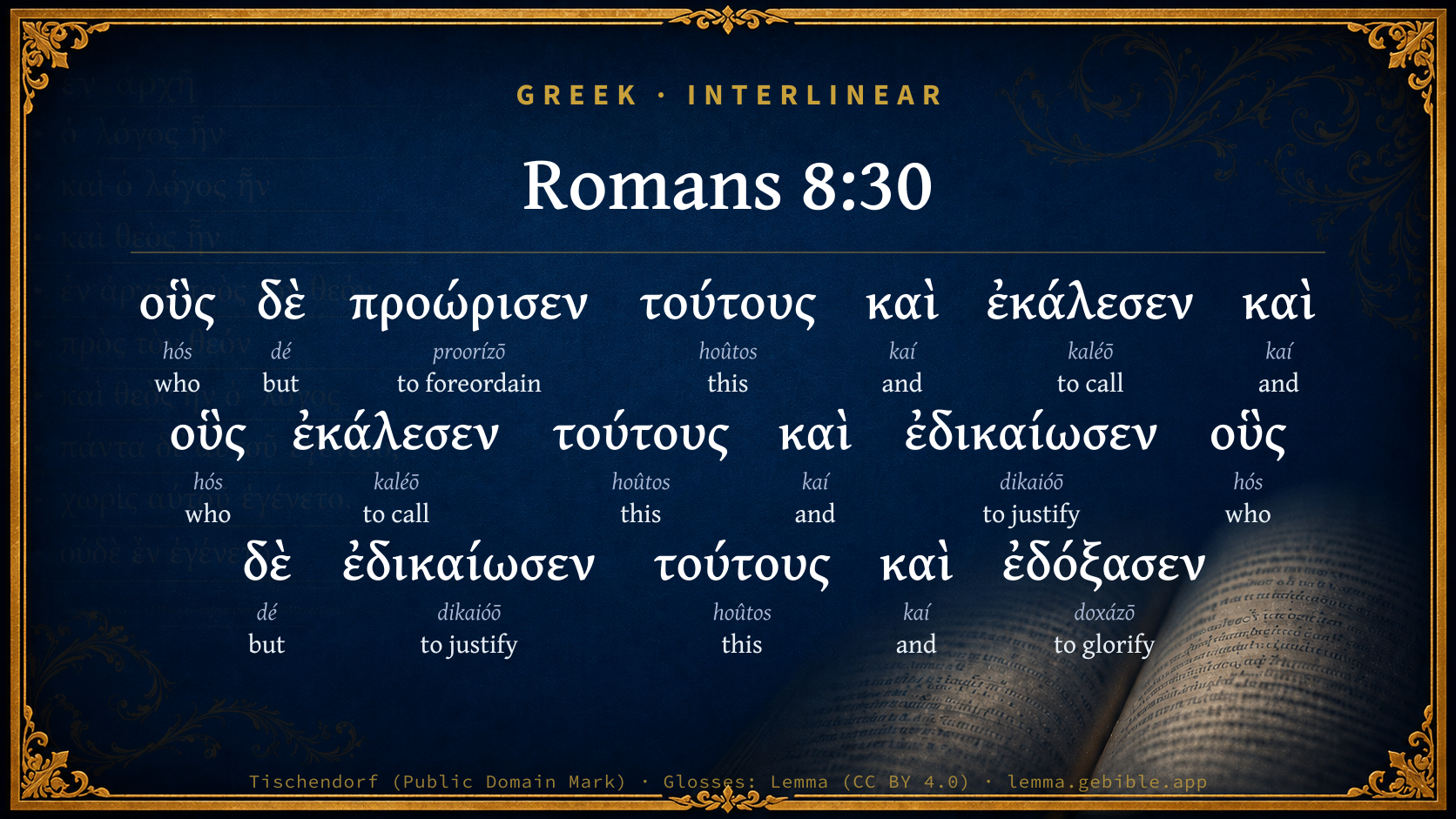
  1. οὓς hós G3739 “who” Relative pronoun, Accusative, Plural, Masculine
  2. δὲ dé G1161 “but” Conjunction
  3. τούτους hoûtos G3778 “this” Demonstrative pronoun, Accusative, Plural, Masculine
  4. καὶ kaí G2532 “and” Conjunction
  5. ἐκάλεσεν kaléō G2564 “to call” Verb, Aorist, Active, Indicative, 3rd person, Singular
  6. καὶ kaí G2532 “and” Conjunction
  7. οὓς hós G3739 “who” Relative pronoun, Accusative, Plural, Masculine
  8. ἐκάλεσεν kaléō G2564 “to call” Verb, Aorist, Active, Indicative, 3rd person, Singular
  9. τούτους hoûtos G3778 “this” Demonstrative pronoun, Accusative, Plural, Masculine
  10. καὶ kaí G2532 “and” Conjunction
  11. ἐδικαίωσεν dikaióō G1344 “to justify” Verb, Aorist, Active, Indicative, 3rd person, Singular
  12. οὓς hós G3739 “who” Relative pronoun, Accusative, Plural, Masculine
  13. δὲ dé G1161 “but” Conjunction
  14. ἐδικαίωσεν dikaióō G1344 “to justify” Verb, Aorist, Active, Indicative, 3rd person, Singular
  15. τούτους hoûtos G3778 “this” Demonstrative pronoun, Accusative, Plural, Masculine
  16. καὶ kaí G2532 “and” Conjunction
  17. ἐδόξασεν doxázō G1392 “to glorify” Verb, Aorist, Active, Indicative, 3rd person, Singular

About this verse

These counts appear in no published source. They are computed here, from the morphology-tagged text and Lemma’s own curated glosses. What Lemma adds →

18
words
8
distinct lemmas
Pauline Epistles
section

Notable vocabulary

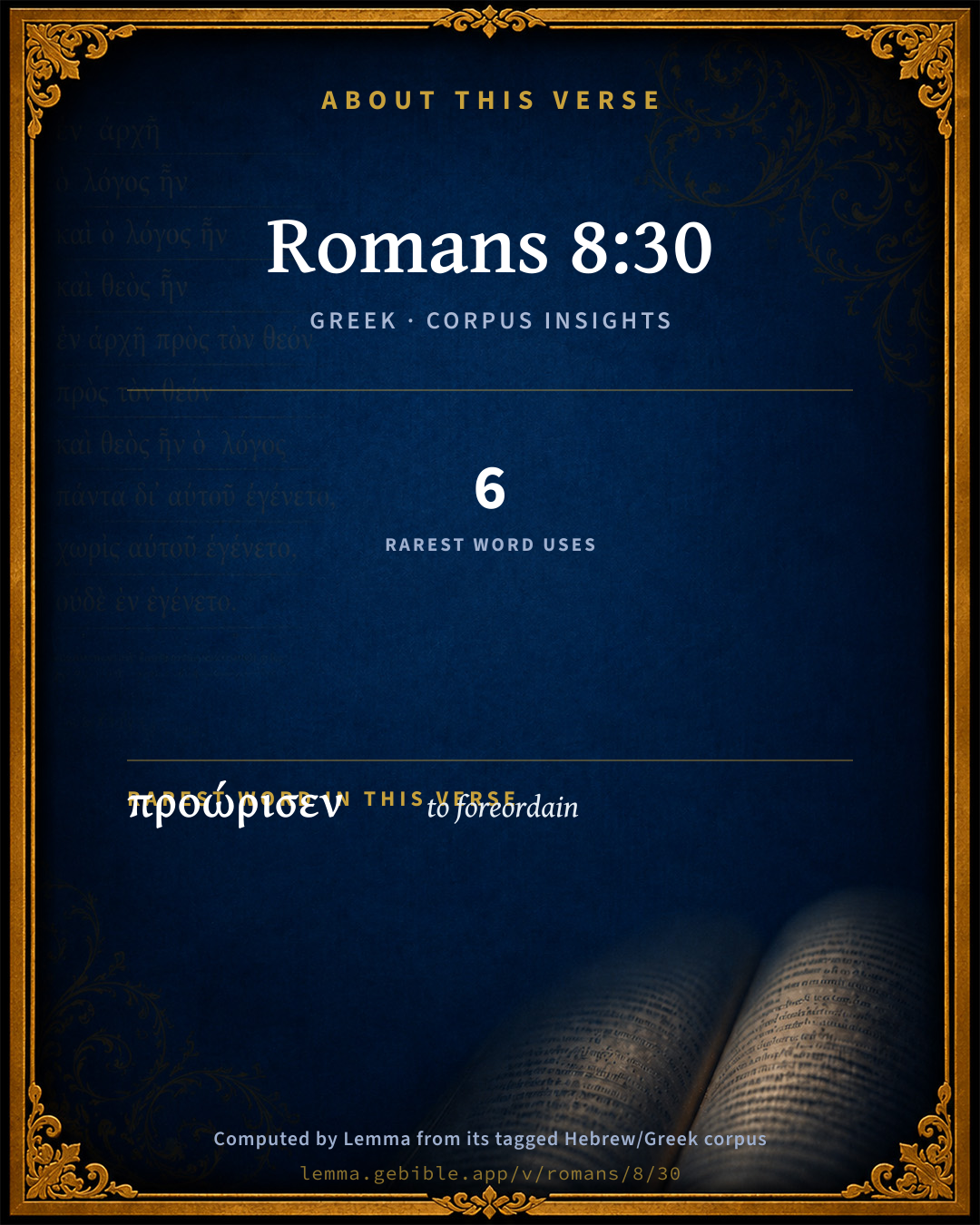
The rarest word here is προώρισεν to foreordain G4309 — appearing just 6 times in the whole Greek New Testament.

Shared distinctive vocabulary

προώρισεν to foreordain G4309 occurs in 6 verses of the Greek New Testament. Also found in:

Repetition

Words recur within this verse:

  • ἐκάλεσεν to call G2564 ×2
  • ἐδικαίωσεν to justify G1344 ×2
  • καὶ and G2532 ×4
  • οὓς who G3739 ×3
  • τούτους this G3778 ×3
  • δὲ but G1161 ×2

Cross-references

35

Topical passages linked to Romans 8:30 in the Treasury of Scripture Knowledge — connected by theme and wording, ordered by reader-vote popularity; previews shown in the World English Bible.

  • Romans 8:28 We know that all things work together for good for those who love God, to those who are called according to his purpose.
  • Revelation 17:14 These will war against the Lamb, and the Lamb will overcome them, for he is Lord of lords, and King of kings. They also will overcome who are with him, called and chosen and faithful."
  • Ephesians 1:11 in whom also we were assigned an inheritance, having been foreordained according to the purpose of him who works all things after the counsel of his will;
  • Romans 9:23–24 and that he might make known the riches of his glory on vessels of mercy, which he prepared beforehand for glory,
  • Ephesians 1:5 having predestined us for adoption as children through Jesus Christ to himself, according to the good pleasure of his desire,
  • Hebrews 9:15 For this reason he is the mediator of a new covenant, since a death has occurred for the redemption of the transgressions that were under the first covenant, that those who have been called may receive the promise of the eternal inheritance.
  • 1 Peter 2:9 But you are a chosen race, a royal priesthood, a holy nation, a people for God's own possession, that you may show forth the excellencies of him who called you out of darkness into his marvelous light:
  • 1 Corinthians 6:11 Such were some of you, but you were washed. But you were sanctified. But you were justified in the name of the Lord Jesus, and in the Spirit of our God.
  • John 17:22 The glory which you have given me, I have given to them; that they may be one, even as we are one;
  • 1 Peter 3:9 not rendering evil for evil, or reviling for reviling; but instead blessing; knowing that to this were you called, that you may inherit a blessing.
  • 2 Peter 1:10 Therefore, brothers, be more diligent to make your calling and election sure. For if you do these things, you will never stumble.
  • 1 Corinthians 1:9 God is faithful, through whom you were called into the fellowship of his Son, Jesus Christ, our Lord.
  • Romans 5:8–10 But God commends his own love toward us, in that while we were yet sinners, Christ died for us.
  • 1 Corinthians 1:2 to the assembly of God which is at Corinth; those who are sanctified in Christ Jesus, called to be saints, with all who call on the name of our Lord Jesus Christ in every place, both theirs and ours:
  • 1 Thessalonians 2:12 to the end that you should walk worthily of God, who calls you into his own Kingdom and glory.
  • 2 Timothy 2:11 This saying is faithful: For if we died with him, We will also live with him.
  • Titus 3:4–7 But when the kindness of God our Savior and his love toward mankind appeared,
  • 1 Peter 5:10 But may the God of all grace, who called you to his eternal glory by Christ Jesus, after you have suffered a little while, perfect, establish, strengthen, and settle you.
  • John 6:39–40 This is the will of my Father who sent me, that of all he has given to me I should lose nothing, but should raise him up at the last day.
  • John 17:24 Father, I desire that they also whom you have given me be with me where I am, that they may see my glory, which you have given me, for you loved me before the foundation of the world.
  • Revelation 19:9 He said to me, "Write, 'Blessed are those who are invited to the marriage supper of the Lamb.'" He said to me, "These are true words of God."
  • Isaiah 41:9 you whom I have taken hold of from the ends of the earth, and called from the corners of it, and said to you, You are my servant, I have chosen you and not cast you away;
  • Romans 3:22–26 even the righteousness of God through faith in Jesus Christ to all and on all those who believe. For there is no distinction,
  • Ephesians 4:4 There is one body, and one Spirit, even as you also were called in one hope of your calling;
  • 2 Thessalonians 1:10–12 when he comes to be glorified in his saints, and to be admired among all those who have believed (because our testimony to you was believed) in that day.
  • 2 Thessalonians 2:13–14 But we are bound to always give thanks to God for you, brothers loved by the Lord, because God chose you from the beginning for salvation through sanctification of the Spirit and belief in the truth;
  • 1 Peter 4:13–14 But because you are partakers of Christ's sufferings, rejoice; that at the revelation of his glory also you may rejoice with exceeding joy.
  • John 5:24 "Most assuredly I tell you, he who hears my word, and believes him who sent me, has eternal life, and doesn't come into judgment, but has passed out of death into life.
  • Romans 8:17–18 and if children, then heirs; heirs of God, and joint-heirs with Christ; if indeed we suffer with him, that we may also be glorified with him.
  • Romans 8:33–35 Who could bring a charge against God's chosen ones? It is God who justifies.
  • 2 Corinthians 4:17 For our light affliction, which is for the moment, works for us more and more exceedingly an eternal weight of glory;
  • Ephesians 2:6 and raised us up with him, and made us to sit with him in the heavenly places in Christ Jesus,
  • Colossians 3:4 When Christ, our life, is revealed, then you will also be revealed with him in glory.
  • Romans 1:6 among whom you are also called to belong to Jesus Christ;
  • Romans 8:1 There is therefore now no condemnation to those who are in Christ Jesus, who don't walk according to the flesh, but according to the Spirit.

Cross-references courtesy of OpenBible.info (CC BY 4.0).

Commentary

Notes on Romans 8:30 from classic Christian and Jewish commentators (each source and its license shown beneath its notes). The classic Christian expositions comment on the surrounding passage and are grouped to its opening verse, so a note may address several verses; the Jewish commentaries on the Tanakh (Rashi and others) are per-verse, so they appear only where the commentator wrote on this verse.

Lemma curates 59 commentaries, every one of them public domain or Creative Commons licensed, each selected and text-cleaned for this edition rather than reprinted as found. About our sources →

The Biblical Illustrator

Joseph S. Exell

Rom_8:30

Moreover, whom He did predestinate, them He also called.

The golden chain

This consists of several links. The middle portion of it hangs down to earth, and comes into the view of men; but the ends of it are fastened to the two eternities and are both hidden. Note:--

I. The unbroken succession of steps in the accomplishment of the original purpose of God. Calling and justification are the principal links, but not all the links; they are sufficient, however, to show that between the eternity of purpose and the eternity of glorification there is no flaw or fracture. We gather from this view of the subject that to get possession of any one link is to get all the links--the unseen as well as the seen--and consequently the whole chain. Calling carries with it justification and glorification on the one hand, and predestination on the other.

II. The co-extensive uniformity of its successive realisations. Every link of the chain is equally comprehensive in the space it covers. The same subjects are handed over at every stage of the progress to the stage that follows. There is no reduction of the number as the process goes on; and if we leave out all intermediate steps, we may say, Whom He did foreknow, them He also glorified. Any two terms of the series may be brought into an equation, and if we wish to satisfy ourselves of our predestination, or of our salvation hereafter, then we have only to be clear about our interest in the calling, or in the justification. The unknown quantity may thus be determined by the known, because they are equivalents. Observe that glorified, like all the other expressions, is in the past tense. And this is used to express the certain and inseparable connection between the different progressive steps in the enumeration, or because what God has determined to do may be said to be done already. There is no tense to express the activity of God, with whom past, present, and future are an eternal now. But besides this, in Christ our salvation is always complete (Eph_2:5-6).

III. How entirely from beginning to end the whole work is attributed to God! Man acts no part. He is merely the subject. If we turn, however, to Rom_10:14, we have another chain which also begins with God and ends in glory; but there the aspect is human. Both are important. God works by instruments, but the success of the instruments are in His hands. Both these passages require to be taken together, in order to furnish a complete account of the process of salvation. Conclusion: Do not permit yourselves to be bewildered by the deep things of Gods eternal purpose and decrees. Rather seek to strike into the line of salvation at the calling of God. God calls you to believe on Christ, and if you call upon the name of the Lord you shall be saved, and only as you make your calling sure do you make your election sure. (P. Strutt.)

Predestination and calling

The book of Gods decrees is closed against the curiosity of man. The lion of the tribe of Judah only hath prevailed to open the book and break the seven seals thereof. How then am I to know whether I am predestinated or no? Until this question be answered my heart cannot rest. The answer is that God has published that page of the sacred decree whereon the character of the predestinated is recorded in His Word: Whom He did predestinate, them He also called. And if thou be called, it follows as a natural inference thou art predestinated. There are two kinds of callings. The first is the general call, which is given to every one that heareth the Word (Matthew; Isa_55:1; Pro_8:4); but the call of the text is personal. It is one that is heard and obeyed. Note:--

I. Illustrations of the call.

1. It is precisely similar to the case of Lazarus. The sinner is dead in sin. Sovereign mercy comes and cries, Come forth! and that man lives. Well, cries one, but what are the words which Christ uses when He calls a sinner from death? Why, any words. There came unto this hall a man to whom the simple reading of the hymn, Jesus, lover of my soul, was the means of his quickening. He said within himself, Does Jesus love me? then I must love Him.

2. While the sinner is dead in sin, he is alive enough to oppose God, as we see in the case of Saul of Tarsus. Let Peter say, Saul, why dost thou oppose Christ? The time shall come when thou shalt yet be His disciple, and Saul would laugh him to scorn. But when Christ dealt with him, he fell to the ground, and in a few days the persecutor becomes the preacher.

3. The effectual call may be illustrated in its sovereignty by the case of Zaccheus. There were many better men in the city than he. Why call him? Simply because the call of God comes to unworthy sinners.

4. To illustrate this call in its effects, take the case of Abraham. What a trial to Abrahams faith when he had to leave all that was so dear to him, and go he knew not whither! And yet God had a goodly land for him, and intended greatly to bless him.

5. When effectual calling comes to a man, at first he may not know it. You remember the case of Samuel, who mistook Gods voice for Elis.

II. And now as a matter of examination let each man judge himself by certain characteristics of the calling. It is--

1. A holy Calling (2Ti_1:9). If you are living in sin, you are not called.

2. A high calling (Php_3:13-14). Has then your calling lifted up your heart and set it upon things above?

3. A heavenly calling (Heb_3:1). Is thy calling a call to heaven as well as from heaven?

4. A call, not to the righteous, but to sinners.

5. A call out of darkness into Gods marvellous light (1Pe_2:9).

6. A call to liberty (Gal_5:15).

7. A call to the fellowship of Christ (1Co_1:9).

III. Consolation.

1. If I am called, then I am predestinated, there is no doubt about it. The scheme of salvation is like the chain which we see at horse-ferries, fixed into one staple on this side of the river, and into another at the other side, but the greater part of the Chain is under water. You only see it as the boat moves on, and as the chain is drawn out of the water by the force that propels the boat. I can see that part of the chain, which is named calling, but blessed be God, that is joined to the side that is called election, and to the side called glorification.

2. If a man be called, he will certainly be saved at last (Rom_11:29). (C. H. Spurgeon.)

Called of God

I. The nature of this calling. There are two calls of God.

1. The outward call of the gospel. Many are called, but few are chosen. To know how ineffectual this often is, I need only look around me. How many sat here ten, twenty, forty years ago, and here they still sit, quite unaffected (Eze_33:31-32).

2. An inward and effectual call. By this call the sinners heart becomes softened, his mind enlightened, his will subdued. While others play about the net of the gospel, he enters into it, and is saved thereby. The outward call often brings men into the profession of Christ; the inward call always brings men into the possession of Christ. It is a call--

(1) From sin to holiness.

(2) From the world to Christ.

(3) From danger to glory.

II. The means by which this is effected.

1. The operations of Gods providence.

(1) Everything in nature God makes to speak; the heavens declare His glory, the firmament showeth forth His handiwork.

(2) Then there is the voice of conscience, and God makes this a means of effectual calling, by making it speak so loud that the man cannot resist.

(3) Sometimes He employs the voice of affliction. Hear ye the rod, and Him that hath appointed it.

2. The preaching of the gospel.

3. The influences of the Holy Spirit. Ministers knock at the door of mens hearts, but the Spirit keeps the key; and He unlocks the door and enters in.

III. The properties of this calling.

1. It is a powerful call. The Turkish ambassador wished to see Mahomet the seconds scimitar, by which it was said he had accomplished such wonderful exploits; when he showed it to him, he said, I dont see anything different in it from others. And he immediately replied, The virtue of the weapon depends upon the strength of my arm, and the wisdom and the power with which I have used it. It is precisely so with the gospel. In this call nothing less than the arm of the Lord will do. Must not that be mighty which conquers the proud heart, subdues the stubborn will, and enlightens the dark understanding?

2. A heavenly call (Heb_3:1).

3. A high calling (Php_3:14).

4. An immutable calling (Rom_11:29).

Conclusion: Admire and magnify--

1. The exceeding grace of God towards you in--

(1) The freeness of this call.

(2) The honour of this call.

2. Take pains clearly to ascertain your calling. Two things certify it. He who is called of God--

(1) Responds to Gods call.

(2) Is deaf to other calls. And further, shall I not say, pity such as are uncalled?

3. Those who feel you are still uncalled, see the misery of your condition. It is said that the cure is half effected when the physician or the patient knows what causes the disease.

(1) Put yourselves in the way to be called. The same feet that carry you to the theatre, and to places of wretchedness, can bring you to the house of God.

(2) Beg of God to call you effectually. (J. Sherman.)

The folly of exclusively regarding predestination

Did you ever hear of a certain Ludovic, an Italian philosopher, who had imbibed the idea of predestination to the exclusion of every other truth? He could see nothing but fate, and thought religious activity useless. A physician who attended him during his sickness, a godly man, desiring to convince him of his error, said to him as he stood by his bedside, I shall not send you any medicine, I shall not attend to you; in fact, I shall not call any more, because if you are to live you will live, and if you are to die you will die; and therefore it is of no use my attending to you He went his way, but in the watches of the night, Ludovic, who had been the slave of a notion, turned it over and saw the folly of it: he saw that there were other truths besides predestination, and he acted like a sane man. As God accomplishes the healing of the sick by the use of medicines, He usually accomplishes also the saving of souls by the means of grace; and as I, not knowing whether I am elected to be healed or not, yet go to the physician, so I, not knowing whether I am elect to be saved or not, yet will go to Jesus as He bids me go, and put my trust in Him, and I hope I shall be accepted in Him. (C. H. Spurgeon.)

Seeking and election go together

There was wit and wisdom, and a whole volume of thought in the old negros reply to Governor Vance, who asked him, Well, now, Joe, do you really believe in this election of God that you speak of? Indeed I do, Massa Vance, was the serious reply. Well, do you think I am elected to be saved? Scasly know, Massa; but I never heard of any one being lected who wasnt a candidate. And there is the point--humble seeking and election to grace go together.

Whom He called, them He also justified.

Of the benefits of effectual calling

I. In this life.

1. There are three leading benefits which Christians partake of here.

(1) They are all justified (Rom_8:1).

(2) They are all adopted children of God (Eph_1:5). They are brought out of the devils family, and made members of the blood-royal of heaven (Eph_3:15).

(3) They are all sanctified (1Co_1:30; 1Th_4:7).

2. There are other benefits which accompany or flow from these. For these come not alone, but each of them is the opening of a treasure to the called, the striking up of a fountain, that runs out in many streams (Eph_1:3).

(1) Reconciliation with God (Rom_5:1).

(2) Access to God, as children to a Father (Eph_3:12). The war being ended, and peace concluded, the communication betwixt heaven and earth is opened.

(3) Freedom from the slavery of sin and Satan (Joh_8:32).

(4) A right to eternal life (Rom_8:17; Act_20:32; 2Co_5:1).

II. In the life to come. These are comprehended in one word, glorification. At death the converted soul is received into heaven; at the last day his body will be gloriously raised, and both soul and body made perfectly happy for ever (2Th_2:14).

III. Uses.

1. Of information. This doctrine lets us see--

(1) That the gospel is the best news that ever was heard in the world, and the most excellent offer that ever was made to poor sinners (Eph_3:8).

(2) That God deals very liberally and kindly with His people that answer His call. They get much in hand, and yet far more in hope (Psa_84:11), and they can never be shaken out of their privileges (Rom_11:29; Heb_12:28).

(3) Whatever men lose by complying with and following the gospel-call, they are gainers (Php_3:8). He was a wise merchant that sold all to buy the pearl of great price.

2. Of exhortation.

(1) To unconverted sinners. Comply with the gospel-call.

(a) While ye do not, ye have no part or lot in these benefits. Ye are not justified; the sentence of condemnation is standing in force against you (Gal_3:10; Joh_3:1-36.). Ye are none of Gods children, but of the devils (Joh_8:44). Ye are not sanctified. A form of godliness ye may have, but the power of it ye are strangers to.

(b) If ye will come to Christ on His call, ye shall partake of all these benefits. If your sins were never so great and many, they shall be pardoned (Isa_55:7), Ye shall be the children of God through Jesus Christ (Joh_1:12). Ye shall be made holy (1Co_6:11).

(2) To converted sinners that have answered the call. Labour to know your great privileges for time and eternity (2Pe_1:10).

2. Be thankful for these privileges (1Jn_3:1).

3. Walk worthy of the vocation, that is, humbly, holily, heavenly, contentedly, patiently, and cheerfully, in hopes of the glory that is to be revealed. (T. Boston, D.D.)

Whom He justified, them He also glorified.--

Justification and glory

I. Justification is--

1. An act of God passed upon a person needing it, consequently upon a person who could not justify himself. The guiltless need no justification; they have it already. He justifies.

2. The result of sovereign grace. By the works of the law shall no flesh living be justified. I cannot earn justification.

3. Has for its matter and means the righteousness of Jesus Christ, set forth in His vicarious obedience, both in life and death. Obedience alone can justify, and where can we have it but in Jesus our substitute?

4. The practical way of its application is by faith. It is not by repenting that we are justified, but by believing.

5. An instantaneous act. Sanctification needs a whole life, justification needs no appreciable time. The sinner looks to Christ, his sin is gone in a moment. Sanctification, moreover, progresses or declines; but justification is complete.

6. An infallible act. It is God that justifieth; where, then, can there be a mistake?

7. An irreversible act. Once justified you shall never be condemned.

8. It is generally attended with such a flood of joy, that I think you must know it, Bunyans pilgrim did not lose the burden off his back and not know it; but as soon as it was gone, he gave three great leaps for joy, and went on his way singing.

II. Glory. How that golden word has been debased in the coinage of human speech. It has come to mean the glitter of wars helmet, and the noise of the crowds hurrahs. Whom He justified, them He also glorified. They follow close together. A little stream divides them, but the apostle says nothing about it, so we will not say anything. Death is not worth thinking of, it is swallowed up in victory. There is--

1. The glory which disembodied spirits are enjoying now. The moment that the soul leaves the body, the justified soul is in glory. Romanism holds that some of the best saints go to heaven when they die; but that the great mass of inferior saints must undergo purgation. But the dying thief was no eminent saint. The only good deed that we ever read of his doing was when he claimed Christ as Lord, and rebuked his fellow-thief for slandering the Saviour. Yet, hear the words, To-day shalt thou be with Me in paradise. Nor is this the only instance. We find, when Lazarus died, that he was carried by angels into Abrahams bosom. Stephen expected the Lord Jesus to receive his spirit, and the apostle Paul was in a strait betwixt two, being willing to depart and to be with Christ. In Eph_3:15, the apostle mentions the whole family as being in heaven and earth, but he speaks of none of the Lords people being in limbo. Those whom we are bidden to follow, in Heb_6:12, are now inheriting the promises. Let the voice of God decide the case for ever (Rev_14:13). The glory of paradise was that God walked there in the cool of the evening with His creatures; and the glory of heaven is, that they need no candle, neither light of the sun, for the Lord God giveth them light, and the days of their mourning shall be ended.

2. The resurrection glory which they will enjoy when soul and body shall be reunited. This will be a joyful meeting. Soul and body often quarrel here; but they are always loath to part, which proves how true is the wedlock between them; but what a happy meeting it will be when there will be no more jars between this husband and wife, when the soul and body shall be merged together in the perfection of union. Then, whatever may be the splendour of Christ will be the splendour of His people.

III. The connection between justification and glory.

1. A justified person has in him the bud of glory. What is glory?

(1) It is a state of perfect peace. Therefore, being justified, we have peace with God through Jesus Christ our Lord.

(2) It is a state of rest. We, which have believed, do enter into rest.

(3) It is a state of safety. When sin is pardoned, I am secure.

(4) It is a state of nearness to God; He hath made us nigh by the blood of His Son.

(5) It is communion with Christ. But we have already boldness and access through Jesus. Inside the acorn there is the whole oak, and within justification there is heaven, with all its light, life, love, joy, and security. Glory is begun below.

2. Justification is a claim to glorification. He that is right in the eye of the law, has a claim to the protection and smile of the law.

3. Justification would be but a very sorry gift of God, if it did not involve glory. (C. H. Spurgeon.)

The Biblical Illustrator, edited by Joseph S. Exell (c. 1880s–1900s) — public domain. Text from a community e-Sword module.

Joseph Benson's Commentary

Rom 8:30. Moreover, whom he did predestinate — Or describe beforehand by his holy prophets, as persons who should resemble the Messiah; them, in due time, he also called — By his word and Spirit; and whom he called — When obedient to the heavenly calling, Act 26:19; he also justified — Accounted righteous, pardoned, and accepted; and whom he justified, provided they continued in his goodness, Rom 11:2; he, in the end, glorified — The apostle does not affirm, either here or in any other part of his writings, that precisely the same number of persons are called, justified, and glorified. He does not deny that a believer may fall away and be cut off, between his special calling and his glorification, Rom 11:22. Neither does he deny that many are called who are never justified. He only affirms that this is the method whereby God leads us, step by step, toward heaven. He glorifies none whom he does not first justify, and indeed also sanctify: and he justifies none who are not first called, and obedient to the call. He glorified — The apostle speaks as one looking back from the goal, upon the race of faith, love, and obedience. Indeed grace, as it is glory begun, is both an earnest and a foretaste of eternal glory.

Joseph Benson's Commentary on the Old and New Testaments (1811–1818) — public domain. Text from a community e-Sword module.

Tyndale Open Study Notes

Tyndale Open Resources

8:30 gave them his glory: Elsewhere in this passage, the glory Christians will experience is consistently in the future (8:18, 21, 23). The past tense here refers to God’s past decision to glorify us in the future. We have not yet entered into our inheritance, but the Father has irrevocably determined to give us his glory.

Tyndale Open Study Notes — © Tyndale Open Resources, licensed CC BY-SA 4.0. Text via the HelloAO Bible API.

Bengel's Gnomon

Johann Albrecht Bengel

Rom 8:30. Τούτους καὶ ἐδικαίωσεν, them He also justified) Paul does not fix the number of those, who are called, justified, glorified, to be absolutely equal; he does not affirm that the believer may not fail between the special call, and final glory, ch. Rom 11:22; nor does he deny that there are also persons called, who may not be justified; but he shows, that God, so far as He Himself is concerned, conducts His people from step to step.—ἐδόξασε, He glorified) Rom 8:17-24. He speaks in the preterite, as if he were looking back from the goal to the race of faith, and from eternal glory, as it were, backward to the eternity itself, in which God decreed the glorifying of His people.—[Comp. Psa 16:3.]

Bengel's Gnomon of the New Testament — English translation (T&T Clark, Edinburgh, 1860) — public domain. Text from a community e-Sword module.

Hodge's Commentary on Romans, Ephesians & First Corinthians

Charles Hodge

Rom_8:30

Moreover, whom he did predestinate, them he also called. Those whom he had thus foreordained to be conformed to the image of his Son in moral character, in suffering, and in future glory, he effectually calls, i.e. leads by the external invitation of the gospel, and by the efficacious operation of his grace, to the end to which they are destined. That the calling here spoken of is not the mere external call of the gospel, is evident both from the usage of the word, and from the necessity of the case; see 1Co_1:9, God is faithful by whom ye were called to the fellowship of his Son, i.e. effectually brought into union with him. In the same chapter, 1Co_1:24, To those which are called, Christ the power of God, etc. The called are here expressly distinguished from the rejecters of the external invitation. 1Co_7:15, 1Co_7:18, in which chapter calling is repeatedly put for effectual conversion, Is any man called, being circumcised, etc. Heb_9:15, That they which are called may receive the promise of eternal inheritance. Rom_9:12; Eph_4:4; 1Th_2:12, and many similar passages. This use of the word, thus common in the New Testament, is obviously necessary here, because the apostle is speaking of a call which is peculiar to those who are finally saved. Whom he calls he justifies and glorifies; see Rom_8:28.

Whom he called, them he also justified; and whom he justified, them he also glorified. The aorist here used may express the idea of frequency. Whom he calls, he is wont to justify; and whom he is wont to justify, is he accustomed to glorify. So that the meaning is the same as though the present tense had been used, Whom he calls, he justifies, etc.; see Jam_1:11; 1Pe_1:24, where the same tense is rendered as the presents The grass withereth, and the flower thereof falleth away. Or, as this use of the aorist is doubtful, or at least unusual, that tense is employed, because Paul is speaking of that God, who sees the end from the beginning, and in whose decree and purpose all future events are comprehended and fixed; so that in predestining us, he at the same time, in effect, called, justified, and glorified us, as all these were included in his purpose.

The justification here spoken of, is doubtless that of which the apostle has been speaking throughout the epistle, the regarding and treating sinners as just, for the sake of the righteousness of Christ. The blessings of grace are never separated from each other. Election, calling, justification, and salvation are indissolubly united; and, therefore, he who has clear evidence of his being called, has the same evidence of his election and final salvation. This is the very idea the apostle means to present for the consolation and encouragement of believes. They have no cause for despondency if the children of God, and called according to his purpose, because nothing can prevent their final salvation.

Charles Hodge — Commentary on Romans (1835), First Corinthians (1857), and Ephesians (1856) — public domain. Text from a community e-Sword module.

Geneva Bible (1599)

Geneva Bible translators

He useth the time past, for the time present, as the Hebrews use, who sometimes set down the thing that is to come, by the time that is past, to signify the certainty of it: and he hath also regard to God’s continual working.

Geneva Bible (1599) marginal notes — public domain. Text via Bolls.life.

Jamieson, Fausset & Brown

Robert Jamieson, A. R. Fausset & David Brown

Moreover--"And," or "Now"; explanatory of Rom 8:29 --In "predestinating us to be conformed to the image of His Son" in final glory, He settled all the successive steps of it. Thus

whom he did predestinate, them he also called--The word "called" (as HODGE and others truly observe) is never in the Epistles of the New Testament applied to those who have only the outward invitation of the Gospel (as in Mat 20:16; Mat 22:14). It always means "internally, effectually, savingly called." It denotes the first great step in personal salvation and answers to "conversion." Only the word conversion expresses the change of character which then takes place, whereas this "calling" expresses the divine authorship of the change, and the sovereign power by which we are summoned, Matthew-like, Zaccheus-like, out of our old, wretched, perishing condition, into a new, safe, blessed life.

and whom he called--thus.

them he also justified--brought into the definite state of reconciliation already so fully described.

and whom he justified, them he also glorified--brought to final glory (Rom 8:17-18). Noble climax, and so rhythmically expressed! And all this is viewed as past; because, starting from the past decree of "predestination to be conformed to the image of God's Son" of which the other steps are but the successive unfoldings--all is beheld as one entire, eternally completed salvation.

Jamieson, Fausset & Brown — Commentary Critical and Explanatory on the Whole Bible (1871) — public domain (CC PDM 1.0). Text via the HelloAO Bible API.

Adam Clarke's Commentary

Verse 30. Whom he did predestinate, c.] The Gentiles, whom He determined to call into his Church with the Jewish people, He called-He invited by the preaching of the Gospel, to believe on his Son Jesus Christ. It is worthy of note, that all that is spoken here refers to what had already taken place for the calling, justifying, and glorifying are here represented as having already taken place, as well as the foreknowing and the predestinating. It is therefore reasonable to suppose that the apostle refers to what God had already done among the Jews and Gentiles: though he may also speak of the things that were not as though they were.

He also justified] Pardoned the sins of all those who with hearty repentance and true faith turned unto him.

He also glorified.] He has honoured and dignified the Gentiles with the highest privileges, and he has already taken many of them to the kingdom of glory, and many more are on their way thither; and all who love him, and continue faithful unto death, shall inherit that glory eternally. Hence it is added, them he also glorified; for all the honours which he confers on them have respect to and are intended to promote their endless felicity; and though the terms are here used in a more general sense, yet, if we take them more restrictedly, we must consider that in the work of justification sanctification is implied; justification being the foundation and beginning of that work. From all this we learn that none will be glorified who have not been sanctified and justified; that the justified are those who have been called or invited by the Gospel of Christ; that those who have had this calling are they to whom God determined to grant this privilege-they did not choose this salvation first, but God sent it to them when they knew him not-and therefore the salvation of the Gentile world, as well as that of the Jews, comes through the gratuitous mercy of God himself, was the result of infinite designs, and stands on the same ground as the calling, c., of the Jewish people. The word δοξα, which we render glory, and δοξαζω, to glorify, both mean to render illustrious, eminent, c., &c., in various parts of the New Testament and in this sense the verb is used Joh 11:4; Joh 12:23, Joh 12:28; Joh 13:31, Joh 13:32; Joh 14:13; Joh 15:8; Joh 21:19; Ac 3:13; Ac 11:13; in none of which places eternal beatification can be intended. Here it seems to mean that those whom God had called into a state of justification he had rendered illustrious by innumerable gifts, graces, and privileges, in the same manner as he had done to the Israelites of old.

The whole of the preceding discourse will show that every thing here is conditional, as far as it relates to the ultimate salvation of any person professing the Gospel of Christ; for the promises are made to character, and not to persons, as some have most injudiciously affirmed. The apostle insists upon a character all along from the beginning of the chapter. Ro 8:1: There is no condemnation to them that are in Christ Jesus, who walk not after the flesh, but after the Spirit. Ro 8:13: If ye live after the flesh, ye shall die, c. The absolute necessity of holiness to salvation is the very subject of his discourse this necessity he positively affirms, and establishes by the most solid arguments. At the very entrance of his argument here, he takes care to settle the connection between our calling and our love and obedience to God, on purpose to prevent that mistake into which so many have fallen, through their great inattention to the scope of his reasoning. Ro 8:28: All things work together for good - To whom? To THEM that LOVE GOD: to them that are the called according to his purpose. To them that love God, because they are called according to his purpose; for those only who love God can reap any benefit by this predestination, vocation, or any other instance of God's favour. See the observations at the end of this chapter, (Ro 8:39 (note)).

Adam Clarke's Commentary on the Bible (1810–1826) — public domain. Text from a community e-Sword/MySword module.

John Calvin's Commentaries

30. And whom he has foredetermined, (præfinivit,) them has he also called, etc. That he might now by a clearer proof show how true it is that a conformity with the humiliating state of Christ is for our good, he adopts a graduating process, by which he teaches us, that a participation of the cross is so connected with our vocation, justification, and, in short, with our future glory, that they can by no means be separated.

But that readers may better understand the Apostle’s meaning, it may be well to repeat what I have already said, — that the word foredetermine does not refer to election, but to that purpose or decree of God by which he has ordained that the cross is to be borne by his people; and by declaring that they are now called, he intimates, that God had not kept concealed what he had determined respecting them, but had made it known, that they might resignedly and humbly submit to the condition allotted to them; for calling here is to be distinguished from secret election, as being posterior to it. That none then may make this objection — that it appears to no one what lot God has appointed for him, the Apostle says, that God by his calling bears an evident testimony respecting his hidden purpose. But this testimony is not only found in the outward preaching of the gospel, but it has also the power of the Spirit connected with it; for the elect are there spoken of, whom God not only addresses by the outward word, but whom he also inwardly draws.

Justification may fitly be extended to the unremitted continuance of God’s favor, from the time of our calling to the hour of death; but as Paul uses this word throughout the Epistle, for gratuitous imputation of righteousness, there is no necessity for us to deviate from this meaning. What Paul indeed had in view was to show that a more precious compensation is offered to us, than what ought to allow us to shun afflictions; for what is more desirable than to be reconciled to God, so that our miseries may no longer be tokens of a curse, nor lead us to ruin?

He then immediately adds, that those who are now pressed down by the cross shall be glorified; so that their sorrows and reproaches shall bring them no loss. Though glorification is not yet exhibited except in our Head, yet as we in a manner behold in him our inheritance of eternal life, his glory brings to us such assurance respecting our own glory, that our hope may be justly compared to a present possession.

We may add, that Paul, imitating the style of the Hebrew language, adopts in these verbs the past instead of the present tense. A continued act is no doubt what is meant, according to this import, “Those whom God now, consistently with his purpose, exercises under the cross, are called and justified, that they may have a hope of salvation, so that nothing of their glory decays during their humiliation; for though their present miseries deform it before the world, yet before God and angels it always shines forth as perfect.” What Paul then means by this gradation is, That the afflictions of the faithful, by which they are now humbled, are intended for this end — that the faithful, having obtained the glory of the celestial kingdom, may reach the glory of Christ’s resurrection, with whom they are now crucified.

John Calvin's Commentaries (1540-1563) — public domain. Text from the Calvin Translation Society English edition (1840s-50s) via the Christian Classics Ethereal Library (ccel.org). Calvin's coverage is partial (roughly two-thirds of the Bible); uncommented books and verses are honest gaps, never fabricated. The 19th-century editor's footnotes and remarks are omitted so the notes are faithfully Calvin's own voice.

Ellicott's Commentary for English Readers

(30) Predestinate.—This is the term which seems most to interfere with human free-will. Foreknowledge does not interfere with free-will, because the foreknowledge, though prior in point of time, is posterior in the order of causation to the act of choice. A man does not choose a certain action because it is foreknown, but it is foreknown because he will choose it. Predestination (the word is not inadequately translated) appears to involve a more rigorous necessity. All we can say is that it must not be interpreted in any sense that excludes free-will. Free-will is a postulate on which all the superstructure of morals and religion must rest. The religious mind, looking back over the course by which it has been brought, sees in it predominating the hand of God; but however large the divine element in salvation may be, it must in the end be apprehended by faith, which is an act of free-will. And the subsequent actions of which faith is the moving cause, though done under a co-operating divine influence, yet belong to the sphere of human freedom. (See Note on Rom_2:6.) It should be remembered that St. Paul is not now writing in the calm temper of philosophical analysis, but in an intense access of religious emotion, and therefore he does not stay to put in all the qualifying clauses that philosophy might require. It is well for mankind that he has done so. In all great and creative religious minds the consciousness of free-will has retired into the background.

Called.—By presenting to them the gospel, directly or indirectly, through the preaching of Christ and His Apostles.

Justified.—In the Pauline sense, as in Rom_3:24, et al.

Glorified.—Strictly, the glorifying of the Christian awaits him in the future, but the Apostle regards all these different acts as focused together as it were on a single point in the past. Glorification is involved in justification.

A Bible Commentary for English Readers, edited by Charles John Ellicott (1878–1897) — public domain. Text from a community e-Sword module.

The Cambridge Bible for Schools and Colleges

gen. ed. J. J. S. Perowne

30. them he also called] See above, on Rom_8:28, last note but one. In this chain of past tenses, the whole process is viewed as in its eternal completeness. We look back, as it were, from the view-point of glory.

justified] See on Rom_2:13. The links in this golden chain are strictly consecutive. The “call” was to obedient faith; therefore justification, by the Divine order, followed. See cch. 3, 4, 5.

glorified] A past tense used, with wonderful power, of a thing future. (See ch. Rom_5:2, where we have the “hope of the glory of God.”) So indissoluble is the chain that the last link is here viewed as an accomplished fact because the first links are so. See, for a remarkable illustration, Eph_2:4-6. There the saints are already “seated in the heavenly places in Christ Jesus:”—such is their union with Him that, just as they are viewed as having gone through penal death, because He died, so they are viewed as having entered heaven, (as regards right of entrance), because He ascended.

It seems difficult, without violence to both the letter and spirit of this passage, to deny that it represents the salvation of “the children of God” as a line drawn from eternity to eternity: first, a sovereign Choice of souls; then the Call of the chosen, resulting in their Faith and their Acceptance; then the final entrance on heavenly Bliss of these same called ones; and also their Note and characteristic now,—Love to God. The “scheme” thus indicated, called by whatever name, has always met with earnest criticism and opposition; but it is the only one which naturally fits St Paul’s language here and in ch. 9. It is really alien from Scripture only when it is stated as if it were a plan of which we saw the whole: assuredly in these things “we know in part”. But this does not mean that we are not to accept what is revealed, just so far as it is revealed, with sincere submission, and with that encouragement and joyful assurance which certainly this passage, on any view of it, was meant to excite.—See, on the whole subject, the equally careful and decided language of the 17th English Church Article; especially noting that the doctrine here stated is there viewed (in the spirit of this passage) as “full of unspeakable comfort[39].”—It must also be remembered that in the scheme in question the sanctification of the saved is viewed as quite as much fore ordained, and quite as necessary a part of the process, as any other; and that the only evidence to the conscience that the person is “foreknown” lies, not in any intuition of a Divine decree, but in the presence of faith and love, and their fruits, in heart and life. These will be always attributed, and justly, to Divine grace alone: but the presence of that grace will be traced in them alone.

[39] See further, Appendix F.

The Cambridge Bible for Schools and Colleges (gen. ed. J. J. S. Perowne; Cambridge University Press, 1878–1918) — public domain. Text from a community e-Sword module.

John Gill's Exposition

Moreover, whom he did predestinate,.... Not to sufferings, which are not expressed nor designed, but to grace and glory after mentioned. This predestination is of particular persons, who, in consequence of it, are called, justified, and glorified; it is the effect of divine grace, and entirely owing to it; it is the source of all the other blessings of grace, and is therefore placed at the head of them, and secures them all:

them he also called; not to afflictions: many may be called to afflictions, and endure them, who are neither justified nor glorified; besides, the people of God, though they meet with many afflictions, between their call to eternal glory, and their enjoyment of it, yet they are not so much called to afflictions, as to patience under them: their call is of grace, by special grace, to peculiar blessings of grace, and to a kingdom and glory; and this their calling is secured by predestination, and connected with glorification: and whom he called,

them he also justified; the meaning of which is, not that he approved of them as sincere and faithful, on account of their faith and patience in sufferings; for neither of their sufferings, nor of their faith and patience in them, is there the least mention in the passage; nor can any instance be produced of the use of the word "justified" in this epistle, or elsewhere in this sense: but the meaning is, that such persons whom God predestinates and calls, he makes them righteous by the imputation of the righteousness of his Son unto them; which is unto all, and upon all them that believe; by which they are justified before God, and in their own consciences, from all sin, and so secured from all wrath and condemnation; wherefore glorification stands inseparably connected with it:

and whom he justified, them he also glorified; which is not meant of being made glorious under sufferings; nor of being made glorious by the extraordinary gifts of the Spirit; for the word is never used in this sense, nor is God ever said to glorify his people in this way; and the apostle is speaking of the saints in general, and not of particular ones: if this was the sense, none would be predestinated, called, and justified, but such who have the extraordinary gifts of the Spirit; and none would have the extraordinary gifts of the Spirit, but such persons; whereas many have had these, and yet no interest in the grace of God, and everlasting happiness: but eternal glory is here meant, which is what the apostle had been speaking of in the context; is what the elect are predestinated and called unto; and which their justification gives them a right and title to; and will consist in a likeness to Christ, in communion with him, in an everlasting vision of him, and in a freedom from all that is evil, and in an enjoyment of all that is good; and so the great end of predestinating grace will be answered in them mentioned in the foregoing verse: now this glorification may be said to be already done, with respect to that part of God's elect, who are in heaven, inheriting the promises; and is in some sense true also of that part of them which is on earth, who are called and justified; being made glorious within by the grace of Christ, and arrayed and adorned with the glorious robe of his righteousness; by the one they have a meetness, and by the other a right to eternal glory; of which this grace they have received is the beginning, pledge, and earnest: besides, they are already glorified in Christ, their head and representative, and in the view of God, and with respect to the certainty of it, it being prepared and made ready for them, is in the hands of Christ for them, and is insured to their faith and hope. It is an observation of a Jewish writer (n),

"that a thing , "which is decreed to be", is spoken of in the past tense:''

this is the Scripture style concerning things decreed, and such is the glorification of all God's elect.

(n) Aben Ezra, in Jon. ii. 2.

John Gill's Exposition of the Whole Bible (1746–1763) — public domain (CC PDM 1.0). Text via the HelloAO Bible API.

Trapp's Complete Commentary

John Trapp

30 Moreover whom he did predestinate, them he also called: and whom he called, them he also justified: and whom he justified, them he also glorified.

Ver. 30. Them also he called, &c.] If ye feel not faith (said that holy martyr), then know that predestination is too high a matter for you to be disputers of, until you have been better scholars in the school house of repentance and justification, which is the grammar school wherein we must be conversant and learned, before we go to the university of God’s most holy predestination and providence.

Them he also justified] Vocation precedeth justification. Deus iustificat fide iam donatos, sicut damnat prius indurates. (Cameron.)

Them he also glorified] That is, he keepeth them glorious by his glorious Spirit, even in this life, from impenitent sin, and maketh them stable and constant in godliness.

John Trapp, A Commentary or Exposition upon All the Books of the Old and New Testament (1647–1656) — public domain. Text from a community e-Sword module.

Albert Barnes' Notes on the Bible

Moreover ... - In this verse, in order to show to Christians the true consolation to be derived from the fact that they are predestinated, the apostle states the connection between that predestination and their certain salvation. The one implied the other.

Whom he did predestinate - All whom he did predestinate.

Them he also called - Called by his Spirit to become Christians. He called, not merely by an external invitation, but in such a way as that they in fact were justified. This cannot refer simply to an external call of the gospel, since those who are here said to be called are said also to be justified and glorified. The meaning is, that there is a certain connection between the predestination and the call, which will be manifested in due time. The connection is so certain that the one infallibly secures the other.

He justified - See the note at Rom 3:24. Not that he justified them from eternity, for this was not true; and if it were, it would also follow that he glorified them from eternity, which would be an absurdity. It means that there is a regular sequence of events - the predestination precedes and secures the calling; and the calling precedes and secures the justification. The one is connected in the purpose of God with the other; and the one, in fact, does not take place without the other. The purpose was in eternity. The calling and justifying in time.

Them he also glorified - This refers probably to heaven. It means that there is a connection between justification and glory. The one does not exist without the other in its own proper time; as the calling does not subsist without the act of justification. This proves, therefore, the doctrine of the perseverance of the saints. There is a connection infallible and ever existing between the predestination and the final salvation. They who are subjects of the one are partakers of the other. That this is the sense is clear,

Because it is the natural and obvious meaning of the passage.

(2)Because this only would meet the design of the argument of the apostle. For how would it be a source of consolation to say to them that whom God foreknew he predestinated, and whom he predestinated he called, and whom he called he justified, and whom he justified “might fall away and be lost forever?”

Albert Barnes' Notes on the Bible (1834–1885) — public domain. Text from a community e-Sword/MySword module.

Haydock's Catholic Bible Commentary

And whom he predestinated, them he also called to the true faith and to his service, without any deserts in them, nay, when all mankind were guilty of eternal death, by original sin. --- And whom he called, them he also justified, by faith, by hope, by a love of him, and a true penance. --- And whom he justified, them he also glorified. That is, hath decreed to glory. Yet not all who have been justified, but only his elect, who are under his special protection, and to whom he grants a perseverance in his grace to the end: so that the call to faith, their sanctification, their final perseverance, and glorification in heaven, are the effects of their free election and predestination. (Witham)

George Leo Haydock (1774–1849), Haydock's Catholic Family Bible and Commentary, 1859 edition — public domain. Excludes Psalms (Douay-Rheims chapter numbering differs from Protestant) and Deuterocanonical books (Catholic canon only).

Matthew Poole's English Annotations

He hath already given them the beginning and pledge thereof in grace; and will in due time bring them to the possession of eternal life and glory. Some, under this term of glorification would have sanctification included; because, otherwise, they think there is a great defect in this chain of salvation, here set down by the apostle, of which sanctification is one special link; but this is rather to be couched and included in effectual calling, which is the third link, and already spoken of.

Matthew Poole's English Annotations on the Holy Bible (1683–1685) — public domain. Text from a community e-Sword/MySword module.

Whedon's Commentary on the Bible

Daniel D. Whedon

30. Called—The apostle does not imply that others were not called; for he knew that “many are called but few chosen.” The disobedient to the call are here left out of the account. They exclude or withdraw themselves, voluntarily and freely, from the favourably foreknown and the predestinated.

Mr. Barnes says, “The predestination secures the calling, and the calling secures the justification.” If the apostle himself had so said, it would have been decisive; but that is precisely what he does not say. All Paul says is, that the calling is the requisite condition before the justification, and the justification before the glorification. He asserts that the latter cannot be without the former. It is the called (or some part of them, for “many are called and few chosen”) alone that are justified; it is the justified alone that are glorified.

Whom he called—They being foreknown as complying.

Whom he justified—Upon their faith.

Them he also glorified—Provided they were justified at the moment when the stage of glorification came. If, though once justified, their justification has ceased, they are then not justified, and so cannot be glorified.

It is not the purpose of the apostle, be it specially noted, to show or declare the surety of any particular individual’s infallibly passing through the stages of this scheme, but to show the indestructible and absolute surety of the scheme itself. (See notes on Rom_8:17; Rom_8:28.) It is the fixedness and unfailing surety of the plan of salvation, in order that each one may avail himself of it, that is affirmed; not the surety for the special individual that God’s power is pledged to fasten him into the plan, and to carry him infallibly through. The ark is unconditionally predestined to outride the deluge; but it depends upon our entering and remaining within the ark whether we individually outride the deluge too. All the aids above described are furnished from the Divine side; but man has a selfhood from which he must act, and upon that action it depends whether he finally is included in the saving result.

Mr. Barnes asks, “How would it be a source of consolation to say to them that those whom he predestinated, etc., might fall away and be lost forever?” But, 1. What consolation to tell them that the justified are to be glorified, so long as they are taught never to be sure of their being justified? Preachers of secured perseverance are obliged, in order to prevent in their followers the great presumption of being too sure of final salvation, to cultivate the perpetual doubt of their being Christians at all, and so destroy the full assurance of faith, and upset all the boasted “consolation” of their own doctrine. What consolation to know that Christians will persevere, if I must never know that I am a Christian? 2. To tell the Christian that he may fall away is not of itself consolation, but warning; and warning the Christian needs in the proper place as truly as consolation. And the true place of consolation and of warning is this: fully to know my present acceptance, and equally to fear my future rejection by unfaithfulness. 3. The true consolation from the present passage is its glorious assurance that the plan of salvation is absolutely sure to those who, by persistent faith, intrust themselves to it. We have a sure stronghold to which we can turn. And such is the doctrine of the entire Epistle; sure salvation by faith. But nowhere is it taught that that faith itself is fixed or fastened upon us, or in us. The exercise and continuance of our faith under God’s gracious aids, is our own duty, and our part, as free-agents, in the work of our salvation.

While a large share of the verbs of these two verses express a future as well as a past fact they are uniformly in the past tense, the Greek aorist. (Note on Rom_5:12.) Alford, in his usual ultra-fatalistic style of interpretation, tells us that this is because the whole is completed in the predetermination of God. But why does not Alford explicitly apply the same exegesis to sinned in Rom_5:12, (where see note,) and thus attribute the authorship of sin to God?—a blasphemy which rash thinkers like him are perpetually committing, yet denying. The true view, we think, is, that the apostle’s standpoint in all these uses of the Greek aorist is at the grand consummation of the whole scheme, contemplating it as a series past. (Note on Rom_5:13.)

Daniel D. Whedon (gen. ed.), Commentary on the Old and New Testaments (1874–1909) — public domain. Text from a community e-Sword module.

John Wesley's Explanatory Notes

Them he - In due time. Called - By his gospel and his Spirit. And whom he called - When obedient to the heavenly calling, Acts xxvi, 19. He also justified - Forgave and accepted. And whom he justified - Provided they "continued in his goodness," chap. xi, 22, he in the end glorified - St. Paul does not affirm, either here or in any other part of his writings, that precisely the same number of men are called, justified, and glorified. He does not deny that a believer may fall away and be cut off between his special calling and his glorification, chap. xi, 22. Neither does he deny that many are called who never are justified. He only affirms that this is the method whereby God leads us step by step toward heaven. He glorified - He speaks as one looking back from the goal, upon the race of faith. Indeed grace, as it is glory begun, is both an earnest and a foretaste of eternal glory.

John Wesley, Explanatory Notes Upon the Whole Bible (1754–1765) — public domain. Text via the GEBible commentary corpus.

Godbey's Commentary on the New Testament

William B. Godbey

30. “But whom he did predestinate, them he also called; and whom he called, them he also justified; and whom he justified, them he also glorified.” Why does not sanctification appear in this specification of graces? Neither regeneration nor sanctification are mentioned, but only the call of the gospel through the Spirit, followed by justification and glorification. Regeneration is implied in justification, and sanctification in glorification. Again, you must remember that in this chapter, e. g., Rom 8:1, as well as elsewhere, justification has the broad signification of complete deliverance from all the penal consequences of sin, both actual and original, in which sense it can only follow entire sanctification, expurgatory of inbred sin. You must remember that foreknowledge stands at the head of this entire catalogue, culminating in glorification. Hence we see the impertinency of recognizing here an unconditional election and absolute predestination, from the simple fact that knowledge of character precedes all these appointments. Now, you must remember that all knowledge with God, whether appertaining to the past or the future, is in the present tense. Omnipotence is certainly absolutely and unconditionally illimitable. Yet you must remember that knowledge does not determine anything, from the simple fact that it is not influence. Therefore we must not identify things which are utterly dissimilar. From the fact that human knowledge is limited and imperfect, it is difficult to illustrate this problem. All of our knowledge of the future does only proximate; e. g., an old pilot, who knows every track through the Atlantic Ocean and every submarine rock, stands on the wharf of this city (New York); seeing a ship sail, he knows by her bearings that she will be wrecked on those formidable and impassable rocks. Yet his knowledge of the fact does not cause the wreckage. You see your own son daily wallowing in debauchery and sensuality, and know to your sorrow that he is going to the dogs and the devil; yet your knowledge does not expedite him on his hellward-bound career. Hence you see in all this election and predestination there is not the slightest interference with the freedom of the will. Why? These pre-appointments simply follow as a logical sequence from the moral and spiritual character of the parties appointed, God, from the beginning, having a perfect knowledge of those characters. Yet it is a fact of universal recognition that we freely choose good or evil, and in this way determine our own characters. Now, is it possible for human destiny to turn out differently from the prediction? We have clear light on that question in 1Sa 23:1-13. During David’s memorable flight from Saul he takes his refuge in Keilah, the men all fawning on him with flattering attestations of conservatism, assuring him that they will be true and stand by him on the battlefield. David, very happily enjoying that gift of the Holy Spirit denominated “discernment of spirits” (1Co 12:10), suspecting their fidelity, goes aside and turns the problem over to God in prayer (Rom 8:11). “Will the men of Keilah deliver me up into his hands? Will Saul come down, as thy servant hath heard? O Lord God of Israel, I beseech thee tell thy servant And the Lord said, He will comedown” (Rom 8:12). “Then said David, Will the men of Keilah deliver me and my men into the hands of Saul? And the Lord said, They will deliver thee up” (Rom 8:13). “Then David and his men, about six hundred, arose and departed out of Keilah, and went whithersoever they could go. And it was told Saul that David was escaped out of Keilah. And he forbear to go forth.” Here we have a positive answer from God to David, “Saul will come down to Keilah and the men of Keilah will deliver thee up.” Now you see that neither of these predicted events transpired, because David immediately rallied his men and fled away from the traitors who were lying to him that they might purchase royal favor with his head, Saul being close on his track, and, hearing that he was gone, did not come to Keilah at all. Hence you see that even these pre-announced events are entirely changed by human action. David understood God’s method with man better than the cavilers of the present day, who apologize for their own obliquity by crying out, “What is to be will be, and I can not change my destiny.” When God told him that Saul would come to Keilah and the inhabitants of the city would betray him into his hands, David well understood that Saul would come and the Keilites would deliver him up if he stayed. Consequently, blowing his war bugle, he immediately rallies his men and skedaddles at double quick. The Bible is a commonsense book, adapted to the common, uneducated people, who are honest enough to receive its plain and candid truth and govern themselves accordingly.

William B. Godbey, Commentary on the New Testament (1896–1900) — public domain. Text from a community e-Sword module.

McGarvey & Pendleton's Commentaries

J. W. McGarvey

and whom he foreordained, them he also called: and whom he called, them he also justified: and whom he justified, them he also glorified . [The keyword which opens the hidden meaning of these two verses is the word purpose, found in verse 28. Before man was created God foresaw his fall, and designed the gospel for his redemption; this fact is well attested by Scripture ( Rom_16:25-26 ; 1Co_2:7 ; Eph_1:8 ; Eph_3:9 ; Col_1:25-26 ). In those times eternal, man, the gospel, justification, etc., existed only in the purpose of God; and it is of these times and conditions that the apostle speaks, showing how God foreknew that a certain class yet to be born would accept of a salvation yet to be provided through the terms of a gospel yet to be made actual. As to this class he foreordained, or fore-decreed, that they should, after the resurrection, bear the image or likeness of his Son, that the Son might have the pre-eminence of being the firstborn (from the dead) among many brethren. And this class, whom in his purpose he thus foreordained, them likewise in his purpose he also called justified and glorified by successive steps, not actually, but in his purpose. Thus the apostle is speaking not of actual decrees, calls, justifications, etc., on the part of God, but of such as existing only in divine contemplation and purpose. So, also, he is not speaking of actual, called, etc., persons, but imaginary, ideal persons, who existed as yet only as a class in the councils or purposes of the Almighty; and Paul's design is not to show the foreordination of any individuals, but to substantiate the assurance of verse 28, by emphasizing the far-reaching purposes of God, which will not suffer afflictions, hardships, or any of the trivialities of time, to frustrate him in working out his eternal plans. That he is not speaking of actualities is shown by the last term in his sequence, viz.: "glorified." Since the apostle is speaking of what transpired in the councils of the Almighty prior to the creation of man, he properly uses the past tense: "glorified;" but if he were speaking of actuality, he would be compelled to use the future tense, to accord with conditions as stated in verse 18, where he clearly recognizes the glorification of man as a future event for which he waits. Thus it is apparent that the foreordination set forth in these two verses is purely hypothetical.]

J. W. McGarvey (with Philip Y. Pendleton), Commentaries on the New Testament (The Fourfold Gospel, 1914; Acts; and the epistles) — public domain. Text from a community e-Sword/MySword module.

The People's New Testament

B. W. Johnson

30. Whom he predestinated. He now shows how this is accomplished for those thus foreknown as the lovers of God. He also called. They are “called” by the preaching of the gospel, as in 2 Thess. 2:14: “Whereunto he called you by our gospel.” It is not stated that these alone are called. We know that many others are called. Justified. The called, accepting the call, are justified. Their sins are blotted out. Glorified. These are made heirs of eternal glory. As stated by Godet, the purpose of the whole passage may be expressed as follows: “I see thou dost love God; art a believer; I therefore decree of thee that thou shalt become like my Son and be glorified with him.” The steps by which this is accomplished are calling, justification, and final glorification.

B. W. Johnson's The People's New Testament with Notes (1889–1891) — public domain. Electronic text from the Christian Classics Ethereal Library (CCEL) ThML edition.

Cambridge Greek Testament for Schools and Colleges

30. ἐκάλεσεν. Of the stage in which GOD’S purpose is first made known to the individual, in the call to be a Christian heard and, in this case, obeyed. A favourite idea in S. Paul and S. Peter; cf. Rom 1:1; Rom 1:7.

ἐδικαίωσεν. Justified sc. in answer to faith, as they are οἱ ἀγαπῶντες τ. θ.

ἐδόξασεν. This is generally taken to refer to the final glory of the future state, cf. 19. But the aorist is a difficulty, and is not satisfactorily explained. 2Co 3:18; 2Co 4:11 show that even under present conditions there is conferred upon Christians a ‘glory’ or manifestation in them of GOD, which is plain to those who have eyes to see. It is the ‘glory’ of the regenerate life in Christ, the manifest working in them of the Spirit, the earnest and promise of that future state. This passage is full of the ideas of 2Co 3:4 to 2Co 4:12, and we may therefore without hesitation interpret ἐδόξασεν by the help of that passage; cf. Joh 12:23; Joh 17:1: and n. 1Pe 2:12 (for the effect upon others) and esp. above Rom 3:23 n.; so = συμμόρφους κ.τ.λ. 29.

Cambridge Greek Testament for Schools and Colleges (Cambridge University Press, 1896; 21 vols, various authors incl. Carr, Maclear, Plummer, Farrar, Lumby, Moule, M. R. James, Simcox) — public domain. Text from a community e-Sword module.

Alford’s Greek Testament

Henry Alford

30.] The Apostle now goes backward from κλητοῖς, to explain how this calling came about. It sprung from God’s fore-knowledge, co-ordinate with His fore-determination of certain persons (to be) conformed to the image of His Son, that Christ might be exalted as the Head of the great Family of God. These persons, thus foreknown and predetermined, He, in the course of His Providence actually, but in His eternal decree implicitly, called, bringing them through justification to glory;—and all this is spoken of as past, because to Him who sees the end from the beginning,—past, present, and future are not, but all is accomplished when determined.

Because whom He foreknew (but in what sense? This has been much disputed: the Pelagian view,—‘eos quos prœsciverat credituros,’ is taken by Orig., Chrys., Œc., Theophyl., Augustine (prop. 55, in Ep. ad Rom. vol. iii. p. 2076), , Erasm. in paraphrase, Calov., Reiche, Meyer, Neander, and others; the sense of fore-loved, by Erasm. in commentary, Grotius, Estius, the Schmidts, &c.: that of fore-decreed, by Thol. edn. 1, and Stuart,—which however Thol. in subsequent editions suspects to be ungrammatical without some infinitive following, and prefers a sense combining foreknowledge and recognition-as-His:—that of elected, adopted as His sons, by Calvin,—‘Dei autem præcognitio, cujus hic Paulus meminit, non nuda est præscientia, ut stulte fingunt quidam imperiti, sed adoptio qua filios suos ab improbis semper discrevit,’—Rückert, De Wette, al. That this latter is implied, is certain: but I prefer taking the word in the ordinary sense of foreknew, especially as it is guarded from being a ‘nuda præscientia’ by what follows: see below and Gal 4:9), He also fore-ordained (His foreknowledge was not a mere being previously aware how a series of events would happen: but was co-ordinate with, and inseparable from, His having pre-ordained all things) conformed (i.e. to be conformed) to the image of His Son (the dat. and gen. are both found after words like σύμμορφος; compare σύμφυτος, ch. 6:5.

The image of Christ here spoken of is not His moral purity, nor His sufferings, but as in 1Co 15:49, that entire form, of glorification in body and sanctification in spirit, of which Christ is the perfect pattern, and all His people shall be partakers. To accomplish this transformation in us is the end, as regards us, of our election by God; not merely to rescue us from wrath. Compare 1Jn 3:2, 1Jn 3:3; Php 3:21: and on the comprehensive meaning of μορφή, Php 2:6, Php 2:7,—where it expresses both ‘the form of God’ in which Christ was, and ‘the form of a servant’ in which He became incarnate), that He might (or may, as Calv., but the reference in the aorist is to the past decree of God) be firstborn among many brethren (i.e. that He might be shewn, acknowledged to be, and glorified as the Son of God, pre-eminent among those who are by adoption through Him the sons of God. This is the further end of our election, as regards Christ: His glorification in us, as our elder Brother and Head):

30.] but whom He fore-ordained, those he also called (in making the decree, He left it not barren, but provided for those circumstances, all at His disposal, by which such decree should be made effectual in them.

ἐκάλεσεν, supply, εἰς τὴν ἑαυτοῦ βασιλείαν καὶ δόξαν 1Th 2:12; other expressions are found in 1Co 1:9; 2Th 2:14; 1Ti 6:12; 1Pe 5:10): and whom He called, these He also justified (the Apostle, remember, is speaking entirely of God’s acts on behalf of the believer: he says nothing now of that faith, through which this justification is, on his part, obtained): but whom He justified, them He also glorified (He did not merely, in His premundane decree, acquit them of sin, but also clothe them with glory: the aorist ἐδόξασεν being used, as the other aorists, to imply the completion in the divine counsel of all these, which are to us, in the state of time, so many successive steps,—simultaneously and irrevocably. So we have the perfect in Joh 17:10, Joh 17:22).

Henry Alford, The Greek Testament (1849–1861) — public domain. Text from a community e-Sword module.

International Critical Commentary

30. οὓς δὲ προώρισε κ.τ.λ. Having taken his readers to the end of the scale, the δόξα in which the career of the Christian culminates, the Apostle now goes back and resolves the latter part of the process into its subdivisions, of which the landmarks are ἐκάλεσεν, ἐδικαίωσεν, ἐδόξασε. These are not quite exhaustive: ἡγίασεν might have been inserted after ἐδικαίωσεν; but it is sufficiently implied as a consequence of ἐδικαίωσεν and a necessary condition of ἐδόξασε: in pursuance of the Divine purpose that Christians should be conformed to Christ, the first step is the call; this brings with it, when it is obeyed, the wiping out of past sins, or justification; and from that there is a straight course to the crowning with Divine glory. ἐκάλεσεν and ἐδικαίωσεν are both naturally in the aorist tense as pointing to something finished and therefore past: ἐδόξασεν is not strictly either finished or past, but it is attracted into the same tense as the preceding verbs; an attraction which is further justified by the fact that, though not complete in its historical working out, the step implied in ἐδόξασεν is both complete and certain in the Divine counsels. To God there is neither ‘before nor after.’

THE PROOFS AND ASSURANCE OF DIVINE LOVE

8:31-39. With the proofs of God’s love before him the Christian has nothing to fear. God, the Judge, is on his side, and the ascended Christ intercedes for him (vv. 31-34).

The love of God in Christ is so strong that earthly sufferings and persecutions—nay, all forms and phases of being—are powerless to intercept it, or to bar the Christian’s triumph (vv. 35-39).

31 What conclusion are we to draw from this? Surely the strongest possible comfort and encouragement. With God on our side what enemy can we fear? 32 As Abraham spared not Isaac, so He spared not the Son who shared His Godhead, but suffered Him to die for all believers. Is not this a sure proof that along with that one transcendent gift His bounty will provide all that is necessary for our salvation? 33 Where shall accusers be found against those whom God has chosen? When God pronounces righteous, 34 who shall condemn? For us Christ has died; I should say rather rose again; and not only rose but sits enthroned at His Father’s side, and there pleads continually for us. 35 His love is our security. And that love is so strong that nothing on earth can come between us and it. The sea of troubles that a Christian has to face, hardship and persecution of every kind, are powerless against it; 36 though the words of the Psalmist might well be applied to us, in which, speaking of the faithful few in his own generation, he described them as ‘for God’s sake butchered all day long, treated like sheep in the shambles.’ 37 We too are no better than they. And yet, crushed and routed as we may seem, the love of Christ crowns us with surpassing victory. 38 For I am convinced that no form or phase of being, whether abstract or personal; not life or its negation; not any hierarchy of spirits; no dimension of time; no supernatural powers; 39 no dimension of space; no world of being invisible to us now,—will ever come between us and the love which God has brought so near to us in Jesus Messiah our Lord.

International Critical Commentary — older volumes (1896–1929), various authors — public domain. Text from a community e-Sword module.

Godet's Commentaries

Frédéric Louis Godet

Vv. 30. “Moreover, whom He did predestinate, them He also called; and whom He called, them He also justified; and whom He justified, them He also glorified.”

Here are the successive acts whereby the eternal decree is executed in time. They stand, as it were, between the eternity in which this decree is pronounced, and the eternity in which it is finished. It is to be remarked that the apostle only points out in its accomplishment the acts pertaining to God: calling, justification, glorification, because he is only setting forth that side of the work of salvation which is contained in the decree of predestination, and which consequently depends solely on divine causation. If his intention had been to explain the order of salvation in all its elements divine and human, he would have put faith between calling and justification, and holiness between justification and glorification.

The δέ, then, moreover, at the beginning of the verse is progressive; it indicates the transition from the eternal decree to its realization in time. He who wishes the end must employ the means; the first mean which God puts in operation is His call, which, as we have seen, embraces the outward invitation by preaching, and the inward drawing by the Spirit of grace. Paul does not mean that God addresses this call only to those whom He has predestined to glory, but he affirms that none of those who are predestinated fail to be also called in their day and hour. Not one of those foreknown shall be forgotten. They form a totality, which, once introduced from eternity into time, is faithfully led by God from step to step to the goal fixed beforehand. God would be inconsequent if He acted otherwise.

The plural pronouns whom...them, imply knowledge of the individuals as such. All were present to the mind of God when he decreed the height to which He would raise them.

The call once accepted—and it could not fail to be so, since we have to do here only with those whose faith God foreknew—a second divine act followed: justification. The καί, also, indicates the continuity of the divine work, the different acts of which follow, and mutually involve one another. Each successive grace is as it were implied in the preceding. Grace upon grace, says Joh 1:16. On those who have been called and have become believers, there has been passed the sentence which declares man righteous, that is to say, put relatively to God in the position of one who has never done any evil nor omitted any good.

The third step, glorification, is no longer connected with the preceding by καί, also, but by δέ, moreover. This change indicates a shade of difference in the thought. The apostle feels that he is nearing the goal, foreseen and announced in Rom 8:29; and this δέ consequently signifies: and finally. The feeling expressed is that of one who, after a painful and perilous journey, at length reaches the end.

We might be tempted to include holiness here in glorification; for, as has been said, holiness is only the inward side of glory, which is its outward manifestation. But when we remember chaps. 6-8, it seems to us more natural to make holiness the transition from justification to glory, and to regard it as implicitly contained in the former. Once justified, the believer receives the Spirit, who sanctifies him in the measure of his docility, and so prepares him for glory.

There is nothing surprising in the fact that verbs in the past are used to denote the first two divine acts, those of calling and justification; for at the time Paul wrote, these two acts were already realized in a multitude of individuals who were in a manner the representatives of all the rest. But how can he employ the same past tense to denote the act of glorification which is yet to come? Many expositors, Thol., Mey., Philip., think that this past expresses the absolute certainty of the event to come. Others, like Reiche, refer this past to the eternal fulfilment of the decree in the divine understanding. Or again, it is taken as an aorist of anticipation, like that of which we have a striking example, Joh 15:6; Joh 15:8. Hodge seems to have sought to combine those different senses when he says: “Paul uses the past as speaking from God’s point of view, who sees the end of things from their beginning.” But if it is true that the use of the two preceding aorists was founded on an already accomplished fact, should it not be the same with this? If believers are not yet glorified, their Head already is, and they are virtually so in Him. This is the completed historical fact which suffices to justify the use of the past. Does not Paul say, Eph 2:6 : “We have been raised up together with Him, and made to sit together with Him in heavenly places”? When the head of a body wears a crown, the whole body wears the same with it.

Paul has thus reached the goal he had set from the beginning, in the last words of the preceding passage (Rom 8:17): “that we may be glorified together with Him.” For he had proposed to himself (Rom 8:1) to show the final abolition of all condemnation, even of that of death, by the law of the Spirit of life which is in Jesus Christ; and he has fulfilled this task. It only remains for him to celebrate in a hymn this unparalleled victory gained in our behalf.

It is obviously too narrow an interpretation of the passage to apply it merely, as Calvin does, to the victory over the sufferings of this present time (Rom 8:18). We have here the consummation of that salvation in Christ, the foundation of which Paul had laid (chaps. 1-5) in the demonstration of the righteousness of faith, and the superstructure of which he had raised in the exposition of sanctification (chaps. 6-8). Hereafter it will only remain to follow this salvation, thus studied in its essence, as it is unfolded on the theatre of history.

Frédéric Louis Godet — Commentaries on Luke, John, Romans, and 1 Corinthians — English translation (T&T Clark, Edinburgh, 1870s–1890s) — public domain. Text from a community e-Sword module.

Lesson kit

Teaching starters — assembled from the data on this page, not authored interpretation. Every prompt links to the verse data it draws on. Edit before teaching.

Romans, in the Pauline Epistles, opens this verse with 18 words (8 distinct Greek lemmas). Its most distinctive word is proorízō (“to foreordain”). A historical commentator’s framing appears above. Read the whole chapter for the surrounding context.

Discussion questions

  1. How does “to foreordain” (proorízō) shape what this verse is saying?
  2. How does Acts 4:28, which shares the word «to foreordain», read alongside this verse?
  3. What does the repetition of “to call” (2× in this one verse) do in this verse?
  4. The translations on this page render this verse differently — a whole-verse word diff, not a word-by-word alignment. What might account for the different wordings?
  5. Compare how The Biblical Illustrator and Joseph Benson's Commentary read this verse. Where do they agree or differ?

Things to notice

  • These translations choose different wording for 5 words in this verse.
  • “to call” occurs 2× in this single verse.
  • 8 distinct Greek lemmas span 18 words in this verse.

Reading settings

Reading text

Shown beneath each verse's original-language words.

Old Testament
Old Testament edition

Read the OT as the Masoretic Hebrew (MT) or the Greek Septuagint (LXX).

English shown for the Greek Septuagint (in the Hebrew ↔ Greek comparison).

Comparing translations? Open the Compare panel on any verse page to stack up to four side by side.