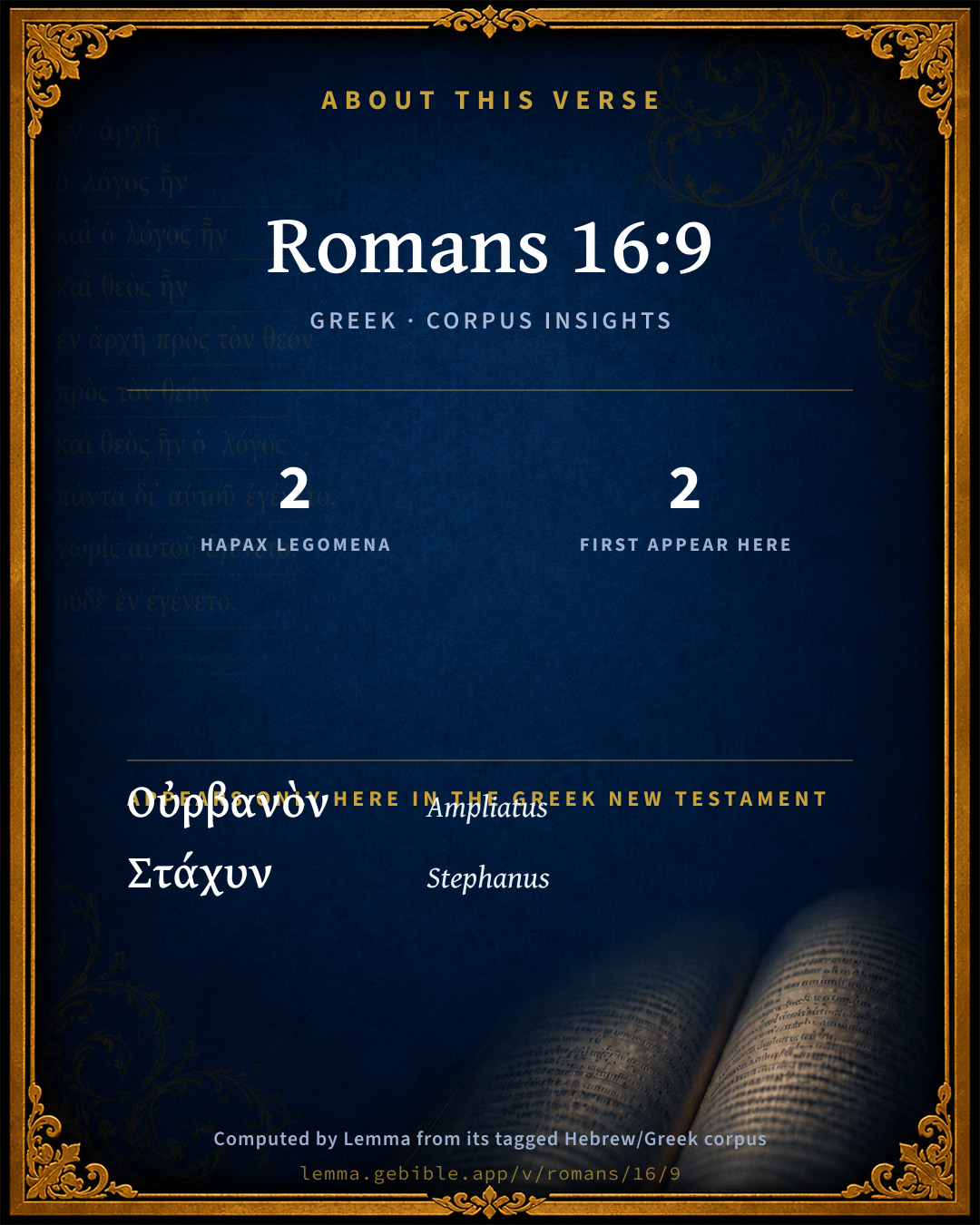
Romans 16:9

Greek (Tischendorf 8th ed.) Romans 16:9 appears in the Greek New Testament. The text above is from the Tischendorf 8th edition. Each word links to its Strong’s number and a concise gloss. Click any word for its full Thayer’s Greek Lexicon entry.
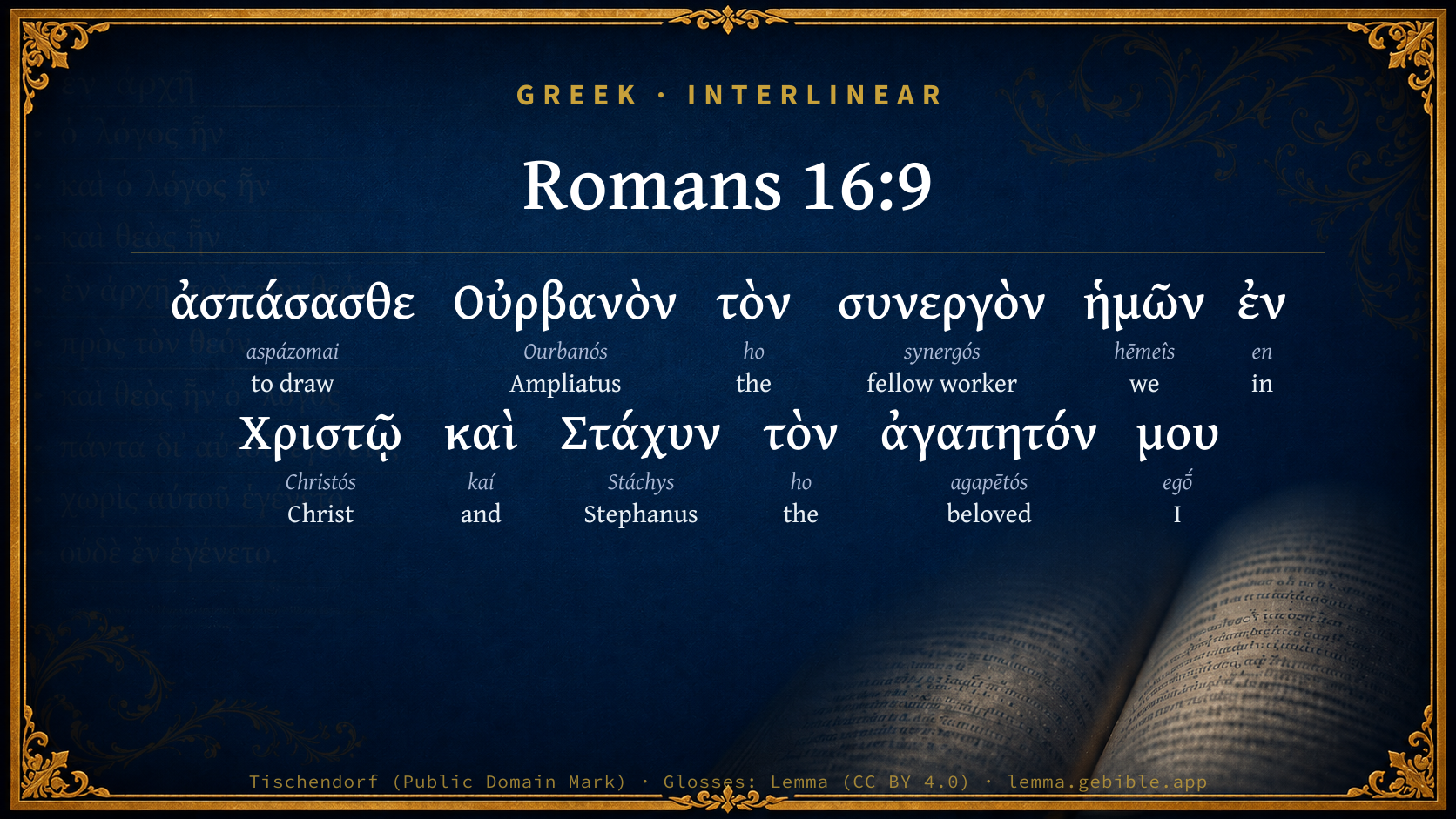
Download image
Cite this verse

Romans 16:9 (World English Bible). Public Domain. Lemma interlinear Bible study tool, https://lemma.gebible.app/v/romans/16/9.

Show BibTeX & RIS
BibTeX
RIS
English Translation
Greet Urbanus, our fellow worker in Christ, and Stachys, my beloved.
World English Bible · Public Domain
Highlights
  • 2 hapax legomena — only here in the Greek New Testament
  • 2 first appearances in the Greek New Testament
Full analysis ↓
Download a study sheet

One document with this verse’s original text, its word-by-word gloss line, the meaning frame, cross-references with their text, attributed commentary, and full source and license credits — printable, and it pastes into notes with its structure intact.

This verse Autodidact and up

Study sheet (.html) Plain text (.txt)

A passage Seminary Student

Up to 50 verses in one chapter. A passage sheet keeps up to 6 commentary sources and 12 cross-references per verse, in the order this page ranks them, and says so on the sheet whenever that leaves anything out. Ask for a single verse and you get the Autodidact verse sheet above.

Everything on this page stays free to read, with no account — the sheet is a download of what is already on screen, not access to it.

Want to remove ads? Support Godless Engineer
Compare translations 3

The same verse in 3 English versions, stacked beneath the original-language interlinear above. Click any original word for its lexicon entry.

Each is an independent rendering of the whole verse — the interlinear is not word-aligned to these translations.

Highlighted words mark where these versions differ — a whole-verse word diff, not a word-by-word alignment.

  • World English Bible Public Domain
    Greet Urbanus, our fellow worker in Christ, and Stachys, my beloved.
  • King James Version Public Domain
    Salute Urbane, our helper in Christ, and Stachys my beloved.
  • unfoldingWord Literal Text CC BY-SA 4.0
    Greet Urbanus, our fellow worker in Christ, and Stachys, my beloved.

unfoldingWord Literal Text — © unfoldingWord, licensed CC BY-SA 4.0. Word-aligned USFM3 via Door43 (git.door43.org/unfoldingWord/en_ult).

Versions to compare (up to 4)

3 of 4 selected

Show all 19 translations

Every available English version of this verse, each an independent rendering of the whole verse.

  • World English Bible Public Domain
    Greet Urbanus, our fellow worker in Christ, and Stachys, my beloved.
  • Berean Standard Bible Public Domain
    Greet Urbanus, our fellow worker in Christ, and my beloved Stachys.
  • Majority Standard Bible Public Domain
    Greet Urbanus, our fellow worker in Christ, and my beloved Stachys.
  • King James Version Public Domain
    Salute Urbane, our helper in Christ, and Stachys my beloved.
  • American Standard Version (1901) Public Domain
    Salute Urbanus our fellow-worker in Christ, and Stachys my beloved.
  • Revised Version (1885) Public Domain
    Salute Urbanus our fellow-worker in Christ, and Stachys my beloved.
  • Geneva Bible (1599) Public Domain
    Salute Vrbanus our fellow helper in Christ, and Stachys my beloued.
  • Douay-Rheims (1899) Public Domain
    Salute Urbanus, our helper in Christ Jesus, and Stachys, my beloved.
  • Young's Literal Translation Public Domain
    salute Arbanus, our fellow-workman in Christ, and Stachys, my beloved;
  • Literal Standard Version CC BY-SA 4.0
    greet Arbanus, our fellow-workman in Christ, and Stachys, my beloved;
  • Unlocked Literal Bible CC BY-SA 4.0
    Greet Urbanus, our fellow worker in Christ, and Stachys, my beloved.
  • unfoldingWord Literal Text CC BY-SA 4.0
    Greet Urbanus, our fellow worker in Christ, and Stachys, my beloved.
  • Darby Bible Public Domain
    Salute Urbanus, our fellow-workman in Christ, and Stachys, my beloved.
  • World Messianic Bible Public Domain
    Greet Urbanus, our fellow worker in Messiah, and Stachys, my beloved.
  • Webster's Bible Public Domain
    Salute Urbane, our helper in Christ, and Stachys my beloved.
  • Free Bible Version CC BY-SA 4.0
    to Urbanus, our co-worker in Christ; and to my dear friend Stachys.
  • Bible in Basic English Public Domain
    Give my love to Urbanus, a worker in Christ with us, and to my dear Stachys.
  • Text-Critical English NT CC BY 4.0
    Greet Urbanus, our fellow worker in Christ, and Stachys, my beloved friend.
  • Tyndale New Testament (1534) Public Domain
    Salute Vrban oure helper in Christ and Stachys my beloved.

Literal Standard Version (2020), Covenant Press — licensed CC BY-SA 4.0. Text via the HelloAO Bible API (eBible.org). Unlocked Literal Bible (unfoldingWord) — licensed CC BY-SA 4.0. Text via the HelloAO Bible API (eBible.org). unfoldingWord Literal Text — © unfoldingWord, licensed CC BY-SA 4.0. Word-aligned USFM3 via Door43 (git.door43.org/unfoldingWord/en_ult). Free Bible Version, Dr. Jonathan Gallagher — licensed CC BY-SA 4.0. Text via the HelloAO Bible API (eBible.org).

Word by word

More ways to search: Search by grammar → Find every occurrence → Compare this word →

Practice this passage: Drill this verse → Learn its vocabulary →

About this verse

These counts appear in no published source. They are computed here, from the morphology-tagged text and Lemma’s own curated glosses. What Lemma adds →

12
words
11
distinct lemmas
Pauline Epistles
section

Notable vocabulary

2 hapax legomena — words that appear only here in the entire Greek New Testament:

  • Οὐρβανὸν Ampliatus G3773
  • Στάχυν Stephanus G4720

First appearance in Scripture

These words make their first canonical appearance in the Greek New Testament here:

  • Οὐρβανὸν Ampliatus G3773
  • Στάχυν Stephanus G4720

Shared distinctive vocabulary

συνεργὸν fellow worker G4904 occurs in 12 verses of the Greek New Testament. Also found in:

Repetition

A word recurs within this verse:

Cross-references

2

Topical passages linked to Romans 16:9 in the Treasury of Scripture Knowledge — connected by theme and wording, ordered by reader-vote popularity; previews shown in the World English Bible.

  • Romans 16:2–3 that you receive her in the Lord, in a way worthy of the saints, and that you assist her in whatever matter she may need from you, for she herself also has been a helper of many, and of my own self.
  • Romans 16:21 Timothy, my fellow worker, greets you, as do Lucius, Jason, and Sosipater, my relatives.

Cross-references courtesy of OpenBible.info (CC BY 4.0).

Commentary

Notes on Romans 16:9 from classic Christian and Jewish commentators (each source and its license shown beneath its notes). The classic Christian expositions comment on the surrounding passage and are grouped to its opening verse, so a note may address several verses; the Jewish commentaries on the Tanakh (Rashi and others) are per-verse, so they appear only where the commentator wrote on this verse.

Lemma curates 59 commentaries, every one of them public domain or Creative Commons licensed, each selected and text-cleaned for this edition rather than reprinted as found. About our sources →

Joseph Benson's Commentary

Rom 16:9-11. Salute Urbane, or Urbanus rather, our helper — Συνεργον, our fellow-labourer — Mine and Timothy’s, Rom 16:21. Salute Apelles, τον δοκιμον, the approved in Christ — One who hath showed himself a sincere Christian and faithful servant of Christ, when tried by affliction and persecution for the gospel; a noble character this, and greatly to be respected. Salute those of the family of Aristobulus — Aristobulus himself is not saluted, either because he was not in Rome at that time, or because he was not yet converted, or perhaps because he was dead. He and Narcissus, mentioned in the next verse, seem each of them to have had a numerous family; some of whom only were converted, and are here saluted by the apostle, whom the fame of their virtues had reached: for probably some of them, at least, were not known to him by face, but only by character.

Joseph Benson's Commentary on the Old and New Testaments (1811–1818) — public domain. Text from a community e-Sword module.

Bengel's Gnomon

Johann Albrecht Bengel

Rom 16:9. Ἡμῶν, of us. Comp. Rom 16:21.[168]

[168] Where we find “my work-fellow:” but here “our helper,” or work-fellow.—ED.

Bengel's Gnomon of the New Testament — English translation (T&T Clark, Edinburgh, 1860) — public domain. Text from a community e-Sword module.

Expositor's Greek Testament

ed. W. Robertson Nicoll

Rom 16:9 . Οὐρβανὸν : also a common slave name, “found, as here, in juxtaposition with Ampliatus, in a list of imperial freedmen, on an inscription A.D. 115” (Gifford). τὸν συνεργὸν ἡμῶν : the ἡμῶν (as opposed to μου , Rom 16:3 ) seems to suggest that all Christian workers had a common helper in Urbanus. Of Stachys nothing is known but that he was dear to Paul. The name is Greek; but, like the others, has been found in inscriptions connected with the Imperial household.

The Expositor's Greek Testament, edited by W. Robertson Nicoll (1897–1910) — public domain. Text from a community e-Sword module.

Hodge's Commentary on Romans, Ephesians & First Corinthians

Charles Hodge

Rom_16:8-15

My beloved in the Lord. The preposition in (ἐν), here, as frequently elsewhere, points out the relation or respect in which the word, to which it refers is to be understood; brother beloved, both in the flesh and in the Lord (Phm_1:16), both in reference to our external relations, and our relation to the Lord. And thus in the following, Rom_16:9, our helper in Christ, i.e. as it regards Christ; Rom_16:10, approved in Christ, i.e. in his relation to Christ; an approved or tried Christian; Rom_16:12, who labor in the Lord; and, which labored much in the Lord, i.e. who, as it regards the Lord, labored much; it was a Christian or religious service. The names, Tryphena, Tryphosa, and Persis, all are feminine. The last is commonly supposed to indicate the native country of the person who bore it, as it was not unusual to name persons from the place of their origin, as Mysa, Syria, Lydia, Andria, etc.; such names, however, soon became common, and were given without any reference to the birthplace of those who received them. Chosen in the Lord, i.e. not one chosen by the Lord; chosen, (i.e., approved, precious; see 1Pe_2:4,) in his relation to the Lord, as a Christian. It is not merely elect in Christ, that is, chosen to eternal life, for this could be said of every Christian; but Rufus is here designated as a chosen man, as a distinguished Christian. It is worth noticing, that at Rome, as at Corinth, few of the great or learned seem to have been called. These salutations are all addressed to men not distinguished for their rank or official dignity. Mylius, as quoted by Calov, says: Notanda hic fidelium istorum conditio: nemo hic nominatur consul, nemo quaestor aut dictator insignitur, minime omnium episcopatuum et cardinalatuum dignitate hic personant: sed operarum, laborum, captivitate titulis plerique notantur. Ita verum etiam in Romana ecclesia fuit olim, quod apostouls scribit, non multi potentis, non multi nobiles, sed stuta mundi electa sunt a Deo. Papatus autem Caesarei, qualis adjuvante diabolo, in perniciem religionis, posteris saeculis Romae involuit, ne umbra quidem apostolorum aetate istic fuit: tantum abest, ut ille originem ab apostolis ipsis traxerit.

Charles Hodge — Commentary on Romans (1835), First Corinthians (1857), and Ephesians (1856) — public domain. Text from a community e-Sword module.

Jamieson, Fausset & Brown

Robert Jamieson, A. R. Fausset & David Brown

Urbane--rather, "Urbanus." It is a man's name.

our helper--"fellow labourer"

in Christ.

Jamieson, Fausset & Brown — Commentary Critical and Explanatory on the Whole Bible (1871) — public domain (CC PDM 1.0). Text via the HelloAO Bible API.

Adam Clarke's Commentary

Verse 9. Urbane, our helper] Who this Urbanus was we know not; what is here stated is, that he had been a fellow labourer with the apostles.

Stachys, my beloved.] One of my particular friends.

Adam Clarke's Commentary on the Bible (1810–1826) — public domain. Text from a community e-Sword/MySword module.

Ellicott's Commentary for English Readers

(9) Urbane.—Urbanus, or Urban; the final “e” should not be sounded. Like Ampliatus, a common name found among members of the household.

Our helper in Christ.—The “helper,” that is, both of St. Paul and of the Roman Church by her efforts in spreading the gospel.

Stachys.—A rarer name than the last two; it appears as that of a court physician in the inscriptions of about the date of this Epistle.

A Bible Commentary for English Readers, edited by Charles John Ellicott (1878–1897) — public domain. Text from a community e-Sword module.

The Cambridge Bible for Schools and Colleges

gen. ed. J. J. S. Perowne

9. Urban] Strictly, Urbânus. The letter -e in the E. V. form is not to be pronounced: it is like the final -e of Constantine, and has nothing to do with feminine terminations. It would have been better to write Urban in E. V.) The name is Latin.

Stachys] A Greek name, and masculine.

The Cambridge Bible for Schools and Colleges (gen. ed. J. J. S. Perowne; Cambridge University Press, 1878–1918) — public domain. Text from a community e-Sword module.

John Gill's Exposition

Salute Apelles approved in Christ,.... Origen was in doubt whether this was not the same person with Apollos the Alexandrian Jew, whom Aquila and Priscilla met with at Ephesus; but had he been intended, the apostle would doubtless have said more of him, he being so eminent and remarkable a preacher of the Gospel; though indeed the character here given is very considerable; besides, Apollos did not live at Rome, though it was not impossible he might be there at this time. The name seems to be a Greek one, there was a famous painter of this name in Greece; though it was also used among the Jews, and this person here might possibly, be a Jew; for Horace (p) speaks of one of this name, when he says, "credat Judaeus Apella"; by whom he means, not, as many have thought, a circumcised Jew in general, but a particular person, a Jew of that name: but it is of no importance whether he was a Jew or a Gentile; some say he was one of the seventy disciples, and bishop of Smyrna; See Gill on Luk 10:1. However, he was one that was approved in Christ; approved of God in Christ, who approves of none but in Christ; not of any on account of their own commendations, or those of others; for not he that commendeth himself is approved of God, nor whom others commend; and oftentimes what is highly esteemed of men, is abominable in the sight of God; nor does he approve of any on the score of their own works and duties, or as in themselves considered, whose righteousness in as filthy rags, and they themselves polluted and unclean; but as in Christ his well beloved Son, in whom he is well pleased, and with all in him; and so God's elect are, as this man was approved of in him the beloved, even in his own Son, in whom both persons and services are accepted: moreover he was approved of by Christ, and that from eternity, as presented to him in the glass of his Father's purposes and decrees; and in time, as adorned with his own grace, and clothed with his justifying righteousness, and as faithfully serving him in his day and generation: he was also proved to be in Christ; he had proved it to himself, to his own satisfaction, by observing, upon self-examination, that Christ was in him; and he had made it to appear to others, by his faith in Christ, love to him, zeal for him, and close attachment to his Gospel, against all errors and heresies, whereby they are approved are made manifest; and that in the face of all opposition and persecution: he was tried and proved, and so approved by a variety of tribulations and afflictions; his faith remained firm, and he abode by the interest of a Redeemer; and so he was tried, or proved, as the Arabic version renders it, "in the religion of Christ"; in which he was sincere, upright, and faithful; his faith was unfeigned, his love without dissimulation, he was an Israelite indeed, in whom there was no guile: if a preacher of the word, he did not corrupt it, but in sincerity, and as in the sight of God and Christ, spoke it; and if only a private believer, he was one that desired the sincere milk of the word, and was in all respects a sincere upright man in Christ; so the word here used may be understood, being the reverse of reprobate, rejected, spurious, adulterate and disapproved: in a word, this character shows, that he was not only approved of God and Christ, but of all good men, and particularly the apostle; and that on account of his being in Christ, united to him, and closely attached to his service and interest, and was an honour to it:

salute them which are of Aristobulus's household. This was also a Greek name, though in use among the Jews; there was one of this name master of Ptolomy, king of Egypt, who was of Jewish extract, and of the priests,

"In the hundred fourscore and eighth year, the people that were at Jerusalem and in Judea, and the council, and Judas, sent greeting and health unto

Aristobulus, king Ptolemeus' master, who was of the stock of the anointed priests, and to the Jews that were in Egypt:'' (2 Maccabees 1:10)

One of the sons of Hyrcanus, the high priest of the Jews, was called by this name; Herod had a son of this name, and it was a name much in use in his family, and among his descendants: who this man was is not known, nor is he himself saluted by the apostle; either because he was now dead, or was absent from Rome at this time; for some say he was sent into Britain, our isle, to preach the Gospel, of which he is said to be bishop, and one of the seventy disciples; See Gill on ; or perhaps he might not be a believer in Christ, only his household believers, and therefore they only are taken notice of.

(p) Serraon. l. 1. Satyr. 5. prope finem.

John Gill's Exposition of the Whole Bible (1746–1763) — public domain (CC PDM 1.0). Text via the HelloAO Bible API.

Trapp's Complete Commentary

John Trapp

9 Salute Urbane, our helper in Christ, and Stachys my beloved.

Ver. 9. Our helper in Christ] A sweet sign to him, that his name was written in the book of life, Php 4:3.

John Trapp, A Commentary or Exposition upon All the Books of the Old and New Testament (1647–1656) — public domain. Text from a community e-Sword module.

Matthew Poole's English Annotations

Urbane; this also is a Roman name; it was coveted afterwards by many bishops of Rome.

Our helper in Christ; the same that was said of Aquila and Priscilla, Rom 16:3. Possibly he might be one of their teachers.

Stachys my beloved; this is a Greek name, which signifieth an ear of corn. Some have reported, he was the first bishop of Constantinople: he was doubtless a person eminent in grace and gifts, or else the apostle would never have dignified him with this additional commendation, that he was beloved of him, or dear to him.

Matthew Poole's English Annotations on the Holy Bible (1683–1685) — public domain. Text from a community e-Sword/MySword module.

John Wesley's Explanatory Notes

Our fellowlabourer - Mine and Timothy's, verse 21.

John Wesley, Explanatory Notes Upon the Whole Bible (1754–1765) — public domain. Text via the GEBible commentary corpus.

McGarvey & Pendleton's Commentaries

J. W. McGarvey

Salute Urbanus our fellow-worker in Christ, and Stachys my beloved .

J. W. McGarvey (with Philip Y. Pendleton), Commentaries on the New Testament (The Fourfold Gospel, 1914; Acts; and the epistles) — public domain. Text from a community e-Sword/MySword module.

unfoldingWord translationNotes

Door43 World Missions Community

Urbanus ... Stachys ... Apelles ... Aristobulus ... Herodion ... Narcissus

These are the names of men. (See: How to Translate Names)

the approved in Christ

The word "approved" refers to someone who has been tested and proved to be genuine. AT: "whom Christ has approved"

who are in the Lord

This refers to those who trust in Jesus. AT: "who are believers" or "who belong to the Lord" (See: Assumed Knowledge and Implicit Information)

translationWords

in Christ

beloved

household

kin

unfoldingWord translationNotes — © Distant Shores Media and the Door43 World Missions Community, licensed CC BY-SA 4.0. Source: git.door43.org/Door43/en_tn.

Cambridge Greek Testament for Schools and Colleges

9. Οὐρβανὸν. “A common slave name, found among the members of the (imperial) household,” S. H. The name of course tells us nothing as to nationality. He may have been a Jew or a Greek.

τὸν συνεργὸν ἡμῶν. Prob., as S. H., a general description of working in the same cause as S. Paul and his companions, not necessarily of personal fellowship; cf. Phm 1:1 only: elsewhere always μου (Rom 16:3; Rom 16:21; Php 2:25; Php 4:3; 2Co 8:23 (ἐμὸς); Phm 1:24).

Στάχυν. “Rare but found in the imperial household,” S. H.; cf. Witkowski, Ep. Priv., p. 73.

Cambridge Greek Testament for Schools and Colleges (Cambridge University Press, 1896; 21 vols, various authors incl. Carr, Maclear, Plummer, Farrar, Lumby, Moule, M. R. James, Simcox) — public domain. Text from a community e-Sword module.

International Critical Commentary

9. Οὐρβανός:a common Roman slave name found among members of the household, C.I.L. vi. 4237 (quoted by Lft. from Murat. 920. 1) vrbanvs ∙ lydes ∙ avg ∙ l ∙ dispens | inmvnis ∙ dat ∙ hermae ∙ fratri ∙ et | cilicae ∙ patri: cf. 5604, 5605, and others, quoted by Lft. (Grut. p. 589. 10, p. 1070. 1).

τὸν συνεργὸν ἡμῶν. Where St. Paul is speaking of personal friends he uses the singular τὸν ἀγαπητόν μου: here he uses the plural because Urbanus was a fellow-worker with all those who worked for Christ.

Στάχυν: a rare Greek name, but found among members of the imperial household: C.I.L. vi. 8607 d. m. | m. vlpio ∙ avg ∙ l | eroti | ab ∙ epistvlis ∙ graecis | epaphroditvs | et ∙ stachys | caesar ∙ n ser | fratri ∙ karissimo ∙ et | clavdia ∙ formiana | fecervnt: cf. also inscriptions quoted by Lft.

International Critical Commentary — older volumes (1896–1929), various authors — public domain. Text from a community e-Sword module.

Vincent's Word Studies in the New Testament

Marvin R. Vincent

Urbane. The correct reading is Urbanus, city - bred.

Stachys. Meaning an ear of corn.

Marvin R. Vincent, Word Studies in the New Testament (1887–1900) — public domain. Text from a community e-Sword/MySword module.

Godet's Commentaries

Frédéric Louis Godet

Vv. 9, 10. “Salute Urbanus, our fellow-worker in Christ, and Stachys my beloved. Salute Apelles [the brother] approved in Christ. Salute them which are of Aristobulus’ household.”

Urbanus, a Latin name signifying citizen; Stachys, a Greek name signifying an ear of corn. In speaking of the former as his fellow-worker, Paul says: our (comp. the on us, Rom 16:6), because it is the apostolic work which is in question with all the workers who engage in it along with him; speaking of his personal friendship, he says: my.

Frédéric Louis Godet — Commentaries on Luke, John, Romans, and 1 Corinthians — English translation (T&T Clark, Edinburgh, 1870s–1890s) — public domain. Text from a community e-Sword module.

Lesson kit

Teaching starters — assembled from the data on this page, not authored interpretation. Every prompt links to the verse data it draws on. Edit before teaching.

Romans, in the Pauline Epistles, opens this verse with 12 words (11 distinct Greek lemmas). Its most distinctive word is Ourbanós (“Ampliatus”). A historical commentator’s framing appears above. Read the whole chapter for the surrounding context.

Discussion questions

  1. What does “Ampliatus” (Ourbanós) contribute to the verse as a whole?
  2. This verse holds 2 words here found nowhere else in the Greek New Testament. What might the rare words draw attention to?
  3. 2 words here appear for the first time in Scripture. What is being introduced at this debut?
  4. Romans 16:3 shares the word «fellow worker» with this verse. How do the two illuminate each other?
  5. “the” occurs 2× in this one verse. What is the effect of the repetition?
  6. These translations render this verse differently; the difference is in the English rendering, not the original. What questions does that raise?
  7. Reading how Joseph Benson's Commentary and Bengel's Gnomon read this verse, where do the two commentators agree and where do they part?

Things to notice

  • 2 words in this verse appear nowhere else in the Greek New Testament.
  • 2 words make their first canonical appearance in Scripture here.
  • These translations choose different wording for 7 words in this verse.
  • “the” occurs 2× in this single verse.
  • 11 distinct Greek lemmas span 12 words in this verse.

Reading settings

Reading text

Shown beneath each verse's original-language words.

Old Testament
Old Testament edition

Read the OT as the Masoretic Hebrew (MT) or the Greek Septuagint (LXX).

English shown for the Greek Septuagint (in the Hebrew ↔ Greek comparison).

Comparing translations? Open the Compare panel on any verse page to stack up to four side by side.