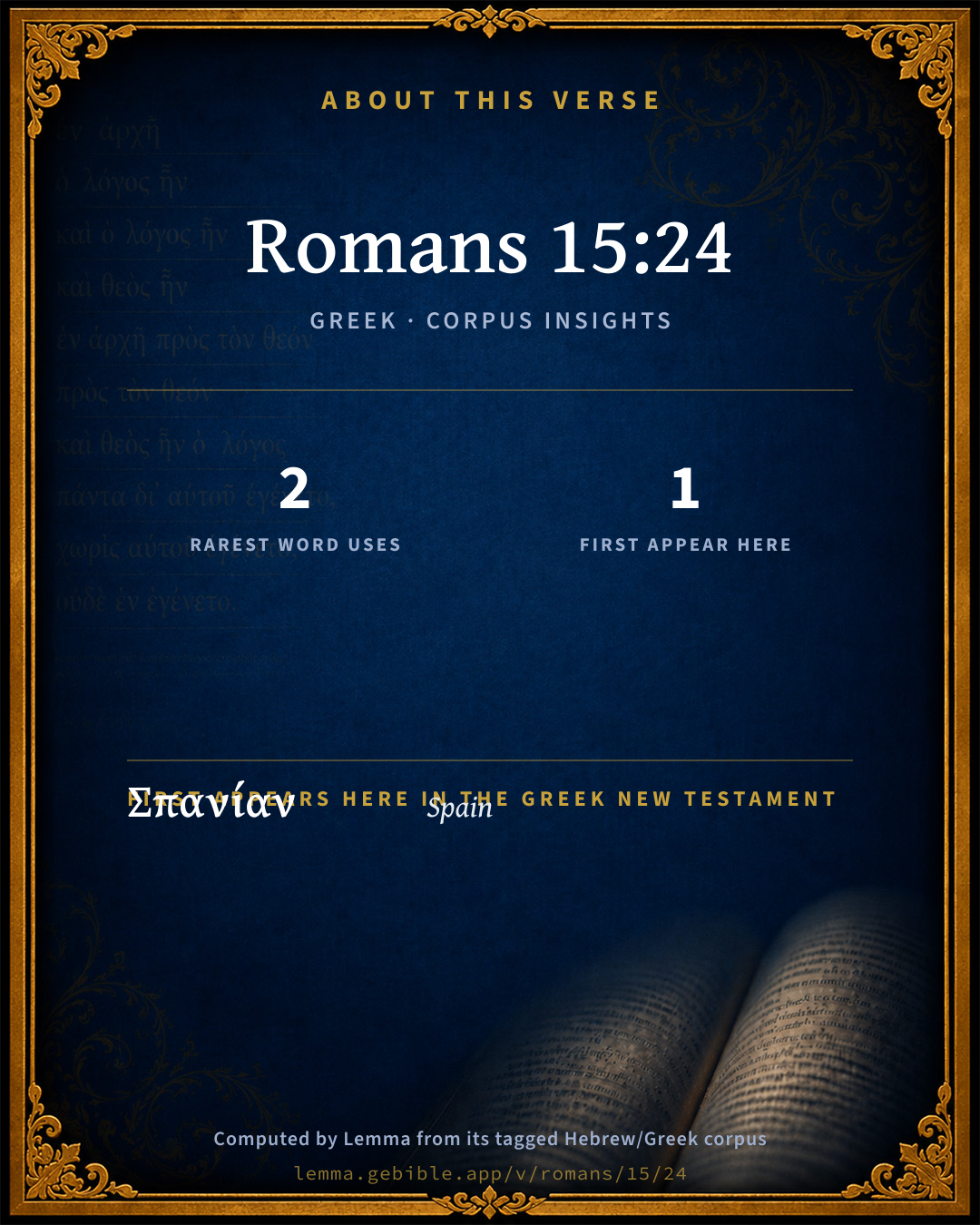
Romans 15:24

Greek (Tischendorf 8th ed.) Romans 15:24 appears in the Greek New Testament. The text above is from the Tischendorf 8th edition. Each word links to its Strong’s number and a concise gloss. Click any word for its full Thayer’s Greek Lexicon entry.

Download image
Cite this verse

Romans 15:24 (World English Bible). Public Domain. Lemma interlinear Bible study tool, https://lemma.gebible.app/v/romans/15/24.

Show BibTeX & RIS
BibTeX
RIS
English Translation
whenever I journey to Spain, I will come to you. For I hope to see you on my journey, and to be helped on my way there by you, if first I may enjoy your company for a while.
World English Bible · Public Domain
Highlights
  • 1 first appearance in the Greek New Testament
Full analysis ↓
Download a study sheet

One document with this verse’s original text, its word-by-word gloss line, the meaning frame, cross-references with their text, attributed commentary, and full source and license credits — printable, and it pastes into notes with its structure intact.

This verse Autodidact and up

Study sheet (.html) Plain text (.txt)

A passage Seminary Student

Up to 50 verses in one chapter. A passage sheet keeps up to 6 commentary sources and 12 cross-references per verse, in the order this page ranks them, and says so on the sheet whenever that leaves anything out. Ask for a single verse and you get the Autodidact verse sheet above.

Everything on this page stays free to read, with no account — the sheet is a download of what is already on screen, not access to it.

Want to remove ads? Support Godless Engineer
Compare translations 3

The same verse in 3 English versions, stacked beneath the original-language interlinear above. Click any original word for its lexicon entry.

Each is an independent rendering of the whole verse — the interlinear is not word-aligned to these translations.

Highlighted words mark where these versions differ — a whole-verse word diff, not a word-by-word alignment.

  • World English Bible Public Domain
    whenever I journey to Spain, I will come to you. For I hope to see you on my journey, and to be helped on my way there by you, if first I may enjoy your company for a while.
  • King James Version Public Domain
    Whensoever I take my journey into Spain, I will come to you: for I trust to see you in my journey, and to be brought on my way thitherward by you, if first I be somewhat filled with your company.
  • unfoldingWord Literal Text CC BY-SA 4.0
    whenever I travel to Spain, I indeed hope, passing through, to see you, and to be sent ahead there by you, if I might first be satisfied for a while by you.

unfoldingWord Literal Text — © unfoldingWord, licensed CC BY-SA 4.0. Word-aligned USFM3 via Door43 (git.door43.org/unfoldingWord/en_ult).

Versions to compare (up to 4)

3 of 4 selected

Show all 19 translations

Every available English version of this verse, each an independent rendering of the whole verse.

  • World English Bible Public Domain
    whenever I journey to Spain, I will come to you. For I hope to see you on my journey, and to be helped on my way there by you, if first I may enjoy your company for a while.
  • Berean Standard Bible Public Domain
    I hope to see you on my way to Spain. And after I have enjoyed your company for a while, you can equip me for my journey.
  • Majority Standard Bible Public Domain
    I hope to come to see you on my way to Spain. And after I have enjoyed your company for a while, you can equip me for my journey.
  • King James Version Public Domain
    Whensoever I take my journey into Spain, I will come to you: for I trust to see you in my journey, and to be brought on my way thitherward by you, if first I be somewhat filled with your company.
  • American Standard Version (1901) Public Domain
    whensoever I go unto Spain (for I hope to see you in my journey, and to be brought on my way thitherward by you, if first in some measure I shall have been satisfied with your company)--
  • Revised Version (1885) Public Domain
    whensoever I go unto Spain (for I hope to see you in my journey, and to be brought on my way thitherward by you, if first in some measure I shall have been satisfied with your company)—
  • Geneva Bible (1599) Public Domain
    When I shall take my iourney into Spaine, I will come to you: for I trust to see you in my iourney, and to be brought on my way thitherward by you, after that I haue bene somewhat filled with your company.
  • Douay-Rheims (1899) Public Domain
    When I shall begin to take my journey into Spain, I hope that as I pass, I shall see you, and be brought on my way thither by you, if first, in part, I shall have enjoyed you:
  • Young's Literal Translation Public Domain
    when I may go on to Spain I will come unto you, for I hope in going through, to see you, and by you to be set forward thither, if of you first, in part, I shall be filled.
  • Literal Standard Version CC BY-SA 4.0
    when I may go on to Spain I will come to you, for I hope in going through, to see you, and by you to be set forward there, if of you first, in part, I will be filled.
  • Unlocked Literal Bible CC BY-SA 4.0
    I am hopeful that I will see you in passing when I go to Spain, and to be helped by you along my journey there, once I have enjoyed your company for a while.
  • unfoldingWord Literal Text CC BY-SA 4.0
    whenever I travel to Spain, I indeed hope, passing through, to see you, and to be sent ahead there by you, if I might first be satisfied for a while by you.
  • Darby Bible Public Domain
    whenever I should go to Spain; (for I hope to see you as I go through, and by you to be set forward thither, if first I shall have been in part filled with your company;)
  • World Messianic Bible Public Domain
    whenever I travel to Spain, I will come to you. For I hope to see you on my journey, and to be helped on my way there by you, if first I may enjoy your company for a while.
  • Webster's Bible Public Domain
    Whenever I take my journey into Spain, I will come to you: for I trust to see you in my journey, and to be brought on my way thitherward by you, if first I shall be somewhat filled with your company.
  • Free Bible Version CC BY-SA 4.0
    when I go to Spain I hope to see you when I pass through. Maybe you can give me some help for my journey once we've enjoyed some time together.
  • Bible in Basic English Public Domain
    Whenever I go to Spain (for it is my hope to see you on my way, and to be sent on there by you, if first I may in some measure have been comforted by your company)--
  • Text-Critical English NT CC BY 4.0
    I will come to you when I go to Spain. For I hope to see you when I pass through, and to have you send me on my way there, once I have first enjoyed your company for a while.
  • Tyndale New Testament (1534) Public Domain
    when I shall take my iorney into spayne I will come to you. I trust to se you in my iorney and to be brought on my waye thither warde by you after that I have somwhat enioyed you.

Literal Standard Version (2020), Covenant Press — licensed CC BY-SA 4.0. Text via the HelloAO Bible API (eBible.org). Unlocked Literal Bible (unfoldingWord) — licensed CC BY-SA 4.0. Text via the HelloAO Bible API (eBible.org). unfoldingWord Literal Text — © unfoldingWord, licensed CC BY-SA 4.0. Word-aligned USFM3 via Door43 (git.door43.org/unfoldingWord/en_ult). Free Bible Version, Dr. Jonathan Gallagher — licensed CC BY-SA 4.0. Text via the HelloAO Bible API (eBible.org).

Word by word

More ways to search: Search by grammar → Find every occurrence → Compare this word →

Practice this passage: Drill this verse → Learn its vocabulary →

Σπανίαν
Spanía
G4681
“Spain”
Noun, Accusative, Singular, Feminine
Part of Speech
Noun
Case
Accusative
Number
Singular
Gender
Feminine
Full Thayer's Definition

Origin: probably of foreign origin

TDNT: None

Spain = "scarceness" 1. the whole peninsula south of the Pyrenees
  1. ὡς hōs G5613 “as” Adverb
  2. ἂν án G302 “if” Particle
  3. πορεύωμαι poreúomai G4198 “to go” Verb, Present, Middle or Passive deponent, Subjunctive, 1st person, Singular
  4. εἰς eis G1519 “into” Preposition
  5. τὴν ho G3588 “the” Article, Accusative, Singular, Feminine
  6. ἐλπίζω elpízō G1679 “to hope” Verb, Present, Active, Indicative, 1st person, Singular
  7. γὰρ gár G1063 “for” Conjunction
  8. διαπορευόμενος diaporeúomai G1279 “to go through” Verb, Present, Middle or Passive deponent, Participle, Nominative, Singular, Masculine
  9. θεάσασθαι theáomai G2300 “to behold” Verb, Aorist, Middle deponent, Infinitive
  10. ὑμᾶς hymeîs G5210 “you” Personal pronoun, 2nd person, Accusative, Plural
  11. καὶ kaí G2532 “and” Conjunction
  12. ὑφ’ hypó G5259 “under” Preposition
  13. ὑμῶν hymeîs G5210 “you” Personal pronoun, 2nd person, Genitive, Plural
  14. προπεμφθῆναι propémpō G4311 “to send before” Verb, Aorist, Passive, Infinitive
  15. ἐκεῖ ekeî G1563 “there” Adverb
  16. ἐὰν eán G1437 “if” Conditional
  17. ὑμῶν hymeîs G5210 “you” Personal pronoun, 2nd person, Genitive, Plural
  18. πρῶτον prōton G4412 “first” Adverb, Superlative
  19. ἀπὸ apó G575 “from” Preposition
  20. μέρους méros G3313 “part” Noun, Genitive, Singular, Neuter
  21. ἐμπλησθῶ empíplēmi G1705 “to fill up” Verb, Aorist, Passive, Subjunctive, 1st person, Singular

About this verse

These counts appear in no published source. They are computed here, from the morphology-tagged text and Lemma’s own curated glosses. What Lemma adds →

22
words
20
distinct lemmas
Pauline Epistles
section

Notable vocabulary

The rarest word here is Σπανίαν Spain G4681 — appearing just 2 times in the whole Greek New Testament.

First appearance in Scripture

This word makes its first canonical appearance in the Greek New Testament here:

  • Σπανίαν Spain G4681

Shared distinctive vocabulary

Σπανίαν Spain G4681 occurs in 2 verses of the Greek New Testament. Also found in:

Repetition

A word recurs within this verse:

  • ὑμᾶς you G5210 ×3

Cross-references

8

Topical passages linked to Romans 15:24 in the Treasury of Scripture Knowledge — connected by theme and wording, ordered by reader-vote popularity; previews shown in the World English Bible.

  • Romans 15:28 When therefore I have accomplished this, and have sealed to them this fruit, I will go on by way of you to Spain.
  • Romans 1:12 that is, that I with you may be encouraged in you, each of us by the other's faith, both yours and mine.
  • Acts 15:3 They, being sent on their way by the assembly, passed through both Phoenicia and Samaria, declaring the conversion of the Gentiles. They caused great joy to all the brothers.
  • Acts 19:21 Now after these things had ended, Paul determined in the spirit, when he had passed through Macedonia and Achaia, to go to Jerusalem, saying, "After I have been there, I must also see Rome."
  • Acts 21:5 When it happened that we had accomplished the days, we departed and went on our journey. They all, with wives and children, brought us on our way until we were out of the city. Kneeling down on the beach, we prayed.
  • 1 Corinthians 16:5–7 But I will come to you when I have passed through Macedonia, for I am passing through Macedonia.
  • 2 Corinthians 1:16 and by you to pass into Macedonia, and again from Macedonia to come to you, and to be sent forward by you on my journey to Judea.
  • 3 John 1:6 They have testified about your love before the assembly. You will do well to send them forward on their journey in a manner worthy of God,

Cross-references courtesy of OpenBible.info (CC BY 4.0).

Where the printed editions differ

1 variant

Places in this verse where the major printed Greek editions disagree on the wording in a way that affects the translation — a comparison of editions, not a manuscript-by-manuscript collation. The editions are the modern critical texts (Nestlé-Aland 28/27, SBL, Westcott-Hort, Tregelles, Tyndale House) and the traditional texts behind the KJV (the Textus Receptus and the Byzantine/Majority text). It is not a claim about which reading is original.

  1. Extra text
    ἐλεύσομαι πρὸς ὑμᾶς,

    “I will come to you”

    In TRByz Not in NA28NA27TynSBLWHTreg

    ἐλεύσομαι πρὸς ὑμᾶς, (eleusomai pros humas) 'I will come to you' is only in traditional manuscripts (TR+Byz)

Textual data: Translators Amalgamated Greek New Testament (STEPBible TAGNT) · CC BY 4.0.

Commentary

Notes on Romans 15:24 from classic Christian and Jewish commentators (each source and its license shown beneath its notes). The classic Christian expositions comment on the surrounding passage and are grouped to its opening verse, so a note may address several verses; the Jewish commentaries on the Tanakh (Rashi and others) are per-verse, so they appear only where the commentator wrote on this verse.

Lemma curates 59 commentaries, every one of them public domain or Creative Commons licensed, each selected and text-cleaned for this edition rather than reprinted as found. About our sources →

Tyndale Open Study Notes

Tyndale Open Resources

15:24 I am planning to go to Spain: In Paul’s day, “Spain” included the entire Iberian Peninsula (modern Spain and Portugal). Parts of the peninsula had been occupied by the Romans since 200 BC, but only within Paul’s lifetime had the area been organized into a Roman province. Paul saw Spain, at the far end of the Mediterranean, as his final target in fulfilling the promise of Isa 66:19-20. • you can provide for my journey: Spain was so far from Paul’s previous sending church, Antioch in Syria, that he hoped the Roman church could serve as the logistical base for this future evangelistic effort.

Tyndale Open Study Notes — © Tyndale Open Resources, licensed CC BY-SA 4.0. Text via the HelloAO Bible API.

Bengel's Gnomon

Johann Albrecht Bengel

Rom 15:24. Ὡς ἐὰν) Ὡς is the principal particle; ἐὰν, soever,[161] παρέλκει, is redundant, in whatsoever manner, at whatsoever time, and by whatsoever route.—εἰς τὴν Σπανίαν, into Spain) where the Gospel was not yet preached.—διαπορευόμενος, passing through on my journey) because the foundation of the faith was already laid at Rome.—προπεμφθῆναι, to be brought on my way) The passive voice with a reciprocal signification, that is, to leave or commit himself to their care to be escorted by them on his journey; he writes familiarly to the brethren whom he had not yet seen, as though by virtue of right [as if his claim on them were matter of right].—ὑμῶν, you) He speaks modestly. The Romans were rather likely to have reason to be filled (to be fully gratified) with Paul’s company.—ἀπὸ μέρους, in some measure) He intimates to them, that he would not however be so long at Rome, as he wished; or else, that it is Christ, and not believers, with whom believers should be perfectly filled.

[161] But the oldest MSS. have ἄν, viz. ABCD(Λ)G.—ED.

Bengel's Gnomon of the New Testament — English translation (T&T Clark, Edinburgh, 1860) — public domain. Text from a community e-Sword module.

Expositor's Greek Testament

ed. W. Robertson Nicoll

Rom 15:24 . ὡς ἂν πορεύωμαι εἰς τὴν Σπανίαν : it is here the apodosis begins, which being broken in on by ἐλπίζω is never formally resumed, though the sense is taken up again in Rom 15:28 f. ὡς ἂν is temporal = simulatque: cf. 1Co 11:34 , Phi 2:23 : Buttmann, p. 232. The principle which Paul has just laid down as regulating his Apostolic work (Rom 15:20 ) forbids him to think of Rome as a proper sphere for it; great as is his interest in the capital of the world, he can only pay it a passing visit on the way to another field. ὑφʼ ὑμῶν προπεμφθῆναι ἐκεῖ : it has been said that Paul expected or claimed “ quasi pro jure suo ” to be escorted all the way to Spain (by sea) by members of the Roman Church; but this is not included in προπεμφθῆναι . Practical illustrations are seen in Act 20:35 ; Act 21:5 : similar anticipations in 1Co 16:6 ; 1Co 16:11 . For πρῶτον see Mat 7:5 ; Mat 8:21 . ἀπὸ μέρους indicates that no such stay would be equal to the Apostle’s longing for fellowship with the Romans, but it would be at least a partial satisfaction of it.

The Expositor's Greek Testament, edited by W. Robertson Nicoll (1897–1910) — public domain. Text from a community e-Sword module.

Hodge's Commentary on Romans, Ephesians & First Corinthians

Charles Hodge

Rom_15:24

Whensoever I take my journey into Spain, I will come to you for I trust to see you in my journey, and to be brought on my way thitherward by you, if first I be somewhat filled with your company. Whensoever (ὡς ἐάν for ὡς ἄν), as soon as; As soon as I take my journey, etc. The words in the original, corresponding to I will come unto you, for are omitted in many MSS.‹80› The sense is complete without them: As soon as I take my journey into Spain, I hope to see you on my way. If the word for be retained, the passage must be differently pointed: Having a great desire to see you, as soon as I go to Spain, (for I hope on my way to see you, etc.) but now I go to Jerusalem. Spain, the common Greek name for the great Pyrenian Peninsula, was Ἰβηρία, although Σπανία was also used. The Romans called it Ἱσπανία. Whether Paul ever accomplished his purpose of visiting Spain, is a matter of doubt. There is no historical record of his having done so, either in the New Testament, or in the early ecclesiastical writers; though most of those writers seem to have taken it for granted. His whole plan was probably deranged by the occurrences at Jerusalem, which led to his long imprisonment at Cesarea, and his being sent in bonds to Rome. To be brought on my way. The original word means, in the active voice, to attend any one on a journey for some distance, as an expression of kindness and respect; and also to make provision for his journey; see Act_15:3; Act_20:38; 1Co_16:6; 2Co_1:16.

Charles Hodge — Commentary on Romans (1835), First Corinthians (1857), and Ephesians (1856) — public domain. Text from a community e-Sword module.

Jamieson, Fausset & Brown

Robert Jamieson, A. R. Fausset & David Brown

whensoever I take my journey into Spain--Whether this purpose was ever accomplished has been much disputed, as no record of it nor allusion to it anywhere occurs. Those who think our apostle was never at large after his first imprisonment at Rome will of course hold that it never was; while those who are persuaded, as we are, that he underwent a second imprisonment, prior to which he was at large for a considerable time after his first, incline naturally to the other opinion.

I will come to you--If these words were not originally in the text, and there is weighty evidence against them, they must at least be inserted as a necessary supplement.

in my journey, &c.--"as I pass through by you, to be set forward on my journey thither, if first I be somewhat filled with your company": that is, "I should indeed like to stay longer with you than I can hope to do, but I must, to some extent at least, have my fill of your company."

Jamieson, Fausset & Brown — Commentary Critical and Explanatory on the Whole Bible (1871) — public domain (CC PDM 1.0). Text via the HelloAO Bible API.

Adam Clarke's Commentary

Verse 24. Whensoever I take my journey into Spain] Where it is very likely the Gospel had not yet been planted; though legendary tales inform us that St. James had planted the Gospel there long before this time, and had founded many bishoprics! But this is as unfounded as it is ridiculous and absurd; for nothing like what is now termed a bishopric, nor even a parish, was founded for many years after this. An itinerant preacher, might, with more propriety, say travelling circuits were formed, rather than bishoprics. Whether the apostle ever fulfilled his design of going to Spain is unknown; but there is no evidence whatever that he did, and the presumption is that he did not undertake this voyage. Antiquity affords no proof that he fulfilled his intention.

I will come to you] ελευσο μαιπρος υμας. These words are wanting in almost every MS. of note, and in the Syriac of Erpen, Coptic, Vulgate, Ethiopic, Armenian, and Itala. If the first clause of this verse be read in connection with the latter clause of the preceding, it will fully appear that this rejected clause is useless. Having a great desire, these many years to come unto you whensoever I take my journey into Spain: for I trust to see you in my journey, c.

Somewhat filled with your company.] The word εμπλησθω, which we translate filled, would be better rendered gratified for εμπλησθηναι signifies to be satisfied, to be gratified, and to enjoy. AELIAN., Hist. Anim., lib. v., c. 21, speaking of the peacock spreading out his beautiful plumage, says: εα γαρ εμπλησθηναι της θεος τον παρεστωτα· "He readily permits the spectator to gratify himself by viewing him." And MAXIMUS TYRIUS, Dissert. 41, page 413: "That he may behold the heavens, και εμπλησθη λαμπρου φωτος, and be gratified with the splendour of the light." HOMER uses the word in the same sense:-

Ἡ δ' εμη ουδε περ υἱος ενιπλησθηναι ακοιτις Οφθαλμοισιν εασε.

Odyss., lib. xi., ver. 451.

"But my wife never suffered my eyes to be delighted with my son."

The apostle, though he had not the honour of having planted the Church at Rome, yet expected much gratification from the visit which he intended to pay them.

Adam Clarke's Commentary on the Bible (1810–1826) — public domain. Text from a community e-Sword/MySword module.

John Calvin's Commentaries

24. For I hope, etc. He refers to the reason why he had for a long time wished to come to them, and now intended to do so, — even that he might see them, enjoy an interview and an intercourse with them, and make himself known to them in his official character; for by the coming of the Apostles the gospel also came.

By saying, to be brought on my way thither by you, he intimates how much he expected from their kindness; and this, as we have already observed, is the best way for conciliating favor; for the more confidence any one hears is reposed in him, the stronger are the obligations under which he feels himself; inasmuch as we deem it base and discourteous to disappoint the good opinion formed of us. And by adding, When I shall first be in part filled, etc., he bears witness to the benevolence of his mind towards them; and to convince them of this was very necessary for the interest of the gospel.

John Calvin's Commentaries (1540-1563) — public domain. Text from the Calvin Translation Society English edition (1840s-50s) via the Christian Classics Ethereal Library (ccel.org). Calvin's coverage is partial (roughly two-thirds of the Bible); uncommented books and verses are honest gaps, never fabricated. The 19th-century editor's footnotes and remarks are omitted so the notes are faithfully Calvin's own voice.

Ellicott's Commentary for English Readers

(24) Into Spain.—In his eagerness to seek out entirely new regions, and to avoid any possibility of crossing the lines of his fellow Apostles, desiring also himself to gather in the “fulness of the Gentiles” so far as lay in his power, he had determined to push on even to Spain. Whether he ever succeeded in carrying out his purpose we cannot say positively, but it is, perhaps, rather more probable than not. A tradition which dates back to the Epistle of Clement of Rome (circ. A.D. 95) says that he visited “the extreme limit of the West,” a phrase which seems hardly satisfied by being interpreted simply of Rome. The author of the Muratorian Fragment (circ. A.D. 170) speaks expressly of a journey to Spain, though his language looks as if it might be an inference from this Epistle. The Acts, it is true, do not carry the Apostle beyond Rome, but the phenomena of the Pastoral Epistles and tradition together seem to justify us in assuming the probability of a later journey or journeys not recorded in that volume, and the argument from silence, as the book in any case stops short of the death of the Apostle, counts for but little. This is just a case in which it cannot be wrong to accept the balance of the argument as it stands. At the same time it is impossible not to feel the grievous blank which lies over the later years of the life of St. Paul, and few things would be more deeply interesting, or would throw more light on the principles of criticism, than the discovery, if only it were possible, of the merest fragment bearing upon it. It is to be feared, however, that there is no reasonable hope of such a discovery being ever made.

I will come to you . . .—These words are wanting in the true text, and have to be supplied. The sentence is left unfinished.

To be brought on my way.—A graphic description of this “bringing upon the way,” is given in the account of the departure of St. Paul after his seven days’ sojourn at Tyre, Act_21:5. (Comp. Act_20:36-38.)

Somewhat filled.—Another characteristic touch. The Apostle will not allow it to be supposed that he could have enough of the society of the Roman Church. He therefore qualifies his expression, “somewhat filled,” or “satisfied,” “satisfied if only in part.”

If first I be somewhat filled is practically equivalent to “when I have been filled.”

A Bible Commentary for English Readers, edited by Charles John Ellicott (1878–1897) — public domain. Text from a community e-Sword module.

The Cambridge Bible for Schools and Colleges

gen. ed. J. J. S. Perowne

24. take my journey] Lit., simply, travel. The Gr. does not, as the E. V. (“my journey”) may seem to do, imply that this was a journey previously expected at Rome. But on the other hand it is almost certain that it was more or less definitely expected, considering that St Paul had such intimate friends (and no doubt correspondents) at Rome as Aquila and Priscilla.

into Spain] Gr. Spania. The form Hispania is also found in Greek; Spania never in Latin. The far commoner Greek name of the Peninsula is Iberia.

On the question whether this journey ever took place, see Introduction, i. § 31. See also on Rom_1:10; Rom_1:13.

I will come to you] There is much documentary evidence against this clause, though it is not absolutely conclusive. The words are needful to the sense; and, if they are interpolated, we have here a strong example of St Paul’s elliptical style: he leaves the statement of his intention to be inferred from the words of Rom_15:22.

to see you] The Gr. verb naturally implies a deliberate beholding, as of one admitted to a spectacle. Cp. Col_2:5.

in my journey] Lit. travelling through. He would not make a long stay at Rome, because there “Christ had been already named.” He little anticipated the “two years in his private lodging.” (Act_28:30.)

to be brought on my way] Perhaps some of the Roman Christians might accompany him to Spain.

by you] A better reading gives, from you.

somewhat] Lit. in part. He affectionately implies that the intercourse must be far shorter than his wishes; but that what enjoyment of it he can secure, he will.

filled] As a faint and hungry traveller with welcome food, which sends him on refreshed. “Ch. Rom_1:12 furnishes the commentary to this word.” (Meyer.)

with your company] Lit. with you.

The Cambridge Bible for Schools and Colleges (gen. ed. J. J. S. Perowne; Cambridge University Press, 1878–1918) — public domain. Text from a community e-Sword module.

John Gill's Exposition

But now I go unto Jerusalem,.... Whither he was bound in spirit, not knowing what should befall him there, from which he could not be dissuaded by his friends, and thither he did go:

to minister unto the saints; not to preach the Gospel, though doubtless he did that when he was there; but to distribute among the poor saints what had been raised for them by the Greek churches; who had entreated him to take upon him this service, even the fellowship of ministering to the saints; and though this might seem below his office as an apostle, and as what more became an inferior officer, a deacon in a church; yet the apostle's heart was so much in it, and he was so bent upon it, and so diligent to execute it, that he postponed his journey to Spain and visit to Rome for the sake of it, and assigns this as a reason why he could not come at present.

Next: Romans Chapter 16

John Gill's Exposition of the Whole Bible (1746–1763) — public domain (CC PDM 1.0). Text via the HelloAO Bible API.

Trapp's Complete Commentary

John Trapp

24 Whensoever I take my journey into Spain, I will come to you: for I trust to see you in my journey, and to be brought on my way thitherward by you, if first I be somewhat filled with your company.

Ver. 24. For I trust to see you] Ipse aspectus viri boni delectat, He himself delights at the sight of good men, saith Seneca. There is a great deal of sweetness in the society of saints, and much good to be gotten thereby. Sometimes (saith a grave divine) though we know that which we ask of others as well as they do, yet good speeches will draw us to know it better, by giving occasion to speak more of it: wherewith the Spirit works more effectually, and imprints it deeper, so that it shall be a more rooted knowledge than before. For that doth good that is graciously known, and that is graciously known that the Spirit seals upon our souls.

John Trapp, A Commentary or Exposition upon All the Books of the Old and New Testament (1647–1656) — public domain. Text from a community e-Sword module.

Albert Barnes' Notes on the Bible

Whensoever I take my journey into Spain - Ancient Spain comprehended the modern kingdoms of Spain and Portugal, or the whole of the Spanish peninsula. It was then subject to the Romans. It is remarkable, even here, that the apostle does not say that his principal object was to visit the church at Rome, much as he desired that, but only to “take it in his way” in the fulfillment of his higher purpose to preach the gospel in regions where Christ was not named. Whether he ever fulfilled his purpose of visiting “Spain” is a matter of doubt. Some of the fathers, Theodoret (on Phi 1:25; 2Ti 4:17) among others, say that after he was released from his captivity when he was brought before Nero, he passed two years in Spain. If he was imprisoned a “second” time at Rome, such a visit is not improbable as having taken place “between” the two imprisonments. But there is no certain evidence of this. Paul probably projected “many” journeys which were never accomplished.

To be brought on my way ... - To be assisted by you in regard to this journey; or to be accompanied by you. This was the custom of the churches; Act 15:3; Act 17:14-15; Act 20:38; Act 21:5; 1Co 16:6, 1Co 16:11; 3Jo 1:8.

If first ... - If on my journey, before I go into Spain.

Somewhat - Greek, “In part.” As though he could not be “fully” satisfied with their company, or could not hope to enjoy their society as fully and as long as he could desire. This is a very tender and delicate expression.

Filled - This is a strong expression, meaning to be “satisfied,” to enjoy. To be “filled” with a thing is to have great satisfaction and joy in it.

With your company - Greek, With “you;” meaning in your society. The expression “to be filled” with one, in the sense of being “gratified,” is sometimes used in the classic writers. (See “Clarke” on this verse.)

Albert Barnes' Notes on the Bible (1834–1885) — public domain. Text from a community e-Sword/MySword module.

Haydock's Catholic Bible Commentary

It is a matter of dispute, whether St. Paul ever executed this his design of visiting Spain. The proofs of the Spaniards, who consider it as certain, are by no means unanswerable. There remain no certain monuments of this journey of his. The proof taken from the words of St. Clement, who lived at Rome in the time of St. Paul, is not certain, since he only says, that St. Paul came to the very extremities of the west. It is a subject on which commentators appear pretty equally divided. (Calmet) --- There is an old tradition that St. Paul, in his journey to Spain, left three of his disciples in Gaul; Trophimus at Arles, Crescentius at Vienne, and Paul at Narbonne; but this very tradition is disputed. (Bible de Vence)

George Leo Haydock (1774–1849), Haydock's Catholic Family Bible and Commentary, 1859 edition — public domain. Excludes Psalms (Douay-Rheims chapter numbering differs from Protestant) and Deuterocanonical books (Catholic canon only).

Matthew Poole's English Annotations

Here he sets down the time when he would visit them, i.e. when he took his journey into Spain. He saith, he trusted he should see them then; he was not assured of it, he had no revelation from God concerning it, he could make no absolute promise. See Rom 15:28.

And to be brought on my way thitherward by you; i.e. by some of you; this he did promise himself from them, and indeed it was usually done by the churches he visited; see Act 17:15; not that he affected any train or pomp, but it was done for his guidance and safety, as he travelled through unknown and dangerous ways.

If first I be somewhat filled with your company: this he adds, lest they should think he meant to make no stay with them; he gives them to understand, that he did not intend to leave them, till they were mutually filled and satisfied with one another’s company and society.

Matthew Poole's English Annotations on the Holy Bible (1683–1685) — public domain. Text from a community e-Sword/MySword module.

Whedon's Commentary on the Bible

Daniel D. Whedon

24. Nothing less will do than a journey into Spain—Says Lange upon the passage: “As ancient Spain embraced the whole Pyrenean peninsula, it undoubtedly has for the apostle the still further significance of a symbol of the whole West extending beyond Rome. To him Spain meant the Western world. But Spain itself was a proper object, because there the two preliminary conditions of missionary labour already existed—Jews and Jewish synagogues, and Grecian and Roman civilization.”

That his purpose of a journey into Spain (fully promised in Rom_15:28) was accomplished commentators doubt. If at all, it took place between his first and second imprisonment, if two there were. But we may here note that no commentator supposes that the non-fulfilment of these words is any disparagement to their inspiration. And this may indicate that even a similar mistake with regard to the coming of our Lord in his own day would be no such disparagement. (See our sup. note, vol. i, p. 301. See also Alford on Rom_13:11.)

Come to you—Rome then was an incident, a stopping place by the way. He had no ambition to be a metropolitan Bishop or preacher even in the metropolis of the civilized world. It is the call for the Gospel in the distant West that draws his soul.

Somewhat filled—Partly satisfied. A delicate hint that it was no want of love that prevented his dwelling with them. He hoped only to be partly satiated with the society of his Roman friends, and then for the broad fields of Spain!

Daniel D. Whedon (gen. ed.), Commentary on the Old and New Testaments (1874–1909) — public domain. Text from a community e-Sword module.

John Wesley's Explanatory Notes

Into Spain - Where the gospel had not yet been preached. If first I may be somewhat satisfied with your company - How remarkable is the modesty with which he speaks! They might rather desire to be satisfied with his. Somewhat satisfied - Intimating the shortness of his stay; or, perhaps, that Christ alone can throughly satisfy the soul.

John Wesley, Explanatory Notes Upon the Whole Bible (1754–1765) — public domain. Text via the GEBible commentary corpus.

Godbey's Commentary on the New Testament

William B. Godbey

24. “As I journey into Spain; for I hope going through to see you and to be sent forth thither by you if in the first place I may be somewhat refreshed by you.” At the time Paul wrote this letter in Corinth, in the winter of A. D. 58, his arrangements were all made to go on his great and last tour to Jerusalem, to bear alms to the poor saints, having already prophetic intimations through the Spirit, anticipating the troubles that awaited him in the land of his consanguinity, and also glowing anticipations of his journey thence to Rome, which really transpired, landing him in the world’s metropolis three years from the date of this writing. The statement, “having no place in these regions,” simply means no appointments out, as he was going away and could not fill them. We see from this writing that Paul contemplated an evangelistic tour into Spain. Whether he ever verified that anticipation we have no record. Suffice it to say, the Anglo-Saxons have a tradition that he visited and preached in the British Isles, of which there is at least a probability in case he did make this tour into Spain. He arrived in Rome, Feb. A. D. 61, and spent the first two years in his hired house with unrestricted liberty, under the protection of Burrus, the commander-in-chief of the Praetorian army. After the death of this friend and protector at the expiration of two years, he was taken out of his hired house and placed in the military barracks, where he wrote the Epistle to the Philippians. The presumption is that he spent but a short time in the barracks till he was tried and acquitted for want of evidence, as Festus, the pro-consul of Judea, was utterly unable to furnish any charges against him criminally in Roman law. After the great fire at Rome, it is believed that he was arrested at Nicapolis, in Macedonia, on charge of the conflagration, not that he was personally guilty of this, but because he was a leading Christian, and this grave allegation was imputed to them by the emperor, Nero. The presumption is that his second imprisonment, trial and decapitation took place in A. D. 68, thus giving an interval of about four years between his two Roman imprisonments, during which he visited the churches in Greece and Asia and wrote the three pastoral epistles, and, for ought we know, carried out his plan to visit Spain, and perhaps went on up the coast to the British Isles, verifying the above mentioned Anglo-Saxon legend, of which we have no record.

William B. Godbey, Commentary on the New Testament (1896–1900) — public domain. Text from a community e-Sword module.

McGarvey & Pendleton's Commentaries

J. W. McGarvey

whensoever I go unto Spain [We have no contemporary record stating that Paul visited Spain in his lifetime, but his noble wish was in large measure gratified, for he visited Spain in later centuries by his Epistles, which wrought so mightily that the Inquisition could only stamp out his influence by stamping out all the influenced] (for I hope to see you in my journey, and to be brought on my way thitherward by you, if first in some measure I shall have been satisfied with your company) ["Brought on;" proempthenai means primarily "to accompany, to go with." (See its use at Act_15:3 ; Act_20:38 ; Act_21:5 ; 1Co_16:6 ; 2Co_1:16 ) Paul thus delicately suggests, but does not deliberately ask, pecuniary and other aid to his journey. He also makes it plain that his stay will be merely a visit--a tarrying to satisfy his hungry desire for their fellowship. But the counsels of God decreed that Paul's stay should be lengthened greatly ( Act_28:30 ) so as to let his influence over the Gentiles radiate from the great Gentile center, and so as to fully gratify his longings for a fellowship which was as loyal and as loving as any that ever refreshed his soul-- Act_28:14-15 ]

J. W. McGarvey (with Philip Y. Pendleton), Commentaries on the New Testament (The Fourfold Gospel, 1914; Acts; and the epistles) — public domain. Text from a community e-Sword/MySword module.

The People's New Testament

B. W. Johnson

24. Whensoever I take my journey into Spain. It was his purpose to go to Spain as a new field. The New Testament does not record that he ever carried out this purpose, though it is the testimony of the early church that he did. To see you in my journey. He only intended to stop for a season, in passing through, for the reason that there was already a church there. God willed that it should be otherwise.

B. W. Johnson's The People's New Testament with Notes (1889–1891) — public domain. Electronic text from the Christian Classics Ethereal Library (CCEL) ThML edition.

unfoldingWord translationNotes

Door43 World Missions Community

Spain

This is a roman province west of Rome that Paul desired to visit. (See: How to Translate Names and Translate Unknowns)

in passing

"as I pass through Rome" or "while I am on my way"

and to be helped by you along my journey

Here Paul implies that he wants the Roman believers to provide some financial assistance to him for his journey to Spain. AT: "that you will help me on my journey" (See: Assumed Knowledge and Implicit Information and Active or Passive)

have enjoyed your company

"have enjoyed spending some time with you" or "have enjoyed visiting you"

translationWords

Jerusalem

believe

unfoldingWord translationNotes — © Distant Shores Media and the Door43 World Missions Community, licensed CC BY-SA 4.0. Source: git.door43.org/Door43/en_tn.

Cambridge Greek Testament for Schools and Colleges

24. ὡς ἄν πορεύωμαι. In 1Co 11:34; Php 2:23 ὡς ἄν w. aor. subj. = ‘as soon as I shall have’: here = ‘when I am on my way to,’ ‘on my journey to Spain’ Rutherford. In LXX[311] ὡς ἄν w. aor. subj., = when, is frequent: only once in this sense with pres. subj. (Pro 6:22); cf. Moulton, p. 167 (where he notes the use of the futuristic present in the subj. mood) and Blass, p. 272. This use appears to be Hellenistic. In cl. Gr. ὡς ἄν is final; and this use would make good sense here: but it seems to have died out; cf. however Witkowski, Ep. Priv. Gr. 1.3.

[311] LXX. the Septuagint Version of the Old Testament

ἐλπίζω γὰρ. A parenthesis occasioned by the mention of Spain—the ultimate object of his journey west.

θεάσασθαι. To visit, only here in N.T.; of. 2Ch 22:6 LXX[312] only. My visit to you is to be ‘.in passing.’

[312] LXX. the Septuagint Version of the Old Testament

ὑφ’ ὑ. προπεμφθῆναι. Cf. 1Co 16:6; 2Co 1:16; Tit 3:13; 3Jn 1:6; Acts (3) it implies assistance and speeding for the journey, and so here enlists the interests of the Romans for his work in Spain, and claims their support.

ὑμῶν—ἐμπλησθῶ. Cf. Od. XI. 452 υἷος ἐμπλησθῆναι … ὀφθαλμοῖας.

ἀπὸ μέρους. ‘In some degree.’ R.

Cambridge Greek Testament for Schools and Colleges (Cambridge University Press, 1896; 21 vols, various authors incl. Carr, Maclear, Plummer, Farrar, Lumby, Moule, M. R. James, Simcox) — public domain. Text from a community e-Sword module.

Alford’s Greek Testament

Henry Alford

24.] ἀπὸ μέρους is an affectionate limitation of ἐμπλησθῶ, implying that he would wish to remain much longer than he anticipated being able to do,—and also, as Chrys. οὐδεὶς γάρ με χρόνος ἐμπλῆσαι δύναται, οὐδὲ ἐμποιῆσαί μοι κόρον τῆς συνουσίας ὑμῶν.

Henry Alford, The Greek Testament (1849–1861) — public domain. Text from a community e-Sword module.

International Critical Commentary

24. In this verse the words ἐλεύσομαι πρὸς ὑμᾶς, which are inserted by the TR. after Σπανίαν, must be omitted on conclusive manuscript evidence, while γάρ must as certainly be inserted after ἐλπίζω. These changes make the sentence an anacolouthon, almost exactly resembling that in 5:12 ff., and arising from very much the same causes. St. Paul does not finish the sentence because he feels that he must explain what is the connexion between his visit to Spain and his desire to visit Rome, so he begins the parenthesis ἐλπίζω γάρ. Then he feels he must explain the reason why he does not start at once; he mentions his contemplated visit to Jerusalem and the purpose of it. This leads him so far away from the original sentence that he is not able to complete it; but in ver. 28 he resumes the main argument, and gives what is the logical, but not the grammatical, apodosis (cf. 5:18).

ὡς ἂν πορεύωμαι. The ὡς ἄν is temporal: cf. Php 2:23; 1Co 11:34: on this latter passage Evans, in Speaker’s Comm. p. 328, writes: ‘When I come: rather according as I come: the presence of the ἄν points to uncertainty of the time and of the event: for this use comp. Aesch. Eum. 33 μαντεύομαι γὰρ ὡς ἂν ἡγῆται θεός.’

προπεμφθῆναι: 1Co 16:6, 1Co 16:11; 2Co 1:16; need not mean more than to be sent forward on a journey with prayers and good wishes. The best commentary on this verse is ch. 1:11 ff.

Lipsius again strikes out vv. 23, 24 and below in ver. 28 διʼ ὑμῶν εἰς τὴν Σπανίαν—a most arbitrary and unnecessary proceeding. The construction of the passage has been explained above and is quite in accordance with St. Paul’s style, and the desire to pass further west and visit Spain is not in any way inconsistent with the desire to visit Rome. The existence of a community there did not at all preclude him from visiting the city, or from preaching in it; but it would make it less necessary for him to remain long. On the other hand, the principal argument against the genuineness of the passage, that St. Paul never did visit Spain (on which see below ver. 28), is most inconclusive; a forger would never have interpolated a passage in order to suggest a visit to Spain which had never taken place. But all such criticism fails absolutely to realize the width and boldness of St. Paul’s schemes. He must carry the message of the Gospel ever further. Nothing will stop him but the end of his own life or the barrier of the ocean.

International Critical Commentary — older volumes (1896–1929), various authors — public domain. Text from a community e-Sword module.

Vincent's Word Studies in the New Testament

Marvin R. Vincent

Spain. The usual Greek name is Iberia. Paul adopts a modification of the Roman name, Hispania.

In my journey [διαπορευομενος] . Lit., journeying through, or as I pass through.

To be brought on my way [προπεμφθηναι] . Escorted. See on Act 14:3. Filled [εμπλησθω] . Lit., filled full : satiated. Compare Act 14:17; Luk 1:53. Rev., satisfied.

Marvin R. Vincent, Word Studies in the New Testament (1887–1900) — public domain. Text from a community e-Sword/MySword module.

Lesson kit

Teaching starters — assembled from the data on this page, not authored interpretation. Every prompt links to the verse data it draws on. Edit before teaching.

Romans, in the Pauline Epistles, opens this verse with 22 words (20 distinct Greek lemmas). Its most distinctive word is Spanía (“Spain”). A historical commentator’s framing appears above. Read the whole chapter for the surrounding context.

Discussion questions

  1. How does “Spain” (Spanía) shape what this verse is saying?
  2. The word “Spain” first appears here in Scripture. What is being introduced at this debut?
  3. Romans 15:28 shares the word «Spain» with this verse. How do the two illuminate each other?
  4. “you” occurs 3× in this one verse. What is the effect of the repetition?
  5. These translations render this verse differently. What is at stake in choosing one wording over another?
  6. Reading how Tyndale Open Study Notes and Bengel's Gnomon read this verse, where do the two commentators agree and where do they part?

Things to notice

  • 1 word makes its first canonical appearance in Scripture here.
  • These translations choose different wording for 28 words in this verse.
  • “you” occurs 3× in this single verse.
  • 20 distinct Greek lemmas span 22 words in this verse.

Reading settings

Reading text

Shown beneath each verse's original-language words.

Old Testament
Old Testament edition

Read the OT as the Masoretic Hebrew (MT) or the Greek Septuagint (LXX).

English shown for the Greek Septuagint (in the Hebrew ↔ Greek comparison).

Comparing translations? Open the Compare panel on any verse page to stack up to four side by side.