
Romans 11:3

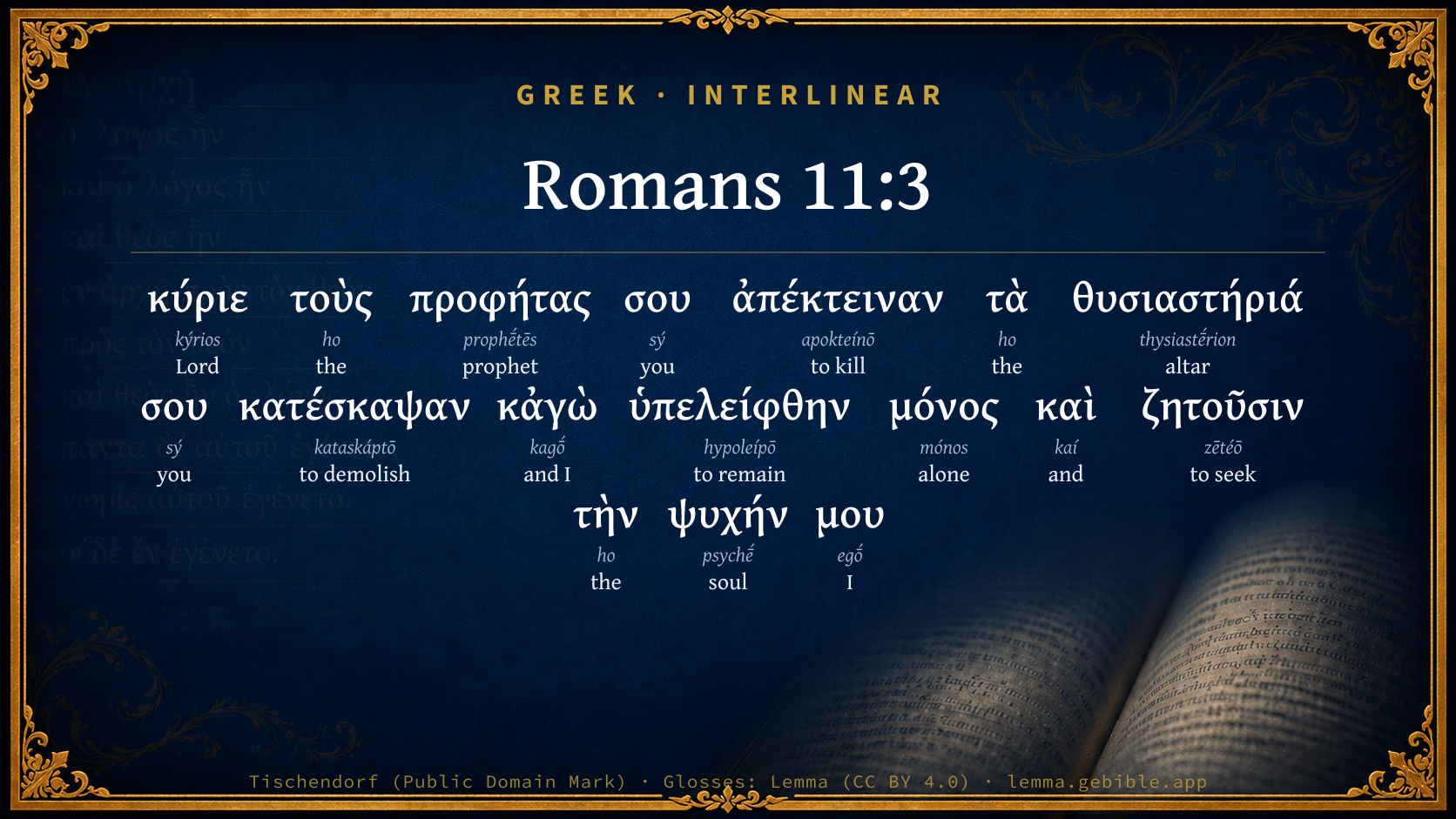
Greek (Tischendorf 8th ed.) Romans 11:3 appears in the Greek New Testament. The text above is from the Tischendorf 8th edition. Each word links to its Strong’s number and a concise gloss. Click any word for its full Thayer’s Greek Lexicon entry.
Download image
Cite this verse

Romans 11:3 (World English Bible). Public Domain. Lemma interlinear Bible study tool, https://lemma.gebible.app/v/romans/11/3.

Show BibTeX & RIS
BibTeX
RIS
English Translation
"Lord, they have killed your prophets, they have broken down your altars; and I am left alone, and they seek my life."
World English Bible · Public Domain
Highlights
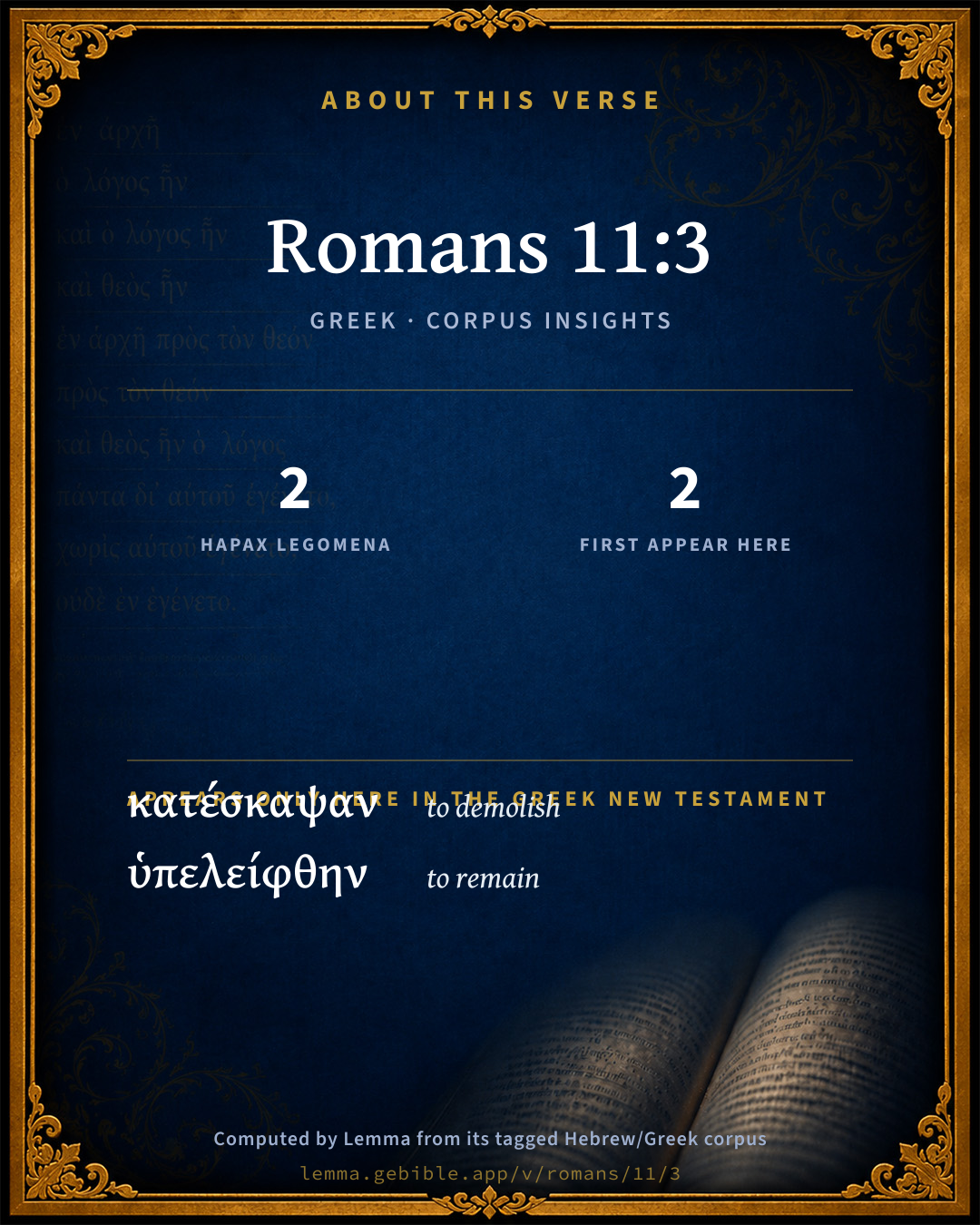
  • 2 hapax legomena — only here in the Greek New Testament
  • 2 first appearances in the Greek New Testament
Full analysis ↓
Download a study sheet

One document with this verse’s original text, its word-by-word gloss line, the meaning frame, cross-references with their text, attributed commentary, and full source and license credits — printable, and it pastes into notes with its structure intact.

This verse Autodidact and up

Study sheet (.html) Plain text (.txt)

A passage Seminary Student

Up to 50 verses in one chapter. A passage sheet keeps up to 6 commentary sources and 12 cross-references per verse, in the order this page ranks them, and says so on the sheet whenever that leaves anything out. Ask for a single verse and you get the Autodidact verse sheet above.

Everything on this page stays free to read, with no account — the sheet is a download of what is already on screen, not access to it.

Want to remove ads? Support Godless Engineer
Compare translations 3

The same verse in 3 English versions, stacked beneath the original-language interlinear above. Click any original word for its lexicon entry.

Each is an independent rendering of the whole verse — the interlinear is not word-aligned to these translations.

Highlighted words mark where these versions differ — a whole-verse word diff, not a word-by-word alignment.

  • World English Bible Public Domain
    "Lord, they have killed your prophets, they have broken down your altars; and I am left alone, and they seek my life."
  • King James Version Public Domain
    Lord, they have killed thy prophets, and digged down thine altars; and I am left alone, and they seek my life.
  • unfoldingWord Literal Text CC BY-SA 4.0
    “Lord, they killed your prophets, they tore down your altars, and I alone was left behind, and they seek my life.”

unfoldingWord Literal Text — © unfoldingWord, licensed CC BY-SA 4.0. Word-aligned USFM3 via Door43 (git.door43.org/unfoldingWord/en_ult).

Versions to compare (up to 4)

3 of 4 selected

Show all 18 translations

Every available English version of this verse, each an independent rendering of the whole verse.

  • World English Bible Public Domain
    "Lord, they have killed your prophets, they have broken down your altars; and I am left alone, and they seek my life."
  • Berean Standard Bible Public Domain
    “Lord, they have killed Your prophets and torn down Your altars. I am the only one left, and they are seeking my life as well”?
  • Majority Standard Bible Public Domain
    “Lord, they have killed Your prophets and torn down Your altars. I am the only one left, and they are seeking my life as well”?
  • King James Version Public Domain
    Lord, they have killed thy prophets, and digged down thine altars; and I am left alone, and they seek my life.
  • American Standard Version (1901) Public Domain
    Lord, they have killed thy prophets, they have digged down thine altars; and I am left alone, and they seek my life.
  • Revised Version (1885) Public Domain
    Lord, they have killed thy prophets, they have digged down thine altars: and I am left alone, and they seek my life.
  • Geneva Bible (1599) Public Domain
    Lord, they haue killed thy Prophets, and digged downe thine altars: and I am left alone, and they seeke my life?
  • Young's Literal Translation Public Domain
    `Lord, Thy prophets they did kill, and Thy altars they dug down, and I was left alone, and they seek my life;'
  • Literal Standard Version CC BY-SA 4.0
    “LORD, they killed Your prophets, and they dug down Your altars, and I was left alone, and they seek my life”;
  • Unlocked Literal Bible CC BY-SA 4.0
    “Lord, they have killed your prophets, they have broken down your altars. I alone am left, and they are seeking my life.”
  • unfoldingWord Literal Text CC BY-SA 4.0
    “Lord, they killed your prophets, they tore down your altars, and I alone was left behind, and they seek my life.”
  • Darby Bible Public Domain
    Lord, they have killed thy prophets, they have dug down thine altars; and *I* have been left alone, and they seek my life.
  • World Messianic Bible Public Domain
    “Lord, they have killed your prophets. They have broken down your altars. I am left alone, and they seek my life.”
  • Webster's Bible Public Domain
    Lord, they have killed thy prophets, and digged down thy altars; and I am left alone, and they seek my life.
  • Free Bible Version CC BY-SA 4.0
    “Lord, they've killed your prophets and destroyed your altars. I'm the only one left, and they're trying to kill me too!”
  • Bible in Basic English Public Domain
    Lord, they have put your prophets to death, and made waste your altars, and now I am the last, and they are searching for me to take away my life.
  • Text-Critical English NT CC BY 4.0
    “Lord, they have killed yoʋr prophets and demolished yoʋr altars, and I alone am left, and they are seeking my life”?
  • Tyndale New Testament (1534) Public Domain
    Lorde they have kylled thy prophetes and dygged doune thyn alters: and I am lefte only and they seke my lyfe.

Literal Standard Version (2020), Covenant Press — licensed CC BY-SA 4.0. Text via the HelloAO Bible API (eBible.org). Unlocked Literal Bible (unfoldingWord) — licensed CC BY-SA 4.0. Text via the HelloAO Bible API (eBible.org). unfoldingWord Literal Text — © unfoldingWord, licensed CC BY-SA 4.0. Word-aligned USFM3 via Door43 (git.door43.org/unfoldingWord/en_ult). Free Bible Version, Dr. Jonathan Gallagher — licensed CC BY-SA 4.0. Text via the HelloAO Bible API (eBible.org).

Word by word

More ways to search: Search by grammar → Find every occurrence → Compare this word →

Practice this passage: Drill this verse → Learn its vocabulary →

κατέσκαψαν
kataskáptō
G2679
“to demolish”
Verb, Aorist, Active, Indicative, 3rd person, Plural
Part of Speech
Verb
Tense
Aorist
Voice
Active
Mood
Indicative
Person
3rd person
Number
Plural
Full Thayer's Definition

Origin: from G2596 and G4626

TDNT: None

1. to dig under, dig down, demolish, destroy
  1. κύριε kýrios G2962 “Lord” Noun, Vocative, Singular, Masculine
  2. τοὺς ho G3588 “the” Article, Accusative, Plural, Masculine
  3. προφήτας prophḗtēs G4396 “prophet” Noun, Accusative, Plural, Masculine
  4. σου sý G4771 “you” Personal pronoun, 2nd person, Genitive, Singular
  5. ἀπέκτειναν apokteínō G615 “to kill” Verb, Aorist, Active, Indicative, 3rd person, Plural
  6. τὰ ho G3588 “the” Article, Accusative, Plural, Neuter
  7. θυσιαστήριά thysiastḗrion G2379 “altar” Noun, Accusative, Plural, Neuter
  8. σου sý G4771 “you” Personal pronoun, 2nd person, Genitive, Singular
  9. κἀγὼ kagṓ G2504 “and I” Personal pronoun, 1st person, Nominative, Singular, Aramaic form
  10. ὑπελείφθην hypoleípō G5275 “to remain” Verb, Aorist, Passive, Indicative, 1st person, Singular
  11. μόνος mónos G3441 “alone” Adjective, Nominative, Singular, Masculine
  12. καὶ kaí G2532 “and” Conjunction
  13. ζητοῦσιν zētéō G2212 “to seek” Verb, Present, Active, Indicative, 3rd person, Plural
  14. τὴν ho G3588 “the” Article, Accusative, Singular, Feminine
  15. ψυχήν psychḗ G5590 “soul” Noun, Accusative, Singular, Feminine
  16. μου egṓ G1473 “I” Personal pronoun, 1st person, Genitive, Singular

About this verse

These counts appear in no published source. They are computed here, from the morphology-tagged text and Lemma’s own curated glosses. What Lemma adds →

17
words
14
distinct lemmas
Pauline Epistles
section

Notable vocabulary

2 hapax legomena — words that appear only here in the entire Greek New Testament:

  • κατέσκαψαν to demolish G2679
  • ὑπελείφθην to remain G5275

First appearance in Scripture

These words make their first canonical appearance in the Greek New Testament here:

  • κατέσκαψαν to demolish G2679
  • ὑπελείφθην to remain G5275

Shared distinctive vocabulary

θυσιαστήριά altar G2379 occurs in 21 verses of the Greek New Testament. Also found in:
Repetition

Words recur within this verse:

Cross-references

6

Topical passages linked to Romans 11:3 in the Treasury of Scripture Knowledge — connected by theme and wording, ordered by reader-vote popularity; previews shown in the World English Bible.

  • 1 Kings 19:10–18 He said, I have been very jealous for Yahweh, the God of hosts; for the children of Israel have forsaken your covenant, thrown down your altars, and slain your prophets with the sword: and I, even I only, am left; and they seek my life, to take it away.
  • 1 Kings 18:13 Wasn't it told my lord what I did when Jezebel killed the prophets of Yahweh, how I hid one hundred men of Yahweh's prophets by fifty in a cave, and fed them with bread and water?
  • Nehemiah 9:26 Nevertheless they were disobedient, and rebelled against you, and cast your law behind their back, and killed your prophets that testified against them to turn them again to you, and they committed awful blasphemies.
  • 1 Kings 18:4 for it was so, when Jezebel cut off the prophets of Yahweh, that Obadiah took one hundred prophets, and hid them by fifty in a cave, and fed them with bread and water.)
  • Jeremiah 2:30 In vain have I struck your children; they received no correction: your own sword has devoured your prophets, like a destroying lion.
  • 1 Kings 18:30–31 Elijah said to all the people, Come near to me; and all the people came near to him. He repaired the altar of Yahweh that was thrown down.

Cross-references courtesy of OpenBible.info (CC BY 4.0).

Commentary

Notes on Romans 11:3 from classic Christian and Jewish commentators (each source and its license shown beneath its notes). The classic Christian expositions comment on the surrounding passage and are grouped to its opening verse, so a note may address several verses; the Jewish commentaries on the Tanakh (Rashi and others) are per-verse, so they appear only where the commentator wrote on this verse.

Lemma curates 59 commentaries, every one of them public domain or Creative Commons licensed, each selected and text-cleaned for this edition rather than reprinted as found. About our sources →

Bengel's Gnomon

Johann Albrecht Bengel

Rom 11:3. Κύριε, τοὺς προφήτας σου—τὴν ψυχήν μου) 1Ki 19:14, LXX., ἐγκατέλιπον τὴν διαθήκην σου οἱ υἱοὶ Ἰσραὴλ, τὰ θυσιαστήριά σου καθειλον, καὶ τοὺς προφήτας σου ἀπέκτειναν ἐν ῥομφαίᾳ, καὶ ὑπολέλειμμαι ἐγὼ μονώτατος, καὶ ζητοῦσι τὴν ψυχήν μου λαβεῖν αὐτήν. The children of Israel have forsaken Thy covenant, thrown down Thine altars, and slain Thy prophets with the sword, and I, even I only, am left, and they seek my life to take it away. The nicety of the apostle’s style is remarkable; the LXX. in this passage use μονώτατος, as they often do; Paul μόνος.

Bengel's Gnomon of the New Testament — English translation (T&T Clark, Edinburgh, 1860) — public domain. Text from a community e-Sword module.

Meyer's Critical & Exegetical Commentary

Heinrich August Wilhelm Meyer

Rom_11:3. 1Ki_19:10; 1Ki_19:14, freely from the LXX.

ἀπέκτ.] The Israelites, namely, under Ahab and Jezebel. 1Ki_18:4; 1Ki_13:22.

κατέσκαψ.] have thoroughly destroyed, have razed. Comp. Soph. Phil. 986: Τροίαν … κατασκάψαι. Eur. Hec. 22 (of the domestic altar); Dem. 361. 20; Plut. Popl. 10; 2Ma_14:38 (τὸ θυσιαστήριον).

τὰ θυσιαστ.] On the plural, as the temple in Jerusalem was the place exclusively destined for worship, the view of Estius suffices: Verisimile est, Eliam loqui de altaribus, quae passim in excelsis studio quodam pietatis Deo vero erecta fuerant; maxime postquam decem tribus regum suorum tyrannide prohibitae fuerunt, ne Jerusolymam ascenderent sacrificii causa. Quamvis enim id lege vetitum esset [see Lev_17:8-9; Deu_12:13-14] ac recte fecerint Ezechias et Josias, reges Judae, etiam ejusmodi aras evertendo, tamen impium erat eas subvertere odio cultus Dei Israel. Comp. Grotius, also Keil, on the books of Kings, p. 262, Archäol. I. § 89.

ὑπελείφθ. μόνος] in the sense of Elias: alone of the prophets; but according to the application designed by the apostle, as Rom_11:4 shows: as the only one of Thy faithful. But in this case we are not to assume, as Hofmann and others wish to do, that Paul, in order to suggest this sense, has transposed the original order of the two clauses of the versewhich is rather to be regarded as accidental; and this, considering the freedom of citation otherwise used, we need the less hesitate about, since Paul could not, even in the original order, see the reference of the verse which was in his thoughts to be excluded.

On ζητεῖν τ. ψυχ. τινος, to seek after ones life, see on Mat_2:20.

Meyer — Critical and Exegetical Commentary on the New Testament — English translation by Peter Christie, edited by Frederick Crombie (T&T Clark, 1880) — public domain. Text from a community e-Sword module.

Vincent's Word Studies in the New Testament

Marvin R. Vincent

They have killed thy prophets - and digged, etc. Paul gives the first two clauses in reverse order from both Septuagint and Hebrew.

Digged down [κατεσκαψαν] . Sept., kaqeilan pulled down.. The verb occurs only here and Act 14:16. Compare on Mt 6:19.

Altars [θυσιαστηρια] . See on Act 17:23.

Alone [μονος] . Sept. has the superlative monwtatov utterly alone. Life [ψυχην] . From yucw to breathe or blow. In classical usage it signifies life in the distinctness of individual existence, especially of man, occasionally of brutes. Hence, generally, the life of the individual. In the further development of the idea it becomes, instead of the body, the seat of the will, dispositions, desires, passions; and, combined with the swma body, denotes the constituent parts of humanity. Hence the morally endowed individuality of man which continues after death.

SCRIPTURE. In the Old Testament, answering to nephesh, primarily life, breath; therefore life in its distinct individuality; life as such, distinguished from other men and from inanimate nature. 55 Not the principle of life, but that which bears in itself and manifests the life - principle. Hence spirit [ρυαχη, πνευμα] in the Old Testament never signifies the individual. Soul [ψυχη] , of itself, does not constitute personality, but only when it is the soul of a human being. Human personality is derived from spirit [πνευμα] , and finds expression in soul or life [ψυχη] .

The New - Testament usage follows the Old, in denoting all individuals from the point of view of individual life. Thus the phrase pasa yuch every soul, i e., every person (Rom 2:9; Rom 13:1), marking them off from inanimate nature. So Rom 11:3; Rom 16:4; 2Co 1:23; 2Co 12:15; Phi 2:30; 1Th 2:8, illustrate an Old - Testament usage whereby the soul is the seat of personality, and is employed instead of the personal pronoun, with a collateral notion of value as individual personality.

These and other passages are opposed to the view which limits the term to a mere animal life - principle. See Eph 6:6; Col 3:23; the compounds sumyucoi with one soul; ijsoyucon like - minded (Phi 1:27; Phi 2:20), where personal interest and accord of feeling are indicated, and not lower elements of personality. See, especially 1Th 5:23. As to the distinction between yuch soul and pneuma spirit, it is to be said :

1. That there are cases where the meanings approach very closely, if they are not practically synonymous; especially where the individual life is referred to. See Luk 1:47; Joh 11:33, and Joh 12:27; Mt 11:29, and 1Co 16:18.

2. That the distinction is to be rejected which rests on the restriction of yuch to the principle of animal life. This cannot be maintained in the face of 1Co 14:45; 1Co 2:14, in which latter the kindred adjective yucikov natural has reference to the faculty of discerning spiritual truth. In both cases the antithesis is pneuma spirit in the ethical sense, requiring an enlargement of the conception of yucikov natural beyond that of sarkikov fleshly.

3. That yuch soul must not be distinguished from pneuma; spirit as being alone subject to the dominion of sin, since the pneuma is described as being subject to such dominion. See 2Co 7:1. So 1Th 5:23; 1Co 7:34, imply that the spirit needs sanctification. Compare Eph 4:23.

4. Yuch soul is never used of God like pneuma spirit. It is used of Christ, but always with reference to His humanity.

Whatever distinction there is, therefore, is not between a higher and a lower element in man. It is rather between two sides of the one immaterial nature which stands in contrast with the body. Spirit expresses the conception of that nature more generally, being used both of the earthly and of the non - earthly spirit, while soul designates it on the side of the creature. In this view yuch soul is akin to sarx, flesh, "not as respects the notion conveyed by them, but as respects their value as they both stand at the same stage of creatureliness in contradistinction to God." Hence the distinction follows that of the Old Testament between soul and spirit as viewed from two different points : the soul regarded as an individual possession, distinguishing the holder from other men and from inanimate nature; the spirit regarded as coming directly from God and returning to Him. "The former indicates the life - principle simply as subsistent, the latter marks its relation to God." Spirit and not soul is the point of contact with the regenerating forces of the Holy Spirit; the point from which the whole personality is moved round so as to face God. Yuch soul is thus :

1. The individual life, the seat of the personality.

2. The subject of the life, the person in which it dwells.

3. The mind as the sentient principle, the seat of sensation and desire.

4. Answer [χρηματισμος] . Only here in the New Testament. For the kindred verb crhmatizw warn, see on Mt 2:12; Luk 2:26; Act 12:26. Compare Rom 8:3. The word means an oracular answer. In the New Testament the verb is commonly rendered warn.

I have reserved [κατελιπον] . Varying from both Septuagint and Hebrew. Heb., I will reserve; Sept., thou wilt leave.

To Baal [τη βααλ] . The feminine article is used with the name instead of the masculine (as in Septuagint in this passage). It occurs, however, in the Septuagint with both the masculine and the feminine article. Various reasons are given for the use of the feminine, some supposing an ellipsis, the image of Baal; others that the deity was conceived as bisexual; others that the feminine article represents the feminine noun hJ aijscunh shame Heb., bosheth, which was used as a substitute for Baal when this name became odious to the Israelites.

Marvin R. Vincent, Word Studies in the New Testament (1887–1900) — public domain. Text from a community e-Sword/MySword module.

Hodge's Commentary on Romans, Ephesians & First Corinthians

Charles Hodge

Rom_11:3

Lord, they have killed thy prophets, and digged down thine altars, and I am left alone, etc. 1Ki_19:10. Paul gives the sense, and nearly the words of the original. The event referred to was the great defection from the true religion, and the murder of the prophets of God, under the reign of Ahab. The point of the analogy to which the apostle refers, is that although then, as now, the defection was apparently entire, yet many unknown of men remained faithful, and escaped the doom visited on the nation as such. As the law allowed only one altar, and that at Jerusalem, it has been asked, How the prophet could speak of digging down the altars of God, as though there were many? To this it is commonly answered, that the probability is, that after the defection of the ten tribes, many altars to the true God were erected in secret places, by those who adhered to the religion of their fathers, and which, as access to Jerusalem was impossible, were then tolerated by the prophets, and the destruction of which, out of hatred to the true religion, was evidence of apostasy from God.

Charles Hodge — Commentary on Romans (1835), First Corinthians (1857), and Ephesians (1856) — public domain. Text from a community e-Sword module.

Jamieson, Fausset & Brown

Robert Jamieson, A. R. Fausset & David Brown

and I am left alone--"I only am left."

Jamieson, Fausset & Brown — Commentary Critical and Explanatory on the Whole Bible (1871) — public domain (CC PDM 1.0). Text via the HelloAO Bible API.

Adam Clarke's Commentary

Verse 3. Lord, they have killed thy prophets] They will not permit any person to speak unto them in thy name; and they murder those who are faithful to the commission which they have received from thee.

Digged down thine altars] They are profligate and profane beyond example, and retain not the slightest form of religion.

I am left alone] There is no prophet besides myself left, and they seek to destroy me.

Adam Clarke's Commentary on the Bible (1810–1826) — public domain. Text from a community e-Sword/MySword module.

Ellicott's Commentary for English Readers

(3) I am left alone—i.e., of the prophets.

A Bible Commentary for English Readers, edited by Charles John Ellicott (1878–1897) — public domain. Text from a community e-Sword module.

The Cambridge Bible for Schools and Colleges

gen. ed. J. J. S. Perowne

3. Lord, they have killed, &c.] 1Ki_19:10. The quotation is not precisely with either LXX. or Heb.; but substantially exact.—The Gr. past verbs here are aorists.

3. This, and not the evangelical equality of Jew and Gentile, is here in view; with the special object of reminding the Gentile Christian how singular and eminent had been the work of the Jewish Church; how welcome individual Jews must be to return to the Church, which, though now universal in extent, was, and of course is always, Jewish in descent; and how natural it was that a special work in that Church should yet be designed for an aggregate of Jewish believers.

The Cambridge Bible for Schools and Colleges (gen. ed. J. J. S. Perowne; Cambridge University Press, 1878–1918) — public domain. Text from a community e-Sword module.

John Gill's Exposition

Lord, they have killed thy prophets,.... By the order of Jezebel, wife of Ahab king of Israel, Kg1 18:4. This sin of slaying the prophets of the Lord is charged upon the Jews by Christ, Mat 23:31, and by the apostle, Th1 2:15. In the text in Kg1 19:14, it is added, "with the sword": which expresses the manner of death they were put to; and this clause is there put after the following, according to a rule of transposition among the Jews; See Gill on Mat 27:10.

And digged down thine altars; either the altars which the patriarchs had formerly built, and were still in being; and though not used, yet were kept and had in great veneration; wherefore the pulling of them down was done in contempt of them, and of the worship of God, which had been formerly performed there; or else such altars, which the religious among the ten tribes built, since the times of Jeroboam, who forbad them to go up to Jerusalem, but ordered them to go to Dan or Bethel; which they not choosing to do erected altars in different places for divine service, and which the Jews (r) say were allowed; for from that time, the prohibition of altars at other places than at Jerusalem ceased:

and I am left alone: meaning either as a prophet, not knowing that Obadiah had hid an hundred prophets by fifty in a cave, Kg1 18:4; or else as a worshipper of the true God, imagining that he was the only person in Israel, that had a true zeal for the Lord of hosts:

and they seek my life; lay in wait for it, Jezebel by her emissaries being in quest of him; it is added in Kg1 19:14, "to take it away"; for she had swore by her gods, that by the morrow about that time, his life should be as the life of one of the prophets of Baal he had slain; and in one copy it is added here.

(r) Kimchi in 1 Kings xviii. 30.

John Gill's Exposition of the Whole Bible (1746–1763) — public domain (CC PDM 1.0). Text via the HelloAO Bible API.

Trapp's Complete Commentary

John Trapp

3 Lord, they have killed thy prophets, and digged down thine altars; and I am left alone, and they seek my life.

Ver. 3. And I am left alone] To withstand and reform the common corruptions. Some have commended it to our consideration, that from the first service in the temple when it was built, and the time of Elijah’s reformation, was about a hundred years. And from the reformation in King Edward VI’s days until now is about the same proportion of time.

John Trapp, A Commentary or Exposition upon All the Books of the Old and New Testament (1647–1656) — public domain. Text from a community e-Sword module.

Albert Barnes' Notes on the Bible

Lord, they have killed ... - This is taken from 1Ki 19:10. The quotation is not literally made, but the sense is preserved. This was a charge which Elijah brought against the whole nation; and the act of killing the prophets he regarded as expressive of the character of the people, or that they were universally given to wickedness. The fact was true that they had killed the prophets, etc.; 1Ki 18:4, 1Ki 18:13; but the inference which Elijah seems to have drawn from it, that there were no pious people in the nation, was not well founded.

And digged down - Altars, by the Law of Moses, were required to be made of earth or unhewn stones; Exo 20:24-25. Hence, the expression to dig them down means completely to demolish or destroy them.

Thine altars - There was one great altar in the front of the tabernacle and the temple, on which the daily sacrifices of the Jews were to be made. But they were not forbidden to make altars also elsewhere; Exo 20:25. And hence they are mentioned as existing in other places; 1Sa 7:17; 1Sa 16:2-3; 1Ki 18:30, 1Ki 18:32. These were the altars of which Elijah complained as having been thrown down by the Jews; an act which was regarded as expressive of signal impiety.

I am left alone - I am the only prophet which is left alive. We are told that when Jezebel cut off the prophets of the Lord, Obadiah took a hundred of them and hid them in a cave; 1Ki 18:4. But it is not improbable that they had been discovered and put to death by Ahab. The account which Obadiah gave Elijah when he met him 1Ki 18:13 seems to favor such a supposition.

Seek my life - That is, Ahab and Jezebel seek to kill me. This they did because he had overcome and slain the prophets of Baal; 1Ki 19:1-2. There could scarcely be conceived a time of greater distress and declension in religion than this. It has not often happened that so many things that were disheartening have occurred to the church at the same period of time. The prophets of God were slain; but one lonely man appeared to have zeal for true religion; the nation was running to idolatry; the civil rulers were criminally wicked, and were the leaders in the universal apostasy; and all the influences of wealth and power were setting in against the true religion to destroy it. It was natural that the solitary man of God should feel disheartened and lonely in this universal guilt; and should realize that he had no power to resist this tide of crime and calamities.

Albert Barnes' Notes on the Bible (1834–1885) — public domain. Text from a community e-Sword/MySword module.

Matthew Poole's English Annotations

See 1Ki 19:10,14.

Digged down thine altars: these were not the altars of the high places, for they are commended that cast them down; nor the altars in the temple at Jerusalem, for they were out of the reach of the ten tribes, against whom Elias complains: but such altars (say some) as the godly of the ten tribes did build to serve God with, when they were not permitted to go up to Jerusalem; in which case the building of private altars (as some learned Jews have affirmed) was allowed. Or else by

altars you may understand such altars as Elias himself, by the special commandment of God, had erected. Others, by digging down God’s altars, do understand their corrupting and destroying the true worship of God; and the words are to be taken synecdochically, or metonomically, the sign being put for the thing signified.

I am left alone; so it was, for aught he knew; for few, if any, did publicly own the true worship of God: so general was the defection of the ten tribes in those days.

Matthew Poole's English Annotations on the Holy Bible (1683–1685) — public domain. Text from a community e-Sword/MySword module.

Whedon's Commentary on the Bible

Daniel D. Whedon

3. Digged down—Built of earth and stones, it required digging utterly to demolish them.

3. Again, we may contemplate the race as a body of living men, under Christ, but unregenerate. Their condemnation, then, arises from their native pravity responsibly sanctioned by their own free act, and their rejection of Christ and holiness. (Note on Joh_3:19.) Men, then, are damned by nature, damned by justice, and even “damned by grace.” It is in this view of men that Paul calls them “by nature children of wrath.” (Eph_2:3.)

Daniel D. Whedon (gen. ed.), Commentary on the Old and New Testaments (1874–1909) — public domain. Text from a community e-Sword module.

John Wesley's Explanatory Notes

1 Kings xix, 10.

John Wesley, Explanatory Notes Upon the Whole Bible (1754–1765) — public domain. Text via the GEBible commentary corpus.

Godbey's Commentary on the New Testament

William B. Godbey

3. “Lord, they have slain thy prophets, they have digged down thine altars, I am left alone and they seek my life.

William B. Godbey, Commentary on the New Testament (1896–1900) — public domain. Text from a community e-Sword module.

McGarvey & Pendleton's Commentaries

J. W. McGarvey

Lord, they have killed thy prophets, they have digged down thine altars; and I am left alone, and they seek my life . [Against these two proofs adduced by the apostle it might be objected that if God was not rejecting his people he must be receiving them, but you, Paul, practically admit that this is not the case, for, were it so, why can you point only to your single self as accepted? Surely your very proofs are against you. To this objection Paul presents a third proof--i. e., the case of Elijah--and his argument, paraphrased, runs thus: You err in supposing that I alone am accepted, and this I will prove by the case of Elijah, who, prophet of prophets though he was, erred in so judging by appearances as to think that he alone remained acceptable. The law required that the nation use the one altar which stood in front of the sanctuary in Jerusalem ( Lev_17:8-9 ; Deu_12:1-14 ). But the Rabbins say (see Lightfoot and Whitby ad h. l.) that when the ten tribes revolted, and their kings forbade them to go up to Jerusalem to worship, then this law ceased as to them, and the Lord permitted them to build other altars and sacrifice on them as at the beginning ( Gen_12:7-8 ; Gen_13:4 ; Gen_13:18 ; Gen_22:9 ; Gen_26:25 ; Gen_33:20 ; Gen_35:1-7 ; Gen_46:1 ), and as they did before worship was centered at Jerusalem ( 1Sa_7:9 ; 1Sa_7:17 ; 1Sa_9:13 ; 1Sa_11:15 ; 1Sa_16:2-3 ). That this is so is proved by the conduct of Elijah, who reconstructed the Lord's altar on Mt. Carmel (which these apostates of whom he speaks had thrown down) and offered sacrifice thereon, and the Lord publicly sanctioned and approved the altar by sending fire from heaven ( 1Ki_18:30-39 ). The altars were to be made of earth and unhewn stone ( Exo_20:24-25 ), hence it was proper to speak of digging them down.]

J. W. McGarvey (with Philip Y. Pendleton), Commentaries on the New Testament (The Fourfold Gospel, 1914; Acts; and the epistles) — public domain. Text from a community e-Sword/MySword module.

Cambridge Greek Testament for Schools and Colleges

3, 4. 1Ki 19:10; 1Ki 19:18.

Cambridge Greek Testament for Schools and Colleges (Cambridge University Press, 1896; 21 vols, various authors incl. Carr, Maclear, Plummer, Farrar, Lumby, Moule, M. R. James, Simcox) — public domain. Text from a community e-Sword module.

International Critical Commentary

3. Κύριε, τοὺς προφήτας κ.τ.λ. The two quotations come from 1Ki 19:10, 1Ki 19:14, 1Ki 19:18; the first being repeated twice. Elijah has fled to Mt. Horeb from Jezebel, and accuses his countrymen before God of complete apostasy; he alone is faithful. God answers that even although the nation as a whole has deserted Him, yet there is a faithful remnant, 7,000 men who have not bowed the knee to Baal. There is an analogy, St. Paul argues, between this situation and that of his own day. The spiritual condition is the same. The nation as a whole has rejected God’s message, now as then; but now as then also there is a faithful remnant left, and if that be so God cannot be said to have cast away His people.

The quotation is somewhat shortened from the LXX, and the order of the clauses is inverted, perhaps to put in a prominent position the words τοὺς προφήτας σου ἀπέκτειναν to which there was most analogy during St. Paul’s time (cf. Act 7:52; 1Th 2:14). The καί between the clauses of the TR. is read by D E L and later MSS. Justin Martyr, Dial. 39. p. 257 D, quotes the words as in St. Paul and not as in the LXX: Καὶ γὰρ Ἠλίας περὶ ὑμῶν πρὸς τὸν Θεὸν ἐντυγχάνων οὕτως λέγει· Κύριε, τοὺς προφήτας σου ἀπέκτειναν καὶ τὰ θυσιαστήριά σου κατέσκαψαν κἀγὼ ὑπελείφθην μόνος καὶ ζητοῦσι τὴν ψυχήν μου. καὶ ἀποκρίνεται αὐτῷ, Ἔτι εἰσί μοι ἑπτακισχίλιοι ἄνδρες, οἳ οὐκ ἔκαμψαν γόνυ τῇ Βάαλ.

International Critical Commentary — older volumes (1896–1929), various authors — public domain. Text from a community e-Sword module.

Godet's Commentaries

Frédéric Louis Godet

Vv. 3. In the Hebrew text the second clause of the verse is put first; it is needless to seek an intention for this inversion.

Mention is made of “altars of God,” though according to the law there was, properly speaking, only one legitimate altar, that of the sanctuary. But the law itself authorized, besides, the erection of altars in the places where God had visibly revealed Himself (Exo 20:24), as at Bethel, for example. Moreover, participation in the legitimate altar being interdicted within the kingdom of the ten tribes, it is probable that in such circumstances the faithful ventured to sacrifice elsewhere than at Jerusalem (1Ki 8:29).

Meyer interprets the word alone in this sense: “alone of all the prophets.” This meaning seems to us incompatible with God’s answer. The seven thousand are not prophets, but simple worshippers. Elijah, in that state of deep discouragement into which foregoing events had plunged him, no longer saw in Israel any others than idolaters, or believers too cowardly to deserve the name.

Frédéric Louis Godet — Commentaries on Luke, John, Romans, and 1 Corinthians — English translation (T&T Clark, Edinburgh, 1870s–1890s) — public domain. Text from a community e-Sword module.

Lesson kit

Teaching starters — assembled from the data on this page, not authored interpretation. Every prompt links to the verse data it draws on. Edit before teaching.

Romans, in the Pauline Epistles, opens this verse with 17 words (14 distinct Greek lemmas). Its most distinctive word is kataskáptō (“to demolish”). A historical commentator’s framing appears above. Read the whole chapter for the surrounding context.

Discussion questions

  1. The word kataskáptō carries the sense “to demolish.” How does it shape the verse?
  2. 2 words here appear nowhere else in the Greek New Testament. Why might the author reach for such rare wording?
  3. 2 words make their first appearance in Scripture here. What does this debut establish?
  4. How does Matthew 5:23, which shares the word «altar», read alongside this verse?
  5. What does the repetition of “the” (3× in this one verse) do in this verse?
  6. The translations on this page render this verse differently — a whole-verse word diff, not a word-by-word alignment. What might account for the different wordings?
  7. Compare how Bengel's Gnomon and Meyer's Critical & Exegetical Commentary read this verse. Where do they agree or differ?

Things to notice

  • 2 words in this verse appear nowhere else in the Greek New Testament.
  • 2 words make their first canonical appearance in Scripture here.
  • These translations choose different wording for 6 words in this verse.
  • “the” occurs 3× in this single verse.
  • 14 distinct Greek lemmas span 17 words in this verse.

Reading settings

Reading text

Shown beneath each verse's original-language words.

Old Testament
Old Testament edition

Read the OT as the Masoretic Hebrew (MT) or the Greek Septuagint (LXX).

English shown for the Greek Septuagint (in the Hebrew ↔ Greek comparison).

Comparing translations? Open the Compare panel on any verse page to stack up to four side by side.