
Romans 5:16

Greek (Tischendorf 8th ed.) Romans 5:16 appears in the Greek New Testament. The text above is from the Tischendorf 8th edition. Each word links to its Strong’s number and a concise gloss. Click any word for its full Thayer’s Greek Lexicon entry.
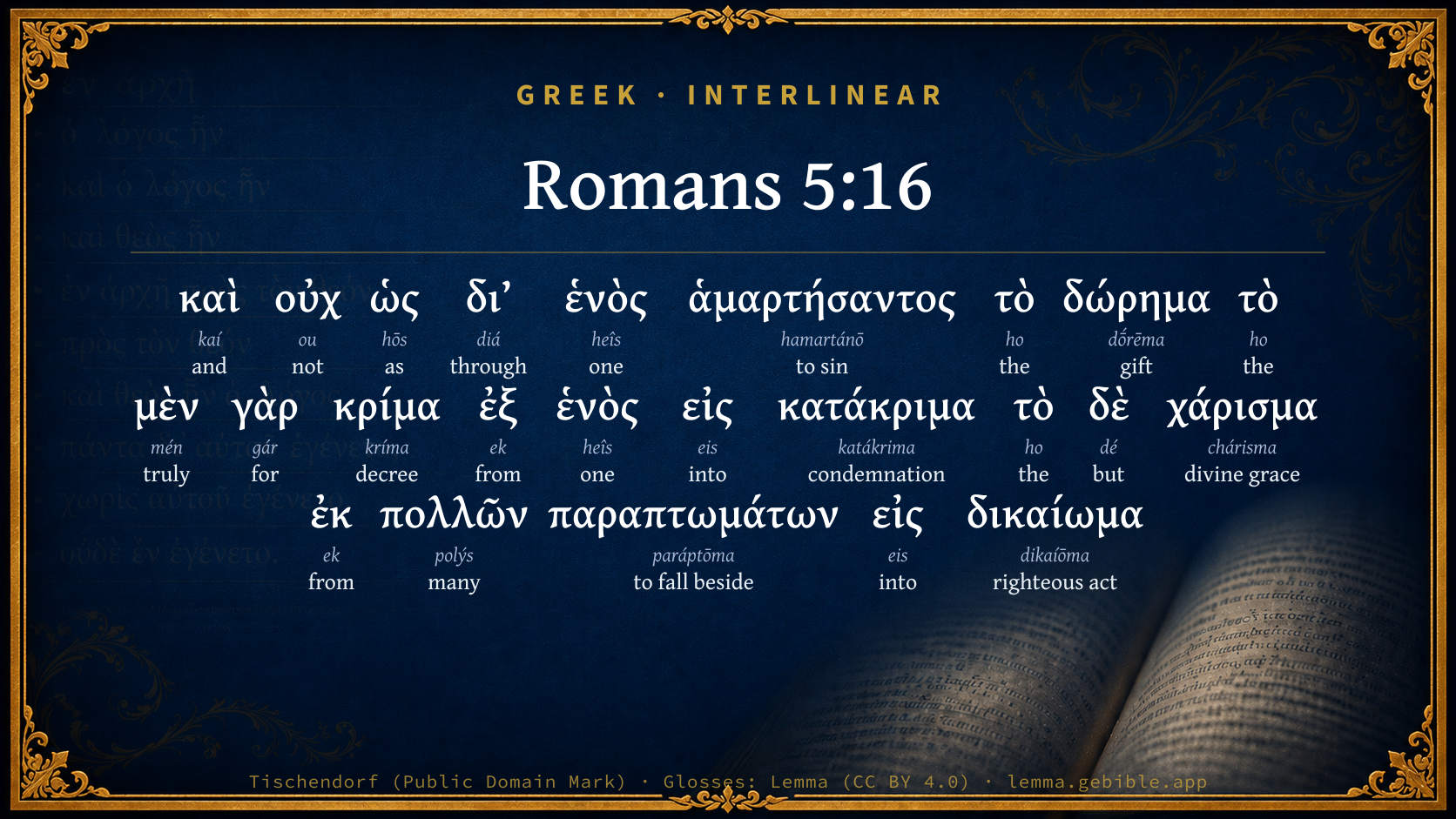
Download image
Cite this verse

Romans 5:16 (World English Bible). Public Domain. Lemma interlinear Bible study tool, https://lemma.gebible.app/v/romans/5/16.

Show BibTeX & RIS
BibTeX
RIS
English Translation
The gift is not as through one who sinned: for the judgment came by one to condemnation, but the free gift came of many trespasses to justification.
World English Bible · Public Domain
Highlights
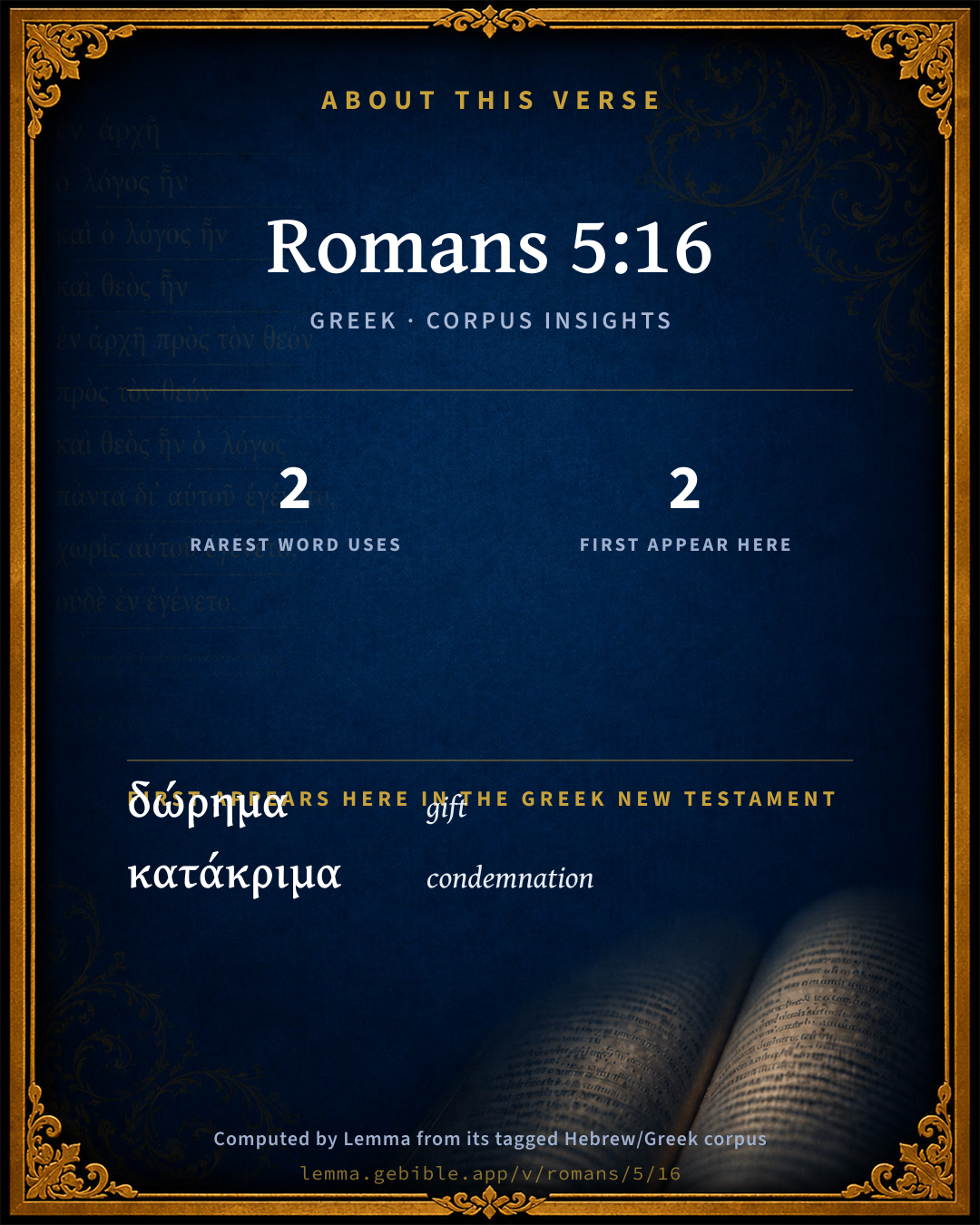
  • 2 first appearances in the Greek New Testament
Full analysis ↓
Download a study sheet

One document with this verse’s original text, its word-by-word gloss line, the meaning frame, cross-references with their text, attributed commentary, and full source and license credits — printable, and it pastes into notes with its structure intact.

This verse Autodidact and up

Study sheet (.html) Plain text (.txt)

A passage Seminary Student

Up to 50 verses in one chapter. A passage sheet keeps up to 6 commentary sources and 12 cross-references per verse, in the order this page ranks them, and says so on the sheet whenever that leaves anything out. Ask for a single verse and you get the Autodidact verse sheet above.

Everything on this page stays free to read, with no account — the sheet is a download of what is already on screen, not access to it.

Want to remove ads? Support Godless Engineer
Compare translations 3

The same verse in 3 English versions, stacked beneath the original-language interlinear above. Click any original word for its lexicon entry.

Each is an independent rendering of the whole verse — the interlinear is not word-aligned to these translations.

Highlighted words mark where these versions differ — a whole-verse word diff, not a word-by-word alignment.

  • World English Bible Public Domain
    The gift is not as through one who sinned: for the judgment came by one to condemnation, but the free gift came of many trespasses to justification.
  • King James Version Public Domain
    And not as it was by one that sinned, so is the gift: for the judgment was by one to condemnation, but the free gift is of many offences unto justification.
  • unfoldingWord Literal Text CC BY-SA 4.0
    And the gift not as through one who sinned. For indeed, the judgment from one, to condemnation, but the gracious gift from many trespasses, to justification.

unfoldingWord Literal Text — © unfoldingWord, licensed CC BY-SA 4.0. Word-aligned USFM3 via Door43 (git.door43.org/unfoldingWord/en_ult).

Versions to compare (up to 4)

3 of 4 selected

Show all 19 translations

Every available English version of this verse, each an independent rendering of the whole verse.

  • World English Bible Public Domain
    The gift is not as through one who sinned: for the judgment came by one to condemnation, but the free gift came of many trespasses to justification.
  • Berean Standard Bible Public Domain
    Again, the gift is not like the result of the one man’s sin: The judgment that followed one sin brought condemnation, but the gift that followed many trespasses brought justification.
  • Majority Standard Bible Public Domain
    Again, the gift is not like the result of the one man’s sin: The judgment that followed one sin brought condemnation, but the gift that followed many trespasses brought justification.
  • King James Version Public Domain
    And not as it was by one that sinned, so is the gift: for the judgment was by one to condemnation, but the free gift is of many offences unto justification.
  • American Standard Version (1901) Public Domain
    And not as through one that sinned, `so' is the gift: for the judgment `came' of one unto condemnation, but the free gift `came' of many trespasses unto justification.
  • Revised Version (1885) Public Domain
    And not as through one that sinned, so is the gift: for the judgment came of one unto condemnation, but the free gift came of many trespasses unto justification.
  • Geneva Bible (1599) Public Domain
    Neither is the gift so, as that which entred in by one that sinned: for the fault came of one offence vnto condemnation: but the gift is of many offences to iustification.
  • Douay-Rheims (1899) Public Domain
    And not as it was by one sin, so also is the gift. For judgment indeed was by one unto condemnation; but grace is of many offences, unto justification.
  • Young's Literal Translation Public Domain
    and not as through one who did sin `is' the free gift, for the judgment indeed `is' of one to condemnation, but the gift `is' of many offences to a declaration of `Righteous,'
  • Literal Standard Version CC BY-SA 4.0
    and not as through one who sinned [is] the free gift, for the judgment indeed [is] of one to condemnation, but the gift [is] of many offenses to a declaration of “Righteous,”
  • Unlocked Literal Bible CC BY-SA 4.0
    For the gift is not like the outcome of that one man's sin. The judgment followed one trespass and brought condemnation, but the gift followed many trespasses and brought justification.
  • unfoldingWord Literal Text CC BY-SA 4.0
    And the gift not as through one who sinned. For indeed, the judgment from one, to condemnation, but the gracious gift from many trespasses, to justification.
  • Darby Bible Public Domain
    And [shall] not as by one that has sinned [be] the gift? For the judgment [was] of one to condemnation, but the act of favour, of many offences unto justification.
  • World Messianic Bible Public Domain
    The gift is not as through one who sinned; for the judgment came by one to condemnation, but the free gift followed many trespasses to justification.
  • Webster's Bible Public Domain
    And not as it was by one that sinned, so is the gift. For the judgment was by one to condemnation, but the free gift is of many offenses to justification.
  • Free Bible Version CC BY-SA 4.0
    The result of the gift is not like that of the sin. The result of Adam's sin was judgment and condemnation, but the gift sets us right with God, despite our many sins.
  • Bible in Basic English Public Domain
    And the free giving has not the same effect as the sin of one: for the effect of one man's sin was punishment by the decision of God, but the free giving had power to give righteousness to wrongdoers in great number.
  • Text-Critical English NT CC BY 4.0
    And the gift cannot be compared to the result of the one man's sin; for the judgment that arose from one trespass brought condemnation, but the gift that arose from many trespasses brought justification.
  • Tyndale New Testament (1534) Public Domain
    And the gifte is not over one synne as deeth cam thorow one synne of one that synned. For damnacion cam of one synne vnto condemnacion: but the gyft cam to iustify from many synnes.

Literal Standard Version (2020), Covenant Press — licensed CC BY-SA 4.0. Text via the HelloAO Bible API (eBible.org). Unlocked Literal Bible (unfoldingWord) — licensed CC BY-SA 4.0. Text via the HelloAO Bible API (eBible.org). unfoldingWord Literal Text — © unfoldingWord, licensed CC BY-SA 4.0. Word-aligned USFM3 via Door43 (git.door43.org/unfoldingWord/en_ult). Free Bible Version, Dr. Jonathan Gallagher — licensed CC BY-SA 4.0. Text via the HelloAO Bible API (eBible.org).

Word by word

More ways to search: Search by grammar → Find every occurrence → Compare this word →

Practice this passage: Drill this verse → Learn its vocabulary →

δώρημα
dṓrēma
G1434
“gift”
Noun, Nominative, Singular, Neuter
Part of Speech
Noun
Case
Nominative
Number
Singular
Gender
Neuter
Full Thayer's Definition

Origin: from G1433

TDNT: 04:46,2

1. a gift, bounty, benefaction
  1. καὶ kaí G2532 “and” Conjunction
  2. οὐχ ou G3756 “not” Particle, Negative
  3. ὡς hōs G5613 “as” Adverb
  4. δι’ diá G1223 “through” Preposition
  5. ἑνὸς heîs G1520 “one” Adjective, Genitive, Singular, Masculine
  6. ἁμαρτήσαντος hamartánō G264 “to sin” Verb, Aorist, Active, Participle, Genitive, Singular, Masculine
  7. τὸ ho G3588 “the” Article, Nominative, Singular, Neuter
  8. τὸ ho G3588 “the” Article, Nominative, Singular, Neuter
  9. μὲν mén G3303 “truly” Particle
  10. γὰρ gár G1063 “for” Conjunction
  11. κρίμα kríma G2917 “decree” Noun, Nominative, Singular, Neuter
  12. ἐξ ek G1537 “from” Preposition
  13. ἑνὸς heîs G1520 “one” Adjective, Genitive, Singular, Masculine
  14. εἰς eis G1519 “into” Preposition
  15. κατάκριμα katákrima G2631 “condemnation” Noun, Accusative, Singular, Neuter
  16. τὸ ho G3588 “the” Article, Nominative, Singular, Neuter
  17. δὲ dé G1161 “but” Conjunction
  18. χάρισμα chárisma G5486 “divine grace” Noun, Nominative, Singular, Neuter
  19. ἐκ ek G1537 “from” Preposition
  20. πολλῶν polýs G4183 “many” Adjective, Genitive, Plural, Neuter
  21. παραπτωμάτων paráptōma G3900 “to fall beside” Noun, Genitive, Plural, Neuter
  22. εἰς eis G1519 “into” Preposition
  23. δικαίωμα dikaíōma G1345 “righteous act” Noun, Accusative, Singular, Neuter

About this verse

These counts appear in no published source. They are computed here, from the morphology-tagged text and Lemma’s own curated glosses. What Lemma adds →

24
words
19
distinct lemmas
Pauline Epistles
section

Notable vocabulary

The rarest word here is δώρημα gift G1434 — appearing just 2 times in the whole Greek New Testament.

First appearance in Scripture

These words make their first canonical appearance in the Greek New Testament here:

  • δώρημα gift G1434
  • κατάκριμα condemnation G2631

Shared distinctive vocabulary

δώρημα gift G1434 occurs in 2 verses of the Greek New Testament. Also found in:
Repetition

Words recur within this verse:

Cross-references

11

Topical passages linked to Romans 5:16 in the Treasury of Scripture Knowledge — connected by theme and wording, ordered by reader-vote popularity; previews shown in the World English Bible.

  • Acts 13:38–39 Be it known to you therefore, brothers, that through this man is proclaimed to you remission of sins,
  • Isaiah 1:18 "Come now, and let us reason together," says Yahweh: "Though your sins be as scarlet, they shall be as white as snow. Though they be red like crimson, they shall be as wool.
  • Isaiah 43:25 I, even I, am he who blots out your transgressions for my own sake; and I will not remember your sins.
  • Isaiah 44:22 I have blotted out, as a thick cloud, your transgressions, and, as a cloud, your sins: return to me; for I have redeemed you.
  • 1 Corinthians 6:9–11 Or don't you know that the unrighteous will not inherit the Kingdom of God? Don't be deceived. Neither the sexually immoral, nor idolaters, nor adulterers, nor male prostitutes, nor homosexuals,
  • 1 Corinthians 11:32 But when we are judged, we are punished by the Lord, that we may not be condemned with the world.
  • Galatians 3:10 For as many as are of the works of the law are under a curse. For it is written, "Cursed is everyone who doesn't continue in all things that are written in the book of the law, to do them."
  • 1 Timothy 1:13–16 although I was before a blasphemer, a persecutor, and insolent. However, I obtained mercy, because I did it ignorantly in unbelief.
  • James 2:10 For whoever shall keep the whole law, and yet stumble in one point, he has become guilty of all.
  • Genesis 3:6–19 When the woman saw that the tree was good for food, and that it was a delight to the eyes, and that the tree was to be desired to make one wise, she took of the fruit of it, and ate; and she gave some to her husband with her, and he ate.
  • Luke 7:47–50 Therefore I tell you, her sins, which are many, are forgiven, for she loved much. But to whom little is forgiven, the same loves little."

Cross-references courtesy of OpenBible.info (CC BY 4.0).

Commentary

Notes on Romans 5:16 from classic Christian and Jewish commentators (each source and its license shown beneath its notes). The classic Christian expositions comment on the surrounding passage and are grouped to its opening verse, so a note may address several verses; the Jewish commentaries on the Tanakh (Rashi and others) are per-verse, so they appear only where the commentator wrote on this verse.

Lemma curates 59 commentaries, every one of them public domain or Creative Commons licensed, each selected and text-cleaned for this edition rather than reprinted as found. About our sources →

The Cambridge Bible for Schools and Colleges

gen. ed. J. J. S. Perowne

16. And not, &c.] The line of thought here is less difficult if we take Rom_5:17 in close connexion, and read the words from “for the judgment” to “unto justification” as a parenthetic statement of the two facts before us. We may then paraphrase Rom_5:16-17 thus: “The Gift, in wonder and greatness of quality, far exceeds the Ruin, though each is the result of one Person’s act: (for, as we know, the sentence and execution was the result of one man’s one sin, while the atonement and justification is the result, in a sense, of many men’s many sins:)—I say the Gift exceeds the Ruin; for while the result of Adam’s sin was just the lawful reign of death over men as sinners, the result of Christ’s work shall be not a mere reversal of this, but the reign of justified men over death in glory.”

And not, &c.] The Gr. here is more exactly, And not as by means of the sinning of one, [is] the gift: for the sentence [resulted] from one [person] unto condemnation; but the boon [resulted] from many offences unto acquittal. Here the “one” is plainly Adam; and the contrast is between his one-ness, and that of his sin, and the many offences of his many sons. St Paul estimates the greatness of the pardon of all the sins of all the justified from the tremendous legal results of the one sin of Adam. Such is sin, that Adam’s sin brought death on all men; such is grace, that innumerable sins are, through the Propitiation, “abundantly pardoned.”—The phrase above, “resulted from,” has of course a different bearing in the two clauses. The first sin was the strict cause of the sentence; while the “many offences” “caused” the boon, only as calling forth the mercy.—“The sentence … unto condemnation;” “the boon … unto acquittal:”—in each of these phrases the last word explains the first: the sentence amounted to sentence of death; the gift was nothing less than acquittal.—The hereditary guilt and doom of the Fall is very distinctly taught in this verse. The sentence of death on man as man came “by means of the sinning of one,” in a sense expressly distinguished from the guilt of the “many offences” of the many.

The Cambridge Bible for Schools and Colleges (gen. ed. J. J. S. Perowne; Cambridge University Press, 1878–1918) — public domain. Text from a community e-Sword module.

The Biblical Illustrator

Joseph S. Exell

Rom_5:16

And not as it was by one that sinned, so is the gift.

The Adamic and Christian dispensations

I. The adamic.

1. One offence brought condemnation.

2. Upon all mankind.

3. By a just and inevitable law.

II. The Christian.

1. Grace is free.

2. Brings justification.

3. For all.

4. From many offences. (J. Lyth, D. D.)

The one and the many

With the one sinner is contrasted the multitude of the justified. What a difference between the power of the spark which sets fire to the forest by lighting a withered branch, and the power of the instrument which extinguishes the conflagration at the moment when every tree is on fire, and makes them all live again. (Prof. Godet.)

Christ and the many

He gave His life a ransom for many (Mat_20:28); His blood was shed for many (Mat_26:28; Mar_14:24); He bare the sins of many (Isa_53:11-12); by His knowledge He justifies many (Isa_53:11); He brings many sins to glory (Heb_2:10). The many are a multitude which no man can number (Rev_7:9). (T. Robinson, D. D.)

Salvation a free gift

One excuse which awakened sinners are accustomed to allege in their own defence is, that they wish to love God with all their heart, but cannot. They do, indeed, wish to be saved, but they are not willing to be saved in Gods way; that is, they are not willing to accept salvation as a free gift. They would do anything to buy it, but will not take it without money and without price. Suppose that you were very sick, and were told by the physician that there was but one medicine in the world which could save your life, and this was exceedingly precious; that you were also told that there was but one person in the world who had any of this in his possession; and that, although he was willing to give it to those who asked, he would on no account sell any. Suppose this person to be one whom you had treated with great neglect and contempt, injured in every possible way. How exceedingly unwilling would you be to send to him for the medicine as a gift: you would rather purchase it at the expense of your whole fortune. You would defer sending as long as possible; and when you found you were daily growing worse, and nothing else could save you, you would be obliged, however reluctantly, to send and ask for some. Just so unwilling are sinners to apply to God for salvation, as a free gift; and they will not do it until they find themselves perishing, and that there is no other hope for them. (E. Payson.)

Sin the occasion of glorifying God

I do believe that sin in itself has the same aspect as affliction--that it makes room for the mercy of God. I hardly dare say what Augustine, when speaking of the fall and of the sin of Adam, and looking to all the display of grace that followed it, said. He said, beata culpa--happy fault, as if he thought that by means of sin the grace of God is so magnified and displayed he might call it a happy fault. I will not go so far. I scarcely do more than repeat what that great master in Israel once said; but I do say this, that I cannot imagine an occasion for glorifying God equal to the fact that man has sinned. God so loved the world as to give Christ to die for sinners, and how could this have been if there had been no sin? The Cross is a constellation of glory that is brighter than creation itself. (C. H. Spurgeon.)

The Biblical Illustrator, edited by Joseph S. Exell (c. 1880s–1900s) — public domain. Text from a community e-Sword module.

Bengel's Gnomon

Johann Albrecht Bengel

Rom 5:16. Καὶ, and) The meaning is to this effect: and not, as by one that sinned (is the judgment) (so by one, the author of righteousness is) the gift [Engl. Vers, is different]; that is to say; And [moreover] the proportion [the ratio] on both sides, is not the same.—κρίμα, the judgment) namely, is.—ἐξ ἑνὸς, from one) namely, offence, [Engl. Vers. differs]; for the antithesis, of many offences, follows. The one offence was of the one man; the many offences are of many men.[53]

[53] I frankly confess, that I do not clearly understand how this plural proves, that Paul is not treating here of original sin, as if it ever exists without the accompaniment of other sins, which is the assumption of some one of the more recent commentators. Doubtless the Apostle distinctly shows, that the gift in Christ is the cure both for original sin, and for the actual offences of individuals BESIDES. There are, certainly, many actual sins, which are not to be considered as the necessary consequence of the first sin (otherwise all the morality of our actions would now cease); but there is no sin, whether it be called original or actual, the pardon and removal of which, ought not to be considered as the mere effect of the gift, χαρίσματος.Therefore the power of the gift, τοῦ χαρίσματος, is greater than that of the judgment, τοῦ κρίματος.—E. B.

Bengel's Gnomon of the New Testament — English translation (T&T Clark, Edinburgh, 1860) — public domain. Text from a community e-Sword module.

Meyer's Critical & Exegetical Commentary

Heinrich August Wilhelm Meyer

Rom_5:16. Continuation of the difference between the gift of grace and the consequence of the fall, and that with reference to the causal origination on either side in a numerical aspect.[1315]

And not as through one, who has sinned, so is the gift, i.e. it is not so in its casethe state of the case there is the very reverseas if it were occasioned διʼ ἑνὸς ἁμαρτήσ. (like death through Adam). The ΔΙʼ ἙΝῸς ἉΜΑΡΤΉΣ. indicates the unity of the person and of the accomplished sinful act; comp Stölting. Beyond the simple ἘΣΤΊ after ΔΏΡΗΜΑ nothing is to be supplied (so also Mangold), because the words without supplement are quite in accordance with the Greek use of Ὡς (Bernhardy, p. 352, Stallbaum, a[1317] Plat. Sympos. p. 179 E), and yield an appropriate sense, whereas none of the supplements that have been attempted are suggested by the context. It has been proposed, e.g. after ἁμαρτ. to supply ΘΆΝΑΤΟς ΕἸΣῆΛΘΕΝ (Grotius, Estius, Koppe), or ΤῸ ΚΡῖΜΑ or ΚΑΤΆΚΡΙΜΑ (Bengel, Klee, Reiche, Köllner; or after Ὡς: ΤΌ (Beza), which is indeed impossible, but is nevertheless resorted to even by de Wette: and not like that which originated through one that sinned, so is the gift, and Tholuck: the gift has a different character from that which has come through the one man sinning. Comp Philippi, who like Rückert and Dietzsch supplies merely ἘΓΈΝΕΤΟ after ἉΜΑΡΤ. (and then after ΔΩΡ.: ἘΣΤΊ),which however still yields no complete sentence, since the ἘΓΈΝΕΤΟ is without a subject. The correct view in substance is taken by Rothe, Ewald, and van Hengel; while Fritzsche still calls in the aid of a supplement after ἉΜΑΡΤ. (ΤῸ ΠΑΡΆΠΤΩΜΑ ἘΓΈΝΕΤΟ); and Hofmann even wishes mentally to supply to ΚΑῚ.… ΔΏΡΗΜΑ from what precedes, to which it is attached, ΕἸς ΤΟῪς ΠΟΛΛΟῪς ἘΠΕΡΊΣΣΕΥΣΕΝ as predicate;[1319] whereas Mehring puts his rendering, which erroneously makes it a question (comp on Rom_5:15), in this form: And ought not the gift to be, as it was through one that sinned?

τὸ μὲν γὰρ κρῖμα κ.τ.λ[1321]] sc[1322] ἐστί; explanation of the point of difference previously specified: For the judicial sentence redounds from a single one to a sentence of condemnation, but the gift of grace from many trespasses to a sentence of justification.

τὸ κρῖμα] quite general: the sentence which God pronounces as judge; comp 1Co_6:7. For the kind of sentence, which this shall prove to be in the concrete result, is indicated only by the following εἰς κατάκριμα. The explanation which refers it to the divine announcement contained in Gen_2:17 (Fritzsche, Dietzsch) is erroneous, because the latter is a threat, and not a κρῖμα; and because the act of Adam must have already preceded the ΚΡῖΜΑ. Others understand by it the sentence of punishment pronounced against Adam, which has become a sentence of punishment (sentence of death) against his posterity (κατάκριμα) (Reiche, Rückert, Nielsen, Baumgarten-Crusius, Krehl, de Wette, Maier, Hofmann); but wrongly, because they thus neglect the pointed interchange of ΚΡῖΜΑ and ΚΑΤΆΚΡΙΜΑ, and in ΕἸς ΚΑΤΆΚΡΙΜΑ place the stress on the condemned subject, which however is not even mentioned. Linguistically erroneous is the view of Beza, Calixtus, Wolf, and others, that Τ. ΚΡῖΜΑ is the guilt. Nor does it mean the state of being finally adjudged (Stölting). Philippi, Tholuck, Ewald, and van Hengel hold the right view; while Rothe, with unnecessary refining and gratuitous importation, takes τὸ μέν and ΤῸ ΔΈ by themselves as subject, ΚΡῖΜΑ and ΧΆΡΙΣΜΑ as predicates (the one effect is a righteous judgment.… the other on the contrary a gift). Dietzsch still more breaks up the sentence, making ΚΡῖΜΑ and ΧΆΡΙΣΜΑ appositions, the former to τὸ μέν, and the latter to ΤῸ ΔΈ.

ἘΞ ἙΝΌς] has, like ἘΚ ΠΟΛΛῶΝ ΠΑΡΣΠΤ afterwards, the chief emphasis; ἙΝΌς is masculine on account of the previous ΔΙʼ ἙΝῸς ἉΜΑΡΤΉΣ., not neuter (ΠΑΡΑΠΤΏΜΑΤΟς), as Rothe, Mehring, Dietzsch, Stölting and others think. This masculine however does not necessitate our taking ΠΟΛΛῶΝ also as masculine (Hofmann), which would in itself be allowable (comp on 2Co_1:11), but is here opposed by the consideration that Paul would have expressed the personal contrast to ἐξ ἑνός more symmetrically and thoughtfully by the bare ἘΚ ΠΟΛΛῶΝ. The Vulgate gives the right sense: ex multis delictis.

ἐξ] points to the motive cause, producing the event from itself: forth from one; see Kühner, II. 1, p. 399. Just in the same way the second ἐκ.

εἰς κατάκριμα] sc[1325] ἐστί, as in the first half of the verse,[1326] ut una cum praesentibus praeterita tamquam eadem in tabella repraesentet, van Hengel. One was the cause (moving the divine righteousness) that the judgment of God presents itself in the result as a punitive judgment (namely, that on account of the sin of one all should die, Rom_5:12); many sins, on the other hand, were the cause (moving the divine compassion) that the gift of grace results in concreto as a judgment of justification. In the one case an unity, in the other a multiplicity, was the occasioning cause. In the second clause also, following the analogy of κρῖμα in the first, τὸ χάρισμα is conceived of generally and abstractly; the χάρισμα redounds in the concrete case εἰς δικαίωμα, when God, namely, forgives the many sins and declares their subjects as righteous. δικαίωμα, which is not, with Dietzsch, to be understood in the sense of the right framing of life through sanctification of the Spirita view contrary to linguistic usage and the contextis here also (comp Rom_1:32, Rom_2:26, Rom_8:4; Luk_1:6; Heb_9:1; Heb_9:10; Rev_15:4; frequently in LXX. and Apocr., see Schleusner, Thes. II. p. 167 f.), according to its literal signification, in itself nothing else than judicial determination, judicial sentence; but it is to be taken here in the Pauline sense of the divine δικαιοῦν, hence: the sentence defining righteousness, the ordinance of God in which He completes the δικαίωσις as actus judicialis, the opposite of κατάκριμα. Condition of righteousness (Luther and others), the actual status of being righteous (Hofmann), would be represented by δικαιοσύνη; satisfaction of justice, compensation of justice (Rothe, Mehring following Calovius, and Wolf), in accordance with which idea it may even designate punishment in classical usage (Plat. Legg. ix. p. 864 E), it might mean (Aristot. Eth. Nic. v. 7, 17: ἐπανόρθωμα τοῦ ἀδικήματος), but never does so in Biblical usage, to which this special definition of the sense is foreign. Paul could convey the sense declaration as righteous, verdict of justification, the more appropriately by δικαίωμα, since in Bar_2:17 the word is also substantially thus used (δώσουσι δόξαν κ. δικαίωα τῷ κυρίῳ, in Hades they shall not praise God and declare Him righteous). Compare also 2Sa_19:28; Jer_11:20; Pro_8:20; Rev_15:4; Rev_19:8.[1328] The right view is taken by Fritzsche, Baumgarten-Crusius, Krehl, Philippi, Tholuck, Ewald, van Hengel, Holsten, Klöpper, and Pfleiderer; Rückert (also Maier) abides by means of justification, following merely the form of the word without empirical proof, while de Wette is undecided, and Stölting, without precedent from linguistic usage (comp above Luther and Hofmann), understands the state of justification into which the state of grace (the χάρισμα) has passed. These two conceptions however exclude any idea of succession, and are concurrent.

The addition ΖΩῆς in D. Vulg. is a correct gloss; comp Rom_5:18.

[1315] Dietzsch takes it differently, finding the progress of the argument in this, that at the end a state of life adequate to the divine law may be established. This view however rests on an erroneous exposition of δικαίωμα (see below), and generally on an erroneous mixing up of sanctification with justificationan intermingling to be avoided throughout the entire train of thought in our passage; comp. Pfleiderer in Hilgenfelds Zeitschr. 1872, p. 167.

[1317] d refers to the note of the commentator or editor named on the particular passage.

[1319] It would run thus: The gift has not so accrued abundantly to the many and passed over to them, as was the case when such a bestowal ensued through one that sinned. This supplement is already guarded against by the fact that κ. οὐχ down to δώρημα is the obvious parallel of οὐχ ὡς τ. παραπτ. down to χάρισμα, and hence, like the latter, may not be supplemented further than by ἐστί. Any other course is arbitrary and artificial.

[1321] .τ.λ. καὶ τὰ λοιπά.

[1322] c. scilicet.

[1325] c. scilicet.

[1326] In consequence of the way in which Hofmann has supplemented the first half of the verse, we should now take, in the one instance, ἐξ ἐνὸς εἰς κατάκριμα εἰς τοὺς πολλοὺς ἐπερίσσευσεν as predicate to τὸ κρῖμα; and in the other instance, ἐκ πολλῶν παραπτωμάτων εἰς δικαίωμα εἰς τοὺς πολλοὺς ἐπερίσσευσεν as predicate to τὸ χάρισμα,notwithstanding that in both cases a definition with εἰς is already given by Paul himself. How enigmatically and misleadingly he would have written!

[1328] Where τὰ δικαιώματα τῶν ἁγίων are the divine verdicts of justification, which the saints have received. The pure byssus is their symbol. Compare Ewald, Joh. Schr. in loc. p. 330. Düsterdieck understands it otherwise (righteous acts).

Meyer — Critical and Exegetical Commentary on the New Testament — English translation by Peter Christie, edited by Frederick Crombie (T&T Clark, 1880) — public domain. Text from a community e-Sword module.

Expositor's Greek Testament

ed. W. Robertson Nicoll

Rom 5:16 . A fresh point of contrast. That which God bestows (for δώρημα , see Mayor on Jas 1:17 ) is not as through one that sinned: the analogy with Adam breaks down here. For the Divine judgment ( κρίμα neutral) starting from one (person) resulted in condemnation (for all); whereas the free gift, starting from many offences (which appealed to the mercy of God), has resulted in a sentence of justification (for all). This abstract way of looking at the matter disregards what the Apostle insists on elsewhere, that this “sentence of justification” only takes effect for the individual on the condition of faith. The ἐκ πολλῶν παραπτωμάτων in this verse is a decisive argument for the meaning given above to πάντες ἥμαρτον : redemption is not inspired merely by the fall of the race in Adam, but by its actual and multiplied offences, and this is its glory. ἐξ ἑνὸς : ἑνὸς is masculine, resuming the ἑνὸς ἁμαρτήσαντος of the previous clause; not neuter, with παραπτώματος anticipated from the following clause.

The Expositor's Greek Testament, edited by W. Robertson Nicoll (1897–1910) — public domain. Text from a community e-Sword module.

Hodge's Commentary on Romans, Ephesians & First Corinthians

Charles Hodge

Rom_5:16

And not as it was by one that sinned,‹16› so is the gift, etc. This clause, as it stands in the original, and not as by one that sinned, the gift, is obviously elliptical. Some word corresponding to gift is to be supplied in the first member; either offense, which is opposed to the free gift in the preceding verse; or judgment, which occurs in the next clause. The sense then is, The gift (of justification, see Rom_5:17) was not like the sentence which came by one that sinned. So Professor Stuart, who very oppositely renders and explains the whole verse thus: Yea, the [sentence] by one who sinned, is not like the free gift; for the sentence by reason of one [offense] was unto condemnation [was a condemning sentence]; but the free gift [pardon] is of many offenses, unto justification, i.e. is a sentence of acquittal from condemnation. The point of this verse is, that the sentence of condemnation which passed on all men‹17› for the sake of Adam, was for one offense, whereas we are justified by Christ from many offenses. Christ does much more than remove the guilt and evils consequent on the sin of Adam. This is the second particular in which the work of Christ differs from that of Adam.

For the judgment was by one to condemnation. By one ἐξ ἑνός, either by one man, or by one offense. As ἁμαρτήσαντος is the true reading in the preceding clause, most modern commentators say that ἐνός must be masculine, by one man. The antithesis, however, between ἐνός and πολλῶν is so obvious, that it is more natural to supply παραπτώματος, from the next clause, as in Hebrew parallelisms, an ellipsis in the first member must at times be supplied from the second. An example of this kind Gesenius finds in Isa_48:11. Here the very object of the apostle is to contrast the one offense for which we suffer through Adam, with the many offenses from the guilt of which Christ delivers us. Luther, Beza, Olshausen, Rothe, and others. take ἐνός as neuter, one offense. A judgment to condemnation is a Hebraic or Hellenistic idiom, for a condemnatory judgment, or sentence of condemnation.‹18› The word κρίμα, rendered judgment, properly means the decision or sentence of a judge, and is here to be taken in its usual and obvious signification. It is then plainly stated that a sentence of condemnation has passed on all men on account of the one sin of Adam. This is one of the clauses which can hardly be forced into the meaning that the sin of Adam was the occasion merely of men being condemned, because it was the means of their being led into sin. Here again we, have a mere exegetical question to decide; not a matter of theory or deduction, but simply of exposition. What does the phrase a sentence of condemnation by, or for one offense, in this connection, mean? The common answer to this question is, It means that the one offense was the ground of the sentence. This answer, for the following reasons, appears to be correct:

1. It is the simple and obvious meaning of the terms. To say a sentence is for an offense, is, in ordinary language, to say that it is on account of the offense; and not that the offense is the cause of something else, which is the ground of the sentence. Who, uninfluenced by theological prejudice, would imagine that the apostle, when he says that condemnation for the offense of one man has passed on all men, means that the sin of Adam was the occasion of our sins, on account of which we are condemned? The preposition (ἐκ), here translated by, expresses properly the idea of the origin of one thing from another; and is, therefore, used to indicate almost any relation in which a cause may stand to an effect. The logical character of this relation depends, of course, on the nature of the subject spoken of. In the phrases faith is by hearing (ἐχ ἀκοῆς,) Rom_10:17; by this craft (ἐκ ταύτης τῆς ἐργασίας) we have our wealth, Act_19:25; our sufficiency is of God (ἐκ τοῦ Θεου), 2Co_3:5; and a multitude of similar cases, the general idea of causation is expressed, but its precise character differs according to the nature of the subject. In the former of these examples the word indicates the instrumental, in the latter the efficient cause. But when it is said that a man is not justified by works (ἐξ ἔργων,) Gal_2:16; that the purpose of election is not of works, Rom_9:11; that our salvation is not by works of righteousness (ἐξ ἔργων τῶν ἐν δικαιοσύνῃ,) which we have done, Tit_3:5; and in a hundred similar examples, the preposition expresses the ground or reason. We are not elected, or justified, or saved on account of our works. In like manner, when it is said we are condemned by, or for the offense of one, and that we are justified for the righteousness of another, the meaning obviously is, that it is on account of the offense we are condemned, and on account of the righteousness we are justified. If it is true, therefore, as is so often asserted, that the apostle here, and throughout this passage, states the fact merely that the offense of Adam has led to our condemnation, without explaining the mode in which it has produced this result, it must be because language cannot express the idea. The truth is, however, that when he says the sentence was by one offense (τὸ κρίμα ἐξ ἐνός,) he expresses the mode of condemnation just as clearly as he denies one mode of justification by saying it is not by works; and as he affirms another by saying it is by the righteousness of Christ.

2. This interpretation is not only the simple and natural meaning of the words in themselves considered, but is rendered necessary by the context. We have, in this verse, the idea of pardon on the one hand, which supposes that of condemnation on the other. If the latter clause of the verse means, as is admitted, that we are pardoned for many offenses, the former must mean that we are condemned for one.

3. The whole force of the contrast lies in this very idea. The antithesis in this verse is evidently between the one offense and the many offenses. To make Paul say that the offense of Adam was the means of involving us in a multitude of crimes, from all of which Christ saves us, is to make the evil and the benefit exactly tantamount: Adam leads us into the offenses from which Christ delivers us. Here is no contrast and no superiority. Paul, however, evidently means to assert that the evil from which Christ saves us, is far greater than that which Adam has brought upon us. According to the simple and natural interpretation of the verse, this idea is retained: Adam brought the condemnation of one offense only; Christ saves us from that of many.

4. Add to these considerations the obvious meaning of the corresponding clauses in the other verses, especially in Rom_5:19, and the design of the apostle in the whole passage, so often referred to, and it seems scarcely possible to resist the evidence in favor of this view of the passage.

5. This interpretation is so clearly the correct one, that it is conceded by commentators and theologians of every shade of doctrine. Justly indeed, says Koppe, on account of one offense, many are subjected to punishment; but by divine grace many are freed from the punishment of many offenses. His own words are, Jure quidem unius delicti causa poenas subeunt multi; ex gratia verò divina a multorum poenis liberantnr beanturque multi. Flatt says, Κατάκριμα setzt als nicht nothwendig eigene Verschuldung voraus, so wie das gegentheil δικαίωμα nicht eigene δικαιοσύνη voraussetzt. Um einer einzigen Sünde willen wurden alle dazu verurtheilt, den θάνατος, (Rom_5:15, Rom_5:17), zu leiden. That is, Condemnation does not necessarily suppose personal transgression, any more than the opposite, justification, presupposes personal righteousness. On account of one single sin, all are condemned to suffer death. So Storr: Damnatio qua propter Adamum tenemur, unius peccati causa damnatio est. The condemnation which we suffer on account of Adam, is a condemnation on account of one sin. Whitby expresses the meaning thus: The judgment was by one sin to condemnation, we being all sentenced to death on account of Adams sin.

The free gift is of many of offenses unto justification; that is, the free gift is justification. The free gift, τὸ δὲ χάρισμα, the act of grace is antithetical to κρίμα, the judgment; as the clauses κρίμα εἰς κατάκριμα and χάρισμα εἰς δικαίωμα (sentence of condemnation and gratuitous justification,) are opposed to each other. The word δικαίωμα is (Rom_1:32) righteous judgment; here, as antithetical to κατάκριμα, condemnation. It means justification, which is a righteous judgment, or decision of a judge, pronouncing one to be just. This interpretation suits the signification of the word, and is to be preferred to making it mean righteousness, a sense which the word has in Rom_5:18, when opposed to transgression, and interchanged with obedience. This justification is ἐκ πολλῶν παραπτωμάτων, from many offenses. The relation indicated by ἐκ, in the first clause, where it is said the sentence was ἐξ ἐνός, for one offense, is slightly different from what it is in the second clause, where it is said justification is ἐκ πολλῶν παραπτωμάτων, from many offenses. That is, sin stands in a different relation to condemnation from that which it sustains to justification; both, however, may be expressed by the same preposition. Christ has done far more than remove the curse pronounced on us for the one sin of Adam; he procures our justification from our own innumerable offenses. This is the main idea presented in this verse.

Charles Hodge — Commentary on Romans (1835), First Corinthians (1857), and Ephesians (1856) — public domain. Text from a community e-Sword module.

Geneva Bible (1599)

Geneva Bible translators

Another inequality consisteth in this, that by Adam’s one offense men are made guilty, but the righteousness of Christ imputed unto us freely, doth not only absolve us from that one fault, but from all others.

To the sentence of absolution, whereby we are quit, and pronounced righteous.

Geneva Bible (1599) marginal notes — public domain. Text via Bolls.life.

Jamieson, Fausset & Brown

Robert Jamieson, A. R. Fausset & David Brown

And not as it was by one that sinned, so is the gift--"Another point of contrast may be mentioned."

for the judgment--"sentence."

was by one--rather, "was of one," meaning not "one man," but, as appears from the next clause, "one offense."

to condemnation, but the free gift--"gift of grace."

is of many offences unto justification--a glorious point of contrast. "The condemnation by Adam was for one sin; but the justification by Christ is an absolution not only from the guilt of that first offense, mysteriously attaching to every individual of the race, but from the countless offenses it, to which, as a germ lodged in the bosom of every child of Adam, it unfolds itself in his life." This is the meaning of "grace abounding towards us in the abundance of the gift of righteousness." It is a grace not only rich in its character, but rich in detail; it is a "righteousness" not only rich in a complete justification of the guilty, condemned sinner; but rich in the amplitude of the ground which it covers, leaving no one sin of any of the justified uncancelled, but making him, though loaded with the guilt of myriads of offenses, "the righteousness of God in Christ."

Jamieson, Fausset & Brown — Commentary Critical and Explanatory on the Whole Bible (1871) — public domain (CC PDM 1.0). Text via the HelloAO Bible API.

Adam Clarke's Commentary

Verse 16. And not as it was by one that sinned] That is, the judicial act that followed Adam's sin (the sentence of death pronounced upon him, and his expulsion from paradise) took its rise from his one offence alone, and terminated in condemnation; but the free gift of God in Christ takes its rise also from the many offences which men, in a long course of life, have personally committed; and the object of this grace is to justify them freely, and bring them to eternal life.

Adam Clarke's Commentary on the Bible (1810–1826) — public domain. Text from a community e-Sword/MySword module.

John Calvin's Commentaries

16. This is especially an explanation of what he had said before, — that by one offense guilt issued in the condemnation of us all, but that grace, or rather the gratuitous gift, is efficacious to our justification from many offenses. It is indeed an expansion of what the last verse contains; for he had not hitherto expressed, how or in what respect Christ excelled Adam. This difference being settled, it appears evident, that their opinion is impious, who have taught that we recover nothing else by Christ but a freedom from original sin, or the corruption derived from Adam. Observe also, that these many offenses, from which he affirms we are freed through Christ, are not to be understood only of those which every one must have committed before baptism, but also of those by which the saints contract daily new guilt; and on account of which they would be justly exposed to condemnation, were they not continually relieved by this grace.

He sets gift in opposition to judgment: by the latter he means strict justice; by the former, gratuitous pardon. From strict justice comes condemnation; from pardon, absolution. Or, which is the same thing, were God to deal with us according to justice, we should be all undone; but he justifies us freely in Christ.

John Calvin's Commentaries (1540-1563) — public domain. Text from the Calvin Translation Society English edition (1840s-50s) via the Christian Classics Ethereal Library (ccel.org). Calvin's coverage is partial (roughly two-thirds of the Bible); uncommented books and verses are honest gaps, never fabricated. The 19th-century editor's footnotes and remarks are omitted so the notes are faithfully Calvin's own voice.

Ellicott's Commentary for English Readers

(16) The judgment was by one.—The judgment, verdict, or sentence from a single case ends in, or in other words takes the form of, condemnation; whereas, on the other hand, the free gift, starting from or prompted by many sins, ends in, takes the form of, justification. In the former of these cases the verdict is “Guilty,” while in the other case it (or, rather, the free act of grace which takes its place) is a verdict of acquittal.

A Bible Commentary for English Readers, edited by Charles John Ellicott (1878–1897) — public domain. Text from a community e-Sword module.

John Gill's Exposition

And not as it was by one that sinned, so is the gift,.... The apostle goes on with the dissimilitude between the effects of Adam's sin, and Christ's righteousness:

for the judgment was by one to condemnation; by "judgment" is meant, not the judgment of God, or the judiciary sentence pronounced by God on Adam and his posterity for sin; but the guilt of the one man's sin, which is imputed to all men to condemnation, on account of which the sentence of condemnation passed on all men; the law transgressed, became a ministration of condemnation to them:

but the free gift is of many offences unto justification; the righteousness of Christ, which stands opposed to the guilt of Adam's sin, being imputed to all his offspring, is to the justification of them; and that not only from the guilt of that particular offence, but from many other offences, even all their actual sins and transgressions, of every sort; which is another instance of the exuberance, or abounding of the grace of God, in the righteousness of Christ, not only over the sin of the one man, but also over the sins of many, even all the elect of God; for the last clause may be also thus rendered, "the free gift is of the offences of many, unto justification".

John Gill's Exposition of the Whole Bible (1746–1763) — public domain (CC PDM 1.0). Text via the HelloAO Bible API.

Trapp's Complete Commentary

John Trapp

16 And not as it was by one that sinned, so is the gift: for the judgment was by one to condemnation, but the free gift is of many offences unto justification.

Ver. 16. Of many offences] i.e. Of all, whether imputed to us, inherent in us, or issuing from us,

John Trapp, A Commentary or Exposition upon All the Books of the Old and New Testament (1647–1656) — public domain. Text from a community e-Sword module.

Albert Barnes' Notes on the Bible

And not ... - This is the second point in which the effects of the work of Christ differ from the sin of Adam The first part Rom 5:15 was, that the evil consequences flowed from the sin of one man, Adam; and that the benefits flowed from the work of one man, Jesus Christ. The point in this verse is, that the evil consequences flowed from one crime, one act of guilt; but that the favors had respect to many acts of guilt. The effects of Adam’s sin, whatever they were, pertained to the one sin; the effects of the work of Christ, to many sins.

By one that sinned - δι ̓ ἑνὸς ἁμαρτήσαντος di' henos hēmartēsantos. By means of one (man) sinning; evidently meaning by one offence, or by one act of sin. So the Vulgate, and many manuscripts. And the connection shows that this is the sense.

The gift - The benefits resulting from the work of Christ.

The judgment - The sentence; the declared penalty. The word expresses properly the sentence which is passed by a judge. Here it means the sentence which God passed, as a judge, on Adam for the one offence, involving himself and his posterity in ruin, Gen 2:17; Gen 3:17-19.

Was by one - By one offence; or one act of sin.

Unto condemnation - Producing condemnation; or involving in condemnation. It is proved by this, that the effect of the sin of Adam was to involve the race in condemnation, or to secure this as a result that all mankind would be under the condemning sentence of the Law, and be transgressors. But in what way it would have this effect, the apostle does not state. He does not intimate that his sin would be imputed to them; or that they would be held to be personally guilty for it. He speaks of a broad, everywhere perceptible fact, that the effect of that sin had been somehow to overwhelm the race in condemnation. In what mode this was done is a fair subject of inquiry; but the apostle does not attempt to explain it.

The free gift - The unmerited favor, by the work of Christ.

Is of many offences - In relation to many sins. It differs thus from the condemnation. That had respect to one offence; this has respect to many crimes. Grace therefore abounds.

Unto justification - Note, Rom 3:24. The work of Christ is designed to have reference to many offences, so as to produce pardon or justification in regard to them all. But the apostle here does not intimate how this is done. He simply states the fact, without attempting in this place to explain it; and as we know that that work does not produce its effect to justify without some act on the part of the individual, are we not hence, led to conclude the same respecting the condemnation for the sin of Adam? As the work of Christ does not benefit the race unless it is embraced, so does not the reasoning of the apostle imply, that the deed of Adam does not involve in criminality and ill-desert unless there be some voluntary act on the part of each individual? However this may be, it is certain that the apostle has in neither case here explained the mode in which it is done. He has simply stated the fact, a fact which he did not seem to consider himself called on to explain. Neither has he affirmed that in the two cases the mode is the same. On the contrary, it is strongly implied that it is not the same, for the leading object here is to present, not an entire resemblance, but a strong contrast between the effects of the sin of Adam and the work of Christ.

Albert Barnes' Notes on the Bible (1834–1885) — public domain. Text from a community e-Sword/MySword module.

Matthew Poole's English Annotations

q.d. As there is a difference between Adam and Christ in respect of their persons, so also in respect of their acts, and the extent thereof; for one sin of Adam did condemn us; the mischief arose from one offence; but the free gift and grace of Christ doth absolve us not only from that one fault, but from all other faults and offences; it reacheth to the pardon, not only of original sin, but of all other personal and actual sins.

Matthew Poole's English Annotations on the Holy Bible (1683–1685) — public domain. Text from a community e-Sword/MySword module.

Whedon's Commentary on the Bible

Daniel D. Whedon

16. By one… of many—Contrast of NUMBER. By one sinner (supply also by one sin) was the condemnation; of many offences (supply also of many offenders) was the justification. By the apostle’s ellipsis the one sinner stands against many offences; but the very nature of the contrast shows the ellipses on both sides should be filled.

Daniel D. Whedon (gen. ed.), Commentary on the Old and New Testaments (1874–1909) — public domain. Text from a community e-Sword module.

John Wesley's Explanatory Notes

The sentence was by one offense to Adam's condemnation - Occasioning the sentence of death to pass upon him, which, by consequence, overwhelmed his posterity. But the free gift is of many offenses unto justification - Unto the purchasing it for all men, notwithstanding many offenses.

John Wesley, Explanatory Notes Upon the Whole Bible (1754–1765) — public domain. Text via the GEBible commentary corpus.

Scofield Reference Notes

C. I. Scofield

offences

Sin. (See Scofield "Rom 3:23").

The Scofield Reference Bible (1917 edition), notes by C. I. Scofield — public domain. Text from a community e-Sword module.

Godbey's Commentary on the New Testament

William B. Godbey

16. “And not as by the one that sinned is the free gift; for judgment is from one unto condemnation, and the free gift from many transgressions unto justification.” This verse confirms the fact the two Adams in their representative characters are parallel lines, running through time and all eternity. All we lost in Adam we gained in Christ and infinitely more, as Christ is infinitesimally greater than Adam.

William B. Godbey, Commentary on the New Testament (1896–1900) — public domain. Text from a community e-Sword module.

McGarvey & Pendleton's Commentaries

J. W. McGarvey

And not as through one that sinned, so is the gift: for the judgment came of one unto condemnation, but the free gift came of many trespasses unto justification . [The apostle here makes mention of the main particular, wherein the effect of Christ's act has a wider range than the effect of Adam's act. It may be well to observe, at this point, that wherever the act of Christ is simply equal in range to that of Adam, the effect is unconditional; but wherever the range exceeds that of Adam, then it becomes conditional upon faith, and is only enjoyed by believers. Paul does not here pause to bring out this important detail, but it is abundantly set forth by him elsewhere, and by other New Testament writers, so that it is, of course, implied here. Moreover, says he, the sentence of condemnation which came through the one person, Adam, though it comprehended the whole human family, is not as wide-reaching as the free gift, or justification, which came through Christ, for the judgment came because of one sin; but the free gift of justification came as to many trespasses to pardon them. In other words, the bestowal of justification exceeded in quantity the bestowal of condemnation; for one condemnation was given for one sin, but the justification was bestowed many times because of many sins. If Christ's one act of sacrifice had simply counteracted the effects of the one sin of Adam, then there would have been equality; but it did much more, for it also effected the justification of the countless trespasses of believers who obtained pardon by reason of it. How great is the efficacy of our Lord's sacrificial act! If one single sin brought death upon the entire human family, how unspeakably awful is its power! Who can measure the destructive force and the eternal energy of a single sin? Who then can estimate the justifying power of the sacrifice of Christ, since it nullifies, for believers, the accumulative power of the incalculable numbers of sins committed by innumerable sinners, in all the untold moments of human lives, each sin of which carries a destructive force which no lapse of ages can exhaust? No wonder, then, that we are told that there is no "other name under heaven, that is given among men, wherein we must be saved." We should note also that Paul does not here say that the sacrifice of Christ justifies all mankind from their many trespasses. This would be Universalism. He merely contrasts the power of one sin with that greater power which nullifies the effect of many sins, and thus shows that the range of Christ's act exceeded that of Adam. To counteract Adam's one sin in a million of his descendants, is a narrower work than to counteract the more than a million sins committed by any mature sinner, much less the unthinkable number committed by millions of sinners.]

J. W. McGarvey (with Philip Y. Pendleton), Commentaries on the New Testament (The Fourfold Gospel, 1914; Acts; and the epistles) — public domain. Text from a community e-Sword/MySword module.

The People's New Testament

B. W. Johnson

16. And not as through one that sinned, so is the gift. A second difference between Adam and Christ is pointed out. One offence of Adam caused condemnation to be sent on Adam and all his race. All have been under death. But the free gift, through Jesus Christ, not only pardons the connection of our race with Adam's sin, but provides a way for the pardon of many offences, all our offences, so as to secure justification. One sin of Adam destroyed all, but the atonement of Jesus Christ provides conditions for forgiveness of all sins.

B. W. Johnson's The People's New Testament with Notes (1889–1891) — public domain. Electronic text from the Christian Classics Ethereal Library (CCEL) ThML edition.

unfoldingWord translationNotes

Door43 World Missions Community

For the gift is not like the outcome of that one man's sin

Here "the gift" refers to God's freely erasing the record of our sins. AT: "The gift is not like the result of Adam's sin" (See: Assumed Knowledge and Implicit Information)

The judgment followed one trespass and brought condemnation, but the gift ... justification

Here Paul gives two reasons why "the gift is not like the result of Adam's sin." The "judgment of condemnation" implies that we all deserve God's punishment for our sins. AT: "Because on the one hand, God declared that all people deserve to be punished because of the sin of one man, but on the other hand" (See: Assumed Knowledge and Implicit Information)

the gift followed many trespasses and brought justification

This refers to how God makes us right with him even when we do not deserve it. AT: "God's kind gift to put us right with himself" (See: Assumed Knowledge and Implicit Information)

followed many trespasses

"after the sins of many"

trespass of the one

This refers to the sin of Adam.

death ruled

Here Paul speaks of "death" as a king who ruled. The "rule" of death causes everyone to die. AT: "everyone died" (See: Personification and Metaphor)

translationWords

gift

sin

judge

condemn

trespass

just

die

righteous

Jesus

unfoldingWord translationNotes — © Distant Shores Media and the Door43 World Missions Community, licensed CC BY-SA 4.0. Source: git.door43.org/Door43/en_tn.

Cambridge Greek Testament for Schools and Colleges

16. καὶ οὐχ—τὸ δώρημα. Still more condensed. δώρημα is the concrete effect or result of χάρις and δωρεά.

δι’ ἑνὸς ἁμαρτήσαντος, through one man and his sin (death came into the world); the gift came after many sins.

The v. l. ἁμαρτήματος is a true gloss: the absence of the article makes the phrase = through one man’s sin: the participial form of the phrase emphasises the responsibility of the act.

τὸ μὲν γὰρ κ.τ.λ. This is explained and must be interpreted by the second γὰρ clause, Rom 5:17.

κρίμα. GOD’s decision upon the act of sin led to the imposition of a penalty. ἐξ ἑνὸς. Neuter.

κατάκριμα. See Deissmann, B. S. II. p. 92. A very rare word. Papyri seem to show that it = a burden imposed upon an estate in consequence of a legal judgment: so a judicial penalty of any kind: ‘poena condemnationem sequens.’

χάρισμα. The gift which GOD gives, after many sins, leads to acquittal.

δικαίωμα Here = acquittal, )[137] κατάκριμα: justification is a sentence of acquittal, though on condition of faith.

[137] )( opposed to

Cambridge Greek Testament for Schools and Colleges (Cambridge University Press, 1896; 21 vols, various authors incl. Carr, Maclear, Plummer, Farrar, Lumby, Moule, M. R. James, Simcox) — public domain. Text from a community e-Sword module.

Alford’s Greek Testament

Henry Alford

16.] Distinction the second, in kind. The former difference was quantitative: this is modal. And not as (that which took place) by one that sinned, so is the gift.

It is a question whether any thing, and what, is to be supplied before διʼ ἑνὸς ἁμαρτ. Röthe, Meyer, and Tholuck (and so E. V.), would supply nothing, and render, ‘And not as by one having sinned, so is the gift.’ But (De W.) this has against it, (1) that since the γάρ following gives the reason for this sentence, this must contain implicitly all that that next expands in detail; which is not merely the distinction between springing from one man and out of many offences, but much more: and (2) that thus διὰ would = ἐκ or vice versa, whereas διὰ characterizes the bringer in, and ἐκ the occasion. Others have supplied τὸ κρῖμα (Bengel, Köllner): τὸ κατάκριμα (Theophyl., Reiche): ὁ θάνατος εἰσῆλθεν (Grot., Estius, Koppe):—but inasmuch as it is purposely left indefinite, to be explained in the next verse, it is better to supply an indefinite phrase which may be thus explained: e.g. το γενόμενον, ‘that which took place by one,’ [or ‘(it was) through one,’] &c.

τὸ μὲν γὰρ κ.τ.λ.] For the judgment (pronounced by God upon Adam) came of (was by occasion of) one (man having sinned,—supply ἁμαρτήσαντος: παραπτώματος would be hardly allowable, and would not help the sense, inasmuch as many sinners, as well as many sins, are implied in πολλ. παραπτ. below), unto condemnation (its result, in his own case and that of his posterity: supply, as in ver. 18 is expressed, (ἐγένετο) εἰς πάντας ἀνθρώπους); but the gift of grace was by occasion of many transgressions (where sin abounded, ver. 20, there grace much more abounded: the existence of the law being implied in παραπτ.) unto justification. The only difficulty here is the sense of δικαίωμα. The ordinary meaning of the word is τὸ ἐπανόρθωμα τοῦ ἀδικήματος, ‘the amendment of an evil deed:’ so Aristotle, Eth. Nicom. v. 10, διαφέρει δὲ τὸ ἀδίκημα καὶ τὸ ἄδικον, καὶ τὸ δικαίωμα καὶ τὸ δίκαιον· ἄδικον μὲν γάρ ἐστι τῇ φύσει ἢ τάξει· τὸ αὐτὸ δὲ τοῦτο ὅταν πραχθῇ, ἀδίκημά ἐστι· πρὶν δὲ πραχθῆναι οὔπω, ἀλλʼ ἄδικον. ὁμοίως δὲ καὶ δικαίωμα· καλεῖται δὲ καὶ τὸ κοινὸν μᾶλλον δικαιοπράγημα, δικαίωμα δὲ τὸ ἐπανόρθωμα τοῦ ἀδικήματος. But this, which Aristot. insists on as the proper, but not perhaps usual sense of the word, is not to be pressed in the N. T., and does not, though upheld by Calv., Calov., Wolf, and Röthe, suit the context as contrasted with κατάκριμα. Other renderings are, ‘an absolutory sentence’ (Meyer, Fritz., al.): ‘a righteous act,’ as in ver. 18; Baruch 2:19; ‘righteousness,’ as in Rev 19:8 (where see note): ‘a righteous cause,’ or plea (LXX, Jer 11:20): ‘justification’ (E. V., Luth., De Wette, al.). The first seems to me to be right, as standing most exactly in contrast with κατάκριμα; the use of the -μα being partly perhaps accounted for by the alliteration of the ending marking more strongly the antithesis. Thus as κατάκριμα is a sentence of condemnation, so δικαίωμα will be a sentence of acquittal. This in fact amounts to justification.

Henry Alford, The Greek Testament (1849–1861) — public domain. Text from a community e-Sword module.

International Critical Commentary

16. The absence of verbs is another mark of compressed antithetic style. With the first clause we may supply ἐστί, with the second ἐγένετο: ‘And not as through one man’s sinning, so is the boon. For the judgement sprang from one to condemnation, but the free gift sprang from many trespasses (and ended in) a declaration of righteousness.’ In the one case there is expansion outwards, from one to many: in the other case there is contraction inwards; the movement originates with many sins which are all embraced in a single sentence of absolution.

δικαίωμα: usually the decision, decree, or ordinance by which a thing is declared δίκαιον (that which gives a thing the force of ‘right’); here the decision or sentence by which persons are declared δίκαιοι. The sense is determined by the antithesis to κατάκριμα. δικαίωμα bears to δικαίωσις the relation of an act completed to an act in process (see p. 31 sup.).

International Critical Commentary — older volumes (1896–1929), various authors — public domain. Text from a community e-Sword module.

Vincent's Word Studies in the New Testament

Marvin R. Vincent

That sinned [αμαρτησαντος] . The better supported reading. Some MSS. and versions read aJmarthmatov transgression.

Of one. Some explain, one man, from the preceding (one) that sinned. Others, one trespass, from ver. 17.

The judgment [κριμα] . Judicial sentence. Compare 1Co 6:7; 1Co 11:29. See on 2Pe 2:3.

Condemnation [κατακριμα] . See on shall be damned, Mr 16:16. A condemnatory sentence.

Justification [δικαιωμα] . Not the subjective state of justification, but a righteous act or deed. Rev 19:8; see on ver. 18.

The word is sometimes rendered orinance, Heb 9:1, 10; an appointment of God having the force of law. So Rom 1:32, where Rev. gives ordinance for judgment, and Rom 2:26, ordinances for righteousness.

Marvin R. Vincent, Word Studies in the New Testament (1887–1900) — public domain. Text from a community e-Sword/MySword module.

Lesson kit

Teaching starters — assembled from the data on this page, not authored interpretation. Every prompt links to the verse data it draws on. Edit before teaching.

Romans, in the Pauline Epistles, opens this verse with 24 words (19 distinct Greek lemmas). Its most distinctive word is dṓrēma (“gift”). A historical commentator’s framing appears above. Read the whole chapter for the surrounding context.

Discussion questions

  1. How does “gift” (dṓrēma) shape what this verse is saying?
  2. 2 words here appear for the first time in Scripture. What is being introduced at this debut?
  3. James 1:17 shares the word «gift» with this verse. How do the two illuminate each other?
  4. “one” occurs 2× in this one verse. What is the effect of the repetition?
  5. The translations on this page render this verse differently — a whole-verse word diff, not a word-by-word alignment. What might account for the different wordings?
  6. Reading how The Cambridge Bible for Schools and Colleges and The Biblical Illustrator read this verse, where do the two commentators agree and where do they part?

Things to notice

  • 2 words make their first canonical appearance in Scripture here.
  • These translations choose different wording for 8 words in this verse.
  • “one” occurs 2× in this single verse.
  • 19 distinct Greek lemmas span 24 words in this verse.

Reading settings

Reading text

Shown beneath each verse's original-language words.

Old Testament
Old Testament edition

Read the OT as the Masoretic Hebrew (MT) or the Greek Septuagint (LXX).

English shown for the Greek Septuagint (in the Hebrew ↔ Greek comparison).

Comparing translations? Open the Compare panel on any verse page to stack up to four side by side.