
Romans 11:9

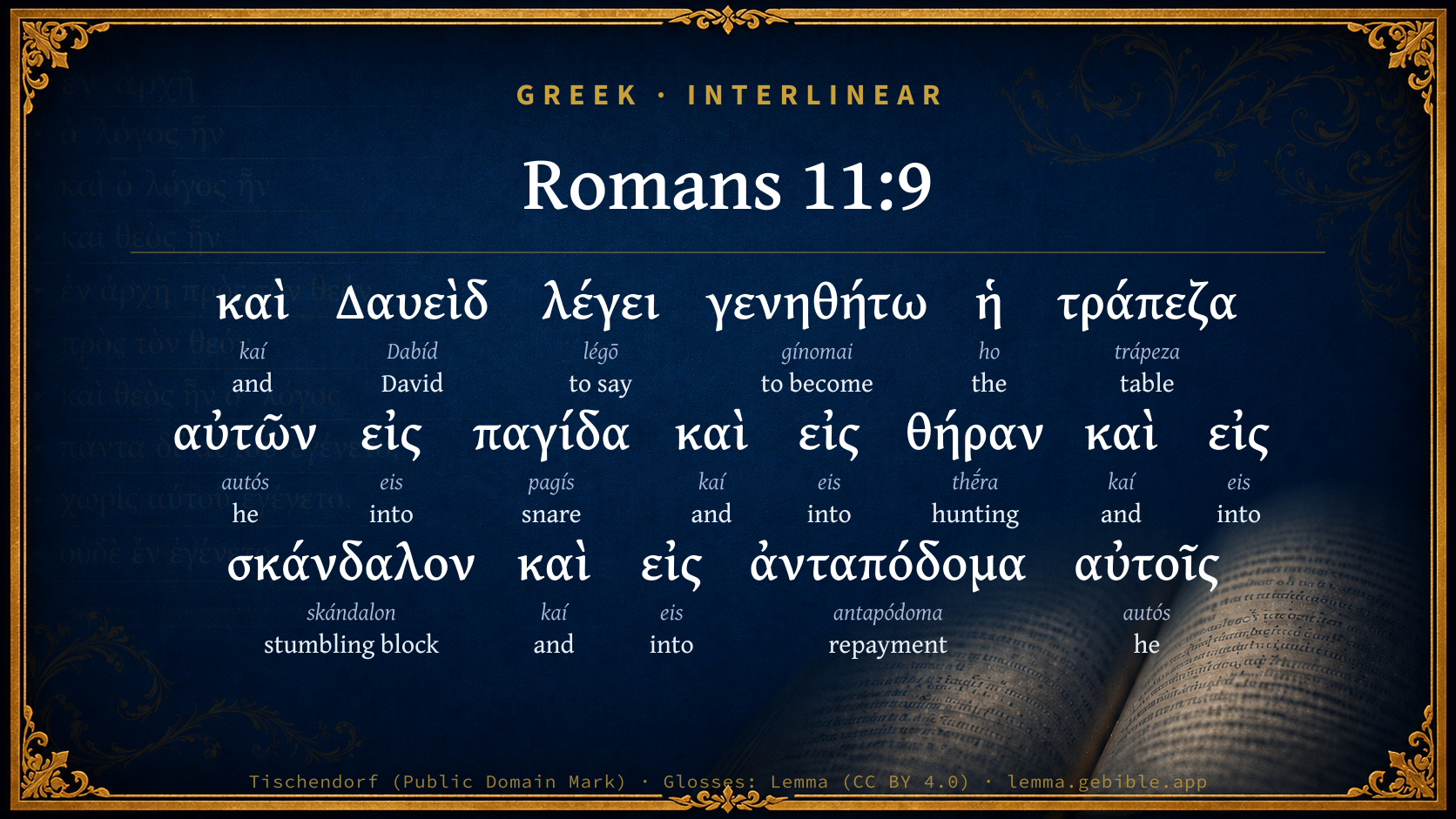
Greek (Tischendorf 8th ed.) Romans 11:9 appears in the Greek New Testament. The text above is from the Tischendorf 8th edition. Each word links to its Strong’s number and a concise gloss. Click any word for its full Thayer’s Greek Lexicon entry.
Download image
Cite this verse

Romans 11:9 (World English Bible). Public Domain. Lemma interlinear Bible study tool, https://lemma.gebible.app/v/romans/11/9.

Show BibTeX & RIS
BibTeX
RIS
English Translation
David says, "Let their table be made a snare, and a trap, A stumbling block, and a retribution to them.
World English Bible · Public Domain
Highlights
  • 1 hapax legomenon — only here in the Greek New Testament
  • 1 first appearance in the Greek New Testament
Full analysis ↓
Download a study sheet

One document with this verse’s original text, its word-by-word gloss line, the meaning frame, cross-references with their text, attributed commentary, and full source and license credits — printable, and it pastes into notes with its structure intact.

This verse Autodidact and up

Study sheet (.html) Plain text (.txt)

A passage Seminary Student

Up to 50 verses in one chapter. A passage sheet keeps up to 6 commentary sources and 12 cross-references per verse, in the order this page ranks them, and says so on the sheet whenever that leaves anything out. Ask for a single verse and you get the Autodidact verse sheet above.

Everything on this page stays free to read, with no account — the sheet is a download of what is already on screen, not access to it.

Want to remove ads? Support Godless Engineer
Compare translations 3

The same verse in 3 English versions, stacked beneath the original-language interlinear above. Click any original word for its lexicon entry.

Each is an independent rendering of the whole verse — the interlinear is not word-aligned to these translations.

Highlighted words mark where these versions differ — a whole-verse word diff, not a word-by-word alignment.

  • World English Bible Public Domain
    David says, "Let their table be made a snare, and a trap, A stumbling block, and a retribution to them.
  • King James Version Public Domain
    And David saith, Let their table be made a snare, and a trap, and a stumblingblock, and a recompence unto them:
  • unfoldingWord Literal Text CC BY-SA 4.0
    And David says, “Let their table become for a net and for a trap, and for a stumbling block and for a retribution to them.

unfoldingWord Literal Text — © unfoldingWord, licensed CC BY-SA 4.0. Word-aligned USFM3 via Door43 (git.door43.org/unfoldingWord/en_ult).

Versions to compare (up to 4)

3 of 4 selected

Show all 18 translations

Every available English version of this verse, each an independent rendering of the whole verse.

  • World English Bible Public Domain
    David says, "Let their table be made a snare, and a trap, A stumbling block, and a retribution to them.
  • Berean Standard Bible Public Domain
    And David says: “May their table become a snare and a trap, a stumbling block and a retribution to them.
  • Majority Standard Bible Public Domain
    And David says: “May their table become a snare and a trap, a stumbling block and a retribution to them.
  • King James Version Public Domain
    And David saith, Let their table be made a snare, and a trap, and a stumblingblock, and a recompence unto them:
  • American Standard Version (1901) Public Domain
    And David saith, Let their table be made a snare, and a trap, And a stumblingblock, and a recompense unto them:
  • Revised Version (1885) Public Domain
    And David saith, Let their table be made a snare, and a trap, And a stumblingblock, and a recompense unto them:
  • Geneva Bible (1599) Public Domain
    And Dauid sayth, Let their table be made a snare, and a net, and a stumbling blocke, euen for a recompence vnto them.
  • Young's Literal Translation Public Domain
    and David saith, `Let their table become for a snare, and for a trap, and for a stumbling-block, and for a recompense to them;
  • Literal Standard Version CC BY-SA 4.0
    and David says, “Let their table become for a snare, and for a trap, and for a stumbling-block, and for a repayment to them;
  • Unlocked Literal Bible CC BY-SA 4.0
    Then David says, “Let their table become a net and a trap, a stumbling block and a retribution for them.
  • unfoldingWord Literal Text CC BY-SA 4.0
    And David says, “Let their table become for a net and for a trap, and for a stumbling block and for a retribution to them.
  • Darby Bible Public Domain
    And David says, Let their table be for a snare, and for a gin, and for a fall-trap, and for a recompense to them:
  • World Messianic Bible Public Domain
    David says, “Let their table be made a snare, a trap, a stumbling block, and a retribution to them.
  • Webster's Bible Public Domain
    And David saith, Let their table be made a snare, and a trap, and a stumbling-block, and a recompense to them:
  • Free Bible Version CC BY-SA 4.0
    David adds, “May their feasts become a trap for them, a net that catches them, a temptation that brings punishment.
  • Bible in Basic English Public Domain
    And David says, Let their table be made a net for taking them, and a stone in their way, and a punishment:
  • Text-Critical English NT CC BY 4.0
    And David says, “Let their table become a snare and a trap, a stumbling block and a retribution to them.
  • Tyndale New Testament (1534) Public Domain
    And David sayth: Let their table be made a snare to take them with all and an occasion to faule and a rewarde vnto them.

Literal Standard Version (2020), Covenant Press — licensed CC BY-SA 4.0. Text via the HelloAO Bible API (eBible.org). Unlocked Literal Bible (unfoldingWord) — licensed CC BY-SA 4.0. Text via the HelloAO Bible API (eBible.org). unfoldingWord Literal Text — © unfoldingWord, licensed CC BY-SA 4.0. Word-aligned USFM3 via Door43 (git.door43.org/unfoldingWord/en_ult). Free Bible Version, Dr. Jonathan Gallagher — licensed CC BY-SA 4.0. Text via the HelloAO Bible API (eBible.org).

Word by word

More ways to search: Search by grammar → Find every occurrence → Compare this word →

Practice this passage: Drill this verse → Learn its vocabulary →

θήραν
thḗra
G2339
“hunting”
Noun, Accusative, Singular, Feminine
Part of Speech
Noun
Case
Accusative
Number
Singular
Gender
Feminine
Full Thayer's Definition

Origin: from ther (a wild animal, as game)

TDNT: None

1. a hunting of wild beasts to destroy them 2. metaph. of preparing destruction for men
  1. καὶ kaí G2532 “and” Conjunction
  2. Δαυεὶδ Dabíd G1138 “David” Noun, Proper, indeclinable
  3. λέγει légō G3004 “to say” Verb, Present, Active, Indicative, 3rd person, Singular
  4. γενηθήτω gínomai G1096 “to become” Verb, Aorist, Passive deponent, Imperative, 3rd person, Singular
  5. ἡ ho G3588 “the” Article, Nominative, Singular, Feminine
  6. τράπεζα trápeza G5132 “table” Noun, Nominative, Singular, Feminine
  7. αὐτῶν autós G846 “he” Personal pronoun, Genitive, Plural, Masculine
  8. εἰς eis G1519 “into” Preposition
  9. παγίδα pagís G3803 “snare” Noun, Accusative, Singular, Feminine
  10. καὶ kaí G2532 “and” Conjunction
  11. εἰς eis G1519 “into” Preposition
  12. καὶ kaí G2532 “and” Conjunction
  13. εἰς eis G1519 “into” Preposition
  14. σκάνδαλον skándalon G4625 “stumbling block” Noun, Accusative, Singular, Neuter
  15. καὶ kaí G2532 “and” Conjunction
  16. εἰς eis G1519 “into” Preposition
  17. ἀνταπόδομα antapódoma G468 “repayment” Noun, Accusative, Singular, Neuter
  18. αὐτοῖς autós G846 “he” Personal pronoun, Dative, Plural, Masculine

About this verse

These counts appear in no published source. They are computed here, from the morphology-tagged text and Lemma’s own curated glosses. What Lemma adds →

19
words
12
distinct lemmas
Pauline Epistles
section

Notable vocabulary

1 hapax legomenon — a word that appears only here in the entire Greek New Testament:

  • θήραν hunting G2339

First appearance in Scripture

This word makes its first canonical appearance in the Greek New Testament here:

  • θήραν hunting G2339

Shared distinctive vocabulary

ἀνταπόδομα repayment G468 occurs in 2 verses of the Greek New Testament. Also found in:
Repetition

Words recur within this verse:

  • εἰς into G1519 ×4
  • καὶ and G2532 ×4
  • αὐτῶν he G846 ×2

Cross-references

15

Topical passages linked to Romans 11:9 in the Treasury of Scripture Knowledge — connected by theme and wording, ordered by reader-vote popularity; previews shown in the World English Bible.

  • Psalms 69:22–23 Let their table before them become a snare. May it become a retribution and a trap.
  • Psalms 28:4 Give them according to their work, and according to the wickedness of their doings. Give them according to the operation of their hands. Bring back on them what they deserve.
  • Luke 12:20 "But God said to him, 'You foolish one, tonight your soul is required of you. The things which you have prepared--whose will they be?'
  • 1 Samuel 25:36–38 Abigail came to Nabal; and, behold, he held a feast in his house, like the feast of a king; and Nabal's heart was merry within him, for he was very drunken: therefore she told him nothing, less or more, until the morning light.
  • Job 20:20–23 "Because he knew no quietness within him, He shall not save anything of that in which he delights.
  • Proverbs 1:32 For the backsliding of the simple will kill them. The careless ease of fools will destroy them.
  • Isaiah 8:13–14 Yahweh of hosts, him shall you sanctify; and let him be your fear, and let him be your dread.
  • Isaiah 59:18 According to their deeds, accordingly he will repay, wrath to his adversaries, recompense to his enemies; to the islands he will repay recompense.
  • Luke 16:19–25 "Now there was a certain rich man, and he was clothed in purple and fine linen, living in luxury every day.
  • 1 Timothy 6:17–19 Charge those who are rich in this present world that they not be haughty, nor have their hope set on the uncertainty of riches, but on the living God, who richly provides us with everything to enjoy;
  • Deuteronomy 32:13–15 He made him ride on the high places of the earth, He ate the increase of the field; He made him to suck honey out of the rock, Oil out of the flinty rock;
  • Deuteronomy 32:35 Vengeance is mine, and recompense, At the time when their foot shall slide: For the day of their calamity is at hand, The things that are to come on them shall make haste.
  • Isaiah 66:9 Shall I bring to the birth, and not cause to bring forth? says Yahweh: shall I who cause to bring forth shut [the womb]? says your God.
  • Hebrews 2:2 For if the word spoken through angels proved steadfast, and every transgression and disobedience received a just recompense;
  • Deuteronomy 6:10–12 It shall be, when Yahweh your God shall bring you into the land which he swore to your fathers, to Abraham, to Isaac, and to Jacob, to give you, great and goodly cities, which you didn't build,

Cross-references courtesy of OpenBible.info (CC BY 4.0).

Commentary

Notes on Romans 11:9 from classic Christian and Jewish commentators (each source and its license shown beneath its notes). The classic Christian expositions comment on the surrounding passage and are grouped to its opening verse, so a note may address several verses; the Jewish commentaries on the Tanakh (Rashi and others) are per-verse, so they appear only where the commentator wrote on this verse.

Lemma curates 59 commentaries, every one of them public domain or Creative Commons licensed, each selected and text-cleaned for this edition rather than reprinted as found. About our sources →

John Gill's Exposition

And David saith,.... That is, Christ by the mouth of David, or David in the person of Christ; for the psalm out of which the following words are taken is a prophecy of the Messiah, as appears from some passages cited out of it in the New Testament, and applied to Christ; compare Rom 11:4 with Joh 15:25, and Rom 11:9 with Joh 2:17, and Rom 11:21 with Joh 19:28; and what are here cited are not so much imprecations, as predictions of what should befall the Jews, by way of recompense for their ill usage of the Messiah, in giving him gall for meat, and vinegar for drink, Mat 27:34,

let their table be made a snare, and a trap and a stumbling block. By their "table" may be meant, the altar; see Mal 1:7; and the sacrifices offered up upon it, their meat offerings and drink offerings, and all others; likewise the laws concerning the difference of meats, and indeed the whole ceremonial law may be intended, which lay in meats and drinks, and such like things: now the Jews placing their justifying righteousness before God, in the observance of these rites and ceremonies, and imagining that by these sacrifices their sins were really expiated and atoned for, they neglected and submitted not to the righteousness of Christ, but went about to establish their own; so that that which should have led them to Christ, became an handwriting of ordinances against them, and rendered Christ of no effect to them: moreover, the sacred writings, which are full of spiritual food and divine refreshment, the prophecies of the Old Testament, which clearly pointed out Christ, not being understood, but misapplied by them, proved a trap, a snare, and a stumbling block to them; so that they rejected the true Messiah, which issued in their utter ruin and destruction: yea, the preaching of the Gospel, the salutary truths and wholesome words of our Lord Jesus Christ, were a stumbling block to the Jews, nay, even the savour of death unto death. Though these words may be literally understood of their table mercies, the necessary provisions of life, their common food and drink, of which they had great scarcity in their last wars; so that they not only by wicked methods stole it from one another, but ate what was forbidden by their law, and what was abhorrent to nature, as one is said to eat her own child; nor is it to be overlooked what is suggested by some, that the passover may be meant by their "table"; which was their grand yearly feast, and which they were eating (s) when they were surrounded and taken by the Roman army, like birds in a net, or beasts in a trap: and all this as

a recompense to them; a just judgment upon them, by way of retaliation for their ill treatment of Christ when on the cross, giving him gall and vinegar for his meat and drink.

(s) Josephus de Bello Jud. l. 6. c. 9.

John Gill's Exposition of the Whole Bible (1746–1763) — public domain (CC PDM 1.0). Text via the HelloAO Bible API.

Bengel's Gnomon

Johann Albrecht Bengel

Rom 11:9. Γενηθήτω—αὐτῶν εἰς παγίδα καὶ εἰς θήραν καὶ εἰς σκάνδαλον καὶ εἰς ἀνταπόδομα αὐτοίς—σύγκαμψον) Psa 69:22-23, LXX., γενηθήτω—αὐτῶν ἐνώπιον αὐτῶν εἰς παγίδα καὶ εἰς ἀνταπόδοσιν καὶ εἰς σκάνδαλον. Let their—be made before their eyes into a snare, and for a recompence, and for an offence.—σύγκαμψον.—τράπεζα, a table) שלחן, Psa 69:22, where, on comparing with it the preceding verse, there is an allegory, i.e., while they are carelessly taking their food, let them be taken themselves.—σκάνδαλον, stumbling-block) It is taken in the more literal sense in this passage, to correspond with the synonyms, noose and instrument of capture (laqueus and captio); for σκάνδαλον is the moveable stick in a trap. It corresponds to מוקש in the above psalm. There is a gradation: the noose (laqueus) catches a part, for example, the foot; the instrument of capture (captio, θήρα, trap) holds the whole; the stumbling-block (scandalum) not only catches, but also hurts.—ἀνταπόδομα, recompence) Their fault, therefore, not the absolute decree of God, was the mediating cause of their rejection.

Bengel's Gnomon of the New Testament — English translation (T&T Clark, Edinburgh, 1860) — public domain. Text from a community e-Sword module.

Meyer's Critical & Exegetical Commentary

Heinrich August Wilhelm Meyer

Rom_11:9-10. A further Scripture proof of ἐπωρώθησαν, and that from Psa_69:23-24, quoted with free deviation from the LXX. The composer of this psalm is not David (in opposition to Hengstenberg, Hävernick), but some one of much later date; a circumstance which we must judge of analogously to the expression of Christ, Mat_22:43. The suffering theocrat of the psalm is, as such, a type of the Messiah, and His enemies a type of the unbelieving Jews; hence Paul could find the fulfilment of the passage in the πώρωσις of the latter. Consequently, in pursuance of this typical reference, the sense in which he takes the words is as follows: Let their table become to them for (let it be turned for them into, comp. Joh_16:20) a snare, and for a chase, and for a trap, and (so) for a retaliation; i.e., while they feast and drink securely and carelessly at their well-furnished table, let the fate of violence overtake them unawares, just as wild beasts are surprised in a snare, and by the capture of the chase, and by a trap; and so must retaliation alight upon them for that which they have done (in rejecting, namely, faith on Christ). But what violent calamity is meant, the sequel expresses, namely: Darkened must their eyes become, that they may not see, i.e. they must become spiritually blinded, incapable of discerning the truth of salvation; and finally the same thing under another figure: And bend their back always, denoting the keeping them in bondage, and that, in the sense of the apostle, the spiritual bondage of the unfree condition of the inner life produced by the πώρωσις. The hardening, therefore, which Paul recognises as predicted in the passage, does not lie in ἡ τράπεζα αὐτῶν (Fritzsche),which is not to be explained of the law and its works, which was Israels food (Philippi, following older expositors, also Tholuck),but in γενηθήτω εἰς παγίδα κ.τ.λ., and is more precisely indicated in Rom_11:10. The express repetition in Rom_11:10 of the becoming blinded, already designated in Rom_11:8, forbids our explaining the prophetic images in Rom_11:9-10 generally as representations of severe divine judgments like Pharaohs overthrow, in which case the specific point of the citation would be neglected (in opposition to Hofmann).

καὶ εἰς θήραν] stands neither in the Hebrew nor in the LXX.; but θήρα means chase, not net (Tholuck, Ewald), to establish which signification the solitary passage Psa_35:8, where the LXX. render רֶשֶׁת inexactly by θήρα, cannot suffice. It often means booty (van Hengel) in the LXX. and in classical Greek; but this is not appropriate here, where the becoming for a booty is said not of such as men, but of the ΤΡΆΠΕΖΑ. This shall be turned for them into a chase, so that they, in their secure feasting, become like to the unfortunate object of the chase, which is captured by the hunter.

σκάνδαλον] corresponding primarily to the classical σκανδάληθρον, the stick set in a trap (Schol. Ar. Ach. 687), is frequently in the LXX. (see Schleusner, Thes. V. p. 38), and so also here, the translation of מוֹקֵשׁ, snare, by which we must therefore abide.

ἈΝΤΑΠΌΔΟΜΑ is not found in classical Greek, but often in the LXX. and Apocrypha, Luk_14:12.

ΚΑῚ ΤῸΝ ΝῶΤΟΝ Κ.Τ.Λ.] is to be taken, according to the context, as the expression of the idea of hardening (represented as a bending together under the yoke of spiritual servitude), not, with Fritzsche, of rendering miserable through the withdrawal of the Messianic salvation. On the masculine Ὁ ΝῶΤΟς, see Lobeck, ad Phryn. p. 290.

Meyer — Critical and Exegetical Commentary on the New Testament — English translation by Peter Christie, edited by Frederick Crombie (T&T Clark, 1880) — public domain. Text from a community e-Sword module.

Godet's Commentaries

Frédéric Louis Godet

Vv. 9, 10. “And David saith, Let their table be made a snare and a trap and a stumbling-block, and [so] a just recompense unto them! Let their eyes be darkened, that they may not see; and bow down their back alway!”

Paul ascribes this psalm to David, according to the title and Jewish tradition; he does not meddle with criticism. Is this title erroneous, as is alleged by our modern savants? They allege Rom 11:33-36, which close the psalm, and in which we have mention made of the liberated captives who shall rebuild and possess the cities of Judah, expressions which naturally apply to the time of the captivity. But, on the other hand, the author speaks “of that zeal for the house of God which eats him up;” which supposes the existence of the temple. Nay more, the adversaries who oppress him are expressly designated as members of God’s people: they are “his brethren, his mother’s children” (Rom 11:8); they shall be blotted out of the book of life” (Rom 11:28); their name was therefore inscribed in it; they are not the Chaldeans. Finally, what is stronger: those enemies, his fellow-countrymen, enjoy perfect external well-being; while they give the Psalmist, the object of their hatred, gall to drink, they themselves sit at table and sing as they drink strong drink (Rom 11:22; Rom 11:11-12); a singular description of the state of the Jews in captivity! It must therefore be held that the last verses of the psalm (Rom 11:33-36) were, like the last and perfectly similar verses of Psalms 51 (Rom 11:18-19), added to the hymn later, when the exiled people applied it to their national sufferings. The original description is that of the righteous Israelite suffering for the cause of God; and his adversaries, to whom the curses contained in the two verses quoted by Paul refer, are all the enemies of this just one within the theocracy itself, from Saul persecuting David down to the Jewish enemies of Jesus Christ and His Church.

The table is, in the Psalmist’s sense, the emblem of the material pleasures in which the ungodly live. Their life of gross enjoyments is to become to them what the snares of all sorts with which men catch them are to the lower animals. It is difficult to avoid thinking that the apostle is here applying this figure in a spiritual sense; for the punishment which he has in view is of a spiritual nature; it is, moral hardening. The cause of such a judgment must therefore be something else than simple worldly enjoyment; it is, as we have seen, the proud confidence of Israel in their ceremonial works. The table is therefore, in Paul’s sense, the emblem of presumptuous security founded on their fidelity to acts of worship, whether the reference be to the table of showbread as a symbol of the Levitical worship in general, or to the sacrificial feasts. These works, on which they reckoned to save them, are precisely what is ruining them.

The Psalmist expresses the idea of ruin only by two terms: those of snare and net (in the LXX. παγίς, net, and σκάνδαλον, stumbling-block). Paul adds a third, θήρα, strictly prey, and hence: every means of catching prey. This third term is taken from Psa 35:8 (in the LXX), where it is used as a parallel to παγίς, net, in a passage every way similar to that of Psalms 69. By this accumulation of almost synonymous terms, Paul means forcibly to express the idea that it will be impossible for them to escape, because no kind of snare will be wanting; first the net (παγίς), then the weapons of the chase (θήρα), and finally the trap which causes the prey to fall into the pit (σκάνδαλον).

The Hebrew and the LXX., as we have said, contain only two of these terms, the first and the third. Instead of the second, the LXX. read another regimen: εἰς ἀνταπόδοσιν, for a recompense. Whence comes this expression? They have evidently meant thereby to render the word lischelomim, for those who are in security, which in the Hebrew text is put between the words snare and stumbling-block. Only to render it as they have done, they must have read leschilloumim (probably after another reading). This substantive is derived from the verb schalam, to be complete, whence in the Pïel: to recompense. It therefore signifies recompense; hence this εἰς ἀνταπόδοσιν, for a recompense, in the LXX. Paul borrows from them this expression; but he puts it at the end as a sort of conclusion: “and so in just retribution.” In Rom 11:10 the apostle continues to apply to the present judgment of Israel (hardening) the expressions of the Psalmist. The reference is to the darkening of the understanding which follows on the insensibility of the heart (Rom 11:9), to such a degree that the Gentiles, with their natural good sense, understand the gospel better than those Jews who have been instructed and cultivated by divine revelation.

The last words: bow down their reins, are an invocation; they refer to the state of slavish fear in which the Jews shall be held as long as this judgment of hardening which keeps them outside of the gospel shall last. They are slaves to their laws, to their Rabbins, and even to their God (Rom 8:15). We must beware of thinking, as Meyer does, that this chastisement is their punishment for the rejection of the Messiah. It is, on the contrary, that rejection which is in the apostle’s eyes the realization of the doom of hardening previously pronounced upon them. As St. John shows, Joh 12:37 et seq., the Jews would not have rejected Jesus if their eyes had not been already blinded and their ears stopped. It could only be under the weight of one of those judgments which visit man with a spirit of torpor, that any could fail to discern the raying forth of the glory of God in the person of Jesus Christ, as the apostle declares, 2Co 4:4. In this passage he ascribes the act of blinding to the god of this world, who has cast a veil over the spirit of his subjects. This means, as is seen in the book of Job, that God proves or punishes by leaving Satan to act, and it may be by the spirit of torpor mentioned in Rom 11:8, as with that spirit of lying whom the Lord sent to seduce Ahab in the vision of the prophet Micaiah, 1Ki 22:10 et seq. However this may be, the rejection of Jesus by the Jews was the effect, not the cause of the hardening. The cause

Paul has clearly enough said, Rom 9:31-33—was the obstinacy of their self-righteousness.

Frédéric Louis Godet — Commentaries on Luke, John, Romans, and 1 Corinthians — English translation (T&T Clark, Edinburgh, 1870s–1890s) — public domain. Text from a community e-Sword module.

Hodge's Commentary on Romans, Ephesians & First Corinthians

Charles Hodge

Rom_11:9, Rom_11:10

And David saith, Let their table be made a snare, and a trap, etc. Psalm 69 is referred to David in the heading prefixed to it, and the propriety of the reference to him as its author is confirmed both by external and internal evidence. See Hengstenbergs Commentary on the Psalms. No portion of the Old Testament Scriptures is more frequently referred to, as descriptive of our Lords sufferings, than the Psalm 69 and 22. There is nothing in this Psalm which forbids its being considered as a prophetic lamentation of the Messiah over his afflictions, and a denunciation of Gods judgments upon his enemies. Psa_69:9, The zeal of thy house hath eaten me up, and Psa_69:21, They gave me vinegar to drink, are elsewhere quoted and applied to Christ. Viewed in this light, the Psalm is directly applicable to the apostles object, as it contains a prediction of the judgments which should befall the enemies of Christ. Let their table be, is only another and a more forcible way of saying, their table shall be. Isa_47:5, Sit thou silent, and get thee into darkness, O daughter of the Chaldeans, for Thou shalt sit, etc. And so in a multitude of cases in the prophetic writings. In the Psalm, indeed, the future term in the Hebrew is used, though it is correctly rendered by the Septuagint and in our version as the imperative, in these passages. The judgments here denounced are expressed in figurative language. The sense is, their blessings shall become a curse; blindness and weakness, hardness of heart and misery shall come upon them. This last idea is forcibly expressed by a reference to the dimness of vision, and decrepitude of old age; as the vigor and activity of youth are the common figure for expressing the results of Gods favor.

Even if the Psalm here quoted be considered as referring to the sorrows and the enemies of the sacred writer himself; and not to those of Christ, it would still be pertinent to the apostles object. The enemies of the Psalmist were the enemies of God; the evils imprecated upon them were implicated on them as such, and not as enemies of the writer. These denunciations are not the expression of the desire of private revenge, but to the just and certain judgments of God. And as the Psamlist declared how the enemies of God should be treated, how dim their eyes should become, and how their strength should be broken, so, Paul says, it actually occurs. David said, let them be so treated, and we find them, says the apostle, suffering these very judgments. Paul, therefore, in teaching that the great body of the Jews, the rejecters and crucifiers of the Son of God, were blinded and cast away, taught nothing more than had already been experienced in various portions of their history, and predicted in their prophets.

Charles Hodge — Commentary on Romans (1835), First Corinthians (1857), and Ephesians (1856) — public domain. Text from a community e-Sword module.

Geneva Bible (1599)

Geneva Bible translators

As unhappy birds are enticed to death by that which is their sustenance, so did that only thing turn to the Jews’ destruction, out of which they sought life, to wit, the Law of God, for the preposterous zeal whereof they refused the Gospel.

Geneva Bible (1599) marginal notes — public domain. Text via Bolls.life.

Jamieson, Fausset & Brown

Robert Jamieson, A. R. Fausset & David Brown

And David saith-- (Psa 69:23), which in such a Messianic psalm must be meant of the rejecters of Christ.

Let their table, &c.--that is, Let their very blessings prove a curse to them, and their enjoyments only sting and take vengeance on them.

Jamieson, Fausset & Brown — Commentary Critical and Explanatory on the Whole Bible (1871) — public domain (CC PDM 1.0). Text via the HelloAO Bible API.

Adam Clarke's Commentary

Verse 9. And David saith, Let their table, c.] And from their present disposition it is reasonable to conclude that the same evils will fall upon them as fell upon the disobedient in former times, as predicted by David, Ps 69:22, Ps 69:23,that their very blessings should become curses to them, and their temporal mercies be their only recompense and yet even these earthly blessings, by not being enjoyed in the Lord, should be a stumbling block over which they should fall, and, instead of being a blessing, should be the means of their punishment. They would have a worldly Messiah, and therefore they rejected him whose kingdom was not of this world.

Adam Clarke's Commentary on the Bible (1810–1826) — public domain. Text from a community e-Sword/MySword module.

John Calvin's Commentaries

9. And David says, etc. In this testimony of David there is also made some change in the words, but it is not what changes the meaning. For he thus speaks, “Let their table before them become a snare, and their peaceful things a trap;” there is no mention of retribution. As to the main point there is sufficient agreement. The Prophet prays, that whatever is desirable and happy in life might turn out to the ruin and destruction of the ungodly; and this is what he means by table and peaceful things. He then gives them up to blindness of spirit and weakening of strength; the one of which he expresses by the darkening of the eyes, and the other by the incurvation of the back. But that this should be extended almost to the whole nation, is not to be wondered at; for we know, that not only the chief men were incensed against David, but that the common people were also opposed to him. It appears plain, that what is read in that passage was not applied to a few, but to a large number; yea, when we consider of whom David was a type, there appears to be a spiritual import in the opposite clause.

Seeing then that this imprecation remains for all the adversaries of Christ, — that their meat shall be converted into poison, (as we see that the gospel is to be the savor of death unto death,) let us embrace with humility and trembling the grace of God. We may add, that since David speaks of the Israelites, who descended according to the flesh from Abraham, Paul fitly applies his testimony to the subject in hand, that the blindness of the majority of the people might not appear new or unusual.

John Calvin's Commentaries (1540-1563) — public domain. Text from the Calvin Translation Society English edition (1840s-50s) via the Christian Classics Ethereal Library (ccel.org). Calvin's coverage is partial (roughly two-thirds of the Bible); uncommented books and verses are honest gaps, never fabricated. The 19th-century editor's footnotes and remarks are omitted so the notes are faithfully Calvin's own voice.

Ellicott's Commentary for English Readers

(9) And David saith.—It appears highly improbable that this Psalm was really written by David. Nor can the Davidic authorship be argued strongly from this passage, as “David” merely seems to stand for the Book of Psalms, with which his name was traditionally connected.

St. Paul is quoting freely from the LXX. In the original of Psalms 69 these verses refer to the fate invoked by the psalmist upon his persecutors; here they are applied by St. Paul to the fiat of the Almighty which had been pronounced against the unbelieving people of Israel.

Let their table . . .—In the very moment of their feasting, let them be caught in a stratagem of their enemies.

And a trap.—These words are not found either in the Hebrew or in the LXX., and appear to be added by St. Paul. Translate rather, Let them be for a chase—i.e., instead of feasting, let them be hunted and persecuted.

And a recompence unto them.—Similarly the LXX. The Hebrew is, “When they are in peace, let it be a trap” (“that which should have been for their welfare, let it become a trap”—A.V.)—i.e., when they are eating and drinking securely, let them be caught as in a trap; let their security itself deceive them. By “recompence unto them” the Apostle means, Let their prosperity bring upon them retaliation for what they have done—namely, for their rejection of Christ.

A Bible Commentary for English Readers, edited by Charles John Ellicott (1878–1897) — public domain. Text from a community e-Sword module.

The Cambridge Bible for Schools and Colleges

gen. ed. J. J. S. Perowne

9. And David saith] Psa_69:22, (LXX. Psa_68:23.) The quotation is nearly (in Rom_11:10 verbatim) with the LXX.; which in the first of the two verses expands the Hebrew. The Heb. there may be rendered, “May their table before them become a trap, and let it be, when they are at peace, (in security,) a snare.” The idea of requital lies in the root of the Heb. word for “peace;” and thus the LXX. interpreted “unto requitals of them;” assuming another form of the word.—The whole Psalm is full of Messiah.—The point of the quotation is that the Psalm indicates a judicial turning of blessings into curses, and a judicial blindness and impotence of the soul, as the way in which retribution would come on Messiah’s enemies. “Seeing then that this imprecation remains for all the adversaries of Christ—that their meat should be converted into poison, (as we see that the Gospel is to be the savour of death unto death,)—let us embrace with humility and trembling the grace of God.” (Calvin.)

The Cambridge Bible for Schools and Colleges (gen. ed. J. J. S. Perowne; Cambridge University Press, 1878–1918) — public domain. Text from a community e-Sword module.

Trapp's Complete Commentary

John Trapp

9 And David saith, Let their table be made a snare, and a trap, and a stumblingblock, and a recompence unto them:

Ver. 9. Be made a snare] As the bait is to the birds.

John Trapp, A Commentary or Exposition upon All the Books of the Old and New Testament (1647–1656) — public domain. Text from a community e-Sword module.

Albert Barnes' Notes on the Bible

And David saith ... - This quotation is made from Psa 69:22-23. This Psalm is repeatedly quoted as having reference to the events recorded in the New Testament. (See the note at Act 1:2.) This quotation is introduced immediately after one that undoubtedly refers to the Lord Jesus. Psa 69:21, “they gave me also gall for my meat, and in my thirst they gave me vinegar to drink.” The passage here quoted immediately follows as an imprecation of vengeance for their sins. “Let their table,” etc. The quotation is not made, however, either literally from the Hebrew or from the Septuagint, but the sense only is retained. The Hebrew is, “Let their table before them be for a snare, and for those at peace, let it be for a gin.” The Septuagint is, “Let their table before them be for a snare, and for a stumbling-block, and for an offence.” The ancient Targum is, “Let their table which they had prepared before me be for a snare, and their sacrifices be for an offence.”

The meaning is this. The word “table” denotes food. In this they expected pleasure and support. David prays that even this, where they expected joy and refreshment, might prove to them the means of punishment and righteous retribution. A snare is that by which birds or wild beasts were taken. They are decoyed into it, or walk or fly carelessly into it, and it is sprung suddenly on them. So of the Jews. The petition is, that while they were seeking refreshment and joy, and anticipating at their table no danger, it might be made the means of their ruin. The only way in which this could be done would be, that their temporal enjoyments would lead them away from God, and produce stupidity and indifference to their spiritual interests. This is often the result of the pleasures of the table, or of seeking sensual gratifications. The apostle does not say whether this prayer was right or wrong. The use which he seems to make of it is this, that David’s imprecation was to be regarded in the light of a prophecy; that what he prayed for would come to pass; and that this had actually occurred in the time of the apostle; that their very enjoyments, their national and private privileges, had been the means of alienating them from God; had been a snare to them; and was the cause of their blindness and infidelity. This also is introduced in the psalm as a punishment for giving him vinegar to drink; and their treatment of the Messiah was the immediate cause why all this blindness had come upon the Jews.

A trap - This properly means anything by which wild beasts are taken in hunting. The word “snare” more properly refers to birds.

And a stumbling-block - Anything over which one stumbles or falls. Hence, anything which occasions us to sin, or to ruin ourselves.

And a recompense - The Hebrew word translated “what should have been for their welfare,” is capable of this meaning, and may denote their recompense, or what is appropriately rendered to them. It means here that their ordinary comforts and enjoyments, instead of promoting their permanent welfare, may be the occasion of their guilt and ruin. This is often the effect of earthly comforts. They might lead us to God, and should excite our gratitude and praise; but they are often abused to our spiritual slumber and guilt, and made the occasion of our ruin. The rich are thus often most forgetful of God; and the very abundance of their blessings made the means of darkness of mind, ingratitude, prayerlessness, and ruin. Satisfied with them, they forget the Giver; and while they enjoy many earthly blessings, God sends barrenness into their souls. This was the guilt of Sodom, “pride, and fulness of bread, and abundance of idleness,” Eze 16:49; and against this Moses solemnly warned the Jews; Deu 6:11-12; Deu 8:10-12. This same caution might be extended to the people of this land, and especially to those who are rich, and are blessed with all that their hearts have wished. From the use which the apostle makes of this passage in the Psalms, it is clear that he regarded it rather as a prophetic denunciation for their sins - a prediction of what would be - than as a prayer. In his time it had been fulfilled; and the very national privileges of the Jews, on which they so much prided themselves, and which might have been so great blessings, were the occasion of their greater sin in rejecting the Messiah, and of their greater condemnation. Thus, their table was made a trap, etc.

Rom 11:10

Let their eyes be darkened - This is taken literally from the psalm, and was evidently the main part of the passage which the apostle had in his eye. This was fulfilled in the insensibility and blindness of the Jews. And the apostle shows them that it was long ago predicted, or invoked, as a punishment on them for giving the Messiah vinegar to drink; Psa 69:21, Psa 69:23.

And bow down their back alway - The Hebrew Psa 69:23 is, “Let their loins totter or shake,” that is, as one does when he has on him a heavy burden. The apostle has retained this sense. It means, let them be called to bear heavy and oppressive burdens; let them be subjected to toil or servitude, as a reward for their sins. That this had come upon the Jews in the time of Paul is clear; and it is further clear that it came upon them, as it was implied in the psalm, in consequence of their treatment of the Messiah. Much difficulty has been felt in reconciling the petitions in the psalms for calamities on enemies, with the spirit of the New Testament. Perhaps they cannot all be thus reconciled; and it is not at all improbable that many of those imprecations were wrong. David was not a perfect man; and the Spirit of inspiration is not responsible for his imperfections. Every doctrine delivered by the sacred writers is true; every fact recorded is recorded as it was.

But it does not follow that all the men who wrote, or about whom a narrative was given, were perfect. The reverse is the fact. And it does not militate against the inspiration of the Scriptures that we have a record of the failings and imperfections of those men. When they uttered improper sentiments, when they manifested improper feelings, when they performed wicked actions, it is no argument against the inspiration of the Scriptures that they were recorded. All that is done in such a case, and all that inspiration demands, is that they be recorded as they are. We wish to see human nature as it is; and one design of making the record of such failings is to show what man is, even under the influence of religion; not as a perfect being, for that would not be true; but as he actually exists mingled with imperfection. Thus, many of the wishes of the ancient saints, imperfect as they were, are condemned as sinful by the spirit of the Christian religion.

They were never commended or approved, but they are recorded just to show us what was in fact the character of man, even partially under the influence of religion. Of this nature probably, were many of the petitions in the Psalms; and the Spirit of God is no more answerable for the feeling because it is recorded, than he is for the feelings of the Edomites when they said, “Rase it, rase it to the foundation” Psa 137:7. Many of those prayers, however, were imprecations on his enemies as a public man, as the magistrate of the land. As it is right and desirable that the robber and the pirate should be detected and punished; as all good people seek it, and it is indispensable for the welfare of the community, where is the impropriety of praying that it may be done? Is it not right to pray that the laws may be executed; that justice may be maintained; and that restraint should be imposed on the guilty? Assuredly this may be done with a very different spirit from that of revenge. It may be the prayer of the magistrate that God will help him in what he is appointed to do, and in what ought to be done. Besides, many of these imprecations were regarded as simply predictions of what would be the effect of sin; or of what God would do to the guilty. Such was the case we are now considering, as understood by the apostle. But in a prediction there can be nothing wrong.

Albert Barnes' Notes on the Bible (1834–1885) — public domain. Text from a community e-Sword/MySword module.

Matthew Poole's English Annotations

David saith; viz. in Psa 69:22,23. The apostle tieth not himself to the very words of the psalmist, but being guided by the same Spirit by which David wrote, he adds and alters some words, without diminishing the sense.

Let their table be made a snare, &c.: some take these words for a prayer; others, a prophecy. David, in the person of Christ, (of whom he was a type), doth complain and prophesy of the extreme injuries and oppressions wherewith the Jews (his own people) should vex him; as that they should give him gall for meat, and in his thirst, give him vinegar to drink, Rom 11:21. Therefore, by way of imprecation, he prayeth down the wrath of God upon them: particularly, he prophesies or prays, that all their most pleasant things might be turned to their destruction; that their understandings might be darkened, so as they shall discern nothing of heavenly things; that they might savour nothing but earthly things, and be unable to lift up their heads and hearts to God, and to his gospel. Now David having, by the Spirit of prophecy, prayed down such miseries upon the Jews, they must be fulfilled; therefore the general unbelief and hardness of heart that is amongst that people is not to be wondered at.

Matthew Poole's English Annotations on the Holy Bible (1683–1685) — public domain. Text from a community e-Sword/MySword module.

Whedon's Commentary on the Bible

Daniel D. Whedon

9. David saith—Psalms 6:23. Quote not verbally, but freely.

Table— Which should be a place of hospitable trust.

Stumblingblock—Note on Mat_18:7.

Recompense—A retribution. For all these disastrous results are the retributive, as well as the natural, results of their own wilful wickedness. This law of retribution is expressed in the form of a prayer, as showing that inspiration fully endorses the result and demands its completion. (Rev_18:6.)

Daniel D. Whedon (gen. ed.), Commentary on the Old and New Testaments (1874–1909) — public domain. Text from a community e-Sword module.

John Wesley's Explanatory Notes

And David saith - In that prophetic imprecation, which is applicable to them, as well as to Judas. A recompence - Of their preceding wickedness. So sin is punished by sin; and thus the gospel, which should have fed and strengthened their souls, is become a means of destroying them. Psalm lxix, 22, 23

John Wesley, Explanatory Notes Upon the Whole Bible (1754–1765) — public domain. Text via the GEBible commentary corpus.

Burkitt's Expository Notes on the New Testament

William Burkitt

The apostle proceeds here to declare unto us, that the general unbelief and hardness of heart which was found amongst the rejected Jews, was not to be wondered at, because it was prophetically foretold by holy David, in the person of the Messiah, of whom he was a type, that his own people the Jews should extremely injure and wrong him, oppress and vex him: for which wickedness he foretells what dreadful and tremendous judgments should come upon the Jews; namely,

That their table should be made to them a snare, a trap, and a stumbling-block; that is, that all their pleasant and delightful things should become the instruments of their destruction.

That their eyes be darkened, that they may not see. The darkening of their eyes signifies the taking away of the judgment and understanding from a people.

And the bowing down of the back always, intimates and implies their grovelling upon this earth; their relishing and savouring nothing but earthly things, never lifting up either head or heart to God.

Now all this which David spake of the wicked Jews in his time, the apostle applies and adapts to the incredulous and unbelieving Jews in his days, to whom the very preaching of the gospel was an occasion of obduration and hardness of heart.

Learn here, 1. That to the obstinate and obdurate enemies of God, the best things become baneful, and through their own corruption become the instruments and means of their own destruction. Let their table be made a snare, a trap, and a stumbling-block.

Learn, 2. That to be deprived of the use of our judgment and understanding, especially in things pertaining unto God, is a very dreadful judgment. Let their eyes be darkened that they may not see.

3. That imprecations are to be used very warily, and only in weighty matters. These and other expressions of David, which look like imprecations, may as well be accounted prophetical predictions, foretelling what will come upon obstinate sinners, rather than praying that evil may come.

Great is the sin and danger of using imprecations lightly, either upon ourselves or others. Some persons use them to gain credit to what they say; but this will not do with wise men, who frequently observe, that persons most guilty are most apt to call for vengeance upon themselves, that they may be thought guiltless.

Lord! how do some sinners wish and call for that at which the devils tremble!--I mean damnation.

Alas! it slumbereth not; within a moment or two thou shalt feel what thou wilt not fear.

William Burkitt's Expository Notes on the New Testament (1700–1703) — public domain. Text from a community e-Sword module.

McGarvey & Pendleton's Commentaries

J. W. McGarvey

And David saith, Let their table be made a snare, and a trap, And a stumblingblock, and a recompense unto them [ Psa_69:22-23 . the word "trap" is added from Psa_35:8 . Theodoret says that Psalm 69 "is a prediction of the sufferings of Christ, and the final destruction of the Jews on that account." That which is presented in the form of a wish is, therefore, really a prophecy. Let the food on their table be as the bait to the snare and the trap, and the stumbling-block over which the tempted creature falls to lame itself. Let that which they think a source of pleasure and life become an enticement to pain and death. Dropping the figure, the words mean that the very religion of the Old Dispensation, to which the Jew looked for spiritual joy and sustenance, should become to him a sorrow and a fatal famine, so that this very blessing became to him a curse. The word "recompense" denotes a punishment for an evil deed; its presence here shows that the evil which came upon the Jews was caused by their own fault and sin, and not by absolute decree]:

J. W. McGarvey (with Philip Y. Pendleton), Commentaries on the New Testament (The Fourfold Gospel, 1914; Acts; and the epistles) — public domain. Text from a community e-Sword/MySword module.

The People's New Testament

B. W. Johnson

9. And David saith. Psalm 69:22, 23. Let their table be made a snare, etc. This prediction is applied to the enemies of Christ. Its meaning is that their enmity shall react upon and injure themselves. Even their table shall become a place of danger.

B. W. Johnson's The People's New Testament with Notes (1889–1891) — public domain. Electronic text from the Christian Classics Ethereal Library (CCEL) ThML edition.

unfoldingWord translationNotes

Door43 World Missions Community

Let their table become a net and a trap

"Table" here is a metonym that represents feasting, and "net" and "trap" are metaphors that represent punishment. You can translate this in an active form. AT: "Please, God, make their feasts like a trap that catches them" (See: Metonymy and Metaphor and Active or Passive)

a stumbling block

A "stumbling block" is anything that causes a person to trip so that he falls down. Here it represents something that tempts a person to sin. AT: "something that tempts them to sin" (See: Metaphor)

a retribution for them

"something that allows you to take revenge on them"

bend their backs continually

Here "bend their back" is a metonym for forcing slaves to carry heavy loads on their backs. This is a metaphor for making them suffer. AT: "make them suffer like people carrying heavy loads" (See: Metonymy and Metaphor)

translationWords

David

stumbling block

unfoldingWord translationNotes — © Distant Shores Media and the Door43 World Missions Community, licensed CC BY-SA 4.0. Source: git.door43.org/Door43/en_tn.

Cambridge Greek Testament for Schools and Colleges

9. Psa 69:22 f., Psa 35:8 (θήρα). A terrible quotation: it implies that the Jews are to be reckoned among those enemies of GOD and persecutors of His suffering people on whom the Psalmist imprecates these curses, the sustenance of their lives is to become a snare and trap and retribution for them, their eyes are to be darkened and their strength broken. The justification of this use of the passage is that to the Psalmist also the persecutors were his own people. The punishment is inevitably found in the very privileges and faculties which they had misused. So the situation described is typical of the present situation = now, as then, the wrath of GOD works side by side with His grace.

θήρα = a net; cf. Psa 35:8 only. ἀνταπόδομα, cf. Luk 14:12 (only in N.T.).

Cambridge Greek Testament for Schools and Colleges (Cambridge University Press, 1896; 21 vols, various authors incl. Carr, Maclear, Plummer, Farrar, Lumby, Moule, M. R. James, Simcox) — public domain. Text from a community e-Sword module.

Alford’s Greek Testament

Henry Alford

9.] And David saith, Let their table be for a snare and for a net (θήρα more usually ‘a hunt,’ or the act of taking or catching,—but here and in ref. a net, the instrument of capture. It is not in the Heb. nor in the LXX, and is perhaps inserted by the Apostle to give emphasis by the accumulation of synonymes), and for a stumbling-block and for a recompense to them (the LXX have εἰς παγίδα κ. εἰς ἀνταπόδοσιν κ. εἰς σκάνδαλον. The Heb. of εἰς ἀνταπόδοσιν, as at present pointed, is לִשְׁלוֹמִים, ‘to the secure.’ It has been supposed that the LXX pointed לִשִׁלּוּמִים or לְשִׁלּוֹמִים, ‘for retributions.’ See Psa 91:8: but qu.?):

Henry Alford, The Greek Testament (1849–1861) — public domain. Text from a community e-Sword module.

International Critical Commentary

9. καὶ Δαβὶδ λέγει κ.τ.λ: quoted from the LXX of 68 [69]. 23, 24 γενηθήτω ἡ τράπεζα αὐτῶν ἐνώπιον αὐτῶν εἰς παγίδα, καὶ εἰς ἀνταπόδοσιν καὶ σκάνδαλον· σκοτισθήτωσαν κ.τ.λ. (which is ascribed in the title to David) with reminiscences of 34:8 [8], and 27:4[4]. The Psalmist is represented as declaring the Divine wrath against those who have made themselves enemies of the Divine will. Those who in his days were the enemies of the spiritual life of the people are represented in the Apostle’s days by the Jews who have shut their ears to the Gospel message.

ἡ τράπεζα αὐτῶν: ‘their feast.’ The image is that of men feasting in careless security, and overtaken by their enemies, owing to the very prosperity which ought to be their strength. So to the Jews that Law and those Scriptures wherein they trusted are to become the very cause of their fall and the snare or hunting-net in which they are caught.

σκάνδαλον: ‘that over which they fall,’ ‘a cause of their destruction.’

ἀνταπόδομα: 27:4 [4.]. ‘A requital,’ ‘recompense.’ The Jews are to be punished for their want of spiritual insight by being given over to blind trust in their own law; in fact being given up entirely to their own wishes.

International Critical Commentary — older volumes (1896–1929), various authors — public domain. Text from a community e-Sword module.

Vincent's Word Studies in the New Testament

Marvin R. Vincent

David saith. Psa 69:23, 24. It is doubtful whether David was the author. Some high authorities are inclined to ascribe it to Jeremiah. David here may mean nothing more than the book of Psalm. 56 Table. Representing material prosperity : feasting in wicked security. Some explain of the Jews ' presumptuous confidence in the law.

Snare [παγιδα] , From phgnumi to make fast. The anchor is called pagiv the maker - fast of the ships.

Trap (qhran). Lit., a hunting. Only here in the New Testament, and neither in the Hebrew nor Septuagint. Many render net, following Psa 35:8, where the word is used for the Hebrew resheth net. No kind of snare will be wanting. Their presumptuous security will become to them a snare, a hunting, a stumbling - block.

A recompense [ανταποδομα] . Substituted by the Septuagint for the Hebrew, to them at ease. It carries the idea of a just retribution.

Marvin R. Vincent, Word Studies in the New Testament (1887–1900) — public domain. Text from a community e-Sword/MySword module.

Lesson kit

Teaching starters — assembled from the data on this page, not authored interpretation. Every prompt links to the verse data it draws on. Edit before teaching.

Romans, in the Pauline Epistles, opens this verse with 19 words (12 distinct Greek lemmas). Its most distinctive word is thḗra (“hunting”). A historical commentator’s framing appears above. Read the whole chapter for the surrounding context.

Discussion questions

  1. The word thḗra carries the sense “hunting.” How does it shape the verse?
  2. 1 word here appears nowhere else in the Greek New Testament. Why might the author reach for such rare wording?
  3. This is the first place “hunting” appears in Scripture (first appears here). What does its debut here establish?
  4. How does Luke 14:12, which shares the word «repayment», read alongside this verse?
  5. What does the repetition of “into” (4× in this one verse) do in this verse?
  6. These translations render this verse differently. What is at stake in choosing one wording over another?
  7. Compare how John Gill's Exposition and Bengel's Gnomon read this verse. Where do they agree or differ?

Things to notice

  • 1 word in this verse appears nowhere else in the Greek New Testament.
  • 1 word makes its first canonical appearance in Scripture here.
  • These translations choose different wording for 10 words in this verse.
  • “into” occurs 4× in this single verse.
  • 12 distinct Greek lemmas span 19 words in this verse.

Reading settings

Reading text

Shown beneath each verse's original-language words.

Old Testament
Old Testament edition

Read the OT as the Masoretic Hebrew (MT) or the Greek Septuagint (LXX).

English shown for the Greek Septuagint (in the Hebrew ↔ Greek comparison).

Comparing translations? Open the Compare panel on any verse page to stack up to four side by side.