Romans 2:12

Greek (Tischendorf 8th ed.) Romans 2:12 appears in the Greek New Testament. The text above is from the Tischendorf 8th edition. Each word links to its Strong’s number and a concise gloss. Click any word for its full Thayer’s Greek Lexicon entry.
Download image
Cite this verse

Romans 2:12 (World English Bible). Public Domain. Lemma interlinear Bible study tool, https://lemma.gebible.app/v/romans/2/12.

Show BibTeX & RIS
BibTeX
RIS
English Translation
For as many as have sinned without law will also perish without the law. As many as have sinned under the law will be judged by the law.
World English Bible · Public Domain
Highlights
  • 1 first appearance in the Greek New Testament
Full analysis ↓
Download a study sheet

One document with this verse’s original text, its word-by-word gloss line, the meaning frame, cross-references with their text, attributed commentary, and full source and license credits — printable, and it pastes into notes with its structure intact.

This verse Autodidact and up

Study sheet (.html) Plain text (.txt)

A passage Seminary Student

Up to 50 verses in one chapter. A passage sheet keeps up to 6 commentary sources and 12 cross-references per verse, in the order this page ranks them, and says so on the sheet whenever that leaves anything out. Ask for a single verse and you get the Autodidact verse sheet above.

Everything on this page stays free to read, with no account — the sheet is a download of what is already on screen, not access to it.

Want to remove ads? Support Godless Engineer
Compare translations 3

The same verse in 3 English versions, stacked beneath the original-language interlinear above. Click any original word for its lexicon entry.

Each is an independent rendering of the whole verse — the interlinear is not word-aligned to these translations.

Highlighted words mark where these versions differ — a whole-verse word diff, not a word-by-word alignment.

  • World English Bible Public Domain
    For as many as have sinned without law will also perish without the law. As many as have sinned under the law will be judged by the law.
  • King James Version Public Domain
    For as many as have sinned without law shall also perish without law: and as many as have sinned in the law shall be judged by the law;
  • unfoldingWord Literal Text CC BY-SA 4.0
    For as many as have sinned without the law will also perish without the law, and as many as have sinned with the law will be judged by the law.

unfoldingWord Literal Text — © unfoldingWord, licensed CC BY-SA 4.0. Word-aligned USFM3 via Door43 (git.door43.org/unfoldingWord/en_ult).

Versions to compare (up to 4)

3 of 4 selected

Show all 19 translations

Every available English version of this verse, each an independent rendering of the whole verse.

  • World English Bible Public Domain
    For as many as have sinned without law will also perish without the law. As many as have sinned under the law will be judged by the law.
  • Berean Standard Bible Public Domain
    All who sin apart from the law will also perish apart from the law, and all who sin under the law will be judged by the law.
  • Majority Standard Bible Public Domain
    All who sin apart from the law will also perish apart from the law, and all who sin under the law will be judged by the law.
  • King James Version Public Domain
    For as many as have sinned without law shall also perish without law: and as many as have sinned in the law shall be judged by the law;
  • American Standard Version (1901) Public Domain
    For as many as have sinned without law shall also perish without the law: and as many as have sinned under the law shall be judged by the law;
  • Revised Version (1885) Public Domain
    For as many as have sinned without law shall also perish without law: and as many as have sinned under law shall be judged by law;
  • Geneva Bible (1599) Public Domain
    For as many as haue sinned without the Lawe, shall perish also without the Lawe: and as many as haue sinned in the Lawe, shall be iudged by the Lawe,
  • Douay-Rheims (1899) Public Domain
    For whosoever have sinned without the law, shall perish without the law; and whosoever have sinned in the law, shall be judged by the law.
  • Young's Literal Translation Public Domain
    for as many as without law did sin, without law also shall perish, and as many as did sin in law, through law shall be judged,
  • Literal Standard Version CC BY-SA 4.0
    for as many as sinned without law, will also perish without law, and as many as sinned in law, through law will be judged,
  • Unlocked Literal Bible CC BY-SA 4.0
    For as many as have sinned without the law will also perish without the law, and as many as have sinned with respect to the law will be judged by the law.
  • unfoldingWord Literal Text CC BY-SA 4.0
    For as many as have sinned without the law will also perish without the law, and as many as have sinned with the law will be judged by the law.
  • Darby Bible Public Domain
    For as many as have sinned without law shall perish also without law; and as many as have sinned under law shall be judged by law,
  • World Messianic Bible Public Domain
    For as many as have sinned without the law will also perish without the law. As many as have sinned under the law will be judged by the law.
  • Webster's Bible Public Domain
    For as many as have sinned without law, shall also perish without law: and as many as have sinned in the law, shall be judged by the law,
  • Free Bible Version CC BY-SA 4.0
    Those who sin even though they don't have the written law are still lost, while those who sin that do have the written law will be condemned by that law.
  • Bible in Basic English Public Domain
    All those who have done wrong without the law will get destruction without the law: and those who have done wrong under the law will have their punishment by the law;
  • Text-Critical English NT CC BY 4.0
    For all who have sinned without the law will also perish without the law, and all who have sinned under the law will be judged by the law.
  • Tyndale New Testament (1534) Public Domain
    But whosoever hath synned with out lawe shall perisshe with out lawe. And as many as haue synned vnder the lawe shalbe iudged by the lawe.

Literal Standard Version (2020), Covenant Press — licensed CC BY-SA 4.0. Text via the HelloAO Bible API (eBible.org). Unlocked Literal Bible (unfoldingWord) — licensed CC BY-SA 4.0. Text via the HelloAO Bible API (eBible.org). unfoldingWord Literal Text — © unfoldingWord, licensed CC BY-SA 4.0. Word-aligned USFM3 via Door43 (git.door43.org/unfoldingWord/en_ult). Free Bible Version, Dr. Jonathan Gallagher — licensed CC BY-SA 4.0. Text via the HelloAO Bible API (eBible.org).

Word by word

More ways to search: Search by grammar → Find every occurrence → Compare this word →

Practice this passage: Drill this verse → Learn its vocabulary →

ἀνόμως
anómōs
G460
“unlawfully”
Adverb
Part of Speech
Adverb
Full Thayer's Definition

Origin: from G459

TDNT: None

1. without the law, without the knowledge of the law 2. to sin in ignorance of the Mosaic law 3. live ignorant of law and discipline
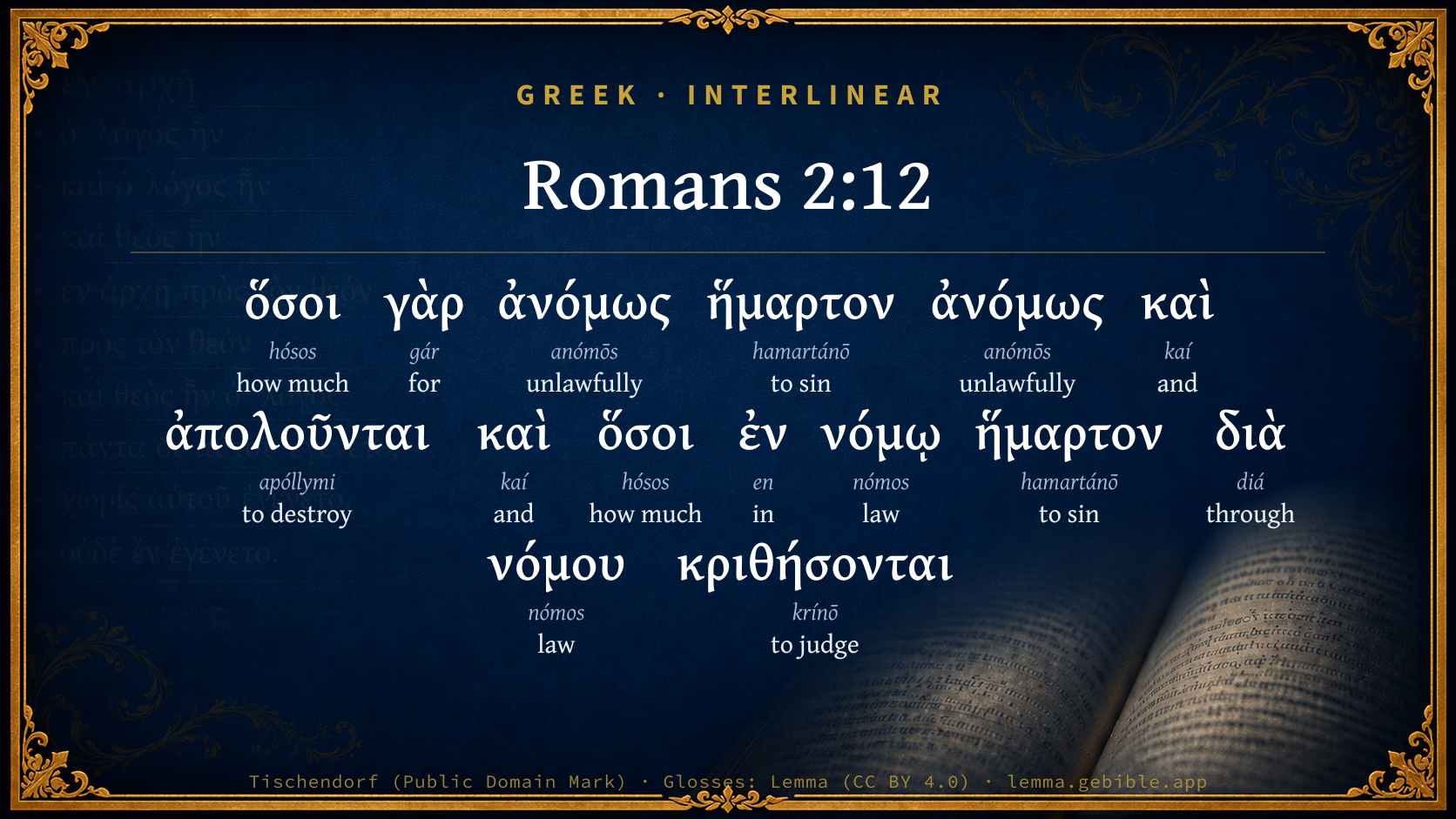
  1. ὅσοι hósos G3745 “how much” Correlative pronoun, Nominative, Plural, Masculine
  2. γὰρ gár G1063 “for” Conjunction
  3. ἥμαρτον hamartánō G264 “to sin” Verb, Aorist, Active, Indicative, 3rd person, Plural
  4. ἀνόμως anómōs G460 “unlawfully” Adverb
  5. καὶ kaí G2532 “and” Conjunction
  6. ἀπολοῦνται apóllymi G622 “to destroy” Verb, Future, Middle, Indicative, 3rd person, Plural
  7. καὶ kaí G2532 “and” Conjunction
  8. ὅσοι hósos G3745 “how much” Correlative pronoun, Nominative, Plural, Masculine
  9. ἐν en G1722 “in” Preposition
  10. νόμῳ nómos G3551 “law” Noun, Dative, Singular, Masculine
  11. ἥμαρτον hamartánō G264 “to sin” Verb, Aorist, Active, Indicative, 3rd person, Plural
  12. διὰ diá G1223 “through” Preposition
  13. νόμου nómos G3551 “law” Noun, Genitive, Singular, Masculine
  14. κριθήσονται krínō G2919 “to judge” Verb, Future, Passive, Indicative, 3rd person, Plural

About this verse

These counts appear in no published source. They are computed here, from the morphology-tagged text and Lemma’s own curated glosses. What Lemma adds →

15
words
10
distinct lemmas
Pauline Epistles
section

Notable vocabulary

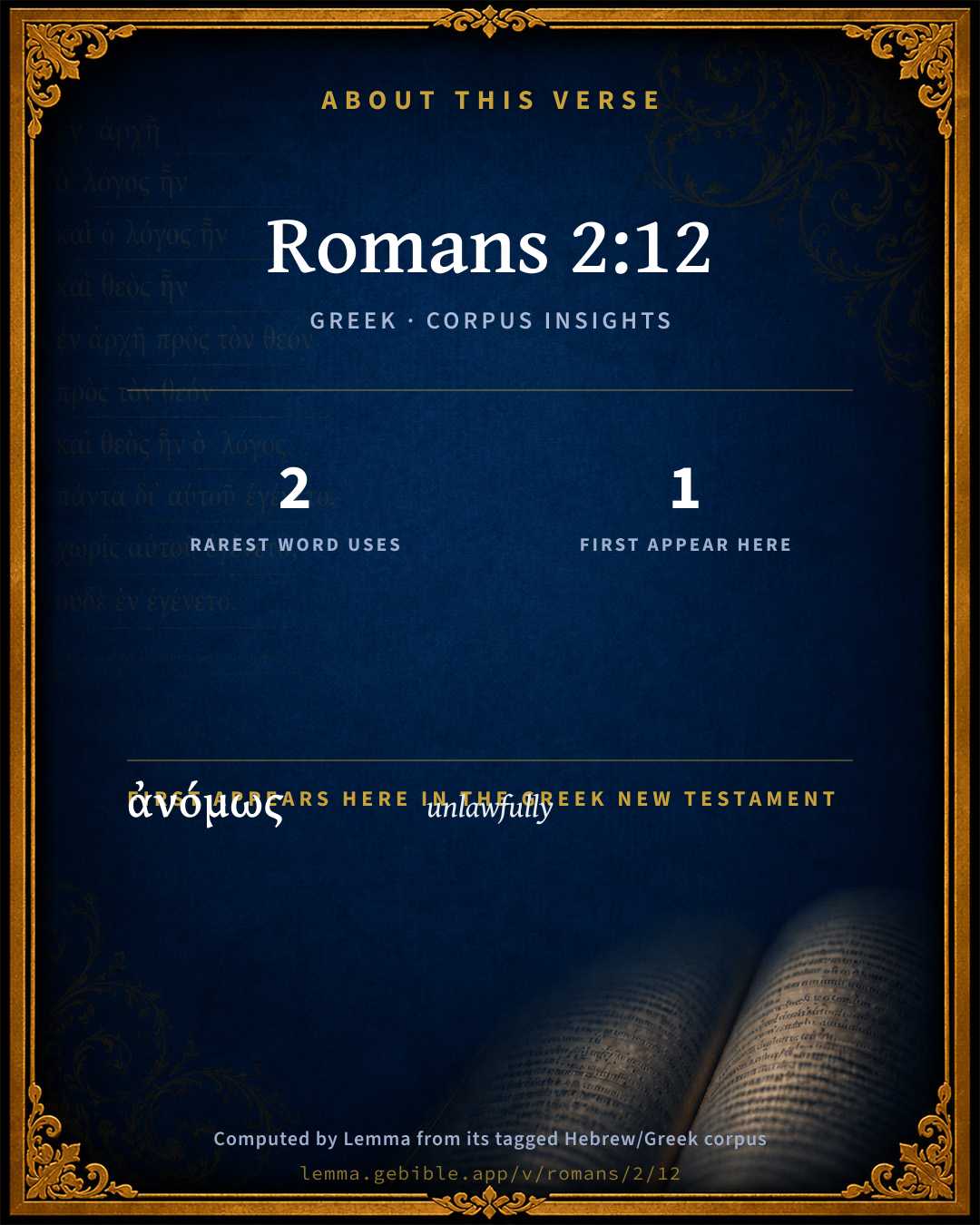
The rarest word here is ἀνόμως unlawfully G460 — appearing just 2 times in the whole Greek New Testament.

First appearance in Scripture

This word makes its first canonical appearance in the Greek New Testament here:

  • ἀνόμως unlawfully G460

Repetition

Words recur within this verse:

  • ὅσοι how much G3745 ×2
  • ἀνόμως unlawfully G460 ×2
  • ἥμαρτον to sin G264 ×2
  • νόμῳ law G3551 ×2
  • καὶ and G2532 ×2

Cross-references

22

Topical passages linked to Romans 2:12 in the Treasury of Scripture Knowledge — connected by theme and wording, ordered by reader-vote popularity; previews shown in the World English Bible.

  • 1 Corinthians 9:21 to those who are without law, as without law (not being without law toward God, but under law toward Christ), that I might win those who are without law.
  • Galatians 3:10 For as many as are of the works of the law are under a curse. For it is written, "Cursed is everyone who doesn't continue in all things that are written in the book of the law, to do them."
  • Acts 17:30–31 The times of ignorance therefore God overlooked. But now he commands that all people everywhere should repent,
  • Romans 2:14–16 (for when Gentiles who don't have the law do by nature the things of the law, these, not having the law, are a law to themselves,
  • Galatians 2:16–19 yet knowing that a man is not justified by the works of the law but through the faith of Jesus Christ, even we believed in Christ Jesus, that we might be justified by faith in Christ, and not by the works of the law, because no flesh will be justified by the works of the law.
  • Romans 7:7–11 What shall we say then? Is the law sin? May it never be! However, I wouldn't have known sin, except through the law. For I wouldn't have known coveting, unless the law had said, "You shall not covet."
  • Romans 8:3 For what the law couldn't do, in that it was weak through the flesh, God did, sending his own Son in the likeness of sinful flesh and for sin, he condemned sin in the flesh;
  • Ezekiel 16:49–50 Behold, this was the iniquity of your sister Sodom: pride, fullness of bread, and prosperous ease was in her and in her daughters; neither did she strengthen the hand of the poor and needy.
  • Matthew 11:24 But I tell you that it will be more tolerable for the land of Sodom, on the day of judgment, than for you."
  • Luke 10:12–15 I tell you, it will be more tolerable in that day for Sodom than for that city.
  • Luke 12:47–48 That servant, who knew his lord's will, and didn't prepare, nor do what he wanted, will be beaten with many stripes,
  • Romans 1:32 who, knowing the ordinance of God, that those who practice such things are worthy of death, not only do the same, but also approve of those who practice them.
  • Romans 3:19–20 Now we know that whatever things the law says, it speaks to those who are under the law, that every mouth may be closed, and all the world may be brought under the judgment of God.
  • 2 Corinthians 3:7–9 But if the service of death, written engraved on stones, came with glory, so that the children of Israel could not look steadfastly on the face of Moses for the glory of his face; which was passing away:
  • Deuteronomy 27:26 Cursed be he who doesn't confirm the words of this law to do them. All the people shall say, Amen.
  • Matthew 11:22 But I tell you, it will be more tolerable for Tyre and Sidon on the day of judgment than for you.
  • Romans 1:18–21 For the wrath of God is revealed from heaven against all ungodliness and unrighteousness of men, who suppress the truth in unrighteousness,
  • Romans 4:15 For the law works wrath, for where there is no law, neither is there disobedience.
  • James 2:10 For whoever shall keep the whole law, and yet stumble in one point, he has become guilty of all.
  • Revelation 20:12–15 I saw the dead, the great and the small, standing before the throne, and they opened books. Another book was opened, which is the book of life. The dead were judged out of the things which were written in the books, according to their works.
  • John 19:11 Jesus answered, "You would have no power at all against me, unless it were given to you from above. Therefore he who delivered me to you has greater sin."
  • Galatians 3:22 But the Scriptures shut up all things under sin, that the promise by faith in Jesus Christ might be given to those who believe.

Cross-references courtesy of OpenBible.info (CC BY 4.0).

Commentary

Notes on Romans 2:12 from classic Christian and Jewish commentators (each source and its license shown beneath its notes). The classic Christian expositions comment on the surrounding passage and are grouped to its opening verse, so a note may address several verses; the Jewish commentaries on the Tanakh (Rashi and others) are per-verse, so they appear only where the commentator wrote on this verse.

Lemma curates 59 commentaries, every one of them public domain or Creative Commons licensed, each selected and text-cleaned for this edition rather than reprinted as found. About our sources →

The Biblical Illustrator

Joseph S. Exell

Rom_2:12

For as many as have sinned without the law shall also perish without law; and as many as have sinned in the law shall be judged by the law.

The law and sin

All sin--

I. Implies law.

II. Must be measured by the law under which it is committed.

III. Must be visited accordingly. (J. Lyth, D. D.)

The responsibility of man

I. The text divides the race into two classes--those who have sinned without law and those who have sinned in the law. What is meant by law? Rule. Here, then, are some without and some within rule--the Gentiles not having and the Jews having a revealed rule.

II. The text affirms a certain amount of obligation connected with each division; for we cannot understand those who have sinned and shall consequently perish without law to mean a class to be judged without any standard whatever by which to try their guilt or innocence. As between man and man we insist, before judgment is passed upon us, on having the opportunity of knowing the rule by which we are to be judged. Before the statute law of this country is proclaimed no one is guilty of any violation of it, and of course it must be the same as between God and man; and so the passage before us would appear to direct our attention to law of some kind applying to each party, and therefore human responsibility appears to arise.

III. Human responsibility seems to arise from the relation in which both classes stand to God. The law revealed to the Gentiles is the law of nature, that to the Jews is the law of the Word of God. Now if both are in substance the same, then we must admit that the responsibility resting on man in a state of nature is as decidedly proved as that resting on him when under revelation.

1. Nature discovers indications of kindness on the part of a fatherly Creator, and of brotherhood among the creatures. Everything is so constructed that all must harmonise to a certain extent with one another or perish together. Different countries have different climates and productions that there may be an intercommunity between the various regions, from all which we conclude that it is the duty and interest of this common family to connect their common wants, safety, and comforts, that they may rejoice together in the same grace of life. To infringe, therefore, this law of nature is to rebel against God, and consequently to incur responsibility for this rebellion. Can we look out on nature, and see what its Author meant, and then set that meaning at naught, and say that we will follow the bent of our own minds and passions, and then say that we feel no accusation of ourselves in our own hearts? We cannot. There is a sense of responsibility to God when we discover what God intends.

2. But to rise into a higher sphere. Are there not intimations in nature that we owe to God an acknowledgment of His being and a veneration for His character? Are there not, e.g., feelings that indicate to us the duty of children to respect their parents? Well, surely we are as much bound to honour the Universal as the particular parent; and so we further establish the responsibility of man, which, when we come to Scripture, is confirmed beyond question.

IV. But it may be said that, admitting all this, there may be an internal inability to meet the rule so cleanly seen. The heathen may see that God is his Father, has kindness and authority, but he may feel within him an indisposition to act accordingly because he is corrupt, and the same may be said about a man who has Gods Word in his hands. Does this, then, relieve from responsibility? Let the answer be derived from individual experience. For what is responsibility? That state which is created by a clear discovery of law to one who is a free agent. And what is inability? A man is physically unable to walk, e.g., when he is chained to his prison, in which case he cannot be blamed for his inability, because it arises from another, not from himself, and this other has the responsibility for all the consequences of his bondage, i.e., whenever the inability is external, and comes not from ourselves, the responsibility is not recognised. So morally, if a man is bound by another his responsibility is at an end. But where is the man whose moral faculty is bound by another? You can tie your neighbours hand, but you cannot bind his will. You can work upon the outward, but you cannot touch the inner man. The moral inclination of man is his own, and can be restrained by none. Why, then, if man is thus free, does he not obey the law? Because he is corrupt, and acts according to his own nature; and is responsible because he so acts. He acts under no foreign influence, but according to the principles by which his own normal nature is moved. And so--to return to our text--those who have had no revelation will be tried by the illustrations of their duty which nature gives, and those who have by the illustrations of duty which it furnishes. And if they are found guilty it will be found to arise, not from inability, but from dislike; and let no man say because he dislikes God therefore he is unaccountable--a delusion which is in itself absurd and an encouragement to all wickedness. Conclusion: Let us acknowledge our responsibility. This will lead us to ask for and to secure power to discharge it, and to find in its discharge peace of conscience in this life and an eternal reward in the life to come. (J. Burner.)

Future of the heathen

A clergyman once travelling in a stagecoach was abruptly asked by one of the passengers if any of the heathen would go to heaven. Sir, replied the clergyman, I am not appointed Judge of the world, and consequently I cannot tell; but if ever you get to heaven you shall either find some of them there or a good reason why they are not there--a reply well fitted to answer an impertinent question, dictated, at best, by an idle curiosity.

The Biblical Illustrator, edited by Joseph S. Exell (c. 1880s–1900s) — public domain. Text from a community e-Sword module.

Joseph Benson's Commentary

Rom 2:12. For as many as have sinned — And have not repented and brought forth fruit worthy of repentance; as many as have lived and died in the commission of known sin: he speaks as of the time past, for all time will be past at the day of judgment; without law — Without having had any written law, any express and outward revelation from God; shall also perish — Be condenmed and punished; without law — Without regard had to any written law, or supernatural revelation, being proved guilty by the law written in their hearts. The expression, shall perish, shows the agreement of the manner of suffering with the manner of sinning. He could not so properly say, shall be judged without law. Some understand it of the annihilation of the heathen; but both reason and Scripture assure us they shall be punished for their sins, though in a less degree than those who disobey the greater light of revelation. Since none of mankind ever lived without the law of nature, it is evident the expressions, ανομως, without law, in this clause, and εν νομω, in, or under law, in the following clause, cannot be understood of that law. Neither can they be understood of the law of Moses, seeing it is affirmed in the latter clause, that as many as have sinned in or under the law, shall be judged by the law. For the Jews are not to be judged by the law of Moses. See note on Rom 2:13. In this context, therefore, νομος, law, signifies divine revelation in general. Thus, the oracles of God, with which the Jews were intrusted, Rom 3:2, have the name of ο νομος, the law, often given to them in Scripture; as Psa 19:7; Joh 10:34; Joh 12:34; Joh 15:25; Rom 3:19; in all which passages, and many others, the law signifies the whole of the divine revelations, taken complexly, as they stand recorded in the Jewish Scriptures. But when these Scriptures are distinguished into parts, as Luk 24:44, where the law of Moses, and the prophets, and the Psalms are mentioned; the law, in that division, denotes the five books of Moses only, as it does likewise, Rom 3:21, being witnessed by the law and the prophets. In this restricted sense, the word νομος, generally, though not always, has the article prefixed, the law. And as many as have sinned in, or under, the law — That is, revelation, whether the patriarchal, the Jewish, or the Christian, shall be judged by the law — By the revelation wherewith they were favoured. Though the word κριθησονται sometimes signifies, shall be condemned, in this passage it is rightly translated, shall be judged, because the apostle’s intention is to show, that all who have enjoyed the benefit of an external revelation shall be more severely punished, if wicked, than the Gentiles, who have not had that advantage: an idea which is better conveyed by the expression, shall be judged, than it would have been by shall be condemned. For judgment implies an accurate consideration of all circumstances, whether of aggravation or of alleviation, and the passing such a sentence as appears to the judge equitable, upon due consideration of the whole case. And the meaning here is, that their guilt being aggravated by the advantages which they enjoyed, they shall be punished in proportion to it. See Macknight.

Joseph Benson's Commentary on the Old and New Testaments (1811–1818) — public domain. Text from a community e-Sword module.

Tyndale Open Study Notes

Tyndale Open Resources

2:12 destroyed: This common New Testament word describes the fate of the wicked after death (see also 9:22; 14:15; 1 Cor 1:18; 15:18; 2 Cor 2:15; 4:3; Phil 1:28; 3:19; 2 Thes 2:10; 1 Tim 6:9). Condemned sinners do not cease to exist, but they suffer eternal punishment, which includes the everlasting destruction of all good in their identity and experience. • the Jews, who do have God’s law: The Jews were given the law of Moses, while the Gentiles never had God’s written law. In the New Testament period, Jews emphasized their possession of the law as a mark of God’s favor and even as a guarantee of salvation.

Tyndale Open Study Notes — © Tyndale Open Resources, licensed CC BY-SA 4.0. Text via the HelloAO Bible API.

Bengel's Gnomon

Johann Albrecht Bengel

Rom 2:12. Ὅσοι γὰρ, for as many) the Gentiles: and as many, the Jews.—ἀνόμως) This word occurs twice by antanaclasis,[28] in the sense, not in the law, not by the law, (ὀυκ ἐν νόμῳ, ὀυ διὰ νόμου) as is evident from the antithesis.—ἥμαρτον) sinned: the past tense, [past] in reference to the time of judgment [shall then be found to have sinned].—καὶ ἀπολο͂υνται, they shall also perish) the word, also, denotes the correspondence between the mode of sinning, and the mode of perishing; he says, they shall also perish; for it was not convenient to say, in this instance, ἀνόμως, they shall be judged without law, as he presently after says aptly, they shall be judged by law.—ἐν νόμῳ) [in, or] with the law, not, [as the heathen], ἀνόμως, without law, i.e. since they had the law.—διὰ νόμου, by the law) ch. Rom 3:20.

[28] See Appendix.

Bengel's Gnomon of the New Testament — English translation (T&T Clark, Edinburgh, 1860) — public domain. Text from a community e-Sword module.

Meyer's Critical & Exegetical Commentary

Heinrich August Wilhelm Meyer

Rom_2:12. Assigns the ground in point of fact for the proposition contained in Rom_2:11, in special reference to the future judgment of condemnation.[631]

ἀνόμως] i.e. without the standard of the law (without having had it). Comp 1Co_9:21; Wis_17:2. Those whose sins were not transgressions of the Mosaic law (but of the moral law of nature), the sinful Gentiles, shall be transferred into the penal state of eternal death without the standard of the law, without having their condemnation decided in accordance with the requirements of a ΝΌΜΟς to which they are strangers. The ἈΠΟΛΟῦΝΤΑΙ, which is to set in at the final judgment, not through natural necessity (Mangold), is the opposite of the ΣΩΤΗΡΊΑ, Rom_1:16, of the ΖΉΣΕΤΑΙ, Rom_1:17, of the ΖΩῊ ΑἸΏΝΙΟς, Rom_2:7, of the ΔΌΞΑ Κ.Τ.Λ[633], Rom_2:10; comp Joh_3:15; Rom_14:15; 1Co_1:18. This very ἀπολοῦνται should of itself have precluded commentators from finding in the second ἀνόμως an element of mitigation (Chrysostom, Theophylact, Oecumenius), as if it was meant to exclude the severity of the law. The immoral Gentiles may not hope to remain unpunished on account of their non-possession of the law; punished they shall be independently of the standard of the law. This is the confirmation of the ἀπροσωποληψία of God on the one side, in regard to the Gentiles.

The καί before ἀπολ. is the also of a corresponding relation, but not between ἀνόμως and ἀνόμως, as if Paul had written καὶ ἀνόμ. ἀπολ., but between ἥμαρτον and ἀπολ.: as they have sinned without law, so shall they also perish without law. In this way ἀνόμως retains the emphasis of the specific how. Compare the following. The praeterite ἥμαρτον is spoken from the standpoint of the time of the judgment.

καὶ ὅσοι ἐν νὁμῳ κ.τ.λ[635]] This gives the other aspect of the case, with reference to the Jews, who do not escape the judgment (of condemnation) on account of their privilege of possessing the law, but on the contrary are to be judged by means of the law, so that sentence shall be passed on them in virtue of it (see Deu_27:26; comp Joh_5:45).

ἘΝ ΝΌΜῼ] Not on the law (Luther), which would be εἰς νόμον, but the opposite of ἈΝΌΜΩς: with the law, i.e. in possession of the law, which they had as a standard,[637] Winer, p. 361 [E. T. 482]. On νόμος without the article, used of the Mosaic law, see Winer, 117 [E. T. 152]. So frequently in the Apocrypha, and of particular laws also in classical writers. To question this use of it in the N. T. (van Hengel, Th. Schott, Hofmann, and others) opens the way for artificial and sometimes intolerable explanations of the several passages.

κριθήσ.] an unsought change of the verb, suggested by διὰ νόμου.

[631] Only in reference to the judgment of condemnation, because the idea of a Messianic bliss of unbelievers was necessarily foreign to the Apostle; as indeed In vv. 7 and 10 he was under the necessity of describing those to whom Messianic bliss was to be given in recompense, in terms of a Christian character.

[633] .τ.λ. καὶ τὰ λοιπά.

[635] .τ.λ. καὶ τὰ λοιπά.

[637] This opposition does not extend beyond the νόμον μὴ ἔχειν and νόμον ἔχειν, ver. 14. Therefore ἐν νόμῳ is not: within the law as the divine order of common life (comp. Rom_3:19) as Hofmann takes it.

Meyer — Critical and Exegetical Commentary on the New Testament — English translation by Peter Christie, edited by Frederick Crombie (T&T Clark, 1880) — public domain. Text from a community e-Sword module.

Expositor's Greek Testament

ed. W. Robertson Nicoll

Rom 2:12 . ἀνόμως means “without law,” not necessarily “without the law”. In point of fact, no doubt, there was only one law given by God, the Mosaic, and Paul is arguing against those who imagined that the mere possession of it put them in a position of privilege as compared with those to whom it was not given; but he expresses himself with a generality which would meet the case of more such revelations of God’s will having been made to man. As many as sin “without law” shall also perish “without law”. Sin and perdition are correlative in Paul. ἀπώλεια (Rom 9:22 , Phi 1:28 ; Phi 3:19 ) answers to ζωὴ αἰώνιος : it is final exclusion from the blessedness implied in this expression; having no part in the kingdom of God. Similarly, as many as sin “in law” shall be judged “by law”. The expression would cover any law, whatever it might be; really, the Mosaic law is the only one that has to be dealt with. The use of the aorist ἥμαρτον is difficult. Weiss says it is used as though the writer were looking back from the judgment day, when sin is simply past. Burton compares Rom 3:23 and calls it a “collective historical aorist”: in either case the English idiom requires the perfect: “all who have sinned”.

The Expositor's Greek Testament, edited by W. Robertson Nicoll (1897–1910) — public domain. Text from a community e-Sword module.

Vincent's Word Studies in the New Testament

Marvin R. Vincent

Without law [ανομως] . Both law in the abstract and the Mosaic law. The principle laid down is general, though apparently viewed with special reference to the law of Moses.

In the law [εν νομω] . Rev., under law, i e., within the sphere of. No decision as to the reference to the law of Moses or otherwise can be based on the presence or absence of the article. Nomov law, is used both with and without the article for the Mosaic law. Cremer correctly says that "the article is usually wanting when the stress is laid, not upon the historical impress and outward form of the law, but upon the conception itself;" or, as Bishop Lightfoot, "law considered as a principle, exemplified no doubt chiefly and signally in the Mosaic law, but very much wider than this in its application."

Shall be judged [κριθησονται] . The antithesis shall perish suggests a condemnatory judgment. There is no doubt that the simple krinw is used in the New Testament in the sense of condemning. See Joh 3:18; 2Th 2:12; Heb 13:4. The change from perish to judge is suggested by by the law. "The Jews alone will be, strictly speaking, subjected to a detailed inquiry such as arises from applying the particular articles of a code" (Godet). Both classes of men shall be condemned; in both the result will be perishing, but the judgment by the law is confined to those who have the law.

Marvin R. Vincent, Word Studies in the New Testament (1887–1900) — public domain. Text from a community e-Sword/MySword module.

Hodge's Commentary on Romans, Ephesians & First Corinthians

Charles Hodge

Rom_2:12

In the preceding verse it was stated that God is just and impartial in all his judgments. This is confirmed not only by the previous assertion, that he will judge every man according to his works, but also by the exhibition of that important principle contained in this verse. Men are to be judged by the light they have severally enjoyed. The ground of judgment is their works; the rule of judgment is their knowledge. For as many as sinned without law. That is, God is impartial, for he will judge men according to the light which they have enjoyed. Our Lord teaches the same doctrine when he says, The servant which knew his lords will, … shall be beaten with many stripes; but he that knew not, and did commit things worthy of stripes, shall be beaten with few stripes. Luk_12:47, Luk_12:48. By law, is here meant a written or supernaturaly revealed law. In 1Co_9:21, the heathen are called ἄνομοι, without law, as distinguished from the Jews, who were ὑπὸ νόμον, under law. Νόμος, as used by the apostle, means the rule of duty, the will of God revealed for our obedience; commonly, however, with special reference to the revelation made in the Scriptures. Ἀνόμως is equivalent to χωρὶς νόμου, without law, and is not to be taken in its moral sense, without restraint, i.e. recklessly. Ἀνόμως καὶ ἀπολοῦνται, shall also perish without law, that is, their punishment shall be assigned without reference to the written law. Καί before ἀπολοῦνται says Rückert and Tholuck, indicates the relation between the cause and effect, or premise and conclusion; or as Fritzsche says, necessitatem indicat, quâ τὸ ἀνόμως ἀπόλλυσθαι ex τῷ ἀνόμως ἁμαρτάνειν consequatur. Neither of these explanations seems to express the true force of the particle; it rather serves to indicate that as the sinning is ἀνόμως, so also is the punishment. Ἀπόλλυμι is to destroy, to put to death, spoken of physical death, and also of eternal death, Mat_10:28; Luk_4:34; and in the passive form, Luk_13:3, Luk_13:5; Joh_3:15, Joh_3:16; 1Co_8:11. The word is strong in its own import; and as explained by other passages, it here teaches that those who sin without a written revelation although they are to be judged fairly, and are to be treated far less severely than those who have enjoyed the light of revelation are still to perish. Vide igitur, quale patrocinium suscipiant, qui praeposterâ misericordiâ gentes evangelii lumine privatas ignorantiae praetextu Dei judicio eximere tentant. Calvin.

Charles Hodge — Commentary on Romans (1835), First Corinthians (1857), and Ephesians (1856) — public domain. Text from a community e-Sword module.

Geneva Bible (1599)

Geneva Bible translators

He applieth that general accusation of mankind particularly both to the Gentiles, and to the Jews.

Geneva Bible (1599) marginal notes — public domain. Text via Bolls.life.

Jamieson, Fausset & Brown

Robert Jamieson, A. R. Fausset & David Brown

For as many as have sinned--not "as many as have sinned at all," but, "as many as are found in sin" at the judgment of the great day (as the whole context shows).

without law--that is, without the advantage of a positive Revelation.

shall also perish without law--exempt from the charge of rejecting or disregarding it.

and as many as have sinned in the law--within the pale of a positive, written Revelation.

shall be judged by the law--tried and condemned by the higher standard of that written Revelation.

Jamieson, Fausset & Brown — Commentary Critical and Explanatory on the Whole Bible (1871) — public domain (CC PDM 1.0). Text via the HelloAO Bible API.

Adam Clarke's Commentary

Verse 12. For as many as have sinned without law, c.] They, viz. the Gentiles, who shall be found to have transgressed against the mere light of nature, or rather, that true light that lighteth every man that cometh into the world, Joh 1:9, shall not come under the same rule with those, the Jews, who have in addition to this enjoyed an extraordinary revelation but they shall be dealt with according to the inferior dispensation, under which they lived: while those, the Jews, who have sinned against the law-the positive Divine revelation granted to them, shall be judged by that law, and punished proportionably to the abuse of such an extraordinary advantage.

Adam Clarke's Commentary on the Bible (1810–1826) — public domain. Text from a community e-Sword/MySword module.

John Calvin's Commentaries

12. Whosoever have sinned without law, etc. In the former part of this section he assails the Gentiles; though no Moses was given them to publish and to ratify a law from the Lord, he yet denies this omission to be a reason why they deserved not the just sentence of death for their sins; as though he had said — that the knowledge of a written law was not necessary for the just condemnation of a sinner. See then what kind of advocacy they undertake, who through misplaced mercy, attempt, on the ground of ignorance, to exempt the nations who have not the light of the gospel from the judgment of God.

Whosoever have sinned under the law, etc. As the Gentiles, being led by the errors of their own reason, go headlong into ruin, so the Jews possess a law by which they are condemned; for this sentence has been long ago pronounced,

“Cursed are all they who continue not in all its precepts.” (Deuteronomy 27:26.)

A worse condition then awaits the Jewish sinners, since their condemnation is already pronounced in their own law.

John Calvin's Commentaries (1540-1563) — public domain. Text from the Calvin Translation Society English edition (1840s-50s) via the Christian Classics Ethereal Library (ccel.org). Calvin's coverage is partial (roughly two-thirds of the Bible); uncommented books and verses are honest gaps, never fabricated. The 19th-century editor's footnotes and remarks are omitted so the notes are faithfully Calvin's own voice.

Ellicott's Commentary for English Readers

(12) Jew and Gentile alike will be judged, each by the method proper to his case; the Jew by the written Law against which he has sinned, the Gentile by the unwritten law of conscience against which he too has sinned. The mere hearing of the Law will bring no exemption to the Jew; and, on the other hand, the Gentile, who, at the dictates of conscience, acts as if he were subject to law, shall have the full benefit that law can give him. In fact, his conscience is to him a law. He undergoes precisely the same conflict of self- condemnation and self-acquittal as one who has a written law to refer to. All this will be done, this strict measure of justice will be applied, at the last great day of judgment.

In the law.—Rather, in law. Here, as in the phrases which follow, “by law,” “the hearers of law,” “the doers of law,” “the Gentiles which have not law,” &c., the article is wrongly inserted by the Authorised version. Its absence shows that the Apostle Lad in mind, not the particular Mosaic law, but the abstraction of law. “Behind the concrete representation—the Mosaic law itself—St. Paul sees an imperious principle, an overwhelming presence, antagonistic to grace, to liberty, to spirit, and (in some aspects) even to life—abstract law, which, though the Mosaic ordinances are its most signal and complete embodiment, nevertheless is not exhausted therein, but exerts its crushing power over the conscience in diverse manifestations. The one, the concrete and special, is ὁ υόμος; the other, the abstract and universal, is νόμος” (Lightfoot).

A Bible Commentary for English Readers, edited by Charles John Ellicott (1878–1897) — public domain. Text from a community e-Sword module.

The Cambridge Bible for Schools and Colleges

gen. ed. J. J. S. Perowne

12. For as many as have sinned] The equality of Jew and Gentile is here pursued, not (as might have been expected from Rom_2:11) in the direction of privilege, but in that of responsibility and judgment. The reason for this direction is, no doubt, that the main subject of the Epistle here is sin and its results.—“Have sinned” is literally in the Greek sinned; an aorist, not a perfect. It is not safe to press far the distinction of these tenses in N. T. Greek. (See on Rom_1:19.) But the aorist, if taken strictly, would here point to the time when earthly life is closed, and judgment is come; to the sinner’s actions as looked back upon from that point.

sinned without law] Lit. lawlessly. The context here shews that the word means “in the absence of a law;” and that this means “in the absence of an explicit, revealed law;” other law than the law of conscience. Similarly, the context proves that to “perish without law” means to perish not “arbitrarily,” but “without an explicit code as the standard of guilt.” This verse no doubt implies the truth, elsewhere so clear, that no man shall be condemned for ignorance of what was in no wise revealed to him; but its main purpose is to teach the awful truth that even without the revealed law there is yet real sin and real doom.

perish] “Be doomed to death;” lose the soul. The Gr. word, which some have held to imply annihilation of being, by no means does so. Its true import is rather ruin and loss in regard of condition. The Latin perditio exactly renders the idea.

in the law] Where it is revealed; within range of its explicit precepts.

judged by the law] To “judge” here means practically, as so often when the context is clear, to “condemn:” so e.g. Heb_13:4.—“By the law,” as the instrument of the doom; as used in determination of the doom.

The whole argument of this passage sufficiently decides what is meant by the Law. It is the Moral Law, the revealed Divine Will concerning right and wrong in respect both of God and man. That it is not specially the Ceremonial Law (which was a divinely-given but temporary and special code) is plain from Rom_2:14 of this chapter, where the witness of conscience must, of course, concern not the legal ceremonies but the principles of duty.

The Cambridge Bible for Schools and Colleges (gen. ed. J. J. S. Perowne; Cambridge University Press, 1878–1918) — public domain. Text from a community e-Sword module.

John Gill's Exposition

For when the Gentiles which have not the law,.... The objection of the Gentiles against their condemnation, taken from their being without the law, is here obviated. The apostle owns that they had not the law, that is, the written law of Moses, and yet intimates that they had, and must have a law, against which they sinned, and so deserved punishment, and which they in part obeyed; for these men

do by nature the things contained in the law. The matter and substance of the moral law of Moses agrees with the law and light of nature; and the Gentiles in some measure, and in some sort, did these things by nature; not that men by the mere strength of nature without the grace of God, can fulfil the law, or do anything that is acceptable to God; and indeed, what these men did was merely natural and carnal, and so unacceptable to God. Some understand this of nature assisted by grace, in converted Gentiles, whether before or after the coming of Christ; others expound the phrase, by nature, freely, willingly, in opposition to the servile spirit of the Jews, in their obedience to the law; though it rather seems to design the dictates of natural reason, by which they acted: and so

these having not the law, the written law,

are a law to themselves; which they have by nature and use, and which natural reason dictates to them. So Plato distinguishes the law

"into written and un written (q): the written law is that which was used in commonwealths; and that "which was according to custom or nature", was called unwritten, such as not to go to market naked, nor to be clothed with women's clothes; which things were not forbidden by any law, but these were not done because forbidden by the unwritten law;''

which he calls "unwritten", because not written on tables, or with ink; otherwise it was written in their minds, and which by nature and use they were accustomed to.

(q) Laertii Vit. Philosoph. l. 3. in Vita Platon.

John Gill's Exposition of the Whole Bible (1746–1763) — public domain (CC PDM 1.0). Text via the HelloAO Bible API.

Trapp's Complete Commentary

John Trapp

12 For as many as have sinned without law shall also perish without law: and as many as have sinned in the law shall be judged by the law;

Ver. 12. Perish without law] Or, though they had no written law, as that of Moses.

John Trapp, A Commentary or Exposition upon All the Books of the Old and New Testament (1647–1656) — public domain. Text from a community e-Sword module.

Albert Barnes' Notes on the Bible

For - This is used to give a reason for what he had just said, or to show on what principles God would treat man, so as not to be a respecter of persons.

As many - Whosoever. This includes all who have done it, and evidently has respect to the Gentile world. It is of the more importance to remark this, because he does not say that it is applicable to a few only, or to great and incorrigible instances of pagan wickedness, but it is a universal, sweeping declaration, obviously including all.

Have sinned - Have been guilty of crimes of any kind toward God or man. Sin is the transgression of a rule of conduct, however made known to mankind.

Without law - ἀνόμως anomōs. This expression evidently means without revealed or written law, as the apostle immediately says that they had a law of nature, Rom 2:14-15. The word “law,” νόμος nomos. is often used to denote the revealed Law of God, the Scriptures, or revelation in general; Mat 12:5; Luk 2:23-24; Luk 10:26; Joh 8:5, Joh 8:17.

Shall also perish - ἀπολοῦνται apolountai. The Greek word used here occurs frequently in the New Testament. It means to destroy, to lose, or to corrupt, and is applied to life, Mat 10:39; to a reward of labor, Mat 10:42; to wisdom 1Co 1:19; to bottles, Mat 9:17. It is also used to denote future punishment, or the destruction of soul and body in hell, Mat 10:28; Mat 18:14; Joh 3:15, where it is opposed to eternal life, and therefore denotes eternal death; Rom 14:15; Joh 17:12. In this sense the word is evidently used in this verse. The connection demands that the reference should be to a future judgment to be passed on the pagan. It will be remarked here that the apostle does not say they shall be saved without law. He does not give even an intimation respecting their salvation. The strain of the argument, as well as this express declaration, shows that they who had sinned - and in the first chapter he had proved that all the pagan were sinners - would be punished. If any of the pagan are saved, it will be, therefore, an exception to the general rule in regard to them. The apostles evidently believed that the great mass of them would be destroyed. On this ground they evinced such zeal to save them; on this ground the Lord Jesus commanded the gospel to be preached to them; and on this ground Christians are now engaged in the effort to bring them to the knowledge of the Lord Jesus. It may be added here, that all modern investigations have gone to confirm the position that the pagan are as degraded now as they were in the time of Paul.

Without law - That is, they shall not be judged by a law which they have not. They shall not be tried and condemned by the revelation which the Jews had. They shall be condemned only according to the knowledge and the Law which they actually possess. This is the equitable rule on which God will judge the world. According to this, it is not to be apprehended that they will suffer as much as those who have the revealed will of God; compare Mat 10:15; Mat 11:24; Luk 10:12.

Have sinned in the law - Have sinned having the revealed will of God, or endowed with greater light and privileges than the pagan world. The apostle here has undoubted reference to the Jews, who had the Law of God, and who prided themselves much on its possession.

Shall be judged by the law - This is an equitable and just rule; and to this the Jews could make no objection. Yet the admission of this would have led directly to the point to which Paul was conducting his argument, to show that they also were under condemnation, and needed a Saviour. It will be observed here, that the apostle uses a different expression in regard to the Jews from what he does of the Gentiles. He says of the former, that they “shall be judged;” of the latter, that they “shall perish.” It is not certainly known why he varied this expression. But if conjecture may be allowed, it may have been for the following reasons.

(1) If he had a affirmed of the Jews that they should perish, it would at once have excited their prejudice, and have armed them against the conclusion to which he was about to come. Yet they could bear the word to be applied to the pagan, for it was in accordance with their own views and their own mode of speaking, and was strictly true.

(2) The word “judged” is apparently more mild, and yet really more severe. It would arouse no prejudice to say that they would be judged by their Law. It was indeed paying a sort of tribute or regard to that on which they prided themselves so much, the possession of the Law of God. Still, it was a word. implying all that he wished to say, and involving the idea that they would be punished and destroyed. If it was admitted that the pagan would perish; and if God was to judge the Jews by an unerring rule, that is, according to their privileges and light; then it would follow that they would also be condemned, and their own minds would come at once to the conclusion. The change of words here may indicate, therefore, a nice tact, or delicate address in argument, urging home to the conscience an offensive truth rather by the deduction of the mind of the opponent himself than by a harsh and severe charge of the writer. In instances of this, the Scriptures abound; and it was this especially that so eminently characterized the arguments of our Saviour.

Albert Barnes' Notes on the Bible (1834–1885) — public domain. Text from a community e-Sword/MySword module.

Haydock's Catholic Bible Commentary

Whosoever have sinned without the law. That is, without the written law of Moses, against their reason and conscience, &c. And also those who being Jews, have sinned under this written law, shall be judged, even with greater severity, for having transgressed against the known law. (Witham)

George Leo Haydock (1774–1849), Haydock's Catholic Family Bible and Commentary, 1859 edition — public domain. Excludes Psalms (Douay-Rheims chapter numbering differs from Protestant) and Deuterocanonical books (Catholic canon only).

Matthew Poole's English Annotations

By the former he means the Gentiles, by the latter, the Jews; the like distribution he makes, 1Co 9:20,21.

In the law; i.e. under the law, or against it.

Matthew Poole's English Annotations on the Holy Bible (1683–1685) — public domain. Text from a community e-Sword/MySword module.

Whedon's Commentary on the Bible

Daniel D. Whedon

12. For—Paul shows this strict impartiality of God in dealing with Gentile as with Jew. In the present verse he declares that unrepented sin, whether without or with the written law, equally incurs perdition.

Daniel D. Whedon (gen. ed.), Commentary on the Old and New Testaments (1874–1909) — public domain. Text from a community e-Sword module.

The Pulpit Commentary

For as many as have sinned without Law (anomwv) shall also perish without Law (anomwv). Their perdition, if it ensues, will not be due to transgression of a code they had not, but to sin against such light as they had; if without knowledge of Law they sinned, without reference to Law their doom will he, And as many as have sinned in Law (or, under Law. En nomw denotes the condition in which they were; cf. en peritomh and en okrobustia , Rom_4:10) shall be judged by Law. The requirements of the Law which they knew they will be held accountable for transgressing kriyhsontai here, instead of apolountai , because a definite standard of judgment is supposed. (cf. Ps 1)

Vers. 12-24. Law and guilt.

God, as the Judge, is utterly impartial. But how, then, shall the differences between Jew and Gentile, especially in respect of the Law, be dealt with in that day? Sin shall be judged, condemned, in Jew or Gentile. The Gentile shall perish according to the measure of his sin; the Jew according to the measure of his. For law must pass into life, otherwise it is void and useless, save for condemnation. We have here the Gentiles and the Jews in their respective relations to Law; and the supreme sin of the Jews.

I THE GENTILES AND THE JEWS IN THEIR RESPECTIVE RELATIONS TO LAW. The Gentile might have pleaded that his ignorance should save him; the Jew certainly did assume that his knowledge would save him. Paul will lay to their charge "that they are all under sin", (Rom_3:9) and to this end he now shows that they are all under law before God.

1. Gentiles.

(1) The law of instinctive impulse: "by nature;" "a law unto themselves." A correct and complete philosophy of the religious nature and relations of man seems almost impossible to us now; but doubtless we must recognize here the fact that man has still, more or less, the native impulses of righteousness moving in the heart, which but for the Fall would have been perfect and all-containing in us, and but for the redemption would have been altogether lost. This, then, is one part of man"s primal constitution as a moral and religious being; he is moved to love and serve God, and to work righteousness, by an original instinct of his nature. Hence heroism, generosity, etc., in ancient and modern world. God works in man, and so far forth man does not suppress God"s working.

(2) The law of reflective consciousness: "their conscience bearing witness therewith;" "their thoughts one with another accusing or else excusing them." Man does not show his true moral nature till the instinct of the heart is obeyed with the intelligent approbation of the reflective consciousness. The instincts of the heart, so far as they approach completeness, afford the essential contents of the moral law; but it is for man to discern, embrace, and obey. And, till righteousness is wrought thus of deliberate choice, it may scarcely be called righteousness. For there are other impulses, which may lead to wrong; and, till the discerning judgment has checked the native impulse, there is hardly moral worth in the one more than in the other. The "thoughts" must excuse or accuse; then the will may act.

2. Jews. But man"s heart is corrupt and man"s mind is dark by reason of hereditary sin; therefore to the Jews God gave, in trust for the world, a Law, to correct and confirm the law of the heart and mind. The coincidence of the Law of Sinai with the true law of the heart and mind; the convincing authority of that Law, in its Divine power of awakening and purifying the law within. Hence to the Jew there was added the Law of revelation. He was doubly taught his duty.

II THE SUPREME SIN OF THE JEWS. But to what end was the Law given, whether of nature or of revelation? To teach righteousness. And therefore the man who wrought unrighteousness, according to his knowledge of the Law, whether Jew or Gentile, frustrated the purpose of God, was under condemnation, and would perish. " Yet the Jew gloried in his enlightenment, oblivious of its purport and intent!

1. The Boast.

(1) Personal.

(a) His name Jew." Called by God, indeed, but for work rather than privilege. He perverted his call by a narrow, selfish exclusion.

(b) Resting upon the Law. Knowledge was safety, he thought; whereas knowledge was duty (see vers. 18, 20).

(c) Glorying in God: a merely national God to him, and One who would merely "save.

(2) Relative.

(a) Guide of the blind.

(b) Light of them that are in darkness.

(c) Corrector of the foolish.

(d) Teacher of babes.

2. The shame.

(1) Inconsistency (vers. 21-23).

(2) Crime (vers. 21-23).

(3) Blasphemy (ver. 24). Their God indeed; what must he be!

Our higher privilege, in the matter of law: Christ, and the Spirit. Our graver peril: orthodoxy, and the name of Christian. "Why call ye me, Lord, Lord, and do not the things which I say?". T.F.L. (Luk_6:46)

The Pulpit Commentary (1880–1919), ed. H.D.M. Spence-Jones & Joseph S. Exell — public domain. Text from a community e-Sword module.

John Wesley's Explanatory Notes

For as many as have sinned - He speaks as of the time past, for all time will be past at the day of judgment. Without the law - Without having any written law. Shall also perish without the law - Without regard had to any outward law; being condemned by the law written in their hearts. The word also shows the agreement of the manner of sinning, with the manner of suffering. Perish - He could not so properly say, Shall be judged without the law.

John Wesley, Explanatory Notes Upon the Whole Bible (1754–1765) — public domain. Text via the GEBible commentary corpus.

Scofield Reference Notes

C. I. Scofield

sinned

Sin. (See Scofield "Rom 3:23").

The Scofield Reference Bible (1917 edition), notes by C. I. Scofield — public domain. Text from a community e-Sword module.

Burkitt's Expository Notes on the New Testament

William Burkitt

That is, as many as have sinned without the written law, which is the case of the Gentiles or Heathens, shall also perish without that law, being judged and condemned by the law of nature written in their hearts; but as many as have sinned in or under the law of Moses, which is the case of the Jews, shall be judged and condemned by that law.

Observe here, 1. A truth plainly implied, and necessarily supposed; namely, That as some sinners perish, having the written word, and all external means of salvation; so others perish, having not the written word or law of God, and the outward and ordinary means of salvation: As many as have sinned without the law, shall perish without the law. God, in the dispensations of his grace, acteth in a way of sovereignty, according to the measures of strict justice, upon the previous demerits of sinners.

Observe, 2. That all men shall not be proceeded against in the day of judgment after one and the same manner; but every man according to the demerit of his sin, and according to the creation capacity and relation in which he stood in this life. The Gentiles which had only the law of nature, shall not be judged by the law of Moses: The Jews, which have both the law of nature, and the law of Moses, shall be judged by both: and consequently, Christians, which have the law of nature unwritten, the Mosaical law written, and the Evangelical law, both written and preached, shall lie under greater guilt, and receive a more aggravating condemnation. Christ will exactly proportion every man’s hell hereafter to his sin committed here; the greater light we have quenched, the greater darkness will be inflicted, How shall we escape, if we neglect so great salvation? Heb 2:3

William Burkitt's Expository Notes on the New Testament (1700–1703) — public domain. Text from a community e-Sword module.

Godbey's Commentary on the New Testament

William B. Godbey

12. “For so many as sinned without law, shall also perish without law; while those who sinned under the law, shall be judged by the law.” From this verse we find there will be three distinct varieties of judgment in the great day. The heathens will not be judged by the Bible, but simply by the laws of nature, the light of conscience and the Holy Ghost. The old Jews will be judged by the Old Testament only, while all who have enjoyed the light of Christendom will be judged by the whole Bible. Hence many heathens will be acquitted and saved whose moral lives have not measured up to the stature of many nominal Christians who will go down under condemnation, because the former walked in all the light they had and the latter did not. Hence we see an infinite diversity of judgments in that great and notable day of the Lord.

William B. Godbey, Commentary on the New Testament (1896–1900) — public domain. Text from a community e-Sword module.

McGarvey & Pendleton's Commentaries

J. W. McGarvey

For as many as have sinned without the law [Gentiles] shall also perish without the law [i. e., without being judged by the expressed terms of the law]: and as many as have sinned under the law [the Jews] shall be judged by the law [i. e., his conduct shall be weighed by the terms of it, and his punishment shall be according to its directions. Thus the Gentiles, having the lesser light of nature, and the Jews, having the greater light of revelation, were alike sinners. By his altars, sacrifices, etc., the Gentile showed that nature's law smote his conscience as truly as the clear, expressed letter of the Mosaic precept condemned the Jew. Thus both Jew and Gentile were condemned to perish; i. e., to receive the opposite of salvation, as outlined in Rom_2:7 ];

J. W. McGarvey (with Philip Y. Pendleton), Commentaries on the New Testament (The Fourfold Gospel, 1914; Acts; and the epistles) — public domain. Text from a community e-Sword/MySword module.

The People's New Testament

B. W. Johnson

12. For as many as have sinned without law. As many as shall be found in sin, at the judgment, without a special revelation of the law of God. While the Mosaic law is in the mind of the apostle, the statement is general. The principle is one of universal application. Those have sinned who have not lived up to their light. Shall perish without law. They shall be judged and condemned without reference to the standards of revealed law. Law, in this verse, has no article in the Greek. When so used it means law in general. When, as occurs so often in Romans, it has the Greek definite article before it, the Mosaic law is meant. Observe that the Revision omits the article (the) in this verse. As many as have sinned under the law. Under a revelation of God's will. These shall be judged by it, and condemned for disobedience to its commands.

B. W. Johnson's The People's New Testament with Notes (1889–1891) — public domain. Electronic text from the Christian Classics Ethereal Library (CCEL) ThML edition.

Cambridge Greek Testament for Schools and Colleges

12–16. These verses bring out, further, the principle of judgment in accordance with the opportunities a man has had and the use he has made of them. Privilege does not exempt from judgment but heightens responsibility; nor does the absence of privilege exempt, provided there is some knowledge which demands corresponding action. The special object of these verses is to justify the inclusion of Gentiles under the judgment of GOD. In Rom 2:17 we pass to the case of the Jew.

12. ὅσοι. All without distinction.

ἀνόμως. The antithesis ἐν νόμῳ and διὰ νόμου and the parallel τὰ μὴ νόμον ἔχοντα, prove that ἀν. = without law (not ‘against law,’ as 1Ti 1:9 (?)); cf. 1Co 9:21. In fact it is arguable that ἄνομος should always be taken in this sense in N.T. See on 14.

ἥμαρτον, in accordance with the whole preceding argument, implies acting against knowledge, even though that knowledge has not been given in explicit law; Rom 2:4 f. explain how it was given. See Add. Note D, on ἁμαρτία, p. 213.

Aor. most simply taken as ‘timeless’; cf. Moulton, p. 134; Burton, § 54, who calls it ‘collective.’ The aorist expresses fundamentally ‘action at a point’ or action simply in itself without time reference. A special difficulty arises in the indicative because the augment gives a reference to past time: but as the present is properly durative, it is natural that the necessity for expressing simple action should lead to the use of the aorist in this sense, in spite of the effect of the augment: so I take it here and Rom 3:23 and tr. ‘all that sin.’ Otherwise, it should be translated by the future perfect, under the influence of the future in the apodosis.

Cambridge Greek Testament for Schools and Colleges (Cambridge University Press, 1896; 21 vols, various authors incl. Carr, Maclear, Plummer, Farrar, Lumby, Moule, M. R. James, Simcox) — public domain. Text from a community e-Sword module.

Alford’s Greek Testament

Henry Alford

12-16.] The justice of a general judgment of all, but according to the advantages of each.

12. ὅσοι γ. ἀνόμως.…] For as many as have sinned without (the) law (of Moses): shall also perish without (the) law (of Moses): i.e. it shall not appear against them in judgment. Whether that will ameliorate their case, is not even hinted,—but only the fact, as consonant with God’s justice, stated. That this is the meaning of ἀνόμως is clear from 1Co 9:21. That even these have sinned against a νόμος, is presently (ver. 14) shewn. Chrys. says (Hom. vi. p. 466),.… ὁ μὲν γὰρ Ἕλλην ἀνόμως κρίνεται· τὸ δὲ ἀνόμως ἐνταῦθα οὐ τὸ χαλεπώτερον, ἀλλὰ τὸ ἡμερώτερον λέγει· (this is perhaps saying too much, see above) τουτέστιν, οὐκ ἔχει κατηγοροῦντα τὸν νόμον. τὸ γὰρ ἀνόμως τοῦτʼ ἐστι, χωρὶς τῆς ἐξ ἐκείνου κατακρίσεως, φησίν, ἀπὸ τῶν τῆς φύσεως λογισμῶν καταδικάζεται μόνων. ὁ δὲ Ἰουδαῖος, ἐννόμως, τουτέστι, μετὰ τῆς φύσεως καὶ τοῦ νόμου κατηγοροῦντος· ὅσῳ γάρ πλείονος ἀπήλαυσεν ἐπιμελείας, τοσούτῳ μείζονα δώσει δίκην.

καί (De W.) serves to range ἀπολ., as well as ἥμαρτ. under the common condition ἀνόμως: As many as without the law have sinned, without the law shall also perish.

ἀπολοῦνται, the result of the judgment on them, rather than κριθήσονται, its process, because the absence of the law would thus seem as if it were the rule by which they are to be judged,—whereas it is only an accident of that judgment, which depends on other considerations.

ἐν νόμῳ, under (in, as a status) the (Mosaic) law; not ‘a law,’ which would make the sentence a truism: it is on that very undeniable assumption, ‘that all who have had a law given shall be judged by that law,’ that the Apostle constructs his argument, asserting it with regard to the Mosaic law in the case of the Jews, and proving that the Gentiles have had a law given to them in the testimony of their consciences. As to the omission of the article, no inference can be drawn, as the word follows a preposition: see ver. 23, where ἐν νόμῳ unquestionably means ‘in the law of Moses.’ Besides, these verses are no general assertions concerning men who have, and men who have not, a law revealed (for all have one), but a statement of the case as concerning Jews and Gentiles.

νόμος, throughout, signifies the law of Moses, even though anarthrous, in every place, except where the absence of the article corresponds to a logical indefiniteness, as e.g. ἑαυτοῖς εἰσιν νόμος, ver. 14: and even there not ‘a law:’ see note. And I hope to shew that it is never thus anarthrously used as = ὁ νόμος, except where usage will account for such omission of the article.

διὰ νόμ. κριθ.] Now, shall be judged by the law: for that will furnish the measure and rule by which judgment will proceed.

Henry Alford, The Greek Testament (1849–1861) — public domain. Text from a community e-Sword module.

International Critical Commentary

12. ἀνόμως. The heathen are represented as deliberately rejecting not only the Law of Moses but even the Noachic ordinances, Thus they have become enemies of God and as such are doomed to destruction (Weber, Altsyn. Theol. p. 65).

ἥμαρτον. Burton (§ 54) calls this a ‘collective Aorist,’ represented in English by the Perfect. ‘From the point of view from which the Apostle is speaking, the sin of each offender is simply a past fact, and the sin of all a series or aggregate of facts together, constituting a past fact. But inasmuch as this series is not separated from the time of speaking we must as in 3:23 employ an English Perfect in translation.’ Prof. Burton suggests an alternative possibility that the aor. may be proleptic, as if it were spoken looking backwards from the Last Judgement of the sins which will then be past; but the parallels of 3:23, 5:12 are against this.

International Critical Commentary — older volumes (1896–1929), various authors — public domain. Text from a community e-Sword module.

Lesson kit

Teaching starters — assembled from the data on this page, not authored interpretation. Every prompt links to the verse data it draws on. Edit before teaching.

Romans, in the Pauline Epistles, opens this verse with 15 words (10 distinct Greek lemmas). Its most distinctive word is anómōs (“unlawfully”). A historical commentator’s framing appears above. Read the whole chapter for the surrounding context.

Discussion questions

  1. The word anómōs carries the sense “unlawfully.” How does it shape the verse?
  2. This is the first place “unlawfully” appears in Scripture (first appears here). What does its debut here establish?
  3. How does 1 Corinthians 9:21, which shares this passage’s theme, read alongside this verse?
  4. What does the repetition of “how much” (2× in this one verse) do in this verse?
  5. The translations on this page render this verse differently — a whole-verse word diff, not a word-by-word alignment. What might account for the different wordings?
  6. Compare how The Biblical Illustrator and Joseph Benson's Commentary read this verse. Where do they agree or differ?

Things to notice

  • 1 word makes its first canonical appearance in Scripture here.
  • These translations choose different wording for 3 words in this verse.
  • “how much” occurs 2× in this single verse.
  • 10 distinct Greek lemmas span 15 words in this verse.

Reading settings

Reading text

Shown beneath each verse's original-language words.

Old Testament
Old Testament edition

Read the OT as the Masoretic Hebrew (MT) or the Greek Septuagint (LXX).

English shown for the Greek Septuagint (in the Hebrew ↔ Greek comparison).

Comparing translations? Open the Compare panel on any verse page to stack up to four side by side.