
Romans 16:18

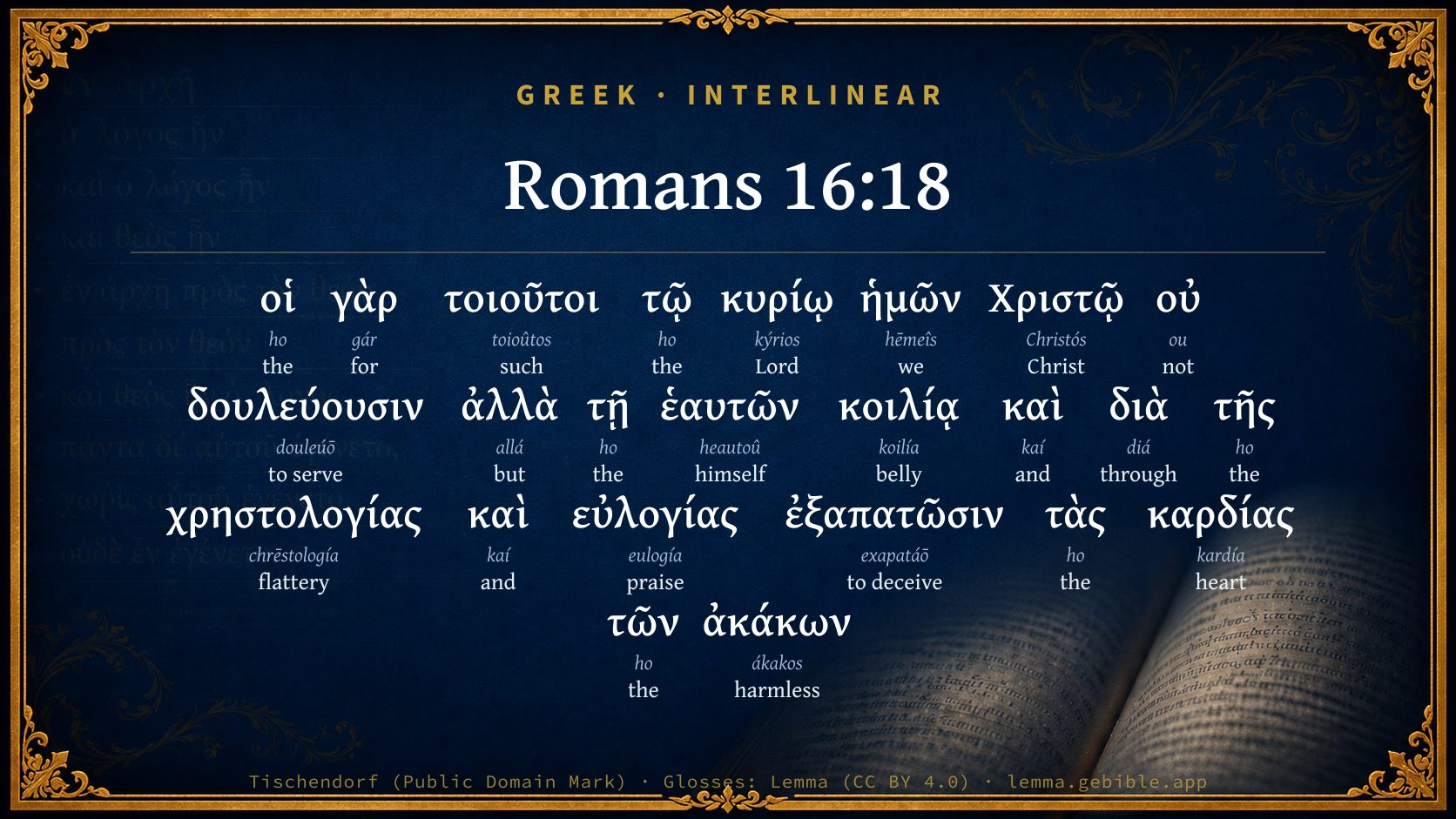
Greek (Tischendorf 8th ed.) Romans 16:18 appears in the Greek New Testament. The text above is from the Tischendorf 8th edition. Each word links to its Strong’s number and a concise gloss. Click any word for its full Thayer’s Greek Lexicon entry.
Download image
Cite this verse

Romans 16:18 (World English Bible). Public Domain. Lemma interlinear Bible study tool, https://lemma.gebible.app/v/romans/16/18.

Show BibTeX & RIS
BibTeX
RIS
English Translation
For those who are such don't serve our Lord, Jesus Christ, but their own belly; and by their smooth and flattering speech, they deceive the hearts of the innocent.
World English Bible · Public Domain
Highlights
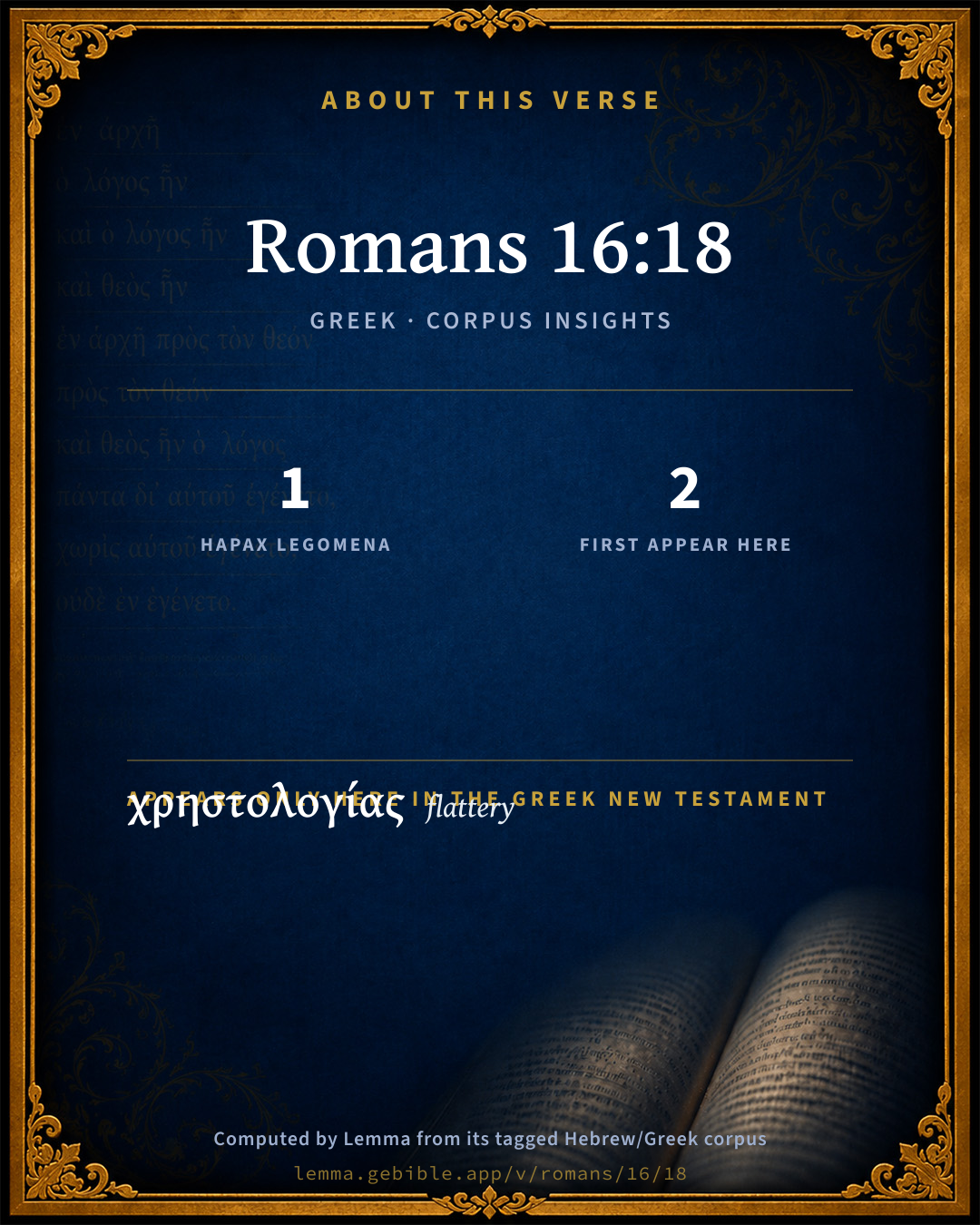
  • 1 hapax legomenon — only here in the Greek New Testament
  • 2 first appearances in the Greek New Testament
Full analysis ↓
Download a study sheet

One document with this verse’s original text, its word-by-word gloss line, the meaning frame, cross-references with their text, attributed commentary, and full source and license credits — printable, and it pastes into notes with its structure intact.

This verse Autodidact and up

Study sheet (.html) Plain text (.txt)

A passage Seminary Student

Up to 50 verses in one chapter. A passage sheet keeps up to 6 commentary sources and 12 cross-references per verse, in the order this page ranks them, and says so on the sheet whenever that leaves anything out. Ask for a single verse and you get the Autodidact verse sheet above.

Everything on this page stays free to read, with no account — the sheet is a download of what is already on screen, not access to it.

Want to remove ads? Support Godless Engineer
Compare translations 3

The same verse in 3 English versions, stacked beneath the original-language interlinear above. Click any original word for its lexicon entry.

Each is an independent rendering of the whole verse — the interlinear is not word-aligned to these translations.

Highlighted words mark where these versions differ — a whole-verse word diff, not a word-by-word alignment.

  • World English Bible Public Domain
    For those who are such don't serve our Lord, Jesus Christ, but their own belly; and by their smooth and flattering speech, they deceive the hearts of the innocent.
  • King James Version Public Domain
    For they that are such serve not our Lord Jesus Christ, but their own belly; and by good words and fair speeches deceive the hearts of the simple.
  • unfoldingWord Literal Text CC BY-SA 4.0
    For ones such as these are not enslaved to our Lord Christ, but to their own stomach, and through their smooth speech and flattery they deceive the hearts of the unsuspecting ones.

unfoldingWord Literal Text — © unfoldingWord, licensed CC BY-SA 4.0. Word-aligned USFM3 via Door43 (git.door43.org/unfoldingWord/en_ult).

Versions to compare (up to 4)

3 of 4 selected

Show all 19 translations

Every available English version of this verse, each an independent rendering of the whole verse.

  • World English Bible Public Domain
    For those who are such don't serve our Lord, Jesus Christ, but their own belly; and by their smooth and flattering speech, they deceive the hearts of the innocent.
  • Berean Standard Bible Public Domain
    For such people are not serving our Lord Christ, but their own appetites. By smooth talk and flattery they deceive the hearts of the naive.
  • Majority Standard Bible Public Domain
    For such people are not serving our Lord Jesus Christ, but their own appetites. By smooth talk and flattery they deceive the hearts of the naive.
  • King James Version Public Domain
    For they that are such serve not our Lord Jesus Christ, but their own belly; and by good words and fair speeches deceive the hearts of the simple.
  • American Standard Version (1901) Public Domain
    For they that are such serve not our Lord Christ, but their own belly; and by their smooth and fair speech they beguile the hearts of the innocent.
  • Revised Version (1885) Public Domain
    For they that are such serve not our Lord Christ, but their own belly; and by their smooth and fair speech they beguile the hearts of the innocent.
  • Geneva Bible (1599) Public Domain
    For they that are such, serue not the Lord Iesus Christ, but their owne bellies, and with faire speach and flattering deceiue the heartes of the simple.
  • Douay-Rheims (1899) Public Domain
    For they that are such, serve not Christ our Lord, but their own belly; and by pleasing speeches and good words, seduce the hearts of the innocent.
  • Young's Literal Translation Public Domain
    for such our Lord Jesus Christ do not serve, but their own belly; and through the good word and fair speech they deceive the hearts of the harmless,
  • Literal Standard Version CC BY-SA 4.0
    for such do not serve our Lord Jesus Christ, but their own belly; and through the good word and fair speech they deceive the hearts of the harmless.
  • Unlocked Literal Bible CC BY-SA 4.0
    For people such as these do not serve our Lord Christ, but their own stomach. By their smooth and flattering speech they deceive the hearts of the innocent.
  • unfoldingWord Literal Text CC BY-SA 4.0
    For ones such as these are not enslaved to our Lord Christ, but to their own stomach, and through their smooth speech and flattery they deceive the hearts of the unsuspecting ones.
  • Darby Bible Public Domain
    For such serve not our Lord Christ, but their own belly, and by good words and fair speeches deceive the hearts of the unsuspecting.
  • World Messianic Bible Public Domain
    For those who are such don’t serve our Lord Yeshua the Messiah, but their own belly; and by their smooth and flattering speech they deceive the hearts of the innocent.
  • Webster's Bible Public Domain
    For they that are such serve not our Lord Jesus Christ, but their own belly; and by good words and fair speeches deceive the hearts of the simple.
  • Free Bible Version CC BY-SA 4.0
    These people are not serving Christ our Lord but their own appetites, and by their smooth-talking and pleasant words they deceive the minds of unsuspecting people.
  • Bible in Basic English Public Domain
    For such people are not servants of the Lord Christ, but of their stomachs; and by their smooth and well-said words the hearts of those who have no knowledge of evil are tricked.
  • Text-Critical English NT CC BY 4.0
    For such people do not serve our Lord Jesus Christ, but their own belly. By smooth talk and fine speech they deceive the hearts of the unsuspecting.
  • Tyndale New Testament (1534) Public Domain
    For they that are suche serve not the Lorde Iesus Christ: but their awne bellyes and with swete preachinges and flatteringe wordes deceave the hertes of the innocetes.

Literal Standard Version (2020), Covenant Press — licensed CC BY-SA 4.0. Text via the HelloAO Bible API (eBible.org). Unlocked Literal Bible (unfoldingWord) — licensed CC BY-SA 4.0. Text via the HelloAO Bible API (eBible.org). unfoldingWord Literal Text — © unfoldingWord, licensed CC BY-SA 4.0. Word-aligned USFM3 via Door43 (git.door43.org/unfoldingWord/en_ult). Free Bible Version, Dr. Jonathan Gallagher — licensed CC BY-SA 4.0. Text via the HelloAO Bible API (eBible.org).

Word by word

More ways to search: Search by grammar → Find every occurrence → Compare this word →

Practice this passage: Drill this verse → Learn its vocabulary →

χρηστολογίας
chrēstología
G5542
“flattery”
Noun, Genitive, Singular, Feminine
Part of Speech
Noun
Case
Genitive
Number
Singular
Gender
Feminine
Full Thayer's Definition

Origin: from a compound of G5543 and G3004

TDNT: 17:12,1

1. fair speaking, the smooth and plausible address which simulates goodness
  1. οἱ ho G3588 “the” Article, Nominative, Plural, Masculine
  2. γὰρ gár G1063 “for” Conjunction
  3. τοιοῦτοι toioûtos G5108 “such” Demonstrative pronoun, Nominative, Plural, Masculine
  4. τῷ ho G3588 “the” Article, Dative, Singular, Masculine
  5. κυρίῳ kýrios G2962 “Lord” Noun, Dative, Singular, Masculine
  6. ἡμῶν hēmeîs G2249 “we” Personal pronoun, 1st person, Genitive, Plural
  7. Χριστῷ Christós G5547 “Christ” Noun, Dative, Singular, Masculine
  8. οὐ ou G3756 “not” Particle, Negative
  9. δουλεύουσιν douleúō G1398 “to serve” Verb, Present, Active, Indicative, 3rd person, Plural
  10. ἀλλὰ allá G235 “but” Conjunction
  11. τῇ ho G3588 “the” Article, Dative, Singular, Feminine
  12. ἑαυτῶν heautoû G1438 “himself” Reflexive pronoun, 3rd person, Genitive, Plural, Masculine
  13. κοιλίᾳ koilía G2836 “belly” Noun, Dative, Singular, Feminine
  14. καὶ kaí G2532 “and” Conjunction
  15. διὰ diá G1223 “through” Preposition
  16. τῆς ho G3588 “the” Article, Genitive, Singular, Feminine
  17. καὶ kaí G2532 “and” Conjunction
  18. εὐλογίας eulogía G2129 “praise” Noun, Genitive, Singular, Feminine
  19. ἐξαπατῶσιν exapatáō G1818 “to deceive” Verb, Present, Active, Indicative, 3rd person, Plural
  20. τὰς ho G3588 “the” Article, Accusative, Plural, Feminine
  21. καρδίας kardía G2588 “heart” Noun, Accusative, Plural, Feminine
  22. τῶν ho G3588 “the” Article, Genitive, Plural, Masculine
  23. ἀκάκων ákakos G172 “harmless” Adjective, Genitive, Plural, Masculine

About this verse

These counts appear in no published source. They are computed here, from the morphology-tagged text and Lemma’s own curated glosses. What Lemma adds →

24
words
18
distinct lemmas
Pauline Epistles
section

Notable vocabulary

1 hapax legomenon — a word that appears only here in the entire Greek New Testament:

  • χρηστολογίας flattery G5542

First appearance in Scripture

These words make their first canonical appearance in the Greek New Testament here:

  • χρηστολογίας flattery G5542
  • ἀκάκων harmless G172

Shared distinctive vocabulary

ἀκάκων harmless G172 occurs in 2 verses of the Greek New Testament. Also found in:
Repetition

Words recur within this verse:

Cross-references

50

Topical passages linked to Romans 16:18 in the Treasury of Scripture Knowledge — connected by theme and wording, ordered by reader-vote popularity; previews shown in the World English Bible.

  • Colossians 2:4 Now this I say that no one may delude you with persuasiveness of speech.
  • Matthew 7:15 "Beware of false prophets, who come to you in sheep's clothing, but inwardly are ravening wolves.
  • Micah 3:5 Thus says Yahweh concerning the prophets who lead my people astray; for those who feed their teeth, they proclaim, "Peace!" and whoever doesn't provide for their mouths, they prepare war against him:
  • 1 Timothy 6:5 constant friction of people of corrupt minds and destitute of the truth, who suppose that godliness is a means of gain. Withdraw yourself from such.
  • Philippians 3:19 whose end is destruction, whose god is the belly, and whose glory is in their shame, who think about earthly things.
  • 2 Timothy 3:2–6 For men will be lovers of self, lovers of money, boastful, arrogant, blasphemers, disobedient to parents, unthankful, unholy,
  • 2 Peter 2:3 In covetousness they will exploit you with deceptive words: whose sentence now from of old doesn't linger, and their destruction will not slumber.
  • 2 Thessalonians 2:10 and with all deception of wickedness for those who are being lost, because they didn't receive the love of the truth, that they might be saved.
  • Jude 1:16 These are murmurers and complainers, walking after their lusts (and their mouth speaks proud things), showing respect of persons to gain advantage.
  • Hosea 4:8–11 They feed on the sin of my people, And set their heart on their iniquity.
  • 2 Corinthians 11:13–15 For such men are false apostles, deceitful workers, masquerading as Christ's apostles.
  • Galatians 1:10 For am I now seeking the favor of men, or of God? Or am I striving to please men? For if I were still pleasing men, I wouldn't be a servant of Christ.
  • Titus 1:10–12 For there are also many unruly men, vain talkers and deceivers, especially those of the circumcision,
  • 2 Peter 2:18–20 For, uttering great swelling words of emptiness, they entice in the lusts of the flesh, by licentiousness, those who are indeed escaping from those who live in error;
  • Proverbs 22:3 A prudent man sees danger, and hides himself; But the simple pass on, and suffer for it.
  • Isaiah 30:10–11 who tell the seers, "Don't see;" and to the prophets, "Don't prophesy to us right things, speak to us smooth things, prophesy deceits,
  • Isaiah 56:10–12 His watchmen are blind, they are all without knowledge; they are all mute dogs, they can't bark; dreaming, lying down, loving to slumber.
  • Jeremiah 8:10–11 Therefore will I give their wives to others, and their fields to those who shall possess them: for everyone from the least even to the greatest is given to covetousness; from the prophet even to the priest every one deals falsely.
  • Ezekiel 13:19 You have profaned me among my people for handfuls of barley and for pieces of bread, to kill the souls who should not die, and to save the souls alive who should not live, by your lying to my people who listen to lies.
  • Matthew 24:24 For there will arise false christs, and false prophets, and they will show great signs and wonders, so as to lead astray, if possible, even the chosen ones.
  • Philippians 2:21 For they all seek their own, not the things of Jesus Christ.
  • 2 Timothy 2:16–18 But shun empty chatter, for they will proceed further in ungodliness,
  • 2 Peter 2:10–15 but chiefly those who walk after the flesh in the lust of defilement, and despise authority. Daring, self-willed, they are not afraid to speak evil of dignitaries;
  • Jude 1:12 These are hidden rocky reefs in your love feasts when they feast with you, shepherds who without fear feed themselves; clouds without water, carried along by winds; autumn leaves without fruit, twice dead, plucked up by the roots;
  • 1 Samuel 2:12–17 Now the sons of Eli were base men; they didn't know Yahweh.
  • 1 Samuel 2:29 Why kick you at my sacrifice and at my offering, which I have commanded in [my] habitation, and honor your sons above me, to make yourselves fat with the best of all the offerings of Israel my people?
  • 2 Chronicles 18:5 Then the king of Israel gathered the prophets together, four hundred men, and said to them, Shall we go to Ramoth-gilead to battle, or shall I forbear? They said, Go up; for God will deliver it into the hand of the king.
  • 2 Chronicles 18:12–17 The messenger who went to call Micaiah spoke to him, saying, Behold, the words of the prophets [declare] good to the king with one mouth: let your word therefore, Please be like one of theirs, and speak you good.
  • Psalms 19:7 Yahweh's law is perfect, restoring the soul. Yahweh's testimony is sure, making wise the simple.
  • Psalms 119:130 The entrance of your words gives light. It gives understanding to the simple.
  • Proverbs 8:5 You simple, understand prudence. You fools, be of an understanding heart.
  • Jeremiah 23:17 They say continually to those who despise me, Yahweh has said, You shall have peace; and to everyone who walks in the stubbornness of his own heart they say, No evil shall come on you.
  • Jeremiah 28:1–9 It happened the same year, in the beginning of the reign of Zedekiah king of Judah, in the fourth year, in the fifth month, that Hananiah the son of Azzur, the prophet, who was of Gibeon, spoke to me in the house of Yahweh, in the presence of the priests and of all the people, saying,
  • Jeremiah 28:15–17 Then said the prophet Jeremiah to Hananiah the prophet, Hear now, Hananiah: Yahweh has not sent you; but you make this people to trust in a lie.
  • Ezekiel 13:16 [to wit], the prophets of Israel who prophesy concerning Jerusalem, and who see visions of peace for her, and there is no peace, says the Lord Yahweh.
  • Matthew 6:24 "No one can serve two masters, for either he will hate the one and love the other; or else he will be devoted to one and despise the other. You can't serve both God and Mammon.
  • Matthew 24:11 Many false prophets will arise, and will lead many astray.
  • Matthew 24:48–51 But if that evil servant should say in his heart, 'My lord is delaying his coming,'
  • John 12:26 If anyone serves me, let him follow me. Where I am, there will my servant also be. If anyone serves me, the Father will honor him.
  • Romans 16:19 For your obedience has become known to all. I rejoice therefore over you. But I desire to have you wise in that which is good, but innocent in that which is evil.
  • 2 Corinthians 2:17 For we are not as so many, peddling the word of God. But as of sincerity, but as of God, in the sight of God, we speak in Christ.
  • Colossians 3:24 knowing that from the Lord you will receive the reward of the inheritance; for you serve the Lord Christ.
  • 1 John 4:1–3 Beloved, don't believe every spirit, but test the spirits, whether they are of God, because many false prophets have gone out into the world.
  • Proverbs 14:15 A simple man believes everything, But the prudent man carefully considers his ways.
  • Malachi 1:10 "Oh that there were one among you who would shut the doors, that you might not kindle fire on my altar in vain! I have no pleasure in you," says Yahweh of hosts, "neither will I accept an offering at your hand.
  • 2 Corinthians 4:2 But we have renounced the hidden things of shame, not walking in craftiness, nor handling the word of God deceitfully; but by the manifestation of the truth commending ourselves to every man's conscience in the sight of God.
  • 2 Corinthians 11:3 But I am afraid that somehow, as the serpent deceived Eve in his craftiness, so your minds might be corrupted from the simplicity that is in Christ.
  • James 1:1 James, a servant of God and of the Lord Jesus Christ, to the twelve tribes which are in the Dispersion: Greetings.
  • Jude 1:1 Jude, a servant of Jesus Christ, and brother of James, to those who are called, sanctified by God the Father, and kept for Jesus Christ:
  • Revelation 1:1 This is the Revelation of Jesus Christ, which God gave him to show to his servants the things which must happen soon, which he sent and made known by his angel to his servant, John,

Cross-references courtesy of OpenBible.info (CC BY 4.0).

Where the printed editions differ

1 variant

Places in this verse where the major printed Greek editions disagree on the wording in a way that affects the translation — a comparison of editions, not a manuscript-by-manuscript collation. The editions are the modern critical texts (Nestlé-Aland 28/27, SBL, Westcott-Hort, Tregelles, Tyndale House) and the traditional texts behind the KJV (the Textus Receptus and the Byzantine/Majority text). It is not a claim about which reading is original.

  1. Extra text
    Ἰησοῦ

    “Jesus”

    In TRByz Not in NA28NA27TynSBLWHTreg

    Ἰησοῦ (Iēsou) 'Jesus' is only in traditional manuscripts (TR+Byz)

Textual data: Translators Amalgamated Greek New Testament (STEPBible TAGNT) · CC BY 4.0.

Commentary

Notes on Romans 16:18 from classic Christian and Jewish commentators (each source and its license shown beneath its notes). The classic Christian expositions comment on the surrounding passage and are grouped to its opening verse, so a note may address several verses; the Jewish commentaries on the Tanakh (Rashi and others) are per-verse, so they appear only where the commentator wrote on this verse.

Lemma curates 59 commentaries, every one of them public domain or Creative Commons licensed, each selected and text-cleaned for this edition rather than reprinted as found. About our sources →

Bengel's Gnomon

Johann Albrecht Bengel

Rom 16:18. οἱ τοιοῦτοι) such as these. The substance with its quality is denoted.—κοιλίᾳ, the belly) Php 3:19.—χρηστολογίας) as concerns themselves by promising.—εὐλογίας) as concerns you, by praising and flattering.—τῶν ἀκάκων) פתי, a word of a middle signification, μέσον, for the sake of euphemy (end.); which the LXX. translate ἄκακος, and which occurs more than once in Proverbs. They are called ἄκακοι, who are merely free from badness, whereas they should also be strong in prudence, and be on their guard against the κακίαν, the badness of others.

Bengel's Gnomon of the New Testament — English translation (T&T Clark, Edinburgh, 1860) — public domain. Text from a community e-Sword module.

Meyer's Critical & Exegetical Commentary

Heinrich August Wilhelm Meyer

Rom_16:18. Reason assigned for the injunction of Rom_16:17.

οἱ τοιοῦτοι] hi tales; notatur substantia cum sua qualitate, Bengel.

οὐ δουλ.] Note the position of the negation; the thought is: to the Lord they refuse service, but their own belly they serve. Thereby they belonged to the category of the ἐχθροὶ τοῦ σταυροῦ τ. Χρ., Php_3:18.

On τῇ κοιλίᾳ δουλεύειν, τῇ γαστρὶ δουλεύειν, abdomini servire (Seneca, de benef. vii. 26), as a designation of selfishness, bent only on good cheer in eating and drinking, comp. on Php_3:19; Jacobs, ad Anthol. IX. p. 416. For this object the sectaries sought to make use of the influence and following which they obtained. Comp. Lucian, de morte Peregr. 11 ff. Behind their teaching, although this was not itself of an Epicurean nature (Hofmann), there lurked, hypocritically concealed, the tendency to epicurean practice.

διὰ τῆς χρηστολ. κ. εὐλογ.] by means of the kind (having a good-natured sound) and fair-set language, which they hold. On χρηστολ. comp. Jul. Capitol, vit. Pertin. 13; Eustath. p. 1437, 53, and the classical λόγοι χρηστοί, λέγειν χρηστά κ.τ.λ.; on εὐλογία, language finely expressed (here: fine phrases), Plat. Rep. p. 400 D; Lucian, Lexiph. 1; Aesop. 229. The two words characterize contents (χρηστολ.) and form (εὐλ.); hence it is preferable to take εὐλογ. in the above signification than in the ordinary one of praise, extolling (Philippi). Comp. Luther: stately language.

τῶν ἀκάκων] of the guileless (Heb_7:26), who themselves have nothing evil in their mind, and are prepared for nothing evil. See Wetstein in loc.; Ruhnken, ad Tim. p. 56; Schaefer, ad Greg. Cor. p. 342.

The assertion that Paul appears too severe in the accusation of his opponents (Rückert) cannot be made good. He writes from long and ample experience.

Meyer — Critical and Exegetical Commentary on the New Testament — English translation by Peter Christie, edited by Frederick Crombie (T&T Clark, 1880) — public domain. Text from a community e-Sword module.

Expositor's Greek Testament

ed. W. Robertson Nicoll

Rom 16:18 . οἱ γὰρ τοιοῦτοι κ . τ . λ . Christians must not associate with those who do not serve the one Lord. τῷ Κυρίῳ ἡμῶν Χριστῷ : this combination occurs here only in N.T. τῇ ἑαυτῶν κοιλίᾳ : cf. Phi 3:19 , ὧν ὁ θεὸς ἡ κοιλίᾳ . The words need not mean that the teachers in question were mere sensualists, or that they taught Epicurean or antinomian doctrines: the sense must partly be defined by the contrast it is not our Lord Christ whom they serve; on the contrary, it is base interests of their own. It is a bitter contemptuous way of describing a self-seeking spirit, rather than an allusion to any particular cast of doctrine. διὰ τῆς χρηστολογίας καὶ εὐλογίας : according to Grimm, χρηστολογία refers to the insinuating tone, εὐλογία to the fine style, of the false teachers. Examples from profane Greek bear out this distinction ( εὔαρχός ἐστιν ὁ λόγος καὶ πολλὴν τὴν εὐλογίαν ἐπιδεικνύμενος καὶ εὔλεξις ), but as εὐλογία in Biblical Greek, and in Philo and Josephus invariably has a religious sense, Cremer prefers to take it so here also: “pious talk”. ἐξαπατῶσι : Rom 7:11 , 1Co 3:18 , 2Th 2:2 . ἀκάκων : all the English versions, except Gen [40] and A.V., render “of the innocent” (Gifford). See Heb 7:26 . In this place “guileless” is rather the idea: suspecting no evil, and therefore liable to be deceived.

[40] genitive case.

The Expositor's Greek Testament, edited by W. Robertson Nicoll (1897–1910) — public domain. Text from a community e-Sword module.

Hodge's Commentary on Romans, Ephesians & First Corinthians

Charles Hodge

Rom_16:18

For they that are such serve not our Lord Jesus Christ, but their own belly; and by good words and fair speeches deceive the hearts of the simple. These men are to be avoided, because they are wicked and injurious. The description here given is applicable, in a great degree, to errorists in all ages. They are not actuated by zeal for the Lord Jesus; they are selfish, if not sensual; and they are plausible and deceitful. Compare Phi_3:18, Phi_3:19; 2Ti_3:5, 2Ti_3:6. The words (χρηστολογία and εὐλογία, blandiloquentia et assentatio) rendered good words and fair speeches, do not in this connection materially differ. They express that plausible and flattering address by which false teachers are wont to secure an influence over the simple. The word (ἄκακος) simple, signifies not merely innocent, but unwary, he who is liable to deception. (Pro_14:15, ἄκακος πιστεύει παντὶ λόγῳ, the simple believes everything.)

Charles Hodge — Commentary on Romans (1835), First Corinthians (1857), and Ephesians (1856) — public domain. Text from a community e-Sword module.

Geneva Bible (1599)

Geneva Bible translators

The word which he useth, signifieth a promising which performeth nothing, and if thou hearest any such, thou mayest assure thyself that he that promiseth thee is more careful of thy matters, than of his own.

Geneva Bible (1599) marginal notes — public domain. Text via Bolls.life.

Jamieson, Fausset & Brown

Robert Jamieson, A. R. Fausset & David Brown

For they that are such serve not our Lord Jesus Christ--"our Lord Christ" appears to be the true reading.

but their own belly--not in the grosset sense, but as "living for low ends of their own" (compare Phi 3:19).

and by good words and fair speeches deceive the simple--the unwary, the unsuspecting. (See Pro 14:15).

Jamieson, Fausset & Brown — Commentary Critical and Explanatory on the Whole Bible (1871) — public domain (CC PDM 1.0). Text via the HelloAO Bible API.

Adam Clarke's Commentary

Verse 18. They - serve not our Lord Jesus] They profess to be apostles, but they are not apostles of CHRIST; they neither do his will, nor preach his doctrine; they serve their own belly - they hate intruded themselves into the Church of Christ that they might get a secular support; it is for worldly gain alone that they take up the profession of the ministry: they have no Divine credentials; they convert not the heathen nor the ungodly, for they have no Divine unction; but by good words and fair speeches (for they have no miraculous nor saving powers) deceive the hearts of the simple, perverting Christian converts, that they may get their property, and thus secure a maintenance for themselves. The Church of God has ever been troubled with such pretended pastors - men who FEED themselves, not the flock; men who are too proud to beg, and too lazy to work; who have neither grace nor gifts to plant the standard of the cross on the devil's territories, and by the power of Christ make inroads upon his kingdom, and spoil him of his subjects. On the contrary, by sowing the seeds of dissension, by means of doubtful disputations, and the propagation of scandals; by glaring and insinuating speeches, χρηστολογιας, for they affect elegance and good breeding, they rend Christian congregations, form a party for themselves, and thus live on the spoils of the Church of God.

Should it be asked, Whom do you intend by this description? I answer: No soul, nor party, but such as the description suits. Irasceris.? - De TE fabula narratur. O, you are angry, are you? O, then, the cap fits you - put it on.

Adam Clarke's Commentary on the Bible (1810–1826) — public domain. Text from a community e-Sword/MySword module.

John Calvin's Commentaries

18. For they who are such, etc. He mentions an unvarying mark, by which false prophets are to be distinguished from the servants of Christ; for they have no care for the glory of Christ, but seek the benefit of their stomach. As, however, they deceitfully crept in, and by assuming another character, concealed their own wickedness, he at the same time pointed out, in order that no one might be deceived, the arts which they adopted — that they ingratiated themselves by a bland address. The preachers of the gospel have also their courtesy and their pleasing manner, but joined with honesty, so that they neither soothe men with vain praises, nor flatter their vices: but impostors allure men by flattery, and spare and indulge their vices, that they may keep them attached to themselves. He calls those simple who are not cautious enough to avoid deceptions.

John Calvin's Commentaries (1540-1563) — public domain. Text from the Calvin Translation Society English edition (1840s-50s) via the Christian Classics Ethereal Library (ccel.org). Calvin's coverage is partial (roughly two-thirds of the Bible); uncommented books and verses are honest gaps, never fabricated. The 19th-century editor's footnotes and remarks are omitted so the notes are faithfully Calvin's own voice.

Ellicott's Commentary for English Readers

(18) Their own belly.—Compare the description in Php_3:18-19, where the Apostle is also denouncing certain persons who made “a god of their belly.” It is not, however, quite clear that the class of persons intended is precisely the same. There the Apostle is condemning Antinomian extravagances which professed to be based on his own teaching; here he would seem to have in view some more radical divergence of doctrine, “contrary to” that which they had learned. Selfish indulgence is unfortunately a common goal, to which many diverse ways of error will be found to lead.

By good words and fair speeches.—The difference, perhaps, is between “insinuating” or “specious” address, and “fine phrases” in a rhetorical sense.

Simple.—Literally, guileless. Those who have no evil intentions themselves, and do not readily suspect others of them.

A Bible Commentary for English Readers, edited by Charles John Ellicott (1878–1897) — public domain. Text from a community e-Sword module.

The Cambridge Bible for Schools and Colleges

gen. ed. J. J. S. Perowne

18. serve not] Perhaps these words (lit. do not bondservice to,) allude to the professed “liberty” of the erring teachers. Q. d., “they decline, indeed, the bondage of Christ, but they are in bondage to their own appetites all the while.” Cp. 2Pe_2:19.—With a similar emphasis, probably, he writes “our Lord (Master) Jesus Christ.”

their own belly] Cp. Php_3:19. The words indicate sensual self-indulgence generally, whether grosser or lighter.

by good words, &c.] Lit. by their sweet-speech and fair-speech. The first word denotes the seeming piety, the second the seeming reasonableness, of their doctrine.

the simple] Lit. the evil-less; people unconscious of bad intentions, and hence unsuspicious of them.

Meyer remarks that St Paul did not write thus severely till after long and full experience.

The Cambridge Bible for Schools and Colleges (gen. ed. J. J. S. Perowne; Cambridge University Press, 1878–1918) — public domain. Text from a community e-Sword module.

John Gill's Exposition

For your obedience is come abroad unto all men,.... That is, as the Arabic and Ethiopic versions render it, "the fame" and report of their obedience to the faith, to the doctrine of the Gospel, and the ministers of it, was spread everywhere, was well known to everyone, and spoken of with commendeth among all the churches in all nations: and this the apostle mentions as another reason why they should beware of false teachers, since it would be greatly to their reproach, should they, after all this, drop that form of doctrine which they had obeyed, desert the faithful ministers of the word, and follow these false teachers; should this be the case, they would be as notorious for their disobedience, as now for their obedience: and moreover, the apostle might hereby suggest, that whereas it was everywhere known how readily and at once they embraced the Gospel of Christ; this credulity and readiness to believe, which was their commendation, might have invited false teachers among them, who might hope and take encouragement from hence the more easily to gain upon them; and therefore they ought to be upon their watch and guard, and beware of them, and not believe every spirit:

I am glad therefore on your behalf; that they had so cheerfully and readily embraced the Gospel, and from the heart obeyed that form of doctrine delivered to them; and that their praise for this was in all the churches of Christ, and had everywhere a good report on this account:

but yet I would have you wise unto that which is good, and simple concerning evil; which is just the reverse of natural and unregenerate men, who are wise to do evil, but to do good they have no knowledge; some reference seems to be had to the words of Christ in Mat 10:16; the apostle's meaning is, that though he rejoiced at the heartiness and simplicity of their obedience, and the credit they obtained abroad on account of it, yet was he not without his fears and jealousies concerning them; and could not but greatly wish them more wisdom to understand the doctrines of the Gospel, to discern things that differ, and approve that which is the most excellent, and hold fast that which is good; and with all their harmlessness, innocence, and simplicity, prudently guard against all evil doctrines and principles, such as might unawares lead them into bad practices, dishonourable to religion, and uncomfortable to themselves.

John Gill's Exposition of the Whole Bible (1746–1763) — public domain (CC PDM 1.0). Text via the HelloAO Bible API.

Trapp's Complete Commentary

John Trapp

18 For they that are such serve not our Lord Jesus Christ, but their own belly; and by good words and fair speeches deceive the hearts of the simple.

Ver. 18. But their own bellies] They pretend the service of Christ to their worldly and wicked respects, by a dissembled sanctity, which is double iniquity. The Duke of Bavaria is even eaten up with those Popish flesh flies, friars and Jesuits. It was an honest complaint of a Popish writer, We, saith he, handle the Scriptures, tantum ut nos pascat et vestiat, only for a livelihood; we serve God for gain: as children will not say their prayers unless they be promised their breakfasts. Cajetan writing on Mat 5:13; "Ye are the salt of the earth," confesseth ingenuously of himself and his fellow prelates, that whereas by their places they should have been the salt of the earth, they had lost their savour, and were good for little else but looking after the rites and revenues of the Church. {a} And such were many of our English prelates grown, before their late extirpation. If you put not into the mouths of these Cerberuses, they would even prepare war against you. Therefore their "sun went down, and the day grew dark over them," Mic 3:5-6. All seducers are self-seekers: "they teach things that they ought not, for filthy lucre’s sake," Tit 1:11. They are like eagles that soar aloft towards heaven, not for any love of heaven, but that they may spy their prey the sooner, seize upon it the better: or like those ravens in Arabia, that, fully gorged, have a tunable sweet record; but empty, they screech horribly. In parabola oves capras suas quaerunt, comparison to a sheep seeking their nanny-goat, as the ferryman looks one way, rows another.

And by good words, &c.] Those locusts in the Revelation have faces like women, insinuative and flattering. The Valentinian heretics had an art to persuade before they taught, whereas the truth persuadeth by teaching, it doth not teach by persuading. (Tertullian.)

They deceive] As cheaters do, by the cogging of a dye, εν τη κυβεια, Eph 4:14. Fallax artificium, vel potius artifex fallacia, saith Erasmus on that text, a cumfing kind of cozenage.

{a} Evanuimus ac ad nihilum utiles, nisi ad externas ceremonias, externaque bona.

John Trapp, A Commentary or Exposition upon All the Books of the Old and New Testament (1647–1656) — public domain. Text from a community e-Sword module.

Albert Barnes' Notes on the Bible

Serve not - Obey not. Though they are professedly, yet they are not his real friends and followers.

But their own belly - Their own “lusts;” their own private interests; they do this to obtain support. The authors of parties and divisions, in church and state, have this usually in view. It is for the indulgence of some earthly appetite; to obtain function or property; or to gratify the love of dominion.

And by good words - Mild, fair, plausible speeches; with an appearance of great sincerity, and regard for the truth; compare Col 2:4; 2Pe 3:3. People who cause divisions commonly make great pretensions to peculiar love of truth and orthodoxy; and put on the appearance of great sincerity, sanctity, and humility.

And fair speeches - Greek εὐλογίας eulogias, eulogy, praise, flattery. This is another very common art. “Flattery” is one of the most powerful means of forming parties in the church; and “a little special attention,” or promise of an office, or commendation for talents or acquirements, will secure “many” to the purposes of party whom no regard for truth or orthodoxy could influence a moment.

Deceive the hearts of the simple - The minds of the unsuspecting, or those who are without guile τῶν ἀκάκων tōn akakōn. The apostle means to designate those who are simple-hearted, without any disposition to deceive others themselves, and of course without any suspicions of the “designs” of others. He has thus drawn the art of making parties with the hand of a master. First, there are smooth, plausible pretences, as of great love for truth. Then, an artful mingling of attentions and flatteries; and all this practiced on the minds of the unsuspecting, drawing their “hearts” and “affections” toward themselves. Happy would it have been if the art had been confined to his own times.

Albert Barnes' Notes on the Bible (1834–1885) — public domain. Text from a community e-Sword/MySword module.

Matthew Poole's English Annotations

In this verse you have a reason of the foregoing admonition, together with a description of the seducers, whom they should mark and avoid. He says, they are such as

serve not our Lord Jesus Christ, but their own belly; i.e. they serve themselves rather than Christ. Though they pretend to be the servants of Jesus Christ, and give themselves out for his ministers, yet they aim at nothing but their own commodity and advantage. A further account you have of such persons in Phi 3:19; 1Ti 6:5; Tit 1:11; 2Pe 2:3.

By good words and fair speeches deceive the hearts of the simple: q.d. As Satan insinuated into Eve, by pretending he wished her good; so these seducers pretend they aim at nothing but the good and benefit of those with whom they have to do: with smooth and flattering words, they praise both the persons and doings of those whom they would insnare, (so much the word ευλογια, here used, imports), and by this means they impose upon the simple, i.e. the over credulous and unwary, who do not mistrust any deceit or hurt. The word here rendered simple, properly signifies such as are not evil, or that are incautious, and not suspicious.

Matthew Poole's English Annotations on the Holy Bible (1683–1685) — public domain. Text from a community e-Sword/MySword module.

Whedon's Commentary on the Bible

Daniel D. Whedon

18. Their own belly—Their own maintenance and sensuality. (Compare Php_3:18-19.)

Good words and fair speeches—With rhyming terminations in the Greek, like apologies and eulogies; with the former commending themselves, with the latter flattering their victims.

Simple— Literally, the unevil and therefore suspecting no evil.

Daniel D. Whedon (gen. ed.), Commentary on the Old and New Testaments (1874–1909) — public domain. Text from a community e-Sword module.

The Pulpit Commentary

Vers. 18-20. For they that are such serve not our Lord Jesus Christ, but their own belly. (cf. Php_3:18, 19) Had St. Paul thought these people sincere though mistaken, he would doubtless have treated them with the tenderness he shows towards the weak brethren. But he regards them as self-interested, and of the flesh; and against such disturbers of the Church"s peace he is, here as elsewhere, indignant. (el. Gal_1:7, 8 2:4 3:1 5:11, 12) In speaking of them as serving, or being slaves to, their own belly, it cannot be concluded certainly that he attributed to them habits of sensuality. He may only mean that it is the gratification of the lower part of their nature that they have in view; and there may be allusion to the motive of such persons being the desire of eating and drinking at the cost of the Churches. In "The Teaching of the Twelve Apostles" (alluded to under Rom_12:6, seq.) the desire to live without working at the cost of the Church is set down as one of the marks of a false apostle or a false prophet. And by good words and fair speeches deceive the hearts of the simple (rather, innocent, or harmless. So the word akakov is translated in Heb_7:26. It is different from akeraiov in ver. 19, though the Authorized Version makes no difference). For your obedience is come abroad unto all men. This is apparently adduced as a reason for his exhorting them to beware of those seducers, with a confidence that they will not be seduced by them, ver. 19 being thus dependent on ver. 17. I am glad therefore on your behalf: but yet I would have you wise unto that which is good, but simple (akeraiouv) concerning evil. And the God of peace shall bruise Satan under your feet shortly. The grace of our Lord Jesus Christ be with you all. Amen.

Victory assured.

In viewing our human life, we are tempted into one or other of two extremes. To the worldly and the careless, especially when young and prosperous, life seems easy. They are conscious of no temptation, for they yield at once to each congenial suggestion. They are ignorant of struggles, for to them life has never shaped itself as a moral warfare. But there are those who are ever oppressed by a constant sense of the solemnity of life. To such the conflict is a daily and inevitable fact. They cannot drift adown the current; yet, strike out as bravely as they will, they feel as though they made no headway against the waters, as though they could never reach the shore. Struggle they must, they do; yet with many failures and with faint hope of final success. Now, Christianity rebukes the first of these classes for frivolity, the second for faithlessness. The Scriptures ever represent our life as a spiritual conflict; yet they ever summon us to fight the good fight of faith with hopeful hearts; the battle is fierce, but to the brave the victory is sure.

I THE CONFLICT AND THE FOE. There is a power of evil, a personal and mighty power. Satan seeks to carry captive human souls; and in the effort employs every resource the fiercest assaults, and the most unscrupulous, insidious wiles. In this Satan deals with men according to their circumstances, their character, their temperament. Over multitudes he triumphs openly. Yet there are those who resist him, who regard him as their deadly foe. Well is it for you if you are aware of your position, your danger, the attempts of the adversary, and your own weakness and insufficiency for a struggle so unequal. Faithful, consistent, experienced Christian! you have not yet finished the campaign; you are not yet beyond the reach of the fiery darts. Young and ardent Christian! dare not to indulge in boasting or to serf-satisfaction. Just where and when you least expect it, then and there the attack may be made. "Resist the devil;" "Watch and pray, lest ye enter into temptation;" "Take to you the whole armour of God.

II THE HELPER AND DELIVERER. In a conflict such as human life, how can we be blind to our own helplessness and need? Whither shall the assaulted and imperilled turn? Upon whom shall they call? The Christian cannot answer these questions amiss; for he has already sought and experienced the saving strength of God"s right hand. Yet he may well need to be reminded of his only hope and refuge. Let us lift up our eyes unto the hills, whence cometh our help. The God of peace is, in the text, set before us as our Saviour. Does it strike you as strange that the Most High should be so described in such a connection? Do you ask Why is the God of peace invoked, to oppose and to vanquish the foe of souls? The answer is plain. God"s nature is peace; his aim is peace; his rule is peace. But his is not the peace of compromise with sin His is the peace which comes with righteousness and with the reign of holy law. Such peace presupposes conflict. War with evil, until evil is vanquished, dethroned, and silent; and then peace, and only then; such is the principle of the gospel, such is the purpose of God, such is the law of the Christian"s life. Divine peace is pure and sincere and lasting. Remember that word of our Lord Jesus, "I am not come to send peace, but a sword.

III THE RESISTANCE AND THE VICTORY. Here we are, as Christians, members of the Church militant. But Christ is the Captain of our salvation; and the language of the apostle implies that, through the might and grace of our Leader, we shall conquer in the holy war. Christ is the Victor, who has conquered for us. The history of our Saviour"s earthly career is a history of conflict. The ministry of the Redeemer was a struggle with the prince of darkness. Witness his temptation, in which he encountered the foe in various guises, and ever vanquished his adversary and ours by the "sword of the Spirit, which is the Word of God." Witness the crisis of his humiliation and suffering: "This is your hour, and the power of darkness." Yet in that crisis the Lord Jesus beheld Satan as lightning cast from heaven, and he spoiled principalities and powers, making a show of them openly. Then was fulfilled the promise, "The seed of the woman shall bruise the serpent"s head." Christ is the Victor, who conquers in us. For it is in our own hearts that the real conflict is waged, that the true victory must be won. By the cross of Christ, through the presence and strengthening of the Spirit of Christ, the soldier who follows his Captain must come to share the Captain"s triumph. He himself has promised that it shall be so. In his humiliation he encouraged his disciples, saying, "Be of good cheer; I have overcome the world." From his glory he cheers them on, saying, "He that overcometh shall sit down with me in my throne." The individual Christian shall, by Divine grace, be victorious over the tempter who is the foe of his soul. He shall not yield to the blandishments or fall before the onsets of Satan; he shall learn submission to God"s will without murmuring; he shall serve without fainting; he shall rebuke without harshness; he shall trust without doubting. The world shall have less hold upon his affections, and heaven shall have more power to attract and charm. "We are more than conquerors through him that loved us." The Church, too, shall go, with the Lord himself, from conquest to conquest. It shall shake off dependence upon earthly and carnal weapons; it shall learn the hard lesson of charity; its pity shall be practical, and its purity shall be glorious; and it shall realize the picture painted by the glowing imagination of the inspired artist.

IV THE CHARACTER AND THE TYPE OF TRIUMPH. On these points the text is especially explicit. God shall "bruise Satan under your feet." From this it appears that the victory shall be complete. Human wisdom is prone to pronounce this impossible, and represents the moral conflict as one most uncertain in its issues, in which the advantage seems now to be with this party, and anon with that. And so far as this life is concerned, we have no reason to believe that we shall reach a position from which we look down and back upon the battle-field, as those superior to Satan"s assaults, delivered altogether from danger and from fear. Yet here we have an assurance of complete and lasting victory. If Satan is to be bruised beneath our feet, that implies that he shall be crushed. The figurative language depicts a conqueror, with his foe at his mercy, possessing no further power for resistance and mischief. "Is it possible," you ask, who have wrestled long and hard with the foe of souls it possible that, over such an adversary, so feeble a soldier of righteousness as I shall ever triumph?" Here is the answer: "They overcame the accuser of the brethren by the blood of the Lamb." Nor have you long to wait; for this shall happen "shortly." The strife is fierce, but it shall not be protracted. When your fidelity is tried and proved, the power of the enemy shall be crippled, and he himself shall be thrust down, and you shall have the crown of life. but a little while, And he shall come again, Who died that we might live, who lives That we with him may reign!

The Pulpit Commentary (1880–1919), ed. H.D.M. Spence-Jones & Joseph S. Exell — public domain. Text from a community e-Sword module.

John Wesley's Explanatory Notes

By good words - Concerning themselves, making great promises. And fair speeches - Concerning you, praising and flattering you. The harmless - Who, doing no ill themselves, are not upon their guard against them that do.

John Wesley, Explanatory Notes Upon the Whole Bible (1754–1765) — public domain. Text via the GEBible commentary corpus.

Godbey's Commentary on the New Testament

William B. Godbey

18. “For such do not serve our Lord Christ, but their own stomach, and through good speaking and eulogy deceive the hearts of the innocent.” This sad revelation of schismatics and heretics has flooded Christendom with delusion and destruction for ages, and is this day rampant in all the earth. Unspiritual, carnal, designing men, by their beautiful, eloquent and fastidious speeches and eulogies, bragging on the people, win the hearts of the simple and unsuspecting and lead them away proselytes, deluded by their sophistry and beguiled into conservatism to their selfish caprices for the sake of filthy lucre, patronage, popularity, promotion and temporal emolument. The same people turn this scripture against the poor holiness bands and accuse them of creating schism, division and heresy. This is where all the martyrs died under charge of schism, heresy and disloyalty. It was true, and is yet, that the devout, sincere people, pursuant to their conscientious duty to God, are forced to separate from these carnal shepherds who starve them to death and let Satan’s wolves devour them. This state of things results from the predominate power and influence of Satan in this dark fallen world, usurping the churches and passing himself for God, filling the pulpits with men of his own calling and leading, who are really these very schismatics and heretics here anathematized by the Holy Ghost. Hence if we did not separate from them, we would not only be untrue to God, but lose our souls. Therefore in all ages the persecuted martyrs and the poor holiness people have really been the true church of God, though everywhere denounced as schismatics and heretics, by the ecclesiastical tyrants, who under Satanic leadership having usurped the visible church, hurl their anathemas against all who dare to retreat away from the deadening influence of their carnal ministry. The real heretic is the one who separates from God and His truth, and not the one who separates from some visible organization claiming to be the church of God, but in countless instances signally failing to verify a solitary differentia of the Holy Ecclesia.

William B. Godbey, Commentary on the New Testament (1896–1900) — public domain. Text from a community e-Sword module.

McGarvey & Pendleton's Commentaries

J. W. McGarvey

For they that are such serve not our Lord Christ, but their own belly ["Belly" is meant to express all the appetites of the carnal life. The heretics here referred to, being mediocre and insufficient teachers in the true faith, resorted to the artifice of stirring up factions for the purpose of obtaining therefrom physical and pecuniary support. (Comp. Phi_3:19 ) Their breed is not extinct. There are many who shine as heretics who would pass their lives in obscurity if they were orthodox, and there are also many who amass fortunes preaching lies who would live at a poor, starving rate if they preached the truth. But nothing better can be expected of the devotees of the belly]; and by their smooth and fair speech they beguile the hearts of the innocent . [They succeeded, not by the inherent power of what they taught, but by the insidious manner in which they taught it. "Truth," says Trapp, "persuadeth by teaching, it doth not teach by persuading." It has always been a characteristic of truth that it comes to us in plain and simple garb, rugged, unadorned ( Mat_11:20 ; Act_4:13 ; 1Co_1:21-31 ; 1Co_2:1-16 ; 2Co_3:12-13 ; 2Co_10:10 ; 2Co_11:6 ; Jam_3:17 ), and its rival, error, sits in the seat of the mighty, speaks with all subtilty and charms with rhetoric and oratorical display-- Act_8:9 ; Act_13:10 ; Act_12:21-23 ; 1Co_8:1-2 ; 1Ti_6:3-5 ; 2Ti_3:7-8 ]

J. W. McGarvey (with Philip Y. Pendleton), Commentaries on the New Testament (The Fourfold Gospel, 1914; Acts; and the epistles) — public domain. Text from a community e-Sword/MySword module.

The People's New Testament

B. W. Johnson

18. Serve not our Lord Jesus Christ. These men, like many other false teachers, were more devoted to their own appetites than to Christ. The simple. The unsuspecting.

B. W. Johnson's The People's New Testament with Notes (1889–1891) — public domain. Electronic text from the Christian Classics Ethereal Library (CCEL) ThML edition.

Cambridge Greek Testament for Schools and Colleges

18. οἱ γὰρ κ.τ.λ. The warning is against men who claimed to be true servants of Christ and were not; cf. 2Co 11:13: therefore Judaising Christians, not necessarily themselves originally Jews.

τῇ ἑαυτῶν κοιλίᾳ. Cf. Joh 7:38; Php 3:19 (metaph. only in N.T.) = selfish desires and objects in the widest sense. He does not say ἑαυτοῖς because they are not even serving their own true interests.

διὰ τῆς χρ. The ‘fair speech’ employed by them or characteristic of them; cf. Gal 3:1; Gal 4:17. S. H. qu. Jul. Capitol. Pertinax 13, χρ. eum appellantes qui bene loqueretur et male faceret.

εὐλογίας seems to get a bad meaning here by its connexion with χρ. S. H. qu. Aesop Fab. 229, p. 150 ed. Av. In N.T. elsewhere always of ‘blessing.’ Plat. Rep. 400 D of fine speech, in a good sense.

τῶν ἀκάκων = simple, guileless, and therefore unsuspicious; combined with εὐήθης Diod. Sic. ap. Wetstein; )[332] πανοῦργος Dio Cass., ib[333]; cf. Pro 1:4; Heb 7:26. S. Paul is careful not to suggest that they have as yet any hold upon the Church.

[332] )( opposed to

[333] ib. ibidem

Cambridge Greek Testament for Schools and Colleges (Cambridge University Press, 1896; 21 vols, various authors incl. Carr, Maclear, Plummer, Farrar, Lumby, Moule, M. R. James, Simcox) — public domain. Text from a community e-Sword module.

Alford’s Greek Testament

Henry Alford

18.] χρηστολογία, κολακεία, Theophyl. Wetstein cites from Julius Capitolinus, in Pertinace, 13, “omnes, qui libere conferebant, male Pertinacem loquebantur, chrestologum eum appellantes, qui bene loqueretur et male faceret.”

εὐλογίας, fairness of speech: so Plato, Rep. iii. 400 d, εὐλογία ἄρα κ. εὐαρμοστία κ. εὐσχημοσύνη κ. εὐρυθμία εὐηθείᾳ ἀκολουθεῖ—or perhaps ‘eulogies’ (flatteries), as Pind. Neh 4:8, οὐδὲ θερμὸν ὕδωρ τόσον | γε μαλθακὰ τεύχει | γυῖα, τόσσον εὐλογία φόρ | μιγγι συνάορος.

Henry Alford, The Greek Testament (1849–1861) — public domain. Text from a community e-Sword module.

International Critical Commentary

18. These false teachers are described as being self-interested in their motives, specious and deceptive in their manners. Cf. Php 3:19 ὦν τὸ τέλος ἀπώλεια, ὦν ὁ θεὸς ἡ κοιλία, καὶ ἡ δόξα ἐν τῇ αἰσχύνῃ αὐτῶν, οἱ τὰ ἐπίγεια φρονοῦντες.

τῇ ἑαυτῶν κοιλίᾳ. These words do not in this case appear to mean that their habits are lax and epicurean, but that their motives are interested, and their conceptions and objects are inadequate. So Origen: Sed et quid causae sit, qua iurgia in ecclesiis suscitantur, et lites, divini Spiritus instinctu aperit. Ventris, inquit, gratia: hoc est, quaestus et cupiditatis. The meaning is the same probably in the somewhat parallel passages Php 3:17-21; Col 2:20-4. So Hort (Judaistic Christianity, p. 124) explains ταπεινοφροσύνη to mean ‘a grovelling habit of mind, choosing lower things as the primary sphere of religion, and not τὰ ἄνω, the region in which Christ is seated at God’s right hand.’

Χρηστολογίας καὶ εὐλογίας, ‘fair and flattering speech.’ In illustration of the first word all commentators quote Jul. Capitolinus, Pertinax 13 (in Hist. August): χρηστολόγον eum appellantes qui bene loqueretur et male faceret. The use of εὐλογία which generally means ‘praise,’ ‘laudation,’ or ‘blessing’ (cp. 15:29), in a bad sense as here of ‘flattering’ or ‘specious’ language is rare. An instance is quoted in the dictionaries from Aesop. Fab. 229, p. 150, ed. Av. ἐὰν σὺ εὐλογίας εὐπορῇς ἔγωγέ σου οὐ κήδομαι.

International Critical Commentary — older volumes (1896–1929), various authors — public domain. Text from a community e-Sword module.

Vincent's Word Studies in the New Testament

Marvin R. Vincent

Belly. Compare Phi 3:19.

Good words [χρηστολογιας] . Only here in the New Testament. Lit., good speaking. The compounded adjective crhs tov is used rather in its secondary sense of mild, pleasant So Rev., smooth speech.

Deceive (ejxapatwsin) Better, as Rev., beguile. It is not merely making a false impression, but practically leading astray Simple [ακακων] . Only here and Heb 7:26. Lit., not evil. Rev., innocent. Bengel says : "An indifferent word. They are called so who are merely without positive wickedness, when they ought to abound also in prudence, and to guard against other men's wickedness."

Marvin R. Vincent, Word Studies in the New Testament (1887–1900) — public domain. Text from a community e-Sword/MySword module.

Godet's Commentaries

Frédéric Louis Godet

Vv. 18. The parties referred to are men at once sensual and hypocritical; it is therefore under the influence of a deep moral aversion that the Christians of Rome are called to avoid them. They serve their sensual appetites, and not Christ. This feature reminds us of Php 3:19, words which apply to the same individuals: “whose god is their belly, and who mind earthly things;” comp. also 2Co 11:20-21 : “If a man bring you into bondage, devour you, take of you, ye suffer it.” It is this sensual and insolent conduct which Paul characterizes, Php 3:2, in the severe terms: “Beware of dogs; beware of evil workers.” The gospel ministry was to these people a means of gain, and gain the means of satisfying their gross passions. They were the Tartuffes of the period. Another point of resemblance identifies them more completely still with the type drawn by Molière: they present themselves with a benignant style of speech (χρηστολογία), and with fatherly benedictions (εὐλογίαι); and the simple (ἄκακοι, literally, the innocent), who suspect no evil, allow themselves to be caught with these devout airs and paternal tone. Was it necessary, as Schultz holds, that these men should be already present to account for Paul speaking thus in regard to them? Had he not learned to know them in this light in Galatia and at Corinth, and could he not portray them to the church of Rome, that they might be recognized immediately on their appearing?

Frédéric Louis Godet — Commentaries on Luke, John, Romans, and 1 Corinthians — English translation (T&T Clark, Edinburgh, 1870s–1890s) — public domain. Text from a community e-Sword module.

Lesson kit

Teaching starters — assembled from the data on this page, not authored interpretation. Every prompt links to the verse data it draws on. Edit before teaching.

Romans, in the Pauline Epistles, opens this verse with 24 words (18 distinct Greek lemmas). Its most distinctive word is chrēstología (“flattery”). A historical commentator’s framing appears above. Read the whole chapter for the surrounding context.

Discussion questions

  1. What does “flattery” (chrēstología) contribute to the verse as a whole?
  2. This verse holds 1 word here found nowhere else in the Greek New Testament. What might the rare word draw attention to?
  3. 2 words here appear for the first time in Scripture. What is being introduced at this debut?
  4. Hebrews 7:26 shares the word «harmless» with this verse. How do the two illuminate each other?
  5. “the” occurs 6× in this one verse. What is the effect of the repetition?
  6. These translations render this verse differently; the difference is in the English rendering, not the original. What questions does that raise?
  7. Reading how Bengel's Gnomon and Meyer's Critical & Exegetical Commentary read this verse, where do the two commentators agree and where do they part?

Things to notice

  • 1 word in this verse appears nowhere else in the Greek New Testament.
  • 2 words make their first canonical appearance in Scripture here.
  • These translations choose different wording for 20 words in this verse.
  • “the” occurs 6× in this single verse.
  • 18 distinct Greek lemmas span 24 words in this verse.

Reading settings

Reading text

Shown beneath each verse's original-language words.

Old Testament
Old Testament edition

Read the OT as the Masoretic Hebrew (MT) or the Greek Septuagint (LXX).

English shown for the Greek Septuagint (in the Hebrew ↔ Greek comparison).

Comparing translations? Open the Compare panel on any verse page to stack up to four side by side.