
Romans 4:22

Greek (Tischendorf 8th ed.) Romans 4:22 appears in the Greek New Testament. The text above is from the Tischendorf 8th edition. Each word links to its Strong’s number and a concise gloss. Click any word for its full Thayer’s Greek Lexicon entry.
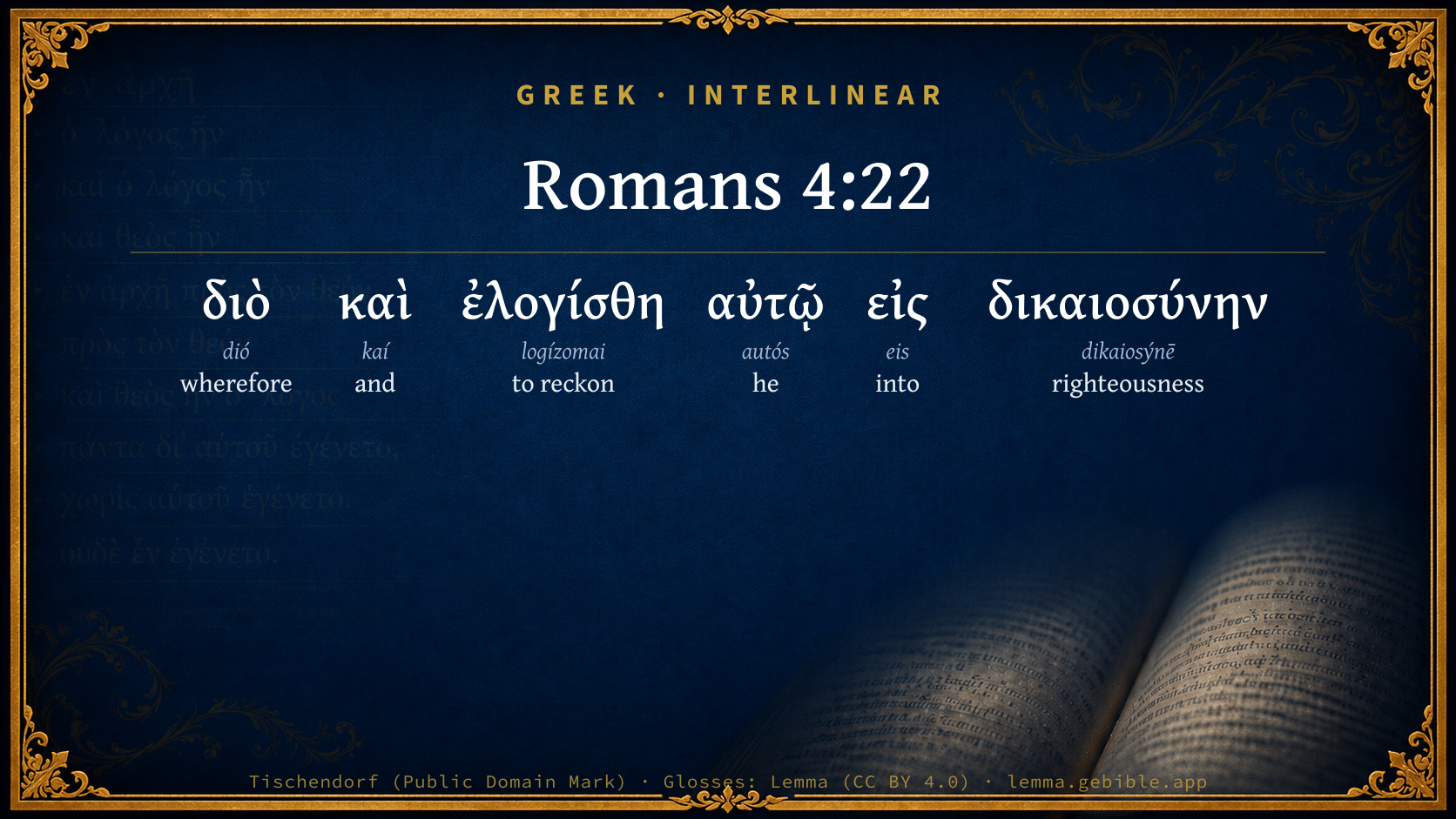
Download image
Cite this verse

Romans 4:22 (World English Bible). Public Domain. Lemma interlinear Bible study tool, https://lemma.gebible.app/v/romans/4/22.

Show BibTeX & RIS
BibTeX
RIS
English Translation
Therefore it also was "reckoned to him for righteousness."
World English Bible · Public Domain
Download a study sheet

One document with this verse’s original text, its word-by-word gloss line, the meaning frame, cross-references with their text, attributed commentary, and full source and license credits — printable, and it pastes into notes with its structure intact.

This verse Autodidact and up

Study sheet (.html) Plain text (.txt)

A passage Seminary Student

Up to 50 verses in one chapter. A passage sheet keeps up to 6 commentary sources and 12 cross-references per verse, in the order this page ranks them, and says so on the sheet whenever that leaves anything out. Ask for a single verse and you get the Autodidact verse sheet above.

Everything on this page stays free to read, with no account — the sheet is a download of what is already on screen, not access to it.

Want to remove ads? Support Godless Engineer
Compare translations 3

The same verse in 3 English versions, stacked beneath the original-language interlinear above. Click any original word for its lexicon entry.

Each is an independent rendering of the whole verse — the interlinear is not word-aligned to these translations.

Highlighted words mark where these versions differ — a whole-verse word diff, not a word-by-word alignment.

  • World English Bible Public Domain
    Therefore it also was "reckoned to him for righteousness."
  • King James Version Public Domain
    And therefore it was imputed to him for righteousness.
  • unfoldingWord Literal Text CC BY-SA 4.0
    And therefore, “it was credited to him as righteousness.”

unfoldingWord Literal Text — © unfoldingWord, licensed CC BY-SA 4.0. Word-aligned USFM3 via Door43 (git.door43.org/unfoldingWord/en_ult).

Versions to compare (up to 4)

3 of 4 selected

Show all 19 translations

Every available English version of this verse, each an independent rendering of the whole verse.

  • World English Bible Public Domain
    Therefore it also was "reckoned to him for righteousness."
  • Berean Standard Bible Public Domain
    This is why “it was credited to him as righteousness.”
  • Majority Standard Bible Public Domain
    This is why “it was credited to him as righteousness.”
  • King James Version Public Domain
    And therefore it was imputed to him for righteousness.
  • American Standard Version (1901) Public Domain
    Wherefore also it was reckoned unto him for righteousness.
  • Revised Version (1885) Public Domain
    Wherefore also it was reckoned unto him for righteousness.
  • Geneva Bible (1599) Public Domain
    And therefore it was imputed to him for righteousnesse.
  • Douay-Rheims (1899) Public Domain
    And therefore it was reputed to him unto justice.
  • Young's Literal Translation Public Domain
    wherefore also it was reckoned to him to righteousness.
  • Literal Standard Version CC BY-SA 4.0
    for this reason also it was reckoned to him for righteousness.
  • Unlocked Literal Bible CC BY-SA 4.0
    Therefore this was also counted to him as righteousness.
  • unfoldingWord Literal Text CC BY-SA 4.0
    And therefore, “it was credited to him as righteousness.”
  • Darby Bible Public Domain
    wherefore also it was reckoned to him as righteousness.
  • World Messianic Bible Public Domain
    Therefore it also was “credited to him for righteousness.”
  • Webster's Bible Public Domain
    And therefore it was imputed to him for righteousness.
  • Free Bible Version CC BY-SA 4.0
    That's why Abraham was considered right by God.
  • Bible in Basic English Public Domain
    For which reason it was put to his account as righteousness.
  • Text-Critical English NT CC BY 4.0
    Therefore, “it was counted to him as righteousness.”
  • Tyndale New Testament (1534) Public Domain
    And therfore was it reckened to him for rightewesnes.

Literal Standard Version (2020), Covenant Press — licensed CC BY-SA 4.0. Text via the HelloAO Bible API (eBible.org). Unlocked Literal Bible (unfoldingWord) — licensed CC BY-SA 4.0. Text via the HelloAO Bible API (eBible.org). unfoldingWord Literal Text — © unfoldingWord, licensed CC BY-SA 4.0. Word-aligned USFM3 via Door43 (git.door43.org/unfoldingWord/en_ult). Free Bible Version, Dr. Jonathan Gallagher — licensed CC BY-SA 4.0. Text via the HelloAO Bible API (eBible.org).

Word by word

More ways to search: Search by grammar → Find every occurrence → Compare this word →

Practice this passage: Drill this verse → Learn its vocabulary →

ἐλογίσθη
logízomai
G3049
“to reckon”
Verb, Aorist, Passive, Indicative, 3rd person, Singular
Part of Speech
Verb
Tense
Aorist
Voice
Passive
Mood
Indicative
Person
3rd person
Number
Singular
Full Thayer's Definition

Origin: middle voice from G3056

TDNT: 08:44,5

1. to reckon, count, compute, calculate, count over a. to take into account, to make an account of 1. metaph. to pass to one's account, to impute 2. a thing is reckoned as or to be something, i.e. as availing for or equivalent to something, as having the like force and weight b. to number among, reckon with c. to reckon or account 2. to reckon inward, count up or weigh the reasons, to deliberate 3. by reckoning up all the reasons, to gather or infer a. to consider, take into account, weigh, meditate on b. to suppose, deem, judge c. to determine, purpose, decide This word deals with reality. If I "logizomai" or reckon that my bank book has $25 in it, it has $25 in it. Otherwise I am deceiving myself. This word refers to facts not suppositions.
  1. διὸ dió G1352 “wherefore” Conjunction
  2. καὶ kaí G2532 “and” Conjunction
  3. αὐτῷ autós G846 “he” Personal pronoun, Dative, Singular, Masculine
  4. εἰς eis G1519 “into” Preposition
  5. δικαιοσύνην dikaiosýnē G1343 “righteousness” Noun, Accusative, Singular, Feminine

About this verse

These counts appear in no published source. They are computed here, from the morphology-tagged text and Lemma’s own curated glosses. What Lemma adds →

6
words
6
distinct lemmas
Pauline Epistles
section

Shared distinctive vocabulary

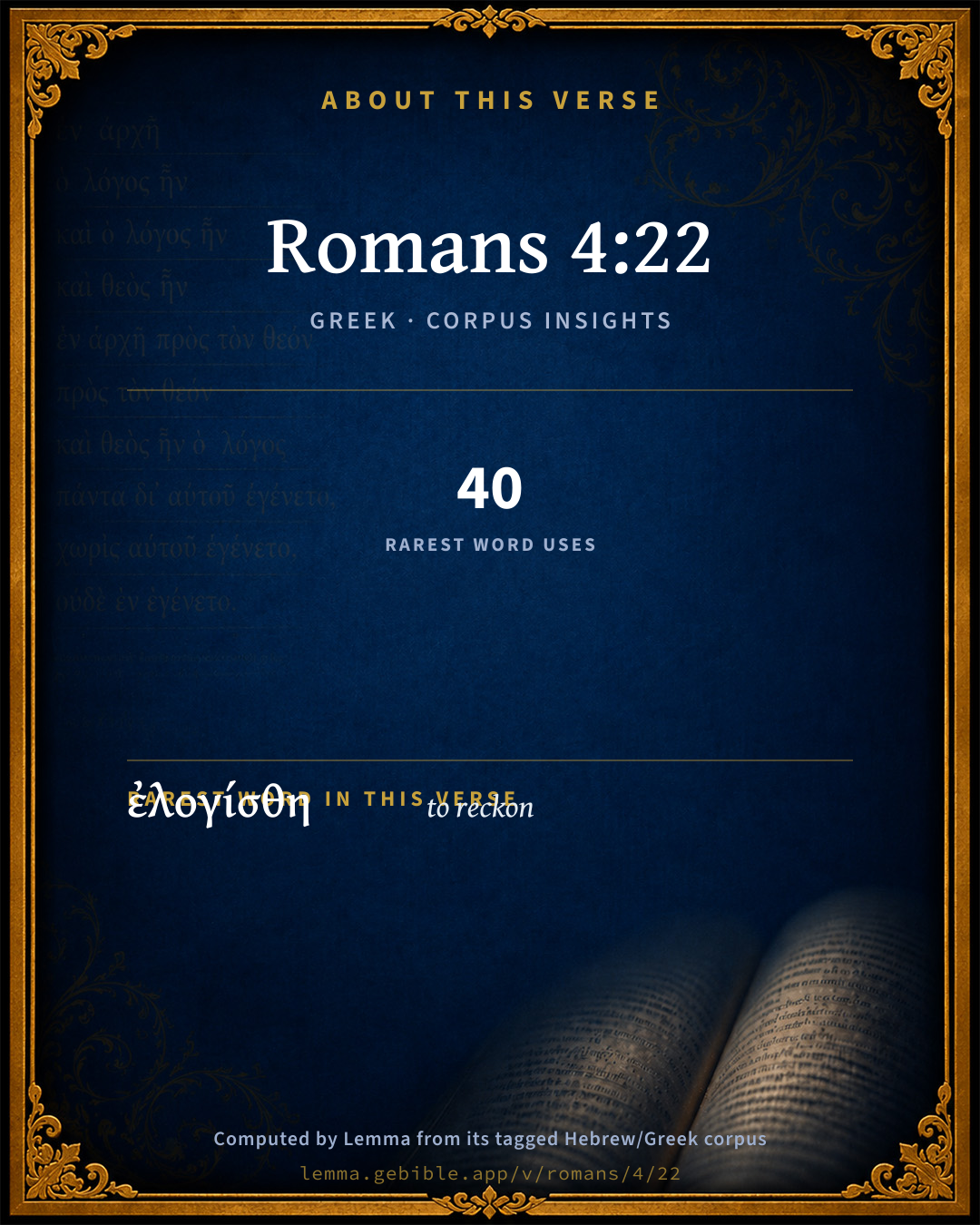
ἐλογίσθη to reckon G3049 occurs in 39 verses of the Greek New Testament. Also found in:
Cross-references

2

Topical passages linked to Romans 4:22 in the Treasury of Scripture Knowledge — connected by theme and wording, ordered by reader-vote popularity; previews shown in the World English Bible.

  • Romans 4:3 For what does the Scripture say? "Abraham believed God, and it was accounted to him for righteousness."
  • Romans 4:6 Even as David also pronounces blessing on the man to whom God counts righteousness apart from works,

Cross-references courtesy of OpenBible.info (CC BY 4.0).

Commentary

Notes on Romans 4:22 from classic Christian and Jewish commentators (each source and its license shown beneath its notes). The classic Christian expositions comment on the surrounding passage and are grouped to its opening verse, so a note may address several verses; the Jewish commentaries on the Tanakh (Rashi and others) are per-verse, so they appear only where the commentator wrote on this verse.

Lemma curates 59 commentaries, every one of them public domain or Creative Commons licensed, each selected and text-cleaned for this edition rather than reprinted as found. About our sources →

Bengel's Gnomon

Johann Albrecht Bengel

Rom 4:22. διὸ, therefore) namely, because he gave glory to GOD.—V. g.

Bengel's Gnomon of the New Testament — English translation (T&T Clark, Edinburgh, 1860) — public domain. Text from a community e-Sword module.

Meyer's Critical & Exegetical Commentary

Heinrich August Wilhelm Meyer

Rom_4:22. Result of the whole disquisition, emphatically pointing back to Rom_4:3 (ἑλογίσθη αὐτῷ εἰς δικαιοσύνην).

διὸ καί] on which account also (Rom_1:24), namely because Abraham believed so strongly as is described in Rom_4:18-21.

The subject of ἑλογίσθη (it was reckoned) is self-evident, viz. the believing. Comp Nägelsbach, zur Ilias, p. 60, ed. 3.

Meyer — Critical and Exegetical Commentary on the New Testament — English translation by Peter Christie, edited by Frederick Crombie (T&T Clark, 1880) — public domain. Text from a community e-Sword module.

Expositor's Greek Testament

ed. W. Robertson Nicoll

Rom 4:22 . διὸ : because of this signal faith, evinced so triumphantly in spite of all there was to quell it. ἐλογίσθη : i.e. , his faith was reckoned to him as righteousness. That which needs to be reckoned as righteousness is not in itself righteousness on this the Apostle’s argument rests in Rom 4:1-8 ; yet it is not arbitrarily that faith is so reckoned. The spiritual attitude of a man, who is conscious that in himself he has no strength, and no hope of a future, and who nevertheless casts himself, upon, and lives by, the word of God which assures him of a future, is the necessarily and eternally right attitude of all souls to God. He whose attitude it is, is at bottom right with God. Now this was the attitude of Abraham to God, and it is the attitude of all sinners who believe in God through Christ; and to him and them alike it is reckoned by God for righteousness. The Gospel does not subvert the religious order under which Abraham lived; it illustrates, extends, and confirms it.

The Expositor's Greek Testament, edited by W. Robertson Nicoll (1897–1910) — public domain. Text from a community e-Sword module.

Hodge's Commentary on Romans, Ephesians & First Corinthians

Charles Hodge

Rom_4:22

Therefore also it was imputed to him for righteousness. That is, the faith of Abraham was imputed to him for righteousness. He was accepted as righteous on account of his faith; not that faith itself was the ground, but the condition of his justification. he believed, and God accepted him as righteous; just as now we believe, and are accepted as righteous, not on account of any merit in our faith, but simply on the ground of the righteousness of Christ, which is imputed to us when we believe; that is, it is given to us, whenever we are willing to receive and rest upon it. Nihil plus conferre fides nobis potest, quam a verbo acceperit. Quare non protinus justus erit, qui generali tantam confusaque notitia imbutus Deum veracem esse statuet, nisi in promissione gratiae quiescat. Faith justifies by appropriating to ourselves the divine promise. But if that promise does not refer to our justification, faith cannot make us righteous. The object of justifying or saving faith, that is, of those acts of faith which secure our acceptance with God, is not the divine veracity in general, nor the divine authority of the Scriptures, but the specific promise of gratuitous acceptance through the mediation and merit of the Lord Jesus Christ.

Charles Hodge — Commentary on Romans (1835), First Corinthians (1857), and Ephesians (1856) — public domain. Text from a community e-Sword module.

Jamieson, Fausset & Brown

Robert Jamieson, A. R. Fausset & David Brown

And therefore it was imputed, &c.--"Let all then take notice that this was not because of anything meritorious in Abraham, but merely because he so believed."

Jamieson, Fausset & Brown — Commentary Critical and Explanatory on the Whole Bible (1871) — public domain (CC PDM 1.0). Text via the HelloAO Bible API.

Adam Clarke's Commentary

Verse 22. And therefore it was imputed to him for righteousness] The verse is thus paraphrased by Dr. Taylor: "For which reason God was graciously pleased to place his faith to his account; and to allow his fiducial reliance upon the Divine goodness, power, and faithfulness, for a title to the Divine blessing, which, otherwise, having been an idolater, he had no right to."

Abraham's strong faith in the promise of the coming Saviour, for this was essential to his faith, was reckoned to him for justification: for it is not said that any righteousness, either his own, or that of another, was imputed or reckoned to him for justification; but it, i.e. his faith in God. His faith was fully persuaded of the most merciful intentions of God's goodness; and this, which, in effect, laid hold on Jesus Christ, the future Saviour, was the means of his justification; being reckoned unto him in the place of personal righteousness, because it laid hold on the merit of Him who died to make an atonement for our offences, and rose again for our justification.

Adam Clarke's Commentary on the Bible (1810–1826) — public domain. Text from a community e-Sword/MySword module.

John Calvin's Commentaries

22. And it was therefore imputed, etc. It becomes now more clear, how and in what manner faith brought righteousness to Abraham; and that was, because he, leaning on God’s word, rejected not the promised favor. And this connection of faith with the word ought to be well understood and carefully remembered; for faith can bring us nothing more than what it receives from the word. Hence he does not become immediately just, who is imbued only with a general and confused idea that God is true, except he reposes on the promise of his favor.

John Calvin's Commentaries (1540-1563) — public domain. Text from the Calvin Translation Society English edition (1840s-50s) via the Christian Classics Ethereal Library (ccel.org). Calvin's coverage is partial (roughly two-thirds of the Bible); uncommented books and verses are honest gaps, never fabricated. The 19th-century editor's footnotes and remarks are omitted so the notes are faithfully Calvin's own voice.

The Cambridge Bible for Schools and Colleges

gen. ed. J. J. S. Perowne

22. And therefore, &c.] This quality of faith accounts for its imputation in justification.

The Cambridge Bible for Schools and Colleges (gen. ed. J. J. S. Perowne; Cambridge University Press, 1878–1918) — public domain. Text from a community e-Sword module.

John Gill's Exposition

But for us also, to whom it shall be imputed,.... What was written in the books of the Old Testament, was not written merely on account of them who are the subjects thereof, but for the use, learning, instruction and profit of saints under the New Testament dispensation; and particularly this concerning the pulsation of Abraham's faith for righteousness, or of the imputation of the righteousness of faith unto him for justification; which was not Abraham's faith, but that "righteousness" which his faith looked to, and laid hold on: see Rom 4:12; for Abraham's faith itself could never be reckoned for righteousness to another, nor indeed was it to himself; but such as believe as Abraham did, they have the same righteousness imputed to them as he had; and truly of the same kind is the faith of Abraham, who believed in "God that quickeneth the dead", Rom 4:17; and that of ours:

if, or "seeing"

we believe on him that raised up Jesus our Lord from the dead; which descriptive of the faith of New Testament believers, and of the object of it; see Rom 10:9; and which object of faith is further described in Rom 4:25.

John Gill's Exposition of the Whole Bible (1746–1763) — public domain (CC PDM 1.0). Text via the HelloAO Bible API.

Trapp's Complete Commentary

John Trapp

22 And therefore it was imputed to him for righteousness.

Ver. 22. {See Trapp on "Rom 4:5"} {See Trapp on "Rom 4:6"} God, by reason of his faith, held him to be as sufficiently disposed to obtain the accomplishment of his promises, as if he had had all the righteousness required by the law to receive God’s benefits. (Diodat.)

John Trapp, A Commentary or Exposition upon All the Books of the Old and New Testament (1647–1656) — public domain. Text from a community e-Sword module.

Albert Barnes' Notes on the Bible

And therefore - His faith was so implicit, and so unwavering, that it was a demonstration that he was the firm friend of God. He was tried, and he had such confidence in God that he showed that he was supremely attached to him, and would obey and serve him. This was reckoned as a full proof of friendship; and he was recognised and treated as righteous; that is, as the friend of God. (The true sense of faith being imputed for righteousness is given in a note at the beginning of the chapter.) See the note at Rom 4:3, 5.

Albert Barnes' Notes on the Bible (1834–1885) — public domain. Text from a community e-Sword/MySword module.

Matthew Poole's English Annotations

See Rom 2:3. By reason of his faith he was as sufficiently disposed and qualified for the obtaining of the promise, as if he had had all the righteousness required by the law.

Matthew Poole's English Annotations on the Holy Bible (1683–1685) — public domain. Text from a community e-Sword/MySword module.

Whedon's Commentary on the Bible

Daniel D. Whedon

22. And therefore—It is clear that the apostle, even while maintaining that faith is not a merit-work, as earning and paying for and purchasing justification and heaven, does assert it to be a most glorious and meritorious act and quality, and so fitted to be the condition upon which God is rightly pleased to confer the free gift of justification and favour. (See note on Rom_3:24.)

Daniel D. Whedon (gen. ed.), Commentary on the Old and New Testaments (1874–1909) — public domain. Text from a community e-Sword module.

The Pulpit Commentary

Vers. 22-25. Wherefore also it was reckoned to him for righteousness. Now it was not written for his sake alone, that it was reckoned to him; but for our sake also, to whom it shall be reckoned, who believe on him that raised up Jesus our Lord front the dead; who was delivered for our offences, and was raised for our justification. It is to be observed that the word here and elsewhere translated justification is dikaiwsiv , corresponding with dikaiosunh . The correspondence is lost in English. The Vulgate preserves it by justitia and justificatio; and the Douay Version has, here as elsewhere, "justice" for dikaiosunh . But righteousness " expresses the meaning better.

The Pulpit Commentary (1880–1919), ed. H.D.M. Spence-Jones & Joseph S. Exell — public domain. Text from a community e-Sword module.

Scofield Reference Notes

C. I. Scofield

imputed

Or, reckoned, i.e. put to the account of. See Phm 1:18, same word:

The Scofield Reference Bible (1917 edition), notes by C. I. Scofield — public domain. Text from a community e-Sword module.

Burkitt's Expository Notes on the New Testament

William Burkitt

Our apostle having, in the former part of this chapter, declared the manner of our justification, from an instance of Abraham, which having at large pursued, lest we should think that was Abraham’s personal privilege, and did not concern us, he applies in the verses before us Abraham’s example unto us, assuming us, that as Abraham’s faith was imputed to him for righteousness, because he depended upon the almighty power of God in the promise, and also looked by faith to the Messias promised, who was to come of his seed; so, says the apostle, was this written for our sakes as well as Abraham’s for our comfort and encouragement, to assure us that faith shall be imputed to us also for righteousness, if we firmly trust in God, through the merits and mediation of our Lord Jesus Christ.

Where observe, The apostle’s argument fully overthrows the Socinian doctrine, which teaches that the godly, under the Old Testament, were not justified in the same way with us under the New; whereas the apostle fully proves, that Abraham, and all the children of Abraham, who walk in the steps of him their father, are justified alike: And accordingly it was not thus written of him for his sake alone, that his faith was imputed to him for righteousness, but for the benefit of us also; to whom the like faith shall be imputed for justification, if we believe on him that raised up Jesus from the dead.

Learn hence, That the doctrine of justification by faith, through the imputed righteousness of the Mediator, is no new doctrine, but as old as Abraham. Some are much offended at this word imputed; but as the pious bishops, Downham and Davenant, on justification well observe, it is no less than ten times mentioned, either in the term or the signification of it, in this chapter: Their arguments for, and answers to, Bellarmin’s objections against the imputed righteousness of the Mediator, runs thus: "If Christ’s righteousness be not imputed, it is not accepted; if it be not accepted, it is not performed, and so there will be no redemption by Jesus Christ; without this, we would make Christ little, very little, in the justifying of sinners; And why is Christ called the Lord our righteousness, and how are we said to be made the righteousness of God in him? And why is faith so infinitely pleasing ot God, but because faith brings to God a righteousness which is highly pleasing to him, even that of the Mediator? for there is no standing before God for any creature in a creature-righteousness." -

The popish objections run thus: Objection, 1. If Christ’s righteousness be imputed to us, then may we be reputed redeemers of the world, as well as he was.

Ans. It may as well be said, the debt may be accounted the surety, because the surety’s payment is accepted for the debtor.

Objection, 2. If Christ’s righteousness be imputed to us as ours, then we ought to be accounted as righteous as himself.

Ans. It may be as well argued and concluded, that the debtor is as rich a man as the surety, because the surety pays the debtor’s debts.

Objection, 3. If Christ’s righteousness be properly imputed to us, then our unrighteousness was properly imputed to him, and he may be strictly and truly called a sinner.

Ans. Just as if we should say! "If the acceptance of the surety’s payment acquits the debtor, then the surety is as bad an husband, and as much a bankrupt as the debtor himself."

Objection, 4. But if Christ’s righteousness be ours, no need of any righteousness of our own.

Ans. We plead for the meritorious righteousness of Christ to answer the demands of the law, and for a personal righteousness of our own, to answer the commands of the gospel: Let us render to all their due; let us render unto Christ the things that are Christ’s, to faith the things which are theirs. Let us awfully adore the wisdom of God, who has made Christ unto us wisdom, righteousness, sanctification, and redemption.

To relieve our ignorance and folly, he is our wisdom; to discharge us from guilt, and free us from condemnation, he is our righteousness; to relieve us against the filth and pollution, the power and dominion of sin, he is our sanctification; and to rescue us from our miserable captivity of Satan, he is our redemption.

Blessed be God for the benefit of imputed righteousness to such as live in the practice and power of inherent holiness. True, our sanctification and holiness, when most perfect, cannot justify us before God; but it will evidence our justification before men, and be a witness to our own consciences, that we are accepted in the Beloved.

William Burkitt's Expository Notes on the New Testament (1700–1703) — public domain. Text from a community e-Sword module.

McGarvey & Pendleton's Commentaries

J. W. McGarvey

Wherefore also it was reckoned unto him for righteousness . [Abraham, like all others, could not honor God by rendering perfect obedience to his will, but he could honor him by being fully persuaded that he would keep his word, though to do so might seemingly involve an impossibility. It was this act of honoring God by belief which was reckoned unto Abraham for righteousness. Faith still thus honors God when it trusts that God can love a sinner and save him notwithstanding his lost condition. "The sinner," says Hodge, "honors God, in trusting his grace, as much as Abraham did in trusting his power."]

J. W. McGarvey (with Philip Y. Pendleton), Commentaries on the New Testament (The Fourfold Gospel, 1914; Acts; and the epistles) — public domain. Text from a community e-Sword/MySword module.

The People's New Testament

B. W. Johnson

22. Therefore it was imputed, etc. The faith that secures God's righteousness is a faith that does not falter, but accepts and acts upon God's promises.

B. W. Johnson's The People's New Testament with Notes (1889–1891) — public domain. Electronic text from the Christian Classics Ethereal Library (CCEL) ThML edition.

Cambridge Greek Testament for Schools and Colleges

22. διὀ καὶ sums up and restates the argument, and so leads to the statement of the parallel between Christians and Abraham, justifying the conclusions of ch. 3.

Cambridge Greek Testament for Schools and Colleges (Cambridge University Press, 1896; 21 vols, various authors incl. Carr, Maclear, Plummer, Farrar, Lumby, Moule, M. R. James, Simcox) — public domain. Text from a community e-Sword module.

Alford’s Greek Testament

Henry Alford

22.] διό, on account of the nature of this faith, which the Apostle has now since ver. 18 been setting forth;—because it was a simple unconditional credence of God and His promise. If we read καί, it imports besides being thus great and admirable, it was reckoned to him for righteousness:—ἐλογίσθη, viz. τὸ πιστεῦσαι τῷ θεῷ.

Henry Alford, The Greek Testament (1849–1861) — public domain. Text from a community e-Sword module.

Godet's Commentaries

Frédéric Louis Godet

Vv. 22 sums up the whole development relating to Abraham’s faith, Rom 4:1-21, to clear the way for the final application which Paul had in view. Διό, wherefore, refers to what has just been said of the confidence with which Abraham laid hold of God’s promise, Rom 4:21. God ascribed to that confidence which glorified Him the worth of perfect righteousness. The καί, also (“wherefore also”), found in the Alex. and Byz. Mjj., points to the moral relation which exists between faith and the imputation made of that faith. The subject of ἐλογίσθη, was counted, might be the πιστεῦσαι, believing, understood; but it is simpler to regard the verb as impersonal: “there was in relation to him an imputation of righteousness.” This saying is more expressly connected with the first of the three subjects treated in this chapter, Abraham’s justification, Rom 4:1-12; but it sums up at the same time the two others, the inheritance of the world and the birth of Isaac, which are, so to speak, its complements. Thus is introduced the fourth part, which contains the application to existing believers, Rom 4:23-25.

Frédéric Louis Godet — Commentaries on Luke, John, Romans, and 1 Corinthians — English translation (T&T Clark, Edinburgh, 1870s–1890s) — public domain. Text from a community e-Sword module.

Lesson kit

Teaching starters — assembled from the data on this page, not authored interpretation. Every prompt links to the verse data it draws on. Edit before teaching.

Romans, in the Pauline Epistles, opens this verse with 6 words (6 distinct Greek lemmas). Its most distinctive word is logízomai (“to reckon”). A historical commentator’s framing appears above. Read the whole chapter for the surrounding context.

Discussion questions

  1. The word logízomai carries the sense “to reckon.” How does it shape the verse?
  2. Luke 22:37 shares the word «to reckon» with this verse. How do the two illuminate each other?
  3. These translations render this verse differently. What is at stake in choosing one wording over another?
  4. Reading how Bengel's Gnomon and Meyer's Critical & Exegetical Commentary read this verse, where do the two commentators agree and where do they part?

Things to notice

Reading settings

Reading text

Shown beneath each verse's original-language words.

Old Testament
Old Testament edition

Read the OT as the Masoretic Hebrew (MT) or the Greek Septuagint (LXX).

English shown for the Greek Septuagint (in the Hebrew ↔ Greek comparison).

Comparing translations? Open the Compare panel on any verse page to stack up to four side by side.