Romans 15:28

Greek (Tischendorf 8th ed.) Romans 15:28 appears in the Greek New Testament. The text above is from the Tischendorf 8th edition. Each word links to its Strong’s number and a concise gloss. Click any word for its full Thayer’s Greek Lexicon entry.
Download image
Cite this verse

Romans 15:28 (World English Bible). Public Domain. Lemma interlinear Bible study tool, https://lemma.gebible.app/v/romans/15/28.

Show BibTeX & RIS
BibTeX
RIS
English Translation
When therefore I have accomplished this, and have sealed to them this fruit, I will go on by way of you to Spain.
World English Bible · Public Domain
Highlights
  • 1 first appearance in the Greek New Testament
Full analysis ↓
Download a study sheet

One document with this verse’s original text, its word-by-word gloss line, the meaning frame, cross-references with their text, attributed commentary, and full source and license credits — printable, and it pastes into notes with its structure intact.

This verse Autodidact and up

Study sheet (.html) Plain text (.txt)

A passage Seminary Student

Up to 50 verses in one chapter. A passage sheet keeps up to 6 commentary sources and 12 cross-references per verse, in the order this page ranks them, and says so on the sheet whenever that leaves anything out. Ask for a single verse and you get the Autodidact verse sheet above.

Everything on this page stays free to read, with no account — the sheet is a download of what is already on screen, not access to it.

Want to remove ads? Support Godless Engineer
Compare translations 3

The same verse in 3 English versions, stacked beneath the original-language interlinear above. Click any original word for its lexicon entry.

Each is an independent rendering of the whole verse — the interlinear is not word-aligned to these translations.

Highlighted words mark where these versions differ — a whole-verse word diff, not a word-by-word alignment.

  • World English Bible Public Domain
    When therefore I have accomplished this, and have sealed to them this fruit, I will go on by way of you to Spain.
  • King James Version Public Domain
    When therefore I have performed this, and have sealed to them this fruit, I will come by you into Spain.
  • unfoldingWord Literal Text CC BY-SA 4.0
    Therefore, having completed this and having sealed this fruit to them, I will go away through you to Spain.

unfoldingWord Literal Text — © unfoldingWord, licensed CC BY-SA 4.0. Word-aligned USFM3 via Door43 (git.door43.org/unfoldingWord/en_ult).

Versions to compare (up to 4)

3 of 4 selected

Show all 19 translations

Every available English version of this verse, each an independent rendering of the whole verse.

  • World English Bible Public Domain
    When therefore I have accomplished this, and have sealed to them this fruit, I will go on by way of you to Spain.
  • Berean Standard Bible Public Domain
    So after I have completed this service and have safely delivered this bounty to them, I will set off to Spain by way of you.
  • Majority Standard Bible Public Domain
    So after I have completed this service and have safely delivered this bounty to them, I will set off to Spain by way of you.
  • King James Version Public Domain
    When therefore I have performed this, and have sealed to them this fruit, I will come by you into Spain.
  • American Standard Version (1901) Public Domain
    When therefore I have accomplished this, and have sealed to them this fruit, I will go on by you unto Spain.
  • Revised Version (1885) Public Domain
    When therefore I have accomplished this, and have sealed to them this fruit, I will go on by you unto Spain.
  • Geneva Bible (1599) Public Domain
    When I haue therefore performed this, and haue sealed them this fruite, I will passe by you into Spaine.
  • Douay-Rheims (1899) Public Domain
    When therefore I shall have accomplished this, and consigned to them this fruit, I will come by you into Spain.
  • Young's Literal Translation Public Domain
    This, then, having finished, and having sealed to them this fruit, I will return through you, to Spain;
  • Literal Standard Version CC BY-SA 4.0
    This, then, having finished, and having sealed to them this fruit, I will return through you, to Spain;
  • Unlocked Literal Bible CC BY-SA 4.0
    Therefore, when I have completed this task and have made sure that they have received what was collected, I will go to Spain and visit you on the way.
  • unfoldingWord Literal Text CC BY-SA 4.0
    Therefore, having completed this and having sealed this fruit to them, I will go away through you to Spain.
  • Darby Bible Public Domain
    Having finished this therefore, and having sealed to them this fruit, I will set off by you into Spain.
  • World Messianic Bible Public Domain
    When therefore I have accomplished this, and have sealed to them this fruit, I will go on by way of you to Spain.
  • Webster's Bible Public Domain
    When therefore I have performed this, and have sealed to them this fruit, I will go by you into Spain.
  • Free Bible Version CC BY-SA 4.0
    So once I've done this, and have safely delivered this contribution to them, I'll visit you on my way to Spain.
  • Bible in Basic English Public Domain
    So when I have done this, and have given them this fruit of love, I will go on by you into Spain.
  • Text-Critical English NT CC BY 4.0
    So when I have finished this task and have sealed to them this fruit, I will set out for Spain and visit you on the way.
  • Tyndale New Testament (1534) Public Domain
    When I have performed this and have brought them this frute sealed. I will come backe agayne by you into Spayne.

Literal Standard Version (2020), Covenant Press — licensed CC BY-SA 4.0. Text via the HelloAO Bible API (eBible.org). Unlocked Literal Bible (unfoldingWord) — licensed CC BY-SA 4.0. Text via the HelloAO Bible API (eBible.org). unfoldingWord Literal Text — © unfoldingWord, licensed CC BY-SA 4.0. Word-aligned USFM3 via Door43 (git.door43.org/unfoldingWord/en_ult). Free Bible Version, Dr. Jonathan Gallagher — licensed CC BY-SA 4.0. Text via the HelloAO Bible API (eBible.org).

Word by word

More ways to search: Search by grammar → Find every occurrence → Compare this word →

Practice this passage: Drill this verse → Learn its vocabulary →

Σπανίαν
Spanía
G4681
“Spain”
Noun, Accusative, Singular, Feminine
Part of Speech
Noun
Case
Accusative
Number
Singular
Gender
Feminine
Full Thayer's Definition

Origin: probably of foreign origin

TDNT: None

Spain = "scarceness" 1. the whole peninsula south of the Pyrenees
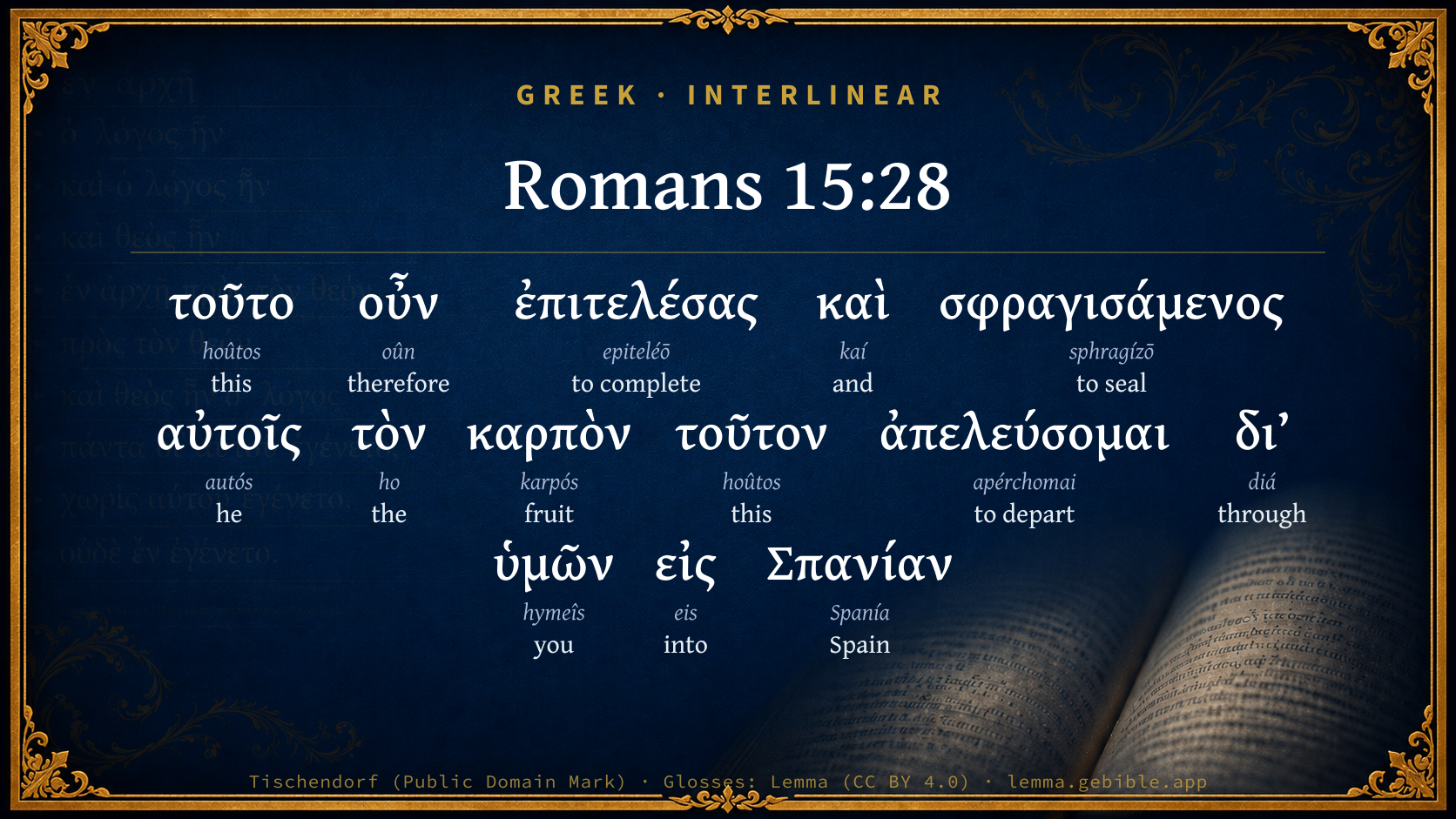
  1. τοῦτο hoûtos G3778 “this” Demonstrative pronoun, Accusative, Singular, Neuter
  2. οὖν oûn G3767 “therefore” Conjunction
  3. ἐπιτελέσας epiteléō G2005 “to complete” Verb, Aorist, Active, Participle, Nominative, Singular, Masculine
  4. καὶ kaí G2532 “and” Conjunction
  5. σφραγισάμενος sphragízō G4972 “to seal” Verb, Aorist, Middle, Participle, Nominative, Singular, Masculine
  6. αὐτοῖς autós G846 “he” Personal pronoun, Dative, Plural, Masculine
  7. τὸν ho G3588 “the” Article, Accusative, Singular, Masculine
  8. καρπὸν karpós G2590 “fruit” Noun, Accusative, Singular, Masculine
  9. τοῦτον hoûtos G3778 “this” Demonstrative pronoun, Accusative, Singular, Masculine
  10. ἀπελεύσομαι apérchomai G565 “to depart” Verb, Future, Middle deponent, Indicative, 1st person, Singular
  11. δι’ diá G1223 “through” Preposition
  12. ὑμῶν hymeîs G5210 “you” Personal pronoun, 2nd person, Genitive, Plural
  13. εἰς eis G1519 “into” Preposition

About this verse

These counts appear in no published source. They are computed here, from the morphology-tagged text and Lemma’s own curated glosses. What Lemma adds →

14
words
13
distinct lemmas
Pauline Epistles
section

Notable vocabulary

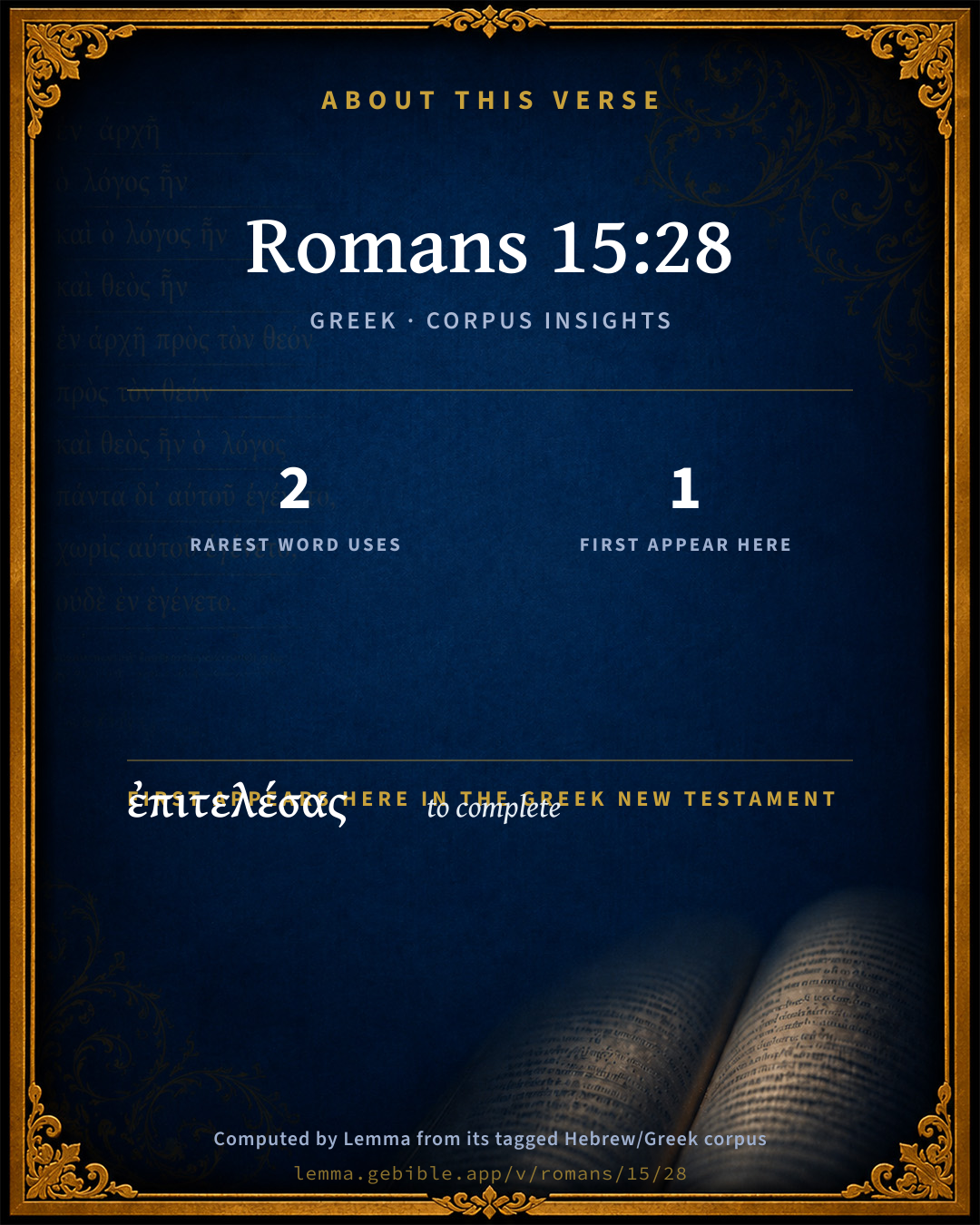
The rarest word here is Σπανίαν Spain G4681 — appearing just 2 times in the whole Greek New Testament.

First appearance in Scripture

This word makes its first canonical appearance in the Greek New Testament here:

  • ἐπιτελέσας to complete G2005

Shared distinctive vocabulary

Σπανίαν Spain G4681 occurs in 2 verses of the Greek New Testament. Also found in:

Repetition

A word recurs within this verse:

  • τοῦτο this G3778 ×2

Cross-references

6

Topical passages linked to Romans 15:28 in the Treasury of Scripture Knowledge — connected by theme and wording, ordered by reader-vote popularity; previews shown in the World English Bible.

  • Romans 15:24 whenever I journey to Spain, I will come to you. For I hope to see you on my journey, and to be helped on my way there by you, if first I may enjoy your company for a while.
  • Philippians 4:17 Not that I seek for the gift, but I seek for the fruit that increases to your account.
  • Colossians 1:6 which has come to you; even as it is in all the world and is bearing fruit and growing, as it does in you also, since the day you heard and knew the grace of God in truth;
  • Proverbs 19:21 There are many plans in a man's heart, But Yahweh's counsel will prevail.
  • Lamentations 3:37 Who is he who says, and it comes to pass, when the Lord doesn't command it?
  • James 4:13–15 Come now, you who say, "Today or tomorrow let's go into this city, and spend a year there, trade, and make a profit."

Cross-references courtesy of OpenBible.info (CC BY 4.0).

Commentary

Notes on Romans 15:28 from classic Christian and Jewish commentators (each source and its license shown beneath its notes). The classic Christian expositions comment on the surrounding passage and are grouped to its opening verse, so a note may address several verses; the Jewish commentaries on the Tanakh (Rashi and others) are per-verse, so they appear only where the commentator wrote on this verse.

Lemma curates 59 commentaries, every one of them public domain or Creative Commons licensed, each selected and text-cleaned for this edition rather than reprinted as found. About our sources →

Joseph Benson's Commentary

Rom 15:28-29. When, therefore, I have performed this journey and service, and have sealed to them — Safely delivered to them, without diminution, as a treasure under a seal; this fruit — This contribution, which is a fruit of their brethren’s faith and love; I will come by you into Spain — Such was his design, though it seems it was never accomplished. There are often holy purposes in the minds of good men, which are overruled by the providence of God, so as never to take effect; and yet they are precious in the sight of God. And I am sure — Οιδα, I know; that when I come to you, I shall come to you in the fulness, &c. — I shall be a means of communicating to you abundance of gospel blessings. It is evident from this, and from the 28th verse, as well as from Rom 1:10-11, that Paul wrote this epistle while he was at liberty, and before Christ had told him, as is mentioned Act 23:11, that he must testify of him at Rome; and before he was constrained to appeal to Cesar, as is related Act 25:11; for in this epistle he speaks still of his journey to Rome as of a voluntary undertaking, not supposing that he should be sent thither as a prisoner.

Joseph Benson's Commentary on the Old and New Testaments (1811–1818) — public domain. Text from a community e-Sword module.

Bengel's Gnomon

Johann Albrecht Bengel

Rom 15:28. Ἐπιτελέσας καὶ σφραγισάμενος) Words nearly related to each other, 2Ki 22:4, וְיַתֵּס אֶת־הַכֶּסֶף, LXX., καὶ σφράγισον τὸ ἀργύριον, and seal the silver. Paul finished this first; nothing interrupted him, how eager soever he might be as to other objects, Act 19:21. σφραγισάμενος, as soon as I shall have sealed, not only that they might perceive the good faith of him, who delivered it, but that they might also be confirmed in spiritual communion. ἀπελεύσομαι, I will go away) even though I may never be about to return from Spain. This is the force of the compound verb.—Σπανίαν, Spain) Paul does not seem to have reached Spain. A holy purpose often exists in the minds of godly men, which, although it is not fulfilled, is nevertheless precious [in God’s eyes], 2Sa 7:2; 2Sa 7:4.

Bengel's Gnomon of the New Testament — English translation (T&T Clark, Edinburgh, 1860) — public domain. Text from a community e-Sword module.

Meyer's Critical & Exegetical Commentary

Heinrich August Wilhelm Meyer

Rom_15:28. Τοῦτο] This work of service for Jerusalem.

κ. σφραγις. κ.τ.λ.] and when I shall have sealed to them this fruit, i.e. shall have confirmed the produce of the κοινωνία, Rom_15:26, to them, secured it as their property. σφραγίζ. in the figurative sense: to confirm, to ratify (see on Joh_3:33); for by delivery of the moneys they were, on the part of the apostle, confirmed to the recipients as the fruit collected for them, after the manner of the law of possession, as with seal impressed.[31] The expression chosen has a certain solemnity; the apostle is moved by the thought that with the close of the work of love to which he refers he was to finish his long and great labours in the East, and was to take in hand a new field in the far West. In these circumstances, an unusual thoughtful expression for the concluding act offers itself naturally. But that which Fritzsche finds in it (rendering of an account and other formalities) neither lies in the simple figurative word, nor was it doubtless intended by Paul, considering his apostolical dignity. Others take σφραγις. in the proper sense, either thus: when I have brought over the money to them, sealed (Erasmus, Cornelius a Lapide, Estius), which, however, the words do not express at all, and how paltrily unapostolic the thought would be! or, referring αὐτοῖς to the Greek Christians (so already Theodoret): when I have made them secure with letter and seal respecting the right delivery of their collection (Glöckler, and so already Michaelis), against which, apart from the unsuitableness of the sense, it is decisive that αὐτοῖς brooks no other reference than ΑὐΤῶΝ and ΑὐΤΟῖς, Rom_15:27 (comp. ΤΟῖς ἉΓΊΟΙς, Rom_15:25). This also against Reithmayr, who brings out even a depositing for the almsgivers in Gods treasury!

[31] The act of handing over itself, namely, was the σφραγίς of the collection for the recipients. Before the delivery the moneys were indeed destined for them, but not yet de facto assured to them as property on the part of the apostle, the bearer. Theodore of Mopsuestia well explains the σφραγισάμ. by ἀποκομίσας καὶ δεδωκώς, and adds, by way of assigning the reason: εἰ γὰρ καὶ τῇ γνώμῃ τῶν δεδωκότων τέλειος ἦν ὁ καρπός, ἀλλὰ τῇ χρεἰᾳ ἀτελὴς, οὔπω δεξαμένων ὧνπερ οὖν ἕνεκεν ἐδόθη. Without any ground in the text, Hofmann introduces bearers appointed on the part of the church, whom the apostle himself conducts to Jerusalem, thereby designating the gift to the recipients as one destined for them with his knowledge and will. Hofmanns objection, that the interpretation given above rather suggests that it should be termed an unsealing than a sealing, is a cavil running counter to the figurative usage elsewhere of σφραγίζειν and σφραγίς, and which might just as aptly be applied to Hofmanns own explanation.

Meyer — Critical and Exegetical Commentary on the New Testament — English translation by Peter Christie, edited by Frederick Crombie (T&T Clark, 1880) — public domain. Text from a community e-Sword module.

Expositor's Greek Testament

ed. W. Robertson Nicoll

Rom 15:28 . τοῦτο οὖν ἐπιτελέσας : having brought this business to a close. It is a mistake to find in Paul’s use of ἐπιτελεῖν any reference to the performance of a religious rite: see 2Co 8:6 ; 2Co 8:2 , Gal 3:3 , Phi 1:6 . σφραγισάμενος αὐτοῖς τὸν καρπὸν τοῦτον . “This fruit” is, of course, the collection; it is one of the gracious results of the reception of the Gospel by the Gentiles, and Paul loves to conceive and to speak of it spiritually rather than materially. Thus in 2Co 8:9 he calls it a χάρις , a διακονία , a κοινωνία , a ἁδρότης , a εὐλογία : never money. The point of the figure in σφραγισάμενος cannot be said to be clear. It may possibly suggest that Paul, in handing over the money to the saints, authenticates it to them as the fruit of their πνευματικά , which have been sown among the Gentiles (so . and H.); or it may only mean “when I have secured this fruit to them as their property ” (so Meyer). The ideas of “property,” “security,” “formality,” “solemnity,” “finality,” are all associated with σφραγίς and σφραγίζω in different passages of the N.T., and it is impossible to say which preponderated in Paul’s mind as he wrote these words. Cf. Joh 3:33 ; Joh 6:27 . ἀπελεύσομαι is simply abibo: the idea of departing from Jerusalem is included in it, which is not brought out in the R.V., “I will go on”. διʼ ὑμῶν : cf. 2Co 1:16 . εἰς Σπανίαν : there is no evidence that this intention was ever carried out except the well-known passage in Clem. Rom 1:5 which speaks of Paul as having come ἐπὶ τὸ τέρμα τῆς δύσεως : an expression which, especially if the writer was a Jew, may as well mean Rome as Spain. But all the more if it was not carried out is this passage in Romans assuredly genuine; a second-century writer would not gratuitously ascribe to an apostle intentions which he must have known were never accomplished.

The Expositor's Greek Testament, edited by W. Robertson Nicoll (1897–1910) — public domain. Text from a community e-Sword module.

Hodge's Commentary on Romans, Ephesians & First Corinthians

Charles Hodge

Rom_15:28

When therefore I have done this, and sealed unto them this fruit, I will come by you into Spain. The word sealed appears here to be used figuratively, When I have safely delivered this fruit to them; compare 2Ki_22:4, Go up to Hilkiah, the high priest, and sum (seal, σφράγισον,) the silver, etc. Commentators compare the use of the Latin words consignare, consignatio, and of the English word consign.

Charles Hodge — Commentary on Romans (1835), First Corinthians (1857), and Ephesians (1856) — public domain. Text from a community e-Sword module.

Geneva Bible (1599)

Geneva Bible translators

This money which was gathered for the use of the poor: which alms is very fitly called fruit.

Performed it faithfully, and sealed it as it were with my ring.

Geneva Bible (1599) marginal notes — public domain. Text via Bolls.life.

Jamieson, Fausset & Brown

Robert Jamieson, A. R. Fausset & David Brown

When therefore I have . . . sealed--that is, delivered over safely

to them this fruit--of the faith and love of the Gentile converts

I will come--"come back," or "return"

by you into Spain--(See on Rom 15:24).

Jamieson, Fausset & Brown — Commentary Critical and Explanatory on the Whole Bible (1871) — public domain (CC PDM 1.0). Text via the HelloAO Bible API.

Adam Clarke's Commentary

Verse 28. When, therefore, I have performed this] Service, and have sealed-faithfully delivered up, to them this fruit, of the success of my ministry and of your conversion to God, I will come by you into Spain: this was in his desire; he had fully purposed it, if God should see meet to permit him; but it does not appear that he ever went. See Ro 15:24.

Adam Clarke's Commentary on the Bible (1810–1826) — public domain. Text from a community e-Sword/MySword module.

John Calvin's Commentaries

28. And sealed to them this fruit, etc. I disapprove not of what some think, that there is here an allusion to a practice among the ancients, who closed up with their seals what they intended to lay up in safety. Thus Paul commends his own faithfulness and integrity; as though he had said, that he was an honest keeper of the money deposited in his hands, no otherwise than if he carried it sealed up. — The word fruit seems to designate the produce, which he had before said returned to the Jews from the propagation of the gospel, in a way similar to the land, which by bringing forth fruit supports its cultivator.

John Calvin's Commentaries (1540-1563) — public domain. Text from the Calvin Translation Society English edition (1840s-50s) via the Christian Classics Ethereal Library (ccel.org). Calvin's coverage is partial (roughly two-thirds of the Bible); uncommented books and verses are honest gaps, never fabricated. The 19th-century editor's footnotes and remarks are omitted so the notes are faithfully Calvin's own voice.

Ellicott's Commentary for English Readers

(28) Sealed to them this fruit.—Placed in their hands the sum raised by the collection. This will appear at first sight a somewhat stilted expression, but it takes a certain solemnity from the fact that St. Paul seems to regard this journey to Jerusalem as the close of his own apostolic labours in those parts, the dropping of the curtain, as it were, before a new act in his career.

Will come by you.—Will pass through your city on my way to Spain.

A Bible Commentary for English Readers, edited by Charles John Ellicott (1878–1897) — public domain. Text from a community e-Sword module.

The Cambridge Bible for Schools and Colleges

gen. ed. J. J. S. Perowne

28. sealed] The metaphor is from a solemn ratification. St Paul, handing over to the Church at Jerusalem the “fruit,” or proceeds, of the Macedonian and Achaian collections, would thereby finally attest it to be now the full property of the receivers: he would put the seal of their ownership upon it.—Meyer suggests that the word indicates also the solemn close of his apostolic work in the East. It is not clear, however, that he would view the transition from the E. to the W. of the Adriatic as a wholly peculiar crisis.

The Cambridge Bible for Schools and Colleges (gen. ed. J. J. S. Perowne; Cambridge University Press, 1878–1918) — public domain. Text from a community e-Sword module.

John Gill's Exposition

When therefore I have performed this,.... Meaning when he had dispatched that business, and finished that affair which the Macedonian and Achaian churches had entreated him to engage in, and which he had undertook; namely, to take their collection, and carry it to Jerusalem, and distribute it among the poor saints there; and which he expresses by another phrase,

and have sealed to them this fruit. The liberality of the Gentile churches is called fruit, as it may be on many accounts; as with respect to the apostle, it was the fruit of his ministry and laborious preaching of the Gospel among them; he had been sowing the seed of the word, and planting churches in these parts; and among other fruits brought forth hereby, as the conversion of sinners, and edification of saints, the exercise of grace, and performance of good works, this of liberality to the poor saints was one: with respect to the persons, the objects of this bounty, it was the fruit of their spiritual things, which the Gentiles, by their means, had been partakers of; and would be as fruit, useful and profitable to them, to relieve their wants, supply them with necessaries, and make their lives more comfortable: and also with respect to the contributors, it was the fruit of the Spirit of God, and his grace in them; it was the fruit of faith, which works by love; and it was the fruit of their love to Christ, and to his saints; and was profitable to them in things temporal, spiritual, and eternal; promises of each being made and performed to such that sow liberally and bountifully. Now the ministration of this to the poor saints at Jerusalem, and on the behalf of the Grecian churches, the apostle calls a "sealing" it to them; and it is thought to be an allusion to the delivery of money sealed up, that it may not be lost, nor made use of for any other purpose than that for which it was designed: whether the apostle carried this collection sealed or not, it matters not; his sense is, that he should deliver it whole and safe unto them, and in such manner as to leave no suspicion that he had converted any part of it to his own use; though the word here used seems to answer to the Hebrew which, with the Jews, frequently signifies to conclude, "finish", and make an end of anything, as well as to "seal"; the sealing up of letters being the last and finishing part of them. Innumerable instances might be given; take the following one as a proof (d):

"we find in the former prophets, , "that they sealed", or ended their words with words of praise, or with words of consolation Says R. Eliezer, except Jeremiah, "who sealed", or finished with words of reproof.''

So the word is used in Dan 9:24, and then the apostle's plain meaning is, when I have made an end of this affair, have finished this business of ministering and distributing to the poor saints at Jerusalem,

I will come by you into Spain. The Ethiopic version reads it, "Lasitania", designing, no doubt, Lusitania, which was formerly a part of Spain, now called Portugal. Whether the apostle ever was there is not certain nor very probable, since when he came to Jerusalem he was apprehended, and after sometime sent a prisoner to Rome, where he suffered; however, it was his intention to go to Spain, and to take Rome in his way thither.

(d) T. Hieros. Beracot, fol. 8. 4.

John Gill's Exposition of the Whole Bible (1746–1763) — public domain (CC PDM 1.0). Text via the HelloAO Bible API.

Trapp's Complete Commentary

John Trapp

28 When therefore I have performed this, and have sealed to them this fruit, I will come by you into Spain.

Ver. 28. When I have sealed] That is, safely delivered, as if it were under seal.

This fruit] This sweet ripe fruit of their faith and love, their alms.

John Trapp, A Commentary or Exposition upon All the Books of the Old and New Testament (1647–1656) — public domain. Text from a community e-Sword module.

Albert Barnes' Notes on the Bible

Have sealed to them - That is, have “secured it” to them. To seal an instrument of writing, a contract, deed, etc. is to “authenticate it,” to make it “sure.” In this sense it is used here. Paul was going himself to see that it was placed “securely” in their hands.

This fruit - This result of the liberality of the Gentile churches - the fruit which their benevolence had produced.

I will come ... - This was Paul’s full purpose; but it is not clear that he ever accomplished it; Note, Rom 15:24.

By you - Taking Rome in my way.

Albert Barnes' Notes on the Bible (1834–1885) — public domain. Text from a community e-Sword/MySword module.

Matthew Poole's English Annotations

When therefore I have performed this, and have sealed to them this fruit; i.e. After that I have despatched this business, and safely delivered the alms of the Greek churches to the Jews, wherewith I am intrusted; it is put into my hands as a treasure sealed in a bag or chest, that it may not be diminished or embezzled: he calls it fruit, because it proceeded from their faith and love, and because it would abound to their account, Phi 4:17; it would benefit them that received it, but much more them that gave it.

I will come by you into Spain; i.e. I will take you, or your city, in my way thither. He told them as much before, Rom 15:24. This he really intended, but it is generally concluded that he was prevented, that he never went this journey into Spain. The purposes of men are ruled and overruled by the providence of God, Pro 16:9.

Matthew Poole's English Annotations on the Holy Bible (1683–1685) — public domain. Text from a community e-Sword/MySword module.

Whedon's Commentary on the Bible

Daniel D. Whedon

28. Sealed—Secured to them as if with a seal. So, says Chrysostom, kings were accustomed to place a seal upon their treasury as a firm security.

Daniel D. Whedon (gen. ed.), Commentary on the Old and New Testaments (1874–1909) — public domain. Text from a community e-Sword module.

The Pulpit Commentary

Vers. 28, 29. When therefore I have accomplished this, and sealed to them (i.e. ratified and assured to them) this fruit, I will come away by you into Spain. And I know that when I come to you (umav here is intended emphatically) I shall come in the fulness of the blessing of Christ. How different from his anticipations were the circumstances of his first visit to Rome we know from the Acts. So man proposes, but God disposes, and all for final good. (cf. Php_1:12, seq.) That he afterwards carried out his intention of visiting Spain cannot be alleged with certainty, though there is distinct evidence of an early tradition that he did so (Canon Muratori, Eusebius, Jerome, Theodoret. Cf. Clem. Romans, Ep. 1, who speaks of St. Paul having gone to "the boundaries of the West"). Certainly before the end of his detention at Rome he had given up any idea he might have had of going thence at once to Spain; for cf. Php_2:19 Phm_1:22; which Epistles are believed, on good grounds, to have been written during that detention. Still, he may have gone during the interval between his release and his final captivity at Rome, during which the pastoral Epistles were probably written.

In what follows (vers. 30-32) some apprehension of dangers attending his visit to Jerusalem, which might possibly thwart his intentions, already appears; sounding like an undertone allaying the confidence of the hope previously expressed. In the course of his progress to Jerusalem this apprehension appears to have grown upon him; for see Act_20:22, Act_20:23, 28 21:4, 11-14. It may be here observed that such signs, evidently unintentional, of conflicting feelings in the letter, and such consistency between the letter and the narrative, are strong confirmations of the genuineness of both.

Fulness of blessing.

Commissioned and endowed as he was, the apostle might lawfully and confidently speak thus. Yet every minister of Christ may, in his measure, cherish the same assurance, and look forward to intercourse with those to whom he ministers with a similar expectation and hope.

I THE ORIGIN AND GIVER OF BLESSING. The word "blessing" has something vague in it; yet this is because of its comprehensiveness. We cannot always be sure what is best to wish for on behalf of others; but we cannot err in seeking for them blessing from God. Poor and few are the gifts man can bestow upon his fellow-men; but "the blessing of God maketh rich, and with it he addeth no sorrow.

II THE CHARACTER AND IMPORT OF BLESSING. What the apostle anticipates is "the blessing of the gospel of Christ." Here there opens up to us a boundless field, for in this are comprehended all that Christ can bestow, all that man can receive; e.g. Christ"s blessing of peace, of life, spiritual and eternal, of confidence and hope, of purity and strength, of fellowship, of service.

III THE MEASURE OF BLESSING.

1. Fulness corresponding to the Giver, whose riches and resources are inexhaustible. The expression "fulness" is a favourite one with the apostle, and indicates his sense of the abundance of the gifts and promises of that new covenant which it was his privilege to explain to the Jews and the Gentiles.

2. Fulness for every applicant and partaker. The nature of each Christian is such that he is capable of receiving from the fulness of God in Jesus Christ. Consider the multitudes who have sought and found in the Mediator the supply for all their spiritual wants; and you will feel what a witness is such a fact to the infinite provision of Divine mercy and beneficence.

3. Fulness unexhausted and inexhaustible for each participant. When Paul came to a city, he had some conception of the immense variety of human need; and when he ministered to a congregation, he did so knowing that it contained individuals with many, varied, urgent, incessant needs all to be supplied from the fulness which is in Jesus Christ. It is a most encouraging and inspiring thought that, whatever the heart may crave of blessing, may be surely appropriated and enjoyed upon application to God through Jesus Christ. The preacher may be but an earthen vessel; but the treasure he conveys is both priceless and inexhaustible.

IV THE CONDITION AND OCCASION OF BLESSING. "When I come unto you." It appears that Christians meeting in fellowship are the means of such mercy to human souls. On the one hand, there is the faithful preacher and teacher of the Word; on the other hand, there are receptive and believing hearers of the Word. The Lord gives to the disciples, and the disciples distribute to the multitude.

V THE ASSURANCE OF BLESSING. The language of Paul is very confident: "I am sure." Such a conviction must be based upon confidence in Divine declarations and promises, and upon past experience of Divine faithfulness and grace. Such persuasion, and the sober yet confident expression of it, are honouring to God.

APPLICATION.

1. Here is an example of the spirit in which bishops, pastors, and evangelists should approach those whose spiritual welfare is entrusted to their charge.

2. Here is also an example of the expectations which Christians should cherish when they place themselves under the influence of an enlightened and spiritual ministry.

An apostle"s confidence.

St. Paul has been stating his plans as regards the future, and especially regarding his intended visit to Rome. There is much that is uncertain. But one thing was a certainty to him. "I am sure that, when I come to you, I shall come in the fulness of the blessing of the gospel of Christ." Had Paul any grounds for this expectation? Was his confidence warranted by facts? Let us see. About two years after this he came to Rome a prisoner. What was his chief occupation then? Preparing his defence? No. "Preaching the kingdom of God, and teaching those things which concern the Lord Jesus Christ, with all confidence, no man forbidding him." (Act_28:31) There were two elements in his confident expectation.

I HIS CONFIDENCE IN THE BLESSING OF THE GOSPEL. "The fulness of the blessing of the gospel of Christ." St. Paul felt that the best blessing he could bring to any city, or any people whom he visited, was the blessing of the gospel. Four features in the gospel have made it a blessing to the world.

1. It is a gospel of love and mercy. This was a new message to the world. What a contrast to the cruel gods of heathenism is the merciful God whom the gospel proclaims!

2. It is a gospel of salvation. It not only shows us the evil of sin and the guilt of it, but it tells us of a Saviour. Here is its transcendent superiority over the best of the heathen religions. Not only so, but the Saviour of whom it speaks is a Divine Saviour. He is able to save to the uttermost all who come unto God through him.

3. It is a gospel of everlasting life. What hopes it opens up! What a stimulus it gives us to exertion to remember that they that are faithful unto death shall receive the crown of life that fadeth not away! It teaches us that this life is eternal in its consequences, and thus exercises a purifying and elevating influence upon the lives of men. What comfort it brings to the bereaved to know that the grave does not end all, but that there is another and a better life beyond! The hope of the agnostic has recently been expressed in a popular novel, "John Ward, Preacher." The heroine expresses her hope for the future by speaking of it as "an eternal sleep." Where is the stimulus to exertion there? Where is there any comfort for the bereaved? When death is drawing nigh, the dying Christian and those who are to be left behind can appreciate the blessing of that gospel which has brought life and immortality to light.

4. It is a gospel of light and guidance. It points out to us the path of duty. It gives us not only wise precepts, but the personal example of the Lord Jesus Christ. Here also it transcends all human systems of religion and morality. The best of human teachers have not been free from imperfection and sin. Christ alone can truly say, "I am the Way, and the Truth, and the Life." He alone has the right to say to us a right vindicated not only by his Divine authority, but by his perfect character me." The influence of Jesus Christ and his example is one of the most precious blessings of the gospel. In the year 1876 the centennial of the United States was celebrated. General Grant was then president. The editors of the Sunday School Times wrote to him, requesting him to give them a message for children and youth in their centennial number. In his reply he said, "My advice to Sunday schools, no matter of what denomination, is Hold fast to the Bible as the sheet-anchor of your liberties, write its precepts on your hearts, and practise them in your lives. To the influence of this book are we indebted for all the progress made in true civilization, and to this we must look as our guide in the future." He, too, had confidence in the gospel, and in the blessings which it brings to the individual and the nation.

II HIS CONFIDENCE IN THE CHRISTIAN"S POWER TO COMMUNICATE THIS BLESSING. The apostle"s words express not only his belief in the blessing of the gospel, but also his confidence that he can and will communicate that blessing. "I am sure that, when I crone to you, I shall come in the fulness of the blessing of the gospel of Christ." And yet it was not a confidence in self, in his own lemming or eloquence. It was a confidence in Christ. He knew whom he had believed. Twenty-five years he had been serving him, and he had more than once proved the Divine power of Christ"s presence and help. Our power to communicate the blessings of the gospel depends on two things.

1. A personal knowledge of the gospel.

2. Constant communion with Christ. A life of prayer is indispensable if we would live a life of usefulness. These two things, personal knowledge of the gospel and personal communion with Christ, will make us independent of time and circumstances. They impart strength and confidence. It was all the same to St. Paul how or when he went to Rome. As if he said, "No matter how, no matter when I come to you, one thing I am sure of, that I shall bring the rich blessing of Christ"s gospel with me." As a matter of fact, he came there as a prisoner, but even thus he brought a blessing. Whether we are rich or poor, learned or unlearned, we shall be sure to carry a blessing to the circles in which we move, if only we have first of all experienced the power of the gospel in our own hearts, and then realize our constant dependence upon Christ.

There are two ways in which we can communicate this blessing.

1. By our Christian character. The Corinthian Christians became living epistles. (2Co_3:2, 2Co_3:3) Their changed life was a remarkable testimony to the power of the gospel.

2. By our personal testimony. If we know by personal experience the preciousness of Christ and the blessings of the gospel, let us be more ready to proclaim them to others. C.H.I.

A promised visit.

A great writer in her preface to a story of Florence pictures an inhabitant revisiting his city after four centuries. He notes many changes. The towers and walls are gone; different questions are mooted in trade, scholarships and politics; garments of altered texture and form are worn. But as the sunlight and shadows are the same, so the dawn still breaks upon rosy sleeping children and hard-handed labourers arising to their toil; the same chants are sung in the churches, and the faces of worshippers still turn to the same image of Divine anguish for a beneficent end. Like the river-courses which shape the lives of men, so those other currents which ebb and flow in human hearts have scarcely altered, pulsating to the same needs, the same great loves and terrors. The broad features of the moral landscape alter not. It is this essential sameness of the human lot which lends to the Bible perennial interest. We have the same battle to fight, the same need of divinely instructed wisdom and divinely furbished weapons. We are taking the same journey as ancient heroes, and share their perplexities and convictions.

I AN INTENSE LONGING. The apostle frequently alluded to his desire to visit Rome and see the brethren there. Aquila and Priscilla must often have conversed with him respecting the famous city, and the vast influx of strangers to be witnessed there continually. The apostle had high hopes kindled in his breast, thoughts of the metropolis as the pulpit" of the world. The words of a speaker amid the seven hills would, like the faith of the disciples there, be trumpeted to every part of the globe. After some years the apostle resolved to carry his desire into effect (see Acts 19). This Epistle offers explanations of the circumstances which had hitherto prevented the realization of the wish. Here is a lesson of patient submission to the guidance of God. Whilst doors of entrance and utterance were opening in the East, and the Gentiles were becoming obedient by word and deed, the Holy Spirit plainly signified that fields so ripe for the sickle must not be deserted. Let those impatient for another sphere of labour beware lest through some burning impulse they neglect the crops ready to the reaper"s hands. The wider scope may be presented hereafter. We learn, too, the apostle"s missionary method. He liked not to build on another"s foundation. He chose of two regions the one most like fallow ground. He loved to evangelize rather than proselytize, and whilst unoccupied territory was near it did not seem right to visit a Church where Christ had been already proclaimed. It is matter for thankfulness that denominations and missionary societies are beginning to recognize the evil and sin of overlapping agencies and districts. Note the apostle"s justification of his desire to see Rome. He intended to make it not his terminus, but a temporary resting-place, and a starting-point for further excursions. His eager vision beheld Churches rising in the furthest western limits of Europe, his ear caught the sounds of prayer and praise soon to ascend from countries debased by superstition and vice. The victories won over Satan in Asia Minor and Greece he hoped to repeat in Italy and Spain.

He perhaps projected tours through France, for to this Christian warrior, as to Alexander of Macedon, there could be no rest as long as there were kingdoms, if not conquered, at least unassailed. Oh for more of this crusading spirit, this holy ambition!

II AN UNCERTAINTY as to the time of the expected visit. "When I come." There seemed no reason why Paul should not proceed to Rome immediately after the Pentecostal feast at Jerusalem. But he saw a cloud arising which contained the materials for a storm, though in what way it would burst, or whether it might not pass over, he could not foresee. He knew the vindictive watchfulness of "them that did not believe in Judaea," enemies who never forgave his desertion of their cause. The story in the Acts tells how his suspicions were confirmed by the predictions of Agabus, and how the apostle"s yielding to the excessive caution of the saints furnished an occasion for the fury of the fanatical Jews. Imprisonment and shipwreck lay on the apostle"s course, and when ultimately his wish to visit the metropolis was gratified, he entered as a prisoner with a prospect of a wearisome captivity. How strangely the hoped-for differed from the actual! Nor is it by any means rare to find the fruition of our hopes attended with far other than the bright-hued environment imagination forecasted. Plans are executed, the projected castles built, the rank secured, the home obtained, yet the accompaniments vary in toto from those anticipated. Sometimes we have asked selfishly, and the cup petitioned has held a bitter potion indeed. Yet the Christian may say confidently, "The will of the Lord be done." There are times when our Master leads his servants purposely through flood and flame. Then be it ours like Paul to accept the post of honour and bravely do our best.

III A FULL ASSURANCE that his arrival would be fraught with good. "I know that I shall come in the fulness of the blessing of Christ.

1. He would enter the city as a messenger of Christ. Not for purposes of pleasure and sight-seeing, but as the bearer of sacred tidings would he in any case approach Rome. Along the Appian Way had many a renowned general returned laden with the spoils of conflict, many an orator and philosopher had passed through the gates, but none more honoured by posterity than this servant of Christ. When seeking our own ends we may ever doubt of a celestial convoy, but when seeking the things of Christ, the ambassador of Christ shall be treated as such.

2. He could not conceive of the absence of that spiritual power which had thus far attended him. "Lo, I am with you alway," was the promise. Like Joseph in Potiphar"s house, and the ark in the house of Obed-Edom, a true man of God brings a blessing where"er he sojourns. Who should separate the apostle from the love and equipment of his Lord? To rely on this is not presumption, but God-honouring confidence.

3. No scanty measure of spiritual gifts ever satisfied or was expected by this devoted labourer. He made little mention of tongues and healing, of priestly functions and intellectual displays; he looked to the blessing which maketh endlessly, joyously rich; that knowledge, proclamation, and practice of the gospel which bears fruit unto eternal life. Next to the presence of the Lord himself the advent of a faithful minister profits our gatherings. With what delight, like members of a family long separated, would these primitive Christians confer on the holy theme of the new faith! Let our anxiety be not to fritter away time in idle gossip, but to make each other wiser and better for the meeting. If we more often expected seasons when, like the river Jordan in harvest-time, our hearts should be filled to overflowing, the testimony would more frequently rejoice us: "It was good to be there." Prepare the vessels for the fulness of the blessing which alone can banish poverty and weakness of the spirit. This conviction did not preclude the apostle from requesting the prayers of the Church for the fulfilment of his beloved project. To our short-sighted reason it is unnecessary to pray to the Father who orders all things aright. But our conclusion is based on too narrow premises; there are other ends subserved by prayer. It has respect to the plans of the Almighty and the character of his creatures. Prayer is one of the laws of the kingdom, and "effectual fervent prayer availeth much. S.R.A.

The Pulpit Commentary (1880–1919), ed. H.D.M. Spence-Jones & Joseph S. Exell — public domain. Text from a community e-Sword module.

John Wesley's Explanatory Notes

When I have sealed to them this fruit - When I have safely delivered to them, as under seal, this fruit of their brethren's love. I will go by you into Spain - Such was his design; but it does not appear that Paul went into Spain. There are often holy purposes in the minds of good men, which are overruled by the providence of God so as never to take effect. And yet they are precious in the sight of God.

John Wesley, Explanatory Notes Upon the Whole Bible (1754–1765) — public domain. Text via the GEBible commentary corpus.

Kretzmann's Popular Commentary

Paul E. Kretzmann

A word in conclusion:

v. 28. When, therefore, I have performed this, and have sealed to them this fruit, I will come by you into Spain.

v. 29. And I am sure that, when I come unto you, I shall come in the fullness of the blessing of the Gospel of Christ.

v. 30. Now I beseech you, brethren, for the Lord Jesus Christ’s sake and for the love of the Spirit that ye strive together with me in your prayers to God for me,

v. 31. that I may be delivered from them that do not believe in Judea, and that my service which I have for Jerusalem may be accepted of the saints;

v. 32. that I may come unto you with joy by the will of God, and may with you be refreshed.

v. 33. Now the God of peace be with you all! Amen.

The trip to Jerusalem had to be taken first, that plan could not be changed. But as soon as Paul had brought this business to its end and consigned, safely delivered, into the hands of the members of the church in Jerusalem this fruit of love, as the collection could well be termed, being the outgrowth of faith which was active in love, then he would pass through Rome on his way to Spain. And of one thing he was sure even then, namely, that in coming to them he would come with the fullness of the blessing of Christ and of the Gospel. That he would be supplied with, that he would bring along in rich abundance. For he was convinced that Christ, who through his labors had shed forth such abundant spiritual blessings upon the Gentile believers, would not overlook the congregation at Rome.

But with all his confident promises, Paul cannot help voicing an apprehension, a presentiment of evil. He had suffered so much in persecution on the part of the Jews that he could not quite throw off a foreboding of harm which might befall him in Jerusalem. Therefore he earnestly begs the Christians of Rome, through the Lord Jesus Christ and through the love of the Spirit, to wage warfare with him in their prayers to God for him. By the work of Jesus Christ all believers are united in a most intimate communion and may intercede for one another with all fervor. And the love which is planted in the hearts of the Christians by the Holy Spirit urges them to come to one another’s aid in prayer. And so earnest and urgent is their prayer that it partakes of the nature of a battle, a fight against the invisible, hostile powers that are endeavoring to hinder the labors of the apostle. With such prayers to assist him, he may expect to be delivered from the disobedient in Judea, from those that refused obedience to the Gospel. And their intercessory prayer may effect also so much that his service to Jerusalem will be made acceptable to the saints, that they will gladly avail themselves of the assistance which was thus brought to them by Paul and his companions. From Act 21:17 ff. we know that the prayer of Paul and of the Christians at Rome was heard, that he was received with joy by the members of the congregation at Jerusalem. And, although Paul did not come to Rome in the way in which he planned to go at this time, he was nevertheless, by the providence of God, brought there in due time, was welcomed by them with great joy, and found some refreshment for further apostolic labors through his intercourse with them. With the earnest prayer, which amounts to a blessing, that the God of peace, He that is reconciled to us through Christ, our Peace, may be with them all, St. Paul closes the epilog of his letter.

Summary

The apostle admonishes the Christians to bear the weaknesses of the brethren and always to live, as a true household of God, in brotherly harmony; he tells them of his plan to visit Rome on his way to Spain, and asks them to remember him in their prayers.

Paul E. Kretzmann, Popular Commentary of the Bible (1921–1924) — public domain. Text from a community e-Sword module.

McGarvey & Pendleton's Commentaries

J. W. McGarvey

When therefore I have accomplished this, and have sealed to them this fruit, I will go on by you unto Spain . ["Seal" is a figurative expression for "deliver safely." Compare its use at 2Ki_22:4 ; where it is translated "sum"; i. e., count out. Our English word "consign" is a similar figure. Paul wished to complete a good work for them: to insure to them the benefit of a noble deed fully accomplished.]

J. W. McGarvey (with Philip Y. Pendleton), Commentaries on the New Testament (The Fourfold Gospel, 1914; Acts; and the epistles) — public domain. Text from a community e-Sword/MySword module.

The People's New Testament

B. W. Johnson

28, 29. When therefore I have performed this. As soon as he has discharged this office, it is his purpose to start to Spain, and to take Rome in on the way. Sealed to them this fruit. Made this contribution safe to them. What is sealed is made secure.

B. W. Johnson's The People's New Testament with Notes (1889–1891) — public domain. Electronic text from the Christian Classics Ethereal Library (CCEL) ThML edition.

unfoldingWord translationNotes

Door43 World Missions Community

made sure that they have received what was collected

Paul speaks of the money he is taking to Jerusalem as if it were a fruit that was collected for them. AT: "and have safely delivered this offering to them" (See: Metaphor)

I know that when I come to you I will come in the fullness of the blessing of Christ

This phrase means that Christ will bless Paul and the Roman believers. AT: "And I know that when I visit you, Christ will abundantly bless us" (See: Assumed Knowledge and Implicit Information)

translationWords

bless

Christ

unfoldingWord translationNotes — © Distant Shores Media and the Door43 World Missions Community, licensed CC BY-SA 4.0. Source: git.door43.org/Door43/en_tn.

Cambridge Greek Testament for Schools and Colleges

28. τοῦτο = this business—of his mission in this cause.

ἐπιτελέσας. ‘When I have put a finish to’; cf. Php 1:6: the word is used in the same connexion in 2Co 8:6; 2Co 8:11.

σφραγισάμενος αὐ. τὸν καρπὸν τοῦτον. Deissmann, B. S. II. 65, 66, quotes from Papyri instances of sealing bags of corn etc. to prevent their being tampered with and so to secure them for the assignee: and following Theod. Mops, and Lipsius tr. ‘bring it safely into their possession.’ This will be an instance, then, of the commercial metaphors not infrequent in S. Paul (cf. βεβαιοῦν, χειρόγραφον, ἀρραβών). The present of money, symbolising brotherly fellowship, is the fruit received by the Jerusalem Church as the result of the spiritual labours of S. Paul, working on their behalf among the Gentiles. The seal was primarily a mark of ownership and authenticity and then secondarily of security and correctness (cf. Mat 27:66) as here. So Rutherford “when I have securely conveyed to them this return.” So Chrys., Theodt (Cramer’s Catena IV. p. 512).

αὐτοῖς = οἱ ἅγιοι (Rom 15:25) in Jerusalem.

ἀπελεύσομαι for Attic ἄπειμι; εἶμι had fallen out of use in popular language, Blass, p. 52; cf. Thackeray, p. 257, 267.

εἰς Σπανίαν. Cf. S. H. Whether S. Paul visited Spain or not is doubtful. That he should have intended to is completely in accordance with his general plan of mission work; cf. Introd. p. xii; cf. Ramsay, Paul the Tr., p. 255.

Cambridge Greek Testament for Schools and Colleges (Cambridge University Press, 1896; 21 vols, various authors incl. Carr, Maclear, Plummer, Farrar, Lumby, Moule, M. R. James, Simcox) — public domain. Text from a community e-Sword module.

Alford’s Greek Testament

Henry Alford

28.] καρπόν, hardly, as Calv., al., “proventum quem ex Evangelii satione ad Judæos redire nuper dixit:” more probably said generally,—fruit of the faith and love of the Gentiles.

σφραγισ., ὡς εἰς βασιλικὰ ταμιεῖα ἐναποθέμενος ὡς ἐν ἀσύλῳ κ. ἀσφαλεῖ χωρίῳ, Chrys. Hom. xxx. p. 739.

διʼ ὑμῶν, through your city.

Henry Alford, The Greek Testament (1849–1861) — public domain. Text from a community e-Sword module.

International Critical Commentary

28. ἐπιτελέσας … σφραγισάμενος. St. Paul resumes his argument and states his plans after the digression he has just made on what lies in the immediate future. With ἐπιτελέσας (a Pauline word), cf. Php 1:6; it was used especially of the fulfilment of religious rites (Heb 9:6 and in classical authors), and coupled with λειτουργῆσαι above, suggests that St. Paul looks upon these contributions of the Gentile communities as a solemn religious offering and part of their εὐχαριστία for the benefits received.

σφραγισάμενος, ‘having set the seal of authentication on.’ The seal was used as an official mark of ownership: hence especially the expression ‘the seal of baptism’ (2Co 1:22; Eph 1:13; see on 4:11). Here the Apostle implies that by taking the contributions to Jerusalem, and presenting them to the Church, he puts the mark on them (as a steward would do), showing that they are the fruit to the Church of Jerusalem of those spiritual blessings (πνευματικά) which through him had gone forth to the Gentile world.

εἰς τὴν Σπανίαν. It has been shown above that it is highly probable that St. Paul should have desired to visit Spain, and that therefore nothing in these verses throws any doubt on the authenticity of the chapter as a whole or of any portions of it. A further question arises, Was the journey ever carried out? Some fresh light is perhaps thrown on the question by Professor Ramsay’s book The Church and the Empire. If his arguments are sound, there is no reason to suppose that if St. Paul was martyred at Rome (as tradition seems to suggest) he must necessarily have suffered in what is ordinarily called the Neronian persecution. He might have been beheaded either in the later years of Nero’s reign or even under Vespasian. So that, if we are at liberty to believe that he survived his first imprisonment, there is no need to compress, as has been customary, the later years of his missionary activity.

It is on these assumptions easier to find room for the Spanish journey. Have we evidence for it? Dismissing later writers who seem to have had no independent evidence, our authorities are reduced to two, the Muratorian Fragment on the Canon, and Clement of Rome. We cannot lay much stress on the former; it is possible perhaps that the writer had independent knowledge, but it is certainly more probable that he is merely drawing a conclusion, and not quite a correct one, from this Epistle: the words are sed et profectionem Pauli ab urbe ad Spaniam proficiscentis. The passage in Clement (§ 5) runs as follows: Παῦλος ὑπομονῆς βραβεῖον ὑπέδειξεν, ἑπτάκις δεσμὰ φορέσας, φυγαδευθείς, λιθασθείς, κῆρυξ γενόμενος ἔν τε τῇ ἀνατολῇ καὶ ἐν τῇ δύσει, τὸ γενναῖον τῆς πίστεως αὐτοῦ κλέος ἔλαβεν, δικαιοσύνην διδάξας ὅλον τὸν κόσμον καὶ ἐπὶ τὸ τέρμα τῆς δύσεως ἐλθών, καὶ μαρτυρήσας ἐπὶ τῶν ἡγουμένων, οὕτως ἀπηλλάγη τοῦ κόσμου καὶ εἰς τὸν ἅγιον τόπον ἐπορεύθη. This passage is much stronger, and Lightfoot’s note in favour of interpreting the words τὸ τέρμα τῆς δύσεως as meaning Spain is very weighty; but is it quite certain that a Jew, as Clement probably was (according to Lightfoot himself), speaking of St. Paul another Jew would not look upon Rome relatively to Jerusalem as the τέρμα τῆς δύσεως, ‘the western limit’? We in England might for example speak of Athens as being in the Eastern Mediterranean. There is also some force in Hilgenfeld’s argument that ἐλθών and μαρτυρήσας should be taken together. For these reasons the question whether St. Paul ever visited Spain must remain very doubtful.

International Critical Commentary — older volumes (1896–1929), various authors — public domain. Text from a community e-Sword module.

Vincent's Word Studies in the New Testament

Marvin R. Vincent

Sealed - this fruit. Secured to them the product of the contribution. See on Joh 3:33; Rev 22:10.

Marvin R. Vincent, Word Studies in the New Testament (1887–1900) — public domain. Text from a community e-Sword/MySword module.

Godet's Commentaries

Frédéric Louis Godet

Vv. 28-29. “When, therefore, I have accomplished this and have sealed to them this fruit, I will go on by you unto Spain. Now I know that when I come unto you, I shall come in the fulness of the blessing of Christ.”

The term σφραγίζεσθαι, to seal, has been understood here in many ways. Erasmus explained it thus: “when I have delivered to them this money well enclosed and sealed.” This meaning is grammatically impossible, and the idea is rather vulgar. Theodoret thought Paul was alluding to the duly signed and sealed receipt which should be given him by the receivers to be transmitted to the donors. But the αὐτοῖς, to them, can only apply to the former, while in this sense it would require to refer to the latter. Hofmann applies the idea of the seal to the signed and sealed deed by which the churches of Greece charged Paul to take to Jerusalem the deputies who were bearers of the collection. But how could all that be included in the simple expression: to seal? The term σφραγίζεσθαι is frequently taken in a metaphorical sense: to keep closed, to keep secret, attest, confirm, consent. It is in this wide sense that it must be explained here. The word denotes the delivery officially and in due form of the sum collected. We can see, Act 21:18, how Paul, arrived at Jerusalem, repaired to the assembly of the elders called together in the house of James, as to a solemn reception. It was then no doubt that the letter of commission from the churches was communicated, with the sums accompanying it, and that a receipt duly signed was given by the elders.

Paul declares that this formality once accomplished, he will haste to take up his project of a journey to the west (Rom 15:29); and if things can be so brought about, he is perfectly sure of the happiness he will enjoy among his brethren of the church of Rome. Would a forger, writing in the apostle’s name in the second century, have made him pen a plan of the future so different from the way in which things really fell out?

The Greco-Latin reading πληροφορία, instead of πληρώματι (fulness), is evidently erroneous; for this word signifies only “fulness of conviction,” a meaning which does not suit the context. The words τοῦ εὐαγγελίου τοῦ, of the gospel of (Christ), in the Byz. documents, must be regarded as an interpolation, unless we choose to explain their omission in the other Mjj. by the four terminations in ου which follow one another consecutively.

The more assured the mind of the apostle is when it is turned to Rome, the more does disquiet take possession of his heart when he thinks of Jerusalem.

Frédéric Louis Godet — Commentaries on Luke, John, Romans, and 1 Corinthians — English translation (T&T Clark, Edinburgh, 1870s–1890s) — public domain. Text from a community e-Sword module.

Lesson kit

Teaching starters — assembled from the data on this page, not authored interpretation. Every prompt links to the verse data it draws on. Edit before teaching.

Romans, in the Pauline Epistles, opens this verse with 14 words (13 distinct Greek lemmas). Its most distinctive word is Spanía (“Spain”). A historical commentator’s framing appears above. Read the whole chapter for the surrounding context.

Discussion questions

  1. What does “Spain” (Spanía) contribute to the verse as a whole?
  2. The word “to complete” first appears here in Scripture. What is being introduced at this debut?
  3. Romans 15:24 shares the word «Spain» with this verse. How do the two illuminate each other?
  4. “this” occurs 2× in this one verse. What is the effect of the repetition?
  5. The translations on this page render this verse differently — a whole-verse word diff, not a word-by-word alignment. What might account for the different wordings?
  6. Reading how Joseph Benson's Commentary and Bengel's Gnomon read this verse, where do the two commentators agree and where do they part?

Things to notice

  • 1 word makes its first canonical appearance in Scripture here.
  • These translations choose different wording for 12 words in this verse.
  • “this” occurs 2× in this single verse.
  • 13 distinct Greek lemmas span 14 words in this verse.

Reading settings

Reading text

Shown beneath each verse's original-language words.

Old Testament
Old Testament edition

Read the OT as the Masoretic Hebrew (MT) or the Greek Septuagint (LXX).

English shown for the Greek Septuagint (in the Hebrew ↔ Greek comparison).

Comparing translations? Open the Compare panel on any verse page to stack up to four side by side.