Romans 9:15

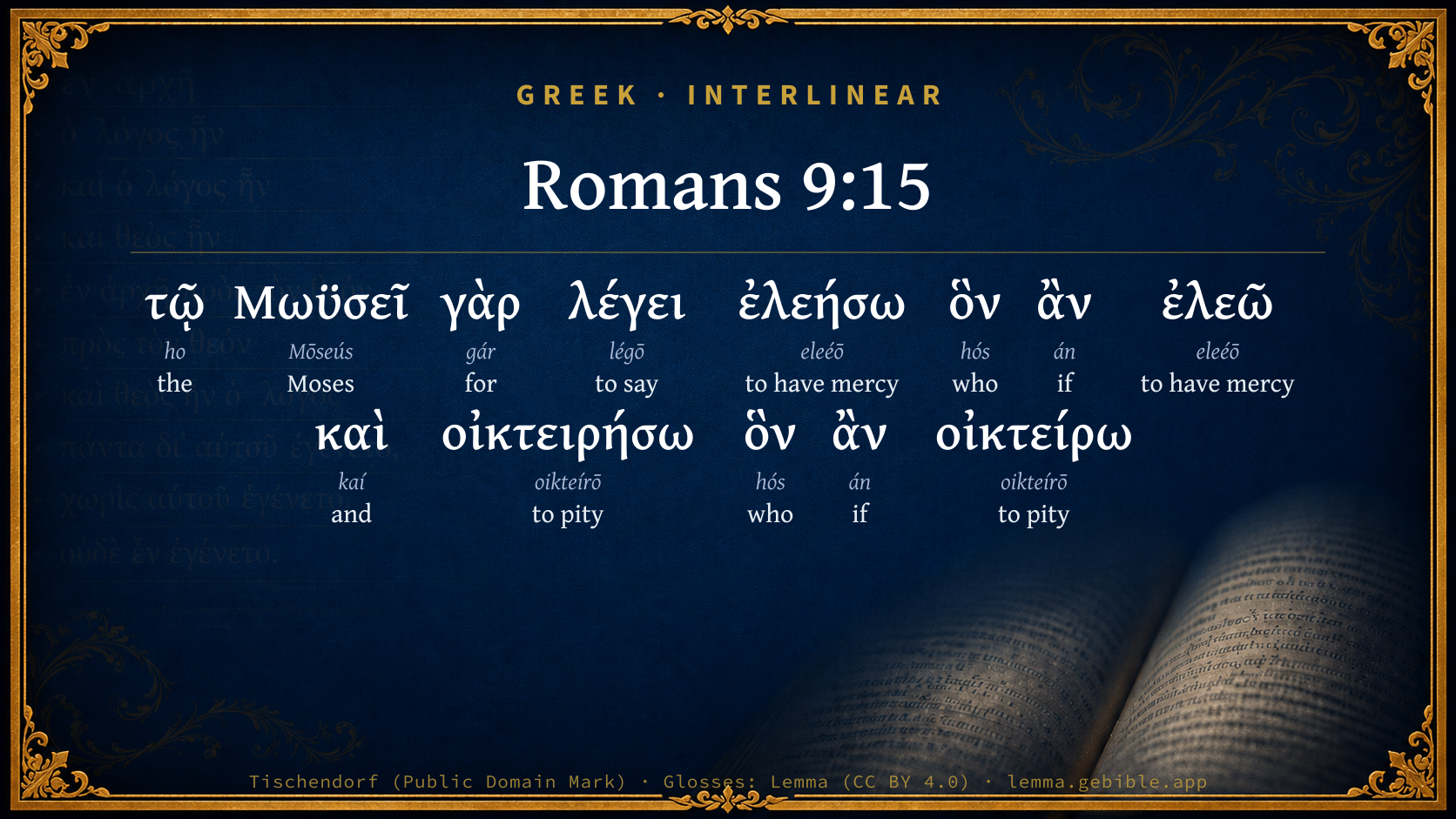
Greek (Tischendorf 8th ed.) Romans 9:15 appears in the Greek New Testament. The text above is from the Tischendorf 8th edition. Each word links to its Strong’s number and a concise gloss. Click any word for its full Thayer’s Greek Lexicon entry.
Download image
Cite this verse

Romans 9:15 (World English Bible). Public Domain. Lemma interlinear Bible study tool, https://lemma.gebible.app/v/romans/9/15.

Show BibTeX & RIS
BibTeX
RIS
English Translation
For he said to Moses, "I will have mercy on whom I have mercy, and I will have compassion on whom I have compassion."
World English Bible · Public Domain
Highlights
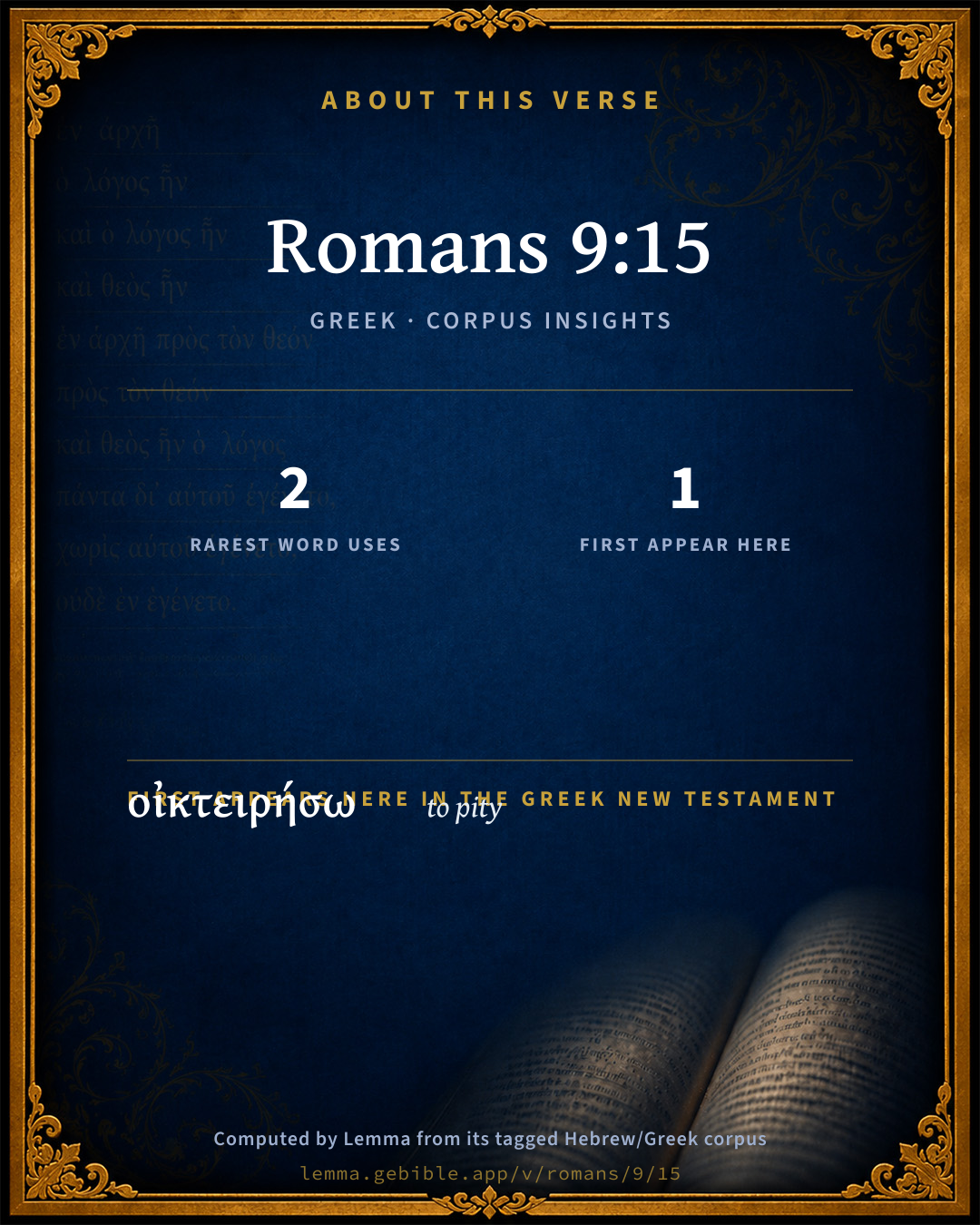
  • 1 first appearance in the Greek New Testament
Full analysis ↓
Download a study sheet

One document with this verse’s original text, its word-by-word gloss line, the meaning frame, cross-references with their text, attributed commentary, and full source and license credits — printable, and it pastes into notes with its structure intact.

This verse Autodidact and up

Study sheet (.html) Plain text (.txt)

A passage Seminary Student

Up to 50 verses in one chapter. A passage sheet keeps up to 6 commentary sources and 12 cross-references per verse, in the order this page ranks them, and says so on the sheet whenever that leaves anything out. Ask for a single verse and you get the Autodidact verse sheet above.

Everything on this page stays free to read, with no account — the sheet is a download of what is already on screen, not access to it.

Want to remove ads? Support Godless Engineer
Compare translations 3

The same verse in 3 English versions, stacked beneath the original-language interlinear above. Click any original word for its lexicon entry.

Each is an independent rendering of the whole verse — the interlinear is not word-aligned to these translations.

Highlighted words mark where these versions differ — a whole-verse word diff, not a word-by-word alignment.

  • World English Bible Public Domain
    For he said to Moses, "I will have mercy on whom I have mercy, and I will have compassion on whom I have compassion."
  • King James Version Public Domain
    For he saith to Moses, I will have mercy on whom I will have mercy, and I will have compassion on whom I will have compassion.
  • unfoldingWord Literal Text CC BY-SA 4.0
    For he says to Moses, “I will have mercy whomever I will have mercy, and I will have compassion whomever I will have compassion.”

unfoldingWord Literal Text — © unfoldingWord, licensed CC BY-SA 4.0. Word-aligned USFM3 via Door43 (git.door43.org/unfoldingWord/en_ult).

Versions to compare (up to 4)

3 of 4 selected

Show all 19 translations

Every available English version of this verse, each an independent rendering of the whole verse.

  • World English Bible Public Domain
    For he said to Moses, "I will have mercy on whom I have mercy, and I will have compassion on whom I have compassion."
  • Berean Standard Bible Public Domain
    For He says to Moses: “I will have mercy on whom I have mercy, and I will have compassion on whom I have compassion.”
  • Majority Standard Bible Public Domain
    For He says to Moses: “I will have mercy on whom I have mercy, and I will have compassion on whom I have compassion.”
  • King James Version Public Domain
    For he saith to Moses, I will have mercy on whom I will have mercy, and I will have compassion on whom I will have compassion.
  • American Standard Version (1901) Public Domain
    For he saith to Moses, I will have mercy on whom I have mercy, and I will have compassion on whom I have compassion.
  • Revised Version (1885) Public Domain
    For he saith to Moses, I will have mercy on whom I have mercy, and I will have compassion on whom I have compassion.
  • Geneva Bible (1599) Public Domain
    For he saith to Moses, I wil haue mercy on him, to whom I wil shew mercie: and wil haue compassion on him, on who I wil haue copassion.
  • Douay-Rheims (1899) Public Domain
    For he saith to Moses: I will have mercy on whom I will have mercy; and I will shew mercy to whom I will shew mercy.
  • Young's Literal Translation Public Domain
    for to Moses He saith, `I will do kindness to whom I do kindness, and I will have compassion on whom I have compassion;'
  • Literal Standard Version CC BY-SA 4.0
    For to Moses He says, “I will do kindness to whom I do kindness, and I will have compassion on whom I have compassion”;
  • Unlocked Literal Bible CC BY-SA 4.0
    For he says to Moses, “I will have mercy on whom I will have mercy, and I will have compassion on whom I will have compassion.”
  • unfoldingWord Literal Text CC BY-SA 4.0
    For he says to Moses, “I will have mercy whomever I will have mercy, and I will have compassion whomever I will have compassion.”
  • Darby Bible Public Domain
    For he says to Moses, I will shew mercy to whom I will shew mercy, and I will feel compassion for whom I will feel compassion.
  • World Messianic Bible Public Domain
    For he said to Moses, “I will have mercy on whom I have mercy, and I will have compassion on whom I have compassion.”
  • Webster's Bible Public Domain
    For he saith to Moses, I will have mercy on whom I will have mercy, and I will have compassion on whom I will have compassion.
  • Free Bible Version CC BY-SA 4.0
    As he said to Moses, “I will be merciful to whoever I should show mercy, and I will have compassion on whoever I should show compassion.”
  • Bible in Basic English Public Domain
    For he says to Moses, I will have mercy on whom I will have mercy, and pity on whom I will have pity.
  • Text-Critical English NT CC BY 4.0
    For he says to Moses, “I will have mercy on whom I have mercy, and I will have compassion on whom I have compassion.”
  • Tyndale New Testament (1534) Public Domain
    For he sayth to Moses: I will shewe mercye to who I shewe mercy: and will have compassion on whom I have compassion.

Literal Standard Version (2020), Covenant Press — licensed CC BY-SA 4.0. Text via the HelloAO Bible API (eBible.org). Unlocked Literal Bible (unfoldingWord) — licensed CC BY-SA 4.0. Text via the HelloAO Bible API (eBible.org). unfoldingWord Literal Text — © unfoldingWord, licensed CC BY-SA 4.0. Word-aligned USFM3 via Door43 (git.door43.org/unfoldingWord/en_ult). Free Bible Version, Dr. Jonathan Gallagher — licensed CC BY-SA 4.0. Text via the HelloAO Bible API (eBible.org).

Word by word

More ways to search: Search by grammar → Find every occurrence → Compare this word →

Practice this passage: Drill this verse → Learn its vocabulary →

About this verse

These counts appear in no published source. They are computed here, from the morphology-tagged text and Lemma’s own curated glosses. What Lemma adds →

13
words
9
distinct lemmas
Pauline Epistles
section

Notable vocabulary

The rarest word here is οἰκτειρήσω to pity G3627 — appearing just 2 times in the whole Greek New Testament.

First appearance in Scripture

This word makes its first canonical appearance in the Greek New Testament here:

  • οἰκτειρήσω to pity G3627

Repetition

Words recur within this verse:

  • ἐλεήσω to have mercy G1653 ×2
  • οἰκτειρήσω to pity G3627 ×2
  • ὃν who G3739 ×2
  • ἂν if G302 ×2

Cross-references

6

Topical passages linked to Romans 9:15 in the Treasury of Scripture Knowledge — connected by theme and wording, ordered by reader-vote popularity; previews shown in the World English Bible.

  • Exodus 33:19 He said, "I will make all my goodness pass before you, and will proclaim the name of Yahweh before you. I will be gracious to whom I will be gracious, and will show mercy on whom I will show mercy."
  • Romans 9:16 So then it is not of him who wills, nor of him who runs, but of God who has mercy.
  • Micah 7:18 Who is a God like you, who pardons iniquity, And passes over the disobedience of the remnant of his heritage? He doesn't retain his anger forever, Because he delights in loving kindness.
  • Romans 9:18–19 So then, he has mercy on whom he desires, and he hardens whom he desires.
  • Exodus 34:6–7 Yahweh passed by before him, and proclaimed, "Yahweh! Yahweh, a merciful and gracious God, slow to anger, and abundant in loving kindness and truth,
  • Isaiah 27:11 When the boughs of it are withered, they shall be broken off; the women shall come, and set them on fire; for it is a people of no understanding: therefore he who made them will not have compassion on them, and he who formed them will show them no favor.

Cross-references courtesy of OpenBible.info (CC BY 4.0).

Commentary

Notes on Romans 9:15 from classic Christian and Jewish commentators (each source and its license shown beneath its notes). The classic Christian expositions comment on the surrounding passage and are grouped to its opening verse, so a note may address several verses; the Jewish commentaries on the Tanakh (Rashi and others) are per-verse, so they appear only where the commentator wrote on this verse.

Lemma curates 59 commentaries, every one of them public domain or Creative Commons licensed, each selected and text-cleaned for this edition rather than reprinted as found. About our sources →

Whedon's Commentary on the Bible

Daniel D. Whedon

15. For—The two fors in this and the seventeenth verse show that Paul gives a reason in each case for maintaining God’s rectitude; first for the bright side, and next for the dark side of the divine dealings in his system of free-agency.

The predestinarian view makes Paul’s answer to the question, Is God unrighteous? be simply this: God is an absolute sovereign, and can do as he pleases, and will as he will, and therefore what he does is right. He can choose men to sin and death “for nothing in them,” and for no fault of theirs; and, because He is almighty, it is right. But,

1. Such a reply is not Pauline, as we have shown, (see note on Rom_3:4-5.) Paul’s doctrine is not that a thing is right because the Absolute One does it; but the Absolute does that which is intrinsically right.

2. The supposed answer is no answer at all. When I ask, Is a given act right? it is no reply to say the actor could do what he pleased, and could will as he willed, and therefore it was right. Power increased infinitely cannot change right. A creature can be supposably wronged by even an infinite being.

3. The predestinarian interpretation makes Paul pretend to give a reason, but really resort to force, and seek to frighten his opponent out of reasoning. Now even if thus silencing instead of convincing were not very mean, the pretending to give a reason when he gives no reason at all would be very mendacious.

4. Mr. Barnes (on Rom_9:15) argues that where all are guilty and worthy of death an executive may pardon a definite number without any just complaint from the unpardoned. Not, we reply, where his own previous decree has plunged the unpardoned into the sin and misery for which he condemns them.

5. Mr. Barnes argues that to predestinate unconditionally a man to sin and damnation is no more unjust than to make him inferior to his fellow “in regard to talents, health, beauty, prosperity, and rank.” It is just as right for God to make me a sinner, and send me to hell for being what he has decretively made me, as it is for him to make me less than a Solomon. (See his notes on Rom_9:12; Rom_9:21.) But,

(1.) These temporal inferiorities are compensated by a large surplus of happiness that renders life desirable in spite of them; but for eternal damnation there is no compensation. Defenders of God’s benevolence, like Paley, point us to the great surplus of happiness over misery diffused by God among all living beings. Life itself is a happiness; and its cessation, death, is dreaded and avoided as the greatest of evils. Thus do all living beings, however inferior, consent, agree, and covenant with God gladly to accept life as long as he will graciously bestow it upon them. But who ever consents to be brought into existence a necessary sinner—just as necessarily as a sparrow is not an eagle, or a zany is not a sage—and for that necessity be sent to an eternal hell?

(2.) These varieties of rank and advantage, of superiority and inferiority, are necessary to a grand system of creation. The result is that, while there is disadvantage in the various parts, the highest advantage is attained for the whole, and such a degree of happiness is secured for every part as that part is glad to accept. But to produce one class of beings upon whom sin and damnation are resistlessly fixed ages before they are born, predetermining their wills to sin, and their souls to hell for that sin, is an awful crime to charge upon God. It is only when by wilful, persistent, undecreed, and unnecessary sin, a free agent violates the divine order, and thus deserves eternal expulsion and reprobation, that such a destiny can be justifiable.

(3.) Omnipotently to create an innocent being supremely miserable would be an act of unspeakable despotism; but there may be discerned in it a certain infernal frankness and magnanimity. But to take an innocent nature, such as man is before he is decreed a sinner, and decretively smear sin upon him as a ground of justly damning him to an eternal hell, is as mean and mendacious as it is despotic. The calling such dealings righteousness, justice, is what our moral nature, with all its intensity, pronounces a truly execrable falsity.

(4.) We offer no solution to the problem that amiable and clear intellects, like Albert Barnes, can not only advocate doctrines which are morally so abominable, but can advocate them with reasonings so futile. But we are almost compelled to believe, from such specimens of logic, that the divine penalty imposed upon the ablest intellects for holding the abhorrent dogma, is to be smitten with collapse in defending it.

Saith unto Moses—(Exo_33:19.) Moses coming down from Sinai, where he had received the law, finding the people immersed in idolatry, exclaims, Who is on Jehovah’s side? Forthwith the tribe of Levi step forth, draw swords, and execute upon the spot three thousand transgressors.

Next day (Exo_22:22) Moses prays that if Jehovah will not spare the people, his own name may be blotted out from God’s book. Jehovah respects the profound unselfishness of the mistaken prayer, but sternly replies,” Whosoever hath sinned against me, HIM will I blot out of my book.” Such was the conditional rule and reason of the Divine will in inflicting wrath, (Exo_32:15-33.) And this explains the dark side of the antithesis in Rom_9:18.

Moses again stands to intercede with God, (xxxiii, 12-19,) and, meeting a gracious reception, beseeches God, Show me thy glory. God consents, declaring, (the words quoted by Paul,) “I will be gracious to whom I will be gracious,” etc. And this explains the bright side of the antithesis in Rom_9:18.

God thus willed, in spite of Moses’ wish, to punish the guilty, and THE GUILTY ONLY; and he willed, in accordance with Moses’ wish, to show him his glory. Thus did God will as he was supremely pleased to will. Yet let four things be noted: First, this willing as he will does not mean willing without a reason, motive, or rule, but willing with a perfect right, reason, motive, and rule. Second. It does not mean that the reason, motive, or rule is an incomprehensible, mysterious, unrevealed, unknown one, but the fully revealed and perfectly just rule of impartially dealing with men as free agents. Third. The peremptoriness of this willing as he will, while it does not exclude either reason, rule, or a publication of reason or rule, does override the small caprice of the man who (as Moses) would doubt, cavil, or rebel against the infinite reason; and, Fourth, This willing as he will is a willing to deal with men, not “for nothing in them,” but according to their faith, and subsequently to their faith, and conditionally upon their faith. The wrongly praying Moses is the type of the weeping Paul, or even of the cavilling Jew, humanely wishing that God would spare the unfaithful people; yet God will inflexibly act on the known and universally published rules of righteous judgment. He will disregard human dictation, whether in form of prayer, weeping, or cavil, and so will have mercy on whom he will have mercy. And human reason, being finitely in the type of divine reason, when it comes to an understanding of the divine rules and reasons, does in its highest exertions profoundly approve the principles on which they are based. So that Paul’s logic is a full reply to his Jewish opponent.

In this interpretation we make no mistake. We have rightly interpreted God’s words to Moses as they are in the Old Testament. And on the perfectly just rule that, where possible, a quotation in the New from the Old Testament must be taken in its original sense, the passage means from the pen of Paul just what it means from the mouth of Jehovah.

Alford makes the apostle here teach “Divine sovereignty” solely and regardless of human freedom, (freedom, he says, is fully taught in other places,) from Paul’s habit of “insulating the one subject under consideration.” But, 1. Alford entirely mistakes the “subject” which the apostle here “insulates.” “Divine sovereignty” is not the “subject,” nor the question, in any part of the chapter. It is God’s “unrighteousness,” (Rom_9:14, as there said in our note,) namely, Has not God the right, overruling the Jews, to sink the old narrow Judaic particularism in a new broad conditional universality? Has not God the right to do right? And, 2, Alford’s exposition not only makes the apostle leave human freedom out of view, but forces it out of existence by completely contradicting it, and making any assertion of freedom elsewhere to be false. 3. Alford forgets that in this very chapter the apostle takes care to assert human freedom, and so to assert it as to run it through all these instances, and so deny the absolutist interpretation in each and every case. (See notes on 30-33.)

I will… on whom I will—This simple assertion, that God will accept whom he pleases, decides not the question, Whom does he please or will to accept? But, taken in its connexions, it plainly means that whereas the Jew wills that God should accept all Jews, God wills—and will do as he wills—to accept all true believers. Paul thus peremptorily asserts not the divine Will in disregard of reason, or in disregard of “anything in the individual,” or in regard to some unknown reason, or in absolute “divine sovereignty” over all things, but in entire independence of Jewish pedigree, merit, or dictation. The Jew prefers a system of predestinated birth-salvation; God prefers an equalized system of free-agency—and will have his way. He will have his way in spite of the cavils of predestinarians, whether Judaistic or Calvinistic.

The rules by which God thus wills, and absolutely pleases, to have mercy, are abundantly revealed in Scripture. To reveal and publish them is, indeed, the great object of Scripture. The decalogue proclaims him a God “showing mercy to thousands that love me and keep my commandments.” “Let the wicked forsake his way, and return to the Lord, and he will have mercy. (Isa_55:7.) The pretence, therefore, that this verse presupposes some no-reason, or some unknowable reason, for his gracious preferences, is a figment and a folly.

Daniel D. Whedon (gen. ed.), Commentary on the Old and New Testaments (1874–1909) — public domain. Text from a community e-Sword module.

Tyndale Open Study Notes

Tyndale Open Resources

9:15 This quotation from Exod 33:19 focuses on God’s nature: God is free from obligation or constraint in bestowing mercy on people.

Tyndale Open Study Notes — © Tyndale Open Resources, licensed CC BY-SA 4.0. Text via the HelloAO Bible API.

Bengel's Gnomon

Johann Albrecht Bengel

Rom 9:15. Τῳ γὰρ Μωσῇ, for to Moses) Many are of opinion, that the objection extends from this verse to Rom 9:18; in which view the for, is used, as in ch. Rom 3:7, and thus thou wilt say then, Rom 9:19, concludes the objection, which was begun at Rom 9:14. And indeed by this introduction of a person speaking there would be a fitting expression of that ἀνταπόκρισις (rejoinder of the opponent), which is censured at Rom 9:20, and is subsequently refuted by taking up the words themselves or their synonyms. In the meantime Paul so expresses himself, as to make ὁ ἀνταποκρινόμενος, the objector whilst replying at the same time answer himself; and therefore the words in this verse may be also taken, without injury to the sense, as spoken in the person of the apostle, as we shall now endeavour to show. Moses, Exodus 33, had prayed for himself and the people by חן, the grace of the Lord, Rom 9:12-13; Rom 9:16-17, and had concluded with, show me thy glory. The Lord answered: I will make all My goodness pass in the presence of thy face, and I will proclaim the name of the Lord before thy face. וחנתי את־אשר אחן ורחמתי את־אשר ארחם, And will be gracious, to whom I will be gracious, and will show mercy, to whom I will show mercy, Rom 9:19. The Lord did not disclose even to Moses without some time intervening, to whom He would show grace and mercy, although the question was respecting Moses and the people of Israel alone, not respecting the Gentiles. To this Moses, then, not merely to others by Moses (Μωσῇ, says Paul, as presently after, τῷ Φαραὼ) the Lord spoke thus: By My proclamation, and by My most abundant working, subsequently, I will designate [mark out] him, as the object of grace and mercy, whosoever he be, whom I make the object of grace and mercy. By these words He intimated, that He would make proclamation [would reveal His own character] as regards grace and mercy; and He shortly after accordingly made proclamation. Exo 34:5, רחום וחנון [ΟΙΚΤΙΡΜΩΝ καὶ ΕΛΕΗΜΩΝ κ.τ.λ. εἰς χιλιάδας], merciful and gracious, etc., to thousands; and added [καὶ τὸν ἔιοχον οὐ καθαριεῖ, ἐπάγων ἁμαρτίας πατέρων, κ.τ.λ.], and He will not clear the guilty, etc. Therefore according to the subsequent proclamation itself, the following meaning of the previous promise comes clearly out: I will show thee the most abundant grace, even to that degree that thou mayest see concerning Me [see centred in Me] all whatsoever thou dost both desire and canst receive [comprehend] in order that thou mayest furthermore understand, that it is [all of] grace; and for this reason inasmuch as I have once for all embraced thee in grace, which thou acknowledgest to be grace; and as to the rest of the people, I will show them the most abundant mercy, in not visiting them with immediate destruction for their idolatry, that they may further understand it to be mercy; and for this reason inasmuch as I have once for all embraced them in mercy, which thou in their behalf acknowledgest to be mercy. The LXX. Int. and Paul have expressed the meaning of this sentence by the difference between the present and future tense: ἐλεήσω ὅν ἂν ἐλεῶ, καὶ οἰκτειρήσω ὅν ἂν οἰκτείρω, I will have mercy on whom I have mercy, and I will have compassion on whom I have compassion. And there is the figure Ploce [en.], which nearly signifies the same as below, ch. Rom 13:7, and here it expresses the liberty of the Agent, of whom the apostle is speaking, as in Exo 16:23. Moreover, each of the two verbs, placed in the two clauses [i.e. repeated twice], contains the emphasis in the former clause; [i.e. the emphasis is on the verb in each of the two clauses on its first mention, not on it when repeated; I will have mercy, on whom I have mercy, etc.]: although generally in other passages the emphasis is on the verb in the latter clause [i.e. on its repetition] Gen 27:33; Gen 43:14; 2Ki 7:4. That the acknowledgment of grace and mercy, on the part of Moses, and the true Israelites, is entwined together, is evident from this, that Paul, Rom 9:16, speaks, on the opposite side, of the man that willeth and that runneth, to whom grace is not grace, and mercy is not mercy. את אשר ὅν ἄν is put twice, and intimates in the former passage that Moses (to whom the word חן, grace, is repeated in reply, taken from his own very prayers from Exodus 33. Rom 9:13: where there occurs the same Ploce), and that in the latter passage, the others, were εἰς χιλιάδας among the thousands [as to whom God said of Himself, keeping mercy for thousands], to whom sinners, their children, grandchildren, etc., are opposed, Exo 34:7. And thus, this testimony is extremely well fitted to prove, that there is no unrighteousness with God. This sentiment is manifest to believers. But in regard to those, who maintain the efficacy of good works, it sounds too abrupt: the reason why God should be merciful, is none other than His own mercy, for no other is mentioned in the writings of Moses, concerning Moses and Israel. I will have mercy, i.e. no one can extort anything by force; all things are in My hand, under My authority, and dependent on My will, if I act otherwise, no one can charge Me with injustice. This answer is sufficient to give to the defender of good works; and if any farther answer is given to him, it is superfluous.

Bengel's Gnomon of the New Testament — English translation (T&T Clark, Edinburgh, 1860) — public domain. Text from a community e-Sword module.

Meyer's Critical & Exegetical Commentary

Heinrich August Wilhelm Meyer

Rom_9:15. Reason assigned for the μὴ γένοιτο, not for the legitimacy of the question μὴ ἀδικία π. τ. Θ. (Mangold, p. 134), so that the opponents language continues, until it culminates in the audacious exclamation of Rom_9:19. Γάρ after μὴ γένοιτο always relates to this. Bengel rightly remarks on γάρ: Nam quod asserimus, Dei assertum est irrefragabile.

τῷ Μωϋς. γ. (see critical remarks) brings into strong relief the venerated recipient of the word, which makes it appear the more weighty (comp. Rom_10:5; Rom_10:19). The citation is Exo_33:19, verbally following the LXX. (which would have more closely translated the Heb. by ἐλεῶ ὃν ἂν ἐλεήσω κ.τ.λ.). In the original text it is an assurance by God to Moses of His favour now directly extended towards him, but expressed in the form of a divine axiom. Hence Paul, following the LXX., was justified in employing the passage as a scriptural statement of the general proposition: Gods mercy, in respect of the persons concerned, whose lot it should be to experience it, lets itself be determined solely by His own free will of grace: I will have mercy upon whosoever is the object of my mercy; so that I am therefore in this matter dependent on nothing external to myself. This is the sovereignty of the divine compassionating will. Observe that the future denotes the actual compassion, fulfilling itself in point of fact, which God promises to show to the persons concerned, towards whom He stands in the mental relation (ἐλεῶ, present) of pity. The distinction between ἐλεῶ and οἰκτείρω is not, as Tittmann, Synon. p. 69 f., defines it, that ἐλ. denotes the active mercy, and οἰκτ. the compassionate kindness, but that the same notion misereri is more strongly expressed by οἰκτ. See Fritzsche. Comp. Plat. Euthyd. p. 288 D: ἐλεήσαντέ με καὶ οἰκτείραντε. The latter denotes originally bewailing sympathy, as opposed to μακαρίζειν (Xen. Anab. iii. 1. 19). Comp. οἶκτος (to which ὀδυρμός, Plat. Rep. iii. p. 387 D, corresponds), οἰκτίζω, οἰκτρός κ.τ.λ. On the form οἰκτειρήσω, see Lobeck, ad Phryn. p. 741.

ὃ ἂν] The ἂν is that everywhere usual with the relative in the sense of cunque. Hence conditionally expressed: if to any one I am gracious, etc. See generally Hartung, Partikell. II. p. 293 f.; Ellendt, Lex. Soph. I. p. 119. Consequently, not merely the mercy in itself, but also the determination of those who should be its objects, is designated as a free act of God, resting on nothing except on His elective purpose, and affecting the persons according to it; for the emphasis lies in the relative clause on the repeated ὃν ἄν, as ἄν generally has its place after the emphatic word.

Meyer — Critical and Exegetical Commentary on the New Testament — English translation by Peter Christie, edited by Frederick Crombie (T&T Clark, 1880) — public domain. Text from a community e-Sword module.

Expositor's Greek Testament

ed. W. Robertson Nicoll

Rom 9:15 . τῷ Μωυσεῖ γὰρ λέγει . τῷ Μωυσεῖ is emphatic by position: the person to whom this declaration was made, as well as the voice which made it, render it peculiarly significant to a Jew. The words (exactly as LXX, Exo 33:19 ) occur in the answer to a prayer of Moses, and may have been regarded by Paul as having special reference to him; as if the point of the quotation were, Even one who had deserved so well as Moses experienced God’s mercy solely because God willed that He should. But that is not necessary, and is not what the original means. The emphasis is on ὃν ἂν , and the point is that in showing mercy God is determined by nothing outside of His mercy itself. οἰκτείρειν is stronger than ἐλεεῖν ; it suggests more strongly the emotion attendant on pity, and even its expression in voice or gesture.

The Expositor's Greek Testament, edited by W. Robertson Nicoll (1897–1910) — public domain. Text from a community e-Sword module.

Hodge's Commentary on Romans, Ephesians & First Corinthians

Charles Hodge

Rom_9:15

For God saith to Moses, I will have mercy on whom I Will have mercy, and I will have compassion on whom I will have compassion. The connection and argument are obvious. It is not unjust in God to exercise his sovereignty in the distribution of his mercies, for he expressly claims the right. The passage quoted is from the account of the solemn interview of Moses with God. In answer to the prayer of the prophet for his people and for himself, God answered, I will proclaim my name before thee, and will be gracious to whom I will be gracious, etc. Exo_33:19. It is, therefore, a formal declaration of a divine prerogative. The form of expression I will do what I will, or I do what I do, is here, as in Exo_16:23; 2Sa_15:20, designed to convey the idea that it rests entirely with the agent to act or not, at his pleasure. The ground of decision is in himself. In the connection of this verse with the former, therefore, it is obvious that Paul quotes this declaration to prove that God claims the sovereignty which he had attributed to him. In order to avoid the force of this passage, many deny that it expresses the sentiment of the apostle. They consider this and the following verses as the objections of a Jewish fatalist, a mode of interpretation so obviously inconsistent with the context, and even the proper force of the words, that it is mentioned only to show how hard it is to close the eyes against the doctrine which the apostle so clearly teaches. Gottes Erbarmen und Huld sei lediglich von seinem eigenen unumschränten Willen abhängig; auf wen eimnal sein Erbarmen gerichtet sei, dem werde ers erweisen. Meyer. Gods mercy and favor depend solely on his own sovereign will, he will manifest that mercy towards him to whom it has been once directed. Tittmann, in his Synon. in N. T., says that the difference between οἰκτείρειν and ἐλεεῖν is, that the former denotes the feeling experienced in view of the sufferings of others, and the latter the desire to relieve them. The difference is very much the same as that between our words compassion and mercy.

Charles Hodge — Commentary on Romans (1835), First Corinthians (1857), and Ephesians (1856) — public domain. Text from a community e-Sword module.

Geneva Bible (1599)

Geneva Bible translators

I will be merciful and favorable to whom I list to be favorable.

I will have compassion on whomsoever I list to have compassion.

He answereth first touching them which are chosen to salvation in choosing of whom, he denieth that God may seem unjust, although he choose and predestinate to salvation, them that are not yet born, without any respect of worthiness: because he bringeth not the chosen to the appointed end, but by the means of his mercy, which is a cause next under predestination. Now mercy presupposeth misery, and again misery presupposeth sin or voluntary corruption of mankind, and corruption presupposeth a pure and perfect creation. Moreover mercy is showed by her degrees: to wit, by calling, by faith, by justification and sanctification, so that at length we come to glorification, as the Apostle will show afterward. Now all these things, orderly following the purpose of God, do clearly prove that he can by no means seem unjust in loving and saving his.

Geneva Bible (1599) marginal notes — public domain. Text via Bolls.life.

Jamieson, Fausset & Brown

Robert Jamieson, A. R. Fausset & David Brown

For he saith to Moses-- (Exo 33:19).

I will have mercy on whom I will have--"on whom I have"

mercy, and I will have compassion on whom I will have--"on whom I have"

compassion--"There can be no unrighteousness in God's choosing whom He will, for to Moses He expressly claims the right to do so." Yet it is worthy of notice that this is expressed in the positive rather than the negative form: not, "I will have mercy on none but whom I will"; but, "I will have mercy on whomsoever I will."

Jamieson, Fausset & Brown — Commentary Critical and Explanatory on the Whole Bible (1871) — public domain (CC PDM 1.0). Text via the HelloAO Bible API.

Adam Clarke's Commentary

Verse 15. For he saith to Moses, I will have mercy, c.] The words of God to Moses, Ex 33:19, show that God has a right to dispense his blessings as he pleases for, after he had declared that he would spare the Jews of old, and continue them in the relation of his peculiar people, when they had deserved to have been cut off for their idolatry, he said: I will make all my goodness pass before thee; and I will proclaim the name of the Lord before thee; and I will have mercy on whom I will have mercy; and I will have compassion on whom I will have compassion. As if he had said: I will make such a display of my perfections as shall convince you that my nature is kind and beneficent; but know, that I am a debtor to none of my creatures. My benefits and blessings are merely from my own good will: nor can any people, much less a rebellious people, challenge them as their due in justice or equity. And therefore I now spare the Jews; not because either you, who intercede for them or they themselves have any claim upon my favour, but of my own free and sovereign grace I choose to show them mercy and compassion. I will give my salvation in my own way and on my own terms. He that believeth on my Son Jesus shall be saved; and he that believeth not shall be damned. This is God's ultimate design; this purpose he will never change; and this he has fully declared in the everlasting Gospel. This is the grand DECREE of reprobation and election.

Adam Clarke's Commentary on the Bible (1810–1826) — public domain. Text from a community e-Sword/MySword module.

John Calvin's Commentaries

15. For he saith to Moses, etc. With regard to the elect, God cannot be charged with any unrighteousness; for according to his good pleasure he favors them with mercy: and yet even in this case the flesh finds reasons for murmuring, for it cannot concede to God the right of showing favor to one and not to another, except the cause be made evident. As then it seems unreasonable that some should without merit be preferred to others, the petulancy of men quarrels with God, as though he deferred to persons more than what is right. Let us now see how Paul defends the righteousness of God.

In the first place, he does by no means conceal or hide what he saw would be disliked, but proceeds to maintain it with inflexible firmness. And in the second place, he labours not to seek out reasons to soften its asperity, but considers it enough to check vile barkings by the testimonies of Scripture.

It may indeed appear a frigid defence that God is not unjust, because he is merciful to whom he pleases; but as God regards his own authority alone as abundantly sufficient, so that he needs the defence of none, Paul thought it enough to appoint him the vindicator of his own right. Now Paul brings forward here the answer which Moses received from the Lord, when he prayed for the salvation of the whole people, “I will show mercy,” was God’s answer, “on whom I will show mercy, and I will have compassion on whom I will have compassion.” By this oracle the Lord declared that he is a debtor to none of mankind, and that whatever he gives is a gratuitous benefit, and then that his kindness is free, so that he can confer it on whom he pleases; and lastly, that no cause higher than his own will can be thought of, why he does good and shows favor to some men but not to all. The words indeed mean as much as though he had said, “From him to whom I have once purposed to show mercy, I will never take it away; and with perpetual kindness will I follow him to whom I have determined to be kind.” And thus he assigns the highest reason for imparting grace, even his own voluntary purpose, and also intimates that he has designed his mercy peculiarly for some; for it is a way of speaking which excludes all outward causes, as when we claim to ourselves the free power of acting, we say, “I will do what I mean to do.” The relative pronoun also expressly intimates, that mercy is not to all indiscriminately. His freedom is taken away from God, when his election is bound to external causes.

The only true cause of salvation is expressed in the two words used by Moses. The first is חנן, chenen, which means to favor or to show kindness freely and bountifully; the other is רחם, rechem, which is to be treated with mercy. Thus is confirmed what Paul intended, that the mercy of God, being gratuitous, is under no restraint, but turns wherever it pleases.

John Calvin's Commentaries (1540-1563) — public domain. Text from the Calvin Translation Society English edition (1840s-50s) via the Christian Classics Ethereal Library (ccel.org). Calvin's coverage is partial (roughly two-thirds of the Bible); uncommented books and verses are honest gaps, never fabricated. The 19th-century editor's footnotes and remarks are omitted so the notes are faithfully Calvin's own voice.

Ellicott's Commentary for English Readers

(15) For he saith to Moses.—In the most characteristic period of the Old Testament the divine favour was promised in this way to Moses and denied to Pharaoh. The original of the first quotation has reference to the special revelation vouchsafed to Moses on Sinai, “I will show grace to whom I will show grace.”

A Bible Commentary for English Readers, edited by Charles John Ellicott (1878–1897) — public domain. Text from a community e-Sword module.

The Cambridge Bible for Schools and Colleges

gen. ed. J. J. S. Perowne

15. For] The connexion is; “The thought of injustice in these acts of the Eternal Judge is all the more to be rejected because they follow a principle expressed in His own words; for He says to Moses, &c.” That the principle, so expressed, is absolutely right, is taken for granted. To the Apostle, God’s word is final and absolute. With Him nothing indeed can be capricious, but none the less His “judgments” must, to a vast degree, be “past finding out,” just because He is the Eternal.

I will have mercy, &c.] Exo_33:19. Verbatim from LXX.—The English exactly represents the Hebrew, if it is noted that “will” throughout this verse might equally well be “shall.” In both Hebrew and Greek there is no explicit reference to “willing,” in the sense of “choosing.” However, the general sense plainly is, “In any case, through human history, wherein I shall be seen to have mercy, the one account I give of the radical cause is this—I have mercy.” It is to be thankfully remembered, by the way, that close to this awful utterance occurs that other equally sovereign proclamation, (Exo_34:6, &c.) “The Lord, the Lord God, merciful and gracious, &c.”

The Cambridge Bible for Schools and Colleges (gen. ed. J. J. S. Perowne; Cambridge University Press, 1878–1918) — public domain. Text from a community e-Sword module.

John Gill's Exposition

So then it is not of him that willeth,.... This is not a consequence drawn by an adversary, showing that if this be the case, it signifies nothing for men to will or do, they may even sit still and do nothing, but depend on the mercy of God; but this is a conclusion of the apostle's from the above cited testimony, inferring from thence, that election, which is what he is discoursing of, is "not of him that willeth",

nor of him that runneth: that is, is not owing to the will or works of men, to the desires, inclinations, and affections of their minds, or to the actions of their lives; these are not the motives, conditions, or causes of this act:

but of God that sheweth mercy; in a free sovereign way and manner, which he is not obliged to by anything the creature wills or works; he is at full liberty, notwithstanding whatever they will or do, to give his grace and mercy, when, where, and to whom he pleases; and therefore to give it to some, and deny it to others, can never be accounted an act of injustice, since he is not bound to give it to any. Some make the it to be the blessing of Isaac, which was not of the will of any of the parties concerned; not of Isaac who willed it to Esau; nor of Esau who willed it to himself, but had it not; nor of the will of the persons who had their desires, not of the will of Rebecca, who was desirous of it for her son Jacob, nor of the will of Jacob, who desired it for himself, though he had it; nor of either of them that ran, not of Esau, who made haste to hunt for, and prepare venison for his father, nor of Jacob, who ran to the flock, for two kids of the goats; but of God that showed mercy to him, who, according to his sovereign will and pleasure, had signified before to Rebecca, that "the elder should serve the younger", Gen 25:23, as the apostle had mentioned this so lately, it might still be in his thoughts, and he may allude to it; but election being what he is discoursing of in the context, that is the "it" here designed; and what is true of that, is true of salvation in all its parts, and therefore some understand it in the large sense of salvation; though by others so qualified and limited, as to spoil the glory of the text: some saying that the sense is, it is not of him that willeth and runneth wrong, but of the grace and mercy of God; but as no man would ever assert, that salvation is of him that wills and runs wrong, so the apostle had no occasion to deny it: others say, that it is not only of him that wills, and only of him that runs, but also of God that shows mercy; making man's will and works joint causes with the mercy of God in man's salvation; and besides, as Austin (k) long ago observes, according to this sense, the words might as well be read, it is not only of God that shows mercy, but of him that willeth, and of him that runneth, which no Christian would dare to say: the true sense is, that as election, which is the leading step to salvation, is not owing at all to the will of men, but to the good pleasure and will of God; and not at all to the works of men, that being done before them, and they being the fruits and effects of that, but to the free love, grace, and good will of God; so salvation in all its parts and branches, as redemption, justification, regeneration, calling, and conversion, faith, repentance, hope, love, &c. and eternal life, is not to be ascribed at all to the will of men, nor at all to the works of men, but entirely and alone to the love, grace, and mercy of God through Christ.

(k) Enchiridion, c. 32.

John Gill's Exposition of the Whole Bible (1746–1763) — public domain (CC PDM 1.0). Text via the HelloAO Bible API.

Trapp's Complete Commentary

John Trapp

15 For he saith to Moses, I will have mercy on whom I will have mercy, and I will have compassion on whom I will have compassion.

Ver. 15. I will have mercy, &c.] Dei voluntas est ratio rationum, nec tantum recta, sed regula. The will of God is the rule of his plan, neither only right but his rule.

John Trapp, A Commentary or Exposition upon All the Books of the Old and New Testament (1647–1656) — public domain. Text from a community e-Sword module.

Albert Barnes' Notes on the Bible

For he saith to Moses - Exo 33:19.

I will have mercy - This is said by God when he declared expressly that he would make all his goodness pass before Moses Exo 33:19, and when, therefore, it was regarded, not as a proof of stern and inexorable justice, but as “the very proof of his benevolence,” and the highest which he thought proper to exhibit. When people, therefore, under the influence of an unrenewed and hosthe heart, charge this as an unjust and arbitrary proceeding, they are resisting and perverting what God regards as the very demonstration of his benevolence. The sense of the passage clearly is, that he would choose the objects of his favor, and bestow his mercies as he chose. None of the human race deserved his favor; and he had a right to pardon whom he pleased, and to save people on his own terms, and according to his sovereign will and pleasure.

On whom I will have mercy - On whom I choose to bestow mercy. The mode he does not explain. But there could not be a more positive declaration of these truths,

That he does it as a sovereign, without giving an account of the reason of his choice to any.

(2)That he does it without regard to any claim on the part of man; or that man is regarded as destitute of merit, and as having no right to his mercy.

(3)That he will do it to any extent which he pleases, and in whatever time and manner may best accord with his own good pleasure.

(4)That he has regard to a definite number and that on that number he intends to bestow eternal life; and,

That no one has a right to complain.

It is proof of his benevolence that any are saved; and where none have a claim, where all are justly condemned, he has a right to pardon whom he pleases. The executive of a country may select any number of criminals whom he may see fit to pardon, or who may be forgiven in consistency with the supremacy of the laws and the welfare of the community and none has a right to complain, but every good citizen should rejoice that any may be pardoned with safety. So in the moral world, and under the administration of its holy Sovereign, it should be a matter of joy that any can be pardoned and saved; and not a subject of murmuring and complaint that those who shall finally deserve to die shall be consigned to woe.

Albert Barnes' Notes on the Bible (1834–1885) — public domain. Text from a community e-Sword/MySword module.

Haydock's Catholic Bible Commentary

I will have mercy, &c. Then it is not of him that willeth, &c. By these words he again teaches that God’s call and predestination of those whom he has decreed to save, in not upon account of any works or merits in men, but only to be attributed to the mercy and goodness of God. See St. Thomas Aquinas on this chap. lect. iii. See St. Augustine, Encher. chap. xcviii. Epis. 194. in the new Ed. Ep. 105. ad Sixtum de lib. Arbit. chap. xxv. &c. (Witham)

George Leo Haydock (1774–1849), Haydock's Catholic Family Bible and Commentary, 1859 edition — public domain. Excludes Psalms (Douay-Rheims chapter numbering differs from Protestant) and Deuterocanonical books (Catholic canon only).

Matthew Poole's English Annotations

q.d. God is not chargeable with any injustice in electing some, and not others; for this is an act of mere mercy and compassion, and that can be no violation of justice. To prove this, he cites a testimony out of Exo 33:19, which see. There he tells Moses, that the good pleasure of his will was the only rule of all his favourable and merciful dealings with the children of men. The same thing is intended and expressed in two several phrases: and the ingemination imports the freeness of God’s mercy; nothing moves him thereunto, but his own gracious inclination; and also the arbitrariness thereof; it depends only upon his good will and pleasure. The sum is, if God show mercy to some, and not to others, he cannot be accused of injustice, because he injures none; nor is he obliged or indebted to any.

Matthew Poole's English Annotations on the Holy Bible (1683–1685) — public domain. Text from a community e-Sword/MySword module.

John Wesley's Explanatory Notes

Exod. xxxiii, 19.

John Wesley, Explanatory Notes Upon the Whole Bible (1754–1765) — public domain. Text via the GEBible commentary corpus.

Godbey's Commentary on the New Testament

William B. Godbey

15. “For he says to Moses, I will have mercy on whom I do have mercy, and will compassionate whom I do compassionate” (Exo 3:19). This progenitorship was a great and signal mercy, yet it did not exclude the reprobated from grace and glory but does imply from a place in the honored Messianic progenitorship.

William B. Godbey, Commentary on the New Testament (1896–1900) — public domain. Text from a community e-Sword module.

McGarvey & Pendleton's Commentaries

J. W. McGarvey

For he saith to Moses [ Exo_33:19 . Surely if the Scripture generally was final authority to the Jew, that part of it would be least questioned wherein God is the speaker and Moses the reporter], I will have mercy on whom I have mercy [God chooses both the occasion and the object of mercy, and it is not regulated by anything external to him. That which is bestowed upon the meritorious and deserving is not pure mercy; for, as Shakespeare expresses it, "The quality of mercy is not strained"], and I will have compassion on whom I have compassion . [Compassion is a stronger term than mercy; it is mercy with the heart in it. The words quoted were spoken to Moses when he requested to see God, and his request was in part granted. In expounding Exo_33:19 ; Keil and Delitzsch speak thus: "These words, though only connected with the previous clause by the copulative vav, are to be understood in a causal sense as expressing the reason why Moses' request was granted, that it was an act of unconditional grace and compassion on the part of God, to which no man, not even Moses, could lay any just claim." This interpretation is strengthened by the Old Testament reading, which runs thus: "I will be gracious to whom I will be gracious, and will show mercy on whom I will show mercy," for the act was one of grace rather than of compassion. Let us remember that Paul is here addressing a hypothetical Jewish objector. The Jew, influenced by false reasoning on his law, held a theory that man's conduct regulated God's and that man took the initiative and that God's actions were merely responsive. Such might, in some measure, have been the case had any man ever kept the law; but as things actually stood, to the subversion of all such things, it was evident from Scripture that Moses, the great lawgiver, himself had never been able to merit a favor at God's hands, but, on the contrary, God granted that to him as a matter of gracious mercy which he could never claim as a matter of right; viz., not eternal life with God, but the mere momentary glimpse of the passing of God's glory. Surely, with such a precedent before him, the rational, thoughtful Jew, whether of Paul's day or of our own, could and can have small hope of gaining heaven by the works of the law. Since it is true that Abraham obtained favor by faith and Moses received it solely by grace, who shall win it by merit under the law?]

J. W. McGarvey (with Philip Y. Pendleton), Commentaries on the New Testament (The Fourfold Gospel, 1914; Acts; and the epistles) — public domain. Text from a community e-Sword/MySword module.

The People's New Testament

B. W. Johnson

15. I will have mercy upon whom I will have mercy. This is in Exod. 33:19, and is in answer to a request of Moses for a high privilege. The Lord grants it, not because he merits it, but of grace, because he “will be gracious to whom he willeth, and will have mercy where he will.” The passage, as applied by Paul, asserts that God favors nations according to his pleasure. He exercises free choice.

B. W. Johnson's The People's New Testament with Notes (1889–1891) — public domain. Electronic text from the Christian Classics Ethereal Library (CCEL) ThML edition.

Cambridge Greek Testament for Schools and Colleges

15. τῷ Μωυσεῖ γὰρ κ.τ.λ = LXX[182] Exo 33:19. In the original the force lies in the assertion of effective mercy. S. Paul applies it as asserting selective mercy (cf. 18). The mercy of GOD depends upon His Will. But how does this exclude the charge of unrighteousness, as γὰρ implies that it does? It can only do so, on the unexpressed assumption that GOD’S Will is essentially and necessarily righteous; cf. Rom 3:6. But this is the very point raised by the objector: and we should have expected it to be expressed in the most explicit form. The context however shows that it is not the general mercy of GOD ‘over all His works’ which is here being considered, but His mercy in selecting human instruments for carrying out His work of redemption; ἔλεος is closely connected with χάρις (cf. Hort, 1 Pet. p. 30). Cf. Rom 11:30 f.

[182] LXX. the Septuagint Version of the Old Testament

Cambridge Greek Testament for Schools and Colleges (Cambridge University Press, 1896; 21 vols, various authors incl. Carr, Maclear, Plummer, Farrar, Lumby, Moule, M. R. James, Simcox) — public domain. Text from a community e-Sword module.

Alford’s Greek Testament

Henry Alford

15.] for He saith to Moses, “I will have mercy on whomsoever I have meroy, and [I] will have compassion on whomsoever I have compassion.” The citation is from the LXX, who insert the indefinite ἄν, the Heb. being … חַנֹּתִי אֶת־אֲשֶׁר אָחֹן; the meaning apparently being, ‘whenever I have mercy on any, it shall be pure mercy, no human desert contributing;’ which agrees better with the next verse than the ordinary rendering, which lays the stress on the ὃν ἄν; and is not inconsistent with ver. 18, ὃν θέλει, ἐλεᾷ: because if God’s mercy be pure mercy without any desert on man’s part, it necessarily follows that he has mercy on whom He will, His will being the only assignable cause of the selection.

Henry Alford, The Greek Testament (1849–1861) — public domain. Text from a community e-Sword module.

International Critical Commentary

15-19. According to Origen, followed by many Fathers and some few modern commentators, the section vv. 15-19 contains not St. Paul’s own words, but a continuation of the objection put into the mouth of his opponent, finally to be refuted by the indignant disclaimer of ver. 20. Such a construction which was adopted in the interest of free-will is quite contrary to the structure of the sentence and of the argument. In every case in which μὴ γένοιτο occurs it is followed by an answer to the objection direct or indirect. Moreover if this had been the construction the interrogative sentence would not have been introduced by the particle μή expecting a negative answer, but would have been in a form which would suggest an affirmative reply.

15. τῷ γὰρ Μωσῇ λέγει. The γάρ explains and justifies the strong denial contained in μὴ γένοιτο. Too much stress must not be laid on the empnasis given to the name by its position; yet it is obvious that the instance chosen adds considerably to the strength of the argument. Moses, if any one, might be considered to have deserved God’s mercy, and the name of Moses would be that most respected by St. Paul’s opponents. λέγει without a nominative for Θεὸς λέγει is a common idiom in quotations (cf. Rom 15:10; Gal 3:16; Eph 4:8; Eph 5:14).ἐλεήσω ὃν ἂν ἐλεω, κ. τ. λ: ‘I will have mercy on whomsoever I have mercy.’ The emphasis is on the ὃν ἄν, and the words are quoted to mean that as it is God who has made the offer of salvation to men, it is for Him to choose who are to be the recipients of His grace, and not for man to dictate to Him. The quotation is from the LXX of Exo 33:19 which is accurately reproduced. It is a fairly accurate translation of the original, there being only a slight change in the tenses. The Hebrew is ‘I am gracious to whom I will be gracious,’ the LXX ‘I will be gracious to whomsoever I am gracious.’ But St. Paul uses the words with a somewhat different emphasis. Moses had said, ‘Show me, I pray thee, thy glory.’ And He said, ‘I will make all my goodness pass before thee, and will proclaim the name of the Lord before thee: and I will be gracious to whom I will be gracious, and will show mercy on whom I will show mercy.’ The point of the words in the original context is rather the certainty of the Divine grace for those whom God has selected; the point which St. Paul wishes to prove is the independence and freedom of the Divine choice.ἐλεήσω … οἰκτειρήσω. The difference between these words seems to be something the same as that between λύπη and ὀδύνη in ver. 2. The first meaning ‘compassion,’ the second ‘distress’ or ‘pain,’ such as expresses itself in outward manifestation. (Cf. Godet, ad loc.)

International Critical Commentary — older volumes (1896–1929), various authors — public domain. Text from a community e-Sword module.

Vincent's Word Studies in the New Testament

Marvin R. Vincent

I will have mercy - compassion [ελεησω - οικτειρησω] , See Exo 33:19. For mercy see on 2 John 3; Luk 1:50. The former verb emphasizes the sense of human wretchedness in its active manifestation; the latter the inward feeling expressing itself in sighs and tears. Have mercy therefore contemplates, not merely the sentiment in itself, but the determination of those who should be its objects. The words were spoken to Moses in connection with his prayer for a general forgiveness of the people, which was refused, and his request to behold God 's glory, which was granted. With reference to the latter, God asserts that His gift is of His own free grace, without any recognition of Moses ' right to claim it on the ground of merit or service.

Marvin R. Vincent, Word Studies in the New Testament (1887–1900) — public domain. Text from a community e-Sword/MySword module.

Lesson kit

Teaching starters — assembled from the data on this page, not authored interpretation. Every prompt links to the verse data it draws on. Edit before teaching.

Romans, in the Pauline Epistles, opens this verse with 13 words (9 distinct Greek lemmas). Its most distinctive word is oikteírō (“to pity”). A historical commentator’s framing appears above. Read the whole chapter for the surrounding context.

Discussion questions

  1. What does “to pity” (oikteírō) contribute to the verse as a whole?
  2. This is the first place “to pity” appears in Scripture (first appears here). What does its debut here establish?
  3. How does Exodus 33:19, which shares this passage’s theme, read alongside this verse?
  4. What does the repetition of “to have mercy” (2× in this one verse) do in this verse?
  5. The translations on this page render this verse differently — a whole-verse word diff, not a word-by-word alignment. What might account for the different wordings?
  6. Compare how Whedon's Commentary on the Bible and Tyndale Open Study Notes read this verse. Where do they agree or differ?

Things to notice

  • 1 word makes its first canonical appearance in Scripture here.
  • These translations choose different wording for 4 words in this verse.
  • “to have mercy” occurs 2× in this single verse.
  • 9 distinct Greek lemmas span 13 words in this verse.

Reading settings

Reading text

Shown beneath each verse's original-language words.

Old Testament
Old Testament edition

Read the OT as the Masoretic Hebrew (MT) or the Greek Septuagint (LXX).

English shown for the Greek Septuagint (in the Hebrew ↔ Greek comparison).

Comparing translations? Open the Compare panel on any verse page to stack up to four side by side.