Romans 11:35

Greek (Tischendorf 8th ed.) Romans 11:35 appears in the Greek New Testament. The text above is from the Tischendorf 8th edition. Each word links to its Strong’s number and a concise gloss. Click any word for its full Thayer’s Greek Lexicon entry.
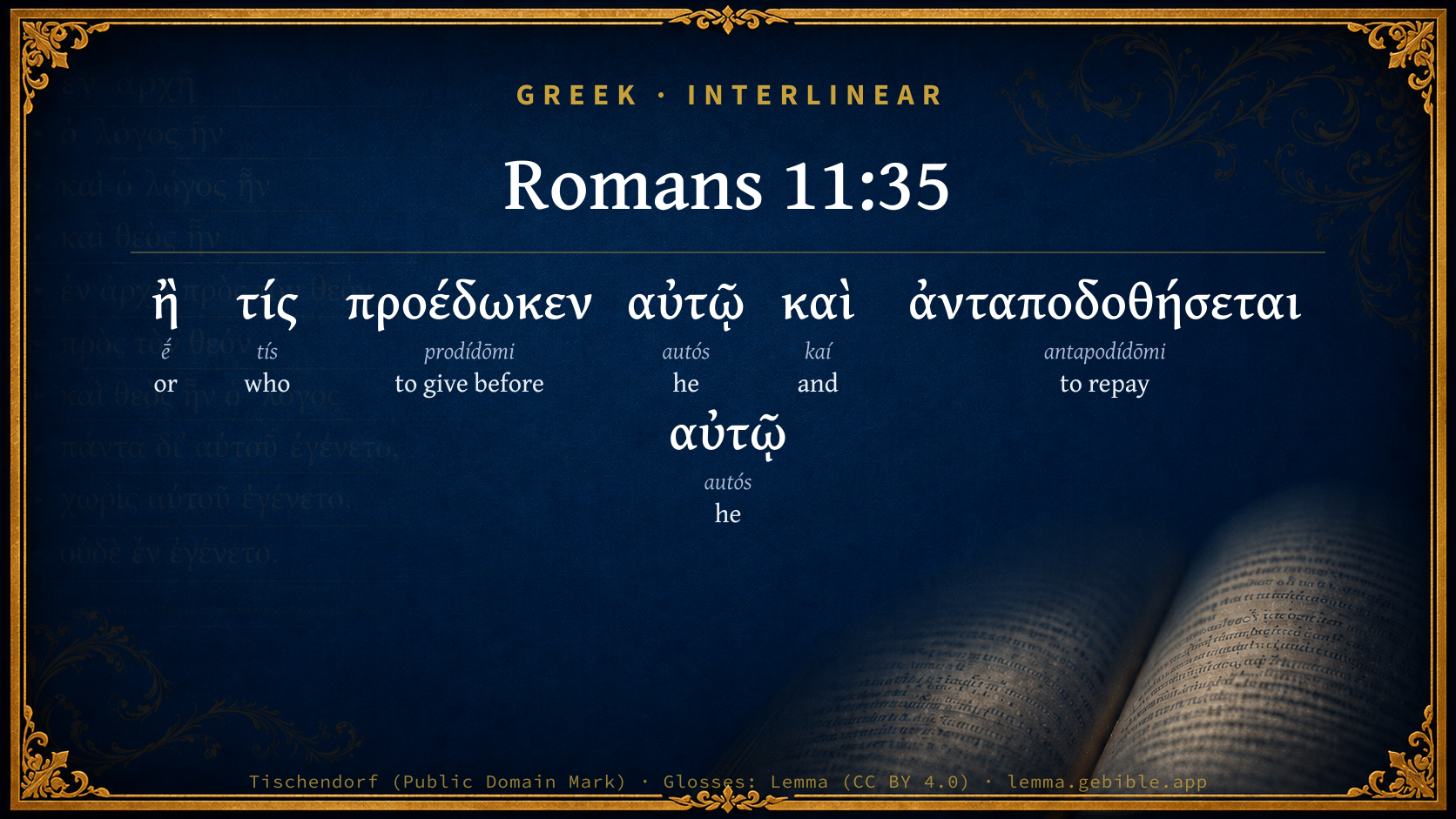
Download image
Cite this verse

Romans 11:35 (World English Bible). Public Domain. Lemma interlinear Bible study tool, https://lemma.gebible.app/v/romans/11/35.

Show BibTeX & RIS
BibTeX
RIS
English Translation
"Or who has first given to him, And it will be repaid to him again?"
World English Bible · Public Domain
Highlights
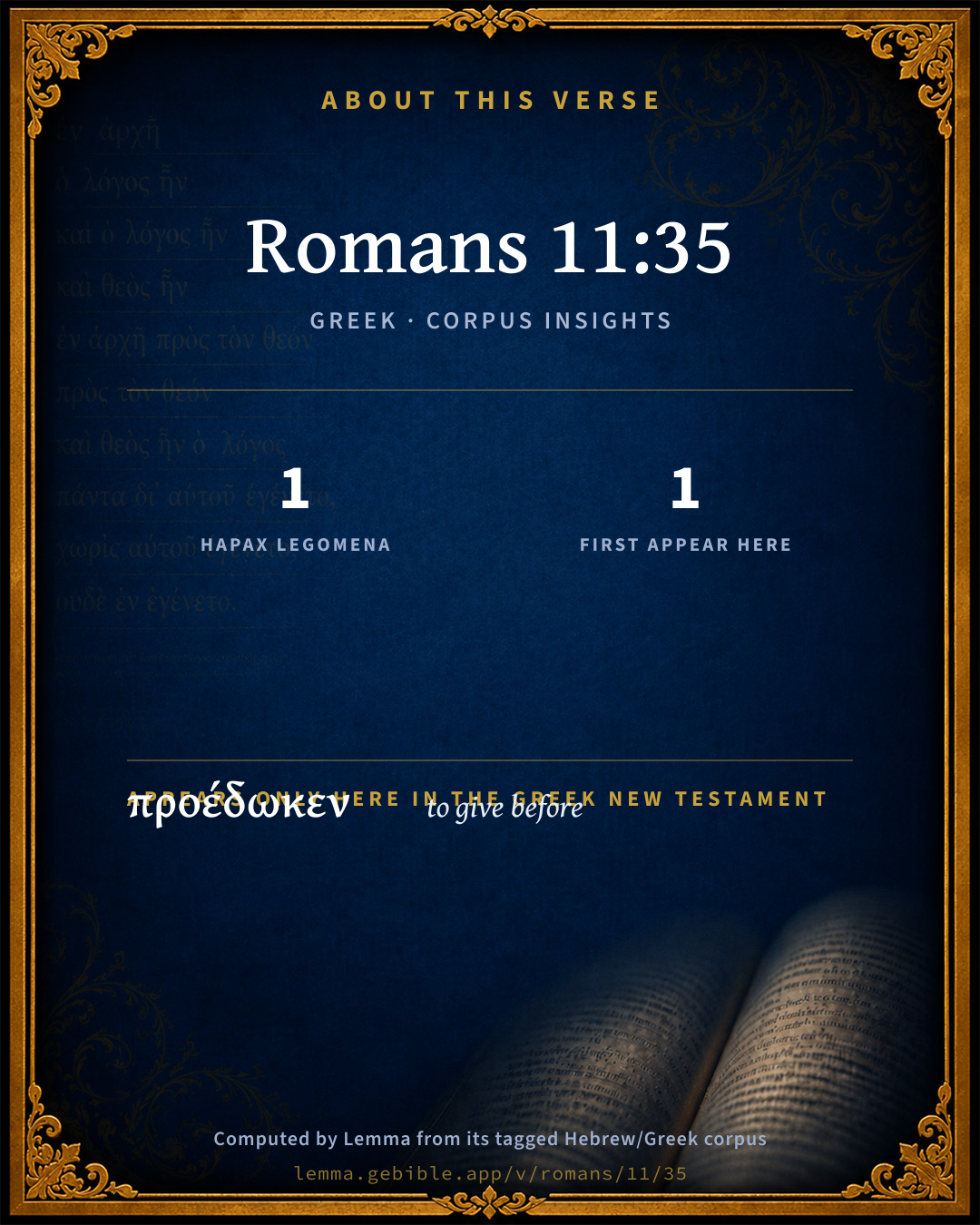
  • 1 hapax legomenon — only here in the Greek New Testament
  • 1 first appearance in the Greek New Testament
Full analysis ↓
Download a study sheet

One document with this verse’s original text, its word-by-word gloss line, the meaning frame, cross-references with their text, attributed commentary, and full source and license credits — printable, and it pastes into notes with its structure intact.

This verse Autodidact and up

Study sheet (.html) Plain text (.txt)

A passage Seminary Student

Up to 50 verses in one chapter. A passage sheet keeps up to 6 commentary sources and 12 cross-references per verse, in the order this page ranks them, and says so on the sheet whenever that leaves anything out. Ask for a single verse and you get the Autodidact verse sheet above.

Everything on this page stays free to read, with no account — the sheet is a download of what is already on screen, not access to it.

Want to remove ads? Support Godless Engineer
Compare translations 3

The same verse in 3 English versions, stacked beneath the original-language interlinear above. Click any original word for its lexicon entry.

Each is an independent rendering of the whole verse — the interlinear is not word-aligned to these translations.

Highlighted words mark where these versions differ — a whole-verse word diff, not a word-by-word alignment.

  • World English Bible Public Domain
    "Or who has first given to him, And it will be repaid to him again?"
  • King James Version Public Domain
    Or who hath first given to him, and it shall be recompensed unto him again?
  • unfoldingWord Literal Text CC BY-SA 4.0
    Or, “Who gave to him, that he should be repaid by him?” p

unfoldingWord Literal Text — © unfoldingWord, licensed CC BY-SA 4.0. Word-aligned USFM3 via Door43 (git.door43.org/unfoldingWord/en_ult).

Versions to compare (up to 4)

3 of 4 selected

Show all 19 translations

Every available English version of this verse, each an independent rendering of the whole verse.

  • World English Bible Public Domain
    "Or who has first given to him, And it will be repaid to him again?"
  • Berean Standard Bible Public Domain
    “Who has first given to God, that God should repay him?”
  • Majority Standard Bible Public Domain
    “Who has first given to God, that God should repay him?”
  • King James Version Public Domain
    Or who hath first given to him, and it shall be recompensed unto him again?
  • American Standard Version (1901) Public Domain
    or who hath first given to him, and it shall be recompensed unto him again?
  • Revised Version (1885) Public Domain
    or who hath first given to him, and it shall be recompensed unto him again?
  • Geneva Bible (1599) Public Domain
    Or who hath giuen vnto him first, and he shalbe recompensed?
  • Douay-Rheims (1899) Public Domain
    Or who hath first given to him, and recompense shall be made him?
  • Young's Literal Translation Public Domain
    or who did first give to Him, and it shall be given back to him again?
  • Literal Standard Version CC BY-SA 4.0
    Or who first gave to Him, and it will be given back to him again?
  • Unlocked Literal Bible CC BY-SA 4.0
    Or who has first given anything to God, that God must repay him?”
  • unfoldingWord Literal Text CC BY-SA 4.0
    Or, “Who gave to him, that he should be repaid by him?” p
  • Darby Bible Public Domain
    or who has first given to him, and it shall be rendered to him?
  • World Messianic Bible Public Domain
    “Or who has first given to him, and it will be repaid to him again?”
  • Webster's Bible Public Domain
    Or who hath first given to him, and it shall be recompensed to him again?
  • Free Bible Version CC BY-SA 4.0
    Who has ever given anything to God that God would be obliged to repay?
  • Bible in Basic English Public Domain
    Or who has first given to him, and it will be given back to him again?
  • Text-Critical English NT CC BY 4.0
    “Or who has first given to God, that he should be repaid?”
  • Tyndale New Testament (1534) Public Domain
    other who hath geven vnto him fyrst that he myght be recompensed agayne?

Literal Standard Version (2020), Covenant Press — licensed CC BY-SA 4.0. Text via the HelloAO Bible API (eBible.org). Unlocked Literal Bible (unfoldingWord) — licensed CC BY-SA 4.0. Text via the HelloAO Bible API (eBible.org). unfoldingWord Literal Text — © unfoldingWord, licensed CC BY-SA 4.0. Word-aligned USFM3 via Door43 (git.door43.org/unfoldingWord/en_ult). Free Bible Version, Dr. Jonathan Gallagher — licensed CC BY-SA 4.0. Text via the HelloAO Bible API (eBible.org).

Word by word

More ways to search: Search by grammar → Find every occurrence → Compare this word →

Practice this passage: Drill this verse → Learn its vocabulary →

About this verse

These counts appear in no published source. They are computed here, from the morphology-tagged text and Lemma’s own curated glosses. What Lemma adds →

7
words
6
distinct lemmas
Pauline Epistles
section

Notable vocabulary

1 hapax legomenon — a word that appears only here in the entire Greek New Testament:

  • προέδωκεν to give before G4272

First appearance in Scripture

This word makes its first canonical appearance in the Greek New Testament here:

  • προέδωκεν to give before G4272

Shared distinctive vocabulary

ἀνταποδοθήσεται to repay G467 occurs in 6 verses of the Greek New Testament. Also found in:

Repetition

A word recurs within this verse:

  • αὐτῷ he G846 ×2

Cross-references

3

Topical passages linked to Romans 11:35 in the Treasury of Scripture Knowledge — connected by theme and wording, ordered by reader-vote popularity; previews shown in the World English Bible.

  • Job 41:11 Who has first given to me, that I should repay him? Everything under the heavens is mine.
  • Job 35:7 If you are righteous, what do you give him? Or what does he receive from your hand?
  • 1 Corinthians 4:7 For who makes you different? And what do you have that you didn't receive? But if you did receive it, why do you boast as if you had not received it?

Cross-references courtesy of OpenBible.info (CC BY 4.0).

Commentary

Notes on Romans 11:35 from classic Christian and Jewish commentators (each source and its license shown beneath its notes). The classic Christian expositions comment on the surrounding passage and are grouped to its opening verse, so a note may address several verses; the Jewish commentaries on the Tanakh (Rashi and others) are per-verse, so they appear only where the commentator wrote on this verse.

Lemma curates 59 commentaries, every one of them public domain or Creative Commons licensed, each selected and text-cleaned for this edition rather than reprinted as found. About our sources →

Bengel's Gnomon

Johann Albrecht Bengel

Rom 11:35. Ἢ τίς, κ.τ.λ) Some adopt these words in the LXX., Isa 40:14: others do not; but Job 41:2, Hebr. and Vulg. have it thus: Who hath previously given to Me, that I may render to Him again? All things which are under heaven are Mine.

Bengel's Gnomon of the New Testament — English translation (T&T Clark, Edinburgh, 1860) — public domain. Text from a community e-Sword module.

Meyer's Critical & Exegetical Commentary

Heinrich August Wilhelm Meyer

Rom_11:35. Description of the βάθος πλούτου by words which are moulded after Job_41:3, according to the Hebrew, not according to the LXX. (Job_41:11), whose translation is quite erroneous.

ΚΑῚ ἈΝΤΑΠΟΔ. ΑὐΤῷ] and will it be recompensed again to Him? With whom does the case occur, that he has previously made a gift to God, and that a recompense will be made to him in return for it? Change of construction by καὶ … αὐτῷ, here occasioned by the Heb. וַאֲשַׁלֵּם. But for the Greek usage, comp. Bernhardy, p. 304; Kühner, II. 2, p. 936.

Meyer — Critical and Exegetical Commentary on the New Testament — English translation by Peter Christie, edited by Frederick Crombie (T&T Clark, 1880) — public domain. Text from a community e-Sword module.

Expositor's Greek Testament

ed. W. Robertson Nicoll

Rom 11:35 . ἢ τίς προέδωκεν αὐτῷ , καὶ ἀνταποδοθήσεται αὐτῷ ; see Job 41:11 (A.V.). The translation of Job 41:3 , Hebrew, is perhaps Paul’s own, as the LXX is entirely different and wrong. The point of the quotation has been variously explained. If it continues the proof of Rom 11:33 , the underlying assumption is that God’s ways would be finite and comprehensible if they were determined by what men had done, so as merely to requite that. It seems better, however, to read the words in the largest sense, and then they express the fundamental truth of religion as Paul understood it viz. , that the initiative in religion belongs to God; or as he puts it elsewhere, that we have nothing we did not receive, and that boasting is excluded. The relation of man to God in these conditions is one which naturally expresses itself in doxology.

The Expositor's Greek Testament, edited by W. Robertson Nicoll (1897–1910) — public domain. Text from a community e-Sword module.

Hodge's Commentary on Romans, Ephesians & First Corinthians

Charles Hodge

Rom_11:35

Or who hath first given to him, and it shall be recompensed to him again? This is not to be confined to giving counsel or knowledge to God, but expresses the general idea that the creature can do nothing to place God under obligation. It will be at once perceived how appropriate is this thought, in reference to the doctrines which Paul had been teaching. Men are justified, not on the ground of their own merit, but of the merit of Christ; they are sanctified, not by the power of their own good purposes, and the strength of their own will, but by the Spirit of God; they are chosen and called to eternal life, not on the ground of anything in them, but according to the purpose of him who worketh all things after the counsel of his own will. God, therefore, is the Alpha and the Omega of salvation. The creature has neither merit nor power. His hopes must rest on sovereign mercy alone. There is a correspondence between the several clauses in these verses. Who hath given to God, refers to the plenitude and sovereignty of his grace (βάθος πλούτου); Who hath known the mind of the Lord? to his unsearchable knowledge; and who hath been his counselor? to his infinite wisdom. This was relearned long ago. Thus Theodoret says: τὰ τρία ταῦτα πρὸς τὰ τρία τέθεικε, τὸν πλοῦτον καὶ τὴν σοφίαν καὶ τὴν γνῶσιν? τὸ μὲν τίς ἔγνω νοῦν κυρίου πρὸς τὴν γνῶσιν, τὸ δὲ τις σύμβουλος αὐτοῦ ἐγένετο πρὸς τὴν σοφίαν, τὸ δὲ τίς προέδωκεν αὐτῷ καὶ ἀνταποδοθήσεται πρὸς τὸν πλοῦτον.

Charles Hodge — Commentary on Romans (1835), First Corinthians (1857), and Ephesians (1856) — public domain. Text from a community e-Sword module.

Geneva Bible (1599)

Geneva Bible translators

This saying overthroweth the doctrine of foreseen works and merits.

Geneva Bible (1599) marginal notes — public domain. Text via Bolls.life.

Jamieson, Fausset & Brown

Robert Jamieson, A. R. Fausset & David Brown

Or who hath first given to him, and it shall be recompensed to him--"and shall have recompense made to him"

again--see Job 35:7; Job 41:11. These questions, it will thus be seen, are just quotations from the Old Testament, as if to show how familiar to God's ancient people was the great truth which the apostle himself had just uttered, that God's plans and methods in the dispensation of His Grace have a reach of comprehension and wisdom stamped upon them which finite mortals cannot fathom, much less could ever have imagined, before they were disclosed.

Jamieson, Fausset & Brown — Commentary Critical and Explanatory on the Whole Bible (1871) — public domain (CC PDM 1.0). Text via the HelloAO Bible API.

Adam Clarke's Commentary

Verse 35. Or, who hath first given to him] Who can pretend to have any demands upon God? To whom is he indebted? Have either Jews or Gentiles any right to his blessings? May not he bestow his favours as he pleases, and to whom he pleases? Does he do any injustice to the Jews in choosing the Gentiles! And was it because he was under obligation to the Gentiles that he has chosen them in the place of the Jews? Let him who has any claim on God prefer it; and he shall be compensated.

But how can the CREATOR be indebted to the creature? How can the CAUSE be dependent on the effect? How can the AUTHOR of providence, and the FATHER of every good and perfect gift, be under obligation to them for whom he provides, and who are wholly dependent on his bounty?

Adam Clarke's Commentary on the Bible (1810–1826) — public domain. Text from a community e-Sword/MySword module.

John Calvin's Commentaries

35. Who has first given to him, etc. Another reason, by which God’s righteousness is most effectually defended against all the accusations of the ungodly: for if no one retains him bound to himself by his own merits, no one can justly expostulate with him for not having received his reward; as he, who would constrain another to do him good, must necessarily adduce those deeds by which he has deserved a reward. The import then of Paul’s words is this — “God cannot be charged with unrighteousness, except it can be proved, that he renders not to every one his due: but it is evident, that no one is deprived by him of his right, since he is under obligation to none; for who can boast of any thing of his own, by which he has deserved his favor?”

Now this is a remarkable passage; for we are here taught, that it is not in our power to constrain God by our good works to bestow salvation on us, but that he anticipates the undeserving by his gratuitous goodness. But if we desire to make an honest examination, we shall not only find, that God is in no way a debtor to us, but that we are all subject to his judgment, — that we not only deserve no layout, but that we are worthy of eternal death. And Paul not only concludes, that God owes us nothing, on account of our corrupt and sinful nature; but he denies, that if man were perfect, he could bring anything before God, by which he could gain his favor; for as soon as he begins to exist, he is already by the right of creation so much indebted to his Maker, that he has nothing of his own. In vain then shall we try to take from him his own right, that he should not, as he pleases, freely determine respecting his own creatures, as though there was mutual debt and credit.

John Calvin's Commentaries (1540-1563) — public domain. Text from the Calvin Translation Society English edition (1840s-50s) via the Christian Classics Ethereal Library (ccel.org). Calvin's coverage is partial (roughly two-thirds of the Bible); uncommented books and verses are honest gaps, never fabricated. The 19th-century editor's footnotes and remarks are omitted so the notes are faithfully Calvin's own voice.

Ellicott's Commentary for English Readers

(35) The depth of God’s knowledge none can penetrate, and the counsels of His wisdom admit of no assessor. The means by which God works are not supplied to Him from without, but proceed from the boundless stores of His omnipotence.

A Bible Commentary for English Readers, edited by Charles John Ellicott (1878–1897) — public domain. Text from a community e-Sword module.

The Cambridge Bible for Schools and Colleges

gen. ed. J. J. S. Perowne

35. hath first given to him, &c.] “Who hath laid Him under obligation?” (Cp. Job_35:7.) Such is no doubt the special reference here. It affects not only the discussions of cch. 9–11, but also (as does indeed the whole of this doxology) the whole great doctrinal Argument of the Epistle. No merit in man, in the matter of acceptance with God, is one of its deep foundation-truths.

The Cambridge Bible for Schools and Colleges (gen. ed. J. J. S. Perowne; Cambridge University Press, 1878–1918) — public domain. Text from a community e-Sword module.

John Gill's Exposition

Or who hath first given to him,.... See Job 41:11; no man can give God anything, which he has not first given him, or which he has not a prior right to, or a claim upon him for; Adam, in innocence, was not able to give God anything, nor are the angels in heaven, much less sinful men on earth; their bodies and souls, and all their enjoyments, all that is good in them, or done by them, are from the Lord; men by all their good works, best duties and services, give nothing to God, nor lay him under any manner of obligation to them: hence no man can merit anything at the hands of God, if he could,

it shall be recompensed to him again; but it is impossible there should be merit in a creature, who has nothing but what he has from God, and does nothing but what he is obliged to do; and that not by his own strength, but by the grace and strength of God; and therefore there is no retribution made by God as of debt, but of grace: hence it follows, that God is indebted to, and obliged by none, and may do what he will with his own; love Jacob and hate Esau; choose one and not another; reject the Jews, and call the Gentiles; save and justify some, and not others; none can call him to account, or say unto him, what dost thou?

John Gill's Exposition of the Whole Bible (1746–1763) — public domain (CC PDM 1.0). Text via the HelloAO Bible API.

Trapp's Complete Commentary

John Trapp

35 Or who hath first given to him, and it shall be recompensed unto him again?

Ver. 35. Who hath first given to himJ Do we not owe him all that we have and are? And can a man merit by paying his debts?

John Trapp, A Commentary or Exposition upon All the Books of the Old and New Testament (1647–1656) — public domain. Text from a community e-Sword module.

Albert Barnes' Notes on the Bible

Or who hath ... - The sentiment in this verse is found substantially in Job 41:11. “Who hath prevented me, that I should repay him.” The Hebrew word “prevented” means to anticipate, to go before; and God asks who has anticipated me; who has conferred favors on me before I have on him; who has thus laid me under obligation to him.” This is the sense in which the apostle uses the word here. Who has, by his services, laid God under obligation to recompense or pay him again? It is added in Job, “Whatsoever is under the whole heaven is mine.” Thus Paul, contrary to the prevailing doctrine of the Jews, shows that no one could plead his own merits, or advance with a claim on God. All the favors of salvation must be bestowed by mercy or grace. God owned them all; and he had a right to bestow them when and where he pleased. The same claim to all things is repeatedly made by God; Exo 19:5; Deu 10:14; Psa 24:1; Psa 50:12.

Shall be recompensed - Repaid as a matter of debt. None of God’s mercies can be conferred in that way; if they could, man could bring God under obligation, and destroy the freeness and benevolence of his favors.

Albert Barnes' Notes on the Bible (1834–1885) — public domain. Text from a community e-Sword/MySword module.

Matthew Poole's English Annotations

q.d. If any man hath obliged God, by any thing he hath done for him, he shall have an ample reward: alluding (as some think) to Job 41:11. But seeing this cannot be, and that God is indebted unto none, therefore the salvation of all is of mere grace and mercy; and there is no cause of complaining, if he deal more bountifully with some than with others.

Matthew Poole's English Annotations on the Holy Bible (1683–1685) — public domain. Text from a community e-Sword/MySword module.

Whedon's Commentary on the Bible

Daniel D. Whedon

35. Given… recompensed. This verse, in fact, forms the key-note to the apostle’s whole doctrine of the irreconcilability of grace and works. Our works cannot recompense God; hence they cannot purchase salvation; hence salvation must be by grace, that is, gratuity. Yet when it is said “we cannot deserve anything from God,” we must be careful not to deny that finite created beings are entitled to just dealing from their Creator. (See note on Rom_11:32.)

Daniel D. Whedon (gen. ed.), Commentary on the Old and New Testaments (1874–1909) — public domain. Text from a community e-Sword module.

John Wesley's Explanatory Notes

Given to him - Either wisdom or power?

John Wesley, Explanatory Notes Upon the Whole Bible (1754–1765) — public domain. Text via the GEBible commentary corpus.

McGarvey & Pendleton's Commentaries

J. W. McGarvey

or who hath first given to him, and it shall be recompensed unto him again? [ Job_41:11 . This question emphasizes the riches of God, introduced at verse 33. The riches mentioned are those of mercy and grace. If we can not exchange gifts with God along the most material lines, as here indicated, how shall we purchase his mercy, buy up his love, or merit his salvation? The moralist, whether Jew or Gentile, can place God under no obligation whatever, for naught can be given to him who justly claims all things ( Exo_19:5 ; Deu_10:14 ; Psa_24:1 ; Psa_50:12 ). "Do we not," says Trapp, "owe him all that we have and are, and can a man merit by paying his debts?" ( Luk_17:10 ). God gives all and to all, and he receives from none. Behold his grace! He freely publishes his unknowable knowledge, that the simplest may profit by his omniscience; he fully reveals his unsearchable wisdom, that the feeblest may co-operate with his omnipotence; and he lovingly gives his unmeritable gifts, that the poorest may enjoy his riches forever! Oh that men might know their riches in him, their folly, their weakness, their poverty without him!-- Rev_3:17-18 ]

J. W. McGarvey (with Philip Y. Pendleton), Commentaries on the New Testament (The Fourfold Gospel, 1914; Acts; and the epistles) — public domain. Text from a community e-Sword/MySword module.

unfoldingWord translationNotes

Door43 World Missions Community

Or who has first given anything to God, that God must repay him?"

Paul uses this question to emphasize his point. AT: "No one has ever given anything to God that he did not first receive from God" (See: Rhetorical Question) *For from him ... through him ... to him - Here, all occurrences of "him" refers to God.

To him be the glory forever

This expresses Paul's desire for all people to honor God. You can make this explicit in your translation. AT: "May all people honor him forever" (See: Assumed Knowledge and Implicit Information)

translationWords

God

glory

eternity

amen

unfoldingWord translationNotes — © Distant Shores Media and the Door43 World Missions Community, licensed CC BY-SA 4.0. Source: git.door43.org/Door43/en_tn.

Cambridge Greek Testament for Schools and Colleges

35. Job 41:11 (Heb.).

Cambridge Greek Testament for Schools and Colleges (Cambridge University Press, 1896; 21 vols, various authors incl. Carr, Maclear, Plummer, Farrar, Lumby, Moule, M. R. James, Simcox) — public domain. Text from a community e-Sword module.

Alford’s Greek Testament

Henry Alford

35.] or who hath previously given to Him, and it shall be repaid to him?—from Job 41:3 (11 E. V.), where the LXX (41:2) have τίς (add ἐστιν ὃς Α) ἀντιστήσεταί μοι, κ. ὑπομενεῖ; But the Heb. is מִי הִקְדִּימַנִי וַאֲשַׁלִּם, ‘who hath anticipated (i.e. by the context, conferred a benefit on) me, that I may repay him?’ And to this the Apostle alludes, using the third person.

We can hardly doubt that this question refers to the freeness and richness of God’s mercy and love.

Henry Alford, The Greek Testament (1849–1861) — public domain. Text from a community e-Sword module.

International Critical Commentary

35. ἤ τίς προέδωκεν αὐτῷ, καὶ ἀνταποδοθήσεται αὐτῷ; taken from Job 41:11, but not the LXX, which reads (ver. 2) τίς ἀντιστήσεταί μοι καὶ ὑπομενεῖ; The Hebrew (RV.) reads, ‘Who hath first given unto me that I should repay him?’ It is interesting to notice that the only other quotation in St. Paul which varies very considerably from the LXX is also taken from the book of Job (1Co 3:19, cf. Job 5:13), see p. 302. This verse corresponds to ὦ βάθος πλούτου. ‘So rich are the spiritual gifts of God, that none can make any return, and He needs no recompense for what He gives.’

International Critical Commentary — older volumes (1896–1929), various authors — public domain. Text from a community e-Sword module.

Vincent's Word Studies in the New Testament

Marvin R. Vincent

Who hath first given, etc. From Job 41:3. Heb., Who has been beforehand with me that I should repay him? Paul here follows the Aramaic translation. The Septuagint is : Who shall resist me and abide ?

Marvin R. Vincent, Word Studies in the New Testament (1887–1900) — public domain. Text from a community e-Sword/MySword module.

Lesson kit

Teaching starters — assembled from the data on this page, not authored interpretation. Every prompt links to the verse data it draws on. Edit before teaching.

Romans, in the Pauline Epistles, opens this verse with 7 words (6 distinct Greek lemmas). Its most distinctive word is prodídōmi (“to give before”). A historical commentator’s framing appears above. Read the whole chapter for the surrounding context.

Discussion questions

  1. The word prodídōmi carries the sense “to give before.” How does it shape the verse?
  2. This verse holds 1 word here found nowhere else in the Greek New Testament. What might the rare word draw attention to?
  3. The word “to give before” first appears here in Scripture. What is being introduced at this debut?
  4. Luke 14:14 shares the word «to repay» with this verse. How do the two illuminate each other?
  5. “he” occurs 2× in this one verse. What is the effect of the repetition?
  6. These translations render this verse differently. What is at stake in choosing one wording over another?
  7. Reading how Bengel's Gnomon and Meyer's Critical & Exegetical Commentary read this verse, where do the two commentators agree and where do they part?

Things to notice

  • 1 word in this verse appears nowhere else in the Greek New Testament.
  • 1 word makes its first canonical appearance in Scripture here.
  • These translations choose different wording for 11 words in this verse.
  • “he” occurs 2× in this single verse.
  • 6 distinct Greek lemmas span 7 words in this verse.

Reading settings

Reading text

Shown beneath each verse's original-language words.

Old Testament
Old Testament edition

Read the OT as the Masoretic Hebrew (MT) or the Greek Septuagint (LXX).

English shown for the Greek Septuagint (in the Hebrew ↔ Greek comparison).

Comparing translations? Open the Compare panel on any verse page to stack up to four side by side.