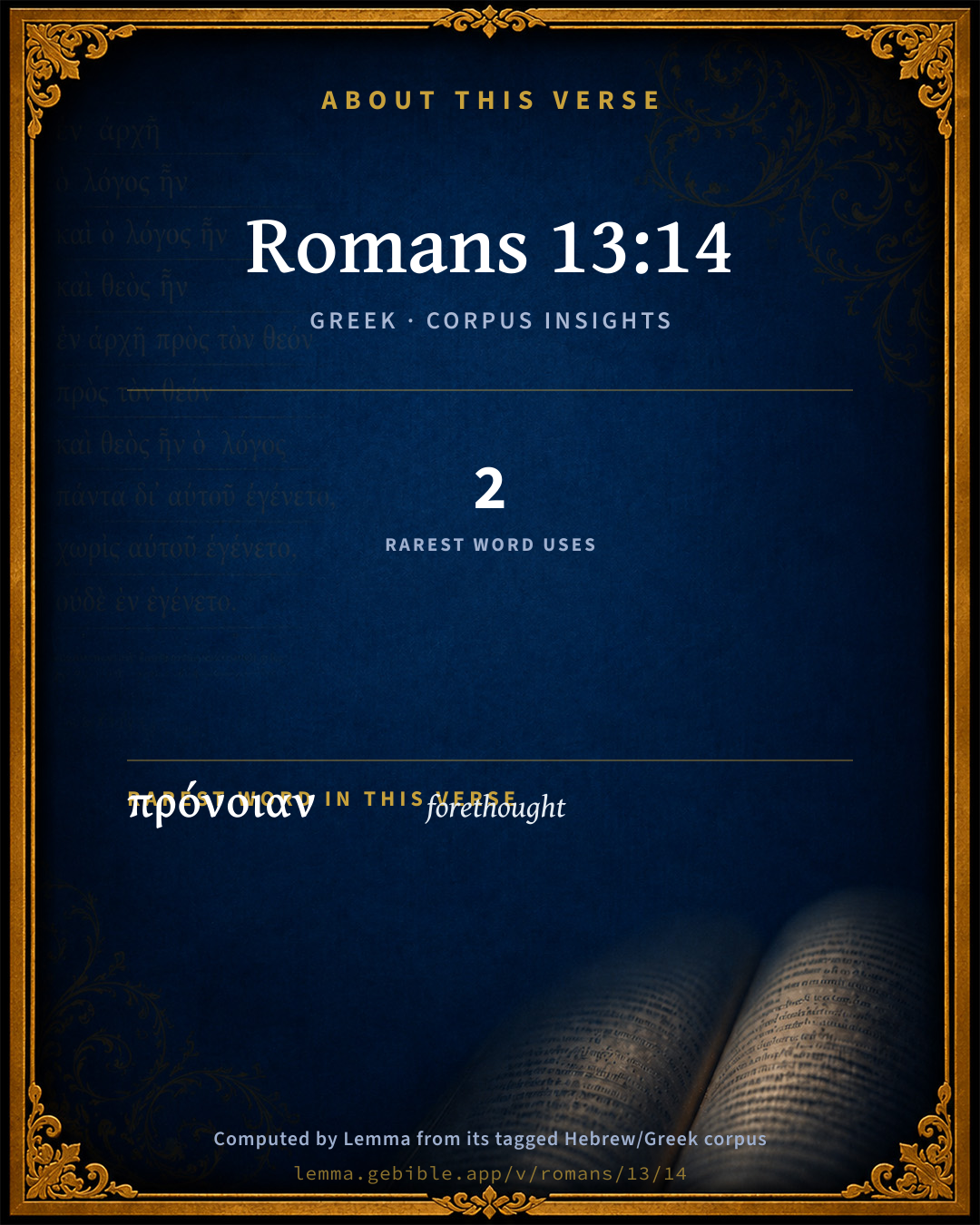
Romans 13:14

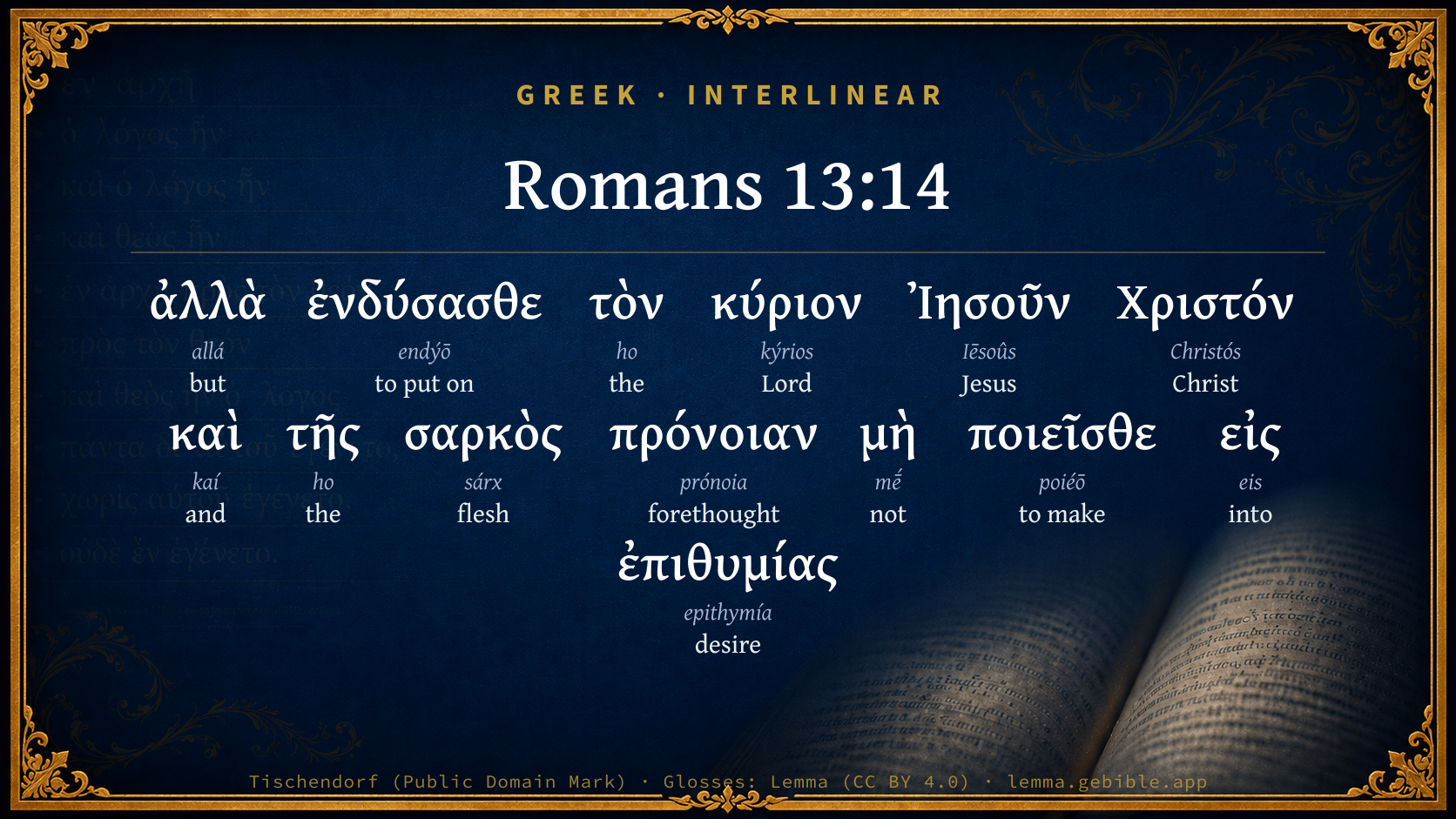
Greek (Tischendorf 8th ed.) Romans 13:14 appears in the Greek New Testament. The text above is from the Tischendorf 8th edition. Each word links to its Strong’s number and a concise gloss. Click any word for its full Thayer’s Greek Lexicon entry.
Download image
Cite this verse

Romans 13:14 (World English Bible). Public Domain. Lemma interlinear Bible study tool, https://lemma.gebible.app/v/romans/13/14.

Show BibTeX & RIS
BibTeX
RIS
English Translation
But put on the Lord Jesus Christ, and make no provision for the flesh, for its lusts.
World English Bible · Public Domain
Download a study sheet

One document with this verse’s original text, its word-by-word gloss line, the meaning frame, cross-references with their text, attributed commentary, and full source and license credits — printable, and it pastes into notes with its structure intact.

This verse Autodidact and up

Study sheet (.html) Plain text (.txt)

A passage Seminary Student

Up to 50 verses in one chapter. A passage sheet keeps up to 6 commentary sources and 12 cross-references per verse, in the order this page ranks them, and says so on the sheet whenever that leaves anything out. Ask for a single verse and you get the Autodidact verse sheet above.

Everything on this page stays free to read, with no account — the sheet is a download of what is already on screen, not access to it.

Want to remove ads? Support Godless Engineer
Compare translations 3

The same verse in 3 English versions, stacked beneath the original-language interlinear above. Click any original word for its lexicon entry.

Each is an independent rendering of the whole verse — the interlinear is not word-aligned to these translations.

Highlighted words mark where these versions differ — a whole-verse word diff, not a word-by-word alignment.

  • World English Bible Public Domain
    But put on the Lord Jesus Christ, and make no provision for the flesh, for its lusts.
  • King James Version Public Domain
    But put ye on the Lord Jesus Christ, and make not provision for the flesh, to fulfil the lusts thereof.
  • unfoldingWord Literal Text CC BY-SA 4.0
    But put on the Lord Jesus Christ and make no forethought with regard to desires of the flesh.

unfoldingWord Literal Text — © unfoldingWord, licensed CC BY-SA 4.0. Word-aligned USFM3 via Door43 (git.door43.org/unfoldingWord/en_ult).

Versions to compare (up to 4)

3 of 4 selected

Show all 19 translations

Every available English version of this verse, each an independent rendering of the whole verse.

  • World English Bible Public Domain
    But put on the Lord Jesus Christ, and make no provision for the flesh, for its lusts.
  • Berean Standard Bible Public Domain
    Instead, clothe yourselves with the Lord Jesus Christ, and make no provision for the desires of the flesh.
  • Majority Standard Bible Public Domain
    Instead, clothe yourselves with the Lord Jesus Christ, and make no provision for the desires of the flesh.
  • King James Version Public Domain
    But put ye on the Lord Jesus Christ, and make not provision for the flesh, to fulfil the lusts thereof.
  • American Standard Version (1901) Public Domain
    But put ye on the Lord Jesus Christ, and make not provision for the flesh, to `fulfil' the lusts `thereof'.
  • Revised Version (1885) Public Domain
    But put ye on the Lord Jesus Christ, and make not provision for the flesh, to fulfill the lusts thereof.
  • Geneva Bible (1599) Public Domain
    But put yee on the Lord JESUS CHRIST, and take no thought for the flesh, to fulfill the lustes of it.
  • Douay-Rheims (1899) Public Domain
    But put ye on the Lord Jesus Christ, and make not provision for the flesh in its concupiscences.
  • Young's Literal Translation Public Domain
    but put ye on the Lord Jesus Christ, and for the flesh take no forethought -- for desires.
  • Literal Standard Version CC BY-SA 4.0
    but put on the Lord Jesus Christ, and take no forethought for the flesh—for desires.
  • Unlocked Literal Bible CC BY-SA 4.0
    But put on the Lord Jesus Christ, and make no provision for the flesh, to gratify its lusts.
  • unfoldingWord Literal Text CC BY-SA 4.0
    But put on the Lord Jesus Christ and make no forethought with regard to desires of the flesh.
  • Darby Bible Public Domain
    But put on the Lord Jesus Christ, and do not take forethought for the flesh to [fulfil its] lusts.
  • World Messianic Bible Public Domain
    But put on the Lord Yeshua the Messiah, and make no provision for the flesh, for its lusts.
  • Webster's Bible Public Domain
    But put ye on the Lord Jesus Christ, and make not provision for the lusts of flesh.
  • Free Bible Version CC BY-SA 4.0
    Instead put on the Lord Jesus Christ, and forget about following your sinful desires.
  • Bible in Basic English Public Domain
    But put on the Lord Jesus Christ, and do not give thought to the flesh to do its desires.
  • Text-Critical English NT CC BY 4.0
    But put on the Lord Jesus Christ, and make no provision for the flesh, to gratify its desires.
  • Tyndale New Testament (1534) Public Domain
    but put the on the Lorde Iesus Christ. And make not provision for the flesshe to fulfyll the lustes of it.

Literal Standard Version (2020), Covenant Press — licensed CC BY-SA 4.0. Text via the HelloAO Bible API (eBible.org). Unlocked Literal Bible (unfoldingWord) — licensed CC BY-SA 4.0. Text via the HelloAO Bible API (eBible.org). unfoldingWord Literal Text — © unfoldingWord, licensed CC BY-SA 4.0. Word-aligned USFM3 via Door43 (git.door43.org/unfoldingWord/en_ult). Free Bible Version, Dr. Jonathan Gallagher — licensed CC BY-SA 4.0. Text via the HelloAO Bible API (eBible.org).

Word by word

More ways to search: Search by grammar → Find every occurrence → Compare this word →

Practice this passage: Drill this verse → Learn its vocabulary →

πρόνοιαν
prónoia
G4307
“forethought”
Noun, Accusative, Singular, Feminine
Part of Speech
Noun
Case
Accusative
Number
Singular
Gender
Feminine
Full Thayer's Definition

Origin: from G4306

TDNT: 20:51,6

1. forethought, providential care 2. to make provision for a thing
  1. ἀλλὰ allá G235 “but” Conjunction
  2. ἐνδύσασθε endýō G1746 “to put on” Verb, Aorist, Middle, Imperative, 2nd person, Plural
  3. τὸν ho G3588 “the” Article, Accusative, Singular, Masculine
  4. κύριον kýrios G2962 “Lord” Noun, Accusative, Singular, Masculine
  5. Ἰησοῦν Iēsoûs G2424 “Jesus” Noun, Accusative, Singular, Masculine
  6. Χριστόν Christós G5547 “Christ” Noun, Accusative, Singular, Masculine
  7. καὶ kaí G2532 “and” Conjunction
  8. τῆς ho G3588 “the” Article, Genitive, Singular, Feminine
  9. σαρκὸς sárx G4561 “flesh” Noun, Genitive, Singular, Feminine
  10. μὴ mḗ G3361 “not” Particle, Negative
  11. ποιεῖσθε poiéō G4160 “to make” Verb, Present, Middle, Imperative, 2nd person, Plural
  12. εἰς eis G1519 “into” Preposition
  13. ἐπιθυμίας epithymía G1939 “desire” Noun, Accusative, Plural, Feminine

About this verse

These counts appear in no published source. They are computed here, from the morphology-tagged text and Lemma’s own curated glosses. What Lemma adds →

14
words
13
distinct lemmas
Pauline Epistles
section

Notable vocabulary

The rarest word here is πρόνοιαν forethought G4307 — appearing just 2 times in the whole Greek New Testament.

Shared distinctive vocabulary

πρόνοιαν forethought G4307 occurs in 2 verses of the Greek New Testament. Also found in:

Repetition

A word recurs within this verse:

Cross-references

10

Topical passages linked to Romans 13:14 in the Treasury of Scripture Knowledge — connected by theme and wording, ordered by reader-vote popularity; previews shown in the World English Bible.

  • Ephesians 4:24 and put on the new man, who in the likeness of God has been created in righteousness and holiness of truth.
  • Galatians 5:16–17 But I say, walk by the Spirit, and you won't fulfill the lust of the flesh.
  • Galatians 3:27 For as many of you as were baptized into Christ have put on Christ.
  • Galatians 5:24 Those who belong to Christ have crucified the flesh with its passions and lusts.
  • 1 Peter 2:11 Beloved, I beg you as foreigners and pilgrims, to abstain from fleshly lusts, which war against the soul;
  • Colossians 3:10–12 and have put on the new man, that is being renewed in knowledge after the image of his Creator,
  • Romans 8:12–13 So then, brothers, we are debtors, not to the flesh, to live after the flesh.
  • 1 John 2:15–17 Don't love the world, neither the things that are in the world. If anyone loves the world, the Father's love isn't in him.
  • Colossians 3:5–8 Put to death therefore your members which are on the earth: sexual immorality, uncleanness, depraved passion, evil desire, and covetousness, which is idolatry;
  • Job 29:14 I put on righteousness, and it clothed me. My justice was as a robe and a diadem.

Cross-references courtesy of OpenBible.info (CC BY 4.0).

Commentary

Notes on Romans 13:14 from classic Christian and Jewish commentators (each source and its license shown beneath its notes). The classic Christian expositions comment on the surrounding passage and are grouped to its opening verse, so a note may address several verses; the Jewish commentaries on the Tanakh (Rashi and others) are per-verse, so they appear only where the commentator wrote on this verse.

Lemma curates 59 commentaries, every one of them public domain or Creative Commons licensed, each selected and text-cleaned for this edition rather than reprinted as found. About our sources →

Jamieson, Fausset & Brown

Robert Jamieson, A. R. Fausset & David Brown

But--to sum up all in one word.

put ye on the Lord Jesus Christ--in such wise that Christ only may be seen in you (see Co2 3:3; Gal 3:27; Eph 4:24).

and make no provision--"take no forethought."

for the flesh, to fulfil the lust thereof--"Direct none of your attention to the cravings of your corrupt nature, how you may provide for their gratification."

Note, (1) How gloriously adapted is Christianity for human society in all conditions! As it makes war directly against no specific forms of government, so it directly recommends none. While its holy and benign principles secure the ultimate abolition of all iniquitous government, the reverence which it teaches for magistracy, under whatever form, as a divine institution, secures the loyalty and peaceableness of its disciples, amid all the turbulence and distractions of civil society, and makes it the highest interest of all states to welcome it within their pale, as in this as well as every other sense--"the salt of the earth, the light of the world" (Rom 13:1-5). (2) Christianity is the grand specific for the purification and elevation of all the social relations; inspiring a readiness to discharge all obligations, and most of all, implanting in its disciples that love which secures all men against injury from them, inasmuch as it is the fulfilling of the law (Rom 13:6-10). (3) The rapid march of the kingdom of God, the advanced stage of it at which we have arrived, and the ever-nearing approach of the perfect day--nearer to every believer the longer he lives--should quicken all the children of light to redeem the time, and, seeing that they look for such things, to be diligent, that they may be found of Him in peace, without spot and blameless (Pe2 3:14). (4) In virtue of "the expulsive power of a new and more powerful affection," the great secret of persevering holiness in all manner of conversation will be found to be "Christ IN US, the hope of glory" (Col 1:27), and Christ ON US, as the character in which alone we shall be able to shine before men (Co2 3:8) (Rom 13:14).

Next: Romans Chapter 14

Jamieson, Fausset & Brown — Commentary Critical and Explanatory on the Whole Bible (1871) — public domain (CC PDM 1.0). Text via the HelloAO Bible API.

Joseph Benson's Commentary

Rom 13:14. But put ye on the Lord Jesus Christ — A strong and beautiful expression for the most intimate union with him, and the being clothed with all the graces which were in him; including the receiving, in faith and love, every part of his doctrine; obeying his precepts, imitating his example, and adorning ourselves therewith as with a splendid robe, not to be put off; because it is the garb intended for that eternal day, which is never to be followed by night. The apostle does not say, “Put on purity and sobriety, peacefulness and benevolence;” but he says all this, and a thousand times more, at once, in saying, Put on Christ. And make not provision for the flesh — To raise foolish and sinful desires in your hearts, or, when they are raised already, to devise means to gratify them.

Joseph Benson's Commentary on the Old and New Testaments (1811–1818) — public domain. Text from a community e-Sword module.

Bengel's Gnomon

Johann Albrecht Bengel

Rom 13:14. Τὸν) Here is summarily contained all the light and power of the New Testament, as it is the whole of salvation [everything that is wrong being excluded.—V. g.] 1Co 6:11.—Ἰησοῦν Χριστὸν, Jesus Christ) ch. Rom 6:3-4.—σαρκὸς, of the flesh) This has respect to ch. 7 and 8.—πρόνοιαν, care) The care of the flesh is neither forbidden in this passage as bad, nor praised as good, but it is reduced to order and fortified against the dangers to which it is liable, as something of a middle character [between bad and good], and yet in some respects the object of suspicion. Πρόνοια, previous [anticipatory] care of the flesh is opposed to holy hope.—ἐπιθυμίας, lusts) of pleasure and passion: with this comp. Rom 13:13 [and ch. Rom 6:7.]

Bengel's Gnomon of the New Testament — English translation (T&T Clark, Edinburgh, 1860) — public domain. Text from a community e-Sword module.

Meyer's Critical & Exegetical Commentary

Heinrich August Wilhelm Meyer

Rom_13:14. Ἐνδύσασθε τ. κύρ. Ἰ. Χρ.] This is the specifically Christian nature of the εὐσχημόνως περιπ. But the expression is figurative, signifying the idea: Unite yourselves in the closest fellowship of life with Christ, so that you may wholly present the mind and life of Christ in your conduct. In classical Greek also ἐνδύεσθαί τινα denotes to adopt any ones mode of sentiment and action. See Wetstein and Kypke. But the praesens efficacia Christi (see Melanchthon) is that which distinguishes the having put on Christ from the adoption of other exemplars. Comp. Gal_3:27; Eph_4:24; Col_3:12; and on the subject-matter, Rom_8:9; 1Co_6:17; Photius in Oecumenius: πῶς δὲ αὐτὸν ἐνδυτέον; εἰ πάντα ἡμῖν αὐτὸς εἴη, ἔσωθεν καὶ ἔξωθεν ἐν ἡμῖν φαινόμενος. Observe further, that the having put on Christ in baptism was the entrance into the sonship of God (Gal_3:27), but that in the further development of the baptized one each new advance of his moral life (comp. on Rom_13:11) is to be a new putting on of Christ; therefore it, like the putting on of the new man, is always enjoined afresh. Comp. Lipsius, Rechtfertigungsl. p. 186 f.

καὶ τῆς σαρκὸς κ.τ.λ.] and make not care of the flesh unto lusts, i.e. take not care for the flesh to such a degree, that lusts are thereby excited. By μὴ the πρόνοιαν ποιεῖσθαι εἰς ἐπιθ. together is forbidden, not (as Luther and many) merely the εἰς ἐπιθ., according to which the whole sentence would resolve itself into the two members: τῆς ς. πρόνοιαν μὲν ποιεῖσθε, ἀλλὰ μὴ εἰς ἐπιθ. In that case μὴ must have stood after ποιεῖσθε (see Rom_14:1); for a transposition of the negation is not to be assumed in any passage of the N. T.

τῆς σαρκός] is emphatically prefixed, adding to the putting on of the Lord previously required, which is the spiritual mode of life, that which is to be done bodily. The σάρξ is here not equivalent to σῶμα (as is frequently assumed; see on the other hand Calovius and Reiche), but is that which composes the material substance of man, as the source and seat of sensuous and sinful desires, in contrast to the πνεῦμα of man with the νοῦς. Paul purposely chose the expression, because in respect of care for the body he wishes to present the point of view that this care nourishes and attends to the σάρξ, and one must therefore be on ones guard against caring for the latter in such measure that the lusts, which have their seat in the σάρξ, are excited and strengthened. According to Fritzsche, Paul absolutely forbids the taking care for the σάρξ (he urges that σάρξ must be libidinosa caro). But to this the expression πρόνοιαν ποιεῖσθε is not at all suitable. The flesh, so understood, is to be crucified (Gal_5:24), the body as determined by it is to be put off (Col_2:11), its πράξεις are to be put to death (Rom_8:13), because its φρόνημα is enmity against God and productive of death (Rom_8:6-7). The σάρξ is here rather the living matter of the σῶμα, which, as the seat of the ἐπιθυμίαι, in order to guard against the excitement of the latter, ought to experience a care that is to be restricted accordingly, and to be subordinated to the moral end (comp. on σάρξ, 1Co_7:28; 1Co_15:50; 2Co_4:10-11; 2Co_7:1; 2Co_7:5; 2Co_12:7; Gal_2:20; Gal_4:13-14). In substance and in moral principle, the ἀφειδία σώματος (Col_2:23) is different from this. Chrysostom aptly observes: ὥσπερ γὰρ οὐ τὸ πίνειν ἐκώλυσεν, ἀλλὰ τὸ μεθύειν, οὐδὲ τὸ γαμεῖν, ἀλλὰ τὸ ἀσελγεῖν, οὕτως οὐδὲ τὸ προνοεῖν τῆς σαρκὸς, ἀλλὰ τὸ εἰς ἐπιθυμίας, οἷον τὸ τὴν χρείαν ὑπερβαίνειν. Moreover it is clear in itself, that Paul has added the second half of Rom_13:14 in view of what is to be handled in chap. 14, and has thereby prepared the way for a transition to the latter.

Meyer — Critical and Exegetical Commentary on the New Testament — English translation by Peter Christie, edited by Frederick Crombie (T&T Clark, 1880) — public domain. Text from a community e-Sword module.

Expositor's Greek Testament

ed. W. Robertson Nicoll

Rom 13:14 . ἀλλὰ ἐνδύσασθε τὸν Κ . Ἰ . Χριστὸν , ἀλλὰ emphasises the contrast between the true Christian life and that which has just been described. The Christian puts on the Lord Jesus Christ, according to Paul’s teaching, in baptism ( cf. Gal 3:27 ), as the solemn deliberate act in which he identifies himself, by faith, with Christ in His death and resurrection (chap. Rom 6:3 ). But the Christian life is not exhausted in this act, which is rather the starting-point for a putting on of Christ in the ethical sense, a “clothing of the soul in the moral disposition and habits of Christ” (Gifford); or as the Apostle himself puts it in Rom 6:11 , a reckoning of ourselves to be dead to sin but alive to God in Christ Jesus. Every time we perform an ethical act of this kind we put on the Lord Jesus Christ more fully. But the principle of all such acts is the Spirit of Christ dwelling in us (chaps. 6 8), and it is the essential antagonism of the spirit to the flesh which determines the form of the last words: καὶ τῆς σαρκὸς πρόνοιαν μὴ ποιεῖσθε εἰς ἐπιθυμίας . It is to inquire too curiously if we inquire whether σάρξ here is used in the physiological sense = the body, or in the moral sense = libidinosa caro (as Fritzsche argues): the significance of the word in Paul depends on the fact that in experience these two meanings are indubitably if not inseparably related. Taking the flesh as it is, forethought or provision for it an interest in it which consults for it, and makes it an object can only have one end, viz. , its ἐπιθυμίαι . All such interest therefore is forbidden as inconsistent with putting on the Lord Jesus Christ in the power of the Holy Spirit.

The Expositor's Greek Testament, edited by W. Robertson Nicoll (1897–1910) — public domain. Text from a community e-Sword module.

Hodge's Commentary on Romans, Ephesians & First Corinthians

Charles Hodge

Rom_13:14

But put ye on the Lord Jesus Christ, i.e. be as he was. To put on Christ, signifies to be intituately united to him, so that he, and not we, may appear, Gal_3:27 : Let not your own evil deeds be seen, (i.e., do not commit such,) but let what Christ was appear in all your conduct, as effectually as if clothed with the garment of his virtues.

And make no provision for the flesh, to fulfill the lusts thereof. That is, let it not be your care to gratify the flesh. By flesh, in this passage, is perhaps generally understood the body; so that the prohibition is confined to the vicious indulgence of the sensual appetites. But there seems to be no sufficient reason for this restriction. As the word is constantly used by Paul for whatever is corrupt, and in the preceding verse the sins of envy and contention are specially mentioned, it may be understood more generally, Do not indulge the desires of your corrupt nature.

Doctrine

1. Civil government is a divine institution, i.e. it is the will of God that it should exist, and be respected and obeyed, Rom_13:2.

2. While government is of God, the form is of men. God has never enjoined any one form obligatory on all communities; but has simply laid down certain principles, applicable to rulers and subjects, under every form in which governments exist, Rom_13:1-7.

3. The obedience which the Scriptures command us to render to our rulers is not unlimited; there are cases in which disobedience is a duty. This is evident, first, from the very nature of the case. The command to obey magistrates is, from its nature, a command to obey them as magistrates in the exercise of their rightful authority. They are not to be obeyed as priests or as parents, but as civil rulers. No one doubts that the precept, Children, obey your parents in all things, is a command to obey them in the exercise of their rightful parental authority, and imposes no obligation to implicit and passive obedience. A parent who should claim the power of a sovereign over his children, would have no right to their obedience. The case is still plainer with regard to the command, Wives, submit to your own husbands. Secondly, from the fact that the same inspired men who enjoin, in such general terms, obedience to rulers, themselves uniformly and openly disobeyed them whenever their commands were inconsistent with other and higher obligations. We ought to obey God rather than men, was the principle which the early Christians avowed, and on which they acted. They disobeyed the Jewish and heathen authorities, whenever they required them to do anything contrary to the will of God. There are cases, therefore, in which disobedience is a duty. How far the rightful authority of rulers extends, the precise point at which the obligation to obedience ceases, must often be a difficult question; and each case must be decided on its own merits. The same difficulty exists in fixing the limits of the authority of parents over their children, husbands over their wives, masters over their servants. This, however, is a theoretical rather than a practical difficulty. The general principles on which the question in regard to any given case is to be decided are sufficiently plain. No command to do anything morally wrong can be binding; nor can any which transcends the rightful authority of the power whence it emanates. What that rightful authority is, must be determined by the institutions and laws of the land, or from prescription and usage, or from the nature and design of the office with which the magistrate is invested. The right of deciding on all these points, and determining where the obligation to obedience ceases, and the duty of resistance begins, must, from the nature of the case, rest with the subject, and not with the ruler. The apostles and early Christians decided this point for themselves, and did not leave the decision with the Jewish or Roman authorities. Like all other questions of duty, it is to be decided on our responsibility to God and our fellow men, Rom_13:1-7.

4. The design of civil government is not to promote the advantage of rulers, but of the ruled. They are ordained and invested with authority, to be a terror to evil doers, and a praise to them that do well. They are the ministers of God for this end, and are appointed for this very thing. On this ground our obligation to obedience rests, and the obligation ceases when this design is systematically, constantly, and notoriously disregarded. Where unfaithfulness on the part of the government exists, or where the form of it is incompatible with the design of its institution, the governed must have a right to remedy the evil. But they cannot have the moral right to remedy one evil, by the production of a greater. And, therefore, as there are few greater evils than instability and uncertainty in governments, the cases in which revolutions are justifiable must be exceedingly rare, Rom_13:3-7.

5. The proper sphere of civil government is the civil and social relations of men, and their temporal welfare; conscience, and of course religion, are beyond its jurisdiction, except so far as the best interests of civil society are necessarily connected with them. What extent of ground this exception covers, ever has been, and probably will ever remain a matter of dispute. Still it is to be remembered, that it is an exception; religion and morality, as such, are not within the legitimate sphere of the civil authority. To justify the interference of the civil government, therefore, in any given case, with these important subjects, an exception must be made out. It must be shown that an opinion or a religion is not only false, but that its prevalence is incompatible with the rights of those members of the community who are not embraced within its communion, before the civil authority can be authorized to interfere for its suppression. It is then to be suppressed, not as a religion, but as a public nuisance. God has ordained civil government for the promotion of the welfare of men as members of the same civil society; and parental government, and the instruction and discipline of the church, for their moral and religious improvement. And the less interference there is between these two great institutions, in the promotion of their respective objects, the better. We do not find in the New Testament any commands addressed to magistrates with regard to the suppression of heresies or the support of the truth; nor, on the other hand, do we meet with any directions to the church to interfere with matters pertaining to the civil government, Rom_13:3-6.

6. The discharge of all the social and civil duties of life is to the Christian a matter of religious obligation, Rom_13:5-7.

Remarks

1. The Christian religion is adapted to all states of society and all forms of civil government. As the Spirit of God, when it enters any human heart, leaves unmolested what is peculiar to its individual character, as far as it is innocent, and effects the reformation of what is evil, not by violence, but by a sweetly constraining influence; so the religion of Christ, when it enters any community of men, does not assail their form of government, whether despotic or free; and if there is anything in their institutions inconsistent with its spirit, it is changed by its silent operation on the heart and conscience, rather than by direct denunciation. It has thus, without rebellion or violent convulsions, curbed the exercise of despotic power, and wrought the abolition of slavery throughout the greater part of Christendom, Rom_13:1-14.

2. The gospel is equally hostile to tyranny and anarchy. It teaches rulers that they are ministers of God for the public good; and it teaches subjects to be obedient to magistrates, not only for fear, but also for conscience sake, Rom_13:5.

3. God is to be recognized as ordering the affairs of civil society: He removeth kings, and he setteth up kings; by him kings reign, and princes decree justice. It is enough, therefore, to secure the obedience of the Christian, that, in the providence of God, he finds the power of government lodged in certain hands. The early Christians would have been in constant perplexity, had it been incumbent on them, amidst the frequent poisonings and assassinations of the imperial palace, the tumults of the pretorian guards, and the proclamation by contending armies of rival candidates, to decide on the individual who had de jure the power of the sword, before they could conscientiously obey, Rom_13:1-6.

4. When rulers become a terror to the good, and a praise to them that do evil, they may still be tolerated and obeyed, not however, of right, but because the remedy may be worse than the disease, Rom_13:3, Rom_13:4.

5. Did genuine Christian love prevail, it would secure the right discharge, not only of the duties of rulers towards their subjects, and of subjects towards their rulers, but of all the relative social duties of life; for he that loveth another fulfilleth the law, Rom_13:7, Rom_13:8.

6. The nearness of eternity should operate on all Christians as a motive to purity and devotedness to God. The night is far spent, the day is at hand; now is our salvation nearer than when we believed, Rom_13:13, Rom_13:14.

7. All Christian duty is included in putting on the Lord Jesus; in being like him, having that similarity of temper and conduct which results from being intimately united to him by the Holy Spirit, Rom_13:14.

Charles Hodge — Commentary on Romans (1835), First Corinthians (1857), and Ephesians (1856) — public domain. Text from a community e-Sword module.

Geneva Bible (1599)

Geneva Bible translators

To put on Christ, is to possess Christ, to have him in us, and us in him.

Geneva Bible (1599) marginal notes — public domain. Text via Bolls.life.

Adam Clarke's Commentary

Verse 14. Put ye on the Lord Jesus] This is in reference to what is said, Ro 13:13: Let us put on decent garments-let us make a different profession, unite with other company, and maintain that profession by a suitable conduct. Putting on, or being clothed with Jesus Christ, signifies receiving and believing the Gospel; and consequently taking its maxims for the government of life, having the mind that was in Christ. The ancient Jews frequently use the phrase putting on the shechinah, or Divine majesty, to signify the soul's being clothed with immortality, and rendered fit for glory.

To be clothed with a person is a Greek phrase, signifying to assume the interests of another - to enter into his views, to imitate him, and be wholly on his side. St. Chrysostom particularly mentions this as a common phrase, ὁ δεινα τον δεινα ενεδυσατο, such a one hath put on such a one; i.e. he closely follows and imitates him. So Dionysius Hal., Antiq., lib. xi., page 689, speaking of Appius and the rest of the Decemviri, says: ουκετι μετριαζοντες, αλλα τον Ταρκυνιον εκεινον ενδυομενοι, They were no longer the servants of Tarquin, but they CLOTHED THEMSELVES WITH HIM-they imitated and aped him in every thing. Eusebius, in his life of Constantine, says the same of his sons, they put on their father-they seemed to enter into his spirit and views, and to imitate him in all things. The mode of speech itself is taken from the custom of stage players: they assumed the name and garments of the person whose character they were to act, and endeavoured as closely as possible to imitate him in their spirit, words, and actions. See many pertinent examples in Kypke.

And make not provision for the flesh] By flesh we are here to understand, not only the body, but all the irregular appetites and passions which led to the abominations already recited. No provision should be made for the encouragement and gratification of such a principle as this.

To fulfil the lusts thereof.] εις επιθυμιας, in reference to its lusts; such as the κωμοι, κοιται, μεθαι, and ασελγειαι, rioting, drunkenness, prostitutions, and uncleanness, mentioned, Ro 13:13, to make provision for which the Gentiles lived and laboured, and bought and sold, and schemed and planned; for it was the whole business of their life to gratify the sinful lusts of the flesh. Their philosophers taught them little else; and the whole circle of their deities, as well as the whole scheme of their religion, served only to excite and inflame such passions, and produce such practices.

I. IN these four last verses there is a fine metaphor, and it is continued and well sustained in every expression.

1. The apostle considers the state of the Gentiles under the notion of night, a time of darkness and a time of evil practices.

2. That this night is nearly at an end, the night is far spent.

3. He considers the Gospel as now visiting the Gentiles, and the light of a glorious day about to shine forth on them.

4. He calls those to awake who were in a stupid, senseless state concerning all spiritual and moral good; and those who were employed in the vilest practices that could debase and degrade mankind.

5. He orders them to cast off the works of darkness, and put on the armour οπλα, the habiliments of light-of righteousness: to cease to do evil; to learn to do well. Here is an allusion to laying aside their night clothes, and putting on their day clothes.

6. He exhorts them to this that they may walk honestly, decently habited; and not spend their time, waste their substance, destroy their lives, and ruin their souls in such iniquitous practices as those which he immediately specifies.

7. That they might not mistake his meaning concerning the decent clothing which he exhorts them to walk in, he immediately explains himself by the use of a common form of speech, and says, still following his metaphor, Put on the Lord Jesus Christ-receive his doctrine, copy his example, and seek the things which belong to another life; for the Gentiles thought of little else than making provision for the flesh or body, to gratify its animal desires and propensities.

II. These last verses have been rendered famous in the Christian Church for more than 1400 years, as being the instrument of the conversion of St. Augustine. It is well known that this man was at first a Manichean, in which doctrine he continued till the 32d year of his age. He had frequent conferences and controversies on the Christian religion with several friends who were Christians; and with his mother Monica, who was incessant in her prayers and tears for his conversion. She was greatly comforted by the assurance given her by St. Ambrose, bishop of Milan, where her son Augustine was then professor of rhetoric: that a child of so many prayers and fears could not perish. He frequently heard St. Ambrose preach, and was affected, not only by his eloquence, but by the important subjects which he discussed; but still could not abandon his Manicheanism. Walking one day in a garden with his friend Alypius, who it appears had been reading a copy of St. Paul's epistle to the Romans, and had left it on a bank near which they then were, (though some say that Augustine was then alone,) he thought he heard a musical voice calling out distinctly, TOLLE et LEGE! TOLLE et LEGE! take up and read! take up and read! He looked down, saw the book, took it up, and hastily opening it, the first words that met his eye were these - Μη κωμοις και μεθαις, c., Not in rioting and drunkenness, c., but put ye on the Lord Jesus Christ. He felt the import and power of the words, and immediately resolved to become a follower of Christ: he in consequence instantly embraced Christianity and afterwards boldly professed and wrote largely in its defence, and became one of the most eminent of all the Latin fathers. Such is the substance of the story handed down to us from antiquity concerning the conversion of St. Augustine. He was made bishop of Hippo in Africa, in the year 395, and died in that city, Aug. 28th, 430, at the very time that it was beseiged by the Vandals.

III. After what I have said in the notes, I need add nothing on the great political question of subordination to the civil powers and of the propriety and expediency of submitting to every ordinance of man for the Lords sake. I need only observe, that it is in things civil this obedience is enjoined; in things religious, God alone is to be obeyed. Should the civil power attempt to usurp the place of the Almighty, and forge a new creed, or prescribe rites and ceremonies not authorized by the word of God, no Christian is bound to obey. Yet even in this case, as I have already noted, no Christian is authorized to rebel against the civil power; he must bear the persecution, and, if needs be, seal the truth with his blood, and thus become a martyr of the Lord Jesus. This has been the invariable practice of the genuine Church of Christ. They committed their cause to him who judgeth righteously. See farther on this subject on Mt 22:20, &c.

Adam Clarke's Commentary on the Bible (1810–1826) — public domain. Text from a community e-Sword/MySword module.

John Calvin's Commentaries

14. But put ye on the Lord Jesus Christ, etc. This metaphor is commonly used in Scripture with respect to what tends to adorn or to deform man; both of which may be seen in his clothing: for a filthy and torn garment dishonors a man; but what is becoming and clean recommends him. Now to put on Christ, means here to be on every side fortified by the power of his Spirit, and be thereby prepared to discharge all the duties of holiness; for thus is the image of God renewed in us, which is the only true ornament of the soul. For Paul had in view the end of our calling; inasmuch as God, by adopting us, unites us to the body of his only-begotten Son, and for this purpose, — that we, renouncing our former life, may become new men in him. On this account he says also in another place, that we put on Christ in baptism. (Galatians 3:27.)

And have no care, etc. As long as we carry about us our flesh, we cannot cast away every care for it; for though our conversation is in heaven, we yet sojourn on earth. The things then which belong to the body must be taken care of, but not otherwise than as they are helps to us in our pilgrimage, and not that they may make us to forget our country. Even heathens have said, that a few things suffice nature, but that the appetites of men are insatiable. Every one then who wishes to satisfy the desires of the flesh, must necessarily not only fall into, but be immerged in a vast and deep gulf.

Paul, setting a bridle on our desires, reminds us, that the cause of all intemperance is, that no one is content with a moderate or lawful use of things: he has therefore laid down this rule, — that we are to provide for the wants of our flesh, but not to indulge its lusts. It is in this way that we shall use this world without abusing it.

John Calvin's Commentaries (1540-1563) — public domain. Text from the Calvin Translation Society English edition (1840s-50s) via the Christian Classics Ethereal Library (ccel.org). Calvin's coverage is partial (roughly two-thirds of the Bible); uncommented books and verses are honest gaps, never fabricated. The 19th-century editor's footnotes and remarks are omitted so the notes are faithfully Calvin's own voice.

Ellicott's Commentary for English Readers

(14) Put ye on the Lord Jesus Christ.—A continuation of the metaphor introduced in Rom_13:12. So invest and identify yourselves with the spirit of Christ as to reproduce it in your outward walk and conduct.

Make not provision for the flesh.—Take no thought for the flesh, so as to supply a stimulus to its lusts. A life of luxury and self-indulgence is apt to excite those fleshly impulses which the Christian should try rather to mortify. He therefore warns his readers not to give their thoughts to such things.

A Bible Commentary for English Readers, edited by Charles John Ellicott (1878–1897) — public domain. Text from a community e-Sword module.

The Cambridge Bible for Schools and Colleges

gen. ed. J. J. S. Perowne

14. But put ye on, &c.] For similar language see Gal_3:27; (where Baptism is to be viewed in its ideal, as involving and sealing the acceptance and confession of Christ.) Cp. also Eph_4:24; Col_3:10. Here again (see Rom_13:12, last note,) observe how the new effort of the life of grace is spoken of as if it were its beginning.

the Lord Jesus Christ] Here the Saviour is presented as the soul’s armour and arms. Cp. Rom_13:12. By means of Him, beheld by faith, adored, accepted, and welcomed as the Guest of the soul, sin is to be resisted and subdued. Grace is to come, above all other means, by means of personal dealings with Him.

and make not provision, &c.] Lit. make not forethought of the flesh. The clause, of course, means (under a sort of euphemism) “positively deny the flesh;” but it specially suggests the sad thought of the elaborate pains with which so often sin is planned and sought.—See the close of 1 Corinthians 9 for St Paul’s own practical comment on this precept.

to fulfil the lusts thereof] Lit., simply, unto lusts; with a view to (evil) desires.

An instructive parallel is Col_2:23, where probably render, “not of any value with a view to [resisting the] gratification of the flesh.” Mere ascetic rules there stand contrasted with the living grace of the personal Saviour here.

This verse is memorable as the turning-point of St Augustine’s conversion. In his Confessions (VIII. 12) he records how, at a time of great moral conflict, he was strangely impelled by a voice, perhaps the cry of children at play, (“Take and read, take and read,”) to open again the Epistles of St Paul (codicem Apostoli) which he had recently been reading. “I read in silence the first place on which my eyes fell; Not in revelling and drunkenness, not in chambering and wantonness, not in strife and envying; but put ye on the Lord Jesus Christ, and make no provision for the flesh in its lusts. I neither cared, nor needed, to read further. At the close of the sentence, as if a ray of certainty were poured into my heart, the clouds of hesitation all fled at once.”—The following words, But him that is weak in faith receive ye, were pointed out to him just after by his friend Alypius, to whom Augustine shewed the present verse. Augustine was at the time so slightly read in the Scriptures that he was not aware (he says) of this context till Alypius, with an application to himself, drew his attention to it.

The Cambridge Bible for Schools and Colleges (gen. ed. J. J. S. Perowne; Cambridge University Press, 1878–1918) — public domain. Text from a community e-Sword module.

John Gill's Exposition

But put ye on the Lord Jesus Christ,.... As a man puts on his clothes when he rises in the morning: the righteousness of Christ is compared to a garment, it is the best robe, it is fine linen, clean and white, and change of raiment; which being put on by the Father's gracious act of imputation, covers the sins and deformities of his people, defends them from divine justice, secures them from wrath to come, and renders them beautiful and acceptable in his sight: which righteousness being revealed from faith to faith, is received by faith, and made use of as a proper dress to appear in before God; and may be daily said to be put on by the believer, as often as he makes use of it, and pleads it with God as his justifying righteousness, which should be continually: moreover, to put on Christ, and which indeed seems to be the true sense of the phrase here, is not only to exercise faith on him as the Lord our righteousness, and to make a profession of his name, but to imitate him in the exercise of grace and discharge of duty; to walk as he walked, and as we have him for an example, in love, meekness, patience, humility, and holiness:

and make not provision for the flesh; the body: not but that due care is to be taken of it, both for food and clothing; and for its health, and the continuance and preservation of it by all lawful methods; but not so as

to fulfil the lusts thereof; to indulge and gratify them, by luxury and uncleanness: it is a saying of Hillell (k), "he that increases flesh, increases worms"; the sense his commentators (l) give of it is, that

"he that increases by eating and drinking, until he becomes fat and fleshy, increases for himself worms in the grave:''

the design of the sentence is, that voluptuous men, who care for nothing else but the flesh, should consider, that ere long they will be a repast for worms: we should not provide, or be caterers for the flesh; and, by pampering it, stir up and satisfy its corrupt inclinations and desires.

(k) Pirke Abot, c. 2. sect. 7. (l) Bartenora in Pirke Abot, c. 2. sect. 7. Vid. Fagium in ib.

Next: Romans Chapter 14

John Gill's Exposition of the Whole Bible (1746–1763) — public domain (CC PDM 1.0). Text via the HelloAO Bible API.

Trapp's Complete Commentary

John Trapp

14 But put ye on the Lord Jesus Christ, and make not provision for the flesh, to fulfil the lusts thereof.

Ver. 14. But put ye on] Augustine confesseth that he was converted by reading and pondering this text.

And make not provision] Make not projects, cater not for the flesh.

John Trapp, A Commentary or Exposition upon All the Books of the Old and New Testament (1647–1656) — public domain. Text from a community e-Sword module.

Albert Barnes' Notes on the Bible

But put ye on - Compare Gal 3:17. The word rendered “put ye on” is the same used in Rom 13:12, and is commonly employed in reference to “clothing” or “apparel.” The phrase to “put on” a person, which seems a harsh expression in our language, was one not infrequently used by Greek writers, and means to imbibe his principles, to imitate his example, to copy his spirit, to become like him. Thus, in Dionysius Halicarnassus the expression occurs, “having put on or clothed themselves with Tarquin;” i. e., they imitated the example and morals of Tarquin. So Lucian says, “having put on Pythagoras;” having received him as a teacher and guide. So the Greek writers speak of putting on Plato, Socrates, etc. meaning to take them as instructors, to follow them as disciples. (See Schleusner.) Thus, to put on the Lord Jesus means to take him as a pattern and guide, to imitate his example, to obey his precepts, to become like him, etc. In “all” respects the Lord Jesus was unlike what had been specified in the previous verse. He was temperate, chaste, pure, peaceable, and meek; and to “put him on” was to imitate him in these respects; Heb 4:15; Heb 7:26; 1Pe 2:22; Isa 53:9; 1Jo 3:5.

And make not provision - The word “provision” here is what is used to denote “provident care,” or preparation for future needs. It means that we should not make it an object to gratify our lusts, or study to do this by laying up anything beforehand with reference to this design.

For the flesh - The word “flesh” is used here evidently to denote the corrupt propensities of the body, or those which he had specified in Rom 13:13.

To fulfil the lusts thereof - With reference to its corrupt desires. The gratification of the flesh was the main object among the Romans. Living in luxury and licentiousness, they made it their great object of study to multiply and prolong the means of licentious indulgence. In respect to this, Christians were to be a separate people, and to show that they were influenced by a higher and purer desire than this grovelling propensity to minister to sensual gratification. It is right, it is a Christian duty, to labor to make provision for all the real needs of life. But the real wants are few; and with a heart disposed to be pure and temperate, the necessary wants of life are easily satisfied; and the mind may be devoted to higher and purer purposes.

Albert Barnes' Notes on the Bible (1834–1885) — public domain. Text from a community e-Sword/MySword module.

Haydock's Catholic Bible Commentary

But put ye on the Lord Jesus Christ. To put on, is a metaphor used in the Scripture; as when it is said, put on the new man, &c. And make not provision for the flesh in its concupiscenses. That is, do not take care, nor pamper and indulge you appetite in eating and drinking, so as to increase your disorderly inclinations, but keep them in due subjection. (Witham) --- The apostle does not forbid all care of the body, since he himself says in the epistle to the Ephesians, v. "No one ever hated his own flesh, but nourishes and cherishes it." But he forbids that care of the flesh, by which the desires and concupiscences of the flesh are strengthened and encouraged. This those are guilty of, who are always indulging in delights and voluptuousness. (Estius) --- Put ye on the Lord Jesus Christ, that is, enter into his sentiments, imitate his virtues, and indulge not the flesh in its inordinate desires.

George Leo Haydock (1774–1849), Haydock's Catholic Family Bible and Commentary, 1859 edition — public domain. Excludes Psalms (Douay-Rheims chapter numbering differs from Protestant) and Deuterocanonical books (Catholic canon only).

Matthew Poole's English Annotations

Put ye on the Lord Jesus Christ; he exhorted, Rom 13:12, to put on the armour of light; now, to put on Jesus Christ. This is necessary, for though grace may help to defend, yet it is Christ and his righteousness only that can cover us (as a garment doth our nakedness) in the sight of God. To put on Christ, is to receive him and rest upon him by faith; as also to profess and imitate him. You have the same phrase, Gal 3:27.

Make not provision for the flesh, to fulfil the lusts thereof: by flesh, here, some understand the corrupt nature; others, the body. When he says,

make not provision for the flesh, he doth not mean, that they should not provide things necessary for the body; this is allowed, Eph 5:29; 1Ti 5:23; we are no where commanded to neglect or macerate our bodies; but he means, that we should not gratify it in its sinful lusts or lustings: see 1Co 11:27. Sustain it we may, but pamper it we may not: we must not care, cater, or make projects for the flesh, to fulfil its inordinacics and cravings.

Matthew Poole's English Annotations on the Holy Bible (1683–1685) — public domain. Text from a community e-Sword/MySword module.

Whedon's Commentary on the Bible

Daniel D. Whedon

14. Put ye on… Christ—Let him be buckled on to your body and soul as all armour, Rom_13:12; let him be invested upon you as a dress instead of wanton attire, Rom_13:13. Put him on as your righteousness, as pardoning your sin and ruling your life. Put him on as your Redeemer and ultimate Glorifier. Put him on by an inward living faith, and by an external exemplary profession.

Provision—Forethought, purpose.

Flesh—In so pure an attire as Christ, be infinitely removed from all the lusts of the fallen nature.

Daniel D. Whedon (gen. ed.), Commentary on the Old and New Testaments (1874–1909) — public domain. Text from a community e-Sword module.

John Wesley's Explanatory Notes

But put ye on the Lord Jesus Christ - Herein is contained the whole of our salvation. It is a strong and beautiful expression for the most intimate union with him, and being clothed with all the graces which were in him. The apostle does not say, Put on purity and sobriety, peacefulness and benevolence; but he says all this and a thousand times more at once, in saying, Put on Christ. And make not provision - To raise foolish desires, or, when they are raised already, to satisfy them.

John Wesley, Explanatory Notes Upon the Whole Bible (1754–1765) — public domain. Text via the GEBible commentary corpus.

Burkitt's Expository Notes on the New Testament

William Burkitt

Observe here, the apostle doth not say, as a moral philosopher would have said, "Instead of rioting and drunkenness, chambering and wantonness, put on temperance, put on sobriety, put on chastity, and so set a single virtue against a single vice; but, put on the Lord Jesus Christ, seek by faith union with him, that so you may derive virtue from him, to enable you unto holy walking before him. Set the doctrine and life of Christ continually before you; follow every instruction, and imitate all the parts of his holy conversation, even as the garment is commensurate to the body: Put ye on the Lord Jesus Christ."

May not the expression imply, 1. That the soul of man, since the fall, is in a naked state, destitute of those divine graces of the Holy Spirit, which were its original clothing in the day of undefiled innocency?

2. That Jesus Christ is our spiritual clothing?

(1.) In his righteousness, to pardon and justify us; he is our clothing, to cover the guilt of sin out of God’s sight.

(2.) In his grace, to sanctify us, by which he cleanses us from our sin’s pollution and filthiness.

3. That Jesus Christ, in order to our spiritual clothing, must be put on by faith: an unapplied Christ justifies none, saves none.

It was not sufficient under the law that the blood of the sacrifice was shed, but it was also to be sprinkled, in order to the expiation of guilt. The personal application of Christ’s blood by faith on our part, is as absolutely necessary to salvation as is the shedding of his blood on his part, in order to our remission and salvation. Put ye on the Lord Jesus Christ. It follows, And make no provision for the flesh, to fulfil the lusts thereof.

Observe, the apostle doth not say, Make no provision for the flesh, to fulfil the necessities and the necessary desires thereof. But, to fulfil the lusts, or inordinate desires, thereof. Then only is provision for the flesh sinful and unlawful, when it is sought more to satisfy its appetite, and to gratify the inordinate desires, than to strengthen and fit us for our duty to God and man.

In this latter sense, to make provision for the flesh, is to furnish our enemy with arms and ammunition to fight against ourselves. Interpretatively, he makes provision for his lusts, that doth not provide against them; he feeds his lusts, that doth not starve them; he nourishes and strengthens his lusts, that doth not mortify and kill them.

Explicity and directly, men provide for their lusts by entertaining such thoughts in their minds as do kindle, excite, and stir up lust; and when those thoughts are gratified with desires, and those desires accompanied with endeavours; but worst and saddest of all it is, when men’s desires to gratify their lusts are turned into prayers unto God Almighty in order to that end. Thus the apostle James says, Ye ask, and receive not, because ye ask amiss, that ye may consume it upon your lusts. Jas 4:3.

Learn hence, 1. That a sober and moderate use of the creatures which God has given us, not barely for necessity, but delight, is allowable, and a commanded duty.

Learn, 2. That to make use of the comforts of life, not to satisfy our natures, but to gratify our lusts and inordinate desires, is a perverting of God’s intention in bestowing the supports of life upon us, and a very heinous sin. Make we then no provision for the flesh, to fulfil the lusts thereof.

William Burkitt's Expository Notes on the New Testament (1700–1703) — public domain. Text from a community e-Sword module.

McGarvey & Pendleton's Commentaries

J. W. McGarvey

But put ye on the Lord Jesus Christ [Kypke's researches reveal the fact that this bold figure of speech, so little used by us, was very familiar to the writers who were read by those of Paul's day. If a man chose any hero or teacher as an example for his life, or as an object for his imitation, he was said to "put on" that hero or teacher. Chrysostom says it was a common figure. Thus Dionysius Halicarnassus says of Appius and the other decemvirs: "They were no longer the servants of Tarquin, but they clothed themselves with him." Lucian speaks of one "having put on Pythagoras," meaning that to the fullest extent he accepted the great mathematician as his teacher and guide. Some centuries after Paul, Eusebius says of the sons of Constantine, "They put on their father." "The mode of speech itself," says Clark, "is taken from the custom of stage players: they assumed the name and garments of the person whose character they were to act, and endeavored as closely as possible to imitate him in their spirit, words and actions." The initial step by which we put on Christ is by being baptized into him. This great truth Paul had revealed only a few months before he wrote to the Romans ( Gal_3:27 ). Only after the inward change wrought by being born of the water and of the Spirit ( Joh_3:5 ; Eph_5:26 ; Tit_3:5 ) are we capable of making the vesture of our outward conduct such that men may see Him and not ourselves in our daily life ( Rom_6:1-11 ; 2Co_3:2-3 ; Eph_4:24 ; Col_2:11-3:10 ). He becomes to us, then, the wedding garment which guarantees our acceptability to God ( Mat_22:11 ), and causes us to cast aside our garment of legal righteousness as a filthy rag-- Phi_3:6-11 ], and make not provision for the flesh, to fulfil the lusts thereof . [We are allowed to make reasonable provision for the just needs of the flesh ( Mat_6:33 ; Eph_5:29 ; 1Co_11:34 ; 1Ti_5:23 ), but our provision must, as it were, go on tiptoe, and be exercised with extreme caution, so as not to waken in us those slumbering dogs of lust which, if aroused, will tear our spiritual life to pieces. Pool aptly says of our fleshly life, "Sustain it we may, but pamper it we may not." Fulfilling the lusts of the flesh was the main object of life in pagan Rome.]

J. W. McGarvey (with Philip Y. Pendleton), Commentaries on the New Testament (The Fourfold Gospel, 1914; Acts; and the epistles) — public domain. Text from a community e-Sword/MySword module.

The People's New Testament

B. W. Johnson

14. But put ye on the Lord Jesus Christ. See Gal. 3:27, for the way to put on Christ. To put on Christ is to enter into fellowship with him. He who is in fellowship with Christ cannot fulfill the lusts of the flesh. “He walks after the Spirit, and not after the flesh.”

B. W. Johnson's The People's New Testament with Notes (1889–1891) — public domain. Electronic text from the Christian Classics Ethereal Library (CCEL) ThML edition.

Cambridge Greek Testament for Schools and Colleges

14. ἐνδύσασθε. Metaph. only in S. Paul (exc. Luk 24:49); cf. Gal 3:27; Eph 4:24; Col 3:10, with 11 ad fin. The closest parallel in thought, though not in language, is Eph. l.c[263], as the reference is not primarily to baptism (as in Gal. l.c[264], Col. l.c[265]) but is the repeated effort to realise the Christian character, that is the character of the Christ as living in the Christian. The metaphor is found in O.T. Job 29:14; Psa 132:9; of. Lk. l.c[266] Col 3:12 after 10, 11, shows the meaning of the metaphor, and gives us a clear hint that in describing the details of Christian character S. Paul is consciously reproducing the elements of the character of our Lord, as we learn them from the gospels. In estimating the amount of acquaintance with the Gospel story which S. Paul had, this fact must be given full weight. The aorist here has the ‘constative’ force (Moulton, p. 130), i.e. describes as one effort the constantly repeated efforts of growth in the Christian character.

[263] l.c. locus citatus

[264] l.c. locus citatus

[265] l.c. locus citatus

[266] l.c. locus citatus

τὸν κύριον Ἰ. Χρ. The full name is remarkable, contrast Gal. l.c[267] If it is the correct reading, it emphasises (1) the indwelling of the Christ, (2) the model given by the life of Jesus on earth, (3) the motive of obedience and allegiance to the Lord.

[267] l.c. locus citatus

τῆς σαρκὸς κ.τ.λ. Cease to provide for the flesh with a view to desires: the negative with the present imperative has its idiomatic force (Moulton, p. 122 f.).

πρόνοιαν μὴ ποιεῖσθε = μὴ προνοεῖσθε; cf. reff. ap. Field, ad loc[268]; cf. Mat 6:25; Luk 12:22 f.; Php 4:6.

[268] ad loc. ad locum

εἰς ἐπιθυμίας, quite general, of all desires of the flesh: the needs and desires of the flesh must no longer be the controlling motives in the life of the new man. = τὰ ἐπὶ τῆς γῆς, Col 3:2; Eph 4:22 is more limited: so Gal 5:16; 1Pe 2:11.

Cambridge Greek Testament for Schools and Colleges (Cambridge University Press, 1896; 21 vols, various authors incl. Carr, Maclear, Plummer, Farrar, Lumby, Moule, M. R. James, Simcox) — public domain. Text from a community e-Sword module.

Alford’s Greek Testament

Henry Alford

14.] Chrys. says, on Eph 4:24, οὕτω καὶ ἐπὶ φίλων λέγομεν, ὁ δεῖνα τὸν δεῖνα ἐνεδύσατο, τὴν πολλὴν ἀγάπην λέγοντες, κ. τὴν ἀδιάλειπτον συνουσίαν. See examples in Wetst.

The last clause is to be read, τῆς σαρκὸς πρόνοιαν μὴ ποιεῖσθε | εἰς ἐπιθυμίας,—not τῆς σαρκὸς πρόνοιαν | μὴ ποιεῖσθε εἰς ἐπιθυμίας,—and rendered, Take not (any) forethought for the flesh, to fulfil its lusts, not ‘Take not your forethought for the flesh, so, as to fulfil its lusts’(Wartet des Leibes, doch also, daß er nicht geil werde, Luth.). This latter would be τὴν πρόνοιαν τ. σαρκ. μὴ π. εἰς ἐπιθ.,—or τῆς σ. πρόν. ποιεῖσθε μὴ εἰς ἐπιθ.: see construction of the next verse.

Henry Alford, The Greek Testament (1849–1861) — public domain. Text from a community e-Sword module.

International Critical Commentary

14. ἐνδύσασθε τὸν Κύριον Ἰησοῦν Χριστόν. Christ is put on first in baptism (6:3; Gal 3:27), but we must continually renew that life with which we have been clothed (Eph 4:24; Col 3:12).

τῆς σαρκός with πρόνοιαν: the word is thrown forward in order to emphasize the contrast between the old nature, the flesh of sin, and the new, the life in Christ.

On this passage most commentators compare St. Aug. Confess. 8:12, 23 Arripui, aperui et legi in silentio capitulum, quo primum coniecti sunt oculi mei: Non in conversationibus et ebrietatibus, non in cubilibus et impudicitiis, non in contentione et aemulatione: sed induite Dominum Iesum Christum, et carnis providentiam ne feceritis in concupiscentiis. Nec ultra volui legere, nec opus erat. Statim quippe cum fine huiusce sententiae quasi luce securitatis infusa cordi meo, omnes dubitationis tenebrae diffugerunt.

The early Christian belief in the nearness of the παρουσία.

There can hardly be any doubt that in the Apostolic age the prevailing belief was that the Second Coming of the Lord was an event to be expected in any case shortly and probably in the life-time of many of those then living; it is also probable that this belief was shared by the Apostles themselves. For example, so strongly did such views prevail among the Thessalonian converts that the death of some members of the community had filled them with perplexity, and even when correcting these opinions St. Paul speaks of ‘we that are alive, that are left unto the coming of our Lord’; and in the second Epistle, although he corrects the erroneous impression which still prevailed that the coming was immediate and shows that other events must precede it, he still contemplates it as at hand. Similar passages may be quoted from all or most of the Epistles, although there are others that suggest that it is by his own death, not by the coming of Christ, that St. Paul expects to attain the full life in Christ to which he looked forward (1Co 7:29-31; Rom 13:11, Rom 13:12; Php 4:5; and on the other side 2Co 5:1-10; Php 1:23; Php 3:11, Php 3:20, Php 3:21; see Jowett, Thessalonians, &c., i. p. 105, who quotes both classes of passages without distinguishing them).

How far was this derived from our Lord’s own teaching? There is, it is true, very clear teaching on the reality and the suddenness of the coming of Christ, and very definite exhortation to all Christians to live as expecting that coming. This teaching is couched largely in the current language of Apocalyptic literature which was often hardly intended to be taken literally even by Jewish writers; moreover it is certainly mingled with teaching which was intended to refer to what was a real manifestation of the Divine power, and very definitely a ‘coming of the Lord’ in the O. T. sense of the term, the destruction of Jerusalem. All this language again is reported to us by those who took it in a literal sense. The expressions of our Lord quoted as prophetic of His speedy return are all to a certain extent ambiguous; for example, ‘This generation shall not pass away until all these things be fulfilled,’ or again ‘There be some of them here who shall not taste of death until they see the Son of man coming with power.’ On the other side there is a very distinct tradition preserved in documents of different classes recording that when our Lord was asked definitely on such matters His answers were ambiguous. Act 1:7 ‘It is not for you to know times and seasons, which the Father hath set within His own authority.’ Joh 21:23 ‘This saying therefore went forth among the brethren, that that disciple should not die: yet Jesus said not unto him, that he should not die; but, If I will that he tarry till I come, what is that to thee?’ Moreover he affirmed that He Himself was ignorant of the date Mar 13:32; Mat 24:36 ‘But of that day and hour knoweth no one, not even the angels of heaven, neither the Son, but the Father only.’

In the face of these passages it is reasonable to believe that this ignorance of the Early Church was permitted and that with a purpose. If so, we may be allowed to speculate as to the service it was intended to fulfil.

In the first place, this belief in the nearness of the second coming quickened the religious and moral earnestness of the early Christian. Believing as intently as he did ‘that the fashion of this world passeth away,’ he ‘set his affection on things above’; he lived in the world and yet not of the world. The constant looking forward to the coming of the Lord produced a state of intense spiritual zeal which braced the Church for its earliest and hardest task.

And secondly, it has been pointed out very ably how much the elasticity and mobility of Christianity were preserved by the fact that the Apostles never realized that they were building up a Church which was to last through the ages. It became the fashion of a later age to ascribe to the Apostles a series of ordinances and constitutions. Any such theory is quite inconsistent with the real spirit of their time. They never wrote or legislated except so far as existing needs demanded. They founded such institutions as were clearly required by some immediate want, or were part of our Lord’s teaching. But they never administered or planned with a view to the remote future. Their writings were occasional, suggested by some pressing difficulty; but they thus incidentally laid down great broad principles which became the guiding principles of the Church. The Church therefore is governed by case law, not by code law: by broad principles, not by minute regulations. It may seem a paradox, but yet it is profoundly true, that the Church is adapted to the needs of every age, just because the original preachers of Christianity never attempted to adapt it to the needs of any period but their own.

The relation of Chaps. 12-14 to the Gospels

There is a very marked resemblance between the moral teaching of St. Paul contained in the concluding section of the Epistle to the Romans, and our Lord’s own words; a resemblance which, in some cases, extends even to language.

Rom 12:14.Mat 5:44.

εὐλογεῖτε τοῦς διώκοντας ὑμᾶς· εὐλογεῖτε, καὶ μὴ καταρᾶσθε. ἀγαπᾶτε τοὺς ἐχθροὺς ὑμῶν, καὶ προσεύχεσθε ὑπὲρ τῶν διωκόντων ὑμᾶς.

Rom 13:7. Mat 22:21.

ἀπόδοτε πᾶσι τὰς ὀφειλάς κ.τ.λ. ἀπόδοτε οὖν τὰ Καίσαρος Καίσαρι, καὶ τὰ τοῦ Θεοῦ τῷ Θεῷ.

Rom 13:9. Mat 22:39, Mat 22:40.

καὶ εἴ τις ἑτέρα ἐντολή, ἐν τούτῳ τῷ λόγῳ ἀνακεφαλαιοῦται, ἐν τῷ Ἀγαπήσεις τὸν πλησίον σου ὡς ὲαυτόν. δευτέρα δὲ ὁμοία αὕτη, Ἀγαπήσεις τὸν πλησίον σου ὡς σεαυτόν. ἐν ταύταις ταῖς δυσὶν ἐντολαῖς ὅλος ὁ νόμος κρέμαται καὶ οἱ προφῆται.

To these verbal resemblances must be added remarkable identity of teaching in these successive chapters. Everything that is said about revenge, or about injuring others, is exactly identical with the spirit of the Sermon on the Mount; our duty towards rulers exactly reproduces the lesson given in St. Matthew’s Gospel; the words concerning the relation of ‘love’ to ‘law’ might be an extract from the Gospel: the two main lines of argument in ch. xiv, the absolute indifference of all external practices, and the supreme importance of not giving a cause of offence to any one are both directly derived from the teaching of Jesus (Mat 18:6, Mat 18:7, 15:Mat 18:11-20). This resemblance is brought out very well by a recent writer (Knowling, Witness of the Epistles, p. 312): ‘Indeed it is not too much to add that the Apostle’s description of the kingdom of God (Rom 14:17) reads like a brief summary of its description in the same Sermon on the Mount; the righteousness, peace, and joy, which formed the contents of the kingdom in the Apostle’s conception are found side by side in the Saviour’s Beatitudes; nor can we fail to notice how both St. Matthew and St. Luke contrast the anxious care for meat and drink with seeking in the first place for the kingdom of God and His righteousness. Nor must it be forgotten that Paul’s fundamental idea of righteousness may be said to be rooted in the teaching of Jesus.’

It is well known that there are definite references by St. Paul to the words of our Lord: so 1Th 4:15 = Mat 24:31; 1Co 7:10 = Mar 10:9; 1Co 9:14 = Luk 10:7; as also in the case of the institution of the Last Supper, 1Co 11:24. Reminiscences also of the Sermon on the Mount may be found in other Epistles, e. g. Jas 4:9 = Mat 5:4; Jas 5:12 = Mat 5:33; 1Pe 3:9 = Mat 5:39; 1Pe 4:14 = Mat 5:11, Mat 5:12, and elsewhere. The resemblances are not in any case sufficient either to prove the use of any document which we possess in its present form, or to prove the use of a different document (see below); but they do show that the teaching of the Apostles was based on some common source, which was identical both in substance and spirit with those words of our Lord contained in the Gospels.

They suggest further that even in cases where we have no direct evidence that Apostolic teaching is based on the Gospel narrative it does not follow that our Lord Himself did not originate it. For Christianity is older than any of its records. The books of the N. T. reflect, they did not originate, the teaching of early Christianity. Moreover, our Lord originated principles. It was these principles which inspired His followers; some of the words which are the product of and which taught those principles are preserved, some are not; but the result of them is contained in the words of the Apostles, which worked out in practical life the principles they had learnt directly or indirectly from the Christ.

A much more exact and definite conclusion is supported with very great industry by Alfred Resch in a series of investigations, the first of which is Agrapha, Aussercanonische Evangelien-fragmente in Texte und Untersuchungen, 5:4. He argues (pp. 28, 29) that the acquaintance shown by St. Paul with the words and teaching of Jesus implies the use of an Urcanonische Quellenschrift, which was also used by St. Mark, as well as the other N. T. writers. It would be of course beside our purpose to examine this theory, but so far as it concerns the passages we are considering it may be noticed: (1) That so far as they go there would be no reason why all St. Paul’s teaching should not have been derived from our present Gospels. He does not profess to be quoting, and the verbal reminiscences might quite well represent the documents we possess. (2) That it is equally impossible to argue against the use of different Gospels. The only legitimate conclusion is that there must have been a common teaching of Jesus behind the Apostle’s words which was identical in spirit and substantially in words with that contained in our Synoptic Gospels. Some stress is laid by Resch (pp.245, 302 ff.) on passages which are identical in Romans and 1 Peter. So Rom 12:17 = 1Pe 3:9; Rom 13:1, Rom 13:3 = 1Pe 2:13, 1Pe 2:14. The resemblance is undoubted, but a far more probable explanation is that 1 Peter is directly indebted to the Romans (see Introduction § 8). There is no reason to cite these as ‘Words of the Lord’; yet it is very probable that much more of the common teaching and even phraseology of the early Church than we are accustomed to imagine goes back to the teaching of Jesus.

Tert. Tertullian.

Jos. Josephus.

אԠCod. Sinaiticus

A Cod. Alexandrinus

B Cod. Vaticanus

L Cod. Angelicus

P Cod. Porphyrianus

Bas. Basil.

Chrys. Chrysostom.

Orig. Origen.

D Cod. Claromontanus

F Cod. Augiensis

G Cod. Boernerianus

Boh. Bohairic.

Vulg. Vulgate.

Clem.-Alex. Clement of Alexandria.

Orig.-lat. Latin Version of Origen

Syrr. Syriac.

Arm. Armenian.

Aeth. Ethiopic.

Eus. Eusebius.

&c. always qualify the word which precedes, not that which follows:

AV. Authorized Version.

E Cod. Sangermanensis

codd. codices.

Sah. Sahidic.

Amb. Ambrose.

Euthym.-Zig. Euthymius Zigabenus.

Aug. Augustine.

International Critical Commentary — older volumes (1896–1929), various authors — public domain. Text from a community e-Sword module.

Vincent's Word Studies in the New Testament

Marvin R. Vincent

Provision [προνοιαν] . Etymologically akin to take thought for, in ch. 13 17.

Flesh. In the moral sense : the depraved nature.

Marvin R. Vincent, Word Studies in the New Testament (1887–1900) — public domain. Text from a community e-Sword/MySword module.

Lesson kit

Teaching starters — assembled from the data on this page, not authored interpretation. Every prompt links to the verse data it draws on. Edit before teaching.

Romans, in the Pauline Epistles, opens this verse with 14 words (13 distinct Greek lemmas). Its most distinctive word is prónoia (“forethought”). A historical commentator’s framing appears above. Read the whole chapter for the surrounding context.

Discussion questions

  1. The word prónoia carries the sense “forethought.” How does it shape the verse?
  2. How does Acts 24:3, which shares the word «forethought», read alongside this verse?
  3. What does the repetition of “the” (2× in this one verse) do in this verse?
  4. These translations render this verse differently. What is at stake in choosing one wording over another?
  5. Compare how Jamieson, Fausset & Brown and Joseph Benson's Commentary read this verse. Where do they agree or differ?

Things to notice

Reading settings

Reading text

Shown beneath each verse's original-language words.

Old Testament
Old Testament edition

Read the OT as the Masoretic Hebrew (MT) or the Greek Septuagint (LXX).

English shown for the Greek Septuagint (in the Hebrew ↔ Greek comparison).

Comparing translations? Open the Compare panel on any verse page to stack up to four side by side.