
Romans 2:9

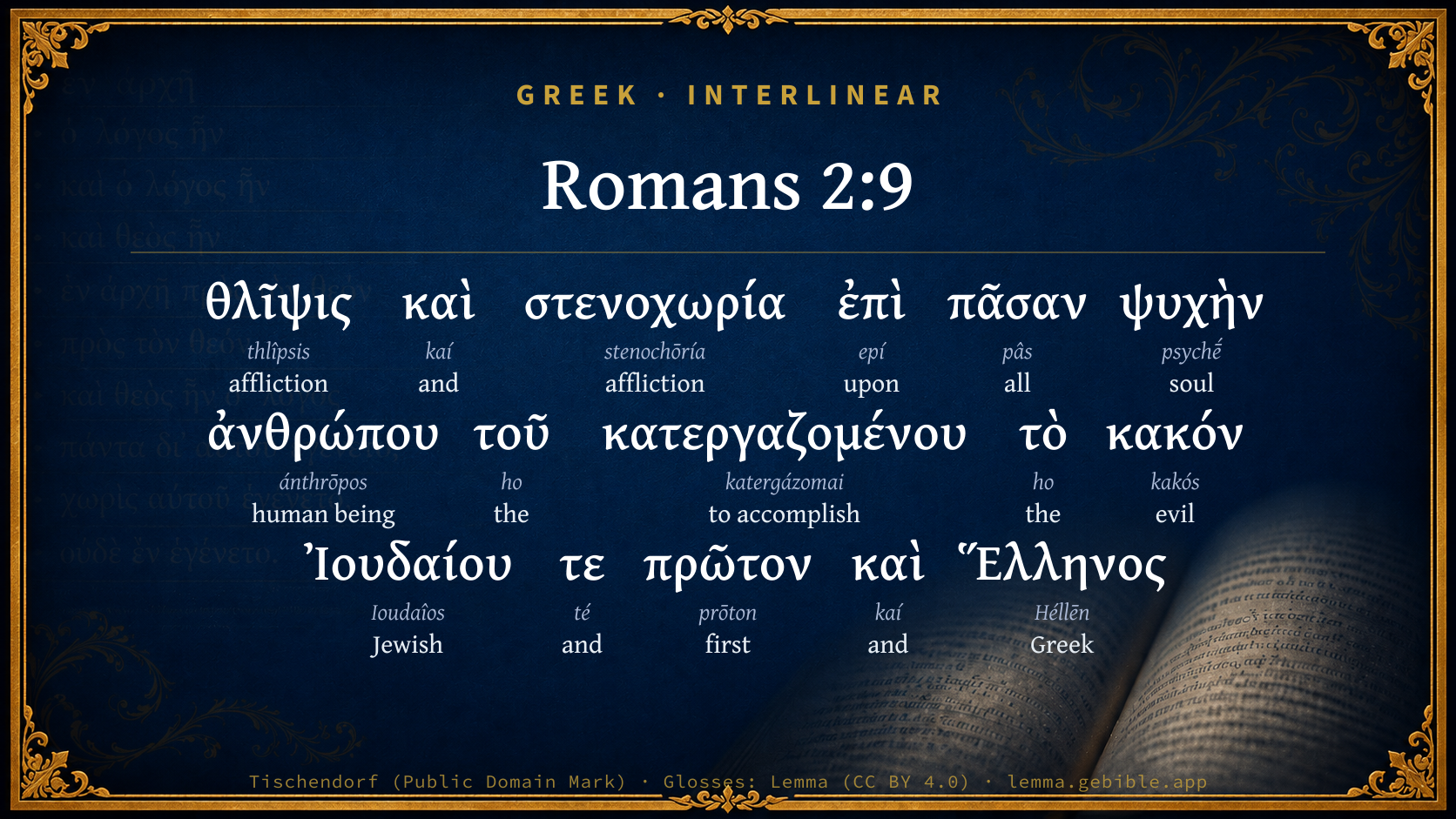
Greek (Tischendorf 8th ed.) Romans 2:9 appears in the Greek New Testament. The text above is from the Tischendorf 8th edition. Each word links to its Strong’s number and a concise gloss. Click any word for its full Thayer’s Greek Lexicon entry.
Download image
Cite this verse

Romans 2:9 (World English Bible). Public Domain. Lemma interlinear Bible study tool, https://lemma.gebible.app/v/romans/2/9.

Show BibTeX & RIS
BibTeX
RIS
English Translation
oppression and anguish, on every soul of man who works evil, on the Jew first, and also on the Greek.
World English Bible · Public Domain
Highlights
  • 1 first appearance in the Greek New Testament
Full analysis ↓
Download a study sheet

One document with this verse’s original text, its word-by-word gloss line, the meaning frame, cross-references with their text, attributed commentary, and full source and license credits — printable, and it pastes into notes with its structure intact.

This verse Autodidact and up

Study sheet (.html) Plain text (.txt)

A passage Seminary Student

Up to 50 verses in one chapter. A passage sheet keeps up to 6 commentary sources and 12 cross-references per verse, in the order this page ranks them, and says so on the sheet whenever that leaves anything out. Ask for a single verse and you get the Autodidact verse sheet above.

Everything on this page stays free to read, with no account — the sheet is a download of what is already on screen, not access to it.

Want to remove ads? Support Godless Engineer
Compare translations 3

The same verse in 3 English versions, stacked beneath the original-language interlinear above. Click any original word for its lexicon entry.

Each is an independent rendering of the whole verse — the interlinear is not word-aligned to these translations.

Highlighted words mark where these versions differ — a whole-verse word diff, not a word-by-word alignment.

  • World English Bible Public Domain
    oppression and anguish, on every soul of man who works evil, on the Jew first, and also on the Greek.
  • King James Version Public Domain
    Tribulation and anguish, upon every soul of man that doeth evil, of the Jew first, and also of the Gentile;
  • unfoldingWord Literal Text CC BY-SA 4.0
    Tribulation and distress on every soul of man that produces the evil, both to the Jew first and to the Greek.

unfoldingWord Literal Text — © unfoldingWord, licensed CC BY-SA 4.0. Word-aligned USFM3 via Door43 (git.door43.org/unfoldingWord/en_ult).

Versions to compare (up to 4)

3 of 4 selected

Show all 19 translations

Every available English version of this verse, each an independent rendering of the whole verse.

  • World English Bible Public Domain
    oppression and anguish, on every soul of man who works evil, on the Jew first, and also on the Greek.
  • Berean Standard Bible Public Domain
    There will be trouble and distress for every human being who does evil, first for the Jew, then for the Greek;
  • Majority Standard Bible Public Domain
    There will be trouble and distress for every human being who does evil, first for the Jew, then for the Greek;
  • King James Version Public Domain
    Tribulation and anguish, upon every soul of man that doeth evil, of the Jew first, and also of the Gentile;
  • American Standard Version (1901) Public Domain
    tribulation and anguish, upon every soul of man that worketh evil, of the Jew first, and also of the Greek;
  • Revised Version (1885) Public Domain
    tribulation and anguish, upon every soul of man that worketh evil, of the Jew first, and also of the Greek;
  • Geneva Bible (1599) Public Domain
    Tribulation and anguish shalbe vpon the soule of euery man that doeth euill: of the Iewe first, and also of the Grecian.
  • Douay-Rheims (1899) Public Domain
    Tribulation and anguish upon every soul of man that worketh evil, of the Jew first, and also of the Greek.
  • Young's Literal Translation Public Domain
    tribulation and distress, upon every soul of man that is working the evil, both of Jew first, and of Greek;
  • Literal Standard Version CC BY-SA 4.0
    tribulation and distress, on every soul of man that is working the evil, both of Jew first, and of Greek;
  • Unlocked Literal Bible CC BY-SA 4.0
    God will bring tribulation and distress on every human soul that has practiced evil, to the Jew first, and also to the Greek.
  • unfoldingWord Literal Text CC BY-SA 4.0
    Tribulation and distress on every soul of man that produces the evil, both to the Jew first and to the Greek.
  • Darby Bible Public Domain
    tribulation and distress, on every soul of man that works evil, both of Jew first, and of Greek;
  • World Messianic Bible Public Domain
    oppression, and anguish on every soul of man who does evil, to the Jew first, and also to the Greek.
  • Webster's Bible Public Domain
    Tribulation and anguish upon every soul of man that doeth evil, of the Jew first, and also of the Gentile;
  • Free Bible Version CC BY-SA 4.0
    Everyone who does evil will have trouble and suffering—the Jewish people first, and the foreigners too.
  • Bible in Basic English Public Domain
    Trouble and sorrow on all whose works are evil, to the Jew first and then to the Greek;
  • Text-Critical English NT CC BY 4.0
    There will be tribulation and distress for everyone who does evil, the Jew first and also the Greek;
  • Tyndale New Testament (1534) Public Domain
    tribulacion and anguysshe vpon the soule of every man that doth evyll: of the Iewe fyrst and also of the gentyll.

Literal Standard Version (2020), Covenant Press — licensed CC BY-SA 4.0. Text via the HelloAO Bible API (eBible.org). Unlocked Literal Bible (unfoldingWord) — licensed CC BY-SA 4.0. Text via the HelloAO Bible API (eBible.org). unfoldingWord Literal Text — © unfoldingWord, licensed CC BY-SA 4.0. Word-aligned USFM3 via Door43 (git.door43.org/unfoldingWord/en_ult). Free Bible Version, Dr. Jonathan Gallagher — licensed CC BY-SA 4.0. Text via the HelloAO Bible API (eBible.org).

Word by word

More ways to search: Search by grammar → Find every occurrence → Compare this word →

Practice this passage: Drill this verse → Learn its vocabulary →

στενοχωρία
stenochōría
G4730
“affliction”
Noun, Nominative, Singular, Feminine
Part of Speech
Noun
Case
Nominative
Number
Singular
Gender
Feminine
Full Thayer's Definition

Origin: from a compound of G4728 and G5561

TDNT: 17:04,1

1. narrowness of place, a narrow place 2. metaph. dire calamity, extreme affliction
  1. θλῖψις thlîpsis G2347 “affliction” Noun, Nominative, Singular, Feminine
  2. καὶ kaí G2532 “and” Conjunction
  3. ἐπὶ epí G1909 “upon” Preposition
  4. πᾶσαν pâs G3956 “all” Adjective, Accusative, Singular, Feminine
  5. ψυχὴν psychḗ G5590 “soul” Noun, Accusative, Singular, Feminine
  6. ἀνθρώπου ánthrōpos G444 “human being” Noun, Genitive, Singular, Masculine
  7. τοῦ ho G3588 “the” Article, Genitive, Singular, Masculine
  8. κατεργαζομένου katergázomai G2716 “to accomplish” Verb, Present, Middle or Passive deponent, Participle, Genitive, Singular, Masculine
  9. τὸ ho G3588 “the” Article, Accusative, Singular, Neuter
  10. κακόν kakós G2556 “evil” Adjective, Accusative, Singular, Neuter
  11. Ἰουδαίου Ioudaîos G2453 “Jewish” Adjective, Genitive, Singular, Masculine
  12. τε té G5037 “and” Particle
  13. πρῶτον prōton G4412 “first” Adverb, Superlative
  14. καὶ kaí G2532 “and” Conjunction
  15. Ἕλληνος Héllēn G1672 “Greek” Noun, Genitive, Singular, Masculine

About this verse

These counts appear in no published source. They are computed here, from the morphology-tagged text and Lemma’s own curated glosses. What Lemma adds →

16
words
14
distinct lemmas
Pauline Epistles
section

Notable vocabulary

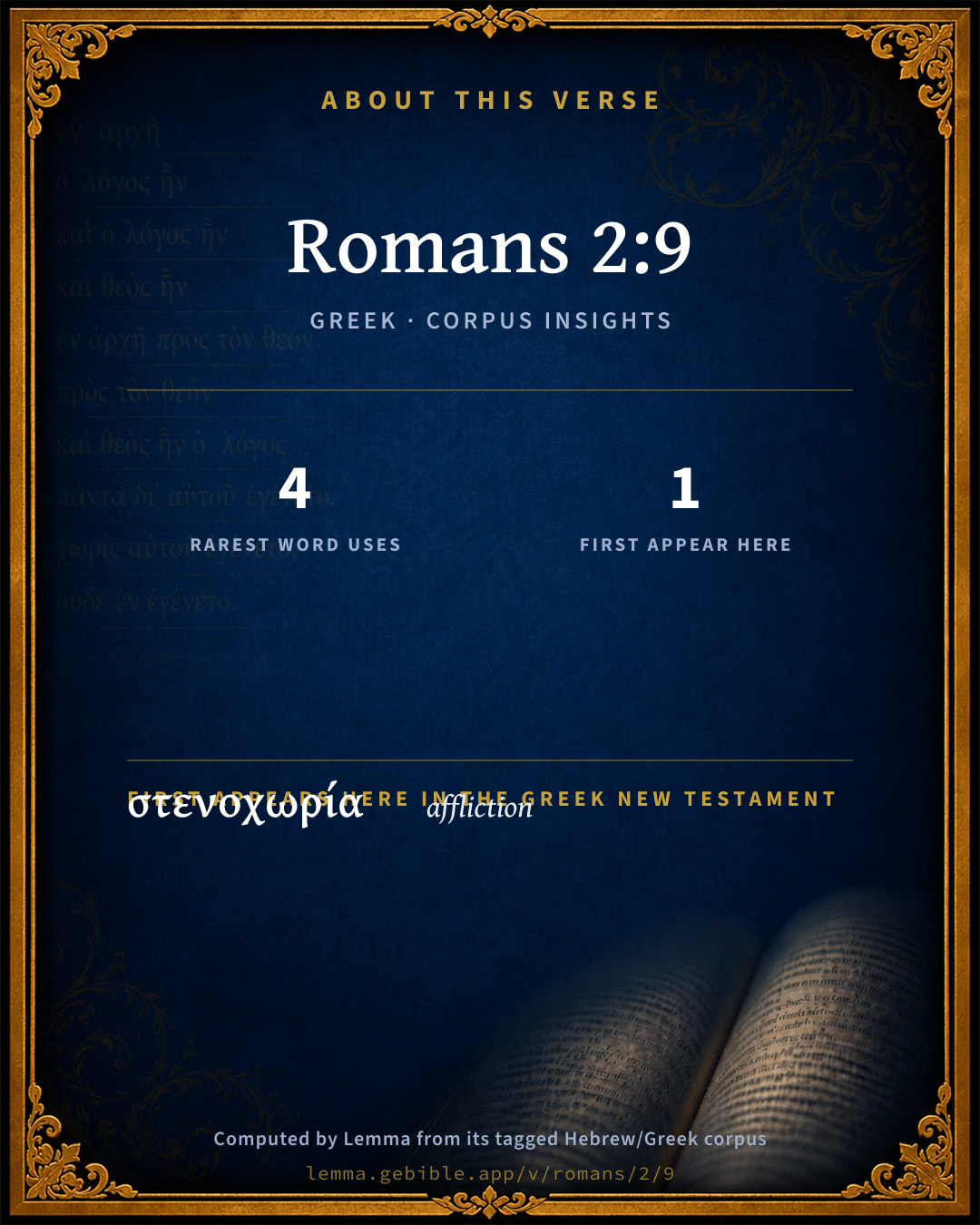
The rarest word here is στενοχωρία affliction G4730 — appearing just 4 times in the whole Greek New Testament.

First appearance in Scripture

This word makes its first canonical appearance in the Greek New Testament here:

  • στενοχωρία affliction G4730

Shared distinctive vocabulary

στενοχωρία affliction G4730 occurs in 4 verses of the Greek New Testament. Also found in:
Repetition

Words recur within this verse:

Cross-references

30

Topical passages linked to Romans 2:9 in the Treasury of Scripture Knowledge — connected by theme and wording, ordered by reader-vote popularity; previews shown in the World English Bible.

  • 1 Peter 4:17 For the time has come for judgment to begin at the house of God. If it begins first with us, what will happen to those who don't obey the Gospel of God?
  • Ezekiel 18:4 Behold, all souls are mine; as the soul of the father, so also the soul of the son is mine: the soul who sins, he shall die.
  • Romans 1:16 For I am not ashamed of the Gospel of Christ, for it is the power of God for salvation for everyone who believes; for the Jew first, and also for the Greek.
  • Luke 24:47 and that repentance and remission of sins should be preached in his name to all the nations, beginning at Jerusalem.
  • Acts 3:26 God, having raised up his servant, Jesus, sent him to you first, to bless you, in turning away everyone of you from your wickedness."
  • Acts 13:46–47 Paul and Barnabas spoke out boldly, and said, "It was necessary that God's word should be spoken to you first. Since indeed you thrust it from you, and judge yourselves unworthy of eternal life, behold, we turn to the Gentiles.
  • Acts 18:5–6 But when Silas and Timothy came down from Macedonia, Paul was compelled by the Spirit, testifying to the Jews that Jesus was the Christ.
  • Romans 2:10 But glory and honor and peace to every man who works good, to the Jew first, and also to the Greek.
  • Romans 3:29–30 Or is God the God of Jews only? Isn't he the God of Gentiles also? Yes, of Gentiles also,
  • Romans 9:24 us, whom he also called, not from the Jews only, but also from the Gentiles?
  • Romans 15:8–9 Now I say that Christ has been made a minister of the circumcision for the truth of God, that he might confirm the promises given to the fathers,
  • Ephesians 2:11–17 Therefore remember that once you, the Gentiles in the flesh, who are called "uncircumcision" by that which is called "circumcision," (in the flesh, made by hands);
  • 2 Thessalonians 1:6 Since it is a righteous thing with God to repay affliction to those who afflict you,
  • Proverbs 1:27–28 When calamity overtakes you like a storm, When your disaster comes on like a whirlwind; When distress and anguish come on you.
  • Amos 3:2 "You only have I chosen of all the families of the earth. Therefore I will punish you for all of your sins."
  • Matthew 11:20–24 Then he began to denounce the cities in which most of his mighty works had been done, because they didn't repent.
  • Matthew 16:26 For what will it profit a man, if he gains the whole world, and forfeits his life? Or what will a man give in exchange for his life?
  • Luke 2:30–32 For my eyes have seen your salvation,
  • Luke 12:47–48 That servant, who knew his lord's will, and didn't prepare, nor do what he wanted, will be beaten with many stripes,
  • Acts 11:18 When they heard these things, they held their peace, and glorified God, saying, "Then God has also granted to the Gentiles repentance to life!"
  • Acts 13:26 Brothers, children of the stock of Abraham, and those among you who fear God, the word of this salvation is sent out to you.
  • Acts 20:21 testifying both to Jews and to Greeks repentance toward God, and faith toward our Lord Jesus.
  • Acts 26:20 but declared first to them of Damascus, at Jerusalem, and throughout all the country of Judea, and also to the Gentiles, that they should repent and turn to God, doing works worthy of repentance.
  • Acts 28:17 It happened that after three days Paul called together those who were the leaders of the Jews. When they had come together, he said to them, "I, brothers, though I had done nothing against the people, or the customs of our fathers, still was delivered prisoner from Jerusalem into the hands of the Romans,
  • Acts 28:28 "Be it known therefore to you, that the salvation of God is sent to the Gentiles. They will also listen."
  • Romans 4:9–12 Is this blessing then pronounced on the circumcised, or on the uncircumcised also? For we say that faith was accounted to Abraham for righteousness.
  • Romans 10:12 For there is no distinction between Jew and Greek; for the same Lord is Lord of all, and is rich to all who call on him.
  • Galatians 2:15–16 "We, being Jews by nature, and not Gentile sinners,
  • Galatians 3:28 There is neither Jew nor Greek, there is neither slave nor free man, there is neither male nor female; for you are all one in Christ Jesus.
  • Colossians 3:11 where there can't be Greek and Jew, circumcision and uncircumcision, barbarian, Scythian, bondservant, freeman; but Christ is all, and in all.

Cross-references courtesy of OpenBible.info (CC BY 4.0).

Commentary

Notes on Romans 2:9 from classic Christian and Jewish commentators (each source and its license shown beneath its notes). The classic Christian expositions comment on the surrounding passage and are grouped to its opening verse, so a note may address several verses; the Jewish commentaries on the Tanakh (Rashi and others) are per-verse, so they appear only where the commentator wrote on this verse.

Lemma curates 59 commentaries, every one of them public domain or Creative Commons licensed, each selected and text-cleaned for this edition rather than reprinted as found. About our sources →

Bengel's Gnomon

Johann Albrecht Bengel

Rom 2:9. Θλίψις καὶ στενοχωρία, affliction and anxiety [tribulation and anguish]. θλίψις, affliction or tribulation for the present; στενοχωρίκ, anxiety or anguish, in regard to things future; θλίψις, affliction, or tribulation, presses down; στενοχωρία, frets and harasses [œstuat et urget], Job 15:20, etc. In these words we have a proof of the avenging justice of God; for the anger of God has for its object, to teach the sinful creature, who is experiencing wrath and every species of adversity, to have himself, because in his whole conduct, he has set himself in opposition to God; and so long as the creature shrinks from this most just hatred of himself, he continues under punishment.—πᾶσαν ψυχὴν, every soul) This term adds to the universal character of the discourse, ch. Rom 13:1.—πρῶτον, first). So Psa 94:10: He that chastiseth the nations, shall he not correct (you among the people?). The Greek is a partaker [in the judgment] along with the Jew.

Rom 2:9-10. Κατεργαζομένου· ἐργαζομένῳ). The distinction between these words is more easily felt, than explained, more easily ridiculed, than refuted. There is another distinction: ἐπὶ ψυχήν is said of the punishment; for punishment falls upon it, and the soul will bear it unwillingly; παντὶ τῳ ἐργαζομένῳ, the dative of advantage, is said of the reward.

Bengel's Gnomon of the New Testament — English translation (T&T Clark, Edinburgh, 1860) — public domain. Text from a community e-Sword module.

Meyer's Critical & Exegetical Commentary

Heinrich August Wilhelm Meyer

Rom_2:9-10. Emphatic recapitulation of Rom_2:7-8, inverting the order, and in addition, giving special prominence to the universality of the retribution. The placing the penal retribution first gives to this an aspect the more threatening and alarming, especially as the terms expressing it are now accumulated in one breath.

θλῖψις κ. στενοχωρία] Tribulation and anguish, sc[625] ἔσται. The calamity is thus described as pressing upon them from without (ΘΛῖΨΙς), and as felt inwardly with the sense of its being beyond help (ΣΤΕΝΟΧ.), Rom_8:35; 2Co_4:7; 2Co_6:12; compare LXX. Isa_30:6; Deu_28:53.

ἘΠῚ ΠᾶΣΑΝ ΨΥΧῊΝ ἈΝΘΡ.] denotes not simply upon every man (so even Philippi), but upon every soul which belongs to a man who practises evil. The ψυχή is thereby designated as that which is affected by the ΘΛῖΨ. Κ. ΣΤΕΝΟΧ. (Act_2:43; Mat_26:28, al[626]); comp Winer, p. 147 [E. T. 194]. It is the part which feels the pain.[628]

πρῶτον] Quite as in Rom_1:16. The Jews, as the people of God, in possession of the revelation with its promises and threatenings, are therefore necessarily also those upon whom the retribution of judgmentnot the reward merely, but also the punishmenthas to find in the first instance its execution. In both aspects they have the priority based on their position in the history of salvation as the theocratic people, and that as certainly as God is impartial. Judaei particeps Graecus, Bengel. The Jewish conceit is counteracted in the first clause by ʼΙουδαίου τε πρῶτον, in the second by ΚΑῚ ἝΛΛΗΝΙ, and counteracted with sternly consistent earnestness. The second ΠΡῶΤΟΝ precludes our taking the first as ironical (Reiche).

εἰρήνη] welfare, by which is intended that of the Messiahs kingdom, as in Rom_8:6. It is not materially different from the ἀφθαρσία and ΖΩῊ ΑἸΏΝΙΟς of Rom_2:7; the totality of that which had already been described in special aspects by ΔΌΞΑ and ΤΙΜΉ (comp on Rom_2:7).

Regarding the distinction between ἘΡΓΑΖ. and ΚΑΤΕΡΓΑΖ. (works and brings to pass) see on Rom_1:27.

[625] c. scilicet.

[626] l. and others; and other passages; and other editions.

[628] See Ernesti, Urspr. d. Sünde, II. p. 101 ff.

Meyer — Critical and Exegetical Commentary on the New Testament — English translation by Peter Christie, edited by Frederick Crombie (T&T Clark, 1880) — public domain. Text from a community e-Sword module.

Expositor's Greek Testament

ed. W. Robertson Nicoll

Rom 2:9 . ὀργὴ is wrath within; θυμός wrath as it overflows. θλίψις and στενοχωρία , according to Trench, Synonyms , § 55, express very nearly the same thing, under different images: the former taking the image of pressure, the latter that of confinement in a narrow space. But to draw a distinction between them, based on etymology, would be very misleading. In both pairs of words the same idea is expressed, only intensified by the reduplication. Supply ἔσται for the changed construction. κατεργαζομένου τὸ κακόν : who works at evil and works it out or accomplishes it. The Jew is put first, because as possessor of an express law this is conspicuously true of him.

The Expositor's Greek Testament, edited by W. Robertson Nicoll (1897–1910) — public domain. Text from a community e-Sword module.

Godet's Commentaries

Frédéric Louis Godet

Vv. 9, 10. “Tribulation and anguish upon every soul of man that effecteth evil, of the Jew first, and also of the Greek; but glory and honor and peace to every man that doeth good, to the Jew first, and also to the Greek!”

The asyndeton indicates, as it always does, the more emphatic reassertion of the previous idea: “Yes, tribulation and anguish!”

The antithesis of Rom 2:7-8 is reproduced in inverse order, not only to avoid the monotony of a too exact parallelism, but chiefly because, following up Rom 2:8 (wrath and indignation), the idea of Rom 2:9 (tribulation and anguish) presented itself more naturally than that of Rom 2:10 (glory and honor and peace); comp. the same arrangement, Luk 1:51-53. The terms tribulation and anguish describe the moral and external state of the man on whom the indignation and wrath of the judge fall (Rom 2:8). Tribulation is the punishment itself (corresponding to wrath); anguish is the wringing of the heart which the punishment produces; it corresponds to the judge’s indignation. The soul is mentioned as the seat of feeling. The phrase, every soul of man, expresses the equality and universality of the treatment dealt out. Yet within this equality there is traced a sort of preference both as to judgment and salvation respectively (Rom 2:10), to the detriment and advantage of the Jew. When he says first, the apostle has no doubt in view (as in Rom 1:16) a priority in time; comp. 1Pe 4:17. Must we not, however, apply at the same time the principle laid down by Jesus, Luk 12:41-48, according to which he who receives most benefits is also the man who has the heaviest responsibility? In any case, therefore, whoever escapes judgment, it will not be the Jew; if there were but one judged, it would be he. Such is the apostle’s answer to the claim alleged, Rom 2:3 : ὅτι σὺ ἐκφεύξῃ, that thou, thou alone, shalt escape.

Frédéric Louis Godet — Commentaries on Luke, John, Romans, and 1 Corinthians — English translation (T&T Clark, Edinburgh, 1870s–1890s) — public domain. Text from a community e-Sword module.

Hodge's Commentary on Romans, Ephesians & First Corinthians

Charles Hodge

Rom_2:9

Tribulation and anguish; θλῖψις, (from θλίβω, to press) means pressure, affliction; στενοχωρία straitness of place, anguish. They are often associated; see Rom_8:35; 2Co_6:4. The latter is the stronger of the two terms, as may be inferred from its always following the other, and especially from 2Co_4:8, θλιβόμενοι, ἀλλ ̓ οὐ στενοχωρούμενοι, troubled but not distressed; Every soul of man, that is, every man. Comp. Act_2:43; Rom_13:1, and the Hebrew אָדָם כָּל־נֶפֶשׁ; Rückert, Meyer, and others, give ψυχή its full force, upon every soul that belongs to a man, to express the idea that the soul and not the body is to suffer the penalty. But in Rom_13:1, ψυχή evidently stands for the whole person: let every soul, means let every person; and such is a common scriptural meaning of the word, if a soul sin, if a soul lie, if the priest buy a soul with his money, etc. Of the Jew first, and also of the Greek. It becomes now apparent that the apostle, in laying down these general principles of justice, had the Jews specially in view. God, he says, will render to every man according to his works, to the good, eternal life; to the evil, tribulation and anguish. And lest the every man should fail to arrest attention, he adds expressly, that the Jew as well as the Greek is to be thus judged. The word πρῶτον may express either order or preeminence. If the former, the sense is what is expressed by Calvin, Haec universalis est divini judicii lex, qua a Judaeis incipiet, et comprehendet totum orbem. The judgment shall begin with the Jews, and extend to the Gentiles. If the latter, the sense is, The Jew shall not only be punished as certainly as others, but more severely, because he has been more highly favored. The Jew first, is equivalent then to the Jew especially. The same remark applies to the following verse. If the Jew is faithful, he shall be specially rewarded. What is true of all men, is specially true of those to whom God has revealed himself in a peculiar manner.

Charles Hodge — Commentary on Romans (1835), First Corinthians (1857), and Ephesians (1856) — public domain. Text from a community e-Sword module.

Jamieson, Fausset & Brown

Robert Jamieson, A. R. Fausset & David Brown

Tribulation and anguish--the effect of these in the sinner himself.

Jamieson, Fausset & Brown — Commentary Critical and Explanatory on the Whole Bible (1871) — public domain (CC PDM 1.0). Text via the HelloAO Bible API.

Adam Clarke's Commentary

Verse 9. Tribulation and anguish] Misery of all descriptions, without the possibility of escape, will this righteous Judge inflict upon every impenitent sinner. The Jew first, as possessing greater privileges, and having abused greater mercies; and also on the Gentile, who, though he had not the same advantages, had what God saw was sufficient for his state; and, having sinned against them, shall have punishment proportioned to his demerit.

Adam Clarke's Commentary on the Bible (1810–1826) — public domain. Text from a community e-Sword/MySword module.

John Calvin's Commentaries

9. To the Jew first, etc. He simply places, I have no doubt, the Jew in opposition to the Gentile; for those whom he calls Greeks he will presently call Gentiles. But the Jews take the precedence in this case, for they had, in preference to others, both the promises and the threatenings of the law; as though he had said, “This is the universal rule of the divine judgment; it shall begin with the Jews, and it shall include the whole world.”

John Calvin's Commentaries (1540-1563) — public domain. Text from the Calvin Translation Society English edition (1840s-50s) via the Christian Classics Ethereal Library (ccel.org). Calvin's coverage is partial (roughly two-thirds of the Bible); uncommented books and verses are honest gaps, never fabricated. The 19th-century editor's footnotes and remarks are omitted so the notes are faithfully Calvin's own voice.

Ellicott's Commentary for English Readers

(9) Upon every soul of man.—The phrase is not quite the same as “upon every man,” but more special in character, indicating the part in which the punishment will be felt.

A Bible Commentary for English Readers, edited by Charles John Ellicott (1878–1897) — public domain. Text from a community e-Sword module.

The Cambridge Bible for Schools and Colleges

gen. ed. J. J. S. Perowne

9. tribulation and anguish] Both words, in Greek as well as in English, indicate the crushing and bewildering power of great grief or pain. “Anguish” is the stronger of the two; for see 2Co_4:8, where the original of “distressed” is cognate to that of “anguish” here.

It is remarkable that the antithesis here to “eternal life” is the conscious experience of the effects of Divine anger.

doeth] The Gr. is somewhat emphatic; practiseth, worketh, worketh out. A habit of sin is intended. Same word as “worketh” in next verse.

of the Jew, &c.] Lit. both of the Jew, first, and of the Greek. The phrase is as if St Paul had been writing simply “of the Jew and of the Greek,” “of Jew and Greek alike;” and then, as by a verbal parenthesis, inserted the word “first” to emphasize what was all along most in his view in the simple phrase; viz., the special accountability of the Jew. On Jew and Greek, see on Rom_1:16.

The Cambridge Bible for Schools and Colleges (gen. ed. J. J. S. Perowne; Cambridge University Press, 1878–1918) — public domain. Text from a community e-Sword module.

John Gill's Exposition

But glory, honour, and peace,.... Which are so many words for the everlasting happiness of the saints; which is a "crown of glory that fadeth not away" Pe1 5:4); an honour exceeding that of the greatest potentates upon earth, since such that enjoy it will be kings and priests, and sit with Christ on his throne to all eternity; and is a peace that passes all understanding: all which will be rendered

to every man that doth good, to the Jew first, and also to the Gentile; which none without Christ, and his grace, and by the strength of nature, does, or can do; not that good works are causes of salvation, but are testimonies of faith, and fruits of grace, with which salvation is connected, whether they be found in Jews or Gentiles; for neither grace nor salvation are peculiar to any nation, or set of people.

John Gill's Exposition of the Whole Bible (1746–1763) — public domain (CC PDM 1.0). Text via the HelloAO Bible API.

Trapp's Complete Commentary

John Trapp

9 Tribulation and anguish, upon every soul of man that doeth evil, of the Jew first, and also of the Gentile;

Ver. 9. Of the Jew first] Qui ideo deteriores sunt, quia meliores esse deberent. Who are therefore worse, because they should be better. Salvian.

John Trapp, A Commentary or Exposition upon All the Books of the Old and New Testament (1647–1656) — public domain. Text from a community e-Sword module.

Albert Barnes' Notes on the Bible

Tribulation - This word commonly denotes affliction, or the situation of being pressed down by a burden, as of trials, calamities, etc.; and hence, to be pressed down by punishment or pain inflicted for sins. As applied to future punishment, it denotes the pressure of the calamities that will come upon the soul as the just reward of sin.

And anguish - στενοχωρία stenochōria. This noun is used in but three other places in the New Testament; Rom 8:35; 2Co 6:4; 2Co 12:10. The verb is used in 2Co 4:8; 2Co 6:12. It means literally narrowness of place, lack of room, and then the anxiety and distress of mind which a man experiences who is pressed on every side by afflictions, and trials, and want, or by punishment, and who does not know where he may turn himself to find relief. (Schleusner.) It is thus expressive of the punishment of the wicked. It means that they shall be compressed with the manifestations of God’s displeasure, so as to be in deep distress, and so as not to know where to find relief. These words affliction and anguish are often connected; Rom 8:35.

Upon every soul of man - Upon all people. In Hebrew the word “soul” often denotes the man himself. But still, the apostles, by the use of this word here, meant perhaps to signify that the punishment should not be corporeal, but afflicting the soul. It should be a spiritual punishment, a punishment of mind. (Ambrose. See Tholuck.)

Of the Jew first - Having stated the general principle of the divine administration, he comes now to make the application. To the principle there could be no objection. And the apostle now shows that it was applicable to the Jew as well as the Greek, and to the Jew pre-eminently. It was applicable first, or in an eminent degree, to the Jew, because,

He had been especially favored with light and knowledge on all these subjects.

(2)These principles were fully stated in his own Law, and were in strict accordance with all the teaching of the prophets; see the note at Rom 2:6; also Psa 7:11; Psa 9:17; Psa 139:19; Pro 14:32.

Of the Gentile - That is, of all who were not Jews. On what principles God will inflict punishment on them, he states in Rom 2:12-16. It is clear that this refers to the future punishment of the wicked, for,

(1) It stands in contrast with the eternal life of those who seek for glory Rom 2:7. If this description of the effect of sin refers to this life, then the effects spoken of in relation to the righteous refer to this life also. But in no place in the Scriptures is it said that people experience all the blessings of eternal life in this world; and the very supposition is absurd.

(2) It is not true that there is a just and complete retribution to every man, according to his deeds, in this life. Many of the wicked are prospered in life, and “there are no bands in their death, but their strength is firm;” Psa 73:4. Many of the righteous pine in poverty and want and affliction, and die in the flames of persecution. Nothing is more clear than there is not in this life a full and equitable distribution of rewards and punishments; and as the proposition, of the apostle here is, that God will render to every man according to his deeds Rom 2:6, it follows that this must be accomplished in another world.

(3) The Scriptures uniformly affirm, that for the very things specified here, God will consign people to eternal death; 2Th 1:8, “In flaming fire, taking vengeance on them that know not God, and that obey not the gospel of our Lord Jesus Christ, who shall be punished with everlasting destruction,” etc.; 1Pe 4:17. We may remark also, that there could be no more alarming description of future suffering than is specified in this passage. It is indignation; it is wrath; it is tribulation; it is anguish which the sinner is to endure forever. Truly people exposed to this awful doom should be alarmed, and should give diligence to escape from the woe which is to come.

Albert Barnes' Notes on the Bible (1834–1885) — public domain. Text from a community e-Sword/MySword module.

Haydock's Catholic Bible Commentary

Of the Jew first, and also the Greek. That is, God, as a just judge, will not have any respect to their persons, but punish or reward both Jews and Gentiles, according to their good or bad works. And salvation is now offered to both. (Witham)

George Leo Haydock (1774–1849), Haydock's Catholic Family Bible and Commentary, 1859 edition — public domain. Excludes Psalms (Douay-Rheims chapter numbering differs from Protestant) and Deuterocanonical books (Catholic canon only).

Matthew Poole's English Annotations

Tribulation and anguish; the word render is here again understood, he shall render tribulation and anguish. Some refer the former to the punishment of sin, the latter to the punishment of loss; or the one to the unquenchable fire, the other to the never dying worm: it seems to be a rhetorical exaggeration: see Psa 11:6; Mar 9:43-48.

Every soul of man; a double Hebraism: first, the soul is put for the person, as Gen 12:5; 14:21; 17:14; 36:6; 46:26. Secondly, every soul of man, is put for the soul of every man; as before, Rom 1:18, all unrighteousness of men, is put for the unrighteousness of all men. The soul of man shall not be punished only, but chiefly.

Of the Jew first, and also of the Gentile; the Jew is first placed in order of punishment, because he better knew God’s will, and had more helps: see Mat 11:22,24; Lu 12:47.

Matthew Poole's English Annotations on the Holy Bible (1683–1685) — public domain. Text from a community e-Sword/MySword module.

Whedon's Commentary on the Bible

Daniel D. Whedon

9. Tribulation and anguish—Nominatives to shall be, understood. As indignation and wrath are tempers in the Divine mind, so tribulation and anguish are the results produced in the persons of the guilty.

Jew first— Priority of offer, not superiority of reward or penalty. From this paragraph it is plain that in the system under Christ the Head men are born into a scene of probation. That is, our human system is a system of free agents upon whose will and determination it depends whether they attain eternal bliss or eternal woe.

This presupposes in man a free responsible will, with the full power in the given moral alternatives to decide either way. He decides for right with the full power of deciding for the wrong instead, and is therefore praiseworthy. Or he decides for wrong, while in possession of the power for having instead decided for right, and is therefore responsible and condemnable. If he does not possess this alternative power of choice for either way, but must choose but one sole way, (without any power of choosing otherwise,) then he is an intellectual machine, and is irresponsible; that is, unless he has flung away his power, in which case he is still responsible. Since man is not a free being, and there is no true responsible probation, unless his will is thus free, we may add that he is not free in the following cases:

1. If while God professes to hold him free in a real probation He determines and decrees beforehand which way man shall choose. There is no probation where man’s action is thus previously fixed. That probation may be a fine piece of machinery, like a panorama, or an orrery, or the solar system itself, but it is no free probationary government.

2. If such be, by the nature of things, the force of motives on the human will as to fix with absolute necessity the determinations of a man’s will, just as the springs fix the strokes of a clock-hammer, without adequate power to strike any otherwise, then man is only a spiritual and bodily machine, and is no more responsible than a clock, and there is no true probation.

3. If the will of man by its own intrinsic nature always acts by fixed laws of so called invariable certainty, precisely according to the measure of motive force, man is not a free being. True and free certainty is the will-be, the future of an event apart from any fixed law. A future event that will be is certain, whether it is certain according to a fixed law, or whether it is a free certainty apart from and without such regulative law. If the will of man is under a certainty previously and eternal, fixed by law, it is not free. If that law be that he shall act according to the precise force of motives and no otherwise, then he is not free, and there is no true probation.

In these three cases, then—namely, where either man’s actions are previously determined, decreed, or fore-ordained by Omnipotence; or where man’s actions are fixed by the necessitating force of presented motives; or where by its own intrinsic nature man’s will always acts with invariable law in accordance with force of motive—in all these three cases there is no divine government, but only a vast machinery! There is no merit, no demerit. There is no desert of reward or penalty. The judgment day is no just reality. All is fatalism. And since God’s own will is also bound by similar laws, so God is subject to the same universal eternal fatalism! Such is not the system of the New Testament.

Dr. Hodge, indeed, argues: “Surely there is such a thing as being made willing without being forced. There is a middle ground between moral suasion and coercion. God supersedes the necessity of forcing, by making us willing in the day of his power.” Our reply is: In the sinner’s act of acceptance of God’s saving grace, we promptly deny any “make-willing” on the part of God which excludes man’s power of not-willing or refusing. God demands a free acceptance. He does not make a farce of our probation by first requiring our free will-ing, and then imposing upon us a “make-willing.” The free will-ing and the “make-willing” are incompatible.

From all this it moreover follows that if man be created, or if he be born into existence, without the power (either by nature or by supernatural provision) to do right and please God, he is not responsible or justly punishable. And if through his whole existence he never had power to will good, Divine Justice can never condemn him for any evil willing.

If for the fall of Adam, or any reason whatever, the whole human race is born unable to do good, it cannot, then, be damned for not doing good. To select or elect a part from this incapable whole, and oblige it to do good by power, is to make machines of that part. To leave the rest in incapacity for good, and then reprobate, that is, damn them for their evil, would be an infinite injustice, which it is an awful thing to charge upon a righteous God.

Daniel D. Whedon (gen. ed.), Commentary on the Old and New Testaments (1874–1909) — public domain. Text from a community e-Sword module.

John Wesley's Explanatory Notes

Of the Jew first - Here we have the first express mention of the Jews in this chapter. And it is introduced with great propriety. Their having been trained up in the true religion, and having had Christ and his apostles first sent to them, will place them in the foremost rank of the criminals that obey not the truth.

John Wesley, Explanatory Notes Upon the Whole Bible (1754–1765) — public domain. Text via the GEBible commentary corpus.

Godbey's Commentary on the New Testament

William B. Godbey

9. “Tribulation and anguish upon every soul, that worketh out the evil, of the Jew first and also of the Greek.” Jew here represents the whole world who claim to be godly; the Greek, the non-professors. “Worketh out the evil” has a final signification, i. e., indicating the ultimate destiny of every soul. As you observe the people within the circle of your acquaintance, you will find the general trend either to the good or the bad developing a finale, one way or the other, before they leave the world. All wind up this life confirmed either in holiness and God or this world and Satan. The church means “the called out of the world,” while sanctification means taking the world out of you and thus perfecting your separation from the world and Satan, who is its god. One way or the other there is in every case a “working out” of the problem for salvation or damnation.

William B. Godbey, Commentary on the New Testament (1896–1900) — public domain. Text from a community e-Sword module.

McGarvey & Pendleton's Commentaries

J. W. McGarvey

tribulation and anguish, upon every soul of man that worketh evil, of the Jew first, and also of the Greek ;

J. W. McGarvey (with Philip Y. Pendleton), Commentaries on the New Testament (The Fourfold Gospel, 1914; Acts; and the epistles) — public domain. Text from a community e-Sword/MySword module.

The People's New Testament

B. W. Johnson

9. Tribulation and anguish. God, the righteous ruler, is displeased and indignant, and hence sends the sore punishment of “tribulation and anguish.” “One refers to the external weight of affliction; the other to the inward sense of that weight.” Upon every soul. Upon every evil doer, whether Jew or Gentile. Of the Jew first. The Jew stood first in opportunity (1:16); hence is first in responsibility. The Greek. The whole Gentile world is meant, as in 1:16; the great race whose culture had spread over the world being taken as the representative of all but the Jews. The emphatic thought is that the Jew, as well as the Gentile, shall be rendered unto according to his works.

B. W. Johnson's The People's New Testament with Notes (1889–1891) — public domain. Electronic text from the Christian Classics Ethereal Library (CCEL) ThML edition.

Cambridge Greek Testament for Schools and Colleges

9. θλίψις καὶ στενοχωρία. These words must be separated from ὀ. κ. θ.: they begin the second pair of antitheses; the adoption of the false and wrong aim worries and narrows the whole life; cf. Rom 8:35; 2Co 4:8; 2Co 6:12. But the direct reference here again is to the final state, consequent on judgment.

ἐπὶ π. ψ. κ.τ.λ. pick up and enforce τοῖς ἐξ ἐρ. κ.τ.λ. and emphasise the universality of the judgment and the single condition τὰ ἔργα; the underlying thought then comes to the surface in Ἰουδαίου κ.τ.λ.; for this pair of antitheses the dominant thought is the universality of the judgment, as in the first pair its certainty and quality.

Cambridge Greek Testament for Schools and Colleges (Cambridge University Press, 1896; 21 vols, various authors incl. Carr, Maclear, Plummer, Farrar, Lumby, Moule, M. R. James, Simcox) — public domain. Text from a community e-Sword module.

Alford’s Greek Testament

Henry Alford

9. θλῖψ. κ. στεν.] An expression from the LXX (see reff.): the former signifying more the outward weight of objective infliction,—the latter the subjective feeling of the pressure. It is possible, in the case of the suffering Christian, for the former to exist without the latter: so 2Co 4:8, ἐν παντὶ θλιβόμενοι, ἀλλʼ οὐ στενοχωρούμενοι. But here the objective weight of infliction and the subjective weight of anguish, are co-existent.

ἐπὶ πᾶσαν ψ. ἀνθ.] probably a periphrasis for the sake of emphasis and solemnity. Had it been (as Fritzsche and Meyer) to indicate that the soul is the suffering part of the man (nearly so Olsh.), it should have been as De W. observes, ἐπὶ ψυχὴν παντὸς ἀνθρ., or ἐπὶ πᾶσαν ψυχὴν ἀνθρώπων (see reff.).

κατεργ.] κατεργάζομαι and ἐργάζομαι seem to have but this slight difference,—that κατεργάζομαι, answering rather to our ‘commit,’ is more naturally used of evil, as manifested and judged of by separate acts among men, whereas ἐργάζομαι, answering to our ‘work,’ is used indifferently of both good and evil. That this is not always kept to, see reff., especially ch. 7:18, and Plato Legg. iii. p. 686, end, in both which places, however, definite acts are spoken of. The pres. part. denotes the status or habit of the man.

Ἰουδ. τε πρῶτον] Because the Jew has so much greater advantages, and better opportunities of knowing the divine will: and, therefore, pre-eminent responsibility.

Henry Alford, The Greek Testament (1849–1861) — public domain. Text from a community e-Sword module.

International Critical Commentary

9. θλῖψις καὶ στενοχωρία: tribulatio (pressura in the African form of the Old Latin) et angustia Vulg., whence our word ‘anguish’: στενοχωρία is the stronger word = ‘torturing confinement’ (cf. 2Co 4:8). But the etymological sense is probably lost in usage: calamitas et angustiae h. e. summa calamitas Fri. p. 106.

For similar combinations (‘day of tribulation and pain,’ ‘of tribulation and great shame,’ ‘of suffering and tribulation,’ ‘of anguish and affliction,’ &c.) see Charles’ note on Enoch xlv. 2.

κατεργαζομένου = ‘carry to the end’; κατά either strengthening the force of the simple vb., as per in perficere, or giving it a bad sense, as in perpetrare Fri. p. 107.

International Critical Commentary — older volumes (1896–1929), various authors — public domain. Text from a community e-Sword module.

Vincent's Word Studies in the New Testament

Marvin R. Vincent

Tribulation and anguish [θλιψις και στενοχωρια] . For tribulation, see on Mt 13:21. Stenocwria anguish, which occurs only in Paul (viii. 35; 2Co 6:4; 2Co 12:10), literally means narrowness of place. The dominant idea is constraint. In Deu 23:53, 57, it describes the confinement of a siege. Trench remarks : "The fitness of this image is attested by the frequency with which, on the other hand, a state of joy is expressed in the Psalms and elsewhere, as a bringing into a large room," Psa 117:5; 2Sa 22:20. Aquinas says : loetitia est latitia, joy is breadth.

Marvin R. Vincent, Word Studies in the New Testament (1887–1900) — public domain. Text from a community e-Sword/MySword module.

Lesson kit

Teaching starters — assembled from the data on this page, not authored interpretation. Every prompt links to the verse data it draws on. Edit before teaching.

Romans, in the Pauline Epistles, opens this verse with 16 words (14 distinct Greek lemmas). Its most distinctive word is stenochōría (“affliction”). A historical commentator’s framing appears above. Read the whole chapter for the surrounding context.

Discussion questions

  1. The word stenochōría carries the sense “affliction.” How does it shape the verse?
  2. This is the first place “affliction” appears in Scripture (first appears here). What does its debut here establish?
  3. How does Romans 8:35, which shares the word «affliction», read alongside this verse?
  4. What does the repetition of “and” (2× in this one verse) do in this verse?
  5. These translations render this verse differently. What is at stake in choosing one wording over another?
  6. Compare how Bengel's Gnomon and Meyer's Critical & Exegetical Commentary read this verse. Where do they agree or differ?

Things to notice

  • 1 word makes its first canonical appearance in Scripture here.
  • These translations choose different wording for 13 words in this verse.
  • “and” occurs 2× in this single verse.
  • 14 distinct Greek lemmas span 16 words in this verse.

Reading settings

Reading text

Shown beneath each verse's original-language words.

Old Testament
Old Testament edition

Read the OT as the Masoretic Hebrew (MT) or the Greek Septuagint (LXX).

English shown for the Greek Septuagint (in the Hebrew ↔ Greek comparison).

Comparing translations? Open the Compare panel on any verse page to stack up to four side by side.