Romans 2:7

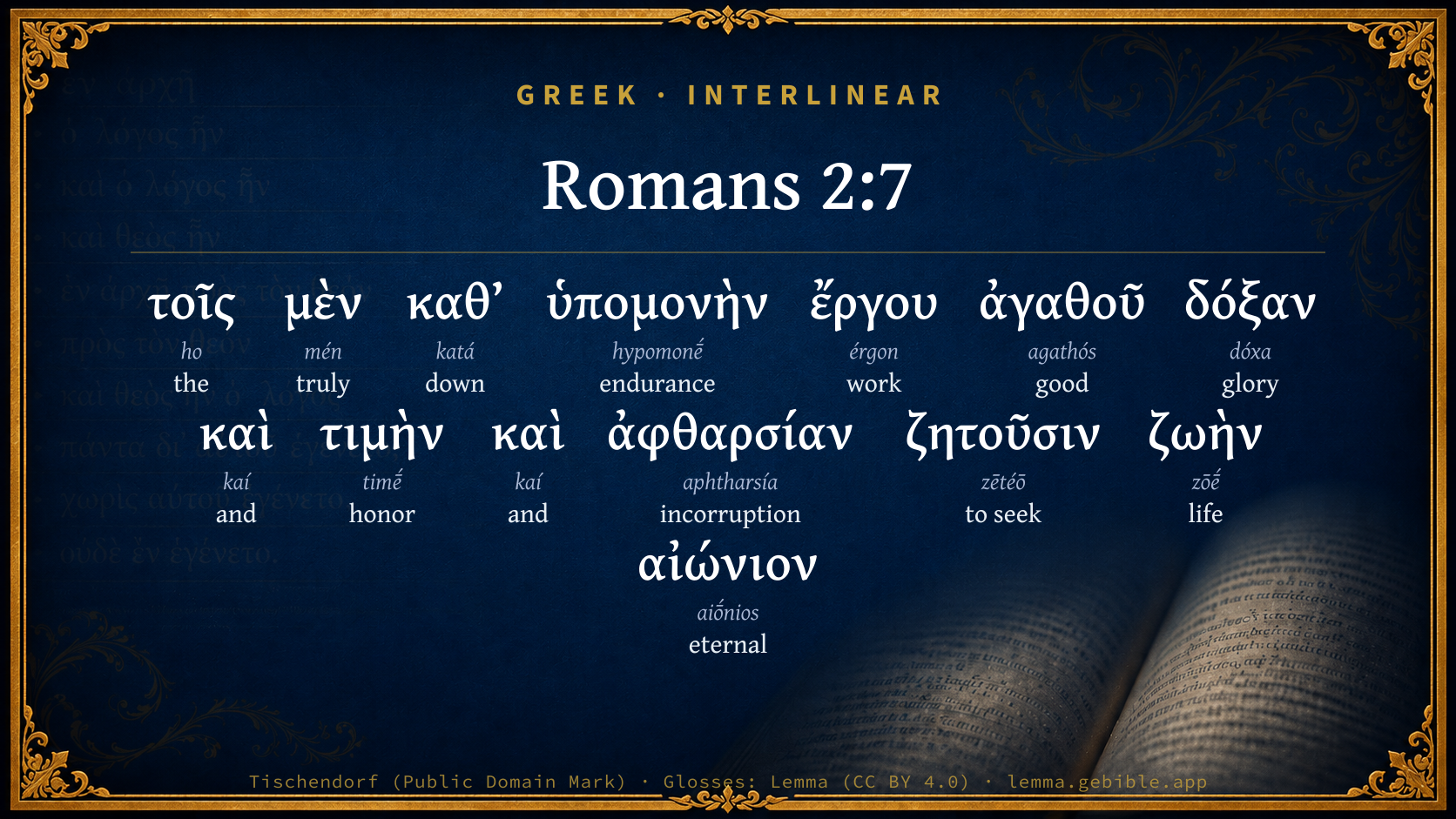
Greek (Tischendorf 8th ed.) Romans 2:7 appears in the Greek New Testament. The text above is from the Tischendorf 8th edition. Each word links to its Strong’s number and a concise gloss. Click any word for its full Thayer’s Greek Lexicon entry.
Download image
Cite this verse

Romans 2:7 (World English Bible). Public Domain. Lemma interlinear Bible study tool, https://lemma.gebible.app/v/romans/2/7.

Show BibTeX & RIS
BibTeX
RIS
English Translation
to those who by patience in well-doing seek for glory and honor and incorruptibility, eternal life;
World English Bible · Public Domain
Highlights
  • 1 first appearance in the Greek New Testament
Full analysis ↓
Download a study sheet

One document with this verse’s original text, its word-by-word gloss line, the meaning frame, cross-references with their text, attributed commentary, and full source and license credits — printable, and it pastes into notes with its structure intact.

This verse Autodidact and up

Study sheet (.html) Plain text (.txt)

A passage Seminary Student

Up to 50 verses in one chapter. A passage sheet keeps up to 6 commentary sources and 12 cross-references per verse, in the order this page ranks them, and says so on the sheet whenever that leaves anything out. Ask for a single verse and you get the Autodidact verse sheet above.

Everything on this page stays free to read, with no account — the sheet is a download of what is already on screen, not access to it.

Want to remove ads? Support Godless Engineer
Compare translations 3

The same verse in 3 English versions, stacked beneath the original-language interlinear above. Click any original word for its lexicon entry.

Each is an independent rendering of the whole verse — the interlinear is not word-aligned to these translations.

Highlighted words mark where these versions differ — a whole-verse word diff, not a word-by-word alignment.

  • World English Bible Public Domain
    to those who by patience in well-doing seek for glory and honor and incorruptibility, eternal life;
  • King James Version Public Domain
    To them who by patient continuance in well doing seek for glory and honour and immortality, eternal life:
  • unfoldingWord Literal Text CC BY-SA 4.0
    Indeed, eternal life to the ones, according to endurance of good work, seeking glory and honor and incorruptibility,

unfoldingWord Literal Text — © unfoldingWord, licensed CC BY-SA 4.0. Word-aligned USFM3 via Door43 (git.door43.org/unfoldingWord/en_ult).

Versions to compare (up to 4)

3 of 4 selected

Show all 19 translations

Every available English version of this verse, each an independent rendering of the whole verse.

  • World English Bible Public Domain
    to those who by patience in well-doing seek for glory and honor and incorruptibility, eternal life;
  • Berean Standard Bible Public Domain
    To those who by perseverance in doing good seek glory, honor, and immortality, He will give eternal life.
  • Majority Standard Bible Public Domain
    To those who by perseverance in doing good seek glory, honor, and immortality, He will give eternal life.
  • King James Version Public Domain
    To them who by patient continuance in well doing seek for glory and honour and immortality, eternal life:
  • American Standard Version (1901) Public Domain
    to them that by patience in well-doing seek for glory and honor and incorruption, eternal life:
  • Revised Version (1885) Public Domain
    to them that by patience in well-doing seek for glory and honour and incorruption, eternal life:
  • Geneva Bible (1599) Public Domain
    That is, to them which through patience in well doing, seeke glorie, and honour, and immortalitie, euerlasting life:
  • Douay-Rheims (1899) Public Domain
    To them indeed, who according to patience in good work, seek glory and honour and incorruption, eternal life:
  • Young's Literal Translation Public Domain
    to those, indeed, who in continuance of a good work, do seek glory, and honour, and incorruptibility -- life age-during;
  • Literal Standard Version CC BY-SA 4.0
    to those, indeed, who in continuance of a good work, seek glory, and honor, and incorruptibility—continuous life;
  • Unlocked Literal Bible CC BY-SA 4.0
    to those who according to consistent, good actions have sought praise, honor, and incorruptibility, he will give eternal life.
  • unfoldingWord Literal Text CC BY-SA 4.0
    Indeed, eternal life to the ones, according to endurance of good work, seeking glory and honor and incorruptibility,
  • Darby Bible Public Domain
    to them who, in patient continuance of good works, seek for glory and honour and incorruptibility, life eternal.
  • World Messianic Bible Public Domain
    to those who by perseverance in well-doing seek for glory, honor, and incorruptibility, eternal life;
  • Webster's Bible Public Domain
    To them who by patient continuance in well-doing, seek for glory, and honor, and immortality; eternal life:
  • Free Bible Version CC BY-SA 4.0
    Those who have kept on trying to do what is good and right will receive glory and honor, immortality and eternal life.
  • Bible in Basic English Public Domain
    To those who go on with good works in the hope of glory and honour and salvation from death, he will give eternal life:
  • Text-Critical English NT CC BY 4.0
    To those who by patient endurance in good works seek glory, honor, and immortality, he will give eternal life;
  • Tyndale New Testament (1534) Public Domain
    that is to saye prayse honoure and immortalite to them which cotinue in good doynge and seke eternall lyfe.

Literal Standard Version (2020), Covenant Press — licensed CC BY-SA 4.0. Text via the HelloAO Bible API (eBible.org). Unlocked Literal Bible (unfoldingWord) — licensed CC BY-SA 4.0. Text via the HelloAO Bible API (eBible.org). unfoldingWord Literal Text — © unfoldingWord, licensed CC BY-SA 4.0. Word-aligned USFM3 via Door43 (git.door43.org/unfoldingWord/en_ult). Free Bible Version, Dr. Jonathan Gallagher — licensed CC BY-SA 4.0. Text via the HelloAO Bible API (eBible.org).

Word by word

More ways to search: Search by grammar → Find every occurrence → Compare this word →

Practice this passage: Drill this verse → Learn its vocabulary →

About this verse

These counts appear in no published source. They are computed here, from the morphology-tagged text and Lemma’s own curated glosses. What Lemma adds →

14
words
13
distinct lemmas
Pauline Epistles
section

Notable vocabulary

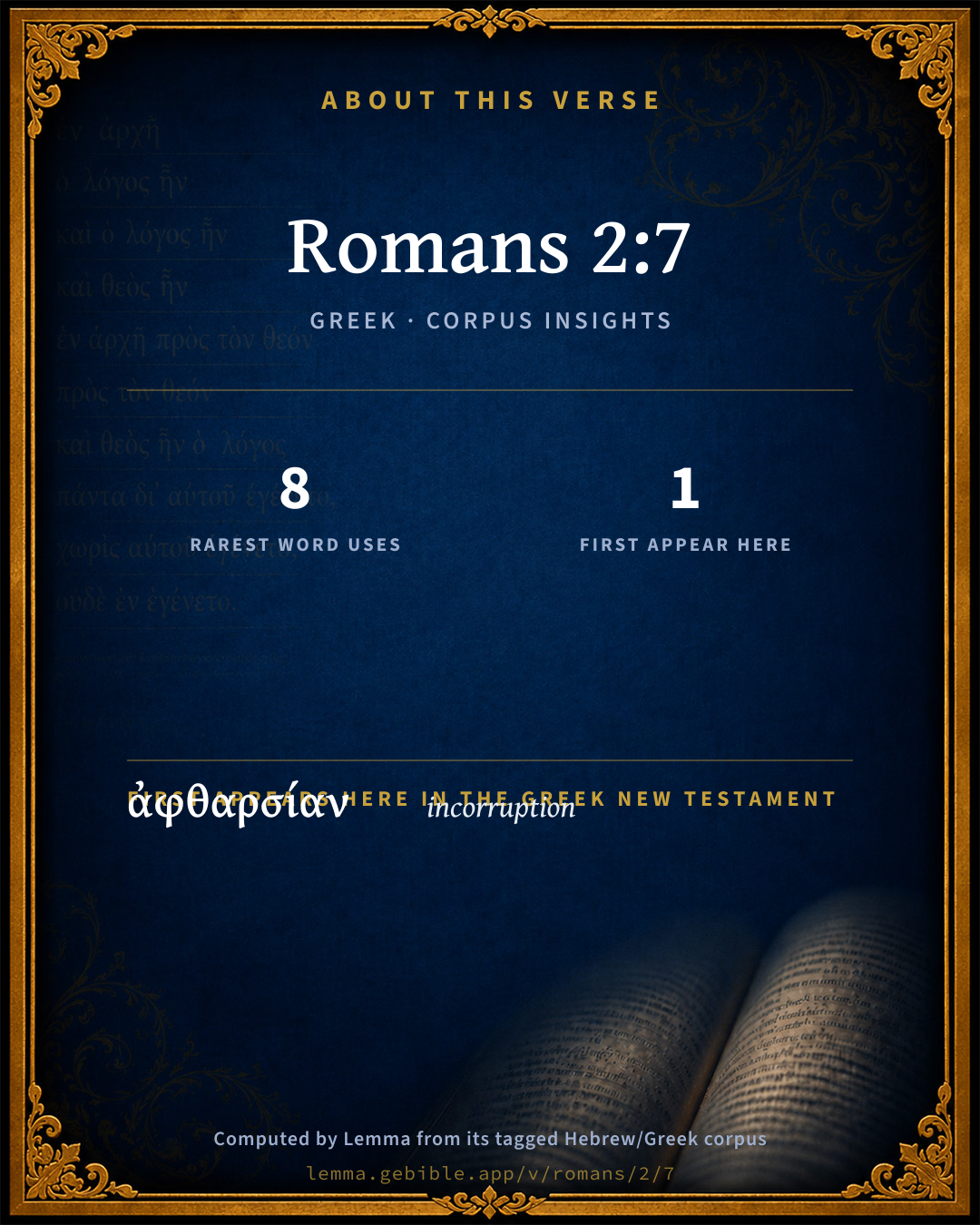
The rarest word here is ἀφθαρσίαν incorruption G861 — appearing just 8 times in the whole Greek New Testament.

First appearance in Scripture

This word makes its first canonical appearance in the Greek New Testament here:

  • ἀφθαρσίαν incorruption G861

Shared distinctive vocabulary

ἀφθαρσίαν incorruption G861 occurs in 8 verses of the Greek New Testament. Also found in:

Repetition

A word recurs within this verse:

Cross-references

29

Topical passages linked to Romans 2:7 in the Treasury of Scripture Knowledge — connected by theme and wording, ordered by reader-vote popularity; previews shown in the World English Bible.

  • 2 Timothy 4:7–8 I have fought the good fight. I have finished the course. I have kept the faith.
  • Luke 8:15 That in the good ground, these are such as in an honest and good heart, having heard the word, hold it tightly, and bring forth fruit with patience.
  • 1 Corinthians 15:58 Therefore, my beloved brothers, be steadfast, immovable, always abounding in the Lord's work, because you know that your labor is not in vain in the Lord.
  • 2 Timothy 1:10 but has now been revealed by the appearing of our Savior, Christ Jesus, who abolished death, and brought life and immortality to light through the Gospel.
  • 1 Peter 1:7–8 that the proof of your faith, which is more precious than gold that perishes even though it is tested by fire, may be found to result in praise, glory, and honor at the revelation of Jesus Christ--
  • Revelation 2:10–11 Don't be afraid of the things which you are about to suffer. Behold, the devil is about to throw some of you into prison, that you may be tested; and you will have oppression for ten days. Be faithful to death, and I will give you the crown of life.
  • Romans 6:23 For the wages of sin is death, but the free gift of God is eternal life in Christ Jesus our Lord.
  • Hebrews 10:35–36 Therefore don't throw away your boldness, which has a great reward.
  • 2 Corinthians 4:16–18 Therefore we don't faint, but though our outward man is decaying, yet our inward man is renewed day by day.
  • James 5:7–8 Be patient therefore, brothers, until the coming of the Lord. Behold, the farmer waits for the precious fruit of the earth, being patient over it, until it receives the early and late rain.
  • Job 17:9 Yet shall the righteous hold on his way. He who has clean hands shall grow stronger and stronger.
  • Galatians 6:9 Let us not be weary in doing good, for we will reap in due season, if we don't give up.
  • Psalms 27:14 Wait for Yahweh. Be strong, and let your heart take courage. Yes, wait for Yahweh.
  • Psalms 37:3 Trust in Yahweh, and do good. Dwell in the land, and enjoy safe pasture.
  • Lamentations 3:25–26 Yahweh is good to those who wait for him, to the soul that seeks him.
  • Matthew 24:12–13 Because iniquity will be multiplied, the love of many will grow cold.
  • Romans 2:10 But glory and honor and peace to every man who works good, to the Jew first, and also to the Greek.
  • Romans 8:18 For I consider that the sufferings of this present time are not worthy to be compared with the glory which will be revealed toward us.
  • 1 Corinthians 15:53–54 For this corruptible must put on incorruption, and this mortal must put on immortality.
  • Colossians 1:27 to whom God was pleased to make known what are the riches of the glory of this mystery among the Gentiles, which is Christ in you, the hope of glory;
  • Psalms 37:34 Wait for Yahweh, and keep his way, And he will exalt you to inherit the land. When the wicked are cut off, you shall see it.
  • John 5:44 How can you believe, who receive glory from one another, and you don't seek the glory that comes from the only God?
  • John 6:66–69 At this, many of his disciples went back, and walked no more with him.
  • Romans 8:24–25 For we were saved in hope, but hope that is seen is not hope. For who hopes for that which he sees?
  • Romans 9:23 and that he might make known the riches of his glory on vessels of mercy, which he prepared beforehand for glory,
  • 1 John 2:25 This is the promise which he promised us, the eternal life.
  • Hebrews 6:12 that you won't be sluggish, but imitators of those who through faith and patience inherited the promises.
  • Hebrews 6:15 Thus, having patiently endured, he obtained the promise.
  • 1 Peter 4:13–14 But because you are partakers of Christ's sufferings, rejoice; that at the revelation of his glory also you may rejoice with exceeding joy.

Cross-references courtesy of OpenBible.info (CC BY 4.0).

Commentary

Notes on Romans 2:7 from classic Christian and Jewish commentators (each source and its license shown beneath its notes). The classic Christian expositions comment on the surrounding passage and are grouped to its opening verse, so a note may address several verses; the Jewish commentaries on the Tanakh (Rashi and others) are per-verse, so they appear only where the commentator wrote on this verse.

Lemma curates 59 commentaries, every one of them public domain or Creative Commons licensed, each selected and text-cleaned for this edition rather than reprinted as found. About our sources →

The Biblical Illustrator

Joseph S. Exell

Rom_2:7-10

To them who by patient continuance in well doing seek for glory and honour and immortality, eternal life.

Contrasts

I. In aim.

II. In conduct.

III. In result. (J. Lyth, D. D.)

Well-doing

I. The supreme duty of life. Well-doing. Man only lives as he is active, and he only lives rightly and happily as he acts well. Well-doing does not mean the well-doing of one faculty, but of all faculties, not in one sphere of life, but in all spheres; it means doing everything from the right principle, supreme love to God.

II. The supreme duty of life requires continuance. Patient continuance. He that does not do well always, at all times, in all circumstances, does not do well at all. A man is either under the sovereignty of the right principle or not. If not, whatever he does is wrong-doing; if he is, whatever he does is right. As a man thinketh in his heart so is he. Hold on to the principle, be ever loyal to it.

III. Continuance in the supreme duty calls for patience. Patient continuance is well-doing. Patience, because there are so many forces that obstruct, so many circumstances that try, so many agencies that are hostile. Resist the devil, etc. (D. Thomas, D. D.)

Well-doing

Good work, as the Greek has it--not works, but lifelong work. Consider this--

I. Negatively. It is not--

1. Well-knowing.

2. Well-promising.

3. Well-professing.

4. Well-abstaining.

II. Positively. It is well-doing; good.

1. As to the matter--prescribed by God and according to His will (Mic_6:8).

2. As to the motive--done for Gods glory and pleasure (1Co_10:31; Col_3:23).

3. As to the manner--carefully, earnestly, heartily (2Co_9:7; Rom_12:11; Col_3:23).

4. As to its essential element--love (Mat_22:37-39; Rom_13:10).

5. As to its example--Christ (1Pe_2:21-23).

III. Relationally. Well-doing is agreeable.

1. To the nature God has given us.

2. To the relation in which we stand to God and our fellow men.

3. To the rule God has given us in Scripture.

Conclusion:

1. Well-doing is the effect of grace alone (Rom_3:12; Eph_2:9).

2. Man is renewed in Christ for this purpose (2Co_5:17; Eph_2:10).

3. Believers are required to abound in it (Col_1:10; 1Ti_6:18).

4. Well-doing alone will be rewarded. Well done thou good and faithful servant. (T. Robinson, D. D.)

Patient continuance in well-doing

As the sun never leaves off shining, though clouds sometimes obscure its light, so we must never cease to do well, even to our enemies and persecutors.

The reward of patient effort

If we look back to the history of efforts which have made great changes, it is astonishing how many of them seemed hopeless to those who looked on at the beginning. Take, e.g., the effort after the unity of Italy. Look into Mazzinis account of his first yearning, when he was a boy, after a restored greatness and new freedom for his country, and of his first efforts as a young man to rouse the same feelings in other young men, and get them to work towards a united nationality. Almost everything seemed against him; his countrymen were ignorant or indifferent, governments hostile, Europe incredulous. Of course the scorners often seemed wise. Yet you see that the prophecy lay with him. (George Eliot.)

Perseverance: its value and effects

It is only by slow stages that we can rear a monument whose proud boast it shall be that it is oere perennius. The constant dropping of water, says one proverb, hollows out the stone, and another that he who goes slowly goes long, and goes far. No work is well done that is done by fits and starts. Steadfast application to a fixed aim is the law of a well-spent life. When Giardini was asked how long it would take to learn the violin, he replied, Twelve hours a day for twenty years. Alas! too many of us think to play our fiddles by a species of inspiration. The Leotards and Blondins--what painful diligence must they have exhibited! The same adherence to a settled purpose might assuredly have made them benefactors of mankind had they been animated by a nobler impulse. In music, take the examples of Malibran and Pasta; in painting, of Titian and Raffaelle; in letters, of Lord Lytton and Carlyle; in science, of Laplace and Faraday; and you will find that the great results which have surrounded their names with imperishable honour, were wrought out by the most wonderful constancy of labour, and the most heroic energy of patience. Nothing can be greater mistake than to suppose that genius dispenses with labour. What genius does is to inspire the soul with a power to persevere in the labour that is needed; but the greater geniuses in every art invariably labour at their art far harder than all others, because their genius shows them the value of such patient labour, and aids them to persist in it. (W. H. D. Adams.)

Good works must be continuous

No grace, no, not the most sparkling and shining grace, can bring a man to heaven of itself without perseverance; not faith (which is the champion of grace), if it be faint and fail; nor love (which is the nurse of grace), if it decline and wax cold; nor humility (which is the adorner and beautifier of grace), if it continue not to the end; not obedience, not repentance, not patience, no, nor any other grace, except they have their perfect work. It is not enough to begin well except we end well. Manasseh and Paul began ill, but ended well; Judas and Demas began well, but ended ill. (T. Brooks.)

The constancy of holiness

Holiness consists not in the rushing of intense resolve, which, like Kishon, sweeps everything before it, and then subsides, but in the constant flow of Siloahs still waters, which perpetually make glad the city of our God. Holiness is no blazing comet, amazing nations with a transient glory; it is a fixed star that, with still, calm radiance, shines on through the darkness of a corrupt age. Holiness is persevering obedience; it is not holiness at all if it be occasional zeal and sensational piety. (C. H. Spurgeon.)

The permanent determination to realise goodness

The notion of patient continuance is emphasised here, not only in opposition to the idea of intermittent moral efforts, but to indicate that there are great moral obstacles to be met on this path, and that a persistent love of goodness is needed to surmount them. The apostle says literally; perseverance in good work. In verse 6 he had used the plural. He now comprehends this multiplicity of works in the profound principle which constitutes their unity--the permanent determination to realise goodness. What supports a man in this course is the good which he has constantly before him: glory, an existence without defilement or weakness, resplendent throughout with the Divine brightness of holiness and power: honour, the approbation of God which forms the eternal honour of its object: incorruptibility, the absolute impossibility of any wound, interruption or end to this state of being. The and between the last two substantives, shows a certain degree of emotion; the accumulation of terms arises from the same cause. In all human conditions there are souls who contemplate the ideal here described, and which, ravished with its beauty, are elevated by it above every earthly ambition and the pursuit of sensual gratifications. These are the men who are represented under the figure of the merchant seeking goodly pearls. For such is the pearl of great price--life eternal! This last word, laden, as it were, with all Divine riches, denotes the realisation of the ideal just described; it worthily closes this magnificent proposition. (Prof. Godet.)

The beatitude of patient courage

I. The ideal Christian life. Patient continuance in well-doing.

1. The feverish ambition which must see its name in the newspaper and be congratulated in public meetings, is in great danger of exhausting its reward before the day of judgment (Mat_6:2-5). Happier far is he who hears with glad surprise the Masters Well done, and finds that the work which was unnoticed on earth was seen and remembered in heaven.

2. Spasmodic effort, brief fervour followed by long languor, wins no enduring honour either in this world or the next. Steady, brave, unremitted work is that which pays best, both here and hereafter. How many teachers have for years toiled on receiving scant recognition on earth, yet day by day preparing for that time when their pound shall have gained ten pounds! There was a teacher at East Grinstead who for fifty-seven years had been present at his post twice every Sunday with few exceptions. He has in his class the grandchildren of those he once taught. He does not remember a single occasion on which he has been late. It would be hard to find a more apt illustration of patient continuance in well-doing.

3. Patient continuance means more than patience, perseverance, endurance. It is heroic patience, strong both to bear and to do, which, like love, beareth all things, believeth all things, hopeth all things, endureth all things and never faileth. There are many short cuts to success in Christian work, but this is the only true way. Let us seek it earnestly, and tread it consistently.

II. The reward.

1. What they seek they win. Eternal glory, the honour that cometh from God, a life that knows no decay, these are the objects of Christian ambition, and they who patiently seek shall find them. God giveth to such eternal life--not simply unending life, but life in all its glorious fulness. This is the end of patient Christian toil.

2. There is way which to the natural man seemeth dull, hard, uninviting, unhonourable, but the end thereof are the ways of life (Pro_14:12). The loftiest end is reached by the lowliest path.

3. Eternal life, with all its unutterable joy and glory, awaits the faithful Christian worker in every field. It is not well to dwell exclusively upon the things that God hath prepared for them that love Him, but it is surely well ever and anon to glance upward for a moment to that crown which the man with the muck rake neither sought nor saw. These things are made known to us, not that we may become careless or boastful, but that we may be strengthened and heartened. (A. E. Gregory.)

High life

I. The grandeur of the aim.

Seek for glory, honour, immortality. What great words these! Some wish to take them out of the vocabulary, and out of human life--they deride such ideas. But we need them, and cannot get on without them. We go into the fields, and there grows a modest simple daisy. But think what a costly flower it is! It owes its shape to the action of the vast terrible law of gravitation working through all the realms of space; to refresh it the ocean must yield its virtue; to vivify it the electrical forces must sweep through the planet; to colour it millions of vibrations must shoot through the light ether; to build it up, unfold it, perfect it, it requires an orb ninety-five millions of miles away, five hundred times bigger than all the planets put together--a million and a half times bigger than the earth itself. Vain little daisy, will not less than this do for you, says the sceptical critic. No; less will not do. So man may seem a poor creature in infidel eyes, but if he is shut out from large ideas and hopes he loses the fulness of life and happiness. Take these words, glory, honour, immortality, out of the vocabulary, and what is the effect on--

1. Character? It is all very well to attempt to shut men up to beef and beer, but we shall never get large, strong, beautiful life out of that. It is certain that where these words have been most laid to heart, the rarest, purest graces have bloomed. Some horticulturists hold that roses grow best on their own roots. I am quite sure that Gods roses grow best so; and whenever they are severed from their own roots, grafted into some wild briar of the wilderness, and planted on secular ground, the moss rose of the garden becomes the dog rose of the hedge. No; you only get noble, tender, pure, beneficent character out of a lofty faith and a glorious hope.

2. Experience? Will the spirit of man be content without these words? No, say the men of the world, but they can find glory, honour, immortality within the worldly life. Can they? Glory means solidity, reality, durability; have they these? Certainly not. According to their philosophy, man is a soap bubble, and, pricked by death, where is he? Honour, have they that? If you take the soul out of man he is but one of the beasts which perish, and social honours are his golden shoes, his jingling bells. Is this honour? Immortality, have they that? Yes, fame. Fame! a deaths head decked with a fading wreath. No, they have not these things, they have only the words. There is no lofty, luminous character, no rich, satisfying experience, except as we recognise our share in the Divine and the eternal. To them who seek glory, honour, immortality, eternal life. God goes beyond our utmost ideas. In the lips of men these words shrink to nothing, but God fills them to overflowing with glorious meaning. Aim at the highest. When a great ideal slips out of a mans soul he begins to rot; only as he cherishes grand thoughts does he find rest to his soul, and come to the stature of a perfect man.

II. The simplicity of the pathway. By patient continuance in well-doing. There is something quite startling between the aim and the condition. Well-doing. Men have sought glory, etc. in many strange paths, but the true plain path is here--well-doing. Not brilliant doing in trade, war, scholarship, but well-doing. Doing the work of life with a willing mind, a loving heart, with both hands earnestly--diligence in getting good, being good, doing good. In this world all the grand prizes go to a few brilliant people. It was so at school. The brilliant boys carried off the prizes. It is the same in the big world, which likes genius, brilliance, audacity. But what a blessing it is to us, the dim million, to know that God recognises patient merit, and that the grandest prizes of all are kept not for the brilliant, but for the faithful. God recognises--

1. The greatness of simple character. We are apt to overlook great character in humble guise, but God does not. We look at the outward appearance, but God looks on the heart. I do not want anybody to tell me about the man who spoke prose for forty years without knowing it. Scores of men speak poetry for forty years without knowing it, nay, act splendid poetry without knowing it, and God shall surprise them with a splendid reward. Then shall the righteous answer Him, saying, Lord, when saw we Thee an hungered, etc. Thousands of lowly men think but little of themselves and their doings, but God knows their measure and shall surprise them with glory, honour, immortality beyond their most glowing dream.

2. The greatness of simple duty. The cynic loves to show how mean splendid things are when critically examined. Such substances as clay and flint form the basis of nearly all the precious stones. But so far from showing the meanness of magnificence, he shows the magnificence of meanness. So men of a certain temper love to show how all the business of life is vulgar and insignificant; but if our daily tasks are viewed in regard to the will of God, the fashioning of our character and destiny, they are solemn and momentous. Angels and shopkeepers, archangels and manufacturers, belong to the same celestial hierarchy as they stand before Gods face and do His bidding. There is no difference, for God is no respecter of persons.

3. The greatness of simple suffering. One of our writers said the world just now wants heroes. It altogether depends what kind of heroes they are. Some of these make a great stir for small advantage. The most illustrious of heroes are often those of obscure life. All around us simple people bear uncomplainingly the most bitter suffering; nobly resist the most terrible temptation; sustain with silence the heaviest burdens. Gordon flashed a splendid figure on the imagination of the world, but there are many Gordons unknown to fame, but who are known to God, and shall not lose their appropriate reward. Conclusion: Let us be content with our place and work however coarse and common. If we cannot be flowers of the garden, of the aristocracy of flowers, let us be flowers of the grass, very beautiful in the eyes of Him who makes the grass to grow upon the mountains. It is not in brilliance that we shall be saved, but by pegging away in simple, honest work. But let us feed our soul with high beliefs and hopes. Let us talk to ourselves all the day long about glory, honour, immortality, eternal life; so shall our path of life, however lowly, be a royal pathway, brighter and brighter, to a perfect day! (W. L. Watkinson.)

The Christians great aim

I. The object of the Christians pursuit. A triple crown--a crown of glory and honour and immortality. But does not this reduce their virtue to a thing of hollow utility? No; as will appear if we consider their motive, which is that they may east their crowns at Jesus feet. They seek--

1. A glorious position--glory, majesty. The inhabitants of heaven are all glorious within, and all glorious without.

2. The highest praise, honour. Courtiers have spent years to insinuate themselves into the favour of their king; while vast numbers have not spent an hour in seeking the smile of God. And yet to have the approbation of the highest potentate of earth, is nothing compared with the approbation of the King of Glory.

3. To hold this position and this praise in perpetual possession. There is here a contrast between the things of earth and of heaven. Here, the leaf must wither and the flower must die; there, the leaf is evergreen and the flower amaranthine.

II. The means employed to obtain this object.

1. There is the performance of good works. This universe is an infinite conjugation of the verb to do. And it is either conjugated ill or well. By the Christian, it is conjugated well.

2. The patient performance of good works. Good doing in this world is climbing the steep, often with bleeding feet. Hence, Christians require the Divine virtue of patience; and patience is true heroism.

3. Perseverance in the performance of good works. Our life must resemble the sun in his commencement, continued course, and consummation. We must travel onward and upward to the perfect day of knowledge, of purity, of joy.

III. The object obtained by the means employed. Those who seek in the way described not only find what they seek, but much more--eternal life. This life is--

1. Pure.

2. Progressive.

3. Permanent. (J. Dunlop.)

Seeking for glory, honour, and immortality

How?

1. As one who feels the want of those blessings (Luk_15:14; Ecc_1:2; Jer_2:13).

2. As one who discerns their surpassing excellence and worth (Mat_13:44; Php_3:7-8).

3. As one who is willing to strive for them in the appointed and proper way, and to accept them upon the terms offered (2Ti_2:5; Isa_55:1).

4. As one who is prepared to make any self-sacrifice, brave all dangers and oppositions, and never to be deterred by failure (Act_21:13). (C. Neil, M. A.)

Glory,

or splendour, is here as often elsewhere in Scripture, specified as the distinguishing characteristic of that celestial state in which the holy find their everlasting award. Then shall the righteous shine forth as the sun in the kingdom of their Father (Mat_13:43; cf. Rom_5:2; Rom_9:23; Eph_1:18; 1Ti_3:16; 2Ti_2:10; Heb_2:10; 1Pe_5:1; 1Pe_5:4; 1Pe_5:10). On earth the righteous may have their lot in the midst of the mean accompaniments of poverty. In heaven everything around as well as within them will be lustrous and glorious. (J. Morison, D. D.)

Honour

This is another fold of the manifold excellency of the heavenly state. It is kindred to glory. Its idea, however, has more of relativity about it. One may be absolutely glorious. God from everlasting was so. But one can have honour only when others esteem and prize and praise. Hence the connection of the Greek word (τιμή) with price (see 1Co_6:20; 1Co_7:23; Mat_27:6; and compare the German preis, and the English prize and praise.) Relative honour as well as essential glory awaits the holy. They will bask in the Fathers approbation and complacency. Angels will rejoice in their companionship. They will be kings unto God, and will reign with Christ (Rev_5:10). (J. Morison, D. D.)

Immortality

naturally looks back to glory and honour, and contrasts the permanence of the celestial with the fleeting shadows of the terrestrial. The inheritance is incorruptible. The diadem that encircles the brows of the glorified heirs is amaranthine. It fadeth not away. (J. Morison, D. D.)

Labouring for eternity

There, exclaimed an artist, on finishing a perishable work on perishable material, it is done!--and it has been thirty years in doing! We labour for eternity; and shall we think a life long to devote to endless results? (A. Reed, D. D.)

Working for eternity

Apelles, the Grecian painters when asked why he touched and retouched his pictures with so much care, answered, Because I paint for eternity.

But unto them that are contentious, and do not obey the truth, but obey unrighteousness, indignation, and wrath.--

Factiousness and its punishment

I. The character described.

1. Factious.

(1) The expression is literally those who are of a factious spirit. Descent or parentage is suggested as in him who is of faith, them who are of the circumcision (cf. also Gal_4:10; Joh_18:37)

, and in children of light, etc. (Eph_2:2-3; Eph_5:8; 1Pe_1:14; 2Th_2:3). In all such expressions the outstanding idea derived from the universally recognised law of like begetting like, is that of predominant characteristic.

(2) The word itself denotes a spirit of faction, but always with a vile implication of interested and selfish aims. The apostles reference, therefore, is not to mere political sectarianism, or national bigotry. His mind has before it the conception of Gods vast moral empire. Faction in it is opposition to the monarch of the universe; opposition that springs from a base desire to gratify the lower principles of the nature. It is in fact a covert kind of rebellion; only it is rebellion animated by the most ignoble aims.

2. The factious are disobedient to the truth. Such, indeed, is implied in their factiousness. The truth is personified as a lady or mistress who ought to be obeyed. The truth is disobeyed when there is a wilful refusal to have the life, at once in its inner thoughts and feelings, and in its outer acts, conformed to the rule which it embodies. The rule is imperative. For moral, religious, evangelical truth is revealed just in order that the living mind may live in conformity with it, and thus in consonance with the will of Him whose voice truth is.

3. The factious while disobedient to the truth are obedient to unrighteousness--the counterpart idea which is the complement of the preceding clause. The lawful sovereign of the soul being disobeyed, subjection is transferred to a usurpers sway. Unrighteousness has doubtless its usual import as the antithesis of moral rectitude, and is not to be regarded as doctrinal error. It is the case, however, that just as the truth received is the kernel of that of righteousness, without which no one can be meet to enter into the kingdom of heaven; so unrighteousness is a husk within which will be found the primal seed of error.

II. Its punishment.

1. Wrath and indignation from God. The one word reverberates on the other. The two are an intensification of the idea of each.

2. The suffering of tribulation and anguish. (J. Morison, D. D.)

The mercenary spirit

Contentions is mistranslated on the supposition that it has something to do with ἐρις--strife--whereas it comes from ἔριθος, a day labourer, a hireling. The word ἐριθεία is used of those who canvass for office, and form cabals and parties to accomplish their ends. Hence, in the largest sense it will signify those who labour for their own private and selfish ends; and it is remarkable that this should be contrasted with the patient continuance in well-doing, as containing in itself every form of evil. The words would be properly translated, those who are of a mercenary spirit. (Bp. Thirlwall.)

Obedience to unrighteousness, i.e.,

revolting against what is good, and becoming slaves to what is evil. Here a striking contrast is indicated between that contentious spirit which disobeys the truth, and yet obeys unrighteousness. The one denotes an extraordinary haughtiness, and an exceeding boldness, and the other extreme meanness and servility of soul. They who do not choose to serve God as their legitimate sovereign become the slaves of a master who is both a tyrant and usurper. (R. Haldane.)

Indignation and wrath

mark the greatness of Gods anger proportioned--

1. To the dignity of the Sovereign Judge of the world.

2. To the authority of those eternal laws which have been violated.

3. To the favours which sinners have received.

4. To the unworthiness and meanness of sin. (R. Haldane.)

Tribulation and anguish upon every soul of man that doeth evil.--

Tribulation and anguish

Tribulation means pressure, which, when extreme, as in various modes of torture, causes excruciating pain. Anguish means straitened room--straits--the source of utter despair and ruin when one is pursued by an invincible antagonist. The latter is stronger than the former (cf. 2Co_4:8)

--in every way troubled and hard pressed, but not reduced to absolute straits. Here the one term simply intensifies the other; and the two in union are a representation of the award of woe which hangs over the persistently wicked. They represent the award as it terminates in the persons judged; whereas indignation and wrath represent it as it emanates from the Judge. (J. Morison, D. D.)

The punishment of sin

I. Its nature.

1. Tribulation. By--

(1) Exclusion from Gods presence and the bliss of heaven.

(2) Confinement to the society of the devil, his angels, and wicked men.

(3) The absence of all that can afford comfort and pleasure.

(4) The presence of all that can occasion misery. Outer darkness: furnace and lake of fire; undying worm; bottomless pit, are its emblems.

2. Anguish. From--

(1) Experience of Gods anger.

(2) Sense of abhorrence of all holy beings.

(3) Consciousness of moral loathsomeness and corruption.

(4) Working of uncontrolled passions and ungratified desires.

(5) Sense of all being self-caused and justly deserved.

(6) Inability to escape or obtain mitigation.

(7) Knowledge that all is everlasting.

II. Its characteristics.

1. Universality. Every soul that doeth evil.

2. Suitability. The soul--

(1) The chief seat of suffering as the chief agent in sinning.

(2) Especially capable of realising the Divine anger.

3. Impartiality. The Jew first and also the Gentile. (T. Robinson, D. D.)

The retribution of sin mercifully revealed

I do not accept the doctrine of eternal punishment because I delight in it. I would cast in doubts, if I could, till I had filled hell up to the brim. I would destroy all faith in it, but that would do me no good; I could not destroy the thing. I cannot alter the stern fact. The exposition of future punishment in Gods Word is not to be regarded as a threat, but as a merciful declaration. If, in the ocean of life, over which we are bound to eternity, there are these rocks and shoals, it is no cruelty to chart them down; it is an eminent and prominent mercy. (H. W. Beecher.)

The law of consequences

After a service in a place where the people had been a good deal bewildered by a young preacher, who accepted only so much of the Bible as suited his whims, and who was wont to make merry over the idea of future punishment, a man stepped up to me and said in a bantering voice: Bishop, do you believe in hell? I said, Are you anxious to know what I think of hell? Yes, said he. Well, said I, the best answer I ever heard came from a poor negro woman. She had a young niece, who sorely tried the poor soul. The more she struggled to keep this wilful charge in the right way the more she seemed to wander. One day, after hearing a new preacher, the niece came bounding into the room and said: Aunty, I aint gwine to believe in a hell no more. Ef dar is any hell, I jest wants to know where dey gets all de brimstone for dat place; dats zactly what I would like to know. The old woman fixed her eyes on her, and with a tear on her cheek, said: Ah, honey darlin, you look out you dont go dere, for youll find dey takes dere own brimstone wid em. I then said, Is there any other question in theology you would like to ask? No, said he. And he went home, I hope, with a new idea that sin brings sorrow and that to be saved we need deliverance from sin. Some men carry their own brimstone even in this world. (Bp. Whipple.)

The end of sinful pleasures

Be assured, a serpent lurks at the bottom of guilts sweetest pleasure. (T. Guthrie, D. D.)

But glory and honour and peace to every man that worketh good.--

Glory, honour and peace

This is the echo of verse 7. Peace is added in contrast to anguish. He who is pursued by an antagonist with whom he cannot cope in strength, he who while thus pursued, finds himself shut in within some strait place, either on land or sea, can have no repose of spirit. But in heaven there are no foes to pursue, and no straits into which to he pursued. Honour and glory shall be enjoyed in uninterrupted peace. On earth, says Chrysostom, whatever good things a man has, he has with many troubles, even though he be rich and powerful, or even a king. Although, too, he may have no dissensions with others, he has them often with himself: there is war within his own thought. But in heaven all is reversed. There is calmness and freedom from trouble, and genuine peace. (J. Morison, D. D.)

The blessings God has in store

I. Their nature.

1. Glory.

2. Honour.

3. Peace.

II. Their objects. Those who work good.

III. Their impartiality. (J. Lyth, D. D.)

The glory of heaven

We know not, and never shall know until experience strips the bandages from our eyes, what new methods of participation of the Divine nature, and new possibilities of intimacy and intercourse with Him may be ours when the veils of flesh and sense and time have all dropped away. New windows may he opened in our spirits, from which we shall perceive new aspects of the Divine character. New doors may be opened in our seals, from out of which we may pass to touch parts of His nature, all impalpable and inconceivable to us now. And when all the veils of a discordant moral nature are taken away, and we are pure, then we shall see, then we shall draw nigh to God. The thing that chiefly separates man from God is mans sin. When that is removed, the centrifugal force which kept our tiny orb apart from the great central sun being withdrawn, we shall, as it were, fall into the brightness and be one, not losing our sense of individuality which would be to lose all the blessedness, but united with Him in a union far more intimate than earth can parallel. (A. Maclaren.)

The glory of heaven

The glory of heaven is such that it can never be fully known till it is fully enjoyed. And yet if heaven were ever made crystally transparent to you, if ever God opened you a window into it, and then the eyes of your faith to look in by that window, think what it is that you there discovered, what inaccessible light, what cherishing love, what daunting majesty, what infinite purity, what overloading joy, what insupportable and sinking glory, what rays and sparklings from crowns and sceptres; but more from the glances and smiles of God upon the heavenly host, who forever warm and sun themselves in his presence; and when you have thought all this, then think once again that all your thoughts are but shadows and glimmerings, that these are dust and ashes in the eye of your faith that makes all these discoveries come infinitely short of the native glory of these things, and then you may guess, and somewhat near, what heaven is. (Bp. Hopkins.)

The Biblical Illustrator, edited by Joseph S. Exell (c. 1880s–1900s) — public domain. Text from a community e-Sword module.

Tyndale Open Study Notes

Tyndale Open Resources

2:7 He will give eternal life to those who keep on doing good: Paul makes it clear elsewhere that no one can receive eternal life except as God’s gift through faith (3:20, 28; 4:1-8). Here, Paul is either referring to Christians whose good deeds (that result from faith) will be taken into account in God’s judgment, or he is reminding readers of the absolute standard that God’s own holiness establishes, since only by perfection can sinners hope to find acceptance before God. As the argument of the letter unfolds, Paul will show that no one is capable of meeting that standard.

Tyndale Open Study Notes — © Tyndale Open Resources, licensed CC BY-SA 4.0. Text via the HelloAO Bible API.

Bengel's Gnomon

Johann Albrecht Bengel

Rom 2:7. Τοῖς) sc. οὖσι; comp. the following verse; for κατὰ (see Act 25:23,) is employed here nearly in the same sense as ἐξ, next verse; save that ἐξ implies a something natural to the sinner; κατὰ, a something supervenient [not natural, but super-induced]. You will see the difference, if you interchange the particles with one another: ἐξ ὑπομονῆς κτλ. In this view, τοῖς and ζητοῦσι stand in apposition, the conjunction being omitted by the figure asyndeton.[26]—ὑπομονὴν ἔργου, patience in work) so the patience of hope, 1Th 1:3; ὑπομονὴ, patience, includes, in this passage, obedience, steadiness, and that, too, with submission.—ἔργου, in work. There is great force in the singular number here (well-doing.—Engl. Vers.; the good work is referred to, of which), Php 1:6; Rev 22:12.—δόξαν, glory) The construction is, τοῖς δόξαν κτλ ζητοῦσιν (ἀποδώσει) ζωήν, to those who seek for glory, etc. (he will render) life. Pure love does not exclude faith, hope, desire, 1Co 15:58.—ζητοῦσι, to them that seek) Whereas thou, O Jew, thinkest, that thou hast no need of any seeking [Industry is requisite.—V. g.]

[26] Beng. construes it “to them who are animated by (κατά) patient continuance in well-doing, even those who seek glory, etc.—ED.]

Rom 2:7-8. Τοῖς μὲν—τοῖς δέ, to these on the one hand—but to them on the other) a more important distinction, than many now think.

Bengel's Gnomon of the New Testament — English translation (T&T Clark, Edinburgh, 1860) — public domain. Text from a community e-Sword module.

Meyer's Critical & Exegetical Commentary

Heinrich August Wilhelm Meyer

Rom_2:7. To those, who by virtue of perseverance in morally-good work seek to obtain glory and honour and immortality, eternal life sc[611] ἀποδώσει. Consequently ΚΑΘʼ ὙΠΟΜ. ἜΡΓΟΥ ἈΓΑΘ. contains the standard, the regulative principle, by which the seeking after glory, honour, etc. is guided, and ἜΡΓΟΥ ἈΓΑΘΟῦ,[612] which is not with Beza to be connected with ΔΌΞΑΝ, is the genitive of the object to which the ὙΠΟΜΟΝΉ refers (1Th_1:3; Polyb. iv. 51, 1; Theophr. Char. 6, 1); while δόξαν κ. τιμὴν κ. ἀφθαρσ. is an exhaustive description of the future salvation according to its glorious appearing (2Co_4:17; Mat_13:43), according to the honour united with it (for it is the prize of victory, 1Co_9:25; Php_3:14; 2Ti_4:8; Jam_1:12; 1Pe_5:4, the joint heirship with Christ, Rom_8:17, the reigning along with Him, 2Ti_2:12), and according to its imperishableness (1Co_15:52 ff.; Rev_21:4; 1Pe_1:4). Paul presents the moral effort under a character thus specifically Christian, just because he can attribute it only to Christian Jews and Gentiles; and hence he is only able to give his description of this first half of the subjects of future judgment, notwithstanding the generality of his language, in the Christian form, in which alone it really takes place. In keeping with this is also the ζωὴν αἰώνιον, i.e. eternal life in the kingdom of the Messiah, Rom_5:21, Rom_6:22 f.; Gal_6:8. The above construction of the words is already followed by Theophilus, a[613] Autol. i. 20, ed. Wolf, and by most expositors, including Tholuck, Rückert, Köllner, de Wette, Olshausen, Philippi, Maier, van Hengel, Umbreit. The objection raised against it by Reiche and Hofmann, that according to the analogy of Rom_2:6 καθʼ ὑπομ. ἔργ. ἀγ. must contain the standard of the ἈΠΟΔΏΣΕΙ, and cannot therefore belong to ΖΗΤΟῦΣΙ, is untenable, because ΚΑΘʼ ὙΠΟΜ. ἜΡΓ. ἈΓ., though attached to ΖΗΤΟῦΣΙ, nevertheless does contain (indirectly) the standard of ἈΠΟΔΏΣΕΙ; so that there remains only an immaterial difference, which however is in fact very consonant to the lively versatility of the Apostles thought. Still less weight attaches to the objection, that to seek glory and honour is not in itself a praiseworthy thing; for the moral tenor of the ζητεῖν δόξαν Κ.Τ.Λ[614] (comp Mat_6:33; Joh_5:44) is most definitely assured by καθʼ ὑπομ. ἔργ. ἀγ. Utterly unfounded, in fine, is the objection of clumsiness (Hofmann); the symmetrical fulness of Rom_2:7-8, has a certain solemnity about it. Reiche and Hofmann, following Oecumenius,[616] Estius, and others, arrange it so that to ΔΌΞΑΝ Κ. ΤΙΜ. Κ. ἈΦΘΑΡΣΊΑΝ they supply ἈΠΟΔΏΣΕΙ, whilst ΖΗΤΟῦΣΙ is to be combined with ΖΩῊΝ ΑἸΏΝ. and regarded as an apposition or (Hofmann) reason assigned to ΤΟῖς ΜΈΝ, and ΚΑΘʼ ὙΠΟΜ. ἜΡΓ. ἈΓ. is the standard of ἈΠΟΔΏΣΕΙ. Substantially so also Ewald. No syntactic objection can be urged against this rendering; but how tamely and heavily is the ΖΗΤΟῦΣΙ ΖΩῊΝ ΑἸΏΝ. subjoined! Paul would have written clearly, emphatically, and in harmony with the contrast in Rom_2:8 : ΤΟῖς.… ἈΓΑΘΟῦ ΖΩῊΝ ΑἸ. ΖΗΤΟῦΣΙ ΔΌΞΑΝ Κ. ΤΙΜ. Κ. ἈΦΘ.

[611] c. scilicet.

[612] The singular without the article indicates the thing in abstracto; the rule is for every given case: perseverance in good work. The idea that the work of redemption is referred to (Mehring, in accordance with Php_1:6), so that ὑπομ. ἔργ. ἀγ., would be equivalent to ὑπακοὴ πίστεως, ought to have been precluded by the parallel in ver. 10. Comp. ver. 2.

[613] d refers to the note of the commentator or editor named on the particular passage.

[614] .τ.λ. καὶ τὰ λοιπά.

[616] Τὸ ὑπερβατὸν οὕτω τακτέον· τοῖς καθʼ ὑπομονὴν ἔργου ἀγαθοῦ ζητοῦσι ζωὴν αἰώνιον, ἀποδώσει δόξαν καὶ.… ἀφθαρσίαν. But there is no ground whatever for the assumption of a hyperbaton, in which Luther also has entangled himself. Very harshly Bengel, Fritzsche, and Krehl separate τοῖς καθʼ ὑπομον. ἔργου ἀγ. from what follows, and supply οὖσι; and then take δόξαν.… ζητοῦσι as apposition to τοῖς.… ἔργου, but make ζωὴν αἰ. likewise dependent on ἀποδώσει.

Meyer — Critical and Exegetical Commentary on the New Testament — English translation by Peter Christie, edited by Frederick Crombie (T&T Clark, 1880) — public domain. Text from a community e-Sword module.

Expositor's Greek Testament

ed. W. Robertson Nicoll

Rom 2:7 . καθʼ ὑπομονὴν ἔργου ἀγαθοῦ : cf. the collective ἔργον “life-work”: S. and H. in Rom 2:15 : “by way of stedfastness in well-doing”. δόξαν = the glory of the future life, as revealed in the Risen Saviour. τιμήν = honour with God. ἀφθαρσίαν “proves that the goal of effort is nothing earthly” (Lipsius). ζωὴ αἰώνιος comprehends all these three: as its counterpart, θάνατος in Rom 2:32 , involves the loss of all. ζωὴν is governed by ἀποδώσει .

The Expositor's Greek Testament, edited by W. Robertson Nicoll (1897–1910) — public domain. Text from a community e-Sword module.

Godet's Commentaries

Frédéric Louis Godet

Vv. 7, 8. “To them who, by patient continuance in well-doing, seek for glory and honor and immortality, [to such] eternal life: but for them that are contentious, and do not obey the truth, but obey unrighteousness, [for such] wrath and indignation!”

The Jews divided men into circumcised, and consequently saved, and uncircumcised, and consequently damned. Here is a new classification, which Paul substitutes, founded solely on the moral aim.

There are two principal ways of construing Rom 2:7. Sometimes the three words: glory, honor, immortality, are made the objects of the verb: will render (Rom 2:6), understood. The phrase: patient continuance in well-doing, is thus taken to qualify the pronoun τοῖς μέν, to them, and the last words: ζητοῦσιν κ.τ.λ., become merely an explanatory appendix: “to wit, to them who seek eternal life.” The meaning of the verse thus taken is: “to them who live in patient continuance in well-doing [He will render] glory and honor and immortality, [to wit, to those] who seek eternal life.” But this construction is very forced. 1. The subordinate clause: “in continuance,” is rather the qualification of a verb than of a pronoun like τοῖς μέν. 2. The participle ζητοῦσι would require the article τοῖς, and would make a clumsy and superfluous appendix. The construction, as given in our translation, is much more simple and significant. The regimen καθ᾿ ὑπομονήν, literally, according to the standard of patient continuance in well-doing, corresponds with the seek, on which it depends; seeking must be in a certain line. And the weighty word eternal life, at the close of this long sentence, depicts, as it were, the final and glorious issue of this long and laborious practice of goodness. This accusative is the object of the verb: will render, understood (Rom 2:6).

The notion of patient continuance is emphasized here, not only in opposition to the idea of intermittent moral efforts, but to indicate that there are great moral obstacles to be met on this path, and that a persistent love of goodness is needed to surmount them. The apostle says literally: perseverance in good work. In Rom 2:6 he had used the plural works. He now comprehends this multiplicity of works in the profound principle which constitutes their unity, the permanent determination to realize goodness. What supports a man in this course is the goal which he has constantly before him: glory, an existence without defilement or weakness, resplendent throughout with the divine brightness of holiness and power; honor, the approbation of God, which forms the eternal honor of its object; immortality (incorruptibility), the absolute impossibility of any wound or interruption or end to this state of being. The ands, καί, before the last two substantives, show a certain degree of emotion; the accumulation of terms arises from the same cause. In all human conditions there are souls which contemplate the ideal here described, and which, ravished with its beauty, are elevated by it above every earthly ambition and the pursuit of sensual gratifications. These are the men who are represented under the figure of the merchant seeking goodly pearls. For such is the pearl of great price, life eternal! This last word, laden as it were with all divine riches, denotes the realization of the ideal just described; it worthily closes this magnificent proposition.

But is it asked again, where, in this description of a normal human life, are faith and salvation by the gospel to be found? Does Paul then preach salvation by the work of man? The apostle has not to do here with the means whereby we can really attain to well-doing; he merely affirms that no one will be saved apart from the doing of good, and he assumes that the man who is animated with this persistent desire will not fail, some time or other, in the journey of life, to meet with the means of attaining an end so holy and glorious. This means is faith in the gospel—a truth which Paul reserves for proof at a later stage. “He that doeth truth,” said Jesus to the same effect, “cometh to the light,” as soon as it is presented to him (Joh 3:21; comp. Rom 7:17). The love of goodness, which is the spring of his life, will then lead him to embrace Christ, the ideal of goodness; and, having embraced Him, he will find in Him the triumphant power for well-doing of which he was in quest. The desire of goodness is the acceptance of the gospel by anticipation. The natural corollary of these premisses is the thought expressed by Peter: the preaching of the gospel before the judgment to every human soul, either in this life or in the next (1Pe 3:19-20; 1Pe 4:6). Comp. Mat 12:31-32. And if the apostle has spoken of patient continuance in this pursuit, it is because he is well aware of that power of self-mastery which is needed, especially in a Jew, to break with his nation, and family, and all his past, and to remain faithful to the end to the supreme love of goodness.

The other class of men is described Rom 2:8. The regimen ἐξ ἐριθείας can without difficulty serve to qualify the pronoun τοῖς δέ; comp. the construction ὁ or οἱ ἐκ πίστεως, Rom 3:26; Gal 3:7. The meaning is: “but for those who are under the dominion of the spirit of contention.”

The word ἐριθεία, contention, does not come, as has been often thought, from ἔρις, disputation, but, as Fritzsche has proved, from ἔριθος, mercenary; whence the verb ἐριθεύειν, “to work for wages,” then, “to put oneself at the service of a party.” The substantive ἐριθεία therefore denotes the spirit which seeks the victory of the party which one has espoused from self-interest, in contrast to the spirit which seeks the possession of the truth. Paul knew well from experience the tendency of Rabbinical discussions, and he characterizes it by a single word. The term truth is here used abstractly; but Paul has, nevertheless, in view the concrete realization of this notion in the gospel revelation. Unrighteousness, which he contrasts with truth (exactly as Jesus does, Joh 7:18), denotes the selfish passions, vain ambitions, and unrighteous prejudices, which lead a man to close his eyes to the light when it presents itself, and thus produce unbelief. Unrighteousness leads to this result as certainly as moral integrity leads to faith. Jesus develops precisely the same thought, Joh 3:19-20. The words wrath and indignation, which express the wages earned by such conduct, are in the nominative in Greek, not in the accusative, like the word eternal life (Rom 2:7). They are not, therefore, the object of the verb will render, which is too remote. We must make them either the subject of a verb understood (ἔσται, will be, there will be), or, better still, an exclamation: “for them, wrath!” The three Byz. Mjj. follow the psychological order, “indignation and wrath!” First the internal emotion (indignation), then the external manifestation (wrath); but the other two families present the inverse order, and rightly so. For what is first perceived is the manifestation; then we pass upward to the feeling which inspires it, and which gives it all its gravity. Θυμός is the emotion of the soul; ὀργή comprehends look, sentence, chastisement.

Why does the apostle once again repeat this contrast of Rom 2:7-8 in Rom 2:9-10? Obviously with the view of now adding to each term of the contrast the words: to the Jew first, and also to the Greek, which expressly efface the false line of demarkation drawn by Jewish theology.

Frédéric Louis Godet — Commentaries on Luke, John, Romans, and 1 Corinthians — English translation (T&T Clark, Edinburgh, 1870s–1890s) — public domain. Text from a community e-Sword module.

Hodge's Commentary on Romans, Ephesians & First Corinthians

Charles Hodge

Rom_2:7-8

The principle laid down in Rom_2:6, is here amplified. God will render eternal life to the good, indignation and wrath to the wicked, without distinction of persons; to the Jews no less than to the Gentiles. Though the sense of these verses is plain, there is great difference of opinion as to the grammatical construction. The explanation adopted by our translators is perhaps the most natural, and is the one which is most generally followed. To the verb ἀποδώσει of Rom_2:6, belong the two accusatives ζωὴν αἰώνιον, and θυμὸν καὶ ὁργήν and the two datives, τοῖς μὲν ζητοῦσι and τοῖς δὲ ἐξ ἐριθείας. The accusatives δόξαν καὶ τιμὴν καὶ ἀφθαρσίαν then of course depend on ζητοῦσι, and καθ ̓ ὑπομονὴν ἔργου ἀγαθοῦ is an adverbial qualification. The passage then reads: To those who through perseverance in good works, seek glory, honor, and immortality, eternal life; but to those who are contentious, indignation and wrath. Another construction, adopted by Bengel, Fritzsche, and others, supposes that τοῖς μὲν καθ ̓ ὑπομονὴν ἔργου ἀγαθοῦ (scil. οὖσι) are to be taken together, to those who are according to perseverance, i.e., to those who persevere; (comp. οἱ κατὰ σάρκα, οἱ σαρκικοί, and οἱ κατὰ Πνεῦμα, οἱ πνευματικοί). The following clause, δόξαν ζητοῦσι, is then in apposition with the preceding: To those who persevere in good works, seeking glory, honor and immortality, he will render eternal life. This view of the passage is recommended by the correspondence thus established between the τοῖς μὲν καθ ̓ ὑπομονήν of Rom_2:7, and the τοῖς δε ἐξ ἐριθείας of Rom_2:8. It is opposed, however, by the following considerations:

1. The interpretation of the phrase οἱ καθ ̓ ὑπομονὴν ἔργου ἀγαθοῦ is hardly born out by a reference to the phrases of οἱ κατὰ σάρκα and οἱ κατὰ Πνεῦμα.

2. The second clause of Rom_2:7, if a mere amplification of the first clause, should be introduced by καὶ, as in Rom_2:8 : Τοῖς δὲ ἐριθείας, καὶ ἀπειθοῦσι.

Luther, after Oecumenius, translates thus: Welcher geben wird Preis und Ehre und unvergängliches Wesen denen, die mit Geduld in guten Werken trachten nach dem ewigen Leben: Who will give glory, honor, and immortality to those who, in patient continuance in well-doing, seek eternal life. According to this view, the accusatives δόξαν, τιμὴν, ἀφθαρσίαν, depend upon ἀποδώσει, and ζωὴν αἰώνιον on ζητοῦσι. But this the position of the words will hardly bear. Luthers fluent and forcible version is effected by an entire transposition of the clauses. The construction therefore first mentioned is on the whole to be preferred. In the English version of the words καθ ̓ ὑπομονήν, κατά is rendered through. So also Grotius, De Wette, and others. See 1Co_12:8; Eph_3:3, Eph_3:7. Others translate it by the Latin preposition secumdùm, according to, or in virtue of. Ὑπομονή is rendered patience by the Vulgate, and Luther; patiens expectatio, by Beza; constancy, or patient continuance in our version. In illustration of the combination ὑπομονὴν ἔργου ἀγαθοῦ comp. ὑπομονὴ τῆς ἐλπίδος, 1Th_1:3. The sing. ἔργου is used collectively for ἔργων, as in Gal_6:4; 1Th_1:3; and elsewhere. What is immediately afterwards expressed by eternal life, is here expressed by the three words, glory, honor, and immortality. The manifested excellence or splendor of the future condition of the saints is expressed by δόξα; the honor due such excellence by τιμή and the endless nature of their blessedness by ἀφθαρσία.

Charles Hodge — Commentary on Romans (1835), First Corinthians (1857), and Ephesians (1856) — public domain. Text from a community e-Sword module.

Geneva Bible (1599)

Geneva Bible translators

Glory which followeth good works, which he layeth not out before us, as though there were any that could attain to salvation by his own strength, but, by laying this condition of salvation before us, which no man can perform, to bring men to Christ, who alone justified the believers, as he himself concludeth, Rom. 2:21-22, following.

Geneva Bible (1599) marginal notes — public domain. Text via Bolls.life.

Jamieson, Fausset & Brown

Robert Jamieson, A. R. Fausset & David Brown

To them who, &c.--The substance of these verses is that the final judgment will turn upon character alone.

by patient continuance in well-doing, &c.--Compare Luk 8:15 : "That on the good ground are they, which in an honest and good heart, having heard the word, keep it, and bring forth fruit with patience"; denoting the enduring and progressive character of the new life.

Jamieson, Fausset & Brown — Commentary Critical and Explanatory on the Whole Bible (1871) — public domain (CC PDM 1.0). Text via the HelloAO Bible API.

Adam Clarke's Commentary

Verse 7. To them, &c.] In this manner will God, in the great day, dispense punishments and rewards:

1. He will give eternal life to them who, in all the trials and difficulties of the present state, have persevered in well doing-seeking for and expecting glory, honour, and immortality.

Adam Clarke's Commentary on the Bible (1810–1826) — public domain. Text from a community e-Sword/MySword module.

John Calvin's Commentaries

7. To them indeed, who by perseverance, etc.; literally, patience; by which word something more is expressed. For it is perseverance, when one is not wearied in constantly doing good; but patience also is required in the saints, by which they may continue firm, though oppressed with various trials. For Satan suffers them not by a free course to come to the Lord; but he strives by numberless hinderances to impede them, and to turn them aside from the right way. And when he says, that the faithful, by continuing in good works, seek glory and honour, he does not mean that they aspire after any thing else but the favor of God, or that they strive to attain any thing higher, or more excellent: but they can not seek him, without striving, at the same time, for the blessedness of his kingdom, the description of which is contained in the paraphrase given in these words. The meaning then is, — that the Lord will give eternal life to those who, by attention to good works, strive to attain immortality.

John Calvin's Commentaries (1540-1563) — public domain. Text from the Calvin Translation Society English edition (1840s-50s) via the Christian Classics Ethereal Library (ccel.org). Calvin's coverage is partial (roughly two-thirds of the Bible); uncommented books and verses are honest gaps, never fabricated. The 19th-century editor's footnotes and remarks are omitted so the notes are faithfully Calvin's own voice.

Ellicott's Commentary for English Readers

(7) To them who.—Before the words “eternal life,” at the end of the verse, we must supply “He will render.” The phrase “glory, and honour, and immortality” is practically equivalent to “eternal life.” “Those who honestly seek for this life shall find it.” The stress is upon the words “by patient continuance in well doing,” From the point of view of rhetoric, no doubt exception might be taken to the tautology; but St. Paul was far too much in earnest to attend carefully to the laws of rhetoric, and it is just this spontaneity which is in great part the secret of his power.

Patient continuance.—A single word in the Greek, but rightly translated in the Authorised version, by (according to, by the rule of) patience (persistence or perseverance) in well doing (literally, in good work). In English we should naturally say, “in good works,” but the Greek, here as frequently, by the use of the singular and by the absence of the article, puts the abstract for the concrete, so covering every particular case.

A Bible Commentary for English Readers, edited by Charles John Ellicott (1878–1897) — public domain. Text from a community e-Sword module.

The Cambridge Bible for Schools and Colleges

gen. ed. J. J. S. Perowne

7. to them who by patient continuance, &c.] More lit., to those who according to patience of (i.e. in) a good work seek, &c.; i.e., who, in that method, by that path, seek for eternal bliss. “Patience” here, as often in N. T., practically means active patience, perseverance. (Cp. Luk_8:15; Heb_10:36; Heb_12:1). “Work” is here, as often, used in the singular as a summary of the Christian’s whole course of obedience.

It is very remarkable to find here, in the first pages of this great Treatise on Gratuitous Salvation, the distinct mention of the blessed result of “good work.” (See specially, by way of contrast, Rom_4:2; Rom_4:6, Rom_11:6; and also Eph_2:9-10.)—It must be remembered that St Paul expressly teaches that man’s knowledge and love of God in this life, and by consequence its practical results, are as much His gift, a gift perfectly free and special, as is the bliss of the life to come; and that the two are inseparably connected. Divine mercy gives the “patient continuance in well-doing” as well as the “glory, honour, and immortality.” It is most true that the just freedom of Scripture language frequently leaves this connexion out of explicit statement; but this whole Epistle tends to remind us that it is among the very foundations of truth.

seek] As a traveller on his homeward road seeks for (aims at, moves toward) his home. Cp. Heb_13:14.

glory] The heavenly state, on its side of exaltation; the dignity of the vision and the likeness of God. See ch. Rom_5:2 for its deep connexion with His presence: it is “the glory of God.”

honour] Often associated with “glory.” See 1Pe_1:7 for an instructive parallel. St Paul here speaks of “perseverance in good works;” St Peter there of the “fiery trial” of faith; both as preliminary to the Master’s welcome.

immortality] Lit. incorruptibility. Same word as 1Co_15:42; 1Co_15:50; 2Ti_1:10. (E. V., “immortality.”) It indicates perpetuity not merely of existence but of purity and power, the immortality of heaven. See further, next note.

eternal life] On these two most weighty words we can only summarize thus. (1) “Life,” beyond question, may, and very often does, mean more than bare existence. A “lifeless” tree, or body, yet exists, though in another state than before. In regard of spiritual life, it is clear that existence may be strong and conscious where there is no such “life.” See Joh_6:53; Eph_2:1. Existence, to be in this sense “life,” must contain happiness and holiness, whether in the germ (as here), or in maturity (as hereafter). (2) “Eternal.” Much has been written on the Greek of this word; aionios. But its connexion with duration, in derivation and usage, is certain. For N. T. usage in this respect, see e.g. 2Co_4:17-18. And it is equally clear that its ruling idea is duration unending in respect of the period referred to. If used e. g. with regard to the present world, or a human lifetime, it naturally means unending while that world, or lifetime, lasts. When applied to the unseen and ultimate world, it appears equally naturally to mean unending while that world lasts. “Everlasting” is thus no arbitrary equivalent for it, for both words have much the same consistent elasticity of meaning.

The Cambridge Bible for Schools and Colleges (gen. ed. J. J. S. Perowne; Cambridge University Press, 1878–1918) — public domain. Text from a community e-Sword module.

John Gill's Exposition

But unto them that are contentious,.... This is a description of the other sort of persons to whom God will render according to their deeds, "who are of the contention"; who contend for victory, and not truth; strive about words to no profit; are quarrelsome, and sow discord among men, and in churches;

and do not obey the truth; neither attend to the light of nature, and to that which may be known of God by it; nor regard and submit to the Gospel revelation and so design both the Gentiles, which knew not God, and Jews, and others, who obey not the Gospel:

but obey unrighteousness; are servants of sin: to these God renders

indignation and wrath; wrathful or fiery indignation, the hottest of his fury.

John Gill's Exposition of the Whole Bible (1746–1763) — public domain (CC PDM 1.0). Text via the HelloAO Bible API.

Trapp's Complete Commentary

John Trapp

7 To them who by patient continuance in well doing seek for glory and honour and immortality, eternal life:

Ver. 7. Who by patient continuance] Or, by suffering persecution for righteousness’ sake. Gordus the martyr said, "It is to my loss, if you bate me anything in nay sufferings." Maiora certamina, maiora sequuntur praemia, οπου πλειων κοπος, πολυ κερδος, saith Ignatius. Much pains hath much gains.

John Trapp, A Commentary or Exposition upon All the Books of the Old and New Testament (1647–1656) — public domain. Text from a community e-Sword module.

Albert Barnes' Notes on the Bible

To them - Whoever they may be.

Patient continuance - Who by perseverance in well doing, or in a good work. It means that they who so continue, or persevere, in good works as to evince that they are disposed to obey the Law of God. It does not mean those who perform one single act, but those who so live as to show that this is their character to obey God. It is the uniform doctrine of the Bible that none will be saved but those who persevere in a life of holiness, Rev 2:10; Mat 10:22; Heb 10:38-39. No other conduct gives evidence of piety but what continues in the ways of righteousness. Nor has God ever promised eternal life to people unless they so persevere in a life of holiness as to show that this is their character, their settled and firm rule of action. The words well doing here denote such conduct as shall be conformed to the Law of God; not merely external conduct, but that which proceeds from a heart attached to God and his cause.

Seek for - This word properly denotes the act of endeavoring to find any thing that is lost, Mat 18:12; Luk 2:48-49. But it also denotes the act when one earnestly strives, or desires to obtain anything; when he puts forth his efforts to accomplish it. Thus, Mat 6:33, “Seek ye first the kingdom of God,” etc. Act 16:10; 1Co 10:24; Luk 13:24. In this place it denotes an earnest and intense desire to obtain eternal life. It does not mean simply the desire of a sinner to be happy, or the efforts of those who are not willing to forsake their sins and yield to God, out the intense effort of those who are willing to forsake all their crimes, and submit to God and obey his laws.

Glory and honour and immortality - The three words used here, denote the happiness of the heavenly world. They vary somewhat in their meaning, and are each descriptive of something in heaven, that renders it an object of intense desire. The expressions are cumulative, or they are designed to express the happiness of heaven in the highest possible degree. The word “glory” δόξαν doxan denotes properly praise, celebrity, or anything distinguished for beauty, ornament, majesty, splendor, as of the sun, etc.; and then it is used to denote the highest happiness or felicity, as expressing everything that shall be splendid, rich, and grand. It denotes that there will be an absence of every thing mean, grovelling, obscure. The word “honor” (τιμὴν timēn) implies rather the idea of reward, or just retribution - the honor and reward which shall be conferred in heaven on the friends of God. It stands opposed to contempt, poverty, and want among people. Here they are despised by people; there, they shall be honored by God.

Immortality - That which is not corruptible or subject to decay. It is applied to heaven as a state where there shall be no decay or death, in strong contrast with our present condition, where all things are corruptible, and soon vanish away. These expressions are undoubtedly descriptive of a state of things beyond the grave. They are never applied in the Scriptures to any condition of things on the earth. This consideration proves, therefore, that the expressions in the next verse, indignation, etc. apply to the punishment of the wicked beyond the grave.

Eternal life - That is, God will “render” eternal life to those who seek it in this manner. This is a great principle; and this shows that the apostle means by “their deeds” Rom 2:6, not merely their external conduct, but their inward thoughts, and efforts evinced by their seeking for glory, etc. For the meaning of the expression “eternal life,” see the note at Joh 5:24.

Albert Barnes' Notes on the Bible (1834–1885) — public domain. Text from a community e-Sword/MySword module.

Matthew Poole's English Annotations

What he had laid down in general, he amplifies more particularly.

Patient continuance; or perseverance in well doing, which implies patience: see Mat 10:22; 24:13; Heb 10:36.

Immortality; or incorruption: he adds this to show, that the

glory and honour he speaks of was not such as the Gentiles usually sought, who made worldly glory the scope of their actions; but it was eternal in the heavens, and such as never fades away.

Eternal life; i.e. God will render eternal life to such: the word render must be supplied out of the former verse.

Matthew Poole's English Annotations on the Holy Bible (1683–1685) — public domain. Text from a community e-Sword/MySword module.

Whedon's Commentary on the Bible

Daniel D. Whedon

7. Patient continuance in well doing—When it is said that faith or well doing will save a man, it is not meant that one act of faith or of well doing will save a man for ever. Whether it is added or not the proviso is always implied that there be no apostasy, but a patient continuance in well doing. If there be not this, then all this past righteousness goes for nothing. (Eze_33:13. See our work on “The Will,” pp. 306-8.)

Glory and honour and immortality—To incite this “O man” to a holy ambition to rise from his impenitent wickedness, the apostle offers these three divine prizes, of which the earthly correspondent objects are but vain shadows.

Glory—The divine splendour in the heavenly abode in which the blessed resident is surrounded.

Honour—The plaudit “well done,” and the renown of having well fought the battle of life.

Immortality—By the two previous blessings the happy candidate is encompassed, but this third impregnates his very essence and person with endless youth, vigour, and beauty.

Eternal life—This noun is the objective of the verb render; the previous three nouns, of the verb seek.

Daniel D. Whedon (gen. ed.), Commentary on the Old and New Testaments (1874–1909) — public domain. Text from a community e-Sword module.

The Pulpit Commentary

Vers. 7-9. To them who by patient continuance in well-doing (literally, good work, ergou agayou , with reference to erga preceding) seek for glory and honour and immortality (literally, incorruption, afyarsian), eternal life. But unto them which are contentious (so Authorized Version; in Revised Version, factious. As to true meaning, see below), and do not obey the truth, but obey unrighteousness, indignation and wrath, tribulation and anguish, upon every soul of man that doeth (rather, worketh, ergazomenw , with reference again to erga in ver. 6) evil, of the Jew first, and also of the Gentile (literally, Greek). The expression, toiv ex eriyeiav , is rendered in the Authorized Version "them which are contentious," eriyeia being translated "contention" also in 2Co_12:20 Gal_5:20 Php_1:16 2:3 Jam_3:14, Jam_3:16. So, too, the Vulgate, qui sunt ex contentione; and similarly Origen, Chrysostom, OEcumenius, Theophylact, Erasmus, Luther, Beza, Calvin, etc. This, however, is not the classical sense of the word, which is not connected with eriv ("strife"), but with eriyov , which means originally a day labourer, or a worker for hire, being so used in Homer. Hence eriyeia meant

(1) labour for wages, and came to mean

(2) canvassing or intriguing for office, and

(3) faction, or party-spirit (cf. Arist., "Pol.," 5. 2, 6; 3, 9).

Notwithstanding the weight of ancient authority for its bearing the sense of "contention" in the New Testament, that of "faction" seems more likely and suitable in the passages where it occurs; and certainly so here, the idea seeming to be that the persons spoken of factiously renounced their allegiance to "the truth," obeying adikia instead. We observe how expressions are here heaped up, significant of the Divine indignation against high-handed sin, unrepented and unatoned for, of which the apostle, in very virtue of his view of the eternal dikaiosunh , had an awful sense. (see above on Rom_1:18; and of. 1Th_1:8, etc.; and also Heb_10:27 Heb_12:29) Still, neither this verse nor ver. 5 is of necessity inconsistent with other well-known passages, where St. Paul seems to contemplate God"s reconciliation in the end of all things to himself in Christ. (see Rom_5:15, et seq.; 1Co_15:24-29 Eph_1:9, Eph_1:10, Eph_1:22, 23 Col_1:20) The "indignation and wrath" spoken of in the passages before us (being, as was said under Rom_1:18, inseparable from a full conception of the eternal righteousness) may still be conceived as having a corrective as well as a punitive purpose. Nor is the doctrine which has been called that of "eternal hope" of necessity precluded by statements which imply no more than that sin, unrepented and unatoned for, must inevitably undergo its doom in the unknown regions of eternity. The thought, at the end of ver. 9, for the first time passes distinctly to the Jew"s assumed exemption from the condemnation of the rest of mankind; and to this exclusively the remainder of the chapter is devoted. The "indignation," etc., it is said, will be upon the Jew first, (cf. Rom_1:16) which may mean either in the first instance, or principally. His priority in Divine favor involves priority in retribution, while his pre-eminence in privilege carries with it corresponding responsibility. (cf. Luk_12:47, Luk_12:48; also Psa_1:3-6 and 1Pe_4:17) Then in ver. 10 a like priority is assigned to the Jew with respect to reward, the general assertion of ver. 7 being repeated (with some differ-once of expression) in order to complete the view of his prior position in both respects. For the covenant was with the Jews; the promises were to them: the Gentiles were as the wild olive tree, grafted in, and made partakers of the root and fatness of the olive tree. (Rom_11:17) "Judaei particeps Graecus" (Bengel).

The Pulpit Commentary (1880–1919), ed. H.D.M. Spence-Jones & Joseph S. Exell — public domain. Text from a community e-Sword module.

John Wesley's Explanatory Notes

To them that seek for glory - For pure love does not exclude faith, hope, desire, 1 Cor. xv, 58.

John Wesley, Explanatory Notes Upon the Whole Bible (1754–1765) — public domain. Text via the GEBible commentary corpus.

Godbey's Commentary on the New Testament

William B. Godbey

7. “To those who according to patience of good work, seek honor, glory and immortality, eternal life.” This world is probationary. We must decide between the animal and the angel. If we live for the angelic element of our nature, we will go up and live with the angels when we go out of this world. If we live for the animal of our nature, we will go down and live with the demonized animals in the world of woe; we will all reap what we sow.

William B. Godbey, Commentary on the New Testament (1896–1900) — public domain. Text from a community e-Sword module.

McGarvey & Pendleton's Commentaries

J. W. McGarvey

to them that by patience in well-doing seek for glory and honor and incorruption, eternal life :

J. W. McGarvey (with Philip Y. Pendleton), Commentaries on the New Testament (The Fourfold Gospel, 1914; Acts; and the epistles) — public domain. Text from a community e-Sword/MySword module.

The People's New Testament

B. W. Johnson

7. To them. First, the apostle speaks of the reward that shall be given to those that live holy lives. By patient continuance. No one can please God who only lives a holy life at times. The Christian life is not spasmodic. There must be constant effort, patient perseverance, a constant seeking. Luke 8:15, in the parable of the sower, says the good ground represents those “who have the Word, keep it, and bring forth fruit with patience.” Seek. Future salvation is thus described as an object of pursuit. It is “glory,” because of a glorious life; “honor,” because it is a reward. Immortality. This is rendered by the Revision, “Incorruption;” it is not subject to decay. Eternal life. This sums up what God bestows on those who seek glory, etc., by “a patient continuance in well doing.”

B. W. Johnson's The People's New Testament with Notes (1889–1891) — public domain. Electronic text from the Christian Classics Ethereal Library (CCEL) ThML edition.

Cambridge Greek Testament for Schools and Colleges

7. τοῖς μὲν. Explanatory, therefore the asyndeton. The rhythmical movement and the balanced antitheses of these clauses decide two ambiguities: (1) ζητοῦσιν governs the preceding accusatives; (2) there should be a colon at θυμός; θλ. κ. στ. begin the second pair of antitheses. The whole structure is noticeable. cf. Joh. Weiss Theol. Stud. D. B. Weiss dargeb., Göttingen, 1897.

καθ’ ὑπομονὴν ἔ. ἀ. The temper by which the life is directed. ὑπ. = perseverance against opposition. The gen. = in good work; cf. 1Th 1:3.

δόξαν καὶ τ. κ. ἀ. with ζητοῦσιν, describing the aims of the life; cf. Rom 1:23-24. The reflection of the known character of GOD in his own life is a man’s proper aim: and the gift of GOD by which that aim is ultimately secured is ζωὴ αἰώνιος, which again is represented in the third clause as δ. κ. τ. καὶ εἰρήνη. The three words here, then, describe the perfected life of man, his true aim. For δόξα in this sense cf. Rom 9:23; 2Co 3:18; for τιμή cf. 1Pe 1:7 (see Hort, ref. Psa 8:6; Rom 9:21; 2Ti 2:20); for ἀφθαρσία cf. 1Co 9:25; 1Co 15:42; 1Pe 1:4; Eph 6:24 (see Robinson) = immortality.

ζωὴν αἰώνιον. Cf. Rom 6:23; Gal 6:8; cf. Dan 12:2; 2Ma 7:9; 4Ma 15:3 only ap. LX[81]. In Synoptics, of the life of the coming age, cf. Mar 10:17; Mar 10:30. Eternal life, the peculiar condition of GOD, is His consummate gift to man, operative in present conditions but consummated only in the future, the sum and crown of all His other gifts; cf. also Rom 6:22; 1Ti 1:16; 1Ti 6:12; Tit 1:2; Tit 3:7; cf. Westcott on Joh 4:14.

[81] LXX the Septuagint Version of the Old Testament

Cambridge Greek Testament for Schools and Colleges (Cambridge University Press, 1896; 21 vols, various authors incl. Carr, Maclear, Plummer, Farrar, Lumby, Moule, M. R. James, Simcox) — public domain. Text from a community e-Sword module.

Alford’s Greek Testament

Henry Alford

7.] This retribution must be carefully kept in its place in the argument. The Apostle is here speaking generally, of the general system of God in governing the world,—the judging according to each man’s works—punishing the evil, and rewarding the righteous. No question at present arises, how this righteousness in God’s sight is to be obtained—but the truth is only stated broadly at present, to be further specified by and by, when it is clearly shewn that by ἔργα νόμου no flesh can be justified before God. The neglect to observe this has occasioned two mistakes: (1) an idea that by this passage it is proved that not faith only, but works also in some measure, justify before God (so Toletus in Pool’s Syn.), and (2) an idea (Tholuck 1st edn. and Köllner) that by ἔργου ἀγαθοῦ here is meant faith in Christ. However true it be, so much is certainly not meant here, but merely the fact, that every where, and in all, God punishes evil, and rewards good.

7,

Henry Alford, The Greek Testament (1849–1861) — public domain. Text from a community e-Sword module.

International Critical Commentary

7. καθʼ ὑπομονὴν ἔργου ἀγαθοῦ: collective use of ἔργον, as in ver. 15, ‘a lifework,’ the sum of a man’s actions.

International Critical Commentary — older volumes (1896–1929), various authors — public domain. Text from a community e-Sword module.

Vincent's Word Studies in the New Testament

Marvin R. Vincent

Eternal life. Supply He will render.

Marvin R. Vincent, Word Studies in the New Testament (1887–1900) — public domain. Text from a community e-Sword/MySword module.

Lesson kit

Teaching starters — assembled from the data on this page, not authored interpretation. Every prompt links to the verse data it draws on. Edit before teaching.

Romans, in the Pauline Epistles, opens this verse with 14 words (13 distinct Greek lemmas). Its most distinctive word is aphtharsía (“incorruption”). A historical commentator’s framing appears above. Read the whole chapter for the surrounding context.

Discussion questions

  1. What does “incorruption” (aphtharsía) contribute to the verse as a whole?
  2. This is the first place “incorruption” appears in Scripture (first appears here). What does its debut here establish?
  3. How does 1 Corinthians 15:42, which shares the word «incorruption», read alongside this verse?
  4. What does the repetition of “and” (2× in this one verse) do in this verse?
  5. These translations render this verse differently. What is at stake in choosing one wording over another?
  6. Compare how The Biblical Illustrator and Tyndale Open Study Notes read this verse. Where do they agree or differ?

Things to notice

  • 1 word makes its first canonical appearance in Scripture here.
  • These translations choose different wording for 19 words in this verse.
  • “and” occurs 2× in this single verse.
  • 13 distinct Greek lemmas span 14 words in this verse.

Reading settings

Reading text

Shown beneath each verse's original-language words.

Old Testament
Old Testament edition

Read the OT as the Masoretic Hebrew (MT) or the Greek Septuagint (LXX).

English shown for the Greek Septuagint (in the Hebrew ↔ Greek comparison).

Comparing translations? Open the Compare panel on any verse page to stack up to four side by side.