
Romans 10:9

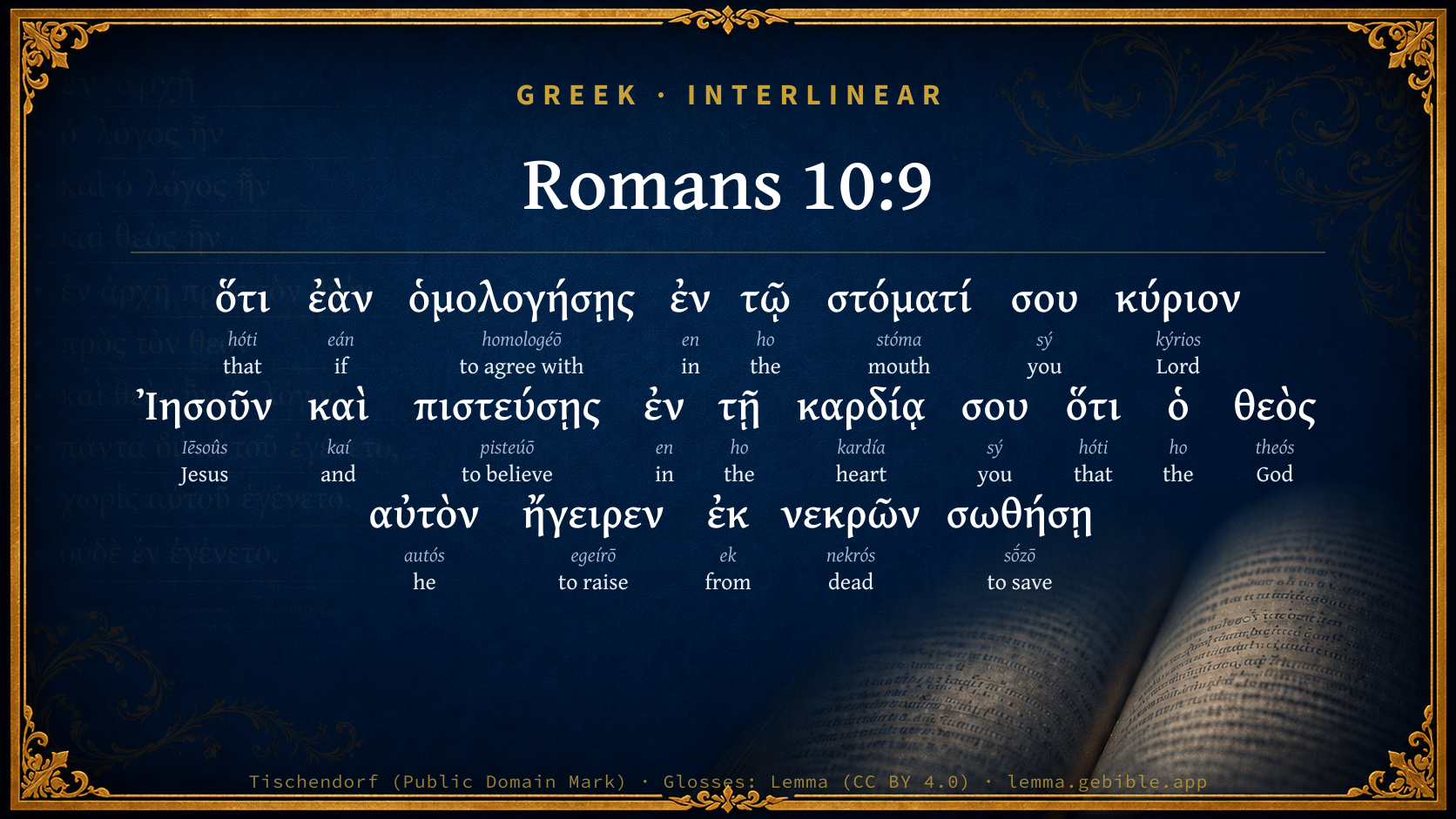
Greek (Tischendorf 8th ed.) Romans 10:9 appears in the Greek New Testament. The text above is from the Tischendorf 8th edition. Each word links to its Strong’s number and a concise gloss. Click any word for its full Thayer’s Greek Lexicon entry.
Download image
Cite this verse

Romans 10:9 (World English Bible). Public Domain. Lemma interlinear Bible study tool, https://lemma.gebible.app/v/romans/10/9.

Show BibTeX & RIS
BibTeX
RIS
English Translation
that if you will confess with your mouth the Lord Jesus, and believe in your heart that God raised him from the dead, you will be saved.
World English Bible · Public Domain
Download a study sheet

One document with this verse’s original text, its word-by-word gloss line, the meaning frame, cross-references with their text, attributed commentary, and full source and license credits — printable, and it pastes into notes with its structure intact.

This verse Autodidact and up

Study sheet (.html) Plain text (.txt)

A passage Seminary Student

Up to 50 verses in one chapter. A passage sheet keeps up to 6 commentary sources and 12 cross-references per verse, in the order this page ranks them, and says so on the sheet whenever that leaves anything out. Ask for a single verse and you get the Autodidact verse sheet above.

Everything on this page stays free to read, with no account — the sheet is a download of what is already on screen, not access to it.

Want to remove ads? Support Godless Engineer
Compare translations 3

The same verse in 3 English versions, stacked beneath the original-language interlinear above. Click any original word for its lexicon entry.

Each is an independent rendering of the whole verse — the interlinear is not word-aligned to these translations.

Highlighted words mark where these versions differ — a whole-verse word diff, not a word-by-word alignment.

  • World English Bible Public Domain
    that if you will confess with your mouth the Lord Jesus, and believe in your heart that God raised him from the dead, you will be saved.
  • King James Version Public Domain
    That if thou shalt confess with thy mouth the Lord Jesus, and shalt believe in thine heart that God hath raised him from the dead, thou shalt be saved.
  • unfoldingWord Literal Text CC BY-SA 4.0
    For if with your mouth you confess, “Jesus Lord,” and believe in your heart that God raised him from dead ones, you will be saved.

unfoldingWord Literal Text — © unfoldingWord, licensed CC BY-SA 4.0. Word-aligned USFM3 via Door43 (git.door43.org/unfoldingWord/en_ult).

Versions to compare (up to 4)

3 of 4 selected

Show all 19 translations

Every available English version of this verse, each an independent rendering of the whole verse.

  • World English Bible Public Domain
    that if you will confess with your mouth the Lord Jesus, and believe in your heart that God raised him from the dead, you will be saved.
  • Berean Standard Bible Public Domain
    that if you confess with your mouth, “Jesus is Lord,” and believe in your heart that God raised Him from the dead, you will be saved.
  • Majority Standard Bible Public Domain
    that if you confess with your mouth, “Jesus is Lord,” and believe in your heart that God raised Him from the dead, you will be saved.
  • King James Version Public Domain
    That if thou shalt confess with thy mouth the Lord Jesus, and shalt believe in thine heart that God hath raised him from the dead, thou shalt be saved.
  • American Standard Version (1901) Public Domain
    because if thou shalt confess with thy mouth Jesus `as' Lord, and shalt believe in thy heart that God raised him from the dead, thou shalt be saved:
  • Revised Version (1885) Public Domain
    because if thou shalt confess with thy mouth Jesus as Lord, and shalt believe in thy heart that God raised him from the dead, thou shalt be saved:
  • Geneva Bible (1599) Public Domain
    For if thou shalt confesse with thy mouth the Lord Iesus, and shalt beleeue in thine heart, that God raised him vp from the dead, thou shalt be saued:
  • Douay-Rheims (1899) Public Domain
    For if thou confess with thy mouth the Lord Jesus, and believe in thy heart that God hath raised him up from the dead, thou shalt be saved.
  • Young's Literal Translation Public Domain
    that if thou mayest confess with thy mouth the Lord Jesus, and mayest believe in thy heart that God did raise him out of the dead, thou shalt be saved,
  • Literal Standard Version CC BY-SA 4.0
    that if you may confess with your mouth that Jesus [is] LORD, and may believe in your heart that God raised Him out of the dead, you will be saved,
  • Unlocked Literal Bible CC BY-SA 4.0
    For if with your mouth you acknowledge Jesus as Lord, and believe in your heart that God raised him from the dead, you will be saved.
  • unfoldingWord Literal Text CC BY-SA 4.0
    For if with your mouth you confess, “Jesus Lord,” and believe in your heart that God raised him from dead ones, you will be saved.
  • Darby Bible Public Domain
    that if thou shalt confess with thy mouth Jesus as Lord, and shalt believe in thine heart that God has raised him from among [the] dead, thou shalt be saved.
  • World Messianic Bible Public Domain
    that if you will confess with your mouth that Yeshua is Lord and believe in your heart that God raised him from the dead, you will be saved.
  • Webster's Bible Public Domain
    That if thou shalt confess with thy mouth the Lord Jesus, and shalt believe in thy heart that God hath raised him from the dead, thou shalt be saved.
  • Free Bible Version CC BY-SA 4.0
    For if you declare that you accept Jesus as Lord, and you are convinced in your mind that God raised him from the dead, then you will be saved.
  • Bible in Basic English Public Domain
    Because, if you say with your mouth that Jesus is Lord, and have faith in your heart that God has made him come back from the dead, you will have salvation:
  • Text-Critical English NT CC BY 4.0
    because if yoʋ confess with yoʋr mouth that Jesus is Lord and believe with yoʋr heart that God raised him from the dead, yoʋ will be saved.
  • Tyndale New Testament (1534) Public Domain
    For yf thou shalt knowledge with thy mouth that Iesus is the lorde and shalt beleve with thyn hert that God raysed him up from deeth thou shalt be safe.

Literal Standard Version (2020), Covenant Press — licensed CC BY-SA 4.0. Text via the HelloAO Bible API (eBible.org). Unlocked Literal Bible (unfoldingWord) — licensed CC BY-SA 4.0. Text via the HelloAO Bible API (eBible.org). unfoldingWord Literal Text — © unfoldingWord, licensed CC BY-SA 4.0. Word-aligned USFM3 via Door43 (git.door43.org/unfoldingWord/en_ult). Free Bible Version, Dr. Jonathan Gallagher — licensed CC BY-SA 4.0. Text via the HelloAO Bible API (eBible.org).

Word by word

More ways to search: Search by grammar → Find every occurrence → Compare this word →

Practice this passage: Drill this verse → Learn its vocabulary →

ὁμολογήσῃς
homologéō
G3670
“to agree with”
Verb, Aorist, Active, Subjunctive, 2nd person, Singular
Part of Speech
Verb
Tense
Aorist
Voice
Active
Mood
Subjunctive
Person
2nd person
Number
Singular
Full Thayer's Definition

Origin: from a compound of the base of G3674 and G3056

TDNT: 08:19,7

1. to say the same thing as another, i.e. to agree with, assent 2. to concede a. not to refuse, to promise b. not to deny 1. to confess 2. declare 3. to confess, i.e. to admit or declare one's self guilty of what one is accused of 3. to profess a. to declare openly, speak out freely b. to profess one's self the worshipper of one 4. to praise, celebrate
  1. ὅτι hóti G3754 “that” Conjunction
  2. ἐὰν eán G1437 “if” Conditional
  3. ἐν en G1722 “in” Preposition
  4. τῷ ho G3588 “the” Article, Dative, Singular, Neuter
  5. στόματί stóma G4750 “mouth” Noun, Dative, Singular, Neuter
  6. σου sý G4771 “you” Personal pronoun, 2nd person, Genitive, Singular
  7. κύριον kýrios G2962 “Lord” Noun, Accusative, Singular, Masculine
  8. Ἰησοῦν Iēsoûs G2424 “Jesus” Noun, Accusative, Singular, Masculine
  9. καὶ kaí G2532 “and” Conjunction
  10. πιστεύσῃς pisteúō G4100 “to believe” Verb, Aorist, Active, Subjunctive, 2nd person, Singular
  11. ἐν en G1722 “in” Preposition
  12. τῇ ho G3588 “the” Article, Dative, Singular, Feminine
  13. καρδίᾳ kardía G2588 “heart” Noun, Dative, Singular, Feminine
  14. σου sý G4771 “you” Personal pronoun, 2nd person, Genitive, Singular
  15. ὅτι hóti G3754 “that” Conjunction
  16. ὁ ho G3588 “the” Article, Nominative, Singular, Masculine
  17. θεὸς theós G2316 “God” Noun, Nominative, Singular, Masculine
  18. αὐτὸν autós G846 “he” Personal pronoun, Accusative, Singular, Masculine
  19. ἤγειρεν egeírō G1453 “to raise” Verb, Aorist, Active, Indicative, 3rd person, Singular
  20. ἐκ ek G1537 “from” Preposition
  21. νεκρῶν nekrós G3498 “dead” Adjective, Genitive, Plural, Masculine
  22. σωθήσῃ sṓzō G4982 “to save” Verb, Future, Passive, Indicative, 2nd person, Singular

About this verse

These counts appear in no published source. They are computed here, from the morphology-tagged text and Lemma’s own curated glosses. What Lemma adds →

23
words
18
distinct lemmas
Pauline Epistles
section

Shared distinctive vocabulary

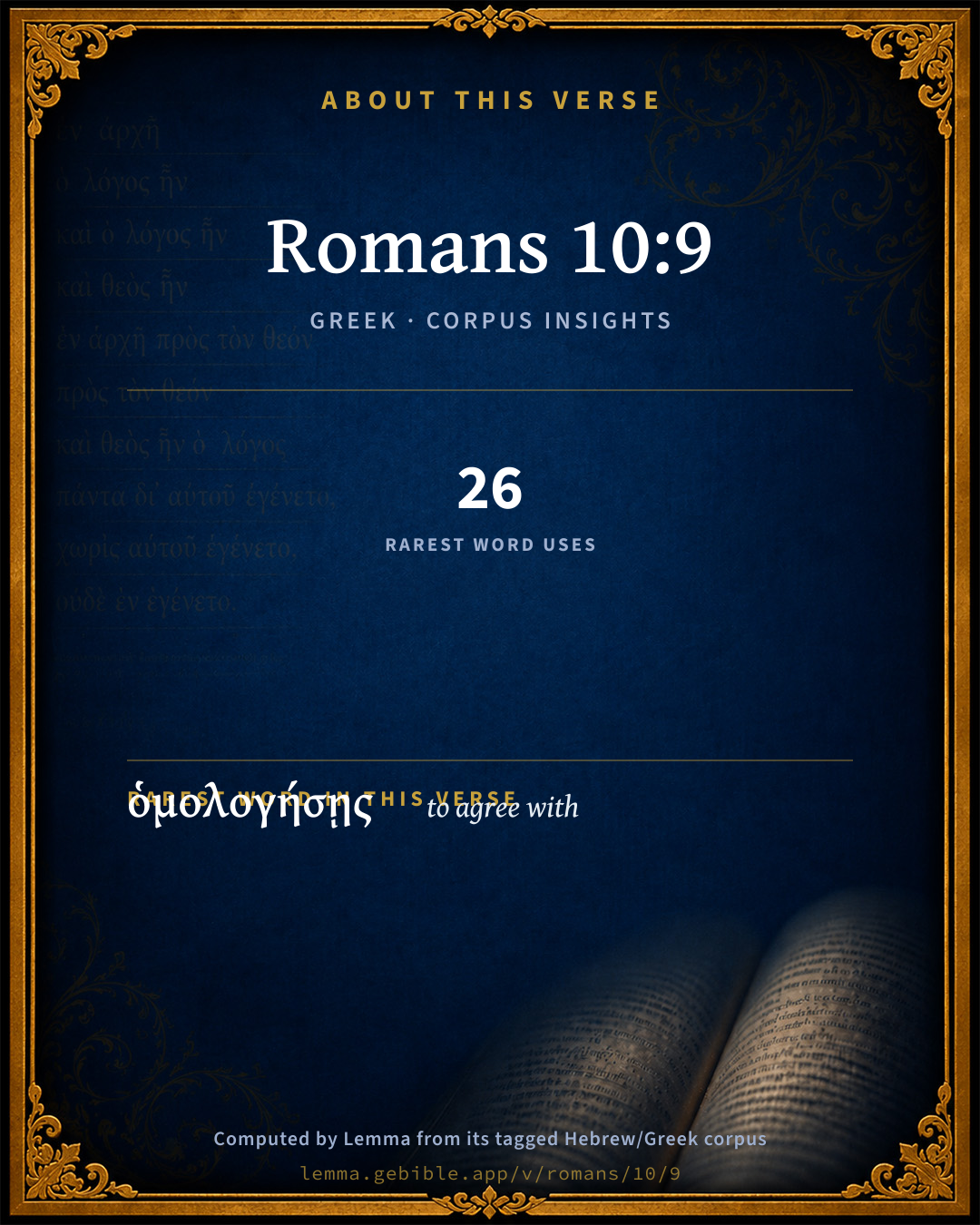
ὁμολογήσῃς to agree with G3670 occurs in 23 verses of the Greek New Testament. Also found in:
Repetition

Words recur within this verse:

Cross-references

17

Topical passages linked to Romans 10:9 in the Treasury of Scripture Knowledge — connected by theme and wording, ordered by reader-vote popularity; previews shown in the World English Bible.

  • Luke 12:8 "I tell you, everyone who confesses me before men, him will the Son of Man also confess before the angels of God;
  • Acts 16:31 They said, "Believe in the Lord Jesus Christ, and you will be saved, you and your household."
  • Philippians 2:11 and that every tongue should confess that Jesus Christ is Lord, to the glory of God the Father.
  • Matthew 10:32–33 Everyone therefore who confesses me before men, him I will also confess before my Father who is in heaven.
  • 1 John 4:2–3 By this you know the Spirit of God: every spirit who confesses that Jesus Christ has come in the flesh is of God,
  • 1 Peter 1:21 who through him are believers in God, who raised him from the dead, and gave him glory; so that your faith and hope might be in God.
  • Romans 8:34 Who is he who condemns? It is Christ who died, yes rather, who was raised from the dead, who is at the right hand of God, who also makes intercession for us.
  • 1 Corinthians 15:14–18 If Christ has not been raised, then our preaching is in vain, and your faith also is in vain.
  • Romans 14:11 For it is written, "'As I live,' says the Lord, 'to me every knee will bow. Every tongue will confess to God.'"
  • John 12:42–43 Nevertheless even of the rulers many believed in him, but because of the Pharisees they didn't confess it, so that they wouldn't be put out of the synagogue,
  • 1 Corinthians 12:3 Therefore I make known to you that no man speaking by God's Spirit says, "Jesus is accursed." No one can say, "Jesus is Lord," but by the Holy Spirit.
  • 2 John 1:7 For many deceivers have gone out into the world, those who don't confess that Jesus Christ came in the flesh. This is the deceiver and the Antichrist.
  • John 9:22 His parents said these things because they feared the Jews; for the Jews had already agreed that if any man would confess him as Christ, he would be put out of the synagogue.
  • John 20:26–29 After eight days again his disciples were inside, and Thomas was with them. Jesus came, the doors being locked, and stood in the midst, and said, "Peace be to you."
  • Acts 2:24 whom God raised up, having freed him from the agony of death, because it was not possible that he should be held by it.
  • Acts 8:36 As they went on the way, they came to some water, and the eunuch said, "Behold, here is water. What is keeping me from being baptized?"
  • John 6:69–71 We have come to believe and know that you are the Christ, the Son of the living God."

Cross-references courtesy of OpenBible.info (CC BY 4.0).

Where the printed editions differ

1 variant

Places in this verse where the major printed Greek editions disagree on the wording in a way that affects the translation — a comparison of editions, not a manuscript-by-manuscript collation. The editions are the modern critical texts (Nestlé-Aland 28/27, SBL, Westcott-Hort, Tregelles, Tyndale House) and the traditional texts behind the KJV (the Textus Receptus and the Byzantine/Majority text). It is not a claim about which reading is original.

  1. Extra text
    τὸ ῥῆμα

    “the declaration”

    In WH Not in NA28NA27TynSBLTregTRByz

    τὸ ῥῆμα (to rhēma) 'the declaration' is only in a few manuscripts (WH)

Textual data: Translators Amalgamated Greek New Testament (STEPBible TAGNT) · CC BY 4.0.

Commentary

Notes on Romans 10:9 from classic Christian and Jewish commentators (each source and its license shown beneath its notes). The classic Christian expositions comment on the surrounding passage and are grouped to its opening verse, so a note may address several verses; the Jewish commentaries on the Tanakh (Rashi and others) are per-verse, so they appear only where the commentator wrote on this verse.

Lemma curates 59 commentaries, every one of them public domain or Creative Commons licensed, each selected and text-cleaned for this edition rather than reprinted as found. About our sources →

Bengel's Gnomon

Johann Albrecht Bengel

Rom 10:9. Εἀν) if only—ὁμολογήσῃς, thou shalt confess) Confession in itself does not save; otherwise infants would not be saved: but only in as far as it includes faith.—Κύριον, the Lord) The summary of faith and salvation is found in this appellation. He who confesses that Jesus is Lord, does not now any longer [now for the first time ceases to] endeavour to bring Him down from heaven.—ἤγειρεν ἐκ νεκρῶν, hath raised Him from the dead) The special object of faith. He who believes the resurrection of Jesus does not now any longer endeavour to bring Him from the dead, Rom 10:7.

Bengel's Gnomon of the New Testament — English translation (T&T Clark, Edinburgh, 1860) — public domain. Text from a community e-Sword module.

Meyer's Critical & Exegetical Commentary

Heinrich August Wilhelm Meyer

Rom_10:9. Not a statement of the contents of the ῥῆμα, but assigning the ground of the immediately previous τοῦτʼ ἔστι τὸ ῥῆμα τῆς πίστεως ὃ κηρύσς. The force of the argument lies in the fact that, in respect of the ῥῆμα published by its preachers, confession and faith (mouth and heart) must be consentaneous in order to obtain salvation, which is what Moses also means of the ῥῆμα (Rom_10:8).

ὁμολ. ἐν τ. στόμ. σου] corresponds to ἐν τῷ στόμ. σου (ἐστι) in Rom_10:8, as afterwards πίστ. ἐν τ. καρδ. σου to ἐν τ. καρδ. σου in Rom_10:8.

κύριον] as Lord (comp. 1Co_12:3; 1Co_8:6; Php_2:11). In hac appellatione est summa fidei et salutis, Bengel. It refers to the question τίς ἀναβ. εἰς τ. οὐρ., Rom_10:6; for the whole acknowledgment of the heavenly κυριότης of Jesus as the σύνθρονος of God is conditioned by the acknowledgment of the preceding descent from heaven, the incarnation of the Son of God; Rom_8:3; Gal_4:4; Php_2:6, et al.

ἤγειρεν ἐκ νεκρῶν] corresponds to the question of Rom_10:7.

σωθήσῃ] corresponds to ζήσεται in Rom_10:6, but characterizes the latter, according to the doctrinal system of the apostle (Rom_1:16, Rom_5:9-10, et al.), as a deliverance from destruction to the Messianic salvation.

The confession of the mouth (of high essential importance for the relations of every time, and peculiarly of that time!) and faith in the heart are not separate things, as though one without the other had as its consequence the σωτηρία, but they are mutually dependent requisites. Comp. Knapp, p. 565 ff.

The resurrection of the Lord here appears, as suggested by Rom_10:7, and according to Rom_4:25 quite justly, as the object of that faith which makes blessed. Without it, His death would not be the atoning death, 1Co_15:17-18, nor would He Himself be the Son of God, Rom_1:4.

Meyer — Critical and Exegetical Commentary on the New Testament — English translation by Peter Christie, edited by Frederick Crombie (T&T Clark, 1880) — public domain. Text from a community e-Sword module.

Expositor's Greek Testament

ed. W. Robertson Nicoll

Rom 10:9 . Apparently this verse gives the content of what the Apostle describes as “the word of faith which we preach”. ὅτι = viz. The reference both to heart and mouth in Deut. suits his purpose, and he utilises it; the closing words in the LXX ( καὶ ἐν ταῖς χερσί σου ποιεῖν αὐτό ) he disregards. ἐὰν ὁμολογήσῃς τὸ ῥῆμα … ὅτι Κύριος Ἰησοῦς : the putting of the confession before the faith which inspires it, and of which it is the confession, seems to be due simply to the fact that in the O.T. passage present to the Apostle’s mind ἐν τῷ στόματί σου precedes ἐν τῇ καρδίᾳ σου . τὸ ῥῆμα is virtually = the Gospel, as God’s word concerning His Son and faith in Him. We confess it when we say, Jesus is Lord. Cf. 1Co 12:3 , Phi 2:11 . The exaltation of Jesus is the fundamental Christian confession, and presupposes the resurrection; and it is this exaltation which here (as in the other passages referred to) is meant by His Lordship. It is mechanical to say that the first part of Rom 10:9 (Jesus is Lord) refers to the doubting question in Rom 10:6 , and therefore means a confession of the incarnation; and the second part of it (God raised Him from the dead) to the doubting question of Rom 10:7 . Paul nowhere connects the Lordship of Christ with His incarnation, and there is certainly no reference to His Divine nature here. The confession of the first part of the verse answers to the faith in the second; he who believes in his heart that God raised Christ from the dead can confess with his mouth (on that ground and in that sense) that Jesus is Lord. On the basis of such mutually interpreting faith and confession he is saved. This does not deprive the death of Christ of the significance which Paul ascribes to it elsewhere. Christ could not be raised unless He had first died, and when He is raised it is with the virtue of His sin-atoning death in Him. His exaltation is that of one who has borne our sins, and the sense of this gives passion to the love with which believers confess Him Lord.

The Expositor's Greek Testament, edited by W. Robertson Nicoll (1897–1910) — public domain. Text from a community e-Sword module.

Hodge's Commentary on Romans, Ephesians & First Corinthians

Charles Hodge

Rom_10:9

That if thou shalt confess with thy mouth the Lord Jesus, etc. The connection of this verse with the preceding may be explained by making the last clause of Rom_10:8 a parenthesis, and connecting this immediately with the first clause. It says, the word is nigh thee; it says, that if thou shalt confess and believe, thou shalt be saved. According to this view, this verse is still a part of what the gospel is represented as saying. Perhaps, however, it is better to consider this verse as Pauls own language, and an explanation of the word of faith just spoken of. The thing is near and easy, to wit, the word of faith which we preach, that if thou wilt confess, etc. The two requisites for salvation mentioned in this verse are confession and faith. They are mentioned in their natural order; as confession is the fruit and external evidence of faith. So in 2Pe_1:10, calling is placed before election, because the former is the evidence of the latter. The thing to be confessed is that Jesus Christ is Lord. That is, we must openly recognize his authority to the full extent in which he is Lord; acknowledge that he is exalted above all principality and powers, that angels are made subject to him, that all power in heaven and earth is committed unto him, and of course that he is our Lord. This confession, therefore, includes in it an acknowledgment of Christs universal sovereignty, and a sincere recognition of his authority over us. To confess Christ as Lord, is to acknowledge him as the Messiah, recognized as such of God, and invested with all the power and prerogatives of the Mediatorial throne. This acknowledgment is consequently often put for a recognition of Christ in all his offices. 1Co_12:3, No man can say that Jesus is the Lord, but by the Holy Ghost. Phi_2:11, Every tongue shall confess that Jesus Christ is Lord.To preach the Lord Jesus, or that Jesus is the Lord, Act_11:20, is to preach him as the Savior in all his fullness. Rom_14:9, For to this end Christ both died, and rose, and revived, that he might be Lord both of the dead and of the living. The necessity of a public confession of Christ unto salvation is frequently asserted in the Scriptures. Mat_10:32, Whosoever, therefore, shall confess me before men, him will I confess also before my Father which is in heaven. Luk_12:8; 1Jo_4:15, Whosoever shall confess that Jesus is the Son of God, God dwelleth in him, and he in God.

The second requisite is faith. The truth to be believed is that God hath raised Christ from the dead. That is, we must believe that by the resurrection of Christ, God has publicly acknowledged him to be all that he claimed to be, and has publicly accepted of all that he came to perform. He has recognized him as his Son and the Savior of the world, and has accepted of his blood as a sacrifice for sin. See Rom_4:25; Rom_1:4; Act_13:32, Act_13:33; 1Pe_1:3-5; 1Co_15:14, et seq.; Act_17:31, Whereof he hath given assurance unto all men, in that he hath raised him from the dead. To believe, therefore, that God has raised Christ from the dead, involves the belief that Christ is all that he claimed to be, and that he has accomplished all that he came to perform. In thy heart. Faith is very far from being a merely speculative exercise. When moral or religious truth is its object, it is always attended by the exercise of the affections. The word heart, however, is not to be taken in its limited sense, for the seat of the affections. It means the whole soul, or inner man. Confession is an outward act, faith is an act of the mind in the wide sense of that word. It includes the understanding and the affections. Saving faith is not mere intellectual assent, but a cordial receiving and resting on Christ alone for salvation.

Charles Hodge — Commentary on Romans (1835), First Corinthians (1857), and Ephesians (1856) — public domain. Text from a community e-Sword module.

Geneva Bible (1599)

Geneva Bible translators

If thou profess plainly, sincerely, and openly, that thou takest Jesus only to be thy Lord and Savior.

That is indeed true faith which is settled not only in the head, but also in the heart of man, whereof also we give testimony, by our outward life, and which tendeth to Christ as to our alone and only Savior, even as he setteth forth himself in his word.

The Father, who is said to have raised the Son from the dead: and this is not spoken to shut out the divinity of the Son, but to set forth the Father’s counsel touching our redemption in the resurrection of the Son.

Geneva Bible (1599) marginal notes — public domain. Text via Bolls.life.

Jamieson, Fausset & Brown

Robert Jamieson, A. R. Fausset & David Brown

That if thou shalt, &c.--So understanding the words, the apostle is here giving the language of the true method of justification; and this sense we prefer (with CALVIN, BEZA, FERME, LOCKE, JOWETT). But able interpreters render the words, "For," or "Because if thou shalt," &c. [Vulgate, LUTHER, DE WETTE, STUART, PHILIPPI, ALFORD, Revised Version]. In this case, these are the apostle's own remarks, confirming the foregoing statements as to the simplicity of the gospel method of salvation.

confess with thy mouth the Lord Jesus--that is, probably, "If thou shalt confess Jesus [to be] the Lord," which is the proper manifestation or evidence of faith (Mat 10:32; Jo1 4:15). This is put first merely to correspond with the foregoing quotation--"in thy mouth and in thine heart." So in Pe1 1:10 the "calling of believers" is put before their "election," as that which is first "made sure," although in point of time it comes after it.

and shalt believe in thine heart that God hath raised--"that God raised"

him from the dead, &c.--(See on Rom 4:25). In Rom 10:10 the two things are placed in their natural order.

Jamieson, Fausset & Brown — Commentary Critical and Explanatory on the Whole Bible (1871) — public domain (CC PDM 1.0). Text via the HelloAO Bible API.

Adam Clarke's Commentary

Verse 9. That if thou shalt confess, c.] Acknowledge the Lord Jesus Christ as the only Saviour. Believe in thy heart that he who died for thy offences has been raised for thy justification and depend solely on him for that justification, and thou shalt be saved.

Adam Clarke's Commentary on the Bible (1810–1826) — public domain. Text from a community e-Sword/MySword module.

John Calvin's Commentaries

9. That if thou wilt confess, etc. Here is also an allusion, rather than a proper and strict quotation: for it is very probable that Moses used the word mouth, by taking a part for the whole, instead of the word face, or sight. But it was not unsuitable for the Apostle to allude to the word mouth, in this manner: — “Since the Lord sets his word before our face, no doubt he calls upon us to confess it.” For wherever the word of the Lord is, it ought to bring forth fruit; and the fruit is the confession of the mouth.

By putting confession before faith, he changes the order, which is often the case in Scripture: for the order would have been more regular if the faith of the heart had preceded, and the confession of the mouth, which arises from it, had followed. But he rightly confesses the Lord Jesus, who adorns him with his own power, acknowledging him to be such an one as he is given by the Father, and described in the gospel.

Express mention is made only of Christ’s resurrection; which must not be so taken, as though his death was of no moment, but because Christ, by rising again, completed the whole work of our salvation: for though redemption and satisfaction were effected by his death, through which we are reconciled to God; yet the victory over sin, death, and Satan was attained by his resurrection; and hence also came righteousness, newness of life, and the hope of a blessed immortality. And thus is resurrection alone often set before us as the assurance of our salvation, not to draw away our attention from his death, but because it bears witness to the efficacy and fruit of his death: in short, his resurrection includes his death. On this subject we have briefly touched in the sixth chapter.

It may be added, that Paul requires not merely an historical faith, but he makes the resurrection itself its end. For we must remember the purpose for which Christ rose again; — it was the Father’s design in raising him, to restore us all to life: for though Christ had power of himself to reassume his soul, yet this work is for the most part ascribed in Scripture to God the Father.

John Calvin's Commentaries (1540-1563) — public domain. Text from the Calvin Translation Society English edition (1840s-50s) via the Christian Classics Ethereal Library (ccel.org). Calvin's coverage is partial (roughly two-thirds of the Bible); uncommented books and verses are honest gaps, never fabricated. The 19th-century editor's footnotes and remarks are omitted so the notes are faithfully Calvin's own voice.

Ellicott's Commentary for English Readers

(9) If thou shalt confess with thy mouth.—Interesting as containing the earliest formal confession of faith; that in Act_8:37 (see Note there) is not genuine.

There is no opposition between the outward confession and the inward act of faith. The one is regarded as the necessary consequence and expression of the other. In the next verse this takes the form of Hebrew parallelism, in which the balanced clauses are regarded as equivalent to each other.

The Lord Jesus.—Jesus as Lord.

Hath raised him from the dead.—Comp. Rom_4:25. Though the death of Christ apprehended by faith is more especially the cause of the Christian’s salvation, still the Apostle regards the Resurrection as the cardinal point; for without the Resurrection the proof of the Messiahship of Jesus would have been incomplete, and His death would not have had its saving efficacy.

A Bible Commentary for English Readers, edited by Charles John Ellicott (1878–1897) — public domain. Text from a community e-Sword module.

The Cambridge Bible for Schools and Colleges

gen. ed. J. J. S. Perowne

9. that if thou shalt, &c.] Here the contents of the “utterance” are given in more detail.

confess with thy mouth] i.e., practically, “submit to and own Him as supreme for thee.” See, for the demand of such “confession,” Mat_10:32; Luk_12:8. For all adult converts, this was an important feature of Baptism. In all cases, it is to be a test of the intelligence and reality of the faith of which it is a fruit.—“Confession” is here put before “believing,” because in Deuteronomy “the mouth” had been named before “the heart.” In the order of experience, of course, faith precedes confession.

the Lord Jesus] Better, Jesus as Lord; i.e., as Supreme and Eternal; the all-blessed Son. Cp. 1Co_12:3; where light is thrown on the deep reality and significance of the confession meant here.—St Paul here refers back to the “who shall ascend?” of Rom_10:6 : Jesus, as Lord, is He “who is in Heaven,” (Joh_3:13,) who came thence, and is the way thither.

that God hath raised him, &c.] Cp. Heb_13:20; where the “bringing again of the Great Shepherd from the dead,” by the Father, is the full and final proof that the Father is the God of Peace; i.e. of Reconciliation, of Justification. See too above, Rom_4:24-25, Rom_5:1; and 1Th_1:10.—The belief in the Resurrection here is not merely historical belief, (which yet is indispensable to all other belief in it,) but “heart” belief; the perception and cordial embrace of what the Resurrection reveals and imports as to the Risen One and His work.—Here, obviously, the “who shall descend?” of Rom_10:7 is referred to.

The Cambridge Bible for Schools and Colleges (gen. ed. J. J. S. Perowne; Cambridge University Press, 1878–1918) — public domain. Text from a community e-Sword module.

John Gill's Exposition

That if thou shalt confess with thy mouth the Lord Jesus,.... That is, if a man shall make a good, sincere, and hearty confession to God, before the church and people of God, and before the world, that Christ is his Lord and Saviour, whom he desires to serve, and to be saved by; and this as arising from a comfortable experience of the grace of God in his soul, and from a true faith in Christ in his heart, wherefore it follows,

and shall believe in thine heart, that God hath raised him from the dead, thou shalt be saved; for this article of Christ's resurrection includes the several other articles of faith: it supposes his death, and that supposes his life, and the obedience of it; and his life implies his being here on earth, and that his coming down from heaven to do the will of his Father; and this is the rather mentioned, which is here ascribed to God the Father, though not to the exclusion of the Son and Spirit, because that Christ is risen again for our justification, with which true faith is principally concerned; for such a faith is intended, not which lies in a mere assent to the truth of this, or any other article of the Christian religion; but which is concerned with Christ for righteousness, life, and glory; and with such a faith salvation is certainly and inseparably connected.

John Gill's Exposition of the Whole Bible (1746–1763) — public domain (CC PDM 1.0). Text via the HelloAO Bible API.

Trapp's Complete Commentary

John Trapp

9 That if thou shalt confess with thy mouth the Lord Jesus, and shalt believe in thine heart that God hath raised him from the dead, thou shalt be saved.

Ver. 9. That if thou shalt confess] That is, if thou shalt call upon the name of the Lord, as it is expounded, Rom 10:13.

John Trapp, A Commentary or Exposition upon All the Books of the Old and New Testament (1647–1656) — public domain. Text from a community e-Sword module.

Albert Barnes' Notes on the Bible

That if thou shalt confess - The word here rendered “confess” ὁμολογέω homologeō is often rendered “profess”; Mat 7:23, “Then will I profess to them, I never knew you;” Tit 1:16; Tit 3:14; Rom 1:22; 1Ti 2:10; 1Ti 6:12-13, 1Ti 6:21; Heb 3:1, etc. It properly means to “speak what agrees with something which others speak or maintain.” Thus, confession or profession expresses our “agreement or concord with what God holds to be true, and what he declares to be true.” It denotes a public declaration or assent to that, here expressed by the words “with thy mouth.” A profession of religion then denotes a public declaration of our agreement with what God has declared, and extends to all his declarations about our lost estate, our sin, and need of a Saviour; to his doctrines about his own nature, holiness, and law; about the Saviour and the Holy Spirit; about the necessity of a change of heart and holiness of life; and about the grave and the judgment; about heaven and hell. As the doctrine respecting a Redeemer is the main and leading doctrine, it is put here by way of eminence, as in fact involving all others; and publicly to express our assent to this, is to declare our agreement with God on all kindred truths.

With thy mouth - To profess a thing with the mouth is to speak of it; to declare it; to do it openly and publicly.

The Lord Jesus - Shalt openly acknowledge attachment to Jesus Christ. The meaning of it may be expressed by regarding the phrase “the Lord” as the predicate; or the thing to be confessed is, that he is Lord; compare Act 2:36; Phi 2:11, “And that every tongue should confess that Jesus Christ is Lord.” Here it means to acknowledge him as Lord, that is, as having a right to rule over the soul.

Shalt believe in thy heart - Shalt sincerely and truly believe this, so that the external profession shall correspond with the real, internal feelings. Where this is not the case, it would be hypocrisy; where this is the case, there would be the highest sincerity, and this religion requires.

That God hath raised him - This fact, or article of Christian belief, is mentioned here because of its great importance, and its bearing on the Christian system. If this be true, then all is true. Then it is true that he came forth from God; that he died for sin; and that God approved and accepted his work. Then it is true that he ascended to heaven, and is exalted to dominion over the universe, and that he will return to judge the quick and the dead. For all this was professed and taught; and all this was regarded as depending on the truth of his having been raised from the dead; see Phi 2:8-11; Eph 1:21; Act 2:24, Act 2:32-33; Act 17:31; 2Co 4:14; 1Co 15:13-20. To profess this doctrine was, therefore, virtually to profess all the truths of the Christian religion. No man could believe this who did not also believe all the truths dependent on it. Hence, the apostles regarded this doctrine as so important, and made it so prominent in their preaching. See the note at Act 1:3.

Thou shalt be saved - From sin and hell. This is the doctrine of the gospel throughout; and all this shows that salvation by the gospel was easy.

Albert Barnes' Notes on the Bible (1834–1885) — public domain. Text from a community e-Sword/MySword module.

Haydock's Catholic Bible Commentary

Thou shalt be saved. To confess the Lord Jesus, and to call upon the name of the Lord, (ver. 13.) is not barely the professing of a belief in the person of Christ: but moreover implies a belief of his whole doctrine, and an obedience to his law; without which the calling of him Lord will save no man. (St. Matthew vii. 21.) (Challoner) --- This passage must be understood like many others of this apostle, of a faith accompanied by a good-will ready to perform what faith says must be practised; as it is required in this very place, that what we believe in the heart, we should confess with our mouth. (Estius)

George Leo Haydock (1774–1849), Haydock's Catholic Family Bible and Commentary, 1859 edition — public domain. Excludes Psalms (Douay-Rheims chapter numbering differs from Protestant) and Deuterocanonical books (Catholic canon only).

Matthew Poole's English Annotations

q.d. There are but these two things, which the gospel principally requires in order to our salvation: the one is, the confession of Christ with our mouths, and that in spite of all persecution and danger, to own him for our Lord, and for our Jesus; and to declare, that we are and will be ruled and saved by him, and by him only. The other is, to believe in our hearts,

that God hath raised him from the dead. This article of the resurrection of Christ presupposeth all the rest, and fasteneth together, as by a link, all the antecedents and consequents of it; his ascension, session at the right hand of God, and intercession, which followed after. This article therefore, by a figure, is put for all the rest; and this is mentioned, because the death and passion of Christ had availed us nothing, unless he had risen again; for thereby he obtained a perfect victory over sin, death, and damnation, for all the elect. This is the principal ground of our justification, as hath been said, Rom 4:25.

Matthew Poole's English Annotations on the Holy Bible (1683–1685) — public domain. Text from a community e-Sword/MySword module.

Whedon's Commentary on the Bible

Daniel D. Whedon

9. That—Rather, because, as depending upon nigh thee.

Mouth… heart—St. Paul follows the order of Moses in these two words; though, in the ordinary order of cause and effect, the latter is the fountain from which the stream flows through the former. And so Paul reverses the order in Rom_10:10. Moses, however, accustomed to outer confession, penetrates from the outward inwardly to the heart.

Daniel D. Whedon (gen. ed.), Commentary on the Old and New Testaments (1874–1909) — public domain. Text from a community e-Sword module.

John Wesley's Explanatory Notes

If thou confess with thy mouth - Even in time of persecution, when such a confession may send thee to the lions.

John Wesley, Explanatory Notes Upon the Whole Bible (1754–1765) — public domain. Text via the GEBible commentary corpus.

Scofield Reference Notes

C. I. Scofield

saved

(See Scofield "Rom 1:16").

The Scofield Reference Bible (1917 edition), notes by C. I. Scofield — public domain. Text from a community e-Sword module.

Burkitt's Expository Notes on the New Testament

William Burkitt

Observe here, The two great and principal things which the gospel requires, in order to our justification and salvation.

The first is, Confession of Christ with our mouth; that is, in all times of danger, particularly in a time of persecution, to own Christ Jesus our Lord, and to declare that we will serve him, and adhere to him, be ruled of him, and expect only to be saved by him.

The second is, To believe in our hearts, that God hath raised Christ from the dead.

But why is the article of Christ’s resurrection only named, seeing faith respects his birth, life, and death, &c.

Answer Because this article of the resurrection presupposeth all the rest of the antecedents to it, and consequences of it; as namely, his incarnation, death, and passion, ascension and intercession.

This article therefore of the resurrection is put for all the rest, and includes all the rest: for as he could not have risen, had he not first died, so his death had availed us nothing, unless he had risen again.

Learn hence, 1. That all those who would be accepted with God unto righteousness and life, must be such as do believe in Christ with the heart, and openly confess with the mouth, that he is the Son of God, and the Saviour of the world. If thou confess and believe, thou shalt be saved.

Learn, 2. That the principal seat and subject of faith is not in the understanding barely, but in the will, called here the heart: With the heart man believeth unto righteousness: not the head.

Although knowledge is so necessary to faith, that it is sometimes put for faith, By his knowledge, or by the knowledge of him, shall my righteous servant justify many, Isa 53:11; yet there may be much light in the understanding, where there is no life in the will, much knowledge in the head, where there is no faith in the heart, nor obedience in the life. Therefore says the apostle here, With the heart man believeth, &c.

William Burkitt's Expository Notes on the New Testament (1700–1703) — public domain. Text from a community e-Sword module.

Godbey's Commentary on the New Testament

William B. Godbey

9. “That if thou mayest confess with thy mouth the Lord Jesus and believe in thy heart that God hath raised him from the dead, thou shalt be saved.

William B. Godbey, Commentary on the New Testament (1896–1900) — public domain. Text from a community e-Sword module.

McGarvey & Pendleton's Commentaries

J. W. McGarvey

because [the gospel (and Moses) speak of the mouth and heart, because] if thou shalt confess with thy mouth Jesus as Lord, and shalt believe in thy heart that God raised him from the dead, thou shalt be saved [Moses emphasized the nearness of the law. The Jew was to keep it near (accept it), for, as a far-off, neglected thing, it would be of no avail. As an accepted rule, loved and talked over daily, it would be effective unto righteousness. Jeremiah, foretelling the days when a new law would be more effective than the old, declared that the promise of Jehovah was: "I will put my law in their inward parts, and in their hearts will I write it." Thus it would become nearer than when written externally upon stone. When this new law came, Jesus indicated the fulfillment of Jeremiah's word by saying. "The kingdom of God is within you" ( Jer_31:33 ; Luk_17:20 ). Therefore, when Paul quotes Moses' words about that nearness of the law which makes it effective, he takes occasion to describe how the gospel or "word of faith" is made effective unto righteousness by the believer's full consent to the will of God that it be near him, making it an inward nearness by confession with the mouth and belief in the heart. In short, the gospel is not righteousness unto life until it is accepted, and the prescribed method by which it is to be accepted is faith leading to confession, followed by obedience of faith, beginning with baptism, which symbolically unites us with our Lord in his death and resurrection. But Paul makes no reference to the ordinance, laying stress on the central truth of Christianity which the ordinance shows forth; namely, God raised Jesus from the dead. The zealous lover of first principles might expect Paul to make the Christhood of Jesus the object of belief ( Mat_16:16 ). But that is already taken care of by the apostle in the brief summary: "Confess with thy mouth Jesus as Lord." The truth is, the resurrection is the demonstration of that proposition: "Jesus is the Christ, the Son of the living God." "Jesus" means "Saviour," and the resurrection proves or demonstrates his ability to save from death and the grave ( 1Co_15:12-19 ; 1Pe_1:3-5 ; 2Co_4:14 ). Jesus is Christ; that is, God's anointed Prophet, Priest and King over all men; for such is the meaning of "Christ." Now, the resurrection proves that Jesus was a teacher of truth, for God honors no liars with a resurrection like that of Jesus; it proves that lie is an acceptable High Priest, for had not his offering for sin canceled the guilt of sin, he had appeared no more in the land of the living ( Mat_5:26 ), but he was raised to complete his priestly work for our justification (see note on Rom_4:25 ; and Act_13:37-39 ); it demonstrated that he was the King, for by his resurrection he led captivity captive ( Eph_4:8 ) and received the gift of universal power ( Mat_28:18 ; Act_2:23-36 ; Act_13:34-37 ; Act_17:31 ; Phi_2:8-11 ; Eph_1:19-23 ); and, finally, it declared him to be the Son of God with power-- Rom_1:4 ; Act_13:32-33 ]:

J. W. McGarvey (with Philip Y. Pendleton), Commentaries on the New Testament (The Fourfold Gospel, 1914; Acts; and the epistles) — public domain. Text from a community e-Sword/MySword module.

The People's New Testament

B. W. Johnson

9. Because if thou shalt confess with thy mouth Jesus as Lord. For the importance which Jesus attached to confession, see Matt. 10:32; Luke 12:8, and compare Acts 8:37. To openly confess Christ in those days of persecution was a trial of faith of the severest kind. Note distinctly that there is no promise here to a concealed faith. And shalt believe in thine heart. That is, with all the heart. The belief must not be only a mental assent, but a belief that brings the whole man into loving trust and obedience to Christ. Such a faith is referred to in 1:5, where the “obedience of faith” is described. Thou shalt be saved. Such a faith confessed unites its subject to Christ as his loving subject, and imparts to him the righteousness of those who have died to sin and been freed from the law. See 6:1–4.

B. W. Johnson's The People's New Testament with Notes (1889–1891) — public domain. Electronic text from the Christian Classics Ethereal Library (CCEL) ThML edition.

Cambridge Greek Testament for Schools and Colleges

9. ὅτι = because.

ὁμολογήσῃς. Cf. Mat 10:32 (|[204] Lk.); 1Ti 6:12; Heb 13:15; 1Jn 2:23.

[204] | parallel to

ὅτι Κ. Ἰ. Cf. 1Co 12:3; 2Co 4:5; Php 2:11; Act 2:36; Act 19:5; above Rom 4:24; 2Co 4:14; Eph 1:15; Phm 1:5.

The simplest form of the Christian creed: κύριος the LXX[205] rendering of Jahweh is predicate to Ἰησοῦς; freq. in Acts in connexion with baptism and the first confession of faith (cf. Act 16:31); cf. Knowling, Witness etc., p. 261 f. The simple combination is most frequent in 1 Thes., but occurs in most of S. Paul’s Epp. and Heb 13:20, Rev 22:20-21, and elsewhere; cf. Robinson on Eph 5:26.

[205] LXX. the Septuagint Version of the Old Testament

καὶ πιστεύσῃς ἐν τῇ κ. ς. The aor. marks the initial act; the addition of ἐν τῇ κ. ς. distinguishes this act, as the expression (ἐν = with) of the whole heart, from bare assent to a fact; cf. Act 8:37 v.l., 1Th 4:14.

Cambridge Greek Testament for Schools and Colleges (Cambridge University Press, 1896; 21 vols, various authors incl. Carr, Maclear, Plummer, Farrar, Lumby, Moule, M. R. James, Simcox) — public domain. Text from a community e-Sword module.

Alford’s Greek Testament

Henry Alford

9.] Because (explanation of the word being near thee: so Thol., De Wette, Stuart, al. Others take ὅτι here as in ver. 5, merely recitantis, making ἐὰν κ.τ.λ. the ῥῆμα preached. But as Thol. observes, (1) the duty of confessing the Lord Jesus can hardly be called part of the contents of the preaching of faith, but the prominence given to that duty shews a reference to the words of Moses: (2) the making ὅτι render a reason for ἐγγύς σου κ.τ.λ. suits much better the context and form of the passage: (3) the fact of the confession with the mouth standing first, also shews a reference to what has gone before: for when the Apostle brings his own arrangement in ver. 10, he puts, as natural, the belief of the heart first), if thou shalt confess with thy mouth (same order as ver. 8) the Lord Jesus (not, I think, ‘Jesus as the Lord’ (see the readg of al.): this might very well be,—and κύριον might, as Thol., be the predicate placed first for emphasis, did not Paul frequently use κύριος Ἰησοῦς for ‘the Lord Jesus,’—see (ch. 14:14 after a prep.) 1Co 1:3 al.; Phil. (2:19) 3:20; Col 3:17 (1Th 1:1; 1Th 4:1). 1Co 12:3 is hardly an example on the other side: see not there, but 2Co 4:5 is, cf. note there), and believe in thine heart that God raised Him from the dead (here, as in 1Co 15:14, 1Co 15:16, 1Co 15:17, regarded as the great central fact of redemption), thou shalt be saved (inherit eternal life).

Here we have the two parts of the above question again introduced: the confession of the Lord Jesus implying his having come down from heaven, and the belief in His resurrection implying His having been brought up from the dead.

Henry Alford, The Greek Testament (1849–1861) — public domain. Text from a community e-Sword module.

International Critical Commentary

9. ὅτι ἐὰν ὁμολογήσῃς κ.τ.λ. This verse corresponds to and applies the preceding verse. The subject of the ῥῆμα which is preached by the Apostles is the person of Christ and the truth of His Resurrection. Κύριος refers to ver. 6, the Resurrection (ὅτι ὁ Θεὸς αὐτὸν ἤγειρεν ἐκ νεκρῶν) to ver. 7. The power of Christ lies in these two facts, namely His Incarnation and His Resurrection, His Divine nature and His triumph over death. What is demanded of a Christian is the outward confession and the inward belief in Him, and these sum up the conditions necessary for salvation.

The ordinary reading in this verse is ἐὰν ὁμολογήσῃς ἐν τῷ στόματί σου Κύριον Ἰησοῦν, for which WH. substitute τὸ ῥῆμα ἐν τῷ στόματί σου ὅτι Κύριος Ἰησοῦς. τὸ ῥῆμα has the authority of B 71, Clem.-Alex. and perhaps Cyril, ὅτι Κ. Ἰ. of B, Boh., Clem.-Alex. and Cyril 2/3. The agreement in the one case of B and Boh., in the other of B and Clem.-Alex. against nearly all the other authorities is noticeable.

International Critical Commentary — older volumes (1896–1929), various authors — public domain. Text from a community e-Sword module.

Vincent's Word Studies in the New Testament

Marvin R. Vincent

That [οτι] . So rendered as expressing the contents of the word of faith; but better because, giving a proof that the word is nigh. Confess and believe, correspond to mouth and heart.

The Lord Jesus [κυριον ιησουν] . Others, however, read to rJhma ejn tw stomati sou oti kuriov Ihsouv If thou shalt confess with thy mouth the word that Jesus is Lord. Rev., Jesus as Lord.

Marvin R. Vincent, Word Studies in the New Testament (1887–1900) — public domain. Text from a community e-Sword/MySword module.

Godet's Commentaries

Frédéric Louis Godet

Vv. 9, 10. “Seeing that if thou shalt confess with thy mouth the Lord Jesus, and shalt believe in thine heart that God hath raised Him from the dead, thou shalt be saved. For with the heart man believeth unto righteousness; and with the mouth confession is made unto salvation.”

The two terms: confessing with the mouth and believing with the heart, reproduce the ideas in thy mouth and in thy heart, of Rom 10:8. These are the two conditions of salvation; for while faith suffices to take hold of the finished expiation, when this faith is living, it inevitably produces profession, and from this follows incorporation into the flock already formed, by means of invocation and baptism. Profession is put first here, in keeping with the words of Moses (Rom 10:8 : in thy mouth); the order is that which from the external ascends to the internal; it reminds us that profession would be nothing without faith.

The object of the profession is the title Lord given to Christ, as is done in the invocation by which we publicly declare ourselves subjects; comp. 1Co 12:3 (according to the true reading). Here again we find the idea of Rom 10:6, that of the glorified Christ. The same relation between the sovereignty of Christ and the Christian profession appears in Php 2:9-11 : “Wherefore God hath supremely exalted Him...that every tongue should confess that He is Lord.” This allusion to Rom 10:6 proves clearly that the reference there was not to the incarnation; for Jesus is called by the title of Lord, as the glorified, and not as the pre-existent Christ.

On the other hand, the special object of faith is Christ risen. The reason is clear: it is in the external fact of the resurrection that faith apprehends its essential object, the moral fact of justification; comp. Rom 4:25.

Paul concludes this long sentence with a brief summary word: σωθήσῃ, thou shalt be saved, as if he would say: After that all is done. Rom 10:10 demonstrates in fact that these conditions once complied with, salvation was sure.

Frédéric Louis Godet — Commentaries on Luke, John, Romans, and 1 Corinthians — English translation (T&T Clark, Edinburgh, 1870s–1890s) — public domain. Text from a community e-Sword module.

Lesson kit

Teaching starters — assembled from the data on this page, not authored interpretation. Every prompt links to the verse data it draws on. Edit before teaching.

Romans, in the Pauline Epistles, opens this verse with 23 words (18 distinct Greek lemmas). Its most distinctive word is homologéō (“to agree with”). A historical commentator’s framing appears above. Read the whole chapter for the surrounding context.

Discussion questions

  1. How does “to agree with” (homologéō) shape what this verse is saying?
  2. Matthew 7:23 shares the word «to agree with» with this verse. How do the two illuminate each other?
  3. “the” occurs 3× in this one verse. What is the effect of the repetition?
  4. These translations render this verse differently. What is at stake in choosing one wording over another?
  5. Reading how Bengel's Gnomon and Meyer's Critical & Exegetical Commentary read this verse, where do the two commentators agree and where do they part?

Things to notice

Reading settings

Reading text

Shown beneath each verse's original-language words.

Old Testament
Old Testament edition

Read the OT as the Masoretic Hebrew (MT) or the Greek Septuagint (LXX).

English shown for the Greek Septuagint (in the Hebrew ↔ Greek comparison).

Comparing translations? Open the Compare panel on any verse page to stack up to four side by side.