
Romans 4:12

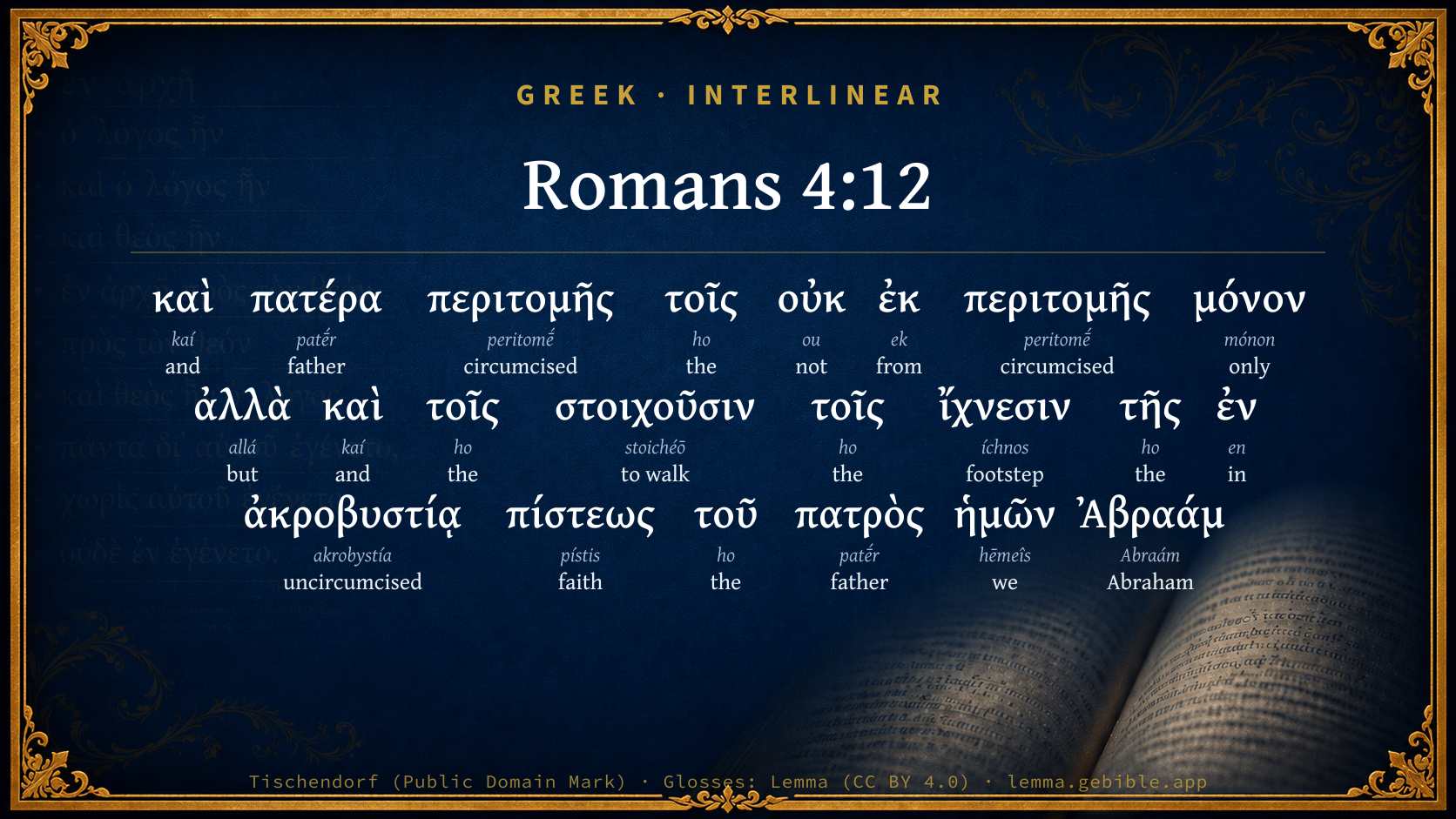
Greek (Tischendorf 8th ed.) Romans 4:12 appears in the Greek New Testament. The text above is from the Tischendorf 8th edition. Each word links to its Strong’s number and a concise gloss. Click any word for its full Thayer’s Greek Lexicon entry.
Download image
Cite this verse

Romans 4:12 (World English Bible). Public Domain. Lemma interlinear Bible study tool, https://lemma.gebible.app/v/romans/4/12.

Show BibTeX & RIS
BibTeX
RIS
English Translation
The father of circumcision to those who not only are of the circumcision, but who also walk in the steps of that faith of our father Abraham, which he had in uncircumcision.
World English Bible · Public Domain
Highlights
  • 1 first appearance in the Greek New Testament
Full analysis ↓
Download a study sheet

One document with this verse’s original text, its word-by-word gloss line, the meaning frame, cross-references with their text, attributed commentary, and full source and license credits — printable, and it pastes into notes with its structure intact.

This verse Autodidact and up

Study sheet (.html) Plain text (.txt)

A passage Seminary Student

Up to 50 verses in one chapter. A passage sheet keeps up to 6 commentary sources and 12 cross-references per verse, in the order this page ranks them, and says so on the sheet whenever that leaves anything out. Ask for a single verse and you get the Autodidact verse sheet above.

Everything on this page stays free to read, with no account — the sheet is a download of what is already on screen, not access to it.

Want to remove ads? Support Godless Engineer
Compare translations 3

The same verse in 3 English versions, stacked beneath the original-language interlinear above. Click any original word for its lexicon entry.

Each is an independent rendering of the whole verse — the interlinear is not word-aligned to these translations.

Highlighted words mark where these versions differ — a whole-verse word diff, not a word-by-word alignment.

  • World English Bible Public Domain
    The father of circumcision to those who not only are of the circumcision, but who also walk in the steps of that faith of our father Abraham, which he had in uncircumcision.
  • King James Version Public Domain
    And the father of circumcision to them who are not of the circumcision only, but who also walk in the steps of that faith of our father Abraham, which he had being yet uncircumcised.
  • unfoldingWord Literal Text CC BY-SA 4.0
    and the father of circumcision to the one not only from the circumcision, but to the ones also following in the steps of the faith of our father Abraham in uncircumcision.

unfoldingWord Literal Text — © unfoldingWord, licensed CC BY-SA 4.0. Word-aligned USFM3 via Door43 (git.door43.org/unfoldingWord/en_ult).

Versions to compare (up to 4)

3 of 4 selected

Show all 19 translations

Every available English version of this verse, each an independent rendering of the whole verse.

  • World English Bible Public Domain
    The father of circumcision to those who not only are of the circumcision, but who also walk in the steps of that faith of our father Abraham, which he had in uncircumcision.
  • Berean Standard Bible Public Domain
    And he is also the father of the circumcised who not only are circumcised, but who also walk in the footsteps of the faith that our father Abraham had before he was circumcised.
  • Majority Standard Bible Public Domain
    And he is also the father of the circumcised who not only are circumcised, but who also walk in the footsteps of the faith that our father Abraham had before he was circumcised.
  • King James Version Public Domain
    And the father of circumcision to them who are not of the circumcision only, but who also walk in the steps of that faith of our father Abraham, which he had being yet uncircumcised.
  • American Standard Version (1901) Public Domain
    and the father of circumcision to them who not only are of the circumcision, but who also walk in the steps of that faith of our father Abraham which he had in uncircumcision.
  • Revised Version (1885) Public Domain
    and the father of circumcision to them who not only are of the circumcision, but who also walk in the steps of that faith of our father Abraham which he had in uncircumcision.
  • Geneva Bible (1599) Public Domain
    And the father of circumcision, not vnto them onely which are of the circumcision, but vnto them also that walke in the steppes of the faith of our father Abraham, which he had when he was vncircumcised.
  • Douay-Rheims (1899) Public Domain
    And might be the father of circumcision; not to them only, that are of the circumcision, but to them also that follow the steps of the faithful, that is in the uncircumcision of our father Abraham.
  • Young's Literal Translation Public Domain
    and father of circumcision to those not of circumcision only, but who also walk in the steps of the faith, that `is' in the uncircumcision of our father Abraham.
  • Literal Standard Version CC BY-SA 4.0
    and father of circumcision to those not of circumcision only, but who also walk in the steps of faith, that [is] in the uncircumcision of our father Abraham.
  • Unlocked Literal Bible CC BY-SA 4.0
    This also meant that Abraham became the father of the circumcision for those who are not only circumcised but also for those who follow in the steps of faith of our father Abraham before he was circumcised.
  • unfoldingWord Literal Text CC BY-SA 4.0
    and the father of circumcision to the one not only from the circumcision, but to the ones also following in the steps of the faith of our father Abraham in uncircumcision.
  • Darby Bible Public Domain
    and father of circumcision, not only to those who are of [the] circumcision, but to those also who walk in the steps of the faith, during uncircumcision, of our father Abraham.
  • World Messianic Bible Public Domain
    He is the father of circumcision to those who not only are of the circumcision, but who also walk in the steps of that faith of our father Abraham, which he had in uncircumcision.
  • Webster's Bible Public Domain
    And the father of circumcision to them who are not of the circumcision only, but who also walk in the steps of that faith of our father Abraham which he had being yet uncircumcised.
  • Free Bible Version CC BY-SA 4.0
    He is also the father of circumcised Jews not merely because they're circumcised, but because they follow the example of the trust in God our father Abraham had before he was circumcised.
  • Bible in Basic English Public Domain
    And the father of circumcision to those who not only are of the circumcision, but who keep to the way of that faith which our father Abraham had before he underwent circumcision.
  • Text-Critical English NT CC BY 4.0
    and so that he might be the father of those who are not only circumcised in the flesh, but who also walk in the footsteps of the faith that our father Abraham had when he was uncircumcised.
  • Tyndale New Testament (1534) Public Domain
    and that he myght be the father of the circumcised not because they are circumcised only: but because they walke also in the steppes of that fayth that was in oure father Abraham before the tyme of circumcision.

Literal Standard Version (2020), Covenant Press — licensed CC BY-SA 4.0. Text via the HelloAO Bible API (eBible.org). Unlocked Literal Bible (unfoldingWord) — licensed CC BY-SA 4.0. Text via the HelloAO Bible API (eBible.org). unfoldingWord Literal Text — © unfoldingWord, licensed CC BY-SA 4.0. Word-aligned USFM3 via Door43 (git.door43.org/unfoldingWord/en_ult). Free Bible Version, Dr. Jonathan Gallagher — licensed CC BY-SA 4.0. Text via the HelloAO Bible API (eBible.org).

Word by word

More ways to search: Search by grammar → Find every occurrence → Compare this word →

Practice this passage: Drill this verse → Learn its vocabulary →

ἴχνεσιν
íchnos
G2487
“footstep”
Noun, Dative, Plural, Neuter
Part of Speech
Noun
Case
Dative
Number
Plural
Gender
Neuter
Full Thayer's Definition

Origin: from ikneomai (to arrive, cf G2240 )

TDNT: 09:42,4

1. a footprint, track, footstep 2. in the NT, metaph. of imitating the example of any one
  1. καὶ kaí G2532 “and” Conjunction
  2. πατέρα patḗr G3962 “father” Noun, Accusative, Singular, Masculine
  3. περιτομῆς peritomḗ G4061 “circumcised” Noun, Genitive, Singular, Feminine
  4. τοῖς ho G3588 “the” Article, Dative, Plural, Masculine
  5. οὐκ ou G3756 “not” Particle, Negative
  6. ἐκ ek G1537 “from” Preposition
  7. περιτομῆς peritomḗ G4061 “circumcised” Noun, Genitive, Singular, Feminine
  8. μόνον mónon G3440 “only” Adverb
  9. ἀλλὰ allá G235 “but” Conjunction
  10. καὶ kaí G2532 “and” Conjunction
  11. τοῖς ho G3588 “the” Article, Dative, Plural, Masculine
  12. στοιχοῦσιν stoichéō G4748 “to walk” Verb, Present, Active, Participle, Dative, Plural, Masculine
  13. τοῖς ho G3588 “the” Article, Dative, Plural, Neuter
  14. τῆς ho G3588 “the” Article, Genitive, Singular, Feminine
  15. ἐν en G1722 “in” Preposition
  16. ἀκροβυστίᾳ akrobystía G203 “uncircumcised” Noun, Dative, Singular, Feminine
  17. πίστεως pístis G4102 “faith” Noun, Genitive, Singular, Feminine
  18. τοῦ ho G3588 “the” Article, Genitive, Singular, Masculine
  19. πατρὸς patḗr G3962 “father” Noun, Genitive, Singular, Masculine
  20. ἡμῶν hēmeîs G2249 “we” Personal pronoun, 1st person, Genitive, Plural
  21. Ἀβραάμ Abraám G11 “Abraham” Noun, Proper, indeclinable

About this verse

These counts appear in no published source. They are computed here, from the morphology-tagged text and Lemma’s own curated glosses. What Lemma adds →

22
words
15
distinct lemmas
Pauline Epistles
section

Notable vocabulary

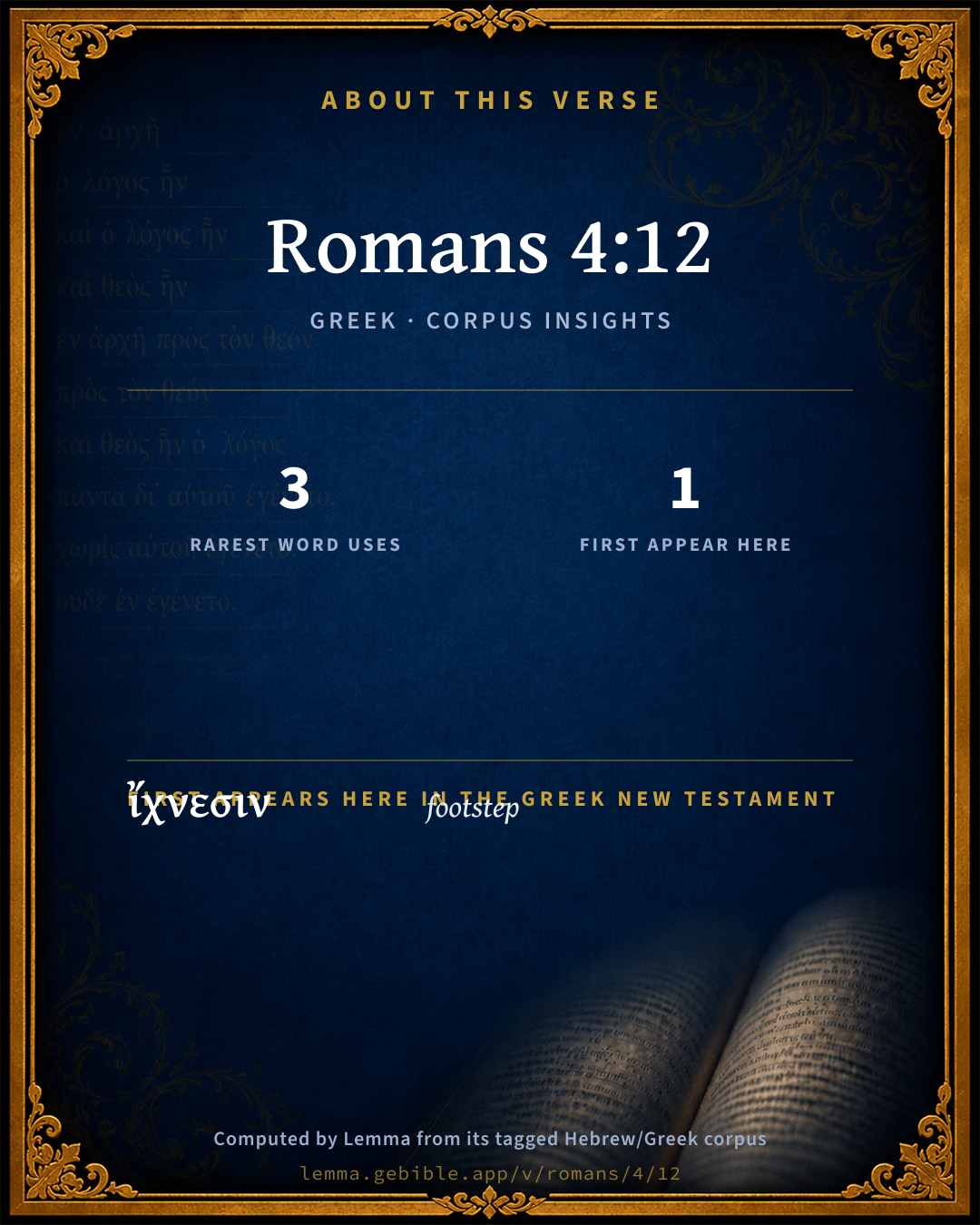
The rarest word here is ἴχνεσιν footstep G2487 — appearing just 3 times in the whole Greek New Testament.

First appearance in Scripture

This word makes its first canonical appearance in the Greek New Testament here:

  • ἴχνεσιν footstep G2487

Shared distinctive vocabulary

ἴχνεσιν footstep G2487 occurs in 3 verses of the Greek New Testament. Also found in:
Repetition

Words recur within this verse:

  • πατέρα father G3962 ×2
  • περιτομῆς circumcised G4061 ×2
  • τοῖς the G3588 ×5
  • καὶ and G2532 ×2

Cross-references

9

Topical passages linked to Romans 4:12 in the Treasury of Scripture Knowledge — connected by theme and wording, ordered by reader-vote popularity; previews shown in the World English Bible.

  • Proverbs 2:20 That you may walk in the way of good men, And keep the paths of the righteous.
  • Song of Solomon 1:8 If you don't know, most beautiful among women, Follow the tracks of the sheep. Graze your young goats beside the shepherds' tents.
  • John 8:39–40 They answered him, "Our father is Abraham." Jesus said to them, "If you were Abraham's children, you would do the works of Abraham.
  • 2 Corinthians 12:18 I exhorted Titus, and I sent the brother with him. Did Titus take any advantage of you? Didn't we walk in the same spirit? Didn't we walk in the same steps?
  • Galatians 4:22–31 For it is written that Abraham had two sons, one by the handmaid, and one by the free woman.
  • 1 Peter 2:21 For to this you were called, because Christ also suffered for us, leaving you an example, that you should follow his steps,
  • Job 33:11 He puts my feet in the stocks, He marks all my paths.'
  • Luke 16:23–31 In Hades, he lifted up his eyes, being in torment, and saw Abraham far off, and Lazarus at his bosom.
  • Romans 9:6–7 But it is not as though the word of God has come to nothing. For they are not all Israel, that are of Israel.

Cross-references courtesy of OpenBible.info (CC BY 4.0).

Commentary

Notes on Romans 4:12 from classic Christian and Jewish commentators (each source and its license shown beneath its notes). The classic Christian expositions comment on the surrounding passage and are grouped to its opening verse, so a note may address several verses; the Jewish commentaries on the Tanakh (Rashi and others) are per-verse, so they appear only where the commentator wrote on this verse.

Lemma curates 59 commentaries, every one of them public domain or Creative Commons licensed, each selected and text-cleaned for this edition rather than reprinted as found. About our sources →

Bengel's Gnomon

Johann Albrecht Bengel

Rom 4:12. Περιτομῆς, of circumcision) The Abstract for the concrete, of the circumcised nation.—το͂ις) Heb. ì: see Nold. on this particle, n. 30, 10, 15, 19, 22. Generally, it implies as to [as regards, in relation to]; so το͂ις, 1Jn 5:16; Luk 1:50; Luk 1:55. LXX. 1Ch 13:1: μετὰ τῶν ἀρχόντων κτλ. παντὶ ἡγουμένῳ, add to these passages 2Ch 31:2; 2Ch 31:16; Num 29:4.—οὐκ—μόνον) Abraham, therefore, is not the father of circumcision to such as are merely of the circumcision, and do not also follow the faith of Abraham.—ἐκ περιτομῆς, of the circumcision) ἐκ, of, means something more weighty than ἐν, in. Circumcision was at least a sign, uncircumcision was not even a sign.[46]—ἀλλὰ καὶ τοῖς) so in Rom 4:16.—ἴχνεσι, in the traces [steps]) The traces of faith are opposed to the traces of outward circumcision; the path is not trodden by many, but there are foot-traces found in it; it is, however, an open way.

[46] Therefore ἐκ is used with περιτομῆς, ἐν with ἀχροβυστία.—ED.

Bengel's Gnomon of the New Testament — English translation (T&T Clark, Edinburgh, 1860) — public domain. Text from a community e-Sword module.

Meyer's Critical & Exegetical Commentary

Heinrich August Wilhelm Meyer

Rom_4:12. The construction carries onward the foregoing πατέρα πάντων κ.τ.λ[1010]: and father of circumcision, i.e. father of circumcised persons (not of all circumcised, hence without the article). And in order to express to what circumcised persons this spiritual fatherhood of Abraham belongs, Paul adds, by way of more precise definition: for those (dativus commodi, comp Rev_21:7; Luk_7:12) who are not merely circumcised (comp Rom_2:8), but also walk in the footsteps, etc. With this rendering (Chrysostom, Oecumenius, Ambrosiaster, Erasmus, Beza, Calvin, Estius and others; including Ammon, Böhme, Tholuck, Klee, Rückert, Benecke, Reiche, Glöckler, Köllner, de Wette, Philippi, and Winer) it must be admitted (against Reiche and Köllner, whose observations do not justify the article) that τοῖς is erroneously repeated before στοιχοῦσι. Paul unsuitably continues with ἀλλὰ καί, just as if he had previously written an Οὐ ΜΌΝΟΝ ΤΟῖς. As any other rendering is wholly inadmissible, and as ΚΑῚ ΤΟῖς cannot be an inversion for ΤΟῖς ΚΑΊ (Mehring), we are driven to the assumption of that erroneous insertion of the article, as a negligence of expression. The expression in Php_1:29 (in opposition to Fritzsche) would be of the same nature only in the event of Paul having written ΤΟῖς.… Οὐ ΜΌΝΟΝ ΤΟῖς ἘΚ ΠΕΡΙΤΟΜῆς, ἈΛΛᾺ ΚΑῚ.… ΤΟῖς ΣΤΟΙΧΟῦΣΙ Κ.Τ.Λ[1013] Others take τοῖς οὐκ for οὐ τοῖς (as 37, 80, Syr[1014] Arr. Vulg. Slav. and several Fathers read as an emendation), thus making a distinction to be drawn here not between merely circumcised and unbelieving Jews, but between Jews and Gentiles (ἀλλὰ καὶ τοῖς κ.τ.λ[1015]). So Theodoret, Luther, Castalio, Koppe, Storr, Flatt, Schrader (Grotius is doubtful). But such an inversion is as unnatural (comp Rom_4:16) as it is unprecedented (it is an error to refer to Rom_2:27; 1Th_1:8); and how strange it would be, if Paul should have once more brought forward the fatherhood as to the believing Gentiles, but should have left that relating to the Jews altogether without conditioning definition! Hofmann (comp also his Schriftbew. II. 2, p. 82) understands περιτομῆς, after the analogy of Ὁ ΘΕῸς Τῆς ΔΌΞΗς Κ.Τ.Λ[1018], as the genitive of quality (a father, whose fatherhood is to be designated according to circumcisedness; as a circumcised person he has begotten Isaac, etc.); then assumes in the case of τοῖς οὐκ ἐκ περιτομῆς μόνον the suppressed antithesis to complete it, ἀλλὰ καὶ ἐκ πίστεως; and finally explains ἀλλὰ καὶ τοῖς στοιχ. as a supplementary addition, while he takes ἀλλὰ καὶ to mean not but also, but also however. A hopeless misinterpretation! For, as genitive of quality, περιτομῆς must have had the article (comp Act_7:2; 2Co_1:3; Eph_1:17 al[1020]), and every reader must have understood περιτομῆς in conformity with πάντων κ.τ.λ[1021], Rom_4:11, as a specification whose father Abraham further is. The reader could all the less mentally supply after τοῖς οὐκ ἐκ περιτ. a suppressed contrast, since the expressed contrast follows immediately with ἀλλὰ καί; and for that reason, again, it could occur to no one to understand this ἀλλὰ καί in any other sense than elsewhere after negations, namely, but also, not also however. (How inappropriate is Hofmanns citation of Luk_24:22, where no negation at all precedes!) Wieselers attempt (in Herzogs Encyklop. XX. p. 592) is also untenable, since he imports into τοῖς οὐκ ἐκ περιτ. μόνον the sense: who do not make circumcision the exclusive condition of salvation, and likewise renders ἀλλὰ καί also however; thus making Paul indicate (1) the Jewish Christians who were not rigid partisans of the law (such as were to be found in Palestine especially), and (2) the Pauline Jewish Christians.

τοῖς ἴχνεσι Κ.Τ.Λ[1022]] who so walk (see on Gal_5:25) that they follow the footsteps which Abraham has left behind through his faith manifested in his uncircumcised condition, i.e. who are believers after the type of the uncircumcised Abraham. The dative, commonly taken as local, is more correctly, in keeping with the other passages in which Paul uses the dative with στοιχεῖν (Gal_5:16; Gal_5:25; Gal_6:16; Php_3:16), interpreted in the sense of the norm.

[1010] .τ.λ. καὶ τὰ λοιπά.

[1013] .τ.λ. καὶ τὰ λοιπά.

[1014] yr. Peschito Syriac

[1015] .τ.λ. καὶ τὰ λοιπά.

[1018] .τ.λ. καὶ τὰ λοιπά.

[1020] l. and others; and other passages; and other editions.

[1021] .τ.λ. καὶ τὰ λοιπά.

[1022] .τ.λ. καὶ τὰ λοιπά.

Meyer — Critical and Exegetical Commentary on the New Testament — English translation by Peter Christie, edited by Frederick Crombie (T&T Clark, 1880) — public domain. Text from a community e-Sword module.

Godet's Commentaries

Frédéric Louis Godet

Vv. 12. There can be no doubt that this verse refers to believers of Jewish origin, who formed the other half of Abraham’s spiritual family. But it presents a great grammatical difficulty. The Greek expression is such that it seems as if Paul meant to speak in this same verse of two different classes of individuals. It appears as if the literal translation should run thus: “father of circumcision, in respect of those who are not only of the circumcision, but also in respect of those who walk in the steps of”...Proceeding on this translation, Theodoret, Luther, and others have applied the first words: “in respect of those who are not only of the circumcision,” to Jewish believers, and the following words: “in respect of those who walk in the footsteps of Abraham’s faith,” to Gentile believers. But why then return to the latter, who had already been sufficiently designated and characterized in Rom 4:11? And how, in speaking of Jewish believers, could Paul content himself with saying that they are not of circumcision only, without expressly mentioning faith as the condition of their being children of Abraham? Finally, the construction would still be incorrect in this sense, which would have demanded οὐ τοῖς...μόνον (not only for those who belong to the circumcision) instead of τοῖς οὐ...μόνον (for those who not only belong to...). This ancient explanation must therefore certainly be abandoned. There can be here only one class of persons designated by two distinct attributes. The first is circumcision, and the second, a faith like Abraham’s. But in this case the Greek construction seems again faulty in the second member. This is acknowledged by Tholuck, Meyer, etc. Philippi is fain to satisfy himself with the reflection that negligences of style are found in the best writers; which is true, but does not help us here; for the faultiness would be a real want of logic. On the other hand, the expedients recently devised by Hofmann and Wieseler are so farfetched that they do not deserve even to be discussed. And yet the apostle has not accustomed us to inexactness unworthy even of an intelligent pupil; and we may still seek to solve the difficulty. This is not impossible, as it appears to us; we need only take the first τοῖς to be a pronoun (those who), as it incontestably is, but regard the second not as a second parallel pronoun (which would, besides, require it to be placed before the καί), but a simple definite article: “the (individuals) walking in the steps of”...The meaning thus reached is to this effect: “those who are not only of the circumcision, but who are also, that is to say, at the same time, the (individuals) walking in the steps of”...This article, τοῖς, the, is partitive. It serves to mark off clearly within the mass of the Jewish people who possess the sign of circumcision, a much narrower circle: those walking in the faith, that is to say, the Jews, who to circumcision add the characteristic of faith. These latter do not form a second class alongside of the first; they form within this latter a group apart, possessing beside the common distinction, an attribute (faith) which is wanting to the others; and it is to draw this line of demarkation accurately within the circumcised Israel that the article is used. The τοῖς is here simply an article analogous to the τοῖς before πιστεύουσιν.

Paul is not satisfied with saying: “who also walk in the footsteps of Abraham’s faith;” he expressly reminds us—for this is the point of his argument—that Abraham had this faith in the state of uncircumcision. What does this mean, if not that Abraham was still ranked as a Gentile when “he believed and his faith was counted to him for righteousness?” Hence it follows that it is not, properly speaking, for Gentile believers to enter by the gate of the Jews, but for Jewish believers to enter by the gate of the Gentiles. It will be allowed that it was impossible for one to overwhelm his adversary more completely. But such is Paul’s logic; it does not stop short with refuting its opponent, it does not leave him till it has made it plain to a demonstration that the truth is the very antipodes of what he affirmed.

We find in these two verses the great and sublime idea of Abraham’s spiritual family, that people which is the product, not of the flesh, but of faith, and which comprises the believers of the whole world, whether Jews or Gentiles. This place of father to all the believing race of man assigned to Abraham, is a fundamental fact in the kingdom of God; it is the act in which this kingdom takes its rise, it is the aim of the patriarch’s call: “that he might be the father of...(Rom 4:11), and of”...(Rom 4:12). Hofmann says rightly: “Abraham is not only the first example of faith, for there had been other believers before him (Hebrews 11); but in him therewas founded forever the community of faith.” From this point the continuous history of salvation begins. Abraham is the stem of that tree, which thenceforth strikes root and develops. For he has not believed simply in the God of creation; he has laid hold by faith of the God of the promise, the author of that redeeming work which appears on the earth in his very faith. The notion of this spiritual paternity once rightly understood, the filiation of Abraham in the physical sense lost all importance in the matter of salvation. The prophets, John the Baptist, Jesus (John 8), were already at one in laying down the truth which the apostle here demonstrates: faith as constituting the principle of life, as it were the life-blood of Abraham’s family, which is that of God on the earth. Because, indeed, this principle is the only one in harmony with the moral essence of things, with the true relation between the Creator who gives of free grace, and the creature who accepts freely.

And this whole admirable deduction made by the apostle is to be regarded as a piece of Rabbinical scholasticism!

The apostle has succeeded in discovering the basis of Christian universalism in the very life of him in whose person theocratic particularism was founded. He has demonstrated the existence of a time when he represented Gentilism, or, to speak more properly, mankind in general; and it was during this period, when he was not yet a Jew, but simply a man, that he received salvation! The whole gospel of Paul was involved in this fact. But a question arose: after receiving justification, Abraham had obtained another privilege: he had been declared, with all his posterity, to be the future possessor of the world. Now this posterity could be none else than his issue by Isaac, and which had been put in possession of circumcision and of Canaan. Through this opening there returned, with banners displayed, that particularism which had been overthrown in the domain of justification. Thus there was lost the whole gain of the preceding demonstration. Paul does not fail to anticipate and remove the difficulty. To this question he devotes the following passage, Rom 4:13-16.

Frédéric Louis Godet — Commentaries on Luke, John, Romans, and 1 Corinthians — English translation (T&T Clark, Edinburgh, 1870s–1890s) — public domain. Text from a community e-Sword module.

Hodge's Commentary on Romans, Ephesians & First Corinthians

Charles Hodge

Rom_4:12

And the father of circumcision to them who are not of the circumcision only, etc. That the preceding clause is parenthetical is plain, because the grammatical construction in this verse is continued unbroken. Father of circumcision, i.e., of the circumcised. To them, αὐτοῖς, This change of construction from the genitive to the dative may be accounted for either by the fact, that in the Hebrew it may be said father to as well as father of; or by assuming that αὐτοῖς is the dative of advantage, for them. The meaning of this verse is somewhat doubtful. According to our version, which adheres closely to the Greek, the meaning is, Abraham is not the father of uncircumcised believers only, as stated in Rom_4:11, but he is the father of the circumcised also, provided they follow the example of his faith. According to this view, as Rom_4:11 presents him as the father of the believing Gentiles, this presents him as the father of the believing Jews. The only grammatical objection to this interpretation is the repetition of the article τοῖς before στοιχοῦσι, which would seem to indicate that those who follow the steps of his faith were a different class from the circumcised. Hence some commentators interpret the passage thus: He is the father of the circumcision, and not of the circumcision only, but also of those who follow his faith, which he had being yet uncircumcised. Put this is inconsistent with the construction.

1. It overlooks the καί, at the beginning of the verse, by which it is connected with Rom_4:11 : He is the father of the uncircumcised, (Rom_4:11,) and father of the circumcised, (Rom_4:12.)

2. It requires a transposition of the words τοῖς οὐ, so as to read οὐ τοῖς. What Paul says is, To those who are not of the circumcision only. This interpretation makes him say, Not to those only who are of the circumcision.

3. It is very unnatural to make this verse repeat what had just been said in Rom_4:11. There Paul had said that Abraham was the father of Gentile believers; why should he here say he was the father of the Jews, and also of the Gentiles?

The former interpretation, which is adopted by the great body of commentators, is therefore to be preferred.

Charles Hodge — Commentary on Romans (1835), First Corinthians (1857), and Ephesians (1856) — public domain. Text from a community e-Sword module.

Geneva Bible (1599)

Geneva Bible translators

An applying of the same example, to the circumcised believers, whose father Abraham is, but yet by faith.

Geneva Bible (1599) marginal notes — public domain. Text via Bolls.life.

Adam Clarke's Commentary

Verse 12. And the father of circumcision] He is also the head and representative of all the circumcision of all the JEWS who walk in the steps of that faith; who seek for justification by faith only, and not by the works of the law; for this was the faith that Abraham had before he received circumcision. For, the covenant being made with Abraham while he was a Gentile, he became the representative of the Gentiles, and they primarily were included in that covenant, and the Jews were brought in only consequentially; but salvation, implying justification by faith, originally belonged to the Gentiles; and, when the Gospel came, they laid hold on this as their original right, having been granted to them by the free mercy of God in their father and representative, Abraham. So that the Jews, to be saved, must come under that Abrahamic covenant, in which the Gentiles are included. This is an unanswerable conclusion, and must, on this point, for ever confound the Jews.

Adam Clarke's Commentary on the Bible (1810–1826) — public domain. Text from a community e-Sword/MySword module.

John Calvin's Commentaries

12. To them who are not, etc. The verb, are, is in this place to be taken for, “are deemed to be:” for he touches the carnal descendants of Abraham, who, having nothing but outward circumcision, confidently gloried in it. The other thing, which was the chief matter, they neglected; for the faith of Abraham, by which alone he obtained salvation, they did not imitate. It hence appears, how carefully he distinguished between faith and the sacrament; not only that no one might be satisfied with the one without the other, as though it were sufficient for justifying; but also that faith alone might be set forth as accomplishing everything: for while he allows the circumcised Jews to be justified, he expressly makes this exception — provided in true faith they followed the example of Abraham; for why does he mention faith while in uncircumcision, except to show, that it is alone sufficient, without the aid of anything else? Let us then beware, lest any of us, by halving things, blend together the two modes of justification.

What we have stated disproves also the scholastic dogma respecting the difference between the sacraments of the Old and those of the New Testament; for they deny the power of justifying to the former, and assign it to the latter. But if Paul reasons correctly, when he argues that circumcision does not justify, because Abraham was justified by faith, the same reason holds good for us, while we deny that men are justified by baptism, inasmuch as they are justified by the same faith with that of Abraham.

John Calvin's Commentaries (1540-1563) — public domain. Text from the Calvin Translation Society English edition (1840s-50s) via the Christian Classics Ethereal Library (ccel.org). Calvin's coverage is partial (roughly two-thirds of the Bible); uncommented books and verses are honest gaps, never fabricated. The 19th-century editor's footnotes and remarks are omitted so the notes are faithfully Calvin's own voice.

Ellicott's Commentary for English Readers

(12) And on the other hand, the mere performance of the rite was no guarantee for justification, unless it was attended with a faith like Abraham’s. Of the two things, faith itself, and circumcision the sign of faith, the first only was essential, and the second was useless without it.

A Bible Commentary for English Readers, edited by Charles John Ellicott (1878–1897) — public domain. Text from a community e-Sword module.

The Cambridge Bible for Schools and Colleges

gen. ed. J. J. S. Perowne

12. of circumcision] Practically = of the circumcision; (see last note on Rom_1:4). Abraham is here said to be the (spiritual) Father of the circumcision; i.e. of the circumcised; and then at once this is limited to the believing circumcised.

to them who] i.e. “to the benefit of those who, &c.” They inherit the eternal promise made to their great Father.

but who also walk] There is a grammatical difficulty in the Gr.; but it leaves the sense exactly as in E. V.

in the steps] Better, by the steps, as rule and model. Cp. Php_3:16. In the Gr. the verse closes with the words “of our father Abraham;” thus with an emphasis on the fact and nature of the fatherhood.

The Cambridge Bible for Schools and Colleges (gen. ed. J. J. S. Perowne; Cambridge University Press, 1878–1918) — public domain. Text from a community e-Sword module.

John Gill's Exposition

For the promise that he should be heir of the world,.... This promise is thought by some to refer to that of his being "the father of many nations", Gen 17:4; by whom the Gentiles are particularly meant, who are sometimes called "the world", and "the whole world", or the elect of God, the believing part of the world; whether among Jews or Gentiles, who sometimes go by the name of "the world" in Scripture: but to this it may be objected, that the promise here spoken of is made to Abraham's seed, as well as to himself; by which is meant not the Messiah, who is indeed heir of the world, and all things in it, but all believers, whether Jews or Gentiles; as appears from Rom 4:16; and therefore cannot be both heirs and inheritance too. Others think the land of Canaan is designed, and by a synecdoche, a part of the world is put for the whole world; but that land is never so called, and, besides, the promise of it belonged to those of the law, and to them only, contrary to what the apostle argues, Rom 4:14. Others therefore consider Canaan as a type of heaven, which Abraham and his spiritual seed are heirs of by promise. But rather, by "the world" here, is meant, both this world and that which is to come; Abraham and all believers are the "heirs" of this world, and of all things in it; "all things" are theirs, and, among the rest, the world, Christ being theirs, and they being Christ's; he is heir of all things, and they are joint heirs with him; and how little soever they may enjoy of it now, the time is coming, when they, by virtue of their right, "shall inherit the earth"; see Psa 37:9; and now they have as much of it as is necessary, and with a blessing, and which the Jews call their "world". It is a saying in their Talmud (o), , "thou shall see thy world" in thy lifetime; which the gloss explains, "thou shalt find", or enjoy all thy necessities, or what is needful for thee; and of Abraham they say (p), that

"he was the foundation of the world, and that for his sake the world was created;''

and introduce God saying of him thus (q).

"as I am the only one in my world, so he is the only one, "in his world".''

And as he and all the saints are heirs of this world, so of the world to come, the future salvation, the inheritance incorruptible, undefiled, never fading, and reserved in the heavens; for they are heirs of God himself, and shall inherit all things: now this large and comprehensive promise, which takes in the things of time and eternity,

was not to Abraham, or to his seed through the law: not through the law of circumcision, or on the score of their obedience to that, for this promise was made before that was enjoined; see Gen 12:2; nor through the law of Moses, which was not as yet given; nor through the law of nature, nor by any righteousness of the law;

but through the righteousness of faith: by virtue of which they have "all things that pertain to life and godliness", Pe2 1:3; and have "the promise of the life that now is, and of that which is to come", Ti1 4:8; enjoy with a blessing what they now have, and have a right and title to the heavenly glory.

(o) T. Bab. Beracot, fol. 17. 1. (p) Caphtor, fol. 99. 2. (q) T. Bab. Pesachim, fol. 118. 1.

John Gill's Exposition of the Whole Bible (1746–1763) — public domain (CC PDM 1.0). Text via the HelloAO Bible API.

Trapp's Complete Commentary

John Trapp

12 And the father of circumcision to them who are not of the circumcision only, but who also walk in the steps of that faith of our father Abraham, which he had being yet uncircumcised.

Ver. 12. Walk in the steps] That herein personate and express him to the life, as Constantine’s children, saith Eusebius, did their father.

John Trapp, A Commentary or Exposition upon All the Books of the Old and New Testament (1647–1656) — public domain. Text from a community e-Sword module.

Albert Barnes' Notes on the Bible

And the father of circumcision - The father, that is, the ancestor, exemplar, or model of those who are circumcised, and who possess the same faith that he did. Not only the father of all believers Rom 4:11, but in a special sense the father of the Jewish people. In this, the apostle intimates that though all who believed would be saved as he was, yet the Jews had a special proprietorship in Abraham; they had special favors and privileges from the fact that he was their ancestor.

Not of the circumcision only - Who are not merely circumcised, but who possess his spirit and his faith. Mere circumcision would not avail; but circumcision connected with faith like his, showed that they were especially his descendants; see the note at Rom 2:25.

Who walk in the steps ... - Who imitate his example; who imbibe his spirit; who have his faith.

Being yet uncircumcised - Before he was circumcised. Compare Gen 15:6, with Gen. 17.

Albert Barnes' Notes on the Bible (1834–1885) — public domain. Text from a community e-Sword/MySword module.

Haydock's Catholic Bible Commentary

And might be the father of circumcision. The apostle here tells them that Abraham is the father of all true believers, uncircumcised as well as circumcised, and all that believe in Christ, his seed, in whom God promised to bless all nations, are the spiritual sons of Abraham, and partake of the blessings promised to him in his posterity: nor can the circumcised be his true and spiritual children, unless they follow the footsteps of his faith, by which he was justified, when he believed the promises which God made to him before that circumcision was instituted; to wit, that he and Sara should have a son, when they were naturally past the age of having children, and that in his posterity all the world should be blessed, that is, in Christ. (Witham)

George Leo Haydock (1774–1849), Haydock's Catholic Family Bible and Commentary, 1859 edition — public domain. Excludes Psalms (Douay-Rheims chapter numbering differs from Protestant) and Deuterocanonical books (Catholic canon only).

Matthew Poole's English Annotations

The former verse tells you he was the father of the believing Gentiles, for the covenant was made with him, for all his believing seed, when he was uncircumcised, which shows, that righteousness is and may be imputed to them also without any outward circumcision: and then he is the father of the believing Jews; especially of as many of them as unto circumcision do add the imitation of his faith; who, besides circumcision, which they derived from him, do also transcribe his divine copy, and follow his example of faith and obedience; who leave their sins, as he did his country; who believe all God’s promises, and adhere to him against all temptations to the contrary.

Matthew Poole's English Annotations on the Holy Bible (1683–1685) — public domain. Text from a community e-Sword/MySword module.

Whedon's Commentary on the Bible

Daniel D. Whedon

12. Father of a spiritual circumcision to the physically uncircumcised Gentile.

Daniel D. Whedon (gen. ed.), Commentary on the Old and New Testaments (1874–1909) — public domain. Text from a community e-Sword module.

John Wesley's Explanatory Notes

And the father of the circumcision - Of those who are circumcised, and believe as Abraham did. To those who believe not, Abraham is not a father, neither are they his seed.

John Wesley, Explanatory Notes Upon the Whole Bible (1754–1765) — public domain. Text via the GEBible commentary corpus.

Godbey's Commentary on the New Testament

William B. Godbey

12. “And the father of circumcision not only to them who walk in the tracks of the faith of our father Abraham which he had in uncircumcision.” We see here that the normal attitude of Abraham’s children is in uncircumcision, as he was converted twenty-four years before he entered the visible church. Here we have it revealed that salvation is only for those who walk in the steps of Abraham, i. e., get justified by faith alone. These belong to class number one, i. e., the normal children of Abraham. In the second place, provision is made for those who belong to the circumcision, i. e., the visible church, that they may also come into the covenant by faith and become the children of Abraham if they will walk in the steps of that faith which he had in uncircumcision. Hence we see the preeminence in the covenant is given to those who get converted before they join the church. It is a mistake to receive the unconverted into the visible church, lest they may lean on it and stop short of experimental salvation, and in that case lose their souls. I joined the church before I was converted, God showing me mercy and leading me on into an intelligent experience, though Satan did his utmost to get me to rest in church membership.

William B. Godbey, Commentary on the New Testament (1896–1900) — public domain. Text from a community e-Sword module.

McGarvey & Pendleton's Commentaries

J. W. McGarvey

and the father of circumcision to them who not only are of the circumcision, but who also walk in the steps of that faith of our father Abraham which he had in uncircumcision . [Now, circumcision was not given to Abraham to justify him, but as a seal, or token, that he had obtained righteousness by faith. Moreover, it was given to him that he might become the father of all believing Gentiles, God having agreed to make him the head or spiritual father of all those saved by Christ on condition of his being circumcised, and Abraham having been circumcised in order to obtain this exalted honor, and thirdly, that he might be the spiritual father of those who are not only circumcised like him, but walk in the steps of that faith of his of which circumcision was the seal. Thus circumcision was the seal that God had made Abraham the father of all who believe in God, and are justified by their belief, whether they belong to the Jews, who, in the earlier ages, had the better opportunity to believe, or to the Gentiles, who had that better opportunity in these latter ages.]

J. W. McGarvey (with Philip Y. Pendleton), Commentaries on the New Testament (The Fourfold Gospel, 1914; Acts; and the epistles) — public domain. Text from a community e-Sword/MySword module.

The People's New Testament

B. W. Johnson

12. The father of circumcision. Of the circumcision described in chap. 2:29. Abraham is the “great father,” the father, not of the circumcision only, but of all who have such faith as he had before he was circumcised. When Abraham was “counted righteous through faith,” there was no difference between Jew and Gentile. Christianity, by its revelation of “righteousness through faith,” leads back to the same condition.

B. W. Johnson's The People's New Testament with Notes (1889–1891) — public domain. Electronic text from the Christian Classics Ethereal Library (CCEL) ThML edition.

Cambridge Greek Testament for Schools and Colleges

12. καὶ πατέρα περιτομῆς. περ. probably abstr. for concrete, = τῶν περιτεμνομένων.

τοῖς οὐκ ἐκ κ.τ.λ. Among the circumcised only those are sons of Abraham who follow in the steps of the faith which he had before he was circumcised. This is obviously the meaning, but requires the assumption of a primitive error in text. Hort suggests καὶ αὐτοῖς for καὶ τοῖς; W. H., appendix, ad loc[119]; cf. S. H. and Giff. The alternatives are to accept Hort’s emendation or to omit τοῖς before στοιχοῦσιν.

[119] ad loc. ad locum

Cambridge Greek Testament for Schools and Colleges (Cambridge University Press, 1896; 21 vols, various authors incl. Carr, Maclear, Plummer, Farrar, Lumby, Moule, M. R. James, Simcox) — public domain. Text from a community e-Sword module.

Alford’s Greek Testament

Henry Alford

12. καὶ (εἰς τὸ εἶναι αὐτὸν) πατέρα περιτομῆς.…] And (that he might be) father of the circumcision (the circumcised) to those (dat. commodi ‘for those,’ ‘in the case of those’) who are not only (physically) of the circumcision, but also who walk (the inversion of the article appears to be in order to bring out more markedly τοῖς ἐκ περιτ. and τοῖς στοιχ.,—who are not only οἱ ἐκ περιτ., but also οἱ στοιχοῦντες.…) in the footsteps (reff.) of the faith of our father (speaking here as a Jew) Abraham (which he had) while he was in uncircumcision. (The art. would make it ‘during his uncircumcision,’—but the sense is better without it, the word being generalized.)

Henry Alford, The Greek Testament (1849–1861) — public domain. Text from a community e-Sword module.

International Critical Commentary

12. τοῖς στοιχοῦσι. As it stands the art. is a solecism: it would make those who are circumcised one set of persons, and those who follow the example of Abraham’s faith another distinct set, which is certainly not St. Paul’s meaning. He is speaking of Jews who are both circumcised and believe. This requires in Greek the omission of the art. before στοιχοῦσιν. But τοῖς στ. is found in all existing MSS. We must suppose therefore either (1) that there has been some corruption. WH. think that τοῖς may be the remains of an original αὐτοῖς: but that would not seen to be a very natural form of sentence. Or (2) we may think that Tertius made a slip of the pen in following St. Paul’s dictation, and that this remained uncorrected. If the slip was not made by Tertius himself, it must have been made in some very early copy, the parent of all our present copies.

στοιχοῦσι. στοιχεῖν is a well-known military term, meaning strictly to ‘march in file’: Pollux viii. 9 τὸ δὲ βαθος στοῖχος καλεῖται, καὶ τὸ μὲν ἐφεξῆς εἶναι κατὰ μῆκος ζυγεῖν· τὸ δὲ ἐφεξῆς κατὰ βάθος στοιχεῖν, ‘the technical term for marching abreast is ζυγεῖν, for marching in depth or in file, στοιχεῖν’ (Wets.).

On οὐ μόνον rather than μὴ μόνον in this verse and in ver. 16 see Burton, M. and T. § 481.

Jewish Teaching on Circumcision

The fierce fanaticism with which the Jews insisted upon the rite of Circumcision is vividly brought out in the Book of Jubilees (xv. 25 ff.): ‘This law is for all generations for ever, and there is no circumcision of the time, and no passing over one day out of the eight days; for it is an eternal ordinance, ordained and written on the heavenly tables. And every one that is born, the flesh of whose foreskin is not circumcised on the eighth day, belongs not to the children of the covenant which the Lord made with Abraham, for he belongs to the children of destruction; nor is there moreover any sign on him that he is the Lord’s, but (he is destined) to be destroyed and slain from the earth, and to be rooted out of the earth, for he has broken the covenant of the Lord our God. … And now I will announce unto thee that the children of Israel will not keep true to this ordinance, and they will not circumcise their sons according to all this law; for in the flesh of their circumcision they will omit this circumcision of their sons, and all of them, sons of Belial, will have their sons uncircumcised as they were born. And there shall be great wrath from the Lord against the children of Israel, because they have forsaken His covenant and turned away from His word, and provoked and blasphemed, according as they have not observed the ordinance of this law; for they treat their members like the Gentiles, so that they may be removed and rooted out of the land. And there will be no pardon or forgiveness for them, so that there should be pardon and release from all the sin of this error for ever.’

So absolute is Circumcision as a mark of God’s favour that if an Israelite has practised idolatry his circumcision must first be removed before he can go down to Gehenna (Weber, Altsyn. Theol. p. 51 f.). When Abraham was circumcised God Himself took a part in the act (ibid. p. 253). It was his circumcision and anticipatory fulfilment of the Law which qualified Abraham to be the ‘father of many nations’ (ibid. p. 256). Indeed it was just through his circumcision that Isaac was born of a ‘holy seed.’ This was the current doctrine. And it was at the root of it that St. Paul strikes by showing that Faith was prior to Circumcision, that the latter was wholly subordinate to the former, and that just those privileges and promises which the Jew connected with Circumcision were really due to Faith.

PROMISE AND LAW

4:13-17. Again the declaration that was made to Abraham had nothing to do with Law. For it turned on Faith and Promise which are the very antithesis of Law. The reason being that Abraham might be the spiritual father of all believers, Gentiles as well as Jews, and that Gentiles might have an equal claim to the Promise.

13Another proof that Gentiles were contemplated as well as Jews. The promise made to Abraham and his descendants of world-wide Messianic rule, as it was not dependent upon Circumcision, so also was not dependent upon Law, but on a righteousness which was the product of Faith. 14If this world-wide inheritance really depended upon any legal system, and if it was limited to those who were under such a system, there would be no place left for Faith or Promise: Faith were an empty name and Promise a dead letter. 15For Law is in its effects the very opposite of Promise. It only serves to bring down God’s wrath by enhancing the guilt of sin. Where there is no law, there is no transgression, which implies a law to be transgressed. Law and Promise therefore are mutually exclusive; the one brings death, the other life. 16Hence it is that the Divine plan was made to turn, not on Law and obedience to Law, but on Faith. For faith on man’s side implies Grace, or free favour, on the side of God. So that the Promise depending as it did not on Law but on these broad conditions, Faith and Grace, might hold good equally for all Abraham’s descendants—not only for those who came under the Mosaic Law, but for all who could lay claim to a faith like his. 17Thus Abraham is the true ancestor of all Christians (ἡμῶν), as it is expressly stated in Gen 17:5 ‘A father’ (i.e. in spiritual fatherhood) ‘of many nations have I made thee*.’

International Critical Commentary — older volumes (1896–1929), various authors — public domain. Text from a community e-Sword module.

Vincent's Word Studies in the New Testament

Marvin R. Vincent

Father of circumcision. Of circumcised persons. The abstract term is used for the concrete. See on 11 7.

Who not only are - but who also walk. Apparently Paul speaks of two classes, but really of but one, designated by two different attributes. The awkwardness arises from the article toiv, erroneously repeated with stoicousin walk, which latter word expresses an added characteristic, not another class. Paul means that Abraham received a seal, etc., that he might be the father of circumcision to those who not only are circumcised, but who add to this outward sign the faith which Abraham exhibited.

Walk (stoicousin). See on elements, 2Pe 3:10.

Marvin R. Vincent, Word Studies in the New Testament (1887–1900) — public domain. Text from a community e-Sword/MySword module.

Lesson kit

Teaching starters — assembled from the data on this page, not authored interpretation. Every prompt links to the verse data it draws on. Edit before teaching.

Romans, in the Pauline Epistles, opens this verse with 22 words (15 distinct Greek lemmas). Its most distinctive word is íchnos (“footstep”). A historical commentator’s framing appears above. Read the whole chapter for the surrounding context.

Discussion questions

  1. What does “footstep” (íchnos) contribute to the verse as a whole?
  2. This is the first place “footstep” appears in Scripture (first appears here). What does its debut here establish?
  3. How does 2 Corinthians 12:18, which shares the word «footstep», read alongside this verse?
  4. What does the repetition of “father” (2× in this one verse) do in this verse?
  5. The translations on this page render this verse differently — a whole-verse word diff, not a word-by-word alignment. What might account for the different wordings?
  6. Compare how Bengel's Gnomon and Meyer's Critical & Exegetical Commentary read this verse. Where do they agree or differ?

Things to notice

  • 1 word makes its first canonical appearance in Scripture here.
  • These translations choose different wording for 10 words in this verse.
  • “father” occurs 2× in this single verse.
  • 15 distinct Greek lemmas span 22 words in this verse.

Reading settings

Reading text

Shown beneath each verse's original-language words.

Old Testament
Old Testament edition

Read the OT as the Masoretic Hebrew (MT) or the Greek Septuagint (LXX).

English shown for the Greek Septuagint (in the Hebrew ↔ Greek comparison).

Comparing translations? Open the Compare panel on any verse page to stack up to four side by side.