
Romans 11:24

Greek (Tischendorf 8th ed.) Romans 11:24 appears in the Greek New Testament. The text above is from the Tischendorf 8th edition. Each word links to its Strong’s number and a concise gloss. Click any word for its full Thayer’s Greek Lexicon entry.
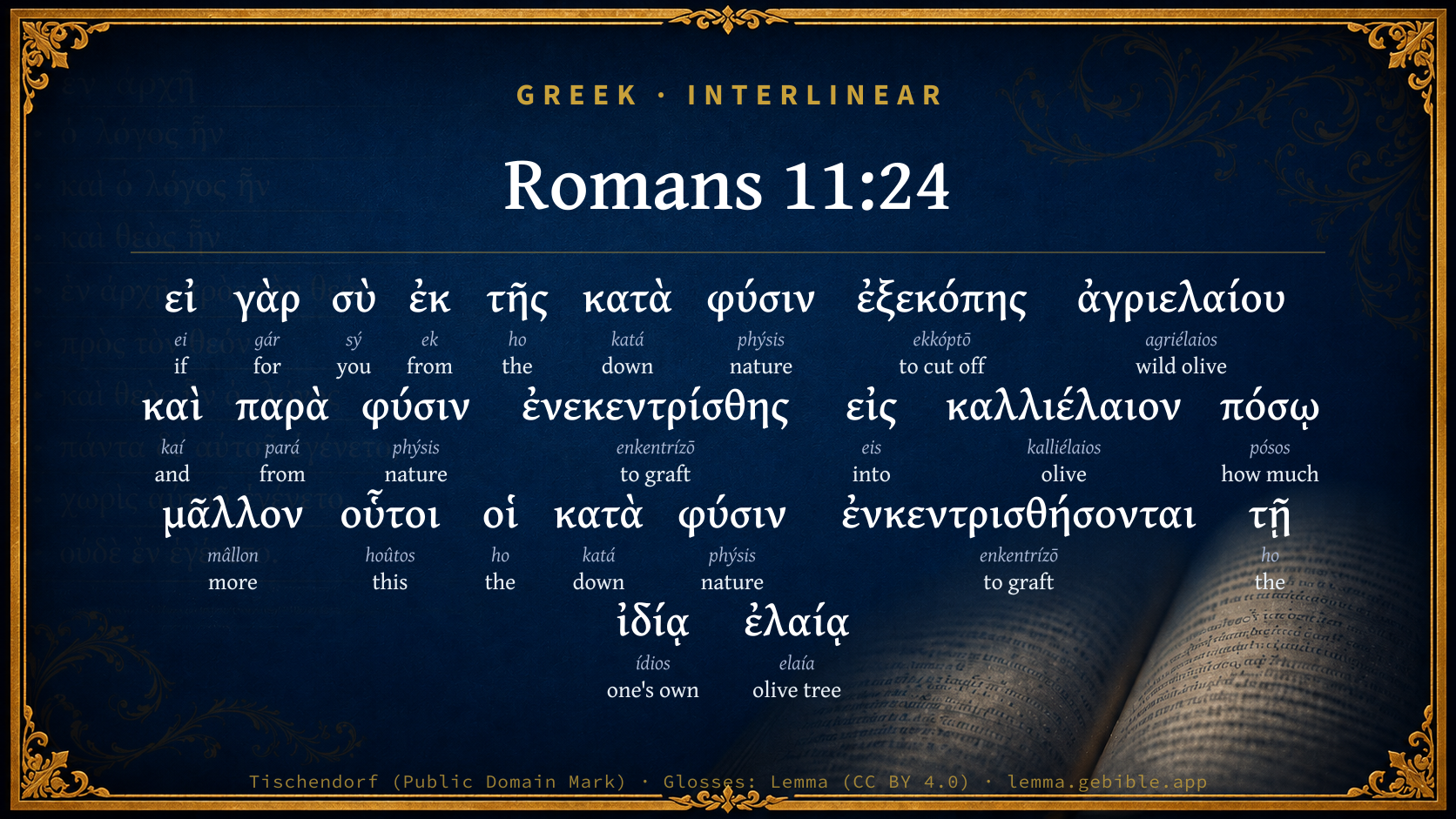
Download image
Cite this verse

Romans 11:24 (World English Bible). Public Domain. Lemma interlinear Bible study tool, https://lemma.gebible.app/v/romans/11/24.

Show BibTeX & RIS
BibTeX
RIS
English Translation
For if you were cut out of that which is by nature a wild olive tree, and were grafted contrary to nature into a good olive tree, how much more will these, which are the natural branches, be grafted into their own olive tree?
World English Bible · Public Domain
Highlights
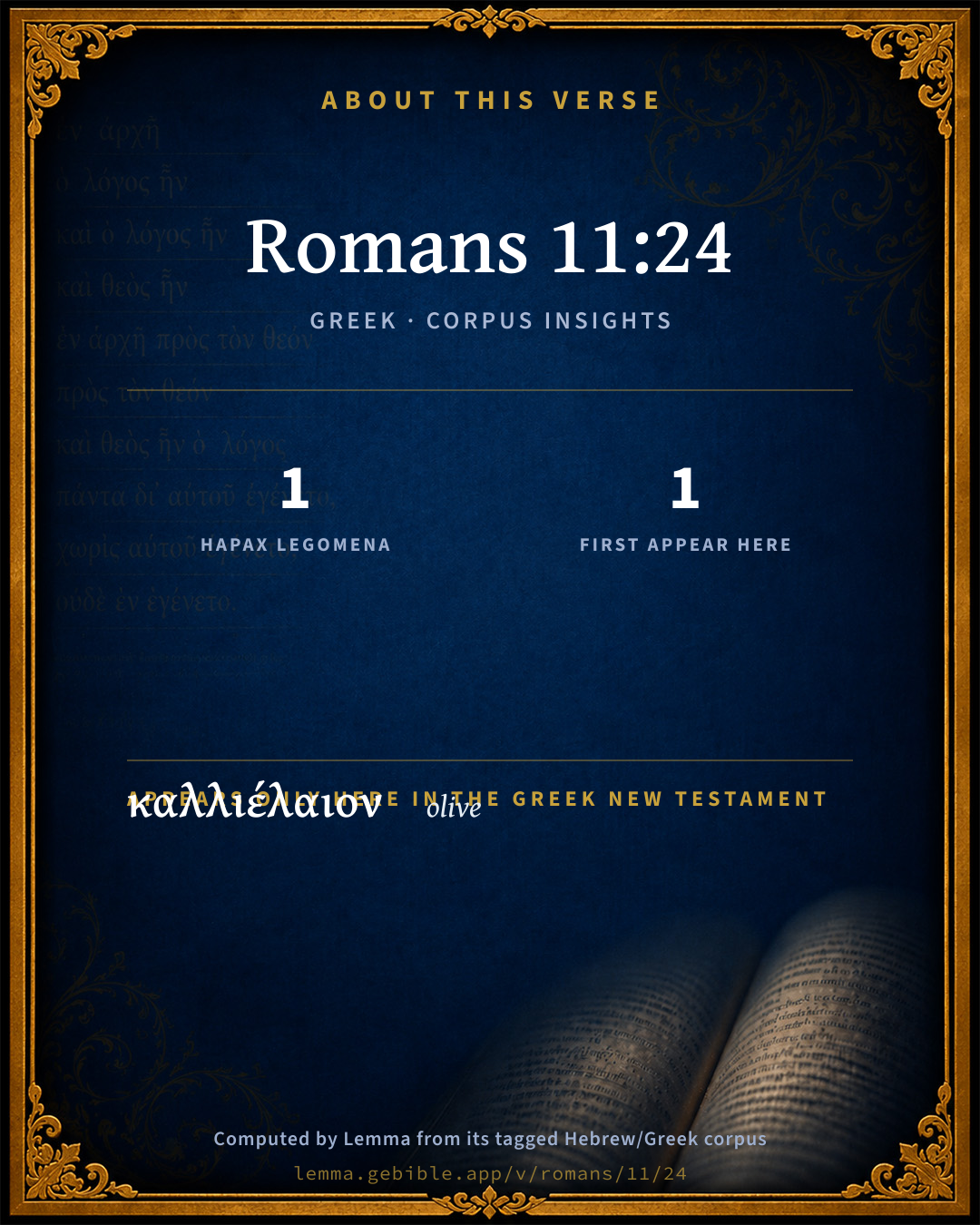
  • 1 hapax legomenon — only here in the Greek New Testament
  • 1 first appearance in the Greek New Testament
Full analysis ↓
Download a study sheet

One document with this verse’s original text, its word-by-word gloss line, the meaning frame, cross-references with their text, attributed commentary, and full source and license credits — printable, and it pastes into notes with its structure intact.

This verse Autodidact and up

Study sheet (.html) Plain text (.txt)

A passage Seminary Student

Up to 50 verses in one chapter. A passage sheet keeps up to 6 commentary sources and 12 cross-references per verse, in the order this page ranks them, and says so on the sheet whenever that leaves anything out. Ask for a single verse and you get the Autodidact verse sheet above.

Everything on this page stays free to read, with no account — the sheet is a download of what is already on screen, not access to it.

Want to remove ads? Support Godless Engineer
Compare translations 3

The same verse in 3 English versions, stacked beneath the original-language interlinear above. Click any original word for its lexicon entry.

Each is an independent rendering of the whole verse — the interlinear is not word-aligned to these translations.

Highlighted words mark where these versions differ — a whole-verse word diff, not a word-by-word alignment.

  • World English Bible Public Domain
    For if you were cut out of that which is by nature a wild olive tree, and were grafted contrary to nature into a good olive tree, how much more will these, which are the natural branches, be grafted into their own olive tree?
  • King James Version Public Domain
    For if thou wert cut out of the olive tree which is wild by nature, and wert graffed contrary to nature into a good olive tree: how much more shall these, which be the natural branches, be graffed into their own olive tree?
  • unfoldingWord Literal Text CC BY-SA 4.0
    For if you from what by nature a wild olive tree were cut off, and contrary to nature were grafted into a good olive tree, how much more will these, who according to nature, be grafted back into their own olive tree?

unfoldingWord Literal Text — © unfoldingWord, licensed CC BY-SA 4.0. Word-aligned USFM3 via Door43 (git.door43.org/unfoldingWord/en_ult).

Versions to compare (up to 4)

3 of 4 selected

Show all 19 translations

Every available English version of this verse, each an independent rendering of the whole verse.

  • World English Bible Public Domain
    For if you were cut out of that which is by nature a wild olive tree, and were grafted contrary to nature into a good olive tree, how much more will these, which are the natural branches, be grafted into their own olive tree?
  • Berean Standard Bible Public Domain
    For if you were cut from a wild olive tree, and contrary to nature were grafted into one that is cultivated, how much more readily will these, the natural branches, be grafted into their own olive tree!
  • Majority Standard Bible Public Domain
    For if you were cut from a wild olive tree, and contrary to nature were grafted into one that is cultivated, how much more readily will these, the natural branches, be grafted into their own olive tree!
  • King James Version Public Domain
    For if thou wert cut out of the olive tree which is wild by nature, and wert graffed contrary to nature into a good olive tree: how much more shall these, which be the natural branches, be graffed into their own olive tree?
  • American Standard Version (1901) Public Domain
    For if thou wast cut out of that which is by nature a wild olive tree, and wast grafted contrary to nature into a good olive tree; how much more shall these, which are the natural `branches', be grafted into their own olive tree?
  • Revised Version (1885) Public Domain
    For if thou wast cut out of that which is by nature a wild olive tree, and wast grafted contrary to nature into a good olive tree: how much more shall these, which are the natural branches, be grafted into their own olive tree?
  • Geneva Bible (1599) Public Domain
    For if thou wast cut out of the Oliue tree, which was wilde by nature, and wast graffed contrary to nature in a right Oliue tree, how much more shall they that are by nature, bee graffed in their owne Oliue tree?
  • Douay-Rheims (1899) Public Domain
    For if thou wert cut out of the wild olive tree, which is natural to thee; and, contrary to nature, were grafted into the good olive tree; how much more shall they that are the natural branches, be grafted into their own olive tree?
  • Young's Literal Translation Public Domain
    for if thou, out of the olive tree, wild by nature, wast cut out, and, contrary to nature, wast graffed into a good olive tree, how much rather shall they, who `are' according to nature, be graffed into their own olive tree?
  • Literal Standard Version CC BY-SA 4.0
    for if you, out of the olive tree, wild by nature, were cut out, and contrary to nature, were grafted into a good olive tree, how much rather will they, who [are] according to nature, be grafted into their own olive tree?
  • Unlocked Literal Bible CC BY-SA 4.0
    For if you were cut out of what is by nature a wild olive tree, and contrary to nature were grafted into a good olive tree, how much more will these Jews, who are the natural branches, be grafted back into their own olive tree?
  • unfoldingWord Literal Text CC BY-SA 4.0
    For if you from what by nature a wild olive tree were cut off, and contrary to nature were grafted into a good olive tree, how much more will these, who according to nature, be grafted back into their own olive tree?
  • Darby Bible Public Domain
    For if *thou* hast been cut out of the olive tree wild by nature, and, contrary to nature, hast been grafted into the good olive tree, how much rather shall they, who are according to nature be grafted into their own olive tree?
  • World Messianic Bible Public Domain
    For if you were cut out of that which is by nature a wild olive tree, and were grafted contrary to nature into a good olive tree, how much more will these, which are the natural branches, be grafted into their own olive tree?
  • Webster's Bible Public Domain
    For if thou wast cut out of the olive-tree which is wild by nature, and wast ingrafted contrary to nature into a good olive-tree; how much more shall these, which are the natural branches, be grafted into their own olive-tree?
  • Free Bible Version CC BY-SA 4.0
    If you could be cut from a wild olive tree, and then be grafted artificially onto a cultivated olive tree, how much more easily they could be grafted back naturally to their own tree.
  • Bible in Basic English Public Domain
    For if you were cut out of a field olive-tree, and against the natural use were united to a good olive-tree, how much more will these, the natural branches, be united again with the olive-tree which was theirs?
  • Text-Critical English NT CC BY 4.0
    For if yoʋ were cut off from what is by nature a wild olive tree and were grafted contrary to nature into a cultivated olive tree, how much more will the natural branches be grafted back into their own olive tree?
  • Tyndale New Testament (1534) Public Domain
    For yf thou wast cut out of a naturall wilde olyve tree and wast graffed contrary to nature in a true olyve tree: how moche more shall the naturall brauches be graffed in their awne olyve tree agayne.

Literal Standard Version (2020), Covenant Press — licensed CC BY-SA 4.0. Text via the HelloAO Bible API (eBible.org). Unlocked Literal Bible (unfoldingWord) — licensed CC BY-SA 4.0. Text via the HelloAO Bible API (eBible.org). unfoldingWord Literal Text — © unfoldingWord, licensed CC BY-SA 4.0. Word-aligned USFM3 via Door43 (git.door43.org/unfoldingWord/en_ult). Free Bible Version, Dr. Jonathan Gallagher — licensed CC BY-SA 4.0. Text via the HelloAO Bible API (eBible.org).

Word by word

More ways to search: Search by grammar → Find every occurrence → Compare this word →

Practice this passage: Drill this verse → Learn its vocabulary →

καλλιέλαιον
kalliélaios
G2565
“olive”
Noun, Accusative, Singular, Feminine
Part of Speech
Noun
Case
Accusative
Number
Singular
Gender
Feminine
Full Thayer's Definition

Origin: from the base of G2566 and G1636

TDNT: None

1. the garden olive as opposed to the wild olive
  1. εἰ ei G1487 “if” Conditional
  2. γὰρ gár G1063 “for” Conjunction
  3. σὺ sý G4771 “you” Personal pronoun, 2nd person, Nominative, Singular
  4. ἐκ ek G1537 “from” Preposition
  5. τῆς ho G3588 “the” Article, Genitive, Singular, Feminine
  6. κατὰ katá G2596 “down” Preposition
  7. φύσιν phýsis G5449 “nature” Noun, Accusative, Singular, Feminine
  8. ἐξεκόπης ekkóptō G1581 “to cut off” Verb, Aorist, Passive, Indicative, 2nd person, Singular
  9. ἀγριελαίου agriélaios G65 “wild olive” Noun, Genitive, Singular, Feminine
  10. καὶ kaí G2532 “and” Conjunction
  11. παρὰ pará G3844 “from” Preposition
  12. φύσιν phýsis G5449 “nature” Noun, Accusative, Singular, Feminine
  13. ἐνεκεντρίσθης enkentrízō G1461 “to graft” Verb, Aorist, Passive, Indicative, 2nd person, Singular
  14. εἰς eis G1519 “into” Preposition
  15. πόσῳ pósos G4214 “how much” Correlative/interrogative pronoun, Dative, Singular, Neuter
  16. μᾶλλον mâllon G3123 “more” Adverb
  17. οὗτοι hoûtos G3778 “this” Demonstrative pronoun, Nominative, Plural, Masculine
  18. οἱ ho G3588 “the” Article, Nominative, Plural, Masculine
  19. κατὰ katá G2596 “down” Preposition
  20. φύσιν phýsis G5449 “nature” Noun, Accusative, Singular, Feminine
  21. ἐνκεντρισθήσονται enkentrízō G1461 “to graft” Verb, Future, Passive, Indicative, 3rd person, Plural
  22. τῇ ho G3588 “the” Article, Dative, Singular, Feminine
  23. ἰδίᾳ ídios G2398 “one's own” Adjective, Dative, Singular, Feminine
  24. ἐλαίᾳ elaía G1636 “olive tree” Noun, Dative, Singular, Feminine

About this verse

These counts appear in no published source. They are computed here, from the morphology-tagged text and Lemma’s own curated glosses. What Lemma adds →

25
words
19
distinct lemmas
Pauline Epistles
section

Notable vocabulary

1 hapax legomenon — a word that appears only here in the entire Greek New Testament:

  • καλλιέλαιον olive G2565

First appearance in Scripture

This word makes its first canonical appearance in the Greek New Testament here:

  • καλλιέλαιον olive G2565

Shared distinctive vocabulary

ἀγριελαίου wild olive G65 occurs in 2 verses of the Greek New Testament. Also found in:
Repetition

Words recur within this verse:

  • φύσιν nature G5449 ×3
  • κατὰ down G2596 ×2
  • ἐνεκεντρίσθης to graft G1461 ×2
  • τῆς the G3588 ×3

Cross-references

1

Topical passages linked to Romans 11:24 in the Treasury of Scripture Knowledge — connected by theme and wording, ordered by reader-vote popularity; previews shown in the World English Bible.

  • Romans 11:17–18 But if some of the branches were broken off, and you, being a wild olive, were grafted in among them, and became partaker with them of the root and of the richness of the olive tree;

Cross-references courtesy of OpenBible.info (CC BY 4.0).

Commentary

Notes on Romans 11:24 from classic Christian and Jewish commentators (each source and its license shown beneath its notes). The classic Christian expositions comment on the surrounding passage and are grouped to its opening verse, so a note may address several verses; the Jewish commentaries on the Tanakh (Rashi and others) are per-verse, so they appear only where the commentator wrote on this verse.

Lemma curates 59 commentaries, every one of them public domain or Creative Commons licensed, each selected and text-cleaned for this edition rather than reprinted as found. About our sources →

Joseph Benson's Commentary

Rom 11:24. For, &c. — As if he had said, And it appears that he will do it, because he has done that which was more unlikely, as being contrary to nature: if thou wert cut out of the tree wild by nature, &c. — If thou wert admitted into the family of God, though descended from parents that were strangers and enemies, how much more shall they who were children of the covenant, to whom the promises originally belonged, be taken into covenant with him. In other words, God will not seem to do so wonderful a thing, in restoring them to what might appear the privilege of their birthright, and in saving the seed of Abraham his friend, as he hath done in calling you sinners of the Gentiles, to participate the blessings of which you had not the least notion, and to which you cannot be supposed to have had any imaginable claim. This reasoning is certainly very just; the conversion of the Jews, though it hath not yet happened, appearing much more probable than did the conversion of the Gentiles, before that event took place. Some understand the expression, grafted contrary to nature, as signifying contrary to the usual way of ingrafting; which is, not to insert a wild scion into a good stock, but a good scion into a wild stock, to which it communicates its changing efficacy, causing it to bear good fruit. But that circumstance appears not to have been at all regarded by the apostle; nor was it necessary, as Doddridge justly observes, that the simile taken from ingrafting should hold in all its particulars: and certainly the engagement to humility arises, in a considerable degree, from the circumstances of the ingrafting here supposed being the reverse of that commonly used. Indeed, had the scion been nobler than the stock into which it was inserted, its dependance on it for life and nourishment would have rendered it unreasonable that it should boast against it; how much more when the case was the reverse of that in use, and the wild olive was ingrafted on the good.

Joseph Benson's Commentary on the Old and New Testaments (1811–1818) — public domain. Text from a community e-Sword module.

Tyndale Open Study Notes

Tyndale Open Resources

11:24 by nature . . . contrary to nature: The usual method of enhancing the yield of olive trees involved grafting a shoot from a cultivated tree onto a wild olive tree to benefit from the wild tree’s vigor. By grafting wild olive branches (Gentiles) into the cultivated olive tree (the people of God), God has done what is contrary to nature.

Tyndale Open Study Notes — © Tyndale Open Resources, licensed CC BY-SA 4.0. Text via the HelloAO Bible API.

Bengel's Gnomon

Johann Albrecht Bengel

Rom 11:24. Ἀγριελαίου, of the wild olive tree) There is as great a distinction between those, who either have not, or have the revealed word, as there is between the wild and cultivated olive-tree.—παρὰ φύσιν) quite contrary to nature, for in the art of gardening, the process of engrafting, which unites two trees of a different nature, commits the soft graft, which is followed by the fruit, to the woody stem: but Paul says, that the graft of the wild olive is inserted into the good olive-tree, in order that it may follow [in consequence partake of] the fatness of the good olive.—πόσῳ μᾶλλον, how much more) He gradually comes from that which can be, to that which actually is. The discourse in fact assumes an augmentation of force; formerly Paul demonstrated from the prophets, that in Israel there were more wicked than good men, he now demonstrates in like manner from the prophets, that there will be hereafter more good than wicked men; and while he is drawing forth this statement, he calls it a mystery, fitted to check the pride of the Gentiles, lest they should think that the part assigned to the Jews was to be always inferior.

Bengel's Gnomon of the New Testament — English translation (T&T Clark, Edinburgh, 1860) — public domain. Text from a community e-Sword module.

Meyer's Critical & Exegetical Commentary

Heinrich August Wilhelm Meyer

Rom_11:24. Γάρ] does not serve to assign the reason of δυνατὸς κ.τ.λ., so that the ability of God for that reingrafting would be popularly illustrated from the facility of this process, as according to nature (the ordinary view). Against this it may be decisively urged, thatapart from the difficulty which experience attests in the conversion of unbelieving Jewsthe power of God is the correlative, not of that which is easy, but precisely of that which is difficult, or which humanly speaking appears impossible (Rom_4:21, Rom_14:4; 2Co_9:8; Rom_9:22; Mat_19:26; Luk_1:37, et al.); and that πόσῳ μᾶλλον, as a designation of greater easiness, must have found in the context a more precise explanation to that effect, if it was not intended to express generally, as elsewhere (comp. Phm_1:16, and the similar use of πολλῷ μᾶλλον), the greater degree of probability or certainty. Rightly, therefore, have Winzer, Progr. 1828, Reiche, Philippi, and Tholuck, referred the γάρ to the main thought of the previous verse, to ἐγκεντρισθήσονται. Yet they should not have taken this γάρ as purely co-ordinate with the preceding γάρ, butas must always be done with two such apparently parallel instances of γάρas explicative (see on Rom_8:6), namely, so that after the brief ground assigned for ἐγκεντρισθήσονται (δυνατὸς κ.τ.λ.), the same is now yet more fully elucidated in regard to its certainty, and by this elucidation is still further confirmed. To this the confirmatory reference to ἐγκεντ. in Hofmann substantially amounts.

σύ] Gentile-Christian.

ἐκ τῆς κατὰ φύσιν … ἀγριελ.] out of the wild olive, which is so according to nature, which by nature has grown a wild olive.

παρὰ φύσιν] for the grafting, as an artificial proceeding, alters the natural development, and is so far contrary to nature (Rom_1:26). The interposition of ἐξεκοπ. brings out more markedly the contrast between κατὰ φύσιν and παρὰ φ. Very violently the simple words are twisted by Hofmann as follows: ἀγριελαίου is in apposition to ἐκ τῆς κατὰ φύσιν; while for the latter there is to be borrowed from ἀγριελαίου the more general notion of the olive tree, and ἡ κατὰ φύσιν is the tree, which is so for the branch in a natural manner.

εἰς καλλιέλ.] into a (not the) noble olive tree. The word is also found in Aristotle, Plant. i. 6, in contrast to ἀγριέλ.

οὗτοι] the Jews who have refused to believe.

οἱ κατὰ φύσιν] sc. ὄντες, those according to nature. In what respect they are so, the context exhibits, namely, as the original branches of the holy olive tree, whose root the patriarchs are, Rom_11:16.

τῇ ἰδίᾳ ἐλ.] for they have originally grown upon it, and then have been cut off from it; hence it is still their own olive tree.

Meyer — Critical and Exegetical Commentary on the New Testament — English translation by Peter Christie, edited by Frederick Crombie (T&T Clark, 1880) — public domain. Text from a community e-Sword module.

Expositor's Greek Testament

ed. W. Robertson Nicoll

Rom 11:24 . God’s power to engraft the Jews again into the stock of His people proved a fortiori by comparison with what He has done for the Gentiles. To restore His own is more natural, conceivable, and one may even say easy, than to call those who are not His own. The Gentile Christian (1) was cut ἐκ τῆς κατὰ φύσιν ἀγριελαίου , from what is in its own nature an uncultivated olive, with no suitableness for the uses which the olive is intended to subserve, and (2) παρὰ φύσιν in violation of nature was engrafted into a good olive; in comparison with this doubly unnatural process one may well argue πόσῳ μᾶλλον κ . τ . λ . how much more shall these, the Jews who κατὰ φύσιν (in their own nature) belong to the good tree, have their connection with it re-established? Weiss takes ἐγκεντρισθήσονται as a logical future, and it may be so; but Paul believes in his logic, and has probably in view in the word that actual restoration of the Jews of which he now proceeds to speak.

The Expositor's Greek Testament, edited by W. Robertson Nicoll (1897–1910) — public domain. Text from a community e-Sword module.

Hodge's Commentary on Romans, Ephesians & First Corinthians

Charles Hodge

Rom_11:24

For if thou were cut out of the olive tree which is wild by nature, and wert graffed contrary to nature into a good olive-tree; how much more, etc. The connection indicated by γάρ (for,) is not with the preceding clause, God is able to graff them in again, because what follows does not prove the power of God to restore the Jews to their ancient privileges, but that their restoration is a probable event. The connection, therefore, is with the main idea in the context, as expressed in Rom_11:23, They shall be graffed in. This may be expected, he says, for, etc. The Gentiles were of the wild olive, having no natural connection with the tree into which they were graffed. The Jews were its natural branches. In itself considered, therefore, their reunion with their native stalk was more probable than the graffing in of the Gentiles. The opposition, however, between κατὰ φύσιν and παρὰ φύσιν, does not refer to any natural fitness of the Jews, as a race, for the true religion, in opposition to the unsuitableness of the Gentiles. According to the Scriptures, there is no difference, so far as their relation to God is concerned, between the different races of men, since all have sinned. They are all alike unfit for the service and enjoyment of God, and alike unable to save themselves. And, on the other hand, they are alike susceptible of the salvation of the gospel, which is adapted to all classes of men. The words in question are used only to preserve the figure of a tree and its branches. The simple meaning, therefore, of this verse is, that the future restoration of the Jews is, in itself, a more probable event than the introduction of the Gentiles into the church of God. This, of course, supposes that God regarded the Jews, on account of their relation to him, with peculiar favor, and that there is still something in their relation to the ancient servants of God, and his covenant with them, which causes them to be regarded with special interest. As men look upon the children of their early friends with kinder feelings than on the children of strangers, God refers to this fact to make us sensible that he still retains purposes of peculiar mercy towards his ancient people. The restoration of this people, therefore, to the blessings of the church of God, is far from being an improbable event.

Charles Hodge — Commentary on Romans (1835), First Corinthians (1857), and Ephesians (1856) — public domain. Text from a community e-Sword module.

Geneva Bible (1599)

Geneva Bible translators

Understand nature, not as it was first made, but as it was corrupted in Adam, and so derived from him to his posterity.

Into the people of the Jews which God had sanctified of his mere grace: and he speaketh of the whole nation, not of every one part.

Geneva Bible (1599) marginal notes — public domain. Text via Bolls.life.

Jamieson, Fausset & Brown

Robert Jamieson, A. R. Fausset & David Brown

For if thou wert cut--"wert cut off"

from the olive tree, which is wild by nature, and wast grafted contrary to nature into a good olive tree; how much more shall these, &c.--This is just the converse of Rom 11:21 : "As the excision of the merely engrafted Gentiles through unbelief is a thing much more to be expected than was the excision of the natural Israel, before it happened; so the restoration of Israel, when they shall be brought to believe in Jesus, is a thing far more in the line of what we should expect, than the admission of the Gentiles to a standing which they never before enjoyed."

Jamieson, Fausset & Brown — Commentary Critical and Explanatory on the Whole Bible (1871) — public domain (CC PDM 1.0). Text via the HelloAO Bible API.

Adam Clarke's Commentary

Verse 24. The olive tree, which is wild by nature] Which is κατα φυσιν, naturally, wild and barren; for that the wild olive bore no fruit is sufficiently evident from the testimony of the authors who have written on the subject; hence the proverb, Ακαρποτερος αγριππου· more unfruitful than the wild olive. Λακωνες γαρ αγριαν ελαιαν αγιππον καλουσι· for the Lacedemonians term the wild olive αγριππον. See SUIDAS. And hence HESYCHIUS interprets αγριελαιος, the wild olive, (the word used here by St. Paul,) by ακαρπος, unfruitful: and the reason given in DIOGEN. Proverb. Cent. ii. n. 63, is φυτον γαρ εστιν ὁ αγριππος ακαρπον· for the wild olive is an unfruitful tree. On this account the apostle very properly says: Thou wert cut, εκ της κατα φυσιν αγριελαιου, out of that olive which is uncultivated, because it is barren: the κατα φυσιν does not refer here to its being naturally barren; but to its being commonly or customarily permitted to remain so. And that this is the import of the phrase here is evident from the next clause of the verse.

And wert grafted contrary to nature] παρα φυσιν, contrary to all custom; for a scion taken from a barren or useless tree is scarcely ever known to be grafted into a good stock; but here the Gentiles, a fruitless and sinful race, are grafted on the ancient patriarchal stock. Now, if it was possible to effect such a change in the state and disposition of the Gentiles, who were αθεοι εν τῳ κοσμῳ, Eph 2:12, without God, ATHEISTS, in the world; how much more possible is it, speaking after the manner of men, to bring about a similar change in the Jews, who acknowledge the one, only, and true God, and receive the law and the prophets as a revelation from him. This seems to be the drift of the apostle's argument.

Adam Clarke's Commentary on the Bible (1810–1826) — public domain. Text from a community e-Sword/MySword module.

The Cambridge Bible for Schools and Colleges

gen. ed. J. J. S. Perowne

24. For if thou, &c.] Cp. on this verse notes on Rom_11:17.

how much more] i.e. “how much more easily to our conception.” As a fact, the Gentile had been grafted in, and no more than this could happen to the Jew. But the latter fact was antecedently much more likely than the former.

The Cambridge Bible for Schools and Colleges (gen. ed. J. J. S. Perowne; Cambridge University Press, 1878–1918) — public domain. Text from a community e-Sword module.

John Gill's Exposition

For if thou wert cut out of the olive tree,.... As the apostle argues the possibility of bringing the Jews into a Gospel church state, from the power of God; so here the probability of it, or the easiness and likelihood of its being performed, from the ingrafting of the Gentiles; who were originally like an olive tree,

which is wild by nature, grows in the field, bears no fruit, and is useless and unprofitable; so they by nature were sinners of the Gentiles, children of wrath, full of unrighteousness, without any fruit of holiness; being not within the pale of the Jewish church and commonwealth; but in the wide field of the world, worthless, and of no account; and yet many were "cut out of" this wild olive tree; were, through the ministration of the Gospel, by the power of divine grace separated from the rest of the world; were effectually called and brought into a Gospel church state; God took out from among them a people for his name. This their being cut out of the wild olive, as it expresses the power and grace of God towards them, it might teach them humility, as it led them to observe their original state and condition:

and wert grafted, contrary to nature, into a good olive tree: for an olive tree being full of fatness, will not admit of ingrafting; nor was it ever usual to ingraft upon olive; hence the Jews say (y) , "there is no ingrafting on olives": besides, it is contrary to nature, use, and custom, to ingraft wild scions, or grafts of any sort into a good stock; but always good scions or grafts into a wild stock, for in wild hungry stocks, grafts grow best: but in the ingrafting of the Gentiles into a Gospel church state, just such a method was taken, as if a wild graft were let into a good stock; so that this ingrafting was not of nature, it was contrary to it; but of pure grace, and, sovereign good will and pleasure; and the apostle's argument is this, that if the Gentiles, who were originally as a wild olive tree; if some as grafts were taken out from among them, and, quite contrary to their own nature, and the nature of things, were, by the goodness and grace of God, grafted into a good olive, the Gospel church state;

how much more shall these which be the natural branches, be grafted into their own olive tree? that there is a greater likelihood, and more easily may it be, according to all appearance of things, that the Jews, the natural branches or descendants of Abraham, should be brought into a Gospel church state, which first began among them, and which at first only consisted of some of their nation. The Gospel church is called "their own olive tree", in allusion to Israel, or the Jewish church, which is often so called in their writings.

"Says (z) R. Joshua ben Levi, to what are the Israelites like? "to an olive tree"; to teach them that as the leaves of an olive tree do not fall, neither on sunshine days, nor on rainy days; so the Israelites will never cease, neither in this world, nor in the world to come; and says R. Jochanan, to what are the Israelites like? "to an olive"; to teach thee that as an olive does not send forth its oil, but by the means of pressing, so the Israelites do not return to do good, but by the means of chastisement:''

and says another (a) of their writers,

"as oil ascendeth above all liquids, and is not mixed with them; so the Israelites ascend above all nations, and are not mixed with them; and there is an intimation that they are even like "to an olive", that is pressed or squeezed; for so the Israelites are bruised and afflicted, and yet, notwithstanding all this, they ascend by virtue of the law, which is called "oil olive".''

It is easy to see from whence this simile is borrowed.

(y) T. Hieros. Celaim, c. 1. fol. 27. 2. (z) T. Bab. Menachot, fol. 53. 2. (a) R. Abraham Seba, Tzeror Hammor, fol. 83. 4.

John Gill's Exposition of the Whole Bible (1746–1763) — public domain (CC PDM 1.0). Text via the HelloAO Bible API.

Trapp's Complete Commentary

John Trapp

24 For if thou wert cut out of the olive tree which is wild by nature, and wert graffed contrary to nature into a good olive tree: how much more shall these, which be the natural branches, be graffed into their own olive tree?

Ver. 24. Contrary] Therefore nature contributes nothing toward the work of conversion.

John Trapp, A Commentary or Exposition upon All the Books of the Old and New Testament (1647–1656) — public domain. Text from a community e-Sword module.

Albert Barnes' Notes on the Bible

For if thou - If you who are Gentiles.

Wert cut out of - Or, if thou wert of the cutting of the wild olive-tree.

Which is wild by nature - Which is uncultivated and unfruitful. That is, if you were introduced into a state of favor with God from a condition which was one of enmity and hostility to him. The argument here is, that it was in itself as difficult a thing to reclaim them, and change them from opposition to God to friendship, as it would seem difficult or impossible to reclaim and make fruitful the wild olive-tree.

And were graffed contrary to nature - Contrary to your natural habits, thoughts, and practices. There was among the Gentiles no inclination or tendency toward God. This does not mean that they were physically depraved, or that their disposition was literally like the wild olive; but it is used, for the sake of illustration, to show that their moral character and habits were unlike those of the friends of God.

How much more ... - The meaning of this whole verse may be thus expressed; “If God had mercy on the Gentiles, who were outcasts from his favor, shall he not much rather on those who were so long his people, to whom had been given the promises, and the covenants, and the Law, whose ancestors had been so many of them his friends, and among whom the Messiah was born?” In some respects, there are facilities among the Jews for their conversion, which had not existed among the Gentiles. They worship one God; they admit the authority of revelation; they have the Scriptures of the Old Testament; they expect a Messiah; and they have a habit of professed reverence for the will of God.

Albert Barnes' Notes on the Bible (1834–1885) — public domain. Text from a community e-Sword/MySword module.

Matthew Poole's English Annotations

He here shows the probability, as well as possibility, of the Jews’ conversion, because God hath done that which is more unlikely: q.d. If the Gentiles, which were a kind of wild olive branches, were grafted into a good olive tree, the church of God, which is contrary to nature, seeing men use to graft a good scion into a wild stock, (as an apple into a crab), and not a wild scion into a good stock; how much more shall the Jews, which are the natural branches, yea, branches of that olive tree into which the Gentiles are now ingrafted, be grafted into their own olive tree, to which formerly they did belong! According to the custom of grafting which was common amongst them, to graft one tree upon another of the same kind; and grounded on Lev 19:19.

Matthew Poole's English Annotations on the Holy Bible (1683–1685) — public domain. Text from a community e-Sword/MySword module.

The Pulpit Commentary

For if thou wast cut out of that which was by nature a wild olive tree (agrielaiou), and wast grafted contrary to nature into a good olive tree (kallielaiou): how much rather shall these, which be branches by nature, be grafted into their own olive tree? In what follows next the eventual coming of the Jewish nation into the Church is not only anticipated as possible or probable, but foretold prophetically. St. Paul announces it as a "mystery," which his readers may be ignorant of, but which he wishes them to know. By the word musthrion , as used by St. Paul, is meant something hidden from man in the Divine counsels till made known by revelation. (see 1Co_2:7, 10 15:51; and, in this Epistle, Rom_16:25, 26 a passage which expresses clearly the apostle"s meaning in his use of the word) In the LXX it denotes any Divine secret, which may or may not be made known to man. (cf. Dan_2:18, Dan_2:19, etc.; Job_11:6 RAPC Wis 2:22; Ecc 22:22; Ecc 27:16) So also in the Gospels (Mat_13:11 Mar_4:11 Luk_8:10) it is said to be given to the disciples to know the mysteries of the kingdom of heaven, but to others in parables. In classical Greek musthria were Divine secrets (as in the Eleusinian Mysteries) which were revealed to the initiated alone. St. Paul uses the word with the same essential meaning; only he speaks of mysteries which had already been revealed to himself and others by the Spirit, and has ever in view the Divine purposes, previously unknown, for the salvation of mankind. Thus in Eph_1:9, seq.; and Eph_3:3, seq., he speaks of the Divine purpose to "gather in one all things in Christ," and that "the Gentiles should be fellow-heirs," etc., as a mystery, "not made known in other ages unto the sons of men," but now revealed to the "holy apostles and prophets by the Spirit." (The other passages in which St. Paul uses the word are 1Co_4:1 1Co_13:2 Eph_5:32 Eph_6:19 Col_1:26, 27 2:2 4:3 1Ti_3:9, 16 2Th_2:7) Here he announces the Divine purpose to save "all Israel" at last through the calling of the Gentiles as a mystery which has been revealed to himself and others, and which he desires the Gentile Christians to be aware of, lest they should be "wise in their own conceits," i.e. presume on their present position of privilege through ignorance of what is in store for Israel.

The Pulpit Commentary (1880–1919), ed. H.D.M. Spence-Jones & Joseph S. Exell — public domain. Text from a community e-Sword module.

John Wesley's Explanatory Notes

Contrary to nature - For according to nature, we graft the fruitful branch into the wild stock; but here the wild branch is grafted into the fruitful stock.

John Wesley, Explanatory Notes Upon the Whole Bible (1754–1765) — public domain. Text via the GEBible commentary corpus.

McGarvey & Pendleton's Commentaries

J. W. McGarvey

For if thou wast cut out of that which is by nature a wild olive tree, and wast grafted contrary to nature into a good olive tree; how much more shall these, which are the natural branches, be grafted into their own olive tree? [Here we are referred to nature for the point emphasized in the apostle's lesson, that we may see that the present system of grace, as operating under the terms of conversion established as the basis of theocratic life in the New Testament, operates in double contradiction to nature. For (1) grafting is unnatural; (2) grafting bad to good is unnatural; for in nature the engraft always changes the juice of the stalk to its own nature, so as to still bear its own fruit. Hence the superior is always grafted into the inferior. But in grace this rule is so changed and operated so "contrary to nature," that the sap, passing into the tame, natural, superior Jewish branches, yielded corrupt fruit, so that they had to be severed; while the same sap, passing into the wild, grafted, inferior Gentile branches, communicated its fatness to them, so that they yielded good fruit. But as it is an accepted axiomatic premise that even God works more readily, regularly and satisfactorily along the lines of the natural than he does along those of the supernatural and miraculous, so it is unquestionably reasonable to suppose that if the Jew will consent to be grafted in by belief, the sap of his own tree will work more readily for him than it did in Paul's day for the Gentiles, or wild olive branches which were not of the tree save by the grafting, or union, of belief. "For," says Chrysostom, "if faith can achieve that which is contrary to nature, much more can it achieve what is according to it." By age-long, hereditary and educational qualifications the Jew has acquired a natural affinity for, and a pre-established harmony with, all that has come to the world through the promises to Abraham, and in fulfillment of the words of the prophets. In short, the conversion of the Jew of our day is a vastly more reasonable expectation than the conversion of the Gentiles which actually took place in Paul's day. Let no man, therefore, doubt Paul's prediction of the ultimate conversion of the Jews. "If God," says Stuart, "had mercy on the Gentiles, who were outcasts from his favor and strangers to the covenant of his promise, shall he not have mercy on the people whom he has always distinguished as being peculiarly his own, by the bestowment of many important privileges and advantages upon them?"]

J. W. McGarvey (with Philip Y. Pendleton), Commentaries on the New Testament (The Fourfold Gospel, 1914; Acts; and the epistles) — public domain. Text from a community e-Sword/MySword module.

The People's New Testament

B. W. Johnson

24. For if thou, etc. This argument is to the Gentile. If wild branches were grafted into the good olive tree, the Gentiles grafted into the spiritual stock of Abraham, how much more likely is it that the natural branches, the Jews, shall be grafted again into their own olive tree, the seed of Abraham to which they belong by nature.

B. W. Johnson's The People's New Testament with Notes (1889–1891) — public domain. Electronic text from the Christian Classics Ethereal Library (CCEL) ThML edition.

Cambridge Greek Testament for Schools and Colleges

24. ἐκ τῆς κατὰ φ. ἀγρ. From the wild olive to which you naturally belonged. So παρὰ φύσιν contrary to your natural origin, οἱ κατὰ φύσιν those who naturally belong to it.

Cambridge Greek Testament for Schools and Colleges (Cambridge University Press, 1896; 21 vols, various authors incl. Carr, Maclear, Plummer, Farrar, Lumby, Moule, M. R. James, Simcox) — public domain. Text from a community e-Sword module.

Alford’s Greek Testament

Henry Alford

24.] For (proof that, besides God’s undoubted power to re-engraft them, the idea of their being so re-engrafted is not an unreasonable one) if thou wast cut off from the olive-tree which is by nature wild, and wast grafted contrary to nature into a good olive-tree, how much more shall these, the natural branches, be engrafted in their own olive-tree? It is a question, as Tholuck remarks, whether κατὰ φύσιν and παρὰ φύσιν denote merely growth in the natural manner and growth (by engrafting) in an unnatural (i.e. artificial) manner,—or that the wild is the nature of the Gentile, and the good olive that of the Jew, so that the sense would be—‘If thou wert cut out of the wild olive which is thine naturally, and wert engrafted contrary to (thy) nature into the good olive, how much more shall these, the natural branches,’ &c. But then the latter part of the sentence does not correspond with the former. We either should expect the οἱ to be omitted (as is done in some mss.), or must, with Fritz., place a comma after οὗτοι, and, taking οἱ as the relative, construe, ‘How much more these, who shall, agreeably to (their) nature, be grafted,’ &c. Tholuck describes the question as being between a comparison of engrafting and not engrafting, and one of engrafting the congruous and the incongruous: and, on the above ground, decides in favour of the former,—κατὰ φύσιν signifying merely natural growth, παρὰ φ., unnatural growth, i.e. the growth of the grafted scion. But however this may fit the former part of the sentence, it surely cannot satisfy the requirements of the latter, where the κατὰ φύσιν (κλάδοι) are described as being engrafted (which would be παρὰ φύσιν) into their own olive-tree. We must at least assume a mixture of the two meanings, the antithesis of κατὰ and παρὰ φ. being rather verbal than logical,—as is so common in the writings of the Apostle. Thus in the former case, that of the Gentile, the fact of natural growth is set against that of engrafted growth: whereas in the latter, the fact of congruity of nature (τῇ ἰδίᾳ ἐλαίᾳ) is set against incongruity,—as making the re-engrafting more probable.

Henry Alford, The Greek Testament (1849–1861) — public domain. Text from a community e-Sword module.

International Critical Commentary

24. This verse sums up the main argument. If God is so powerful that by a purely unnatural process (παρὰ φύσιν) He can graft a branch of wild olive into a stock of the cultivated plant, so that it should receive nourishment from it; can He not equally well, nay far more easily, reingraft branches which have been cut off the cultivated olive into their own stock? The restoration of Israel is an easier process than the call of the Gentiles.

The Merits of the Fathers

In what sense does St. Paul say that Israelites are holy because the stock from which they come is holy (ver. 16), that they are ἀγαπητοὶ διὰ τοὺς πατέρας (ver. 28)? He might almost seem to be taking up himself the argument he has so often condemned, that the descent of the Jews from Abraham is sufficient ground for their salvation.

The greatness of the Patriarchs had become one of the commonplaces of Jewish Theology. For them the world was created (Apoc. Baruch, xxi. 24). They had been surrounded by a halo of myth and romance in popular tradition and fancy (see the note on 4:3), and very early the idea seems to have prevailed that their virtues had a power for others as well as for themselves. Certainly Ezekiel in the interests of personal religion has to protest against some such view: ‘Though these three men, Noah, Daniel, and Job, were in it, they should deliver but their own souls by their righteousness, saith the Lord God’ (Eze 14:14). We know how this had developed by the time of our Lord, and the cry had arisen: ‘We have Abraham for our father’ (see note on 2:3). At a later date the doctrine of the merits of the Fathers had been developed into a system. As Israel was an organic body, the several members of which were closely bound together, the superfluous merits of the one part might be transferred to another. Of Solomon before he sinned it was said that he earned all by his own merit, after he sinned by the merit of the Fathers (Kohel rabba 60c). A comment on the words of Son 1:5 ‘I am black, but comely,’ closely resembles the dictum of St. Paul in ver. 18 ‘The congregation of Israel speaks: I am black through mine own works, but lovely through the works of my fathers’ (Shemoth rabba,c. 23). So again: ‘Israel lives and endures, because it supports itself on the fathers’ (ib. c. 44). A very close parallel to the metaphor of ver. 17 f. is given by Wajjikra rabba, c. 36 ‘As this vine supports itself on a trunk which is dry, while it is itself fresh and green, so Israel supports itself on the merit of the fathers, although they already sleep.’ So the merit of the fathers is a general possession of the whole people of Israel, and the protection of the whole people in the day of Redemption (Shemoth rabba, c. 44; Beresch rabba, c. 70). So Pesikta 153b ‘The Holy One spake to Israel: My sons, if ye will be justified by Me in the judgement, make mention to Me of the merits of your fathers, so shall ye be justified before Me in the judgement’ (see Weber, Altsyn. Theol. p. 280 f.).

Now, although St. Paul lays great stress on the merits of the Fathers, it becomes quite clear that he had no such idea as this in his mind; and it is convenient to put the developed Rabbinical idea side by side with his teaching in order to show at once the resemblance and the divergence of the two views. It is quite clear in the first place that the Jews will not be restored to the Kingdom on any ground but that of Faith; so ver. 23 ἐὰν μὴ ἐπιμείνωσι τῇ ἀπιστίᾳ. And in the second place St. Paul is dealing (as becomes quite clear below) not with the salvation of individuals, but with the restoration of the nation as a whole. The merits of the Fathers are not then looked upon as the cause of Israel’s salvation, but as a guarantee that Israel will attain that Faith which is a necessary condition of their being saved. It is a guarantee from either of two points of view. So far as our Faith is God’s gift, and so far as we can ascribe to Him feelings of preference or affection for one race as opposed to another (and we can do so just as much as Scripture does), it is evidence that Israel has those qualities which will attract to it the Divine Love. Those qualities of the founders of the race, those national qualities which Israel inherits, and which caused it to be selected as the Chosen People, these it still possesses. And on the other side so far as Faith comes by human effort or character, so far that Faith of Abraham, for which he was accounted righteous before God, is a guarantee that the same Faith can be developed in his descendants. After all it is because they are a religious race, clinging too blindly to their own views, that they are rejected, and not because they are irreligious. They have a zeal for God, if not according to knowledge. When the day comes that that zeal is enlisted in the cause of the Messiah, the world will be won for Christ; and that it will be so enlisted the sanctity and the deep religious instinct of the Jewish stock as exhibited by the Patriarchs is, if not certain proof, at any rate evidence which appeals with strong moral force.

MERCY TO ALL THE ULTIMATE PURPOSE OF GOD

11:25-36. All this is the unfolding of a mystery. The whole world, both Jew and Gentile, shall enter the Kingdom but a passing phase of disobedience has been allowed to the Jews now, as to the Gentiles in the past, that both alike, Jew as well as Gentile, may need and receive the Divine mercy (vv. 25-32). What a stupendous exhibition of the Divine mercy and wisdom (vv. 33-36)!

25But I must declare to you, my brethren, the purpose hitherto concealed, but now revealed in these dealings of God with His people. I must not leave you ignorant. I must guard you against self-conceit on this momentous subject. That hardening of heart which has come upon Israel is only partial and temporary. It is to last only until the full complement of the Gentiles has entered into Christ’s kingdom. 26When this has come about then the whole people of Israel shall be saved. So Isaiah (59:20) described the expected Redeemer as one who should come forth from the Holy city and should remove impieties from the descendants of Jacob, and purify Israel: 27 he would in fact fulfil God’s covenant with His people, and that would imply, as Isaiah elsewhere explains (27:9), a time when God would forgive Israel’s sins. This is our ground for believing that the Messiah who has come will bring salvation to Israel, and that He will do it by exercising the Divine prerogative of forgiveness; if Israel now needs forgiveness this only makes us more confident of the truth of the prophecy. 28 In the Divine plan, according to which the message of salvation has been preached, the Jews are treated as enemies of God, that room may be found for you Gentiles in the kingdom; but this does not alter the fact that by the Divine principle of selection, they are still the beloved of the Lord, chosen for the sake of their ancestors, the Patriarchs. 29 God has showered upon them His blessings and called them to His privileges, and He never revokes the choice He has made. 30 There is thus a parallelism between your case and theirs. You Gentiles were once disobedient to God. Now it has been Israel’s turn to be disobedient; and that disobedience has brought to you mercy. 31 In like manner their present disobedience will have this result: that they too will be recipients of the same mercy that you have received. 32 And the reason for the disobedience may be understood in both cases, if we look to the final purpose. God has, as it were, locked up all mankind, first Gentiles and then Jews, in the prison-house of unbelief, that He may be able at last to show His mercy on all alike.

33 When we contemplate a scheme like this spread out before us in vast panorama, how forcibly does it bring home to us the inexhaustible profundity of that Divine mind by which it was planned! The decisions which issue from that mind and the methods by which it works are alike inscrutable to man. 34 Into the secrets of the Almighty none can penetrate. No counsellor stands at His ear to whisper words of suggestion. 35 Nothing in Him is derived from without so as to be claimed back again by its owner. 36 He is the source of all things. Through Him all things flow. He is the final cause to which all things tend. Praised for ever be His name! Amen.

International Critical Commentary — older volumes (1896–1929), various authors — public domain. Text from a community e-Sword module.

Vincent's Word Studies in the New Testament

Marvin R. Vincent

Contrary to nature. See remarks on ver. 17.

Marvin R. Vincent, Word Studies in the New Testament (1887–1900) — public domain. Text from a community e-Sword/MySword module.

Godet's Commentaries

Frédéric Louis Godet

Vv. 24. There is, in fact, between the Jewish nation and the kingdom of God an essential affinity, a sort of pre-established harmony, so that when the hour has come, their restoration will be accomplished still more easily than the incorporation of the Gentiles.

The words: how much more, seem to us to signify naturally in the context: “How much more easily.” It is objected, no doubt, that one thing is no easier to God than another. That is true in the physical world; but in the moral world God encounters a factor which He Himself respects—moral freedom. The Jewish people having been raised up only with a view to the kingdom of God, will not have an organic transformation to undergo in order to return to it; and if it is objected that a Jew is converted with more difficulty than a Gentile, that proves nothing as to the final and collective revolution which will be wrought in the nation at the end of the times. A veil will fall (1Co 3:14-15), and all will be done.

Thus far the apostle has shown the moral congruity of the event which he has in view; now he announces the fact positively, and as matter of express revelation.

Frédéric Louis Godet — Commentaries on Luke, John, Romans, and 1 Corinthians — English translation (T&T Clark, Edinburgh, 1870s–1890s) — public domain. Text from a community e-Sword module.

Lesson kit

Teaching starters — assembled from the data on this page, not authored interpretation. Every prompt links to the verse data it draws on. Edit before teaching.

Romans, in the Pauline Epistles, opens this verse with 25 words (19 distinct Greek lemmas). Its most distinctive word is kalliélaios (“olive”). A historical commentator’s framing appears above. Read the whole chapter for the surrounding context.

Discussion questions

  1. What does “olive” (kalliélaios) contribute to the verse as a whole?
  2. This verse holds 1 word here found nowhere else in the Greek New Testament. What might the rare word draw attention to?
  3. The word “olive” first appears here in Scripture. What is being introduced at this debut?
  4. Romans 11:17 shares the word «wild olive» with this verse. How do the two illuminate each other?
  5. “nature” occurs 3× in this one verse. What is the effect of the repetition?
  6. These translations render this verse differently; the difference is in the English rendering, not the original. What questions does that raise?
  7. Reading how Joseph Benson's Commentary and Tyndale Open Study Notes read this verse, where do the two commentators agree and where do they part?

Things to notice

  • 1 word in this verse appears nowhere else in the Greek New Testament.
  • 1 word makes its first canonical appearance in Scripture here.
  • These translations choose different wording for 14 words in this verse.
  • “nature” occurs 3× in this single verse.
  • 19 distinct Greek lemmas span 25 words in this verse.

Reading settings

Reading text

Shown beneath each verse's original-language words.

Old Testament
Old Testament edition

Read the OT as the Masoretic Hebrew (MT) or the Greek Septuagint (LXX).

English shown for the Greek Septuagint (in the Hebrew ↔ Greek comparison).

Comparing translations? Open the Compare panel on any verse page to stack up to four side by side.