

Romans 6:13
Greek (Tischendorf 8th ed.) Romans 6:13 appears in the Greek New Testament. The text above is from the Tischendorf 8th edition. Each word links to its Strong’s number and a concise gloss. Click any word for its full Thayer’s Greek Lexicon entry.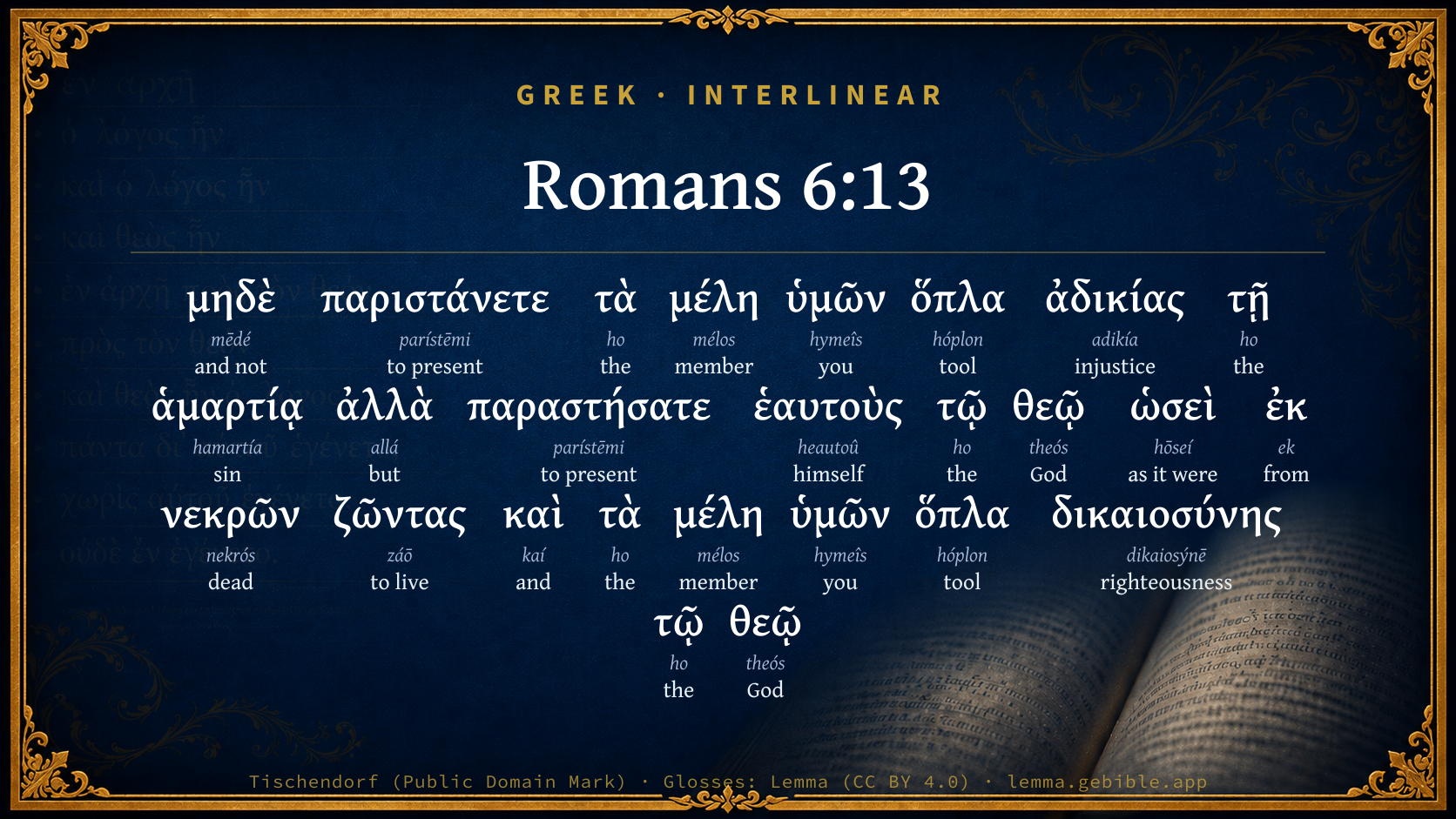
Neither present your members to sin as instruments of unrighteousness, but present yourselves to God, as alive from the dead, and your members as instruments of righteousness to God.
Download a study sheet
One document with this verse’s original text, its word-by-word gloss line, the meaning frame, cross-references with their text, attributed commentary, and full source and license credits — printable, and it pastes into notes with its structure intact.
This verse Autodidact and up
A passage Seminary Student
Up to 50 verses in one chapter. A passage sheet keeps up to 6 commentary sources and 12 cross-references per verse, in the order this page ranks them, and says so on the sheet whenever that leaves anything out. Ask for a single verse and you get the Autodidact verse sheet above.
Everything on this page stays free to read, with no account — the sheet is a download of what is already on screen, not access to it.
Compare translations 3
The same verse in 3 English versions, stacked beneath the original-language interlinear above. Click any original word for its lexicon entry.
Each is an independent rendering of the whole verse — the interlinear is not word-aligned to these translations.
Highlighted words mark where these versions differ — a whole-verse word diff, not a word-by-word alignment.
-
World English Bible Public Domain
Neither present your members to sin as instruments of unrighteousness, but present yourselves to God, as alive from the dead, and your members as instruments of righteousness to God.
-
King James Version Public Domain
Neither yield ye your members as instruments of unrighteousness unto sin: but yield yourselves unto God, as those that are alive from the dead, and your members as instruments of righteousness unto God.
-
unfoldingWord Literal Text CC BY-SA 4.0
And do not keep presenting your members tools of unrighteousness to sin. But present yourselves to God, as living from dead ones, and your members tools of righteousness to God.
unfoldingWord Literal Text — © unfoldingWord, licensed CC BY-SA 4.0. Word-aligned USFM3 via Door43 (git.door43.org/unfoldingWord/en_ult).
Show all 19 translations
Every available English version of this verse, each an independent rendering of the whole verse.
-
World English Bible Public Domain
Neither present your members to sin as instruments of unrighteousness, but present yourselves to God, as alive from the dead, and your members as instruments of righteousness to God.
-
Berean Standard Bible Public Domain
Do not present the parts of your body to sin as instruments of wickedness, but present yourselves to God as those who have been brought from death to life; and present the parts of your body to Him as instruments of righteousness.
-
Majority Standard Bible Public Domain
Do not present the parts of your body to sin as instruments of wickedness, but present yourselves to God as those who have been brought from death to life; and present the parts of your body to Him as instruments of righteousness.
-
King James Version Public Domain
Neither yield ye your members as instruments of unrighteousness unto sin: but yield yourselves unto God, as those that are alive from the dead, and your members as instruments of righteousness unto God.
-
American Standard Version (1901) Public Domain
neither present your members unto sin `as' instruments of unrighteousness; but present yourselves unto God, as alive from the dead, and your members `as' instruments of righteousness unto God.
-
Revised Version (1885) Public Domain
neither present your members unto sin as instruments of unrighteousness; but present yourselves unto God, as alive from the dead, and your members as instruments of righteousness unto God.
-
Geneva Bible (1599) Public Domain
Neither giue ye your members, as weapons of vnrighteousnes vnto sinne: but giue your selues vnto God, as they that are aliue from the dead, and giue your members as weapons of righteousnesse vnto God.
-
Douay-Rheims (1899) Public Domain
Neither yield ye your members as instruments of iniquity unto sin; but present yourselves to God, as those that are alive from the dead, and your members as instruments of justice unto God.
-
Young's Literal Translation Public Domain
neither present ye your members instruments of unrighteousness to the sin, but present yourselves to God as living out of the dead, and your members instruments of righteousness to God;
-
Literal Standard Version CC BY-SA 4.0
neither present your members instruments of unrighteousness to sin, but present yourselves to God as living out of the dead, and your members instruments of righteousness to God;
-
Unlocked Literal Bible CC BY-SA 4.0
Do not present the parts of your body to sin, to be tools used for unrighteousness. But present yourselves to God, as those who have been brought from death to life, and present the parts of your body to God as tools to be used for righteousness.
-
unfoldingWord Literal Text CC BY-SA 4.0
And do not keep presenting your members tools of unrighteousness to sin. But present yourselves to God, as living from dead ones, and your members tools of righteousness to God.
-
Darby Bible Public Domain
Neither yield your members instruments of unrighteousness to sin, but yield yourselves to God as alive from among [the] dead, and your members instruments of righteousness to God.
-
World Messianic Bible Public Domain
Also, do not present your members to sin as instruments of unrighteousness, but present yourselves to God as alive from the dead, and your members as instruments of righteousness to God.
-
Webster's Bible Public Domain
Neither yield ye your members as instruments of unrighteousness to sin: but yield yourselves to God, as those that are alive from the dead, and your members as instruments of righteousness to God:
-
Free Bible Version CC BY-SA 4.0
and don't use any parts of your body as evil tools of sin. Instead dedicate yourselves to God as those who have been brought back from death to life, and use all parts of your body as tools to do something good for God.
-
Bible in Basic English Public Domain
And do not give your bodies to sin as the instruments of wrongdoing, but give yourselves to God, as those who are living from the dead, and your bodies as instruments of righteousness to God.
-
Text-Critical English NT CC BY 4.0
And do not present your members to sin as instruments of unrighteousness, but present yourselves to God as alive from the dead, and present your members to God as instruments of righteousness.
-
Tyndale New Testament (1534) Public Domain
Nether geve ye youre members as instrumentes of vnrightewesnes vnto synne: but geve youre selves vnto God as they that are alive from deeth. And geve youre membres as iustrumetes of rightewesnes vnto God.
Literal Standard Version (2020), Covenant Press — licensed CC BY-SA 4.0. Text via the HelloAO Bible API (eBible.org). Unlocked Literal Bible (unfoldingWord) — licensed CC BY-SA 4.0. Text via the HelloAO Bible API (eBible.org). unfoldingWord Literal Text — © unfoldingWord, licensed CC BY-SA 4.0. Word-aligned USFM3 via Door43 (git.door43.org/unfoldingWord/en_ult). Free Bible Version, Dr. Jonathan Gallagher — licensed CC BY-SA 4.0. Text via the HelloAO Bible API (eBible.org).
Word by word
More ways to search: Search by grammar → Find every occurrence → Compare this word →
Practice this passage: Drill this verse → Learn its vocabulary →
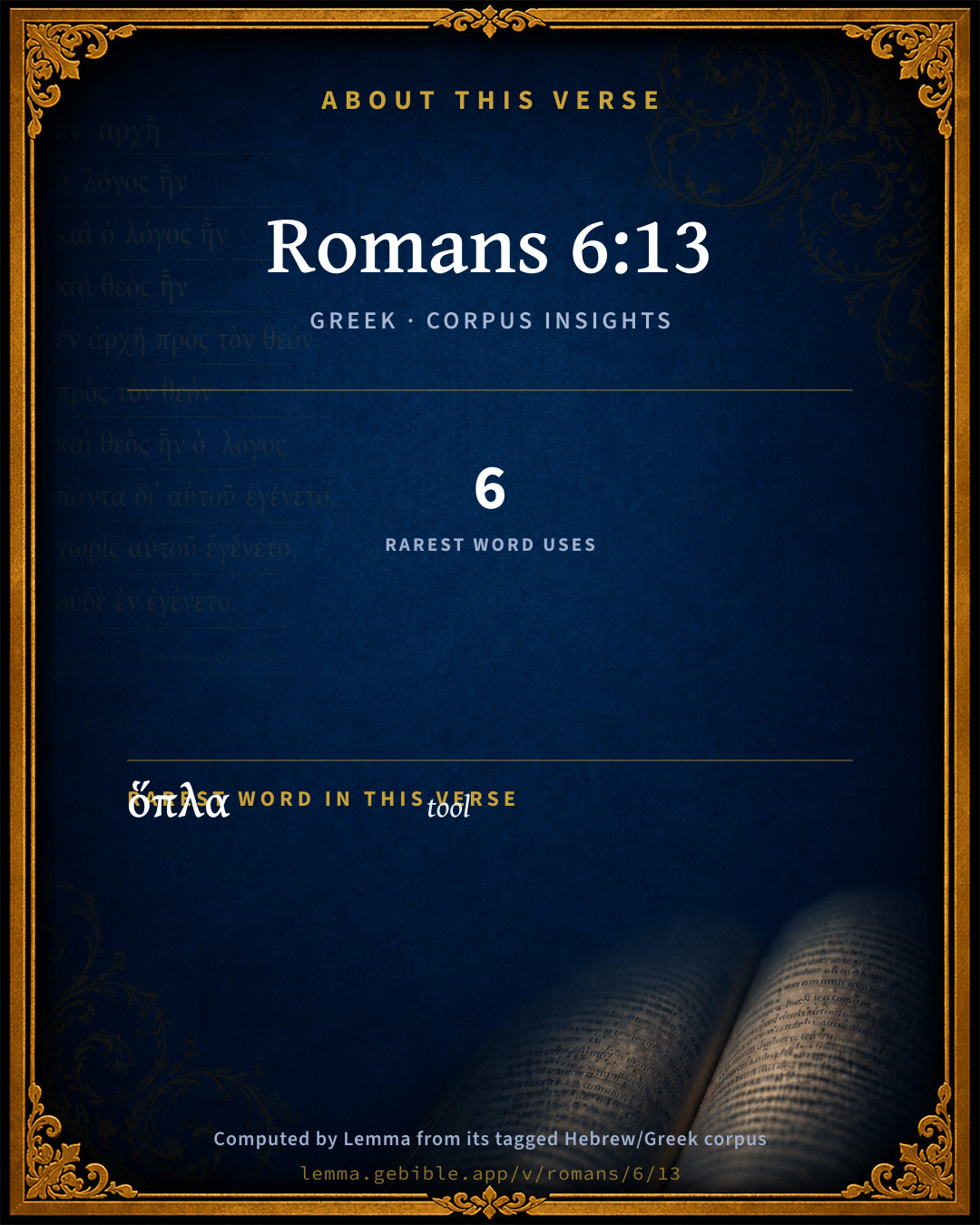
- Appears 6× in the Greek New Testament
- First appears at John 18:3
- Part of Speech
- Noun
- Case
- Accusative
- Number
- Plural
- Gender
- Neuter
Full Thayer's Definition
- μηδὲ mēdé G3366 “and not” Conjunction, Negative
- παριστάνετε parístēmi G3936 “to present” Verb, Present, Active, Imperative, 2nd person, Plural
- τὰ ho G3588 “the” Article, Accusative, Plural, Neuter
- μέλη mélos G3196 “member” Noun, Accusative, Plural, Neuter
- ὑμῶν hymeîs G5210 “you” Personal pronoun, 2nd person, Genitive, Plural
- ὅπλα hóplon G3696 “tool” Noun, Accusative, Plural, Neuter
- ἀδικίας adikía G93 “injustice” Noun, Genitive, Singular, Feminine
- τῇ ho G3588 “the” Article, Dative, Singular, Feminine
- ἁμαρτίᾳ hamartía G266 “sin” Noun, Dative, Singular, Feminine
- ἀλλὰ allá G235 “but” Conjunction
- παραστήσατε parístēmi G3936 “to present” Verb, Aorist, Active, Imperative, 2nd person, Plural
- ἑαυτοὺς heautoû G1438 “himself” Reflexive pronoun, 2nd person, Accusative, Plural, Masculine
- τῷ ho G3588 “the” Article, Dative, Singular, Masculine
- θεῷ theós G2316 “God” Noun, Dative, Singular, Masculine
- ὡσεὶ hōseí G5616 “as it were” Adverb
- ἐκ ek G1537 “from” Preposition
- νεκρῶν nekrós G3498 “dead” Adjective, Genitive, Plural, Masculine
- ζῶντας záō G2198 “to live” Verb, Present, Active, Participle, Accusative, Plural, Masculine
- καὶ kaí G2532 “and” Conjunction
- τὰ ho G3588 “the” Article, Accusative, Plural, Neuter
- μέλη mélos G3196 “member” Noun, Accusative, Plural, Neuter
- ὑμῶν hymeîs G5210 “you” Personal pronoun, 2nd person, Genitive, Plural
- ὅπλα hóplon G3696 “tool” Noun, Accusative, Plural, Neuter
- δικαιοσύνης dikaiosýnē G1343 “righteousness” Noun, Genitive, Singular, Feminine
- τῷ ho G3588 “the” Article, Dative, Singular, Masculine
- θεῷ theós G2316 “God” Noun, Dative, Singular, Masculine
About this verse
These counts appear in no published source. They are computed here, from the morphology-tagged text and Lemma’s own curated glosses. What Lemma adds →
- 26
- words
- 17
- distinct lemmas
- Pauline Epistles
- section
Cross-references
37Topical passages linked to Romans 6:13 in the Treasury of Scripture Knowledge — connected by theme and wording, ordered by reader-vote popularity; previews shown in the World English Bible.
- Romans 12:1 Therefore I urge you, brothers, by the mercies of God, to present your bodies a living sacrifice, holy, acceptable to God, which is your spiritual service.
- Romans 6:16 Don't you know that to whom you present yourselves as servants to obedience, his servants you are whom you obey; whether of sin to death, or of obedience to righteousness?
- Colossians 3:5 Put to death therefore your members which are on the earth: sexual immorality, uncleanness, depraved passion, evil desire, and covetousness, which is idolatry;
- 1 Peter 2:24 who his own self bore our sins in his body on the tree, that we, having died to sins, might live to righteousness; by whose stripes you were healed.
- Romans 7:5 For when we were in the flesh, the sinful passions which were through the law, worked in our members to bring forth fruit to death.
- 1 Corinthians 6:20 for you were bought with a price. Therefore glorify God in your body and in your spirit, which are God's.
- Colossians 2:13 You were dead through your trespasses and the uncircumcision of your flesh. He made you alive together with him, having forgiven us all our trespasses,
- 1 Peter 4:2 that you no longer should live the rest of your time in the flesh for the lusts of men, but for the will of God.
- 1 John 1:9 If we confess our sins, he is faithful and righteous to forgive us the sins, and to cleanse us from all unrighteousness.
- 1 Corinthians 6:15 Don't you know that your bodies are members of Christ? Shall I then take the members of Christ, and make them members of a prostitute? May it never be!
- James 3:5–6 So the tongue is also a little member, and boasts great things. See how a small fire can spread to a large forest!
- 1 Corinthians 6:9 Or don't you know that the unrighteous will not inherit the Kingdom of God? Don't be deceived. Neither the sexually immoral, nor idolaters, nor adulterers, nor male prostitutes, nor homosexuals,
- 2 Corinthians 10:4 for the weapons of our warfare are not of the flesh, but mighty before God to the throwing down of strongholds,
- Ephesians 2:5 even when we were dead through our trespasses, made us alive together with Christ (by grace you have been saved),
- 2 Chronicles 30:8 Now don't you be stiff-necked, as your fathers were; but yield yourselves to Yahweh, and enter into his sanctuary, which he has sanctified forever, and serve Yahweh your God, that his fierce anger may turn away from you.
- Romans 6:19 I speak in human terms because of the weakness of your flesh, for as you presented your members as servants to uncleanness and to wickedness upon wickedness, even so now present your members as servants to righteousness for sanctification.
- Philippians 1:20 according to my earnest expectation and hope, that I will in no way be disappointed, but with all boldness, as always, now also Christ will be magnified in my body, whether by life, or by death.
- Deuteronomy 25:16 For all who do such things, [even] all who do unrighteously, are an abomination to Yahweh your God.
- Isaiah 55:7 let the wicked forsake his way, and the unrighteous man his thoughts; and let him return to Yahweh, and he will have mercy on him; and to our God, for he will abundantly pardon.
- Luke 15:32 But it was appropriate to celebrate and be glad, for this, your brother, was dead, and is alive again. He was lost, and is found.'"
- Romans 6:11 Thus also consider yourselves also to be dead to sin, but alive to God in Christ Jesus our Lord.
- Romans 7:23 but I see a different law in my members, warring against the law of my mind, and bringing me into captivity under the law of sin which is in my members.
- 2 Corinthians 5:15 He died for all, that those who live should no longer live to themselves, but to him who for their sakes died and rose again.
- Proverbs 12:18 There is one who speaks rashly like the piercing of a sword, But the tongue of the wise heals.
- Ezekiel 18:4 Behold, all souls are mine; as the soul of the father, so also the soul of the son is mine: the soul who sins, he shall die.
- Luke 15:24 for this, my son, was dead, and is alive again. He was lost, and is found.' They began to celebrate.
- John 5:24 "Most assuredly I tell you, he who hears my word, and believes him who sent me, has eternal life, and doesn't come into judgment, but has passed out of death into life.
- Romans 2:8–9 but to those who are self-seeking, and don't obey the truth, but obey unrighteousness, will be wrath and indignation,
- 2 Corinthians 8:5 This was not as we had hoped, but first they gave their own selves to the Lord, and to us through the will of God.
- Ephesians 5:14 Therefore he says, "Awake, you who sleep, and arise from the dead, and Christ will shine on you."
- 2 Peter 2:13–15 receiving the wages of unrighteousness; people who count it pleasure to revel in the day-time, spots and blemishes, reveling in their deceit while they feast with you;
- Psalms 37:30 The mouth of the righteous talks of wisdom. His tongue speaks justice.
- Isaiah 3:10–11 Tell the righteous "Good!" For they shall eat the fruit of their deeds.
- Daniel 3:28 Nebuchadnezzar spoke and said, Blessed be the God of Shadrach, Meshach, and Abednego, who has sent his angel, and delivered his servants who trusted in him, and have changed the king's word, and have yielded their bodies, that they might not serve nor worship any god, except their own God.
- Romans 1:29 being filled with all unrighteousness, sexual immorality, wickedness, covetousness, maliciousness; full of envy, murder, strife, deceit, evil habits, secret slanderers,
- 2 Thessalonians 2:12 that they all might be judged who didn't believe the truth, but had pleasure in unrighteousness.
- James 4:1 Where do wars and fightings among you come from? Don't they come from your pleasures that war in your members?
Cross-references courtesy of OpenBible.info (CC BY 4.0).
Lesson kit
Teaching starters — assembled from the data on this page, not authored interpretation. Every prompt links to the verse data it draws on. Edit before teaching.
Romans, in the Pauline Epistles, opens this verse with 26 words (17 distinct Greek lemmas). Its most distinctive word is hóplon (“tool”). A historical commentator’s framing appears above. Read the whole chapter for the surrounding context.
Discussion questions
- How does “tool” (hóplon) shape what this verse is saying?
- John 18:3 shares the word «tool» with this verse. How do the two illuminate each other?
- “to present” occurs 2× in this one verse. What is the effect of the repetition?
- The translations on this page render this verse differently — a whole-verse word diff, not a word-by-word alignment. What might account for the different wordings?
- Reading how The Biblical Illustrator and The Pulpit Commentary read this verse, where do the two commentators agree and where do they part?
Things to notice
- These translations choose different wording for 11 words in this verse.
- “to present” occurs 2× in this single verse.
- 17 distinct Greek lemmas span 26 words in this verse.
Commentary
Notes on Romans 6:13 from classic Christian and Jewish commentators (each source and its license shown beneath its notes). The classic Christian expositions comment on the surrounding passage and are grouped to its opening verse, so a note may address several verses; the Jewish commentaries on the Tanakh (Rashi and others) are per-verse, so they appear only where the commentator wrote on this verse.
Lemma curates 59 commentaries, every one of them public domain or Creative Commons licensed, each selected and text-cleaned for this edition rather than reprinted as found. About our sources →
The Biblical Illustrator
Joseph S. Exell
The Biblical Illustrator, edited by Joseph S. Exell (c. 1880s–1900s) — public domain. Text from a community e-Sword module.
The Pulpit Commentary
The Pulpit Commentary (1880–1919), ed. H.D.M. Spence-Jones & Joseph S. Exell — public domain. Text from a community e-Sword module.
Scofield Reference Notes
C. I. Scofield
The Scofield Reference Bible (1917 edition), notes by C. I. Scofield — public domain. Text from a community e-Sword module.
Bengel's Gnomon
Johann Albrecht Bengel
Bengel's Gnomon of the New Testament — English translation (T&T Clark, Edinburgh, 1860) — public domain. Text from a community e-Sword module.
Godet's Commentaries
Frédéric Louis Godet
Frédéric Louis Godet — Commentaries on Luke, John, Romans, and 1 Corinthians — English translation (T&T Clark, Edinburgh, 1870s–1890s) — public domain. Text from a community e-Sword module.
Hodge's Commentary on Romans, Ephesians & First Corinthians
Charles Hodge
Charles Hodge — Commentary on Romans (1835), First Corinthians (1857), and Ephesians (1856) — public domain. Text from a community e-Sword module.
Geneva Bible (1599)
Geneva Bible translators
Geneva Bible (1599) marginal notes — public domain. Text via Bolls.life.
Jamieson, Fausset & Brown
Robert Jamieson, A. R. Fausset & David Brown
Jamieson, Fausset & Brown — Commentary Critical and Explanatory on the Whole Bible (1871) — public domain (CC PDM 1.0). Text via the HelloAO Bible API.
Adam Clarke's Commentary
Adam Clarke's Commentary on the Bible (1810–1826) — public domain. Text from a community e-Sword/MySword module.
John Calvin's Commentaries
John Calvin's Commentaries (1540-1563) — public domain. Text from the Calvin Translation Society English edition (1840s-50s) via the Christian Classics Ethereal Library (ccel.org). Calvin's coverage is partial (roughly two-thirds of the Bible); uncommented books and verses are honest gaps, never fabricated. The 19th-century editor's footnotes and remarks are omitted so the notes are faithfully Calvin's own voice.
Ellicott's Commentary for English Readers
A Bible Commentary for English Readers, edited by Charles John Ellicott (1878–1897) — public domain. Text from a community e-Sword module.
The Cambridge Bible for Schools and Colleges
gen. ed. J. J. S. Perowne
The Cambridge Bible for Schools and Colleges (gen. ed. J. J. S. Perowne; Cambridge University Press, 1878–1918) — public domain. Text from a community e-Sword module.
John Gill's Exposition
John Gill's Exposition of the Whole Bible (1746–1763) — public domain (CC PDM 1.0). Text via the HelloAO Bible API.
Trapp's Complete Commentary
John Trapp
John Trapp, A Commentary or Exposition upon All the Books of the Old and New Testament (1647–1656) — public domain. Text from a community e-Sword module.
Albert Barnes' Notes on the Bible
Albert Barnes' Notes on the Bible (1834–1885) — public domain. Text from a community e-Sword/MySword module.
Matthew Poole's English Annotations
Matthew Poole's English Annotations on the Holy Bible (1683–1685) — public domain. Text from a community e-Sword/MySword module.
Whedon's Commentary on the Bible
Daniel D. Whedon
Daniel D. Whedon (gen. ed.), Commentary on the Old and New Testaments (1874–1909) — public domain. Text from a community e-Sword module.
John Wesley's Explanatory Notes
John Wesley, Explanatory Notes Upon the Whole Bible (1754–1765) — public domain. Text via the GEBible commentary corpus.
Burkitt's Expository Notes on the New Testament
William Burkitt
William Burkitt's Expository Notes on the New Testament (1700–1703) — public domain. Text from a community e-Sword module.
Godbey's Commentary on the New Testament
William B. Godbey
William B. Godbey, Commentary on the New Testament (1896–1900) — public domain. Text from a community e-Sword module.
McGarvey & Pendleton's Commentaries
J. W. McGarvey
J. W. McGarvey (with Philip Y. Pendleton), Commentaries on the New Testament (The Fourfold Gospel, 1914; Acts; and the epistles) — public domain. Text from a community e-Sword/MySword module.
The People's New Testament
B. W. Johnson
B. W. Johnson's The People's New Testament with Notes (1889–1891) — public domain. Electronic text from the Christian Classics Ethereal Library (CCEL) ThML edition.
Cambridge Greek Testament for Schools and Colleges
Cambridge Greek Testament for Schools and Colleges (Cambridge University Press, 1896; 21 vols, various authors incl. Carr, Maclear, Plummer, Farrar, Lumby, Moule, M. R. James, Simcox) — public domain. Text from a community e-Sword module.
Alford’s Greek Testament
Henry Alford
Henry Alford, The Greek Testament (1849–1861) — public domain. Text from a community e-Sword module.
International Critical Commentary
International Critical Commentary — older volumes (1896–1929), various authors — public domain. Text from a community e-Sword module.
Vincent's Word Studies in the New Testament
Marvin R. Vincent
Marvin R. Vincent, Word Studies in the New Testament (1887–1900) — public domain. Text from a community e-Sword/MySword module.