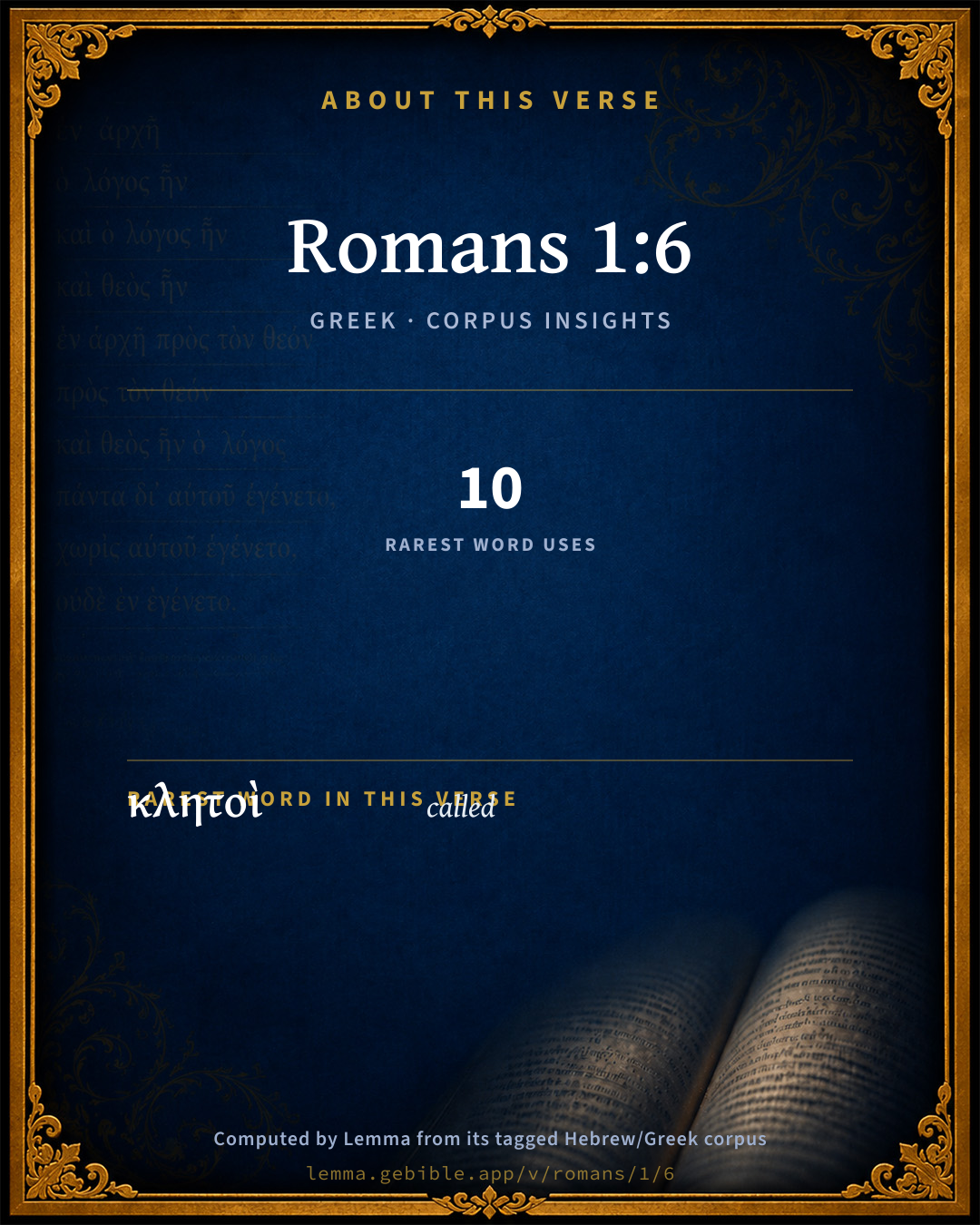
Romans 1:6

Greek (Tischendorf 8th ed.) Romans 1:6 appears in the Greek New Testament. The text above is from the Tischendorf 8th edition. Each word links to its Strong’s number and a concise gloss. Click any word for its full Thayer’s Greek Lexicon entry.
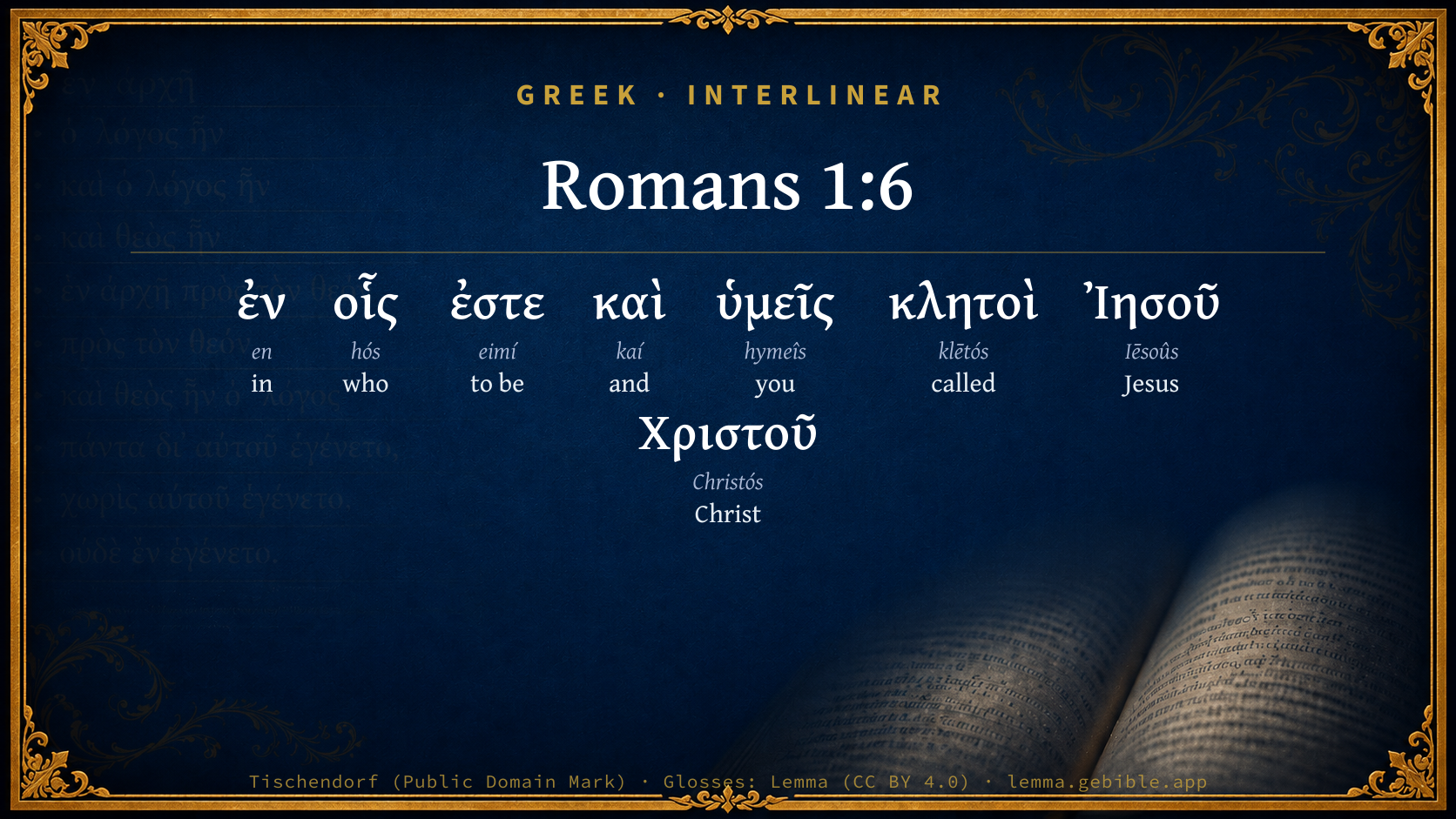
Download image
Cite this verse

Romans 1:6 (World English Bible). Public Domain. Lemma interlinear Bible study tool, https://lemma.gebible.app/v/romans/1/6.

Show BibTeX & RIS
BibTeX
RIS
English Translation
among whom you are also called to belong to Jesus Christ;
World English Bible · Public Domain
Download a study sheet

One document with this verse’s original text, its word-by-word gloss line, the meaning frame, cross-references with their text, attributed commentary, and full source and license credits — printable, and it pastes into notes with its structure intact.

This verse Autodidact and up

Study sheet (.html) Plain text (.txt)

A passage Seminary Student

Up to 50 verses in one chapter. A passage sheet keeps up to 6 commentary sources and 12 cross-references per verse, in the order this page ranks them, and says so on the sheet whenever that leaves anything out. Ask for a single verse and you get the Autodidact verse sheet above.

Everything on this page stays free to read, with no account — the sheet is a download of what is already on screen, not access to it.

Want to remove ads? Support Godless Engineer
Compare translations 3

The same verse in 3 English versions, stacked beneath the original-language interlinear above. Click any original word for its lexicon entry.

Each is an independent rendering of the whole verse — the interlinear is not word-aligned to these translations.

Highlighted words mark where these versions differ — a whole-verse word diff, not a word-by-word alignment.

  • World English Bible Public Domain
    among whom you are also called to belong to Jesus Christ;
  • King James Version Public Domain
    Among whom are ye also the called of Jesus Christ:
  • unfoldingWord Literal Text CC BY-SA 4.0
    among whom you also are called ones of Jesus Christ.

unfoldingWord Literal Text — © unfoldingWord, licensed CC BY-SA 4.0. Word-aligned USFM3 via Door43 (git.door43.org/unfoldingWord/en_ult).

Versions to compare (up to 4)

3 of 4 selected

Show all 19 translations

Every available English version of this verse, each an independent rendering of the whole verse.

  • World English Bible Public Domain
    among whom you are also called to belong to Jesus Christ;
  • Berean Standard Bible Public Domain
    And you also are among those who are called to belong to Jesus Christ.
  • Majority Standard Bible Public Domain
    And you also are among those who are called to belong to Jesus Christ.
  • King James Version Public Domain
    Among whom are ye also the called of Jesus Christ:
  • American Standard Version (1901) Public Domain
    among whom are ye also called `to be' Jesus Christ's:
  • Revised Version (1885) Public Domain
    among whom are ye also, called to be Jesus Christ’s:
  • Geneva Bible (1599) Public Domain
    Among whom ye be also the called of Iesus Christ:
  • Douay-Rheims (1899) Public Domain
    Among whom are you also the called of Jesus Christ:
  • Young's Literal Translation Public Domain
    among whom are also ye, the called of Jesus Christ;
  • Literal Standard Version CC BY-SA 4.0
    among whom are also you, the called of Jesus Christ;
  • Unlocked Literal Bible CC BY-SA 4.0
    Among these nations, you also have been called to belong to Jesus Christ.
  • unfoldingWord Literal Text CC BY-SA 4.0
    among whom you also are called ones of Jesus Christ.
  • Darby Bible Public Domain
    among whom are *ye* also [the] called of Jesus Christ:
  • World Messianic Bible Public Domain
    among whom you are also called to belong to Yeshua the Messiah;
  • Webster's Bible Public Domain
    Among whom are ye also the called of Jesus Christ:
  • Free Bible Version CC BY-SA 4.0
    You are also included among those who were called to belong to Jesus Christ.
  • Bible in Basic English Public Domain
    Among whom you in the same way have been marked out to be disciples of Jesus Christ:
  • Text-Critical English NT CC BY 4.0
    including you who are also called to belong to Jesus Christ;
  • Tyndale New Testament (1534) Public Domain
    of the which hethen are ye a part also which are Iesus christes by vocacion.

Literal Standard Version (2020), Covenant Press — licensed CC BY-SA 4.0. Text via the HelloAO Bible API (eBible.org). Unlocked Literal Bible (unfoldingWord) — licensed CC BY-SA 4.0. Text via the HelloAO Bible API (eBible.org). unfoldingWord Literal Text — © unfoldingWord, licensed CC BY-SA 4.0. Word-aligned USFM3 via Door43 (git.door43.org/unfoldingWord/en_ult). Free Bible Version, Dr. Jonathan Gallagher — licensed CC BY-SA 4.0. Text via the HelloAO Bible API (eBible.org).

Word by word

More ways to search: Search by grammar → Find every occurrence → Compare this word →

Practice this passage: Drill this verse → Learn its vocabulary →

About this verse

These counts appear in no published source. They are computed here, from the morphology-tagged text and Lemma’s own curated glosses. What Lemma adds →

8
words
8
distinct lemmas
Pauline Epistles
section

Notable vocabulary

The rarest word here is κλητοὶ called G2822 — appearing just 10 times in the whole Greek New Testament.

Shared distinctive vocabulary

κλητοὶ called G2822 occurs in 10 verses of the Greek New Testament. Also found in:

Cross-references

15

Topical passages linked to Romans 1:6 in the Treasury of Scripture Knowledge — connected by theme and wording, ordered by reader-vote popularity; previews shown in the World English Bible.

  • 1 Peter 2:9 But you are a chosen race, a royal priesthood, a holy nation, a people for God's own possession, that you may show forth the excellencies of him who called you out of darkness into his marvelous light:
  • Revelation 17:14 These will war against the Lamb, and the Lamb will overcome them, for he is Lord of lords, and King of kings. They also will overcome who are with him, called and chosen and faithful."
  • 2 Peter 1:10 Therefore, brothers, be more diligent to make your calling and election sure. For if you do these things, you will never stumble.
  • Hebrews 3:1 Therefore, holy brothers, partakers of a heavenly calling, consider the Apostle and High Priest of our confession, Jesus;
  • 1 Corinthians 1:9 God is faithful, through whom you were called into the fellowship of his Son, Jesus Christ, our Lord.
  • Romans 8:28–30 We know that all things work together for good for those who love God, to those who are called according to his purpose.
  • Ephesians 1:11 in whom also we were assigned an inheritance, having been foreordained according to the purpose of him who works all things after the counsel of his will;
  • 2 Timothy 1:9 who saved us and called us with a holy calling, not according to our works, but according to his own purpose and grace, which was given to us in Christ Jesus before times eternal,
  • 1 Peter 2:21 For to this you were called, because Christ also suffered for us, leaving you an example, that you should follow his steps,
  • Romans 9:24 us, whom he also called, not from the Jews only, but also from the Gentiles?
  • Galatians 1:6 I marvel that you are so quickly deserting him who called you in the grace of Christ to a different gospel;
  • 1 Thessalonians 2:12 to the end that you should walk worthily of God, who calls you into his own Kingdom and glory.
  • 2 Thessalonians 2:14 to which he called you through our Gospel, for the obtaining of the glory of our Lord Jesus Christ.
  • Colossians 1:21 You, being in past times alienated and enemies in your mind in your evil works,
  • Colossians 1:6 which has come to you; even as it is in all the world and is bearing fruit and growing, as it does in you also, since the day you heard and knew the grace of God in truth;

Cross-references courtesy of OpenBible.info (CC BY 4.0).

Commentary

Notes on Romans 1:6 from classic Christian and Jewish commentators (each source and its license shown beneath its notes). The classic Christian expositions comment on the surrounding passage and are grouped to its opening verse, so a note may address several verses; the Jewish commentaries on the Tanakh (Rashi and others) are per-verse, so they appear only where the commentator wrote on this verse.

Lemma curates 59 commentaries, every one of them public domain or Creative Commons licensed, each selected and text-cleaned for this edition rather than reprinted as found. About our sources →

The Biblical Illustrator

Joseph S. Exell

Rom_1:6

Among whom are ye also the called of Jesus Christ.

The called of Jesus Christ

This expression denotes--

1. That the change is wholly of the Lord, that it is the effect of His own good pleasure, and accomplished by His Almighty power. Others may attempt it, but none can do it effectually but Himself. The Word may be the instrument, but its success is of Him alone.

2. The ease with which this great work is accomplished, for what more easy than to do it with a word. In the morning of creation God said, Let there be light, and there was light. In the morning of conversion His mandate is equally sovereign and efficacious.

3. The great difference that is made between the former and present state of the person called. It clearly implies that a separation existed between the parties, and that in virtue of this call the sinner is brought nigh to God.

I. The nature of this holy calling. There are various calls mentioned in the Scriptures.

1. To particular services of a civil nature. God called Cyrus to the conquest of nations, and to be the protector of Israel. A persons secular employment is said to be his calling; it is the work to which Providence invites him (Isa_45:4; 1Co_7:20).

2. To office, as when Paul was called to the apostleship (Rom_1:1). Thus every faithful minister of the gospel, in an inferior degree, is called of God (1Co_12:7-11).

3. To mankind, wherever the gospel comes, to believe in the Lord Jesus Christ and be saved. But though all without exception are thus invited, few are chosen (Pro_8:4; Isa_55:7; Mat_22:1-10; Act_17:30). But the call mentioned in our text is peculiar to true believers.

It implies--

1. A conviction of the evil of sin, of the utter insufficiency of the creature, and of the want of a Saviour.

2. A sweet and powerful inclination of the whole soul towards God. The compliance is voluntary, while the energy is efficient and almighty. I drew them with cords of a man, with bands of love.

3. A solemn surrender of ourselves to be the Lords.

4. Certain effects. Sinners are hereby called out of darkness into marvellous light; from the bondage of sin, Satan, and the law, to the glorious liberty of the sons of God. It is said to he a holy and a heavenly calling, whereby we are called to the attainment of glory and virtue. It is that by which we are meetened for heaven. A partial but real conformity to God in this world will be followed by a perfect conformity to Him in the next; for whom He called, them He also glorified (Rom_8:30; 2Pe_1:3).

II. The means employed. These are diverse, but it is the same God which worketh all in all. Some are called into the vineyard at the third hour, some at the sixth, some at the ninth, and some even at the eleventh hour of the day. Sometimes remarkable providences have become the messengers of unexpected mercy; sometimes fearful dreams, or the edifying discourse of pious friends, but more frequently the public ministry of the Word. The Lord calls some in thunder, others in the still small voice.

III. Its distinguishing properties. It is--

1. Personal and particular. The general call of the gospel is addressed to all who come within its sound, but this singles out the object and speaks to him as it were by name. Zaccheus, come down. Saul, Saul, why persecutest thou Me? The former is drawing the bow at a venture, the latter directs the arrow to the mark. The one is the act of man, the other the sole work of God: the one is directed to the ear, the other to the heart.

2. Secret and internal. It is visible only in its effects (Joh_3:8). Sauls companions heard a sound of words, but knew not what was spoken.

3. Effectual. Many other calls are not so, even where God Himself is the speaker; for he speaketh once--yea, twice--to our senses, to our reason, in the works of creation and providence, and in the ministry of the Word, but man perceiveth it not, or does not regard it. But when God speaks to the conscience and the heart the sinner is made to hear and to obey, His language is, Call Thou and I will answer--speak, Lord, for Thy servant heareth.

4. Irrevocable. Not only the gifts, but the calling of God is without repentance (Rom_11:29), God is said to repent that He gave man a being, but never that He gave him grace,

Improvement:

1. How necessary and important is it that we give all diligence to make our calling and election sure (2Pe_1:10).

2. Let us learn our obligations to Divine grace. Whatever we are enabled to do for Christ is the fruit of what He has done for us.

3. Let our gratitude for Gods distinguishing grace be exemplified by a course of universal obedience. (B. Beddome.)

The inspiring energy of a Divine call

Great heroes of history have often been represented as urged on, stimulated, or inspired by some influence beyond themselves. Whether it has been called a genius or a spirit, a demon or an angel, fate or providence, the principle is the same. They have either themselves believed, or the superstition of their followers has given birth to the idea that some overruling and irresistible power was leading them through the intricacies of their earthly course and directing their every step towards a predetermined end. Thus Joan of Arc, a simple rustic country maid, was led on by imaginary voices which she heard to seek the deliverance of her country from the hand of her enemies. She believed herself inspired to take the lead of armies and to place the crown of France upon the head of the rightful monarch. Nor did she cease or fail in her endeavours till she had roused her countrymen to vigorous action, led them on to victory, and restored the kingdom to him whom she regarded as its true and lawful king. (Harvey Phillips.)

The Christian calling ascertained

To every Christian man there is a heavenly calling, a Divine mission, a sacred consecration, and it behoves him to see, to contemplate, to study what that calling is and how he can best perform its sacred obligations. (Harvey Phillips.)

Life not to fall below the heavenly calling

A being already invested with a deathless life, already adopted into the immediate family of God, already enrolled in the brotherhood of angels, yea, of the Lord of angels; a being who, amid the revolutions of earth and skies, feels and knows himself indestructible, capacitated to outlast the universe, a sharer in the immortality of God--what is there that can be said of such an one which falls not below the awful glory of his position! Oh, misery, that with such a calling, man should be the grovelling thing that he is that, summoned but to pause for awhile in the vestibule of the eternal temple ere he be introduced into its sanctuaries, he should forget, in the dreams of his lethargy, the eternity that awaits him! Oh, wretchedness beyond words, that, surrounded by love, and invited to glory, we should have no heart for happiness, but should still cower in the dark, while light ineffable solicits him to behold and enjoy it! (Prof. W. A. Butler.)

The Christian calling should lead to service

Like as if the Queen, to show her puissance against a foreign power, should call forth some of her subjects who are most beholden to her to combat in her presence for her honour, they would, no doubt, strain all their strength in this service, yea, and their lives too: even so, much more ought we that are Christians to perform this duty to our God and Prince, who hath called us out by name to fight for His honour, to be a chosen and peculiar people unto Himself, to stand on His posts, to show forth His virtues and to be zealous of good works; yea, and, that we might the better perform this service, He had furnished us with His own armour and weapons, yea, and His own holy hand is with us too, though all men see it not; therefore we must endeavour to do valiantly, and to do our best, to answer the expectation of our heavenly King and Prince. (Cawdray.)

The gospel is

I. The call of God.

1. He provides it.

2. Speaks in it.

3. Sends it.

II. Addressed to all.

1. Of every nation.

2. To you in particular. (J. Lyth, D. D.)

The Biblical Illustrator, edited by Joseph S. Exell (c. 1880s–1900s) — public domain. Text from a community e-Sword module.

Bengel's Gnomon

Johann Albrecht Bengel

Rom 1:6. Ἐν οἷς), among which nations, that have been brought to the obedience of the faith by the calling of Jesus Christ—καὶ ὑμεῖς, ye also) Paul ascribes no particular superiority to the Romans.—Comp. 1Co 14:36. He, however, touches upon the reason for his writing to the Romans. Presently, in the following verse, he directly addresses them—κλητοὶ, called), Rom 1:7.

V. 7. Πᾶσι το͂ις οὖσιν ἐν Ῥώμῃ, to all that be in Rome) Most of these were of the Gentiles, Rom 1:13, with whom, however, Jews were mixed. They had been either born and educated at Rome, or, at least, were residing there at that time. They were dwelling scattered throughout a very large city, and had not hitherto been brought into the form of a regularly constituted church. Only some of them were in the habit of assembling in the house of Priscilla and Aquila, Rom 16:5. What follows, beloved, etc., agrees with the word all; for he does not address the idolaters at Rome—ἀγαπητοῖς Θεοῦ, κλητοῖς ἁγίοις) These two clauses want the copulative conjunction, and are parallel; for he, who belongs to God, is holy [set apart]. Comp. Heb 3:1. The expression, the beloved of God, he particularly applies to the believing Israelites, ch. Rom 11:28; called to be saints, to believers of the Gentiles. The Israelites are holy by descent from their fathers, Act 20:32, note. Comp. with annot. on Rom 1:1 of this chapter; but believers of the Gentiles are said to be sanctified or called saints, holy by calling, as Paul interprets it [‘sanctified’], 1Co 1:2. We have here a double title, and I have referred the first part to the Israelites, the second to the Gentiles. Comp. Rom 1:5-6, and add the passages, which have just now been quoted. The celebrated Baumgarten, in his German exposition of this Epistle, to which we shall often have occasion to refer, writes thus: “Hiedurch würde der gottesdienstliche Unterschied der Gläubigen und eingebildete Vorzug der Israëliten zu sehr bestätiget worden seyn, den Paulus vielmehr bestreitet und abgeschaffet oder aufgehoben zu seyn versichert.”[6] We answer: The privilege of the Israelite (although he who is called holy, is as highly blessed, as he who is the beloved of God) is as appropriate to be mentioned in Paul’s introduction, as the πρῶτον, ch. Rom 1:16 [to the Jew first], is appropriate in the Statement of his subject[7] there; which [the statement of the priority of the Jew, at Rom 1:16] Baumgarten defends enough and more than enough.—χάρις, grace, etc. This form of expression is the customary one in the writings of Paul. See the beginnings of his epistles, and also Eph 6:23.—ὑμῖν, to you) Supply, may there fall to your lot.—εἰρήνη, peace) שלום, peace: a form of salutation in common use among the Hebrews, before which is placed ΧΆΡΙς, grace, a term altogether consonant to the New Testament, and to the preaching of the apostles. Grace comes from God; then, in consequence, man is in a state of peace, ch. Rom 5:2, note.—ἀπὸ Θεο͂υ πατρὸς ἡμῶν καὶ Κυρίου Ιησο͂υ Χριστο͂υ, from God our Father and the Lord Jesus Christ) The solemn form of appellation used by the apostles, God and the Father, God our Father; and, when they speak to one another, they do not often say Κυρίος, Lord, inasmuch as by it the proper name of GOD with four letters [יהוה were the four letters, tetragrammaton] is intended; but, in the Old Testament, they had said, Jehovah our God. The reason of the difference is: in the Old Testament they were, so to speak, slaves; in the New Testament they are sons; but sons so know their father, as to render it unnecessary to call him often by his proper name. Comp. Heb 8:11. Farther, when Polytheism was rooted out, it was not so necessary, that the true God should be distinguished from false gods, by His proper name. ΚΥΡΊΟΥ is construed, not with ἩΜῶΝ; for God is declared to be the Father of Jesus Christ, and our Father, not, our Father, and the Father of Jesus Christ; but [Κυρίου is construed] with ἀπὸ, as is evident from 2Ti 1:2. There is one and the same grace, one and the same peace, from God and Christ. Our confidence and prayers are directed to God, inasmuch as He is the Father of our Lord; and to Jesus Christ, inasmuch as He makes us, through Himself, stand in the presence of the Father.

[6] Here lay the difference in divine services among believers, and the imaginary superiority of the Israelites would have been too strongly confirmed, which Paul, to make quite sure of it, would much rather have disputed and cancelled or abolished.

[7] ‘Propositioni’ in the Latin: Cic. Inv. ii.18, defines it as “per quem locus is breviter exponitur, ex quo vis omnis oportet emanet ratiocinationis.”

Bengel's Gnomon of the New Testament — English translation (T&T Clark, Edinburgh, 1860) — public domain. Text from a community e-Sword module.

Meyer's Critical & Exegetical Commentary

Heinrich August Wilhelm Meyer

Rom_1:6. Application of the contents of Rom_1:5 to the relation in which the Apostle stood to his readers, whereby he indicates how he is officially entitled to address them also, teaching, exhorting, and so forth

ἐν οἷς ἐστε καὶ ὑμεῖς κλητοὶ Ἰ. Χ.] To be written thus, without a comma after ὑμεῖς, with Heumann, Lachmann, Tischendorf, de Wette, Hofmann, and Bisping: among whom also are ye called (ones) of Jesus Christ. Among the Gentile nations the Roman Christians were, like other Gentile-Christian churches, called of the Lord; amidst the Gentile world, nationally belonging to it (in opposition to Mangolds mere geographical interpretation), they also shared this high distinction. The reference of the καὶ to Paul (Th. Schott), and consequently the interpretation: as I, so also ye, is erroneous, because the Apostle has asserted concerning himself something far higher than the mere Christian calling. The common interpretation of κλητοὶ Ἰ. Χ. as an address (so too Rückert, Fritzsche, Philippi, van Hengel, Mehring) makes the ἐν οἶς ἐστε κ. ὑμ. quite a meaningless assertion; for Bengels suggestion for meeting the difficulty, that ἐν οἶς has the implied meaning: among which converted nations, is purely arbitrary.

Since the calling (to the Messianic salvation; see on Gal_1:6; also 1Co_7:17) is invariably ascribed by Paul to God (Rom_8:30, Rom_9:24; 1Co_1:9; 1Co_7:15; 1Co_7:17; 1Th_2:12; 2Th_2:14; comp Usteri, p. 281; Weiss, bibl. Theol. § 127; what Schmidt urges in opposition, in Rudelbachs Zeitschr. 1849, II. p. 188 ff. is untenable) we must explain it, hot as: called by Christ (Luther, Rückert, Mehring, Hofmann, and others), but as: called (by God) who belong to Christ (so Erasmus, Beza, Estius, and most modern commentators, also Winer, p. 183). The genitive is possessive, just as in the analogous τοὺς ἐκλεκτοὺς αὐτοῦ in Mat_24:31. With the substantive nature of κλητός (comp Buttmann, neut. Gr. p. 147) the genitive by no means admits merely the interpretation which points to the calling subject, as in 2Sa_15:11; 1Ki_1:41; 1Ki_1:49; Zep_1:7; but admits of very different references, as e.g. in Homer, Od. xvii. 386, κλητοί γε βροτῶν are not those called by mortals, but those who are called among mortals (genitive totius).

Meyer — Critical and Exegetical Commentary on the New Testament — English translation by Peter Christie, edited by Frederick Crombie (T&T Clark, 1880) — public domain. Text from a community e-Sword module.

Expositor's Greek Testament

ed. W. Robertson Nicoll

Rom 1:6 . The Romans, as well as others, are included among the Gentiles, and described as Jesus Christ’s called. They belong to Him, because they have heard and obeyed the Gospel. “Calling” in Paul always includes obedience as well as hearing. It is effectual calling, the κλητοὶ being those who have accepted the Divine invitation.

The Expositor's Greek Testament, edited by W. Robertson Nicoll (1897–1910) — public domain. Text from a community e-Sword module.

Hodge's Commentary on Romans, Ephesians & First Corinthians

Charles Hodge

Rom_1:6

Among whom are ye also. The apostle thus justifies his addressing the Church at Rome in his official character. If the commission which he had received extended to all nations, he was not transcending its limits in writing as an apostle to any church, though it had not been founded by his instrumentality, nor enjoyed his personal ministry. Called of Jesus Christ. This may mean, Those whom Christ has called. But as the κλῆσις, or vocation of believers, is generally in the New Testament referred to God, the meaning probably is, The called who belong to Christ. Qui Dei beneficio estis Jesu Christi, Beza. The word κλητός is never in the epistles applied to one who is merely invited by the external call of the gospel. Οις κλητοί, the called, means the effectually called; those who are so called by God as to be made obedient to the call. Hence the κλητοί are opposed to those who receive and disregard the outward call. Christ, though an offense to the Jews and Greeks, is declared to be (τοῖς κλητοῖϚ) to the called the wisdom and power of God, 1Co_1:24. Hence, too, κλητοί and ἐκλεκτοί are of nearly the same import; κατὰ πρόθεσιν κλητοί, Rom_8:28; comp. Rom_9:11; 1Co_1:26, 1Co_1:27. We accordingly find κλητοί used as a familiar designation of believers, as in Rev_17:14 οις μετ- αὐτοῦ κλητοὶ καὶ ἐκλεκτοὶ καὶ πιστοί. See Jud_1:1. Comp. Rom_8:30; Rom_9:24; 1Co_1:9; 1Co_7:17 et seq., Gal_1:15; Eph_4:1; Col_3:15; 1Th_2:12; 1Th_5:24; 2Ti_1:9. In these and in many other passages, the verb καλέω expresses the inward efficacious call of the Holy Spirit.

Theophylact remarks that the word κλητοί is applied to Christians, since they are drawn by grace, and do not come of themselves. God, as it were, anticipates them. The same remark may be made of most of the other terms by which believers are designated. They all more or less distinctly bring into view the idea of the agency of God in making them to differ from others. They are called ἐκλεκτοί θεοῦ. Rom_8:33; Col_3:12; 1Ti_1:1; or more fully ἐκλεκτοὶ κατὰ πρόγνωσιν θεοῦ, 1Pe_1:2; ἡγιασμένοι sanctified, which includes the idea of separation, 1Co_1:2; Jud_1:1; προορισθέντες κατὰ πρόθεσιν τοῦ θεοῦ, Eph_1:11; σωζόμενοι, 1Co_1:18; 2Co_2:15; τεταγμένοι εἰς ζωὴν αἰώνιον, Act_13:48.

Charles Hodge — Commentary on Romans (1835), First Corinthians (1857), and Ephesians (1856) — public domain. Text from a community e-Sword module.

Geneva Bible (1599)

Geneva Bible translators

Which through God’s goodness, are Christ’s.

Geneva Bible (1599) marginal notes — public domain. Text via Bolls.life.

Jamieson, Fausset & Brown

Robert Jamieson, A. R. Fausset & David Brown

Among whom are ye also--that is, along with others; for the apostle ascribes nothing special to the Church of Rome (compare Co1 14:36) [BENGEL].

the called--(See on Rom 8:30).

of Christ Jesus--that is, either called "by Him" (Joh 5:25), or the called "belonging to Him"; "Christ's called ones." Perhaps this latter sense is best supported, but one hardly knows which to prefer.

Jamieson, Fausset & Brown — Commentary Critical and Explanatory on the Whole Bible (1871) — public domain (CC PDM 1.0). Text via the HelloAO Bible API.

Adam Clarke's Commentary

Verse 6. Ye are the called] Ye Romans are all invited to believe in Christ Jesus, for the salvation of your souls; and to you, with the rest, my apostolical mission extends. This appears to be the most obvious sense of the word called in this place-to be called by the Gospel is to be invited to believe in Christ Jesus, and become his disciples. The word sometimes means constituted, or made, as in Ro 1:1.

Adam Clarke's Commentary on the Bible (1810–1826) — public domain. Text from a community e-Sword/MySword module.

Ellicott's Commentary for English Readers

(6) Among whom are ye also.—It is, perhaps, best not to put a comma at “also.” Among these Gentile churches, to which I am specially commissioned, you Romans too are called to the same obedience of faith, and therefore I have the more right to address you.

Called of Jesus Christ—i.e., not “called by Jesus Christ,” but “called and so belonging to Jesus Christ,” “your Master’s own elect ones.” (Comp. LXX., 1Ki_1:41, where the words “guests of Adonijah” are in the Greek “called of Adonijah.”)

A Bible Commentary for English Readers, edited by Charles John Ellicott (1878–1897) — public domain. Text from a community e-Sword module.

The Cambridge Bible for Schools and Colleges

gen. ed. J. J. S. Perowne

6. the called of Jesus Christ] Jesus Christ’s called ones; called, and as such belonging to Him. The “call” here referred to, as almost always in the Epistles, is the effectual call of Divine grace; more than the external message. In the Gospels “call” and “choice” are almost contrasted; e.g. Mat_22:14. In the Epp. they are (not indeed identical but) united. See Rom_8:28, Rom_11:29; 1Co_1:24; Judges 1; Rev_17:14.

The Cambridge Bible for Schools and Colleges (gen. ed. J. J. S. Perowne; Cambridge University Press, 1878–1918) — public domain. Text from a community e-Sword module.

John Gill's Exposition

Among whom are ye also,.... The Romans, though they were the chief, were among the nations of the world to whom the apostles were sent; and since Paul was called to be an apostle, and had, as others, grace and apostleship, and particularly the apostleship of the uncircumcision, or was ordained a teacher of the Gentiles, more especially he was an apostle to them, and as such was to be regarded by them. This seems to point out what they were originally; they were among all nations which lay in darkness; and were without Christ and hope, and God in the world; but now,

the called of Jesus Christ. The calling here spoken of is not to an office, or a mere external one by the ministry of the word, but an internal special call by the grace of God; and which is irresistible, efficacious, and unchangeable, and is an high, holy, and heavenly one; by it persons are called out of darkness into light, out of bondage into liberty, out of the world, from the company of the men of it, and the sinful pleasures thereof, to fellowship with Christ and his saints, and off a dependence on themselves, and their own righteousness, to the grace and righteousness of Christ, and to eternal glory. The persons so called are the elect of God, who are secured in Christ, and redeemed by him, and who has a concern with the Father and Spirit in the calling of them: hence they are styled, "the called of Jesus Christ"; they are called by him, and after his name; he has an interest in them; as they were before his chosen and redeemed ones, they are now his called ones; as Jacob and Israel of old were named of God, "my called", Isa 48:12; so these were named Christ's called ones; and who by calling came to be partakers of him and of his grace.

John Gill's Exposition of the Whole Bible (1746–1763) — public domain (CC PDM 1.0). Text via the HelloAO Bible API.

Trapp's Complete Commentary

John Trapp

6 Among whom are ye also the called of Jesus Christ:

Ver. 6. Ye are the called] With a high and heavenly calling, Heb 3:1. {See Trapp on "Heb 3:1"}

John Trapp, A Commentary or Exposition upon All the Books of the Old and New Testament (1647–1656) — public domain. Text from a community e-Sword module.

Albert Barnes' Notes on the Bible

Among whom - That is, among the Gentiles who had become obedient to the Christian faith in accordance with the design of the gospel, Rom 1:8. This proves that the church at Rome was made up partly at least, if not mainly, of Gentiles or pagans. This is fully proved in the xvith. chapter by the names of the persons whom Paul salutes.

The called of Jesus Christ - Those whom Jesus Christ has called to be his followers. The word “called” (see Rom 1:1) denotes not merely an external invitation to privilege, but it also denotes the “internal” or “effectual” call which secures conformity to the will of him who calls, and is thus synonymous with the name Christians, or believers. That true Christians are contemplated by this address, is clear from the whole scope of the Epistle; see particularly Rom. 8; compare Phi 3:14; Heb 3:1.

Albert Barnes' Notes on the Bible (1834–1885) — public domain. Text from a community e-Sword/MySword module.

Haydock's Catholic Bible Commentary

Among whom are you also the called of Jesus. That is, you also are a part of those, who by his mercy, are called to this faith and belief in him. All beginning from those words in the third verse, who was made to him, &c. till the end of the sixth verse, are to be taken as within a parenthesis, which is not unusual in the style of St. Paul. Then he goes on after this long parenthesis. (Witham)

George Leo Haydock (1774–1849), Haydock's Catholic Family Bible and Commentary, 1859 edition — public domain. Excludes Psalms (Douay-Rheims chapter numbering differs from Protestant) and Deuterocanonical books (Catholic canon only).

Matthew Poole's English Annotations

Among whom are ye also; the Romans are in this number, and a part of the nations to whom I have a commission, and for whom I have received the grace of apostleship. He adds this, to show his warrant for writing to them, he did it by virtue of his office; as also to humble them; for though they were Romans, and such as bore the greatest sway in the world, yet they were formerly pagans and idolaters.

The called of Jesus Christ: though such were some of you, to wit, heathen idolaters; yet now you are Christians, and the called of Jesus Christ: called outwardly by his word, and inwardly by his Spirit. By effectual calling you are become his disciples and followers.

Matthew Poole's English Annotations on the Holy Bible (1683–1685) — public domain. Text from a community e-Sword/MySword module.

Whedon's Commentary on the Bible

Daniel D. Whedon

6. The called. (See note on Rom_1:1.)

Daniel D. Whedon (gen. ed.), Commentary on the Old and New Testaments (1874–1909) — public domain. Text from a community e-Sword module.

The Pulpit Commentary

Among whom are ye also, called ones of Jesus Christ; and therefore included in my apostolic mission. Here the parenthetic passage ends, ver. 7 being the sequence of ver. 1.

Vers. 6, 7. The Roman Christians.

In the great capital of the empire and of the world there was thus early constituted a congregation of Christian worshippers and disciples. Amidst the grandeur, the opulence, the vice, that prevailed in this, as in every metropolis; amidst proud patricians, turbulent plebeians, and wretched slaves, there existed already an obscure but, to us, notable society, composed of Jews, Romans, and foreigners resident in the city, to whom Paul, the apostle of the Gentiles, wrote this letter. The members of this society were not characterized by any outward marks of distinction which would render them interesting to the inhabitants of Rome generally. Yet, whilst the great and learned and wealthy, who either never heard of the Christian Church in their midst, or who, if they heard of it, despised it, whilst they, for the most part, are forgotten, that Church is still remembered with deepest interest. Notice the marks by which it was distinguished to the view of the inspired apostle. He wrote "to all that be in Rome," who were differenced from those around them in certain respects.

I THEY WERE CALLED OF CHRIST. They had, for the most part, never seen the Lord Jesus; but their souls had heard his holy, gracious call.

1. They had been addressed by the audible voice of his uttered Word. The call of the gospel had reached their understanding.

2. They had experienced the inner call of his Spirit. To each one of them might the apostle say, "The Word is nigh thee, even in thy heart.

3. They had responded to the call by their faith and obedience; they had not received the grace of God in vain.

II THEY WERE BELOVED OF GOD.

1. In common with all mankind, they were the objects of Divine pity. "God so loved the world," etc.

2. But there was a special sense in which they were partakers of the love of God. He had revealed his love to them, and they loved God, because he first loved them. He loved his own image reflected in their character and life.

3. This love was especially manifested in their adoption. "Behold what manner of love the Father hath bestowed upon us, that we should be called the children of God!

III THEY WERE SEPARATED UNTO HOLINESS. The word "saint" is now appropriated to personages of peculiar and distinguished piety. But it serves to remind us that Christians were intended to be pure amidst a sinful world and a sinful generation a condition of the Divine favour, as well as a result of the privileges enjoyed by the people of God. The term may be thus unfolded. Saints are

(1) distinguished from sinful society by which they are surrounded;

(2) distinguished from their former selves;

(3) filled with the Spirit of holiness;

(4) and in character, as well as by profession, witnesses unto a holy God and Saviour.

Such "notes" of true, experimental Christianity were, indeed, not peculiar to the Roman Christians; but their conspicuous presence in the society addressed by the apostle was an earnest of the fruits of true religion which should abound wherever the gospel was proclaimed and received.

The Pulpit Commentary (1880–1919), ed. H.D.M. Spence-Jones & Joseph S. Exell — public domain. Text from a community e-Sword module.

John Wesley's Explanatory Notes

Among whom - The nations brought to the obedience of faith. Are ye also - But St. Paul gives them no preeminence above others.

John Wesley, Explanatory Notes Upon the Whole Bible (1754–1765) — public domain. Text via the GEBible commentary corpus.

Godbey's Commentary on the New Testament

William B. Godbey

6. “In whom ye are also the elect of Jesus Christ:

William B. Godbey, Commentary on the New Testament (1896–1900) — public domain. Text from a community e-Sword module.

McGarvey & Pendleton's Commentaries

J. W. McGarvey

among whom are ye also, called to be Jesus Christ's :

J. W. McGarvey (with Philip Y. Pendleton), Commentaries on the New Testament (The Fourfold Gospel, 1914; Acts; and the epistles) — public domain. Text from a community e-Sword/MySword module.

The People's New Testament

B. W. Johnson

6. Among whom are ye also the called. From among “all nations” (verse 5). The members of the church at Rome, though partly Jews, were mostly Gentiles. They had heard the gospel call, had obeyed it, and were now “the called of Jesus Christ.” In the next verse, they are said to be “called to be saints.”

B. W. Johnson's The People's New Testament with Notes (1889–1891) — public domain. Electronic text from the Christian Classics Ethereal Library (CCEL) ThML edition.

Cambridge Greek Testament for Schools and Colleges

6. ἐν οἷς κ.τ.λ. A hint of the reason of his writing to them. Cf. Rom 1:13.

καὶ ὑμεῖς. Throughout the Epistle S. Paul primarily considers Gentile Christians.

κλητοὶ Ἰ. Χρ. Called to belong to Jesus Christ, |[62] κλητὸς ἀπόστολος, Rom 1:1, and κλητοῖς ἁγίοις, Rom 1:7. The genitive stands for an adjective, e.g. Χριστίανοι.

[62] | parallel to

Cambridge Greek Testament for Schools and Colleges (Cambridge University Press, 1896; 21 vols, various authors incl. Carr, Maclear, Plummer, Farrar, Lumby, Moule, M. R. James, Simcox) — public domain. Text from a community e-Sword module.

Alford’s Greek Testament

Henry Alford

6. ἐν οἷς.…] The whole to χριστοῦ should be taken together: among whom ye also are called of Jesus Christ; otherwise, with a comma at ὑμεῖς, the assertion, ‘among whom are ye,’ is flat and unmeaning.

De Wette and Calvin would take Ἰησοῦ χρ. as a gen. of possession, because the call of believers is generally referred to the Father: but sometimes the Son is said to call likewise, see Joh 5:25; 1Ti 1:12:—and with ἀγαπητοὶ θεοῦ following so close upon it, the expression can I think hardly be taken otherwise than as called by Jesus Christ. ἐκλεκτοὶ αὐτοῦ, Mat 24:31, cited by De W. is hardly parallel.

Henry Alford, The Greek Testament (1849–1861) — public domain. Text from a community e-Sword module.

International Critical Commentary

6. ἐν οἷς: not merely in a geographical sense of a Jewish community among Gentiles, but clearly numbering the Roman Church among Gentile communities.

κλητοὶ Ἰησοῦ χριστοῦ: ‘called ones of Jesus Christ’: gen. of possession.

International Critical Commentary — older volumes (1896–1929), various authors — public domain. Text from a community e-Sword module.

Vincent's Word Studies in the New Testament

Marvin R. Vincent

Ye also. As Romans among other Gentiles : not, called as I am called.

Marvin R. Vincent, Word Studies in the New Testament (1887–1900) — public domain. Text from a community e-Sword/MySword module.

Godet's Commentaries

Frédéric Louis Godet

Vv. 6 may be construed in two ways: either the κλητοὶ ᾿Ι. Χ. may be taken as a predicate: “in the midst of whom (Gentiles) ye are the called of Jesus Christ,” or the last words may be taken in apposition to the subject: “of the number of whom ye are, ye who are called of Jesus Christ.” The former construction does not give a simple meaning; for the verb ye are has then two predicates which conflict with one another: “ye are in the midst of them,” and: “ye are the called of Jesus Christ.” Besides, is it necessary to inform the Christians of Rome that they live in the midst of the Gentiles, and that they are called by Jesus Christ? Add the καί, also, which would signify: like all the other Christians in the world, and you have an addition wholly superfluous, and, besides, far from clear. What has led commentators like De Wette, Meyer, etc., to hold this first construction is, that it seemed to them useless to make Paul say: “ye are among, or ye are of the number of the Gentiles.” But, on the contrary, this idea is very essential. It is the minor premiss of the syllogism within which Paul, so to speak, incloses the Romans. The major: Christ has made me the Apostle of the Gentiles; the minor: ye are of the number of the Gentiles; conclusion: therefore, in virtue of the authority of that Christ who has called you as He has called me, ye are the sheep of my fold. The καί, also, from this point of view is easily explained: “of the number of whom (Gentiles) ye also are, ye Romans, falling consequently like the other Gentiles called by me personally to my apostolical domain.” The title κλητοὶ ᾿Ι. Χ., called of Jesus Christ, corresponds to the title which Paul gave himself, Rom 1:1: κλητὸς ἀπόστολος, “an apostle by calling.” They are bound to hear him in virtue of the same authority under which he writes to them, that of Jesus Christ. The complement: “called of Jesus Christ,” may be taken as a genitive of possession: “called ones belonging to Jesus Christ.” But it is better to regard it as a genitive of cause: “called ones, whose calling comes from Jesus Christ.” For the important thing in the context is not the commonplace idea that they belong to the Lord; it is the notion of the act by which the Lord Himself acted on them to make them believers, as on Paul to make him their apostle. The idea of calling (of God or Christ), according to Paul’s usage, includes two thoughts, an outward solicitation by preaching, and an inward and simultaneous drawing by the Holy Spirit. It need not be said that neither the one nor the other of these influences is irresistible, nor that the adhesion of faith remains an act of freedom. This adhesion is here implied in the fact that the Romans are members of the church and readers of these lines.

If we needed a confirmation of the Gentile origin of the majority of this church, it would be found in overwhelming force in Rom 1:5-6, especially when taken in connection with Rom 1:4; and really it needs far more than common audacity to attempt to get out of them the opposite idea, and to paraphrase them, as Volkmar does, in the following way: “I seem to you no doubt to be only the apostle of the Hellenes; but, nevertheless, I am called by Jesus Christ to preach the gospel to all nations, even to the non-Hellenes such as you, believers of Jewish origin!”

We come now to the second and third parts of the address, the indication of the readers and the expression of the writer’s prayer.

Frédéric Louis Godet — Commentaries on Luke, John, Romans, and 1 Corinthians — English translation (T&T Clark, Edinburgh, 1870s–1890s) — public domain. Text from a community e-Sword module.

Lesson kit

Teaching starters — assembled from the data on this page, not authored interpretation. Every prompt links to the verse data it draws on. Edit before teaching.

Romans, in the Pauline Epistles, opens this verse with 8 words (8 distinct Greek lemmas). Its most distinctive word is klētós (“called”). A historical commentator’s framing appears above. Read the whole chapter for the surrounding context.

Discussion questions

  1. The word klētós carries the sense “called.” How does it shape the verse?
  2. How does Matthew 22:14, which shares the word «called», read alongside this verse?
  3. The translations on this page render this verse differently — a whole-verse word diff, not a word-by-word alignment. What might account for the different wordings?
  4. Compare how The Biblical Illustrator and Bengel's Gnomon read this verse. Where do they agree or differ?

Things to notice

Reading settings

Reading text

Shown beneath each verse's original-language words.

Old Testament
Old Testament edition

Read the OT as the Masoretic Hebrew (MT) or the Greek Septuagint (LXX).

English shown for the Greek Septuagint (in the Hebrew ↔ Greek comparison).

Comparing translations? Open the Compare panel on any verse page to stack up to four side by side.