Romans 8:22

Greek (Tischendorf 8th ed.) Romans 8:22 appears in the Greek New Testament. The text above is from the Tischendorf 8th edition. Each word links to its Strong’s number and a concise gloss. Click any word for its full Thayer’s Greek Lexicon entry.
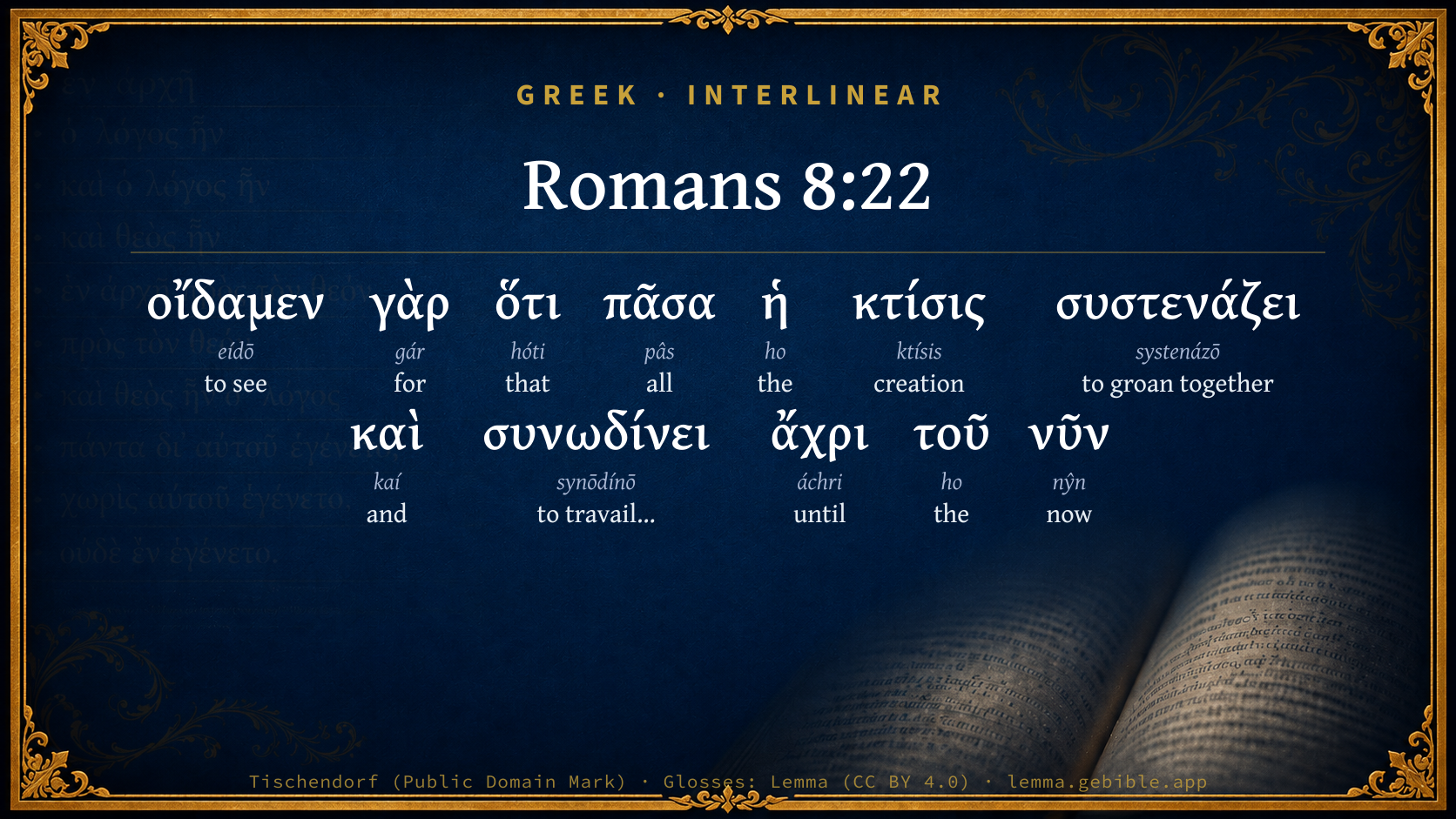
Download image
Cite this verse

Romans 8:22 (World English Bible). Public Domain. Lemma interlinear Bible study tool, https://lemma.gebible.app/v/romans/8/22.

Show BibTeX & RIS
BibTeX
RIS
English Translation
For we know that the whole creation groans and travails in pain together until now.
World English Bible · Public Domain
Highlights
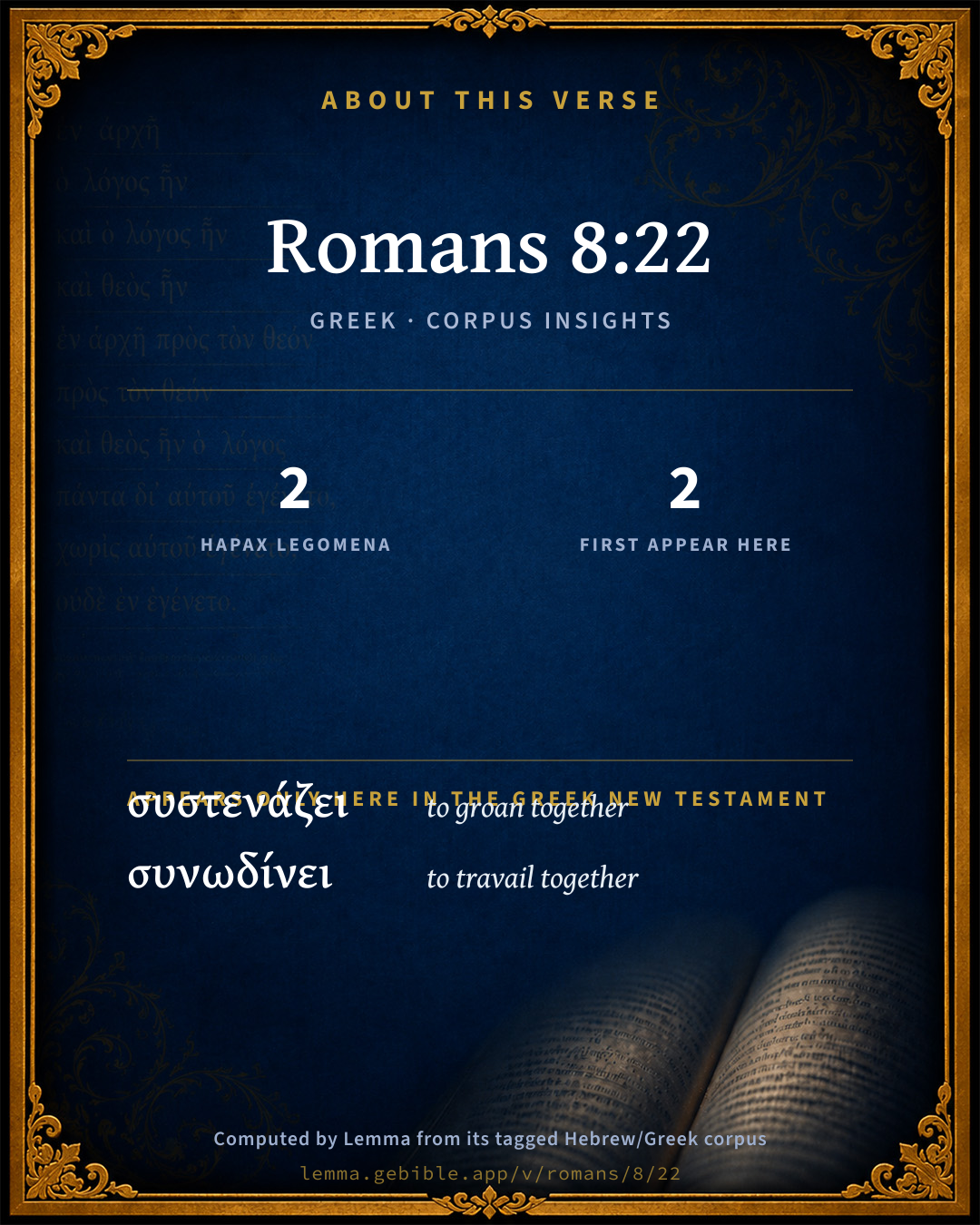
  • 2 hapax legomena — only here in the Greek New Testament
  • 2 first appearances in the Greek New Testament
Full analysis ↓
Download a study sheet

One document with this verse’s original text, its word-by-word gloss line, the meaning frame, cross-references with their text, attributed commentary, and full source and license credits — printable, and it pastes into notes with its structure intact.

This verse Autodidact and up

Study sheet (.html) Plain text (.txt)

A passage Seminary Student

Up to 50 verses in one chapter. A passage sheet keeps up to 6 commentary sources and 12 cross-references per verse, in the order this page ranks them, and says so on the sheet whenever that leaves anything out. Ask for a single verse and you get the Autodidact verse sheet above.

Everything on this page stays free to read, with no account — the sheet is a download of what is already on screen, not access to it.

Want to remove ads? Support Godless Engineer
Compare translations 3

The same verse in 3 English versions, stacked beneath the original-language interlinear above. Click any original word for its lexicon entry.

Each is an independent rendering of the whole verse — the interlinear is not word-aligned to these translations.

Highlighted words mark where these versions differ — a whole-verse word diff, not a word-by-word alignment.

  • World English Bible Public Domain
    For we know that the whole creation groans and travails in pain together until now.
  • King James Version Public Domain
    For we know that the whole creation groaneth and travaileth in pain together until now.
  • unfoldingWord Literal Text CC BY-SA 4.0
    For we know that all the creation groans and labors in pain together until now.

unfoldingWord Literal Text — © unfoldingWord, licensed CC BY-SA 4.0. Word-aligned USFM3 via Door43 (git.door43.org/unfoldingWord/en_ult).

Versions to compare (up to 4)

3 of 4 selected

Show all 19 translations

Every available English version of this verse, each an independent rendering of the whole verse.

  • World English Bible Public Domain
    For we know that the whole creation groans and travails in pain together until now.
  • Berean Standard Bible Public Domain
    We know that the whole creation has been groaning together in the pains of childbirth until the present time.
  • Majority Standard Bible Public Domain
    We know that the whole creation has been groaning together in the pains of childbirth until the present time.
  • King James Version Public Domain
    For we know that the whole creation groaneth and travaileth in pain together until now.
  • American Standard Version (1901) Public Domain
    For we know that the whole creation groaneth and travaileth in pain together until now.
  • Revised Version (1885) Public Domain
    For we know that the whole creation groaneth and travaileth in pain together until now.
  • Geneva Bible (1599) Public Domain
    For we knowe that euery creature groneth with vs also, and trauaileth in paine together vnto this present.
  • Douay-Rheims (1899) Public Domain
    For we know that every creature groaneth and travaileth in pain, even till now.
  • Young's Literal Translation Public Domain
    for we have known that all the creation doth groan together, and doth travail in pain together till now.
  • Literal Standard Version CC BY-SA 4.0
    for we have known that all the creation groans together, and travails in pain together until now.
  • Unlocked Literal Bible CC BY-SA 4.0
    For we know that the whole creation groans and labors in pain together even now.
  • unfoldingWord Literal Text CC BY-SA 4.0
    For we know that all the creation groans and labors in pain together until now.
  • Darby Bible Public Domain
    For we know that the whole creation groans together and travails in pain together until now.
  • World Messianic Bible Public Domain
    For we know that the whole creation groans and travails in pain together until now.
  • Webster's Bible Public Domain
    For we know that the whole creation groaneth, and travaileth in pain together until now:
  • Free Bible Version CC BY-SA 4.0
    We know that all creation groans with longing, suffering birth-pains even up till now.
  • Bible in Basic English Public Domain
    For we are conscious that all living things are weeping and sorrowing in pain together till now.
  • Text-Critical English NT CC BY 4.0
    For we know that all creation has been groaning together with labor pains until now.
  • Tyndale New Testament (1534) Public Domain
    For we knowe that every creature groneth with vs also and travayleth in payne even vnto this tyme.

Literal Standard Version (2020), Covenant Press — licensed CC BY-SA 4.0. Text via the HelloAO Bible API (eBible.org). Unlocked Literal Bible (unfoldingWord) — licensed CC BY-SA 4.0. Text via the HelloAO Bible API (eBible.org). unfoldingWord Literal Text — © unfoldingWord, licensed CC BY-SA 4.0. Word-aligned USFM3 via Door43 (git.door43.org/unfoldingWord/en_ult). Free Bible Version, Dr. Jonathan Gallagher — licensed CC BY-SA 4.0. Text via the HelloAO Bible API (eBible.org).

Word by word

More ways to search: Search by grammar → Find every occurrence → Compare this word →

Practice this passage: Drill this verse → Learn its vocabulary →

About this verse

These counts appear in no published source. They are computed here, from the morphology-tagged text and Lemma’s own curated glosses. What Lemma adds →

12
words
11
distinct lemmas
Pauline Epistles
section

Notable vocabulary

2 hapax legomena — words that appear only here in the entire Greek New Testament:

  • συστενάζει to groan together G4959
  • συνωδίνει to travail together G4944

First appearance in Scripture

These words make their first canonical appearance in the Greek New Testament here:

  • συστενάζει to groan together G4959
  • συνωδίνει to travail together G4944

Shared distinctive vocabulary

κτίσις creation G2937 occurs in 19 verses of the Greek New Testament. Also found in:

Repetition

A word recurs within this verse:

Cross-references

8

Topical passages linked to Romans 8:22 in the Treasury of Scripture Knowledge — connected by theme and wording, ordered by reader-vote popularity; previews shown in the World English Bible.

  • Jeremiah 12:4 How long shall the land mourn, and the herbs of the whole country wither? for the wickedness of those who dwell therein, the animals are consumed, and the birds; because they said, He shall not see our latter end.
  • Jeremiah 12:11 They have made it a desolation; it mourns to me, being desolate; the whole land is made desolate, because no man lays it to heart.
  • John 16:21 A woman, when she gives birth, has sorrow, because her time has come. But when she has delivered the child, she doesn't remember the anguish any more, for the joy that a human being is born into the world.
  • Colossians 1:23 if it is so that you continue in the faith, grounded and steadfast, and not moved away from the hope of the Gospel which you heard, which is being proclaimed in all creation under heaven; of which I, Paul, was made a servant.
  • Romans 8:20 For the creation was subjected to vanity, not of its own will, but because of him who subjected it, in hope
  • Mark 16:15 He said to them, "Go into all the world, and preach the Gospel to the whole creation.
  • Psalms 48:6 Trembling took hold of them there, Pain, as of a woman in travail.
  • Revelation 12:2 She was with child. She cried out in pain, laboring to give birth.

Cross-references courtesy of OpenBible.info (CC BY 4.0).

Commentary

Notes on Romans 8:22 from classic Christian and Jewish commentators (each source and its license shown beneath its notes). The classic Christian expositions comment on the surrounding passage and are grouped to its opening verse, so a note may address several verses; the Jewish commentaries on the Tanakh (Rashi and others) are per-verse, so they appear only where the commentator wrote on this verse.

Lemma curates 59 commentaries, every one of them public domain or Creative Commons licensed, each selected and text-cleaned for this edition rather than reprinted as found. About our sources →

Joseph Benson's Commentary

Rom 8:22. For we know that the whole creation — Ever since the first apostacy of our nature from God; groaneth — Suffers a variety of miseries; and travaileth — Συνωδινει, literally, is in the pains of childbirth, to be delivered from the burden of the curse; until now — To this very hour, and so on to the time of deliverance. “According to some commentators, the words πασα η κτισις denote the whole creatures of God, animate and inanimate, which, as they were cursed for the sin of the first man, may, by a beautiful rhetorical figure, be represented as groaning together under that curse, and earnestly wishing to be delivered from it. Such figures indeed are not unusual in Scripture. See Psa 96:12; Psa 98:8. Nevertheless, Rom 8:21, where it is said that the creature itself shall be delivered, &c., into the glorious liberty of the children of God; and the antithesis, Rom 8:23, not only they, but ourselves also, show that the apostle is speaking, not of the brute and inanimate creation but of mankind, and of their earnest desire of immortality. For these reasons, and especially because (Mar 16:15) preach the gospel, παση τη κτισει, means, to every human creature, I think the same expression in this verse, and η κτισις in the preceding verses, signify mankind in general, Jews as well as Gentiles. The same expression, also, Col 1:23, signifies every human creature.” — Macknight.

Joseph Benson's Commentary on the Old and New Testaments (1811–1818) — public domain. Text from a community e-Sword module.

Tyndale Open Study Notes

Tyndale Open Resources

8:22 The pains of childbirth is a metaphor for the longing of creation (see also Matt 24:8; Mark 13:8; John 16:20-22).

Tyndale Open Study Notes — © Tyndale Open Resources, licensed CC BY-SA 4.0. Text via the HelloAO Bible API.

Bengel's Gnomon

Johann Albrecht Bengel

Rom 8:22. Γὰρ, for) This aetiology[96] [assigning of a reason] supposes, that the groaning of the creature is not in vain, but that it is heard by God.—ΠᾶΣΑ) all [the whole]. It is considered as one whole, comp. Rom 8:28; Rom 8:32; Rom 8:39.—συστενάζει, groaneth together) with united groanings [sighings]. Dio Cassius, book 39, gives a singular example of this in the wailing of the elephants, which Pompey devoted to the public shows contrary to an express pledge [promise given], as men at the time interpreted it; and the people themselves were so affected by it, that they imprecated curses on the head of the commander.—ἄχρι, until) He insinuates, that there will be an end of pains and groans, the pains and groans of the creature.

[96] See Appendix.

Bengel's Gnomon of the New Testament — English translation (T&T Clark, Edinburgh, 1860) — public domain. Text from a community e-Sword module.

Meyer's Critical & Exegetical Commentary

Heinrich August Wilhelm Meyer

Rom_8:22. Proof, not of the ἀποκαραδοκία τῆς κτίσεως (Philippi), which is much too distant, and whose goal remains quite unnoticed here; nor yet of the δουλεία τῆς φθορᾶς (Zahn), which was not the point of the foregoing thought at all; but of what was announced by ἐπʼ ἐλπίδι, ὅτι κ. ἀ. ἡ κτ. ἐλευθρωθήσεται κ.τ.λ. For if that hope of glorious deliverance had not been left to it, all nature would not have united its groaning and travailing until now. This phenomenon, so universal and so unbroken, cannot be conduct without an aim; on the contrary, it presupposes as the motive of the painful travail that very hope, towards whose final fulfilment it is directed. The οἴδαμεν (comp. Rom_2:2, Rom_3:19, Rom_7:14) is sufficiently explained as an appeal to the Christian consciousness, in which the view of nature stands in connection with the curse of sin. The perfectly superfluous assumption, that the apostle had a book before him containing a similar deduction (Ewald), is suggested by nothing in the text.

In συστενάζει. and συνωδίνει the συν is not a mere strengthening particle (Loesner, Michaelis, Semler, Ernesti, and Köllner), but, on the contrary (comp. Beza), finds its natural reference in πᾶσα, and denotes gemitum et dolorem communem inter se partium creaturae, Estius. Calvin, Pareus, Koppe, Ewald, and Umbreit, following Oecumenius, have indeed referred ΣΥΝ to the groaning being in common with that of the children of God; but against this view Rom_8:23 is decisive, and the reference to men generally, with whom the κτίσις sighs (Fritzsche), is foreign to the context. Fritzsche, without due reason, asserts the want of linguistic usage in favour of our view. For it is unquestionable that, in accordance with the usage of analogous verbs, ΣΥΣΤΕΝΆΖΕΙΝ may denote the common sighing of the elements comprised in the collective πᾶσα ἡ κτίσις among themselves (comp. Eph_4:16 : πᾶν τὸ σῶμα συναρμολογούμενον, comp. Rom_2:21; Plat. Legg. iii. p. 686 B: ἐπεὶ γενομένη γε ἡ τότε διάνοια καὶ συμφωνήσασα εἰς ἕν, Dem. 516. 7 : ΣΥΝΟΡΓΙΣΘΕῚς Ὁ ΔῆΜΟς, 775. 18: ΣΥΝΤΑΡΆΤΤΕΤΑΙ Πᾶς Ὁ Τῆς ΠΌΛΕΩς ΚΌΣΜΟς). That concrete examples of that nature cannot be quoted, is not decisive against it, since συστενάζειν (Eur. Ion. 935, comp. συστένειν, Arist. Eth. ix. 11) and also συνωδίνειν (Eur. Hel. 727; Porphyr. de abst. iii. 10) are only extant in a very few passages. Comp. generally Winer, de verb. compos. II. p. 21 f. Just the same with συναλγεῖν, Plat. Rep. p. 462 D, and συλλυπεῖσθαι p. 462 E.

ΣΥΝΩΔΊΝΕΙ] Not an allusion to the חבלי המשיח (Reiche), because the dolores Messiae (see on Mat_2:3) are peculiar sufferings, that shall immediately precede the appearance of the Messiah, whilst the travail of nature has continued since as early as Gen_3:17 (Rom_8:20). But the figure is the same in both casesthat of the pains of labour. All nature groans and suffers anguish, as if in travail, over-against the moment of its deliverance. The conception of the ὠδίνειν is based on the fact that the painful struggling of the κτίσις is directed towards the longed-for change, with the setting in of which the suffering has accomplished its end and ceases. Comp. Joh_16:21.

ἌΧΡΙ ΤΟῦ ΝῦΝ] that is, up to the present moment; so incessantly has the sighing continued. Formerly Frommann imported the thought: until now, when the revelation of the true goal in Christ has taken place; see, against this, Zahn, p. 524 f. However, Frommann has now corrected his view. Hofmann erroneously takes it as: now still, in contrast to the future change. Comp. rather Php_1:5. The point of beginning of the sighing and travailing is that ὑπετάγη in Rom_8:20. Comp. also ἕως τοῦ νῦν in Mat_24:21. Now still would be ἜΤΙ ΝῦΝ, 1Co_3:2.

Meyer — Critical and Exegetical Commentary on the New Testament — English translation by Peter Christie, edited by Frederick Crombie (T&T Clark, 1880) — public domain. Text from a community e-Sword module.

Expositor's Greek Testament

ed. W. Robertson Nicoll

Rom 8:22 . οἴδαμεν γὰρ κ . τ . λ .: How Christians know this Paul does not say. Perhaps we may say that the Christian consciousness of sin and redemption is in contact with the ultimate realities of the universe, and that no interpretation of nature can be true but one which, like this, is in essential harmony with it. The force of the preposition in συστενάζει and συνωδίνει is not that we sigh and are in pain, and creation along with us; but that the whole frame of creation, all its parts together, unite in sighing and in pain. Weiss is right in saying that there is no reference to the dolores Messiae ; but in συνωδίνει there is the suggestion of the travail out of which the new world is to be born. ἄχρι τοῦ νῦν means up till now, without stopping, ever since the moment of ὑπετάγη .

The Expositor's Greek Testament, edited by W. Robertson Nicoll (1897–1910) — public domain. Text from a community e-Sword module.

Godet's Commentaries

Frédéric Louis Godet

Vv. 22. The hope expressed in Rom 8:21 is justified in Rom 8:22. By the word we know, Paul appeals, not as Ewald supposes, to an old book that has been lost, but to a book always open to those who have eyes to read it, nature itself, the daily sight of which proclaims loudly enough all the apostle here says. Is there not a cry of universal suffering, a woful sigh perpetually ascending from the whole life of nature? Have not poets caught this vast groaning in every age? has not their voice become its organ? As Schelling said: On the loveliest spring day, while Nature is displaying all her charms, does not the heart, when drinking in admiration, imbibe a poison of gnawing melancholy? The preposition σύν, with, which enters into the composition of the two verbs, can only refer to the concurrence of all the beings of nature in this common groaning. But there is more than groaning in the case; there is effort, travail. This is forcibly expressed by the second verb συνωδίνει, literally, to travail in birth. It seems as if old Nature bore in her bosom the germ of a more perfect nature, and, as the poet says, “sente bondir en elle un nouvel univers” (feels in her womb the leaping of a new universe).

We should beware of giving to the expression until now the meaning assigned to it by De Wette and Meyer: from the first of time, or without interruption. This would be a superfluous observation. The context shows what Paul means: Until now, even after redemption is already accomplished. The renovating principle has transformed the domain of the Spirit; for it became penetrated therewith at Pentecost. But the domain of nature has remained till now outside of its action. Comp. the ἑως ἀρτι, 1Co 4:13. It is in this respect with the whole as with the individual; comp. Rom 8:10.

Frédéric Louis Godet — Commentaries on Luke, John, Romans, and 1 Corinthians — English translation (T&T Clark, Edinburgh, 1870s–1890s) — public domain. Text from a community e-Sword module.

Hodge's Commentary on Romans, Ephesians & First Corinthians

Charles Hodge

Rom_8:22

For we know that the whole creation groaneth and travaileth in pain together until now. This verse is a repetition and confirmation of the preceding sentiment: The creature is subject to vanity, and longs for deliverance; for we see, from universal and long continued experience, the whole creation groaning and travailing in pain. It is, however, as Calvin remarks, the pains of birth, and not of death. After sorrow comes the joy of a new existence. The word together may have reference to the whole creation which groans together, all its parts uniting and sympathizing; or it may refer to the sons of God, For the whole creation groans together with the sons of God. On account of the following verse, in which Christians are specially introduced as joining with the whole creation in this sense of present misery and desire of future good, the former method of understanding the passage seems preferable. Until now, from the beginning until the present time. The creature has always been looking forward to the day of redemption. Particula Hactenus, vel ad hunc usque diem, ad levandum diuturni languoris taedium pertinet. Nam si tot saeculis durarunt in suo gemitu creaturae, quam inexcusabilis erit nostra mollities vel ignavia, si in brevi umbratilis vitae curriculo deficimus? Calvin.

Charles Hodge — Commentary on Romans (1835), First Corinthians (1857), and Ephesians (1856) — public domain. Text from a community e-Sword module.

Geneva Bible (1599)

Geneva Bible translators

By this word is meant, not only exceeding sorrow, but also the fruit that followeth of it.

Geneva Bible (1599) marginal notes — public domain. Text via Bolls.life.

Jamieson, Fausset & Brown

Robert Jamieson, A. R. Fausset & David Brown

For we know that the whole creation groaneth and travaileth in pain together until now--If for man's sake alone the earth was cursed, it cannot surprise us that it should share in his recovery. And if so, to represent it as sympathizing with man's miseries, and as looking forward to his complete redemption as the period of its own emancipation from its present sin-blighted condition, is a beautiful thought, and in harmony with the general teaching of Scripture on the subject. (See on Pe2 3:13).

Jamieson, Fausset & Brown — Commentary Critical and Explanatory on the Whole Bible (1871) — public domain (CC PDM 1.0). Text via the HelloAO Bible API.

Adam Clarke's Commentary

Verse 22. The whole creation groaneth and travaileth] If it be inquired how the Gentile world groaned and travailed in pain; let them who explain this of the fabric of the material world, tell us how that groans and travails? They must needs own it to be a borrowed and allusive phrase: but in the sense above given, the very literal construction may be admitted.

Adam Clarke's Commentary on the Bible (1810–1826) — public domain. Text from a community e-Sword/MySword module.

John Calvin's Commentaries

22. For we know, etc. He repeats the same sentiment, that he might pass over to us, though what is now said has the effect and the form of a conclusion; for as creatures are subject to corruption, not through their natural desire, but through the appointment of God, and then, as they have a hope of being hereafter freed from corruption, it hence follows, that they groan like a woman in travail until they shall be delivered. But it is a most suitable similitude; it shows that the groaning of which he speaks will not be in vain and without effect; for it will at length bring forth a joyful and blessed fruit. The meaning is, that creatures are not content in their present state, and yet that they are not so distressed that they pine away without a prospect of a remedy, but that they are as it were in travail; for a restoration to a better state awaits them. By saying that they groan together, he does not mean that they are united together by mutual anxiety, but he joins them as companions to us. The particle hitherto, or, to this day, serves to alleviate the weariness of daily languor; for if creatures have continued for so many ages in their groaning, how inexcusable will our softness or sloth be if we faint during the short course of a shadowy life.

John Calvin's Commentaries (1540-1563) — public domain. Text from the Calvin Translation Society English edition (1840s-50s) via the Christian Classics Ethereal Library (ccel.org). Calvin's coverage is partial (roughly two-thirds of the Bible); uncommented books and verses are honest gaps, never fabricated. The 19th-century editor's footnotes and remarks are omitted so the notes are faithfully Calvin's own voice.

Ellicott's Commentary for English Readers

(22) Groaneth and travaileth.—In view of the physical evil and misery prevalent in the world, the Apostle attributes a human consciousness of pain to the rest of creation. It groans and travails together, i.e., every member of it in common with its kind. The idea of travailing, as in childbirth, has reference to the future prospect of joyful delivery. (Comp. Joh_16:21.)

Until now.—This consciousness of pain and imperfection has been continuous and unbroken (nor will it cease until an end is put to it by the Coming of Christ.)

A Bible Commentary for English Readers, edited by Charles John Ellicott (1878–1897) — public domain. Text from a community e-Sword module.

The Cambridge Bible for Schools and Colleges

gen. ed. J. J. S. Perowne

22. we know] By observation of the pain and disturbance everywhere in the material world.

travaileth in pain] A powerful and expressive word, indicating both great present distress and the definite result which is to close it.

together] This word is to be taken with both “groaneth” and “travaileth.” It refers to the complex whole of “creation;” all its kinds and regions share the distress and anticipation.

until now] i.e. ever since the primeval “subjugation.” The “now” perhaps specially refers to the Gospel Age, as that which heralds the final and eternal Age of Glory.

The Cambridge Bible for Schools and Colleges (gen. ed. J. J. S. Perowne; Cambridge University Press, 1878–1918) — public domain. Text from a community e-Sword module.

John Gill's Exposition

For we know that the whole creation groaneth,.... As a woman with child, ready to bring forth: for it is added,

and travaileth in pain together until now; regeneration is owing to the grace of God, which is compared to "seed", of which men are born again; the means of conveying it is the Gospel, and ministers are the instruments of begetting souls to Christ, and who travail in birth till Christ be formed in them: now the Gospel being carried by the apostles into the Gentile world, and being succeeded there, it was like a woman big with child, ready to bring forth many sons to God; for as it was prophesied, so it came to pass, that "more are the children of the desolate, than the children of the married wife", Isa 54:1; and these births were attended with pain. The apostles preached the word with much contention, and the Gentiles received it in much affliction, though with the joy of the Holy Ghost; as a woman rejoices when a man child is brought forth, though the birth has been attended with pain and labour. This was an united groan, and travail of all the converted Gentiles in the several parts of the world, together with the ministers of the Gospel, earnestly desiring more instances of conversion among them; and this vehement desire had appeared "until now", from the first time of the preaching of the Gospel among the Gentiles, to the writing of this epistle; and supposes, that though there were many spiritual births, there were more to come; as there has been, and will be more abundantly, in the latter day: and moreover, this painful labour, and these united groans for spiritual births, the apostles were well acquainted with, and therefore could say, "we know", &c. by their preaching among them, in whom they could easily observe, and do in their writings take notice, how eagerly desirous they were of having the Gospel preached unto them.

(The whole creation was brought under a curse because of Adam's sin. This curse will be removed in the eternal state when Christ will restore the creation to the way it was in the beginning. Editor.)

John Gill's Exposition of the Whole Bible (1746–1763) — public domain (CC PDM 1.0). Text via the HelloAO Bible API.

Trapp's Complete Commentary

John Trapp

22 For we know that the whole creation groaneth and travaileth in pain together until now.

Ver. 22. The whole creation groaneth] Even the very heavens are not without their feebleness and the manifest effects of fainting old age. It is observed that since the days of Ptolemy, the sun runs nearer the earth by 9976 German miles, and therefore the heavens have not kept their first perfection.

And travaileth] How Mr Bradshaw pitied the poor beast he rode on, and said, that men take too much liberty in killing and misusing some contemptible creatures, see in his Life by Mr. Clark, p. 130.

John Trapp, A Commentary or Exposition upon All the Books of the Old and New Testament (1647–1656) — public domain. Text from a community e-Sword module.

Albert Barnes' Notes on the Bible

For we know - The sentiment of this verse is designed as an illustration of what had just been said.

That the whole creation - Margin, “every creature.” This expression has been commonly understood as meaning the same as “the creature” in Rom 8:20-21. But I understand it as having a different signification; and as being used in the natural and usual signification of the word “creature,” or “creation.” It refers, as I suppose, to the whole animate creation; to all living beings; to the state of all created things here, as in a condition of pain and disorder, and groaning and death. Everything which we see; every creature which lives, is thus subjected to a state of servitude, pain, vanity, and death. The reasons for supposing that this is the true interpretation, are,

That the apostle expressly speaks of “the whole creation, of every creature, qualifying the phrase by the expression “we know,” as if he was drawing an illustration from a well-understood, universal fact.

(2)This interpretation makes consistent sense, and makes the verse have a direct bearing on the argument. “It is just an argument from analogy.”

He had Rom 8:20-21 said that the condition of a Christian was one of bondage and servitude. It was an imperfect, humiliating state; one attended with pain, sorrow, and death. This might be regarded as a melancholy description, and the question might arise, why was not the Christian at once delivered from this? The answer is in this verse. “It is just the condition of everything.” It is the manifest principle on which God governs the world. The whole creation is in just this condition; and we are not to be surprised, therefore, if it is the condition of the believer. It is a part of the universal system of things; it accords with everything we see; and we are not to be surprised that the church exists on the same principle of administration; in a state of bondage, imperfection, sorrow, and sighing for deliverance.

Groaneth - Greek, Groans together. All is united in a condition of sorrow. The expression denotes mutual and universal grief. It is one wide and loud lamentation, in which a dying world unites; and in which it has united “until now.”

And travaileth in pain together - This expression properly denotes the extreme pain of parturition. It also denotes any intense agony, or extreme suffering; and it means here that the condition of all things has been that of intense, united, and continued suffering; in other words, that we are in a world of misery and death. This has been united; all have partaken of it: it has been intense; all endure much: it has been unremitted; every age has experienced the repetition of the same thing.

Until now - Until the time when the apostle wrote. It is equally true of the time since he wrote. It has been the characteristic of every age. It is remarkable that the apostle does not here say of “the whole creation,” that it had any hope of deliverance; an additional consideration that shows that the interpretation above suggested is correct, Rom 8:20-21, Rom 8:23. Of the sighing and suffering universe, he says nothing with respect to its future state. He does not say that the suffering brutal creation shall be compensated, or shall be restored or raised up. He simply adverts to the fact that it suffers, as an illustration that the condition of the Christian is not singular and special. The Scriptures say nothing of the future condition of the brutal creation.

Albert Barnes' Notes on the Bible (1834–1885) — public domain. Text from a community e-Sword/MySword module.

Matthew Poole's English Annotations

If here again the heavens and the earth, with what is therein, be understood, then the apostle further enlargeth upon their present state and condition; before they waited and expected deliverance, now they groan and travail in pain. They also are metaphorical expressions; one is taken for a man who hath upon him a heavy burden, another from a woman that is near her delivery. And this they do

until now; i.e. from the fall of Adam to this present day. They that understand the words of the Gentile world, thus interpret them: We, the apostles and ministers of Jesus Christ, do find by experience, that the Gentiles are very forward to receive the gospel when they hear it, whilst the Jews generally reject it. The Gentile world is, as it were, in pangs of travail ever since Christ’s time till now, ready to bring forth sons and daughters to God.

Matthew Poole's English Annotations on the Holy Bible (1683–1685) — public domain. Text from a community e-Sword/MySword module.

Whedon's Commentary on the Bible

Daniel D. Whedon

22. For—This is true of us Christians, in a measure, not only as human creatures, but as part of the whole creation, so that 22 and 23 are a more explicit statement of the unity herein of the Christian with the creation.

Whole creation—Individual suffering is in unison with universal suffering. All animated nature is groaning. All physical nature is scarred with past convulsions, and puts forth its thorny luxuriance as if groaning under the primeval curse.

Travaileth—Its pains are, however, not merely of death, but also of birth. It is as if nature were a mother struggling to bring forth a fresh and new creation. This is, however, the only intimation that the passage contains of any renovation beyond that of the sons of God. It intimates nothing of an immortality or resurrection of beasts. Of such a renovation of the world, not only the Jews, but other oriental nations, cherished an expectation. Nor does geology, as some suppose, exclude the supposition. That science discloses wondrous revolutions and stages through which the earth has passed in past ages. The most wonderful, surpassing in some respects most of the miracles of Scripture, was the introduction of animal life. And geology reveals some great changes as sudden. Of life it may be said that it was a suspension of all previous laws, by the interposition of a new power in the world. When life forms or enters an organism, the ordinary course of chemical affinities is arrested; when that interposition is withdrawn, “the lower law by which the particles of matter seek their natural affinity resumes its reign.” This seems a shadow of the interposition in nature of the still higher Power by which still higher arrangements will be established, which, though miracles to our present order, will be natural to the new state, and natural as accordant with the laws of God’s universe.

Daniel D. Whedon (gen. ed.), Commentary on the Old and New Testaments (1874–1909) — public domain. Text from a community e-Sword module.

The Pulpit Commentary

Vers. 22, 23. For we know that the whole creation groaneth and travaileth in pain together until now. And not only so, lout ourselves also, which have the firstfruits of the Spirit, even we ourselves groan Within ourselves, waiting for the adoption, to wit, the redemption of our body. The present unwilling subjection of the whole visible creation to evil is here still more forcibly expressed, and spoken of as being what is known a subject of experience to all who observe and think; and it is added that this state of things continues still it is "until now." The yearned-for deliverance has not yet come; and therefore we should not be surprised if we too, the regenerate, while in the body, are not yet exempt from our share in the universal groaning. For we have but the first fruits of the Spirit as yet, not its full triumph; cf. "the earnest of the Spirit", (2Co_1:22) and "the earnest of our inheritance". (Eph_1:14) Its being said that we still wait for our adoption as sons is not inconsistent with other statements, (as in Eph_4:5-7, and above, ver. 14, etc.) to the effect that we are already adopted, and are already sons; for uiowesia here denotes the final realization of our present sonship, when the sons of God shall be revealed (ver. 19). Similarly, our redemption (apolutrwsiv) is here regarded as future. In one sense we are redeemed already; in another we await our redemption, i.e. the full accomplishment thereof. It is the consummation called by our Lord h paliggenesia , (Mat_19:28) and by St. Peter, apokatastasiv pantwn . (Act_3:21) cf. 2Pe_3:13, and Revelation generally. "Of our body" seems to be added with reference to what has been seen above as to our present "mortal bodies" being both the organs of the lust of the flesh and the hindrances to the proper development of our inward spiritual life.

The Pulpit Commentary (1880–1919), ed. H.D.M. Spence-Jones & Joseph S. Exell — public domain. Text from a community e-Sword module.

John Wesley's Explanatory Notes

For the whole creation groaneth together - With joint groans, as it were with one voice. And travaileth - Literally, is in the pains of childbirth, to be delivered of the burden of the curse. Until now - To this very hour; and so on till the time of deliverance.

John Wesley, Explanatory Notes Upon the Whole Bible (1754–1765) — public domain. Text via the GEBible commentary corpus.

Godbey's Commentary on the New Testament

William B. Godbey

22. “For we know that all creation groaneth together and travaileth in pain till now.” This metaphor vividly describes all creation, even the earth itself, as groaning in great anguish and suffering like a woman in the throes of childbirth, till the new creation is born (Revelation 21), “new firmament and new earth,” thus lucidly portraying the fulfillment of prophecy appertaining to the glorious restitution in Christ, ultimating not only in the glorification of the soul, mind and body after the similitude of Christ, but the glorification of earth and firmament after the fiery sanctification, when Omnipotence will again come in and create it anew, celestializing and adding it back to the heavenly universe, where it belonged in halcyon days of Eden.

William B. Godbey, Commentary on the New Testament (1896–1900) — public domain. Text from a community e-Sword module.

McGarvey & Pendleton's Commentaries

J. W. McGarvey

For we know that the whole creation groaneth and travaileth in pain together until now . [And creation thus waits; for at and by reason of the fall of man, it became subject to frailty; i. e., it also fell from its original design and purpose, and became abortive, diminutive, imperfect, and subject to premature decay. And this it did not do of its own accord, but because the will of God ordered that it should be thus altered ( Gen_3:17-18 ); not leaving it, however, without hope that it also should so far share in the redemption of the sons of God as not only to be delivered from the bondage of being corruptible, to which God subjected it, but also to be transferred to the liberty which results from or accompanies the revelation or glorification of the sons of God. And this hopeful waiting is evident, for we Christians know that God designs to make all things new ( 2Pe_3:13 ; Rev_21:1 ; Rev_21:5 ), and also that the whole creation so shares man's deterioration and degradation that with him it groans, and has, as it were, the pains of childbirth, even to this hour. The figure of childbirth is appropriate, since nature wishes to reproduce herself in a new, fresh and better form, corresponding to that which she had before the fall of man.]

J. W. McGarvey (with Philip Y. Pendleton), Commentaries on the New Testament (The Fourfold Gospel, 1914; Acts; and the epistles) — public domain. Text from a community e-Sword/MySword module.

The People's New Testament

B. W. Johnson

22. For we know that the whole creation groaneth, etc. The world is in travail, groaning for deliverance. That it is in travail is certain; there is unrest and crying for deliverance everywhere. It may not understand its trouble, nor even what it wants, but the meaning is that it is fallen, its wishes frustrated, and it is sighing for deliverance. These groans and sorrows are a prophecy of a time of deliverance when “there shall be a new heaven, and a new earth, wherein dwelleth righteousness.”

B. W. Johnson's The People's New Testament with Notes (1889–1891) — public domain. Electronic text from the Christian Classics Ethereal Library (CCEL) ThML edition.

Cambridge Greek Testament for Schools and Colleges

22. οἴδαμεν. The appeal to common experience.

συνστ. καὶ συνωδ. συν. not with man, but throughout all its parts, members and organisms. The cpds only here; for ὠδίν. cf Mat 24:8; the thought is of the pangs of birth = ἐφ’ ἑλπίδι κ.τ.λ.

Cambridge Greek Testament for Schools and Colleges (Cambridge University Press, 1896; 21 vols, various authors incl. Carr, Maclear, Plummer, Farrar, Lumby, Moule, M. R. James, Simcox) — public domain. Text from a community e-Sword module.

Alford’s Greek Testament

Henry Alford

22.] For we know (said of an acknowledged and patent fact, see ch. 2:2; 3:19; 7:14) that the whole creation groans together and travails together (not, groans and travails with us or with mankind, which would render the οὐ μόνον δὲ ἀλλά of the next verse superfluous. On the figure in συνωδίνει see Joh 16:21, note) [until now (i.e.] up to this time = from the beginning till now: no reference to time future, because οἴδαμεν γάρ expresses the results of experience).

Henry Alford, The Greek Testament (1849–1861) — public domain. Text from a community e-Sword module.

International Critical Commentary

22. οἴδαμεν γάρ introduces a fact of common knowledge (though the apprehension of it may not have been so common as he assumes) to which the Apostle appeals.

συστενάζει καὶ συνωδίνει. It seems on the whole best to take the συν- in both instances as = ‘together,’ i.e. in all the parts of which creation is made up (so. Theod.-Mops. expressly: βούλεται δὲ εἰπεῖν ὅτι συμφώνως έπιδείκνυται τοῦτο πᾶσα ἡ κτίσις· ἵνα τὺ παρὰ πάσης τὸ αὐτὸ γένεσθαι ὁμοίως, παιδεύσῃ τούτους τὴν πρὸς ἅπαντας κοινωνίαν αἱρεῖσθαι τῃ τῶν λυπηρῶν καρτερία). Oltr. gets out of it the sense of ‘inwardly’ (= ἐν ἐαυτοῖς), which it will not bear: Fri. Lips. and others, after Euthym.-Zig. make it = ‘with men’ or ‘with the children of God’; but if these had been pointed to, there would not be so clear an opposition as there is at the beginning of the next verse (οὐ μόνον δέ, ἀλλὰ καὶ αὐτοί). The two verses must be kept apart.

International Critical Commentary — older volumes (1896–1929), various authors — public domain. Text from a community e-Sword module.

Vincent's Word Studies in the New Testament

Marvin R. Vincent

For. Introducing the proof of the hope, not of the bondage. Groaneth - travaileth together [συστεναζει - συνωδινει] . Both only here in the New Testament. The simple verb wjdinw to travail, occurs Gal 4:19, 27; Rev 12:2; and the kindred noun wjdin birth - pang, in Matthew and Mark, Acts, and 1Th 5:3. See on Mr 13:9; Act 2:24. Together refers to the common longing of all the elements of the creation, not to its longing in common with God 's children. "Nature, with its melancholy charm, resembles a bride who, at the very moment when she was fully attired for marriage, saw the bridegroom die. She still stands with her fresh crown and in her bridal dress, but her eyes are full of tears" (Schelling, cited by Godet).

Marvin R. Vincent, Word Studies in the New Testament (1887–1900) — public domain. Text from a community e-Sword/MySword module.

Lesson kit

Teaching starters — assembled from the data on this page, not authored interpretation. Every prompt links to the verse data it draws on. Edit before teaching.

Romans, in the Pauline Epistles, opens this verse with 12 words (11 distinct Greek lemmas). Its most distinctive word is systenázō (“to groan together”). A historical commentator’s framing appears above. Read the whole chapter for the surrounding context.

Discussion questions

  1. How does “to groan together” (systenázō) shape what this verse is saying?
  2. This verse holds 2 words here found nowhere else in the Greek New Testament. What might the rare words draw attention to?
  3. 2 words here appear for the first time in Scripture. What is being introduced at this debut?
  4. Mark 10:6 shares the word «creation» with this verse. How do the two illuminate each other?
  5. “the” occurs 2× in this one verse. What is the effect of the repetition?
  6. The translations on this page render this verse differently — a whole-verse word diff, not a word-by-word alignment. What might account for the different wordings?
  7. Reading how Joseph Benson's Commentary and Tyndale Open Study Notes read this verse, where do the two commentators agree and where do they part?

Things to notice

  • 2 words in this verse appear nowhere else in the Greek New Testament.
  • 2 words make their first canonical appearance in Scripture here.
  • These translations choose different wording for 7 words in this verse.
  • “the” occurs 2× in this single verse.
  • 11 distinct Greek lemmas span 12 words in this verse.

Reading settings

Reading text

Shown beneath each verse's original-language words.

Old Testament
Old Testament edition

Read the OT as the Masoretic Hebrew (MT) or the Greek Septuagint (LXX).

English shown for the Greek Septuagint (in the Hebrew ↔ Greek comparison).

Comparing translations? Open the Compare panel on any verse page to stack up to four side by side.