

Romans 9:4
Greek (Tischendorf 8th ed.) Romans 9:4 appears in the Greek New Testament. The text above is from the Tischendorf 8th edition. Each word links to its Strong’s number and a concise gloss. Click any word for its full Thayer’s Greek Lexicon entry.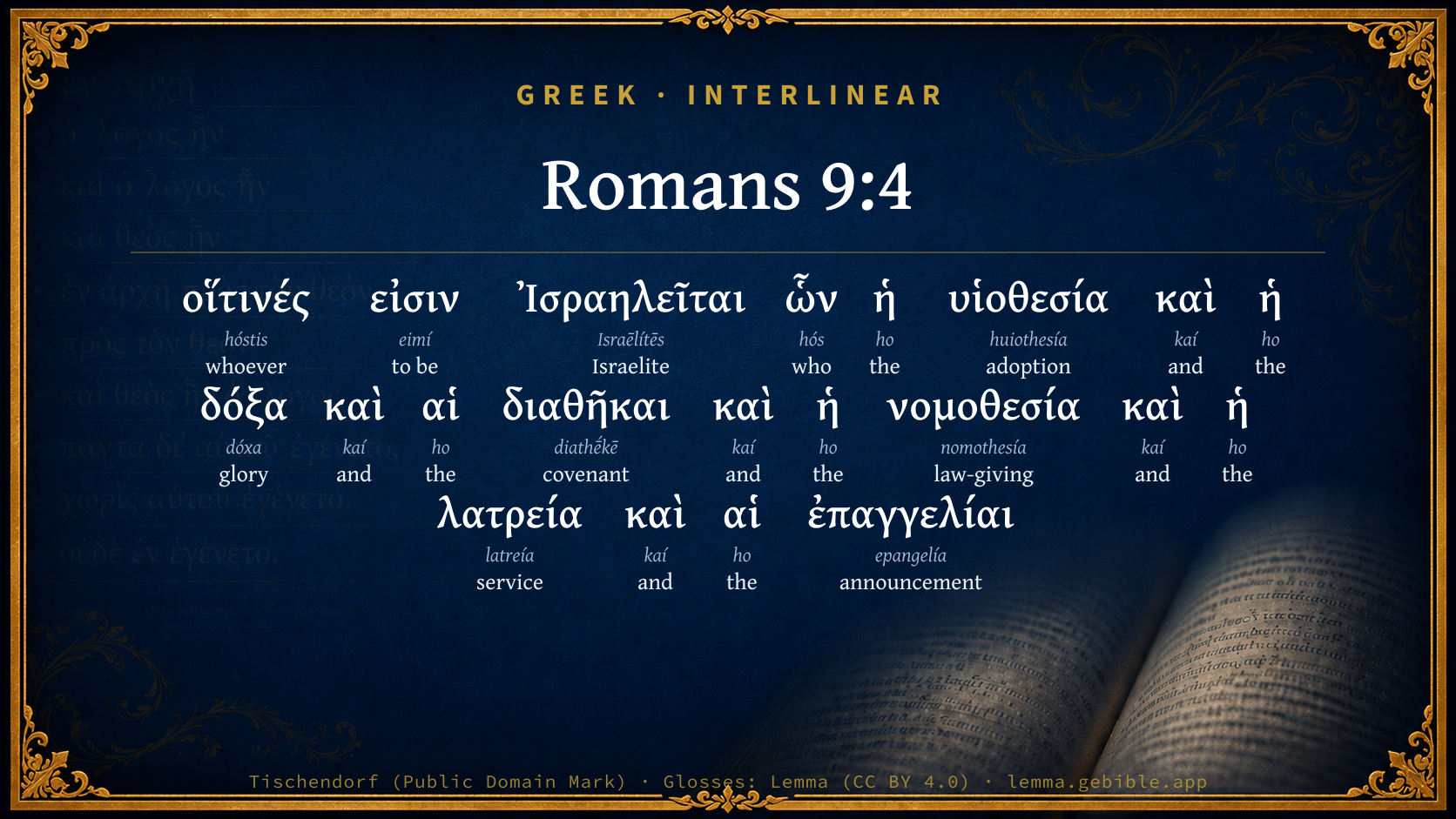
who are Israelites; whose is the adoption, the glory, the covenants, the giving of the law, the service, and the promises;
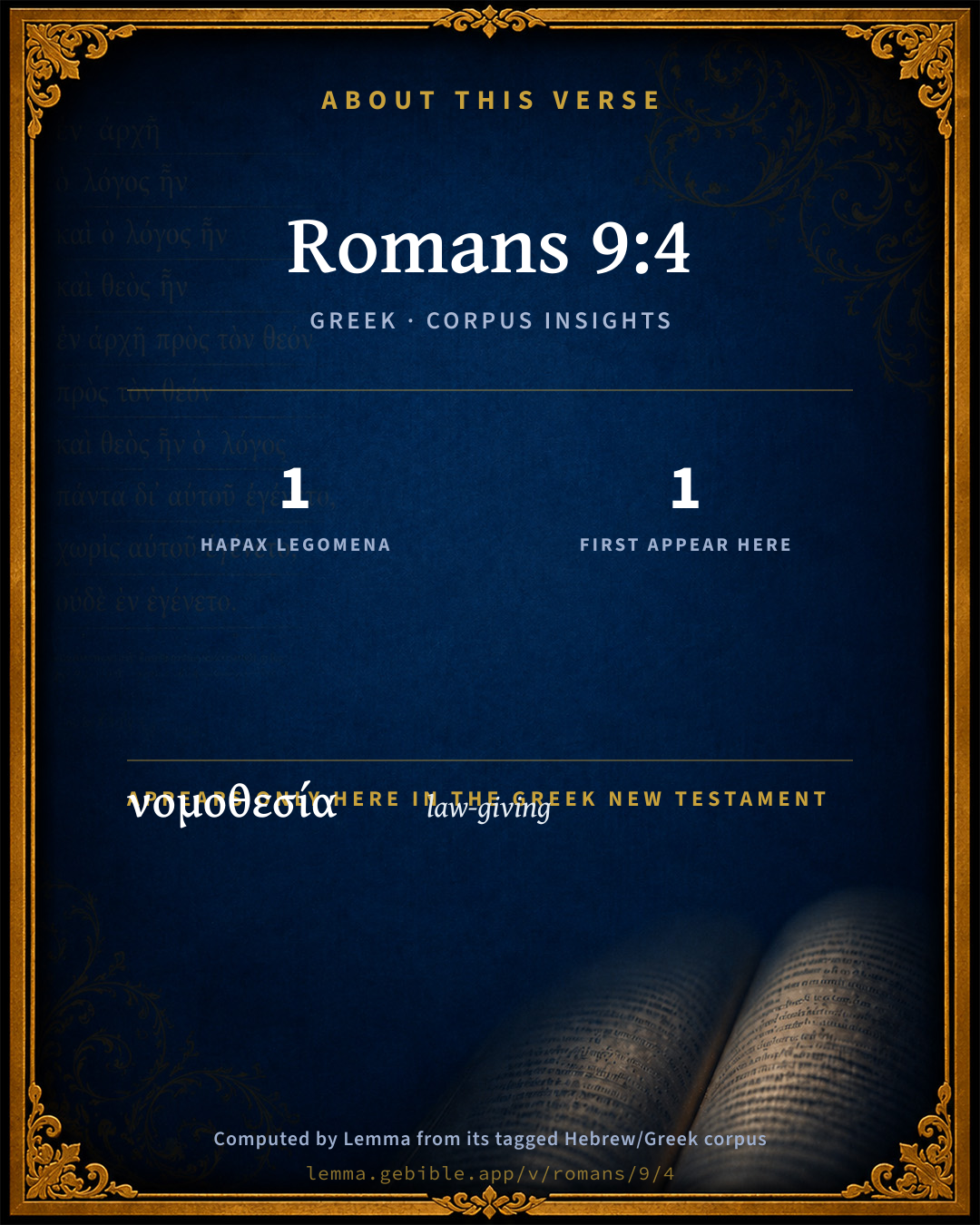
- 1 hapax legomenon — only here in the Greek New Testament
- 1 first appearance in the Greek New Testament
Download a study sheet
One document with this verse’s original text, its word-by-word gloss line, the meaning frame, cross-references with their text, attributed commentary, and full source and license credits — printable, and it pastes into notes with its structure intact.
This verse Autodidact and up
A passage Seminary Student
Up to 50 verses in one chapter. A passage sheet keeps up to 6 commentary sources and 12 cross-references per verse, in the order this page ranks them, and says so on the sheet whenever that leaves anything out. Ask for a single verse and you get the Autodidact verse sheet above.
Everything on this page stays free to read, with no account — the sheet is a download of what is already on screen, not access to it.
Compare translations 3
The same verse in 3 English versions, stacked beneath the original-language interlinear above. Click any original word for its lexicon entry.
Each is an independent rendering of the whole verse — the interlinear is not word-aligned to these translations.
Highlighted words mark where these versions differ — a whole-verse word diff, not a word-by-word alignment.
-
World English Bible Public Domain
who are Israelites; whose is the adoption, the glory, the covenants, the giving of the law, the service, and the promises;
-
King James Version Public Domain
Who are Israelites; to whom pertaineth the adoption, and the glory, and the covenants, and the giving of the law, and the service of God, and the promises;
-
unfoldingWord Literal Text CC BY-SA 4.0
who are Israelites, of whom the adoption, and the glory, and the covenants, and the law-giving, and the service, and the promises;
unfoldingWord Literal Text — © unfoldingWord, licensed CC BY-SA 4.0. Word-aligned USFM3 via Door43 (git.door43.org/unfoldingWord/en_ult).
Show all 18 translations
Every available English version of this verse, each an independent rendering of the whole verse.
-
World English Bible Public Domain
who are Israelites; whose is the adoption, the glory, the covenants, the giving of the law, the service, and the promises;
-
Berean Standard Bible Public Domain
the people of Israel. Theirs is the adoption as sons; theirs the divine glory and the covenants; theirs the giving of the law, the temple worship, and the promises.
-
Majority Standard Bible Public Domain
the people of Israel. Theirs is the adoption as sons; theirs the divine glory and the covenants; theirs the giving of the law, the temple worship, and the promises.
-
King James Version Public Domain
Who are Israelites; to whom pertaineth the adoption, and the glory, and the covenants, and the giving of the law, and the service of God, and the promises;
-
American Standard Version (1901) Public Domain
who are Israelites; whose is the adoption, and the glory, and the covenants, and the giving of the law, and the service `of God', and the promises;
-
Revised Version (1885) Public Domain
who are Israelites; whose is the adoption, and the glory, and the covenants, and the giving of the law, and the service of God, and the promises;
-
Geneva Bible (1599) Public Domain
Which are the Israelites, to whome perteineth the adoption, and the glory, and the Couenants, and the giuing of the Lawe, and the seruice of God, and the promises.
-
Young's Literal Translation Public Domain
who are Israelites, whose `is' the adoption, and the glory, and the covenants, and the lawgiving, and the service, and the promises,
-
Literal Standard Version CC BY-SA 4.0
who are Israelites, whose [is] the adoption, and the glory, and the covenants, and the lawgiving, and the service, and the promises,
-
Unlocked Literal Bible CC BY-SA 4.0
They are Israelites. They have adoption, the glory, the covenants, the gift of the law, the worship of God, and the promises.
-
unfoldingWord Literal Text CC BY-SA 4.0
who are Israelites, of whom the adoption, and the glory, and the covenants, and the law-giving, and the service, and the promises;
-
Darby Bible Public Domain
who are Israelites; whose [is] the adoption, and the glory, and the covenants, and the law-giving, and the service, and the promises;
-
World Messianic Bible Public Domain
who are Israelites; whose is the adoption, the glory, the covenants, the giving of the law, the service, and the promises;
-
Webster's Bible Public Domain
Who are Israelites; to whom pertain the adoption, and the glory, and the covenants, and the giving of the law, and the service of God, and the promises;
-
Free Bible Version CC BY-SA 4.0
They are my fellow-Israelites, God's chosen people. God revealed to them his glory and made agreements with them, giving them the law, true worship, and his promises.
-
Bible in Basic English Public Domain
Who are Israelites: who have the place of sons, and the glory, and the agreements with God, and the giving of the law, and the worship, and the hope offered by God:
-
Text-Critical English NT CC BY 4.0
They are Israelites, and to them belong the adoption as sons, the glory, the covenants, the giving of the law, the temple service, and the promises.
-
Tyndale New Testament (1534) Public Domain
which are the Israelites. To whom pertayneth the adopcion and the glorie and the covenauntes and the law that was geven and the service of God and the promyses:
Literal Standard Version (2020), Covenant Press — licensed CC BY-SA 4.0. Text via the HelloAO Bible API (eBible.org). Unlocked Literal Bible (unfoldingWord) — licensed CC BY-SA 4.0. Text via the HelloAO Bible API (eBible.org). unfoldingWord Literal Text — © unfoldingWord, licensed CC BY-SA 4.0. Word-aligned USFM3 via Door43 (git.door43.org/unfoldingWord/en_ult). Free Bible Version, Dr. Jonathan Gallagher — licensed CC BY-SA 4.0. Text via the HelloAO Bible API (eBible.org).
Word by word
More ways to search: Search by grammar → Find every occurrence → Compare this word →
Practice this passage: Drill this verse → Learn its vocabulary →
- Appears 1× in the Greek New Testament
- First appears here
- Part of Speech
- Noun
- Case
- Nominative
- Number
- Singular
- Gender
- Feminine
Full Thayer's Definition
- οἵτινές hóstis G3748 “whoever” Relative pronoun, Nominative, Plural, Masculine
- εἰσιν eimí G1510 “to be” Verb, Present, Active, Indicative, 3rd person, Plural
- Ἰσραηλεῖται Israēlítēs G2475 “Israelite” Noun, Nominative, Plural, Masculine
- ὧν hós G3739 “who” Relative pronoun, Genitive, Plural, Masculine
- ἡ ho G3588 “the” Article, Nominative, Singular, Feminine
- υἱοθεσία huiothesía G5206 “adoption” Noun, Nominative, Singular, Feminine
- καὶ kaí G2532 “and” Conjunction
- ἡ ho G3588 “the” Article, Nominative, Singular, Feminine
- δόξα dóxa G1391 “glory” Noun, Nominative, Singular, Feminine
- καὶ kaí G2532 “and” Conjunction
- αἱ ho G3588 “the” Article, Nominative, Plural, Feminine
- διαθῆκαι diathḗkē G1242 “covenant” Noun, Nominative, Plural, Feminine
- καὶ kaí G2532 “and” Conjunction
- ἡ ho G3588 “the” Article, Nominative, Singular, Feminine
- νομοθεσία nomothesía G3548 “law-giving” Noun, Nominative, Singular, Feminine
- καὶ kaí G2532 “and” Conjunction
- ἡ ho G3588 “the” Article, Nominative, Singular, Feminine
- λατρεία latreía G2999 “service” Noun, Nominative, Singular, Feminine
- καὶ kaí G2532 “and” Conjunction
- αἱ ho G3588 “the” Article, Nominative, Plural, Feminine
- ἐπαγγελίαι epangelía G1860 “announcement” Noun, Nominative, Plural, Feminine
About this verse
These counts appear in no published source. They are computed here, from the morphology-tagged text and Lemma’s own curated glosses. What Lemma adds →
- 21
- words
- 12
- distinct lemmas
- Pauline Epistles
- section
Notable vocabulary
1 hapax legomenon — a word that appears only here in the entire Greek New Testament:
- νομοθεσία law-giving G3548
First appearance in Scripture
This word makes its first canonical appearance in the Greek New Testament here:
- νομοθεσία law-giving G3548
Shared distinctive vocabulary
υἱοθεσία adoption G5206 occurs in 5 verses of the Greek New Testament. Also found in:
Cross-references
55Topical passages linked to Romans 9:4 in the Treasury of Scripture Knowledge — connected by theme and wording, ordered by reader-vote popularity; previews shown in the World English Bible.
- Ephesians 2:12 that you were at that time separate from Christ, alienated from the commonwealth of Israel, and strangers from the covenants of the promise, having no hope and without God in the world.
- Psalms 147:19 He shows his word to Jacob; His statutes and his ordinances to Israel.
- Genesis 17:2 I will make my covenant between me and you, and will multiply you exceedingly."
- Romans 9:6 But it is not as though the word of God has come to nothing. For they are not all Israel, that are of Israel.
- Deuteronomy 7:6 For you are a holy people to Yahweh your God: Yahweh your God has chosen you to be a people for his own possession, above all peoples who are on the face of the earth.
- Acts 2:39 For to you is the promise, and to your children, and to all who are far off, even as many as the Lord our God will call to himself."
- Exodus 4:22 You shall tell Pharaoh, 'Thus says Yahweh, Israel is my son, my firstborn,
- Hebrews 9:1 Now indeed even the first covenant had ordinances of divine service, and an earthly sanctuary.
- 1 Kings 8:11 so that the priests could not stand to minister by reason of the cloud; for the glory of Yahweh filled the house of Yahweh.
- Psalms 89:3 "I have made a covenant with my chosen one, I have sworn to David, my servant,
- Acts 3:25–26 You are the children of the prophets, and of the covenant which God made with our fathers, saying to Abraham, 'In your seed will all the families of the earth be blessed.'
- Romans 8:15 For you didn't receive the spirit of bondage again to fear, but you received the Spirit of adoption, by whom we cry, "Abba! Father!"
- Hebrews 6:13–17 For when God made a promise to Abraham, since he could swear by none greater, he swore by himself,
- Genesis 17:7 I will establish my covenant between me and you and your seed after you throughout their generations for an everlasting covenant, to be a God to you and to your seed after you.
- Deuteronomy 14:1 You are the children of Yahweh your God: you shall not cut yourselves, nor make any baldness between your eyes for the dead.
- Jeremiah 31:33 But this is the covenant that I will make with the house of Israel after those days, says Yahweh: I will put my law in their inward parts, and in their heart will I write it; and I will be their God, and they shall be my people:
- Luke 1:69–75 And has raised up a horn of salvation for us in the house of his servant David
- John 1:17 For the law was given through Moses. Grace and truth came through Jesus Christ.
- Hebrews 9:10 being only (with meats and drinks and various washings) fleshly ordinances, imposed until a time of reformation.
- Genesis 15:18 In that day Yahweh made a covenant with Abram, saying, "To your seed have I given this land, from the river of Egypt to the great river, the river Euphrates:
- Genesis 17:10 This is my covenant, which you shall keep, between me and you and your seed after you. Every male among you shall be circumcised.
- Genesis 32:28 He said, "Your name will no longer be called 'Jacob,' but, 'Israel,' for you have fought with God and with men, and have prevailed."
- Exodus 12:25 It shall happen when you have come to the land which Yahweh will give you, according as he has promised, that you shall keep this service.
- Exodus 19:3–6 Moses went up to God, and Yahweh called to him out of the mountain, saying, "This is what you shall tell the house of Jacob, and tell the children of Israel:
- Exodus 24:7–8 He took the book of the covenant and read it in the hearing of the people, and they said, "All that Yahweh has spoken will we do, and be obedient."
- Exodus 34:27 Yahweh said to Moses, "Write you these words: for in accordance with these words I have made a covenant with you and with Israel."
- Exodus 40:34 Then the cloud covered the tent of meeting, and the glory of Yahweh filled the tent.
- Numbers 7:89 When Moses went into the Tent of Meeting to speak with Yahweh, he heard his voice speaking to him from above the mercy seat that was on the ark of the Testimony, from between the two cherubim: and he spoke to him.
- Deuteronomy 29:1 These are the words of the covenant which Yahweh commanded Moses to make with the children of Israel in the land of Moab, besides the covenant which he made with them in Horeb.
- Deuteronomy 29:14 Neither with you only do I make this covenant and this oath,
- Deuteronomy 31:16 Yahweh said to Moses, Behold, you shall sleep with your fathers; and this people will rise up, and play the prostitute after the strange gods of the land, where they go to be among them, and will forsake me, and break my covenant which I have made with them.
- 1 Samuel 4:21–22 She named the child Ichabod, saying, The glory is departed from Israel; because the ark of God was taken, and because of her father-in-law and her husband.
- Nehemiah 9:13–14 You came down also on Mount Sinai, and spoke with them from heaven, and gave them right ordinances and true laws, good statutes and commandments,
- Nehemiah 13:29 Remember them, my God, because they have defiled the priesthood, and the covenant of the priesthood, and of the Levites.
- Psalms 63:2 So I have seen you in the sanctuary, Watching your power and your glory.
- Psalms 73:1 Surely God is good to Israel, To those who are pure in heart.
- Psalms 78:61 And delivered his strength into captivity, His glory into the adversary's hand.
- Psalms 89:34 I will not break my covenant, Nor alter what my lips have uttered.
- Psalms 90:16 Let your work appear to your servants; Your glory to their children.
- Isaiah 5:2 He dug it up, Gathered out its stones, Planted it with the choicest vine, Built a tower in its midst, And also cut out a winepress therein. He looked for it to yield grapes, But it yielded wild grapes.
- Isaiah 41:8 But you, Israel, my servant, Jacob whom I have chosen, the seed of Abraham my friend,
- Isaiah 46:3 Listen to me, house of Jacob, and all the remnant of the house of Israel, that have been borne [by me] from their birth, that have been carried from the womb;
- Isaiah 60:19 The sun shall be no more your light by day; neither for brightness shall the moon give light to you: but Yahweh will be to you an everlasting light, and your God your glory.
- Jeremiah 31:9 They shall come with weeping; and with petitions will I lead them: I will cause them to walk by rivers of waters, in a straight way in which they shall not stumble; for I am a father to Israel, and Ephraim is my firstborn.
- Jeremiah 31:20 Is Ephraim my dear son? is he a darling child? for as often as I speak against him, I do earnestly remember him still: therefore my heart yearns for him; I will surely have mercy on him, says Yahweh.
- Jeremiah 33:20–25 Thus says Yahweh: If you can break my covenant of the day, and my covenant of the night, so that there shall not be day and night in their season;
- Ezekiel 20:11–12 I gave them my statutes, and shown them my ordinances, which if a man do, he shall live in them.
- Hosea 11:1 "When Israel was a child, then I loved him, And called my son out of Egypt.
- Matthew 21:33 "Hear another parable. There was a man who was a master of a household, who planted a vineyard, set a hedge about it, dug a winepress in it, built a tower, leased it out to farmers, and went into another country.
- Luke 1:54–55 He has given help to Israel, his servant, that he might remember mercy,
- John 1:47 Jesus saw Nathanael coming to him, and said about him, "Behold, an Israelite indeed, in whom is no deceit!"
- Acts 13:32–33 We bring you good news of the promise made to the fathers,
- Hebrews 8:6–10 But now he has obtained a more excellent ministry, by so much as he is also the mediator of a better covenant, which has been enacted on better promises.
- Hebrews 9:3 After the second veil was the tabernacle which is called the Holy of Holies,
- Romans 3:2 Much in every way! Because first of all, they were entrusted with the oracles of God.
Cross-references courtesy of OpenBible.info (CC BY 4.0).
Lesson kit
Teaching starters — assembled from the data on this page, not authored interpretation. Every prompt links to the verse data it draws on. Edit before teaching.
Romans, in the Pauline Epistles, opens this verse with 21 words (12 distinct Greek lemmas). Its most distinctive word is nomothesía (“law-giving”). A historical commentator’s framing appears above. Read the whole chapter for the surrounding context.
Discussion questions
- The word nomothesía carries the sense “law-giving.” How does it shape the verse?
- 1 word here appears nowhere else in the Greek New Testament. Why might the author reach for such rare wording?
- This is the first place “law-giving” appears in Scripture (first appears here). What does its debut here establish?
- How does Romans 8:15, which shares the word «adoption», read alongside this verse?
- What does the repetition of “the” (6× in this one verse) do in this verse?
- The translations on this page render this verse differently — a whole-verse word diff, not a word-by-word alignment. What might account for the different wordings?
- Compare how Matthew Poole's English Annotations and The Biblical Illustrator read this verse. Where do they agree or differ?
Things to notice
- 1 word in this verse appears nowhere else in the Greek New Testament.
- 1 word makes its first canonical appearance in Scripture here.
- These translations choose different wording for 7 words in this verse.
- “the” occurs 6× in this single verse.
- 12 distinct Greek lemmas span 21 words in this verse.
Commentary
Notes on Romans 9:4 from classic Christian and Jewish commentators (each source and its license shown beneath its notes). The classic Christian expositions comment on the surrounding passage and are grouped to its opening verse, so a note may address several verses; the Jewish commentaries on the Tanakh (Rashi and others) are per-verse, so they appear only where the commentator wrote on this verse.
Lemma curates 59 commentaries, every one of them public domain or Creative Commons licensed, each selected and text-cleaned for this edition rather than reprinted as found. About our sources →
Matthew Poole's English Annotations
Matthew Poole's English Annotations on the Holy Bible (1683–1685) — public domain. Text from a community e-Sword/MySword module.
The Biblical Illustrator
Joseph S. Exell
The Biblical Illustrator, edited by Joseph S. Exell (c. 1880s–1900s) — public domain. Text from a community e-Sword module.
Joseph Benson's Commentary
Joseph Benson's Commentary on the Old and New Testaments (1811–1818) — public domain. Text from a community e-Sword module.
Tyndale Open Study Notes
Tyndale Open Resources
Tyndale Open Study Notes — © Tyndale Open Resources, licensed CC BY-SA 4.0. Text via the HelloAO Bible API.
Bengel's Gnomon
Johann Albrecht Bengel
Bengel's Gnomon of the New Testament — English translation (T&T Clark, Edinburgh, 1860) — public domain. Text from a community e-Sword module.
Meyer's Critical & Exegetical Commentary
Heinrich August Wilhelm Meyer
Meyer — Critical and Exegetical Commentary on the New Testament — English translation by Peter Christie, edited by Frederick Crombie (T&T Clark, 1880) — public domain. Text from a community e-Sword module.
Expositor's Greek Testament
ed. W. Robertson Nicoll
The Expositor's Greek Testament, edited by W. Robertson Nicoll (1897–1910) — public domain. Text from a community e-Sword module.
Godet's Commentaries
Frédéric Louis Godet
Frédéric Louis Godet — Commentaries on Luke, John, Romans, and 1 Corinthians — English translation (T&T Clark, Edinburgh, 1870s–1890s) — public domain. Text from a community e-Sword module.
Hodge's Commentary on Romans, Ephesians & First Corinthians
Charles Hodge
Charles Hodge — Commentary on Romans (1835), First Corinthians (1857), and Ephesians (1856) — public domain. Text from a community e-Sword module.
Geneva Bible (1599)
Geneva Bible translators
Geneva Bible (1599) marginal notes — public domain. Text via Bolls.life.
Jamieson, Fausset & Brown
Robert Jamieson, A. R. Fausset & David Brown
Jamieson, Fausset & Brown — Commentary Critical and Explanatory on the Whole Bible (1871) — public domain (CC PDM 1.0). Text via the HelloAO Bible API.
Adam Clarke's Commentary
Adam Clarke's Commentary on the Bible (1810–1826) — public domain. Text from a community e-Sword/MySword module.
John Calvin's Commentaries
John Calvin's Commentaries (1540-1563) — public domain. Text from the Calvin Translation Society English edition (1840s-50s) via the Christian Classics Ethereal Library (ccel.org). Calvin's coverage is partial (roughly two-thirds of the Bible); uncommented books and verses are honest gaps, never fabricated. The 19th-century editor's footnotes and remarks are omitted so the notes are faithfully Calvin's own voice.
Ellicott's Commentary for English Readers
A Bible Commentary for English Readers, edited by Charles John Ellicott (1878–1897) — public domain. Text from a community e-Sword module.
The Cambridge Bible for Schools and Colleges
gen. ed. J. J. S. Perowne
The Cambridge Bible for Schools and Colleges (gen. ed. J. J. S. Perowne; Cambridge University Press, 1878–1918) — public domain. Text from a community e-Sword module.
John Gill's Exposition
John Gill's Exposition of the Whole Bible (1746–1763) — public domain (CC PDM 1.0). Text via the HelloAO Bible API.
Trapp's Complete Commentary
John Trapp
John Trapp, A Commentary or Exposition upon All the Books of the Old and New Testament (1647–1656) — public domain. Text from a community e-Sword module.
Albert Barnes' Notes on the Bible
Albert Barnes' Notes on the Bible (1834–1885) — public domain. Text from a community e-Sword/MySword module.
Haydock's Catholic Bible Commentary
George Leo Haydock (1774–1849), Haydock's Catholic Family Bible and Commentary, 1859 edition — public domain. Excludes Psalms (Douay-Rheims chapter numbering differs from Protestant) and Deuterocanonical books (Catholic canon only).
Whedon's Commentary on the Bible
Daniel D. Whedon
Daniel D. Whedon (gen. ed.), Commentary on the Old and New Testaments (1874–1909) — public domain. Text from a community e-Sword module.
The Pulpit Commentary
The Pulpit Commentary (1880–1919), ed. H.D.M. Spence-Jones & Joseph S. Exell — public domain. Text from a community e-Sword module.
John Wesley's Explanatory Notes
John Wesley, Explanatory Notes Upon the Whole Bible (1754–1765) — public domain. Text via the GEBible commentary corpus.
Burkitt's Expository Notes on the New Testament
William Burkitt
William Burkitt's Expository Notes on the New Testament (1700–1703) — public domain. Text from a community e-Sword module.
Godbey's Commentary on the New Testament
William B. Godbey
William B. Godbey, Commentary on the New Testament (1896–1900) — public domain. Text from a community e-Sword module.
McGarvey & Pendleton's Commentaries
J. W. McGarvey
J. W. McGarvey (with Philip Y. Pendleton), Commentaries on the New Testament (The Fourfold Gospel, 1914; Acts; and the epistles) — public domain. Text from a community e-Sword/MySword module.
The People's New Testament
B. W. Johnson
B. W. Johnson's The People's New Testament with Notes (1889–1891) — public domain. Electronic text from the Christian Classics Ethereal Library (CCEL) ThML edition.
Cambridge Greek Testament for Schools and Colleges
Cambridge Greek Testament for Schools and Colleges (Cambridge University Press, 1896; 21 vols, various authors incl. Carr, Maclear, Plummer, Farrar, Lumby, Moule, M. R. James, Simcox) — public domain. Text from a community e-Sword module.
Alford’s Greek Testament
Henry Alford
Henry Alford, The Greek Testament (1849–1861) — public domain. Text from a community e-Sword module.
International Critical Commentary
International Critical Commentary — older volumes (1896–1929), various authors — public domain. Text from a community e-Sword module.
Vincent's Word Studies in the New Testament
Marvin R. Vincent
Marvin R. Vincent, Word Studies in the New Testament (1887–1900) — public domain. Text from a community e-Sword/MySword module.