
Romans 4:16

Greek (Tischendorf 8th ed.) Romans 4:16 appears in the Greek New Testament. The text above is from the Tischendorf 8th edition. Each word links to its Strong’s number and a concise gloss. Click any word for its full Thayer’s Greek Lexicon entry.
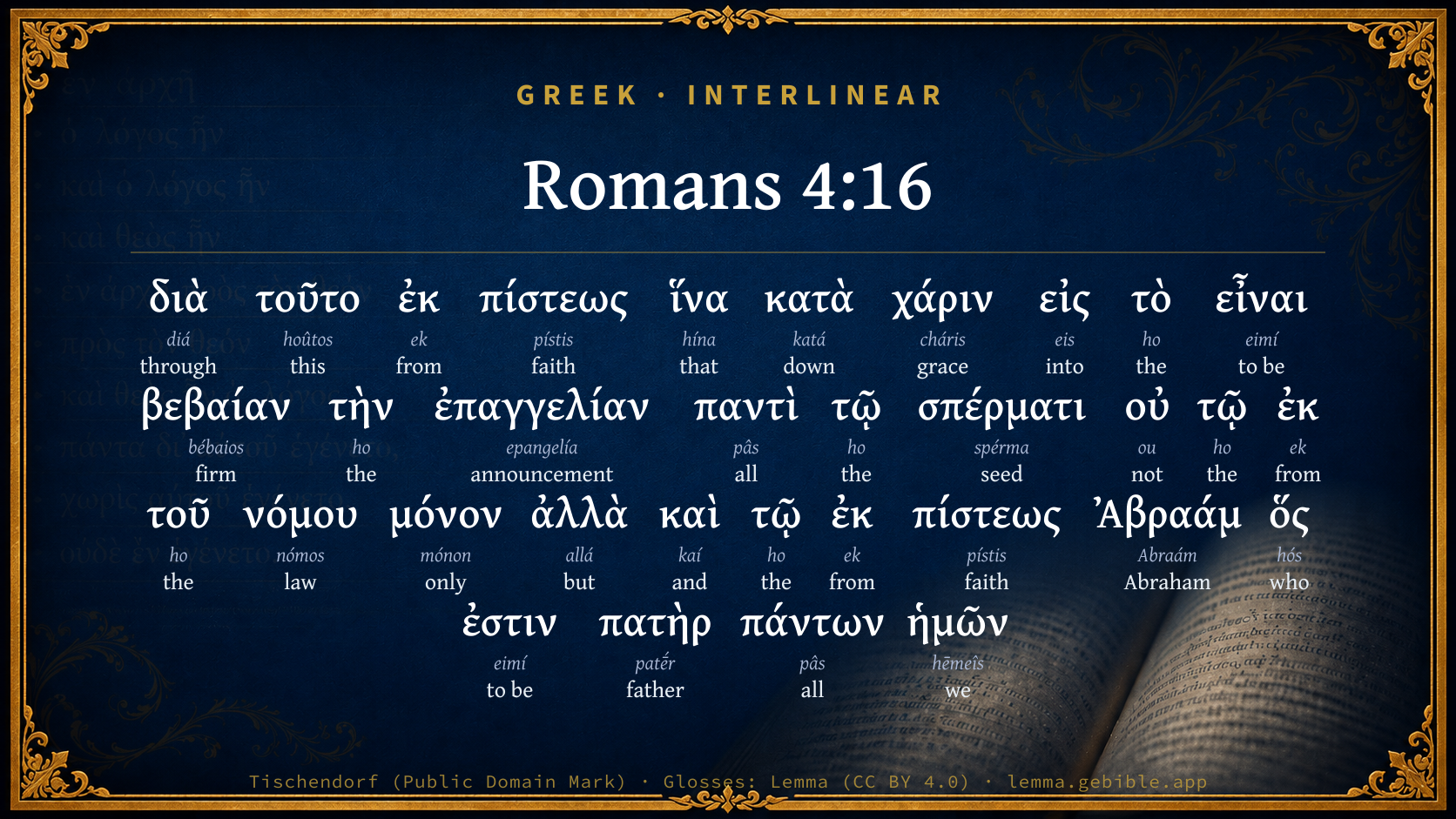
Download image
Cite this verse

Romans 4:16 (World English Bible). Public Domain. Lemma interlinear Bible study tool, https://lemma.gebible.app/v/romans/4/16.

Show BibTeX & RIS
BibTeX
RIS
English Translation
For this cause it is of faith, that it may be according to grace, to the end that the promise may be sure to all the seed, not to that only which is of the law, but to that also which is of the faith of Abraham, who is the father of us all.
World English Bible · Public Domain
Highlights
  • 1 first appearance in the Greek New Testament
Full analysis ↓
Download a study sheet

One document with this verse’s original text, its word-by-word gloss line, the meaning frame, cross-references with their text, attributed commentary, and full source and license credits — printable, and it pastes into notes with its structure intact.

This verse Autodidact and up

Study sheet (.html) Plain text (.txt)

A passage Seminary Student

Up to 50 verses in one chapter. A passage sheet keeps up to 6 commentary sources and 12 cross-references per verse, in the order this page ranks them, and says so on the sheet whenever that leaves anything out. Ask for a single verse and you get the Autodidact verse sheet above.

Everything on this page stays free to read, with no account — the sheet is a download of what is already on screen, not access to it.

Want to remove ads? Support Godless Engineer
Compare translations 3

The same verse in 3 English versions, stacked beneath the original-language interlinear above. Click any original word for its lexicon entry.

Each is an independent rendering of the whole verse — the interlinear is not word-aligned to these translations.

Highlighted words mark where these versions differ — a whole-verse word diff, not a word-by-word alignment.

  • World English Bible Public Domain
    For this cause it is of faith, that it may be according to grace, to the end that the promise may be sure to all the seed, not to that only which is of the law, but to that also which is of the faith of Abraham, who is the father of us all.
  • King James Version Public Domain
    Therefore it is of faith, that it might be by grace; to the end the promise might be sure to all the seed; not to that only which is of the law, but to that also which is of the faith of Abraham; who is the father of us all,
  • unfoldingWord Literal Text CC BY-SA 4.0
    For this reason by faith, in order that according to grace, so that the promise might be certain to all the seed—not only to the one from the law, but also to the one from the faith of Abraham, who is the father of us all,

unfoldingWord Literal Text — © unfoldingWord, licensed CC BY-SA 4.0. Word-aligned USFM3 via Door43 (git.door43.org/unfoldingWord/en_ult).

Versions to compare (up to 4)

3 of 4 selected

Show all 19 translations

Every available English version of this verse, each an independent rendering of the whole verse.

  • World English Bible Public Domain
    For this cause it is of faith, that it may be according to grace, to the end that the promise may be sure to all the seed, not to that only which is of the law, but to that also which is of the faith of Abraham, who is the father of us all.
  • Berean Standard Bible Public Domain
    Therefore, the promise comes by faith, so that it may rest on grace and may be guaranteed to all Abraham’s offspring—not only to those who are of the law, but also to those who are of the faith of Abraham. He is the father of us all.
  • Majority Standard Bible Public Domain
    Therefore, the promise comes by faith, so that it may rest on grace and may be guaranteed to all Abraham’s offspring—not only to those who are of the law, but also to those who are of the faith of Abraham. He is the father of us all.
  • King James Version Public Domain
    Therefore it is of faith, that it might be by grace; to the end the promise might be sure to all the seed; not to that only which is of the law, but to that also which is of the faith of Abraham; who is the father of us all,
  • American Standard Version (1901) Public Domain
    For this cause `it is' of faith, that `it may be' according to grace; to the end that the promise may be sure to all the seed; not to that only which is of the law, but to that also which is of the faith of Abraham, who is the father of us all
  • Revised Version (1885) Public Domain
    For this cause it is of faith, that it may be according to grace; to the end that the promise may be sure to all the seed; not to that only which is of the law, but to that also which is of the faith of Abraham, who is the father of us all
  • Geneva Bible (1599) Public Domain
    Therefore it is by faith, that it might come by grace, and the promise might be sure to all the seede, not to that onely which is of the Lawe: but also to that which is of the faith of Abraham, who is the father of vs all,
  • Douay-Rheims (1899) Public Domain
    Therefore is it of faith, that according to grace the promise might be firm to all the seed; not to that only which is of the law, but to that also which is of the faith of Abraham, who is the father of us all,
  • Young's Literal Translation Public Domain
    Because of this `it is' of faith, that `it may be' according to grace, for the promise being sure to all the seed, not to that which `is' of the law only, but also to that which `is' of the faith of Abraham,
  • Literal Standard Version CC BY-SA 4.0
    Because of this [it is] of faith, that [it may be] according to grace, for the promise being sure to all the seed, not to that which [is] of the Law only, but also to that which [is] of the faith of Abraham,
  • Unlocked Literal Bible CC BY-SA 4.0
    For this reason it is by faith, in order that the promise may rest on grace and be guaranteed to all of Abraham's descendants—not only to those who are under the law, but also to those who share the faith of Abraham. He is the father of us all,
  • unfoldingWord Literal Text CC BY-SA 4.0
    For this reason by faith, in order that according to grace, so that the promise might be certain to all the seed—not only to the one from the law, but also to the one from the faith of Abraham, who is the father of us all,
  • Darby Bible Public Domain
    Therefore [it is] on the principle of faith, that [it might be] according to grace, in order to the promise being sure to all the seed, not to that only which [is] of the law, but to that also which [is] of Abraham's faith, who is father of us all,
  • World Messianic Bible Public Domain
    For this cause it is of faith, that it may be according to grace, to the end that the promise may be sure to all the offspring, not to that only which is of the law, but to that also which is of the faith of Abraham, who is the father of us all.
  • Webster's Bible Public Domain
    Therefore it is of faith, that it might be by grace; to the end the promise might be sure to all the seed, not to that only which is of the law, but to that also which is of the faith of Abraham, who is the father of us all;
  • Free Bible Version CC BY-SA 4.0
    So the promise is based on trusting God. It is provided as a free gift, guaranteed to all the children of Abraham—not merely to those who follow the law, but also to those who trust like Abraham, the father of us all.
  • Bible in Basic English Public Domain
    For this reason it is of faith, so that it may be through grace; and so that the word of God may be certain to all the seed; not only to that which is of the law, but to that which is of the faith of Abraham, who is the father of us all,
  • Text-Critical English NT CC BY 4.0
    For this reason the promise comes by faith, so that it may be according to grace and be guaranteed to all Abraham's offspring, not only to the one who is of the law, but also to the one who is of the faith of Abraham, who is the father of us all
  • Tyndale New Testament (1534) Public Domain
    Therfore by fayth is the inheritaunce geven that it myght come of faveour: and the promes myght be sure to all the seed. Not to them only which are of the lawe: but also to them which are of the fayth of Abraham which is the father of vs all.

Literal Standard Version (2020), Covenant Press — licensed CC BY-SA 4.0. Text via the HelloAO Bible API (eBible.org). Unlocked Literal Bible (unfoldingWord) — licensed CC BY-SA 4.0. Text via the HelloAO Bible API (eBible.org). unfoldingWord Literal Text — © unfoldingWord, licensed CC BY-SA 4.0. Word-aligned USFM3 via Door43 (git.door43.org/unfoldingWord/en_ult). Free Bible Version, Dr. Jonathan Gallagher — licensed CC BY-SA 4.0. Text via the HelloAO Bible API (eBible.org).

Word by word

More ways to search: Search by grammar → Find every occurrence → Compare this word →

Practice this passage: Drill this verse → Learn its vocabulary →

βεβαίαν
bébaios
G949
“firm”
Adjective, Accusative, Singular, Feminine
Part of Speech
Adjective
Case
Accusative
Number
Singular
Gender
Feminine
Full Thayer's Definition

Origin: from the base of G939 (through the idea of basality)

TDNT: 11:00,1

1. stable, fast, firm 2. metaph. sure, trusty
  1. διὰ diá G1223 “through” Preposition
  2. τοῦτο hoûtos G3778 “this” Demonstrative pronoun, Accusative, Singular, Neuter
  3. ἐκ ek G1537 “from” Preposition
  4. πίστεως pístis G4102 “faith” Noun, Genitive, Singular, Feminine
  5. ἵνα hína G2443 “that” Conjunction
  6. κατὰ katá G2596 “down” Preposition
  7. χάριν cháris G5485 “grace” Noun, Accusative, Singular, Feminine
  8. εἰς eis G1519 “into” Preposition
  9. τὸ ho G3588 “the” Article, Accusative, Singular, Neuter
  10. εἶναι eimí G1510 “to be” Verb, Present, Active, Infinitive
  11. τὴν ho G3588 “the” Article, Accusative, Singular, Feminine
  12. ἐπαγγελίαν epangelía G1860 “announcement” Noun, Accusative, Singular, Feminine
  13. παντὶ pâs G3956 “all” Adjective, Dative, Singular, Neuter
  14. τῷ ho G3588 “the” Article, Dative, Singular, Neuter
  15. σπέρματι spérma G4690 “seed” Noun, Dative, Singular, Neuter
  16. οὐ ou G3756 “not” Particle, Negative
  17. τῷ ho G3588 “the” Article, Dative, Singular, Neuter
  18. ἐκ ek G1537 “from” Preposition
  19. τοῦ ho G3588 “the” Article, Genitive, Singular, Masculine
  20. νόμου nómos G3551 “law” Noun, Genitive, Singular, Masculine
  21. μόνον mónon G3440 “only” Adverb
  22. ἀλλὰ allá G235 “but” Conjunction
  23. καὶ kaí G2532 “and” Conjunction
  24. τῷ ho G3588 “the” Article, Dative, Singular, Neuter
  25. ἐκ ek G1537 “from” Preposition
  26. πίστεως pístis G4102 “faith” Noun, Genitive, Singular, Feminine
  27. Ἀβραάμ Abraám G11 “Abraham” Noun, Proper, indeclinable
  28. ὅς hós G3739 “who” Relative pronoun, Nominative, Singular, Masculine
  29. ἐστιν eimí G1510 “to be” Verb, Present, Active, Indicative, 3rd person, Singular
  30. πατὴρ patḗr G3962 “father” Noun, Nominative, Singular, Masculine
  31. πάντων pâs G3956 “all” Adjective, Genitive, Plural, Masculine
  32. ἡμῶν hēmeîs G2249 “we” Personal pronoun, 1st person, Genitive, Plural

About this verse

These counts appear in no published source. They are computed here, from the morphology-tagged text and Lemma’s own curated glosses. What Lemma adds →

33
words
23
distinct lemmas
Pauline Epistles
section

Notable vocabulary

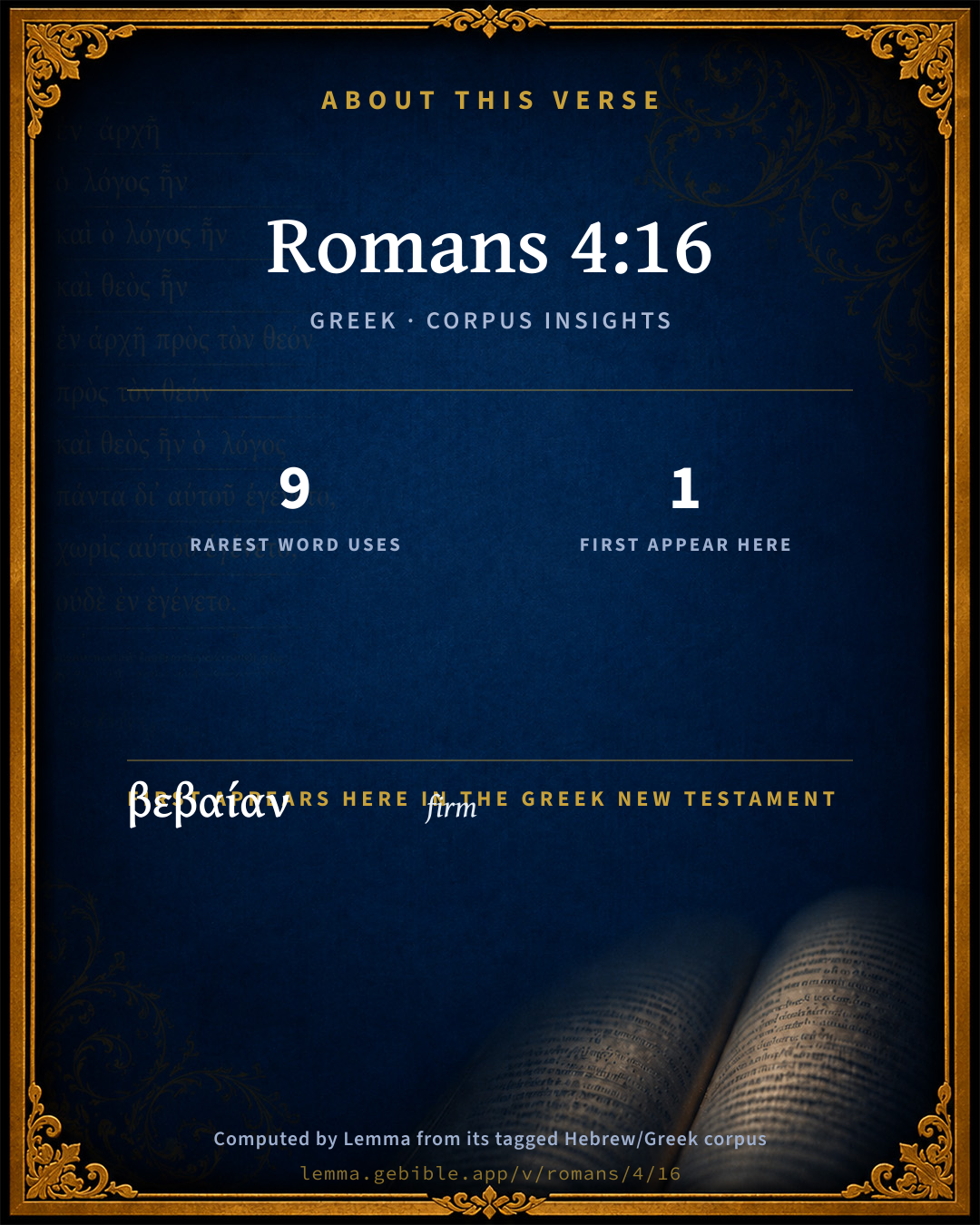
The rarest word here is βεβαίαν firm G949 — appearing just 9 times in the whole Greek New Testament.

First appearance in Scripture

This word makes its first canonical appearance in the Greek New Testament here:

  • βεβαίαν firm G949

Shared distinctive vocabulary

βεβαίαν firm G949 occurs in 9 verses of the Greek New Testament. Also found in:
Repetition

Words recur within this verse:

  • πίστεως faith G4102 ×2
  • εἶναι to be G1510 ×2
  • παντὶ all G3956 ×2
  • τὸ the G3588 ×6
  • ἐκ from G1537 ×3

Cross-references

12

Topical passages linked to Romans 4:16 in the Treasury of Scripture Knowledge — connected by theme and wording, ordered by reader-vote popularity; previews shown in the World English Bible.

  • Romans 3:24–26 being justified freely by his grace through the redemption that is in Christ Jesus;
  • Ephesians 2:8 for by grace you have been saved through faith, and that not of yourselves; it is the gift of God,
  • Romans 9:8 That is, it is not the children of the flesh who are children of God, but the children of the promise are counted as a seed.
  • Galatians 3:22 But the Scriptures shut up all things under sin, that the promise by faith in Jesus Christ might be given to those who believe.
  • Titus 3:7 that, being justified by his grace, we might be made heirs according to the hope of eternal life.
  • Isaiah 51:2 Look to Abraham your father, and to Sarah who bore you; for when he was but one I called him, and I blessed him, and made him many.
  • Romans 5:1 Being therefore justified by faith, we have peace with God through our Lord Jesus Christ;
  • Romans 15:8 Now I say that Christ has been made a minister of the circumcision for the truth of God, that he might confirm the promises given to the fathers,
  • Ephesians 2:5 even when we were dead through our trespasses, made us alive together with Christ (by grace you have been saved),
  • Galatians 3:7–12 Know therefore that those who are of faith, the same are children of Abraham.
  • Hebrews 6:13–19 For when God made a promise to Abraham, since he could swear by none greater, he swore by himself,
  • 2 Peter 1:10 Therefore, brothers, be more diligent to make your calling and election sure. For if you do these things, you will never stumble.

Cross-references courtesy of OpenBible.info (CC BY 4.0).

Commentary

Notes on Romans 4:16 from classic Christian and Jewish commentators (each source and its license shown beneath its notes). The classic Christian expositions comment on the surrounding passage and are grouped to its opening verse, so a note may address several verses; the Jewish commentaries on the Tanakh (Rashi and others) are per-verse, so they appear only where the commentator wrote on this verse.

Lemma curates 59 commentaries, every one of them public domain or Creative Commons licensed, each selected and text-cleaned for this edition rather than reprinted as found. About our sources →

The Biblical Illustrator

Joseph S. Exell

Rom_4:16

Therefore it is of faith, that it might be by grace.

How is salvation received

I. The fact.

1. It is of faith. And what is faith? It is taking God at His Word, and acting upon that by trusting in Him. Some of the Puritans used to divide it into three parts.

(1) Self-renunciation, which is, perhaps, rather a preparation for faith than faith itself.

(2) Reliance, in which a man trusts, and leaves his soul in the Saviours hands.

(3) Appropriation, by which a man takes to himself that which God presents in the promise. We shall, however, better understand what faith is as we consider--

1. Abrahams case.

(1) He believed the promise of God firmly and practically. He was in Chaldea when the Lord promised to give him a land and a seed, and straightway he went forth, not knowing whither he went. When he came into Canaan he had no settled resting place, but still believed that the land wherein he sojourned as a stranger was his own. God promised to give him a seed, and he waited till he was a hundred years old and Sarah ninety when Isaac was born. Nor did he doubt when the Lord bade him take Isaac and offer him up as a sacrifice.

(2) He had an eye to the central point of the promise, the Messiah. When the Lord said that He would make him a blessing, and in him should all the nations of the earth be blessed, I do not suppose Abraham saw all the fulness of that marvellous word; but our Lord declares, Abraham saw My day and was glad.

(3) He considered no difficulties whatever (Rom_4:18-19). These were terrible difficulties; they were for God to consider, and not for him.

(4) He gave glory to God (Rom_4:20). God had promised, and he treated the Lords promise with becoming reverence. He knew that Jehovah is not a man that He should lie, nor the son of man that He should repent. Abraham glorified the truth of God, and at the same time he glorified His power. It belongs to puny man to speak more than he can do; but is anything too hard for the Lord?

(5) He rested upon the Lord alone (Rom_4:21). There was nothing whatever in his house, his wife, himself, or anywhere else, which could guarantee the fulfilment of the promise. He had only God to look to, and what could a man have more? And this is the kind of faith which God loves and honours, which wants no signs, evidences, or other buttresses to support the word of the Lord. Dictum! Factum! These twain are one with the Most High.

2. The faith of every man who is saved must be of this character. When we are saved--

(1) We take the promise of God and depend upon it.

(2) We believe in God over the head of great difficulties. If it was hard for Abraham to believe that a son should be born unto him, methinks it is harder for a sinner to believe the hopeful things which the gospel prophesies unto him.

(a) Can the gospel message be true to such a worthless rebel as I am? Despite the trepidation of the awakened spirit, the Holy Spirit enables it to quiet itself with the firm persuasion that God for Christs sake doth put away its sin.

(b) Another miracle is also believed in, namely, regeneration. This is quite as great an act of faith as Abraham to believe in the birth of a child by parents who were advanced in years. The faith which saves believes in Jesus and obtains power to become children of God and strength to conquer sin.

(c) Does it not seem incredible that such feeble, foolish creatures as we should continue in faith? Yet this we must do; and the faith which saves enables us to believe that we shall persevere, for it is persuaded that the Redeemer is able to keep that which we have committed unto Him.

(d) We believe, according to Gods promise, that we shall one day be without spot or wrinkle, or any such thing. Without fault before the throne of God. But how is this to be? Surely our confidence is, that He who has promised it is able to perform it.

(3) This saving faith rests in the power of God as manifested in Jesus (Rom_4:24-25). It is not to us a thing incredible that God should raise the dead; we therefore believe that because God has raised the dead He hath raised us also from our death in sin, and that He will raise our bodies too.

II. The first reason why God has chosen to make salvation by faith, that it might be of grace. He might have willed to make the condition of salvation a mitigated form of works. If He had done so it would not have been of grace. As water and oil will not mix, and as fire and water will not lie down side by side in quiet, so neither will the principle of merit and the principle of free favour. Grace and faith are congruous, and will draw together in the same chariot, but grace and merit pull opposite ways, and therefore God has not chosen to yoke them together.

1. In Abrahams case, inasmuch as he received the blessing by faith, it is very evident that it was of grace. No man thinks of Abraham as a self-justifying person, saying, God, I thank Thee that I am not as other men. His name is not the father of the innocent, but the father of the faithful.

2. Inasmuch as we are saved by faith, every believer is made to see for himself that, in his own instance, it is grace. Believing is such a self-renunciating act that no man who looks for eternal life thereby ever talked about his own merits. He cannot get away from simple faith, for the moment he attempts to do so he feels the ground going from under him.

3. Through the prominence given to faith, the truth of salvation by grace is so conspicuously revealed that even the outside world are compelled to see it, though the only result may be to make them cavil.

4. Moreover, faith never did clash with grace yet. When the sinner comes and trusts to Christ, and Christ saith to him, I forgive thee freely by My grace, faith says, O Lord, that is what I want. But if I give thee everlasting life it will not be because thou deservest it, but for Mine own names sake. Faith replies, O Lord, that also is precisely as I desire.

5. Faith is the child of grace. The believer knows that his faith is not a seed indigenous to the soil of his heart, but an exotic planted there by Divine wisdom; and he knows too that if the Lord does not nourish it his faith will die like a withered flower. Faith is begotten and sustained by a power not less mighty than that which raised our Lord from the dead.

III. A further reason. To the end that the promise might be sure to all the seed. For--

1. It could not have been sure to us Gentiles by the law, because we were not under the law of Moses at all. The Jew, coming under the law, might have been reached by a legal method, but we who are Gentiles would have been altogether shut out. Therefore grace chooses to bless us by faith in order that the Gentile may partake of the blessing of the covenant as well as the Jew.

2. The other method has failed already in every ease. We have all broken the law already, and so have put ourselves beyond the power of ever receiving blessing as a reward of merit. What remaineth, then, if we are to be saved at all, but that it should be of faith?

3. It is of faith that it might be sure. Under the system of works nothing is sure. Suppose you were under a covenant of salvation by works, and you had fulfilled those works up till now, yet you would not be sure. But after all you have done for these long years you may lose everything before you have finished your next meal. But see the excellence of salvation by grace, for when you reach the ground of faith you are upon terra firma.

4. If the promise had been made to works there are some of the seed to whom most evidently it never could come. If salvation to the dying thief must come by works, how can he be saved? but he believed, cast a saving eye upon the Lord Jesus and said, Lord, remember me, and the promise was most sure to him, for the answer was, Today shalt thou be with Me in Paradise. (C. H. Spurgeon.)

Salvation of faith, that it might be by grace

I. Because faith is the gift of God, not the recompense of any previous desert. Were it otherwise, all would live and die in unbelief; for no one could deserve the gift, and no one would believe on whom it was not bestowed. Faith is a coming to Christ for life; but this coming is alone the effect of Divine influence (Joh_6:65). The habit, the exercise, and the increase of faith, are all from God.

II. Faith is a suppliant grace, sensible of its own poverty and inefficacy (Pro_18:23). One of the most modest, and yet importunate suppliants was the woman of Canaan; and our Lord attributed her importunity to the strength of her faith. The prayer of faith is the least assuming, the most submissive. Its language is, Lord, save, or I perish. God be merciful to me a sinner.

III. Faith receives all from Christ; it is the empty hand extended towards Him for a full and complete salvation. Love may be said indeed to give, but it is the office of faith only to receive. Faith receives the truths and blessings of Christ Himself; and is constantly receiving out of His fulness, even grace for grace. It is also of the nature of faith to receive all with humility and self-abasement (Psa_115:1; Rom_3:27).

IV. The entire dependence of faith upon the will of God. Its language is, Let Him do with me as seemeth good in His sight. If I am condemned, the sentence will be just; if saved, it will be owing to a multitude of tender mercies. Its hand is laid, not upon the duties it performs, but upon the head of the great atoning sacrifice. When it asks it is in the name of Jesus; what it expects is alone for His sake, both grace here and glory hereafter.

V. There is an imperfection in faith, which shows that it can have no meritorious influence on our salvation. If faith has any strength, it arises not from itself, but from its object; it needs continual support, and is often ready to sink under the weight of objections and oppositions. It may in this respect be said of graces as it is of persons, God hath chosen the things that are weak and despised (1Co_1:28-29; 1Co_12:24).

VI. Faith is humble and self-denying. Its language is, after all its laborious exertions, Yet not I--I can do nothing. It is Christ that has done, it is He that must do all. I am not worthy that Thou shouldest come under my roof, says the centurion. I have not found so great faith, no, not in Israel, replied the Saviour. It puts on the robe, but it did not weave it; it shows the debt paid, but did not discharge it. We are said to live by faith; yet faith says, It is not I, but Christ liveth in me.

1. If salvation be of faith, what will become of unbelievers (Joh_3:18-36).

2. If salvation be of faith, that it might be by grace, then it is no wonder that Satan employs his utmost endeavours to prevent faith, and also to destroy it (2Co_4:4).

3. Let his malignant activity excite us to watchful. Less and diligence, and to beware of his devices. (B. Beddome, M. A.)

Salvation by grace through faith

I. Salvation is by faith in order--

1. That it might be by grace, or pure favour and goodwill. Coming thus--

(1) It honours God as an act of royal beneficence.

(2) It honours man as making him the object, not of Divine justice and wisdom merely, but of Divine charity.

(3) It blesses the recipient by culturing humility and gratitude.

2. That the promise may be sure to all--

(1) Were it by works, however, some may fancy themselves able to gain it, the mass of mankind must despair.

(2) Were it by works the original purpose of its provision could not be fulfilled, for the promise was to all nations.

(3) Faith in a condition which all may fulfil; the feeblest as the strongest, the most guilty as the least guilty, the debtor of ten thousand talents as the debtor of an hundred pence.

III. This faith is exemplified in Abraham. He is the father of all who believe, as Tubal is the father of iron workers, and Jubal of musicians. His faith is exhibited as--

1. A faith that regarded God as the quickener of the dead and Creator of things not existing--as a God with whom nothing was impossible.

2. A faith that looked for fulfilment of the promise when there was no probability of that fulfilment; as when he believed in his possession of Canaan.

3. A faith that expected when fulfilment seemed impossible; as when he believed the promise of a son to himself and aged, barren Sarah.

4. A faith that failed not when fulfilment seemed to be stopped by the acts of God Himself; as When the whole promised seed lay doomed to death upon the altar.

5. A. faith that staggered not--a full persuasion of heart.

6. A faith that practically confided: as when he went forth from his fathers house, and when he bound Isaac for death; thus a faith made perfect by works. His seed are all who imitate his faith. (W. Griffiths.)

Salvation by grace through faith

I. Salvation is by faith.

1. A deliverance.

2. Effected for us.

3. Through faith.

4. In Christ.

5. Without merit.

II. That it might be of grace.

1. Received.

2. Felt.

3. Recognised.

4. Enjoyed as grace. (J. Lyth, D. D.)

Salvation by grace

In a period of religious awakening, Sammy thought himself a subject of the work, and, with others, presented himself for admission to the Church. The office bearers hesitated, on the ground that he might not have sufficient capacity to comprehend the doctrines of the gospel and the evidences of conversion. They concluded, however, to examine him, and began with the subject of regeneration. Do you think, Sammy, said the pastor, that you have been born again? I think I have, was the answer. Well, if so, whose work is that? Oh! God did a part, and I did a part. Ah! what part did you do, Sammy? Why, I opposed God all I could; and He did the rest. The result of the examination was, that, so far as they could judge, the Holy Spirit had been Sammys theological teacher, and had indeed created him anew in Christ, not of works, lest any man should boast. (Christian Treasury.)

Faith not meritorious, but effectual

It does not stand in the place of obedience, as the terms of a new bargain, that has been substituted in room of an old one. It is very natural to conceive that, as under the old covenant we had salvation for our works, so, under the new, we have salvation for our faith; and that, therefore, faith is that which wins and purchases the reward. And thus Heavens favour is still looked upon as a premium, not for doing, it is true, but for believing. And this has just the effect of infusing the legal spirit into our evangelical system; and thus, not merely of nourishing the pride and the pretension of its confident votaries, but of prolonging the disquietude of all earnest and humble inquiries. For, instead of looking broadly out on the gospel as an offer, they look as anxiously within for the personal qualification of faith, as they ever did upon the personal qualification of obedience. This transfers their attention from that which is sure, even the promises of God--to that which is unsure, even their own fickle and fugitive emotions. Instead of thinking upon Christ, they perpetually think upon themselves. They ought surely to cast their challenged and their invited regards on Him, who calls them to look upon Him from all the ends of the earth and be saved! But no! they cast their eyes with downward obstinacy upon their own minds; and there toil for the production of faith in the spirit of bondage; and perhaps, after they are satisfied with the fancied possession of it, rejoice over it as they would over any other meritorious acquirement in the spirit of legality. This is not the way in which the children of Israel looked out upon the serpent in the wilderness. They did not pore upon their wounds to mark the progress of healing there; nor did they reflect upon the power and perfection of their seeing faculties; nor did they even suffer any doubt that still lingered in their imaginations, to restrain them from the simple act of lifting up their eyes. And when they were cured in consequence, they would never think of this as a reward for their looking, but regard it as the fruit of Heavens gracious appointment. Do in like manner. It will make both against your humility and your peace, that you regard faith in the light of a meritorious qualification; or that you attempt to draw a comfort from the consciousness of faith, which you ought directly to draw from the contemplation of the Saviour. If salvation be given as a reward for faith, then it is not of grace. But we are told in this verse that it is of faith, expressly that it might be by grace. In the one way, you can only be as sure of the promise as you are sure of yourself; and what a frail and fluctuating dependence is this! In the other way, you are as sure of the promise as you are sure of God; and thus your confidence has a rock to repose upon. And in the very act of leaning upon God, man is upheld not only in hope but in holiness. It is in the very position of standing erect upon the foundation of the promises that the promised strength as well as the promised righteousness is fulfilled to him. It is in the very act of looking unto Jesus, that the light of all that grace and truth which shine from the countenance of the Saviour is let in upon the soul; and is thence reflected back again in the likeness of this worth and virtue from his own person. (T. Chalmers, D. D.)

To the end that the promise might be sure to all the seed.--

The promise made sure--grace and faith

I. The end in view--that the promise may be sure to all the seed. Every promise of God is sure in the sense of being trustworthy. But the fulfilment is not necessarily sure to any, for they come short of its stipulations. The certainty here is the opposite of what is deprecated in Rom_4:4 : the promise being made of none effect, i.e., falling short of its full accomplishment. Let us think of the origin of the promise.

1. Let us behold the Father taking up the question of the inheritance. It is the heirship of the world (Rom_4:13). Who are ultimately to inherit? That must be settled before anything about it can become the subject of promise at all. And in settling that, there must be sovereign choice.

2. The Son has from everlasting an interest in the promise. The inheritance which it conveys is in the first instance destined to Him (Heb_1:2). He is the one seed; and others are included in the seed only as being one with Him. Through what a ministry on His part they are to become fellow heirs with Him He all along knows full well. He is to bear their griefs and carry their sorrows; to be made sin, to be made a curse for them. Through such sore travail of His soul in their stead He is to obtain the fulfilment of the promise: to see in them His seed; the seed that being one with Him is to be the heir of the world, to inherit all things in Him.

2. The Holy Spirit is one with the Father and the Son; as in the essence of the Divine nature, so also in this covenant of peace. He is a party to it. The seed who are to be heirs are to be put into His hands, to be made one with the Son in His heirship, and one with one another in the Son. That the promise may be sure, He must put forth His soul-subduing power. Is He to do so otherwise than on the footing of its being sure to all the seed?

II. The two steps by which alone it is to be reached. But why should there be any steps? Why may not the mere fiat of Omnipotence at once secure the end in view? God has but to speak, and Out of these stones He is able to raise up children unto Abraham. Yes! And if it were stones that He had to deal with, the old creation formula--Let it be--would suffice. The voice might go forth, not only figuratively, Thy seed shall be as the sand, but literally, Let the sand by thy seed. And if the seed could be as stones, or as sand, ever after, to be managed as stones or sand, the problem of securing that the promise should be sure might be easily solved. But it is not so. For the materials are not stone or sand, but beings who have possessed and abused the faculty of free will. The problem is solved, however, when we take into account the two steps here indicated as securing the result.

1. It is by grace. The whole economy is alive and instinct with grace.

(1) Its origin is very gracious. It has its rise in the favour which the Son ever finds in the Fathers right from everlasting. What but this grace moves the Father to appoint the Son heir of all things (Heb_1:2)? And that is at once the source and pattern of all subsequent exercises of the same grace in time.

(2) It is by the same grace that, in virtue of His being appointed heir of all things, the Son is the agent by whom God made the worlds, and who upholdeth all things by the word of His power (Heb_1:3). It is for the grace He ever has with the Father that, as the Lord of creation and providence, and now the Lord of the economy of redemption, He has in all the preeminence (Col_1:16-18).

(3) For very specially this grace appears in His having constituted the Saviour of men. When He comes into the world on His errand of redemption He finds grace and favour in the Fathers eyes (Mat_3:17). When He leaves the world, His work being finished, He finds grace and favour still (Rom_1:4). It is because the Father graciously accepts Him as the righteous one (Isa_53:11), that He sets Him at His own right hand in the heavenly places (Eph_1:20). This grace, love, on the Fathers part, how gladly does the Son always own (Pro_8:30-31)! How willingly does He welcome the task that is to cost Him so dear (Psa_40:7-8)!

(4) And now it may be seen how the Fathers treatment of those who are the Sons seed, is simply an extension of the favour which He bears to the Son Himself. They are embraced or comprehended in the grace which the Son ever finds in the Fathers sight. It is on this principle that the Father proceeds in pardoning, acquitting, justifying, glorifying them (Eph_1:6).

2. It is of faith. Why? Simply, that it may still be all by grace. We have seen that it is by grace alone that any are admitted into fellowship with the Son in His gracious work and ministry of substitution. Let us now see what grace there is in the terms, or the manner, of their admission, Freely, unreservedly, unconditionally; if they will; when they will. Ah! but does not this really destroy all certainty? If they will! Does it not cast doubt on everything? When they will! When will they? Will they ever? Of what avail then is all this grace to them? And yet how can the thing be otherwise? How can any enter into union with the Son, so as to have the promise made sure to them in Him, otherwise than by its being freely left to their own free choice? If the grace is to be free, it must be not only freely given, but freely taken. There can be no coercion. There must be cordial and congenial consent. No otherwise can the promise be sure to beings capable of choice. Their free, unforced yes must be got. And if that yes be got, all is safe. Hence the necessity of faith, which is simply that free affirmative response. This may be seen more clearly if we consider--

(1) Faith. The whole virtue of faith lies in its being your actual appropriation of the benefit. Its charm consists in dealing with what is presented to it as its object, not through anything, even itself, coming in between, but directly and immediately, without any regard to itself at all. Now the object with which it has to deal is the promise, or rather the Son, to whom, in the first instance, the promise belongs, and is sure. The only use of faith is that it embraces Christ.

(2) With its office, the nature of faith corresponds. Our entire moral nature is concerned in it. Every faculty and feeling is taken up with Christ. There is no unoccupied power of the mind within at leisure to take cognisance of the rest.

(3) But how shall this full, simple, direct, straightforward faith spring up in any soul? Plainly it is not natural to man. Witness the extreme difficulty of getting men to comprehend it. A Divine teacher is needed to purge the inward sight, and open the eye of the soul. And if, for simply lodging a clear idea of this Divine method of grace in the intellect, the agency of the Divine Spirit Himself is needed, how much more when we are asked to approve of it, to go along with it and become parties to it? Thus by grace are we saved through faith, and that not of ourselves, it is the gift of God. (R. S. Candlish, D. D.)

The Biblical Illustrator, edited by Joseph S. Exell (c. 1880s–1900s) — public domain. Text from a community e-Sword module.

Joseph Benson's Commentary

Rom 4:16. Therefore it — The blessing; is of faith, that it might be by grace — That it might appear to flow from the free love of God; that God might magnify the riches of his grace, in proposing justification and eternal life to us, in a way that might, in multitudes of instances, be effectual. A righteousness by the merit of works, or by perfect obedience to the law of nature, or of Moses, “being unattainable by men, the inheritance is by a righteousness of faith, that, being a free gift, it might be bestowed in the manner, and on the persons, God saw fit; namely, on believers of all nations, whether the objects of their faith were more or less extensive, and whether their good works were more or fewer; for in the faith and works of believers there must be great differences, according to the mental endowments and outward advantages bestowed on each. In this passage, by the most just reasoning, the apostle hath overthrown the narrow notion of bigots, who confine the mercy of God within the pale of this or that church; and by a noble liberality of sentiment, he hath declared that all who imitate that faith and piety which Abraham exercised uncircumcised, shall, like him, obtain the inheritance, through the free favour of God by Jesus Christ.” That the promise might be sure — Might be firm and secure; to all the believing seed of Abraham; not to that only which is of the law, &c. — “Here the apostle teaches, that Abraham had two kinds of seed; one by natural descent, called his seed by the law, and another by faith: see Gal 3:26. To the natural seed the promise of the earthly Canaan was made; but to the seed by faith, the spiritual seed, the promise of a heavenly country, typified by the earthly one, was given. And to each the promise that was made to them was sure.” As it is written, Gen 12:5, I have made thee a father of many nations — That is, as I have received thee into favour upon thy believing, so many of several nations, both Jews and Gentiles, shall receive favour from me by believing, and so be justified in the way thou art: before him whom he believed, even God — Though before men nothing of this appeared, those nations being yet unborn. To illustrate the greatness of Abraham’s faith, and to show with what propriety he was made the father of all believers, the apostle in these words observes, that the principles on which he believed the Lord, were proper views of his almighty power, and other perfections. Who quickeneth the dead — The dead are not dead to him. And even the things that have no existence, exist before him. And calleth those things which be not as though they were — Summoning them to rise into being, and appear before him. The seed of Abraham did not then exist, yet God said, So shall thy seed be. A man can easily say to his servant, actually existing, Do this, and he doth it; but God saith to light, while it does not exist, Go forth, and it goeth.

Joseph Benson's Commentary on the Old and New Testaments (1811–1818) — public domain. Text from a community e-Sword module.

Tyndale Open Study Notes

Tyndale Open Resources

4:16 whether or not we live according to the law of Moses (literally not only those who are of the law): The Jews were of the law in that their covenant with God included the law of Moses and they were to live according to it.

Tyndale Open Study Notes — © Tyndale Open Resources, licensed CC BY-SA 4.0. Text via the HelloAO Bible API.

Bengel's Gnomon

Johann Albrecht Bengel

Rom 4:16. Ἐκ πίστεως, of faith) So ἐκ, Ch. Rom 3:30, Rom 5:1. Supply heirship (the heirship is of faith) comp. Rom 4:14.—ἐκ το͂υ νόμου, of the law) so of the circumcision, Rom 4:12, where the not only belongs to of the circumcision, but in this verse, not only refers to the expression, to that seed which.

Bengel's Gnomon of the New Testament — English translation (T&T Clark, Edinburgh, 1860) — public domain. Text from a community e-Sword module.

Meyer's Critical & Exegetical Commentary

Heinrich August Wilhelm Meyer

Rom_4:16 f. Διὰ τοῦτο] Inference from Rom_4:15, consequently from the wrath-operating nature of the law, on account of which it is so utterly incapable of being the condition of the κληρονομία, that the latter must on the contrary result from the opposite of the lawfrom faith, etc. Comp on Rom_4:14 f. This conclusion is so evident and pertinent that it required only the incomplete, but thus all the more striking expression: therefore of faith, in order that according to grace, to the end that, etc.

ἐκ πίστεως] scil, οἱ κληρονόμοι εἰσί, according to Rom_4:14. The supplying, by Fritzsche and others, of ἡ ἐπαγγελία γίνεται or ἐγένετο from Rom_4:13 is forbidden by the contrast in which ἐκ πίστ. stands to ἐκ νόμου, Rom_4:14.

ἵνα κατὰ χάριν] The purpose of God in ἐκ πίστεως: in order that they might be so by way of grace, not by way of merit. Comp Rom_4:4 and δωρεάν Rom_3:24.

εἰς τὸ εἶναι βεβαίαν κ.τ.λ[1044]] contains now in turn the divine purpose,[1045] which prevails in the κατὰ χάριν. They shall be heirs by way of grace; and why by way of grace? In order that the promise may be sure, i.e. may subsist in active validity as one to be realised (the opposite of κατήργηται, Rom_4:14) for the collective posterity (i.e. for all believers, see Rom_5:11; Rom_5:13), not for those alone, who are such out of the law (not solely for believers who have become so out of the legal bond of Judaism), but also for those who are such out of the faith of Abraham,[1046] i.e. whose Abrahamic kinship is based on Abrahams faith, the uncircumcised believers. Theophylact: παντὶ τῷ σπέρματι, τουτέστι πᾶσι τοῖς πιστεύουσιν· οὐ μόνον τοῖς ἐκ νόμου, τουτέστι τοῖς ἐμπεριτόμοις, ἀλλὰ καὶ τοῖς ἀκροβύστοις, οἵτινες εἰσι σπέρμα Ἀβραὰμ ἐκ πίστεως αὐτῷ γενηθέντες. If anything else than χάρις (such as ὀφείλημα) were the reason determining God to confer the κληρονομία, then both halves of the σπέρμα, in their legal imperfection, would be unsecured with respect to the promise. As it is, however, believing Jews as also believing Gentiles have in the divine χάρις the same guarantee that the κληρονομία shall be imparted to them ἐκ πίστεως.

ὅς ἐστι πατ. πάντ. ἡμῶν] reiterated (comp Rom_4:11-12) solemn setting forth of the fatherhood of Abraham for all (πάντων) believers (ἡμῶν), which was indeed the pith and fundamental idea of the entire argument (since Rom_4:9); there is therefore no new point raised here (Hofmann), but this fatherhood of the patriarch in the history of salvation, already clearly laid down, is summarily expressed afresh, in order (Rom_4:17), after the insertion of a testimony from Scripture, to present it, by means of κατέναντι οὗ κ.τ.λ[1048], in its holy, divine guarantee and dignity.

ὍΤΙ ΠΑΤΈΡΑ ΠΟΛΛῶΝ Κ.Τ.Λ[1049]] Gen_17:5, closely after the LXX.; therefore ὅτι, for, which in the original text specifies the reason of the name Abraham, is repeated by Paul without any special bearing on his connection, simply as forming part of the words of Scripture.

πατέρα πολλῶν ἐθν.] Aptly explained, in the sense of the Apostle, by Chrysostom and Theophylact: οὐ κατὰ φυσικὴν συγγένειαν, ἀλλὰ κατʼ οἰκείωσιν πίστεως. In this spiritual sensewhich the passage of Scripture expresses typicallyhe is constituted by God as father of many nations (in so far, namely, as all believers from among the Jews and all Gentile peoples are to be, in the history of salvation, his spiritual σπέρμα), i.e. appointed, and thus made so (compare Heb_1:2; 1Ma_10:65; 1Ma_14:34; Hom. Od. xv. 253, Il. vi. 300; Plat. Theaet. p. 169 E; Pind. Ol. xiii. 21). Even the original text cannot have meant by גוים merely the twelve tribes of Israel (Hofmann). It means the posterity of Abraham, in so far as Gentile peoples also shall be subjected to it. The Israelite tribes would be עמים.

κατέναντι οὗ ἐπίστ. Θεοῦ] is connected, after the parenthesis (καθὼς.… σε), with ὅς ἐστι πατὴρ πάντ. ἡμῶν. To get rid of the parenthesis by supposing a suppressed intervening thought (Philippi), or an asyndeton, as if it were καὶ κατέναντι κ.τ.λ[1050] (van Hengel), is a harsh and arbitrary course; while it is impossible to regard ΚΑΤΈΝΑΝΤΙ Κ.Τ.Λ[1051] as explanation of the καθὼς γέγραπται (Hofmann), because καθὼς γέγρ. can only be taken as the quite common (occurring thirteen times in our Epistle) simple formula for quoting a Scripture proof, and not as: in harmony with the Scripture passage.

κατέναντι, equivalent to the classical κατεναντίον, means overagainst (Mar_11:2; Mar_12:41; Luk_19:30), i.e. here: in presence of (κατενώπιον), coram, as after the Heb. frequently in the LXX. and Apocrypha. See Biel and Schleusner. The attraction is to be resolved into: κατέναντι τοῦ Θεοῦ, κατέναντι οὗ ἐπίστευσε: coram Deo, coram quo credidit.[1052] Quite analogous are such passages as Luk_1:4, περὶ ὧν κατήχηθης λόγων, instead of περὶ τῶν λόγων περὶ ὧν κατηχ., Mat_7:2 al[1053] See Bornemann, Schol. in Luc. p. 177; Schmid in the Tüb. Zeitschr. f. Theol. 1831, 2, p. 137 ff.; Winer, p. 155 f. [E. T. 204]; comp on Act_21:16. So also rightly Philippi and Hofmann;[1055] comp Märcker. The mode of resolving it adopted by most commentators (Thomas Aquinas, Castalio, Calvin, Beza, Er. Schmid, Grotius, Estius, and others; also Tholuck, Rückert, Reiche, Köllner, Fritzsche, Ewald, van Hengel, Buttmann): κατέναντι Θεοῦ ᾧ ἐπίστευσε, is at least at variance with the usual mode of attraction, since the attraction of the relative, which, not attracted, would stand in the dative, has no precedent in the N. T., and even in Greek authors very seldom occurs (Kühner, a[1057] Xen. Mem. ii. 2, 5, Gramm. II. 2, p. 914). Finally, the explanation which takes κατέναντι οὗ as equivalent to κατέναντι τούτου, ὅτι, and the latter as equivalent to ἀνθʼ οὗ, propterea quod, and in accordance with which Θεοῦ κ.τ.λ[1058] is then taken as genitive absolute (whilst God, who quickeneth the dead, calleth also to that which is not, as though it were present, Mehring), is wrong just because κατέναντι has not the sense supposed.

ΤΟῦ ΖΩΟΠ. Τ. ΝΕΚΡΟῪς, ΚΑῚ Κ.Τ.Λ[1059]] Distinguishing quality of God as the Almighty, selected with practical reference to the circumstances of Abraham (Rom_4:18-21): Who quickeneth the dead and calleth the non-existent as though it were, and certainly, therefore, can quicken the decayed powers of procreation, and dispose of generations not yet in existence. A reference to the offering of Isaac, whom God could make alive again (Erasmus, Grotius, Baumgarten-Crusius and Mangold), is so foreign to the connection that it would have required definite indication. The ζωοποιεῖν τοὺς νεκρούς is a formal attribute of the almighty God. 1Sa_2:6; Wis_16:13; Tob_13:2; comp Deu_32:9. See also Joh_5:21; 2Co_1:9; 1Ti_6:13. Origen, Ambrosiaster, Anselm, erroneously hold that the νεκροί are spiritually dead, a view which the context must have rendered necessary; comp Olshausen, who holds that ζωοπ. and καλ. indicate typically the spiritual awakening and the new birth; also Ewald, who will have the application made to the revivifying of the dead Gentiles into true Christians.

καλοῦντος τὰ μὴ ὄντα ὡς ὄντα] i.e. who utters His disposing decree over that which does not exist, equally as over the existing. What a lofty expression of all-commanding power! And how thoroughly in harmony with the then position of Abraham! For as he stood before God and believed (Gen_15:6), God had just showed to him the stars of heaven, with the promise οὕτως ἔσται τὸ σπέρμα σου! So that God hereby issued his potent summons (so shall it be!) to something that was not (the σπέρμα of Abraham) as though it had been. This explanation (followed also by Rückert and Philippi) is perfectly faithful to the sense of the words, and as much in harmony with the vividly realised situation of Abraham as it is appropriate to the parallelism; for the latter is climactic, leading from the νεκροῖς to the τὰ μὴ ὄντα. καλεῖν, like קרא, does not here mean to name (Hofmann, comp Loesner and Benecke), which would refer to the name of father pronounced by God and have in view the divine knowledge, but on the contrary, correlative with the mighty ζωοποιεῖν τ. νεκρ. (comp ΔΥΝΑΤΌς Rom_4:21), it denotes the call of the Ruler, which He issues to that which is subject to His power. Comp Psa_50:1; Isa_41:26;[1065] ὡς is the simple as of comparison. Parallels in point are found in Philo, de Jos. p. 544 C, where it is said of the force of imagination, that it pictures τὰ μὴ ὄντα ὡς ὄντα; and Artemidor. i. 53, p. 46, ed. Rigalt. where it is said of the painter, that he represents τὰ μὴ ὄντα ὡς ὄντα. Paul could also have, like Clement, Cor. II. 1, used τὰ οὐκ ὄντα (the non-existent, Xen. Mem. ii. 2, 3), as the contradictory antithesis of τὰ ὄντα (comp also Plat. Rep. p. 476 E); but the negation is conceived subjectively, from the standpoint of the subject who calls: he calls the things, which he knows as non-existent, as if they were. Comp Xen. Anab. iv. 4, 15, and Kühner in loc[1068]; Baeumlein, Partik. p. 278. Still what Delitzsch, Psychol. p. 37 f., deduces from τὰ μὴ ὄνταthat that which enters into historical existence was not previously an absolute nothing, but an object of divine knowledgeis based on the common conception of καλεῖν in the sense of creative activity, which is erroneous. No doubt καλεῖν, as is well known, often denotes the creating call of God (Isa_22:12; Isa_41:4; Isa_48:13; 2Ki_8:1; Wis_11:25; Philo, de creat. princ. p. 728 B, where τὰ μὴ ὄντα ἐκάλεσεν is further defined by εἰς τὸ εἶναι; comp de Opif. p. 13 E). In this case we should have to think by no means of the historical act of creation out of nothing (Piscator, Estius and others), but rather, on account of the present participle, either of the continuous creative activity (Köllner), or (better still on account of the parallel of ζωοπ.) of an abiding characteristic of God generally, from which no time is excluded. But this whole interpretation of καλεῖν is set aside here by ὡς ὄντα. For ὡς cannot be taken for εἰς (Luther, Wolf, and others), because an use so utterly isolated in the N. T. is in itself very improbable, and because, where ὡς stands in classic authors in the sense of εἰς, it is only so used in reference to persons (Hermann, a[1070] Viger. p. 853; Poppo, a[1071] Thuc. III. 1, p. 318 ff.), or, at the most, where what is personal is represented by neuter objects; see Döderlein, philolog. Beitr. p. 303 ff. Some desire ὡς ὄντα to be taken for ὡς ἐσόμενα (de Wette), or as a summary expression for εἰς τὸ εἶναι ὡς ὄντα (Reiche, Köllner, Tholuck, de Wette, Bisping), but these expedients are arbitrary in themselves, and, in the case of the latter especiallyseeing that ὄντα would have to be taken in the sense of the result, as only adjectives are elsewhere used (see on Mat_12:43, and Breitenbach, a[1072] Xen. Oec. 4, 7)

ὡς would only be superfluous and confusing.

[1044] .τ.λ. καὶ τὰ λοιπά.

[1045] Here also the peculiar deeper scope of the view given is often left unnoticed, and εἰς τὸ εἶναι is taken as inference: so that, etc. See on the other hand on Rom_1:20.

[1046] ἐν πίστ. Ἀβραάμ goes together (in opposition to Fritzsche, who has conceived the σπέρματι to be supplied as before Ἀβρ., and made the genitive Ἀβραάμ dependent on it), since it is not Jews and Christians, but Jewish and Gentile believers who are placed side by side, and in the latter the faith of Abraham (comp. ver. 10) is the characteristic.

[1048] .τ.λ. καὶ τὰ λοιπά.

[1049] .τ.λ. καὶ τὰ λοιπά.

[1050] .τ.λ. καὶ τὰ λοιπά.

[1051] .τ.λ. καὶ τὰ λοιπά.

[1052] The coram, in presence of, is neither to be explained ad exemplum (Chrysostom, Theodoret, Theophylact and others), nor according to the will (Reiche, Krehl and others), nor according to the judgment (Rückert, Köllner, Fritzsche, Maier, Umbreit and others), nor vi atque potestate divina (Koppe), nor before the omniscience of God (Olshausen), but is to be left without any modifying explanation. Abraham is realised as present, just as he stands πατὴρ πάντων ἡμῶν face to face with the God who had appeared to him, and has become a believer in conspectu Dei. This vivid realisation of the believing patriarch, as if he were standing there as father of us all before the face of God, just as formerly in that sacred moment of history, is a plastic form of presentation which, inaptly condemned by Hofmann, quite accords with the elevated and almost poetic strain of the following words. It also fully warrants the coupling of κατέναντι κ.τ.λ. with ὄς ἐστι πατὴρ πάντων ἡμῶν; it is unnecessary to seek a connection with ὅτι πατέρα.… τέθεικά σε, either with Bengel, who compares Mat_9:6, or with Philippi, who, thereby getting rid of the parenthesis, inserts after τέθεικά σε the thought: and as such he has been appointed.

[1053] l. and others; and other passages; and other editions.

[1055] Who, nevertheless, in consequence of his incorrect view of καθὼς γέγραπται, professes to illustrate the κατέναντι thus: At that time, when he believed, he stood face to face with God as Him who quickeneth the dead, etc.; and by the fact, that God has shown Himself to be just the same as Him before whom he then stood, it has so come to pass, that he is now before Him the father of us all.

[1057] d refers to the note of the commentator or editor named on the particular passage.

[1058] .τ.λ. καὶ τὰ λοιπά.

[1059] .τ.λ. καὶ τὰ λοιπά.

[1065] Quite contrary to the context Erasmus, Ch. Schmid, Koppe and Böhme take καλεῖν in the dogmatic sense. And yet even Fritzsche and Mangold have gone over to this explanation: homines nondum in lucem editos ad vitam aeternam invitat. Van Hengel takes καλεῖν as arcessere, and τὰ μὴ ὄντα that which is of no account (see on 1Co_1:28), so that the sense would be: quaecunque nullius numeri sunt arcessivit (to the childship of Abraham), quasi sint in pretio. But this peculiar interpretation of μὴ ὄντα and ὄντα must have been specifically suggested by the context, especially as it strips off the whole poetical beauty of the expression.

[1068] n loc. refers to the note of the commentator or editor named on the particular passage.

[1070] d refers to the note of the commentator or editor named on the particular passage.

[1071] d refers to the note of the commentator or editor named on the particular passage.

[1072] d refers to the note of the commentator or editor named on the particular passage.

Meyer — Critical and Exegetical Commentary on the New Testament — English translation by Peter Christie, edited by Frederick Crombie (T&T Clark, 1880) — public domain. Text from a community e-Sword module.

Expositor's Greek Testament

ed. W. Robertson Nicoll

Rom 4:16-22 . The Apostle can now develop, without further interruption or digression, his idea of the representative (and therefore universal) character of Abraham’s justification. The New Testament cannot be said to subvert the Old if the method of justification is the same under both. Nay, it establishes the Old (Rom 3:31 ). This is the point which is enforced in the closing verses of chap. 4.

Rom 4:16 f. Διὰ τοῦτο : because of the nature of law, and its inability to work anything but wrath. εκ πίστεως : the subject is the promise, considered in reference to the mode of its fulfilment. ἵνα κατὰ χάριν : χάρις on God’s part is the correlative of πίστις on man’s εἰς τὸ εἶναι βεβαίαν κ . τ . λ . This is the Divine purpose in instituting the spiritual order of grace and faith: it is the only one consistent with universalism in religion οὐ τῷ ἐκ τοῦ νόμου μόνον ἀλλὰ καὶ τῷ ἐκ πίστεως Ἀβραάμ : there seems to be some inexactness in expression here. The seed which is “of the Law” ought to mean the Jews, as partisans of law in distinction from faith: then the seed which is “of the faith of Abraham” would mean the Gentiles. But the promise did not belong at all to the seed which was “of the law,” i.e. , to the Jews, as Abraham’s natural descendants; even in them, faith was required. And the seed which is “of the faith” of Abraham is not quite appropriate to describe Gentile believers exclusively; the very point of the argument in the passage is that the faith of Abraham is reproduced in all the justified, whether Gentile or Jew. Still there seems no doubt that the persons meant to be contrasted in the two clauses are Jewish and Gentile believers (Meyer), not Jews and Christians (Fritzsche, who supplies σπέρματι before Ἀβραάμ ): the difficulty is that the words do not exactly suit either meaning.

ὅς ἐστιν πατὴρ πάντων ἡμῶν . The πάντων is emphatic, and ἡμῶν expresses the consciousness of one who has seen in Abraham the spiritual ancestor of the new Christian community, living (as it does), and inheriting the promise, by faith. Opponuntur haec verba Judaeis, qui Abrahamum non nominant nisi cum adjecto אבינר pater noster (Schoettgen). When Paul speaks out of his Jewish consciousness, he shares this pride (“whose are the fathers,” Rom 9:5 ); when he speaks as a Christian, to whom the Church is “the Israel of God” (Gal 6:16 ), and who can even say “ we are the circumcision,” he claims all the Jews boasted of as in reality the property of believers: it is Christians, and not Jews by birth, who can truly say “We have Abraham to our father”. The earliest indication (an indirect one) of the Jewish pride in Abraham is perhaps seen in Isa 63:16 . That Abraham is the father of us all agrees with Scripture: Gen 17:5 LXX. The ὅτι belongs to the quotation. If there is any parenthesis, it should only be from καθὼς to σέ . As Abraham has this character in Scripture, so he has it before God: the two things are one and the same; it is his true, historical, Divine standing, that he is father of all believers. The attraction in κατέναντι οὗ ἐπίστευσεν θεοῦ is most simply resolved into κ . θεοῦ ᾧ ἐπίστευσε : but see Winer, p. 204, 206. In characterising the God whom Abraham believed, the Apostle brings out further the correspondence between the patriarch’s faith and that of Christians. He is “God who makes the dead alive and calls things that are not as though they were”. Such a reference to Isaac as we find in Heb 11:19 ( λογισάμενος ὅτι καὶ ἐκ νεκρῶν ἐγείρειν δυνατὸς ὁ θεός ) is not suggested here (yet see Rom 4:24 ), and hence it is better to take ζωοπ . τοὺς νεκροὺς of restoring vitality to Abraham, whose body was as good as dead. In the application, the things that are not are the unborn multitudes of Abraham’s spiritual children. God speaks of them (hardly, issues his summons to them) as if they had a being. Faith in a God who is thus conceived comes nearer than anything else in Paul to the definition given in Heb 11:1 . On τὰ μὴ ὄντα , see Winer, p. 608.

The Expositor's Greek Testament, edited by W. Robertson Nicoll (1897–1910) — public domain. Text from a community e-Sword module.

Godet's Commentaries

Frédéric Louis Godet

Vv. 16. If, then, the promise of the inheritance was serious, there was only one way to its fulfilment—that the inheritance should be given by the way of faith and not of law. This consequence is expounded in Rom 4:16, which develops the last words of Rom 4:13 : by the righteousness of faith, as Rom 4:15 had developed the first: not by the law.

Therefore: because of that condemning effect which attaches to the law. The verb and subject to be understood in this elliptical proposition might be: the promise was made. But the words following: that it might be by grace, do not allow this; the subject in question is evidently the fulfilment. What we must supply, therefore, is: the promise will be fulfilled, or: the heritage will be given. The inheritance, from the moment of its being granted to faith only, remains a gift of pure grace; and while remaining a gift of grace, it is possible for it not to be withdrawn, as it must have been if its acquisition had been attached to the fulfilment of the law. It is very important not to efface the notion of aim contained in the words εἰς τὸ εἶναι (that the promise might be), by translating, as Oltramare does, so that. There was positive intention on God’s part, when He made the gift of inheritance depend solely on faith. For He knew well that this was the only way to render the promise sure (the opposite of being made void, Rom 4:14). And sure for whom? For all the seed of Abraham, in the true and full sense of the word; it was the fulfilment of those terms of the promise: “to thee and to thy seed.” After what precedes, this term can only designate the patriarch’s spiritual family—all believers, Jew or Gentile. Faith being the sole condition of promise, ought also to be the sole characteristic of those in whom it will be realized. These words: sure for all the seed, are developed in what follows. The apostle embraces each of the two classes of believers contained in this general term: “sure,” says he, “not only to that which is of the law,” believers of Jewish origin who would lose the inheritance if it was attached to the law, “but also to that which is of faith,” Christians of Gentile origin to whom the promise would cease to be accessible the instant it was made to depend on any other character than that of faith. It is plain that the expression used here has a wholly different meaning from the apparently similar form employed in Rom 4:12. There are two classes of persons here, and not two attributes of the same persons. The second τῷ is a pronoun as well as the first. It may be objected, indeed, that in designating the first of these two classes Paul does not mention the characteristic of faith, and that consequently he is still speaking of Jews simply, not believing Jews. But after all that had gone before, the notion of faith was naturally implied in that of Abraham’s seed. And to understand the apostle’s words, we must beware of connecting the μόνον, only, exclusively with the words ἐκ τοῦ νόμοῦ, of the law: “those who are of the law only,” that is to say, who are simply Jews, and not believers. The μόνον refers to the whole phrase: τῷ ἐκ τοῦ νόμου, only that which is of the law, as is shown in the following context by the position of the καί, also, before the second τῷ: “not only that which is of the law, but also that which”...that is to say: not only believers who were formerly under the law, but also Gentile believers. The attribute of faith is expressly mentioned in the case of the last, because it appears in them free from all legal environment, and as their sole title to form part of Abraham’s descendants.

The last words: who is the father of us all, sum up all that has been developed in the previous context. Believing Jews and Gentiles, we all participate by faith not only in justification, but also in the future possession of the world; for the true seed to whom this promise was made was that of faith, not that according to the law. Abraham is therefore the sole stem from which proceed those two branches which form in him one and the same spiritual organism.

But after all a Jew might still present himself, saying: “Very true; but that this divine plan might be realized, it was necessary that there should be an Israel; and that there might be an Israel, there must needs come into the world an Isaac. Now this son is born to Abraham in the way of natural, physical generation; and what has this mode of filiation in common with the way of faith?” Here in an instant is the domain of the flesh reconquered by the adversary; and to the question of Rom 4:1 : “What has Abraham found by the flesh?” it only remains to answer: His son Isaac, consequently the chosen people, and consequently everything. A mind so familiarized as Paul’s was with the secret thoughts of the Israelitish heart, could not neglect this important side of the question. He enters into this new subject as boldly as into the two preceding, and sapping the last root of Jewish prejudice by Scripture, he demonstrates that the birth of Isaac, no less than the promise of the inheritance and the grace of justification, was the effect of faith. Thus it is thoroughly proved that Abraham found nothing by the flesh; quod erat demonstrandum (Rom 4:1). This is the subject of the third passage, Rom 4:17-21.

Frédéric Louis Godet — Commentaries on Luke, John, Romans, and 1 Corinthians — English translation (T&T Clark, Edinburgh, 1870s–1890s) — public domain. Text from a community e-Sword module.

Hodge's Commentary on Romans, Ephesians & First Corinthians

Charles Hodge

Rom_4:16

Therefore it is of faith, that it might be by grace; to the end that the promise might be sure to all the seed, etc. This and the following verse contain the conclusion from the previous reasoning, and especially from the two preceding arguments: The inheritance promised to Abraham and his seed must be either of the law, or of faith. It cannot be of the law, for the law works wrath, therefore it is of faith. The expression in the original is simply διὰ τοῦτο ἐκ πίστεως, therefore of faith. It matters little, so far as the sense is concerned, whether we supply the words οἱ κληρονόμοι εἰσί (therefore the heirs are of faith,) from Rom_4:13, or the word ἐπαγγελία (the promise,) from Rom_4:13, or with Luther, δικαιοσύνη, out of the general context darum muss die Gerechtigkeit aus dem Glauben kommen. These are only different ways of saying the same thing. The connection, as stated above, is in favor of the first explanation. The inheritance is of faith, (ἵνα κατὰ χάριν,) in order that it might be a matter of grace. And it is of grace, (εἰς τὸ εἶναι βεβαίαν τὴν ἐπαγγελίαν,) in order that the promise might be sure. If salvation be in any form or to any degree dependent on the merit, the goodness, or the stability of man, it never can be sure, nay, it must be utterly unattainable. Unless we are saved by grace, we cannot be saved at all. To reject, therefore, a gratuitous salvation, is to reject the only method of salvation available for sinners. Salvation being of grace, suspended on the simple condition of faith, without regard to parentage, to national or ecclesiastical connection, it is available for all classes of men. And therefore the apostle says, The promise is sure (παντὶ τῷ σπέρματι) to all the seed; i.e. to all the spiritual children of Abraham. He had already shown in Rom_4:11, Rom_4:12, that Abraham was the father of believing Gentiles as well as of believing Jews. The word σπέρμα (seed) must therefore, in this connection, be understood of believers who, in a higher sense than mere natural descendants, are the children of Abraham. Both classes of his seed are included in the promise which is sure, (οὐ τῷ ἐκ τοῦ νόμου μόνον,) not to that of the law only, i.e. not only to that portion of the seed who are of the law, that is, believing Jews, but also (τῷ ἐκ πίστεως Ἀβραάμ) to that which is of the faith of Abraham. These formulas are indefinite, and susceptible, taken by themselves, of different interpretations; but the context renders all plain. Paul is speaking of the spiritual children of Abraham; of those who are heirs of the inheritance promised to them. Of these there are two classes; believing Jews and believing Gentiles. The former are distinguished as (ἐκ νόμου) of the law, the latter as of the faith of Abraham, because their connection with him is purely spiritual, whereas the Jewish believers were connected with him by a twofold tie the one natural, the other spiritual. Who is the father of us all, i.e. of all believes. The highest privilege of New Testament saints is to be partakers of the inheritance promised to Abraham. They are not exalted above him, but united with him in the blessings which flow from union with Christ.

Charles Hodge — Commentary on Romans (1835), First Corinthians (1857), and Ephesians (1856) — public domain. Text from a community e-Sword module.

Geneva Bible (1599)

Geneva Bible translators

The conclusion of this argument. The salvation and justification of all the posterity of Abraham (that is, of the Church which is gathered together of all people) proceedeth of faith, which layeth hold on the promise made unto Abraham, and which promise Abraham himself first of all laid hold on.

That is to say, not only of them which believe and are also circumcised according to the Law, but of them also which without circumcision, and in respect of faith only, are counted amongst the children of Abraham.

To all the believers.

Geneva Bible (1599) marginal notes — public domain. Text via Bolls.life.

Jamieson, Fausset & Brown

Robert Jamieson, A. R. Fausset & David Brown

Therefore, &c.--A general summary: "Thus justification is by faith, in order that its purely gracious character may be seen, and that all who follow in the steps of Abraham's faith--whether of his natural seed or no--may be assured of the like justification with the parent believer."

Jamieson, Fausset & Brown — Commentary Critical and Explanatory on the Whole Bible (1871) — public domain (CC PDM 1.0). Text via the HelloAO Bible API.

Adam Clarke's Commentary

Verse 16. Therefore it is of faith, that it might be by grace] On this account the promise is mercifully grounded, not on obedience to a law, but on the infinite goodness of God: and thus the promise is sure to all the seed - to all, both Jews and Gentiles, who, believing in Christ Jesus, have a right to all the blessings contained in the Abrahamic covenant. All the seed necessarily comprehends all mankind. Of the Gentiles there can be no doubt, for the promise was given to Abraham while he was a Gentile; and the salvation of the Jews may be inferred, because they all sprang from him after he became an heir of the righteousness or justification which is received by faith; for he is the father of us all, both Jews and Gentiles. Dr. Taylor has an excellent note on this verse. "Here," says he, "it should be well observed that faith and grace do mutually and necessarily infer each other. For the grace and favour of God, in its own nature, requires faith in us; and faith on our part, in its own nature, supposes the grace or favour of God. If any blessing is the gift of God, in order to influence our temper and behaviour, then, in the very nature of things, it is necessary that we be sensible of this blessing, and persuaded of the grace of God that bestows it; otherwise it is not possible we should improve it. On the other hand, if faith in the goodness of God, with regard to any blessing, is the principle of our religious hopes and action, then it follows that the blessing is not due in strict justice, nor on the foot of law, but that it is the free gift of Divine goodness. If the promise to Abraham and his seed be of faith on their part, then it is of grace on the part of God. And it is of faith, that it might be by grace: grace, being the mere good will of the donor, is free and open to all whom he chooses to make the objects of it: and the Divine wisdom appointed faith to be the condition of the promise; because faith is, on our part, the most simple principle, bearing an exact correspondence to grace, and reaching as far as that can extend; that so the happy effects of the promise might extend far and wide, take in the largest compass, and be confined to no condition, but what is merely necessary in the nature of things."

Adam Clarke's Commentary on the Bible (1810–1826) — public domain. Text from a community e-Sword/MySword module.

John Calvin's Commentaries

16. It is therefore of faith, etc. This is the winding up of the argument; and you may summarily include the whole of it in this statement, — “If the heirship of salvation comes to us by works, then faith in it vanishes, the promise of it is abolished; but it is necessary that both these should be sure and certain; hence it comes to us by faith, so that its stability being based on the goodness of God alone, may be secured.” See how the Apostle, regarding faith as a thing firm and certain, considers hesitancy and doubt as unbelief, by which faith is abolished, and the promise abrogated. And yet this doubting is what the schoolmen call a moral conjecture, and which, alas! they substitute for faith.

That it might be by grace, etc. Here, in the first place, the Apostle shows, that nothing is set before faith but mere grace; and this, as they commonly say, is its object: for were it to look on merits, absurdly would Paul infer, that whatever it obtains for us is gratuitous. I will repeat this again in other words, — “If grace be everything that we obtain by faith, then every regard for works is laid in the dust.” But what next follows more fully removes all ambiguity, — that the promise then only stands firm, when it recumbs on grace: for by this expression Paul confirms this truth, that as long as men depend on works, they are harassed with doubts; for they deprive themselves of what the promises contain. Hence, also, we may easily learn, that grace is not to be taken, as some imagine, for the gift of regeneration, but for a gratuitous favor: for as regeneration is never perfect, it can never suffice to pacify souls, nor of itself can it make the promise certain.

Not to that only which is of the law, etc. Though these words mean in another place those who, being absurd zealots of the law, bind themselves to its yoke, and boast of their confidence in it, yet here they mean simply the Jewish nation, to whom the law of the Lord had been delivered. For Paul teaches us in another passage, that all who remain bound to the dominion of the law, are subject to a curse; it is then certain that they are excluded from the participation of grace. He does not then call them the servants of the law, who, adhering to the righteousness of works, renounce Christ; but they were those Jews who had been brought up in the law, and yet professed the name of Christ. But that the sentence may be made clearer, let it be worded thus, — “Not to those only who are of the law, but to all who imitate the faith of Abraham, though they had not the law before.”

Who is the father of us all, etc. The relative has the meaning of a causative particle; for he meant to prove, that the Gentiles were become partakers of this grace, inasmuch as by the same oracle, by which the heirship was conferred on Abraham and his seed, were the Gentiles also constituted his seed: for he is said to have been made the father, not of one nation, but of many nations; by which was presignified the future extension of grace, then confined to Israel alone. For except the promised blessing had been extended to them, they could not have been counted as the offspring of Abraham. The past tense of the verb, according to the common usage of Scripture, denotes the certainty of the Divine counsel; for though nothing then was less apparent, yet as God had thus decreed, he is rightly said to have been made the father of many nations. Let the testimony of Moses be included in a parenthesis, that this clause, “Who is the father of us all,” may be connected with the other, “before God,” etc.: for it was necessary to explain also what that relationship was, that the Jews might not glory too much in their carnal descent. Hence he says, “He is our father before God;” which means the same as though he had said, “He is our spiritual father;” for he had this privilege, not from his own flesh, but from the promise of God

John Calvin's Commentaries (1540-1563) — public domain. Text from the Calvin Translation Society English edition (1840s-50s) via the Christian Classics Ethereal Library (ccel.org). Calvin's coverage is partial (roughly two-thirds of the Bible); uncommented books and verses are honest gaps, never fabricated. The 19th-century editor's footnotes and remarks are omitted so the notes are faithfully Calvin's own voice.

Ellicott's Commentary for English Readers

(16) Therefore it is of faith.—The words “it is” have to be supplied. “It” stands for the Messianic inheritance, or, in common phrase, salvation. Faith on man’s part is correlative with grace on the part of God, and salvation being thus dependent upon grace is as wide and universal as grace itself. It knows no restriction of law.

Not to that only which is of the law.—Not only to that part of the human race which belongs to the dispensation of the Law, but also to that which is in a spiritual sense descended from Abraham by imitating his faith.

A Bible Commentary for English Readers, edited by Charles John Ellicott (1878–1897) — public domain. Text from a community e-Sword module.

The Cambridge Bible for Schools and Colleges

gen. ed. J. J. S. Perowne

16. Therefore, &c.] Lit. Therefore out of faith, that according to grace; a singularly terse sentence even in Gr. “Therefore:”—q. d., “such being the case under Law, the Divine mercy acted accordingly on our behalf.” The clause may be expanded: “Therefore God took faith as the one condition of justification, so that justification might stand clear of the conditions laid down necessarily in His Law; i.e. those of perfect obedience, outward and inward. That is to say, the justification was ‘according to grace,’ for it treated man as having what he had not—meritorious righteousness.” We might of course supply “the promise,” or “the inheritance,” instead of “justification,” as the subject in these clauses. But the latter idea is so much the more prominent, that it is the safer suggestion.

sure] i.e. not imperilled by the conditions of the Law for the Jewish believer, and by the lack of its privileges for the Gentile believer.

not to that only] The Gr. has grammatical difficulties, but the sense is practically as in E. V. The “seed” is regarded as in its two great divisions; and here first, that which is “of the law,” i.e. Jewish believers, not as really having a claim from the law, but taken as having one, to bring out the validity of the claim of faith on the Gentiles’ part.

the faith of Abraham] Abraham is here the example of manifestly extra-legal faith, and therefore the case in point for the Gentile. Not that the Jewish believer (Rom_4:12) did not equally need “Abraham’s faith,” but the stress here is on the case of the Gentile.

us all] i.e. all believers; the “nations of the saved” (cp. Gal_3:7). Here first St Paul seems distinctly to turn from his Jewish opponents to his co-believers, Jewish or Gentile. Henceforth there is little if any anti-Jewish reasoning.—Wonderful was the triumph of the Gospel, which made it not only possible but profoundly natural for former Pharisees and former idolaters to unite as “we” and “us” in Christ.

The Cambridge Bible for Schools and Colleges (gen. ed. J. J. S. Perowne; Cambridge University Press, 1878–1918) — public domain. Text from a community e-Sword module.

John Gill's Exposition

As it is written I have made thee a father of many nations,.... The passage referred to, is in Gen 17:4; which proves him to be a father not of the Jews only, since they cannot be called "many nations", but of the Gentiles also; and which must be understood in a spiritual sense, for Abraham was the father of them,

before him whom he believed, even God; that is, he was so, either in the sight of God, who sees not as man sees; in his account, he was the father of many nations, long before he really in fact was; or "over against" or "like unto him", as the word may signify: as God was the Father of many nations, so was Abraham, though not in such a sense as he is; and as God is the Father of us all that believe, so was Abraham; there is some little likeness and resemblance in this between them, though not sameness. The object of his faith is described as he,

who quickeneth the dead: meaning either the dead body of Abraham and Sarah's womb; or Isaac, who was given up for dead; or the Gentiles, who were dead in trespasses and sins; or rather the dead bodies of men at the last day, a work which none but the almighty God can effect; the consideration of which is sufficient to engage faith in the promises of God, and a dependence on him for the fulfilment or them: and who stands further described as he, who

calleth those things which be not, as though they were; so he called Abraham the father of many nations, when he was not in fact, as if he really was; and the Gentiles his seed and offspring, before they were; and when he comes effectually to call them by his grace, they are represented as "things which are not", whom he called, "to bring to nought things that are", Co1 1:28; they were not his people, nor his children, and he called them so, and by his grace made them so, and made them appear to be so; for as in creation so in regeneration, God calls and brings that into being which before was not: and the phrase seems to be an allusion to the creation of all things out of nothing; and it is a Rabbinical one, for so the Jews speaking of the creation say (s).

"Nya la arwq, "he calls to that which is not", and it is excluded; (i.e. all things are excluded out of it, as a chicken out of an egg;) and to that which is, and it is established, and to the world, and it is stretched out.''

(s) R. Solomon ben Gabirol in Cether Malcuth apud L. Capell. in loc.

John Gill's Exposition of the Whole Bible (1746–1763) — public domain (CC PDM 1.0). Text via the HelloAO Bible API.

Trapp's Complete Commentary

John Trapp

16 Therefore it is of faith, that it might be by grace; to the end the promise might be sure to all the seed; not to that only which is of the law, but to that also which is of the faith of Abraham; who is the father of us all,

Ver. 16. It is of faith] Fidei mendica manu.

That it might be by grace] Paul was a great advancer of the grace of God, and abaser of man. For he knew that as wax and water cannot meet together, so neither can Christ and anything else in the work of man’s salvation.

John Trapp, A Commentary or Exposition upon All the Books of the Old and New Testament (1647–1656) — public domain. Text from a community e-Sword module.

Albert Barnes' Notes on the Bible

Therefore - In view of the course of reasoning which has been pursued. We have come to this conclusion.

It is of faith - Justification is by faith; or the plan which God has devised of saving people is by faith, Rom 3:26.

That it might be by grace - As a matter of mere undeserved mercy. If people were justified by law, it would be by their own merits; now it is of mere unmerited favor.

To the end - For the purpose, or design.

The promise ... - Rom 4:13.

Might be sure - Might be firm, or established. On any other ground, it could not be established. If it had depended on entire conformity to the Law, the promise would never have been established, for none would have yielded such obedience. But now it may be secured to all the posterity of Abraham.

To all the seed - Rom 4:13.

Not to that only - Not to that part of his descendants alone who were Jews, or who had the Law.

But to that ... - To all who should possess the same faith as Abraham. The father of us all. Of all who believe, whether they be Jews or Gentiles.

Albert Barnes' Notes on the Bible (1834–1885) — public domain. Text from a community e-Sword/MySword module.

Haydock's Catholic Bible Commentary

There are two kinds of children of Abraham, to whom alone these promises are made; the one is according to the flesh, the other according to the spirit. The former of these had no part in the promises made to him and his seed than the Gentiles, unless they imitated the fidelity and obedience of their father. (Calmet) --- It is in this sense of spiritual father, that the [Catholic] priest at the altar, speaking in the name of the faithful, calls Abraham our patriarch. (Estius)

George Leo Haydock (1774–1849), Haydock's Catholic Family Bible and Commentary, 1859 edition — public domain. Excludes Psalms (Douay-Rheims chapter numbering differs from Protestant) and Deuterocanonical books (Catholic canon only).

Matthew Poole's English Annotations

Here are two new arguments to prove that the inheritance is not of the law, but of faith.

It is of faith, that it might be by grace; for to he justified by faith and by grace are all one with the apostle. Again, that the promise might be sure to all the seed; whereas if it were of the law, it would be uusure and uncertain, because of man’s weakness, who is not able to perform it. Abraham’s seed is of two sorts. One sort is of the law, to wit, the Jews. Another sort is of such as walk in the steps of Abraham’s faith, whether Jews or Gentiles. To all these the promise must be sure; which cannot be, if the law be made the condition or the means of the inheritance.

Matthew Poole's English Annotations on the Holy Bible (1683–1685) — public domain. Text from a community e-Sword/MySword module.

Whedon's Commentary on the Bible

Daniel D. Whedon

16. Father of us all—A telling clause by which Paul boldly and forever inserts the Christian Church into sonship to Abraham.

Daniel D. Whedon (gen. ed.), Commentary on the Old and New Testaments (1874–1909) — public domain. Text from a community e-Sword module.

The Pulpit Commentary

Vers. 16, 17. Therefore it is of faith, that it may be according to grace (kata carin , as in ver. 4); to the end the promise may be sure to all the seed; not to that only which is of the Law, but to that also which is of the faith of Abraham, who is the father of all, (as it is written, A father of many nations have I made thee,) before him whom he believed, who quickeneth the dead, and calleth the things that are not as though they were. Ver. 16 introduces no new thought, being but a summing up of what has been said, except that, in ver. 17, the text Gen_17:5 is adduced in support of the extended sense in which "the seed of Abraham" has been understood. In ver. 17, too, the thought is introduced of how Abraham evinced his faith; and this with a view of showing it to have been in essence the same as the justifying faith of Christians.

Obtaining an inheritance.

An honourable lineage is not to be despised. Many advantages accrue from the law of heredity, by which progenitors transmit distinguishing qualities to their descendants. But the text invites to an unusual course of begetting an ancestry and thus winning a noble inheritance nothing less than claiming Abraham as our father. The qualification is to exhibit like faith with the father of the faithful. Faith is thus like the horn of Egremont Castle"Horn it was which none could sound, No one upon living ground Save he who came as rightful heir.

I THE SIMILARITY OF ABRAHAM"S FAITH TO THAT REQUIRED BY THE GOSPEL.

1. Each has God as its supreme Object, and rests on some promise of God. As the patriarch had respect to the word and power of the Almighty, so the Christian"s faith regards the wonder-working might of him who "raised up Jesus from the dead." That in the latter case we look back, not forward, makes no difference as to the essence of faith, and this resurrection becomes itself the ground of believing expectancy in relation to our own future salvation.

2. The subject of faith thereby differentiates himself from his fellows. Out of a world in a condition of rebellion and distrust, Abraham stood forth a monumental pillar of faith. Sin first entered in the guise of a doubt of God"s Word, and faith is the throwing off of all suspicion and the adoption of a right attitude before God. Men find it hard to trust God"s assurance of pardon and life.

3. The effect of faith is the same. The believer is justified, for God rejoices in the altered state. The implicit credence honours him, and is for his creatures" lasting good. Christ"s mission was to show us the Father, revealing his displeasure at sin, and his self-sacrificing sympathy with the sinner.

II THE PROMINENCE OF GRACE.

1. That the inheritance is won by faith involves the absence of valid merit on the part of the recipient. He receives not the wages of a workman, but the free donation of his King. Pride is pulled up by the roots in this manifestation of the kindness of God. Justification is an exercise of clemency for established reasons.

2. The same truth is recognized in the use of the term "promise." We are entitled to claim the heritage on the ground of God"s own declaration, not on the score of our personal worthiness.

3. Only by such a method could the promise to Abraham be fulfilled, that is, "made sure to all the seed." If dependent on physical connection, who but the Israelites could hope for the inheritance? If dependent on obedience to the Law, neither Jew nor Gentile could show conformity to the conditions. A world-wide blessing means the removal of both local and universal restrictions.

III THIS DIVINE PLAN JUSTIFIED BY ITS RESULTS. Complaints of arbitrariness and indifference vanish before this apprehended scheme of mercy. Faith tends to produce a righteousness of life which the stern threatenings of Law could never effect. The despairing criminal begins to see that past transgressions and failures need not debar him from hope of the prize, and with the entrance of this thought, new energy is infused into his soul. The greater contains the less. If God promise to save, he will not withhold minor temporal blessings. Let us, like Abraham, view the land of promise, look away from all in our surroundings that would check faith in God, and say, "I will trust, and not be afraid. S.R.A.

The Pulpit Commentary (1880–1919), ed. H.D.M. Spence-Jones & Joseph S. Exell — public domain. Text from a community e-Sword module.

John Wesley's Explanatory Notes

Therefore it - The blessing. Is of faith, that it might be of grace - That it might appear to flow from the free love of God, and that the promise might be firm, sure, and effectual, to all the spiritual seed of Abraham; not only Jews, but gentiles also, if they follow his faith.

John Wesley, Explanatory Notes Upon the Whole Bible (1754–1765) — public domain. Text via the GEBible commentary corpus.

Burkitt's Expository Notes on the New Testament

William Burkitt

The apostle here assigns a double cause, why the wisdom of God has appointed justification and salvation to be obtained in the way of faith:

namely, 1. That it might be of free and undeserved grace and favour; for to be justified by faith, and by grace, are all one with the apostle.

And, 2. That the promise might be sure to all the seed: That is, that God’s promise might stand firm and sure to all the believing seed of Abraham, not only to all the children of the flesh, to whom the law was given, but to all the children of his faith, even Gentiles as well as Jews; he being the father of all that believe, whether Jews or Gentiles.

Learn hence, That if our justification and salvation did depend upon our performing perfect obedience to the law, it would never be sure, but always uncertain, because of our impotency and weakness to keep and observe it.

The apostle, Rom 8:3. tells us, That the law is weak through the flesh; though the truth is, the law is not weak to us, but we are weak to that; the law has the same authority for commanding that ever it had, but we have not the same ability for obeying. ’Tis our wickedness that is the sole cause of the law’s weakness: Had every man the same integrity, the law would have the same ability that ever it had, both to justify and save us.

William Burkitt's Expository Notes on the New Testament (1700–1703) — public domain. Text from a community e-Sword module.

Godbey's Commentary on the New Testament

William B. Godbey

16. “There it is by faith, in order that it may be by grace, that the promise may be sure to all the seed, not only to those who are of the law, but to those who are of the faith of Abraham, who is the father of us all.” “Seed” here means all truly elect in Christ, i. e., all who will be saved by the atonement in all ages. You see that faith and grace are counterparts of the same plan of salvation, i. e., the antithetical hemispheres of the same glorious globe of human redemption. Hence, like Siamese twins, they must live and die together. Hence you see legalism nullifies the grace of God and slights the whole scheme of redemption. If salvation had been by works, the thief on the cross might have been left out. Millions of people die out of reach of interceding priests and water baptism; yet they are not beyond the reach of God’s redeeming grace. The elect of God are, in all nations and ages, indiscriminately dispersed in all the earth. Grace reaches every one of them utterly independent of human instrumentality. God can use anything or nothing in the salvation of souls. Faith is the human side of the glorious plan, and grace the divine side. The former is coexistent with humanity and the latter with God. Hence the silly pusillanimity of laying a human embargo on the divine prerogative.

William B. Godbey, Commentary on the New Testament (1896–1900) — public domain. Text from a community e-Sword module.

McGarvey & Pendleton's Commentaries

J. W. McGarvey

For this cause it is of faith, that it may be according to grace; to the end that the promise may be sure to all the seed; not to that only which is of the law, but to that also which is of the faith of Abraham, who is the father of us all

J. W. McGarvey (with Philip Y. Pendleton), Commentaries on the New Testament (The Fourfold Gospel, 1914; Acts; and the epistles) — public domain. Text from a community e-Sword/MySword module.

The People's New Testament

B. W. Johnson

16–22. Therefore it is of faith. The inheritance promised to Abraham and his seed. It comes through faith, and hence is a free gift (of grace). That it might be sure. It could not be sure if it had to be secured by the righteousness that is of law, since none can keep the law perfectly. But all can secure it through faith. To all the seed. To all children of Abraham, whether those of the law, the Jews, or those of the faith of Abraham, who become his children by exercising his faith, whether Jew or Gentile. See Gal. 3:7.

B. W. Johnson's The People's New Testament with Notes (1889–1891) — public domain. Electronic text from the Christian Classics Ethereal Library (CCEL) ThML edition.

unfoldingWord translationNotes

Door43 World Missions Community

For this reason

"So"

it is by faith

The word "it" refers to receiving what God had promised. AT: "it is by faith that we receive the promise" or "we receive the promise by faith"

in order that the promise may rest on grace

Here "the promise may rest on grace" represents God giving what he promised because of his grace. AT: "so that what he promised might be a free gift" or "so that his promise would be because of his grace" (See: Metaphor)

be guaranteed to all of Abraham's descendants

This can be stated in active form. AT: "all of Abraham's descendants might certainly receive what God has promised to give" (See: Active or Passive)

those who are under the law

This refers to the Jewish people, who were obligated to obey the law of Moses.

those who share the faith of Abraham

This refers to those who have faith as Abraham did before he was circumcised. AT: "those who believe as Abraham did"

father of us all

Here the word "us" refers to Paul and includes all Jewish and non-Jewish believers in Christ. Abraham is the physical ancestor of the Jewish people, but he is also the spiritual father of those who have faith. (See: Inclusive "We")

as it is written

Where it is written can be made explicit. You can also translate this in an active form. AT: "as someone has written in the Scriptures" (See: Assumed Knowledge and Implicit Information and Active or Passive)

I have made you

Here the word "you" is singular and refers to Abraham. (See: Forms of You)

Abraham was in the presence of him whom he trusted, that is, God, who gives life to the dead

Here "of him whom he trusted" refers to God. AT: "Abraham was in the presence of God whom he trusted, who gives life to those who have died" (See: Assumed Knowledge and Implicit Information)

calls the things that do not exist into existence

"created everything from nothing"

translationWords

faith

grace

promise

descend

law

written

nation

unfoldingWord translationNotes — © Distant Shores Media and the Door43 World Missions Community, licensed CC BY-SA 4.0. Source: git.door43.org/Door43/en_tn.

Cambridge Greek Testament for Schools and Colleges

16. διᾲ τοῦτο κ.τ.λ. Here follows the positive side of the argument, of which the negative has been given—not ἐκ νόμου but κατὰ χάριν. Observe that νόμος as laying conditions upon men is contrasted with πίστις, as implying the action of GOD with χάρις. See. below.

διὰ τοῦτο. Antecedent to ἵνα; for this cause, with this object; cf. Blass, p. 132, § 42, 1. Cf. 2Co 13:10; 2Th 2:11; 1Ti 1:16; Phm 1:15; Heb 9:15 (w. ὅπως).

ἐκ πίστεως, sc. ἡ δικαιοσύνη ἐστίν.

ἵνα κατὰ χάριν, sc. γένηται, that it might depend on and be measured by GOD’S favour in contrast to man’s earning; cf. Rom 3:24 and below, chh. 5, 6.

εἰς τὸ εἶναι βεβαίαν. Only if righteousness is the free gift of GOD could the promise be guaranteed to all the seed: other conditions would have imported an element of insecurity.

παντὶ τῷ σπέρματι determines the meaning of τῷ σπέρματι in Rom 4:13; contrast Gal 3:16.

τῷ ἐκ τοῦ νόμου. The promise is secure to these too, if besides starting from law they have Abraham’s faith.

τῷ ἐκ π. It is implied that these have not τὸν νόμον; cf. Rom 3:30.

ὅς ἐστιν κ.τ.λ. expands and emphasises παντὶ τῷ σπέρματι. ἡμῶν, in the widest possible sense.

Cambridge Greek Testament for Schools and Colleges (Cambridge University Press, 1896; 21 vols, various authors incl. Carr, Maclear, Plummer, Farrar, Lumby, Moule, M. R. James, Simcox) — public domain. Text from a community e-Sword module.

Alford’s Greek Testament

Henry Alford

16.] For this (viz. the following) reason it (the inheritance,—not the promise; the promise was not strictly speaking ἐκ πίστεως:—nor must we supply they, meaning the heirs, who although they might fairly be said to be ἐκ πίστεως (compare οἱ ἐκ νόμου above, and reff.) could hardly be without harshness described as being κατὰ χάριν) was by faith that it might be (strictly the purpose;—not, ‘so that it was’) according to grace (free unmerited favour. As the law bringing the knowledge of guilt, works wrath,—so the promise, awakening faith, manifests God’s free grace,—the end for which it was given); in order that the promise might be sure (not, ‘so that the promise was sure:’ this was the result, but the Apostle states this as the aim and end of the inheritance being by faith,—quoad the seed of Abraham,—that they all might be inheritors,—as the manifestation of God’s grace was the higher aim and end) to all the seed, not only to that (part of it) which is of the law (see ver. 14), but to that which is of the faith (walks in the steps of the faith, ver. 12) of Abraham (it is altogether wrong to make Ἀβραάμ depend on σπέρματι expressed or understood, as Œcum., Koppe, and Fritzsche). The part of the seed which is of the law here is of course confined to believing Jews; the seed being believers only. This has been sometimes lost sight of, and the whole argument of vv. 13-16 treated as if it applied to the doctrine of justification by faith without the works of the law, a point already proved, and now presupposed,—the present argument being an historical and metaphysical one, proceeding on the facts of Abraham’s history, and the natures respectively of the law and grace, to prove him to be the father of all believers, uncircumcised as well as circumcised.

ὅς ἐστιν πατὴρ πάντων ἡμῶν] By the last declaration, the paternity of Abraham, which is co-extensive with the inheritance, has been extended to all who are of his faith; here therefore it is reasserted: ἡμῶν meaning τῶν πιστευόντων.

Henry Alford, The Greek Testament (1849–1861) — public domain. Text from a community e-Sword module.

International Critical Commentary

16. ἐκ πίστεως. In his rapid and vigorous reasoning St. Paul contents himself with a few bold strokes, which he leaves it to the reader to fill in. It is usual to supply with ἐκ πίστεως either ἡ κληρονομία ἐστίν from 14 (Lips. Mey.) or ἡ ἐπαγγελία ἐστιν from 13 (Fri.), but as τὴν ἐπαγγελίαν is defined just below it seems better to have recourse to some wider thought which shall include both these. ‘It was’ = ‘The Divine plan was, took its start, from faith.’ The bold lines of God’s plan, the Providential ordering of things, form the background, understood if not directly expressed, to the whole chapter.

εἰς τὸ εἶναι. Working round again to the same conclusion as before; the object of all these pre-arranged conditions was to do away with old restrictions, and to throw open the Messianic blessings to all who in any true sense could call Abraham ‘father,’ i.e. to believing Gentile as well as to believing Jew.

ABRAHAM’S FAITH A TYPE OF THE CHRISTIAN’S

4:17-22. Abraham’s Faith was remarkable both for its strength and for its object: the birth of Isaac in which Abraham believed might be described as a ‘birth from the dead.’

International Critical Commentary — older volumes (1896–1929), various authors — public domain. Text from a community e-Sword module.

Vincent's Word Studies in the New Testament

Marvin R. Vincent

Sure [βεβαιαν] . Stable, valid, something realized, the opposite of made of none effect, ver. 14.

Marvin R. Vincent, Word Studies in the New Testament (1887–1900) — public domain. Text from a community e-Sword/MySword module.

Lesson kit

Teaching starters — assembled from the data on this page, not authored interpretation. Every prompt links to the verse data it draws on. Edit before teaching.

Romans, in the Pauline Epistles, opens this verse with 33 words (23 distinct Greek lemmas). Its most distinctive word is bébaios (“firm”). A historical commentator’s framing appears above. Read the whole chapter for the surrounding context.

Discussion questions

  1. The word bébaios carries the sense “firm.” How does it shape the verse?
  2. This is the first place “firm” appears in Scripture (first appears here). What does its debut here establish?
  3. How does 2 Corinthians 1:6, which shares the word «firm», read alongside this verse?
  4. What does the repetition of “faith” (2× in this one verse) do in this verse?
  5. The translations on this page render this verse differently — a whole-verse word diff, not a word-by-word alignment. What might account for the different wordings?
  6. Compare how The Biblical Illustrator and Joseph Benson's Commentary read this verse. Where do they agree or differ?

Things to notice

  • 1 word makes its first canonical appearance in Scripture here.
  • These translations choose different wording for 14 words in this verse.
  • “faith” occurs 2× in this single verse.
  • 23 distinct Greek lemmas span 33 words in this verse.

Reading settings

Reading text

Shown beneath each verse's original-language words.

Old Testament
Old Testament edition

Read the OT as the Masoretic Hebrew (MT) or the Greek Septuagint (LXX).

English shown for the Greek Septuagint (in the Hebrew ↔ Greek comparison).

Comparing translations? Open the Compare panel on any verse page to stack up to four side by side.