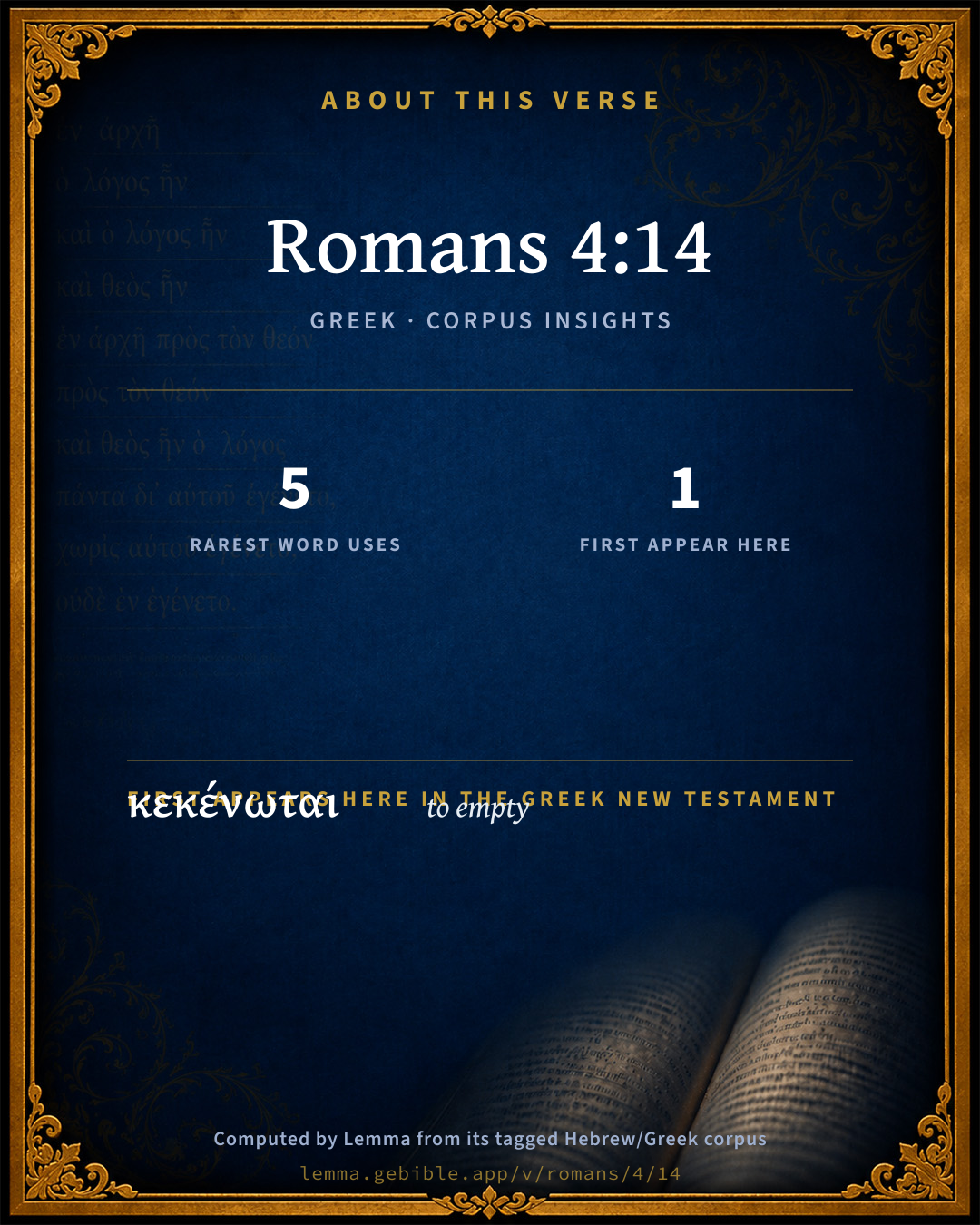
Romans 4:14

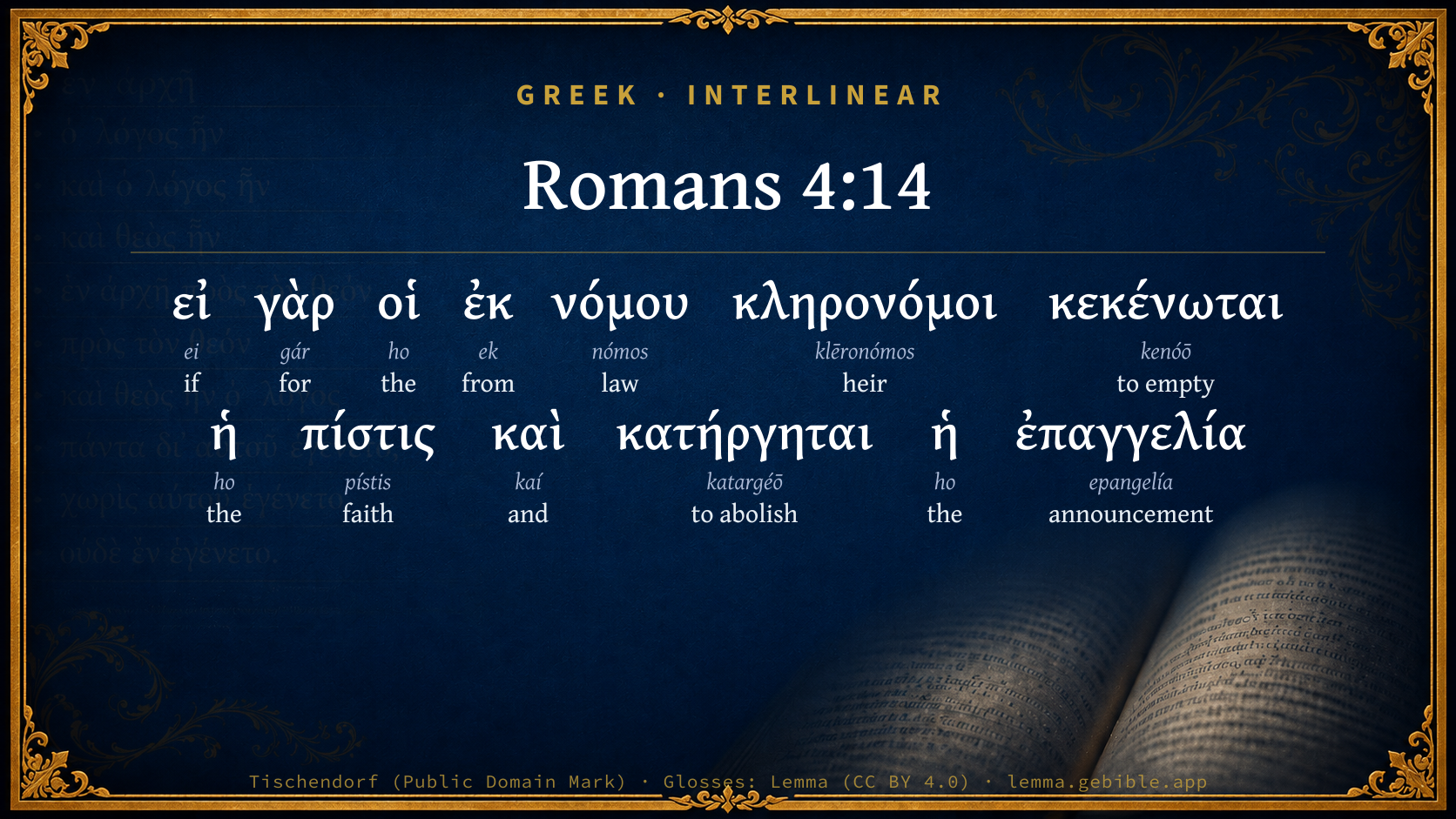
Greek (Tischendorf 8th ed.) Romans 4:14 appears in the Greek New Testament. The text above is from the Tischendorf 8th edition. Each word links to its Strong’s number and a concise gloss. Click any word for its full Thayer’s Greek Lexicon entry.
Download image
Cite this verse

Romans 4:14 (World English Bible). Public Domain. Lemma interlinear Bible study tool, https://lemma.gebible.app/v/romans/4/14.

Show BibTeX & RIS
BibTeX
RIS
English Translation
For if those who are of the law are heirs, faith is made void, and the promise is made of no effect.
World English Bible · Public Domain
Highlights
  • 1 first appearance in the Greek New Testament
Full analysis ↓
Download a study sheet

One document with this verse’s original text, its word-by-word gloss line, the meaning frame, cross-references with their text, attributed commentary, and full source and license credits — printable, and it pastes into notes with its structure intact.

This verse Autodidact and up

Study sheet (.html) Plain text (.txt)

A passage Seminary Student

Up to 50 verses in one chapter. A passage sheet keeps up to 6 commentary sources and 12 cross-references per verse, in the order this page ranks them, and says so on the sheet whenever that leaves anything out. Ask for a single verse and you get the Autodidact verse sheet above.

Everything on this page stays free to read, with no account — the sheet is a download of what is already on screen, not access to it.

Want to remove ads? Support Godless Engineer
Compare translations 3

The same verse in 3 English versions, stacked beneath the original-language interlinear above. Click any original word for its lexicon entry.

Each is an independent rendering of the whole verse — the interlinear is not word-aligned to these translations.

Highlighted words mark where these versions differ — a whole-verse word diff, not a word-by-word alignment.

  • World English Bible Public Domain
    For if those who are of the law are heirs, faith is made void, and the promise is made of no effect.
  • King James Version Public Domain
    For if they which are of the law be heirs, faith is made void, and the promise made of none effect:
  • unfoldingWord Literal Text CC BY-SA 4.0
    For if the heirs from the law, the faith has been emptied, and the promise has been nullified.

unfoldingWord Literal Text — © unfoldingWord, licensed CC BY-SA 4.0. Word-aligned USFM3 via Door43 (git.door43.org/unfoldingWord/en_ult).

Versions to compare (up to 4)

3 of 4 selected

Show all 19 translations

Every available English version of this verse, each an independent rendering of the whole verse.

  • World English Bible Public Domain
    For if those who are of the law are heirs, faith is made void, and the promise is made of no effect.
  • Berean Standard Bible Public Domain
    For if those who live by the law are heirs, faith is useless and the promise is worthless,
  • Majority Standard Bible Public Domain
    For if those who live by the law are heirs, faith is useless and the promise is worthless,
  • King James Version Public Domain
    For if they which are of the law be heirs, faith is made void, and the promise made of none effect:
  • American Standard Version (1901) Public Domain
    For if they that are of the law are heirs, faith is made void, and the promise is made of none effect:
  • Revised Version (1885) Public Domain
    For if they which are of the law be heirs, faith is made void, and the promise is made of none effect:
  • Geneva Bible (1599) Public Domain
    For if they which are of the Lawe, be heires, faith is made voide, and the promise is made of none effect.
  • Douay-Rheims (1899) Public Domain
    For if they who are of the law be heirs, faith is made void, the promise is made of no effect.
  • Young's Literal Translation Public Domain
    for if they who are of law `are' heirs, the faith hath been made void, and the promise hath been made useless;
  • Literal Standard Version CC BY-SA 4.0
    for if they who are of law [are] heirs, faith has been made void, and the promise has been made useless;
  • Unlocked Literal Bible CC BY-SA 4.0
    For if those who live by the law are to be the heirs, faith is made empty, and the promise is void.
  • unfoldingWord Literal Text CC BY-SA 4.0
    For if the heirs from the law, the faith has been emptied, and the promise has been nullified.
  • Darby Bible Public Domain
    For if they which [are] of law be heirs, faith is made vain, and the promise made of no effect.
  • World Messianic Bible Public Domain
    For if those who are of the law are heirs, faith is made void, and the promise is made of no effect.
  • Webster's Bible Public Domain
    For if they who are of the law are heirs, faith is made void, and the promise made of no effect.
  • Free Bible Version CC BY-SA 4.0
    For if the promised inheritance is based on keeping the law, then the issue of trusting God is not necessary, and the promise is pointless.
  • Bible in Basic English Public Domain
    For if they who are of the law are the people who get the heritage, then faith is made of no use, and the word of God has no power;
  • Text-Critical English NT CC BY 4.0
    For if those who are of the law are heirs, faith has been made void and the promise has been invalidated,
  • Tyndale New Testament (1534) Public Domain
    For yf they which are of the lawe be heyres then is fayth but vayne and the promes of none effecte.

Literal Standard Version (2020), Covenant Press — licensed CC BY-SA 4.0. Text via the HelloAO Bible API (eBible.org). Unlocked Literal Bible (unfoldingWord) — licensed CC BY-SA 4.0. Text via the HelloAO Bible API (eBible.org). unfoldingWord Literal Text — © unfoldingWord, licensed CC BY-SA 4.0. Word-aligned USFM3 via Door43 (git.door43.org/unfoldingWord/en_ult). Free Bible Version, Dr. Jonathan Gallagher — licensed CC BY-SA 4.0. Text via the HelloAO Bible API (eBible.org).

Word by word

More ways to search: Search by grammar → Find every occurrence → Compare this word →

Practice this passage: Drill this verse → Learn its vocabulary →

κεκένωται
kenóō
G2758
“to empty”
Verb, Perfect, Passive, Indicative, 3rd person, Singular
Part of Speech
Verb
Tense
Perfect
Voice
Passive
Mood
Indicative
Person
3rd person
Number
Singular
Full Thayer's Definition

Origin: from G2756

TDNT: 14:01,4

1. to empty, make empty a. of Christ, he laid aside equality with or the form of God 2. to make void a. deprive of force, render vain, useless, of no effect 3. to make void a. cause a thing to be seen to be empty, hollow, false
  1. εἰ ei G1487 “if” Conditional
  2. γὰρ gár G1063 “for” Conjunction
  3. οἱ ho G3588 “the” Article, Nominative, Plural, Masculine
  4. ἐκ ek G1537 “from” Preposition
  5. νόμου nómos G3551 “law” Noun, Genitive, Singular, Masculine
  6. κληρονόμοι klēronómos G2818 “heir” Noun, Nominative, Plural, Masculine
  7. ἡ ho G3588 “the” Article, Nominative, Singular, Feminine
  8. πίστις pístis G4102 “faith” Noun, Nominative, Singular, Feminine
  9. καὶ kaí G2532 “and” Conjunction
  10. κατήργηται katargéō G2673 “to abolish” Verb, Perfect, Passive, Indicative, 3rd person, Singular
  11. ἡ ho G3588 “the” Article, Nominative, Singular, Feminine
  12. ἐπαγγελία epangelía G1860 “announcement” Noun, Nominative, Singular, Feminine

About this verse

These counts appear in no published source. They are computed here, from the morphology-tagged text and Lemma’s own curated glosses. What Lemma adds →

13
words
11
distinct lemmas
Pauline Epistles
section

Notable vocabulary

The rarest word here is κεκένωται to empty G2758 — appearing just 5 times in the whole Greek New Testament.

First appearance in Scripture

This word makes its first canonical appearance in the Greek New Testament here:

  • κεκένωται to empty G2758

Shared distinctive vocabulary

κεκένωται to empty G2758 occurs in 5 verses of the Greek New Testament. Also found in:

Repetition

A word recurs within this verse:

Cross-references

13

Topical passages linked to Romans 4:14 in the Treasury of Scripture Knowledge — connected by theme and wording, ordered by reader-vote popularity; previews shown in the World English Bible.

  • Galatians 3:18–24 For if the inheritance is of the law, it is no more of promise; but God has granted it to Abraham by promise.
  • Philippians 3:9 and be found in him, not having a righteousness of my own, that which is of the law, but that which is through faith in Christ, the righteousness which is from God by faith;
  • Hebrews 7:19 (for the law made nothing perfect), and a bringing in thereupon of a better hope, through which we draw near to God.
  • Isaiah 55:11 so shall my word be that goes forth out of my mouth: it shall not return to me void, but it shall accomplish that which I please, and it shall prosper in the thing whereto I sent it.
  • Romans 3:31 Do we then nullify the law through faith? May it never be! No, we establish the law.
  • Romans 4:16 For this cause it is of faith, that it may be according to grace, to the end that the promise may be sure to all the seed, not to that only which is of the law, but to that also which is of the faith of Abraham, who is the father of us all.
  • Galatians 2:21 I don't make void the grace of God. For if righteousness is through the law, then Christ died for nothing!"
  • Hebrews 7:28 For the law appoints men as high priests who have weakness, but the word of the oath which came after the law appoints a Son forever who has been perfected.
  • Numbers 30:12 But if her husband made them null and void in the day that he heard them, then whatever proceeded out of her lips concerning her vows, or concerning the bond of her soul, shall not stand: her husband has made them void; and Yahweh will forgive her.
  • Numbers 30:15 But if he shall make them null and void after that he has heard them, then he shall bear her iniquity.
  • Psalms 119:126 It is time to act, Yahweh, For they break your law.
  • Jeremiah 19:7 I will make void the counsel of Judah and Jerusalem in this place; and I will cause them to fall by the sword before their enemies, and by the hand of those who seek their life: and their dead bodies will I give to be food for the birds of the sky, and for the animals of the earth.
  • Galatians 5:4 You are alienated from Christ, you who desire to be justified by the law. You have fallen away from grace.

Cross-references courtesy of OpenBible.info (CC BY 4.0).

Commentary

Notes on Romans 4:14 from classic Christian and Jewish commentators (each source and its license shown beneath its notes). The classic Christian expositions comment on the surrounding passage and are grouped to its opening verse, so a note may address several verses; the Jewish commentaries on the Tanakh (Rashi and others) are per-verse, so they appear only where the commentator wrote on this verse.

Lemma curates 59 commentaries, every one of them public domain or Creative Commons licensed, each selected and text-cleaned for this edition rather than reprinted as found. About our sources →

Tyndale Open Study Notes

Tyndale Open Resources

4:14 then faith is not necessary (literally faith is emptied): If works of obedience can be substituted for faith, then “faith is emptied” of its importance. Believing in God means acknowledging our unworthiness and depending entirely on God’s mercy.

Tyndale Open Study Notes — © Tyndale Open Resources, licensed CC BY-SA 4.0. Text via the HelloAO Bible API.

Bengel's Gnomon

Johann Albrecht Bengel

Rom 4:14. Εἰ, if) The promise and faith complete the whole: and we ought not to add the law, as if it were something homogeneous.—οἱ ἐκ νόμου, those who are of the law) This phrase recurs in a milder sense in Rom 4:16.—κεκένωται—κατήργηται—made void—and of no effect), words synonymous but not interchangeable. Comp. Gal 3:17; Gal 3:15; the word antithetic to these is sure [βεβάιαν], Rom 4:16. Faith receives [Rom 4:11] blessings in all their fulness, it is therefore said, on the opposite side, to be made void, to be of no effect.—πίστις—ἐπαγγελία, faith—the promise) words correlative: and they are appropriately put in retrograde order [comp. Rom 4:13] in an argument like the present, wherein is shown the absurdity which would flow from from the opposite theory [by the reductio, or argumentum ad absurdum].

Bengel's Gnomon of the New Testament — English translation (T&T Clark, Edinburgh, 1860) — public domain. Text from a community e-Sword module.

Meyer's Critical & Exegetical Commentary

Heinrich August Wilhelm Meyer

Rom_4:14. Here also νόμος is not (as Flatt and others take it) the moral law (to which however the saying may certainly be applied), but the law of Moses, viewed in excluding antithesis to the πίστις. By οἱ ἐκ νόμου, those of the law (Luther), are meant those who belong to the law, are as such subjected to it; consequently the Jews at all events, but just so far as they are not believers, not belonging to the Ἰσραὴλ τοῦ Θεοῦ (Gal_6:16). The opposite: οἱ ἐκ πίστεως, Rom_3:26, Gal_3:7. That they wish to attain to the κληρονομία by the way of the law, is true in itself, but is not expressed in the mere οἱ ἐκ νόμου (in opposition to Hofmann).

κεκένωται ἡ πίστις κ.τ.λ[1034]] then faith is made void and the promise done away, i.e. faith is thereby rendered inoperative and the promise of no effect. If it be true that to be subject to the law is the condition of obtaining the possession of the world, nothing further can be said either of a saving power of faith (comp 1Co_1:17), or of the validity of the promise (comp Rom_3:31, Gal_3:17). And why not? Because (Rom_4:15) the law, to which in accordance with that protasis the ΚΛΗΡΟΝΟΜΊΑ would be appended, has an operation so entirely opposed to the essence of faith (which trusts in the divine ΧΆΡΙς) and of the promise (which is an emanation from this ΧΆΡΙς), (comp Rom_4:16), that it brings about the divine wrath, since its result is transgression. On this ground (διὰ τοῦτο, Rom_4:16) because the law worketh wrath, its relation to the κληρονομία, laid down in Rom_4:14, cannot exist; but on the contrary the latter must proceed from faith that it may be according to grace, etc., Rom_4:16.

The πίστις is the Christian saving faith, of which Abrahams faith was the beginning and type, and the ἘΠΑΓΓΕΛΊΑ is the Divine promise of the ΚΛΗΡΟΝΟΜΊΑ, given to Abraham and his seed, Rom_4:13.

[1034] .τ.λ. καὶ τὰ λοιπά.

Rom_4:14-17. Proof of the antithesis οὐ διὰ νόμου.… ἀλλὰ κ.τ.λ[1033] in Rom_4:13, conducted not historically (as in Gal_3:13 ff.), but dogmatically, a priori, from the nature of the law, from which results the opposite of the latter, the πίστις, as cause of the κληρονομία.

[1033] .τ.λ. καὶ τὰ λοιπά.

Meyer — Critical and Exegetical Commentary on the New Testament — English translation by Peter Christie, edited by Frederick Crombie (T&T Clark, 1880) — public domain. Text from a community e-Sword module.

Expositor's Greek Testament

ed. W. Robertson Nicoll

Rom 4:14 . κεκένωται cf. 1Co 1:17 ; 1Co 9:15 , 2Co 9:3 . κατήργηται : a favourite word of Paul, who uses it twenty-five times.

The Expositor's Greek Testament, edited by W. Robertson Nicoll (1897–1910) — public domain. Text from a community e-Sword module.

Hodge's Commentary on Romans, Ephesians & First Corinthians

Charles Hodge

Rom_4:14

For if they which are of the law be heirs, etc. The original condition being faith, if another be substituted the covenant is broken, the promise violated, and the condition made of none effect. They who are of the law (οἱ ἐκ νόμου,) sometimes, as Rom_4:16, means the Jews, i.e. those who have the law; compare Rom_4:12, Those of circumcision, etc. But here it means legalists, those who seek justification by the works of the law; as those who are of faith are believers, those who seek justification by faith; compare Gal_3:10, As many as are of the works of the law are under the curse, i.e. as many as seek acceptance by their own works. The apostles meaning, therefore, obviously is, that if those who rely upon their own works are the heirs of the promise, and are accepted on the condition of obedience to the law, the whole covenant is broken, faith is made void, and the promise made of none effect. Is made void (κεκένωται,) is rendered useless; see 1Co_1:17; The cross of Christ is made useless, 1Co_9:15, etc.; compare 1Co_15:17, Your faith is vain, not only without foundation but of no use. The promise is made of none effect (κατήργηται) i.e. is invalidated; see Rom_3:3, Rom_3:31. It is plain from the whole design and argument of the apostle, that by law, in this whole connection, he means not specifically the law of Moses, but the law of God, however revealed as a rule of duty for man. He has reference to the Gentiles as well as to the Jews. His purpose is not simply to convince his readers that obedience to the Mosaic law cannot save them, but that obedience in any form, works of any kind, are insufficient for a mans justification before God. So far, therefore, from the context requiring, as so many of the modern commentators assert, an exclusive reference in this connection to the law of Moses, it imperatively demands the reverse.

Charles Hodge — Commentary on Romans (1835), First Corinthians (1857), and Ephesians (1856) — public domain. Text from a community e-Sword module.

Geneva Bible (1599)

Geneva Bible translators

A double confirmation of that reason: the one is, that the promise cannot be apprehended by the Law, and therefore it should be frustrated: the other, that the condition of faith should be joined in vain to that promise which should be apprehended by works.

If they be heirs which have fulfilled the Law.

Geneva Bible (1599) marginal notes — public domain. Text via Bolls.life.

Jamieson, Fausset & Brown

Robert Jamieson, A. R. Fausset & David Brown

For if they which are of the law be heirs--If the blessing is to be earned by obedience to the law.

faith is made void--the whole divine method is subverted.

Jamieson, Fausset & Brown — Commentary Critical and Explanatory on the Whole Bible (1871) — public domain (CC PDM 1.0). Text via the HelloAO Bible API.

Adam Clarke's Commentary

Verse 14. For, if they which are of the law be heirs] If the Jews only be heirs of the promise made to Abraham, and that on the ground of prior obedience to the law, then faith is made void-is entirely useless; and the promise, which was made to faith, is made of none effect.

Adam Clarke's Commentary on the Bible (1810–1826) — public domain. Text from a community e-Sword/MySword module.

John Calvin's Commentaries

14. For if they who are of the law, etc. He takes his argument from what is impossible or absurd, that the favor which Abraham obtained from God, was not promised to him through any legal agreement, or through any regard to works; for if this condition had been interposed — that God would favor those only with adoption who deserved, or who performed the law, no one could have dared to feel confident that it belonged to him: for who is there so conscious of so much perfection that he can feel assured that the inheritance is due to him through the righteousness of the law? Void then would faith be made; for an impossible condition would not only hold the minds of men in suspense and anxiety, but fill them also with fear and trembling: and thus the fulfillment of the promises would be rendered void; for they avail nothing but when received by faith. If our adversaries had ears to hear this one reason, the contest between us might easily be settled.

The Apostle assumes it as a thing indubitable, that the promises would by no means be effectual except they were received with full assurance of mind. But what would be the case if the salvation of men was based on the keeping of the law? consciences would have no certainty, but would be harassed with perpetual inquietude, and at length sink in despair; and the promise itself, the fulfillment of which depended on what is impossible, would also vanish away without producing any fruit. Away then with those who teach the common people to seek salvation for themselves by works, seeing that Paul declares expressly, that the promise is abolished if we depend on works. But it is especially necessary that this should be known, — that when there is a reliance on works, faith is reduced to nothing. And hence we also learn what faith is, and what sort of righteousness ought that of works to be, in which men may safely trust.

The Apostle teaches us, that faith perishes, except the soul rests on the goodness of God. Faith then is not a naked knowledge either of God or of his truth; nor is it a simple persuasion that God is, that his word is the truth; but a sure knowledge of God’s mercy, which is received from the gospel, and brings peace of conscience with regard to God, and rest to the mind. The sum of the matter then is this, — that if salvation depends on the keeping of the law, the soul can entertain no confidence respecting it, yea, that all the promises offered to us by God will become void: we must thus become wretched and lost, if we are sent back to works to find out the cause or the certainty of salvation.

John Calvin's Commentaries (1540-1563) — public domain. Text from the Calvin Translation Society English edition (1840s-50s) via the Christian Classics Ethereal Library (ccel.org). Calvin's coverage is partial (roughly two-thirds of the Bible); uncommented books and verses are honest gaps, never fabricated. The 19th-century editor's footnotes and remarks are omitted so the notes are faithfully Calvin's own voice.

Ellicott's Commentary for English Readers

(14) Is made void.—Literally, emptied of its meaning, becomes an empty name, and the promise is rendered nugatory. There is nothing left for either to do, if the votaries of law, simply as such, are to be the inheritors of the Messianic kingdom.

(14-17) This Messianic kingdom cannot have anything to do with law; for if it had, faith and the promise would cease to have any office. Faith and law cannot co-exist. They are the opposites of each other. The proper effect of law is punishment; for law only exposes sin. Faith, on the other hand, is the real key to the inheritance. It sets in motion grace; and grace, unlike law, excludes no one. It is open alike to the legal and to the spiritual descendants of Abraham; in other words (as the Scripture itself testifies), to all mankind, as the representative of whom Abraham stands before God.

A Bible Commentary for English Readers, edited by Charles John Ellicott (1878–1897) — public domain. Text from a community e-Sword module.

The Cambridge Bible for Schools and Colleges

gen. ed. J. J. S. Perowne

14. of the law] Lit. out of the law. On the Gr. construction see on Rom_3:26 (ad finem).—“Law” here is without article, and possibly its reference is general; q. d. “If those who in any sense claim on grounds of a law, &c.” But it is far better to read (in English) “the law.” The lack of the article is quite natural where the thing is conspicuous and well known.

heirs] i.e. of the world, as promised to Abraham.

faith] Gr. the faith; i.e., probably, “the faith in question;” justifying faith, and Abraham’s in particular.

made void … of none effect] Both verbs in Gr. are in the perfect; and the probable point is q. d., “If the Law becomes the condition of heirship, ipso facto the faith and the promise are void;” they have been cancelled by the mere fact of a legal condition.

the promise] i.e. “that he” (Abraham, in his seed) “should be heir of the world.” In other words, that Messiah, the Son of Abraham, (and thereby His “Israel”), should enjoy a sacred victory and dominion.

The Cambridge Bible for Schools and Colleges (gen. ed. J. J. S. Perowne; Cambridge University Press, 1878–1918) — public domain. Text from a community e-Sword module.

John Gill's Exposition

Because the law worketh wrath,.... Not the wrath of man, though that is sometimes stirred up through the prohibitions of the law, to which the carnal mind of man is enmity, but the wrath of God the law is so far from justifying sinners, that it curses and condemns them; and when it comes into the heart and is let into the conscience of a sinner, it fills with terrible apprehensions of the wrath of God, and a fearful looking for of his judgment and fiery indignation:

for where no law is, there is no transgression; (r); a sort of a proverbial expression: had the law of Moses not been given, there was the law of nature which sin is a transgression of; but the law of Moses was added for the better discovery and detection of sin, which would not have been so manifest without it, and which may be the apostle's sense; that where there is no law, there is no knowledge of any transgression; and so the Ethiopic version reads the words, "if the law had not come, there would have been none who would have known sin"; but the law is come, and there is a law by which is the knowledge of sin, and therefore no man can be justified by it; since that convinces him of sin, and fills him with a sense of divine wrath on account of it.

(r) Caphtor, fol. 10. 1.

John Gill's Exposition of the Whole Bible (1746–1763) — public domain (CC PDM 1.0). Text via the HelloAO Bible API.

Trapp's Complete Commentary

John Trapp

14 For if they which are of the law be heirs, faith is made void, and the promise made of none effect:

Ver. 14. Faith is made void] {See Trapp on "Gal 3:12"} {See Trapp on "Gal 5:2"} That Epistle to the Galatians is an epitome of this to the Romans, and lends light to it. It is compendium, sed non dispendium.

John Trapp, A Commentary or Exposition upon All the Books of the Old and New Testament (1647–1656) — public domain. Text from a community e-Sword module.

Albert Barnes' Notes on the Bible

For if they which are of the law - Who seek for justification and acceptance by the Law.

Faith is made void - Faith would have no place in the scheme; and consequently the strong commendations bestowed on the faith of Abraham, would be bestowed without any just cause. If people are justified by the Law, they cannot be by faith, and faith would be useless in this work.

And the promise ... - A promise looks to the future. Its design and tendency is to excite trust and confidence in him who makes it. All the promises of God have this design and tendency; and consequently, as God has given many promises, the object is to call forth the lively and constant faith of people, all going to show that in the divine estimation, faith is of inestimable value. But if people are justified by the Law; if they are rendered “acceptable” by conformity to the institutions of Moses; then they cannot depend for acceptance on any promise made to Abraham, or his seed. They cut themselves off from that promise, and stand independent of it. That promise, like all other promises, was made to excite faith. If, therefore, the Jews depended on the Law for justification, they were cut off from all the promises made to Abraham; and if they could be justified by the Law, the promise was useless. This is as true now as it was then. If people seek to be justified by their morality or their forms of religion, they cannot depend on any promise of God; for he has made no promise to any such attempt. They stand independently of any promise, covenant, or compact, and are depending on a scheme of their own; a scheme which would render his plan vain and useless; which would render his promises, and the atonement of Christ, and the work of the Spirit of no value. It is clear, therefore, that such an attempt at salvation cannot be successful.

Albert Barnes' Notes on the Bible (1834–1885) — public domain. Text from a community e-Sword/MySword module.

Haydock's Catholic Bible Commentary

For if they, who are of the law, be heirs: faith is made void, the promise is made of no effect. That is, if the Jews, who are under the law, are the only heirs of the blessings promised, it will follow that the faith which Abraham had before the circumcision, and before the law, was of no value, which I have shewn to be false. And, secondly it will follow that the promise made to him, that in him all nations should be blessed, is also null. (Witham)

George Leo Haydock (1774–1849), Haydock's Catholic Family Bible and Commentary, 1859 edition — public domain. Excludes Psalms (Douay-Rheims chapter numbering differs from Protestant) and Deuterocanonical books (Catholic canon only).

Matthew Poole's English Annotations

i.e. If they that trust to the fulfilling of the law, be heirs of the promise of God, and so the inheritance come by works; then faith is to no purpose, neither is there any use of it; and so also the promises which are made to believers are vain and useless. This is the sun, of this verse; a more particular explication follows.

If they which are of the law: compare this with Gal 3:9,10. There the apostle sorts them that seek righteousness and salvation into two kinds. First, some are of faith, and they are such as seek salvation in that way. Again, others are of the works of the law, and they are such as seek salvation by means thereof. These phrases, of the law, and of the works of the law, are all one.

Be heirs; that is, of the promises of God; of the heavenly rest, of which, as before, Canaan was a type.

Faith is made void; i.e. if they which seek the inheritance of the law can by the law obtain it, then there is no use of faith: to what end should we by faith go out of ourselves to seek righteousness and salvation in Christ, if we could obtain it by the legal obedience? See the like, Gal 5:4.

And the promise made of none effect; i.e. the promise itself, which was made to Abraham and his seed, that also is ineffectual, and brought to nought; no man shall be saved by it; forasmuch as the law can bring no man to the obtaining of what is promised.

Matthew Poole's English Annotations on the Holy Bible (1683–1685) — public domain. Text from a community e-Sword/MySword module.

Whedon's Commentary on the Bible

Daniel D. Whedon

14. They… of the law—Those who claim heirship in virtue of a fulfilment of the law.

Promise… of none effect—The promise is God’s side of the Abrahamic compact by which he is the sun and shield of the faithful, which promise is not only to Abraham, out to his seed, (Rom_4:16.)

Daniel D. Whedon (gen. ed.), Commentary on the Old and New Testaments (1874–1909) — public domain. Text from a community e-Sword module.

John Wesley's Explanatory Notes

If they only who are of the law - Who have kept the whole law. Are heirs, faith is made void - No blessing being to be obtained by it; and so the promise is of no effect.

John Wesley, Explanatory Notes Upon the Whole Bible (1754–1765) — public domain. Text via the GEBible commentary corpus.

Burkitt's Expository Notes on the New Testament

William Burkitt

That is, If they which seem to be justified by the works of the law be heirs of this promised inheritance; then faith, that is, the way of justification by faith, prescribed by God, is to no purpose, for to what end should we by faith seek righteousness in another, if by our legal obedience we can find ourselves?

Here then lies couched another argument, to confirm the apostle’s doctrine of justification by faith: Thus, that only justifies, unto which gracious promise of justification is made; but no such promise is made to any man for his weak and imperfect keeping of the law, but for his believing there is; therefore, by the law there can be no justification, but by faith only.

William Burkitt's Expository Notes on the New Testament (1700–1703) — public domain. Text from a community e-Sword module.

Godbey's Commentary on the New Testament

William B. Godbey

14. “For if the heirs were from the law, faith is made empty and the promise of none effect.” The great promise which God made to Abraham to redeem the world by the gift of His Son, which was utterly unnecessary if they could be saved by legal obedience. The law was here four thousand years before Christ came; there was plenty of water to baptize people, and every other conceivable facility of legal obedience. Therefore if salvation had been possible through the law, the condescension and death of Christ were unnecessary, null and void. The utter incompetency of fallen humanity to be saved in any other way superinduced the absolute necessity for Christ to come and die, thus redeeming us from sin, death and hell. Hence legalism is so abominable in the sight of God; from the ostensible fact that it treats with contempt the vicarious atonement which cost the life of His Son.

William B. Godbey, Commentary on the New Testament (1896–1900) — public domain. Text from a community e-Sword module.

McGarvey & Pendleton's Commentaries

J. W. McGarvey

For if they that are of the law are heirs, faith is made void, and the promise is made of none effect :

J. W. McGarvey (with Philip Y. Pendleton), Commentaries on the New Testament (The Fourfold Gospel, 1914; Acts; and the epistles) — public domain. Text from a community e-Sword/MySword module.

The People's New Testament

B. W. Johnson

14. For if they which are of the law (of law, the article wanting) are heirs. If keeping law makes men heirs, then faith is void. It sets aside God's plan of “counting faith as righteousness,” and destroys the promise which depends on faith.

B. W. Johnson's The People's New Testament with Notes (1889–1891) — public domain. Electronic text from the Christian Classics Ethereal Library (CCEL) ThML edition.

Cambridge Greek Testament for Schools and Colleges

14. οἱ ἐκ νόμου, those who base a claim on law, and those only.

κεκένωται ἡ π. κ. κ. ἡ ἐ. The two principles are mutually exclusive. ἡ π. = the act of faith seen in Abraham.

κεκένωται = is made, by such a qualification, pointless; cf. 1Co 15:14; 1Co 1:17.

κατήργηται = is robbed of all meaning; cf. Gal 3:17.

Cambridge Greek Testament for Schools and Colleges (Cambridge University Press, 1896; 21 vols, various authors incl. Carr, Maclear, Plummer, Farrar, Lumby, Moule, M. R. James, Simcox) — public domain. Text from a community e-Sword module.

Alford’s Greek Testament

Henry Alford

14.] The supposition is now made which ver. 13 denied,—and its consequences shewn. For if they who are of the law (who belong to the law, see reff.: not, ‘who keep the law,’ nor is δίκαιοι to be supplied) are inheritors (i.e. inherit ‘ejus rei causâ,’ by virtue of the law: they may be inheritors by the righteousness of faith, but not quoad their legal standing), faith is (thereby) made empty (robbed of its virtue and rendered useless), and the promise is annulled (has no longer place). How and why so? The Apostle himself immediately gives the reason.

Henry Alford, The Greek Testament (1849–1861) — public domain. Text from a community e-Sword module.

International Critical Commentary

14. οἱ ἐκ νόμου: ‘the dependants of law,’ ‘vassals of a legal system,’ such as were the Jews.

κληρονόμοι. If the right to that universal dominion which will belong to the Messiah and His people is confined to those who are subject to a law, like that of Moses, what can it have to do either with the Promise originally given to Abraham, or with Faith to which that Promise was annexed? In that case Faith and Promise would be pushed aside and cancelled altogether. But they cannot be cancelled; and therefore the inheritance must depend upon them and not upon Law.

International Critical Commentary — older volumes (1896–1929), various authors — public domain. Text from a community e-Sword module.

Godet's Commentaries

Frédéric Louis Godet

Vv. 14. If, in order to be heir of the world, it is absolutely necessary to come under the jurisdiction of the law, and consequently to be its faithful observer—otherwise what purpose would it serve?—it is all over at a stroke both with faith and with the promise: with faith, that is to say, with the hope of that final heritage, since the realization of that expectation would be bound to a condition which sinful man could not execute, the fulfilment of the law, and since faith would thus be deprived of its object (literally, emptied, κεκένωται, from κενός, empty); and next, with the promise itself: for, an impossible condition being attached to it, it would thereby be paralyzed in its effects (κατήργηται). Proof and conclusion, Rom 4:15-16.

Frédéric Louis Godet — Commentaries on Luke, John, Romans, and 1 Corinthians — English translation (T&T Clark, Edinburgh, 1870s–1890s) — public domain. Text from a community e-Sword module.

Lesson kit

Teaching starters — assembled from the data on this page, not authored interpretation. Every prompt links to the verse data it draws on. Edit before teaching.

Romans, in the Pauline Epistles, opens this verse with 13 words (11 distinct Greek lemmas). Its most distinctive word is kenóō (“to empty”). A historical commentator’s framing appears above. Read the whole chapter for the surrounding context.

Discussion questions

  1. How does “to empty” (kenóō) shape what this verse is saying?
  2. This is the first place “to empty” appears in Scripture (first appears here). What does its debut here establish?
  3. How does 1 Corinthians 1:17, which shares the word «to empty», read alongside this verse?
  4. What does the repetition of “the” (3× in this one verse) do in this verse?
  5. These translations render this verse differently. What is at stake in choosing one wording over another?
  6. Compare how Tyndale Open Study Notes and Bengel's Gnomon read this verse. Where do they agree or differ?

Things to notice

  • 1 word makes its first canonical appearance in Scripture here.
  • These translations choose different wording for 10 words in this verse.
  • “the” occurs 3× in this single verse.
  • 11 distinct Greek lemmas span 13 words in this verse.

Reading settings

Reading text

Shown beneath each verse's original-language words.

Old Testament
Old Testament edition

Read the OT as the Masoretic Hebrew (MT) or the Greek Septuagint (LXX).

English shown for the Greek Septuagint (in the Hebrew ↔ Greek comparison).

Comparing translations? Open the Compare panel on any verse page to stack up to four side by side.