
Romans 9:23

Greek (Tischendorf 8th ed.) Romans 9:23 appears in the Greek New Testament. The text above is from the Tischendorf 8th edition. Each word links to its Strong’s number and a concise gloss. Click any word for its full Thayer’s Greek Lexicon entry.

Download image
Cite this verse

Romans 9:23 (World English Bible). Public Domain. Lemma interlinear Bible study tool, https://lemma.gebible.app/v/romans/9/23.

Show BibTeX & RIS
BibTeX
RIS
English Translation
and that he might make known the riches of his glory on vessels of mercy, which he prepared beforehand for glory,
World English Bible · Public Domain
Highlights
  • 1 first appearance in the Greek New Testament
Full analysis ↓
Download a study sheet

One document with this verse’s original text, its word-by-word gloss line, the meaning frame, cross-references with their text, attributed commentary, and full source and license credits — printable, and it pastes into notes with its structure intact.

This verse Autodidact and up

Study sheet (.html) Plain text (.txt)

A passage Seminary Student

Up to 50 verses in one chapter. A passage sheet keeps up to 6 commentary sources and 12 cross-references per verse, in the order this page ranks them, and says so on the sheet whenever that leaves anything out. Ask for a single verse and you get the Autodidact verse sheet above.

Everything on this page stays free to read, with no account — the sheet is a download of what is already on screen, not access to it.

Want to remove ads? Support Godless Engineer
Compare translations 3

The same verse in 3 English versions, stacked beneath the original-language interlinear above. Click any original word for its lexicon entry.

Each is an independent rendering of the whole verse — the interlinear is not word-aligned to these translations.

Highlighted words mark where these versions differ — a whole-verse word diff, not a word-by-word alignment.

  • World English Bible Public Domain
    and that he might make known the riches of his glory on vessels of mercy, which he prepared beforehand for glory,
  • King James Version Public Domain
    And that he might make known the riches of his glory on the vessels of mercy, which he had afore prepared unto glory,
  • unfoldingWord Literal Text CC BY-SA 4.0
    and so that he might make known the wealth of his glory upon vessels of mercy, which he prepared beforehand for glory—

unfoldingWord Literal Text — © unfoldingWord, licensed CC BY-SA 4.0. Word-aligned USFM3 via Door43 (git.door43.org/unfoldingWord/en_ult).

Versions to compare (up to 4)

3 of 4 selected

Show all 19 translations

Every available English version of this verse, each an independent rendering of the whole verse.

  • World English Bible Public Domain
    and that he might make known the riches of his glory on vessels of mercy, which he prepared beforehand for glory,
  • Berean Standard Bible Public Domain
    What if He did this to make the riches of His glory known to the vessels of His mercy, whom He prepared in advance for glory—
  • Majority Standard Bible Public Domain
    What if He did this to make the riches of His glory known to the vessels of His mercy, whom He prepared in advance for glory—
  • King James Version Public Domain
    And that he might make known the riches of his glory on the vessels of mercy, which he had afore prepared unto glory,
  • American Standard Version (1901) Public Domain
    and that he might make known the riches of his glory upon vessels of mercy, which he afore prepared unto glory,
  • Revised Version (1885) Public Domain
    and that he might make known the riches of his glory upon vessels of mercy, which he afore prepared unto glory,
  • Geneva Bible (1599) Public Domain
    And that hee might declare the riches of his glory vpon the vessels of mercy, which hee hath prepared vnto glory?
  • Douay-Rheims (1899) Public Domain
    That he might shew the riches of his glory on the vessels of mercy, which he hath prepared unto glory?
  • Young's Literal Translation Public Domain
    and that He might make known the riches of His glory on vessels of kindness, that He before prepared for glory, whom also He did call -- us --
  • Literal Standard Version CC BY-SA 4.0
    and that He might make known the riches of His glory on vessels of kindness, that He before prepared for glory, whom also He called—us—
  • Unlocked Literal Bible CC BY-SA 4.0
    What if he did this in order that he might make known the riches of his glory upon containers of mercy, which he had previously prepared for glory?
  • unfoldingWord Literal Text CC BY-SA 4.0
    and so that he might make known the wealth of his glory upon vessels of mercy, which he prepared beforehand for glory—
  • Darby Bible Public Domain
    and that he might make known the riches of his glory upon vessels of mercy, which he had before prepared for glory,
  • World Messianic Bible Public Domain
    and that he might make known the riches of his glory on vessels of mercy, which he prepared beforehand for glory—
  • Webster's Bible Public Domain
    And that he might make known the riches of his glory on the vessels of mercy, which he had before prepared for glory,
  • Free Bible Version CC BY-SA 4.0
    so that he might reveal the greatness of his glory through these “pots of mercy” which he has prepared in advance for glory.
  • Bible in Basic English Public Domain
    And to make clear the wealth of his glory to vessels of mercy, which he had before made ready for glory,
  • Text-Critical English NT CC BY 4.0
    in order to make known the riches of his glory upon vessels of mercy that he has prepared in advance for glory,
  • Tyndale New Testament (1534) Public Domain
    that he myght declare the ryches of his glory on the vessels of mercye which he had prepayred vnto glorie:

Literal Standard Version (2020), Covenant Press — licensed CC BY-SA 4.0. Text via the HelloAO Bible API (eBible.org). Unlocked Literal Bible (unfoldingWord) — licensed CC BY-SA 4.0. Text via the HelloAO Bible API (eBible.org). unfoldingWord Literal Text — © unfoldingWord, licensed CC BY-SA 4.0. Word-aligned USFM3 via Door43 (git.door43.org/unfoldingWord/en_ult). Free Bible Version, Dr. Jonathan Gallagher — licensed CC BY-SA 4.0. Text via the HelloAO Bible API (eBible.org).

Word by word

More ways to search: Search by grammar → Find every occurrence → Compare this word →

Practice this passage: Drill this verse → Learn its vocabulary →

προητοίμασεν
proetoimázō
G4282
“to prepare before”
Verb, Aorist, Active, Indicative, 3rd person, Singular
Part of Speech
Verb
Tense
Aorist
Voice
Active
Mood
Indicative
Person
3rd person
Number
Singular
Full Thayer's Definition

Origin: from G4253 and G2090

TDNT: 13:44,3

1. to prepare before, to make ready beforehand
  1. καὶ kaí G2532 “and” Conjunction
  2. ἵνα hína G2443 “that” Conjunction
  3. γνωρίσῃ gnōrízō G1107 “to make known” Verb, Aorist, Active, Subjunctive, 3rd person, Singular
  4. τὸν ho G3588 “the” Article, Accusative, Singular, Masculine
  5. πλοῦτον ploûtos G4149 “riches” Noun, Accusative, Singular, Masculine
  6. τῆς ho G3588 “the” Article, Genitive, Singular, Feminine
  7. δόξης dóxa G1391 “glory” Noun, Genitive, Singular, Feminine
  8. αὐτοῦ autós G846 “he” Personal pronoun, Genitive, Singular, Masculine
  9. ἐπὶ epí G1909 “upon” Preposition
  10. σκεύη skeûos G4632 “vessel” Noun, Accusative, Plural, Neuter
  11. ἐλέους éleos G1656 “mercy” Noun, Genitive, Singular, Neuter
  12. ἃ hós G3739 “who” Relative pronoun, Accusative, Plural, Neuter
  13. εἰς eis G1519 “into” Preposition
  14. δόξαν dóxa G1391 “glory” Noun, Accusative, Singular, Feminine

About this verse

These counts appear in no published source. They are computed here, from the morphology-tagged text and Lemma’s own curated glosses. What Lemma adds →

15
words
13
distinct lemmas
Pauline Epistles
section

Notable vocabulary

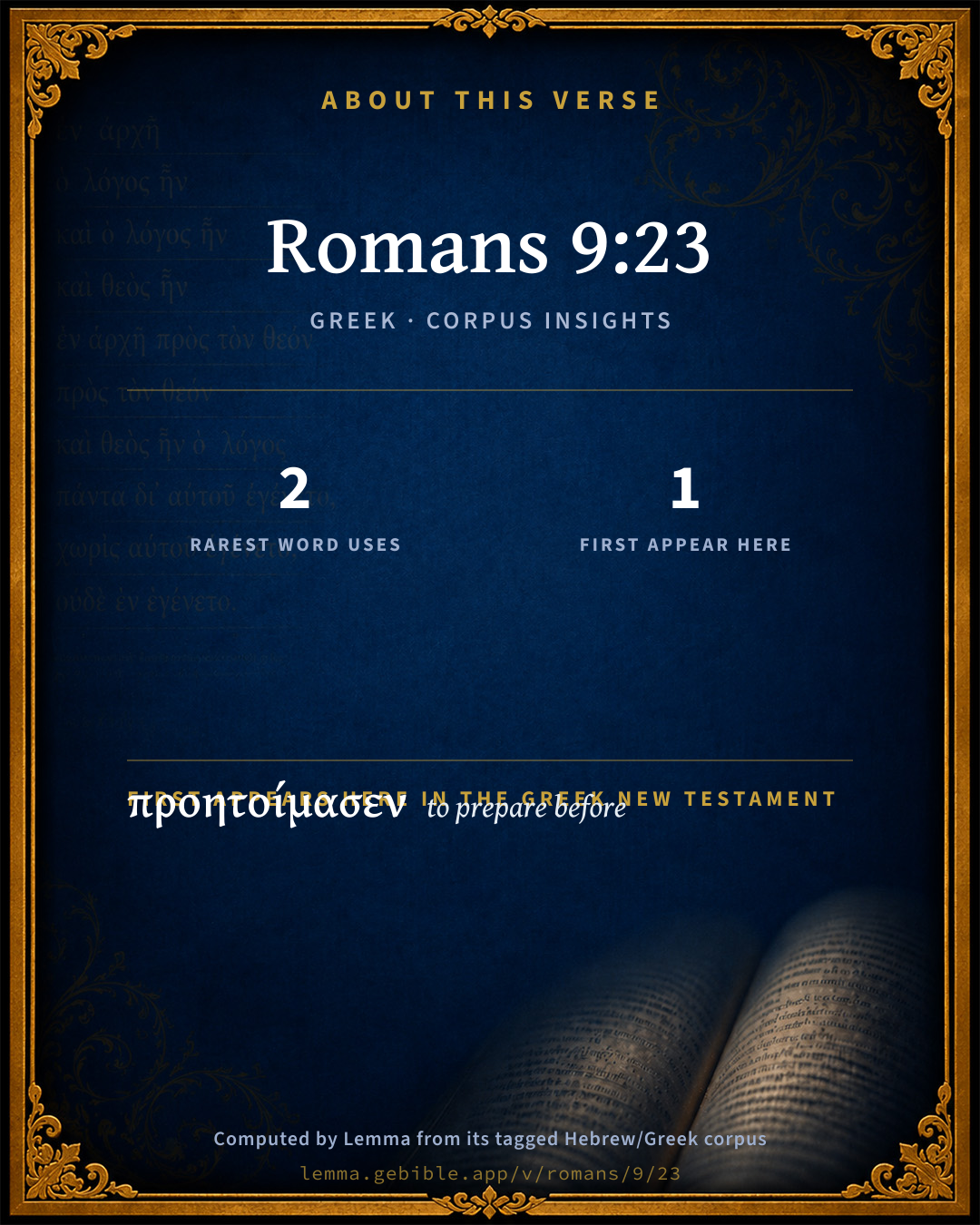
The rarest word here is προητοίμασεν to prepare before G4282 — appearing just 2 times in the whole Greek New Testament.

First appearance in Scripture

This word makes its first canonical appearance in the Greek New Testament here:

  • προητοίμασεν to prepare before G4282

Shared distinctive vocabulary

προητοίμασεν to prepare before G4282 occurs in 2 verses of the Greek New Testament. Also found in:
Repetition

Words recur within this verse:

  • δόξης glory G1391 ×2
  • τὸν the G3588 ×2

Cross-references

20

Topical passages linked to Romans 9:23 in the Treasury of Scripture Knowledge — connected by theme and wording, ordered by reader-vote popularity; previews shown in the World English Bible.

  • Romans 2:4 Or do you despise the riches of his goodness, forbearance, and patience, not knowing that the goodness of God leads you to repentance?
  • 1 Peter 1:2–5 according to the foreknowledge of God the Father, in sanctification of the Spirit, that you may obey Jesus Christ and be sprinkled in his blood: Grace to you and peace be multiplied.
  • Romans 5:20–21 The law came in besides, that the trespass might abound; but where sin abounded, grace did abound more exceedingly;
  • Ephesians 2:10 For we are his workmanship, created in Christ Jesus for good works, which God prepared before that we would walk in them.
  • Ephesians 3:16 that he would grant you, according to the riches of his glory, that you may be strengthened with power through his Spirit in the inward man;
  • Colossians 1:27 to whom God was pleased to make known what are the riches of the glory of this mystery among the Gentiles, which is Christ in you, the hope of glory;
  • 1 Chronicles 29:18 Yahweh, the God of Abraham, of Isaac, and of Israel, our fathers, keep this forever in the imagination of the thoughts of the heart of your people, and prepare their heart to you;
  • Luke 1:17 He will go before him in the spirit and power of Elijah, 'to turn the hearts of the fathers to the children,' and the disobedient to the wisdom of the just; to make ready a people prepared for the Lord."
  • Romans 8:29 For whom he foreknew, he also predestined to be conformed to the image of his Son, that he might be the firstborn among many brothers.
  • Ephesians 1:6–8 to the praise of the glory of his grace, by which he freely bestowed favor on us in the Beloved,
  • Ephesians 1:18 having the eyes of your hearts enlightened, that you may know what is the hope of his calling, and what are the riches of the glory of his inheritance in the saints,
  • Ephesians 2:3–5 among whom we also all once lived in the lust of our flesh, doing the desires of the flesh and of the mind, and were by nature children of wrath, even as the rest.
  • Ephesians 2:7 that in the ages to come he might show the exceeding riches of his grace in kindness toward us in Christ Jesus;
  • 2 Timothy 2:21 If anyone therefore purges himself from these, he will be a vessel for honor, sanctified, and suitable for the master's use, prepared for every good work.
  • Ephesians 3:8 To me, the very least of all saints, was this grace given, to preach to the Gentiles the unsearchable riches of Christ,
  • Colossians 1:12 giving thanks to the Father, who made us fit to be partakers of the inheritance of the saints in light;
  • 1 Thessalonians 5:9 For God didn't appoint us to wrath, but to the obtaining of salvation through our Lord Jesus Christ,
  • 2 Thessalonians 1:10–12 when he comes to be glorified in his saints, and to be admired among all those who have believed (because our testimony to you was believed) in that day.
  • 2 Thessalonians 2:13–14 But we are bound to always give thanks to God for you, brothers loved by the Lord, because God chose you from the beginning for salvation through sanctification of the Spirit and belief in the truth;
  • Titus 3:3–7 For we were also once foolish, disobedient, deceived, serving various lusts and pleasures, living in malice and envy, hateful, and hating one another.

Cross-references courtesy of OpenBible.info (CC BY 4.0).

Commentary

Notes on Romans 9:23 from classic Christian and Jewish commentators (each source and its license shown beneath its notes). The classic Christian expositions comment on the surrounding passage and are grouped to its opening verse, so a note may address several verses; the Jewish commentaries on the Tanakh (Rashi and others) are per-verse, so they appear only where the commentator wrote on this verse.

Lemma curates 59 commentaries, every one of them public domain or Creative Commons licensed, each selected and text-cleaned for this edition rather than reprinted as found. About our sources →

Bengel's Gnomon

Johann Albrecht Bengel

Rom 9:23. Ἵνα, that) Denotes more distinctly the end and aim, without excluding means.—γνωρίσῃ, might make known) This verb is applied to things not formerly known; it is therefore put both here and in the preceding verse, but ἐνδείκνυσθαι, to show, is only used in verse 22 concerning wrath; of which even the Gentiles have some knowledge.—ἐπὶ, upon) The sentence is thus quite consistent. But if God that He might make known the riches of His glory, supply, did this, or, in other words, made known the riches [of His glory] on the vessels of mercy; respecting the apodosis, see the beginning of the note, Rom 9:22.—τῆς δόξης) of His glory: of His goodness, grace, mercy, wisdom, omnipotence, Eph 1:6.—ἐλέους) of mercy, Rom 9:15-16; Rom 9:18; Rom 9:25, which presupposes the former misery of those, styled vessels.—προητοίμασεν, previously prepared) antecedently to works, Rom 9:11, by the arrangement of all the external and internal circumstances, which he, who is called, finds tending to his salvation, at the first moment of his call. This is implied by the preposition in προητοίμασεν. So a vessel unto honour, prepared, 2Ti 2:21.

Bengel's Gnomon of the New Testament — English translation (T&T Clark, Edinburgh, 1860) — public domain. Text from a community e-Sword module.

Expositor's Greek Testament

ed. W. Robertson Nicoll

Rom 9:23 f. The sentence beginning with εἰ δὲ θέλων is not grammatically completed, but Rom 9:23 is an irregular parallel to Rom 9:22 . God’s purpose is regarded as twofold. It is on the one hand to show His wrath and make known His power; it is on the other hand to make known the riches of His glory ( cf. Eph 3:16 ). The first part of it is carried out on those who are σκεύη ὀργῆς , the latter on those who are σκεύη ἐλέους ; but, in carrying out both parts alike, God acts in a way which is so far from giving man room to complain that it commands his wonder and adoration; for the σκεύη ὀργῆς there is much long-suffering, for the σκεύη ἐλέους a preparation and a calling in which God’s free unmerited mercy is conspicuous. καὶ ἵνα γνωρίσῃ : This is mentioned as a principal purpose of God. ἐπὶ σκεύη ἐλέους : the glory is conceived as something shed upon the persons concerned; they are irradiated with the Divine brightness. Cf. 2Th 1:10 . δόξα in such connections has usually a super-sensible eschatological meaning; its content was fixed for Paul by his vision of Christ as Lord of Glory. The end of God’s ways with the vessels of mercy is to conform them to the image of His exalted Son. ἃ προητοίμασεν εἰς δίξαν : Paul does not shrink from introducing God as subject here. The vessels of mercy, in whom the Divine glory is to be revealed, are such as God prepared before for that destiny. That Paul is not speaking here abstractly, as in his discussion of the relations of creature and Creator in Rom 9:21 f., but on the basis of experience, is shown by the words which immediately follow: οὒς καὶ ἐκάλεσεν ἡμᾶς = whom he also called in us . The σκεύη ἐλέους , in other words, are not a mere theological conception = “God’s elect”: they are the actual members of the Christian Church, Jew and Gentile; and it is not a deduction from the necessities of the Divine nature, but an account of real experiences of God’s goodness, which is given both in προητοίμασεν and in ἐκάλεσεν . How much is covered by προητοίμασεν is not clear, but the text presents no ground whatever for importing into it the idea of an unconditional eternal decree. Those who are called know that the antecedents of their calling, the processes which lead up to and prepare for it, are of God. They know that in all these processes, even in the remote initial stages of them, to the significance of which they were blind at the time, glory was in view. The fact that both Jews and Gentiles are called shows that this preparation is not limited to any one nation; the fact that the called are from among both Jews and Gentiles shows that no one can claim God’s mercy as a right in virtue of his birth in some particular race.

The Expositor's Greek Testament, edited by W. Robertson Nicoll (1897–1910) — public domain. Text from a community e-Sword module.

Godet's Commentaries

Frédéric Louis Godet

Vv. 23. Here God is presented to us as the potter, laboring to form the vessels of honor.

How are we to construe the proposition: And that He might make known? The most forced construction is that of Ewald, Hofmann, and Schott, who find here the principal clause on which depends the subordinate: Now, if God, willing...ver. 22. The sense would in that case be: “Now, if God, willing to show..., endured..., He also (καί) acted that (ἵνα).” Such an ellipsis seems inadmissible.

Calvin, Grotius, Meyer, Lange leave nothing to be understood, but make the καὶ ἵνα, and that, directly dependent on the: He endured, in the preceding sentence: “If, willing to show His wrath..., God endured..., and also that”...Here on this view would be a second aim in God’s long-suffering, added by Paul as subsidiary to the first. The principal proposition on which the if depends would remain understood, as we said in the outset; it would be: “What can be said? Canst thou find fault?” The meaning is nearly the same as in the previous construction; only the grammatical form is a little more flowing. But it is difficult to believe that God’s dealing with the vessels of honor should be given as a mere appendix, supplementary to His dealing with the vessels of wrath. The two things ought at least to be put on an equal footing, as in Rom 9:21.

Beza, Rückert, and Beyschlag make the that dependent on κατηρτισμένα, fitted to: “Vessels of wrath fitted to destruction, and also that (καὶ ἵνα) God might make known the riches of His grace.” But how make the idea of the manifestation of grace, which is one of the two fundamental ideas of the whole passage, dependent on an expression so subordinate as this participle?

There remains only one possible construction, that of some ancients, and of Philippi, Reuss, and others, that is, to understand here the εἰ, if, of Rom 9:22, and to make Rom 9:23 a proposition parallel to the preceding: “If willing...God endured...and [if] that”...But where, in this case, is the verb dependent on this second if and parallel to He endured? Either there must be held to be a new ellipsis to be added to that of the principal verb,—which is very clumsy—or this verb must be found in the ἐκάλεσεν, He called, of Rom 9:24. Undoubtedly the relative pronoun οὕς, whom, “whom He called,” seems to be opposed to this solution. But we have already seen—and it is a turn of expression not unusual in Greek—that Paul sometimes connects with a dependent proposition a member of the sentence which properly belonged to the principal proposition; comp. Rom 3:8, and especially Gal 2:4-5 : “to whom we did not give place,” for: “we gave not place to them.” It is precisely for this reason, no doubt, that he here adds to the relative οὕς, whom, the pronoun ἡμᾶς, us, this apposition being, as it were, the last remnant of the regular construction which had been abandoned. And why this incorrectness? Is it a piece of negligence? By no means. By this relative οὕς, whom, as well as by the καί, also, added to the verb He called, Rom 9:24, the apostle means to bring out the close bond which connects with one another the two acts of preparing beforehand, Rom 9:23, and calling, Rom 9:24; comp. Rom 8:30, where the same relation of ideas is expressed under the same form: “Whom He did predestinate, them He also called.” Our translation has rendered (Rom 9:24) this turn of the original as exactly as our language permits.

By the words: to make known the riches of His glory, Paul alludes to the example of Moses, Rom 9:15, who had asked God to show him His glory, exactly as by the expression of Rom 9:22 he had reminded his readers of those relative to Pharaoh. These riches of glory are the manifestation of His mercy which heaps glory on the vessels of honor, as the manifestation of wrath brings down perdition on the vessels that are worthless. Glory is here particularly the splendor of divine love.

Vessels of mercy: Vessels that are to be filled with salvation by mercy.

Which He prepared beforehand, ἃ προητοίμασε. This expression means more than the ready or fitted for of the previous verse; it was God Himself who had beforehand prepared everything to make those beings the objects of His grace. This saying is explained by the analogous expressions Rom 8:29-30; comp. the πρό, beforehand, which enters into the composition of the verb, as into that of the two verbs Rom 8:29; then the relation of the verbs prepared beforehand and call, which is the same as that between the verbs predestinate and call, Rom 9:30; and, finally, the καί, also, before ἐκάλεσε, called, which reproduces that of Rom 8:30. Jesus expresses an idea analogous to this, Mat 25:34: “Inherit the kingdom prepared for you from the foundation of the world;” with this difference, that in this saying it is the kingdom which is prepared in advance for believers, whereas here it is believers who are so for the kingdom. In this term: prepared beforehand, there are contained the two ideas of foreknowledge (prevision of faith) and predestination (destination to glory), expounded Rom 8:29. Let us further remark these four striking differences between this expression and the corresponding term of the preceding verse (κατηρτισμένα): 1. The preposition πρό, beforehand, is wanting in the participle of Rom 9:22. 2. There the passive form, instead of the active used here. 3. Here the aorist, referring to the eternal act, as in Rom 8:29, instead of the perfect (Rom 9:22), which denoted the present fact. 4. Here the verb ἑτοιμάζειν, to prepare, which indicates the beginning of the development, instead of that of Rom 9:21, which indicated its result. These four differences are not accidental, and leave no doubt as to the apostle’s view.

Frédéric Louis Godet — Commentaries on Luke, John, Romans, and 1 Corinthians — English translation (T&T Clark, Edinburgh, 1870s–1890s) — public domain. Text from a community e-Sword module.

Hodge's Commentary on Romans, Ephesians & First Corinthians

Charles Hodge

Rom_9:22, Rom_9:23

But what if God, willing to show his wrath, and to make his power known, endured with much long-suffering the vessels of wrath fitted to destruction; and that he might make known the riches of his glory on the vessels of mercy, which he had afore prepared unto glory, even us, etc.? These verses contain Pauls second answer to the difficulty presented in the 19th verse. He had shown in Rom_9:20, Rom_9:21, that in virtue of his relation to men as his sinful creatures, God is at perfect liability to dispose of them at his pleasure, pardoning one and punishing another, as seemeth good in his sight. He now shows that in the exercise of this right there is nothing unreasonable or unjust, nothing of which his creatures have the least right to complain. The punishment of the wicked is not an arbitrary act, having no object but to make them miserable; it is designed to manifest the displeasure of God against sin, and to make known his true character. On the other hand, the salvation of the righteous is designed to display the riches of his grace. Both in the punishment of the one class and the salvation of the other, most important and benevolent ends are to be answered. And since for these ends it was necessary that some should be punished, while others might be pardoned, as all are equally undeserving, it results from the nature of the case that the decision between the vessels of wrath and the vessels of mercy must be left to God. The apostle would, moreover, have it remarked, that even in the necessary punishment of the wicked, God does not proceed with any undue severity, but, on the contrary, deals with them with the greatest long-suffering and tenderness. Such seems to be the general purport and object of these difficult verses.

The attentive reader will perceive, that even with the insertion of the word what, which has nothing to answer to it in the original, and with a sign of interrogation at the end of Rom_9:24, the construction of the passage in our version remains ungrammatical and the sense incomplete. As the difficulty exists in the Greek text, and not merely in our translation, the explanations which have been proposed are very numerous. Many of these are presented and canvassed by Tholuck and Wolf, particularly the latter. There are three views taken of the connection, which are the most plausible.

1. The two verses are considered as both referring to the rejection of the wicked, for which Rom_9:22 assigns one reason, and Rom_9:23 another. What if God, willing to show his wrath, endured with much long-suffering the vessels of wrath, so that also he might make known the riches of his glory on the vessels of mercy, etc. The treatment of the wicked was not only to display the divine displeasure against sin, but also, by contrast, his mercy towards his people.‹49› But, in order to make the two verses cohere in this way, it is necessary to transpose the words at the beginning of the 23rd verse, and read that also, instead of and that, which alters the sense materially, while for such a transposition there is no authority. Besides this, it makes Rom_9:23 too subordinate to Rom_9:22; that is, it makes Gods dealings towards the vessels of mercy merely an incidental topic, instead of having equal prominence with his treatment of the vessels of wrath. From the context we are led to expect a vindication of his course, not only in the destruction of the latter, but in the salvation of the former.

2. A second explanation is to make the second clause of Rom_9:22 and the beginning of Rom_9:23 depend on the first words of Rom_9:22. God willing to show his wrath and make his power known, and (willing) that the riches of his glory should be known, etc. This gives a good sense, though the construction is suddenly, and rather violently, changed at the beginning of Rom_9:23, that he might make known, being substituted for the infinitive, to make known.

3. Tholuck makes Rom_9:24 parallel with Rom_9:23, and explains the passage thus, God, willing to manifest his wrath, bore with the vessels of wrath; and that he might make known his mercy, called us, etc. This gives a very good sense, but assumes the construciton to be irregular to a very unusual degree. Though the second method be somewhat irregular, it seems, on the whole, the least objectionable, and gives a sense obviously consistent with the context. The meaning of the apostle is sufficiently plain. He asks a question εἰ δέ, but if. What can be said if God, to manifest his justice, bears with the vessels of wrath, and to manifest his grace prepares the vessels of mercy? There is nothing in this inconsistent with the character of God, or the rights of his creatures.

The two objects which Paul here specifies as designed to be answered by the punishment of the wicked, are the manifestation of the wrath of God, and the exhibition of his power. The word wrath is used here as in Rom_1:18, for the divine displeasure against sin, the calm and holy disapprobation of evil, joined with the determination to punish those who commit it.‹50› The power of God is conspicuously displayed in the destruction of the wicked, no matter how mighty or numerous they may be. Though the inherent ill-desert of sin must ever be regarded as the primary ground of the infliction of punishment, a ground which would remain in full force, were no beneficial results anticipated from the misery of the wicked, yet God has so ordered his government that the evils which sinners incur shall result in the manifestation of his character, and the consequent promotion of the holiness and happiness of his intelligent creatures throughout eternity.

God treats the wicked, not as a severe judge, but with much long-suffering. The expression vessels of wrath, no doubt suggests itself from the illustration of the potter used in the preceding verse; though the term vessel is used not infrequently in reference to men, Act_9:15; 1Pe_3:7. Vessels of wrath, i.e. vessels to receive wrath, or which are destined to be the objects of wrath. This is a modification of the expression in Rom_9:21, σκεῦος εἰς ἀτιμίαν, vessel unto dishonor.

Fitted to destruction, κατηρτισμένα εἰς ἀπώλειαν. This phrase admits of two interpretations. The passive participle may be taken as a verbal adjective, fit for destruction. This leaves undetermined the agency by which this fitness was effected. Comp. 2Co_10:10; 1Pe_1:8. In favor of this view is the change of expression adopted in 1Pe_1:23. Of the vessels of wrath, it is simply said that they are fit for destruction; but of the vessels of mercy, that God prepares them for glory. Why this change, if the apostle did not intend to intimate that the agency of God is very different in the one case from what it is in the other? Besides, as it is the object of the writer to vindicate the justice of God in these dispensations, it is specially pertinent to represent the vessels of wrath as fit for destruction in the sense of deserving it. The other interpretation assumes that the reference is to God, and that κατηρτισμένα has its full participle force; prepared (by God) for destruction. This is adopted not only by the majority of Augustinians, but also by many Lutherans and Neologists. This sense they say is demanded by the context. God is compared to a potter, who prepares one vessel to honor, and another to dishonor. So God prepares some for wrath and some for mercy. This, however, is not to be understood in a supralapsarian sense. God does not create men in order to destroy them. The preparation intended is that illustrated in the case of Pharaoh. God did not make him wicked and obdurate; but as a punishment for his sin, he so dealt with him that the evil of his nature revealed itself in a form, and under circumstances, which made him a fit object of the punitive justice of God. The dealings of God as a sovereign are often, by the Jewish writers, spoken of in the same terms as those here used; see Moed Katon, fol. 9, 1. Exiit filia vocis, dixitque eis; vos omnes ordinati estis ad vitam seculi futuri. Megilla, fol. 12, 2. Memuchan, Est_1:14, i.e., Haman. Cur vocatur nomen ejus Memucan? quia ordinatas est ad poenas. R. Bechai in Pentateuch, fol. 132. Gentes ordinatae ad gehennam: Israel vero ad vitam. Fol. 220, 4, Duas istas gentes vocat Salomo duas filias, dicitque ad gehennam ordinatas esse. Bechoroth, fol. 8, 2. R. Joseph docuit, hi sunt Persae, qui preparati sunt in gehennam. Wetstein on Act_13:48.

Rom_9:23

And that he might make known the riches of his glory, etc. The grammatical construction of this clause, as before remarked, is doubtful. The ἵνα γνωρίσῃ may depend on ἤνεγκεν he bore with the vessels of wrath in order that he might make known the riches of his glory on the vessels of mercy; or, they may be connected with κατηρτισμένα, vessels prepared for destruction, in order that he might make known, etc. Or, we must assume that ἵνα γνωρίσῃ is used for the infinitive, and that this clause is coordinate with the preceding What if God, to manifest his wrath, bears with the wicked, and to make known his mercy, prepares others for glory. The vessels of mercy, i.e. those destined to mercy. The riches of, i.e., the abundance or greatness of his glory. The glory refers to the divine majesty or excellence which is glorious, that is, the proper object of admiration. It may be used of the divine perfections in general, or for any of the divine attributes in particular, for his power, as Rom_6:4, or his mercy, in Eph_3:16. Here it should be taken in its comprehensive sense, although from its opposition to the word wrath, the reference is specially to the mercy of God. That is the attribute most conspicuously displayed in the salvation of sinners.

Which he had afore prepared, προητοίμασεν. This word is used both in the sense of preparing beforehand, and of predestining. Many prefer the latter sense here; whom he had predestined to glory. Comp. Eph_2:10. But the context is in favor of the ordinary meaning of the word. God, as the potter, prepares or fashions the vessels of mercy unto glory. The word glory here evidently refers to the glorious state of existence for which God is preparing his people, and in hope of which they now rejoice, Rom_9:2.

Charles Hodge — Commentary on Romans (1835), First Corinthians (1857), and Ephesians (1856) — public domain. Text from a community e-Sword module.

Geneva Bible (1599)

Geneva Bible translators

The unmeasurable and marvelous greatness.

Geneva Bible (1599) marginal notes — public domain. Text via Bolls.life.

Jamieson, Fausset & Brown

Robert Jamieson, A. R. Fausset & David Brown

And that he might make known the riches of his glory on the vessels of mercy--that "glorious exuberance of Divine mercy" which "was manifested in choosing and eternally arranging for the salvation of sinners."

Jamieson, Fausset & Brown — Commentary Critical and Explanatory on the Whole Bible (1871) — public domain (CC PDM 1.0). Text via the HelloAO Bible API.

Adam Clarke's Commentary

Verse 23. And that he might make known] God endured with much long-suffering the vessels of wrath:

1. To show his wrath, and to make his power known. And also,

2. That he might make known the riches of his glory on the vessels of mercy.

Which he had afore prepared unto glory] The Jews were fitted for destruction long before; but the fittest time to destroy them was after he had prepared the believing Gentiles unto glory. For the rod of the Messiah's strength was to be sent out of Zion, Ps 110:2. The Jewish nation was to supply the first preachers of the Gospel, and from Jerusalem their sound was to go forth into all the earth. Therefore the Jewish state, notwithstanding its corruptions, was to be preserved till the Messiah came, and even till the Gospel preached by the apostles had taken deep root in the Gentile world. Another thing which rendered the time when the Jewish polity was overthrown the most proper, was this, because then the immediate occasion of it was the extensiveness of the Divine grace. They would not have the Gentiles admitted into the Church of God; but contradicted, and blasphemed, and rejected the Lord that bought them: thus, then, the extensiveness of the Divine grace occasioned their infidelity, Ro 9:33; Ro 10:3; Ro 11:11; Ro 11:12; Ro 11:15; Ro 11:28; Ro 11:30. Thus the Jews were diminished by that abundance of grace which has enriched the Gentiles. And so the grace of God was illustrated; or, so God made known the riches of his glory on the vessels of mercy-the apostles and primitive believers among the Jews, and the Gentile world, which received the Gospel by the preaching of the apostles and their successors.

Adam Clarke's Commentary on the Bible (1810–1826) — public domain. Text from a community e-Sword/MySword module.

John Calvin's Commentaries

23. That he might also make known the riches of his glory, etc. I doubt not but the two particles καὶ ἵνα, is an instance of a construction, where the first word is put last; (ὕστερον πρότερον) and that this clause may better unite with the former, I have rendered it, That he might also make known, etc. (Ut notas quoque faceret, etc.) It is the second reason which manifests the glory of God in the destruction of the reprobate, because the greatness of divine mercy towards the elect is hereby more clearly made known; for how do they differ from them except that they are delivered by the Lord from the same gulf of destruction? and this by no merit of their own, but through his gratuitous kindness. It cannot then be but that the infinite mercy of God towards the elect must appear increasingly worthy of praise, when we see how miserable are all they who escape not his wrath.

The word glory, which is here twice mentioned, I consider to have been used for God’s mercy, a metonymy of effect for the cause; for his chief praise or glory is in acts of kindness. So in Ephesians 1:13, after having taught us, that we have been adopted to the praise of the glory of his grace, he adds, that we are sealed by the Spirit of promise unto the praise of his glory, the word grace being left out. He wished then to show, that the elect are instruments or vessels through whom God exercises his mercy, that through them he may glorify his name.

Though in the second clause he asserts more expressly that it is God who prepares the elect for glory, as he had simply said before that the reprobate are vessels prepared for destruction; there is yet no doubt but that the preparation of both is connected with the secret counsel of God. Paul might have otherwise said, that the reprobate give up or cast themselves into destruction; but he intimates here, that before they are born they are destined to their lot.

John Calvin's Commentaries (1540-1563) — public domain. Text from the Calvin Translation Society English edition (1840s-50s) via the Christian Classics Ethereal Library (ccel.org). Calvin's coverage is partial (roughly two-thirds of the Bible); uncommented books and verses are honest gaps, never fabricated. The 19th-century editor's footnotes and remarks are omitted so the notes are faithfully Calvin's own voice.

The Cambridge Bible for Schools and Colleges

gen. ed. J. J. S. Perowne

23. and that he might] Some such clause as “so acted,” or better, “so had patience,” must be mentally supplied. The idea of the patience of God seems to attach here to both parts of the statement: so far from acting in haste, He bore both with the persistent rebellion of the lost, and with the once equal rebellion, and then frequent failures, of the saved.

the riches of his glory] Same word as Eph_1:18; Eph_3:16; Col_1:27; (in the last two places, however, the reference is different from that here). For comment, see Rom_8:18. The “glory” of God here is the bliss and exaltation in eternity which He will give to His saints. In that better life His endless “riches” of blessing will be evermore “made known” among the glorified, by being evermore conferred on them. For similar phrases, see Rom_2:4, Rom_11:33; Eph_1:7; Eph_2:7; Eph_3:8; Php_4:19.

on] See on Rom_8:18, last note.

afore prepared] By the Divine process traced Rom_8:29-30. See also note above, Rom_9:22, on “fitted.”

The Cambridge Bible for Schools and Colleges (gen. ed. J. J. S. Perowne; Cambridge University Press, 1878–1918) — public domain. Text from a community e-Sword module.

John Gill's Exposition

Even us whom he hath called,.... From election the apostle proceeds to calling, the fruit and evidence of it, taking the same method he did in Rom 8:30, with a view to treat of the call of the Gentiles, of which he afterwards gives proof from prophecy; whence it appears to be according to divine predestination, upon which prophecy is founded; for God foretells that such a thing will be, because he has foreordained it shall be. These words are explanative of the former, and show who the vessels of mercy are; they are such whom God calls by his grace. Election may be known by calling, as the cause by its effect, and that without an extraordinary revelation. This may as well be known, as man's adoption, justification, and the forgiveness of his sins; for as all the chosen are, and shall be called in time, so all that are truly called by the grace of God, are manifestly, and to a demonstration, the chosen vessels of salvation: if a man is satisfied of his calling, he ought to be equally so of his election, the one being demonstrable by the other; and for such an one to doubt of it, is his sin and crime. Moreover, the above phrase, "afore prepared for glory", is here further explained; to be afore prepared for glory, is no other than to be called, sanctified, and justified, in the name of the Lord Jesus, and by the Spirit of our God; for this is the saints' preparation for glory, before they come to it; and hereby the means are expressed, even sanctification of the Spirit, and belief of the truth, through which God appoints his people unto salvation: now this calling is to be understood, not of a call to any office, as of Aaron to the priesthood, of Saul to the kingdom, of the disciples of Christ to apostleship, or of ministers to the work of the ministry; for persons may be called to the highest office in church and state, as Judas to: apostleship, and Pharaoh to the throne of Egypt, and yet have no share in electing grace: nor of a call by the external ministry of the word, which is often slighted, despised, and of none effect; in this sense many are called, who are not chosen: but of a call that is by the powerful, efficacious, and irresistible grace of God; a call that is internal, that reaches the heart, and not the ear only: a special one that is peculiar to God's elect, is by special grace, and is to special blessings, as both grace and glory; it is an high, heavenly, and holy calling, and is without repentance; between which and glorification, as between it and eternal election, there is a close and an inseparable connection. The objects of this grace follow,

not of the Jews only, but also of the Gentiles; not all the Jews, nor all the Gentiles, but some of each; as all are not chosen, all are not redeemed, only some out of every kindred, tongue, nation, and people; so not all, but some only are called by grace: and this is not peculiar to the Jews, it reaches to the Gentiles also; and under the present dispensation, to the far greater number of them.

John Gill's Exposition of the Whole Bible (1746–1763) — public domain (CC PDM 1.0). Text via the HelloAO Bible API.

Trapp's Complete Commentary

John Trapp

23 And that he might make known the riches of his glory on the vessels of mercy, which he had afore prepared unto glory,

Ver. 23. And that he might] He rejected some, that his mercy might the more appear in the election of others.

The riches of his glory] That is, of his mercy wherein he principally glorieth, and for the which he is most of all glorified.

John Trapp, A Commentary or Exposition upon All the Books of the Old and New Testament (1647–1656) — public domain. Text from a community e-Sword module.

Matthew Poole's English Annotations

q.d. Again, on the other side, what hast thou to say, if he proceed more mercifully with others? Seeing:

1. He thereby manifesteth the riches of his glory, or his glorious grace; and seeing:

2. They are vessels of mercy, which he had afore prepared unto glory; i.e. he had done it by election from eternity, and by regeneration and sanctification of the Spirit in time. He speaks here of two sorts of vessels, some of wrath, and some of mercy, as he had before spoken of vessels of honour, and of dishonour. Concerning the latter, he speaks passively, that they are fitted to destruction: see Rom 9:22. Concerning the former, he speaks actively, that God hath prepared them unto glory.

Matthew Poole's English Annotations on the Holy Bible (1683–1685) — public domain. Text from a community e-Sword/MySword module.

Whedon's Commentary on the Bible

Daniel D. Whedon

23. Make known—Reveal in living instances.

Riches—A beautiful term. These obedient vessels of mercy are filled up and laden with the very affluence of glory.

He had afore—God had prepared them by glory for future glory beforehand. By the us of the next verse the apostle will show who these obedient vessels are, and so imply who the disobedient are.

Daniel D. Whedon (gen. ed.), Commentary on the Old and New Testaments (1874–1909) — public domain. Text from a community e-Sword module.

John Wesley's Explanatory Notes

That he might make known - What if by showing such longsuffering even to "the vessels of wrath," he did the more abundantly show the greatness of his glorious goodness, wisdom, and power, on the vessels of mercy; on those whom he had himself, by his grace, prepared for glory. Is this any injustice?

John Wesley, Explanatory Notes Upon the Whole Bible (1754–1765) — public domain. Text via the GEBible commentary corpus.

Godbey's Commentary on the New Testament

William B. Godbey

23. “In order that he may make known the riches of his glory unto the vessels of mercy, which he before prepared unto glory.” “Glory” here means the glorification of spirit, soul and body, which awaits all the saints at the end of this life, spirit and mind being glorified simultaneously with the evacuation of the body, the latter receiving glorification in the resurrection, unless, fortunately, we should be honored with the translation, going up in the rapture “to meet the Lord in the air,” in which case, soul and mind and body will all he glorified at the same time. Hence our entire probationary life here is in the hands of the blessed Potter, who is constantly bringing into availability His Omnipotent grace and merciful Providence to prepare us for glorification in the end, thus perfecting us vessels of honor.

William B. Godbey, Commentary on the New Testament (1896–1900) — public domain. Text from a community e-Sword module.

McGarvey & Pendleton's Commentaries

J. W. McGarvey

and [A copula of thoughts, rather than of clauses: God spared the wicked because of longsuffering mercy to them, and because they could be used to aid him in making known the riches of his glory upon vessels of mercy. Without attempting to show that God's patience with the godless aids him to win the godly, we will let it suffice to say that God spares the wicked for the sake of the righteous, lest the hasty uprooting of the former might jeopardize the safety of the latter-- Mat_13:28-30 ] that [he showed longsuffering to the wicked, in order that] he might make known the riches of his glory [God's glory is his holiness, his perfection; "riches," as Bengel observes, "of goodness, grace, mercy, wisdom, omnipotence"] upon vessels of mercy, which he afore prepared unto glory [It is much disputed whether the "glory" here mentioned is the temporal honor of being a church militant, a covenant people, a temple of the Spirit ( Eph_2:22 ), a new dispensation of grace supplanting that of the law (glories won by the Gentiles, and lost by the Jews), or whether it refers to the glory of the land celestial, and the bliss of heaven. The context favors the latter view, for "glory" is the antithesis of "destruction" in the parallel clause, and destruction can refer to nothing temporal. By comparing the two parallel clauses, Gifford deduces the following: "We see (1) that St. Paul is here speaking, not of election or predestination, but of an actual preparation and purgation undergone by vessels of mercy to fit them for glory, before God 'makes known the riches of his glory upon them.' Compare 2Ti_2:20-21 ; a passage which evidently looks back on this. (2) We observe that this preparation, unlike that by which 'vessels of wrath' are 'fitted for destruction,' is ascribed directly and exclusively to God as its author, being wholly brought about by his providence and prevenient grace. The idea of fitness, akin to that of desert, is ascribed only to the vessels of wrath. The vessels of mercy God has made ready for glory, but there is no idea of merit involved"],

J. W. McGarvey (with Philip Y. Pendleton), Commentaries on the New Testament (The Fourfold Gospel, 1914; Acts; and the epistles) — public domain. Text from a community e-Sword/MySword module.

The People's New Testament

B. W. Johnson

23. And that he might make known. “The vessels of mercy” are both Gentile and Jewish believers. What if God endured vessels fitted for destruction (verse 22), was there wrong in this? What if he thus made known the riches of his glory on vessels of mercy, was there wrong in this? Which he had afore prepared unto glory. The preparation referred to is not that of individuals for eternal life, but the preparation made was to save the Gentiles as well as Jews. The next verse shows what is meant.

B. W. Johnson's The People's New Testament with Notes (1889–1891) — public domain. Electronic text from the Christian Classics Ethereal Library (CCEL) ThML edition.

Cambridge Greek Testament for Schools and Colleges

23. ἵνα γνωρίσῃ. The object of the patience of GOD is to bring home to men’s minds ‘the wealth of His glory’; cf. Rom 11:32-33. ἵνα depends on ἤνεγκεν. The patience effected this object, because the mercy was revealed in spite of the opposition of sinners, such as Pharaoh or unfaithful Israel; and was recognised as all the more abundant because of that opposition. The redemption of Israel from Egypt, and the saving of a remnant and call of the Gentiles, were all the more signal triumphs of GOD’S purpose for the opposition that was overcome. Hence the emphatic τὸν πλ. τ. δ.

If καὶ is read before ἵνα, (as S. H.), we may take the final clause either (1) as practically connected with ἐν πολλῇ μακροθυμίᾳ ‘bore with much long-suffering and with the object of making known’ (so S. H.); but the sequence is disjointed; or (2) as connected with ἐνδείξασθαι, wishing to give an instance of His wrath and to make known His grace; where we have the same combination of constructions as in 1Co 14:5; and the sequence is good: but the intervention of the main clause makes this very difficult, though perhaps not impossible.

τὸν πλοῦτον τῆς δόξης. πλ. specially characteristic of Eph. and Col.: but cf. also Rom 2:4, Rom 11:33; Php 4:19: = the inexhaustible abundance. δόξα here of the revelation of GOD’S character in His dealings with man, in thought closely |[192] Eph 2:7: the great acts of redemption reveal GOD to man. Cf. Eph 1:18.

[192] | parallel to

ἐπί. Towards or over as in Eph 2:7: depends on the whole of the preceding phrase.

σκεύη ἐλέους |[193] σκεύη ὀργῆς, instruments fit for the use of His mercy; such as He can use for His merciful purposes.

[193] | parallel to

ἃ προητοίμασεν. Which instruments He prepared beforehand for bringing about this revelation of Himself. For the word cf. Eph 2:10 only. The σκ. ἐλ. are prepared by GOD Himself; the σκ. ὀργῆς make themselves so, by rejecting His methods of preparation. The reference is to the training through history and life, not to ‘election,’ Gift.

εἰς δόξαν. δ. must have the same meaning as in the preceding clause = for revelation of His purpose and character. The thought of final glorification is not included here; cf. Rom 8:30.

Cambridge Greek Testament for Schools and Colleges (Cambridge University Press, 1896; 21 vols, various authors incl. Carr, Maclear, Plummer, Farrar, Lumby, Moule, M. R. James, Simcox) — public domain. Text from a community e-Sword module.

International Critical Commentary

23. καὶ ἵνα γνωρίσῃ. These words further develop and explain God’s action so as to silence any objection. St. Paul states that God has not only shown great long-suffering in bearing with those fitted for destruction, but has done so in order to be able to show mercy to those whom He has called: the καί therefore couples ἵνα γνωρίσῃ in thought with ἐν πολλῇ μακροθυμίᾳ. St. Paul is no longer (see ver. 24) confining himself to the special case of Pharaoh, although he still remembers it, as his language shows, but he is considering the whole of God’s dealings with the unbelieving Jews, and is laying down the principles which will afterwards be worked out in full—that the Jews had deserved God’s wrath, but that He had borne with them with great long-suffering both for their own sakes and for the ultimate good of His Church. In these verses, as in the expression ἡ κατʼ ἐκλογὴν ποόθεσις, St. Paul is in fact hinting at the course of the future argument, and in that connexion they must be understood.

On the exact construction of these words there has been great variety of opinion, and it may be convenient to mention some divergent views. (1) WH on the authority of B, several minuscules, Vulg. Boh. Sah., Orig.-Lam 3:3 omit καί. This makes the construction simpler, but probably for that very reason should be rejected. A reviser or person quoting would naturally omit καί: it is difficult to understand why it should be inserted: moreover on such a point as this the authority of versions is slighter, since to omit a pleonastic καί would come within the ordinary latitude of interpretation necessary for their purpose. There is some resemblance to 16:27. In both cases we find the same MS. supporting a reading which we should like to accept, but which has much the appearance of being an obvious correction. (2) Calv. Grot. de W. Alf. and others make καί couple θέλων and ἵνα γνωρίσῃ. But this obliges us to take θέλων … ἐνδείξασθαι as expressing the purpose of the sentence which is both impossible Greek and gives a meaning inconsistent with μακροθυμίᾳ. (3) Fri. Beyschlag and others couple ἵνα γνωρίσῃ and εἰς ἀπώλειαν; but this is to read an idea of purpose into κατηρτισμένα which it does not here possess. (4) To make καὶ ἵνα give the apodosis of the sentence εἰ δὲ ἤνεγκεν (Ols. Ewald, &c.), or to create a second sentence repeating εἰ, καὶ εἰ ἴνα … (supposing a second ellipse), or to find a verb hidden in ἐκάλεσεν, supposing that St. Paul meant to write καὶ εἰ ἵνα γνωρίσῃ … ἐκάλεσεν but changed the construction and put the verb into a relative sentence (Go Oltramare); all these are quite impossible and quite unnecessary constructions.

τὸν πλοῦτον, κ.τ.λ.: cf. 2:4: Eph 3:16 κατὰ τὸ πλοῦτος τῆς δόξης αὐτοῦ.

ἃ προητοίμασεν εἰς δόξαν: the best commentary on these words is Rom 8:28-30.

We may note the very striking use made of this metaphor of the potter’s wheel and the cup by Browning, Rabbi ben Ezra, xxvi-xxxii. We may especially illustrate the words ἅ προητοίμασεν εἰς δόξαν.

But I need now as then,

Thee, God, who mouldest men;

. . . . . .

So take and use thy work!

Amend what flaws may lurk,

What strain o’ the stuff, what warpings past the aim!

My times be in Thy hand!

Perfect the cup as planned!

Let age approve of youth, and death complete the same!

International Critical Commentary — older volumes (1896–1929), various authors — public domain. Text from a community e-Sword module.

Vincent's Word Studies in the New Testament

Marvin R. Vincent

And that He might make known. The connection is variously explained. Some make and that dependent on He endured : "If, willing to show His wrath.... God endured... and also that." Others make that dependent on fitted : "Vessels fitted to destruction and also that He might make known," etc. Godet supplies He called from ver 24 "And called that He might make known," etc. The difficulty is resolved by the omission of kai and. So Westcott and Hort, on the single authority of B. See Rev., in margin.

His glory. See on ch. Rom 3:23. Godet thinks the phrase was suggested by Moses ' request, "Show me thy glory," Exo 33:18.

Afore prepared [προητοιμασεν] . Only here and Eph 2:10. The studied difference in the use of this term instead of katartizw to fit (ver. 22), cannot be overlooked. The verb is not equivalent to foreordained [προοριζω] . Fitted, by the adjustment of parts, emphasizes the concurrence of all the elements of the case to the final result. Prepared is more general. In the former case the result is indicated; in the latter, the previousness. Note before prepared, while before is wanting in ver. 22. In this passage the direct agency of God is distinctly stated; in the other the agency is left indefinite. Here a single act is indicated; there a process. The simple verb eJtoimazw often indicates, as Meyer remarks, to constitute qualitatively; i e., to arrange with reference to the reciprocal quality of the thing prepared, and that for which it is prepared. See Luk 1:17; Joh 14:2; 1Co 2:9; 2Ti 2:21. "Ah, truly," says Reuss, "if the last word of the christian revelation is contained in the image of the potter and the clay, it is a bitter derision of all the deep needs and legitimate desires of a soul aspiring toward its God. This would be at once a satire of reason upon herself and the suicide of revelation. But it is neither the last word nor the only word; nor has it any immediate observable bearing on the concrete development of our lives. It is not the only word, because, in nine - tenths of Scripture, it is as wholly excluded from the sphere of revelation as though it had been never revealed at all; and it is not the last word, because, throughout the whole of Scripture, and nowhere more than in the writings of the very apostle who has faced this problem with the most heroic inflexibility, we see bright glimpses of something beyond. How little we were intended to draw logical conclusions from the metaphor, is shown by the fact that we are living souls, not dead clay; and St. Paul elsewhere recognized a power, both within and without our beings, by which, as by an omnipotent alchemy, mean vessels can become precious, and vessels of earthenware be transmuted into vessels of gold" (Farrar). See note at end of ch. 11.

Marvin R. Vincent, Word Studies in the New Testament (1887–1900) — public domain. Text from a community e-Sword/MySword module.

Lesson kit

Teaching starters — assembled from the data on this page, not authored interpretation. Every prompt links to the verse data it draws on. Edit before teaching.

Romans, in the Pauline Epistles, opens this verse with 15 words (13 distinct Greek lemmas). Its most distinctive word is proetoimázō (“to prepare before”). A historical commentator’s framing appears above. Read the whole chapter for the surrounding context.

Discussion questions

  1. How does “to prepare before” (proetoimázō) shape what this verse is saying?
  2. The word “to prepare before” first appears here in Scripture. What is being introduced at this debut?
  3. Ephesians 2:10 shares the word «to prepare before» with this verse. How do the two illuminate each other?
  4. “glory” occurs 2× in this one verse. What is the effect of the repetition?
  5. These translations render this verse differently. What is at stake in choosing one wording over another?
  6. Reading how Bengel's Gnomon and Expositor's Greek Testament read this verse, where do the two commentators agree and where do they part?

Things to notice

  • 1 word makes its first canonical appearance in Scripture here.
  • These translations choose different wording for 6 words in this verse.
  • “glory” occurs 2× in this single verse.
  • 13 distinct Greek lemmas span 15 words in this verse.

Reading settings

Reading text

Shown beneath each verse's original-language words.

Old Testament
Old Testament edition

Read the OT as the Masoretic Hebrew (MT) or the Greek Septuagint (LXX).

English shown for the Greek Septuagint (in the Hebrew ↔ Greek comparison).

Comparing translations? Open the Compare panel on any verse page to stack up to four side by side.