
Romans 4:19

Greek (Tischendorf 8th ed.) Romans 4:19 appears in the Greek New Testament. The text above is from the Tischendorf 8th edition. Each word links to its Strong’s number and a concise gloss. Click any word for its full Thayer’s Greek Lexicon entry.
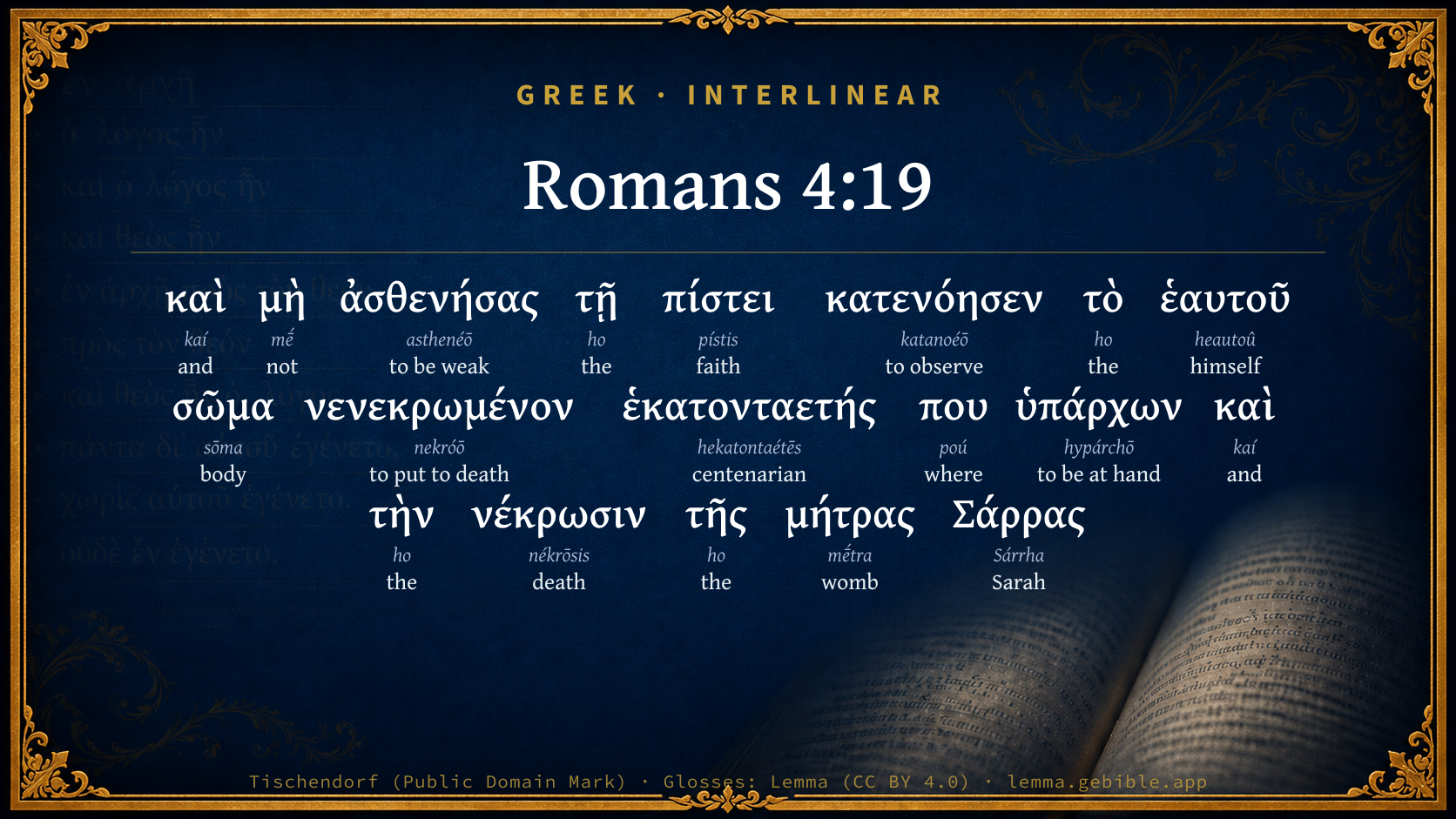
Download image
Cite this verse

Romans 4:19 (World English Bible). Public Domain. Lemma interlinear Bible study tool, https://lemma.gebible.app/v/romans/4/19.

Show BibTeX & RIS
BibTeX
RIS
English Translation
Without being weakened in faith, he didn't consider his own body, already having been worn out, (he being about a hundred years old), and the deadness of Sarah's womb.
World English Bible · Public Domain
Highlights
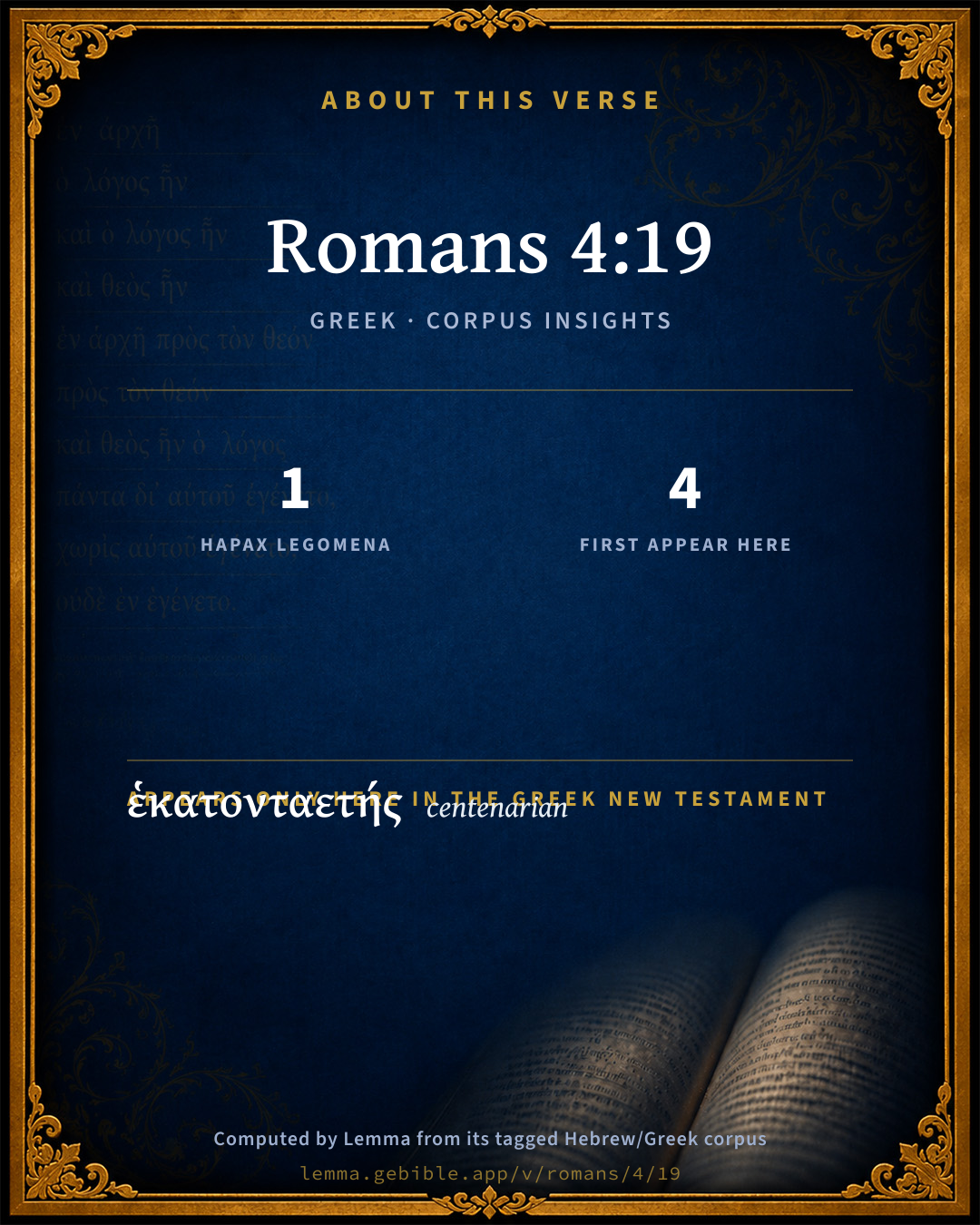
  • 1 hapax legomenon — only here in the Greek New Testament
  • 4 first appearances in the Greek New Testament
Full analysis ↓
Download a study sheet

One document with this verse’s original text, its word-by-word gloss line, the meaning frame, cross-references with their text, attributed commentary, and full source and license credits — printable, and it pastes into notes with its structure intact.

This verse Autodidact and up

Study sheet (.html) Plain text (.txt)

A passage Seminary Student

Up to 50 verses in one chapter. A passage sheet keeps up to 6 commentary sources and 12 cross-references per verse, in the order this page ranks them, and says so on the sheet whenever that leaves anything out. Ask for a single verse and you get the Autodidact verse sheet above.

Everything on this page stays free to read, with no account — the sheet is a download of what is already on screen, not access to it.

Want to remove ads? Support Godless Engineer
Compare translations 3

The same verse in 3 English versions, stacked beneath the original-language interlinear above. Click any original word for its lexicon entry.

Each is an independent rendering of the whole verse — the interlinear is not word-aligned to these translations.

Highlighted words mark where these versions differ — a whole-verse word diff, not a word-by-word alignment.

  • World English Bible Public Domain
    Without being weakened in faith, he didn't consider his own body, already having been worn out, (he being about a hundred years old), and the deadness of Sarah's womb.
  • King James Version Public Domain
    And being not weak in faith, he considered not his own body now dead, when he was about an hundred years old, neither yet the deadness of Sarah's womb:
  • unfoldingWord Literal Text CC BY-SA 4.0
    And not weakening in the faith, he considered his own body as already being dead (being about a hundred years old)—and the deadness of the womb of Sarah.

unfoldingWord Literal Text — © unfoldingWord, licensed CC BY-SA 4.0. Word-aligned USFM3 via Door43 (git.door43.org/unfoldingWord/en_ult).

Versions to compare (up to 4)

3 of 4 selected

Show all 19 translations

Every available English version of this verse, each an independent rendering of the whole verse.

  • World English Bible Public Domain
    Without being weakened in faith, he didn't consider his own body, already having been worn out, (he being about a hundred years old), and the deadness of Sarah's womb.
  • Berean Standard Bible Public Domain
    Without weakening in his faith, he acknowledged the decrepitness of his body (since he was about a hundred years old) and the lifelessness of Sarah’s womb.
  • Majority Standard Bible Public Domain
    Without weakening in his faith, he acknowledged neither the decrepitness of his body (since he was about a hundred years old) nor the lifelessness of Sarah’s womb.
  • King James Version Public Domain
    And being not weak in faith, he considered not his own body now dead, when he was about an hundred years old, neither yet the deadness of Sarah's womb:
  • American Standard Version (1901) Public Domain
    And without being weakened in faith he considered his own body now as good as dead (he being about a hundred years old), and the deadness of Sarah's womb;
  • Revised Version (1885) Public Domain
    And without being weakened in faith he considered his own body now as good as dead (he being about a hundred years old), and the deadness of Sarah’s womb:
  • Geneva Bible (1599) Public Domain
    And he not weake in the faith, considered not his owne bodie, which was nowe dead, being almost an hundreth yeere olde, neither the deadnes of Saraes wombe.
  • Douay-Rheims (1899) Public Domain
    And he was not weak in faith; neither did he consider his own body now dead, whereas he was almost an hundred years old, nor the dead womb of Sara.
  • Young's Literal Translation Public Domain
    and not having been weak in the faith, he did not consider his own body, already become dead, (being about a hundred years old,) and the deadness of Sarah's womb,
  • Literal Standard Version CC BY-SA 4.0
    and having not been weak in faith, he did not consider his own body, already become dead (being about one hundred years old), and the deadness of Sarah’s womb,
  • Unlocked Literal Bible CC BY-SA 4.0
    Without becoming weak in faith, he considered his own body as dead (because he was about a hundred years old)—and he considered the deadness of Sarah's womb.
  • unfoldingWord Literal Text CC BY-SA 4.0
    And not weakening in the faith, he considered his own body as already being dead (being about a hundred years old)—and the deadness of the womb of Sarah.
  • Darby Bible Public Domain
    and not being weak in faith, he considered not his own body already become dead, being about a hundred years old, and the deadening of Sarah's womb,
  • World Messianic Bible Public Domain
    Without being weakened in faith, he didn’t consider his own body, already having been worn out, (he being about a hundred years old), and the deadness of Sarah’s womb.
  • Webster's Bible Public Domain
    And being not weak in faith, he considered not his own body now dead, when he was about a hundred years old, neither yet the deadness of Sarah's womb.
  • Free Bible Version CC BY-SA 4.0
    His trust in God didn't weaken even though he thought his body was practically dead (he was around a hundred years old), and knew that Sarah was too old to have children.
  • Bible in Basic English Public Domain
    And not being feeble in faith though his body seemed to him little better than dead (he being about a hundred years old) and Sarah was no longer able to have children:
  • Text-Critical English NT CC BY 4.0
    Because he was not weak in faith, he did not consider his own body, now as good as dead (since he was somewhere around a hundred years old), or the deadness of Sarah's womb.
  • Tyndale New Testament (1534) Public Domain
    And he faynted not in the fayth nor yet consydered hys awne body which was now deed even when he was almost an hondred yeare olde: nether yet that Sara was past chyldeberinge.

Literal Standard Version (2020), Covenant Press — licensed CC BY-SA 4.0. Text via the HelloAO Bible API (eBible.org). Unlocked Literal Bible (unfoldingWord) — licensed CC BY-SA 4.0. Text via the HelloAO Bible API (eBible.org). unfoldingWord Literal Text — © unfoldingWord, licensed CC BY-SA 4.0. Word-aligned USFM3 via Door43 (git.door43.org/unfoldingWord/en_ult). Free Bible Version, Dr. Jonathan Gallagher — licensed CC BY-SA 4.0. Text via the HelloAO Bible API (eBible.org).

Word by word

More ways to search: Search by grammar → Find every occurrence → Compare this word →

Practice this passage: Drill this verse → Learn its vocabulary →

ἑκατονταετής
hekatontaétēs
G1541
“centenarian”
Adjective, Nominative, Singular, Masculine
Part of Speech
Adjective
Case
Nominative
Number
Singular
Gender
Masculine
Full Thayer's Definition

Origin: from G1540 and G2094

TDNT: None

1. centenarian, a hundred years old
  1. καὶ kaí G2532 “and” Conjunction
  2. μὴ mḗ G3361 “not” Particle, Negative
  3. ἀσθενήσας asthenéō G770 “to be weak” Verb, Aorist, Active, Participle, Nominative, Singular, Masculine
  4. τῇ ho G3588 “the” Article, Dative, Singular, Feminine
  5. πίστει pístis G4102 “faith” Noun, Dative, Singular, Feminine
  6. κατενόησεν katanoéō G2657 “to observe” Verb, Aorist, Active, Indicative, 3rd person, Singular
  7. τὸ ho G3588 “the” Article, Accusative, Singular, Neuter
  8. ἑαυτοῦ heautoû G1438 “himself” Reflexive pronoun, 3rd person, Genitive, Singular, Masculine
  9. σῶμα sōma G4983 “body” Noun, Accusative, Singular, Neuter
  10. νενεκρωμένον nekróō G3499 “to put to death” Verb, Perfect, Passive, Participle, Accusative, Singular, Neuter
  11. που poú G4225 “where” Particle
  12. ὑπάρχων hypárchō G5225 “to be at hand” Verb, Present, Active, Participle, Nominative, Singular, Masculine
  13. καὶ kaí G2532 “and” Conjunction
  14. τὴν ho G3588 “the” Article, Accusative, Singular, Feminine
  15. νέκρωσιν nékrōsis G3500 “death” Noun, Accusative, Singular, Feminine
  16. τῆς ho G3588 “the” Article, Genitive, Singular, Feminine
  17. μήτρας mḗtra G3388 “womb” Noun, Genitive, Singular, Feminine
  18. Σάρρας Sárrha G4564 “Sarah” Noun, Genitive, Singular, Feminine

About this verse

These counts appear in no published source. They are computed here, from the morphology-tagged text and Lemma’s own curated glosses. What Lemma adds →

19
words
15
distinct lemmas
Pauline Epistles
section

Notable vocabulary

1 hapax legomenon — a word that appears only here in the entire Greek New Testament:

  • ἑκατονταετής centenarian G1541

First appearance in Scripture

These words make their first canonical appearance in the Greek New Testament here:

  • νενεκρωμένον to put to death G3499
  • ἑκατονταετής centenarian G1541
  • νέκρωσιν death G3500
  • Σάρρας Sarah G4564

Shared distinctive vocabulary

νέκρωσιν death G3500 occurs in 2 verses of the Greek New Testament. Also found in:
Repetition

Words recur within this verse:

Cross-references

10

Topical passages linked to Romans 4:19 in the Treasury of Scripture Knowledge — connected by theme and wording, ordered by reader-vote popularity; previews shown in the World English Bible.

  • Hebrews 11:11–19 By faith, even Sarah herself received power to conceive, and she bore a child when she was past age, since she counted him faithful who had promised.
  • Genesis 17:17 Then Abraham fell on his face, and laughed, and said in his heart, "Will a child be born to him who is one hundred years old? Will Sarah, who is ninety years old, give birth?"
  • Romans 4:20–21 Yet, looking to the promise of God, he didn't waver through unbelief, but grew strong through faith, giving glory to God,
  • Genesis 18:11–14 Now Abraham and Sarah were old, well advanced in age. It had ceased to be with Sarah after the manner of women.
  • Matthew 6:30 But if God so clothes the grass of the field, which today exists, and tomorrow is thrown into the oven, won't he much more clothe you, you of little faith?
  • Matthew 8:26 He said to them, "Why are you fearful, oh you of little faith?" Then he got up, rebuked the wind and the sea, and there was a great calm.
  • Matthew 14:31 Immediately Jesus stretched out his hand, took hold of him, and said to him, "You of little faith, why did you doubt?"
  • Mark 9:23–24 Jesus said to him, "If you can believe, all things are possible to him who believes."
  • John 20:27–28 Then he said to Thomas, "Reach here your finger, and see my hands. Reach here your hand, and put it into my side. Don't be unbelieving, but believing."
  • Romans 14:21 It is good to not eat meat, drink wine, nor do anything by which your brother stumbles, is offended, or is made weak.

Cross-references courtesy of OpenBible.info (CC BY 4.0).

Where the printed editions differ

1 variant

Places in this verse where the major printed Greek editions disagree on the wording in a way that affects the translation — a comparison of editions, not a manuscript-by-manuscript collation. The editions are the modern critical texts (Nestlé-Aland 28/27, SBL, Westcott-Hort, Tregelles, Tyndale House) and the traditional texts behind the KJV (the Textus Receptus and the Byzantine/Majority text). It is not a claim about which reading is original.

  1. Extra text
    οὐ

    “not”

    In TRByz Not in NA28NA27TynSBLWHTreg

    οὐ (ou) 'not' is only in traditional manuscripts (TR+Byz)

Textual data: Translators Amalgamated Greek New Testament (STEPBible TAGNT) · CC BY 4.0.

Commentary

Notes on Romans 4:19 from classic Christian and Jewish commentators (each source and its license shown beneath its notes). The classic Christian expositions comment on the surrounding passage and are grouped to its opening verse, so a note may address several verses; the Jewish commentaries on the Tanakh (Rashi and others) are per-verse, so they appear only where the commentator wrote on this verse.

Lemma curates 59 commentaries, every one of them public domain or Creative Commons licensed, each selected and text-cleaned for this edition rather than reprinted as found. About our sources →

The Biblical Illustrator

Joseph S. Exell

Rom_4:19-22

And being not weak in faith … he staggered not at the promise of God through unbelief.

The sinfulness of staggering

I. What is it to stagger at the promise? The word staggered is properly to make use of our own judgment and reason, in discerning of things, of what sort they be (1Co_11:29). In the sense wherein it is here used (as also Mat_21:21). It holds out a self-consultation and dispute, concerning those contrary things that are proposed to us (so also Act_10:20). To stagger then at the promise is to take into consideration the promise, and all the difficulties that lie in the way of its accomplishment, and so to dispute it, as not fully to cast it off, nor fully to close with it. E.g., the soul considers the promise of free grace in the blood of Jesus, weighs those considerations which might lead the heart to rest firmly upon it; but considers his own unworthiness, etc., which, as he supposes, staves off the efficacy of the promise. If he add a grain of faith, the scale turns on the side of the promise; the like quantity of unbelief makes it turn upon him; and what to do he knows not: let go the promise he cannot, take fast hold he dares not, but wavers to and fro. Thus the soul comes to be like Paul (Php_1:23), or as David (2Sa_24:14). He sees, in a steadfast closing with the promise, presumption; on the other hand, destruction; arguments arise on both sides, he knows not how to determine them, and so hanging in suspense, he staggers. Like a man meeting with two paths, that promise both fairly, and knows not which is his proper way, guesses and guesses, and at length sits down until someone comes that can give direction. The soul very frequently in this hesitation refuses to go one step forward till God come mightily and lead out the spirit to the promise, or the devil turn it aside to unbelief. It is as a light in the air: the weight that it hath carries it downwards; and the air, with some breath of wind, bears it up again. Sometimes it seems as though it would fall by its own weight; and sometimes, again, as though it would mount quite out of sight; but poised between both it tosseth up and down, without any great gaining either way. The promise draws the soul upward, and the weight of its unbelief sinks it downward; but neither prevails. Like the two disciples going to Emmaus (Luk_24:14), They talked together of the things that had happened, and (Rom_4:22) they gave up. Yet they cannot quite give over all trusting in Christ (Rom_4:23-25): hereupon they staggered (Rom_4:17); much appears for them, something against them, they know not what to do.

II. Notwithstanding any pretences whatever staggering is from unbelief. The two disciples just mentioned thought they had good cause of all their doubtings (Luk_24:20). But our Saviour tells them that they are foolish, and slow of heart to believe. Peter venturing upon the waves at the command of Christ (Mat_14:1-36), seeing the wind to grow boisterous, also hath a storm within, and cries out, Oh; save me! The real cause of his fear was merely unbelief (verse 31). And upon several occasions doth our Saviour lay all the staggering of His followers as to any promised mercy upon this score (Mat_6:30; Mat_8:26; see also Isa_7:7; Isa_7:9; Heb_4:2). But these things will be more clear if we consider that when a man doubts his reasonings must have their rise, either from something within himself, or from something in the things concerning which he staggereth. He that doubteth whether his friend be alive or not, his staggering ariseth from the uncertainty of the thing itself; when that is made out, he is resolved, as it was with Jacob in the case of Joseph. But he that doubteth whether the needle in the compass being touched with the lodestone will turn northward all the uncertainty is in his own mind. If when men stagger at the promises we demonstrate that there is nothing in the promise that should occasion any such staggering, we lay the blame on unbelief. Let us now see weather anything be wanting to the promises.

1. Is there truth in these promises? If there be the least occasion to suspect their truth, or the veracity of the Promiser, then our staggering may arise from thence, and not from our own unbelief. But now the Author of the promises is the God of truth, who has used all possible means to cause us to apprehend the truth of His promises.

(1) By often affirming the same thing. There is not anything that He hath promised us but He hath done it again and again; e.g., as if He would say, I will be merciful to your sins, I pray believe Me, for I will pardon your iniquities, yea, it shall be so, I will blot out your transgressions as a cloud.

(2) By confirming the truth with an oath (Heb_6:13-18).

(3) By entering into covenant to accomplish what He has spoken.

(4) By giving us a hostage to secure us of His truth, one exceedingly dear to Him, of whose honour He is as careful as of His own. Jesus Christ is the pledge of His fidelity in His promises (Isa_7:14). In Him are all the promises of God yea and amen. Thus also to His saints He gives the further hostage of His Spirit, and the first fruits of glory.

2. But though there be truth in the promise, yet there may want ability in the promiser. A physician may promise a sick man recovery who, though he could rely upon the physicians truth, yet doubts his ability, knowing that to cure is not absolutely in his power; but when He promises who is able to perform, then all doubting is removed. See then whether it be so in respect of Gods promises (Gen_17:1). When difficulties, temptations, and troubles arise, remember God is not only true and faithful, but Almighty (Rom_4:21; chap. 11:23; Eph_3:20). When men come to close with the promise, to make a life upon it, they are very ready to inquire whether it be possible that the word should be made good to them. He that sees a little boat swimming at sea looks upon it without any solicitousness; but let this man commit his own life to sea in it, what inquiries will he make? So whilst we consider the promises at large, as they lie in the Word, they are all true; but when we go to venture our souls upon a promise, in an ocean of temptations, then every blast we think will overturn it. Now here we are apt to deceive ourselves. We inquire whether it can be so to us, as the Word holds out, when the question is not about the nature of the thing, but about the power of God. Place the doubt aright, and it is this: Is God able to accomplish what He hath spoken? Can He pardon my sins? Now, that there may be no occasion of staggering upon this point, you see God reveals Himself as an all-sufficient God, as one that is able to go through with all His engagements. But you will say, Though God be thus able, yet may there not be defects in the means whereby He worketh? As a man may have a strong arm able to strike his enemies to the ground, but yet if he strike with a feather, or a straw, it will not be done. But--

(1) Gods instruments do not act according to their own virtue, but according to the influence by Him to them communicated.

(2) It is expressly affirmed of the great mediums of the promise, that they also are able. There is

(a) The procuring means, Jesus Christ (Heb_5:27; Heb_2:18).

(b) The means of manifestation, the Word of God (Act_20:32).

(c) The means of operation, the Spirit of grace (1Co_12:11).

3. But there may be want of sincerity in promises, which, whilst we do but suspect, we cannot choose, but stagger at them. But there can be no room for staggering here; for nothing can be plainer or more certain than that the promises of God signify His purpose, that the believer of them shall be the enjoyer of them. So that upon the making out of any promise, you may safely conclude that upon believing the mercy of this promise is mine. It is true, if a man stand staggering, whether he have any share in the promise, and close not with it by faith, he may come short of it; and yet without the least impeachment of the sincerity of the Promiser; for God hath not signified that men shall enjoy them whether they believe or not. If proclamation be, made granting pardon to all such rebels as shall come in by such a season, do men use to stand questioning whether the State bear them any goodwill or not? The gospel proclamation is of pardon to all comers in; it is for thee therefore to roll thyself on this, there is an absolute sincerity in the engagement which thou mayest freely rest upon.

4. But though all be present, truth, power, sincerity; yet if he that makes the promise should forget, this were a ground of staggering. Pharaohs butler probably spake the truth according to his present intention, and afterwards had doubtless power to have procured the liberty of a prisoner; but he did not remember Joseph. This forgetting made all other things useless. But neither hath this the least colour of Divine promises (Isa_49:14). The onuses of forgetfulness are--

(1) Want of love. But infinite love will have infinite thoughtfulness and remembrance.

(2) Multiplicity of business. But although God rules the world, He will not forget (Psa_77:9).

5. But where all other things may concur, yet if the promiser may alter his resolution, a man may justly doubt the accomplishment of the promise. Wherefore the Lord carefully rejects all sinful surmises concerning the least change or alteration in Him, or any of His engagements (Jam_1:18; Mal_3:6). In conclusion, then, such staggering must dishonour God, for--

1. It robs Him of the glory of His truth 1Jn_5:10).

2. It robs Him of the glory of His fidelity to His promises (1Jn_1:9).

3. It robs Him of the glory of His grace.

In a word, if a man should choose to set himself in a universal opposition unto God, he can think of no more compendious way than this. This then is the fruit, this the advantage of our staggering; we rob God of glory, and our own souls of mercy. (J. Owen, D. D.)

Unstaggering faith

It was Gods purpose that Abraham should be a surpassingly excellent example of the power of faith. It was therefore necessary that his faith should be exercised in a special manner. To this end God gave him a promise that in his seed should all the nations of the earth be blessed, and yet for many a year he remained without an heir. Doubtless he weighed the natural impossibilities, but he maintained a holy confidence, and left the matter in the hands of the Sovereign Ruler. His faith triumphed in all its conflicts. Had it not been that Sarah and Abraham were both at such an advanced age there would have been no credit to them in believing the promise of God, but the more difficult its fulfilment, the more wonderful was Abrahams faith. By such unquestioning confidence Abraham brought glory to God. It glorifies God greatly for His servants to trust Him; they then become witnesses to His faithfulness, just as His works in creation are witnesses to His power and wisdom. Let us view the text in regard to--

I. The individual worker.

1. You are conscious of your spiritual weakness. You say, If God intends to bless souls, I cannot see how they can be blessed through me. I feel myself to be the most unworthy instrument in the world.

(1) Such a lowly sense of our own unfitness is common at the beginning of Christian labour, and arises from the novel difficulties with which we are surrounded. We have not gone this way heretofore, and being quite new to the work, Satan whispers, You are a poor creature to pretend to serve God; leave this service to better men. But take comfort; this is part of your preparation; you must be made to feel early in the work that all the glory must be of God.

(2) This sense of weakness grows on the Christian worker. To continue in harness year after year is not without its wear and tear; our spirit truly is willing, but the flesh is weak, and faintness in pursuing reveals to us that our own strength is perfect weakness. The more earnest your labours for the Lord, the more clear will be your sense of your own nothingness.

(3) There are times when a want of success will help to make us feel most keenly how barren and unfruitful we are until the Lord endows us with His Spirit. Those whom we thought to be converted turn out to be merely the subjects of transient excitement, those who stood long, turn aside, and then we cry out, Woe is me! How shall I speak any more in the name of the Lord? Like Moses, we would have the Lord send by whomsoever He would send, but not by us; or like Elias, we hide ourselves for fear, and say Let me die, I am no better than my fathers. I suppose there is no worker who is quite free from times of deep depression, times when his fears make him say, Surely I ran without being called. At such moments it only needs another push from Satan to make us like Jonah to go down to Joppa, that we may no longer bear the burden of the Lord. I am not sorry if you are passing through this fiery ordeal, for it is in your weakness God will show His own strength, and when there is an end of you there will be a beginning of Him.

2. It may be also that our sphere of Christian effort is remarkably unpromising. In that Sunday school class the boys are obstinate, the girls frivolous. You had not reckoned upon this. The more you try to influence their hearts the less you succeed. It is possible you are called to labour where the prejudices, temptations, and habits and ways of thought are all dead against the chance of success. But Christian work never succeeds until the worker rates the difficulties at their proper rate. The fact is, to save a soul is the work of Deity; and unless we have made up our minds to that, we had better retire, for we are not ready for labour.

3. Yet the godly worker has that which sustains him, for he has a promise from God. Abraham had received a promise, and he knew the difficulties and weighed them; but having done so, he put them away as not worth considering. God had said it, and that was enough, The promise of God was as good as its fulfilment; just as in trade some mens bills are as good as cash. Now if we are to be successful we must get hold of a promise too. You say, If I could have a special revelation, just as Abraham had, I would doubt no more. Now God gives His promises in many ways. Sometimes He gives them to individuals, at other times to classes of character. Now God has been pleased to give the revelation, in your case, to character. He that goeth forth and weepeth, bearing precious seed, shall doubtless come again with rejoicing, bringing his sheaves with him. Now if you have gone forth, wept, and carried forth precious seed, the Lord declares that you shall doubtless come again rejoicing. My word shall not return unto Me void, but it shall accomplish that which I please, it shall prosper in the thing whereto I sent it. Have you delivered Gods word? if so, then God declares it shall not return unto Him void; and these promises are quite as good as though they had been spoken to you by the voice of an angel. A promise however given is equally binding upon a man of honour, and a promise of God, no matter how delivered, is sure of fulfilment; all you have to do is to lay hold upon it.

II. The church.

1. We have set our hearts upon a revival. But I fear that our temptation is to suppose there is some power in the ministry, or in our organisation, or our zeal. Let us divest ourselves of all that. As to causing a genuine revival by our own efforts, we might as well talk of whirling the stars from their spheres. If God help us we can pray, but without His aid our prayer will be mockery. If God help us we can preach, but apart from Him our preaching is but a weary tale told without power.

2. There is not only difficulty in ourselves, but in the work. We want to see all these people converted. But what can we do? The preacher can do nothing, for he has done his best and has failed, and all that any can suggest will fail also. The work is impossible with us, but do we therefore give up the attempt? No, for is it not written, I said not unto the seed of Jacob, Seek ye My face in vain? Christ must see of His souls travail, must see of it in this place too. We have Gods promise for it; we cannot do it, but He can.

III. Every pleading soul. If your heart has been set upon any special object in prayer, if you have an express promise for it, you must not be staggered if the object of your desire be farther off now than when you first began to pray. Wait at the mercy seat in the full persuasion that although God may take His time, and that time may not be your time, yet He must and will redeem His promise when the fulness of time has come. If you have prayed for the salvation of your child, or husband, or friend, and that person has grown worse instead of better, still God must be held to His word; and if you have the faith to challenge His faithfulness and power, assuredly He never did and never will let your prayers fall fruitless to the ground. Remember that to trust God in the light is nothing, but to trust Him in the dark--that is faith.

IV. The seeker. You imagined at one time that you could become a Christian at your own will at any moment; and now how to perform that which you would you find not. You desire to break the chains of sin, but they are far easier to bind than to loose. You want to come to Jesus with a broken heart, but your heart refuses to break. You long to trust Jesus, but your unbelief is so mighty that you cannot see His Cross. I am glad to find you in this poverty-stricken state, for I believe that in your case you must know your own powerlessness. Every sinner must learn that he is by nature dead in sins, and that the work of salvation is high above out of his reach. Self-despair throws a man upon his God; he feels that he can do nothing, and he turns to one who can do all things. Now the next thing is to find a promise. Whosoever calleth upon the name of the Lord shall be saved. Have you called upon the name of the Lord? Have you cried to Him, God be merciful to me a sinner? If you so call you must be saved. Whosoever cometh to Me I will in no wise cast out. Do you come? If so, you cannot be cast out. (C. H. Spurgeon.)

Religious faith rational

That its object is marvellous is quite true; and it is also true that no mind will form itself to a habit of faith without the influences of Divine grace. But to say that such a faith as that of Abraham, which led him to believe Gods word when opposed to his own experience, is a strange principle and irrational, is absurd.

I. For we act on trust every hour of our lives.

1. We trust to our memory, and our confidence in it is so strong that no man could persuade us to reject its testimony.

2. We trust our reasoning powers. Who of us would doubt, on seeing strong shadows on the ground, that the sun was shining, though our face happened to be turned the other way?

3. And we trust our memory and our reasoning powers in this way, though they often deceive us; because on the whole they are faithful witnesses, and because in all practical matters we are obliged to decide by not what may be possibly, but what is likely to be. There is a chance, e.g., that our food today may be poisonous, but it looks and tastes the same, and we have good friends round us; so we do not abstain from it, for all this chance.

4. But it may be said that such belief is not what is meant by faith--that to trust our senses and reason is to trust ourselves--and though these do sometimes mislead us, yet we can use them to correct each other; but it is a very different thing to trust another person, which is faith in the Scripture sense of the word. But reliance on the word of another is no irrational or strange principle of conduct in the concerns of this life. For what do we know without trusting others?

(1) Are there not towns within fifty or sixty miles of us which we have never seen, but in which we fully believe? What convinces us? The report of others--this faith in testimony which, when religion is concerned, is called irrational.

(2) Consider how we are obliged to confide in persons we never saw, or know but slightly; nay, in their handwritings, which, for what we know, may be forged.

(3) It is certain that we all must sooner or later die, and men arrange their affairs accordingly. Yet what proof have we of this? because other men die? how does he know that? has he seen them die? he can know nothing of what took place before he was born, nor of what happens in other countries. How little, indeed, he knows about it at all, except that it is a received fact.

(4) We constantly believe things against our own judgment; i.e., when we think our informant likely to know more about the matter under consideration than ourselves, which is the precise case in the question of religious faith. And thus from reliance on others we acquire knowledge of all kinds, and proceed to reason, judge, decide, act, form plans for the future. But it is needless to proceed; the world could not go on without trust. The most distressing event that can happen to a state is the spreading of a want of confidence between man and man. Distrust, want of faith, breaks the very bonds of human society.

5. Now, shall we account it only rational for a man to yield to anothers judgment as better than his own, and yet think it against reason when one, like Abraham, sets the promise of God above his own short-sighted expectation?

II. The main reason for disbelief. It may be objected, If God had spoken to us as He did to Abraham, it were madness to disbelieve; but it is not His voice we hear, but mans speaking in His name. How are we to know whether they speak truth or not?

1. Whatever such may say about their willingness to believe, in a great many cases they murmur at being required to believe, dislike being bound to act without seeing, and prefer to trust themselves to trusting God, even though it could be plainly proved to them that God was speaking to them. Their conduct shows this. Why otherwise do they so frequently scoff at religious men, as if timid and narrow-minded, merely because they fear to sin? Clearly, it is their very faith itself they ridicule. To trust another implicitly is to acknowledge ones self to be his inferior; and this mans proud nature cannot bear to do. It is therefore very much to our purpose to accustom our minds to the fact that almost everything we do is grounded on mere trust in others, and that visible dependence reminds us forcibly of our truer and fuller dependence upon God.

2. Unbelievers condemn themselves out of their own mouth. Our obedience to God is not founded on our belief in the word of such persons as tell us Scripture came from God. We obey God primarily because we feel His presence in our consciences bidding us obey Him. Now, if they trust their senses and their reason, why do they not trust their conscience too? Their conscience is as much a part of themselves as their reason is; and it is placed within them in order to balance the influence of sight and reason and yet they will not attend to it; for they love to be their own masters, and therefore they will not attend to that secret whisper of their hearts, which tells them they are not their own masters, and that sin is hateful and ruinous. Nothing shows this more plainly than their conduct. Supposing a man says to them, You know in your heart that you should not do so; they get angry; or attempt to turn what is said into ridicule; anything will they do, except answer by reasoning. Their boasted argumentation flies like a coward before the stirring of conscience; and their passions are the only champions left for their defence. They in effect say, We do so, because we like it; perhaps they even avow this in so many words. And are such the persons whom any Christian can trust? Surely faith in them would be of all conceivable confidences the most irrational. For ourselves, let us but obey Gods voice in our hearts, and we shall have no doubts practically formidable about the truth of Scripture. Our doubts will be found to arise after disobedience. And if we but obey God in time faith will become like sight; we shall have no more difficulty in finding what will please God than in moving our limbs, or in understanding the conversation of our familiar friends. (J. H. Newman, D. D.)

But was strong in faith, giving glory to God.--

Strong faith

I. What it is.

1. Abraham grew strong in faith; faith grows by exercise.

2. He was made strong by faith; faith is a bracing grace. The worlds heroes are strong by faith in themselves, Gods by faith in Him (Jdg_6:14; Heb_11:1-40; David, Daniel, etc.). Weak faith is not rejected, but strong faith is commended. Strong faith triumphs over doubts and fears (Mat_14:30-31).

II. What it does. It glorifies God as unbelief dishonours Him. It gives glory to all His attributes, especially His faithfulness, benevolence, almightiness, for it builds on them alone. Honouring God is therefore honoured by Him. Not to believe Him is to offer Him the greatest insult (1Jn_5:10). Gods honour and mans interest, both combined. Faith secures both. Abraham giving glory to God waxed strong in faith. As faith glorifies God it becomes stronger and stronger, and is a worthy medium of justification as giving God all the glory. (T. Robinson, D. D.)

Strong faith

I. Strong faith is supported by abundant reasons.

1. All the reasons which justify our believing in God at all justify our believing in Him most firmly. It can never be right to believe unless the statements are true, and if true they deserve undivided faith. If anything be strong enough for you to trust your eternal destiny to it, your trust ought to be immovable as a granite rock. If it be right to enter into faiths stream at all, every possible argument proves that the deeper you go the better.

2. Reasons for strong faith may be found in the character of God. Our reliance upon man must be cautiously given; but--

(1) The Lord is not a man that He should lie, nor the son of man that He should repent. Should we not have strong faith who believe in a God whose very essence is pure truth?

(2) God is omnipotent, and therefore believing should be strong. Is anything too hard for the Lord? With God all things are possible.

(3) All things else change, but God knoweth no shadow of a turning. Believe immutably in an immutable God.

(4) He is the God of love. What a wanton insult it is to mistrust one who cannot be unkind.

3. When I turn mine eyes to our Lord Jesus it appears incongruous that the Son of God should be received with meagre confidence. Can we doubt His ability to save? Abraham had strong confidence when he saw the type--the burning lamp passing between the pieces of the slain victims. With how much greater confidence should we rest in the antitype.

4. We ought to give God strong faith, because there is no evidence which could justify mistrust.

(1) All down the ages those who have trusted in Him have never been confounded. We read in the eleventh of Hebrews the record of what the Lord wrought in those who believed in Him. Now, per contra, there standeth nothing.

(2) On the bed of death the truth generally comes out, yet who ever heard a solitary believer declare that it is a mistake to confide in the blood of Jesus, or to rest in the faithfulness of God? Somewhere or other this thing would have come out if it had been so.

(3) Have you experienced anything which casts suspicion upon the character of God? When you have trusted Him has He failed you? Will you put your finger upon a promise which He has broken?

II. Strong faith produces the most desirable results. We can only dwell upon the one mentioned here, giving glory to God. This is mans chief end. Strong faith answers that end because--

1. It treats him like God. Unbelief is practical atheism; because, denying the truthfulness of God, it takes away what is a part of His essential character. I would not grieve those who have but little faith, but still weak faith limits the Holy One of Israel! It believes Him up to such a point, or under such and such circumstances, whereas strong faith treats God according to His infinite character.

2. It treats Him as a father, and acts towards Him in the childlike spirit, i.e., with unlimited confidence. Can my Father do an unkind thing, be untrue, be false or changeable? Impossible!

3. It strengthens all the other graces, and all these bring glory to God.

4. It gives a striking testimony to the world, The faith which can practise eminent self-denial or achieve great enterprises attracts the eyes of men; they see your strong faith, and they glorify your Father which is in heaven. I have known some faith which would have required a microscope to perceive it, and when we have declared that little faith saves the soul, the worldling has replied, Well, it is a very small concern at any rate.

5. It enables Him to work in us and through us. As our Saviour could not do many mighty works in a certain place because of their unbelief, so is God hampered with regard to some of us.

III. Strong faith which gives glory to God may be exercised by persons who are otherwise exceedingly weak.

1. What a joy this is to you who are sufferers in body! You cannot do apostolic work and range a continent, but you may exhibit a placid patience, a sweet resignation, a sacred hopefulness as to the future, a Divine disdain as to the fear of death.

2. So you may have few talents, and yet you may have strong faith. You need not be a genius in order to give glory to God, for the strength of your faith will do it. You can glorify God by holding firmly to the truth of which you understand so little, but which you love so heartily.

3. Some saints are conscious of weakness of every sort, but they must not, therefore, think that they cannot honour God by strong faith, for Abraham was so old that his body was now dead, and yet he believed that he would be the progenitor of the chosen seed. The depth of your weakness is just the height of your possibilities of honouring the Lord.

IV. This strong faith varies as to its manner of working, very much according to the person and his circumstances.

1. There is one thing that strong faith does not do, it never talks big and boasts of what it will accomplish. There is a great deal of difference between confidence in yourself and confidence in God. Barking dogs do not often bite, and those men who promise much very seldom perform. Point me to one boastful word that fell from Abraham. David said little to his envious brothers, but he brought home the giants head.

2. Faith exercises itself as in the case of Abraham, by believing Gods word. God had said many things to him, and he believed them all.

3. But Abrahams was not alone receptive faith: his was a faith which obeyed the precept. The test of obedience was the strange command to take his only son and offer him up for a sacrifice, but he went to do it.

4. Abrahams faith awakened in him great expectations. He was looking for an heir, from whom should spring a seed as the stars of heaven for multitude. We shall be full of expectation if we have strong faith: looking for blessings, expecting prayers to be answered, and promises to be fulfilled.

V. Strong faith is especially to be expected in certain quarters.

1. In those who know God. They that know Thy name will put their trust in Thee, for Thou Lord, hast not forsaken them that seek Thee.

2. Those who have had a long experience of Him. Speak well of the bridge which has carried you over so many times. Let those of us who have been twenty-five years in the ways of God put aside our childish doubts.

3. Those who have lived in fellowship with Him.

4. Those who are getting near to heaven. Do not let it be among the last memories of earth that you doubted your Beloved.

5. Teachers and preachers. We shall never win sinners to faith if we preach what we do not intensely believe. And I do not think we shall have many conversions unless we expect God to bless the word. It is the rule of His kingdom. According to your faith so be it unto you. (C. H. Spurgeon.)

Trusting the Promiser

Said Hester Ann Rogers: By thus trusting the promise and the Promiser, I have conquered, and, glory be to God, through His strength I shall prevail. It is by hanging on Jesus, as an infant on its mothers breast, I retain my peace, and love, and joy.

Unfaltering faith

John and Charles Wesley were once conversing about an important project, which they agreed was desirable, but Charles thought they could not do it. John thought they should attempt it. At length Charles said, When God gives me wings Ill fly. John replied, When God tells me to fly Ill trust Him for the wings. (H. K. Burton.)

Strong faith

Amongst us there may be a lack of faith. The unbelieving man is weak, and the believing man is strong. Faith pours vigour into the understanding, the judgment, the affection, and the will. In proportion to a mans faith so is his power. This principle has been illustrated times without number, by the soldier on the battlefield, the sailor on the great deep, the traveller in other lands, and men in every department in life. Without strong faith, Hannibal never could have attempted the bold enterprise of crossing the Alps. Without strong faith, Columbus never could have sailed upon the untried waters, amid the insubordination of his crew. Without strong faith, Cook, Bruce and Livingstone never could have confronted and overcome such gigantic difficulties in unknown countries. Without strong faith in reason and science, Socrates and Galileo never could have been so daring and dauntless, so great and sublime. A mere sneerer--the man who sits in his easy chair, folds his arms, believes in nothing, and laughs at everything--could have done none of these things, and can do nothing for the improvement of the race worthy of a moments consideration. What steam is to the locomotive, or what life is to the body, faith is to successful action. (A. McAuslane.)

Faith glorifying God

The leading thought here is the connection of Gods glory with our faith. Having that faith, as the gift of God, we glorify Him. And being strong in that faith, we glorify Him all the more. To be glorifying to God, therefore, our faith--

I. Must have a promise of God to rest on. Human faith, not resting on a Divine promise, is either folly or fanaticism.

1. Even in the natural world this is true. We walk by faith; but it is by faith grounded on the promise that natures laws will operate with the regularity hitherto observed. Strong in that faith you walk safely, and glorify God. But if you disregard that promise, you rush into danger and dishonour God.

2. The promise to Abraham was fitted to try his capacity of believing to the uttermost. The only thing that could lessen the difficulty was that there could be no doubt as to the exact thing promised, or as to the particular person to whom it was promised. Ah! but one says, Give me a promise like that and I will not hesitate for a moment. But consider--

(1) May not Abrahams words elsewhere be applicable here?--If they hear not Moses and the prophets, neither will they be persuaded though one rose from the dead. Is it clear that if I am not now complying with the gospel call, addressed to all sinners, I would comply with it more readily if it were addressed to me by name? And again, if forgiveness of sin, renewal, etc., are now felt to be intangible, would it obviate the difficulty to have them made up into a material packet which my hand may handle, my eye see, my mouth swallow? Called by name I might refuse as now; that would not make me willing, and if I got the blessings embodied in some sensible sign, it would be the embodiment alone that became mine. The blessings embodied would seem as shadowy as ever. Be sure that the call is personal and pointed enough, and that the promise is to be realised experimentally. Let us together taste and see that God is good.

(2) Understand clearly the object of faith of Abraham. Immediately it was a son in his old age. But surely he did not contemplate that barely in itself. He looked at it in its spiritual significancy; in its bearing on the fulfilment of the great original promise, which he had been told was to be fulfilled in his seed. But for that aspect of it, the promise could really have no meaning to him. In a worldly point of view, what need has he of this child, for whose birth the very laws of nature are to be suspended? For his own temporal prosperity, for the preservation of his name and memory in a numerous posterity, provision has been made already. The promise then is not merely that a son is to be born to him, but that in that son he is to see the day of Christ afar off with gladness. Viewed thus, Abrahams faith really differs in no material respect from that which you are called to exercise. He has no promise on which his faith may lean more special and personal than you have; and what his faith has to lay hold of is the same unseen Saviour, and the same spiritual salvation that you have set before you in the gospel. And, simply relying, as you may rely, on the testimony of God concerning Him who is to be his seed in Isaac, he believes, and righteousness is imputed to him. Hence--

(3) Abrahams case becomes now really ours. Or, if there is any difference, the advantage is with you. Abraham had presented to him an event future and conditional upon certain necessary antecedents (verses 19, 20). You have an accomplished fact (verse 24). Isaac is to be born; and in him is to be found the seed of the woman that is to bruise the serpents head: that is Abrahams ground of hope. Christ is risen; the seed of woman having actually bruised the serpents head: that is yours.

II. Must be such as will be glorifying to God. My faith must have its root in a real personal dealing between God and me. He and I must meet personally, face to face; as truly as He and Abraham did. We must know one another; trust one another. No other kind of faith than that can be glorifying to Him. What! Shall I be contented that a member of my family should go about to satisfy himself by evidence from hearsay, or from circumstances. Is that a sort of faith which I can feel to be either complimentary or kind? Is it not, on the contrary, a bitter disappointment. For does it not show that I am held to be, not a friend, or father, who may be fondly resorted to, that I may be trusted and consulted; but at the best a suspected stranger, about whom it may be desirable to be informed?

III. Must be strong or in the way of becoming strong. Now, in considering this we must bear in mind the Lords own saying--If ye have faith as a grain of mustard seed … nothing shall be impossible with you. The woman with an issue of blood was apparently not strong in faith. And yet her faith did a great thing for her, and surely God was greatly glorified through it. And indeed it was strong faith to say, If I may but touch His garment, I shall be whole, for it was such immediate, personal dealing with the Lord that put all His power and love in operation on her behalf. The strength of Abrahams faith consisted--

1. Negatively, in not considering what sense may urge against the promise (verses 19, 20). If he had considered these things he would have been weak in faith.

(1) Certainly they were formidable obstacles that had to be overcome by a miracle of power upon and a miracle of faith within him. Everything that he could see and know and feel, in nature and in himself, was against his believing. And what had he on the other side for believing? Simply God speaking; God promising. That, however, prevailed.

(2) But we must distinguish this not considering these difficulties from the mere shutting of the eyes to the fact of their existence. I may be so bent upon the attainment of an object as unconsciously to overlook all intervening obstacles, and fondly persuade myself that what I wish must be possible, simply because I wish it. Or I may be so impatient, foolhardy, as to be wilfully blind to everything but the gratifying of my hearts desire. Not such was the faith of Abraham. He had full in view the obstacles in the way of the promise. And this was the very strength of his faith, that, having them full in view, he disregarded them.

(3) Alas! how is faith weakened and made to stagger by your considering what sense says or suggests against it.

(a) Am I called, as a sinner, to believe in Christ for the forgiveness of my sin and my peace with God? God Himself is telling me, not of a child to be born, but of the Child actually born; and not of His birth merely, but of His wondrous life and death; and of His rising from the dead, etc., God is telling me of this Christ as mine, if I will but have Him to be mine. Alas! I give heed to considerations that seem to make all this impossible. I am not worthy enough, or vile enough. I have not repentance enough, or faith enough. I will not make up my mind absolutely to reject Christ. But I stagger at the promise through unbelief. I stagger into unbelief. Is this giving glory to God?

(b) As regards a holy life, this evil is sorely felt. Ah! how am I tempted here to consider my own deadness; and so to consider it, as to put up with it, and make allowance for it. How apt am I to dwell on infirmities and hindrances; how ready to acquiesce in what I am, as if it were all I might be. How does all this interfere with my giving glory to God!

(c) For others my faith is to be exercised. I plead with God for a child, a brother, a friend. I have promises to plead. Ah! I can it be that here too I am hindered by my considering the suggestions of sense, and giving heed to difficulties and questions respecting his deadness and mine?

(d) For the seed of Abraham; for Him who is the seed of Abraham, and for all that is His; His cause and kingdom; the progress of His gospel; the winning of souls to Him; for all that, I am commanded to believe God. Alas! for my weakness in this faith. How do I consider the mountains that are in my way! For all this staggering the remedy is to be found, at least in part, in the negative way of not considering the difficulties which sense may raise.

2. Positively, notice what being strong in faith really is. It is simply being fully persuaded that what He had promised He was able also to perform (verse 21). Nay, but who doubts that? you ask. I at least never dream of calling in question the omnipotence of God. And yet I see not how that will of itself make me, or any man, strong in faith. Very true. But the faith in question is not believing something about God, but believing God. Ah! in that view it is everything, to be fully persuaded that what He has promised He is able also to perform. It is a blessed thing to remember that it is the Almighty who speaks to you, who bids you speak to Him. O ye of little faith, whereof do you doubt? Is anything too hard for Him who asks you to believe Him? Be, then, strong in this faith, giving glory to God. For it is faith in Gods power that most glorifies Him; it is distrust of His power which lies at the root of most of the unbelief that is so dishonouring to Him. If Thou canst do anything, we are apt to say, with the afflicted father. Let us ponder the gracious answer, If thou canst believe, all things are possible to him that believeth. And let us enter into the spirit of the gracious reply, Lord, I believe, help Thou mine unbelief. Conclusion: Lay to heart the ground of believing strongly. It is not that it gives peace, joy, salvation, but that it gives glory to God. To be weak in faith is not merely to miss or mar a privilege, but to dishonour the God whom you are bound to glorify. To be dwelling on hindrances standing in the way of His free word of promise; to be distrusting His ability to sweep them all away, and make His word of promise good; can anything be more fitted to affront the Almighty, the faithful, true, and loving Jehovah? Is it not literally and truly making him a liar? Beware of so great a sin. You may fancy that there is humility in it. You feel your own unworthiness and unsteadfastness so deeply that you dare not venture to be too confident or to presume. Presume!--the presumption is all the other way! The intolerable presumption is to refuse to take God at His word. Be clothed with humility. And that you may be clothed with humility, be not faithless but believing. Be strong in faith, giving glory to God. (R. S. Candlish, D. D.)

And being fully persuaded that what he had promised He was able also to perform.

Full persuasion

Having full assurance (Luk_1:1; Rom_14:5; 2Ti_4:5; 2Ti_4:17). Metaphor from a ship carried forward with full sail, Gave out all his canvas. Ventured all on Gods word. Believed without hesitation or reserve. Full assurance of faith (Heb_10:22). Grounded on full assurance of understanding (Col_2:2). Conducts to full assurance of hope (Heb_6:11). Faith a filling grace. Unbelief empties and keeps empty. (T. Robinson, D. D.)

The full persuasion of Gods ability

Gods ability the foundation of faiths stability. Faith honours God by counting Him able (Job_42:2; Gen_18:14; Mat_19:26; Luk_1:37; 1Sa_14:6; 2Ch_14:11). (T. Robinson, D. D.)

Faith as a condition of receiving

Is it any wonder that, when we stagger at any promise of God through unbelief, we do not receive it? Not that faith merits the answer or in any way earns it, or works it out; but God has made believing a condition of receiving, and the giver has a sovereign right to choose his own terms of gift. (Samuel Hart.)

The Biblical Illustrator, edited by Joseph S. Exell (c. 1880s–1900s) — public domain. Text from a community e-Sword module.

Bengel's Gnomon

Johann Albrecht Bengel

Rom 4:19. Μὴ ἀσθενήσας, being not weak) Reason [had he hearkened to it] might have afforded causes of weakness.—ἑαυτοῦ—Σάῤῥας, his own—of Sarah’s) The old age of both the husband and wife, and the previous barrenness of the latter, increase the difficulty, and prove the birth of Isaac to have been miraculous. The course of the history shows, that Sarah gave birth to Isaac only [not save, ‘nonnisi’] in conjunction with Abraham. The renewed vigour of his body remained even in his marriage with Keturah.—ἑκατονταέτης που, when he was about a hundred years old) After Shem, we read of no one begetting children, who was a hundred years of age, Genesis 11.

Bengel's Gnomon of the New Testament — English translation (T&T Clark, Edinburgh, 1860) — public domain. Text from a community e-Sword module.

Meyer's Critical & Exegetical Commentary

Heinrich August Wilhelm Meyer

Rom_4:19-21 are still dependent on ὁς, completing the description of the believing Abraham: and (who), because he was not weak in faith, regarded not his own dead body.[1081] Theophylact has properly expressed the meiosis in μὴ ἀσθ.: ΜῊ ἈΣΘΕΝΉΣΑς Τῇ ΠΊΣΤΕΙ, ἈΛΛʼ ἸΣΧΥΡᾺΝ ΑὐΤῊΝ ἜΧΩΝ. By ΜΉ the ἈΣΘΕΝ. is negatived from the point of view of the subject. Comp on Rom_4:17.

Οὐ ΚΑΤΕΝΌΗΣΕ] he did not fix his attention thereon. Comp Heb_3:1; Heb_10:24; Luk_12:24; Jdt_10:14. This remark is no historical blunder inconsistent with Gen_17:17 (de Wette; comp Rückert), but is quite in harmony with the account given in Gen_15:5-6, where, immediately after the divine promise ΟὝΤΩς ἜΣΤΑΙ ΤῸ ΣΠΈΡΜΑ ΣΟΥ, it is said: ΚΑῚ ἘΠΊΣΤΕΥΣΕΝ ἈΒΡ. Τῷ ΘΕῷ. This (and not what is related in Gen_17:17) is the fact which Paul here exhibits in greater detail, inasmuch as he depicts the καὶ ἐπίστευσε of Gen. l.c[1085], in its strength at first negatively (in the non-consideration of bodily obstacles) and then positively. The immediately decided faith of Abraham in Genesis 15, to which Paul here refers, is not inconsistent with the subsequent hesitation, Genesis 17 (the account of which, moreover, belongs to another author); the latter is a wavering which may easily be understood from a psychological point of view. Comp the doubt of the Baptist as to the Messiahship of Jesus, Mat_11:2 ff.

ΝΕΝΕΚΡΩΜΈΝΟΝ and ΝΈΚΡΩΣΙς conveying the idea of decrepitude with reference to the powers of procreation and of conception respectively. Comp Heb_11:12; Kypke, II. p. 164.

ἙΚΑΤΟΝΤΑΈΤΗς Κ.Τ.Λ[1088]] although so advanced in years that he might naturally have regarded etc., yet he did not do so. The που is the circiter in approximate statements of number; Herod. i. 119; vii. 5; Diog. L. viii. 86. Comp Xen. Oec. 17, 3. Not used by Paul elsewhere. Abraham was then ninety-nine years old. See Gen_17:1; Gen_17:17; Gen_21:5. Post Semum nemo centum annorum generasse Genesis 11 legitur, Bengel.[1090]

Observe, as to καὶ τ. νέκ., that the negation Οὐ ΚΑΤΈΝΟΗΣΕ extends to both the objects of the sentence. Hofmanns objection to our reading,[1091] and his declaration that instead of ΚΑΊ we should expect ΟὐΔΈ, are erroneous; see Winer, p. 460 [E. T. 610]; Buttmann, neut. Gr. p. 315.[1092] The νέκρωσις is the deadness of the womb attested as having already set in at Gen_18:11. Was Sarah still to become a mother ἐκ πολιᾶς γαστρός (Pind. Pyth. iv. 98)!

εἰς δὲ τὴν ἐπαγγελίαν Κ.Τ.Λ[1093]] The negative proposition in Rom_4:19 is, in the first place, still more specially elucidated, likewise negatively, by εἰς.… ἀπιστία (δέ, the epexegetical autem), and then the positive opposite relation is subjoined to it by ἀλλʼ ἐνεδυν. κ.τ.λ[1094] In the former negative illustrative clause the chief element giving the information is εἰς τ. ἐπαγγ. τ. Θεοῦ, which is therefore placed first with great emphasis: but with regard to the promise of God he wavered not incredulously, but waxed strong in faith, etc. Since in this way the discourse runs on very simply and suitably to the sense, it is unnecessary to resort to the more awkward suggestion, that Paul already begins the antithetic statement with δέ (however, see Hartung, Partikell. I. p. 171), to which nevertheless he has again given the emphasis of contrast through the negative and positive forms (Philippi, who, however, admits our view also; comp Tholuck and others). In no case, however, can it be said, with Rückert, that Paul wished to write ΕἸς ΔῈ Τ. ἘΠΑΓΓ. Τ. ΘΕΟῦ ἘΠΊΣΤ. ΜΗΔῈΝ ΔΙΑΚΡΙΝΌΜΕΝΟς, but that his love for antitheses induced him to divide the idea of ἘΠΊΣΤ. into its negative and positive elements, and that therefore ΕἸς should be referred to the ἘΠΊΣΤ. at first thought of. De Wette (comp Krehl) conjectures that, according to the analogy of ΠΙΣΤΕΎΕΙΝ ΕἸς, ΕἸς is the object of ΔΙΕΚΡ. It is the quite usual in regard to, as respects; see Winer, p. 371 [E. T. 496].

διακρίνεσθαι] To waver, the idea being that of a mental struggle into which one enters, Rom_14:23; Mat_21:21; Act_10:20; see Huther on Jam_1:6. This usage is so certain in the N. T., that there is no need to translate, with van Hengel: non contradixit, referring to Gen_17:17 ff., in which case τῇ ἀπιστίᾳ is supposed to mean: quanquam in animo volvebat, quae diffidentiam inspirarent. Such a thought is foreign to the connection, in which everything gives prominence to faith only, and not to a mere resignation.

τῇ ἀπιστίᾳ is instrumental, in the sense of the producing cause, but τῇ πίστει, on account of the correlation with ἈΣΘΕΝ. Τῇ ΠΊΣΤΕΙ in Rom_4:19, is to be taken as the dative of more precise definition, consequently: he wavered not by means of the unbelief (which in such a case he would have had), but became strong as respects the faith (which he had). Hofmanns explanation is erroneous, because not in keeping with the ἀσθεν. τ. πίστ. above He takes Τῇ ΠΊΣΤΕΙ as causal: by faith Abraham was strengthened to an action in harmony with the promise and requisite for its realisation. This addition, which can hardly fail to convey a very indelicate idea, is a purely gratuitous importation.

ἐνεδυναμώθη] became strong, heroic in faith; passive. Comp Aq. Gen_7:20 : ἐνεδυναμώθη τό ὕδωρ. Heb_11:34; Act_9:32; Eph_6:10; LXX. Psa_52:7 : ἘΝΕΔΥΝΑΜΏΘΗ ἘΠῚ Τῇ ΚΑΤΑΙΌΤΗΤΙ ΑὐΤΟῦ. In Greek authors the word does not occur.

ΔΟῪς ΔΌΞΑΝ Τῷ ΘΕῷ] while he gave God glory, and[1098] was fully persuaded (Rom_14:5; Col_4:12) that, etc. The aorist participles put the διδόναι δόξαν Κ.Τ.Λ[1099] not as preceding the ἐνεδυναμώθη, or as presupposed in it, but as completed simultaneously with it. (comp on Eph_1:5).

διδόναι δόξαν (נָתַן כָבו̇ד) τῷ Θεῷ denotes generally every act (thinking, speaking or doing) that tends to the glory of God (Jos_7:19; Jer_13:16; Esr. Rom_10:11; Luk_17:18; Joh_9:24; Act_12:23); and the context supplies the special reference of its meaning. Here: by recognition of the divine omnipotence (not circumcisione subeunda, as van Hengel thinks), as is shown by what follows, which is added epexegetically. Insigne praeconium fidei est, gloriam Deo tribuere, Melancthon. The opposite: 1Jn_5:10.

ἐπήγγελται] in a middle sense. Winer, p. 246 [E. T. 328].

[1081] i.e. his own body: which was one already dead. Therefore νενεκρ. without the article. Comp. Kühner, ad Xen. Anab. iv. 6, 1; Stallbaum, ad Plat. Rep. p. 573 A.

[1085] .c. loco citato or laudato.

[1088] .τ.λ. καὶ τὰ λοιπά.

[1090] With regard to the children subsequently begotten with Keturah, Gen_25:1 ff., the traditional explanation, already lying at the foundation of Augustine, de Civ. D. xvi. 28, is sufficient, viz. that the power of begetting, received from God, continued after the death of Sarah.On ἑκατονταέτης comp. Pind. Pyth. iv. 503. According to the uncertain canon of the old grammarians (see Lobeck, ad Phryn. p. 406 f.) it ought to have been written here as an oxytone (so Lachmann) because it is the predicate of a person. Comp. Kuhner, I. p. 420.

[1091] With the reading without οὐ (see the crit. remarks) the thought conveyed is: and without having been weak in faith he regarded, etc., but did not become doubtful in respect to the promise of God, etc. Comp. Hofmann. But μὴ ἀσθ. τ. πίστ. would thus be superfluous, and even logically unsuitable in relation to ver. 20. Simply and clearly Paul would only have written: καὶ κατενόησε μὲν τὸ ἑαυτοῦ σῶμα κ.τ.λ. εἰς δὲ τὴν ἐπαγγ. κ.τ.λ.

[1092] Comp. also Jacobs, ad Del. epigr. vi. 10, not. crit.

[1093] .τ.λ. καὶ τὰ λοιπά.

[1094] .τ.λ. καὶ τὰ λοιπά.

[1098] The evidence against καί is too weak. Without it πληροφ. would be subordinated to the δοὺς δόξ. τ. Θ. Oecumenius has aptly remarked on πληροφ. : οὐκ εἶπε πιστεύσας, ἀλλʼ ἐμφατικώτερον. It corresponds with the full victory of the trial of the patriarchs faith at the close of its delineation.

[1099] .τ.λ. καὶ τὰ λοιπά.

Meyer — Critical and Exegetical Commentary on the New Testament — English translation by Peter Christie, edited by Frederick Crombie (T&T Clark, 1880) — public domain. Text from a community e-Sword module.

International Critical Commentary

19. μὴ ἀσθενήσας. Comp. Lft. in Journ. of Class. and Sac. Philol. iii. 106 n.: ‘The New Testament use of μή with a participle … has a much wider range than in the earlier language. Yet this is no violation of principle, but rather an extension of a particular mode of looking at the subordinate event contained in the participial clause. It is viewed as an accident or condition of the principal event described by the finite verb, and is therefore negatived by the dependent negative μή and not by the absolute οὐ. Rom 4:19 … is a case in point whether we retain οὐ or omit it with Lachm. In the latter case the sense will be, “he so considered his own body now dead, as not to be weak in the (?) faith.”’ This is well expressed in RV. ‘without being weakened,’ except that ‘being weakened’ should be rather ‘showing weakness’ or ‘becoming weak.’ See also Burton, M. and T. § 145.

κατενόησε א A B C some good cursives, some MSS. of Vulg. (including am.), Pesh. Boh., Orig.-lat. (which probably here preserves Origen’s Greek), Chrys. and others; οὐ κατενόησε D E F G K L P &c., some MSS. of Vulg. (including fuld, though it is more probable that the negative has come in from the Old Latin and that it was not recognized by Jerome), Syr.-Harcl., Orig.-lat. bis, Epiph. Ambrstr. al.

Both readings give a good sense: κατενόησε, ‘he did consider, and yet did not doubt’; οὐ κατενόνσε, ‘he did not consider, and therefore did not doubt.’ Both readings are also early: but the negative οὐ κατενόησε is clearly of Western origin, and must probably be set down to Western laxity: the authorities which omit the negative are as a rule the most trustworthy.

ὑπάρχων: ‘being already about a hundred years old.’ May we not say that εἶναι denotes a present state simply as present, but that ὑπάρχειν denotes a present state as a product of past states, or at least a state in present time as related to past time (‘vorhandensein, dasein, Lat. existere, adesse, praesto esse’ Schmidt)? See esp. T. S. Evans in Sp. Comm. on 1Co 7:26: ‘the last word (ὑπάρχειν) is difficult; it seems to mean sometimes “to be originally,” “to be substantially or fundamentally,” or, as in Demosthenes, “to be stored in readiness.” An idea of propriety sometimes attaches to it: comp. ὕπαρξις, “property” or “substance.” The word however asks for further investigation.’ Comp. Schmidt, Lat. u. gr. Synonymik, § 74. 4.

International Critical Commentary — older volumes (1896–1929), various authors — public domain. Text from a community e-Sword module.

Godet's Commentaries

Frédéric Louis Godet

Vv. 19, 20. “And being not weak in faith, he considered his own body now dead—he was about an hundred years old—and the old age of Sarah’s body; but having regard to the promise, he doubted not through unbelief; but grew in strength by faith, giving glory to God.”

Abraham is represented in this passage as placed between two opposite forces, that of sight, which turns to the external circumstances (Rom 4:19), and that of faith, which holds firmly to the promise (Rom 4:20). The δέ, but, of Rom 4:20, expresses the triumph of faith over sight.

We find in Rom 4:19 one of the most interesting various readings in the text of our Epistle. Two of the three families of MSS., the Greco-Latin and the Byz., read the negative οὐ before κατενόησε: he considered not. The effect of the subjective negative μή before ἀσθενήσας, being weak, on the principal verb would then be rendered thus, because: “because he was not weak in faith, he considered not”...The meaning is good: the look of faith fixed on the promise prevented every look cast on the external circumstances which might have made him stagger, as was the case with Peter, who, as long as he looked to Jesus, regarded neither the winds nor the waves. But the Alex. family, with the Peshito this time on its side, rejects the οὐ. The meaning is then wholly different: “not being weak in faith, he looked at (or considered) his deadened body...but for all that (δέ, Rom 4:20) he staggered not”...This reading seems to be preferable to the preceding, for it better explains the contrast indicated by the δέ, but, of Rom 4:20. The meaning is also more forcible. He considered...but he did not let himself be shaken by the view, discouraging as it was. The μή before ἀσθενήσας may be explained either as a reflection of the author intended to bring out a circumstance which accompanied this view (he considered without being weak), or, what is better, as indicating the negative cause, which controls all that follows (Rom 4:19-20): “because he was not weak in faith, he regarded...but did not stagger.” In favor of the Received reading: “he considered not,”...the passage has been alleged: “Abraham laughed, and said in his heart, Shall a child be born unto him that is an hundred years old? and shall Sarah, that is ninety years old, bear?” (Gen 17:17); a passage which, according to this view, gave occasion to the rejection of the negative οὖ. This is not wholly impossible. But the time to which this passage (Genesis 17) applies is not the same as that of which the apostle here speaks (Genesis 15).

Frédéric Louis Godet — Commentaries on Luke, John, Romans, and 1 Corinthians — English translation (T&T Clark, Edinburgh, 1870s–1890s) — public domain. Text from a community e-Sword module.

Hodge's Commentary on Romans, Ephesians & First Corinthians

Charles Hodge

Rom_4:19

And being not weak in faith, he considered not his own body, now dead, etc. The 18th verse had stated it was contrary to all appearances that Abraham believed; this verse states the circumstances which rendered the accomplishment of the promise an apparent impossibility, viz. his own advanced age, and the age and barrenness of his wife. These circumstances he did not consider, that is, he did not allow them to have weight, he did not fix his mind on the difficulties of the case. Had he been weak in faith, and allowed himself to dwell on the obstacles to the fulfillment of the divine promise, he would have staggered. This does not imply that there was no inward conflict with doubt in Abrahams mind. It only says, that his faith triumphed over all difficulties. The mind, says Calvin, is never so enlightened that there are no remains of ignorance, nor the heart so established that there are no misgivings. With these evils of our nature, he adds, faith maintains a perpetual conflict, in which conflict it is often sorely shaken and put to great stress; but still it conquers, so that believers may be said to be in ipsa infirmitate firmissimi. Paul says Abraham was not weak, τῇ πίστει, as to faith.

Charles Hodge — Commentary on Romans (1835), First Corinthians (1857), and Ephesians (1856) — public domain. Text from a community e-Sword module.

Geneva Bible (1599)

Geneva Bible translators

Void of strength, and unmeet to get children.

Very strong and constant.

Geneva Bible (1599) marginal notes — public domain. Text via Bolls.life.

Jamieson, Fausset & Brown

Robert Jamieson, A. R. Fausset & David Brown

he considered not, &c.--paid no attention to those physical obstacles, both in himself and in Sarah, which might seem to render the fulfilment hopeless.

Jamieson, Fausset & Brown — Commentary Critical and Explanatory on the Whole Bible (1871) — public domain (CC PDM 1.0). Text via the HelloAO Bible API.

Adam Clarke's Commentary

Verse 19. He considered not his own body now dead] He showed at once the correctness and energy of his faith: God cannot lie; Abraham can believe. It is true that, according to the course of nature, he and Sarah are so old that they cannot have children; but God is almighty, and can do whatsoever he will, and will fulfil his promise. This was certainly a wonderful degree of faith; as the promise stated that it was in his posterity that all the nations of the earth were to be blessed; that he had, as yet, no child by Sarah; that he was 100 years old; that Sarah was 90; and that, added to the utter improbability of her bearing at that age, she had ever been barren before. All these were so many reasons why he should not credit the promise; yet he believed; therefore it might be well said, Ro 4:20, that he staggered not at the promise, though every thing was unnatural and improbable; but he was strong in faith, and, by this almost inimitable confidence, gave glory to God. It was to God's honour that his servant put such unlimited confidence in him; and he put this confidence in him on the rational ground that God was fully able to perform what he had promised.

Adam Clarke's Commentary on the Bible (1810–1826) — public domain. Text from a community e-Sword/MySword module.

John Calvin's Commentaries

19. In faith, etc. If you prefer to omit one of the negatives you may render it thus, “Being weak in faith, he considered not his own body,” etc.; but this makes no sense. He indeed shows now more fully what might have hindered, yea, and wholly turned Abraham aside from receiving the promise. A seed from Sarah was promised to him at a time when he was not by nature fit for generating, nor Sarah for conceiving. Whatever he could see as to himself was opposed to the accomplishment of the promise. Hence, that he might yield to the truth of God, he withdrew his mind from those things which presented themselves to his own view, and as it were forgot himself.

You are not however to think, that he had no regard whatever to his own body, now dead, since Scripture testifies to the contrary; for he reasoned thus with himself, “Shall a child be born to a man an hundred years old? and shall Sarah, who is ninety, bear a son?” But as he laid aside the consideration of all this, and resigned his own judgment to the Lord, the Apostle says, that he considered not, etc.; and truly it was a greater effort to withdraw his thoughts from what of itself met his eyes, than if such a thing came into his mind.

And that the body of Abraham was become through age incapable of generating, at the time he received the Lord’s blessing, is quite evident from this passage, and also from Genesis 17 and 18, so that the opinion of Augustine is by no means to be admitted, who says somewhere, that the impediment was in Sarah alone. Nor ought the absurdity of the objection to influence us, by which he was induced to have recourse to this solution; for he thought it inconsistent to suppose that Abraham in his hundredth year was incapable of generating, as he had afterwards many children. But by this very thing God rendered his power more visible, inasmuch as he, who was before like a dry and barren tree, was so invigorated by the celestial blessing, that he not only begot Isaac, but, as though he was restored to the vigor of age, he had afterwards strength to beget others. But some one may object and say, that it is not beyond the course of nature that a man should beget children at that age. Though I allow that such a thing is not a prodigy, it is yet very little short of a miracle. And then, think with how many toils, sorrows, wanderings, distresses, had that holy man been exercised all his life; and it must be confessed, that he was no more debilitated by age, than worn out and exhausted by toils. And lastly, his body is not called barren simply but comparatively; for it was not probable that he, who was unfit for begetting in the flower and vigor of age, should begin only now when nature had decayed.

The expression, being not weak in faith, take in this sense — that he vacillated not, nor fluctuated, as we usually do under difficult circumstances. There is indeed a twofold weakness of faith — one is that which, by succumbing to trying adversities, occasions a falling away from the supporting power of God — the other arises from imperfection, but does not extinguish faith itself: for the mind is never so illuminated, but that many relics of ignorance remain; the heart is never so strengthened, but that much doubting cleaves to it. Hence with these vices of the flesh, ignorance and doubt, the faithful have a continual conflict, and in this conflict their faith is often dreadfully shaken and distressed, but at length it comes forth victorious; so that they may be said to be strong even in weakness.

John Calvin's Commentaries (1540-1563) — public domain. Text from the Calvin Translation Society English edition (1840s-50s) via the Christian Classics Ethereal Library (ccel.org). Calvin's coverage is partial (roughly two-thirds of the Bible); uncommented books and verses are honest gaps, never fabricated. The 19th-century editor's footnotes and remarks are omitted so the notes are faithfully Calvin's own voice.

Ellicott's Commentary for English Readers

(19) Considered not.—The negative should, in accordance with the evidence of the best MSS., be emitted. “Who, because he was not weak in faith, considered indeed—took full account of—the natural impediments to the fulfilment of the promise, and yet did not doubt.”

A Bible Commentary for English Readers, edited by Charles John Ellicott (1878–1897) — public domain. Text from a community e-Sword module.

The Cambridge Bible for Schools and Colleges

gen. ed. J. J. S. Perowne

19. being not weak] i.e., at that crisis; so the Gr. implies. Under that strain he did not succumb; in faith he rose to the effort.

he considered not] So as to distract his view of the fact of the Promise. He was conscious of the physical impossibility (at least in Gen_17:17), but he looked away from it, and rose above it. See below, Rom_4:20-21.

now dead] Same word as that translated “as good as dead,” Heb_11:12.

about an hundred year old] Ninety-nine (Gen_17:1). Bengel remarks that between Shem and Abraham none of the patriarchs had begotten a first son (so far as recorded) when 100 years old. Indeed, none did so at above 34, except Terah.

The Cambridge Bible for Schools and Colleges (gen. ed. J. J. S. Perowne; Cambridge University Press, 1878–1918) — public domain. Text from a community e-Sword module.

John Gill's Exposition

He staggered not at the promise of God,.... There is no reason to stagger at, or hesitate about any of the promises of God, since they are made by him that cannot lie; his faithfulness is engaged to perform them; with him all things are possible; every promise is in Christ, yea and amen, and never did any fail; and yet so it is, that some of God's children,

through unbelief, do stagger at the promises of God; thinking either that they are too great for them, or demur upon them through difficulties which attend them:

but so did not Abraham, he

was strong in faith; nothing moved him, no difficulties discouraged him, he made no demur upon the promise, nor had the least hesitation in his mind about the accomplishment of it; but was fully assured that so it would be, as God had said; and thus he was

giving glory to God; ascribing to him the glory of his veracity, faithfulness, power, grace, and goodness, as all such who are strong in faith do; such persons bring the most glory to God, and are the most comfortable in their own souls. This phrase, , "to be strong" or strengthened, or strengthen themselves "in faith", is to be met with in Jewish writings (u), and is particularly used of the patriarchs, Abraham, Isaac, and Jacob; all the tribes of Israel are not said to be , "strong in their faith"; only the tribe of Levi, when Moses stood in the gate and said, "who is on the Lord's side, let him come unto me", Exo 32:26, whoever is , "strong in his faith" (w); and there were none in all Israel but the tribe of Levi, who were "strong in their faith".

(u) Zohar in Gen. fol. 83. 4. (w) Tzeror Hammor, fol. 87. 4.

John Gill's Exposition of the Whole Bible (1746–1763) — public domain (CC PDM 1.0). Text via the HelloAO Bible API.

Trapp's Complete Commentary

John Trapp

19 And being not weak in faith, he considered not his own body now dead, when he was about an hundred years old, neither yet the deadness of Sara’s womb:

Ver. 19. He considered not] Gr. ου κατενοησε, He cared not for all his own body, &c.; he never thought of that.

When he was about a hundred years old] This the Scripture makes a great matter; whereas Terah was a hundred and thirty when he begat Abraham; but because Abraham had his child by faith, therefore was it a great matter. And so, saith a divine, in all ather things that we have, do, or suffer, if they he by faith, they are great things.

John Trapp, A Commentary or Exposition upon All the Books of the Old and New Testament (1647–1656) — public domain. Text from a community e-Sword module.

Albert Barnes' Notes on the Bible

And being not weak in faith - That is, having strong faith.

He considered not - He did not regard the fact that his body was now dead, as any obstacle to the fulfillment of the promise. He did not suffer that fact to influence him, or to produce any doubt about the fulfillment. Faith looks to the strength of God, not to second causes, or to difficulties that may appear formidable to man.

Now dead - Aged; dead as to the purpose under consideration; compare Heb 11:12, “As good as dead.” That is, he was now at an age when it was highly improbable that he would have any children; compare Gen 17:17.

Deadness ... - Heb 11:11, “When she was past age;” compare Gen 18:11.

Albert Barnes' Notes on the Bible (1834–1885) — public domain. Text from a community e-Sword/MySword module.

Haydock's Catholic Bible Commentary

Effete, through old age, Greek: nenekromenon.

George Leo Haydock (1774–1849), Haydock's Catholic Family Bible and Commentary, 1859 edition — public domain. Excludes Psalms (Douay-Rheims chapter numbering differs from Protestant) and Deuterocanonical books (Catholic canon only).

Matthew Poole's English Annotations

He regarded not the impotency of his own body, which was as it were dead, because of his age, in respect of any desires or powers of generation. Abraham several years after married Keturah, by whom he had divers children; how then doth the apostle say his body was now dead, or unable for generation? Some say that the deadness of Abraham’s body was only in his own opinion. Augustine hath two answers:

1. That his body was not dead simply, but in respect of Sarah; he might be able to beget children of a younger woman.

2. His body was revived, and he received a new generative faculty of God. Another question may be moved, and that is, how the apostle could say that Abraham considered not his own body, being dead; seeing we read, Gen 17:17, that Abraham, upon the promise of a son, fell upon his face, and laughed, and said in his heart, Shall a child be born unto him that is an hundred years old? &c. Some answer, that Abraham at first doubted, but afterwards he recollected himself, and got over that unbelief; his faith overcame all difficulties. Others say, that he doubted not at all of the truth of God’s promise, but was uncertain only how it should be understood, whether properly or figuratively: see Gen 17:19. Others say, that these words of Abraham are not words of doubting, but inquiring; they proceed from a desire to be further instructed how that thing should be. It was a question like that of the virgin Mary’s, How shall these things be? Augustine says, that Abraham’s laughter was not like Sarah’s. Hers proceeded from distrust; his, from joy and admiration.

Matthew Poole's English Annotations on the Holy Bible (1683–1685) — public domain. Text from a community e-Sword/MySword module.

Whedon's Commentary on the Bible

Daniel D. Whedon

19. Weak in faith—Grasping with all the energy of his higher nature, by a free and powerful exertion of his will, the promise of God.

Own body now dead—The apostle here, as in Heb_11:8-12; Heb_11:17-19, expatiates with pleasurable repetition on that Abrahamic faith by which the very existence of the chosen race sprung from the renovated bodies of their illustrious progenitors, as if by a resurrection from the dead. But for that, where would have been these boasting and gainsaying Jews? where the race of Israel? where their Messiah himself?

Considered not—Took not into consideration the obstacle.

Daniel D. Whedon (gen. ed.), Commentary on the Old and New Testaments (1874–1909) — public domain. Text from a community e-Sword module.

Godbey's Commentary on the New Testament

William B. Godbey

19. “And not being weak in faith, he considered not his own body already dead, being a hundred years old, and the deadness of Sarah’s womb:

William B. Godbey, Commentary on the New Testament (1896–1900) — public domain. Text from a community e-Sword module.

McGarvey & Pendleton's Commentaries

J. W. McGarvey

And without being weakened in faith he considered his own body now as good as dead (he being about a hundred years old), and the deadness of Sarah's womb ;

J. W. McGarvey (with Philip Y. Pendleton), Commentaries on the New Testament (The Fourfold Gospel, 1914; Acts; and the epistles) — public domain. Text from a community e-Sword/MySword module.

The People's New Testament

B. W. Johnson

19. Being not weak in faith. Strong in faith, though weak in body. His own body now dead. Its vital powers exhausted. But God could quicken the dead, and he had the promise of God.

B. W. Johnson's The People's New Testament with Notes (1889–1891) — public domain. Electronic text from the Christian Classics Ethereal Library (CCEL) ThML edition.

Cambridge Greek Testament for Schools and Colleges

19. καὶ μὴ ἀσθενήσας. μὴ in N.T. and all later Greek is normally used with part.; cf. Moulton, pp. 170, 232.

κατενόησεν. Really a μὲν clause—though he fully saw … yet (εἰς δὲ …).

Cambridge Greek Testament for Schools and Colleges (Cambridge University Press, 1896; 21 vols, various authors incl. Carr, Maclear, Plummer, Farrar, Lumby, Moule, M. R. James, Simcox) — public domain. Text from a community e-Sword module.

Alford’s Greek Testament

Henry Alford

19.] The reading (with or without οὐ?) must first be considered. Reading οὐ, the sense will be, And not being weak in faith, he paid no attention to, &c. Omitting οὐ, ‘And not being weak in (his) faith, he was well aware of, &c.—but did not,’ &c. Of these, the second agrees the better with εἰς δὲ τὴν ἐπ. ver. 20,—but the first very much better suits the context; the object being, to extol Abraham’s faith, not to introduce the new and somewhat vapid notice of his being well aware of those facts of which it may be assumed as a matter of course that he could not be ignorant. The Apostle does not want to prove that Abraham was in his sound senses when he believed the promise, but that he was so strong in faith as to be able to overleap all difficulties in its way. The erasure of οὐ seems to have been occasioned by the use of καί instead of οὐδέ before τὴν νέκρωσιν. And the following δέ, without being strongly adversative, falls well into its place—He took no account of, &c. but.…

The rendering, ‘And he did not, being weak in faith, take account of, &c.’ (omitting οὐ, and making μή the ruling neg. particle of the clause), is ungrammatical: οὐ would be required.

Abraham did indeed feel and express the difficulty (Gen 17:17), but his faith overcame it, and he ceased to regard it. But most probably Paul here refers only to Gen 15:5, Gen 15:6, where his belief was implicit and unquestioning.

ἑκατοντ.] Abraham’s own expression in l. c., where he also describes Sarah as being 90. His exact age was 99. Gen 17:1, Gen 17:24.

Henry Alford, The Greek Testament (1849–1861) — public domain. Text from a community e-Sword module.

Vincent's Word Studies in the New Testament

Marvin R. Vincent

Being not weak in faith he considered not [μη ασθενησας τη πιστει ου κατενοησεν] . The best texts omit ouj not before considered. According to this the rendering is as Rev., he considered, etc. Being not weak or weakened : (Rev.) is an accompanying circumstance to he considered. He considered all these unfavorable circumstances without a weakening of faith. The preposition kata in katenohsen considered, is intensive - attentively. He fixed his eye upon the obstacles.

Dead [νενεκρωμενον] . The participle is passive, slain. Used here hyperbolically. Hence, Rev., as good as dead.

Marvin R. Vincent, Word Studies in the New Testament (1887–1900) — public domain. Text from a community e-Sword/MySword module.

Lesson kit

Teaching starters — assembled from the data on this page, not authored interpretation. Every prompt links to the verse data it draws on. Edit before teaching.

Romans, in the Pauline Epistles, opens this verse with 19 words (15 distinct Greek lemmas). Its most distinctive word is hekatontaétēs (“centenarian”). A historical commentator’s framing appears above. Read the whole chapter for the surrounding context.

Discussion questions

  1. How does “centenarian” (hekatontaétēs) shape what this verse is saying?
  2. This verse holds 1 word here found nowhere else in the Greek New Testament. What might the rare word draw attention to?
  3. 4 words here appear for the first time in Scripture. What is being introduced at this debut?
  4. 2 Corinthians 4:10 shares the word «death» with this verse. How do the two illuminate each other?
  5. “the” occurs 4× in this one verse. What is the effect of the repetition?
  6. The translations on this page render this verse differently — a whole-verse word diff, not a word-by-word alignment. What might account for the different wordings?
  7. Reading how The Biblical Illustrator and Bengel's Gnomon read this verse, where do the two commentators agree and where do they part?

Things to notice

  • 1 word in this verse appears nowhere else in the Greek New Testament.
  • 4 words make their first canonical appearance in Scripture here.
  • These translations choose different wording for 20 words in this verse.
  • “the” occurs 4× in this single verse.
  • 15 distinct Greek lemmas span 19 words in this verse.

Reading settings

Reading text

Shown beneath each verse's original-language words.

Old Testament
Old Testament edition

Read the OT as the Masoretic Hebrew (MT) or the Greek Septuagint (LXX).

English shown for the Greek Septuagint (in the Hebrew ↔ Greek comparison).

Comparing translations? Open the Compare panel on any verse page to stack up to four side by side.