Romans 1:12

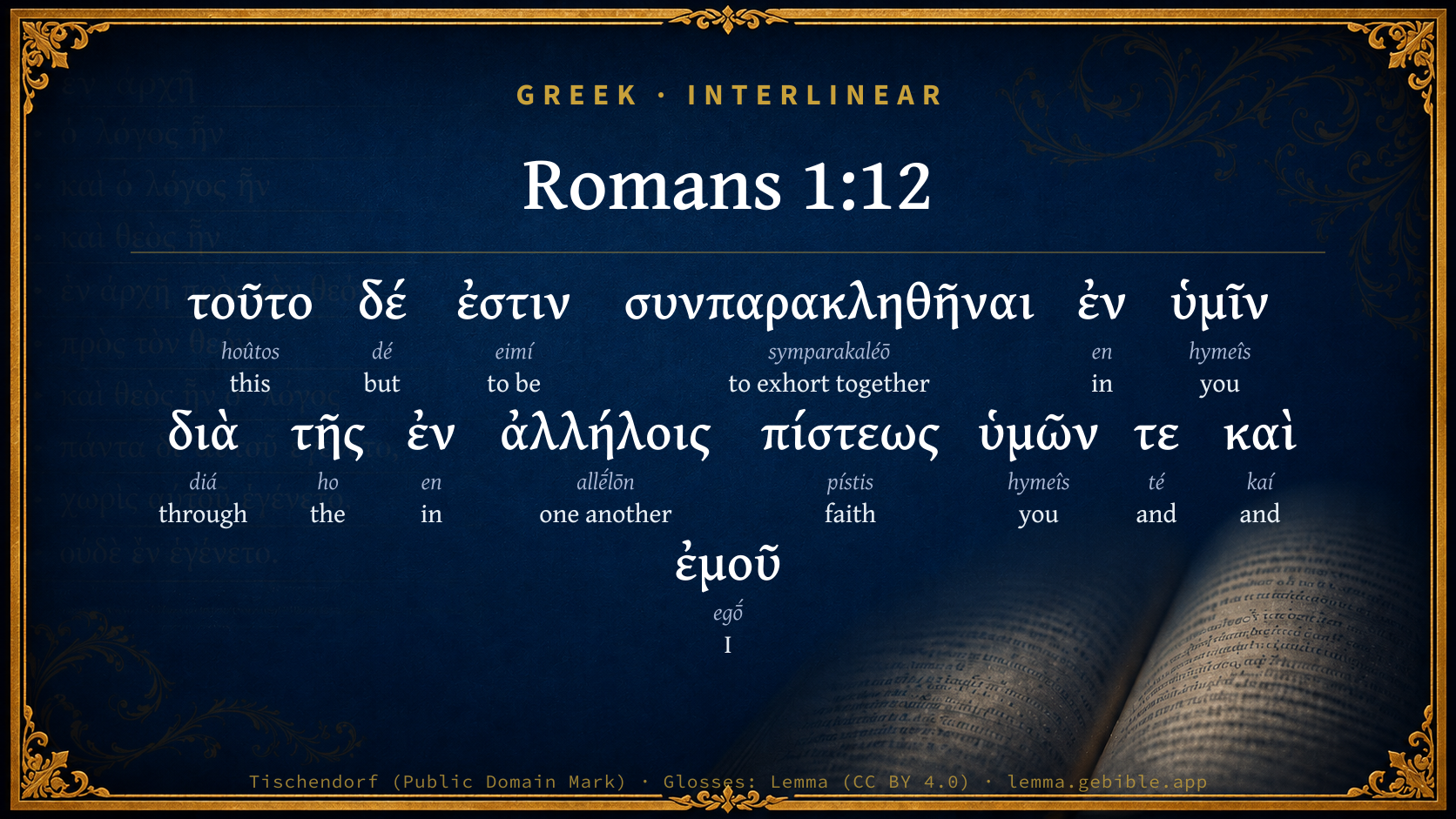
Greek (Tischendorf 8th ed.) Romans 1:12 appears in the Greek New Testament. The text above is from the Tischendorf 8th edition. Each word links to its Strong’s number and a concise gloss. Click any word for its full Thayer’s Greek Lexicon entry.
Download image
Cite this verse

Romans 1:12 (World English Bible). Public Domain. Lemma interlinear Bible study tool, https://lemma.gebible.app/v/romans/1/12.

Show BibTeX & RIS
BibTeX
RIS
English Translation
that is, that I with you may be encouraged in you, each of us by the other's faith, both yours and mine.
World English Bible · Public Domain
Highlights
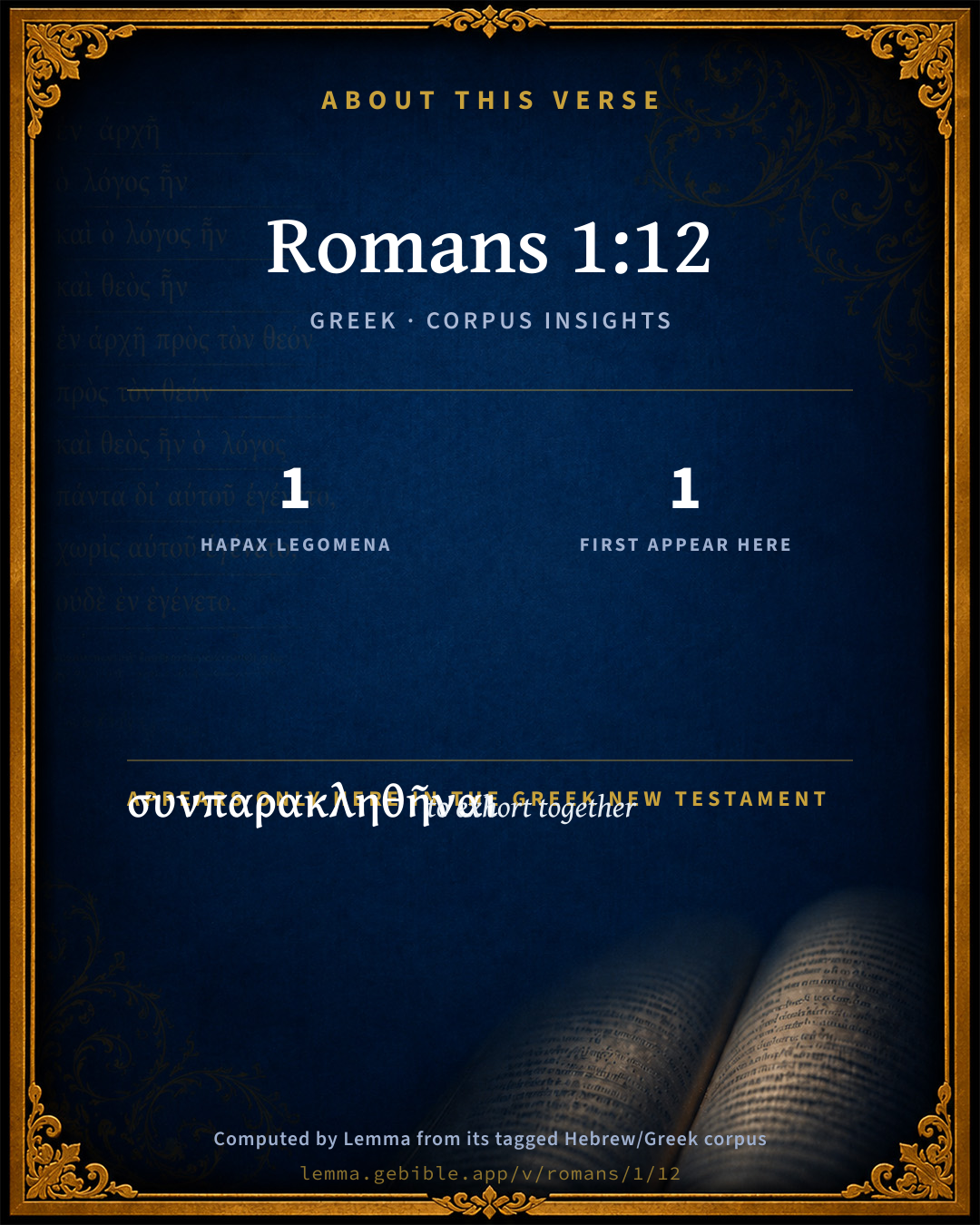
  • 1 hapax legomenon — only here in the Greek New Testament
  • 1 first appearance in the Greek New Testament
Full analysis ↓
Download a study sheet

One document with this verse’s original text, its word-by-word gloss line, the meaning frame, cross-references with their text, attributed commentary, and full source and license credits — printable, and it pastes into notes with its structure intact.

This verse Autodidact and up

Study sheet (.html) Plain text (.txt)

A passage Seminary Student

Up to 50 verses in one chapter. A passage sheet keeps up to 6 commentary sources and 12 cross-references per verse, in the order this page ranks them, and says so on the sheet whenever that leaves anything out. Ask for a single verse and you get the Autodidact verse sheet above.

Everything on this page stays free to read, with no account — the sheet is a download of what is already on screen, not access to it.

Want to remove ads? Support Godless Engineer
Compare translations 3

The same verse in 3 English versions, stacked beneath the original-language interlinear above. Click any original word for its lexicon entry.

Each is an independent rendering of the whole verse — the interlinear is not word-aligned to these translations.

Highlighted words mark where these versions differ — a whole-verse word diff, not a word-by-word alignment.

  • World English Bible Public Domain
    that is, that I with you may be encouraged in you, each of us by the other's faith, both yours and mine.
  • King James Version Public Domain
    That is, that I may be comforted together with you by the mutual faith both of you and me.
  • unfoldingWord Literal Text CC BY-SA 4.0
    and that is to be mutually encouraged with you through each other’s faith, both yours and mine.

unfoldingWord Literal Text — © unfoldingWord, licensed CC BY-SA 4.0. Word-aligned USFM3 via Door43 (git.door43.org/unfoldingWord/en_ult).

Versions to compare (up to 4)

3 of 4 selected

Show all 19 translations

Every available English version of this verse, each an independent rendering of the whole verse.

  • World English Bible Public Domain
    that is, that I with you may be encouraged in you, each of us by the other's faith, both yours and mine.
  • Berean Standard Bible Public Domain
    that is, that you and I may be mutually encouraged by each other’s faith.
  • Majority Standard Bible Public Domain
    that is, that you and I may be mutually encouraged by each other’s faith.
  • King James Version Public Domain
    That is, that I may be comforted together with you by the mutual faith both of you and me.
  • American Standard Version (1901) Public Domain
    that is, that I with you may be comforted in you, each of us by the other's faith, both yours and mine.
  • Revised Version (1885) Public Domain
    that is, that I with you may be comforted in you, each of us by the other’s faith, both yours and mine.
  • Geneva Bible (1599) Public Domain
    That is, that I might be comforted together with you, through our mutuall faith, both yours and mine.
  • Douay-Rheims (1899) Public Domain
    That is to say, that I may be comforted together in you, by that which is common to us both, your faith and mine.
  • Young's Literal Translation Public Domain
    and that is, that I may be comforted together among you, through the faith in one another, both yours and mine.
  • Literal Standard Version CC BY-SA 4.0
    and that is, that I may be comforted together among you, through faith in one another, both yours and mine.
  • Unlocked Literal Bible CC BY-SA 4.0
    That is, I long to be mutually encouraged among you, through each other's faith, yours and mine.
  • unfoldingWord Literal Text CC BY-SA 4.0
    and that is to be mutually encouraged with you through each other’s faith, both yours and mine.
  • Darby Bible Public Domain
    that is, to have mutual comfort among you, each by the faith [which is] in the other, both yours and mine.
  • World Messianic Bible Public Domain
    that is, that I with you may be encouraged in you, each of us by the other’s faith, both yours and mine.
  • Webster's Bible Public Domain
    That is, that I may be comforted together with you, by the mutual faith both of you and me.
  • Free Bible Version CC BY-SA 4.0
    In this way we can be encouraged together by each others' trust in God, both your trust and mine.
  • Bible in Basic English Public Domain
    That is to say, that all of us may be comforted together by the faith which is in you and in me.
  • Text-Critical English NT CC BY 4.0
    that is, that while I am among you we may be mutually encouraged by each other's faith, both yours and mine.
  • Tyndale New Testament (1534) Public Domain
    that is that I myght have consolacion together with you through the commen fayth which bothe ye and I have.

Literal Standard Version (2020), Covenant Press — licensed CC BY-SA 4.0. Text via the HelloAO Bible API (eBible.org). Unlocked Literal Bible (unfoldingWord) — licensed CC BY-SA 4.0. Text via the HelloAO Bible API (eBible.org). unfoldingWord Literal Text — © unfoldingWord, licensed CC BY-SA 4.0. Word-aligned USFM3 via Door43 (git.door43.org/unfoldingWord/en_ult). Free Bible Version, Dr. Jonathan Gallagher — licensed CC BY-SA 4.0. Text via the HelloAO Bible API (eBible.org).

Word by word

More ways to search: Search by grammar → Find every occurrence → Compare this word →

Practice this passage: Drill this verse → Learn its vocabulary →

συνπαρακληθῆναι
symparakaléō
G4837
“to exhort together”
Verb, Aorist, Passive, Infinitive
Part of Speech
Verb
Tense
Aorist
Voice
Passive
Mood
Infinitive
Full Thayer's Definition

Origin: from G4862 and G3870

TDNT: None

1. to call upon or invite or exhort at the same time or together 2. to strengthen (comfort) with others
  1. τοῦτο hoûtos G3778 “this” Demonstrative pronoun, Nominative, Singular, Neuter
  2. δέ dé G1161 “but” Conjunction
  3. ἐστιν eimí G1510 “to be” Verb, Present, Active, Indicative, 3rd person, Singular
  4. ἐν en G1722 “in” Preposition
  5. ὑμῖν hymeîs G5210 “you” Personal pronoun, 2nd person, Dative, Plural
  6. διὰ diá G1223 “through” Preposition
  7. τῆς ho G3588 “the” Article, Genitive, Singular, Feminine
  8. ἐν en G1722 “in” Preposition
  9. ἀλλήλοις allḗlōn G240 “one another” Reciprocal pronoun, Dative, Plural, Masculine
  10. πίστεως pístis G4102 “faith” Noun, Genitive, Singular, Feminine
  11. ὑμῶν hymeîs G5210 “you” Personal pronoun, 2nd person, Genitive, Plural
  12. τε té G5037 “and” Particle
  13. καὶ kaí G2532 “and” Conjunction
  14. ἐμοῦ egṓ G1473 “I” Personal pronoun, 1st person, Genitive, Singular

About this verse

These counts appear in no published source. They are computed here, from the morphology-tagged text and Lemma’s own curated glosses. What Lemma adds →

15
words
13
distinct lemmas
Pauline Epistles
section

Notable vocabulary

1 hapax legomenon — a word that appears only here in the entire Greek New Testament:

  • συνπαρακληθῆναι to exhort together G4837

First appearance in Scripture

This word makes its first canonical appearance in the Greek New Testament here:

  • συνπαρακληθῆναι to exhort together G4837

Repetition

Words recur within this verse:

Cross-references

10

Topical passages linked to Romans 1:12 in the Treasury of Scripture Knowledge — connected by theme and wording, ordered by reader-vote popularity; previews shown in the World English Bible.

  • 1 Thessalonians 3:7–10 for this cause, brothers, we were comforted over you in all our distress and affliction through your faith.
  • 3 John 1:3–4 For I rejoiced greatly, when brothers came and testified about your truth, even as you walk in truth.
  • 2 Corinthians 7:4–7 Great is my boldness of speech toward you. Great is my boasting on your behalf. I am filled with comfort. I overflow with joy in all our affliction.
  • 2 Corinthians 7:13 Therefore we have been comforted. In our comfort we rejoiced the more exceedingly for the joy of Titus, because his spirit has been refreshed by you all.
  • Titus 1:4 to Titus, my true child according to a common faith: Grace, mercy, and peace from God the Father and the Lord Jesus Christ our Savior.
  • 2 Peter 1:1 Simon Peter, a servant and apostle of Jesus Christ, to those who have obtained a like precious faith with us in the righteousness of our God and Savior, Jesus Christ:
  • Acts 11:23 who, when he had come, and had seen the grace of God, was glad. He exhorted them all, that with purpose of heart they should remain near to the Lord.
  • Romans 15:32 that I may come to you in joy through the will of God, and together with you, find rest.
  • 2 Corinthians 2:1–3 But I determined this for myself, that I would not come to you again in sorrow.
  • 1 Thessalonians 2:17–20 But we, brothers, being bereaved of you for a short season, in presence, not in heart, tried even harder to see your face with great desire,

Cross-references courtesy of OpenBible.info (CC BY 4.0).

Commentary

Notes on Romans 1:12 from classic Christian and Jewish commentators (each source and its license shown beneath its notes). The classic Christian expositions comment on the surrounding passage and are grouped to its opening verse, so a note may address several verses; the Jewish commentaries on the Tanakh (Rashi and others) are per-verse, so they appear only where the commentator wrote on this verse.

Lemma curates 59 commentaries, every one of them public domain or Creative Commons licensed, each selected and text-cleaned for this edition rather than reprinted as found. About our sources →

Trapp's Complete Commentary

John Trapp

12 That is, that I may be comforted together with you by the mutual faith both of you and me.

Ver. 12. That I may be comforted] Or, exhorted, Ad communem exhortationem percipiendam, saith Beza out of Bucer, and others. The meanest of Christ’s members may contribute somewhat to the edifying even of an apostle, 2Jn 1:12. That favourite of Christ would be furthered and quickened by the graces of a woman. Now when such grandees in grace have benefit by communion of saints, how much more may they whose measures are less! The very angels know not so much but they would know more, Eph 3:10; 1Pe 1:12.

John Trapp, A Commentary or Exposition upon All the Books of the Old and New Testament (1647–1656) — public domain. Text from a community e-Sword module.

Matthew Poole's English Annotations

This is added to qualify what he had said before, lest he should seem to arrogate too much to himself; he tells them, he hoped not only to comfort them, but to be comforted by them. The meanest of Christ’s members may contribute somewhat to the edifying even of an apostle. The apostle John did hope to be quickened and comforted by the graces of a woman and her children, 2Jo 1:12. Great is the benefit of the communion of saints.

By the mutual faith both of you and me; i.e. by the faith which you and I have in Jesus Christ; which he elsewhere calls the common faith, and the faith of God’s elect. All true comfort springs from faith.

Matthew Poole's English Annotations on the Holy Bible (1683–1685) — public domain. Text from a community e-Sword/MySword module.

Bengel's Gnomon

Johann Albrecht Bengel

Rom 1:12. Τοῦτο δέ ἐστι, Moreover, that is) He explains the words, to see you, etc. He does not say, Moreover, that is, that I may bring you into the form of a regularly constituted church. Precaution was taken [by Divine foresight] lest the Church of Rome should be the occasion of any mischief, which nevertheless arose in after-times.—ὑμῶν τε καῖ ἐμο͂υ, both of you and me) He not only associates with himself the Romans, together with whom he longs to be comforted [or stirred up together with whom], but he even puts them first in the order of words, before himself. The style of the apostle is widely different from that of the Papal court at Rome.

Bengel's Gnomon of the New Testament — English translation (T&T Clark, Edinburgh, 1860) — public domain. Text from a community e-Sword module.

Meyer's Critical & Exegetical Commentary

Heinrich August Wilhelm Meyer

Rom_1:12. Τοῦτο δέ ἐστι] This, however, which I have just designated as my longing (namely, ἰδεῖν ὑμᾶς, ἵνα … στηριχθ. ὑμᾶς) means, thereby I intend to say nothing else than, etc. By this modifying explanation, subjoined with humility, and expressed in a delicate complimentary manner (Erasmus puts the matter too strongly, pia vafrities et sancta adulatio), Paul guards himself, in presence of a church to which he was still a stranger, from the possible appearance of presumption and of forming too low an estimate of the Christian standpoint of his readers.[367]

ΣΥΜΠΑΡΑΚΛΗΘῆΝΑΙ] must be understood not, with the Peschito, Vulgate, Valla, Erasmus, Luther, Piscator, de Dieu, and many others, including Koppe and Ewald, in the sense of comfort or of refreshment (Castalio, Grotius, Cramer, Rosenmüller, Böhme)which it would be necessary that the context should call for, as in 1Th_3:2; 2Th_2:17, but which it here forbids by the general ἰδεῖν ὑμᾶς, ἱνα Κ.Τ.Λ[368]but in the quite general sense of Christian encouragement and quickening. The συμ.however is not to be explained by ὑμᾶς καὶ ἐμαυτόν; on the contrary, the ἐν ὑμῖν renders it necessary that Paul alone should be conceived as the subject of συμπαρακληθῆναι. He desires to be quickened among the Romans (ἐν ὑμῖν) at the same time with them, and this by the faith common to both, theirs and his, which should mutually act and react in the way of the Christian sympathy that is based on specific harmony of faith. That the readers are not the subject of the συμπαρακλ. (Fritzsche, van Hengel) is certain from ἐν ὑμῖν, which, if it meant in animis vestris (van Hengel), would be a perfectly superfluous addition.

The compound συμπαρακλ. occurs only here in the N. T., and is not found in the LXX. or Apocr.; but see Plat. Rep. p. 555 A; and Polyb. v. 83, 3.

ἡ ἐν ἀλλήλοις πίστις, more significant of the hearty character of the faith than ἡ ἀλλήλων πίστις, is the faith of both viewed in its mutual identity, so that the faith which lives in the one lives also in the other.

ὑμῶν τε καὶ ἐμοῦ] placed in this order with delicate tact.

[367] The delicate turn which he gives to the matter is this: to see you, in order that I, etc., means nothing more than to be quickened along with and among you, etc. Consequently συμπαρακλ. is parallel to the ἰδεῖν; for both infinitives must have the same subject. If συμπαρακλ. κ.τ.λ. had been meant to be merely a delicate explanation of στηριχθῆναι ὑμᾶς (the usual exposition after Chrysostom), then ἐμέ must necessarily have been added to συμπαρακλ. Grotius aptly says: συμπαρακλ. regitur ab ἐπιποθῶ. The true interpretation is given also by Bengel and Th. Schott; comp. Olshausen. Ewald, and Hofmann, who erroneously imputes to me the common view.

[368] .τ.λ. καὶ τὰ λοιπά.

Meyer — Critical and Exegetical Commentary on the New Testament — English translation by Peter Christie, edited by Frederick Crombie (T&T Clark, 1880) — public domain. Text from a community e-Sword module.

Expositor's Greek Testament

ed. W. Robertson Nicoll

Rom 1:12 . τοῦτο δὲ ἐστιν : an explanatory correction. Paul disclaims being in a position in which all the giving must be on his side. When he is among them ( ἐν ὑμῖν ) his desire is that he may be cheered and strengthened with them (the subject of συνπαρακληθῆναι must be ἐμὲ in the first instance, though widening, as the sentence goes on, into ἡμᾶς ) by the faith which both they and he possess ( ὑμῶν τε καὶ ἐμοῦ ), and which each recognises in the other ( ἐν ἀλλήλοις ). The ἐν here is to be taken as in 2Ti 1:5 .

The Expositor's Greek Testament, edited by W. Robertson Nicoll (1897–1910) — public domain. Text from a community e-Sword module.

Hodge's Commentary on Romans, Ephesians & First Corinthians

Charles Hodge

Rom_1:12

That is, that I may be comforted among you. This is obviously intended to be an explanation or correction of what precedes. He had desired to see them, in order that he might do them good; but this was not his whole object, he hoped to receive benefit himself. As to the grammatical construction, the infinite συμπαρακληθῆναι may depend on στηριχθῆναι. The sense would then be, That you may be strengthened, that I may be comforted. Or the one infinitive is coordinate with the other; then both depend on the ἵνα μεταδῶ of Rom_1:11, That I may impart some spiritual gift to you, in order that you may be strengthened; that is, that I may be comforted together with you. This seems the most natural construction; yet as Paul expected to be refreshed by their faith and not by his giving them spiritual gifts, the sense seems to require that συμπαρακληθῆναι should depend on the first words of Rom_1:11, I desire to see you, that I may impart (ἵνα μεταδῶ) some spiritual gift to you; that is, that I may be comforted (συμπαρακληθῆναι), etc. It is not a valid objection to this interpretation, that it supposes a change of the construction from the subjunctive to the infinitive. A similar change occurs (probably) in Rom_9:22, Rom_9:23; and much greater irregularities are not unfrequent in the New Testament.

The word παρακαλέω is used in such various senses, that it is not easy to determine what precise meaning should be attached to it here. It signifies to call near, to invite, Act_28:20 to call upon, and more generally to address, either for instruction, admonition, exhortation, confirmation, or consolation. Our translators and the majority of commentators choose the last mentioned sense, and render συμπαρακληθῆναι(ἐμέ) that I may be comforted. This is probably too narrow. The word expresses all that excitement and strengthening of faith and pious feeling, as well as consolation, which is wont to flow from the communion of saints. This appears from the context, and especially from the following clause, διὰ τῆς ἐν ἀλλήλοις πίστεως, ὑμῶν τε καὶ ἐμοῦ, through our mutual faith, as well yours as mine. The faith of the Romans would not only comfort, but strengthen the apostle; and his faith could not fail to produce a like effect on them. Βν τε καὶ ἐμοῦ are the explanation of the preceding ἐν ἀλλήλοις, and should therefore be in the dative. Fritzsche refers to Luk_1:55 for a similar case of variation in the construction.

Charles Hodge — Commentary on Romans (1835), First Corinthians (1857), and Ephesians (1856) — public domain. Text from a community e-Sword module.

Geneva Bible (1599)

Geneva Bible translators

Though Paul were never so excellent, yet by teaching the Church, he might be instructed by it.

Geneva Bible (1599) marginal notes — public domain. Text via Bolls.life.

Jamieson, Fausset & Brown

Robert Jamieson, A. R. Fausset & David Brown

That is, that I may be comforted together with you by the mutual faith both of you and me--"Not wishing to "lord it over their faith," but rather to be a "helper of their joy," the apostle corrects his former expressions: my desire is to instruct you and do you good, that is, for us to instruct and do one another good: in giving I shall also receive" [JOWETT]. "Nor is he insincere in so speaking, for there is none so poor in the Church of Christ who may not impart to us something of value: it is only our malignity and pride that hinder us from gathering such fruit from every quarter" [CALVIN]. How "widely different is the apostolic style from that of the court of Papal Rome!" [BENGEL].

Jamieson, Fausset & Brown — Commentary Critical and Explanatory on the Whole Bible (1871) — public domain (CC PDM 1.0). Text via the HelloAO Bible API.

Adam Clarke's Commentary

Verse 12. That I may be comforted together with you] He here, with great address, intimates that he longs for this opportunity, as well on his own account as on theirs, and to show them that he arrogates nothing to himself; for he intimates that it will require the conjoint action of their faith as well as his own, to be the means of receiving those blessings from God to which he refers.

Adam Clarke's Commentary on the Bible (1810–1826) — public domain. Text from a community e-Sword/MySword module.

John Calvin's Commentaries

12. Being not satisfied with this modest statement, he qualifies it, and shows, that he did not so occupy the place of a teacher, but that he wished to learn also from them; as though he said, “I desire so to confirm you according to the measure of grace conferred on me, that your example may also add courage (alacritatem — alacrity) to my faith, and that we may thus mutually benefit one another.”

See to what degree of modesty his pious heart submitted itself, so that he disdained not to seek confirmation from unexperienced beginners: nor did he speak dissemblingly, for there is no one so void of gifts in the Church of Christ, who is not able to contribute something to our benefit: but we are hindered by our envy and by our pride from gathering such fruit from one another. Such is our high-mindedness, such is the inebriety produced by vain reputation, that despising and disregarding others, every one thinks that he possesses what is abundantly sufficient for himself. I prefer to read with Bucer, exhortation (exhortationem — encouragement) rather than consolatim; for it agrees better with the former part.

John Calvin's Commentaries (1540-1563) — public domain. Text from the Calvin Translation Society English edition (1840s-50s) via the Christian Classics Ethereal Library (ccel.org). Calvin's coverage is partial (roughly two-thirds of the Bible); uncommented books and verses are honest gaps, never fabricated. The 19th-century editor's footnotes and remarks are omitted so the notes are faithfully Calvin's own voice.

Ellicott's Commentary for English Readers

(12) That is, that I may be comforted.—A beautiful touch of true courtesy. He is anxious to see them, that he may impart to them some spiritual gift. But no! He hastily draws back and corrects himself. He does not wish it to be implied that it is for him only to impart, and for them only to receive. He will not assume any such air of superiority. In the impulse of the moment, and in the expansiveness of his own heart, he had seemed to put it so; but his real meaning was that they should receive mutual comfort and edification.

Strictly, the idea of mutual comfort is drawn from the two verses combined, not from this singly. In the last verse the Romans were the subject: “That ye may be established.” Here St. Paul himself is the subject: “That I may be comforted.”

Comforted.—The Greek word has rather more of the sense of our “encouraged,” though the idea of “comfort” is also contained in it. It is a similar word to that which is translated “comforter” in several passages in John 14, 15, 16 (where see Notes, and Excursus to St. John’s Gospel).

Together with you.—Literally, that I may at the same time be comforted among you; that is, “that I may be comforted at the same time that you are comforted, by my intercourse with you, through that mutual faith which acts and reacts upon each of us.” The Apostle looks to obtain benefit from his intercourse with the Roman Christians. He expects that their faith will help to increase his own.

There is a truth underlying the Apostle’s courtesy which is not mere compliment. The most advanced Christian will receive something from the humblest. There are very few men whose “spirits are not finely touched” somewhere; and St. Paul was conscious that even an Apostle might not be equally strong at every point.

A Bible Commentary for English Readers, edited by Charles John Ellicott (1878–1897) — public domain. Text from a community e-Sword module.

The Cambridge Bible for Schools and Colleges

gen. ed. J. J. S. Perowne

12. that is, that I may be comforted together, &c.] We have here St Paul’s fine tact, to use a word “soiled by ignoble use,” because sometimes associated with insincerity. The tact of the Apostle is only an exquisite combination of sympathy and judgment; he speaks the true word, in the right place, and from the heart. It would be shallow criticism indeed which would see here only an ingenious religious compliment. To the sincere Christian teacher nothing is more real than the reflex aid he receives among Christian learners[32].

[32] See Introduction, i. § 33, note.

with you] Better, in you; among you; “that I may share consolation among you.”

by the mutual faith] Lit. the faith which is in one another; a pregnant phrase; q. d., “the faith which dwells in each, and which each manifests to the other.”

The Cambridge Bible for Schools and Colleges (gen. ed. J. J. S. Perowne; Cambridge University Press, 1878–1918) — public domain. Text from a community e-Sword module.

John Gill's Exposition

That is, that I may be comforted together with you,.... This is a further explanation of his view, in being desirous of coming to them, and preaching: the Gospel among them; for what makes for establishment, makes for comfort; and what makes for comfort, makes for establishment; and when souls are established, ministers are comforted as well as they; and whilst ministers are imparting their spiritual gifts for the use of others, they themselves are sometimes comforted of God in their work, and particularly when they find there is an agreement between their doctrine, and the experience of the saints:

by the mutual faith both of you and me. The grace of faith is the same in all the saints, and so is the doctrine of it, as dispensed by Christ's faithful ministers, and experimentally received and embraced by his people; the consideration of which has a very great influence on the comfort and establishment of each other; nor are any so perfect, but they may receive benefit from others, even though inferior to them.

John Gill's Exposition of the Whole Bible (1746–1763) — public domain (CC PDM 1.0). Text via the HelloAO Bible API.

Albert Barnes' Notes on the Bible

That I may be comforted ... - It was not merely to confirm them that Paul wished to come. He sought the communion of saints; he expected to be himself edified and strengthened; and to be comforted by seeing their strength of faith, and their rapid growth in grace. We may remark here,

(1) That one effect of religion is to produce the desire of the communion of saints. It is the nature of Christianity to seek the society of those who are the friends of Christ.

(2) Nothing is better suited to produce growth in grace than such communion. Every Christian should have one or more Christian friends to whom he may unbosom himself. No small part of the difficulties which young Christians experience would vanish, if they should communicate their feelings and views to others. Feelings which they suppose no Christians ever had, which greatly distress them, they will find are common among those who are experienced in the Christian life.

(3) There is nothing better suited to excite the feelings, and confirm the hopes of Christian ministers, than the firm faith of young converts, of those just commencing the Christian life, 3Jo 1:4.

(4) The apostle did not disdain to be taught by the humblest Christians. He expected to be strengthened himself by the faith of those just beginning the Christian life. “There is none so poor in the church of Christ, that he cannot make some addition of importance to our stores,” Calvin.

Albert Barnes' Notes on the Bible (1834–1885) — public domain. Text from a community e-Sword/MySword module.

Whedon's Commentary on the Bible

Daniel D. Whedon

12. That is—Lest the reason last given might sound too patronizing, as if the apostle’s visit were a favour from his own side solely, he now explains by giving a reason of a mutual nature.

Daniel D. Whedon (gen. ed.), Commentary on the Old and New Testaments (1874–1909) — public domain. Text from a community e-Sword module.

The Pulpit Commentary

That is, that I with you may be comforted in you, each of us by each other"s faith, yours and mine. The spirit of delicate courtesy here evinced, in addressing persons over whom one loss of a Christian gentleman than St. Paul was might have assumed a lordly tone, is apparent elsewhere in his Epistles, (cf. Rom_15:15 Rom_16:19 2Co_2:3 2Co_3:1 2Co_8:8 2Co_9:2) and especially the whole Epistle to Philemon.

The Pulpit Commentary (1880–1919), ed. H.D.M. Spence-Jones & Joseph S. Exell — public domain. Text from a community e-Sword module.

John Wesley's Explanatory Notes

That is, I long to be comforted by the mutual faith both of you and me - He not only associates the Roman with, but even prefers them before, himself. How different is this style of the apostle from that of the modern court of Rome!

John Wesley, Explanatory Notes Upon the Whole Bible (1754–1765) — public domain. Text via the GEBible commentary corpus.

Godbey's Commentary on the New Testament

William B. Godbey

12. “But this is the consolation among you through the faith in one another, both of you and me.” While God is the only object of faith, yet in a subjective sense the faith of the saints mutually cooperates, developing reciprocal invigoration, intensification and augmentation.

William B. Godbey, Commentary on the New Testament (1896–1900) — public domain. Text from a community e-Sword module.

McGarvey & Pendleton's Commentaries

J. W. McGarvey

that is, that I with you may be comforted in you, each of us by the other's faith, both yours and mine . [Paul here sets forth the reason why he so earnestly desired to visit the church at Rome; it was because he wished to enjoy the blessedness both of giving and receiving. Spiritual gifts are those wrought by the Holy Spirit, and of these Paul had two kinds to bestow: 1, extraordinary or miraculous, and 2, ordinary, or those pertaining to the Christian graces. No doubt he had the bestowal of both of these gifts in mind, for no apostle had yet visited the church to bestow the former, and, from the list of gifts recorded at Rom_12:6-8 ; it appears that that of prophecy was the only miraculous one they possessed; and the context, especially verse 12, indicates that the latter, or ordinary gifts, were also in his thoughts. Because their faiths were essentially the same, Paul here acknowledges the ability of all disciples, even the humblest, to comfort, i. e., to encourage and help him by a strengthening of his faith; because their steadfastness would react on him. Gifts, whether of a miraculous nature, or merely graces, tended to establish or strengthen the church.]

J. W. McGarvey (with Philip Y. Pendleton), Commentaries on the New Testament (The Fourfold Gospel, 1914; Acts; and the epistles) — public domain. Text from a community e-Sword/MySword module.

The People's New Testament

B. W. Johnson

12. That is. Such a result would minister to the mutual comfort of Paul and the church. If they are established, he will be comforted in them. The idea is that his faith will be a comfort and strength to them, and he will be encouraged and strengthened by their faith. Thus they will be mutual helpers. How different the humble apostolic style of address from that of a Roman bishop!

B. W. Johnson's The People's New Testament with Notes (1889–1891) — public domain. Electronic text from the Christian Classics Ethereal Library (CCEL) ThML edition.

Cambridge Greek Testament for Schools and Colleges

12. συνπαρ., only here. ἐν (cf. ἐπί, 2Co 7:7), no |[65], = in my feelings about you.

[65] | parallel to

διὰ τῆς ἐν ἀλλήλοις κ.τ.λ. πίστις has its regular meaning, faith in GOD through Christ, ἐν ἀλλ., which we each find in the other: he piles up phrases to emphasise the reciprocity of benefit (συν., ἐν ἀλλ., ὑ. κ. ἐ.).

Cambridge Greek Testament for Schools and Colleges (Cambridge University Press, 1896; 21 vols, various authors incl. Carr, Maclear, Plummer, Farrar, Lumby, Moule, M. R. James, Simcox) — public domain. Text from a community e-Sword module.

Alford’s Greek Testament

Henry Alford

12.] εἶτα ἐπειδὴ καὶ τοῦτο σφόδρα φορτικὸν ἦν, ὅρα πῶς αὐτὸ παραμυθεῖται διὰ τῆς ἐπαγωγῆς. ἵνα γὰρ μὴ λέγωσι, τί γάρ; σαλευόμεθα καὶ περιφερόμεθα, καὶ τῆς παρὰ σοῦ δεόμεθα γλώττης εἰς τὸ στῆναι βεβαίως, προλαβὼν ἀναιρεῖ τὴν τοιαύτην ἀντίῤῥησιν οὕτω λέγων (ver. 12). ὡς ἂν εἰ ἔλεγε, μὴ ὑποπτεύσητε ὅτι κατηγορῶν ὑμῶν εἶπον, οὐ ταύτῃ τῇ γνώμῃ ἐφθεγξάμην τὸ ῥῆμα· ἀλλὰ τί ποτέ ἐστιν, ὅπερ ἠβουλήθην εἰπεῖν; Πολλὰς ὑπομένετε θλίψεις ὑπὸ τῶν διωκόντων περιαντλούμενοι· ἐπεθύμησα τοίνυν ὑμᾶς ἰδεῖν, ἵνα παρακαλέσω, μᾶλλον δὲ οὐχ ἵνα παρακαλέσω μόνον, ἀλλʼ ἵνα καὶ αὐτὸς παράκλησιν δέξωμαι. Chrys. Hom. ii. p. 440. The inf. συμπαρακληθῆναι is parallel with στηριχθῆναι, ἐμέ being understood: that is, that I with you may be comforted among you, each by the faith which is in the other. That the gift he wished to impart to them was παράκλησις, is implied in the συνπαρακλ. See the same wish expressed in different words ch. 15:32, and the partial realization of it, Act 28:15.

ἐν ἀλλήλοις, which might otherwise be ambiguous, is explained by ὑμῶν τε καὶ ἐμοῦ to mean which we recognize in one another: or as above and in A. V. R. The expression “mutual faith,” of the E. V. should properly mean, faith which each has in the other.

πίστις is used in the most general sense—faith as the necessary condition and working instrument of all Christian exhortation, comfort, and confirmation; producing these, and evidenced by them.

Henry Alford, The Greek Testament (1849–1861) — public domain. Text from a community e-Sword module.

International Critical Commentary

12. συμπαρακληθῆναι: the subject is ἐμέ, which, from the συν- in συμπαρακλ. and ἐν ὑμῖν, is treated in the latter part of the sentence as equivalent to ἡμεῖς. We note of course the delicacy with which the Apostle suddenly checks himself in the expression of his desire to impart from his own fulness to the Roman Christians: he will not assume any airs of superiority, but meets them frankly upon their own level: if he has anything to confer upon them they in turn will confer an equivalent upon him.

International Critical Commentary — older volumes (1896–1929), various authors — public domain. Text from a community e-Sword module.

Vincent's Word Studies in the New Testament

Marvin R. Vincent

That is [τουου δε εστιν] . The A. V. and Rev. omit de however, thus losing an important shade of meaning. That is is not merely an explanatory repetition of the preceding phrase, but modifies the idea contained in it. It is a modest and delicate explanation, by which Paul guards himself against the possible appearance of underestimating the christian standpoint of his readers, to whom he was still, personally, a stranger. Hence he would say : "I desire to impart some spiritual gift that you may be strengthened, not that I would imply a reproach of weakness or instability; but that I desire for you the strengthening of which I stand in need along with you, and which I hope may be wrought in us both by our personal intercourse and our mutual faith."

Marvin R. Vincent, Word Studies in the New Testament (1887–1900) — public domain. Text from a community e-Sword/MySword module.

Lesson kit

Teaching starters — assembled from the data on this page, not authored interpretation. Every prompt links to the verse data it draws on. Edit before teaching.

Romans, in the Pauline Epistles, opens this verse with 15 words (13 distinct Greek lemmas). Its most distinctive word is symparakaléō (“to exhort together”). A historical commentator’s framing appears above. Read the whole chapter for the surrounding context.

Discussion questions

  1. What does “to exhort together” (symparakaléō) contribute to the verse as a whole?
  2. This verse holds 1 word here found nowhere else in the Greek New Testament. What might the rare word draw attention to?
  3. The word “to exhort together” first appears here in Scripture. What is being introduced at this debut?
  4. 1 Thessalonians 3:7–10 shares this passage’s theme. How do the two illuminate each other?
  5. “in” occurs 2× in this one verse. What is the effect of the repetition?
  6. The translations on this page render this verse differently — a whole-verse word diff, not a word-by-word alignment. What might account for the different wordings?
  7. Reading how Trapp's Complete Commentary and Matthew Poole's English Annotations read this verse, where do the two commentators agree and where do they part?

Things to notice

  • 1 word in this verse appears nowhere else in the Greek New Testament.
  • 1 word makes its first canonical appearance in Scripture here.
  • These translations choose different wording for 15 words in this verse.
  • “in” occurs 2× in this single verse.
  • 13 distinct Greek lemmas span 15 words in this verse.

Reading settings

Reading text

Shown beneath each verse's original-language words.

Old Testament
Old Testament edition

Read the OT as the Masoretic Hebrew (MT) or the Greek Septuagint (LXX).

English shown for the Greek Septuagint (in the Hebrew ↔ Greek comparison).

Comparing translations? Open the Compare panel on any verse page to stack up to four side by side.