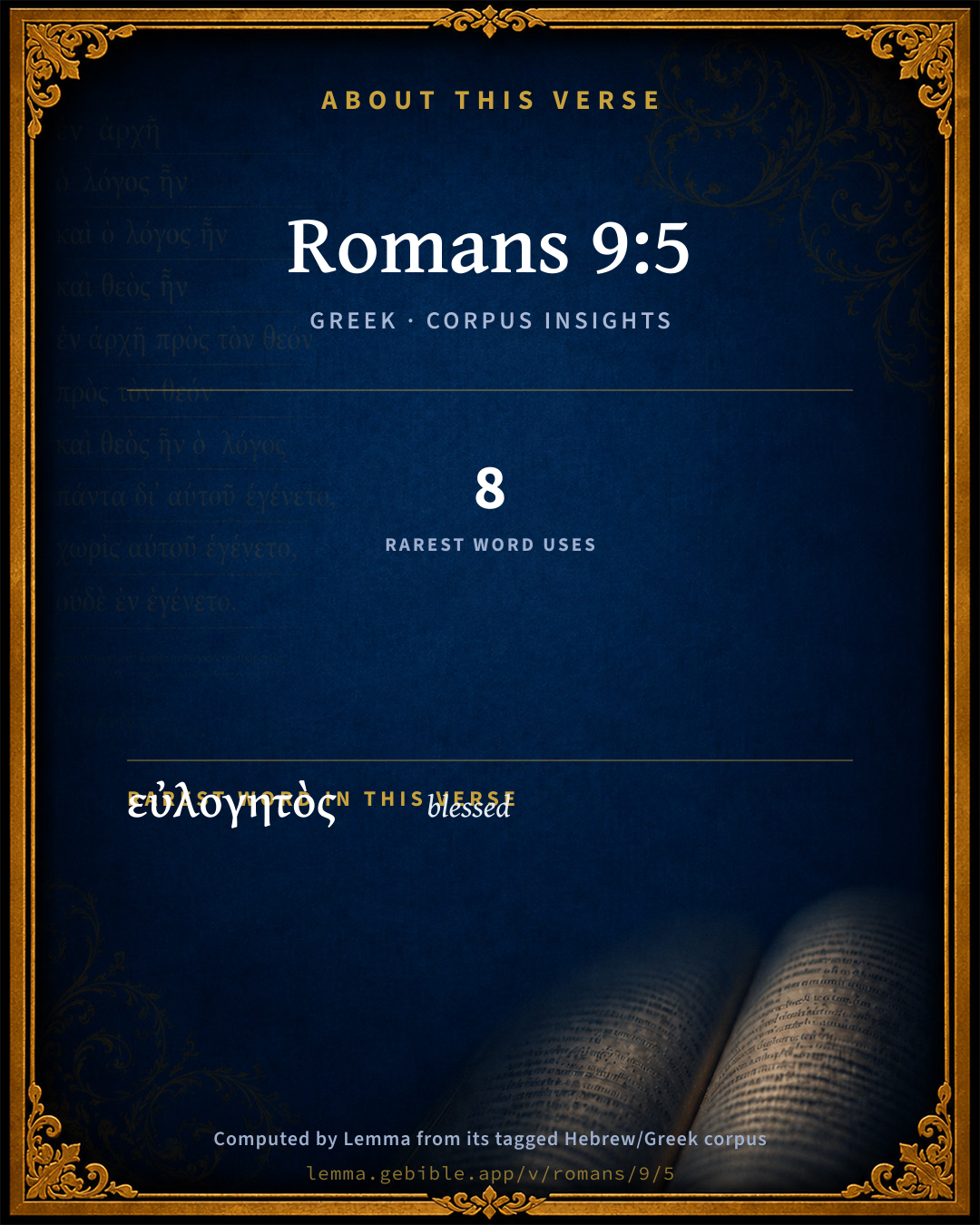
Romans 9:5

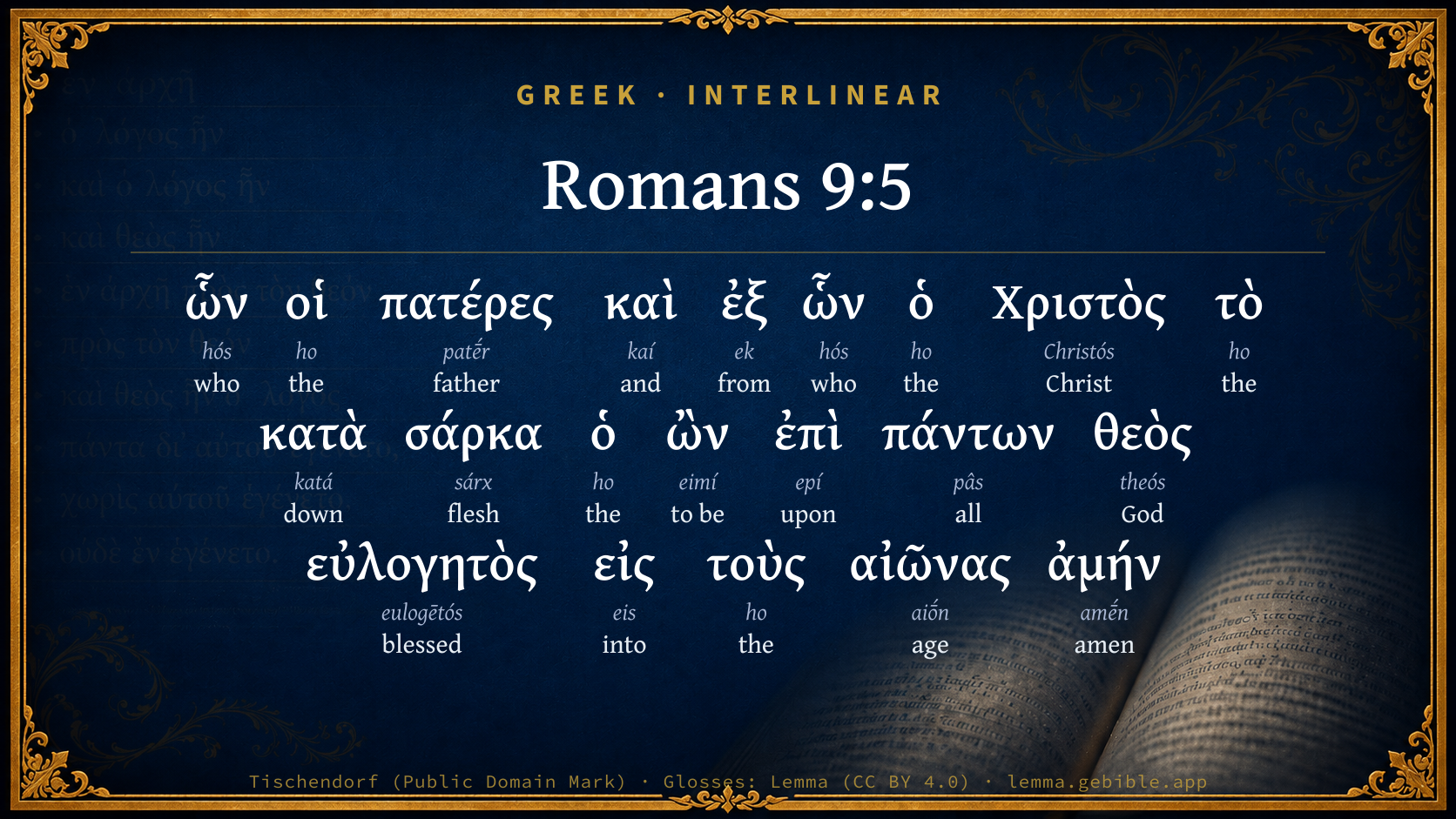
Greek (Tischendorf 8th ed.) Romans 9:5 appears in the Greek New Testament. The text above is from the Tischendorf 8th edition. Each word links to its Strong’s number and a concise gloss. Click any word for its full Thayer’s Greek Lexicon entry.
Download image
Cite this verse

Romans 9:5 (World English Bible). Public Domain. Lemma interlinear Bible study tool, https://lemma.gebible.app/v/romans/9/5.

Show BibTeX & RIS
BibTeX
RIS
English Translation
of whom are the fathers, and from whom is Christ as concerning the flesh, who is over all, God, blessed forever. Amen.
World English Bible · Public Domain
Download a study sheet

One document with this verse’s original text, its word-by-word gloss line, the meaning frame, cross-references with their text, attributed commentary, and full source and license credits — printable, and it pastes into notes with its structure intact.

This verse Autodidact and up

Study sheet (.html) Plain text (.txt)

A passage Seminary Student

Up to 50 verses in one chapter. A passage sheet keeps up to 6 commentary sources and 12 cross-references per verse, in the order this page ranks them, and says so on the sheet whenever that leaves anything out. Ask for a single verse and you get the Autodidact verse sheet above.

Everything on this page stays free to read, with no account — the sheet is a download of what is already on screen, not access to it.

Want to remove ads? Support Godless Engineer
Compare translations 3

The same verse in 3 English versions, stacked beneath the original-language interlinear above. Click any original word for its lexicon entry.

Each is an independent rendering of the whole verse — the interlinear is not word-aligned to these translations.

Highlighted words mark where these versions differ — a whole-verse word diff, not a word-by-word alignment.

  • World English Bible Public Domain
    of whom are the fathers, and from whom is Christ as concerning the flesh, who is over all, God, blessed forever. Amen.
  • King James Version Public Domain
    Whose are the fathers, and of whom as concerning the flesh Christ came, who is over all, God blessed for ever. Amen.
  • unfoldingWord Literal Text CC BY-SA 4.0
    of whom the fathers, and from whom the Christ—(that, according to the flesh)—the one who over all, blessed God to eternity. Amen.

unfoldingWord Literal Text — © unfoldingWord, licensed CC BY-SA 4.0. Word-aligned USFM3 via Door43 (git.door43.org/unfoldingWord/en_ult).

Versions to compare (up to 4)

3 of 4 selected

Show all 18 translations

Every available English version of this verse, each an independent rendering of the whole verse.

  • World English Bible Public Domain
    of whom are the fathers, and from whom is Christ as concerning the flesh, who is over all, God, blessed forever. Amen.
  • Berean Standard Bible Public Domain
    Theirs are the patriarchs, and from them proceeds the human descent of Christ, who is God over all, forever worthy of praise! Amen.
  • Majority Standard Bible Public Domain
    Theirs are the patriarchs, and from them proceeds the human descent of Christ, who is God over all, forever worthy of praise! Amen.
  • King James Version Public Domain
    Whose are the fathers, and of whom as concerning the flesh Christ came, who is over all, God blessed for ever. Amen.
  • American Standard Version (1901) Public Domain
    whose are the fathers, and of whom is Christ as concerning the flesh, who is over all, God blessed for ever. Amen.
  • Revised Version (1885) Public Domain
    whose are the fathers, and of whom is Christ as concerning the flesh, who is over all, God blessed for ever. Amen.
  • Geneva Bible (1599) Public Domain
    Of whome are the fathers, and of whome concerning the flesh, Christ came, who is God ouer all, blessed for euer, Amen.
  • Young's Literal Translation Public Domain
    whose `are' the fathers, and of whom `is' the Christ, according to the flesh, who is over all, God blessed to the ages. Amen.
  • Literal Standard Version CC BY-SA 4.0
    whose [are] the fathers, and of whom [is] the Christ, according to the flesh, who is God over all, blessed for all ages. Amen.
  • Unlocked Literal Bible CC BY-SA 4.0
    Theirs are the ancestors from whom Christ has come with respect to the flesh—he who is God over all. May he be praised forever. Amen.
  • unfoldingWord Literal Text CC BY-SA 4.0
    of whom the fathers, and from whom the Christ—(that, according to the flesh)—the one who over all, blessed God to eternity. Amen.
  • Darby Bible Public Domain
    whose [are] the fathers; and of whom, as according to flesh, [is] the Christ, who is over all, God blessed for ever. Amen.
  • World Messianic Bible Public Domain
    of whom are the fathers, and from whom is Messiah as concerning the flesh, who is over all, God, blessed forever. Amen.
  • Webster's Bible Public Domain
    Whose are the fathers, and from whom according to the flesh, Christ came, who is over all, God blessed for ever. Amen.
  • Free Bible Version CC BY-SA 4.0
    They are our forefathers—ancestors of Christ, humanly-speaking, the one who rules over everything, the eternally-blessed God. Amen.
  • Bible in Basic English Public Domain
    Whose are the fathers, and of whom came Christ in the flesh, who is over all, God, to whom be blessing for ever. So be it.
  • Text-Critical English NT CC BY 4.0
    To them belong the patriarchs, and from them, according to the flesh, came the Christ, who is God over all, blessed forever. Amen.
  • Tyndale New Testament (1534) Public Domain
    whose also are the fathers and they of whome (as concernynge the flesshe) Christ came which is God over all thinges blessed for ever Amen.

Literal Standard Version (2020), Covenant Press — licensed CC BY-SA 4.0. Text via the HelloAO Bible API (eBible.org). Unlocked Literal Bible (unfoldingWord) — licensed CC BY-SA 4.0. Text via the HelloAO Bible API (eBible.org). unfoldingWord Literal Text — © unfoldingWord, licensed CC BY-SA 4.0. Word-aligned USFM3 via Door43 (git.door43.org/unfoldingWord/en_ult). Free Bible Version, Dr. Jonathan Gallagher — licensed CC BY-SA 4.0. Text via the HelloAO Bible API (eBible.org).

Word by word

More ways to search: Search by grammar → Find every occurrence → Compare this word →

Practice this passage: Drill this verse → Learn its vocabulary →

εὐλογητὸς
eulogētós
G2128
“blessed”
Adjective, Nominative, Singular, Masculine
Part of Speech
Adjective
Case
Nominative
Number
Singular
Gender
Masculine
Full Thayer's Definition

Origin: from G2127

TDNT: 14:44,3

1. blessed, praised
  1. ὧν hós G3739 “who” Relative pronoun, Genitive, Plural, Masculine
  2. οἱ ho G3588 “the” Article, Nominative, Plural, Masculine
  3. πατέρες patḗr G3962 “father” Noun, Nominative, Plural, Masculine
  4. καὶ kaí G2532 “and” Conjunction
  5. ἐξ ek G1537 “from” Preposition
  6. ὧν hós G3739 “who” Relative pronoun, Genitive, Plural, Masculine
  7. ὁ ho G3588 “the” Article, Nominative, Singular, Masculine
  8. Χριστὸς Christós G5547 “Christ” Noun, Nominative, Singular, Masculine
  9. τὸ ho G3588 “the” Article, Nominative, Singular, Neuter
  10. κατὰ katá G2596 “down” Preposition
  11. σάρκα sárx G4561 “flesh” Noun, Accusative, Singular, Feminine
  12. ὁ ho G3588 “the” Article, Nominative, Singular, Masculine
  13. ὢν eimí G1510 “to be” Verb, Present, Active, Participle, Nominative, Singular, Masculine
  14. ἐπὶ epí G1909 “upon” Preposition
  15. πάντων pâs G3956 “all” Adjective, Genitive, Plural, Neuter
  16. θεὸς theós G2316 “God” Noun, Nominative, Singular, Masculine
  17. εἰς eis G1519 “into” Preposition
  18. τοὺς ho G3588 “the” Article, Accusative, Plural, Masculine
  19. αἰῶνας aiṓn G165 “age” Noun, Accusative, Plural, Masculine
  20. ἀμήν amḗn G281 “amen” Hebrew transliteration

About this verse

These counts appear in no published source. They are computed here, from the morphology-tagged text and Lemma’s own curated glosses. What Lemma adds →

21
words
16
distinct lemmas
Pauline Epistles
section

Notable vocabulary

The rarest word here is εὐλογητὸς blessed G2128 — appearing just 8 times in the whole Greek New Testament.

Shared distinctive vocabulary

εὐλογητὸς blessed G2128 occurs in 8 verses of the Greek New Testament. Also found in:

Repetition

Words recur within this verse:

Cross-references

42

Topical passages linked to Romans 9:5 in the Treasury of Scripture Knowledge — connected by theme and wording, ordered by reader-vote popularity; previews shown in the World English Bible.

  • John 10:30 I and the Father are one."
  • John 1:1–3 In the beginning was the Word, and the Word was with God, and the Word was God.
  • Colossians 1:16–19 For by him were all things created, in the heavens and on the earth, things visible and things invisible, whether thrones or dominions or principalities or powers; all things have been created through him, and for him.
  • Romans 1:25 who exchanged the truth of God for a lie, and worshiped and served the creature rather than the Creator, who is blessed forever. Amen.
  • 1 John 5:20 We know that the Son of God has come, and has given us an understanding, that we know him who is true, and we are in him who is true, in his Son Jesus Christ. This is the true God, and eternal life.
  • Romans 1:3 concerning his Son, who was born of the seed of David according to the flesh,
  • Philippians 2:6–11 who, existing in the form of God, didn't consider it robbery to be equal with God,
  • 1 Timothy 3:16 Without controversy, the mystery of godliness is great: God was revealed in the flesh, Justified in the spirit, Seen by angels, Preached among the nations, Believed on in the world, And received up in glory.
  • Isaiah 9:6–7 For to us a child is born, to us a son is given; and the government shall be on his shoulder: and his name shall be called Wonderful, Counselor, Mighty God, Everlasting Father, Prince of Peace.
  • Isaiah 11:1 There shall come forth a shoot out of the stock of Jesse, and a branch out of his roots shall bear fruit.
  • Matthew 1:1–17 The book of the generation of Jesus Christ, the son of David, the son of Abraham.
  • Revelation 1:18 and the Living one. I was dead, and behold, I am alive forevermore. Amen. I have the keys of Death and of Hades.
  • Psalms 41:13 Blessed be Yahweh, the God of Israel, From everlasting and to everlasting! Amen and amen.
  • Psalms 45:6 Your throne, God, is forever and ever. A scepter of equity is the scepter of your kingdom.
  • Psalms 72:19 Blessed be his glorious name forever! Let the whole earth be filled with his glory! Amen and amen.
  • Psalms 103:19 Yahweh has established his throne in the heavens. His kingdom rules over all.
  • Psalms 106:48 Blessed be Yahweh, the God of Israel, From everlasting even to everlasting! Let all the people say, "Amen." Praise Yah!
  • Isaiah 7:14 Therefore the Lord himself will give you a sign. Behold, the virgin will conceive, and bear a son, and shall call his name Immanuel.
  • Jeremiah 23:5–6 Behold, the days come, says Yahweh, that I will raise to David a righteous Branch, and he shall reign as king and deal wisely, and shall execute justice and righteousness in the land.
  • Micah 5:2 But you, Bethlehem Ephrathah, Being small among the clans of Judah, Out of you one will come forth to me that is to be ruler in Israel; Whose goings forth are from of old, from everlasting.
  • Romans 10:12 For there is no distinction between Jew and Greek; for the same Lord is Lord of all, and is rich to all who call on him.
  • Romans 11:28 Concerning the Gospel, they are enemies for your sake. But concerning the election, they are beloved for the fathers' sake.
  • 2 Corinthians 11:31 The God and Father of the Lord Jesus Christ, he who is blessed forevermore, knows that I don't lie.
  • Hebrews 1:8–13 but of the Son he says, "Your throne, O God, is forever and ever; The scepter of uprightness is the scepter of your Kingdom.
  • Revelation 22:16 I, Jesus, have sent my angel to testify these things to you for the assemblies. I am the root and the offspring of David; the Bright and Morning Star."
  • Deuteronomy 27:15–26 Cursed be the man who makes an engraved or molten image, an abomination to Yahweh, the work of the hands of the craftsman, and sets it up in secret. All the people shall answer and say, Amen.
  • 1 Kings 1:36 Benaiah the son of Jehoiada answered the king, and said, Amen: Yahweh, the God of my lord the king, say so [too].
  • 1 Chronicles 16:36 Blessed be Yahweh, the God of Israel, From everlasting even to everlasting. All the people said, Amen, and praised Yahweh.
  • Psalms 89:52 Blessed be Yahweh forevermore. Amen, and Amen.
  • Matthew 28:20 teaching them to observe all things that I commanded you. Behold, I am with you always, even to the end of the age." Amen.
  • Luke 3:23–38 Jesus himself, when he began to teach, was about thirty years old, being the son (as was supposed) of Joseph, the son of Heli,
  • 1 Corinthians 14:16 Otherwise if you bless with the spirit, how will he who fills the place of the unlearned say the "Amen" at your giving of thanks, seeing he doesn't know what you say?
  • 1 Timothy 6:15 which in its own times he will show, who is the blessed and only Ruler, the King of kings, and Lord of lords;
  • 2 Timothy 2:8 Remember Jesus Christ, risen from the dead, of the seed of David, according to my Gospel,
  • Revelation 22:20 He who testifies these things says, "Yes, I come quickly." Amen! Yes, come, Lord Jesus.
  • Jeremiah 28:6 even the prophet Jeremiah said, Amen: Yahweh do so; Yahweh perform your words which you have prophesied, to bring again the vessels of Yahweh's house, and all them of the captivity, from Babylon to this place.
  • Matthew 6:13 Bring us not into temptation, but deliver us from the evil one. For yours is the Kingdom, the power, and the glory forever. Amen.'
  • Acts 20:28 Take heed, therefore, to yourselves, and to all the flock, in which the Holy Spirit has made you overseers, to shepherd the assembly of the Lord and God which he purchased with his own blood.
  • Revelation 5:14 The four living creatures said, "Amen!" The elders fell down and worshiped.
  • Genesis 12:3 I will bless those who bless you, and I will curse him who curses you. In you will all of the families of the earth be blessed."
  • Genesis 49:10 The scepter will not depart from Judah, Nor the ruler's staff from between his feet, Until he comes to whom it belongs. To him will the obedience of the peoples be.
  • Deuteronomy 10:15 Only Yahweh had a delight in your fathers to love them, and he chose their seed after them, even you above all peoples, as at this day.

Cross-references courtesy of OpenBible.info (CC BY 4.0).

Commentary

Notes on Romans 9:5 from classic Christian and Jewish commentators (each source and its license shown beneath its notes). The classic Christian expositions comment on the surrounding passage and are grouped to its opening verse, so a note may address several verses; the Jewish commentaries on the Tanakh (Rashi and others) are per-verse, so they appear only where the commentator wrote on this verse.

Lemma curates 59 commentaries, every one of them public domain or Creative Commons licensed, each selected and text-cleaned for this edition rather than reprinted as found. About our sources →

Joseph Benson's Commentary

Rom 9:5. Whose, &c. — To the preceding the apostle now adds two more prerogatives: theirs are the fathers — They are the descendants of Abraham, Isaac, and Jacob, the ancient patriarchs, and other holy men, who were great in the sight of God, and to whom he made many great and precious promises, in which their children also and children’s children were interested. And of whom — Of which Israelites; as concerning the flesh — That is, in respect of his human nature; Christ — The expected Messiah; — came. This plainly supposes another nature in Christ, according to which he came not from the Israelites. And this can be none other but the divine nature; which, in the sequel of the verse, is expressly attributed to him. The apostle reserves the mention of Christ’s descent from the Jews for the last of their prerogatives, as being the greatest of them all: who is over all, God, &c. — The apostle gives this, so highly honourable a testimony to Christ, because he was so vilified by the Jews; thus making up that great breach, so to speak, which they had made on his name and honour by their unbelief, and wicked rejection of him. He is said to be over all, 1st, Because, as he was God-Man and Mediator, all power was given unto him in heaven and on earth, Mat 28:18; all things delivered into his hands, and put under his feet, Joh 3:35; 1Co 15:27; the Father giving him a name above every name, Php 2:9; and constituting him his great plenipotentiary, to transact all things relating to the whole creation, especially angels and men; to settle the affairs of heaven and earth for eternity. And more especially, 2d, Because as God, possessed of true, essential deity, he was in union with his Father and the Holy Spirit, supreme over all, and consequently blessed for ever — Which words he adds to show, that a far different measure from that which the Jews had hitherto measured out unto Christ, was due to him from them, as from all other men. No words can more clearly express his divine, supreme majesty, and his gracious sovereignty over both Jews and Gentiles. The apostle closes all with the word, amen — An expression commonly used for a serious confirmation of what is said immediately before, together with an approbation of it; sometimes also importing a desire for the performance thereof. Some would persuade us that the true reading of this clause is, ων ο επι παντων θεος, whose is the God over all; because by this reading, they say, the climax is completed; and the privilege in which the Jews gloried above all others, (namely, that of having the true God for their God,) is not omitted. “But as this reading,” says Macknight, “is found in no copy whatever, it ought not to be admitted on conjecture.” Thus also Doddridge: “How ingenious soever that conjecture may be thought, by which some would read this, whose is the God over all, to answer to, whose are the fathers, I think it would be extremely dangerous to follow this reading, unsupported as it is by any critical authority of manuscripts or ancient quotations. Nor can I find any authority for rendering Θεος ευλογητος εις τους αιωνας, God be blessed for ever. I must, therefore, consider this memorable text as a proof of Christ’s proper deity, which, I think, the opposers of that doctrine have never been able, nor will ever be able to answer. Though common sense must teach, what Christians have always believed, that it is not with respect to the Father, but to the created world that this august title is given to him:” that is, that he is said to be God over all.

Joseph Benson's Commentary on the Old and New Testaments (1811–1818) — public domain. Text from a community e-Sword module.

Tyndale Open Study Notes

Tyndale Open Resources

9:5 Christ came from the people of Israel, and God first made his promises of salvation to them.

Tyndale Open Study Notes — © Tyndale Open Resources, licensed CC BY-SA 4.0. Text via the HelloAO Bible API.

Bengel's Gnomon

Johann Albrecht Bengel

Rom 9:5. Ὧν οἱ πατέρες, κ.τ.λ.) whose are the fathers, etc. Baumgarten has both written a dissertation on this passage, and has added it to his Exposition of this Epistle. All, that is of importance to me in it, I have explained im Zeugniss, p. 157, etc. (ed. 1748), [c. 11, 28].—καὶ ἐξ ὧν, and of whom, i.e. of the Israelites, Act 3:22. To the six privileges of the Israelites lately mentioned are added the seventh and eighth, respecting the fathers, and respecting the Messiah Himself. Israel is a noble and a holy people.—ὁ ὤν) i.e. ὅς ἐστι, but the participle has a more narrow meaning. Artemonius with great propriety proves from the grief of Paul, that there is no doxology in this passage: Part I. cap. 42; but at the same time he along with his associates contends, that Paul wrote ὧν ὁ ἐπὶ πάντων, Θεὸς, κ.τ.λ. So that there may be denoted in the passage this privilege of the Israelites, that the Lord is their God; and he interprets the clause, ὁ ἐπὶ πάντων, thus: that this privilege is the greatest of all the honours conferred upon Israel. But such an interpretation of the ὁ ἐπὶ πάντων, with which comp. Eph 4:6 (that we may remove this out of our way in the first place), implies a meaning, which owes its birth merely to the support of an hypothesis, and which requires to be expressed rather by a phrase of this sort; τὸ δὴ πάντων μεῖζον. The conjecture itself, ὧν ὁ, carries with it an open violation of the text. For I. it dissevers τὸ κατὰ σάρκα from the antithetic member of the sentence, κατὰ πνεῦμα,[109] which is usually everywhere mentioned [expressed]. II. It at the same time divides the last member of the enumeration [of the catalogue of privileges], before which καὶ, and, is suitably placed, καὶ ἐξ ὧν, κ.τ.λ. into two members, and in the second of these the conjunction is by it harshly suppressed.

[109] i.e., according to His divine nature. The words ὁ ἐπὶ πάντων θεός are equivalent to κατὰ πνεῦμα, and form a plain antithesis to τὸ κατὰ σάρκα = His human nature.—ED.

Artemonius objects: I. Christ is nowhere in the sacred Scriptures expressly called God. Ans. Nowhere? Doubtless because Artemonius endeavours to get rid of all those passages either by proposing a different reading, or by a different mode of interpretation. He himself admits, that too many proofs of one thing ought not to be demanded, page 225. In regard to the rest, see note on Joh 1:1. He objects, II. If Paul wrote ὁ ὤν, he omitted the principal privilege of the Israelites, that God, who is the Best and Greatest of all, was their God. Ans. The adoption and the glory had consisted in that very circumstance; therefore he did not omit it; nor is that idea, the Lord is the God of Israel, ever expressed in these words, Thine, O Israel, is God blessed for ever. He urges further; Christ is included even in the covenants, and yet Paul presently after makes mention of Christ; how much more would he be likely to make mention of God the Father Himself? Ans. The reason in the case of Christ for His being mentioned does not equally hold good in the case of God. Paul mentions in the order of time all the privileges of Israel (the fathers being by the way [incidentally] joined with Christ). He therefore mentions Christ, as He was manifested [last in order of time]; but it was not necessary that that should be in like manner mentioned of God. Moreover, Christ was in singularly near relationship to the Israelites; but God was also the God of the Gentiles, ch. Rom 3:29: and it was not God, but Christ, whom the Jews rejected more openly. What? In the very root of the name Israel, and therefore of the Israelites, to which the apostle refers, Rom 9:4; Rom 9:6, the name El, God, is found. He objects, III. The style of the Fathers disagrees with this opinion: nay, the false Ignatius [pseudoignatius] reckons among the ministers of Satan those, who said, that Jesus Himself is God over all. Ans. By this phrase, he has somewhat incautiously described the Sabellians, and next to them he immediately places the Artemonites in the same class. In other respects the fathers often apply the phraseology of Paul respecting Christ to the Father, and by that very circumstance prove the true force of that phraseology [as expressing Divinity]; and yet the apostle is superior to [should have more weight than] the fathers. Wolfius refutes Artemonius at great length in vol. ii. Curar. ad N. T., p. 802, etc.—ἐπὶ πάντων, over all) The Father is certainly excepted, 1Co 15:27. Christ is of the fathers, according to the flesh; and at the same time was, is, and shall be over all, inasmuch as He is God blessed for ever. Amen! The same praise is ascribed to the Father and the Son, 2Co 11:31. Over all, which is antithetic to, of whom, shows both the pre-existence (προὗπαρξιν) of Christ before the fathers, in opposition to His descent from the fathers according to the flesh, and His infinite majesty and dominion full of grace over Jews and Gentiles; comp. as to the phrase, Eph 4:6; as to the fact itself, Joh 8:58; Mat 22:45. They are quite wrong, who fix the full stop either here [after πάντων], (for the comma may be placed with due respect to religion); for in that case the expression should have been, εὐλογητὸς ὁ θεός [not ὁ—θεὸς εὐλογητός], if only there had been here any peculiar occasion for such a doxology; or [who fix a full stop] after σάρκα; for in this case τὸ κατὰ σάρκα would be without its proper antithesis [which is, “who in His divine nature is God over all”].—Θεὸς, God) We should greatly rejoice, that in this solemn description Christ is so plainly called God. The apostles, who wrote before John, take for granted the deity of Christ, as a thing acknowledged; whence it is that they do not directly treat of it, but yet when it comes in their way, they mark it in a most glorious manner. Paul, ch. Rom 5:15, had called Jesus Christ man; but he now calls Him God; so also 1Ti 2:5; 1Ti 3:16. The one appellation supports the other.—εὐλογητὸς, blessed) הקבה֞. By this epithet we unite in giving all praise to God, 2Co 11:31.—εἰς τους αἰῶνας, for ever) [He] Who is above all—for ever, is the first and the last, Rev 1:17.

Bengel's Gnomon of the New Testament — English translation (T&T Clark, Edinburgh, 1860) — public domain. Text from a community e-Sword module.

Meyer's Critical & Exegetical Commentary

Heinrich August Wilhelm Meyer

Rom_9:5. Now, after that first relative sentence with its six theocratic distinctions, two other relative clauses introduce the mutually correlative persons, on whom the sacred-historical calling of Israel was based and was to reach its accomplishment.

οἱ πατέρες] Abraham, Isaac, and Jacob, who are per excellentiam the patriarchs, Exo_3:13; Exo_3:15; Exo_4:5; Act_3:13; Act_7:32.

καὶ ἐξ ὧν κ.τ.λ.] The last and highest distinction of the Israelites: and from whom Christ descends, namely, according to the human phenomenal nature, as a human phenomenon, apart from the spiritually-divine side of His personality, according to which He is not from the Jews, but (as υἱὸς Θεοῦ κατὰ πνεῦμα ἁγιωσύνης, Rom_1:4) is ἐκ τοῦ Θεοῦ. Regarded in the light of His supernatural generation, He would be also κατὰ σάρκα of God. Comp. Clem. Cor. Rom_1:32 : ἐξ αὐτοῦ ὁ κύριος Ἰησοῦς τὸ κατὰ σάρκα. On the article τὸ κ. ς., see Heind. ad Gorg. p. 228; Buttm. neut. Gr. p. 84. The καὶ before ἐξ ὧν forbids the reference of the latter to οἱ πατέρες.

ὁ ὢν ἐπὶ πάντων Θεὸς εὐλογ. εἰς τ. αἰῶνας] This passage, which has become of dogmatic importance, has received two different leading interpretations, by the side of which yet a third way, namely, by taking to pieces the relative sentence, came to be suggested. (1) The words are referred (placing a comma after σάρκα) to Christ, who is God over all, blessed for ever. So, substantially, Irenaeus (Haer. iii. 16. 3), Tertullian (adv. Prax. § 13, p. 2101, ed. Seml.), Origen, Cyprian, Epiphanius, Athanasius, Chrysostom, Theodore of Mopsuestia, Augustine, Jerome, Theodoret, and later Fathers; Luther, Erasmus, Paraphr., Flacius, Calvin, Beza, and most of the older expositors; and of the later, Michaelis, Koppe, Tholuck, Flatt, Klee, Usteri, Benecke, Olshausen, Nielsen, Reithmayr, Maier, Beck, Philippi, Bisping, Gess, Krummacher, Jatho, Hahn, Thomasius, Ebrard, Ritschl, Hofmann, Weiss, bibl. Theol. p. 306, Delitzsch, and others; in a peculiar fashion also, Herm. Schultz (see below); de Wette is undecided. (2) The words are regarded (placing a period after σάρκα, as do Lachm. and Tisch.) as a doxology to God, isolated from the foregoing: Blessed for ever be the God who is over all. So none of the Fathers (as to those erroneously adduced by Wetstein, see Fritzsche, p. 262 ff.), at least not expressly; but Erasmus in his Annot., Wetstein, Semler, Stolz, and several others, and recently Reiche, Köllner, Winzer, Fritzsche, Glöckler, Schrader, Krehl, Ewald, van Hengel, and, though not fully decided, Rückert. See also Baur, II. p. 231; Zeller, in the Theol. Jahrb. 1842, p. 51; Räbiger, Christol. Paul. p. 26 f.; Beyschlag, Christol. p. 210. Now the decision, which of the two leading interpretations fits the meaning of the apostle, cannot be arrived at from the language used, since, so far as the words go, both may be equally correct; nor yet from the immediate connection, since with equal reason Paul might (by no means: must, against which is the analogy of Rom_9:3; and the divine in Christ did not belong here, as in Rom_1:3, necessarily to the connection) feel himself induced to set over-against the human side of the being of Jesus its divine side (as in Rom_1:3), or might be determined by the recital of the distinctions of his nation to devote a doxology to God, the Author of these privileges, who therefore was not responsible for the deeply-lamented unbelief of the Jews; just as he elsewhere, in peculiar excited states of piety, introduces a giving glory to God (Rom_1:25; 2Co_11:31; Gal_1:5; comp. 1Ti_1:17). Observe, rather, with a view to a decision, the following considerations: Although our passage, referred to Christ, would term Him not ὁ Θεός, but (who is God over all) only Θεός predicatively (without the article), and although Paul, by virtue of his essential agreement in substance with the Christology of John, might have affirmed, just as appropriately as the latter (Rom_1:1), the predicative Θεός (of divine essence) of Christ, because Christ is also in Pauls view the Son of God in a metaphysical sense, the image of God, of like essence with the Father, the agent in creation and preservation, the partaker in the divine government of the world, the judge of all, the object of prayerful invocation, the possessor of divine glory and fulness of grace (Rom_1:4, Rom_10:12; Php_2:6; Col_1:15 ff; Col_2:9; Eph_1:20 ff.; 1Co_8:6; 2Co_4:4; 2Co_8:9); yet Paul has never used the express Θεός of Christ, since he has not adopted, like John, the Alexandrian form of conceiving and setting forth the divine essence of Christ, but has adhered to the popular concrete, strictly monotheistic terminology, not modified by philosophical speculation even for the designation of Christ; and he always accurately distinguishes God and Christ; see, in opposition to such obscure and erroneous intermingling of ideas, Rich. Schmidt, Paulin. Christol. p. 149 ff. John himself calls the divine nature of Christ Θεός only in the introduction of his Gospel, and only in the closest connection with the Logos-speculation. And thus there runs through the whole N. T. a delicate line of separation between the Father and the Son; so that, although the divine essence and glory of the latter is glorified with the loftiest predicates in manifold ways, nevertheless it is only the Father, to whom the Son is throughout subordinated, and never Christ, who is actually called God by the apostles (with the exception of Joh_1:1, and the exclamation of Thomas, Joh_20:28)not even in 1Jn_5:20. Paul, particularly, even where he accumulates and strains to the utmost expressions concerning the Godlike nature of the exalted Christ (as Php_2:6 ff.; Col_1:15 ff; Col_2:9), does not call Him Θεός, but sharply and clearly distinguishes Him as the ΚΎΡΙΟς from ΘΕΌς, even in Rom_10:9, 1Co_12:3 (in opposition to Ritschl, Altkath. K. p. 79 f.). The post-apostolical period (and not at all 2Pe_1:1, see Huther) first obliterated this fine line of separation, and often denominated Christ Θεός, ὁ Θεὸς ἡμῶν, and the like. So, e.g., already several of the Ignatian epistles in the shorter recension (not those ad Magnes., ad Philadelph., ad Trall., not even chap. 7) and the so-called second epistlenot the firstof Clement, nor the epistle of Polycarp. In the closest internal connection herewith stands the fact, that in the properly apostolical writings (2Pe_3:18 does not belong to them, nor does Heb_13:21) we never meet with a doxology to Christ in the form which is usual with doxologies to God (not even in 1Pe_4:11); therefore, in this respect also, the present passage would stand to the apostolic type in the relation of a complete anomaly. Besides, the insuperable difficulty would be introduced, that here Christ would be called not merely and simply Θεός, but even God over all, and consequently would be designated as Θεὸς παντοκράτωρ, which is absolutely incompatible with the entire view of the N. T. as to the dependence of the Son on the Father (see Gess, v. d. Pers. Chr. p. 157 ff.; Kahnis, Dogm. I. p. 457 ff.), and especially with passages like Rom_8:34 (ἐντυγχάνει), 1Co_3:23; 1Co_8:6; 1Co_11:3, Eph_4:5-6, and notably 1Co_15:28. Accordingly, the doxology of our passage cannot be referred to Christ, but must be referred to God; although Philippi continues of opinion that the former reference has all in its favour and nothing against it. On the other hand, Tholuck (see also Schmid, bibl. Theol. II. p. 540, ed. 2) does more justice to the objections against the old ecclesiastical interpretation, which Messner also, Lehre d. Ap. p. 236 f., prefers, but only with a certain diffidence; whilst Herm. Schultz (comp. Socinus, in Calovius, p. 153) comes ultimately to a lower acceptation of the notion of Θεός, which is meant not metaphysically, but only designates the fulness of power committed to Christ for behoof of His work, and excludes neither dependence and coming into being, nor beginning and end. Against the latter suggestion it may be decisively urged, that thus characteristics are attached to the notion Θεός, which, compared with the current Pauline mode of expression, directly annul it, and make it interchangeable with κύριος, as Paul uses it of Christ (Eph_4:5-6; Php_2:11; 1Co_8:6, and many other passages). See, in opposition to it, also Grimm. If we suppose the quite singular case here to occur, that Paul names Christ God, yea God over all, we need not shrink from recognising, with the orthodox interpreters, an expression of the fact that Christ is not nuncupative, but naturaliter God (Flacius, Clav. II. p. 187). (3) Another way, that of taking to pieces the relative clause, was suggested by Erasmus, who proposed to place the point (as in Cod. 71) after πάντων (in which Locke, Clarke, Justi, Ammon, Stolz, Grimm, l.c., and in de Johann. Christol. indole Paulinae compar. p. 75 f., Baumgarten-Crusius, Ernesti, Urspr. d. Sünde, I. p. 200 ff., and Märcker follow him), so that qui est super omnia (or omnes) refers to Christ (comp. Act_10:36), and then the doxology to God follows. But how intolerably abrupt is this!not merely the brief description given of Christ, but also the doxology itself, which with ὁ ὢν ἐπὶ πάντων loses its natural connection with the preceding. Again, with this separation would disappear the motive for Pauls not having put εὐλογ. in the first place, as usually (comp. 2Co_1:3; Eph_1:3; also the doxologies in the LXX.). This motive is, namely, the emphasis which Θεός obtains by the characteristic description ὁ ὢν ἐπὶ πάντων (the God who is over all). Still more disjointed and halting the language becomes through the punctuation of Morus (who, however, concurs in referring the whole to Christ): ὁ ὢν ἐπὶ πάντων, Θεὸς, εὐλογ. εἰς τ. αἰ. Why Reiche, whom Krehl and van Hengel have followed, although rightly referring the whole to God, has adopted this punctuation (He who is over all, God, be praised for ever), we cannot perceive; ὁ ὢν ἐπὶ πάντων Θεός, taken independently, forms in fact, according to a quite customary manner of expression, one phrase, so that Θεός is not without the article. Comp. 1Co_3:7; Kühner, II. § 464, 8, c. Finally, Grotius (not also Schoettgen, as Schultz states) would consider Θεός as not genuine, and would refer ὁ ὢν ἐπὶ π. εὐλ. to Christ, to whom laus et honor debetur supra omnes, i. e. etiam supra Abrah., Isaac. et Jacob. But that Θεός is not wanting in the Peschito, as Grotius maintains, is decisively settled (see Koppe), and the witnesses who actually omit it (edd. of Cyprian, and Hilary, Leo once, Ephraem) are much too weak and doubtful; see Bengel, Appar. crit. in loc. Quite arbitrary is the conjecture of Sam. Crell (Artemonius): ὧν ὁ ἐπὶ κ.τ.λ.

ἐπὶ πάντων] neuter. The limitation which takes it as masc. (Syr., Beza, Grotius, Socinus, Justi, Hofmann, and others), in which case it is by some held to apply to men generally, by others to the patriarchs, must have been presented by the context; but it is not at all suggested by anything, not even in the reference of the sense, which Fritzsche introduces: qui omnibus hominibus prospicit Deus, ut male credas Judaeos ab eo destitutos esse, etc.

ἐπὶ indicates the relation of the rule over all things; see Lobeck, ad Herodian. p. 474, ad Phryn. pp. 164, 174; Bähr, ad Plut. Alc. p. 162. God is the παντοκράτωρ, 2Co_6:18; often in the Apocalypse, ὁ μόνος δυνάστης ὁ βασιλεὺς τῶν βασιλευόντων κ.τ.λ., 1Ti_6:15-16.

Meyer — Critical and Exegetical Commentary on the New Testament — English translation by Peter Christie, edited by Frederick Crombie (T&T Clark, 1880) — public domain. Text from a community e-Sword module.

Cambridge Greek Testament for Schools and Colleges

5. οἱ πατέρες. Cf. Rom 11:28, Rom 15:8; 1Co 10:1; Heb 1:1; Heb 8:9 (qu.); Luk 11:47; Joh 6:49; Act 13:32. On the Jewish insistence on the merits of the fathers cf. S. H., p. 330. The term includes the whole ancestry of Israel, not merely the Patriarchs.

ἐξ ὧν, with τὸ κατὰ σάρκα. ὁ χρ. the Messiah. τὸ κ. ς.; as regards merely human origin, cf. Rom 1:3; Romans cf.1 Clem. xxxii. 2 (F. C. Burkitt, J. T. S., v. p. 455). On the constr. cf. Blass, p. 94, cf[178] Heb 2:17; below Rom 12:18, Rom 15:17: “the accus. of reference has already become an adverbial accus.”

[178] confert

ὁ ὢν ἐπὶ πάντων, κ.τ.λ. I adopt the stopping of W. H. margin (σάρκα· ὁ ὢν κ.τ.λ.). This clause is an ascription of blessing to GOD, in His character as supreme ruler of all things, the author and director of all the dispensations of His Providence, tr. ‘He who is over all, even GOD, is blessed for ever, Amen.’ See Add. Note, p. 219.

ADDITIONAL NOTES

F. Rom 9:5

ὁ ὣ ἐπὶ πάντων θεὸς εὐλογητὸς εἰς τοὺς αἰῶνας ἀμήν

The insertion of the participle throws emphasis on ὁ … ἐπὶ πάντων and shows that it must be taken as subject and θεὸς as in apposition. Otherwise we should expect ὁ ἐπὶ πάντων θεός. ἐπὶ πάντων implies not mere superiority (which seems never to be indicated by ἐπὶ with gen.) but authority and government, = He who is supreme governor of all things, a periphrasis for κύριος. πάντων is probably neuter and refers to the whole process, in sum and in detail, of the ordered government and dispensations of the ages. The only other occurrence of ἐπὶ πάντων in N.T. is in Eph 4:6. The question, therefore, whether the phrase can be applied to ὁ χριστός depends not on any strict parallel, but on the analogy of the use of κύριος: for this cf. Rom 10:9 with 12; 1Co 12:3; Php 2:10-11; and esp. 1Co 8:6; Eph 4:5; and generally the application of κύριος, with its O.T. associations, to Christ; see Hort, 1 Pet. p. 30 f. It still remains open to question whether S. Paul would name, as an attribute of the Christ, the management of the dispensations; Heb 1:3 (φέρων κ.τ.λ.) is only partly paralleled by Col 1:17; and S. Paul himself seems to reserve this function of providential government to GOD as creator. The term κύριος seems to be applied to Christ rather as sovereign over the present dispensation, than as the director of all the dispensations, the Son being the agent of the operations of the Father: cf. Rom 16:25-26. It was probably some such consideration as this that led Hort to say (Appendix, ad loc[348]) that the separation of this clause from ὁ χρ. τ. κ. σ. “alone seems adequate to account for the whole of the language employed.” Neither S. H. nor Giff. elucidate this point. The question is not whether the term θεὸς as predicate or the verbal εὐλογητὸς would be used of Christ by S. Paul (there is strong evidence for an affirmative answer); but whether he would assign to Him this function of deity. It is to be observed that it is generally agreed that the form of the phrase ὁ ὢν ἐπὶ πάντων throws the stress exactly on this function. These considerations point to a separation of this clause from the preceding; cf. 1 Clem. xxxii. 2.

[348] ad loc. ad locum

Two questions remain: (1) is the insertion of the clause, if separated from the preceding, natural in the context? (2) does the run of the whole sentence allow of such separation?

As regards (1) the immediate context deals with GOD’s dispensation to and through Israel suggested by the strange paradox that the dispensation of the Gospel, expounded in the preceding chapters and in full climax in ch. 8, finds Israel alien. That the Gospel should have been prepared for in Israel, and that in spite of Israel’s opposition the Gospel should now be in full course in its comprehensive universality, are both the results of GOD’s government or management of the dispensations: it is not unnatural that when the climax of the description of Israel’s past has been reached, while the climax of ch. 8 is still in mind, S. Paul should turn to bless Him who directs and orders all, GOD worthy to be blessed for ever. The emphatic position and phrasing of ὁ ὢν ἐπὶ πάντων suits the turn of thought exactly. Nor is this assumption out of place here, in view of the great sorrow spoken of in Rom 9:2 (as Giff.): that sorrow does not even for a moment suspend S. Paul’s trust in the just and merciful government of GOD.

(2) It is no doubt true that the change of subject is abrupt: but it is of the very nature of an interjectional ascription to be abrupt: and the formal abruptness is compensated by the naturalness of the interjection.

Two further points require to be noticed. (1) It is argued that in ascriptions of blessing εὐλογητὸς always comes first in the sentence. But no order of words is so fixed that it cannot be changed for emphasis’ sake: and the emphasis on ὁ ὢ ἐπὶ πάντων is amply sufficient to account for the order here; cf. Psalms 67 (68):2 LX[349]. (2) It is argued that τὸ κατὰ σάρκα. requires the statement of the other side of the nature of the Christ. But this argument ignores the reason for the mention of the Christ here at all, namely, to complete the enumeration of the privileges of Israel.

[349] LXX the Septuagint Version of the Old Testament

On the whole I conclude that the most natural interpretation is to place the stronger stop after σάρκα and to translate ‘He that governs all, even GOD, be blessed for ever. Amen.’

It is perhaps necessary to observe that this comment is not influenced by the consideration that S. Paul was not likely to apply the term θεὸς predicatively to Christ. The possibility of his doing so ought not to be denied in view of 2Th 1:12, Php 2:6, 2Co 13:13, and other passages in which the Father and the Son are coordinated.

Prof. Burkitt (J. T. S. v. p. 451 ff.) argues that the ἀμὴν marks the clause as an ascription of blessing to GOD, not a description of nature. The ascription is here made, as an appeal for GOD’s witness to the truth and sincerity of his statement in 1–4; cf. Rom 1:25; 2Co 11:31. He takes ὁ ὢν (cf. Exo 3:14-15; Rev 1:4) as representing the ‘Name of the Holy One,’ the mere utterance of which with the necessarily accompanying benediction is an appeal to the final court of truth. So he connects “Rom 9:1; Rom 9:5 b, οὐ ψεύδομαι … ὁ ὤν, ἐπὶ πάντων θεός, εὐλογητὸς εἰς τοὺς αἰῶνας, ἀμήν: I lie not. The Eternal (Blessed is His Name!) I call Him to witness.” While this argument seems to me conclusive as to the main connexion and intention of the clause, and the reference in ὁ ὢν to Exodus seems very probable, I still feel that the context and the Greek order point to connecting ἐπὶ πάντων with ὁ ὢν, nor does this seem inconsistent with such a reference. If ἐπὶ πάντων had been meant as epithet to θεὸς, I should have expected the avoidance of ambiguity by a change of order—θεὸς ἐπὶ πάντων.

A conjectural emendation of the text (ὧν ὁ for ὁ ὢν) has occurred to commentators from time to time. Jonas Schlicting in his commentary on the Romans (1656) mentions it, as likely to suggest itself, and points out the suitability of the climax, but rejects it as giving an unscriptural phrase. John Taylor (of Norwich, 1754) makes the same suggestion and justifies it as giving a proper climax. Wetstein refers to these and others, without comment. Bentley (Crit. Sacr. ed. Ellis, p. 30) mentions it, apparently with favour. John Weiss (op. cit[350] p. 238) adopts it, referring to Wrede, Lic. Disp., a work which I have not seen. Hart, J. T. S. xi. p. 36 n., suggests the same emendation.

[350] op. cit. opus citatum

Mr Hart supports the emendation, in a letter to me, as follows: “St Paul is writing here if anywhere as a Jew, and the relation of Israel to the GOD of Jacob forms the proper climax: Christian scribes altered the text because in their view that privilege was forfeited and had lapsed to the Church. I think this passage from Philo clinches the matter—de praemiis § 123 (M. ii. p. 428) (Lev 26:12) τούτου καλεῖται θεὸς ἰδίως ὁ τῶν συμπάντων θεὸς, καὶ λαὸς ἐξαιρετὸς πάλιν οὗτος οὐ τῶν κατὰ μέρος ἀρχόντων ἀλλὰ τοῦ ἑνὸς καὶ πρὸς ἀλήθειαν ἄρχοντος, ἁγίου ἅγιος.—So St Paul says ‘to whom belongs the supreme GOD, blessed be He for ever and ever, Amen.’ But his reporters did not sympathise and desiderated an antithesis to κατὰ σάρκα, having identified the (abstract) Messiah with our Lord.”

It will be seen that here again the justification of the conjecture depends on the propriety of the climax. The quotation from Philo does not, I think, carry us far. He is there emphasising the establishment of a personal relation between the GOD of all men and the individual saint, and he calls this single person a λαὸς ἐξαιρετός. Such language could of course be used by any Jew or Christian. We have a parallel in Heb 11:16: οὐκ ἐπαισχύνεται ὁ θεὸς θεὸς ἐπικαλεῖσθαι αὐτῶν, ἡτοίμασεν γὰρ αὐτοῖς πόλιν. But the point need not be laboured. Against this suggestion the following points may be urged:—(1) It ignores the effect of the ἀμήν in making the whole clause an ascription: see above. (2) The question is raised whether the idea embodied in the term ‘The GOD of Israel’ is naturally to be expected as the climax of the enumeration here made. It may be premised that that term is never used by S. Paul in his Epistles, or indeed in the N. T. except in Mat 15:31, Luk 16:18, Act 13:17. It does not occur, either explicitly or implicitly, in the other enumerations of the privileges of Israel (Rom 2:17; Rom 3:3, 2Co 11:22). Further, in this Epistle the whole argument has been based on the universal relation of GOD to man; and the very phrase ἐξ ὧν ὁ χριστὸς τὸ κατὰ σάρκα seems to exclude the divine relation of the Christ, and a fortiori the relation of man to GOD, from the list of the special privileges of Israel. Finally, the phrase ἐπὶ πάντων (see above), as referring directly to the governing and dispensing operations of GOD gives, almost necessarily, a wider range of reference than to the relations to Israel alone.

Cambridge Greek Testament for Schools and Colleges (Cambridge University Press, 1896; 21 vols, various authors incl. Carr, Maclear, Plummer, Farrar, Lumby, Moule, M. R. James, Simcox) — public domain. Text from a community e-Sword module.

International Critical Commentary

5. οἱ πατέρες: ‘the patriarchs.’ Act 3:13, Act 7:32. On the ‘merits’ of the patriarchs and their importance in Jewish theology see the note on p. 330.

ἐξ ὦν ὁ Χριστὸς τὸ κατὰ σάρκα. Cf. 1 Clem. xxxii. 2 ἐξ αὐτοῦ ὁ Κύριος Ἰησοῦς τὸ κατὰ σάρκα. ὁ Χρ. is not a personal name, but must be translated ‘the Messiah.’ Not only have the Jews been united to God by so many ties, but the purpose for which they have been selected has been fulfilled. The Messiah has come forth from them, and yet they have been rejected.

ὁ ῶν ἐπὶ πάντων Θεός, κ.τ.λ.: with Χριστός (see below), ‘who is over all, God blessed for ever.’ πάντων is probably neuter, cf. 11:36. This description of the supreme dignity of Him who was on His human side of Jewish stock serves to intensify the conception of the privileged character of the Jewish race.

The Privileges of Israel

By this enumeration of the privileges of Israel St. Paul fulfils two purposes in his argument. He gives firstly the facts which intensify his sorrow. Like the writer of 4 Ezra his grief is heightened by the remembrance of the position which his countrymen have held in the Divine economy. Every word in the long list calls to mind some link which had united them, the Chosen People, with God; every word reminds us of the glory of their past history; and it is because of the great contrast suggested between the destiny of Israel and their actual condition that his grief is so profound.

But the Apostle has another and more important thought to emphasize. He has to show the reality and the magnitude of the problem before him, and this list of the privileges of Israel just emphasizes it. It was so great as almost to be paradoxical. It was this. Israel was a chosen people, and was chosen for a certain purpose. According to the teaching of the Apostle it had attained this end: the Messiah, whose coming represented in a sense the consummation of its history, had appeared, and yet from any share in the glories of this epoch the Chosen People themselves were cut off. All the families of the earth were to be blessed in Israel: Israel itself was not to be blessed. They were in an especial sense the sons of God: but they were cut off from the inheritance. They were bound by special covenants to God: the covenant had been broken, and those outside shared in the advantages. The glories of the Messianic period might be looked upon as a recompense for the long years of suffering which a faithful adhesion to the Law and a loyal preservation of the temple service had entailed: the blessings were to come for those who had never kept the Law. The promises were given to and for Israel: Israel alone would not inherit them.

Such was the problem. The pious Jew, remembering the sufferings of his nation, pictured the Messianic time as one when these should all pass away; when all Israel—pure and without stain—should be once more united; when the ten tribes should be collected from among the nations; when Israel which had suffered much from the Gentiles should be at last triumphant over them. All this he expected. The Messiah had come: and Israel, the Messiah’s own people, seemed to be cut off and rejected from the blessings which it had itself prepared for the world. How was this problem to be solved? (Cf. 4 Ezra 13; Schürer, Geschichte, ii. 452 sq.)

The Punctuation of Rom 9:5

καὶ ἐξ ὧν ὁ Χριστὸς τὸ κατὰ σάρκα, ὁ ὢν ἐπὶ πάντων, Θεὸς εὐλογητὸς εἰς τοὺς αἰῶνας· ἀμήν.

Special literature.

The interpretation of Rom 9:5 has probably been discussed at greater length than that of any other verse of the N. T. Besides long notes in various commentaries, the following special papers may be mentioned: Schultz, in Jahrbücher für deutsche Theologie, 1868, vol. xiii. pp. 462-506; Grimm, Zwth., 1869, pp. 311-322; Harmsen, ib. 1872, pp. 510, 521: but England and America have provided the fullest discussions—by Prof. Kennedy and Dr. Gifford, namely, The Divinity of Christ, a sermon preached on Christmas Day, 1882, before the University of Cambridge, with an appendix on Rom 9:5 and Tit 2:13, by Benjamin Hall Kennedy, D.D., Cambridge, 1883; Caesarem Appello, a letter to Dr. Kennedy, by Edwin Hamilton Gifford, D.D., Cambridge, 1883; and Pauline Christology, I. Examination of Rom 9:5, being a rejoinder to the Rev. Dr. Gifford’s reply, by Benjamin Hall Kennedy, D.D., Cambridge, 1883: by Prof. Dwight and Dr. Ezra Abbot, in J.B. Exeg. June and December, 1881, pp. 22-55, 87-154; and 1883, pp. 90-112. Of these the paper of Dr. Abbot is much the most exhaustive, while that of Dr. Gifford seems to us on the whole to show the most exegetical power.

Alternative interpretations.

Dismissing minor variations, there are four main interpretations (all of them referred to in the RV.) which have been suggested:

(a) Placing a comma after σάρκα and referring the whole passage to Christ. So RV.

(b) Placing a full stop after σάρκα and translating ‘He who is God over all be blessed for ever,’ or ‘is blessed for ever.’ So RV. marg.

(c) With the same punctuation translating ‘He who is over all is God blessed for ever.’ RV. marg.

(d) Placing a comma after σάρκα and a full stop at πάντων, ‘who is over all. God be (or is) blessed for ever.’ RV. marg.

The original MSS without punctuation.

It may be convenient to point out at once that the question is one of interpretation and not of criticism. The original MSS. of the Epistles were almost certainly destitute of any sort of punctuation. Of MSS. of the first century we have one containing a portion of Isocrates in which a few dots are used, but only to divide words, never to indicate pauses in the sense; in the MS. of the Πολιτεία of Aristotle, which dates from the end of the first or beginning of the second century, there is no punctuation whatever except that a slight space is left before a quotation: this latter probably is as close a representation as we can obtain in the present day of the original form of the books of the N. T. In carefully written MSS., the work of professional scribes, both before and during the first century, the more important pauses in the sense were often indicated but lesser pauses rarely or never; and, so far as our knowledge enables us to speak, in roughly written MSS. such as were no doubt those of the N.T., there is no punctuation at all until about the third century. Our present MSS. (which begin in the fourth century) do not therefore represent an early tradition. If there were any traditional punctuation we should have to seek it rather in early versions or in second and third century Fathers: the punctuation of the MSS. is interesting in the history of interpretation, but has no other value.

History of the interpretation.

(1) The Versions.

(2) The Fathers.

The history of the interpretation must be passed over somewhat cursorily. For our earliest evidence we should naturally turn to the older versions, but these seem to labour under the same obscurity as the original. It is however probably true that the traditional interpretation of all of them is to apply the doxology to Christ.

About most of the Fathers however there is no doubt. An immense preponderance of the Christian writers of the first eight centuries refer the word to Christ. This is certainly the case with Irenaeus, Haer. III. xvii. 2, ed. Harvey; Tertullian, Adv. Prax. 13, 15; Hippolytus, Cont. Noct. 6 (cf. Gifford, op. cit. p. 60); Novatian, Trin. 13; Cyprian, Test. ii. 6, ed. Hartel; Syn. Ant. adv. Paul. Sam. in Routh, Rel. Sacrae, iii. 291, 292; Athanasius, Cont. Arian. I. iii. 10; Epiphanius, Haer. Lev 2:9, ed. Oehler; Basil, Adv. Eunom. iv. p. 282; Gregory of Nyssa, Adv. Eunom. 11 ; Chrysostom, Hom. ad Rom. xvi. 3, &c.; Theodoret, Ad Rom. iv. p. 100; Augustine, De Trinitate, ii. 13 ; Hilarius, De Trinitate, viii. 37, 38; Ambrosius, De Spiritu Sancto, i. 3. 46 ; Hieronymus, Ep. CXXI. ad Algas. Qu. ix; Cyril Al., Cont. Iul. x. pp. 327, 328. It is true also of Origen (in Rom. vii. 13) if we may trust Rufinus’ Latin translation (the subject has been discussed at length by Gifford, op. cit. p. 31; Abbot, J. B. Exeg. 1883, p. 103; WH. ad loc.). Moreover there is no evidence that this conclusion was arrived at on dogmatic grounds. The passage is rarely cited in controversy, and the word Θεός was given to our Lord by many sects who refused to ascribe to him full divine honours, as the Gnostics of the second century and the Arians of the fourth. On the other hand this was a useful text to one set of heretics, the Sabellians; and it is significant that Hippolytus, who has to explain that the words do not favour Sabellianism, never appears to think of taking them in any other way.

(3) The older MSS.

The strongest evidence against the reference to Christ is that of the leading uncial MSS. Of these א has no punctuation, A undoubtedly puts a point after σάρκα, and also leaves a slight space. The punctuation of this chapter is careful, and certainly by the original hand; but as there is a similar point and space between Χριστοῦ and ὑπέρ in ver. 3, a point between σάρκα and οἵτινες, and another between Ἰσραηλῖται and ὧν, there is no reason as far as punctuation is concerned why ὁ ὤν should not refer to Χριστός as much as οἵτινες does to ἀδελφῶν.*. B has a colon after σάρκα, but leaves no space, while there is a space left at the end of the verse. The present colon is however certainly not by the first hand, and whether it covers an earlier stop or not cannot be ascertained. C has a stop after σάρκα. The difference between the MSS. and the Fathers has not been accounted for and is certainly curious.

Against ascribing these words to Christ some patristic evidence has been found. Origen (Rufinus) ad loc. tells us there were certain persons who thought the ascription of the word Θεός to Christ difficult, for St. Paul had already called him νἱὸς Θεοῦ. The long series of extracts made by Wetstein ad loc. stating that the words ὁ ἐπὶ πάντων Θεός cannot be used of the Son are not to the point, for the Son here is called not ὁ ἐπὶ πάντων Θεός, but ἐπὶ πάντων Θεός, and some of the writers he quotes expressly interpret the passage of the Christ elsewhere. Again, Cyril of Alexandria (Cont. Iul. x. p. 327) quotes the Emperor Julian to the effect that St. Paul never calls Christ Θεός, but although this is certainly an interesting statement, this passage, which Cyril quotes against him, might easily have been overlooked. Two writers, and two only, Photius (Cont. Man. 3:14) and Diodorus (Cramer’s Catena, p. 162), definitely ascribe the words to the Father.

(4) Modern criticism.

The modern criticism of the passage began with Erasmus, who pointed out that there were certainly three alternative interpretations possible, and that as there was so much doubt about the verse it should never be used against heretics. He himself wavers in his opinion. In the Commentary he seems to refer the words to the Father, in the Paraphrase (a later but popular work) he certainly refers them to the Son. Socinus, it is interesting to note, was convinced by the position of εὐλογητός (see below) that the sentence must refer to Christ. From Erasmus’ time onwards opinions have varied, and have been influenced, as was natural, largely by the dogmatic opinions of the writer; and it seems hardly worth while to quote long lists of names on either side, when the question is one which must be decided not by authority or theological opinion but by considerations of language.

The discussion which follows will be divided into three heads:— (1) Grammar; (2) Sequence of thought; (3) Pauline usage.

The grammar of the passage.

(1) τὸ καὶσὰρκα.

The first words that attract our attention are τὸ κατὰ σάρκα, and a parallel naturally suggests itself with Rom 1:3, Rom 1:4. As there St. Paul describes the human descent from David, but expressly limits it κατὰ σάρκα, and then in contrast describes his Divine descent κατὰ πνεῦμα ἁγιωσύνης; so here the course of the argument having led him to lay stress on the human birth of Christ as a Jew, he would naturally correct a one-sided statement by limiting that descent to the earthly relationship and then describe the true nature of Him who was the Messiah of the Jews. He would thus enhance the privileges of his fellow-countrymen, and put a culminating point to his argument. τὸ κατὰ σάρκα leads us to expect an antithesis, and we find just what we should have expected in ὁ ὢν ἐπὶ πάντων Θεός.

Is this legitimate? It has been argued first of all that the proper antithesis to σάρξ is πνεῦμα. But this objection is invalid. Θεός is in a considerable number of cases used in contrast to σάρξ (Luk 3:6; 1Co 1:29; Col 3:22; Phm 1:16; 2Ch 32:8; Psa_55 [56]. 5; Jer 17:5; Dan 2:11; cf. Gifford, p. 40, to whom we owe these instances).

Again it is argued that the expression τὸ κατὰ σάρκα as opposed to κατὰ σάρκα precludes the possibility of such a contrast in words. While κατὰ σάρκα allows the expression of a contrast, τὸ κατὰ σάρκα would limit the idea of a sentence but would not allow the limitation to be expressed. This statement again is incorrect. Instances are found in which there is an expressed contrast to such limitations introduced with the article (see Gifford, p. 39; he quotes Isocrates, p. 32 e; Demosth. cont. Eubul. p. 1299, l.14).

But although neither of these objections is valid, it is perfectly true that neither κατὰ σάρκα nor τὸ κατὰ σάρκα demands an expressed antithesis (Rom 4:1; Clem. Rom 1:32). The expression τὸ κατὰ σάρκα cannot therefore be quoted as decisive; but probably any one reading the passage for the first time would be led by these words to expect some contrast and would naturally take the words that follow as a contrast.

(2) ὁ ὤν

The next words concerning which there has been much discussion are ὁ ὤν. It is argued on the one hand that ὁ ὤν is naturally relatival in character and equivalent to ὅς ἐστι, and in support of this statement 2Co 11:31 is quoted: ὁ Θεὸς καὶ πατὴρ τοῦ Κυρίου Ἰησοῦ οἶδεν, ὁ ὢν εὐλογητὸς εἰς τοὺς αἰῶνας, ὅτι οὐ ψεύδομαι—a passage which is in some respects an exact parallel. On the other hand passages are quoted in which the words do not refer to anything preceding, such as Joh 3:31 ὁ ἄνωθεν ἐρχόμενος ἐπάνω πάντων ἐστίν· ὁ ὢν ἐκ τῆς γῆς ἐκ τῆς γῆς ἐστι, καὶ ἐκ τῆς γῆς λαλεῖ: and οἱ ὄντες in Rom 8:5, Rom 8:8. The question is a nice one. It is perfectly true that ὁ ὤν can be used in both ways; but it must be noticed that in the last instances the form of the sentence is such as to take away all ambiguity, and to compel a change of subject. In this case, as there is a noun immediately preceding to which the words would naturally refer, as there is no sign of a change of subject, and as there is no finite verb in the sentence following, an ordinary reader would consider that the words ὁ ὢν ἐπὶ πάντων Θεός refer to what precedes unless they suggest so great an antithesis to his mind that he could not refer them to Christ.

But further than this: no instance seems to occur, at any rate in the N.T., of the participle ὤν being used with a prepositional phrase and the noun which the prepositional phrase qualifies. If the noun is mentioned the substantive verb becomes unnecessary. Here ὁ ἐπὶ πάντων Θεός would be the correct expression, if Θεός is the subject of the sentence; if ὢν is added Θεός must become predicate. This excludes the translation (b.) ‘He who is God over all be (or is) blessed for ever.’ It still leaves it possible to translate as (c.) ‘He who is over all is God blessed for ever,’ but the reference to Χριστός remains the most natural interpretation, unless, as stated above, the word Θεός suggests in itself too great a contrast.

(3) The position of εὐλογητός.

It has thirdly been pointed out that if this passage be an ascription of blessing to the Father, the word εὐλογητός would naturally come first, just as the word ‘Blessed’ would in English. An examination of LXX usage shows that except in cases in which the verb is expressed and thrown forward (as Psa 112 [123]. 2 εἴη τὸ ὄνομα Κυρίου εὐλογημένον) this is almost invariably its position. But the rule is clearly only an empirical one, and in cases in which stress has to be laid on some special word, it may be and is broken (cf. Ps. Sol. 8:40, 41). As ὁ ὢν ἐπὶ πάντων Θεός if it does not refer to ὁ Χριστός must be in very marked contrast with it, there would be a special emphasis on the words, and the perversion of the natural order becomes possible. These considerations prevent the argument from the position of εὐλογητός being as decisive as some have thought it, but do not prevent the balance of evidence being against the interpretation as a doxology referring to the Father.

The result of an examination of the grammar of the passage makes it clear that if St. Paul had intended to insert an ascription of praise to the Father we should have expected him to write εὐλογητὸς εἰς τοὺς αἰῶνας ὁ ἐπὶ πάντων Θεός. If the translation (d.) suggested above, which leaves the stop at πάντων, be accepted, two difficulties which have been urged are avoided, but the awkwardness and abruptness of the sudden Θεὸς εὐλογητὸς εἰς τοὺς αἰῶνας make this interpretation impossible. We have seen that the position of εὐλογητός makes a doxology (b.) improbable, and the insertion of the participle makes it very unnatural. The grammatical evidence is in favour of (a.). i.e. the reference of the words to ὁ Χριστός, unless the words ὁ ὢν ἐπὶ πάντων Θεός contain in themselves so marked a contrast that they could not possibly be so referred.

The connexion of thought.

We pass next to the connexion of thought. Probably not many will doubt that the interpretation which refers the passage to Christ (a.) admirably suits the context. St. Paul is enumerating the privileges of Israel, and as the highest and last privilege he reminds his readers that it was from this Jewish stock after all that Christ in His human nature had come, and then in order to emphasize this he dwells on the exalted character of Him who came according to the flesh as the Jewish Messiah. This gives a perfectly clear and intelligible interpretation of the passage. Can we say the same of any interpretation which applies the words to the Father?

Those who adopt this latter interpretation have generally taken the words as a doxology, ‘He that is over all God be blessed for ever,’ or ‘He that is God over all be blessed for ever.’ A natural criticism that at once arises is, how awkward the sudden introduction of a doxology! how inconsistent with the tone of sadness which pervades the passage! Nor do the reasons alleged in support of this interpretation really avoid the difficulty. It is quite true of course that St. Paul was full of gratitude for the privileges of his race and especially for the coming of the Messiah, but that is not the thought in his mind. His feeling is one of sadness and of failure: it is necessary for him to argue that the promise of God has not failed. Nor again does a reference to Rom 1:25 support the interpretation. It is quite true that there we have a doxology in the midst of a passage of great sadness; but like 2Co 11:31 that is an instance of the ordinary Rabbinic and oriental usage of adding an ascription of praise when the name of God has been introduced. That would not apply in the present case where there is no previous mention of the name of God. It is impossible to say that a doxology could not stand here; it is certainly true that it would be unnatural and out of place.

Prof. Kennedy’s interpretation.

So strongly does Dr. Kennedy feel the difficulties both exegetical and grammatical of taking these words as a blessing addressed to the Father, that being unable to adopt the reference to Christ, he considers that they occur here as a strong assertion of the Divine unity introduced at this place in order to conciliate the Jews: ‘He who is over all is God blessed for ever.’ It is difficult to find anything in the context to support this opinion, St. Paul’s object is hardly to conciliate unbelieving Jews, but to solve the difficulties of believers, nor does anything occur in either the previous or the following verses which might be supposed to make an assertion of the unity of God either necessary or apposite. The interpretation fails by ascribing too great subtlety to the Apostle.

Pauline usage.

(1) Θεός.

Unless then Pauline usage makes it absolutely impossible to refer the expressions Θεός and ἐπὶ πάντων to Christ, or to address to Him such a doxology and make use in this connexion of the decidedly strong word εὐλογητός, the balance of probability is in favour of referring the passage to Him. What then is the usage of St. Paul? The question has been somewhat obscured on both sides by the attempt to prove that St. Paul could or could not have used these terms of Christ, i. e. by making the difficulty theological and not linguistic. St. Paul always looks upon Christ as being although subordinate to the Father at the head of all creation (1Co 11:3; 1Co 15:28; Php 2:5-11; Col 1:13-20), and this would quite justify the use of the expression ἐπὶ πάντων of Him. So also if St. Paul can speak of Christ as εἰκὼν τοῦ Θεοῦ (2Co 4:4; Col 1:15), as ἐν μορφῇ Θεοῦ ὑπάρχων, and ἶσα Θεῷ (Php 2:6), he ascribes to Him no lesser dignity than would be implied by Θεός as predicate. The question rather is this: was Θεός so definitely used of the ‘Father’ as a proper name that it could not be used of the Son, and that its use in this passage as definitely points to the Father as would the word πατήρ if it were substituted? The most significant passage referred to 1Co 12:4-6, where it is asserted that Θεός is as much a proper name as κύριος or πνεῦμα and is used in marked distinction to κύριος. But this passage surely suggests the answer. Κύριος is clearly used as a proper name of the Son, but that does not prevent St. Paul elsewhere speaking of the Father as Κύριος, certainly in quotations from the O.T. and probably elsewhere (1Co 3:5), nor of Χριστός as πνεῦμα (2Co 3:16). The history of the word appears to be this. To one brought up as a Jew it would be natural to use it of the Father alone, and hence complete divine prerogatives would be ascribed to the Son somewhat earlier than the word itself was used. But where the honour was given the word used predicatively would soon follow. It was habitual at the beginning of the second century as in the Ignatian letters, it is undoubted in St. John where the Evangelist is writing in his own name, it probably occurs Act 20:28 and perhaps Tit 2:14. It must be admitted that we should not expect it in so early an Epistle as the Romans; but there is no impossibility either in the word or the ideas expressed by the word occurring so early.

(2) Doxologies addressed to Christ.

So again with regard to doxologies and the use of the term εὐλογητός. The distinction between εὐλογητός and εὐλογημένος which it is attempted to make cannot be sustained: and to ascribe a doxology to the Son would be a practical result of His admittedly divine nature which would gradually show itself in language. At first the early Jewish usage would be adhered to; gradually as the dignity of the Messiah became realized, a change would take place in the use of words. Hence we find doxologies appearing definitely in later books of the N. T., probably in 2Ti 4:18, certainly in Rev 5:13 and 2Pe 3:18. Again we can assert that we should not expect it in so early an Epistle as the Romans, but, as Dr. Liddon points out, 2Th 1:12 implies it as does also Php 2:5-8; and there is no reason why language should not at this time be beginning to adapt itself to theological ideas already formed.

Conclusion.

Throughout there has been no argument which we have felt to be quite conclusive, but the result of our investigations into the grammar of the sentence and the drift of the argument is to incline us to the belief that the words would naturally refer to Christ, unless Θεός is so definitely a proper name that it would imply a contrast in itself. We have seen that that is not so. Even if St. Paul did not elsewhere use the word of the Christ, yet it certainly was so used at a not much later period. St. Paul’s phraseology is never fixed; he had no dogmatic reason against so using it. In these circumstances with some slight, but only slight, hesitation we adopt the first alternative and translate ‘Of whom is the Christ as concerning the flesh, who is over all, God blessed for ever. Amen.’

THE REJECTION OF ISRAEL NOT INCONSISTENT WITH THE DIVINE PROMISES

9:6-13. For it is indeed true. With all these privileges Israel is yet excluded from the Messianic promises.

Now in the first place does this imply, as has been urged, that the promises of God have been broken? By no means. The Scriptures show clearly that physical descent is not enough. The children of Ishmael and the children of Esau, both alike descendants of Abraham to whom the promise was given, have been rejected. There is then no breach of the Divine promise, if God rejects some Israelites as He has rejected them.

6Yet in spite of these privileges Israel is rejected. Now it has been argued: ‘If this be so, then the Divine word has failed. God made a definite promise to Israel. If Israel is rejected, that promise is broken.’ An examination of the conditions of the promise show that this is not so. It was never intended that all the descendants of Jacob should be included in the Israel of privilege, 7no more in fact than that all were to share the full rights of sons of Abraham because they were his offspring. Two instances will prove that this was not the Divine intention. Take first the words used to Abraham in Gen 21:12 when he cast forth Hagar and her child: ‘In Isaac shall thy seed be called.’ These words show that although there were then two sons of Abraham, one only, Isaac, was selected to be the heir, through whom the promise was to be inherited. 8And the general conclusion follows: the right of being ‘sons of God,’ i.e. of sharing that adoption of which we spoke above as one of the privileges of Israel, does not depend on the mere accident of human birth, but those born to inherit the promise are reckoned by God as the descendants to whom His words apply. 9The salient feature is in fact the promise, and not the birth; as is shown by the words used when the promise was given at the oak of Mamre (Gen 18:10) ‘At this time next year will I come and Sarah shall have a son.’ The promise was given before the child was born or even conceived, and the child was born because of the promise, not the promise given because the child was born.

10A second instance shows this still more clearly. It might be argued in the last case that the two were not of equal parentage: Ishmael was the son of a female slave, and not of a lawful wife: in the second case there is no such defect. The two sons of Isaac and Rebecca had the same father and the same mother: moreover they were twins, born at the same time. 11The object was to exhibit the perfectly free character of the Divine action, that purpose of God in the world which works on a principle of selection not dependent on any form of human merit or any convention of human birth, but simply on the Divine will as revealed in the Divine call; and so before they were born, before they had done anything good or evil, a selection was made between the two sons. 12From Gen 25:23 we learn that it was foretold to Rebecca that two nations, two peoples were in her womb, and that the elder should serve the younger. God’s action is independent of human birth; it is not the elder but the younger that is selected. 13And the prophecy has been fulfilled. Subsequent history may be summed up in the words of Malachi (1:2, 3) ‘Jacob have I loved, and Esau have I hated.’

International Critical Commentary — older volumes (1896–1929), various authors — public domain. Text from a community e-Sword module.

Hodge's Commentary on Romans, Ephesians & First Corinthians

Charles Hodge

Rom_9:5

Whose are the fathers, and of whom, as concerning the flesh, Christ came, etc. The descent of the Jews from men so highly favored of God as Abraham, Isaac, and Jacob, was justly regarded as a great distinction. And of whom. The and here shows that whom refers, not to the fathers but to the Israelites, to whom pertained the adoption, the law, the service and of whom Christ came. This was the great honor of the Jewish race. For this they were separated as a peculiar people, and preserved amidst all their afflictions. As it was true, however, only in one sense, that Christ was descended from the Israelites, and as there was another view of his person, according to which he was infinitely exalted above them and all other men, the apostle qualifies his declaration by saying as concerning the flesh. The word flesh is used so often for human nature in its present state, or for men, that the phrase as to the flesh, in such connections, evidently means in as far as he was a man, or as to his humble nature, Rom_1:3. In like manner, when it is said Christ manifested or came in the flesh, it means, he came in our nature, 1Ti_3:16; 1Jo_4:2, etc.

Who is over all, God blessed for ever. Amen. There is but one interpretation of this important passage which can, with the least regard to the rules of construction, be maintained. The words ὁ ὢν are equivalent here to ὃς ἐστι, as in Joh_1:18; Joh_12:17; 2Co_11:31. Over all, i.e., over all things, not over all persons. The πάντων is neuter, and not masculine; see Act_10:36; 1Co_15:28. It is supremacy over the universe which is here expressed, and therefore this language precludes the possibility of Θεὸς being taken in any subordinate sense. In the Greek fathers, ὁ ἐπὶ πάντων Θεὸς is the constantly recurring designation of the supreme God. So exalted is its import, that some of them used it only in reference to the Father, who, being the first Person in the Trinity, was, they say, alone as a person, God over all. It is not the relation of the persons of the Trinity, however, which is here brought into view, but simply the true and supreme divinity of our Lord. Paul evidently declares that Christ, who, he had just said, was, as to his human nature, or as a man, descended from the Israelites, is, in another respect, the supreme God, or God over all, and blessed for ever. That this is the meaning of the passage, is evident from the following arguments:

1. The relative who must agree with the nearest antecedent. There is no other subject in the context sufficiently prominent to make a departure from this ordinary rule, in this case, even plausible. Of whom Christ came, who is, etc. Who is? Certainly Christ, for he alone is spoken of.

2. The context requires this interpretation, because, as Paul was speaking of Christ, it would be very unnatural thus suddenly to change the subject, and break out into a doxology to God. Frequently as the pious feelings of the apostle led him to use such exclamations of praise, he never does it except when God is the immediate subject of discourse. See Rom_1:25, Who worship and serve the creature more than the Creator, who is blessed for evermore; Gal_1:5; 2Co_11:31. Besides, it was the very object of the apostle to set forth the great honor to the Jews of having Christ born among them, and this, of course, would lead to his presenting the dignity of the Redeemer in the strongest light. For the greater he was, the greater the honor to those of whose race he came.

3. The antithesis, which is evidently implied between the two clauses of the verse, is in favor of this interpretation. Christ, according to the flesh, was an Israelite, but, according to his higher nature, the supreme God. On any other interpretation there is nothing to answer to the τὸ κατὰ σάρκα. These words are used in distinct reference, and for the sake of the clause who is over all. Why not simply say, of whom Christ came? This would have expressed everything, had not the apostle designed to bring into view the divine nature. Having, however, the purpose to exalt Christ, in order to present in the highest form the honor conferred on the Jewish race in giving the Messiah to the world, he limits the first clause. It was only as to the flesh that Christ was descended from the patriarchs; as to his higher nature, he was the supreme God. See the strikingly analogous passage in Rom_1:3, Rom_1:4, where Christ is said, according to one nature, to be the Son of David, according to the other, the Son of God.

4. No other interpretation is at all consistent with the grammatical construction, or the relative position of the words. One proposed by Erasmus is to place a full stop after the words Christ came, and make all the rest of the verse refer to God. The passage would then read thus: Of whom, as concerning the flesh, Christ came. God blessed for ever. Amen. But this is not only opposed by the reasons already urged, that such doxologies suppose God to be the immediate subject of discourse, or are preceded by some particle which breaks the connection, and shows plainly what the reference is, etc.; but, apart from these objections, no such doxology occurs in all the Bible. That is, the uniform expression is, blessed be God, and never God be blessed.‹48› The word blessed always stands first, and the word God after it with the article. Often as such cases occur in the Greek and Hebrew Scriptures, there is, it is believed, no case of the contrary arrangement. In Psa_68:19 (Septuagint 67:19), the only apparent exception, the first clause is probably not a doxology, but a simple affirmation, as in the old Latin version, Dominus Deus benedictus est. In the Hebrew it is, as in all other cases, Blessed be the Lord, and so in our version of that Psalm. See also Psa_31:21; Psa_72:18, Psa_72:19; Psa_41:13; Psa_68:35; Psa_89:52; Gen_9:26; Exo_18:10, and a multitude of other examples. In all these and similar passages, the expression is blessed be God, or blessed be the Lord, and never God blessed, or Lord blessed. This being the case, it is altogether incredible that Paul, whose ear must have been perfectly familiar with this constantly recurring formula of praise, should, in this solitary instance, have departed from the established usage. This passage, therefore, cannot be considered as a doxology, or an ascription of praise to God, and rendered God be blessed, but must be taken as a declaration, who is blessed; see Rom_1:25, The Creator, who is blessed for ever. 2Co_11:31, The God and Father of our Lord Jesus Christ, who is blessed for evermore. See Mat_21:9; Luk_1:68; 2Co_1:3; Eph_1:3; 1Pe_1:3; in these and all other cases, where, as here, the copula is omitted, it is εὐλογητὸς ὁ Θεὸς. Where the relative and verb are used, then it is not an exclamation but an affirmation, as Rom_1:25 : τὸν κτίσαντα, ὅς ἐστιν εὐλογητὸς εἰς τοὺς αἰῶνας. Ἀμήν. 2Co_11:31 : ὁ Θεὸς καὶ πατὴρ ὁ ὤν εὐλογητὸς εἰς τοὺς αἰῶνας; and here, Χριστὸς, ὁ ὤν ἐπὶ πάντων Θεὸς, εὐλογητὸς εἰς τοὺς αἰῶνας. Ἀμήν. To separate this passage from the class to which it obviously belongs, and to make it a solitary exception, is to do violence to the text. A second method of pointing the verse, also proposed by Erasmus, and followed by many others, is to place the pause after the word all. The verse would then read, Of whom, as concerning the flesh, Christ came, who is over all. God be blessed for ever. This avoids some of the difficulties specified above, but it is subject to all the others. It breaks unnaturally the connection, and makes a doxology out of a form of expression which, in the Scriptures, as just stated, is never so used.

5. There is no reason for thus torturing the text to make it speak a different language from that commonly ascribed to it; because the sense afforded, according to the common interpretation, is scriptural, and in perfect accordance with other declarations of this apostle. Tit_1:3, According to the commandment of God our savior. Looking for that blessed hope, and the glorious appearing of the great God and (even) our Savior Jesus Christ, Tit_2:13; see Phi_2:6; Col_2:9 etc., etc.

Over all is equivalent to most high, supreme. The same words occur in Eph_4:6, One God, who is above all. This passage, therefore, shows that Christ is God in the highest sense of the word. Amen is a Hebrew word signifying true. It is used as in the New Testament often adverbially and is rendered verily; or, at the close of a sentence, as expressing desire, let it be, or merely approbation. It does not, therefore, necessarily imply that the clause to which it is attached contains a wish. It is used here, as in Rom_1:25, for giving a solemn assent to what has been said. God who is blessed for ever, Amen. To this declaration we say, Amen. It is true.

Doctrine

1. The Holy Ghost is ever present with the souls of the people of God. He enlightens the judgment and guides the conscience, so that the true and humble Christian often has an assurance of his sincerity, and of the correctness of what he says or does, above what the powers of nature can bestow, Rom_9:1.

2. There is no limit to the sacrifice which one man may make for the benefit of others, except that which his duty to God imposes, Rom_9:3.

3. Paul does not teach that we should be willing to be damned for the glory of God.

1. His very language implies that such a wish would be improper. For in the ardor of his disinterested affection, he does not himself entertain or express the wish, but merely says, in effect, that were it proper or possible, he would be willing to perish for the sake of his brethren.

2. If it is wrong to do evil that good may come, how can it be right to wish to be evil that good may come?

3. There seems to be a contradiction involved in the very terms of the wish. Can one love God so much as to wish to hate him? Can he be so good as to desire to be bad? We must be willing to give up houses and lands, parents and brethren, and our life also, for Christ and his kingdom, but we are never required to give up holiness for his sake, for this would be a contradiction.

4. It is, in itself, a great blessing to belong to the external people of God, and to enjoy all the privileges consequent on this relation, Rom_9:4.

5. Jesus Christ is at once man and God over all, blessed for ever. Paul asserts this doctrine in language too plain to be misunderstood, Rom_9:5.

Remarks

1. Whatever we say or do, should be said or done as in Christ, i.e., in a Christian manner, Rom_9:1.

2. If we can view, unmoved, the perishing condition of our fellow-men, or are unwilling to make sacrifices for their benefit, we are very different from Paul, and from Him who wept over Jerusalem, and died for our good upon Mount Calvary, Rom_9:2, Rom_9:3.

3. Though we may belong to the true Church, and enjoy all its privileges, we may still be cast away. Our external relation to the people of God cannot secure our salvation, Rom_9:4.

4. A pious parentage is a great distinction and blessing, and should be felt and acknowledged as such, Rom_9:5.

5. If Jesus Christ has come in the flesh, if he has a nature like our own, how intimate the union between him and his people; how tender the relation; how unspeakable the honor done to human nature in having it thus exalted! If Jesus Christ is God over all, and blessed for ever, how profound should be our reverence, how unreserved our obedience, and how entire and joyful our confidence! Rom_9:5.

6. These five verses; the introduction to the three following chapters, teach us a lesson which we have before had occasion to notice. Fidelity does not require that we should make the truth as offensive as possible. On the contrary, we are bound to endeavor, as Paul did, to allay all opposing or inimical feelings in the minds of those whom we address, and to allow the truth, unimpeded by the exhibition of any thing offensive on our part, to do its work upon the heart and conscience.

Charles Hodge — Commentary on Romans (1835), First Corinthians (1857), and Ephesians (1856) — public domain. Text from a community e-Sword module.

Geneva Bible (1599)

Geneva Bible translators

A most manifest testimony of the Godhead and divinity of Christ.

Geneva Bible (1599) marginal notes — public domain. Text via Bolls.life.

Jamieson, Fausset & Brown

Robert Jamieson, A. R. Fausset & David Brown

Whose are the fathers--here, probably, the three great fathers of the covenant--Abraham, Isaac, and Jacob--by whom God condescended to name Himself (Exo 8:6, Exo 8:13; Luk 20:37).

and--most exalted privilege of all, and as such, reserved to the last.

of whom as concerning the flesh--(See on Rom 1:3).

Christ came--or, "is Christ"

who is over all, God--rather, "God over all."

blessed for ever. Amen--To get rid of the bright testimony here borne to the supreme divinity of Christ, various expedients have been adopted: (1) To place a period, either after the words "concerning the flesh Christ came," rendering the next clause as a doxology to the Father--"God who is over all be blessed for ever"; or after the word "all"--thus, "Christ came, who is over all: God be blessed.", &c. [ERASMUS, LOCKE, FRITZSCHE, MEYER, JOWETT, &c.]. But it is fatal to this view, as even Socinus admits, that in other Scripture doxologies the word "Blessed" precedes the name of God on whom the blessing is invoked (thus: "Blessed be God," Psa 68:35; "Blessed be the Lord God, the God of Israel," Psa 72:18). Besides, any such doxology here would be "unmeaning and frigid in the extreme"; the sad subject on which he was entering suggesting anything but a doxology, even in connection with Christ's Incarnation [ALFORD]. (2) To transpose the words rendered "who is"; in which case the rendering would be, "whose (that is, the fathers') is Christ according to the flesh" [CRELLIUS, WHISTON, TAYLOR, WHITBY]. But this is a desperate expedient, in the face of all manuscript authority; as is also the conjecture of GROTIUS and others, that the word "God" should be omitted from the text. It remains then, that we have here no doxology at all, but a naked statement of fact, that while Christ is "of" the Israelitish nation "as concerning the flesh," He is, in another respect, "God over all, blessed for ever." (In Co2 11:31 the very Greek phrase which is here rendered "who is," is used in the same sense; and compare Rom 1:25, Greek). In this view of the passage, as a testimony to the supreme divinity of Christ, besides all the orthodox fathers, some of the ablest modern critics concur [BENGEL, THOLUCK, STUART, OLSHAUSEN, PHILIPPI, ALFORD, &c.]

Jamieson, Fausset & Brown — Commentary Critical and Explanatory on the Whole Bible (1871) — public domain (CC PDM 1.0). Text via the HelloAO Bible API.

Adam Clarke's Commentary

Verse 5. Whose are the fathers] Abraham, Isaac, Jacob, Joseph, the twelve patriarchs, Moses, Joshua, Samuel, David, c., c., without controversy, the greatest and most eminent men that ever flourished under heaven. From these, is an uninterrupted and unpolluted line, the Jewish people had descended and it was no small glory to be able to reckon, in their genealogy, persons of such incomparable merit and excellency.

And of whom, as concerning the flesh Christ came] These ancestors were the more renowned, as being the progenitors of the human nature of the MESSIAH. Christ, the Messiah, κατα σαρκα, according to the flesh, sprang from them. But this Messiah was more than man, he is God over all the very Being who gave them being, though he appeared to receive a being from them.

Here the apostle most distinctly points out the twofold nature of our Lord-his eternal Godhead and his humanity; and all the transpositions of particles, and alterations of points in the universe, will not explain away this doctrine. As this verse contains such an eminent proof of the deity of Christ, no wonder that the opposers of his divinity should strive with their utmost skill and cunning to destroy its force. And it must be truly painful to a mind that has nothing in view but truth, to see the mean and hypocritical methods used to elude the force of this text. Few have met it in that honest and manly way in which Dr. Taylor, who was a conscientious Arian, has considered the subject. "Christ," says he, "is God over all, as he is by the Father appointed Lord, King, and Governor of all. The Father hath committed all judgement to the Son, Joh 5:22; has given all things into his hands, Mt 28:18; he is Lord of all, Ac 10:36. God has given him a name above every name, Php 2:9; above every name that is named, not only in this world, but also in that which is to come; and has put all things (himself excepted, 1Co 15:27) under his feet and given him to be head over all things, Eph 1:21, Eph 1:22. This is our Lord's supreme Godhead. And that he is ευλογητος, blessed for ever, or the object of everlasting blessing, is evident from Re 5:12, Re 5:13 : Worthy is the Lamb that was slain to receive power-and blessing and honour be unto him that sitteth upon the throne, and unto the Lamb for ever and ever. Thus it appears the words may be justly applied to our blessed Lord." Notes, p. 329. Yes, and when we take other scriptures into the account, where his essential Godhead is particularly expressed, such as Col 1:16-17: For by him were all things created, that are in heaven, and that are in earth, visible and invisible, whether they be thrones, or dominions, or principalities, or powers: all things were created BY him, and FOR him: and he is BEFORE all things, and BY him do all things consist; we shall find that he is not God by investiture or office, but properly and essentially such; for it is impossible to convey in human language, to human apprehension, a more complete and finished display of what is essential to Godhead, indivisible from it, and incommunicable to any created nature, than what is contained in the above verses. And while these words are allowed to make a part of Divine revelation, the essential Godhead of Jesus Christ will continue to be a doctrine of that revelation.

I pass by the groundless and endless conjectures about reversing some of the particles and placing points in different positions, as they have been all invented to get rid of the doctrine of Christ's divinity, which is so obviously acknowledged by the simple text; it is enough to state that there is no omission of these important words in any MS. or version yet discovered.

Adam Clarke's Commentary on the Bible (1810–1826) — public domain. Text from a community e-Sword/MySword module.

John Calvin's Commentaries

5. Whose are the fathers, etc. It is indeed of some importance to be descended from saints and men beloved of God, since God promised to the godly fathers mercy with regard to their children, even to thousand generations, and especially in the words addressed to Abraham, Isaac, and Jacob, as we find in Genesis 17:4, and in other passages. It matters not, that this by itself, when separated from the fear of God and holiness of life, is vain and useless: for we find the same to have been the case as to worship and glory, as it is evident everywhere in the prophets, especially in Isaiah 1:11; Isaiah 60:1; and also in Jeremiah 7:4. But, as God dignified these things, when joined with attention to godliness, with some degree of honor, he justly enumerated them among the privileges of the Jews. They are indeed said to be the heirs of the promises for this very reason, — because they descended from the fathers. (Acts 3:25.)

From whom, is Christ, etc. They who apply this to the fathers, as though Paul meant only to say that Christ had descended from the fathers, have no reason to allege: for his object was to close his account of the pre-eminence of the Jews by this encomium, — that Christ proceeded from them; for it was not a thing to be lightly esteemed, to have been united by a natural relationship with the Redeemer of the world; for if he had honored the whole human race, in joining himself to us by a community of nature, much more did he honor them, with whom he had a closer bond of union. It must at the same time be always maintained, that when this favor of being allied by kindred is unconnected with godliness, it is so far from being an advantage, that on the contrary it leads to a greater condemnation.

But we have here a remarkable passage, — that in Christ two natures are in such a manner distinguished, that they are at the same time united in the very person of Christ: for by saying that Christ had descended from the Jews, he declared his real humanity. The words according to the flesh, which are added, imply that he had something superior to flesh; and here seems to be an evident distinction made between humanity and divinity. But he at last connects both together, where he says, that the Christ, who had descended from the Jew’s according to the flesh, is God blessed for ever.

We must further observe, that this ascription of praise belongs to none but only to the true and eternal God; for he declares in another place, (1 Timothy 1:17,) that it is the true God alone to whom honor and glory are due. They who break off this clause from the previous context, that they may take away from Christ so clear a testimony to his divinity, most presumptuously attempt, to introduce darkness in the midst of the clearest light; for the words most evidently mean this, — Christ, who is from the Jews according to the flesh, is God blessed for ever And I doubt not, but that Paul, who had to contend hard with a reproach urged against him, did designedly raise up his own mind to the contemplation of the eternal glory of Christ; nor did he do this so much for his own sake individually, as for the purpose of encouraging others by his example to raise up their thoughts.

John Calvin's Commentaries (1540-1563) — public domain. Text from the Calvin Translation Society English edition (1840s-50s) via the Christian Classics Ethereal Library (ccel.org). Calvin's coverage is partial (roughly two-thirds of the Bible); uncommented books and verses are honest gaps, never fabricated. The 19th-century editor's footnotes and remarks are omitted so the notes are faithfully Calvin's own voice.

Ellicott's Commentary for English Readers

(5) The fathers.—The patriarchs—Abraham, Isaac, and Jacob.

Who is over all, God blessed for ever.—These words are a well-known subject for controversy. Trinitarian and English interpreters, as a rule, take them with the punctuation of the Authorised version, as referring to Christ. Socinian interpreters, with some of the most eminent among the Germans, put a full stop after “came,” and make the remainder of the verse a doxology addressed to God, “Blessed for ever be God, who is over all.” Both ways are possible. The question is, Which is the most natural and probable? and this is to be considered, putting altogether on one side prepossessions of every kind. We are not to read meaning into Scripture, but to elicit meaning from it. The balance of the argument stands thus:—(1) The order of the words is somewhat in favour of the application to Christ. If the clause had really been a formal doxology, the ascription of blessing would more naturally have come at the beginning in Greek as in English, “Blessed be God,” &c. (2) The context is also somewhat in favour of this application. The break in the form of the sentence becomes rather abrupt on the other hypothesis, and is not to be quite paralleled. Intruded doxologies, caused by a sudden access of pious feeling, are not uncommon in the writings of St. Paul, but they are either worked into the regular order of the sentence, as in Rom_1:25, Gal_1:5, or else they are formally introduced as in 2Co_11:31; 1Ti_1:17. (3) But on the other hand, to set somewhat decidedly against this application, is the fact that the words used by the Apostle, “Who is over all,” and the ascription of blessing in all other places where they occur, are referred, not to Christ, but to God. (Comp. Rom_1:25; 2Co_1:3; 2Co_11:31; Eph_1:3; Eph_4:6.) There is, indeed, a doxology addressed to Christ in 2Ti_4:18; it should, however, be remembered that the Pauline origin of that Epistle has been doubted by some, though it is also right to add that these doubts do not appear to have any real validity. The title “God” does not appear to be elsewhere applied to our Lord by St. Paul, though all the attributes of Godhead are ascribed to Him: e.g., in Php_2:6 et seq., Col_1:15 et seq. In 1Ti_3:16, which would be an apparent exception, the true reading is, * Who was manifested,” and not “God was manifested.” On the other hand, St. John certainly makes use of this title, not only in Joh_1:1; Joh_20:28, but also in the reading, adopted by many, of Joh_1:18, “God only begotten” for “Only begotten Son.” Weighing the whole of the arguments against each other, the data do not seem to be sufficient to warrant a positive and dogmatic conclusion either way. The application to our Lord appears perhaps a little the more probable of the two. More than this cannot be said. Nor is a stronger affirmation warranted by any considerations resting on the division of authorities.

A Bible Commentary for English Readers, edited by Charles John Ellicott (1878–1897) — public domain. Text from a community e-Sword module.

The Cambridge Bible for Schools and Colleges

gen. ed. J. J. S. Perowne

5. the fathers] Cp. Rom_11:28. The reference is probably specially to Abraham, Isaac, and Jacob. But David is also “the patriarch David;” Act_2:29.—These sacred Persons are now mentioned, after the previous sacred Things, so as to usher in the mention of the Christ Himself.

of whom] out of whom; not merely “whose,” as in previous clauses; perhaps to keep the thought in view that He was not exclusively for Israel, though wholly of Israel.

as concerning the flesh] In respect of His human Parent’s descent He also was Jewish. His blessed Humanity was indeed, on the Paternal side, “of God;” (Meyer;) but this distinction is not in view here, where the plain meaning is that, by human parentage, He was Jewish.

who is over all, God blessed for ever] The Gr. may (with more or less facility) be translated, (1) as in E. V.; or (2) who is God over all, &c.;” or (3) blessed for ever [be] the God who is over all. Between (1) and (2) the practical difference is slight, but (1) is the easier and safer grammatically: between (3) and the others the difference is, of course, complete. If we adopt (3) we take the Apostle to be led, by the mention of the Incarnation, to utter a sudden doxology to the God who gave that crowning mercy. In favour of this view it is urged, (not only by Socinian commentators and the like, but by some of the orthodox, as Meyer,) that St Paul nowhere else styles the Lord simply “God;” but always rather “the Son of God,” &c. By this they do not mean to deny or detract from the Lord’s Deity, but they maintain that St Paul always so states that Deity, under Divine guidance, as to mark the “Subordination of the Son”—that Subordination which is not a difference of Nature, Power, or Eternity, but of Order; just such as is marked by the simple but profound words Father and Son.—But on the other hand there is Tit_2:13, where the Gr. is (at least) perfectly capable of the rendering “our great God and Saviour Jesus Christ.” And if, as St John is witness, it is divinely true that “the Word is God,” it is surely far from wonderful if here and there, in peculiar connexions, an equally inspired Teacher should so speak of Christ, even though guided to keep another side of the truth habitually in view. Now, beyond all fair question, the Greek here (in view of the usual order of words in ascriptions of praise) is certainly best rendered as in E. V.: had it not been for controversy, probably, no other rendering would have been suggested. And lastly, the context far rather suggests a lament (over the fall of Israel) than an ascription of praise; while it also pointedly suggests some allusion to the super-human Nature of Christ, by the words “according to the flesh.” But if there is such an allusion, then it must lie in the words “over all, God.”—We thus advocate the rendering of the E. V., as clearly the best grammatically, and the best suited to the context.—Observe lastly that while St John (Joh_1:1; Joh_20:28; and perhaps Joh_1:18, where E. V. “Son;”) uses the word God of Christ, and in Joh_12:41 distinctly implies that He is Jehovah, (Isa_6:5,) yet his Gospel is quite as full of the Filial Subordination as of the Filial Deity and Co-equality. So that the words of St Paul here are scarcely more exceptional in him than they would be in St John.

for ever] Lit. unto the ages; the familiar phrase for endless duration, under all possible developements, where God and the other world are in question.

Amen] The word is properly a Hebrew adverb (“surely”), repeatedly used as here in O. T. See e.g. Deu_27:15; Psa_72:19; Jer_11:5 (marg. E. V.).

The Cambridge Bible for Schools and Colleges (gen. ed. J. J. S. Perowne; Cambridge University Press, 1878–1918) — public domain. Text from a community e-Sword module.

John Gill's Exposition

Not as though the word of God hath taken none effect,.... Or "it is not possible indeed that the word of God should fall"; see Sa1 3:10; This the apostle says, partly to relieve his own mind pressed with sorrow, and partly to obviate an objection some might make, or prevent any mistake any might be ready to go into; as though from what he suggested that what God had said concerning the people of the Jews, was made void and without effect: for whether by the "word of God" are meant, the Scriptures in general, the prophecies of the Old Testament, these were now about to have their accomplishment, in the rejection of the Jews, and in the conversion of the Gentiles; or whether by it is designed the Gospel, this, as preached both by Christ and his apostles, had had its effect upon God's chosen ones among that people; it was become the power of God unto salvation, to the Jew first: or rather by it may be intended, God's word of promise to Abraham, that he would be a God to him, and to his seed after him; and that he and they should be heir of the world, of this and of that which is to come; particularly the heavenly inheritance, which he gave to him by promise; this was not made void, or had taken none effect: for this was made only to Abraham and his spiritual seed; and therefore though his carnal seed believed not, and for their unbelief should be cut off, this did not make the faith, or faithfulness of God of none effect:

for they are not all Israel, which are of Israel; that is, they which are the descendants of the patriarch Jacob, whose name was Israel; or who are of the Israelitish nation, of the stock of Israel, belonging to that people; they are not all , "the Israel", by way of emphasis, as in Psa 25:22, or the "Israel of God", Gal 6:16, the Israel whom Jehovah the Father has chosen for a peculiar people; which Christ has redeemed from all their iniquities; which the Spirit of God calls with an holy calling, by special grace, to special privileges; the seed of Israel who are justified in Christ, whose iniquities are so pardoned and done away, that when they are sought for they shall not be found, and who are saved in the Lord with an everlasting salvation: or in other words, though they are "Israel after the flesh", Co1 10:18, yet not after the Spirit; though they are by nation Israelites, they are not Israelites "indeed", as Nathanael was, Joh 1:47; they are Jews outwardly, not inwardly; they have not all principles of grace, uprightness, and sincerity in them: now to these spiritual Israelites, or seed of Abraham, were the word of God, the promises of God concerning spiritual and eternal things made, and upon these they had their effect; and therefore it could not be said that the word of God had taken none effect; though the whole body of Israel after the flesh were cut off and rejected. Some copies, and the Vulgate Latin version, read, "who are Israelites"; and the Ethiopic version, "they are not all Israel who came out of Egypt".

John Gill's Exposition of the Whole Bible (1746–1763) — public domain (CC PDM 1.0). Text via the HelloAO Bible API.

Trapp's Complete Commentary

John Trapp

5 Whose are the fathers, and of whom as concerning the flesh Christ came, who is over all, God blessed for ever. Amen.

Ver. 5. Of whom is Christ] This is as great an honour to all mankind (how much more to the Jews!) as if the king should marry into some poor family of his subjects.

John Trapp, A Commentary or Exposition upon All the Books of the Old and New Testament (1647–1656) — public domain. Text from a community e-Sword module.

Albert Barnes' Notes on the Bible

Whose are the fathers - Who have been honored with so illustrious an ancestry. Who are descended from Abraham, Isaac, etc. On this they highly valued themselves, and in a certain sense not unjustly; compare Mat 3:9.

Of whom - Of whose nation. This is placed as the crowning and most exalted privilege, that their nation had given birth to the long-expected Messiah, the hope of the world.

As concerning the flesh - So far as his human nature was concerned. The use of this language supposes that there was a higher nature in respect to which he was not of their nation; see the note at Rom 1:3.

Christ came - He had already come; and it was their high honor that he was one of their nation.

Who is over all - This is an appellation that belongs only to the true God. It implies supreme divinity; and is full proof that the Messiah is divine: Much effort has been made to show that this is not the true rendering, but without success. There are no various readings in the Greek manuscripts of any consequence; and the connection here evidently requires us to understand this of a nature that is not “according to the flesh,” i. e., as the apostle here shows, of the divine nature.

God blessed forever - This is evidently applied to the Lord Jesus; and it proves that he is divine. If the translation is fairly made, and it has never been proved to be erroneous, it demonstrates that he is God as well as man. The doxology “blessed forever” was usually added by the Jewish writers after the mention of the name God, as an expression of reverence. (See the various interpretations that have been proposed on this passage examined in Prof. Stuart’s Notes on this verse.)

Albert Barnes' Notes on the Bible (1834–1885) — public domain. Text from a community e-Sword/MySword module.

Haydock's Catholic Bible Commentary

===============================

[BIBLIOGRAPHY]

Qui est super omnes Deus benedictus in sæcula. Amen. Greek: o on ep ponton theos eulogetos eis tous aionas, Amen.

George Leo Haydock (1774–1849), Haydock's Catholic Family Bible and Commentary, 1859 edition — public domain. Excludes Psalms (Douay-Rheims chapter numbering differs from Protestant) and Deuterocanonical books (Catholic canon only).

Matthew Poole's English Annotations

Whose are the fathers; who are lineally descended of the holy patriarchs, Abraham, Isaac, and Jacob, with other holy fathers and prophets, and of the same blood. This was also a great privilege, of which the Jews boasted.

Of whom as concerning the flesh Christ came; or out of whom; understand the people of the Jews, not the fathers. The meaning is, Christ took his human nature of their stock. It is the great honour of mankind, that Christ took not the nature of angels, but of man; and it is a great honour to the nation of the Jews, that he took the seed of Abraham their father.

Who is over all, God blessed for ever; this is the fullest place to express the two natures that are in the person of our Redeemer, the Lord Jesus Christ; he was God as well as man: yea, this is the title by which the one and supreme God was known amongst the Jews.

Matthew Poole's English Annotations on the Holy Bible (1683–1685) — public domain. Text from a community e-Sword/MySword module.

Whedon's Commentary on the Bible

Daniel D. Whedon

5. The fathers—Including not only Abraham and his patriarchal sons, but the whole wonderful pedigree running through Heber up to Adam. This recorded pedigree, the very pith of the human race, Israel alone had preserved. At one end (according to Luke’s list) was Adam and God, at the other Christ; so that Israel was the divine Adamic-Messianic race.

The flesh—In antithesis with his being over all, God. So that we have here his double nature as human-divine.

Over all—As he is humanly the descendant of all, so he is divinely the Over-all, the Supreme.

God—This solemn epithet can here be no otherwise held than in apposition with Over all. It then stands indisputably as a title of Christ, as in Tit_1:3; Tit_2:13; Joh_1:1; 1Ti_3:16.

Antitrinitarian commentators have placed a full stop after all, and rendered the last clause God be blessed forever. But, 1. This destroys the above-named antithesis, and renders the phrase according to the flesh superfluous. 2. In all cases where the doxology of the kind supposed occurs in the Hebrew and Greek Scriptures, the word for blessed precedes the divine name—Blessed be God. In this form the phrase occurs, according to Stuart, more than thirty times in the Old Testament.

Daniel D. Whedon (gen. ed.), Commentary on the Old and New Testaments (1874–1909) — public domain. Text from a community e-Sword module.

John Wesley's Explanatory Notes

To the preceding, St. Paul now adds two more prerogatives. Theirs are the fathers - The patriarchs and holy men of old, yea, the Messiah himself. Who is over all, God blessed forever - The original words imply the self-existent, independent Being, who was, is, and is to come. Over all - The supreme; as being God, and consequently blessed forever. No words can more dearly express his divine, supreme majesty, and his gracious sovereignty both over Jews and, gentiles.

John Wesley, Explanatory Notes Upon the Whole Bible (1754–1765) — public domain. Text via the GEBible commentary corpus.

McGarvey & Pendleton's Commentaries

J. W. McGarvey

whose are the fathers [At Hebrews 11 we have the list of the chief of these fathers. They were Israel's pride and inspiration. "The heroes of a people," says Godet, "are regarded as its most precious treasure." The three pre-eminent "fathers" were Abraham, Isaac and Jacob-- Exo_3:6 ; Exo_3:13 ; Exo_3:15 ; Exo_4:5 ; Mat_22:32 ; Act_3:13 ; Act_7:32 ], and of whom [i. e., of or descended from the fathers] is Christ as concerning the flesh [Paul's enumeration of Israel's endowments ends in this as the climax of all their glories when coupled with the statement as to the divine nature of this Christ. But to this climax Israel failed to attain. They accepted neither the humanity nor divinity of Christ, hence Paul's grief], who is over all, God blessed for ever. Amen . [These words have quite a history. None of the so-called Ante-Nicene Fathers (theologians who wrote prior to A. D. 325) ever thought of contorting them from their plain reference to Christ. Even among later writers, but two--Diodorus of Tarsus (bishop in A. D. 378; died in 394) and Theodore of Mopseustia (A. D. 350-429)--ever questioned their reference to Christ. Then came Erasmus (A. D. 1465-1536). This fertile genius seems to have exerted all his ingenuity on this passage, for, by changing the punctuation, he made it read four different ways, two of which have attracted some notice. The first of these reads thus: "Of whom is Christ as concerning the flesh, who is over all. Blessed be God for ever. Amen." This effort to cut off the last clause and make a benediction of it is open to several objections; we note two. 1. It is too abrupt. 2. It is not grammatical if taken as a benediction, for to be in correct form eulogetos ("blessed") should precede Theos ("God"), but, instead, it follows it, as in narrative form ( Rom_1:25 ; 2Co_11:31 ), which it is. The second reading makes the whole passage a benediction, thus: "Of whom is Christ concerning the flesh. Blessed for ever be God, who is over all. Amen." To this reading it may be properly objected: 1. That a benediction is contrary to the apostle's mood and thought. He is mourning over the rejection of Israel. Though he does recount the endowments of Israel, why should he burst forth in ecstatic benediction when all these endowments only brought the heavier condemnation because of Israel's unbelief? 2. Why should he leave his analysis of Christ unfinished (compare the finished, similar analysis at Rom_1:3-4 ) to wind up in a benediction, when he might have finished his analysis and thereby laid, in a finished climax, a better basis for a benediction? 3. Again, the eulogetos still follows the Theos, when it should precede it to form a benediction, as it does above twenty times in Scripture ( Luk_1:68 ; 2Co_1:3 ; Eph_1:3 ; 1Pe_1:3 ; etc.). 4. The ho oon, "who is," stands naturally as in apposition to the preceding subject, ho Christos, "the Christ," and if by any unusual construction it has been meant to be taken in apposition to Theos, "God," it is hardly conceivable that we should have had the participle oon, "is" (literally "being"), which under such a construction is superfluous and awkward. This untenable reading would soon have been forgotten, but, unfortunately, Meyer has given respectability to it by a long argument in its favor; in which he insists that the reading, "Christ. . . who is over all, God blessed for ever," is contrary to the invariable teaching of Paul, who always recognizes the subordination of the Son to the Father and who does this by never calling the Son "God"; always reserving that title for the Father. It is true that Paul recognizes this subordination, and generally does it in the way indicated, but he does it as to Christ the unit; i. e., Christ the united compound of God and man. But Paul is here resolving that compound into its two elements; viz., Christ, man-descended after the flesh; and Christ, God after the Spirit. Now, when thus resolved into his elements, the divine in Christ is not described as subordinate to the Father, nor is the full measure of deity withheld from him. On the contrary, John and Paul (whom Meyer conceives of as disagreeing as to the Christ's subordination) agree perfectly in this, only Paul is even clearer and more explicit in his statement. John begins with our Lord before his divinity became compounded with humanity, and calls him the Word. "In the beginning," says he, "was the Word, and the Word was with God, and the Word was God" ( Joh_1:1 ). Surely there is no subordination indicated by John in treating of the separate divine nature of our Lord. Then he tells of the compounding of that divine nature with the human nature. "And the Word," says he, "became flesh, and dwelt among us" ( Joh_1:14 ). Here, then, is that compounding of divinity and humanity which we call Jesus, and this Jesus is, according to John, subordinate to the Father. On this important point John lets the God-man speak for himself. "The Father," says Jesus, "is greater than I" ( Joh_14:28 ). Now let us compare this teaching with the doctrine of Paul. "Have this mind in you," says he, "which was also in Christ Jesus: who, existing in the form of God" (that is, when he was what John calls the Word; when he was not as yet compounded with humanity), "counted not the being on an equality with God" (here Paul is more explicit than John in asserting our Lord's unsubordinate condition before he became incarnate) "a thing to be grasped, but he emptied himself, taking the form of a servant, being made in the likeness of men" (equivalent to John's "the Word became flesh," after which follows the statement of subordination; viz.); "and being found in fashion as a man, he humbled himself, becoming obedient even unto death, yea, the death of the cross," etc. ( Phi_2:5-11 ). To one, therefore, who carefully compares these passages, it is apparent that according to apostolic doctrine Jesus, the unit, is subordinate to the Father, but when Jesus is separated by analysis into his component parts, his divine nature is God, and equal with God ( Col_2:9 ). At Rom_1:3-4 this divine nature is called "Son of God"; here it is called "God over all, blessed for ever." So Meyer's contention against the reading of the text is not well taken. The natural reading refers the words to Christ, and there is good Scriptural reason why this should be done, for all things here said of Christ rest on Scriptural authority; for (1) he is called God ( Isa_9:6 ; Joh_1:1 ; Phi_2:5-11 ; Joh_20:28 ; Tit_1:3 ; Tit_2:13 ; Tit_3:4 ; Tit_3:6 ; Col_2:9 . Comp. 1Ti_2:5 with Act_20:28 ; and the "my church" of Mat_16:18 ). (2) The term eulogetos may be fittingly applied to him, for it is even applied to mere men by the LXX. ( Deu_7:14 ; Rth_2:20 ; 1Sa_15:13 ), and is no stronger than the term "glory" ( 2Pe_3:18 ; Heb_13:21 ; 2Ti_4:18 ). (3) Christ himself claims to be "over all" ( Joh_3:31 ; Mat_28:18 ), and it is abundantly asserted that such is the case ( Phi_2:6-11 ; Eph_1:20-23 ; Rom_10:12 ; Act_10:36 ). So complete is his dominion that Paul deems it needful to expressly state that the Father is not made subordinate ( 1Co_15:25-28 ). The whole passage, as Gifford well says, constitutes "a noble protest against the indignity cast upon him (Christ) by the unbelief of the Jews."]

J. W. McGarvey (with Philip Y. Pendleton), Commentaries on the New Testament (The Fourfold Gospel, 1914; Acts; and the epistles) — public domain. Text from a community e-Sword/MySword module.

The People's New Testament

B. W. Johnson

5. Whose are the fathers. The patriarchs and prophets. Of whom … Christ came. Greatest of all, Christ, in his fleshly nature, was of their race, of the tribe of Judah, and of the seed of David. Who is over all. See Matt. 28:18. He is our King and our Judge. God blessed forever. More than man; Divine.

B. W. Johnson's The People's New Testament with Notes (1889–1891) — public domain. Electronic text from the Christian Classics Ethereal Library (CCEL) ThML edition.

Vincent's Word Studies in the New Testament

Marvin R. Vincent

Of whom [εξ ων] . From the midst of whom. But in order to guard the point that the reference is only to Christ 's human origin, he adds, as concerning the flesh.

Who is over all, God blessed for ever [ο ων επι παντων θεος ευλογητος εις τους αιωνας] . Authorities differ as to the punctuation; some placing a colon, and others a comma after flesh. This difference indicates the difference in the interpretation; some rendering as concerning the flesh Christ came. God who is over all be blessed for ever; thus making the words God, etc., a doxology : others, with the comma, the Christ, who is over all, God blessed forever; i e., Christ is God (For minor variations see margin of Rev.) 51 Amen. See on Rev 1:6.

Marvin R. Vincent, Word Studies in the New Testament (1887–1900) — public domain. Text from a community e-Sword/MySword module.

Lesson kit

Teaching starters — assembled from the data on this page, not authored interpretation. Every prompt links to the verse data it draws on. Edit before teaching.

Romans, in the Pauline Epistles, opens this verse with 21 words (16 distinct Greek lemmas). Its most distinctive word is eulogētós (“blessed”). A historical commentator’s framing appears above. Read the whole chapter for the surrounding context.

Discussion questions

  1. The word eulogētós carries the sense “blessed.” How does it shape the verse?
  2. Mark 14:61 shares the word «blessed» with this verse. How do the two illuminate each other?
  3. “the” occurs 5× in this one verse. What is the effect of the repetition?
  4. These translations render this verse differently. What is at stake in choosing one wording over another?
  5. Reading how Joseph Benson's Commentary and Tyndale Open Study Notes read this verse, where do the two commentators agree and where do they part?

Things to notice

Reading settings

Reading text

Shown beneath each verse's original-language words.

Old Testament
Old Testament edition

Read the OT as the Masoretic Hebrew (MT) or the Greek Septuagint (LXX).

English shown for the Greek Septuagint (in the Hebrew ↔ Greek comparison).

Comparing translations? Open the Compare panel on any verse page to stack up to four side by side.