
Romans 4:24

Greek (Tischendorf 8th ed.) Romans 4:24 appears in the Greek New Testament. The text above is from the Tischendorf 8th edition. Each word links to its Strong’s number and a concise gloss. Click any word for its full Thayer’s Greek Lexicon entry.
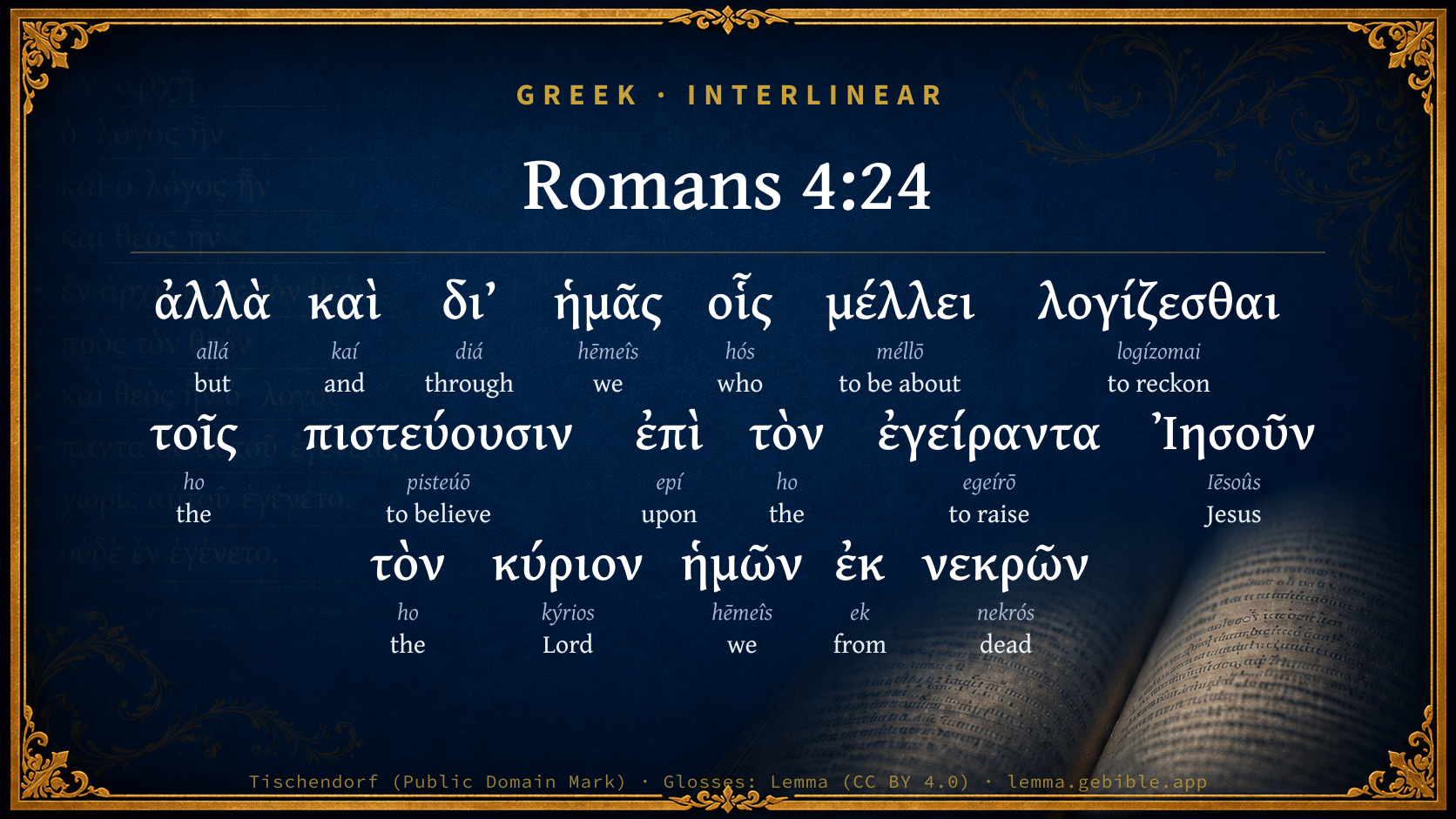
Download image
Cite this verse

Romans 4:24 (World English Bible). Public Domain. Lemma interlinear Bible study tool, https://lemma.gebible.app/v/romans/4/24.

Show BibTeX & RIS
BibTeX
RIS
English Translation
but for our sake also, to whom it will be accounted, who believe in him who raised Jesus, our Lord, from the dead,
World English Bible · Public Domain
Download a study sheet

One document with this verse’s original text, its word-by-word gloss line, the meaning frame, cross-references with their text, attributed commentary, and full source and license credits — printable, and it pastes into notes with its structure intact.

This verse Autodidact and up

Study sheet (.html) Plain text (.txt)

A passage Seminary Student

Up to 50 verses in one chapter. A passage sheet keeps up to 6 commentary sources and 12 cross-references per verse, in the order this page ranks them, and says so on the sheet whenever that leaves anything out. Ask for a single verse and you get the Autodidact verse sheet above.

Everything on this page stays free to read, with no account — the sheet is a download of what is already on screen, not access to it.

Want to remove ads? Support Godless Engineer
Compare translations 3

The same verse in 3 English versions, stacked beneath the original-language interlinear above. Click any original word for its lexicon entry.

Each is an independent rendering of the whole verse — the interlinear is not word-aligned to these translations.

Highlighted words mark where these versions differ — a whole-verse word diff, not a word-by-word alignment.

  • World English Bible Public Domain
    but for our sake also, to whom it will be accounted, who believe in him who raised Jesus, our Lord, from the dead,
  • King James Version Public Domain
    But for us also, to whom it shall be imputed, if we believe on him that raised up Jesus our Lord from the dead;
  • unfoldingWord Literal Text CC BY-SA 4.0
    but also for our sake, to whom it is about to be credited, to the ones believing in the one having raised Jesus our Lord from the dead ones,

unfoldingWord Literal Text — © unfoldingWord, licensed CC BY-SA 4.0. Word-aligned USFM3 via Door43 (git.door43.org/unfoldingWord/en_ult).

Versions to compare (up to 4)

3 of 4 selected

Show all 19 translations

Every available English version of this verse, each an independent rendering of the whole verse.

  • World English Bible Public Domain
    but for our sake also, to whom it will be accounted, who believe in him who raised Jesus, our Lord, from the dead,
  • Berean Standard Bible Public Domain
    but also for us, to whom righteousness will be credited—for us who believe in Him who raised Jesus our Lord from the dead.
  • Majority Standard Bible Public Domain
    but also for us, to whom righteousness will be credited—for us who believe in Him who raised Jesus our Lord from the dead.
  • King James Version Public Domain
    But for us also, to whom it shall be imputed, if we believe on him that raised up Jesus our Lord from the dead;
  • American Standard Version (1901) Public Domain
    but for our sake also, unto whom it shall be reckoned, who believe on him that raised Jesus our Lord from the dead,
  • Revised Version (1885) Public Domain
    but for our sake also, unto whom it shall be reckoned, who believe on him that raised Jesus our Lord from the dead,
  • Geneva Bible (1599) Public Domain
    But also for vs, to whom it shalbe imputed for righteousnesse, which beleeue in him that raised vp Iesus our Lord from the dead,
  • Douay-Rheims (1899) Public Domain
    But also for us, to whom it shall be reputed, if we believe in him, that raised up Jesus Christ, our Lord, from the dead,
  • Young's Literal Translation Public Domain
    but also on ours, to whom it is about to be reckoned -- to us believing on Him who did raise up Jesus our Lord out of the dead,
  • Literal Standard Version CC BY-SA 4.0
    but also on ours, to whom it is about to be reckoned—to us believing on Him who raised up Jesus our Lord out of the dead,
  • Unlocked Literal Bible CC BY-SA 4.0
    It was written also for us, for whom it will be counted, we who believe in him who raised Jesus our Lord from the dead.
  • unfoldingWord Literal Text CC BY-SA 4.0
    but also for our sake, to whom it is about to be credited, to the ones believing in the one having raised Jesus our Lord from the dead ones,
  • Darby Bible Public Domain
    but on ours also, to whom, believing on him who has raised from among [the] dead Jesus our Lord,
  • World Messianic Bible Public Domain
    but for our sake also, to whom it will be accounted, who believe in him who raised Yeshua our Lord from the dead,
  • Webster's Bible Public Domain
    But for us also, to whom it will be imputed, if we believe on him that raised Jesus our Lord from the dead,
  • Free Bible Version CC BY-SA 4.0
    They were for us too, those of us who will be considered as right, since we trust in God who raised our Lord Jesus from the dead.
  • Bible in Basic English Public Domain
    But for us in addition, to whose account it will be put, if we have faith in him who made Jesus our Lord come back again from the dead,
  • Text-Critical English NT CC BY 4.0
    but for ours also. It will be counted to us who believe in him who raised Jesus our Lord from the dead,
  • Tyndale New Testament (1534) Public Domain
    but also for vs to whom it shalbe counted for rightewesnes so we beleve on him that raysed vp Iesus oure Lorde from deeth.

Literal Standard Version (2020), Covenant Press — licensed CC BY-SA 4.0. Text via the HelloAO Bible API (eBible.org). Unlocked Literal Bible (unfoldingWord) — licensed CC BY-SA 4.0. Text via the HelloAO Bible API (eBible.org). unfoldingWord Literal Text — © unfoldingWord, licensed CC BY-SA 4.0. Word-aligned USFM3 via Door43 (git.door43.org/unfoldingWord/en_ult). Free Bible Version, Dr. Jonathan Gallagher — licensed CC BY-SA 4.0. Text via the HelloAO Bible API (eBible.org).

Word by word

More ways to search: Search by grammar → Find every occurrence → Compare this word →

Practice this passage: Drill this verse → Learn its vocabulary →

λογίζεσθαι
logízomai
G3049
“to reckon”
Verb, Present, Passive, Infinitive
Part of Speech
Verb
Tense
Present
Voice
Passive
Mood
Infinitive
Full Thayer's Definition

Origin: middle voice from G3056

TDNT: 08:44,5

1. to reckon, count, compute, calculate, count over a. to take into account, to make an account of 1. metaph. to pass to one's account, to impute 2. a thing is reckoned as or to be something, i.e. as availing for or equivalent to something, as having the like force and weight b. to number among, reckon with c. to reckon or account 2. to reckon inward, count up or weigh the reasons, to deliberate 3. by reckoning up all the reasons, to gather or infer a. to consider, take into account, weigh, meditate on b. to suppose, deem, judge c. to determine, purpose, decide This word deals with reality. If I "logizomai" or reckon that my bank book has $25 in it, it has $25 in it. Otherwise I am deceiving myself. This word refers to facts not suppositions.
  1. ἀλλὰ allá G235 “but” Conjunction
  2. καὶ kaí G2532 “and” Conjunction
  3. δι’ diá G1223 “through” Preposition
  4. ἡμᾶς hēmeîs G2249 “we” Personal pronoun, 1st person, Accusative, Plural
  5. οἷς hós G3739 “who” Relative pronoun, Dative, Plural, Masculine
  6. μέλλει méllō G3195 “to be about” Verb, Present, Active, Indicative, 3rd person, Singular
  7. τοῖς ho G3588 “the” Article, Dative, Plural, Masculine
  8. πιστεύουσιν pisteúō G4100 “to believe” Verb, Present, Active, Participle, Dative, Plural, Masculine
  9. ἐπὶ epí G1909 “upon” Preposition
  10. τὸν ho G3588 “the” Article, Accusative, Singular, Masculine
  11. ἐγείραντα egeírō G1453 “to raise” Verb, Aorist, Active, Participle, Accusative, Singular, Masculine
  12. Ἰησοῦν Iēsoûs G2424 “Jesus” Noun, Accusative, Singular, Masculine
  13. τὸν ho G3588 “the” Article, Accusative, Singular, Masculine
  14. κύριον kýrios G2962 “Lord” Noun, Accusative, Singular, Masculine
  15. ἡμῶν hēmeîs G2249 “we” Personal pronoun, 1st person, Genitive, Plural
  16. ἐκ ek G1537 “from” Preposition
  17. νεκρῶν nekrós G3498 “dead” Adjective, Genitive, Plural, Masculine

About this verse

These counts appear in no published source. They are computed here, from the morphology-tagged text and Lemma’s own curated glosses. What Lemma adds →

18
words
15
distinct lemmas
Pauline Epistles
section

Shared distinctive vocabulary

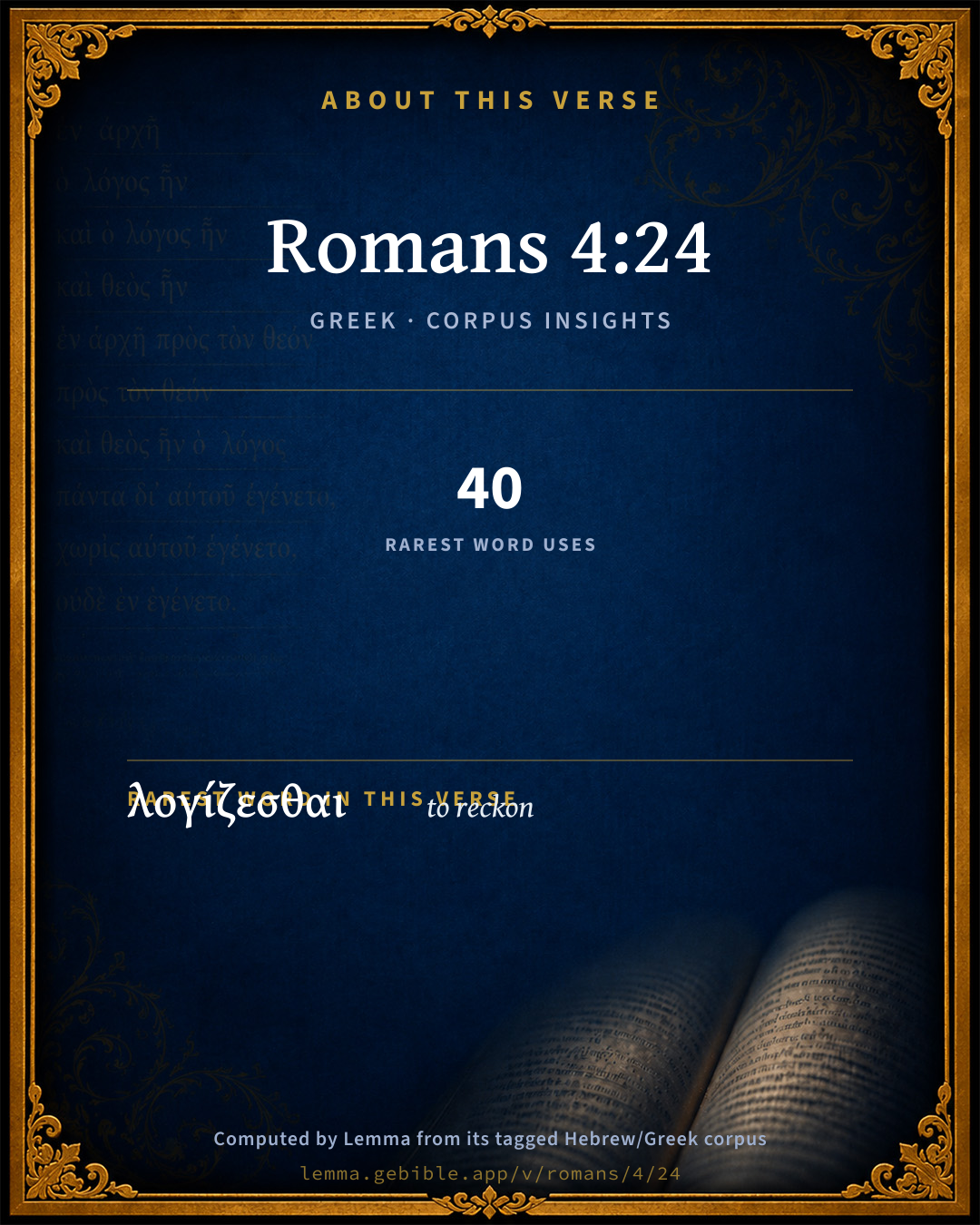
λογίζεσθαι to reckon G3049 occurs in 39 verses of the Greek New Testament. Also found in:
Repetition

Words recur within this verse:

Cross-references

9

Topical passages linked to Romans 4:24 in the Treasury of Scripture Knowledge — connected by theme and wording, ordered by reader-vote popularity; previews shown in the World English Bible.

  • Acts 2:24 whom God raised up, having freed him from the agony of death, because it was not possible that he should be held by it.
  • 1 Peter 1:21 who through him are believers in God, who raised him from the dead, and gave him glory; so that your faith and hope might be in God.
  • Acts 13:30 But God raised him from the dead,
  • Romans 10:9–10 that if you will confess with your mouth the Lord Jesus, and believe in your heart that God raised him from the dead, you will be saved.
  • Mark 16:16 He who believes and is baptized will be saved; but he who disbelieves will be condemned.
  • John 3:14–16 As Moses lifted up the serpent in the wilderness, even so must the Son of Man be lifted up,
  • Acts 2:39 For to you is the promise, and to your children, and to all who are far off, even as many as the Lord our God will call to himself."
  • Ephesians 1:18–20 having the eyes of your hearts enlightened, that you may know what is the hope of his calling, and what are the riches of the glory of his inheritance in the saints,
  • Hebrews 13:20–21 Now may the God of peace, who brought again from the dead the great shepherd of the sheep with the blood of an eternal covenant, our Lord Jesus,

Cross-references courtesy of OpenBible.info (CC BY 4.0).

Commentary

Notes on Romans 4:24 from classic Christian and Jewish commentators (each source and its license shown beneath its notes). The classic Christian expositions comment on the surrounding passage and are grouped to its opening verse, so a note may address several verses; the Jewish commentaries on the Tanakh (Rashi and others) are per-verse, so they appear only where the commentator wrote on this verse.

Lemma curates 59 commentaries, every one of them public domain or Creative Commons licensed, each selected and text-cleaned for this edition rather than reprinted as found. About our sources →

Tyndale Open Study Notes

Tyndale Open Resources

4:24 raised . . . from the dead: Abraham experienced the life-giving power of God in the birth of his son Isaac. Christians witness it in the resurrection of Jesus. Throughout history, salvation has been available only through faith in God, who makes and keeps his promises.

Tyndale Open Study Notes — © Tyndale Open Resources, licensed CC BY-SA 4.0. Text via the HelloAO Bible API.

Bengel's Gnomon

Johann Albrecht Bengel

Rom 4:24. Ἐγείραντα, Him, who raised up) Comp. v. 17, quickening the dead. The faith of Abraham was directed to that, which was about to be, and which could come to pass, ours to that which has actually taken place; the faith of both, is directed to the Quickener [Him, who makes alive].

Παρεδόθη, was delivered) so the LXX. Isa 53:12, καὶ διὰ τὰς ἀνομίας ἀυτῶν παρεδόθη, and for their iniquities He was delivered up. God is not said to have inflicted death upon Chirst; although He inflicted on Him [put Him to] griefs; but [God is said] to have delivered up Christ, or else Christ is said to have died, ch. Rom 8:34. I do not deny the fact itself, see Zec 13:7; but the phrases are moulded in such a way that they rather express that the passion was enjoined upon Christ by the Father, as also that the death was obediently endured by Christ to the utmost [‘exantlata;’ the cup of suffering to death drained to the dregs].—δικαίωσιν, justification) a verbal noun, differing from δικαιοσύνη, righteousness. Faith flows from the resurrection of Christ, and so also does justification, Col 2:12; 1Pe 1:21. The ground on which our belief in God rests, is, that He has raised Jesus Christ from the dead. Yet this ground of belief does not impair the truth, that the obedience of Jesus Christ, and His own blood, is the source of our justification. See ch. Rom 3:25, Rom 5:19.

Bengel's Gnomon of the New Testament — English translation (T&T Clark, Edinburgh, 1860) — public domain. Text from a community e-Sword module.

Hodge's Commentary on Romans, Ephesians & First Corinthians

Charles Hodge

Rom_4:23, Rom_4:24

Now, it was not written for his sake alone, that it was imputed to him. The record concerning the faith and consequent justification of Abraham, was not made with the simple intention of giving a correct history of that patriarch. It had a much higher purpose. Abraham was a representative person. What was true of him, was true of all others who stood in the same relation to God. The method in which he was justified, is the method in which other sinners must be justified. That he was justified by faith, is recorded in the Scriptures to be a perpetual testimony as to the true method of justification before God. The apostle therefore adds, that it was δι ̓ ἡμᾶς, on our account. That is, on account of those to whom it shall be imputed; οἷς μέλλει λογίζεσθαι to whom it is appointed to be imputed; in case they should believe. As all men are sinners, the method in which one was certainly justified is the method by which others may secure the same blessing. If Abraham was justified by faith, we may be justified by faith. If the object of Abrahams faith was the promise of redemption, the same must be the object of our faith. He believed in God as quickening the dead, that is, as able to raise up from one as good as dead, the promised Redeemer. Therefore those to whom faith shall now be imputed for righteousness are described as those who believe that God hath raised up Jesus from the dead. By thus raising him from the dead, he declared him to be his Son, and the seed of Abraham, in whom all the nations of the earth were to be blessed. The object of the Christians faith, therefore, is the same as the object of the faith of Abraham. Both believe the promise of redemption through the promised seed, which is Christ. When we are said to believe in God, who raised up Christ, it of course implies that we believe that Christ was thus raised up. As the resurrection of Christ was the great decisive evidence of the divinity of his mission, and the validity of all his claims, to believe that he rose from the dead, is to believe he was the Son of God, the propitiation for our sins, the Redeemer and the Lord of men; that he was all he claimed to be, and had accomplished all he purposed to effect. Compare Rom_10:9; Act_1:22; Act_4:33; 1 Corinthians 15, and other passages, in which the resurrection of Christ is spoken of as the corner-stone of the gospel, as the great fact to be proved, and which, being proved, involves all the rest.

Charles Hodge — Commentary on Romans (1835), First Corinthians (1857), and Ephesians (1856) — public domain. Text from a community e-Sword module.

Jamieson, Fausset & Brown

Robert Jamieson, A. R. Fausset & David Brown

to whom it shall be imputed, if we believe in him that raised up Jesus our Lord from the dead--in Him that hath done this, even as Abraham believed that God would raise up a seed in whom all nations should be blessed.

Jamieson, Fausset & Brown — Commentary Critical and Explanatory on the Whole Bible (1871) — public domain (CC PDM 1.0). Text via the HelloAO Bible API.

Adam Clarke's Commentary

Verse 24. But for us also] The mention of this circumstance has a much more extensive design than merely to honour Abraham. It is recorded as the model, according to which God will save both Jews and Gentiles: indeed there can be no other way of salvation; as all have sinned, all must either be saved by faith through Christ Jesus, or finally perish. If God, therefore, will our salvation, it must be by faith; and faith contemplates his promise, and his promise comprehends the Son of his love.

Adam Clarke's Commentary on the Bible (1810–1826) — public domain. Text from a community e-Sword/MySword module.

John Calvin's Commentaries

24. Who believe on him, etc. I have already reminded you of the design of those periphrastic expressions: Paul introduced them, that he might, according to what the passages may require, describe in various ways the real character of faith — of which the resurrection of Christ is not the smallest part; for it is the ground of our hope as to eternal life. Had he said only, that we believe in God, it could not have been so readily learnt how this could serve to obtain righteousness; but when Christ comes forth and presents to us in his own resurrection a sure pledge of life, it then appears evident from what fountain the imputation of righteousness flows.

John Calvin's Commentaries (1540-1563) — public domain. Text from the Calvin Translation Society English edition (1840s-50s) via the Christian Classics Ethereal Library (ccel.org). Calvin's coverage is partial (roughly two-thirds of the Bible); uncommented books and verses are honest gaps, never fabricated. The 19th-century editor's footnotes and remarks are omitted so the notes are faithfully Calvin's own voice.

Ellicott's Commentary for English Readers

(24) That raised up.—It is an association of ideas which leads the Apostle up to this point. The birth of Isaac resembles the resurrection of Christ in that it involved the exercise of Omnipotence, and in that Omnipotence Abraham believed and we are to believe. The Apostle is further led to allude to the Resurrection (though he has not laid so much stress upon it hitherto) because of the place which it held in his theory of the gospel.

A Bible Commentary for English Readers, edited by Charles John Ellicott (1878–1897) — public domain. Text from a community e-Sword module.

The Cambridge Bible for Schools and Colleges

gen. ed. J. J. S. Perowne

24. for us also] Lit. also because of us; “because we were to be likewise dealt with, and therefore needed to know it.”

shall be] Lit., fully, is about to be. The reference of the futurity is to the abiding intention of the Justifier. Justification is, individually, present on condition of belief; but with regard to all who “shall believe,” it is in intention, a future thing.

if we believe] More lit. even us who believe. The faith is assumed.

on him that raised up, &c.] The Father. (Cp. Psa_16:10; Act_2:24; Act_13:30; Act_17:31; Eph_1:20, &c.; Heb_13:20.) His “bringing Jesus again” stands here as a Divine pledge of His infinite trustworthiness. “He hath given assurance unto all men,” not only of judgment (Act_17:31), but of a present and complete justification, “in that He raised Jesus from the dead.” Abraham believed Him specially as the God of the primeval Promise, and of particular providence and love to himself: we believe Him now also as the Father who raised His Son to life after propitiatory death.

our Lord] The title of Majesty enhances the significance of the Resurrection.

The Cambridge Bible for Schools and Colleges (gen. ed. J. J. S. Perowne; Cambridge University Press, 1878–1918) — public domain. Text from a community e-Sword module.

Trapp's Complete Commentary

John Trapp

24 But for us also, to whom it shall be imputed, if we believe on him that raised up Jesus our Lord from the dead;

Ver. 24. That raised up Jesus] And with him all believers, Col 3:1; Rom 6:4.

John Trapp, A Commentary or Exposition upon All the Books of the Old and New Testament (1647–1656) — public domain. Text from a community e-Sword module.

Albert Barnes' Notes on the Bible

But for us also - For our use; (compare Rom 15:4; 1Co 10:11), that we might have an example of the way in which people may be accepted of God. It is recorded for our encouragement and imitation, to show that we may in a similar manner be accepted and saved.

If we believe on him ... - Abraham showed his faith in God by believing just what God revealed to him. This was his faith, and it might be as strong and implicit as could be exercised under the fullest revelation. Faith, now, is belief in God just so far as he has revealed his will to us. It is therefore the same in principle, though it may have reference to different objects. It is confidence in the same God, according to what we know of his will. Abraham showed his faith mainly in confiding in the promises of God respecting a numerous posterity. This was the leading truth made known to him, and this he believed.

(The promise made to Abraham was, “in thy seed shall all nations of the earth be blessed,” on which we have the following inspired commentary: “And the scriptures foreseeing that God would justify the pagan through faith, preached before the gospel unto Abraham, saying, In thee shall all nations be blessed,” Gal 3:8. It would seem, then, that this promise, like that made immediately after the fall, contained the very germ and principles of the gospel. So that after all there is not so great difference between the object of Abraham’s faith, and that of ours. Indeed the object in both cases is manifestly the same.)

The main or leading truths that God has made known to us are, that he has given his Son to die; that he has raised him up; and that through him he is ready to pardon. To put confidence in these truths is to believe now. Doing this, we believe in the same God that Abraham did; we evince the same spirit; and thus show that we are the friends of the same God, and may be treated in the same manner. This is faith under the gospel (compare the notes at Mar 16:16), and shows that the faith of Abraham and of all true believers is substantially the same, and is varied only by the difference of the truths made known.

Albert Barnes' Notes on the Bible (1834–1885) — public domain. Text from a community e-Sword/MySword module.

Whedon's Commentary on the Bible

Daniel D. Whedon

24. If we believe on him—If we believe God now as Abraham did then. God promised the seed, and Abraham believed; God has now given the seed, and we must likewise believe. Both beliefs in their root are one, namely, faith in God. True justifying faith is trusting in God just so far as God has in faith and to faith revealed.

This is a true and great principle. The illustrious catalogue of heroes of the faith in Hebrews 11, Abel, Enoch, Noah, and others, knew not definitely of the atoning Christ. And yet their justifying faith was identical in nature with Christian faith, for it was a true faith in the holy God. It was faith in whatever God presented as object of faith; and had Christ been definitely presented, Christ would have been explicitly believed. Hence millions who never knew Christ have had true Christian faith. Even in Christian lands we may cherish a degree of trembling hope for those who seem to exhibit the Christian spirit yet fail to understand Christ as he truly is, while we feel it to be a most dubious ground to stand upon. There possibly may be in them “the spirit of faith” where there is an invincible ignorance of the true object of faith. (See the chapter on “Equation of Probational Advantages” in our work on the Will.) (See note on Rom_2:6; Rom_3:22, and introductory note to 6.)

Daniel D. Whedon (gen. ed.), Commentary on the Old and New Testaments (1874–1909) — public domain. Text from a community e-Sword module.

John Wesley's Explanatory Notes

But on ours also - To establish us in seeking justification by faith, and not by works; and to afford a full answer to those who say that, " to be justified by works means only, by Judaism; to be justified by faith means, by embracing Christianity, that is, the system of doctrines so called." Sure it is that Abraham could not in this sense be justified either by faith or by works; and equally sure that David (taking the words thus) was justified by works, and not by faith. Who raised up Jesus from the dead - As he did in a manner both Abraham and Sarah. If we believe on him who raised up Jesus - God the Father therefore is the proper object of justifying faith. It is observable, that St. Paul here, in speaking both of our faith and of the faith of Abraham, puts a part for the whole. And he mentions that part, with regard to Abraham, which would naturally affect the Jews most.

John Wesley, Explanatory Notes Upon the Whole Bible (1754–1765) — public domain. Text via the GEBible commentary corpus.

Scofield Reference Notes

C. I. Scofield

imputed

Or, reckoned, i.e. put to the account of. See Phm 1:18, same word:

The Scofield Reference Bible (1917 edition), notes by C. I. Scofield — public domain. Text from a community e-Sword module.

Godbey's Commentary on the New Testament

William B. Godbey

24. “But truly for the sake of us unto whom he is about to impute it,” i. e., “to those who believed on him who raised up Jesus our Lord from the dead.” You see from these Scriptures that we are justified precisely like Father Abraham. Oh, how simple! He just believed God, and it was counted unto him for justification. Here it is positively specified that it was not written for the sake of Him alone, but for us, that we may know how to be saved. People are constantly stumbling over the very simplicity of God’s saving grace. Satan is constantly decoying us away after big things, lest we believe the simple truth of God and be saved.

William B. Godbey, Commentary on the New Testament (1896–1900) — public domain. Text from a community e-Sword module.

McGarvey & Pendleton's Commentaries

J. W. McGarvey

but for our sake also, unto whom it shall be reckoned, who believe on him that raised Jesus our Lord from the dead ,

J. W. McGarvey (with Philip Y. Pendleton), Commentaries on the New Testament (The Fourfold Gospel, 1914; Acts; and the epistles) — public domain. Text from a community e-Sword/MySword module.

The People's New Testament

B. W. Johnson

24. For us also. If we believe our faith shall save us. On him that raised Jesus. The same God who quickened Abraham's body, as good as dead, raised up our Lord.

B. W. Johnson's The People's New Testament with Notes (1889–1891) — public domain. Electronic text from the Christian Classics Ethereal Library (CCEL) ThML edition.

Cambridge Greek Testament for Schools and Colleges

24. τοῖς πιστεύουσιν = οἳτινες π.

ἐπὶ τὸν ἐγ. Ἰ. (1) The trust is personal in a Personal Power, whose Power and Character are revealed in the crucial act. (2) The raising of Jesus is a kind of antitype of the birth of Isaac. Note that the name Jesus is used alone to emphasise the historic fact—τὸν κ. ἡ. = whom we acknowledge as Lord.

Cambridge Greek Testament for Schools and Colleges (Cambridge University Press, 1896; 21 vols, various authors incl. Carr, Maclear, Plummer, Farrar, Lumby, Moule, M. R. James, Simcox) — public domain. Text from a community e-Sword module.

Alford’s Greek Testament

Henry Alford

24.] ἐκ νεκρῶν is almost (see Col 2:12; 1Th 1:10) always anarthrous, as indeed νεκροί sometimes is (for ‘the dead’) in classic writers, e.g. Thucyd. iv. 14; v. 10, end: and see Winer, edn. 6, § 19. 1. The omission may in this phrase be accounted for by the preposition (Middleton, ch. vi. 1): but I suspect Winer is right in looking for the cause of the absence of the article after prepositions rather in the usage of the particular substantive than in any idiom of general application.

Henry Alford, The Greek Testament (1849–1861) — public domain. Text from a community e-Sword module.

International Critical Commentary

24. τοῖς πιστεύουσιν: ‘to us who believe.’ St. Paul asserts that his readers are among the class of believers. Not ‘if we believe,’ which would be πιστεύουσιν (sine artic.).

International Critical Commentary — older volumes (1896–1929), various authors — public domain. Text from a community e-Sword module.

Vincent's Word Studies in the New Testament

Marvin R. Vincent

It shall be reckoned [μελλει λογιζεσθαι] .. Not the future of the verb to reckon, but mellw to intend points to God 's definite purpose. See on Act 27:2; 2Pe 1:12.

Who believe. Since we are those who believe.

Marvin R. Vincent, Word Studies in the New Testament (1887–1900) — public domain. Text from a community e-Sword/MySword module.

Lesson kit

Teaching starters — assembled from the data on this page, not authored interpretation. Every prompt links to the verse data it draws on. Edit before teaching.

Romans, in the Pauline Epistles, opens this verse with 18 words (15 distinct Greek lemmas). Its most distinctive word is logízomai (“to reckon”). A historical commentator’s framing appears above. Read the whole chapter for the surrounding context.

Discussion questions

  1. How does “to reckon” (logízomai) shape what this verse is saying?
  2. Luke 22:37 shares the word «to reckon» with this verse. How do the two illuminate each other?
  3. “the” occurs 3× in this one verse. What is the effect of the repetition?
  4. These translations render this verse differently. What is at stake in choosing one wording over another?
  5. Reading how Tyndale Open Study Notes and Bengel's Gnomon read this verse, where do the two commentators agree and where do they part?

Things to notice

Reading settings

Reading text

Shown beneath each verse's original-language words.

Old Testament
Old Testament edition

Read the OT as the Masoretic Hebrew (MT) or the Greek Septuagint (LXX).

English shown for the Greek Septuagint (in the Hebrew ↔ Greek comparison).

Comparing translations? Open the Compare panel on any verse page to stack up to four side by side.