
Romans 14:6

Greek (Tischendorf 8th ed.) Romans 14:6 appears in the Greek New Testament. The text above is from the Tischendorf 8th edition. Each word links to its Strong’s number and a concise gloss. Click any word for its full Thayer’s Greek Lexicon entry.
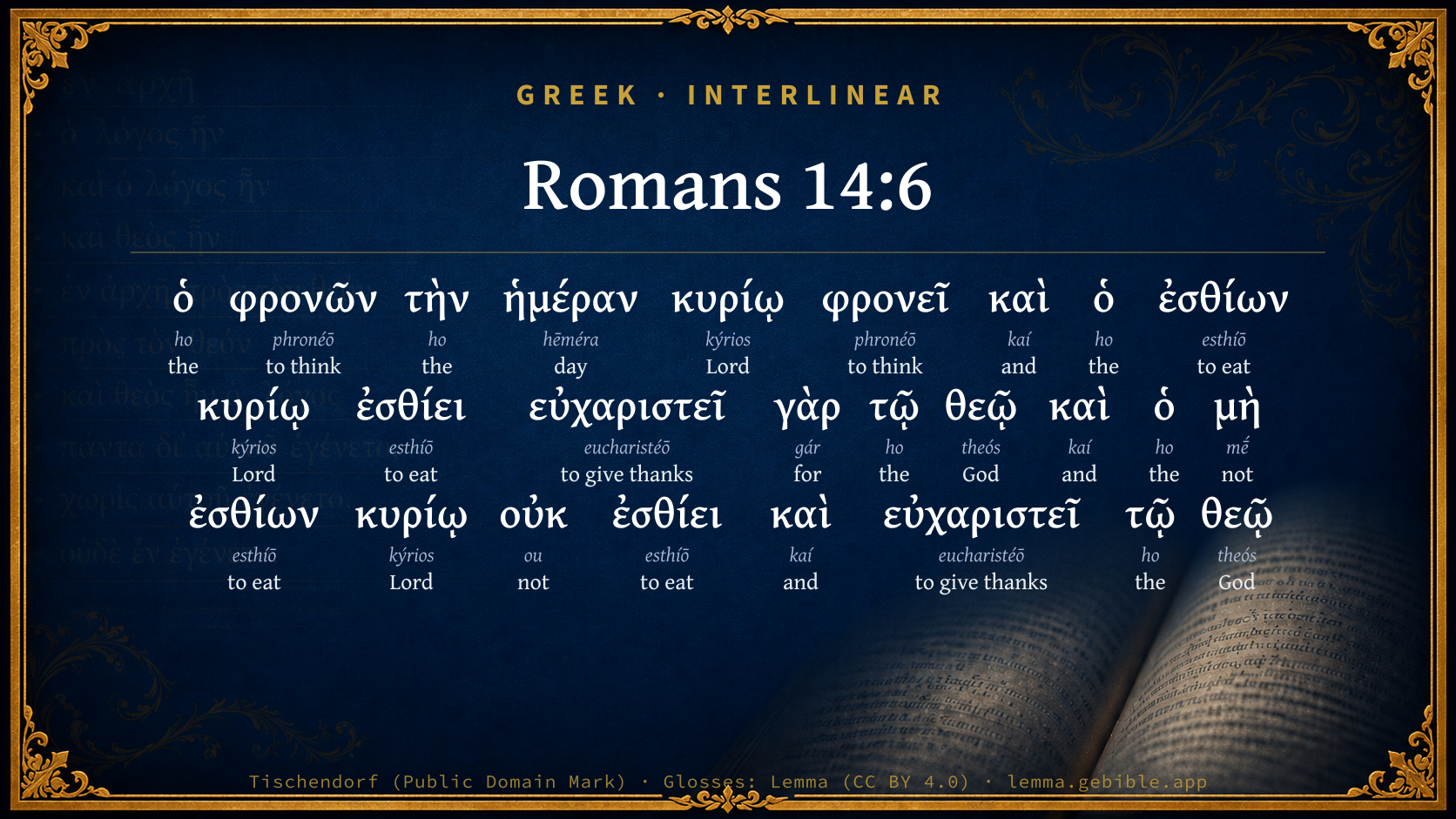
Download image
Cite this verse

Romans 14:6 (World English Bible). Public Domain. Lemma interlinear Bible study tool, https://lemma.gebible.app/v/romans/14/6.

Show BibTeX & RIS
BibTeX
RIS
English Translation
He who observes the day, observes it to the Lord; and he who does not observe the day, to the Lord he does not observe it. He who eats, eats to the Lord, for he gives God thanks. He who doesn't eat, to the Lord he doesn't eat, and gives God thanks.
World English Bible · Public Domain
Download a study sheet

One document with this verse’s original text, its word-by-word gloss line, the meaning frame, cross-references with their text, attributed commentary, and full source and license credits — printable, and it pastes into notes with its structure intact.

This verse Autodidact and up

Study sheet (.html) Plain text (.txt)

A passage Seminary Student

Up to 50 verses in one chapter. A passage sheet keeps up to 6 commentary sources and 12 cross-references per verse, in the order this page ranks them, and says so on the sheet whenever that leaves anything out. Ask for a single verse and you get the Autodidact verse sheet above.

Everything on this page stays free to read, with no account — the sheet is a download of what is already on screen, not access to it.

Want to remove ads? Support Godless Engineer
Compare translations 3

The same verse in 3 English versions, stacked beneath the original-language interlinear above. Click any original word for its lexicon entry.

Each is an independent rendering of the whole verse — the interlinear is not word-aligned to these translations.

Highlighted words mark where these versions differ — a whole-verse word diff, not a word-by-word alignment.

  • World English Bible Public Domain
    He who observes the day, observes it to the Lord; and he who does not observe the day, to the Lord he does not observe it. He who eats, eats to the Lord, for he gives God thanks. He who doesn't eat, to the Lord he doesn't eat, and gives God thanks.
  • King James Version Public Domain
    He that regardeth the day, regardeth it unto the Lord; and he that regardeth not the day, to the Lord he doth not regard it. He that eateth, eateth to the Lord, for he giveth God thanks; and he that eateth not, to the Lord he eateth not, and giveth God thanks.
  • unfoldingWord Literal Text CC BY-SA 4.0
    The one regarding the day, regards it for the Lord; and the one eating, eats for the Lord, for he gives thanks to God, and the one not eating, does not eat for the Lord; he also gives thanks to God.

unfoldingWord Literal Text — © unfoldingWord, licensed CC BY-SA 4.0. Word-aligned USFM3 via Door43 (git.door43.org/unfoldingWord/en_ult).

Versions to compare (up to 4)

3 of 4 selected

Show all 19 translations

Every available English version of this verse, each an independent rendering of the whole verse.

  • World English Bible Public Domain
    He who observes the day, observes it to the Lord; and he who does not observe the day, to the Lord he does not observe it. He who eats, eats to the Lord, for he gives God thanks. He who doesn't eat, to the Lord he doesn't eat, and gives God thanks.
  • Berean Standard Bible Public Domain
    He who observes a special day does so to the Lord; he who eats does so to the Lord, for he gives thanks to God; and he who abstains does so to the Lord and gives thanks to God.
  • Majority Standard Bible Public Domain
    He who observes a special day does so to the Lord. And he who does not observe the day, to the Lord he does not observe it. He who eats does so to the Lord, for he gives thanks to God; and he who abstains does so to the Lord and gives thanks to God.
  • King James Version Public Domain
    He that regardeth the day, regardeth it unto the Lord; and he that regardeth not the day, to the Lord he doth not regard it. He that eateth, eateth to the Lord, for he giveth God thanks; and he that eateth not, to the Lord he eateth not, and giveth God thanks.
  • American Standard Version (1901) Public Domain
    He that regardeth the day, regardeth it unto the Lord: and he that eateth, eateth unto the Lord, for he giveth God thanks; and he that eateth not, unto the Lord he eateth not, and giveth God thanks.
  • Revised Version (1885) Public Domain
    He that regardeth the day, regardeth it unto the Lord: and he that eateth, eateth unto the Lord, for he giveth God thanks; and he that eateth not, unto the Lord he eateth not, and giveth God thanks.
  • Geneva Bible (1599) Public Domain
    He that obserueth the day, obserueth it to the Lord: and he that obserueth not the day, obserueth it not to the Lord. He that eateth, eateth to the Lord: for he giueth God thankes: and he that eateth not, eateth not to the Lord, and giueth God thankes.
  • Douay-Rheims (1899) Public Domain
    He that regardeth the day, regardeth it unto the Lord. And he that eateth, eateth to the Lord: for he giveth thanks to God. And he that eateth not, to the Lord he eateth not, and giveth thanks to God.
  • Young's Literal Translation Public Domain
    He who is regarding the day, to the Lord he doth regard `it', and he who is not regarding the day, to the Lord he doth not regard `it'. He who is eating, to the Lord he doth eat, for he doth give thanks to God; and he who is not eating, to the Lord he doth not eat, and doth give thanks to God.
  • Literal Standard Version CC BY-SA 4.0
    He who is regarding the day, he regards [it] to the LORD, and he who is not regarding the day, he does not regard [it] to the LORD. He who is eating, he eats to the LORD, for he gives thanks to God; and he who is not eating, he does not eat to the LORD, and gives thanks to God.
  • Unlocked Literal Bible CC BY-SA 4.0
    He who observes the day, observes it for the Lord; and he who eats, eats for the Lord, for he gives thanks to God. He who does not eat, refrains from eating for the Lord, he also gives thanks to God.
  • unfoldingWord Literal Text CC BY-SA 4.0
    The one regarding the day, regards it for the Lord; and the one eating, eats for the Lord, for he gives thanks to God, and the one not eating, does not eat for the Lord; he also gives thanks to God.
  • Darby Bible Public Domain
    He that regards the day, regards it to [the] Lord. And he that eats, eats to [the] Lord, for he gives God thanks; and he that does not eat, [it is] to [the] Lord he does not eat, and gives God thanks.
  • World Messianic Bible Public Domain
    He who observes the day, observes it to the Lord; and he who does not observe the day, to the Lord he does not observe it. He who eats, eats to the Lord, for he gives God thanks. He who doesn’t eat, to the Lord he doesn’t eat, and gives God thanks.
  • Webster's Bible Public Domain
    He that regardeth the day, regardeth it to the Lord: and he that regardeth not the day, to the Lord he doth not regard it. He that eateth, eateth to the Lord, for he giveth God thanks; and he that eateth not, to the Lord he eateth not, and giveth God thanks.
  • Free Bible Version CC BY-SA 4.0
    Those who respect a special day do so for the Lord; and those who eat without worrying do so for the Lord since they give thanks to God; while those who avoid eating certain things do so for the Lord, and they also give thanks to God.
  • Bible in Basic English Public Domain
    He who keeps the day, keeps it to the Lord; and he who takes food, takes it as to the Lord, for he gives praise to God; and he who does not take food, to the Lord he takes it not, and gives praise to God.
  • Text-Critical English NT CC BY 4.0
    He who observes a particular day, observes it in honor of the Lord, while he who abstains from observing a particular day, abstains in honor of the Lord. He who eats, eats in honor of the Lord, for he gives thanks to God, while he who abstains from eating, abstains in honor of the Lord, and he gives thanks to God.
  • Tyndale New Testament (1534) Public Domain
    He that observeth one daye more then another doth it for the lordes pleasure. And he that observeth not one daye moare then another doeth it to please the lorde also. He that eateth doth it to please the lorde for he geveth god thankes. And he that eateth not eateth not to please the lorde with all and geveth god thankes.

Literal Standard Version (2020), Covenant Press — licensed CC BY-SA 4.0. Text via the HelloAO Bible API (eBible.org). Unlocked Literal Bible (unfoldingWord) — licensed CC BY-SA 4.0. Text via the HelloAO Bible API (eBible.org). unfoldingWord Literal Text — © unfoldingWord, licensed CC BY-SA 4.0. Word-aligned USFM3 via Door43 (git.door43.org/unfoldingWord/en_ult). Free Bible Version, Dr. Jonathan Gallagher — licensed CC BY-SA 4.0. Text via the HelloAO Bible API (eBible.org).

Word by word

More ways to search: Search by grammar → Find every occurrence → Compare this word →

Practice this passage: Drill this verse → Learn its vocabulary →

φρονῶν
phronéō
G5426
“to think”
Verb, Present, Active, Participle, Nominative, Singular, Masculine
Part of Speech
Verb
Tense
Present
Voice
Active
Mood
Participle
Case
Nominative
Number
Singular
Gender
Masculine
Full Thayer's Definition

Origin: from G5424

TDNT: 12:40,1

1. to have understanding, be wise 2. to feel, to think a. to have an opinion of one's self, think of one's self, to be modest, not let one's opinion (though just) of himself exceed the bounds of modesty b. to think or judge what one's opinion is c. to be of the same mind i.e. agreed together, cherish the same views, be harmonious 3. to direct one's mind to a thing, to seek, to strive for a. to seek one's interest or advantage b. to be of one's party, side with him (in public affairs)
  1. ὁ ho G3588 “the” Article, Nominative, Singular, Masculine
  2. τὴν ho G3588 “the” Article, Accusative, Singular, Feminine
  3. ἡμέραν hēméra G2250 “day” Noun, Accusative, Singular, Feminine
  4. κυρίῳ kýrios G2962 “Lord” Noun, Dative, Singular, Masculine
  5. φρονεῖ phronéō G5426 “to think” Verb, Present, Active, Indicative, 3rd person, Singular
  6. καὶ kaí G2532 “and” Conjunction
  7. ὁ ho G3588 “the” Article, Nominative, Singular, Masculine
  8. ἐσθίων esthíō G2068 “to eat” Verb, Present, Active, Participle, Nominative, Singular, Masculine
  9. κυρίῳ kýrios G2962 “Lord” Noun, Dative, Singular, Masculine
  10. ἐσθίει esthíō G2068 “to eat” Verb, Present, Active, Indicative, 3rd person, Singular
  11. εὐχαριστεῖ eucharistéō G2168 “to give thanks” Verb, Present, Active, Indicative, 3rd person, Singular
  12. γὰρ gár G1063 “for” Conjunction
  13. τῷ ho G3588 “the” Article, Dative, Singular, Masculine
  14. θεῷ theós G2316 “God” Noun, Dative, Singular, Masculine
  15. καὶ kaí G2532 “and” Conjunction
  16. ὁ ho G3588 “the” Article, Nominative, Singular, Masculine
  17. μὴ mḗ G3361 “not” Particle, Negative
  18. ἐσθίων esthíō G2068 “to eat” Verb, Present, Active, Participle, Nominative, Singular, Masculine
  19. κυρίῳ kýrios G2962 “Lord” Noun, Dative, Singular, Masculine
  20. οὐκ ou G3756 “not” Particle, Negative
  21. ἐσθίει esthíō G2068 “to eat” Verb, Present, Active, Indicative, 3rd person, Singular
  22. καὶ kaí G2532 “and” Conjunction
  23. εὐχαριστεῖ eucharistéō G2168 “to give thanks” Verb, Present, Active, Indicative, 3rd person, Singular
  24. τῷ ho G3588 “the” Article, Dative, Singular, Masculine
  25. θεῷ theós G2316 “God” Noun, Dative, Singular, Masculine

About this verse

These counts appear in no published source. They are computed here, from the morphology-tagged text and Lemma’s own curated glosses. What Lemma adds →

26
words
11
distinct lemmas
Pauline Epistles
section

Shared distinctive vocabulary

φρονῶν to think G5426 occurs in 21 verses of the Greek New Testament. Also found in:
Repetition

Words recur within this verse:

  • ἐσθίων to eat G2068 ×4
  • κυρίῳ Lord G2962 ×3
  • φρονῶν to think G5426 ×2
  • εὐχαριστεῖ to give thanks G2168 ×2
  • θεῷ God G2316 ×2
  • ὁ the G3588 ×6
  • καὶ and G2532 ×3

Cross-references

11

Topical passages linked to Romans 14:6 in the Treasury of Scripture Knowledge — connected by theme and wording, ordered by reader-vote popularity; previews shown in the World English Bible.

  • 1 Corinthians 10:30–31 If I partake with thankfulness, why am I denounced for that for which I give thanks?
  • 1 Timothy 4:3–5 forbidding marriage and commanding to abstain from foods which God created to be received with thanksgiving by those who believe and know the truth.
  • Exodus 12:42 It is a night to be much observed to Yahweh for bringing them out from the land of Egypt. This is that night of Yahweh, to be much observed of all the children of Israel throughout their generations.
  • Matthew 14:19 He commanded the multitudes to sit down on the grass; and he took the five loaves and the two fish, and looking up to heaven, he blessed, broke and gave the loaves to the disciples, and the disciples gave to the multitudes.
  • Matthew 15:36 and he took the seven loaves and the fish. He gave thanks and broke them, and gave to the disciples, and the disciples to the multitudes.
  • Exodus 12:14 This day shall be to you for a memorial, and you shall keep it a feast to Yahweh: throughout your generations you shall keep it a feast by an ordinance forever.
  • Exodus 16:25 Moses said, "Eat that today, for today is a Sabbath to Yahweh. Today you shall not find it in the field.
  • Isaiah 58:5 Is such the fast that I have chosen? the day for a man to afflict his soul? Is it to bow down his head as a rush, and to spread sackcloth and ashes under him? will you call this a fast, and an acceptable day to Yahweh?
  • Zechariah 7:5–6 "Speak to all the people of the land, and to the priests, saying, 'When you fasted and mourned in the fifth and in the seventh month for these seventy years, did you at all fast to me, really to me?
  • John 6:28 They said therefore to him, "What must we do, that we may work the works of God?"
  • Galatians 4:10 You observe days, months, seasons, and years.

Cross-references courtesy of OpenBible.info (CC BY 4.0).

Where the printed editions differ

1 variant

Places in this verse where the major printed Greek editions disagree on the wording in a way that affects the translation — a comparison of editions, not a manuscript-by-manuscript collation. The editions are the modern critical texts (Nestlé-Aland 28/27, SBL, Westcott-Hort, Tregelles, Tyndale House) and the traditional texts behind the KJV (the Textus Receptus and the Byzantine/Majority text). It is not a claim about which reading is original.

  1. Extra text
    καὶ ὁ μὴ φρονῶν τὴν ἡμέραν κυρίῳ οὐ φρονεῖ·

    “and the [one] not regarding the day to [the] Lord not regards [it];”

    In TRByz Not in NA28NA27TynSBLWHTreg

    καὶ ὁ μὴ φρονῶν τὴν ἡμέραν κυρίῳ οὐ φρονεῖ· (kai ho mē phronōn tēn hēmeran kuriō ou phronei) 'and the [one] not regarding the day to [the] Lord not regards [it];' is only in traditional manuscripts (TR+Byz)

Textual data: Translators Amalgamated Greek New Testament (STEPBible TAGNT) · CC BY 4.0.

Commentary

Notes on Romans 14:6 from classic Christian and Jewish commentators (each source and its license shown beneath its notes). The classic Christian expositions comment on the surrounding passage and are grouped to its opening verse, so a note may address several verses; the Jewish commentaries on the Tanakh (Rashi and others) are per-verse, so they appear only where the commentator wrote on this verse.

Lemma curates 59 commentaries, every one of them public domain or Creative Commons licensed, each selected and text-cleaned for this edition rather than reprinted as found. About our sources →

Bengel's Gnomon

Johann Albrecht Bengel

Rom 14:6. Εὐχαριστεῖ γὰρ—καὶ εὐχαριστεῖ, for he gives thanks—and gives thanks) Thanksgiving sanctifies all actions, however outwardly different, which do not weaken it, 1Co 10:30; Col 2:7; Col 3:17; 1Ti 4:4. The, For, however, has greater force than and, as thanksgiving is more connected with eating, than with abstinence from eating; and in him, who eats, there are both the fruits and the criterion, and in some respects the ground of faith, even of that faith, of which we have an account at Rom 14:22, and of an assured conscience; with respect to him who does not eat, that faith, of which we read at Rom 14:22, is no doubt defective as to its fruits, criterion, and the ground on which it rests, but yet the man retains all the three as regards a conscience void of offence [not violated].—καὶ εὐχαριστεῖ, and gives thanks) for herbs, Rom 14:2.

Bengel's Gnomon of the New Testament — English translation (T&T Clark, Edinburgh, 1860) — public domain. Text from a community e-Sword module.

Meyer's Critical & Exegetical Commentary

Heinrich August Wilhelm Meyer

Rom_14:6. The right point of view, according to which each must have his own full persuasion, expressed not imperatively, but indicatively, as the Christian axiom in these matters, which conditions and regulates that πληροφορία.

ὁ φρονῶν τὴν ἡμέραν κ.τ.λ.] he who directs his carefulness to the day, exercises this carefulness in his interest for the Lord, namely, in order thereby to respond to his relation of belonging to the Lord. Τὴν ἡμέρ. with the article denotes textually the day concerned, that which comes into consideration conformably to the κρίνειν ἡμέραν παρʼ ἡμέραν, not the day as it happens (Hofmann). By κύριος most understand God, others (as Estius, Rückert, Köllner, Fritzsche, Philippi) Christ. The former appears to be correct, on account of εὐχαρ. γὰρ τ. Θεῷ; but the latter is correct, on account of Rom_14:9. The absence of the article is not at variance with this. See Winer, de sensu vocum κύριος et ὁ κύρ., Erl. 1828; Gramm. p. 118 [E. T. p. 154]; Fritzsche, ad Marc. p. 573.

κυρίῳ ἐσθίει] using his Christian freedom in regard to the use of flesh in the interest of the Lord, which definite ethical direction of his ἐσθίειν he attests by his εὐχαριστεῖν τῷ Θεῷ therein. This refers to the prayer at table, and, as is also the case with the subsequent εὐχ. τ. Θ., not to that offered after the meal (Hofmann), but to that before it; comp. Mat_15:36; Mat_26:26; Act_27:35; 1Co_10:30; 1Co_11:24; 1Ti_4:4. The thanksgiving to God consecrating the partaking of food presupposes the conviction that one does the ἐσθίειν in the capacity of belonging to Christ, and conformably to this specific relation; for anything that is opposed to Christ the Christian cannot thank the Father of Christ.

καὶ ὁ μὴ ἐσθ. κ.τ.λ.] The opposite of the preceding point (the observance of days) Paul has not added (see critical notes), because he has not at the beginning of Rom_14:6 planned his language antithetically; and it is only on the mention of the second more important point that the conception of the opposite occurs to him, and he takes it up also. To append the antithesis also to the first clause of the verse, was indeed not necessary (Philippi); but neither would it have been confusing (Hofmann), especially as the selecting of days and its opposite, as well as the eating and not-eating, were for those respectively concerned equally matters of conscience.

κυρίῳ οὐκ ἐσθίει] for the Lord he refrains from the eating (of flesh), persuaded that this abstinence tends to serve the interest of Christ.

καὶ εὐχαρ. τῷ Θεῷ] That which was previously conceived as the reason (γάρ) is here conceived as the consequence (καί); and so he utters his thanksgiving table-prayer to God, namely, for the other, vegetable food, which forms the meal to be enjoyed by him. He is enabled to do so by the conviction that his οὐκ ἐσθίειν has its holy ethical reference to the Lord.

Meyer — Critical and Exegetical Commentary on the New Testament — English translation by Peter Christie, edited by Frederick Crombie (T&T Clark, 1880) — public domain. Text from a community e-Sword module.

Expositor's Greek Testament

ed. W. Robertson Nicoll

Rom 14:6 . The indifference of the questions at issue, from the religious point of view, is shown by the fact that both parties, by the line of action they choose, have the same end in view viz. , the interest of the Lord. ὁ φρονῶν τὴν ἡμέραν cf. Col 3:2 . The setting of the mind upon the day implies of course some distinction between it and others. The clause καὶ ὁ μὴ φρονῶν … οὐ φρονεῖ is omitted by most editors, but its absence from most MSS. might still be due to homœoteleuton . εὐχαριστεῖ : thanksgiving to God consecrates every meal, whether it be the ascetic one of him who abstains from wine and flesh ( ὁ μὴ ἐσθίων ), or the more generous one of him who uses both ( ὁ ἐσθίων ): cf. Act 27:35 , 1Co 10:30 , 1Ti 4:3-5 . The thanksgiving shows that in either case the Christian is acting εἰς δόξαν θεοῦ (1Co 10:31 ), and therefore that the Lord’s interest is safe.

The Expositor's Greek Testament, edited by W. Robertson Nicoll (1897–1910) — public domain. Text from a community e-Sword module.

Hodge's Commentary on Romans, Ephesians & First Corinthians

Charles Hodge

Rom_14:6

He that regardeth the day, regardeth it unto the Lord; and he that regardeth not the day, to the Lord he doth not regard it. He that eateth, eateth to the Lord, etc. That is, both parties are actuated by religious motives in what they do; they regulate their conduct by a regard to the will of God, and therefore, although some, from weakness or ignorance, may err as to the rule of duty, they are not to be despised or cast out as evil. The strong should not condemn the scrupulous, nor the scrupulous be censorious towards the strong. This is a fourth argument in favor of the mutual forbearance enjoined in the first verse. He that eateth, eateth to the Lord; for he giveth God thanks, etc. That is, he who disregards the Mosaic distinction between clean and unclean meats, and uses indiscriminately the common articles of food, acts religiously in so doing, as is evident from his giving God thanks. He could not deliberately thank God for what he supposed God had forbidden him to use. In like manner, he that abstains from certain meats, does it religiously, for he also giveth thanks to God; which implies that he regards himself as acting agreeably to the divine will. The Lord is he who died and rose again, that he might be Lord both of the living and the dead. It is to him the believer is responsible, as to the Lord of his inner life.

Charles Hodge — Commentary on Romans (1835), First Corinthians (1857), and Ephesians (1856) — public domain. Text from a community e-Sword module.

Geneva Bible (1599)

Geneva Bible translators

He that toucheth not meats which he taketh to be unclean by the Law.

Observeth precisely.

God shall judge whether he do well or no: And therefore you should rather strive about this, how every one of you will be allowed of God, than to think upon other men’s doings.

He that maketh no difference of meats.

So the Apostle showeth that he speaketh of the faithful, both strong and weak. But what if we have to do with infidels? Then must we here take heed of two things, as also is declared in the Epistle to the Corinthians. The one is, that we count not their superstitions among things indifferent, as they did which sat down to meat in Idols’ Temples: the other is, that then also when the matter is indifferent (as to buy a thing offered to idols, in the butcher’s shambles, and to eat it at home in a private banquet) we wound not the conscience of our weak brother.

A reason taken from the nature of indifferent things, which a man may with good conscience do and omit: for seeing that the difference of days and meats was appointed by God, how could they, which as yet understood not the abrogating of the Law, and yet otherwise acknowledged Christ as their Savior, with good conscience neglect that which they knew was commanded of God? And on the contrary side, they that knew the benefit of Christ in this behalf, did with good conscience neither observe days nor meats. Therefore saith the Apostle, verse 10, Let not the strong condemn the weak for these things, seeing that the weak brethren are brethren notwithstanding. Now if any man would draw this doctrine to these our times and ages, let them know that the Apostle speaketh of such things indifferent, as they which thought them not to be indifferent, had a ground in the Law, and were deceived by simple ignorance: and not of malice (for to such the Apostles yielded not, no not for a moment) nor superstition, but of a religious fear of God.

Geneva Bible (1599) marginal notes — public domain. Text via Bolls.life.

Jamieson, Fausset & Brown

Robert Jamieson, A. R. Fausset & David Brown

He that regardeth the day, regardeth it to the Lord--the Lord CHRIST, as before.

and he . . . not, to the Lord he doth not--each doing what he believes to be the Lord's will.

He that earth, eateth to the Lord, for he giveth God thanks; and he that eateth not, to the Lord he eateth not, and giveth God thanks--The one gave thanks to God for the flesh which the other scrupled to use; the other did the same for the herbs to which, for conscience' sake, he restricted himself. From this passage about the observance of days, ALFORD unhappily infers that such language could not have been used if the sabbath law had been in force under the Gospel in any form. Certainly it could not, if the sabbath were merely one of the Jewish festival days; but it will not do to take this for granted merely because it was observed under the Mosaic economy. And certainly, if the sabbath was more ancient than Judaism; if, even under Judaism, it was enshrined among the eternal sanctities of the Decalogue, uttered, as no other parts of Judaism were, amidst the terrors of Sinai; and if the Lawgiver Himself said of it when on earth, "The Son of man is LORD EVEN OF THE SABBATH DAY" (see Mar 2:28) --it will be hard to show that the apostle must have meant it to be ranked by his readers among those vanished Jewish festival days, which only "weakness" could imagine to be still in force--a weakness which those who had more light ought, out of love, merely to bear with.

Jamieson, Fausset & Brown — Commentary Critical and Explanatory on the Whole Bible (1871) — public domain (CC PDM 1.0). Text via the HelloAO Bible API.

Adam Clarke's Commentary

Verse 6. He that regardeth the day] A beautiful apology for mistaken sincerity and injudicious reformation. Do not condemn the man for what is indifferent in itself: if he keep these festivals, his purpose is to honour God by the religious observance of them. On the other hand, he who finds that he cannot observe them in honour of God, not believing that God has enjoined them, he does not observe them at all. In like manner, he that eateth any creature of God, which is wholesome and proper food, gives thanks to God as the author of all good. And he who cannot eat of all indiscriminately, but is regulated by the precepts in the Mosaic law relative to clean and unclean meats, also gives God thanks. Both are sincere; both upright; both act according to their light; God accepts both; and they should bear with each other.

Adam Clarke's Commentary on the Bible (1810–1826) — public domain. Text from a community e-Sword/MySword module.

John Calvin's Commentaries

6. He who regards a day, etc. Since Paul well knew that a respect for days proceeded from ignorance of Christ, it is not probable that such a corruption was altogether defended by him; and yet his words seem to imply, that he who regarded days committed no sin; for nothing but good can be accepted by God. Hence, that you may understand his purpose, it is necessary to distinguish between the notion, which any one may have entertained as to the observance of days, and the observance itself to which he felt himself bound. The notion was indeed superstitious, nor does Paul deny this; for he has already condemned it by calling it infirmity, and he will again condemn it still more plainly. Now, that he who was held fast by this superstition, dared not to violate the solemnity of a particular day; this was approved by God, because he dared not to do any thing with a doubtful conscience. What indeed could the Jew do, who had not yet made such progress, as to be delivered from scruples about days? He had the word of God, in which the keeping of days was commended; there was a necessity laid on him by the law; and its abrogation was not clearly seen by him. Nothing then remained, but that he, waiting for a fuller revelation, should keep himself within the limits of his own knowledge, and not to avail himself of the benefit of liberty, before he embraced it by faith.

The same also must be thought of him who refrained from unclean meats: for if he ate in a doubtful state of mind, it would not have been to receive any benefit, from God’s hand, but to lay his own hand on forbidden things. Let him then use other things, which he thinks is allowed to him, and follow the measure of his knowledge: he will thus give thanks to God; which he could not do, except he was persuaded that he is fed by God’s kindness. He is not then to be despised, as though he offended the Lord by this his temperance and pious timidity: and there is nothing unreasonable in the matter, if we say, that the modesty of the weak is approved by God, not on the ground of merit, but through indulgence.

But as he had before required an assurance of mind, so that no one ought rashly of his own will to do this or that, we ought to consider whether he is here exhorting rather than affirming; for the text would better flow in this strain, — “Let a reason for what he does be clear to every one; as an account must be given before the celestial tribunal; for whether one eats meat or abstains, he ought in both instances to have regard to God.” And doubtless there is nothing more fitted to restrain licentiousness in judging and to correct superstitions, than to be summoned before the tribunal of God: and hence Paul wisely sets the judge before all, to whose will they are to refer whatever they do. It is no objection that the sentence is affirmative; for he immediately subjoins, that no one lives or dies for himself; where he declares, not what men do, but commands what they ought to do.

Observe also what he says, — that we then eat to the Lord, or abstain, when we give thanks. Hence, eating is impure, and abstinence is impure, without thanksgiving. It is only the name of God, when invoked, that sanctifies us and all we have.

John Calvin's Commentaries (1540-1563) — public domain. Text from the Calvin Translation Society English edition (1840s-50s) via the Christian Classics Ethereal Library (ccel.org). Calvin's coverage is partial (roughly two-thirds of the Bible); uncommented books and verses are honest gaps, never fabricated. The 19th-century editor's footnotes and remarks are omitted so the notes are faithfully Calvin's own voice.

Ellicott's Commentary for English Readers

(6) Regardeth.—Much as we might say, “he who minds the day,” or directs his thoughts and feelings to it.

He that regardeth not the day, to the Lord he doth not regard it.—This clause is omitted by the best MSS. and editors.

For he giveth God thanks.—By the saying of grace at meat, the meal, whatever it may be, is consecrated to God, and he who partakes of it shows that he does so in no irreverent spirit.

A Bible Commentary for English Readers, edited by Charles John Ellicott (1878–1897) — public domain. Text from a community e-Sword module.

The Cambridge Bible for Schools and Colleges

gen. ed. J. J. S. Perowne

6. regardeth] Lit. thinketh, mindeth. Same word as e. g. Rom_8:5.

unto the Lord] i.e. the Lord Christ, “the Lord of the dead and living” (Rom_14:9). The word thus used is a good implicit proof of St Paul’s view of the supreme dignity of Messiah; especially when we find him just below writing, in the same connexion, “he giveth God thanks.” It would indeed be unsafe to say that in that clause “God” means specially or exclusively “Christ.” But the two words are so used that no such gulf as that between Creator and Creature can possibly divide them.—“Unto the Lord:”—i.e., as one who not only is responsible to Him, but owns that he is. This seems to be required by the use made of the fact of thanksgiving just below.

and he that regardeth not—not regard it] Documentary evidence appears to exclude this part of the verse. But as an explanatory gloss it is just and valuable.

He that eateth] Probably read And before this clause.

for he giveth God thanks] And so evidences his sense of subjection and responsibility.

and giveth God thanks] Here again, the inward sense of responsibility to “the Lord” is evidenced by the outward act of thanksgiving to “God.”—The thanks given is, of course, for the food (vegetable, or “clean” meat), which he does eat.

The Cambridge Bible for Schools and Colleges (gen. ed. J. J. S. Perowne; Cambridge University Press, 1878–1918) — public domain. Text from a community e-Sword module.

John Gill's Exposition

He that regardeth the day, regardeth it to the Lord,.... The apostle strengthens the above advice with this reason, because what is done both by one and the other, is done unto the Lord. The weak brother that esteems one day above another, and regards the passover, pentecost, and feast of tabernacles, a new moon, or a seventh day sabbath, does it in obedience to the commands of the Lord, which he thinks are still binding, not knowing that they are disannulled by Christ; and the worship performed by him on any of those days is done in the name and strength of the Lord, with a view to his glory, and as believing it was pleasing in his sight; and whether he is right or wrong, it is to the Lord he does it, and to his own master he stands or falls. The following clause is omitted in the Alexandrian copy and some others, and in the Vulgate Latin and Ethiopic versions, but is in most Greek copies, and retained in the Syriac and Arabic versions.

And he that regardeth not the day, the Lord he doth not regard it; believing it is the will of the Lord, that all distinction of days should cease; and that the law of commandments contained in ordinances, respecting such Jewish days, is abolished by the Lord Jesus Christ; and that it is to the honour the Lord not to observe them: for to regard the days of the feast of tabernacles, is tacitly to say, that the Word has not tabernacled among us; and to observe he days of the passover, is virtually to deny that our passover is sacrificed for us; and to keep the day of Pentecost, is all one as to affirm, that the firstfruits of the Spirit have not been given; and to regard a new moon, is in effect to say, that the church has not received evangelical light from Christ, the sun of righteousness; and to keep a seventh day sabbath, is a strong insinuation, as if Christ the true sabbath, in whom we have our spiritual and eternal rest, is not come; however, it is to the Lord that the stronger brother and more confirmed believer disregards any of those days; and it is to his own master he stands or falls, nor is he to be judged of man's judgment: and the same is the case of the eater, or non-eater of meats forbidden by the law:

he that eateth, eateth to the Lord, for he giveth God thanks. The man that is strong in faith, and is fully persuaded by the Lord Jesus that all distinction of meats, as of days, is ceased, eats any thing, and every sort of food, that comes in his way, without making any difference; and when he eats or drinks at any time, it is all to the glory of God; which is a clear case, by his giving God thanks, as becomes him, for the food he eats: he acknowledges that these are the creatures of God, and his gifts to him; he gives him thanks for the right he has given him to eat of them, and for taking away the distinction of meats, and giving him the free use of his creatures; and the more thankful he is when he considers how unworthy he is of the least of these mercies: and

he that eateth not, to the Lord he eateth, or, and giveth God thanks. The man that is weak in faith, that eateth not food forbidden by the law, abstains from such food, purely on account of the Lord, in obedience to his will, and with a view to his glory, supposing such a law to be in full force; and is thankful to God for the herbs he allows him to eat, or for other food not forbidden by the law: and therefore since each party shows such a religious concern for the glory of the Lord, the apostle argues they ought to be easy one with another. The Alexandrian copy reads, "and giveth the Lord thanks".

John Gill's Exposition of the Whole Bible (1746–1763) — public domain (CC PDM 1.0). Text via the HelloAO Bible API.

Trapp's Complete Commentary

John Trapp

6 He that regardeth the day, regardeth it unto the Lord; and he that regardeth not the day, to the Lord he doth not regard it. He that eateth, eateth to the Lord, for he giveth God thanks; and he that eateth not, to the Lord he eateth not, and giveth God thanks.

Ver. 6. For he giveth God thanks] A custom used by the very heathens to their gods, as is to be read in Homer and Virgil, but grown clean out of use among the Catholics in France and Italy, (Sir Ed. Sands, Spec. Europae.) But if they that give thanks at a meal do eat to God, to whom do they eat that give none?

John Trapp, A Commentary or Exposition upon All the Books of the Old and New Testament (1647–1656) — public domain. Text from a community e-Sword module.

Albert Barnes' Notes on the Bible

He that regardeth - Greek, “Thinketh of;” or pays attention to; that is, he that “observes” it as a festival, or as holy time.

The day - Any of the days under discussion; the days that the Jews kept as religious occasions.

Regardeth unto the Lord - Regards it as “holy,” or as set apart to the service of God. He believes that he is “required” by God to keep it, that is, that the laws of Moses in regard to such days are binding on him.

He that regardeth not the day - Or who does not observe such distinctions of days as are demanded in the laws of Moses.

To the Lord ... - That is, he does not believe that God “requires” such an observance.

He that eateth - The Gentile Christian, who freely eats all kinds of meat; Rom 14:2.

Eateth to the Lord - Because he believes that God does not forbid it; and because he desires, in doing it, to glorify God; 1Co 10:31. “To eat to the Lord,” in this case, is to do it believing that such is his will. In all other cases, it is to do it feeling that we receive our food from him; rendering thanks for his goodness, and desirous of being strengthened that we may do his commands.

He giveth God thanks - This is an incidental proof that it is our duty to give God thanks at our meals for our food. It shows that it was the “practice” of the early Christians, and has the commendation of the apostle. It was, also, uniformly done by the Jews, and by the Lord Jesus; Mat 14:19; Mat 26:26; Mar 6:41; Mar 14:22; Luk 9:16; Luk 24:30.

To the Lord he eateth not - He abstains from eating because he believes that God requires him to do it, and with a desire to obey and honor him.

And giveth God thanks - That is, the Jew thanked God for the Law, and for the favor he had bestowed on him in giving him more light than he had the Gentiles. For this privilege they valued themselves highly, and this feeling, no doubt, the converted Jews would continue to retain; deeming themselves as specially favored in having a “special” acquaintance with the Law of God.

Albert Barnes' Notes on the Bible (1834–1885) — public domain. Text from a community e-Sword/MySword module.

Matthew Poole's English Annotations

In this verse you have a reason why Christians should not censure one another, upon an account of different opinions and practices, because they have all the same end and scope, which is the pleasing and glorifying of God. It is with regard to him that they eat, or eat not; that they observe those festival days, or observe them not; and so far they are on both sides to be commended; for that indeed should be our end, in all our actions, to glorify and please the Lord: see 1Co 10:31; Col 3:17.

He giveth God thanks; i.e. he is thankful unto God for the bountiful and free use of his creatures. Some would ground that laudable practice of giving thanks at meals upon this text, but it hath a clearer warrant from Mat 14:19; 15:36; 26:26; Act 27:35.

He eateth not, and giveth God thanks; because he hath meat enough besides, which he is not forbidden, 1Co 10:28.

Matthew Poole's English Annotations on the Holy Bible (1683–1685) — public domain. Text from a community e-Sword/MySword module.

Whedon's Commentary on the Bible

Daniel D. Whedon

6. Regardeth it unto the Lord—Paul justifies the maintainer of the special day as acceptable to God. But it is remarkable that the following clause, He that regardeth not the day to the Lord he doth not regard it, is decided by scholars to be spurious. It was originally inserted by copyists, who inferred it to be needed from the fact that in the last half of this verse both the positive and negative side of the eating of meats are commended as being done unto the Lord. It is therefore very remarkable that while in regard to the eating of meats both sides are thus commended in regard to days it is only one side, namely, the esteem of the special day alone that is so sanctioned. This appears to be a decisive indication that it was the apostle’s own opinion. This passage, therefore, is a strong proof-text of the validity of the Christian sabbath. (See Dr. Fairbairn’s work on “Revelation of Law,” whence much of this argument is suggested.)

In our Saviour’s life every day was a sacred day, redolent with the holiness of the sabbath; and yet one day was by him acknowledged to possess that special rank. Similarly, in Paul’s own life every day was holy, yet one in seven only was sabbath. What Jesus did, what Paul did in his human measure, that these pietists professed and aspired to do, and perhaps succeeded; namely, drown the special sanctity of one day in the general sanctity of all, and so doctrinally abolish the sabbath. It is one thing to raise every day to a sabbatic holiness, and another to sink the sabbath to an ordinary secularity. Yet this mysticism of these pietists marred the practical soundness of secular Christian life; and, though bearing its palliations, was a weakness in the faith, productive of ungrounded censoriousness, and endangering perseverance in Christian life.

Daniel D. Whedon (gen. ed.), Commentary on the Old and New Testaments (1874–1909) — public domain. Text from a community e-Sword module.

The Pulpit Commentary

He that regardeth the day, regardeth it unto the Lord (omit, as ill-supported, as well as unnecessary, and he that regardeth not, etc.); he that eateth, eateth unto the Lord, for he giveth God thanks; and he that eateth not, to the Lord he eateth not, and giveth God thanks. Both parties are supposed to be equally desirous of serving God. The eater of whatsoever is set before him is so, as is shown by his thanking God for it observe "for he giveth," etc. and no creature of God can be polluting "if received with thanksgiving"; (1Ti_4:5) the abstainer gives thanks too; and so his dinner of herbs is also hallowed to him. (Though it is not necessary to confine the thought to the practice of saying grace before meat, this is doubtless in view as expressing the asserted thankfulness. For proof of the custom, cf. Mat_15:36 Act_27:35 1Co_10:30 1Co_11:24 1Ti_4:4, 1Ti_4:5) The general principle on which, in eating and drinking, as in all beside, Christians are of necessity supposed to act, and which both parties are to be credited with desiring to carry out, is set forth in vers. 7, 8, 9, which follow.

The Pulpit Commentary (1880–1919), ed. H.D.M. Spence-Jones & Joseph S. Exell — public domain. Text from a community e-Sword module.

John Wesley's Explanatory Notes

Regardeth it to the Lord - That is, out of a principle of conscience toward God. To the Lord he doth not regard it - He also acts from a principle of conscience. He that eateth not - Flesh. Giveth God thanks - For his herbs.

John Wesley, Explanatory Notes Upon the Whole Bible (1754–1765) — public domain. Text via the GEBible commentary corpus.

Godbey's Commentary on the New Testament

William B. Godbey

6. “He that regardeth the day regardeth it to the Lord.

William B. Godbey, Commentary on the New Testament (1896–1900) — public domain. Text from a community e-Sword module.

McGarvey & Pendleton's Commentaries

J. W. McGarvey

He that regardeth the day, regardeth it unto the Lord: and he that eateth, eateth unto the Lord, for he giveth God thanks; and he that eateth not, unto the Lord he eateth not, and giveth God thanks . [The conduct of each was equally commendable, as the object of each was the same; that is, to serve God. The one who rested and the one who labored each sought to please God in his act. One gave thanks for meat and all, and the other gave thanks for all, less meat. "This so remarkable saying of the apostle furnishes us," says Godet, "with the true means of deciding all those questions of casuistry which so often arise in Christian life, and cause the believer so much embarrassment. May I allow myself this or that pleasure? Yes, if I can enjoy it to the Lord, and while giving him thanks for it; no, if I can not receive it as a gift from his hand, and bless him for it. This mode of solution respects at once the rights of the Lord and those of individual liberty." The passage indicates that grace before meals was the universal practice of Christians in Paul's day. It probably rested on the habit of Jesus-- Luk_9:16 ; Luk_22:17-19 ; Luk_24:30-35 ]

J. W. McGarvey (with Philip Y. Pendleton), Commentaries on the New Testament (The Fourfold Gospel, 1914; Acts; and the epistles) — public domain. Text from a community e-Sword/MySword module.

The People's New Testament

B. W. Johnson

6. He that regardeth the day, etc. It is regarded unto the Lord if he keeps it, because he thinks it is the Lord's will. If another refuses to keep it, because he believes it is the Lord's will that he should not, his non-keeping is to the Lord. He that eateth. Meats. See verse 2. He who obeys what he regards the Lord's will in this, either eating or abstaining, does it with reference to the Lord.

B. W. Johnson's The People's New Testament with Notes (1889–1891) — public domain. Electronic text from the Christian Classics Ethereal Library (CCEL) ThML edition.

Cambridge Greek Testament for Schools and Colleges

6. ὁ φρονῶν τὴν ἡμ. Cf. Rom 8:5; Php 3:19; Col 3:2; Mar 8:33 (|[275] Mt.).

[275] | parallel to

κυρίῳ φρονεῖ. Dat. to denote the person whose interest is affected, Blass p. 111. Anarthrous κύριος is used (1) after O.T. as a name for GOD, passim. (2) of Christ, very rarely without the addition of Ἰ. or Χρ. or both: and then only with a preposition (2Co 11:17; Eph 6:8 = Col 3:20 (?); 1Th 5:17) or in gen. after anarthrous subst. (1Co 7:25; 1Th 4:15; 2Ti 2:24). There is no clear parallel to the use in this passage if we take κ. as = the Lord Christ.

So tr. to a master: he has a master to whom he is responsible and in view of whom he forms his opinion; the master is Christ. See next verse.

Cambridge Greek Testament for Schools and Colleges (Cambridge University Press, 1896; 21 vols, various authors incl. Carr, Maclear, Plummer, Farrar, Lumby, Moule, M. R. James, Simcox) — public domain. Text from a community e-Sword module.

Alford’s Greek Testament

Henry Alford

6.] The words in brackets were probably omitted from the similar ending φρονεῖ of both clauses having misled some early copyists; but perhaps it may have been intentionally done, after the observation of the Lord’s Day came to be regarded as binding.

φρονῶν, taking account of, ‘regarding.’

εὐχαριστεῖ, adduced as a practice of both parties, shews the universality among the early Christians of thanking God at meals: see 1Ti 4:3, 1Ti 4:4. The εὐχαριστία of the μὴ ἐσθίων was over his ‘dinner of herbs.’

κυρίῳ is Christ.

Henry Alford, The Greek Testament (1849–1861) — public domain. Text from a community e-Sword module.

International Critical Commentary

6. The reason for indifference in these matters is that both alike, both the man who has grasped the Christian principle and the man who is scrupulous, are aiming at the one essential thing, to render service to God, to live as men who are to give account to Him.

ὁ φρονῶν: ‘esteem,’ ‘estimate,’ ‘observe.’ Κυρίῳ, emphatic, is Dat. of reference as above, ver. 4.

ὁ ἐσθίων … ὁ μὴ ἐσθίων: see ver. 3. Both alike make their meal an occasion of solemn thanksgiving to God, and it is that which consecrates the feast. Is there any reference in αὐχαριστεῖ to the Christian εὐχαριστία?

After Κυρίῳ φρονεῖ the T. R. with later authorities (LP &c., Syrr., Bas. Chrys. Thdrt.) add καὶ ὁ μὴ φρονῶν τὴν ἡμέραν Κυρίῳ οὐ φρονεῖ, a gloss which seemed necessary for completing the sentence on the analogy of the last half of the verse. The addition of this clause caused the omission of καί before ὁ ἐσθίων (TR. with some minuscules). That the words καὶ ὁ μὴ φρονῶν were not parts of the original text omitted by homoeoteleuton is shown by the fact that many authorities which insert them still preserve the superfluous καί (Syrr., Bas. Chrys. Thdrt. and many minuscules). Various instances of homoeoteleuton occur, as might be expected, in these verses, but they are in all cases confined to a single or very slight authority. L omits καὶ ὁ μὴ ἐσθίων … εὐχ. τῷ θεῷ: 66 omits ἡμέραν to ἡμέραν; minusc. 3 omit ἐσθίει to ἐσθίει.

International Critical Commentary — older volumes (1896–1929), various authors — public domain. Text from a community e-Sword module.

Vincent's Word Studies in the New Testament

Marvin R. Vincent

He that regardeth not - doth not regard it. Omit.

Marvin R. Vincent, Word Studies in the New Testament (1887–1900) — public domain. Text from a community e-Sword/MySword module.

Lesson kit

Teaching starters — assembled from the data on this page, not authored interpretation. Every prompt links to the verse data it draws on. Edit before teaching.

Romans, in the Pauline Epistles, opens this verse with 26 words (11 distinct Greek lemmas). Its most distinctive word is phronéō (“to think”). A historical commentator’s framing appears above. Read the whole chapter for the surrounding context.

Discussion questions

  1. How does “to think” (phronéō) shape what this verse is saying?
  2. How does Matthew 16:23, which shares the word «to think», read alongside this verse?
  3. What does the repetition of “to eat” (4× in this one verse) do in this verse?
  4. These translations render this verse differently; the difference is in the English rendering, not the original. What questions does that raise?
  5. Compare how Bengel's Gnomon and Meyer's Critical & Exegetical Commentary read this verse. Where do they agree or differ?

Things to notice

Reading settings

Reading text

Shown beneath each verse's original-language words.

Old Testament
Old Testament edition

Read the OT as the Masoretic Hebrew (MT) or the Greek Septuagint (LXX).

English shown for the Greek Septuagint (in the Hebrew ↔ Greek comparison).

Comparing translations? Open the Compare panel on any verse page to stack up to four side by side.